Circular Slab
Introduction
• Uses of Circular Slabs:
1.Roof of a room or hall circular in plan
2.Floor of circular water tanks or towers
3.Roof of pump houses constructed above tube
wells
4.Roof of a traffic control post at the
intersection of roads
• In circular slab, Bending takes place in
distinctly two perpendicular directions along
the two spans.
• Reinforcement is provided in the form of a
mesh of bars having equal area of cross
section in both the directions, the area being
equal to that required for the bigger of the
radial and circumferential moments.
• However, if the stresses near the edge are not
negligible, or if the edge is fixed, radial and
circumferential reinforcement near the edge
becomes essential.
Circular slab
• Circular slabs are more commonly used in the design of circular
water tank containers with flat bottom and raft foundations.
• The analysis of stresses in these slabs is generally based on elastic
theory. Under uniformly distributed loads, these slabs deflect in the
form of a saucer and develop radial and circumferential stresses.
Tensile stresses develop on the convex surface and compressive
stresses develop on the concave surface.
• Tensile stresses must be provided in the radial and circumferential
directions near the convex surface.
• Alternatively, reinforcing bars can be provided in two mutually
perpendicular directions instead of in the radial and circumferential
directions.
• Normally, near the Centre of the slab, reinforcement is provided in
the form of mutually right angle mesh; and near the edge of the
slab, in the form of radial and circumferential bars.
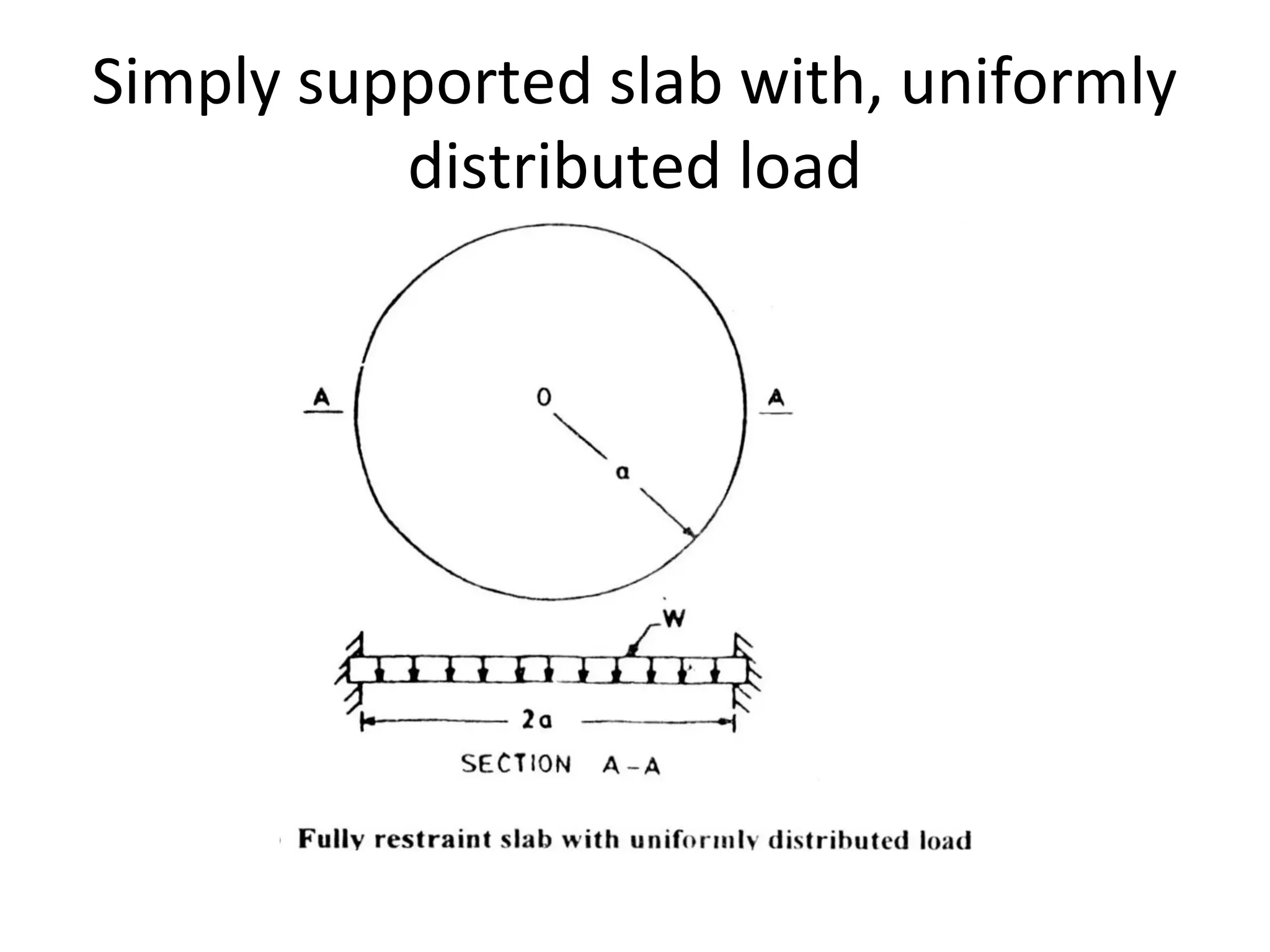
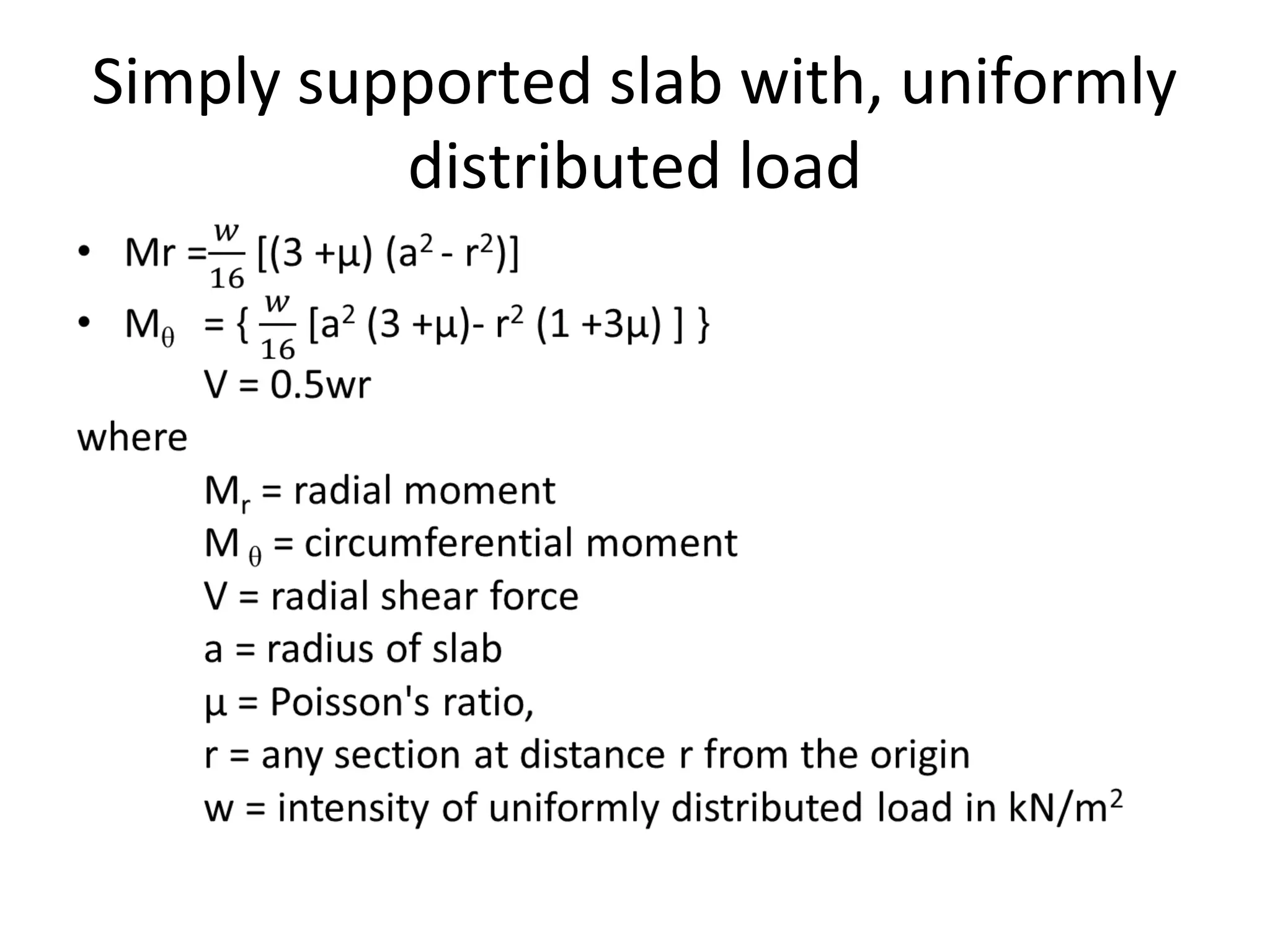
Simply supported slab with, uniformly
distributed load
Simply supported slab with, uniformly
distributed load
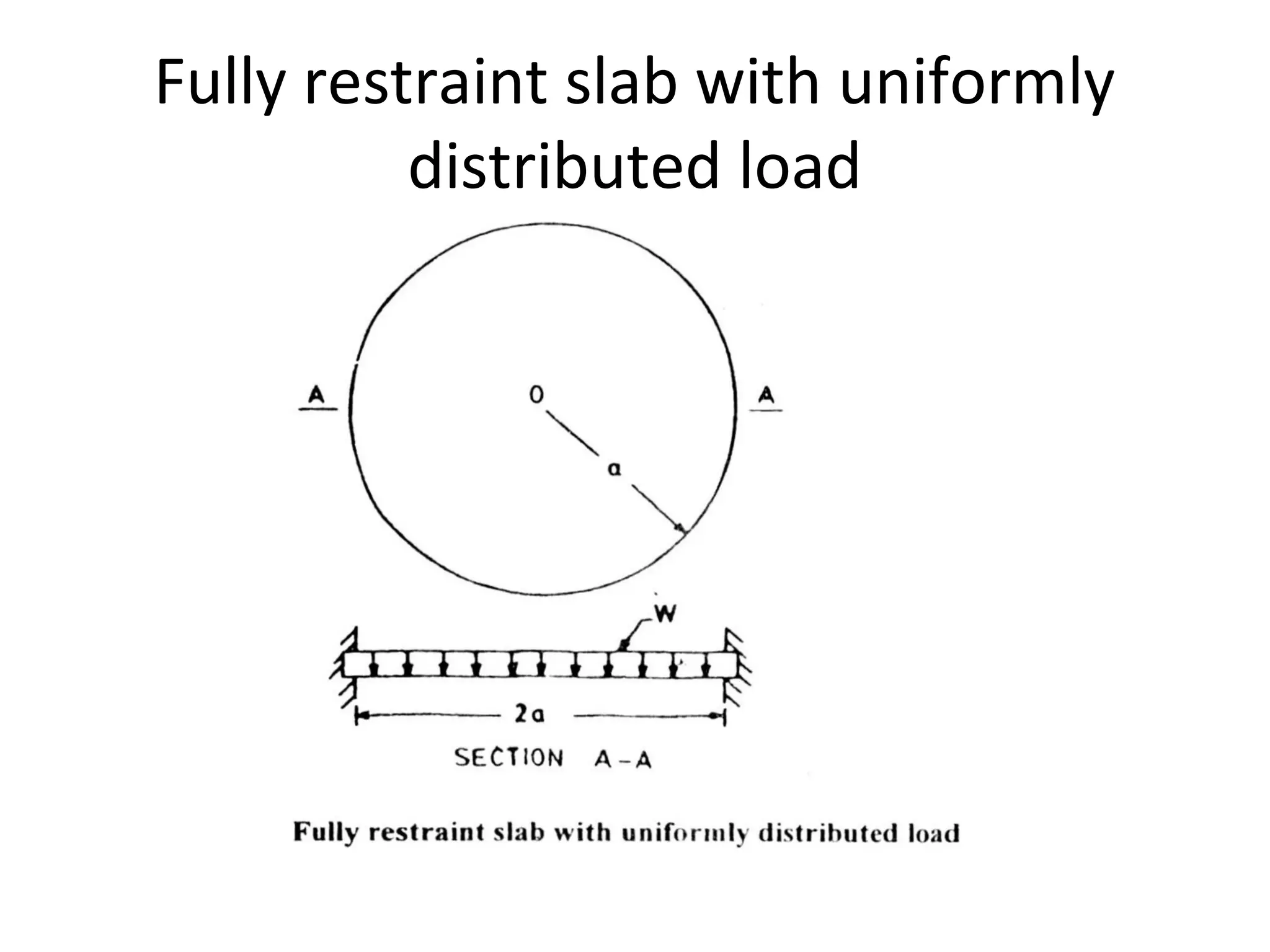
Fully restraint slab with uniformly
distributed load
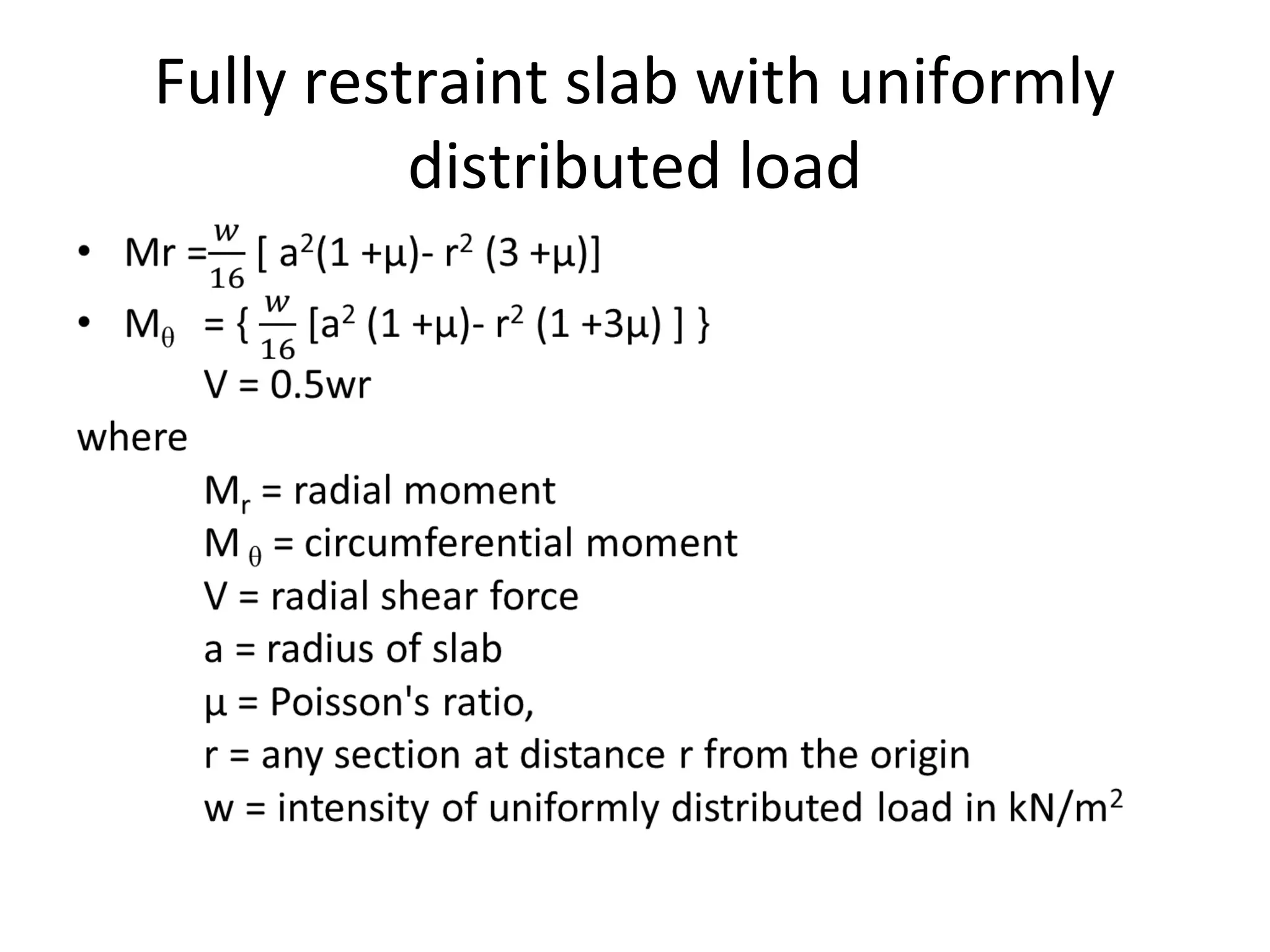
Fully restraint slab with uniformly
distributed load
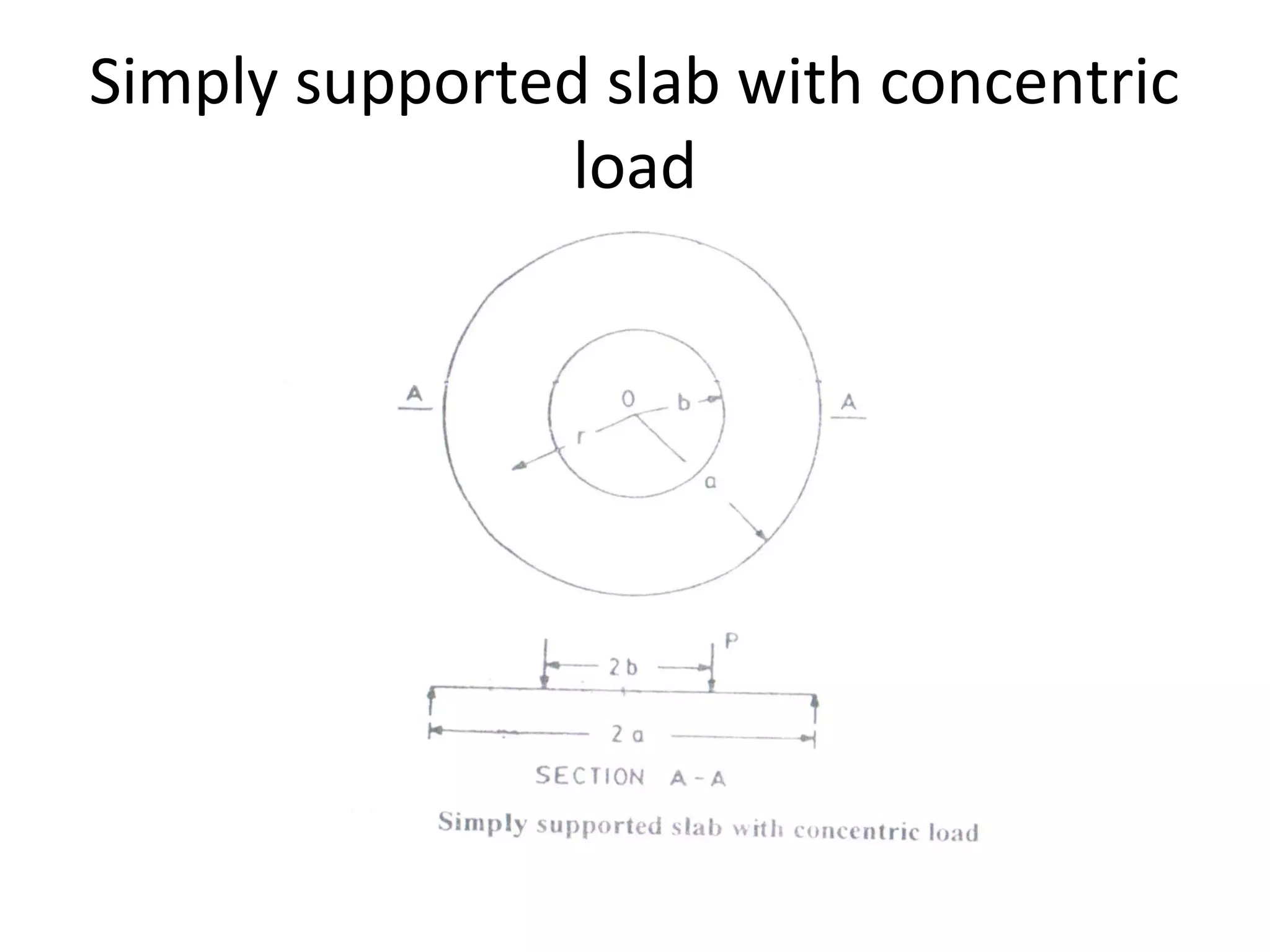
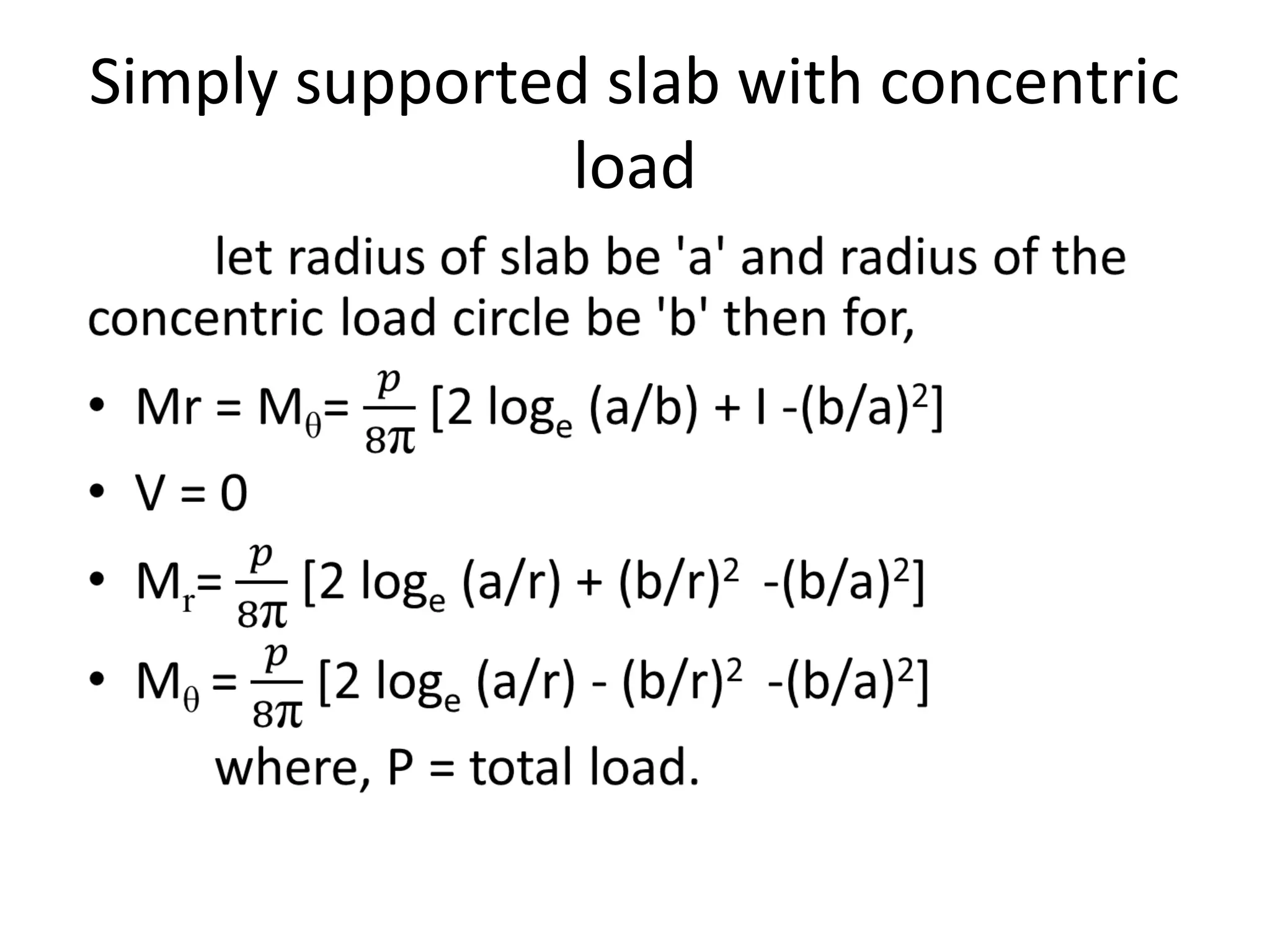
Simply supported slab with concentric
load
Simply supported slab with concentric
load
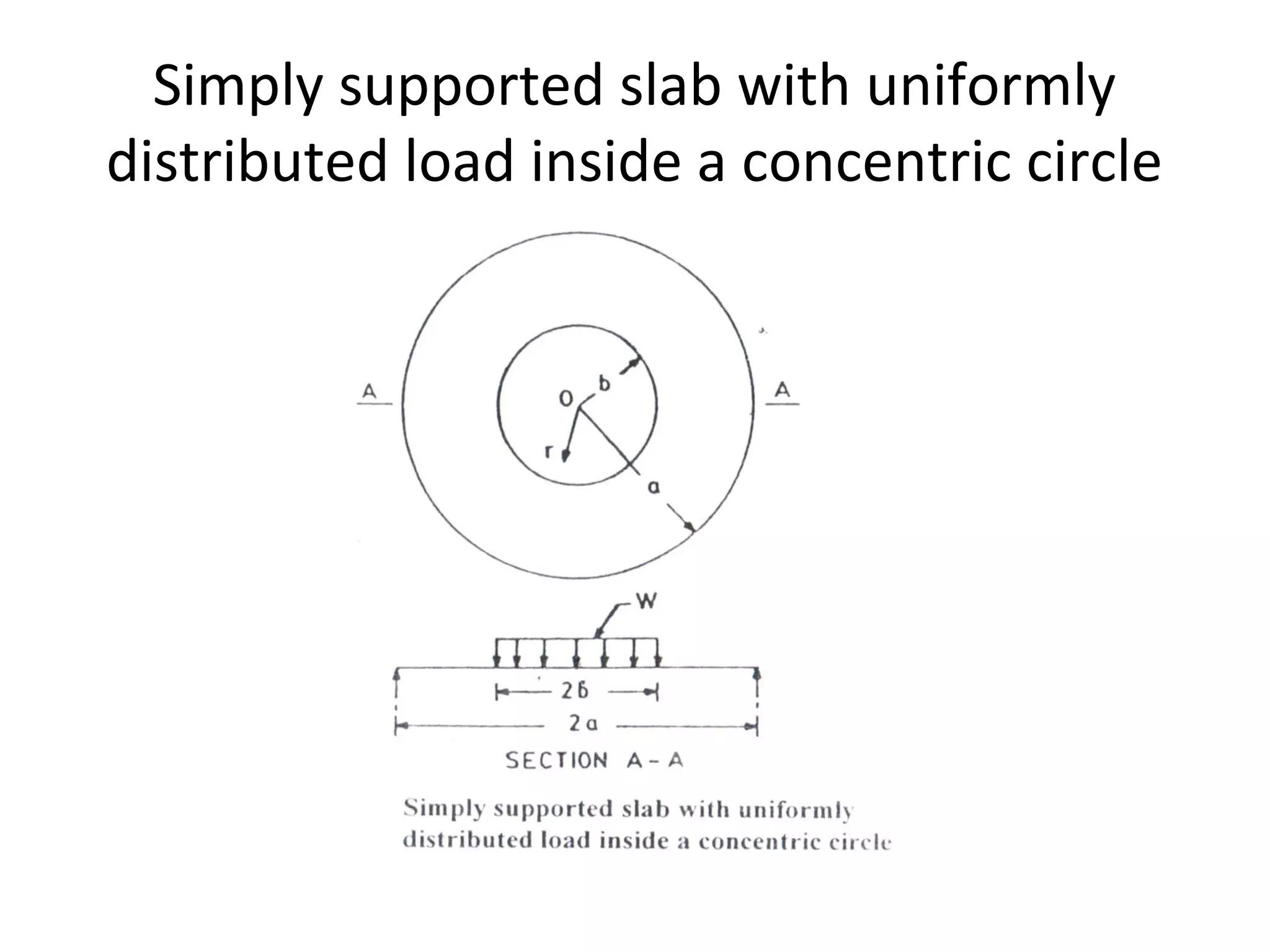
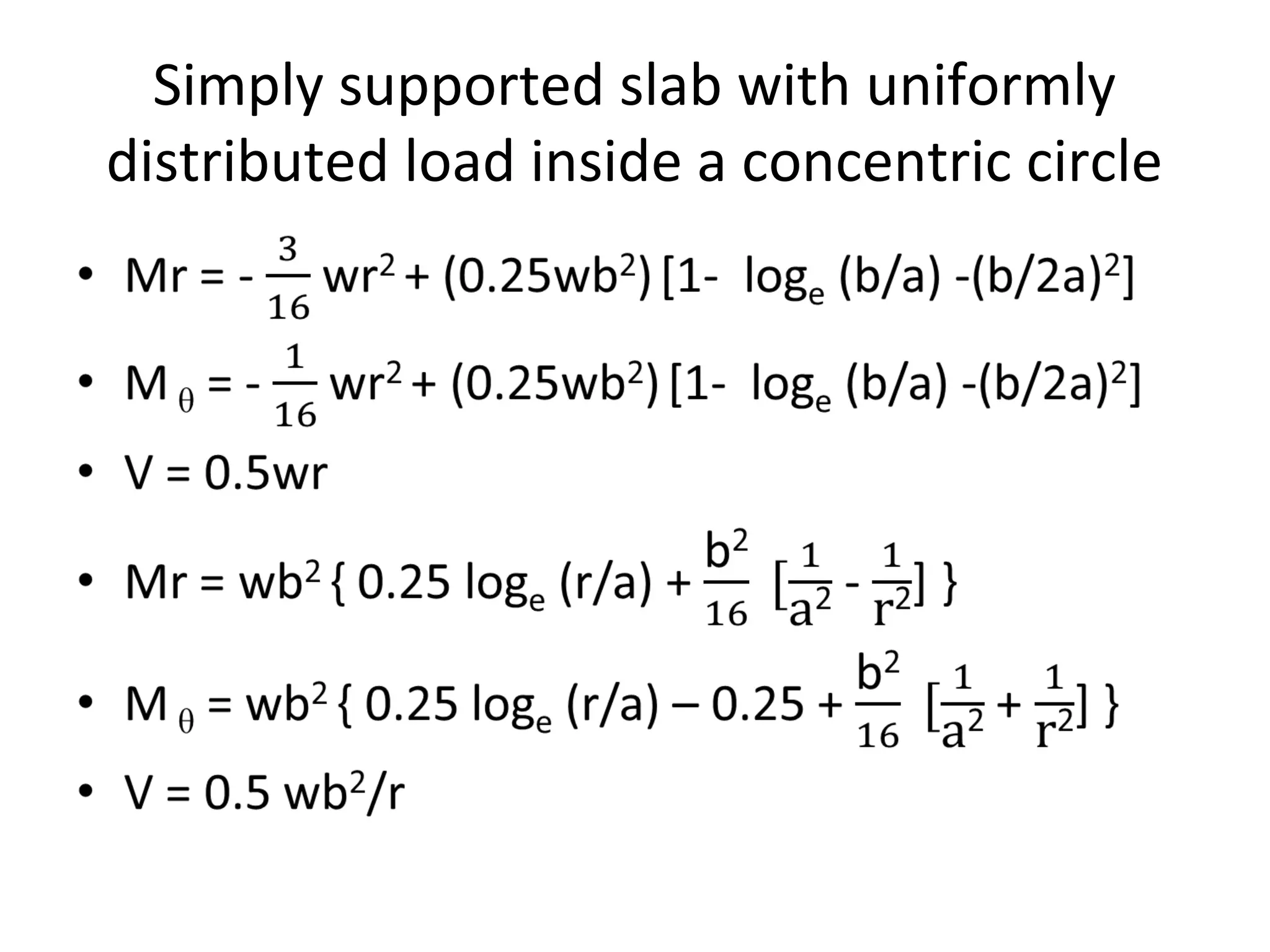
Simply supported slab with uniformly
distributed load inside a concentric circle
Simply supported slab with uniformly
distributed load inside a concentric circle
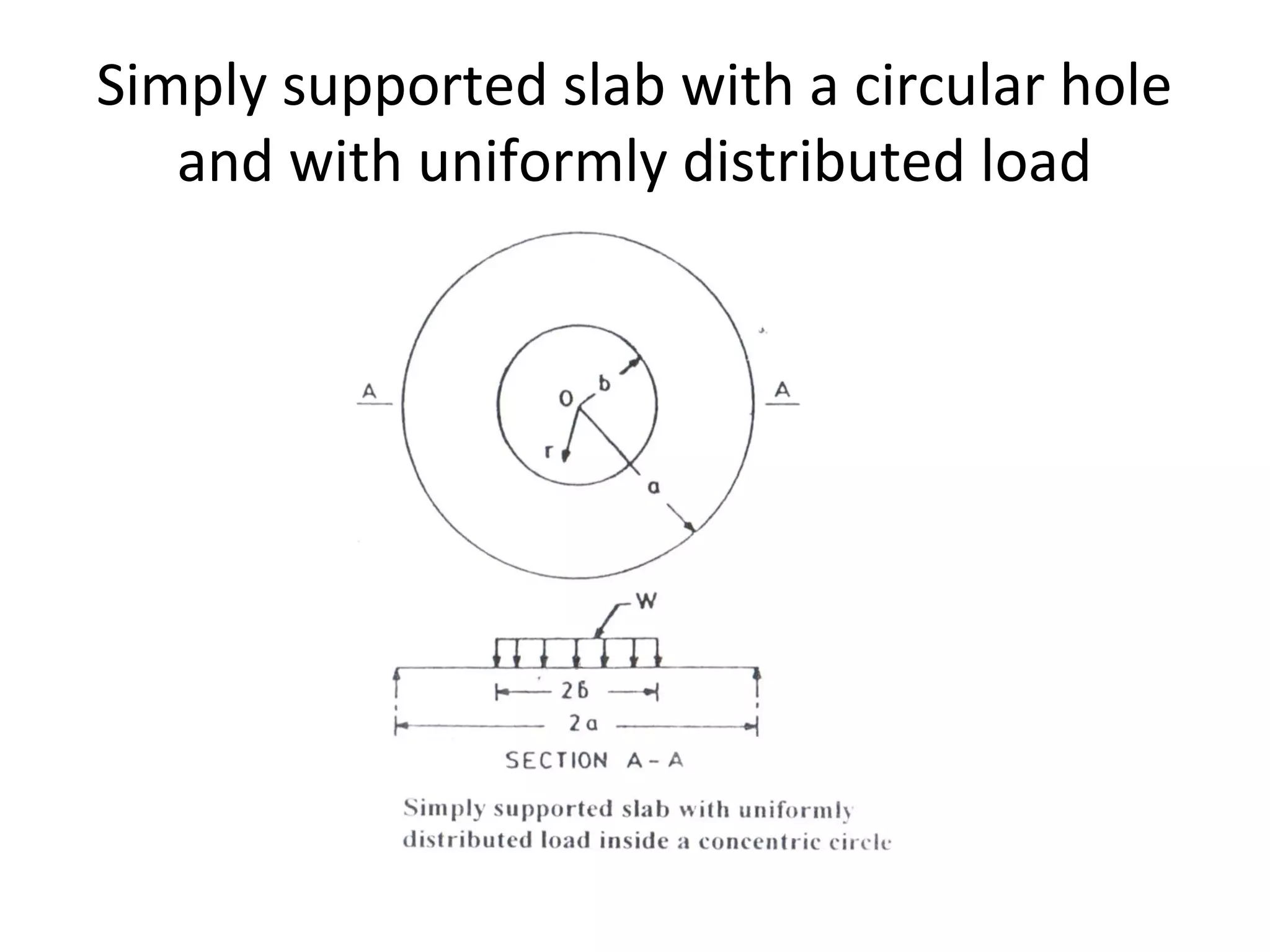
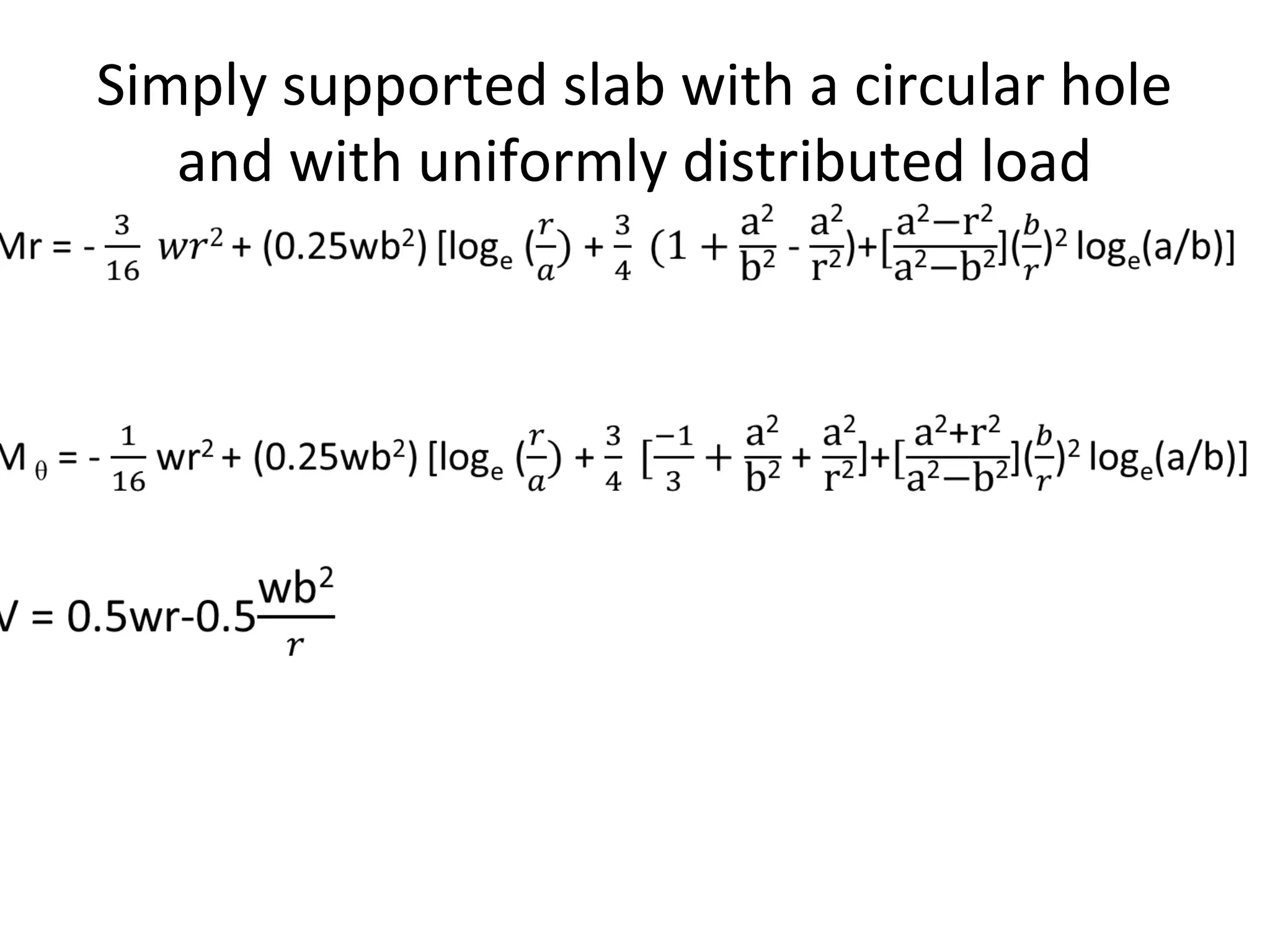
Simply supported slab with a circular hole
and with uniformly distributed load
Simply supported slab with a circular hole
and with uniformly distributed load
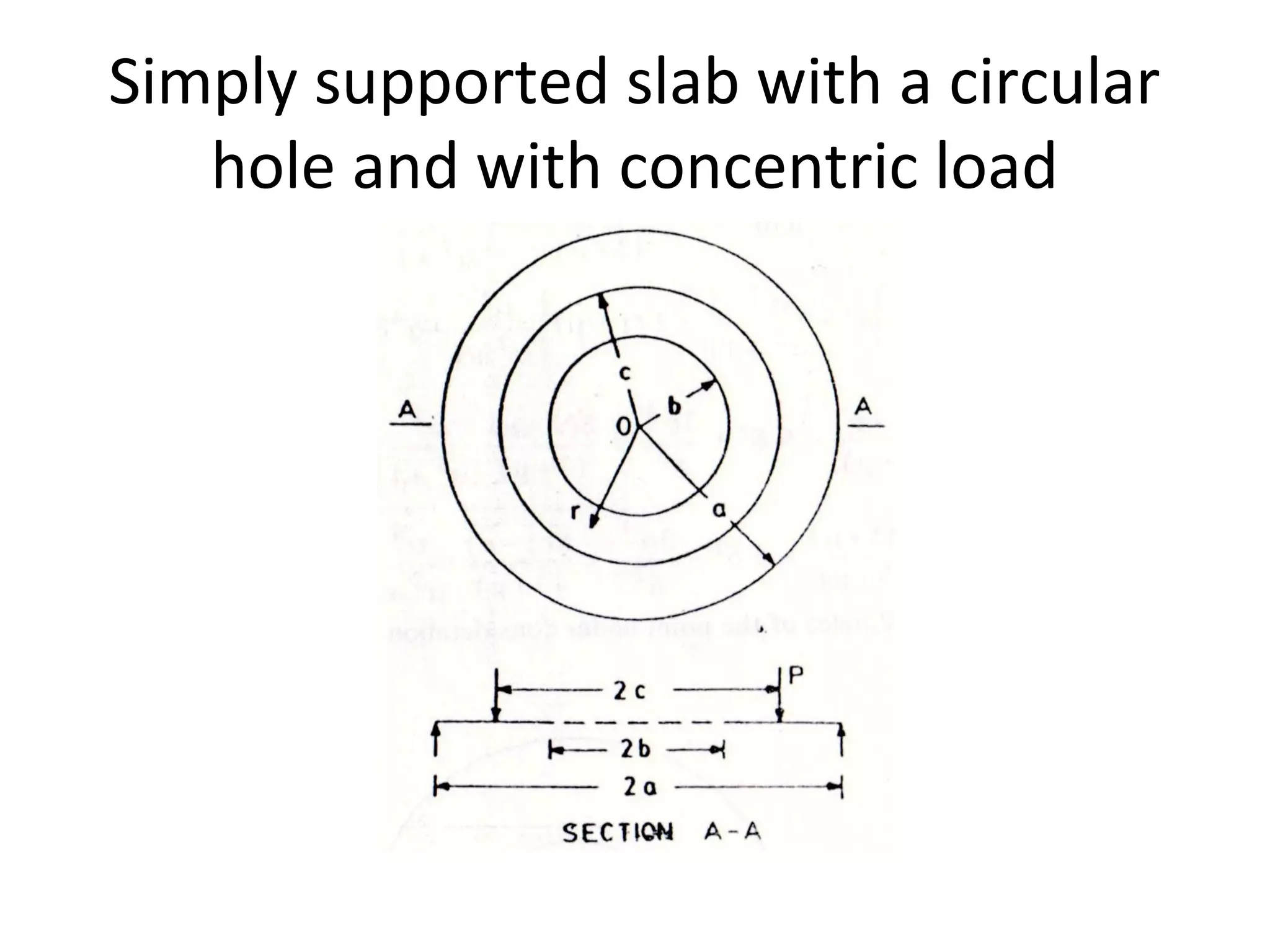
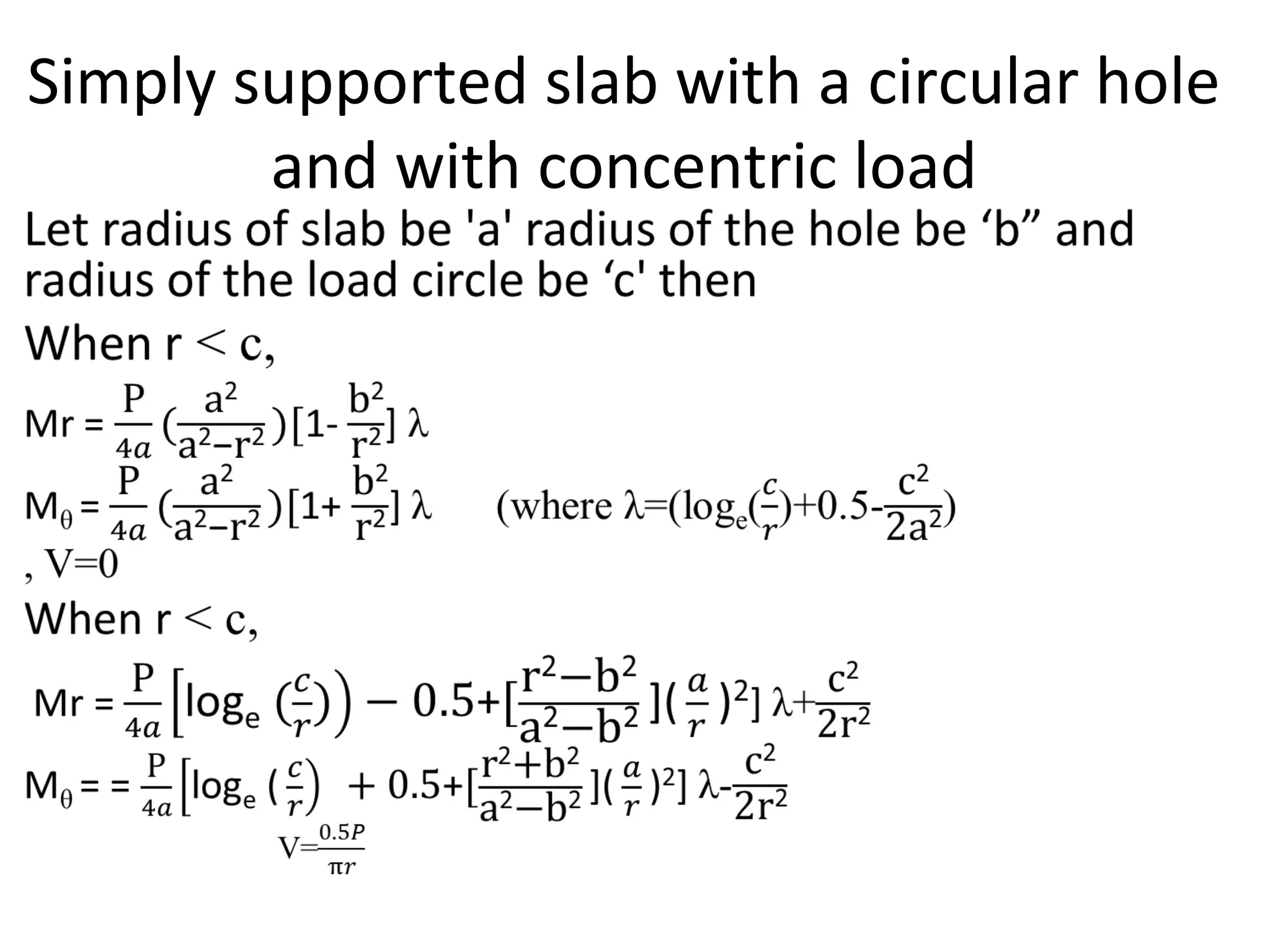
Simply supported slab with a circular
hole and with concentric load
Simply supported slab with a circular hole
and with concentric load
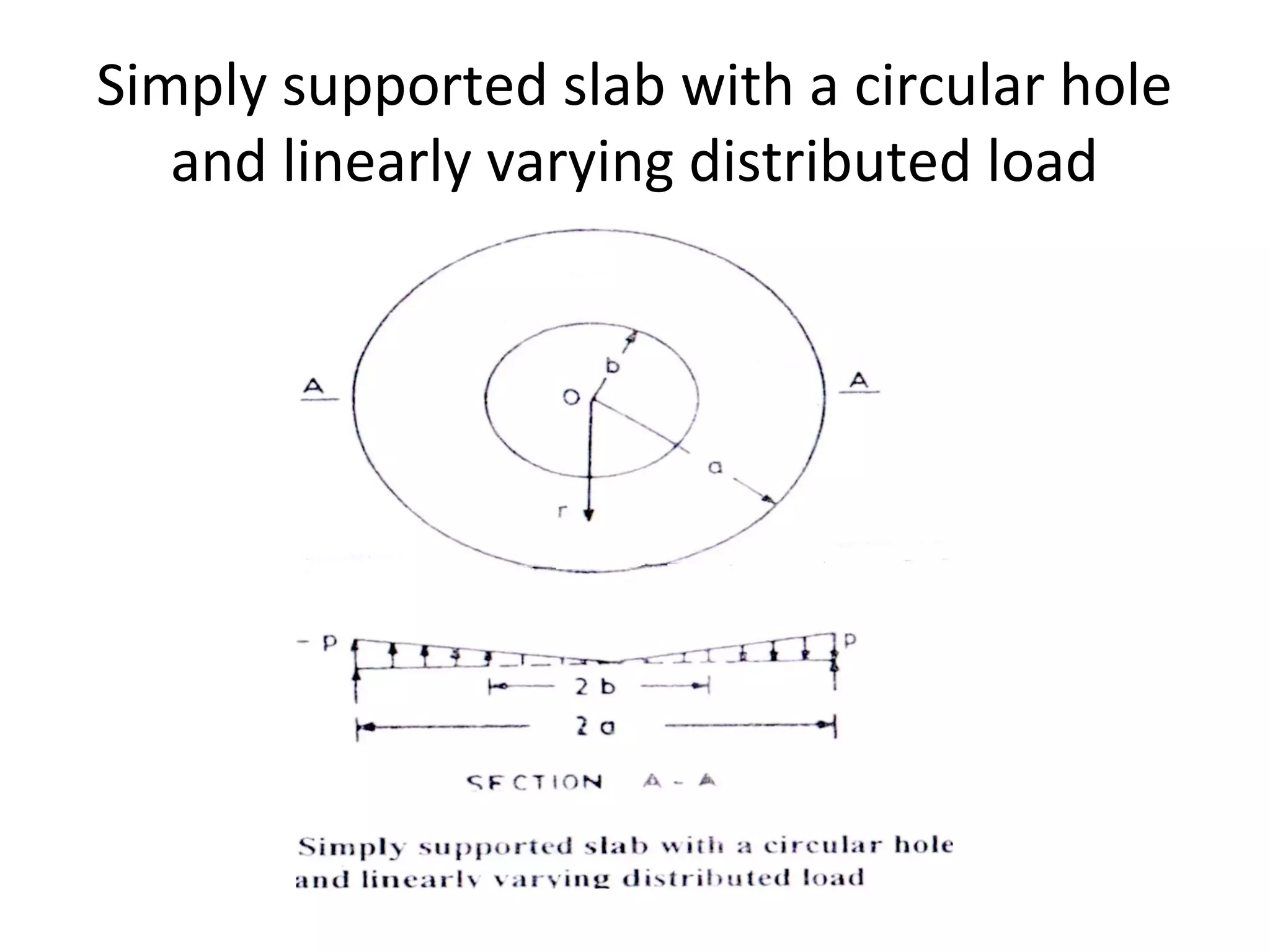
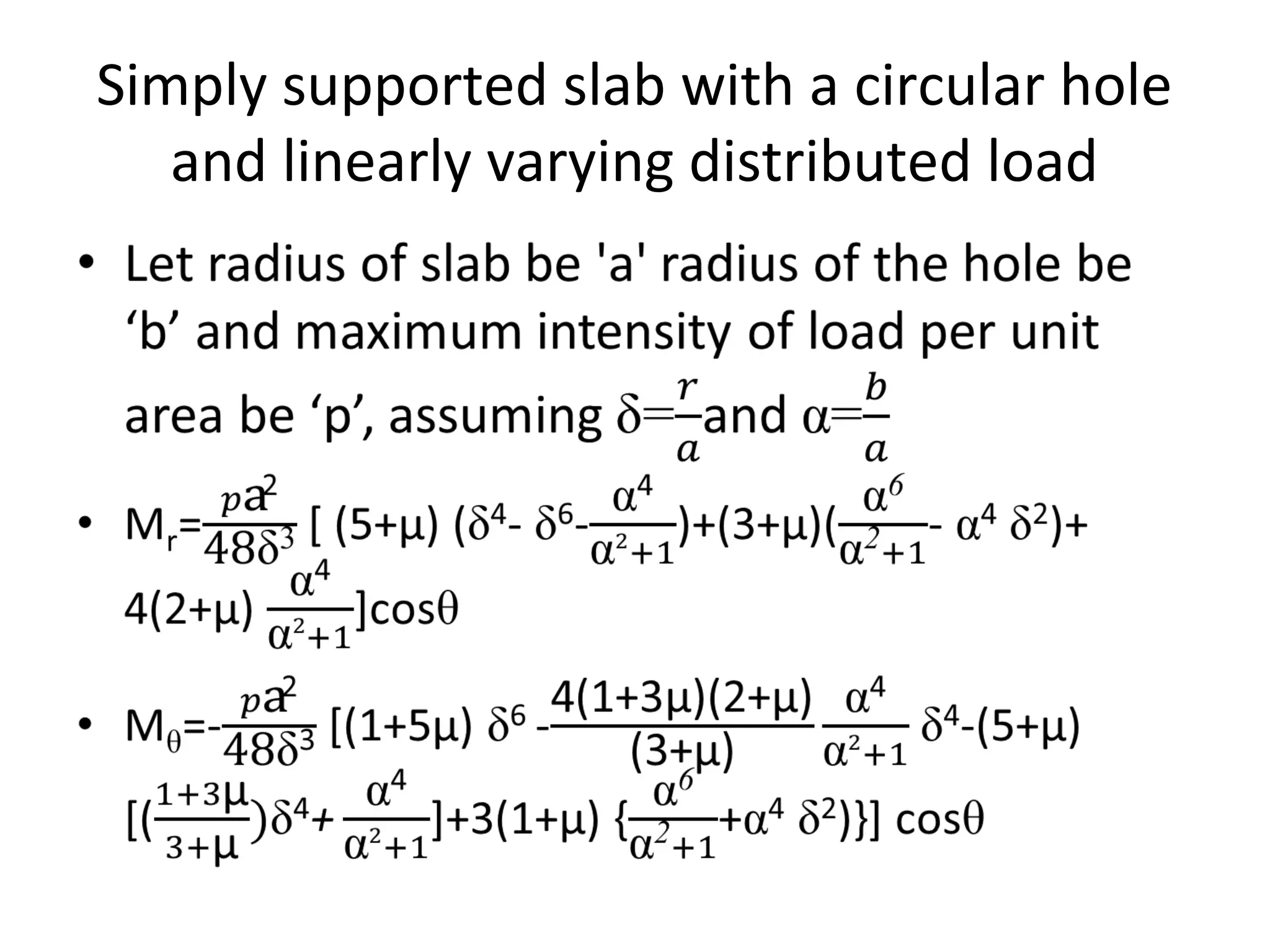
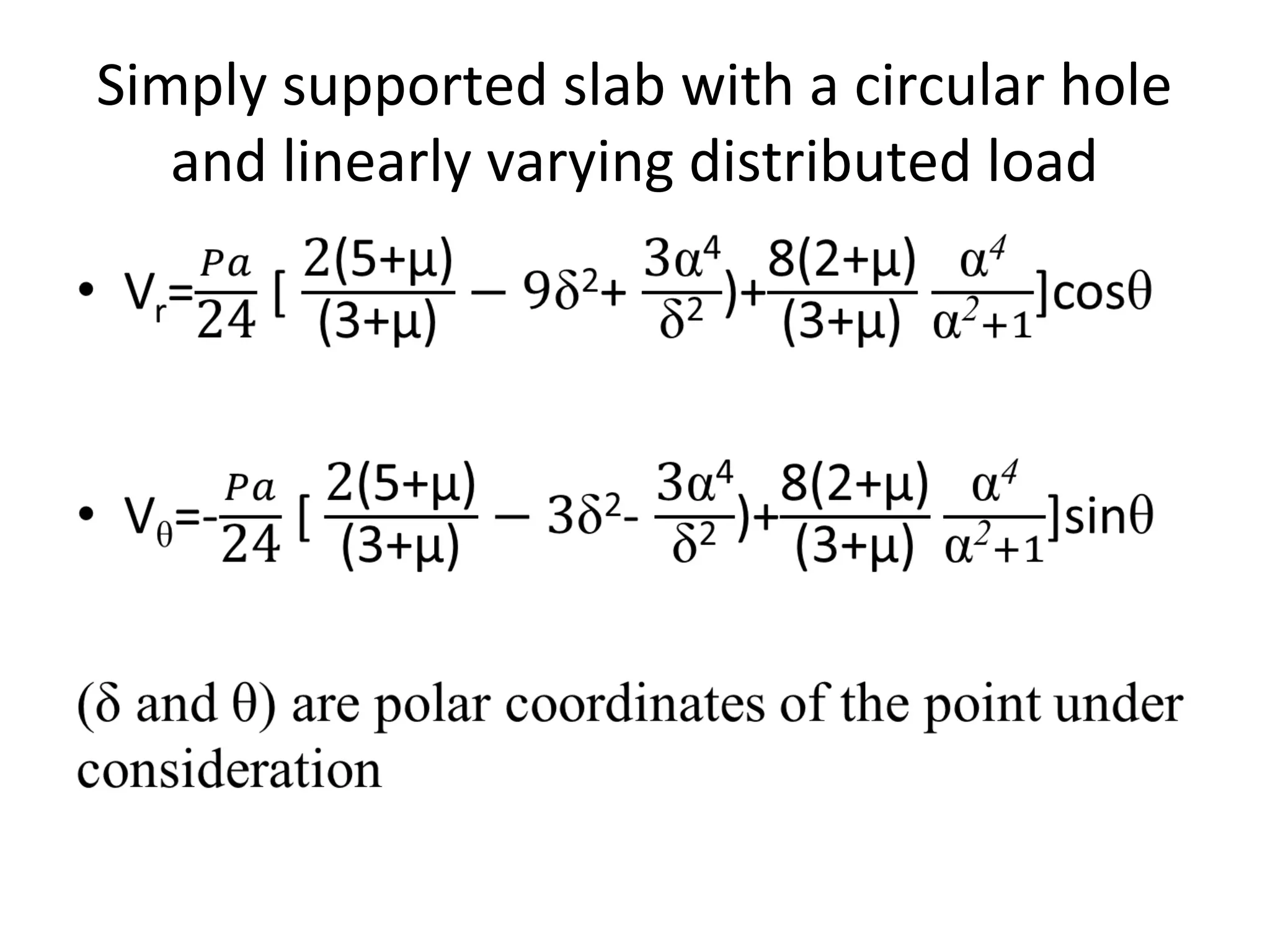
Simply supported slab with a circular hole
and linearly varying distributed load
Simply supported slab with a circular hole
and linearly varying distributed load
Simply supported slab with a circular hole
and linearly varying distributed load

Circular slabs

  • 1.
  • 2.
    Introduction • Uses ofCircular Slabs: 1.Roof of a room or hall circular in plan 2.Floor of circular water tanks or towers 3.Roof of pump houses constructed above tube wells 4.Roof of a traffic control post at the intersection of roads
  • 3.
    • In circularslab, Bending takes place in distinctly two perpendicular directions along the two spans. • Reinforcement is provided in the form of a mesh of bars having equal area of cross section in both the directions, the area being equal to that required for the bigger of the radial and circumferential moments. • However, if the stresses near the edge are not negligible, or if the edge is fixed, radial and circumferential reinforcement near the edge becomes essential.
  • 4.
    Circular slab • Circularslabs are more commonly used in the design of circular water tank containers with flat bottom and raft foundations. • The analysis of stresses in these slabs is generally based on elastic theory. Under uniformly distributed loads, these slabs deflect in the form of a saucer and develop radial and circumferential stresses. Tensile stresses develop on the convex surface and compressive stresses develop on the concave surface. • Tensile stresses must be provided in the radial and circumferential directions near the convex surface. • Alternatively, reinforcing bars can be provided in two mutually perpendicular directions instead of in the radial and circumferential directions. • Normally, near the Centre of the slab, reinforcement is provided in the form of mutually right angle mesh; and near the edge of the slab, in the form of radial and circumferential bars.
  • 5.
    Simply supported slabwith, uniformly distributed load
  • 6.
    Simply supported slabwith, uniformly distributed load
  • 7.
    Fully restraint slabwith uniformly distributed load
  • 8.
    Fully restraint slabwith uniformly distributed load
  • 9.
    Simply supported slabwith concentric load
  • 10.
    Simply supported slabwith concentric load
  • 11.
    Simply supported slabwith uniformly distributed load inside a concentric circle
  • 12.
    Simply supported slabwith uniformly distributed load inside a concentric circle
  • 13.
    Simply supported slabwith a circular hole and with uniformly distributed load
  • 14.
    Simply supported slabwith a circular hole and with uniformly distributed load
  • 15.
    Simply supported slabwith a circular hole and with concentric load
  • 16.
    Simply supported slabwith a circular hole and with concentric load
  • 17.
    Simply supported slabwith a circular hole and linearly varying distributed load
  • 18.
    Simply supported slabwith a circular hole and linearly varying distributed load
  • 19.
    Simply supported slabwith a circular hole and linearly varying distributed load