CMMI OverviewCMMI Overview
Why & What is Process
CMMI Model Overview
Process Areas, Goals, Practices
Benefits
Table of Contents
Process :
 Sequence of steps performed for a given purpose
 A set of inter related activities, which transform inputs into
outputs, to achieve a given purpose
Process Area :
 A cluster of related practices in an area that, when implemented
collectively, satisfies a set of goals considered important for
making improvement in that area
Process and Process Area
Sequence of steps performed for a given purpose
A set of inter related activities, which transform inputs into
outputs, to achieve a given purpose
Process definition & Benefits
Benefits of Improving the Processes
Processes enables you to understand what is going on
By defining, measuring and controlling the processes,
improvements are more successful and sustained
People develop their potential fully and effectively
While process is often described as a node of the process-people-technology triad, it
can also be considered the “glue” that ties the triad together.
PEOPLE
PROCESS
TECHNOLOGY
Process, people, and technology are the major determinants of product
cost, schedule, and quality.
Quality Leverage Points
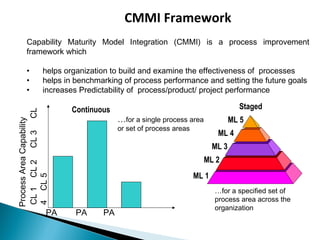
Staged
ML 1
ML 2
ML 3
ML 4
ML 5
…for a specified set of
process area across the
organization
…for a single process area
or set of process areas
Continuous
ProcessAreaCapability
PA PA PA
CL1CL2CL3CL
4CL5Capability Maturity Model Integration (CMMI) is a process improvement
framework which
• helps organization to build and examine the effectiveness of processes
• helps in benchmarking of process performance and setting the future goals
• increases Predictability of process/product/ project performance
CMMI Framework
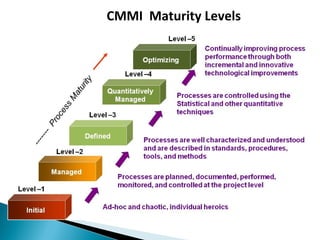
CMMI Maturity Levels
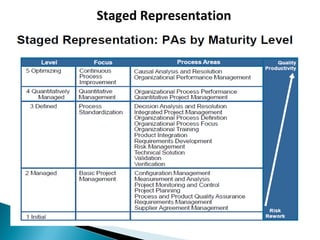
Staged Representation
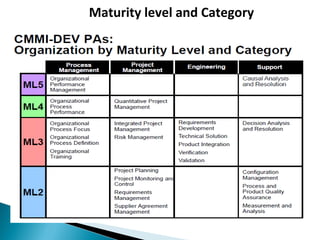
Maturity level and Category
Goals and Practices
e.g.
Specific Goals And Practices
Purpose
Manage the requirements of the project's products and product
components and to identify inconsistencies between those requirements
and the project's plans and work products
Requirements Management
Understanding
Requirements
Commitment to
Requirements
Maintain
Bi -Directional Traceability
Ensure alignment between Project
work & Requirements
Manage Requirement Change
Review to ensure
requirements are
understood and accepted
Purpose
Establish and maintain plans that define project activities
Project Planning
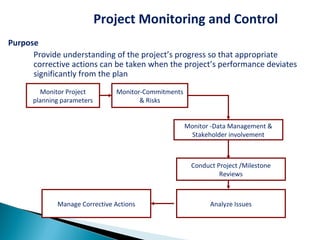
Purpose
Provide understanding of the project’s progress so that appropriate
corrective actions can be taken when the project’s performance deviates
significantly from the plan
Project Monitoring and Control
Monitor Project
planning parameters
Monitor-Commitments
& Risks
Conduct Project /Milestone
Reviews
Analyze Issues
Monitor -Data Management &
Stakeholder involvement
Manage Corrective Actions
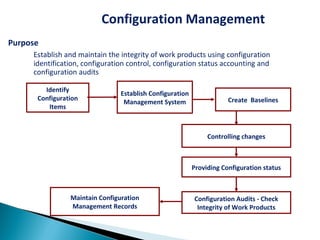
Purpose
Establish and maintain the integrity of work products using configuration
identification, configuration control, configuration status accounting and
configuration audits
Configuration Management
Identify
Configuration
Items
Establish Configuration
Management System
Configuration Audits - Check
Integrity of Work Products
Providing Configuration status
Create Baselines
Controlling changes
Maintain Configuration
Management Records
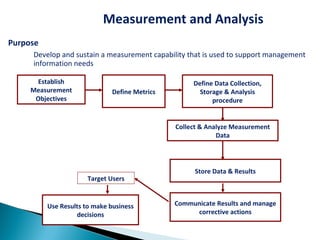
Purpose
Develop and sustain a measurement capability that is used to support management
information needs
Measurement and Analysis
Establish
Measurement
Objectives
Define Metrics
Store Data & Results
Communicate Results and manage
corrective actions
Collect & Analyze Measurement
Data
Target Users
Use Results to make business
decisions
Define Data Collection,
Storage & Analysis
procedure
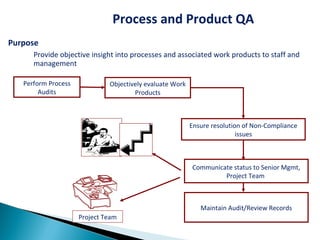
Purpose
Provide objective insight into processes and associated work products to staff and
management
Process and Product QA
Perform Process
Audits
Objectively evaluate Work
Products
Communicate status to Senior Mgmt,
Project Team
Maintain Audit/Review Records
Ensure resolution of Non-Compliance
issues
Project Team
Purpose
Manage the acquisition of products from suppliers for which there exists a formal
agreement
Supplier Agreement Management
Determine type of
acquisition for
product / product
component
Review & Monitor Performance
Accept & Transition Supplier Product
Establish & Maintain
Supplier Agreement
Select
Supplier
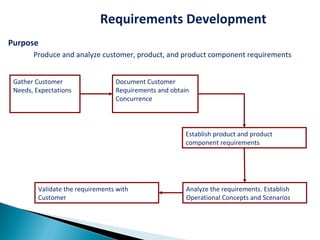
Purpose
Produce and analyze customer, product, and product component requirements
Requirements Development
Gather Customer
Needs, Expectations
Document Customer
Requirements and obtain
Concurrence
Analyze the requirements. Establish
Operational Concepts and Scenarios
Establish product and product
component requirements
Validate the requirements with
Customer
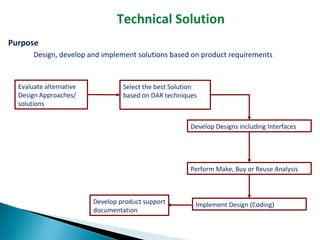
Purpose
Design, develop and implement solutions based on product requirements
Technical Solution
Evaluate alternative
Design Approaches/
solutions
Select the best Solution
based on DAR techniques
Perform Make, Buy or Reuse Analysis
Develop Designs including Interfaces
Develop product support
documentation
Implement Design (Coding)
Purpose
Assemble the product from the product components, ensure that the product, as
integrated, functions properly (i.e., possesses the required functionality and quality
attributes ) and deliver the product
Product Integration
Develop integration
strategy and plan
Establish integration
environment
Integrate/build product components
Package and deliver the product
Review compatibility of interfaces
Evaluate (integration testing)
integrated components/modules
Purpose
Ensure that selected work products meet their specified requirements
Verification
Develop Verification
strategy /Plan
Prepare for/Conduct
Peer Reviews and
Testing
Close the Review/Testing
defects
Analyze Review / Test
results
Identification of
corrective action
Re-Review/Testing if
necessary
Establish
Verification
Environment
Purpose
Demonstrate that a product or product component fulfills its intended use
when placed in its intended environment
Validation
Develop Validation
strategy /Plan
Conduct Validation /
Testing
Close the Testing defects
Identification of
corrective action
Re-Testing if
necessary
Establish Validation
Environment
Analyze Test results
Purpose
Establish and manage the project and the involvement of the relevant stakeholders
according to an integrated and defined process that is tailored from the
organization's set of standard processes
Integrated Project Management
Establishing project’s
defined process by
tailoring the Org.
Defined Process
Establish Project
Work environment,
Integrate Plans and
Manage the Project
Enabling relevant stakeholder’s unique
expertise to be used and manage
dependencies
Resolve Coordination Issues
Contribute Project’s Learning to
Organization’s Process Assets
Purpose
Identify potential problems before they occur, so that risk handling activities may be
planned and invoked as needed across the life of the product or project to mitigate
adverse impacts on achieving objectives
Risk Management
Determine risk
sources and
categories
Establish Risk
Management Strategy
Identify risks, and
analyze each risk
Monitor risks and
implementation of
mitigation plans
Early identification and mitigation of
risks - increases the probability of
success of projects and Organization
Develops mitigation plans
for the selected /critical risks
Evaluate, Quantify,
Categorize and Prioritize
Risks
Purpose
Establish and maintain a usable set of organizational process assets
Plan and implement organizational process improvement based on a through
understanding of the current strengths and weaknesses of the organization’s
processes and process assets
Organizational Process Focus and Definition
Establish/Appraise
Organizational
Process Needs
Define Organizational
Standard Processes
(QMS)
Define Guidelines for
Tailoring Standard Processes
Identify and implement
process improvements to
Standard Processes
Implement Organizational
Process Assets /Metrics Library
Feedback, Lessons
Learnt, Best Practices,
Assets
Purpose
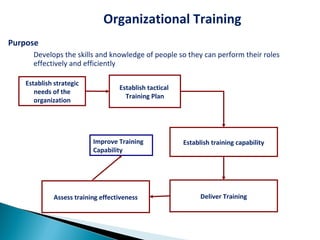
Develops the skills and knowledge of people so they can perform their roles
effectively and efficiently
Organizational Training
Establish strategic
needs of the
organization
Deliver Training
Establish training capability
Assess training effectiveness
Establish tactical
Training Plan
Improve Training
Capability
Purpose
Analyze possible decisions using
formal evaluation process that
evaluates identified alternatives
against established criteria
Decision Analysis & Resolution
Define Guidelines for Decision Analysis
Establish the Evaluation Criteria
Select Evaluation Methods/Techniques
Evaluate alternatives
and select suitable
solution
Record
Identify Alternative Solutions
Business Benefits
A Common Integrated Vision of Improvement
Decreased Defect Levels
Increased Productivity
Improved Efficiency Level
Reduced Cycle time
Increased Level of Employee Motivation
Improved schedule and budget predictability
Increased customer satisfaction
Increased return on investment
Decreased cost of quality

Cmmi process overview

  • 1.
  • 2.
    Why & Whatis Process CMMI Model Overview Process Areas, Goals, Practices Benefits Table of Contents
  • 4.
    Process :  Sequenceof steps performed for a given purpose  A set of inter related activities, which transform inputs into outputs, to achieve a given purpose Process Area :  A cluster of related practices in an area that, when implemented collectively, satisfies a set of goals considered important for making improvement in that area Process and Process Area
  • 5.
    Sequence of stepsperformed for a given purpose A set of inter related activities, which transform inputs into outputs, to achieve a given purpose Process definition & Benefits Benefits of Improving the Processes Processes enables you to understand what is going on By defining, measuring and controlling the processes, improvements are more successful and sustained People develop their potential fully and effectively
  • 7.
    While process isoften described as a node of the process-people-technology triad, it can also be considered the “glue” that ties the triad together. PEOPLE PROCESS TECHNOLOGY Process, people, and technology are the major determinants of product cost, schedule, and quality. Quality Leverage Points
  • 8.
    Staged ML 1 ML 2 ML3 ML 4 ML 5 …for a specified set of process area across the organization …for a single process area or set of process areas Continuous ProcessAreaCapability PA PA PA CL1CL2CL3CL 4CL5Capability Maturity Model Integration (CMMI) is a process improvement framework which • helps organization to build and examine the effectiveness of processes • helps in benchmarking of process performance and setting the future goals • increases Predictability of process/product/ project performance CMMI Framework
  • 9.
  • 10.
  • 11.
  • 12.
  • 13.
    Purpose Manage the requirementsof the project's products and product components and to identify inconsistencies between those requirements and the project's plans and work products Requirements Management Understanding Requirements Commitment to Requirements Maintain Bi -Directional Traceability Ensure alignment between Project work & Requirements Manage Requirement Change Review to ensure requirements are understood and accepted
  • 14.
    Purpose Establish and maintainplans that define project activities Project Planning
  • 15.
    Purpose Provide understanding ofthe project’s progress so that appropriate corrective actions can be taken when the project’s performance deviates significantly from the plan Project Monitoring and Control Monitor Project planning parameters Monitor-Commitments & Risks Conduct Project /Milestone Reviews Analyze Issues Monitor -Data Management & Stakeholder involvement Manage Corrective Actions
  • 16.
    Purpose Establish and maintainthe integrity of work products using configuration identification, configuration control, configuration status accounting and configuration audits Configuration Management Identify Configuration Items Establish Configuration Management System Configuration Audits - Check Integrity of Work Products Providing Configuration status Create Baselines Controlling changes Maintain Configuration Management Records
  • 17.
    Purpose Develop and sustaina measurement capability that is used to support management information needs Measurement and Analysis Establish Measurement Objectives Define Metrics Store Data & Results Communicate Results and manage corrective actions Collect & Analyze Measurement Data Target Users Use Results to make business decisions Define Data Collection, Storage & Analysis procedure
  • 18.
    Purpose Provide objective insightinto processes and associated work products to staff and management Process and Product QA Perform Process Audits Objectively evaluate Work Products Communicate status to Senior Mgmt, Project Team Maintain Audit/Review Records Ensure resolution of Non-Compliance issues Project Team
  • 19.
    Purpose Manage the acquisitionof products from suppliers for which there exists a formal agreement Supplier Agreement Management Determine type of acquisition for product / product component Review & Monitor Performance Accept & Transition Supplier Product Establish & Maintain Supplier Agreement Select Supplier
  • 20.
    Purpose Produce and analyzecustomer, product, and product component requirements Requirements Development Gather Customer Needs, Expectations Document Customer Requirements and obtain Concurrence Analyze the requirements. Establish Operational Concepts and Scenarios Establish product and product component requirements Validate the requirements with Customer
  • 21.
    Purpose Design, develop andimplement solutions based on product requirements Technical Solution Evaluate alternative Design Approaches/ solutions Select the best Solution based on DAR techniques Perform Make, Buy or Reuse Analysis Develop Designs including Interfaces Develop product support documentation Implement Design (Coding)
  • 22.
    Purpose Assemble the productfrom the product components, ensure that the product, as integrated, functions properly (i.e., possesses the required functionality and quality attributes ) and deliver the product Product Integration Develop integration strategy and plan Establish integration environment Integrate/build product components Package and deliver the product Review compatibility of interfaces Evaluate (integration testing) integrated components/modules
  • 23.
    Purpose Ensure that selectedwork products meet their specified requirements Verification Develop Verification strategy /Plan Prepare for/Conduct Peer Reviews and Testing Close the Review/Testing defects Analyze Review / Test results Identification of corrective action Re-Review/Testing if necessary Establish Verification Environment
  • 24.
    Purpose Demonstrate that aproduct or product component fulfills its intended use when placed in its intended environment Validation Develop Validation strategy /Plan Conduct Validation / Testing Close the Testing defects Identification of corrective action Re-Testing if necessary Establish Validation Environment Analyze Test results
  • 25.
    Purpose Establish and managethe project and the involvement of the relevant stakeholders according to an integrated and defined process that is tailored from the organization's set of standard processes Integrated Project Management Establishing project’s defined process by tailoring the Org. Defined Process Establish Project Work environment, Integrate Plans and Manage the Project Enabling relevant stakeholder’s unique expertise to be used and manage dependencies Resolve Coordination Issues Contribute Project’s Learning to Organization’s Process Assets
  • 26.
    Purpose Identify potential problemsbefore they occur, so that risk handling activities may be planned and invoked as needed across the life of the product or project to mitigate adverse impacts on achieving objectives Risk Management Determine risk sources and categories Establish Risk Management Strategy Identify risks, and analyze each risk Monitor risks and implementation of mitigation plans Early identification and mitigation of risks - increases the probability of success of projects and Organization Develops mitigation plans for the selected /critical risks Evaluate, Quantify, Categorize and Prioritize Risks
  • 27.
    Purpose Establish and maintaina usable set of organizational process assets Plan and implement organizational process improvement based on a through understanding of the current strengths and weaknesses of the organization’s processes and process assets Organizational Process Focus and Definition Establish/Appraise Organizational Process Needs Define Organizational Standard Processes (QMS) Define Guidelines for Tailoring Standard Processes Identify and implement process improvements to Standard Processes Implement Organizational Process Assets /Metrics Library Feedback, Lessons Learnt, Best Practices, Assets
  • 28.
    Purpose Develops the skillsand knowledge of people so they can perform their roles effectively and efficiently Organizational Training Establish strategic needs of the organization Deliver Training Establish training capability Assess training effectiveness Establish tactical Training Plan Improve Training Capability
  • 29.
    Purpose Analyze possible decisionsusing formal evaluation process that evaluates identified alternatives against established criteria Decision Analysis & Resolution Define Guidelines for Decision Analysis Establish the Evaluation Criteria Select Evaluation Methods/Techniques Evaluate alternatives and select suitable solution Record Identify Alternative Solutions
  • 30.
    Business Benefits A CommonIntegrated Vision of Improvement Decreased Defect Levels Increased Productivity Improved Efficiency Level Reduced Cycle time Increased Level of Employee Motivation Improved schedule and budget predictability Increased customer satisfaction Increased return on investment Decreased cost of quality

Editor's Notes

  • #9 It can be used for Systems Engineering, Integrated Product Development (i.e., large, complex projects), and Supplier Sourcing.  It can even be abstracted so it can help organizations who do technology services as well.  There are currently three "flavors" of CMMI called constellations.  The most famous one is the CMMI for Development -- i.e., "DEV".  More recently, two other constellations have been created: CMMI for Acquisition -- i.e., "ACQ", and CMMI for Services -- i.e., "SVC". 
  • #13 Common features of GPs – Commitment to Perform, Ability to Perform, Directing Implementation, Verifying Implementation
  • #20 Types of Acquisition include purchasing COTS/Modified COTS, in house supplier, customer, preferred supplier
  • #30 Guidelines on when to apply formal techniques – Design implementation decisions, Procurement etc.