By- Dr. Priya Jaswani
 Slide discussion of Leukemoid reaction and
Chronic Myeloid Leukemia .
A 39 yr male patient came with c/o
abdominal pain-2 week in duration
vague dragging pain
associated with fullness of abdomen
no aggravating or
relieving factors
 h/o fatigue, fever ,increased sweating,early
satiety + ,
 h/o loss of appetite +
 No h/o loss of weight, no h/o bleeding tendency
 PAST h/o -> No h/o Tb/HTN/DM
 PERSONAL h/o -> consumes alcohol occasionally
 P/A –mild distention of abdomen+
moderate splenomegaly(+)
mild hepatomegaly
Sternal tenderness was present .
No lymphadenopathy .
 Hemoglobin: 8.5 g/dl
 RBC series : Moderate anisopoikilocytosis .
Predominantly normocytes are seen . Few
macrocytes and tear drop cells seen .
Polychromasia also seen .
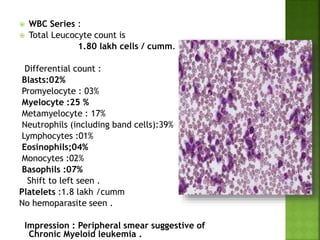
 WBC Series :
 Total Leucocyte count is
1.80 lakh cells / cumm.
Differential count :
Blasts:02%
Promyelocyte : 03%
Myelocyte :25 %
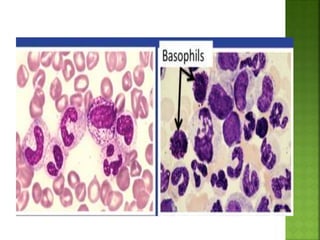
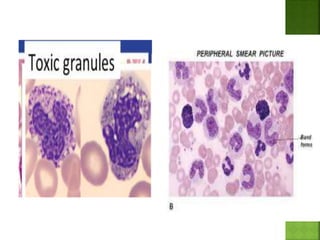
Metamyelocyte : 17%
Neutrophils (including band cells):39%
Lymphocytes :01%
Eosinophils;04%
Monocytes :02%
Basophils :07%
Shift to left seen .
Platelets :1.8 lakh /cumm
No hemoparasite seen .
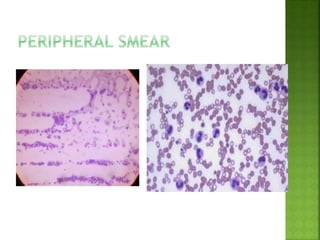
Impression : Peripheral smear suggestive of
Chronic Myeloid leukemia .
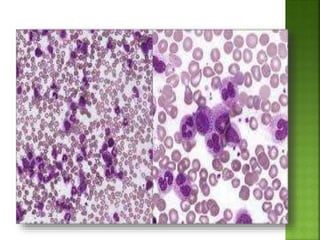
Marked Leukocytosis
Predominantly neutrophils,
metamyelocytes, myelocytes
Myelocyte bulge.
Less 3% are Myeloblast
Eosinophilia & Basophilia
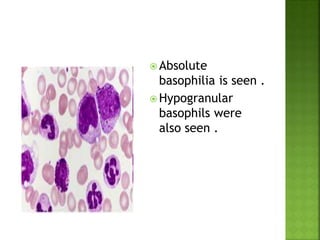
 Absolute
basophilia is seen .
 Hypogranular
basophils were
also seen .
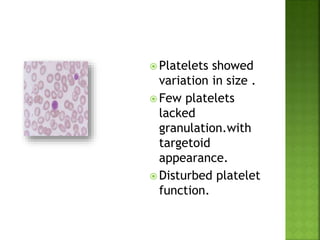
 Platelets showed
variation in size .
 Few platelets
lacked
granulation.with
targetoid
appearance.
 Disturbed platelet
function.
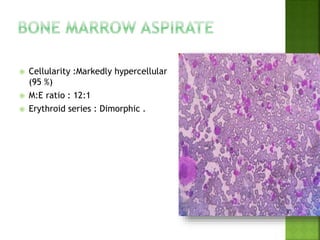
 Cellularity :Markedly hypercellular
(95 %)
 M:E ratio : 12:1
 Erythroid series : Dimorphic .
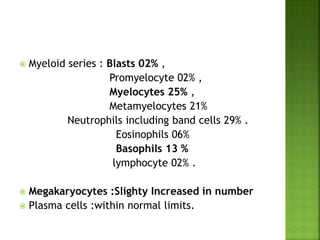
 Myeloid series : Blasts 02% ,
Promyelocyte 02% ,
Myelocytes 25% ,
Metamyelocytes 21%
Neutrophils including band cells 29% .
Eosinophils 06%
Basophils 13 %
lymphocyte 02% .
 Megakaryocytes :Slighty Increased in number
 Plasma cells :within normal limits.
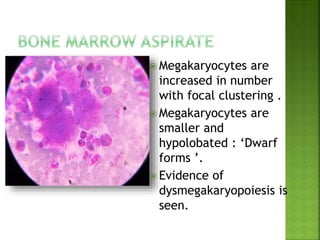
 Megakaryocytes are
increased in number
with focal clustering .
 Megakaryocytes are
smaller and
hypolobated : ‘Dwarf
forms ’.
 Evidence of
dysmegakaryopoiesis is
seen.
 A 38 year old female was admitted in medical ward with
the complain of Fever since one month . It was of
moderate grade not associated with chills or rigor .
 She had cough along with expectoration since one month .
 Also she complained of increased frequency of micturition.
 Urine Culture :Positive for E.coli.
 P/A: No hepatomegaly, no splenomegaly
 Hb: 7.4 g/dl
 RBC series : Mild anisopoikilocytosis
moderate hypochromia
.Predominantly microcytic
hypochromic cells seen.Few pencil
cells , tear drop cells seen .
.
 WBC Series : Total Leucocyte count is
56,000 cells / cumm.
Differential count : Blasts:00
Promyelocyte : 01%
Myelocyte :06%
Metamyelocyte :19%
Neutrophils (including band cells):56 %
Lymphocytes :09%
Eosinophils;03%
Monocytes :04%
Basophils :02%
Shift to left seen.
Platelets :1.8 lakh /cumm
No hemoparasite seen .
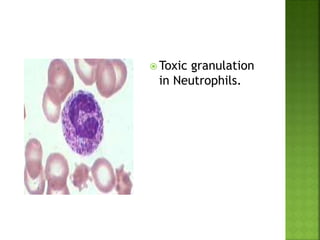
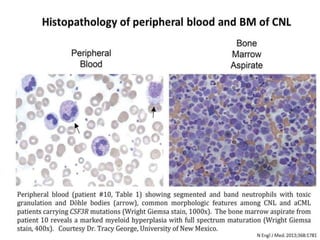
 Toxic granulation
in Neutrophils.
 Leukocytosis, defined as an increase in white
blood cell (WBC) count, is a common finding
with a broad differential diagnosis,
encompassing both benign and malignant
entities.
 Classification and diagnosis of leukocytosis
require confirmation of automated
differential counts and examination of the
peripheral blood smear.
 Further if increased blasts are seen then it
should prompt a workup for acute leukemia.
 For confirmation of reactive leucocytosis and
chronic leukemias we require flow
cytometric test, immunophenotyping and
bone marrow examination with cytogenetic
and molecular genetic tests.
1.Brief introduction of
Myeloid Leukemoid reaction
Chronic Myeloid Leukemia
Chronic Neutrophilic leukemia
2.Differentiation between above three on the basis of
Peripheral smear,
Bone marrow aspirate picture
Bone marrow biopsy picture
LAP score
Cytogenetics
Immunophenotyping
3.Brief discussion of Lymphoid leukemoid reaction and
eosinophilic leukemoid reaction .
 Leukemoid reaction — a secondary
reversible significant increase in the number
of leukocytes in response to a stimulus,
accompanied by the appearance in the blood
of immature forms of leukocytes.
 It is defined by a leukocyte count greater
than 50,000 cells/μL, caused by reactive
causes outside the bone marrow
 As reactive changes in blood are similar to
hematological malignancies, it is important
to differentiate them from leukemia.
 Careful history, good physical examination,
and limited imaging studies may assist in
revealing the underlying cause of leukemoid
reaction .
 The diagnosis of Myeloid Leukemoid
Reaction is based on the exclusion of chronic
myelogenous leukemia (CML) and
chronic neutrophilic leukemia (CNL).
 Chronic Neutrophilic Leukemia is a rare,
distinct myeloproliferative syndrome with a
poor prognosis.
 The differential diagnosis between
Leukemoid Reaction and Chronic Neutrophilic
Leukemia may be difficult or even
impossible because both conditions share
identical morphological features, including a
raised LAP score and the absence of the
bcr/abl translocation .
MYELOID TYPE LEUKEMOID REACTION :
Leukemoid reactions of myeloid type develop in
various infectious and noninfectious processes.
ACUTE BACTERIAL INFECTIONS:
Pneumonia,
Pyogenic meningitis
Cellulitis
Infected burns
Diphtheria
ACUTE STRESS STATES :
 Post surgery
 Post hemorrhage
 Myocardial Infarction
MISCELLANEOUS :
 Steroid therapy
 Gout
 Rheumatoid arthritis
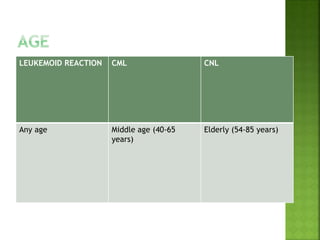
LEUKEMOID REACTION CML CNL
Any age Middle age (40-65
years)
Elderly (54-85 years)
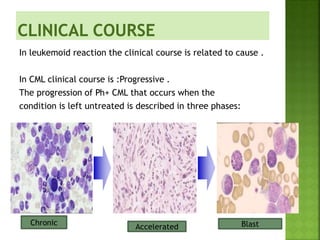
In leukemoid reaction the clinical course is related to cause .
In CML clinical course is :Progressive .
The progression of Ph+ CML that occurs when the
condition is left untreated is described in three phases:
Chronic
Accelerated Blast
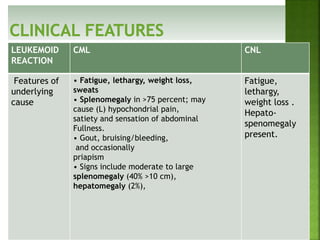
LEUKEMOID
REACTION
CML CNL
Features of
underlying
cause
• Fatigue, lethargy, weight loss,
sweats
• Splenomegaly in >75 percent; may
cause (L) hypochondrial pain,
satiety and sensation of abdominal
Fullness.
• Gout, bruising/bleeding,
and occasionally
priapism
• Signs include moderate to large
splenomegaly (40% >10 cm),
hepatomegaly (2%),
Fatigue,
lethargy,
weight loss .
Hepato-
spenomegaly
present.
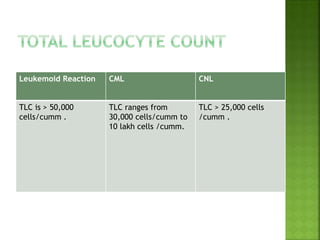
Leukemoid Reaction CML CNL
TLC is > 50,000
cells/cumm .
TLC ranges from
30,000 cells/cumm to
10 lakh cells /cumm.
TLC > 25,000 cells
/cumm .
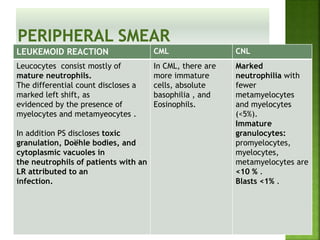
LEUKEMOID REACTION CML CNL
Leucocytes consist mostly of
mature neutrophils.
The differential count discloses a
marked left shift, as
evidenced by the presence of
myelocytes and metamyeocytes .
In addition PS discloses toxic
granulation, Doëhle bodies, and
cytoplasmic vacuoles in
the neutrophils of patients with an
LR attributed to an
infection.
In CML, there are
more immature
cells, absolute
basophilia , and
Eosinophils.
Marked
neutrophilia with
fewer
metamyelocytes
and myelocytes
(<5%).
Immature
granulocytes:
promyelocytes,
myelocytes,
metamyelocytes are
<10 % .
Blasts <1% .
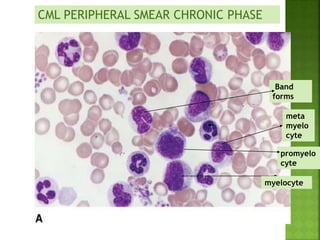
Band
forms
promyelo
cyte
myelocyte
meta
myelo
cyte
CML PERIPHERAL SMEAR CHRONIC PHASE
Leukemoid
reactiom
CML( Chronic
phase )
CNL
Increased
cellularity with
myeloid
hyperplasia .
But NO marrow
fibrosis
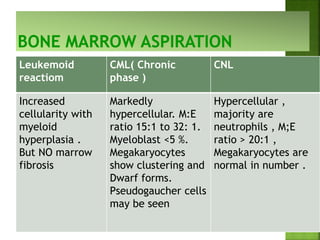
Markedly
hypercellular. M:E
ratio 15:1 to 32: 1.
Myeloblast <5 %.
Megakaryocytes
show clustering and
Dwarf forms.
Pseudogaucher cells
may be seen
Hypercellular ,
majority are
neutrophils , M;E
ratio > 20:1 ,
Megakaryocytes are
normal in number .
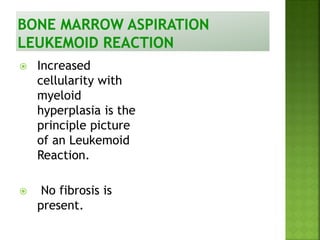
 Increased
cellularity with
myeloid
hyperplasia is the
principle picture
of an Leukemoid
Reaction.
 No fibrosis is
present.
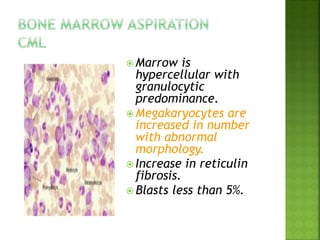
 Marrow is
hypercellular with
granulocytic
predominance.
 Megakaryocytes are
increased in number
with abnormal
morphology.
 Increase in reticulin
fibrosis.
 Blasts less than 5%.
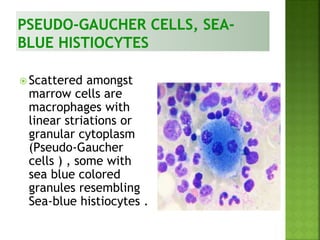
 Scattered amongst
marrow cells are
macrophages with
linear striations or
granular cytoplasm
(Pseudo-Gaucher
cells ) , some with
sea blue colored
granules resembling
Sea-blue histiocytes .
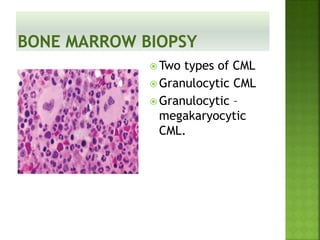
 Two types of CML
 Granulocytic CML
 Granulocytic –
megakaryocytic
CML.
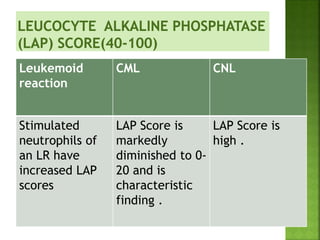
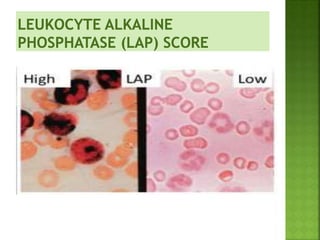
Leukemoid
reaction
CML CNL
Stimulated
neutrophils of
an LR have
increased LAP
scores
LAP Score is
markedly
diminished to 0-
20 and is
characteristic
finding .
LAP Score is
high .
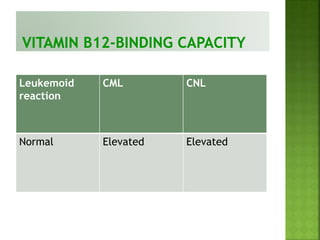
 .Leukemoid
reaction
CML CNL
Normal Elevated Elevated
 In CML there is increase in
 uric acid level
 lactate dehydrogenase.
 Increase in the level of angiogenic factors
 Entire chromosomal complement is
evaluated to identify philadelphia
chromosome and other abnormalities.
 Can be done on both peripheral blood and
bone marrow .
 Cytogenetics cannot identify complex
translocations.
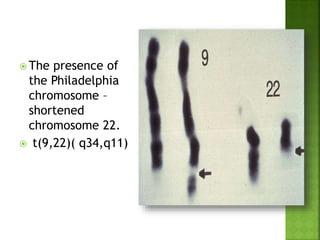
 The presence of
the Philadelphia
chromosome –
shortened
chromosome 22.
 t(9,22)( q34,q11)
Nearly 95 % patients demonstrate Ph chromosome .
For CML patients who are cytogenetically
Ph-chromosome–negative (Ph-) the following special
techniques can be used to detect BCR-ABL Fusion:
• Fluorescence in situ hybridization (FISH)
• Reverse transcriptase polymerase chain reaction
(RT-PCR) %
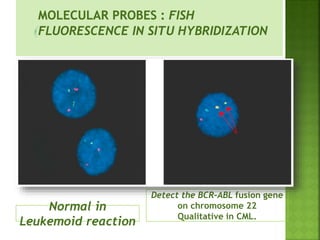
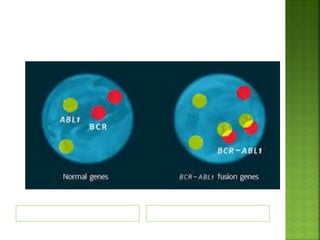
Normal in
Leukemoid reaction
Detect the BCR-ABL fusion gene
on chromosome 22
Qualitative in CML.
 Detects different length products
corresponding to chimeric BCR-ABL proteins
of 190,210 and 230 kda.
 So helps in distinguishing CML from ALL and
CNL.
 Immunophenoty
ping is
necessary for
assigning
specific lineage
to CML Blast
crisis cells.
Leukemoid
reaction
CML CNL
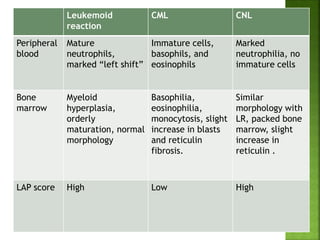
Peripheral
blood
Mature
neutrophils,
marked “left shift”
Immature cells,
basophils, and
eosinophils
Marked
neutrophilia, no
immature cells
Bone
marrow
Myeloid
hyperplasia,
orderly
maturation, normal
morphology
Basophilia,
eosinophilia,
monocytosis, slight
increase in blasts
and reticulin
fibrosis.
Similar
morphology with
LR, packed bone
marrow, slight
increase in
reticulin .
LAP score High Low High
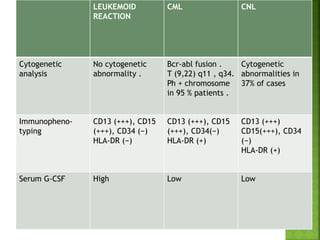
LEUKEMOID
REACTION
CML CNL
Cytogenetic
analysis
No cytogenetic
abnormality .
Bcr-abl fusion .
T (9,22) q11 , q34.
Ph + chromosome
in 95 % patients .
Cytogenetic
abnormalities in
37% of cases
Immunopheno-
typing
CD13 (+++), CD15
(+++), CD34 (−)
HLA-DR (−)
CD13 (+++), CD15
(+++), CD34(−)
HLA-DR (+)
CD13 (+++)
CD15(+++), CD34
(−)
HLA-DR (+)
Serum G-CSF High Low Low
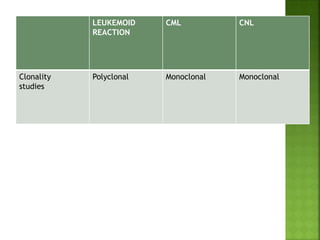
LEUKEMOID
REACTION
CML CNL
Clonality
studies
Polyclonal Monoclonal Monoclonal
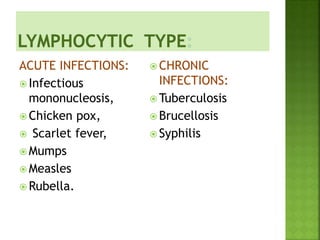
ACUTE INFECTIONS:
 Infectious
mononucleosis,
 Chicken pox,
 Scarlet fever,
 Mumps
 Measles
 Rubella.
 CHRONIC
INFECTIONS:
 Tuberculosis
 Brucellosis
 Syphilis
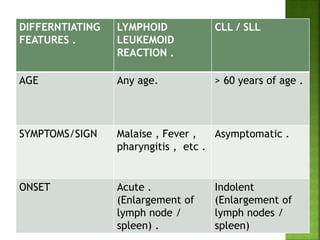
DIFFERNTIATING
FEATURES .
LYMPHOID
LEUKEMOID
REACTION .
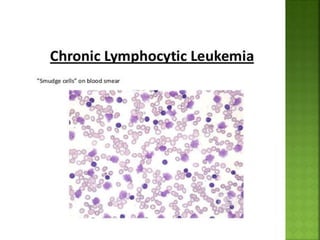
CLL / SLL
AGE Any age. > 60 years of age .
SYMPTOMS/SIGN Malaise , Fever ,
pharyngitis , etc .
Asymptomatic .
ONSET Acute .
(Enlargement of
lymph node /
spleen) .
Indolent
(Enlargement of
lymph nodes /
spleen)
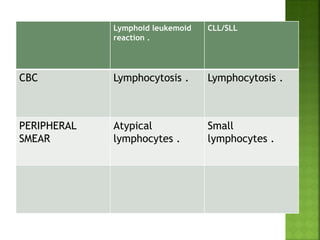
Lymphoid leukemoid
reaction .
CLL/SLL
CBC Lymphocytosis . Lymphocytosis .
PERIPHERAL
SMEAR
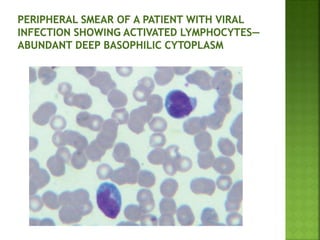
Atypical
lymphocytes .
Small
lymphocytes .
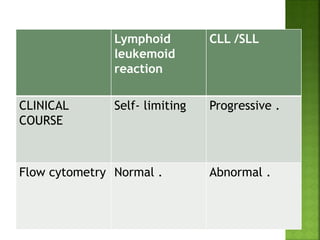
Lymphoid
leukemoid
reaction
CLL /SLL
CLINICAL
COURSE
Self- limiting Progressive .
Flow cytometry Normal . Abnormal .
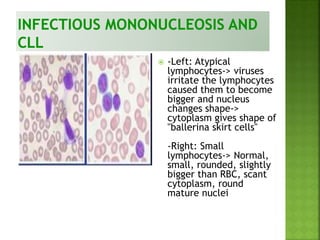
 -Left: Atypical
lymphocytes-> viruses
irritate the lymphocytes
caused them to become
bigger and nucleus
changes shape->
cytoplasm gives shape of
"ballerina skirt cells"
-Right: Small
lymphocytes-> Normal,
small, rounded, slightly
bigger than RBC, scant
cytoplasm, round
mature nuclei
ALLERGIC STATES:
Asthma
Urticaria
Hay fever
Drug dermatitis
MISCLLANEOUS :
Tropical eosinophila
Eosinophilic Pneumonia
Eosinophilic granuloma.
PARASITIC DISEASES:
Roundworm infestation
Hookworm infestation.
Filariasis .
Trichinosis .
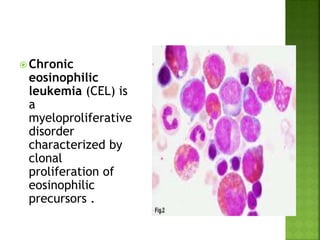
 Chronic
eosinophilic
leukemia (CEL) is
a
myeloproliferative
disorder
characterized by
clonal
proliferation of
eosinophilic
precursors .
 Persistent eosinophilia >1500/cumm.
 Myeloblasts <20% in blood and bone marrow .
 There is multilobation,vacuolation and
degranulation of eosinophils .
 INFECTIONS:
 Tuberculosis
 Kala azar
 Malaria
 Trypanosomiasis
 Bacterial
endocarditis
 Needs to be
differentiated
from :
 Chronic Myelo-
monocytic
Leukemia
 AML M4 and M5
 Hodgkin’s disease
leukemoid reaction and leukemia

leukemoid reaction and leukemia

  • 1.
  • 2.
     Slide discussionof Leukemoid reaction and Chronic Myeloid Leukemia .
  • 3.
    A 39 yrmale patient came with c/o abdominal pain-2 week in duration vague dragging pain associated with fullness of abdomen no aggravating or relieving factors
  • 4.
     h/o fatigue,fever ,increased sweating,early satiety + ,  h/o loss of appetite +  No h/o loss of weight, no h/o bleeding tendency  PAST h/o -> No h/o Tb/HTN/DM  PERSONAL h/o -> consumes alcohol occasionally  P/A –mild distention of abdomen+ moderate splenomegaly(+) mild hepatomegaly Sternal tenderness was present . No lymphadenopathy .
  • 5.
     Hemoglobin: 8.5g/dl  RBC series : Moderate anisopoikilocytosis . Predominantly normocytes are seen . Few macrocytes and tear drop cells seen . Polychromasia also seen .
  • 6.
     WBC Series:  Total Leucocyte count is 1.80 lakh cells / cumm. Differential count : Blasts:02% Promyelocyte : 03% Myelocyte :25 % Metamyelocyte : 17% Neutrophils (including band cells):39% Lymphocytes :01% Eosinophils;04% Monocytes :02% Basophils :07% Shift to left seen . Platelets :1.8 lakh /cumm No hemoparasite seen . Impression : Peripheral smear suggestive of Chronic Myeloid leukemia .
  • 7.
    Marked Leukocytosis Predominantly neutrophils, metamyelocytes,myelocytes Myelocyte bulge. Less 3% are Myeloblast Eosinophilia & Basophilia
  • 9.
     Absolute basophilia isseen .  Hypogranular basophils were also seen .
  • 10.
     Platelets showed variationin size .  Few platelets lacked granulation.with targetoid appearance.  Disturbed platelet function.
  • 11.
     Cellularity :Markedlyhypercellular (95 %)  M:E ratio : 12:1  Erythroid series : Dimorphic .
  • 12.
     Myeloid series: Blasts 02% , Promyelocyte 02% , Myelocytes 25% , Metamyelocytes 21% Neutrophils including band cells 29% . Eosinophils 06% Basophils 13 % lymphocyte 02% .  Megakaryocytes :Slighty Increased in number  Plasma cells :within normal limits.
  • 13.
     Megakaryocytes are increasedin number with focal clustering .  Megakaryocytes are smaller and hypolobated : ‘Dwarf forms ’.  Evidence of dysmegakaryopoiesis is seen.
  • 14.
     A 38year old female was admitted in medical ward with the complain of Fever since one month . It was of moderate grade not associated with chills or rigor .  She had cough along with expectoration since one month .  Also she complained of increased frequency of micturition.  Urine Culture :Positive for E.coli.  P/A: No hepatomegaly, no splenomegaly
  • 15.
     Hb: 7.4g/dl  RBC series : Mild anisopoikilocytosis moderate hypochromia .Predominantly microcytic hypochromic cells seen.Few pencil cells , tear drop cells seen . .
  • 16.
     WBC Series: Total Leucocyte count is 56,000 cells / cumm. Differential count : Blasts:00 Promyelocyte : 01% Myelocyte :06% Metamyelocyte :19% Neutrophils (including band cells):56 % Lymphocytes :09% Eosinophils;03% Monocytes :04% Basophils :02% Shift to left seen. Platelets :1.8 lakh /cumm No hemoparasite seen .
  • 18.
  • 19.
     Leukocytosis, definedas an increase in white blood cell (WBC) count, is a common finding with a broad differential diagnosis, encompassing both benign and malignant entities.  Classification and diagnosis of leukocytosis require confirmation of automated differential counts and examination of the peripheral blood smear.
  • 20.
     Further ifincreased blasts are seen then it should prompt a workup for acute leukemia.  For confirmation of reactive leucocytosis and chronic leukemias we require flow cytometric test, immunophenotyping and bone marrow examination with cytogenetic and molecular genetic tests.
  • 21.
    1.Brief introduction of MyeloidLeukemoid reaction Chronic Myeloid Leukemia Chronic Neutrophilic leukemia 2.Differentiation between above three on the basis of Peripheral smear, Bone marrow aspirate picture Bone marrow biopsy picture LAP score Cytogenetics Immunophenotyping 3.Brief discussion of Lymphoid leukemoid reaction and eosinophilic leukemoid reaction .
  • 22.
     Leukemoid reaction— a secondary reversible significant increase in the number of leukocytes in response to a stimulus, accompanied by the appearance in the blood of immature forms of leukocytes.  It is defined by a leukocyte count greater than 50,000 cells/μL, caused by reactive causes outside the bone marrow
  • 23.
     As reactivechanges in blood are similar to hematological malignancies, it is important to differentiate them from leukemia.  Careful history, good physical examination, and limited imaging studies may assist in revealing the underlying cause of leukemoid reaction .
  • 24.
     The diagnosisof Myeloid Leukemoid Reaction is based on the exclusion of chronic myelogenous leukemia (CML) and chronic neutrophilic leukemia (CNL).
  • 25.
     Chronic NeutrophilicLeukemia is a rare, distinct myeloproliferative syndrome with a poor prognosis.  The differential diagnosis between Leukemoid Reaction and Chronic Neutrophilic Leukemia may be difficult or even impossible because both conditions share identical morphological features, including a raised LAP score and the absence of the bcr/abl translocation .
  • 26.
    MYELOID TYPE LEUKEMOIDREACTION : Leukemoid reactions of myeloid type develop in various infectious and noninfectious processes. ACUTE BACTERIAL INFECTIONS: Pneumonia, Pyogenic meningitis Cellulitis Infected burns Diphtheria
  • 27.
    ACUTE STRESS STATES:  Post surgery  Post hemorrhage  Myocardial Infarction MISCELLANEOUS :  Steroid therapy  Gout  Rheumatoid arthritis
  • 28.
    LEUKEMOID REACTION CMLCNL Any age Middle age (40-65 years) Elderly (54-85 years)
  • 29.
    In leukemoid reactionthe clinical course is related to cause . In CML clinical course is :Progressive . The progression of Ph+ CML that occurs when the condition is left untreated is described in three phases: Chronic Accelerated Blast
  • 30.
    LEUKEMOID REACTION CML CNL Features of underlying cause •Fatigue, lethargy, weight loss, sweats • Splenomegaly in >75 percent; may cause (L) hypochondrial pain, satiety and sensation of abdominal Fullness. • Gout, bruising/bleeding, and occasionally priapism • Signs include moderate to large splenomegaly (40% >10 cm), hepatomegaly (2%), Fatigue, lethargy, weight loss . Hepato- spenomegaly present.
  • 31.
    Leukemoid Reaction CMLCNL TLC is > 50,000 cells/cumm . TLC ranges from 30,000 cells/cumm to 10 lakh cells /cumm. TLC > 25,000 cells /cumm .
  • 32.
    LEUKEMOID REACTION CMLCNL Leucocytes consist mostly of mature neutrophils. The differential count discloses a marked left shift, as evidenced by the presence of myelocytes and metamyeocytes . In addition PS discloses toxic granulation, Doëhle bodies, and cytoplasmic vacuoles in the neutrophils of patients with an LR attributed to an infection. In CML, there are more immature cells, absolute basophilia , and Eosinophils. Marked neutrophilia with fewer metamyelocytes and myelocytes (<5%). Immature granulocytes: promyelocytes, myelocytes, metamyelocytes are <10 % . Blasts <1% .
  • 35.
  • 37.
    Leukemoid reactiom CML( Chronic phase ) CNL Increased cellularitywith myeloid hyperplasia . But NO marrow fibrosis Markedly hypercellular. M:E ratio 15:1 to 32: 1. Myeloblast <5 %. Megakaryocytes show clustering and Dwarf forms. Pseudogaucher cells may be seen Hypercellular , majority are neutrophils , M;E ratio > 20:1 , Megakaryocytes are normal in number .
  • 38.
     Increased cellularity with myeloid hyperplasiais the principle picture of an Leukemoid Reaction.  No fibrosis is present.
  • 39.
     Marrow is hypercellularwith granulocytic predominance.  Megakaryocytes are increased in number with abnormal morphology.  Increase in reticulin fibrosis.  Blasts less than 5%.
  • 40.
     Scattered amongst marrowcells are macrophages with linear striations or granular cytoplasm (Pseudo-Gaucher cells ) , some with sea blue colored granules resembling Sea-blue histiocytes .
  • 41.
     Two typesof CML  Granulocytic CML  Granulocytic – megakaryocytic CML.
  • 42.
    Leukemoid reaction CML CNL Stimulated neutrophils of anLR have increased LAP scores LAP Score is markedly diminished to 0- 20 and is characteristic finding . LAP Score is high .
  • 44.
  • 45.
     In CMLthere is increase in  uric acid level  lactate dehydrogenase.  Increase in the level of angiogenic factors
  • 46.
     Entire chromosomalcomplement is evaluated to identify philadelphia chromosome and other abnormalities.  Can be done on both peripheral blood and bone marrow .  Cytogenetics cannot identify complex translocations.
  • 47.
     The presenceof the Philadelphia chromosome – shortened chromosome 22.  t(9,22)( q34,q11)
  • 48.
    Nearly 95 %patients demonstrate Ph chromosome . For CML patients who are cytogenetically Ph-chromosome–negative (Ph-) the following special techniques can be used to detect BCR-ABL Fusion: • Fluorescence in situ hybridization (FISH) • Reverse transcriptase polymerase chain reaction (RT-PCR) %
  • 49.
    Normal in Leukemoid reaction Detectthe BCR-ABL fusion gene on chromosome 22 Qualitative in CML.
  • 51.
     Detects differentlength products corresponding to chimeric BCR-ABL proteins of 190,210 and 230 kda.  So helps in distinguishing CML from ALL and CNL.
  • 52.
     Immunophenoty ping is necessaryfor assigning specific lineage to CML Blast crisis cells.
  • 54.
    Leukemoid reaction CML CNL Peripheral blood Mature neutrophils, marked “leftshift” Immature cells, basophils, and eosinophils Marked neutrophilia, no immature cells Bone marrow Myeloid hyperplasia, orderly maturation, normal morphology Basophilia, eosinophilia, monocytosis, slight increase in blasts and reticulin fibrosis. Similar morphology with LR, packed bone marrow, slight increase in reticulin . LAP score High Low High
  • 55.
    LEUKEMOID REACTION CML CNL Cytogenetic analysis No cytogenetic abnormality. Bcr-abl fusion . T (9,22) q11 , q34. Ph + chromosome in 95 % patients . Cytogenetic abnormalities in 37% of cases Immunopheno- typing CD13 (+++), CD15 (+++), CD34 (−) HLA-DR (−) CD13 (+++), CD15 (+++), CD34(−) HLA-DR (+) CD13 (+++) CD15(+++), CD34 (−) HLA-DR (+) Serum G-CSF High Low Low
  • 56.
  • 57.
    ACUTE INFECTIONS:  Infectious mononucleosis, Chicken pox,  Scarlet fever,  Mumps  Measles  Rubella.  CHRONIC INFECTIONS:  Tuberculosis  Brucellosis  Syphilis
  • 58.
    DIFFERNTIATING FEATURES . LYMPHOID LEUKEMOID REACTION . CLL/ SLL AGE Any age. > 60 years of age . SYMPTOMS/SIGN Malaise , Fever , pharyngitis , etc . Asymptomatic . ONSET Acute . (Enlargement of lymph node / spleen) . Indolent (Enlargement of lymph nodes / spleen)
  • 59.
    Lymphoid leukemoid reaction . CLL/SLL CBCLymphocytosis . Lymphocytosis . PERIPHERAL SMEAR Atypical lymphocytes . Small lymphocytes .
  • 60.
    Lymphoid leukemoid reaction CLL /SLL CLINICAL COURSE Self- limitingProgressive . Flow cytometry Normal . Abnormal .
  • 61.
     -Left: Atypical lymphocytes->viruses irritate the lymphocytes caused them to become bigger and nucleus changes shape-> cytoplasm gives shape of "ballerina skirt cells" -Right: Small lymphocytes-> Normal, small, rounded, slightly bigger than RBC, scant cytoplasm, round mature nuclei
  • 64.
    ALLERGIC STATES: Asthma Urticaria Hay fever Drugdermatitis MISCLLANEOUS : Tropical eosinophila Eosinophilic Pneumonia Eosinophilic granuloma. PARASITIC DISEASES: Roundworm infestation Hookworm infestation. Filariasis . Trichinosis .
  • 65.
     Chronic eosinophilic leukemia (CEL)is a myeloproliferative disorder characterized by clonal proliferation of eosinophilic precursors .
  • 66.
     Persistent eosinophilia>1500/cumm.  Myeloblasts <20% in blood and bone marrow .  There is multilobation,vacuolation and degranulation of eosinophils .
  • 67.
     INFECTIONS:  Tuberculosis Kala azar  Malaria  Trypanosomiasis  Bacterial endocarditis  Needs to be differentiated from :  Chronic Myelo- monocytic Leukemia  AML M4 and M5  Hodgkin’s disease

Editor's Notes

  • #27 Infections(sepsis, purulent processes, lobar pneumonia, dysentery), Severe injuries and acute hemolysis. Infections Intoxication Metastatic tumors of the bone marrow, ionizing radiation Rarely paraneoplastic syndrome Intoxication (therapeutic intoxication, including sulfanilamide drugs, uremia), Metastatic tumors of the bone marrow, ionizing radiation (radiotherapy).
  • #31 Sternal tenderness, Splenomegaly Hepatomegaly Easy bruising Weight loss Priapism
  • #44 LAP is an enzyme present in the cytoplasmic microsomes of neutrophils, bands, metamyelocytes, and myelocytes,but not in lymphocytes or monocytes. Immature neutrophils, such as those observed in CML, have decreased LAP scores. stimulated neutrophils of an LR have increased LAP scores [1]. In CNL, low LAP scores are the exception [22].
  • #50 Uses fluorescent dye probes to bind to specific pieces of DNA For CML 2 probes may be used, 1 to bind to the BCR gene, and 1 to bind to the ABL gene Reveals whether BCR and ABL genes are next to each other (as in the Philadelphia chromosome), or on separate chromosomes (as in normal cells)
  • #65 . Etiology: Helminthic infestation — opisthorchiasis, fascioliasis, strongyloidiasis, trichinosis, and others; Eosinophilic pneumonia (eosinophilic infiltrates in the lung), Allergic (Antibiotics, drug dermatitis, severe universal dermatitis, etc.), Allergic large eosinophilia of unknown origin (duration 1 — 6 months.)