Organizational
Plan

Compilation and Organization of These
Slides by: Abdul Rauf
1. What’s Organizational
Plan?


An organizational plan is basically a
“to do” list for an organization. It lists
out the plan of work, programs, and
organizational growth over a period of
time - six months, a year, a five years.



Planning helps an organization chart a
course for the achievement of its
goals.
A plan can help you:
Set priorities for your work
 Make sure tasks get done on time
 Focus on one thing at a time
 Share work among staff, board members
and volunteers
 Make your goals clear to funders
 Get a handle on big projects by breaking
them down into smaller tasks
 See the big picture of what your
organization is doing

2. How to Plan?
2.1
 2.2
 2.3
 2.4
 2.5
 2.6
 2.7
 2.8


Decide On Categories
Set Goals
Set Tasks
Plan a Schedule
Choose Responsibility
Support
Follow Through
Plan Evaluation
2.1 Decide On Categories
First, think about all the work that your
organization does, and list out the general
categories
 for example:


◦ Fundraising,
◦ Community Outreach,
◦ Website,
◦ and so on. ..
(Some big categories might be split up)
2.2 Set Goals
Second, make sure the goals for your
work in each category are clear.
 Ask yourselves, “Where do we want
to be with this work in a year or two or
more?”


Example: Fundraising: Raise $8000.
2.3 Set Tasks
Next, discuss each goal and talk about all
the tasks that need to be done to achieve
that goal.
 At this point, they don’t have to be in order.
Some will be more specific than others; the
more specific the better, in general.
 You may not know how to reach some
goals, yet; it’s fine to have a task list that
looks like
“Get fundraising training. Create fundraising
plan and schedule. Carry out plan.”

2.4 Plan a Schedule


Make sure that all the tasks are listed,
number them.



Then draft a schedule for the tasks—
either when they will be completed, or
(for ongoing tasks) when they will
begin.



The goal is to set a schedule that is
challenging but realistic.
2.5 Choosing
Responsibilities
Assign responsibilities by asking people to
volunteer to be responsible for goals or
tasks.
 If nobody is willing to volunteer for a
particular task, ask the group if it is really
necessary to do it. If the group decides
that it is, try to break it down into smaller
tasks that might be easier to take on.

2.6 Support
Brainstorm other individuals and
organizations that can provide
support, assistance or advice in
helping you carry out particular tasks
or achieve general goals.
 Get support from other stakeholders
like government departments etc.

2.7 Follow through
Come up with a plan to check in
 Support and encourage people as they
carry out their tasks.
 This may mean choosing one person to
regularly check on the status of different
tasks, or it may be part of reporting back
at meetings.

2.8 Plan Evaluation
Finally, set a time to revisit the whole
plan as a group to evaluate how things
are going and revise assignments and
schedules.
 This may be a few months or half a
year in the future.

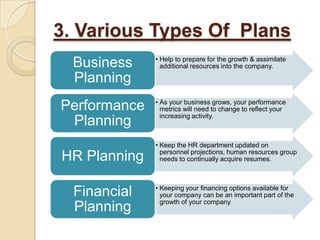
3. Various Types Of Plans
Business
Planning

• Help to prepare for the growth & assimilate
additional resources into the company.

Performance
Planning

• As your business grows, your performance
metrics will need to change to reflect your
increasing activity.

HR Planning

Financial
Planning

• Keep the HR department updated on
personnel projections, human resources group
needs to continually acquire resumes.

• Keeping your financing options available for
your company can be an important part of the
growth of your company
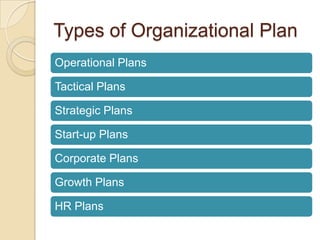
Types of Organizational Plan
Operational Plans
Tactical Plans
Strategic Plans
Start-up Plans
Corporate Plans
Growth Plans

HR Plans
4.1 Operational Plans
The specific results expected from
departments, work groups, and individuals
are the operational goals.
 These goals should be precise and
measurable.


◦ “Process 150 sales applications each week” or
“Publish 20 books this quarter” are examples of
operational goals.


An operational plan is one that a manager
uses to accomplish his or her job
responsibilities. Supervisors, team leaders,
and facilitators develop operational plans to
support tactical plans.
4.2 Tactical plans








A tactical plan is concerned with what the lower
level units within each division must do, how they
must do it, and who is in charge at each level.
Tactics are the means needed to activate a
strategy and make it work.
Tactical plans are concerned with shorter time
frames and narrower scopes than are strategic
plans.
These plans usually span one year or less
because they are considered short‐term goals.
Long‐term goals, on the other hand, can take
several years or more to accomplish. Normally, it
is the middle manager's responsibility to take the
broad strategic plan and identify specific tactical
actions.
4.3 Strategic Plan









A strategic plan is an outline of steps designed
with the goals of the entire organization as a
whole in mind, rather than with the goals of
specific divisions or departments.
Strategic planning begins with an organization's
mission.
Strategic plans look ahead over the next two,
three, five, or even more years to move the
organization from where it currently is to where it
wants to be.
Requiring multilevel involvement
Top‐level management develops the directional
objectives for the entire organization
Lower levels of management develop compatible
objectives and plans to achieve them.
4.4 Start-up Plans
The start-up plan is the stepping stone of
the business.
 In this plan, the incorporator of the
business analyzes the financial viability
of his proposed venture.
 Startup Plans Include:


◦ The proposed product
◦ Its market of operation
◦ The team of individuals who would assist him
in his venture
◦ The finances of the business and their mode
of procurement
4.5 Corporate Plans


These plans are also known as
strategic plans. These plans are
drawn with the intent of analyzing
whether or not the company’s
resources are being utilized optimally.
As there are often several ways in
which a chore can be performed,
corporate plans highlight the most
feasible and profitable one.
4.6 Growth Plans
Whenever an organization is looking in the
direction of expansion, it formulates a growth
plan.
 This plan is very similar to a start-up plan.
 Through this plan, the company determines
whether or not it can spread its wings further.
 The company here analyzes its


◦
◦
◦
◦

Operations,
Finances,
Personnel
Capabilities.
4.7 HR Plans
These plans are chalked out by the
human resources department to
obtain the right number of employees
with the right skills for the right places
at the right time.
 Through the implementation of this
plan, all the departments of the
company should have the optimum
number of personnel required.

Basics of Organizational Plans

Basics of Organizational Plans

  • 1.
  • 2.
    1. What’s Organizational Plan?  Anorganizational plan is basically a “to do” list for an organization. It lists out the plan of work, programs, and organizational growth over a period of time - six months, a year, a five years.  Planning helps an organization chart a course for the achievement of its goals.
  • 3.
    A plan canhelp you: Set priorities for your work  Make sure tasks get done on time  Focus on one thing at a time  Share work among staff, board members and volunteers  Make your goals clear to funders  Get a handle on big projects by breaking them down into smaller tasks  See the big picture of what your organization is doing 
  • 4.
    2. How toPlan? 2.1  2.2  2.3  2.4  2.5  2.6  2.7  2.8  Decide On Categories Set Goals Set Tasks Plan a Schedule Choose Responsibility Support Follow Through Plan Evaluation
  • 5.
    2.1 Decide OnCategories First, think about all the work that your organization does, and list out the general categories  for example:  ◦ Fundraising, ◦ Community Outreach, ◦ Website, ◦ and so on. .. (Some big categories might be split up)
  • 6.
    2.2 Set Goals Second,make sure the goals for your work in each category are clear.  Ask yourselves, “Where do we want to be with this work in a year or two or more?”  Example: Fundraising: Raise $8000.
  • 7.
    2.3 Set Tasks Next,discuss each goal and talk about all the tasks that need to be done to achieve that goal.  At this point, they don’t have to be in order. Some will be more specific than others; the more specific the better, in general.  You may not know how to reach some goals, yet; it’s fine to have a task list that looks like “Get fundraising training. Create fundraising plan and schedule. Carry out plan.” 
  • 8.
    2.4 Plan aSchedule  Make sure that all the tasks are listed, number them.  Then draft a schedule for the tasks— either when they will be completed, or (for ongoing tasks) when they will begin.  The goal is to set a schedule that is challenging but realistic.
  • 9.
    2.5 Choosing Responsibilities Assign responsibilitiesby asking people to volunteer to be responsible for goals or tasks.  If nobody is willing to volunteer for a particular task, ask the group if it is really necessary to do it. If the group decides that it is, try to break it down into smaller tasks that might be easier to take on. 
  • 10.
    2.6 Support Brainstorm otherindividuals and organizations that can provide support, assistance or advice in helping you carry out particular tasks or achieve general goals.  Get support from other stakeholders like government departments etc. 
  • 11.
    2.7 Follow through Comeup with a plan to check in  Support and encourage people as they carry out their tasks.  This may mean choosing one person to regularly check on the status of different tasks, or it may be part of reporting back at meetings. 
  • 12.
    2.8 Plan Evaluation Finally,set a time to revisit the whole plan as a group to evaluate how things are going and revise assignments and schedules.  This may be a few months or half a year in the future. 
  • 13.
    3. Various TypesOf Plans Business Planning • Help to prepare for the growth & assimilate additional resources into the company. Performance Planning • As your business grows, your performance metrics will need to change to reflect your increasing activity. HR Planning Financial Planning • Keep the HR department updated on personnel projections, human resources group needs to continually acquire resumes. • Keeping your financing options available for your company can be an important part of the growth of your company
  • 14.
    Types of OrganizationalPlan Operational Plans Tactical Plans Strategic Plans Start-up Plans Corporate Plans Growth Plans HR Plans
  • 15.
    4.1 Operational Plans Thespecific results expected from departments, work groups, and individuals are the operational goals.  These goals should be precise and measurable.  ◦ “Process 150 sales applications each week” or “Publish 20 books this quarter” are examples of operational goals.  An operational plan is one that a manager uses to accomplish his or her job responsibilities. Supervisors, team leaders, and facilitators develop operational plans to support tactical plans.
  • 16.
    4.2 Tactical plans      Atactical plan is concerned with what the lower level units within each division must do, how they must do it, and who is in charge at each level. Tactics are the means needed to activate a strategy and make it work. Tactical plans are concerned with shorter time frames and narrower scopes than are strategic plans. These plans usually span one year or less because they are considered short‐term goals. Long‐term goals, on the other hand, can take several years or more to accomplish. Normally, it is the middle manager's responsibility to take the broad strategic plan and identify specific tactical actions.
  • 17.
    4.3 Strategic Plan       Astrategic plan is an outline of steps designed with the goals of the entire organization as a whole in mind, rather than with the goals of specific divisions or departments. Strategic planning begins with an organization's mission. Strategic plans look ahead over the next two, three, five, or even more years to move the organization from where it currently is to where it wants to be. Requiring multilevel involvement Top‐level management develops the directional objectives for the entire organization Lower levels of management develop compatible objectives and plans to achieve them.
  • 18.
    4.4 Start-up Plans Thestart-up plan is the stepping stone of the business.  In this plan, the incorporator of the business analyzes the financial viability of his proposed venture.  Startup Plans Include:  ◦ The proposed product ◦ Its market of operation ◦ The team of individuals who would assist him in his venture ◦ The finances of the business and their mode of procurement
  • 19.
    4.5 Corporate Plans  Theseplans are also known as strategic plans. These plans are drawn with the intent of analyzing whether or not the company’s resources are being utilized optimally. As there are often several ways in which a chore can be performed, corporate plans highlight the most feasible and profitable one.
  • 20.
    4.6 Growth Plans Wheneveran organization is looking in the direction of expansion, it formulates a growth plan.  This plan is very similar to a start-up plan.  Through this plan, the company determines whether or not it can spread its wings further.  The company here analyzes its  ◦ ◦ ◦ ◦ Operations, Finances, Personnel Capabilities.
  • 21.
    4.7 HR Plans Theseplans are chalked out by the human resources department to obtain the right number of employees with the right skills for the right places at the right time.  Through the implementation of this plan, all the departments of the company should have the optimum number of personnel required. 