Seminar On


Data security in cloud computing


                    Presented by:
             M. Jagadeesh Chandra
Contents

 Abstract
 Introduction
 Architecture
 Services models
 Data security
 Latest technologies
 Latest techniques
 References
 Thank Q!
Abstract
 With the development of cloud computing, Data
  security becomes more and more important in cloud
  computing. This paper analyses the basic problem of
  cloud computing data security. .
 Cloud Computing provides the way to share
  distributed resources and services that belong to
  different organizations or sites. Since Cloud
  Computing share distributed resources via network in
  the open environment thus it makes security problems
 In this method some important security services
  including authentication, encryption and decryption
  and compression are provided in Cloud Computing
  system
Existing system:
 User an entity, who has data to be stored in the cloud and
  relies on the cloud for data storage and computation, can
  be either enterprise or individual customers.

 Data redundancy can be employed with a technique of
  erasure correcting code to further tolerate faults or server
  crash as user’s data grow in size and importance.

 The existing system user to audit the cloud storage for
  very high communication and cost.
Proposed system:
 The proposed design allows users to audit the cloud storage with
  very lightweight communication and computation cost.

 The proposed design further supports secure and efficient
  dynamic operations on outsourced data, including managed
  control such as,
    Block modification.
    Deletion.
    Append.
    security
What is cloud computing:
 “Cloud    computing is an emerging computing
  technology that uses the internet and central remote
  servers to maintain data and applications.
 Cloud computing is internet based technology that
  enables small business and organizations to use highly
  sophisticated computer applications.
Definition:
 Cloud computing refers to applications and services
  offered over the Internet. These services are offered
  from data centers all over the world, which collectively
  are referred to as the "cloud."
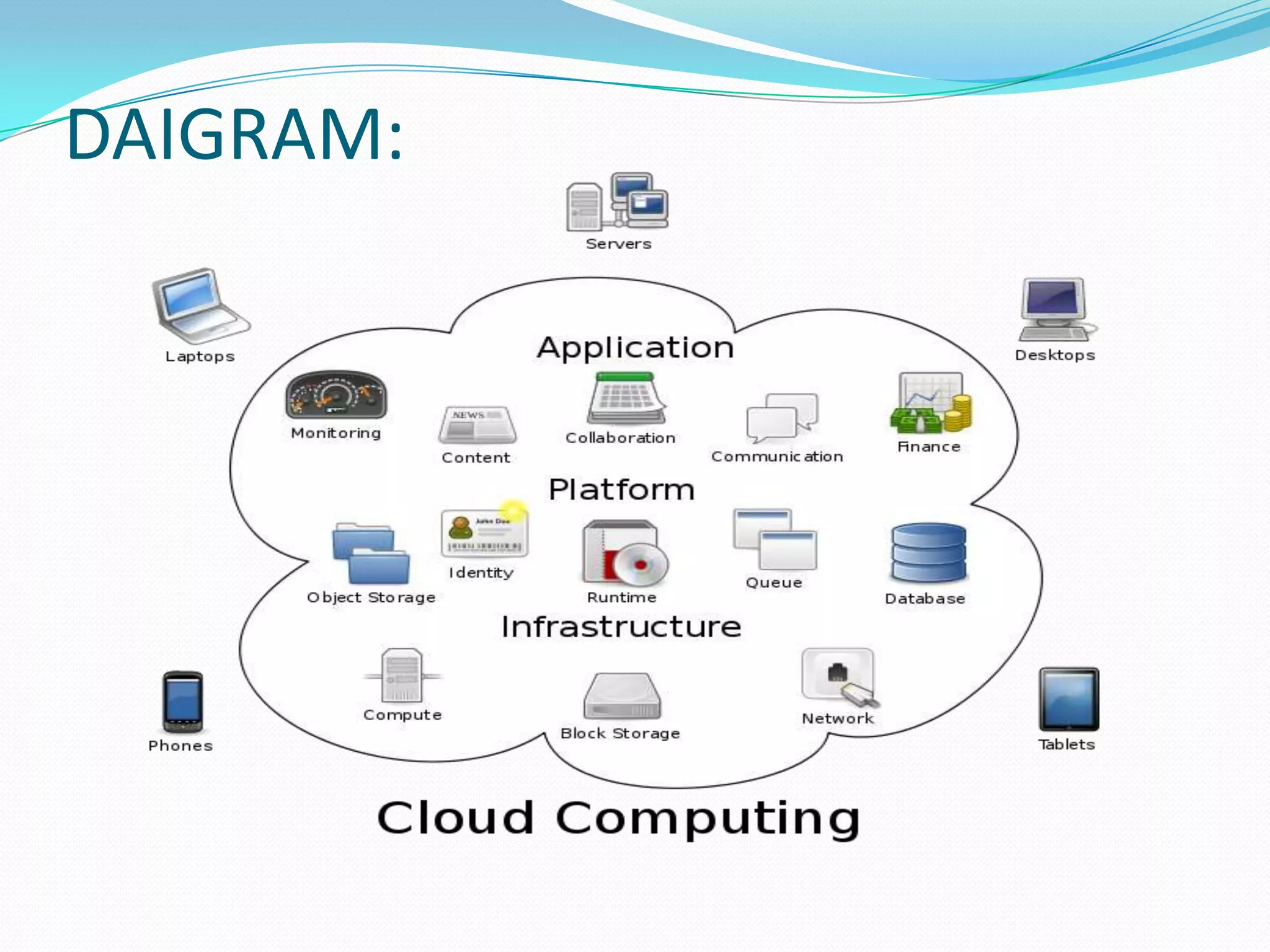
DAIGRAM:
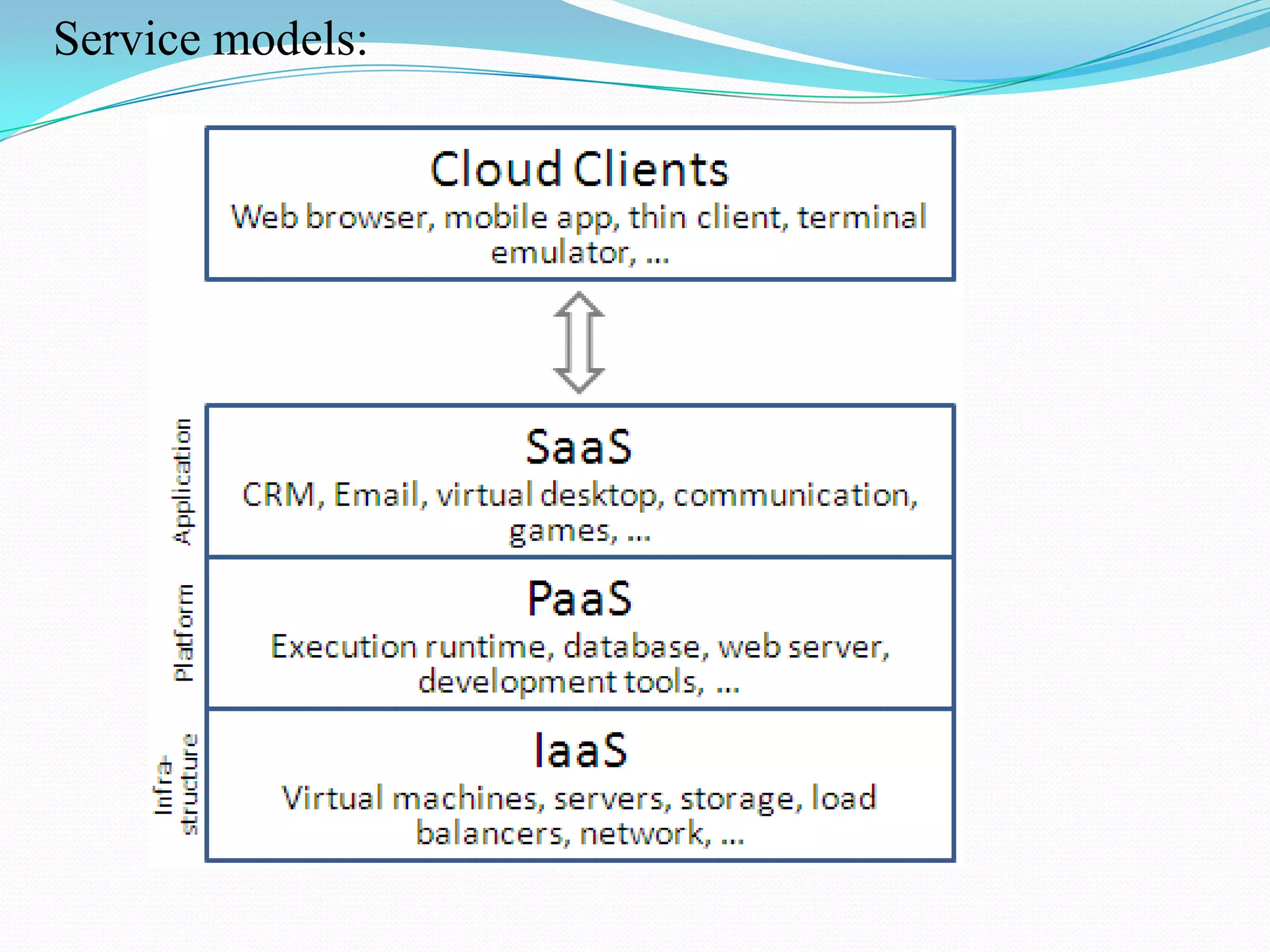
Service models:
Platform as a service approach (PaaS):

•The offering also includes a software execution environment.
As for example, there could be a PaaS application server that
enables the lone developers to deploy web-based applications
•Example database,webservers, development tools

Characteristics of PaaS:
 No need of downloading and installing operating System
It saves Customers money
 It mainly deals for delivering operating systems over
Internet
Software can be developed, tested and deployed
Infrastructure as a service (IaaS):
•Refers to the sharing of hardware resources for
executing services, typically using Virtualization
technology. Infrastructure as a Service is an equipment
which is used to support hardware, software, storage,
servers and mainly used for delivering software
application environments

example of IaaS are Amazon, Microsoft, VMWare and
Red Hat.
Characteristics of IaaS:
 Policy based Services
 Utility computing Services
Dynamic Scaling
Internet Connectivity
Software as a Service (SaaS) :
Software as a Service is nothing but a software
distribution model which are made available to
customers over a network such as server or Internet
The example of SaaS are Google Apps, Cisco‟s WebEx,
Salesforce CRM

Characteristics of SaaS:
 Its easy to work under administration
 It can be globally access
The software can be updated automatically
All license holder user will have same version of
software
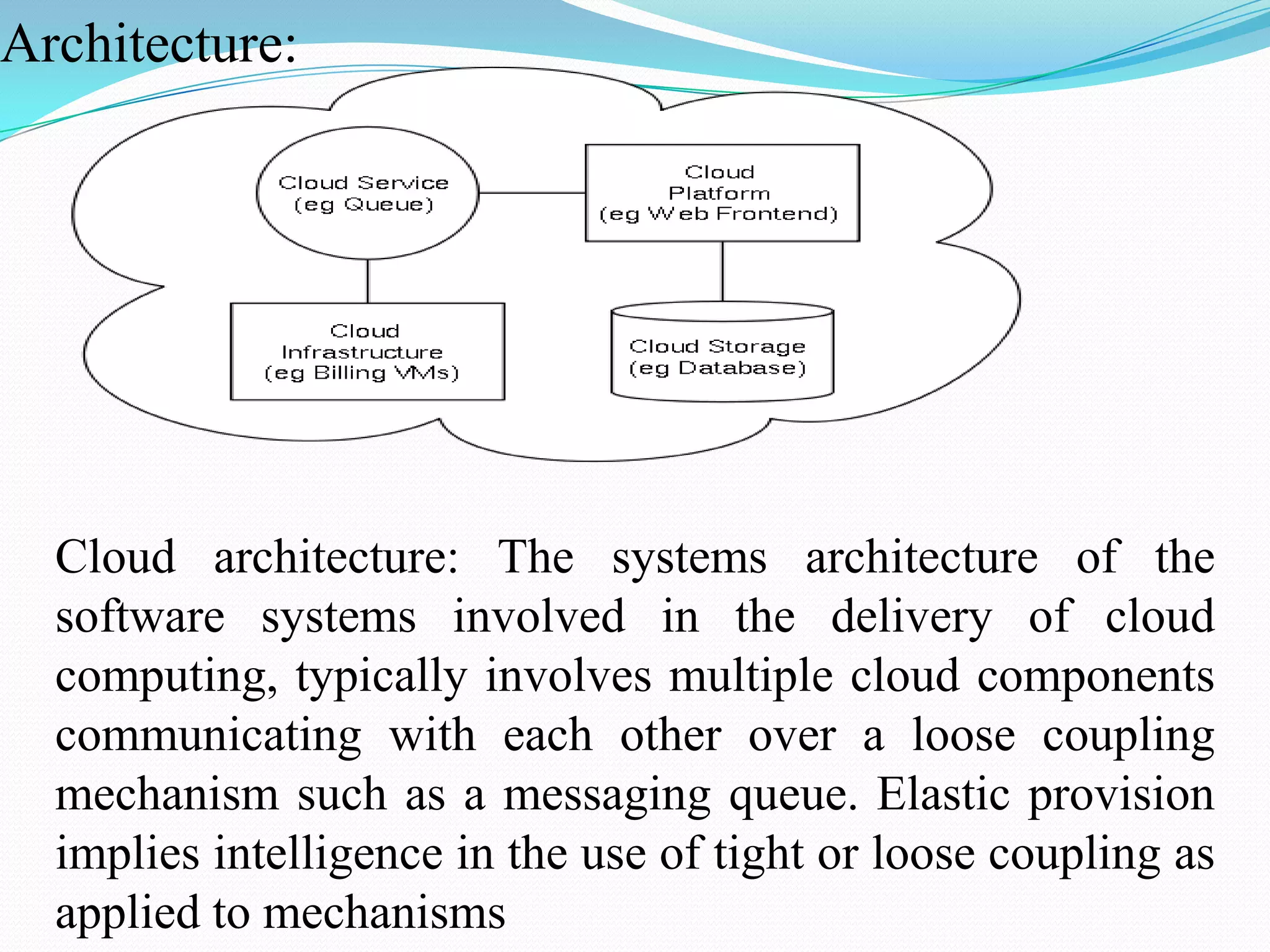
Architecture:


  Cloud architecture: The systems architecture of the
  software systems involved in the delivery of cloud
  computing, typically involves multiple cloud components
  communicating with each other over a loose coupling
  mechanism such as a messaging queue. Elastic provision
  implies intelligence in the use of tight or loose coupling as
  applied to mechanisms
DATA SECURITY IN CLOUD COMPUTING:

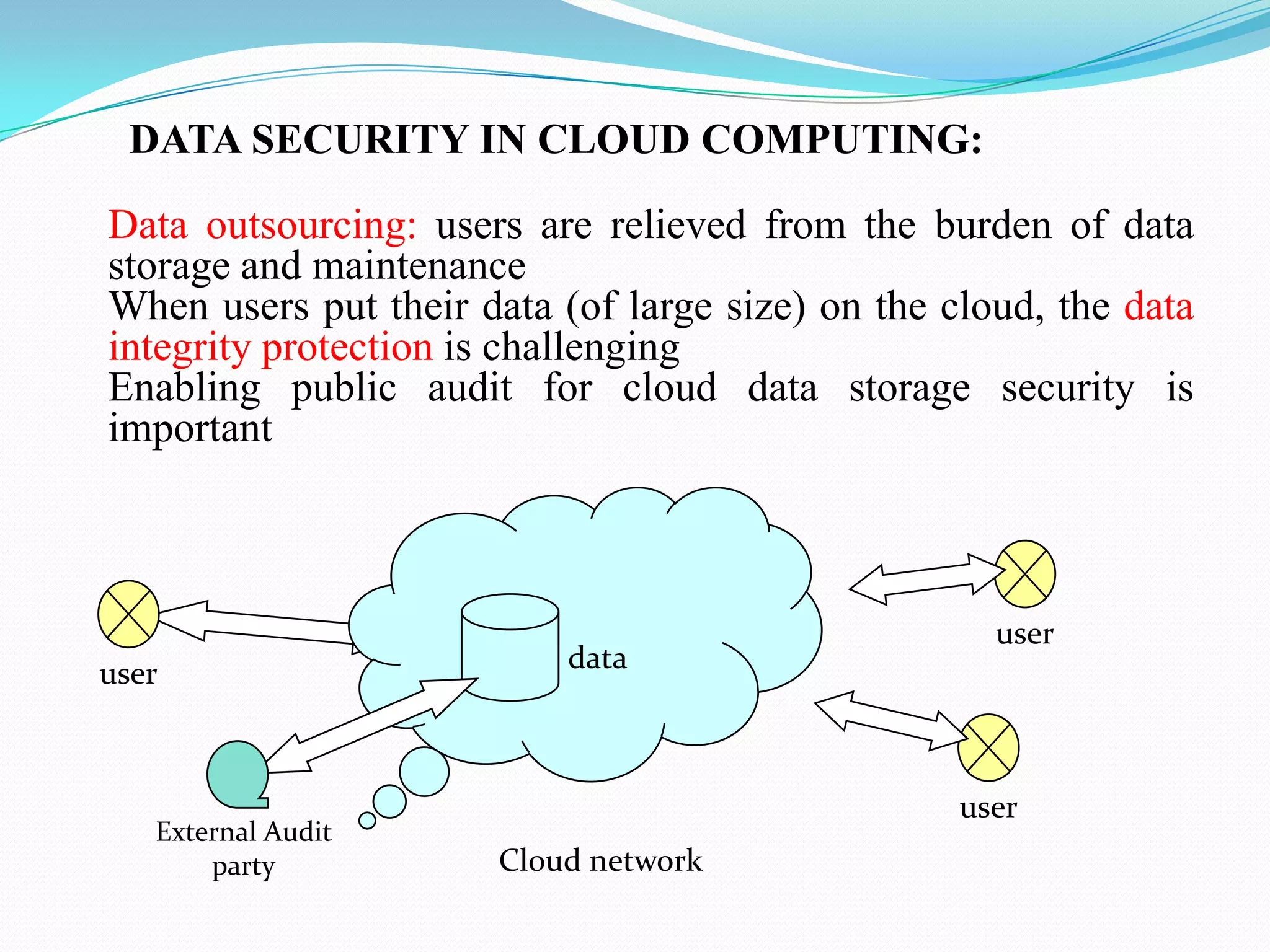
Data outsourcing: users are relieved from the burden of data
storage and maintenance
When users put their data (of large size) on the cloud, the data
integrity protection is challenging
Enabling public audit for cloud data storage security is
important


                                                    user
user                       data


                                                  user
   External Audit
       party           Cloud network
 cloud computing is built on top of
virtualization, if there are security issues with
virtualization, then there will also security issues
with cloud computing.
 Data segregation. Data in the cloud is typically in
a shared environment alongside data from other
customers. Encryption is effective but isn't a cure-
all. The cloud provider should provide evidence that
encryption schemes were designed and tested by
experienced specialists.
    A data center full of servers supporting cloud
computing is internally and externally
indistinguishable from a data center full of "regular"
servers. In each case, it will be important for the data
center to be physically secure against unauthorized
access

 Computer and network security is fundamentally
about three goals/objectives:

-- confidentiality (C)
-- integrity (I), and
-- availability (A).
     Confidentiality refers to keeping data private. Privacy is of
the amount importance as data leaves the borders of the
organization. Not only must internal secrets and sensitive personal
data be safeguarded, but metadata and transactional data can also
leak important details about firms or individuals. Confidentiality is
supported by, among other things, technical tools such as
encryption and access control, as well as legal protections

      Integrity is a degree confidence that the data in the cloud is
what is supposed to be there, and is protected against accidental or
intentional alteration without authorization. It also extends to the
hurdles of synchronizing multiple databases. Integrity is supported
by well audited code, well-designed distributed systems, and
robust access control mechanisms.
      Availability means being able to use the system as
anticipated. Cloud technologies can increase availability through
widespread internet-enabled access, but the client is dependent on
the timely and robust provision of resources. Availability is
supported by capacity building and good architecture by the
provider, as well as well-defined contracts and terms of agreement

Reduces the exposure of sensitive data
Simplifies security auditing & testing
Enables automated security management
Improves redundancy & disaster recovery
.
Latest technologies used       in data security in cloud
computing:

•Latest Training Program on Cloud Computing and Windows
Azure In order to address the aforementioned challenges,
Fujitsu Laboratories developed new cloud information
gateway technology that can flexibly control data, including
data content, transmitted from the inside of a company to a
cloud and between multiple clouds.

•In addition to the option of blocking confidential data, the
data gateway also includes the following three features.
Data Masking Technology
Secure Logic Migration and Execution Technology
Data Traceability Technology


Data Masking Technology :


• Using masking technology, when data passes through the
information gateway, confidential parts of the data can be
deleted or changed before the data are transmitted to an
external cloud.
Secure Logic Migration and Execution Technology:

• For confidential data that cannot be released outside of the
company, even formed by concealing certain aspects of the
data, by simply defining the security level of data, the
information gateway can transfer the cloud-based application
to the in-house sandbox for execution.


• The sandbox will block access to data or networks that lack
pre-authorized access, so even applications transferred from
the cloud can be safely executed.
Data Traceability Technology :

• The information gateway tracks all information flowing
into and out of the cloud, so these flows and their content can
be checked.


• Data traceability technology uses the logs obtained on data
traffic as well as the characteristics of the related text to
make visible the data used in the cloud.
Latest techniques used data security in cloud computing:

Authentication and Identity:

• Maintaining confidentiality, integrity, and availability for
data security is a function of the correct application and
configuration of familiar network, system, and application
security mechanisms at various levels in the cloud
infrastructure.
• Authentication of users takes several forms, but all are
based on a combination of authentication factors: something
an individual knows (such as a password), something they
possess (such as a security token), or some measurable
quality that is intrinsic to them (such as a fingerprint).
Application of Encryption for Data in Motion:

•Encryption is used to assure that if there was a breach of
communication integrity between the two parties that the
data remains confidential.

•Authentication is used to assure that the parties
communicating data are who they say they are.

• Common means of authentication themselves employ
cryptography in various ways.
Data Masking:

•Data masking is a technique that is intended to remove all
identifiable and distinguishing characteristics from data in
order to render it anonymous and yet still be operable.

•This technique is aimed at reducing the risk of exposing
sensitive information.

•Data masking has also been known by such names as data
obfuscation, de-identification, or depersonalization.
Advantages:
•Reduces the exposure of sensitive data
•Simplifies security auditing & testing
•Enables automated security management
•Improves redundancy & disaster recovery
•Access to highly qualified IT security personnel
• Prevent or curtail viruses and malware infection
• Secure sensitive or confidential information in motion
• Achieve compliance with leading self-regulatory frameworks
• Conduct training and awareness for all system users
• In contrast, cloud providers are least confident about the following
security requirements:
• Identify and authenticate users before granting access
• Secure vendor relationships before sharing information assets
• Prevent or curtail external attacks
• Encrypt sensitive or confidential information assets whenever
feasible
• Determine the root cause of cyber attacks
Platforms:

Amazon's Elastic Compute Cloud, or EC2, is probably the
most generalized and best-known of the cloud computing
service offerings.
IBM Computing on Demand or Blue Cloud is a highly
enterprise-focused cloud computing offering that, because it is
related to and built with the same technology sold to
enterprises, can cross over between public and private cloud
applications.
Microsoft's Azure cloud computing, based on Microsoft Vista
and .NET technology, includes both cloud computing and
cloud-hosted extension
REFERENCES

•Rajkumar Buyya Market-Oriented Cloud Computing:Vision,Hype,and
Reality for Delivering IT Services as Computing Utilities 2008

•Jean-Daniel Cryans,Criteria to Compare Cloud Computing with Current
Database Technology 2008
Data security in cloud computing

Data security in cloud computing

  • 1.
    Seminar On Data securityin cloud computing Presented by: M. Jagadeesh Chandra
  • 2.
    Contents  Abstract  Introduction Architecture  Services models  Data security  Latest technologies  Latest techniques  References  Thank Q!
  • 3.
    Abstract  With thedevelopment of cloud computing, Data security becomes more and more important in cloud computing. This paper analyses the basic problem of cloud computing data security. .  Cloud Computing provides the way to share distributed resources and services that belong to different organizations or sites. Since Cloud Computing share distributed resources via network in the open environment thus it makes security problems  In this method some important security services including authentication, encryption and decryption and compression are provided in Cloud Computing system
  • 4.
    Existing system:  Useran entity, who has data to be stored in the cloud and relies on the cloud for data storage and computation, can be either enterprise or individual customers.  Data redundancy can be employed with a technique of erasure correcting code to further tolerate faults or server crash as user’s data grow in size and importance.  The existing system user to audit the cloud storage for very high communication and cost.
  • 5.
    Proposed system:  Theproposed design allows users to audit the cloud storage with very lightweight communication and computation cost.  The proposed design further supports secure and efficient dynamic operations on outsourced data, including managed control such as,  Block modification.  Deletion.  Append.  security
  • 6.
    What is cloudcomputing:  “Cloud computing is an emerging computing technology that uses the internet and central remote servers to maintain data and applications.  Cloud computing is internet based technology that enables small business and organizations to use highly sophisticated computer applications. Definition:  Cloud computing refers to applications and services offered over the Internet. These services are offered from data centers all over the world, which collectively are referred to as the "cloud."
  • 7.
  • 8.
  • 9.
    Platform as aservice approach (PaaS): •The offering also includes a software execution environment. As for example, there could be a PaaS application server that enables the lone developers to deploy web-based applications •Example database,webservers, development tools Characteristics of PaaS: No need of downloading and installing operating System It saves Customers money It mainly deals for delivering operating systems over Internet Software can be developed, tested and deployed
  • 10.
    Infrastructure as aservice (IaaS): •Refers to the sharing of hardware resources for executing services, typically using Virtualization technology. Infrastructure as a Service is an equipment which is used to support hardware, software, storage, servers and mainly used for delivering software application environments example of IaaS are Amazon, Microsoft, VMWare and Red Hat. Characteristics of IaaS: Policy based Services Utility computing Services Dynamic Scaling Internet Connectivity
  • 11.
    Software as aService (SaaS) : Software as a Service is nothing but a software distribution model which are made available to customers over a network such as server or Internet The example of SaaS are Google Apps, Cisco‟s WebEx, Salesforce CRM Characteristics of SaaS: Its easy to work under administration It can be globally access The software can be updated automatically All license holder user will have same version of software
  • 12.
    Architecture: Cloudarchitecture: The systems architecture of the software systems involved in the delivery of cloud computing, typically involves multiple cloud components communicating with each other over a loose coupling mechanism such as a messaging queue. Elastic provision implies intelligence in the use of tight or loose coupling as applied to mechanisms
  • 13.
    DATA SECURITY INCLOUD COMPUTING: Data outsourcing: users are relieved from the burden of data storage and maintenance When users put their data (of large size) on the cloud, the data integrity protection is challenging Enabling public audit for cloud data storage security is important user user data user External Audit party Cloud network
  • 14.
     cloud computingis built on top of virtualization, if there are security issues with virtualization, then there will also security issues with cloud computing.  Data segregation. Data in the cloud is typically in a shared environment alongside data from other customers. Encryption is effective but isn't a cure- all. The cloud provider should provide evidence that encryption schemes were designed and tested by experienced specialists.
  • 15.
    A data center full of servers supporting cloud computing is internally and externally indistinguishable from a data center full of "regular" servers. In each case, it will be important for the data center to be physically secure against unauthorized access  Computer and network security is fundamentally about three goals/objectives: -- confidentiality (C) -- integrity (I), and -- availability (A).
  • 16.
    Confidentiality refers to keeping data private. Privacy is of the amount importance as data leaves the borders of the organization. Not only must internal secrets and sensitive personal data be safeguarded, but metadata and transactional data can also leak important details about firms or individuals. Confidentiality is supported by, among other things, technical tools such as encryption and access control, as well as legal protections  Integrity is a degree confidence that the data in the cloud is what is supposed to be there, and is protected against accidental or intentional alteration without authorization. It also extends to the hurdles of synchronizing multiple databases. Integrity is supported by well audited code, well-designed distributed systems, and robust access control mechanisms.
  • 17.
    Availability means being able to use the system as anticipated. Cloud technologies can increase availability through widespread internet-enabled access, but the client is dependent on the timely and robust provision of resources. Availability is supported by capacity building and good architecture by the provider, as well as well-defined contracts and terms of agreement Reduces the exposure of sensitive data Simplifies security auditing & testing Enables automated security management Improves redundancy & disaster recovery .
  • 18.
    Latest technologies used in data security in cloud computing: •Latest Training Program on Cloud Computing and Windows Azure In order to address the aforementioned challenges, Fujitsu Laboratories developed new cloud information gateway technology that can flexibly control data, including data content, transmitted from the inside of a company to a cloud and between multiple clouds. •In addition to the option of blocking confidential data, the data gateway also includes the following three features.
  • 19.
    Data Masking Technology SecureLogic Migration and Execution Technology Data Traceability Technology Data Masking Technology : • Using masking technology, when data passes through the information gateway, confidential parts of the data can be deleted or changed before the data are transmitted to an external cloud.
  • 20.
    Secure Logic Migrationand Execution Technology: • For confidential data that cannot be released outside of the company, even formed by concealing certain aspects of the data, by simply defining the security level of data, the information gateway can transfer the cloud-based application to the in-house sandbox for execution. • The sandbox will block access to data or networks that lack pre-authorized access, so even applications transferred from the cloud can be safely executed.
  • 21.
    Data Traceability Technology: • The information gateway tracks all information flowing into and out of the cloud, so these flows and their content can be checked. • Data traceability technology uses the logs obtained on data traffic as well as the characteristics of the related text to make visible the data used in the cloud.
  • 22.
    Latest techniques useddata security in cloud computing: Authentication and Identity: • Maintaining confidentiality, integrity, and availability for data security is a function of the correct application and configuration of familiar network, system, and application security mechanisms at various levels in the cloud infrastructure. • Authentication of users takes several forms, but all are based on a combination of authentication factors: something an individual knows (such as a password), something they possess (such as a security token), or some measurable quality that is intrinsic to them (such as a fingerprint).
  • 23.
    Application of Encryptionfor Data in Motion: •Encryption is used to assure that if there was a breach of communication integrity between the two parties that the data remains confidential. •Authentication is used to assure that the parties communicating data are who they say they are. • Common means of authentication themselves employ cryptography in various ways.
  • 24.
    Data Masking: •Data maskingis a technique that is intended to remove all identifiable and distinguishing characteristics from data in order to render it anonymous and yet still be operable. •This technique is aimed at reducing the risk of exposing sensitive information. •Data masking has also been known by such names as data obfuscation, de-identification, or depersonalization.
  • 25.
    Advantages: •Reduces the exposureof sensitive data •Simplifies security auditing & testing •Enables automated security management •Improves redundancy & disaster recovery •Access to highly qualified IT security personnel • Prevent or curtail viruses and malware infection • Secure sensitive or confidential information in motion • Achieve compliance with leading self-regulatory frameworks • Conduct training and awareness for all system users • In contrast, cloud providers are least confident about the following security requirements: • Identify and authenticate users before granting access • Secure vendor relationships before sharing information assets • Prevent or curtail external attacks • Encrypt sensitive or confidential information assets whenever feasible • Determine the root cause of cyber attacks
  • 26.
    Platforms: Amazon's Elastic ComputeCloud, or EC2, is probably the most generalized and best-known of the cloud computing service offerings. IBM Computing on Demand or Blue Cloud is a highly enterprise-focused cloud computing offering that, because it is related to and built with the same technology sold to enterprises, can cross over between public and private cloud applications. Microsoft's Azure cloud computing, based on Microsoft Vista and .NET technology, includes both cloud computing and cloud-hosted extension
  • 27.
    REFERENCES •Rajkumar Buyya Market-OrientedCloud Computing:Vision,Hype,and Reality for Delivering IT Services as Computing Utilities 2008 •Jean-Daniel Cryans,Criteria to Compare Cloud Computing with Current Database Technology 2008