Prof. Neeraj Bhargava
Pooja Dixit
Department of Computer Science
School of Engineering & System Science
MDS, University Ajmer, Rajasthan, India
1
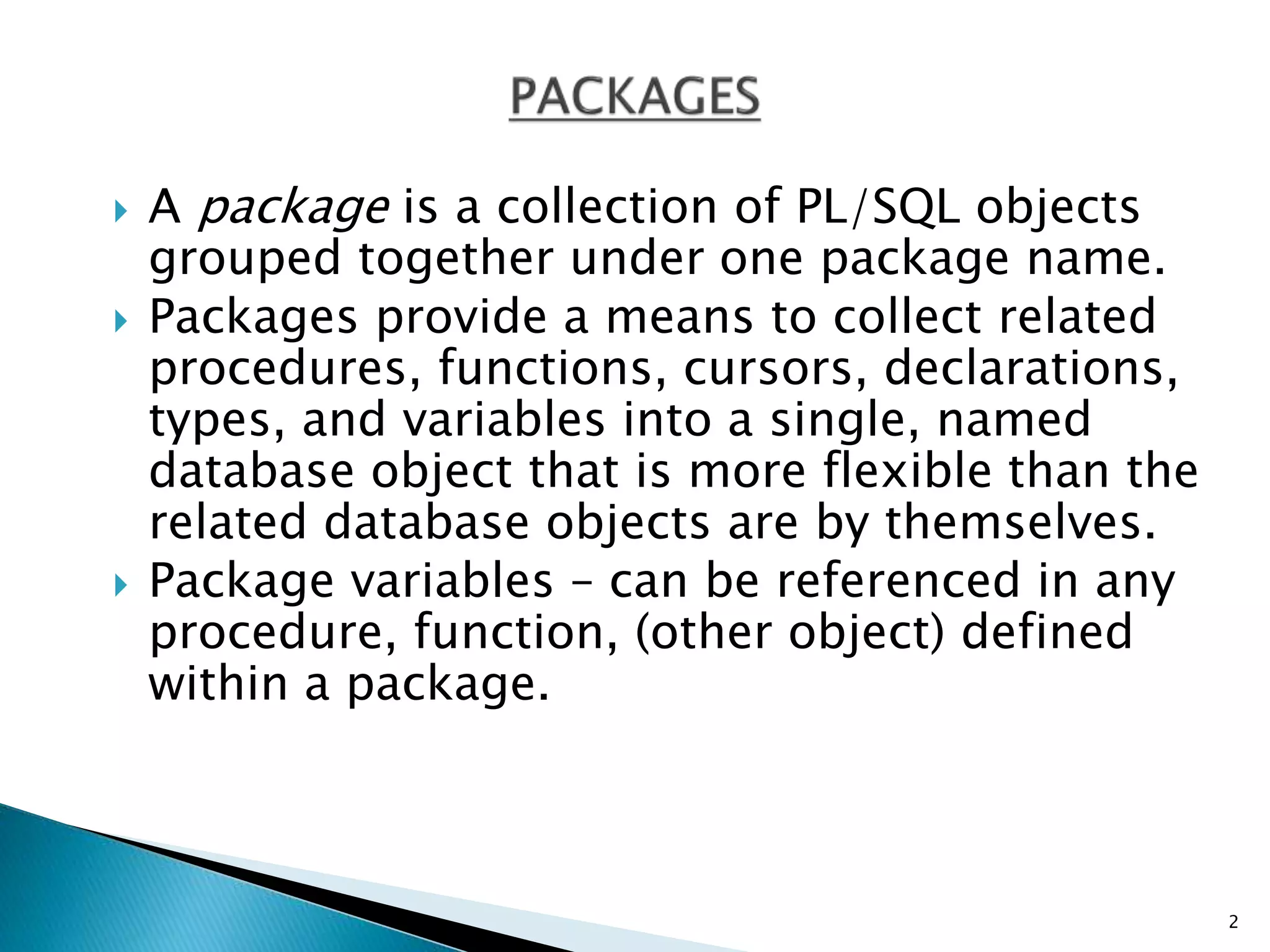
 A package is a collection of PL/SQL objects
grouped together under one package name.
 Packages provide a means to collect related
procedures, functions, cursors, declarations,
types, and variables into a single, named
database object that is more flexible than the
related database objects are by themselves.
 Package variables – can be referenced in any
procedure, function, (other object) defined
within a package.
2
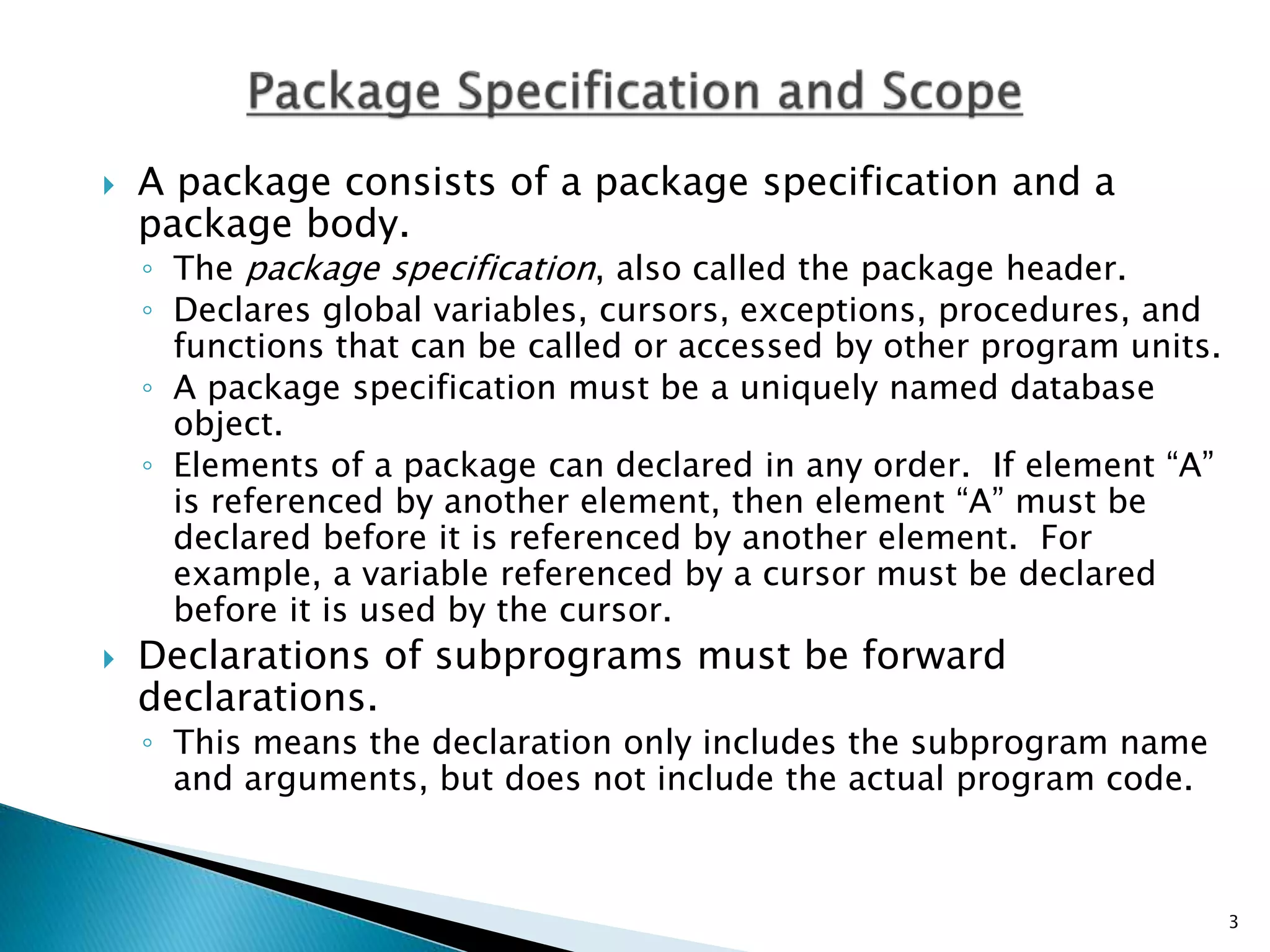
 A package consists of a package specification and a
package body.
◦ The package specification, also called the package header.
◦ Declares global variables, cursors, exceptions, procedures, and
functions that can be called or accessed by other program units.
◦ A package specification must be a uniquely named database
object.
◦ Elements of a package can declared in any order. If element “A”
is referenced by another element, then element “A” must be
declared before it is referenced by another element. For
example, a variable referenced by a cursor must be declared
before it is used by the cursor.
 Declarations of subprograms must be forward
declarations.
◦ This means the declaration only includes the subprogram name
and arguments, but does not include the actual program code.
3
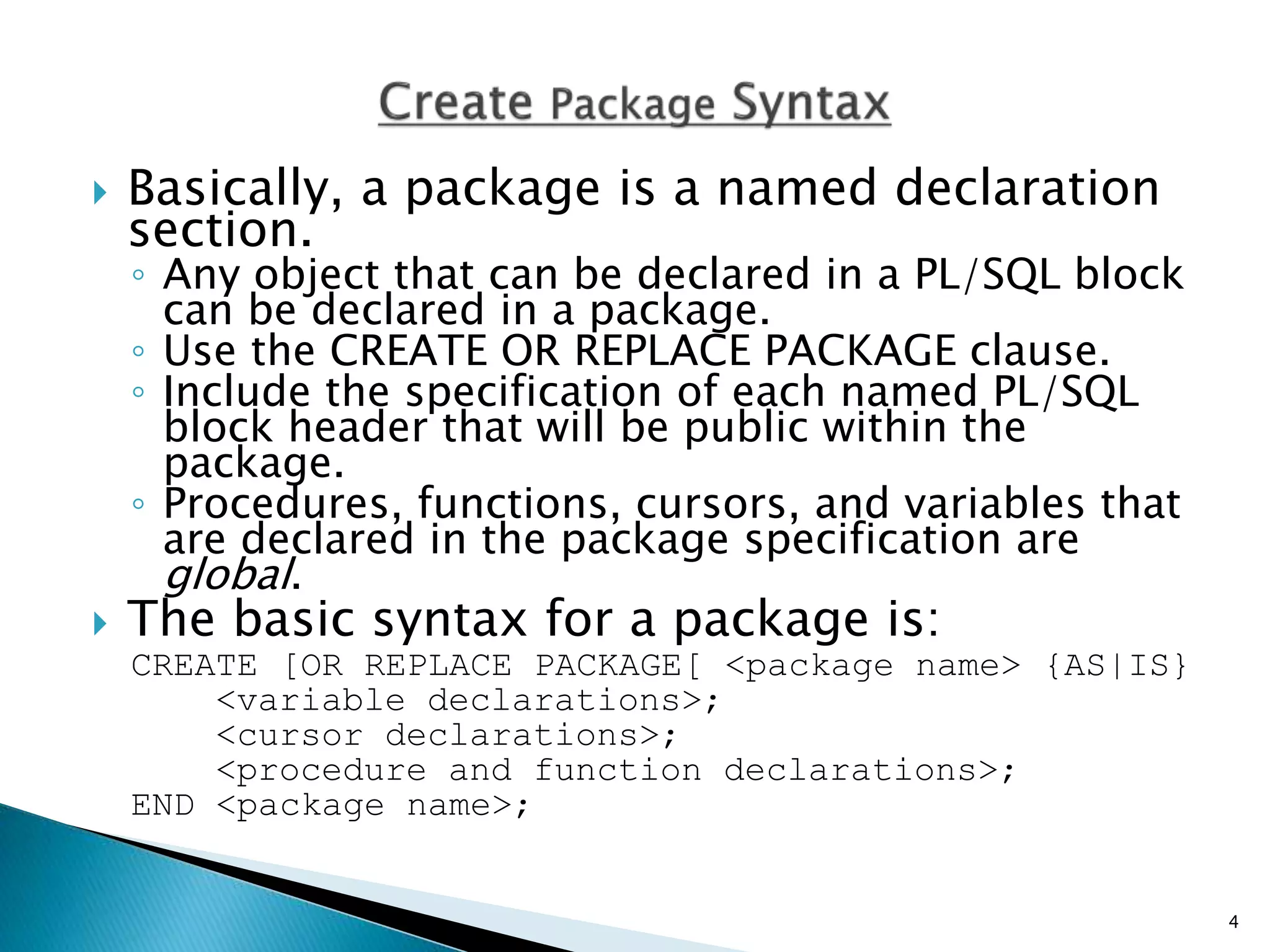
 Basically, a package is a named declaration
section.
◦ Any object that can be declared in a PL/SQL block
can be declared in a package.
◦ Use the CREATE OR REPLACE PACKAGE clause.
◦ Include the specification of each named PL/SQL
block header that will be public within the
package.
◦ Procedures, functions, cursors, and variables that
are declared in the package specification are
global.
 The basic syntax for a package is:
CREATE [OR REPLACE PACKAGE[ <package name> {AS|IS}
<variable declarations>;
<cursor declarations>;
<procedure and function declarations>;
END <package name>;
4
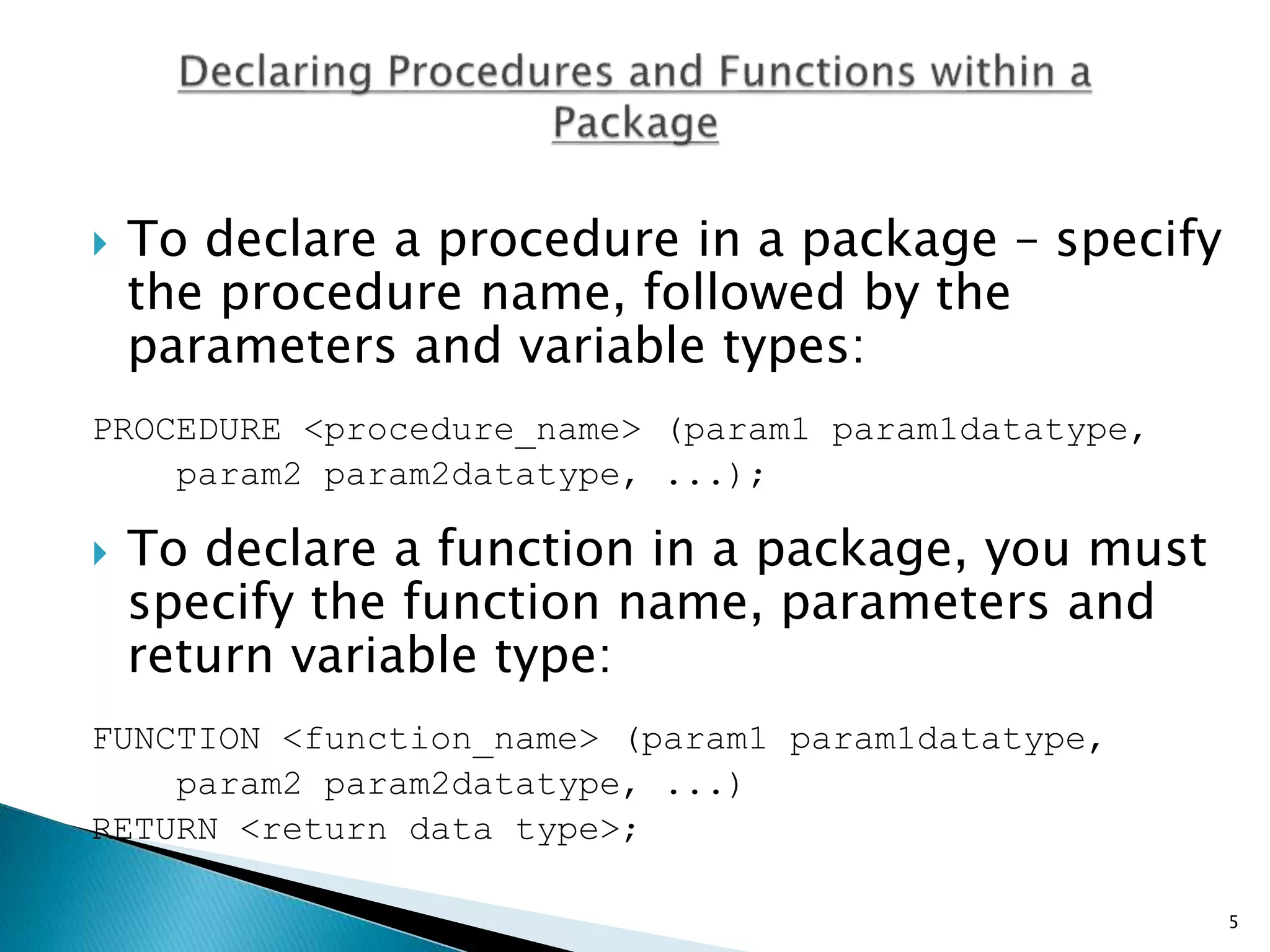
 To declare a procedure in a package – specify
the procedure name, followed by the
parameters and variable types:
PROCEDURE <procedure_name> (param1 param1datatype,
param2 param2datatype, ...);
 To declare a function in a package, you must
specify the function name, parameters and
return variable type:
FUNCTION <function_name> (param1 param1datatype,
param2 param2datatype, ...)
RETURN <return data type>;
5
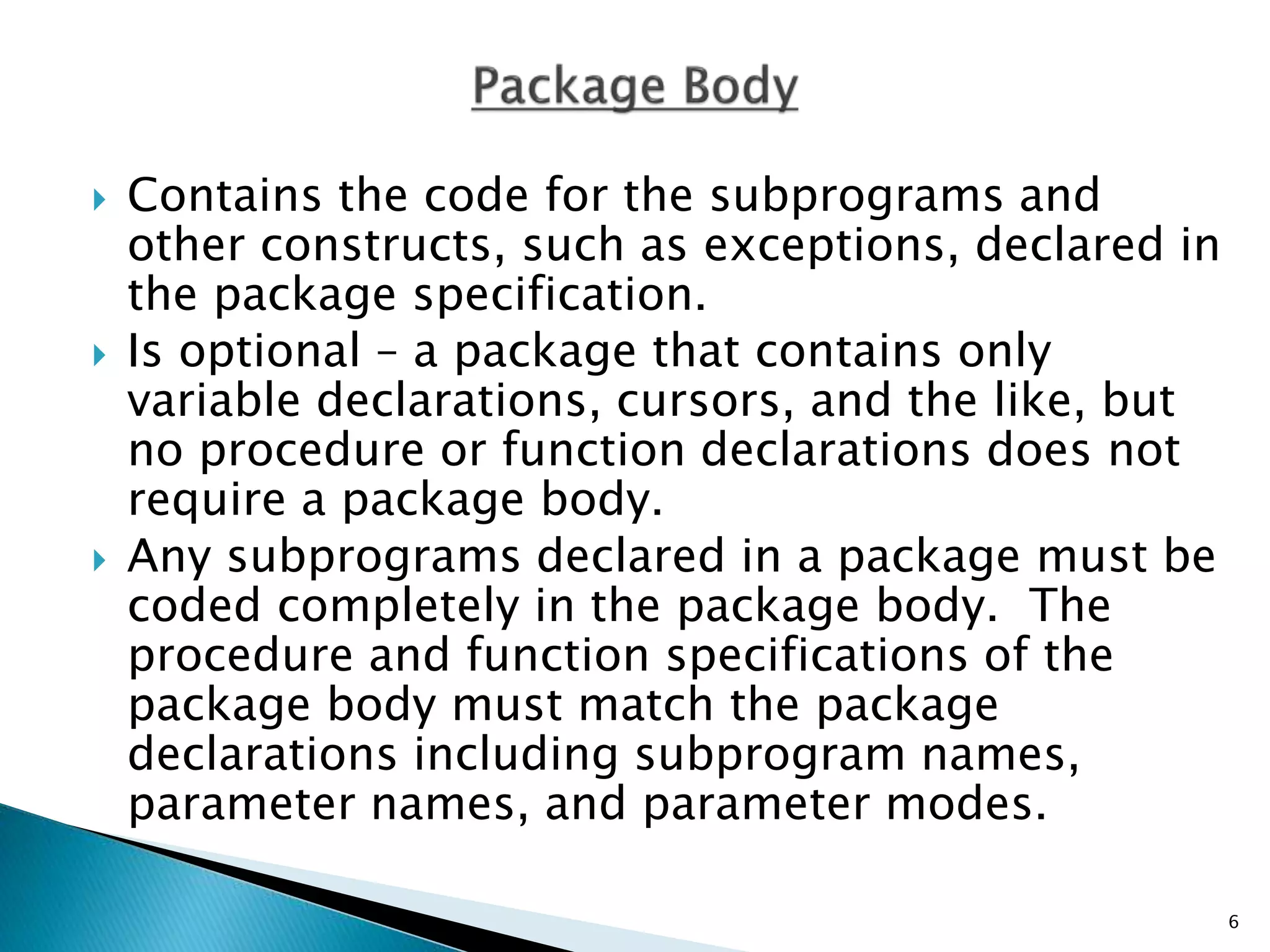
 Contains the code for the subprograms and
other constructs, such as exceptions, declared in
the package specification.
 Is optional – a package that contains only
variable declarations, cursors, and the like, but
no procedure or function declarations does not
require a package body.
 Any subprograms declared in a package must be
coded completely in the package body. The
procedure and function specifications of the
package body must match the package
declarations including subprogram names,
parameter names, and parameter modes.
6
 Use the CREATE OR REPLACE PACKAGE
BODY clause to create a package body.
The basic syntax is:
CREATE [OR REPLACE] PACKAGE BODY
<package name> AS
<cursor specifications>
<subprogram specifications and code>
END <package name>;
7
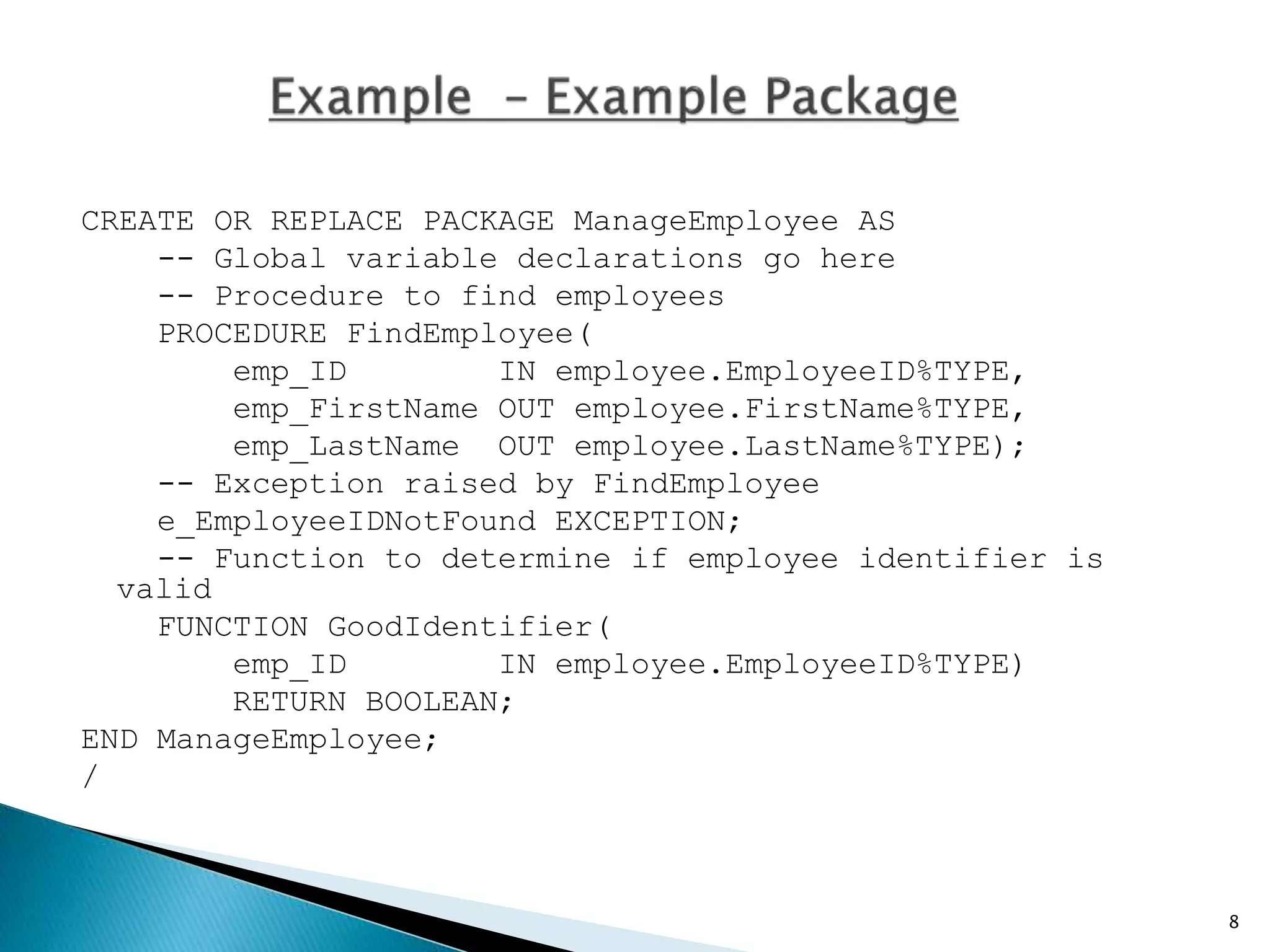
CREATE OR REPLACE PACKAGE ManageEmployee AS
-- Global variable declarations go here
-- Procedure to find employees
PROCEDURE FindEmployee(
emp_ID IN employee.EmployeeID%TYPE,
emp_FirstName OUT employee.FirstName%TYPE,
emp_LastName OUT employee.LastName%TYPE);
-- Exception raised by FindEmployee
e_EmployeeIDNotFound EXCEPTION;
-- Function to determine if employee identifier is
valid
FUNCTION GoodIdentifier(
emp_ID IN employee.EmployeeID%TYPE)
RETURN BOOLEAN;
END ManageEmployee;
/
8
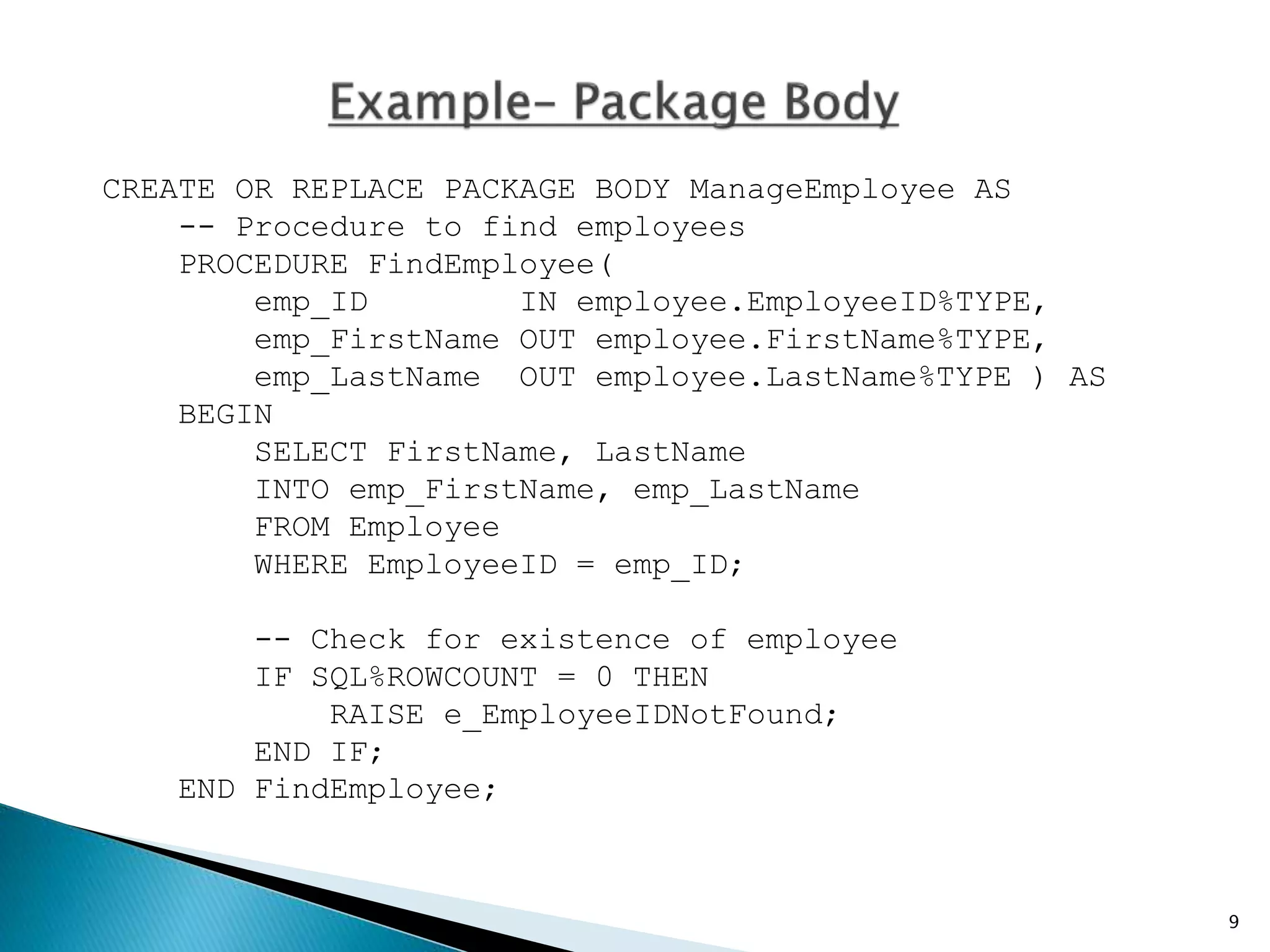
CREATE OR REPLACE PACKAGE BODY ManageEmployee AS
-- Procedure to find employees
PROCEDURE FindEmployee(
emp_ID IN employee.EmployeeID%TYPE,
emp_FirstName OUT employee.FirstName%TYPE,
emp_LastName OUT employee.LastName%TYPE ) AS
BEGIN
SELECT FirstName, LastName
INTO emp_FirstName, emp_LastName
FROM Employee
WHERE EmployeeID = emp_ID;
-- Check for existence of employee
IF SQL%ROWCOUNT = 0 THEN
RAISE e_EmployeeIDNotFound;
END IF;
END FindEmployee;
9
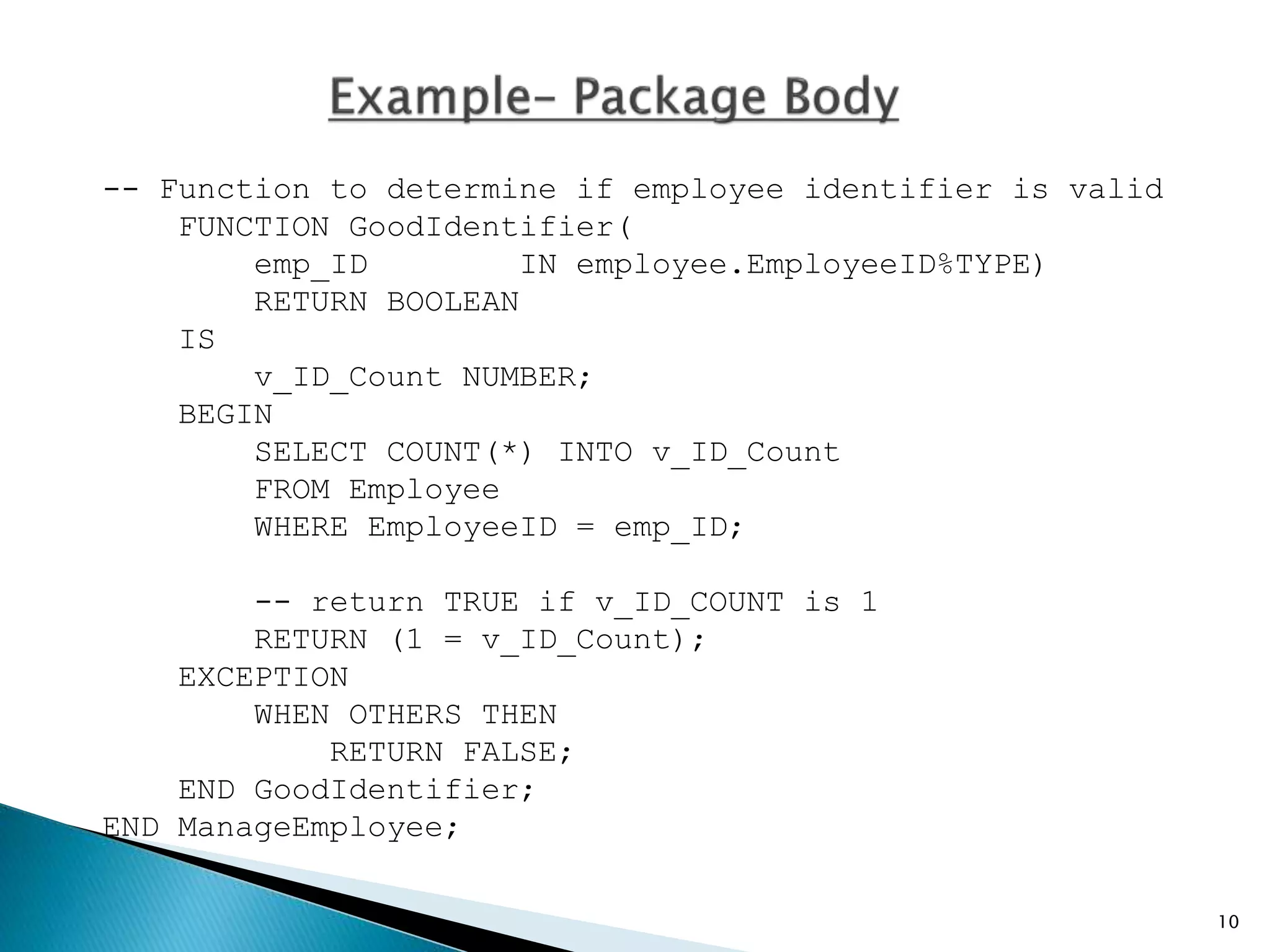
-- Function to determine if employee identifier is valid
FUNCTION GoodIdentifier(
emp_ID IN employee.EmployeeID%TYPE)
RETURN BOOLEAN
IS
v_ID_Count NUMBER;
BEGIN
SELECT COUNT(*) INTO v_ID_Count
FROM Employee
WHERE EmployeeID = emp_ID;
-- return TRUE if v_ID_COUNT is 1
RETURN (1 = v_ID_Count);
EXCEPTION
WHEN OTHERS THEN
RETURN FALSE;
END GoodIdentifier;
END ManageEmployee;
10
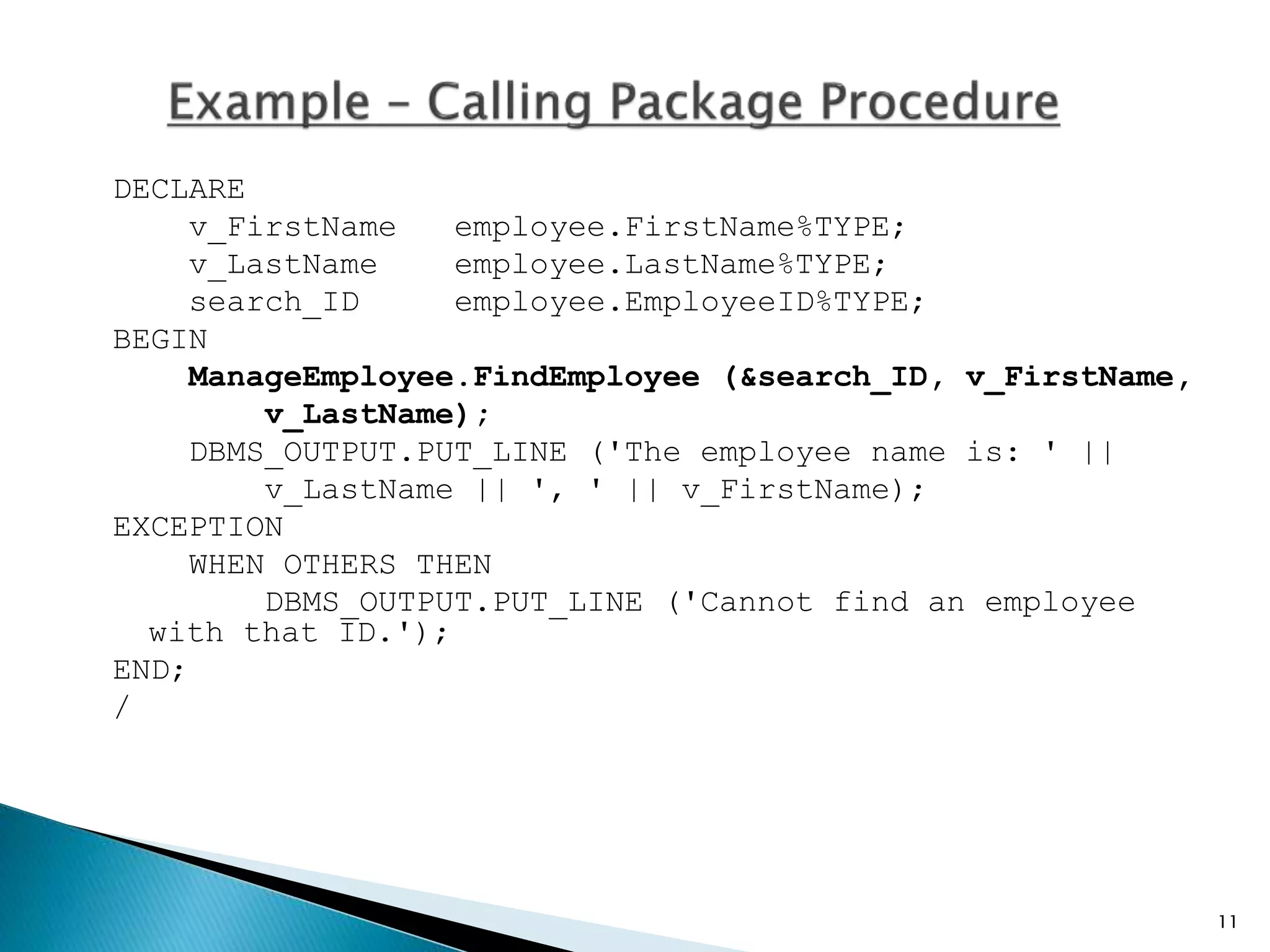
DECLARE
v_FirstName employee.FirstName%TYPE;
v_LastName employee.LastName%TYPE;
search_ID employee.EmployeeID%TYPE;
BEGIN
ManageEmployee.FindEmployee (&search_ID, v_FirstName,
v_LastName);
DBMS_OUTPUT.PUT_LINE ('The employee name is: ' ||
v_LastName || ', ' || v_FirstName);
EXCEPTION
WHEN OTHERS THEN
DBMS_OUTPUT.PUT_LINE ('Cannot find an employee
with that ID.');
END;
/
11
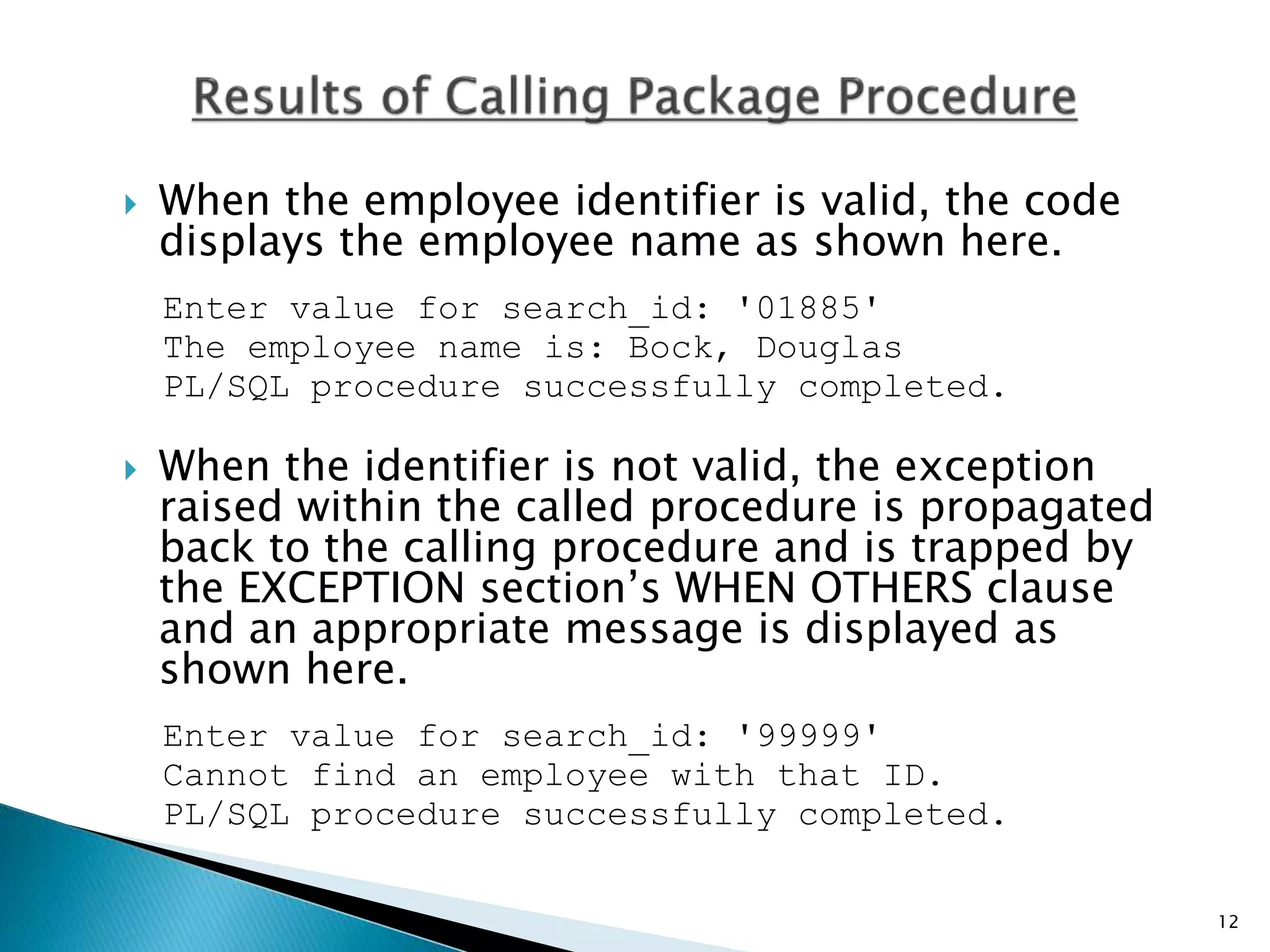
 When the employee identifier is valid, the code
displays the employee name as shown here.
Enter value for search_id: '01885'
The employee name is: Bock, Douglas
PL/SQL procedure successfully completed.
 When the identifier is not valid, the exception
raised within the called procedure is propagated
back to the calling procedure and is trapped by
the EXCEPTION section’s WHEN OTHERS clause
and an appropriate message is displayed as
shown here.
Enter value for search_id: '99999'
Cannot find an employee with that ID.
PL/SQL procedure successfully completed.
12
 A cursor variable can make a cursor dynamic so that it is
reusable and sharable among different procedures and
functions such as those created as part of a package.
 A cursor variable has data type REF CURSOR. It is like a
pointer in the C language, and it points to a query work
area where a result set is stored.
 First you must define a REF CURSOR type.
 Next, you define a cursor variable of that type. In this
general syntactic example, the <return_type> object
represents a row in a database table.
TYPE ref_type_name IS REF CURSOR
[RETURN <return_type>];
 This provides an example of declaring a cursor variable
that can be used to process data rows for the equipment
table of the Madison Hospital database.
DECLARE
TYPE equipment_Type IS REF CURSOR
RETURN equipment%ROWTYPE;
cv_Equipment IN OUT equipment_Type;
13
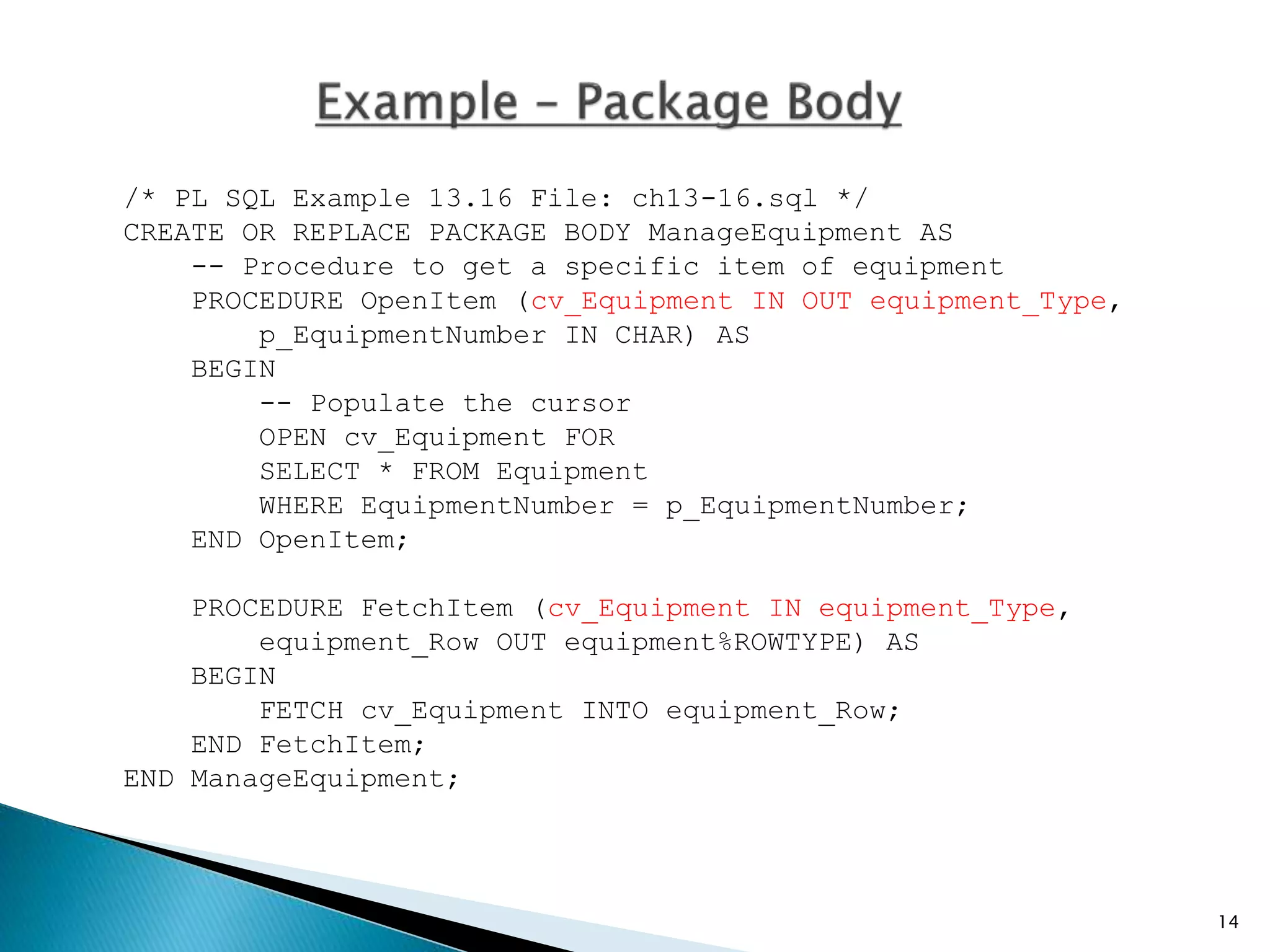
/* PL SQL Example 13.16 File: ch13-16.sql */
CREATE OR REPLACE PACKAGE BODY ManageEquipment AS
-- Procedure to get a specific item of equipment
PROCEDURE OpenItem (cv_Equipment IN OUT equipment_Type,
p_EquipmentNumber IN CHAR) AS
BEGIN
-- Populate the cursor
OPEN cv_Equipment FOR
SELECT * FROM Equipment
WHERE EquipmentNumber = p_EquipmentNumber;
END OpenItem;
PROCEDURE FetchItem (cv_Equipment IN equipment_Type,
equipment_Row OUT equipment%ROWTYPE) AS
BEGIN
FETCH cv_Equipment INTO equipment_Row;
END FetchItem;
END ManageEquipment;
14
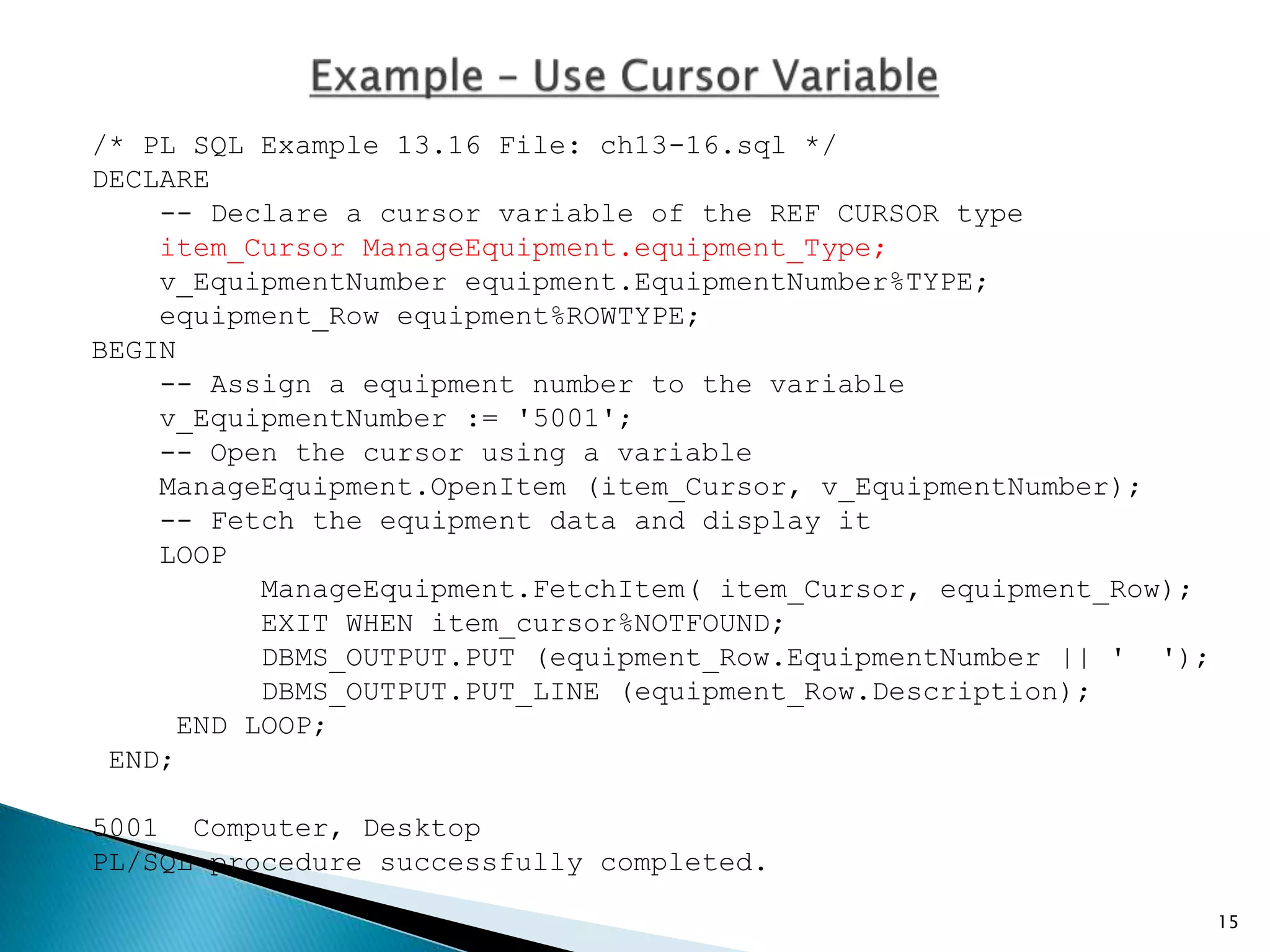
/* PL SQL Example 13.16 File: ch13-16.sql */
DECLARE
-- Declare a cursor variable of the REF CURSOR type
item_Cursor ManageEquipment.equipment_Type;
v_EquipmentNumber equipment.EquipmentNumber%TYPE;
equipment_Row equipment%ROWTYPE;
BEGIN
-- Assign a equipment number to the variable
v_EquipmentNumber := '5001';
-- Open the cursor using a variable
ManageEquipment.OpenItem (item_Cursor, v_EquipmentNumber);
-- Fetch the equipment data and display it
LOOP
ManageEquipment.FetchItem( item_Cursor, equipment_Row);
EXIT WHEN item_cursor%NOTFOUND;
DBMS_OUTPUT.PUT (equipment_Row.EquipmentNumber || ' ');
DBMS_OUTPUT.PUT_LINE (equipment_Row.Description);
END LOOP;
END;
5001 Computer, Desktop
PL/SQL procedure successfully completed.
15

Packages in PL/SQL

  • 1.
    Prof. Neeraj Bhargava PoojaDixit Department of Computer Science School of Engineering & System Science MDS, University Ajmer, Rajasthan, India 1
  • 2.
     A packageis a collection of PL/SQL objects grouped together under one package name.  Packages provide a means to collect related procedures, functions, cursors, declarations, types, and variables into a single, named database object that is more flexible than the related database objects are by themselves.  Package variables – can be referenced in any procedure, function, (other object) defined within a package. 2
  • 3.
     A packageconsists of a package specification and a package body. ◦ The package specification, also called the package header. ◦ Declares global variables, cursors, exceptions, procedures, and functions that can be called or accessed by other program units. ◦ A package specification must be a uniquely named database object. ◦ Elements of a package can declared in any order. If element “A” is referenced by another element, then element “A” must be declared before it is referenced by another element. For example, a variable referenced by a cursor must be declared before it is used by the cursor.  Declarations of subprograms must be forward declarations. ◦ This means the declaration only includes the subprogram name and arguments, but does not include the actual program code. 3
  • 4.
     Basically, apackage is a named declaration section. ◦ Any object that can be declared in a PL/SQL block can be declared in a package. ◦ Use the CREATE OR REPLACE PACKAGE clause. ◦ Include the specification of each named PL/SQL block header that will be public within the package. ◦ Procedures, functions, cursors, and variables that are declared in the package specification are global.  The basic syntax for a package is: CREATE [OR REPLACE PACKAGE[ <package name> {AS|IS} <variable declarations>; <cursor declarations>; <procedure and function declarations>; END <package name>; 4
  • 5.
     To declarea procedure in a package – specify the procedure name, followed by the parameters and variable types: PROCEDURE <procedure_name> (param1 param1datatype, param2 param2datatype, ...);  To declare a function in a package, you must specify the function name, parameters and return variable type: FUNCTION <function_name> (param1 param1datatype, param2 param2datatype, ...) RETURN <return data type>; 5
  • 6.
     Contains thecode for the subprograms and other constructs, such as exceptions, declared in the package specification.  Is optional – a package that contains only variable declarations, cursors, and the like, but no procedure or function declarations does not require a package body.  Any subprograms declared in a package must be coded completely in the package body. The procedure and function specifications of the package body must match the package declarations including subprogram names, parameter names, and parameter modes. 6
  • 7.
     Use theCREATE OR REPLACE PACKAGE BODY clause to create a package body. The basic syntax is: CREATE [OR REPLACE] PACKAGE BODY <package name> AS <cursor specifications> <subprogram specifications and code> END <package name>; 7
  • 8.
    CREATE OR REPLACEPACKAGE ManageEmployee AS -- Global variable declarations go here -- Procedure to find employees PROCEDURE FindEmployee( emp_ID IN employee.EmployeeID%TYPE, emp_FirstName OUT employee.FirstName%TYPE, emp_LastName OUT employee.LastName%TYPE); -- Exception raised by FindEmployee e_EmployeeIDNotFound EXCEPTION; -- Function to determine if employee identifier is valid FUNCTION GoodIdentifier( emp_ID IN employee.EmployeeID%TYPE) RETURN BOOLEAN; END ManageEmployee; / 8
  • 9.
    CREATE OR REPLACEPACKAGE BODY ManageEmployee AS -- Procedure to find employees PROCEDURE FindEmployee( emp_ID IN employee.EmployeeID%TYPE, emp_FirstName OUT employee.FirstName%TYPE, emp_LastName OUT employee.LastName%TYPE ) AS BEGIN SELECT FirstName, LastName INTO emp_FirstName, emp_LastName FROM Employee WHERE EmployeeID = emp_ID; -- Check for existence of employee IF SQL%ROWCOUNT = 0 THEN RAISE e_EmployeeIDNotFound; END IF; END FindEmployee; 9
  • 10.
    -- Function todetermine if employee identifier is valid FUNCTION GoodIdentifier( emp_ID IN employee.EmployeeID%TYPE) RETURN BOOLEAN IS v_ID_Count NUMBER; BEGIN SELECT COUNT(*) INTO v_ID_Count FROM Employee WHERE EmployeeID = emp_ID; -- return TRUE if v_ID_COUNT is 1 RETURN (1 = v_ID_Count); EXCEPTION WHEN OTHERS THEN RETURN FALSE; END GoodIdentifier; END ManageEmployee; 10
  • 11.
    DECLARE v_FirstName employee.FirstName%TYPE; v_LastName employee.LastName%TYPE; search_IDemployee.EmployeeID%TYPE; BEGIN ManageEmployee.FindEmployee (&search_ID, v_FirstName, v_LastName); DBMS_OUTPUT.PUT_LINE ('The employee name is: ' || v_LastName || ', ' || v_FirstName); EXCEPTION WHEN OTHERS THEN DBMS_OUTPUT.PUT_LINE ('Cannot find an employee with that ID.'); END; / 11
  • 12.
     When theemployee identifier is valid, the code displays the employee name as shown here. Enter value for search_id: '01885' The employee name is: Bock, Douglas PL/SQL procedure successfully completed.  When the identifier is not valid, the exception raised within the called procedure is propagated back to the calling procedure and is trapped by the EXCEPTION section’s WHEN OTHERS clause and an appropriate message is displayed as shown here. Enter value for search_id: '99999' Cannot find an employee with that ID. PL/SQL procedure successfully completed. 12
  • 13.
     A cursorvariable can make a cursor dynamic so that it is reusable and sharable among different procedures and functions such as those created as part of a package.  A cursor variable has data type REF CURSOR. It is like a pointer in the C language, and it points to a query work area where a result set is stored.  First you must define a REF CURSOR type.  Next, you define a cursor variable of that type. In this general syntactic example, the <return_type> object represents a row in a database table. TYPE ref_type_name IS REF CURSOR [RETURN <return_type>];  This provides an example of declaring a cursor variable that can be used to process data rows for the equipment table of the Madison Hospital database. DECLARE TYPE equipment_Type IS REF CURSOR RETURN equipment%ROWTYPE; cv_Equipment IN OUT equipment_Type; 13
  • 14.
    /* PL SQLExample 13.16 File: ch13-16.sql */ CREATE OR REPLACE PACKAGE BODY ManageEquipment AS -- Procedure to get a specific item of equipment PROCEDURE OpenItem (cv_Equipment IN OUT equipment_Type, p_EquipmentNumber IN CHAR) AS BEGIN -- Populate the cursor OPEN cv_Equipment FOR SELECT * FROM Equipment WHERE EquipmentNumber = p_EquipmentNumber; END OpenItem; PROCEDURE FetchItem (cv_Equipment IN equipment_Type, equipment_Row OUT equipment%ROWTYPE) AS BEGIN FETCH cv_Equipment INTO equipment_Row; END FetchItem; END ManageEquipment; 14
  • 15.
    /* PL SQLExample 13.16 File: ch13-16.sql */ DECLARE -- Declare a cursor variable of the REF CURSOR type item_Cursor ManageEquipment.equipment_Type; v_EquipmentNumber equipment.EquipmentNumber%TYPE; equipment_Row equipment%ROWTYPE; BEGIN -- Assign a equipment number to the variable v_EquipmentNumber := '5001'; -- Open the cursor using a variable ManageEquipment.OpenItem (item_Cursor, v_EquipmentNumber); -- Fetch the equipment data and display it LOOP ManageEquipment.FetchItem( item_Cursor, equipment_Row); EXIT WHEN item_cursor%NOTFOUND; DBMS_OUTPUT.PUT (equipment_Row.EquipmentNumber || ' '); DBMS_OUTPUT.PUT_LINE (equipment_Row.Description); END LOOP; END; 5001 Computer, Desktop PL/SQL procedure successfully completed. 15