 Procedural Language – SQL
 An extension to SQL with design features of
programming languages (procedural and object
oriented)
 PL/SQL and Java are both supported as internal
host languages within Oracle products.
 Acts as host language for stored procedures
and triggers.
 Provides the ability to add middle tier business
logic to client/server applications.
 Provides Portability of code from one
environment to another
 Improves performance of multi-query
transactions.
 Provides error handling
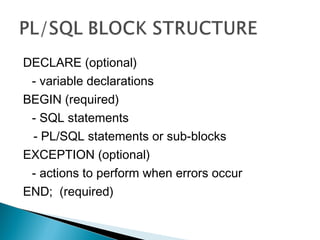
DECLARE (optional)
- variable declarations
BEGIN (required)
- SQL statements
- PL/SQL statements or sub-blocks
EXCEPTION (optional)
- actions to perform when errors occur
END; (required)
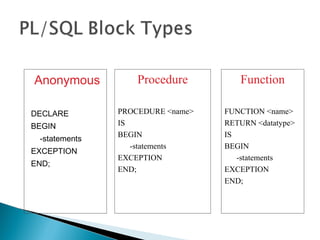
Anonymous
DECLARE
BEGIN
-statements
EXCEPTION
END;
Procedure
PROCEDURE <name>
IS
BEGIN
-statements
EXCEPTION
END;
Function
FUNCTION <name>
RETURN <datatype>
IS
BEGIN
-statements
EXCEPTION
END;
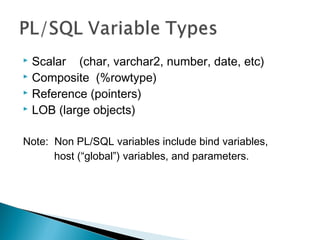
 Scalar (char, varchar2, number, date, etc)
 Composite (%rowtype)
 Reference (pointers)
 LOB (large objects)
Note: Non PL/SQL variables include bind variables,
host (“global”) variables, and parameters.
 Two variables can have the same name if they are
in different blocks (bad idea)
 The variable name should not be the same as any
table column names used in the block.
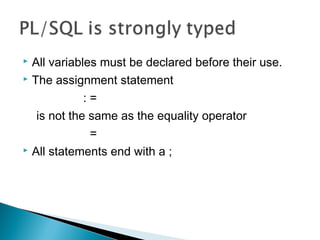
 All variables must be declared before their use.
 The assignment statement
: =
is not the same as the equality operator
=
 All statements end with a ;
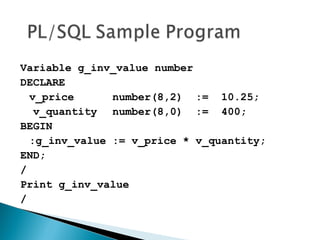
Variable g_inv_value number
DECLARE
v_price number(8,2) := 10.25;
v_quantity number(8,0) := 400;
BEGIN
:g_inv_value := v_price * v_quantity;
END;
/
Print g_inv_value
/
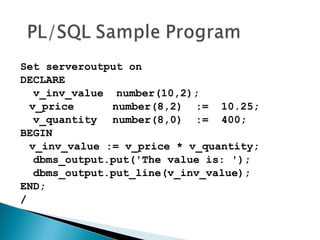
Set serveroutput on
DECLARE
v_inv_value number(10,2);
v_price number(8,2) := 10.25;
v_quantity number(8,0) := 400;
BEGIN
v_inv_value := v_price * v_quantity;
dbms_output.put('The value is: ');
dbms_output.put_line(v_inv_value);
END;
/
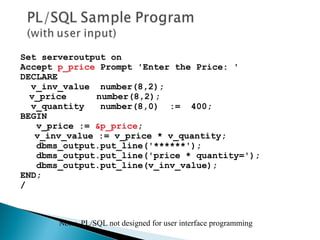
Set serveroutput on
Accept p_price Prompt 'Enter the Price: '
DECLARE
v_inv_value number(8,2);
v_price number(8,2);
v_quantity number(8,0) := 400;
BEGIN
v_price := &p_price;
v_inv_value := v_price * v_quantity;
dbms_output.put_line('******');
dbms_output.put_line('price * quantity=');
dbms_output.put_line(v_inv_value);
END;
/
Note: PL/SQL not designed for user interface programming
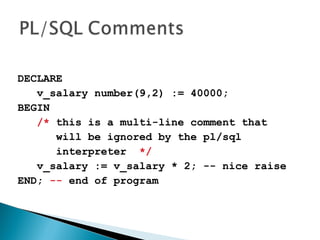
DECLARE
v_salary number(9,2) := 40000;
BEGIN
/* this is a multi-line comment that
will be ignored by the pl/sql
interpreter */
v_salary := v_salary * 2; -- nice raise
END; -- end of program
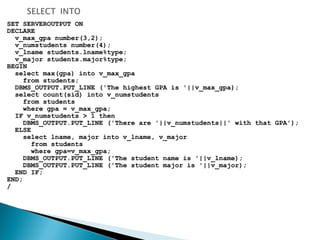
SET SERVEROUTPUT ON
DECLARE
v_max_gpa number(3,2);
v_numstudents number(4);
v_lname students.lname%type;
v_major students.major%type;
BEGIN
select max(gpa) into v_max_gpa
from students;
DBMS_OUTPUT.PUT_LINE ('The highest GPA is '||v_max_gpa);
select count(sid) into v_numstudents
from students
where gpa = v_max_gpa;
IF v_numstudents > 1 then
DBMS_OUTPUT.PUT_LINE ('There are '||v_numstudents||' with that GPA');
ELSE
select lname, major into v_lname, v_major
from students
where gpa=v_max_gpa;
DBMS_OUTPUT.PUT_LINE ('The student name is '||v_lname);
DBMS_OUTPUT.PUT_LINE ('The student major is '||v_major);
END IF;
END;
/
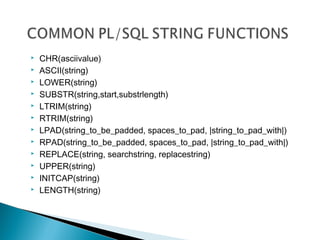
 CHR(asciivalue)
 ASCII(string)
 LOWER(string)
 SUBSTR(string,start,substrlength)
 LTRIM(string)
 RTRIM(string)
 LPAD(string_to_be_padded, spaces_to_pad, |string_to_pad_with|)
 RPAD(string_to_be_padded, spaces_to_pad, |string_to_pad_with|)
 REPLACE(string, searchstring, replacestring)
 UPPER(string)
 INITCAP(string)
 LENGTH(string)
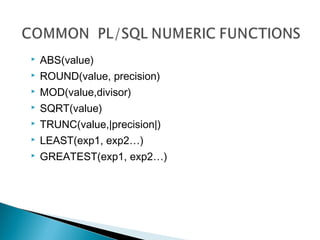
 ABS(value)
 ROUND(value, precision)
 MOD(value,divisor)
 SQRT(value)
 TRUNC(value,|precision|)
 LEAST(exp1, exp2…)
 GREATEST(exp1, exp2…)
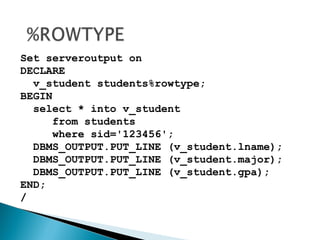
Set serveroutput on
DECLARE
v_student students%rowtype;
BEGIN
select * into v_student
from students
where sid='123456';
DBMS_OUTPUT.PUT_LINE (v_student.lname);
DBMS_OUTPUT.PUT_LINE (v_student.major);
DBMS_OUTPUT.PUT_LINE (v_student.gpa);
END;
/
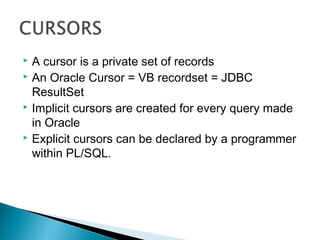
 A cursor is a private set of records
 An Oracle Cursor = VB recordset = JDBC
ResultSet
 Implicit cursors are created for every query made
in Oracle
 Explicit cursors can be declared by a programmer
within PL/SQL.
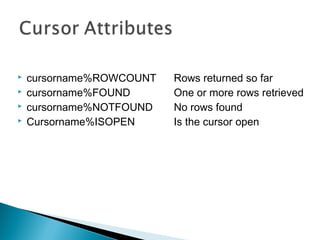
 cursorname%ROWCOUNT Rows returned so far
 cursorname%FOUND One or more rows retrieved
 cursorname%NOTFOUND No rows found
 Cursorname%ISOPEN Is the cursor open
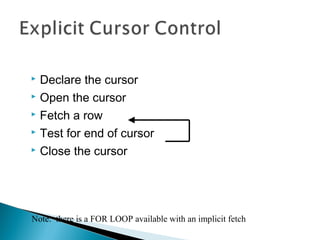
 Declare the cursor
 Open the cursor
 Fetch a row
 Test for end of cursor
 Close the cursor
Note: there is a FOR LOOP available with an implicit fetch
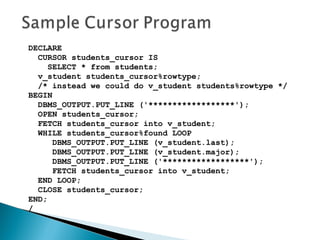
DECLARE
CURSOR students_cursor IS
SELECT * from students;
v_student students_cursor%rowtype;
/* instead we could do v_student students%rowtype */
BEGIN
DBMS_OUTPUT.PUT_LINE ('******************');
OPEN students_cursor;
FETCH students_cursor into v_student;
WHILE students_cursor%found LOOP
DBMS_OUTPUT.PUT_LINE (v_student.last);
DBMS_OUTPUT.PUT_LINE (v_student.major);
DBMS_OUTPUT.PUT_LINE ('******************');
FETCH students_cursor into v_student;
END LOOP;
CLOSE students_cursor;
END;
/
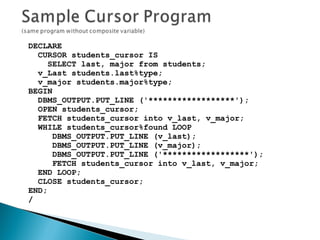
DECLARE
CURSOR students_cursor IS
SELECT last, major from students;
v_Last students.last%type;
v_major students.major%type;
BEGIN
DBMS_OUTPUT.PUT_LINE ('******************');
OPEN students_cursor;
FETCH students_cursor into v_last, v_major;
WHILE students_cursor%found LOOP
DBMS_OUTPUT.PUT_LINE (v_last);
DBMS_OUTPUT.PUT_LINE (v_major);
DBMS_OUTPUT.PUT_LINE ('******************');
FETCH students_cursor into v_last, v_major;
END LOOP;
CLOSE students_cursor;
END;
/
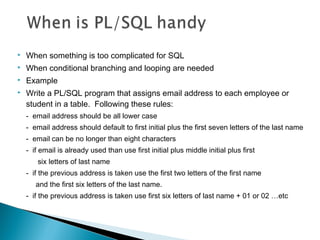
 When something is too complicated for SQL
 When conditional branching and looping are needed
 Example
 Write a PL/SQL program that assigns email address to each employee or
student in a table. Following these rules:
- email address should be all lower case
- email address should default to first initial plus the first seven letters of the last name
- email can be no longer than eight characters
- if email is already used than use first initial plus middle initial plus first
six letters of last name
- if the previous address is taken use the first two letters of the first name
and the first six letters of the last name.
- if the previous address is taken use first six letters of last name + 01 or 02 …etc
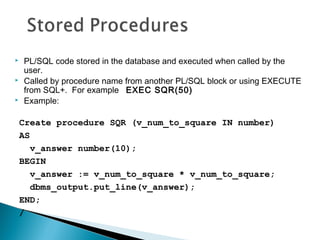
 PL/SQL code stored in the database and executed when called by the
user.
 Called by procedure name from another PL/SQL block or using EXECUTE
from SQL+. For example EXEC SQR(50)
 Example:
Create procedure SQR (v_num_to_square IN number)
AS
v_answer number(10);
BEGIN
v_answer := v_num_to_square * v_num_to_square;
dbms_output.put_line(v_answer);
END;
/
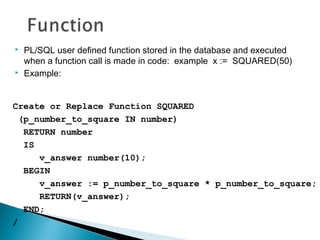
 PL/SQL user defined function stored in the database and executed
when a function call is made in code: example x := SQUARED(50)
 Example:
Create or Replace Function SQUARED
(p_number_to_square IN number)
RETURN number
IS
v_answer number(10);
BEGIN
v_answer := p_number_to_square * p_number_to_square;
RETURN(v_answer);
END;
/
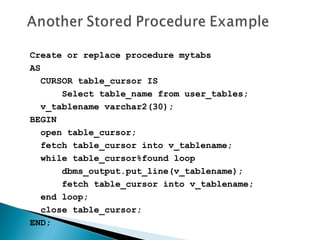
Create or replace procedure mytabs
AS
CURSOR table_cursor IS
Select table_name from user_tables;
v_tablename varchar2(30);
BEGIN
open table_cursor;
fetch table_cursor into v_tablename;
while table_cursor%found loop
dbms_output.put_line(v_tablename);
fetch table_cursor into v_tablename;
end loop;
close table_cursor;
END;
 PL/SQL code executed automatically in response to a database event,
typically DML.
 Like other stored procedures, triggers are stored in the database.
 Often used to:
◦ enforce complex constraints, especially multi-table constraints. Financial
posting is an example of this.
◦ Trigger related actions
◦ implement auditing “logs”
◦ pop a sequence when creating token keys
 Triggers do not issue transaction control statements (such as commit).
Triggers are part of the SQL transaction that invoked them.
 USER_TRIGGERS provides a data dictionary view of triggers.
CREATE OR REPLACE TRIGGER <trigger_name>
[BEFORE/AFTER][DELETE/INSERT/UPDATE of <column_name |, column_name… |>
ON <table_name>
|FOR EACH ROW|
|WHEN <triggering condition>|
|DECLARE|
BEGIN
trigger statements
…………
END;
To delete a trigger use:
DROP TRIGGER <trigger_name>;
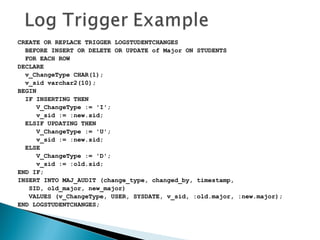
CREATE OR REPLACE TRIGGER LOGSTUDENTCHANGES
BEFORE INSERT OR DELETE OR UPDATE of Major ON STUDENTS
FOR EACH ROW
DECLARE
v_ChangeType CHAR(1);
v_sid varchar2(10);
BEGIN
IF INSERTING THEN
V_ChangeType := 'I';
v_sid := :new.sid;
ELSIF UPDATING THEN
V_ChangeType := 'U';
v_sid := :new.sid;
ELSE
V_ChangeType := 'D';
v_sid := :old.sid;
END IF;
INSERT INTO MAJ_AUDIT (change_type, changed_by, timestamp,
SID, old_major, new_major)
VALUES (v_ChangeType, USER, SYSDATE, v_sid, :old.major, :new.major);
END LOGSTUDENTCHANGES;
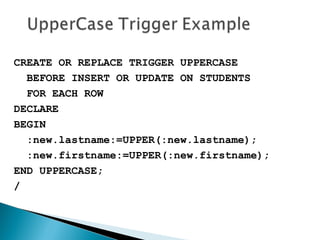
CREATE OR REPLACE TRIGGER UPPERCASE
BEFORE INSERT OR UPDATE ON STUDENTS
FOR EACH ROW
DECLARE
BEGIN
:new.lastname:=UPPER(:new.lastname);
:new.firstname:=UPPER(:new.firstname);
END UPPERCASE;
/
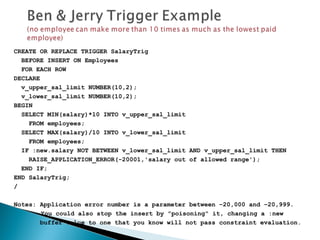
CREATE OR REPLACE TRIGGER SalaryTrig
BEFORE INSERT ON Employees
FOR EACH ROW
DECLARE
v_upper_sal_limit NUMBER(10,2);
v_lower_sal_limit NUMBER(10,2);
BEGIN
SELECT MIN(salary)*10 INTO v_upper_sal_limit
FROM employees;
SELECT MAX(salary)/10 INTO v_lower_sal_limit
FROM employees;
IF :new.salary NOT BETWEEN v_lower_sal_limit AND v_upper_sal_limit THEN
RAISE_APPLICATION_ERROR(-20001,'salary out of allowed range');
END IF;
END SalaryTrig;
/
Notes: Application error number is a parameter between –20,000 and –20,999.
You could also stop the insert by "poisoning" it, changing a :new
buffer value to one that you know will not pass constraint evaluation.
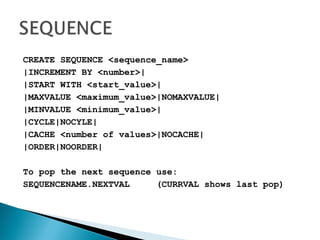
CREATE SEQUENCE <sequence_name>
|INCREMENT BY <number>|
|START WITH <start_value>|
|MAXVALUE <maximum_value>|NOMAXVALUE|
|MINVALUE <minimum_value>|
|CYCLE|NOCYLE|
|CACHE <number of values>|NOCACHE|
|ORDER|NOORDER|
To pop the next sequence use:
SEQUENCENAME.NEXTVAL (CURRVAL shows last pop)

PLSQL

  • 2.
     Procedural Language– SQL  An extension to SQL with design features of programming languages (procedural and object oriented)  PL/SQL and Java are both supported as internal host languages within Oracle products.
  • 3.
     Acts ashost language for stored procedures and triggers.  Provides the ability to add middle tier business logic to client/server applications.  Provides Portability of code from one environment to another  Improves performance of multi-query transactions.  Provides error handling
  • 4.
    DECLARE (optional) - variabledeclarations BEGIN (required) - SQL statements - PL/SQL statements or sub-blocks EXCEPTION (optional) - actions to perform when errors occur END; (required)
  • 5.
  • 6.
     Scalar (char,varchar2, number, date, etc)  Composite (%rowtype)  Reference (pointers)  LOB (large objects) Note: Non PL/SQL variables include bind variables, host (“global”) variables, and parameters.
  • 7.
     Two variablescan have the same name if they are in different blocks (bad idea)  The variable name should not be the same as any table column names used in the block.
  • 8.
     All variablesmust be declared before their use.  The assignment statement : = is not the same as the equality operator =  All statements end with a ;
  • 9.
    Variable g_inv_value number DECLARE v_pricenumber(8,2) := 10.25; v_quantity number(8,0) := 400; BEGIN :g_inv_value := v_price * v_quantity; END; / Print g_inv_value /
  • 10.
    Set serveroutput on DECLARE v_inv_valuenumber(10,2); v_price number(8,2) := 10.25; v_quantity number(8,0) := 400; BEGIN v_inv_value := v_price * v_quantity; dbms_output.put('The value is: '); dbms_output.put_line(v_inv_value); END; /
  • 11.
    Set serveroutput on Acceptp_price Prompt 'Enter the Price: ' DECLARE v_inv_value number(8,2); v_price number(8,2); v_quantity number(8,0) := 400; BEGIN v_price := &p_price; v_inv_value := v_price * v_quantity; dbms_output.put_line('******'); dbms_output.put_line('price * quantity='); dbms_output.put_line(v_inv_value); END; / Note: PL/SQL not designed for user interface programming
  • 12.
    DECLARE v_salary number(9,2) :=40000; BEGIN /* this is a multi-line comment that will be ignored by the pl/sql interpreter */ v_salary := v_salary * 2; -- nice raise END; -- end of program
  • 13.
    SET SERVEROUTPUT ON DECLARE v_max_gpanumber(3,2); v_numstudents number(4); v_lname students.lname%type; v_major students.major%type; BEGIN select max(gpa) into v_max_gpa from students; DBMS_OUTPUT.PUT_LINE ('The highest GPA is '||v_max_gpa); select count(sid) into v_numstudents from students where gpa = v_max_gpa; IF v_numstudents > 1 then DBMS_OUTPUT.PUT_LINE ('There are '||v_numstudents||' with that GPA'); ELSE select lname, major into v_lname, v_major from students where gpa=v_max_gpa; DBMS_OUTPUT.PUT_LINE ('The student name is '||v_lname); DBMS_OUTPUT.PUT_LINE ('The student major is '||v_major); END IF; END; /
  • 14.
     CHR(asciivalue)  ASCII(string) LOWER(string)  SUBSTR(string,start,substrlength)  LTRIM(string)  RTRIM(string)  LPAD(string_to_be_padded, spaces_to_pad, |string_to_pad_with|)  RPAD(string_to_be_padded, spaces_to_pad, |string_to_pad_with|)  REPLACE(string, searchstring, replacestring)  UPPER(string)  INITCAP(string)  LENGTH(string)
  • 15.
     ABS(value)  ROUND(value,precision)  MOD(value,divisor)  SQRT(value)  TRUNC(value,|precision|)  LEAST(exp1, exp2…)  GREATEST(exp1, exp2…)
  • 16.
    Set serveroutput on DECLARE v_studentstudents%rowtype; BEGIN select * into v_student from students where sid='123456'; DBMS_OUTPUT.PUT_LINE (v_student.lname); DBMS_OUTPUT.PUT_LINE (v_student.major); DBMS_OUTPUT.PUT_LINE (v_student.gpa); END; /
  • 17.
     A cursoris a private set of records  An Oracle Cursor = VB recordset = JDBC ResultSet  Implicit cursors are created for every query made in Oracle  Explicit cursors can be declared by a programmer within PL/SQL.
  • 18.
     cursorname%ROWCOUNT Rowsreturned so far  cursorname%FOUND One or more rows retrieved  cursorname%NOTFOUND No rows found  Cursorname%ISOPEN Is the cursor open
  • 19.
     Declare thecursor  Open the cursor  Fetch a row  Test for end of cursor  Close the cursor Note: there is a FOR LOOP available with an implicit fetch
  • 20.
    DECLARE CURSOR students_cursor IS SELECT* from students; v_student students_cursor%rowtype; /* instead we could do v_student students%rowtype */ BEGIN DBMS_OUTPUT.PUT_LINE ('******************'); OPEN students_cursor; FETCH students_cursor into v_student; WHILE students_cursor%found LOOP DBMS_OUTPUT.PUT_LINE (v_student.last); DBMS_OUTPUT.PUT_LINE (v_student.major); DBMS_OUTPUT.PUT_LINE ('******************'); FETCH students_cursor into v_student; END LOOP; CLOSE students_cursor; END; /
  • 21.
    DECLARE CURSOR students_cursor IS SELECTlast, major from students; v_Last students.last%type; v_major students.major%type; BEGIN DBMS_OUTPUT.PUT_LINE ('******************'); OPEN students_cursor; FETCH students_cursor into v_last, v_major; WHILE students_cursor%found LOOP DBMS_OUTPUT.PUT_LINE (v_last); DBMS_OUTPUT.PUT_LINE (v_major); DBMS_OUTPUT.PUT_LINE ('******************'); FETCH students_cursor into v_last, v_major; END LOOP; CLOSE students_cursor; END; /
  • 22.
     When somethingis too complicated for SQL  When conditional branching and looping are needed  Example  Write a PL/SQL program that assigns email address to each employee or student in a table. Following these rules: - email address should be all lower case - email address should default to first initial plus the first seven letters of the last name - email can be no longer than eight characters - if email is already used than use first initial plus middle initial plus first six letters of last name - if the previous address is taken use the first two letters of the first name and the first six letters of the last name. - if the previous address is taken use first six letters of last name + 01 or 02 …etc
  • 23.
     PL/SQL codestored in the database and executed when called by the user.  Called by procedure name from another PL/SQL block or using EXECUTE from SQL+. For example EXEC SQR(50)  Example: Create procedure SQR (v_num_to_square IN number) AS v_answer number(10); BEGIN v_answer := v_num_to_square * v_num_to_square; dbms_output.put_line(v_answer); END; /
  • 24.
     PL/SQL userdefined function stored in the database and executed when a function call is made in code: example x := SQUARED(50)  Example: Create or Replace Function SQUARED (p_number_to_square IN number) RETURN number IS v_answer number(10); BEGIN v_answer := p_number_to_square * p_number_to_square; RETURN(v_answer); END; /
  • 25.
    Create or replaceprocedure mytabs AS CURSOR table_cursor IS Select table_name from user_tables; v_tablename varchar2(30); BEGIN open table_cursor; fetch table_cursor into v_tablename; while table_cursor%found loop dbms_output.put_line(v_tablename); fetch table_cursor into v_tablename; end loop; close table_cursor; END;
  • 26.
     PL/SQL codeexecuted automatically in response to a database event, typically DML.  Like other stored procedures, triggers are stored in the database.  Often used to: ◦ enforce complex constraints, especially multi-table constraints. Financial posting is an example of this. ◦ Trigger related actions ◦ implement auditing “logs” ◦ pop a sequence when creating token keys  Triggers do not issue transaction control statements (such as commit). Triggers are part of the SQL transaction that invoked them.  USER_TRIGGERS provides a data dictionary view of triggers.
  • 27.
    CREATE OR REPLACETRIGGER <trigger_name> [BEFORE/AFTER][DELETE/INSERT/UPDATE of <column_name |, column_name… |> ON <table_name> |FOR EACH ROW| |WHEN <triggering condition>| |DECLARE| BEGIN trigger statements ………… END; To delete a trigger use: DROP TRIGGER <trigger_name>;
  • 28.
    CREATE OR REPLACETRIGGER LOGSTUDENTCHANGES BEFORE INSERT OR DELETE OR UPDATE of Major ON STUDENTS FOR EACH ROW DECLARE v_ChangeType CHAR(1); v_sid varchar2(10); BEGIN IF INSERTING THEN V_ChangeType := 'I'; v_sid := :new.sid; ELSIF UPDATING THEN V_ChangeType := 'U'; v_sid := :new.sid; ELSE V_ChangeType := 'D'; v_sid := :old.sid; END IF; INSERT INTO MAJ_AUDIT (change_type, changed_by, timestamp, SID, old_major, new_major) VALUES (v_ChangeType, USER, SYSDATE, v_sid, :old.major, :new.major); END LOGSTUDENTCHANGES;
  • 29.
    CREATE OR REPLACETRIGGER UPPERCASE BEFORE INSERT OR UPDATE ON STUDENTS FOR EACH ROW DECLARE BEGIN :new.lastname:=UPPER(:new.lastname); :new.firstname:=UPPER(:new.firstname); END UPPERCASE; /
  • 30.
    CREATE OR REPLACETRIGGER SalaryTrig BEFORE INSERT ON Employees FOR EACH ROW DECLARE v_upper_sal_limit NUMBER(10,2); v_lower_sal_limit NUMBER(10,2); BEGIN SELECT MIN(salary)*10 INTO v_upper_sal_limit FROM employees; SELECT MAX(salary)/10 INTO v_lower_sal_limit FROM employees; IF :new.salary NOT BETWEEN v_lower_sal_limit AND v_upper_sal_limit THEN RAISE_APPLICATION_ERROR(-20001,'salary out of allowed range'); END IF; END SalaryTrig; / Notes: Application error number is a parameter between –20,000 and –20,999. You could also stop the insert by "poisoning" it, changing a :new buffer value to one that you know will not pass constraint evaluation.
  • 31.
    CREATE SEQUENCE <sequence_name> |INCREMENTBY <number>| |START WITH <start_value>| |MAXVALUE <maximum_value>|NOMAXVALUE| |MINVALUE <minimum_value>| |CYCLE|NOCYLE| |CACHE <number of values>|NOCACHE| |ORDER|NOORDER| To pop the next sequence use: SEQUENCENAME.NEXTVAL (CURRVAL shows last pop)