Prewriting Techniques
What is Prewriting?

 Considered the first step in the traditional
   writing process. It is sometimes referred to as the
  invention stage.
 ANYTHING you do before writing your first draft.
 Usually begins with you thinking about your writing
  purpose (what you are trying to communicate and
  why it is important) and audience (to whom you are
  trying to communicate).
 Can use some prewriting techniques to discern your
  topic and can also use some prewriting techniques to
  generate ideas about a topic.
Prewriting Techniques:

 There are a variety of basic techniques.
 Please note no single technique works for
 everyone.
  Listing

  Freewriting

  Clustering

  Scratch   Outline
Listing:

 Jot down every idea you have about your topic. Free-
  associate; don’t hold back anything.
 Try to brainstorm for at least ten minutes
 Write everything down in a list form.
    This can be one word, a phrase, an entire sentence, or more.
    Remember do no worry about grammar and spelling at this
     point, just get your thoughts on paper.
Freewriting

 Some people just prefer to start writing in order to
  find a focus for their essays.
 To get started:
    Take out a blank sheet of paper or open a new word document
    Begin writing for at least ten to fifteen minutes.
    Write whatever comes to your mind about your subject.
    Do not worry about spelling, punctuation, or grammar.
    Do not change, correct, or delete anything.
    If you cannot think of something to write about, just write “I
     can’t think of anything to write right now; I’m stumped.”
     Simply keep writing until a new thought comes into your mind.
Clustering

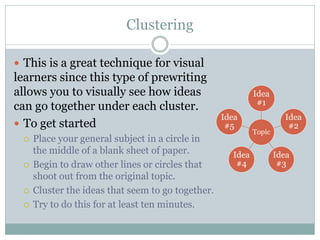
 This is a great technique for visual
learners since this type of prewriting
allows you to visually see how ideas                        Idea
                                                             #1
can go together under each cluster.
                                                   Idea               Idea
 To get started                                    #5                 #2
                                                            Topic
    Place your general subject in a circle in
     the middle of a blank sheet of paper.           Idea           Idea
    Begin to draw other lines or circles that        #4             #3
     shoot out from the original topic.
    Cluster the ideas that seem to go together.
    Try to do this for at least ten minutes.
Heuristic Methods

 The word has a broad definition used in many
 different fields, but in the writing world, it refers to a
 prewriting technique that involves asking yourself a
 fixed set of questions to generate ideas and
 information about any topic. (Only effective if you
 have your topic already.)
    Journalists’ Questions – Who, What, Where, When, Why, and
     How
    Cubing
    Tagmemics
    Aristotles Common Topics
    Dramatism
Cubing

 Cubing forces you to look at a topic from six different
  angles, as if you were studying the six sides of a cube. The
  six angles are describing, comparing, associating,
  analyzing, applying, and arguing.
     a. Describe it: What does your subject look like? What size, colors,
      texture does it have? Any special features worth noting?
     b. Compare or contrast it: What is your subject similar to? What is
      your subject different from? In what ways?
     c. Free-associate it: What does this subject remind you of? What does
      it call to mind? What memories does it conjure up?
     d. Analyze it: How does it work? How are the parts connected? What
      is its significance?
     e. Argue for or against it: What arguments can you make for or
      against your subject? What advantages or disadvantages does it
      have? What changes or improvements should be made?
     f. Apply it: What are the uses of your subject? What can you do with
      it?
Tagmemics
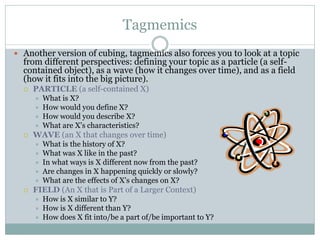
 Another version of cubing, tagmemics also forces you to look at a topic
  from different perspectives: defining your topic as a particle (a self-
  contained object), as a wave (how it changes over time), and as a field
  (how it fits into the big picture).
     PARTICLE (a self-contained X)
         What is X?
         How would you define X?
         How would you describe X?
         What are X's characteristics?
     WAVE (an X that changes over time)
         What is the history of X?
         What was X like in the past?
         In what ways is X different now from the past?
         Are changes in X happening quickly or slowly?
         What are the effects of X's changes on X?
     FIELD (An X that is Part of a Larger Context)
         How is X similar to Y?
         How is X different than Y?
         How does X fit into/be a part of/be important to Y?
Aristotle’s Common Questions

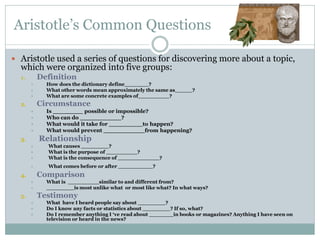
 Aristotle used a series of questions for discovering more about a topic,
  which were organized into five groups:
  1.       Definition
            How does the dictionary define_______?
            What other words mean approximately the same as_____?
            What are some concrete examples of_________?
  2.       Circumstance
            Is ________ possible or impossible?
            Who can do ___________?
            What would it take for _________to happen?
            What would prevent ___________from happening?
  3.       Relationship
            What causes ________?
            What is the purpose of _________?
            What is the consequence of ____________?
            What comes before or after __________?
  4.       Comparison
            What is _________similar to and different from?
            ________is most unlike what or most like what? In what ways?
  5.       Testimony
            What have I heard people say about ________?
            Do I know any facts or statistics about ________? If so, what?
            Do I remember anything I ‘ve read about _______in books or magazines? Anything I have seen on
             television or heard in the news?
Dramatism

 Dramatism, invented by Kenneth Burke, treats a topic like a
  play with five dramatic elements: act (the what), agent (the
  who), agency (the how), purpose (the why), and scene (the
  where and when). These elements can be combined to inspire
  sub-questions. This resembles the journalist’s questions and
  can be applied to many topics.
     Act:
         What is happening?
     Agent:
         Who is doing it?
     Agency:
         What method is being used?
     Purpose:
         What is the goal, intent, objective?
     Scene:
         Where and when is it happening?
Sources:

Hacker, Diana and Nancy Sommers. A Writer’s
     Reference. 7th ed. Boston: Bedford/St. Martin’s,
     2011. Print.
“Techniques for Creating (Prewriting).” Johnson
     Community College Writing Center. 2010. PDF
     file.

Prewriting techniques

  • 1.
  • 2.
    What is Prewriting? Considered the first step in the traditional writing process. It is sometimes referred to as the invention stage.  ANYTHING you do before writing your first draft.  Usually begins with you thinking about your writing purpose (what you are trying to communicate and why it is important) and audience (to whom you are trying to communicate).  Can use some prewriting techniques to discern your topic and can also use some prewriting techniques to generate ideas about a topic.
  • 3.
    Prewriting Techniques:  Thereare a variety of basic techniques. Please note no single technique works for everyone.  Listing  Freewriting  Clustering  Scratch Outline
  • 4.
    Listing:  Jot downevery idea you have about your topic. Free- associate; don’t hold back anything.  Try to brainstorm for at least ten minutes  Write everything down in a list form.  This can be one word, a phrase, an entire sentence, or more.  Remember do no worry about grammar and spelling at this point, just get your thoughts on paper.
  • 5.
    Freewriting  Some peoplejust prefer to start writing in order to find a focus for their essays.  To get started:  Take out a blank sheet of paper or open a new word document  Begin writing for at least ten to fifteen minutes.  Write whatever comes to your mind about your subject.  Do not worry about spelling, punctuation, or grammar.  Do not change, correct, or delete anything.  If you cannot think of something to write about, just write “I can’t think of anything to write right now; I’m stumped.” Simply keep writing until a new thought comes into your mind.
  • 6.
    Clustering  This isa great technique for visual learners since this type of prewriting allows you to visually see how ideas Idea #1 can go together under each cluster. Idea Idea  To get started #5 #2 Topic  Place your general subject in a circle in the middle of a blank sheet of paper. Idea Idea  Begin to draw other lines or circles that #4 #3 shoot out from the original topic.  Cluster the ideas that seem to go together.  Try to do this for at least ten minutes.
  • 7.
    Heuristic Methods  Theword has a broad definition used in many different fields, but in the writing world, it refers to a prewriting technique that involves asking yourself a fixed set of questions to generate ideas and information about any topic. (Only effective if you have your topic already.)  Journalists’ Questions – Who, What, Where, When, Why, and How  Cubing  Tagmemics  Aristotles Common Topics  Dramatism
  • 8.
    Cubing  Cubing forcesyou to look at a topic from six different angles, as if you were studying the six sides of a cube. The six angles are describing, comparing, associating, analyzing, applying, and arguing.  a. Describe it: What does your subject look like? What size, colors, texture does it have? Any special features worth noting?  b. Compare or contrast it: What is your subject similar to? What is your subject different from? In what ways?  c. Free-associate it: What does this subject remind you of? What does it call to mind? What memories does it conjure up?  d. Analyze it: How does it work? How are the parts connected? What is its significance?  e. Argue for or against it: What arguments can you make for or against your subject? What advantages or disadvantages does it have? What changes or improvements should be made?  f. Apply it: What are the uses of your subject? What can you do with it?
  • 9.
    Tagmemics  Another versionof cubing, tagmemics also forces you to look at a topic from different perspectives: defining your topic as a particle (a self- contained object), as a wave (how it changes over time), and as a field (how it fits into the big picture).  PARTICLE (a self-contained X)  What is X?  How would you define X?  How would you describe X?  What are X's characteristics?  WAVE (an X that changes over time)  What is the history of X?  What was X like in the past?  In what ways is X different now from the past?  Are changes in X happening quickly or slowly?  What are the effects of X's changes on X?  FIELD (An X that is Part of a Larger Context)  How is X similar to Y?  How is X different than Y?  How does X fit into/be a part of/be important to Y?
  • 10.
    Aristotle’s Common Questions Aristotle used a series of questions for discovering more about a topic, which were organized into five groups: 1. Definition  How does the dictionary define_______?  What other words mean approximately the same as_____?  What are some concrete examples of_________? 2. Circumstance  Is ________ possible or impossible?  Who can do ___________?  What would it take for _________to happen?  What would prevent ___________from happening? 3. Relationship  What causes ________?  What is the purpose of _________?  What is the consequence of ____________?  What comes before or after __________? 4. Comparison  What is _________similar to and different from?  ________is most unlike what or most like what? In what ways? 5. Testimony  What have I heard people say about ________?  Do I know any facts or statistics about ________? If so, what?  Do I remember anything I ‘ve read about _______in books or magazines? Anything I have seen on television or heard in the news?
  • 11.
    Dramatism  Dramatism, inventedby Kenneth Burke, treats a topic like a play with five dramatic elements: act (the what), agent (the who), agency (the how), purpose (the why), and scene (the where and when). These elements can be combined to inspire sub-questions. This resembles the journalist’s questions and can be applied to many topics.  Act:  What is happening?  Agent:  Who is doing it?  Agency:  What method is being used?  Purpose:  What is the goal, intent, objective?  Scene:  Where and when is it happening?
  • 12.
    Sources: Hacker, Diana andNancy Sommers. A Writer’s Reference. 7th ed. Boston: Bedford/St. Martin’s, 2011. Print. “Techniques for Creating (Prewriting).” Johnson Community College Writing Center. 2010. PDF file.