

Stability Testing of Herbal
Drugs
S.Selvadurai.,M.Pharm.,MBA.,
Associate Professor
Department of Pharmacognosy
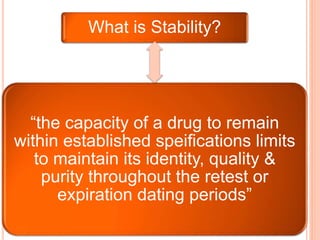
What is Stability?
โ€œthe capacity of a drug to remain
within established speifications limits
to maintain its identity, quality &
purity throughout the retest or
expiration dating periodsโ€
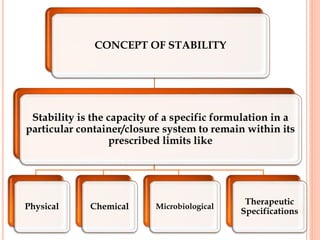
CONCEPT OF STABILITY
Stability is the capacity of a specific formulation in a
particular container/closure system to remain within its
prescribed limits like
Physical Chemical Microbiological
Therapeutic
Specifications
ADVANTAGES
๏ถHelp in determination of shelf life and
storage conditions.
๏ถHelp in selection of suitable formulation,
excipients and container closure
systems for a product.
๏ถWell being of the patient and
manufacture by ensuring the good
product quality.
๏ถEnhance patient confidence in herbal
drugs and improve compliance.
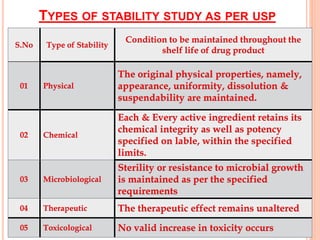
TYPES OF STABILITY STUDY AS PER USP
S.No Type of Stability
Condition to be maintained throughout the
shelf life of drug product
01 Physical
The original physical properties, namely,
appearance, uniformity, dissolution &
suspendability are maintained.
02 Chemical
Each & Every active ingredient retains its
chemical integrity as well as potency
specified on lable, within the specified
limits.
03 Microbiological
Sterility or resistance to microbial growth
is maintained as per the specified
requirements
04 Therapeutic The therapeutic effect remains unaltered
05 Toxicological No valid increase in toxicity occurs
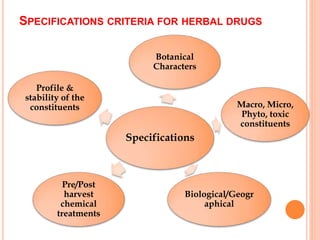
SPECIFICATIONS CRITERIA FOR HERBAL DRUGS
Specifications
Botanical
Characters
Macro, Micro,
Phyto, toxic
constituents
Biological/Geogr
aphical
Pre/Post
harvest
chemical
treatments
Profile &
stability of the
constituents
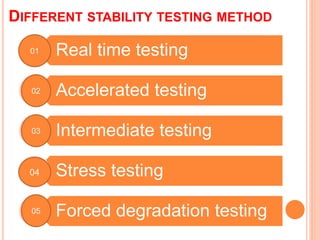
DIFFERENT STABILITY TESTING METHOD
Real time testing
Accelerated testing
Intermediate testing
Stress testing
Forced degradation testing
01
02
03
04
05
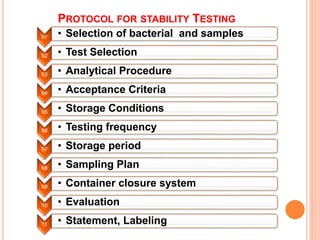
PROTOCOL FOR STABILITY TESTING
01 โ€ข Selection of bacterial and samples
02 โ€ข Test Selection
03 โ€ข Analytical Procedure
04 โ€ข Acceptance Criteria
05 โ€ข Storage Conditions
06 โ€ข Testing frequency
07 โ€ข Storage period
08 โ€ข Sampling Plan
09 โ€ข Container closure system
10 โ€ข Evaluation
11 โ€ข Statement, Labeling
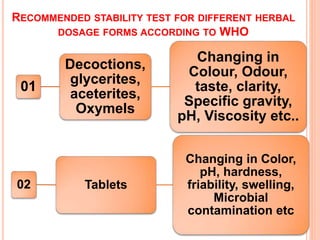
RECOMMENDED STABILITY TEST FOR DIFFERENT HERBAL
DOSAGE FORMS ACCORDING TO WHO
01
Decoctions,
glycerites,
aceterites,
Oxymels
Changing in
Colour, Odour,
taste, clarity,
Specific gravity,
pH, Viscosity etc..
02 Tablets
Changing in Color,
pH, hardness,
friability, swelling,
Microbial
contamination etc
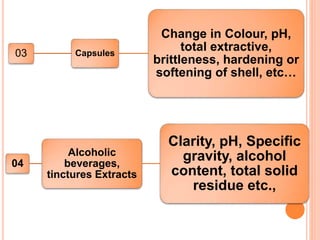
03 Capsules
Change in Colour, pH,
total extractive,
brittleness, hardening or
softening of shell, etcโ€ฆ
04
Alcoholic
beverages,
tinctures Extracts
Clarity, pH, Specific
gravity, alcohol
content, total solid
residue etc.,
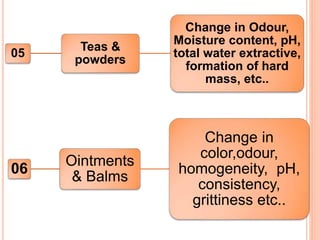
05
Teas &
powders
Change in Odour,
Moisture content, pH,
total water extractive,
formation of hard
mass, etc..
06
Ointments
& Balms
Change in
color,odour,
homogeneity, pH,
consistency,
grittiness etc..
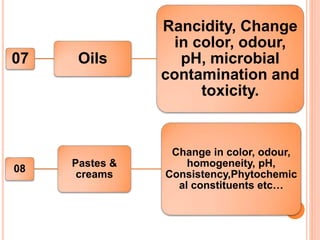
07 Oils
Rancidity, Change
in color, odour,
pH, microbial
contamination and
toxicity.
08
Pastes &
creams
Change in color, odour,
homogeneity, pH,
Consistency,Phytochemic
al constituents etcโ€ฆ
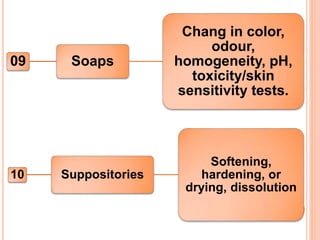
09 Soaps
Chang in color,
odour,
homogeneity, pH,
toxicity/skin
sensitivity tests.
10 Suppositories
Softening,
hardening, or
drying, dissolution
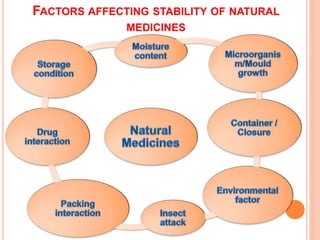
FACTORS AFFECTING STABILITY OF NATURAL
MEDICINES
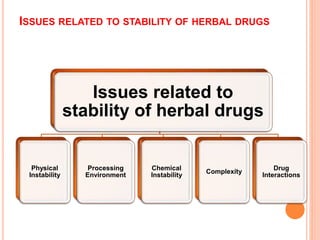
ISSUES RELATED TO STABILITY OF HERBAL DRUGS
Issues related to
stability of herbal drugs
Physical
Instability
Processing
Environment
Chemical
Instability
Complexity
Drug
Interactions
stability testing

stability testing

  • 1.
    Stability Testing ofHerbal Drugs S.Selvadurai.,M.Pharm.,MBA., Associate Professor Department of Pharmacognosy
  • 3.
    What is Stability? โ€œthecapacity of a drug to remain within established speifications limits to maintain its identity, quality & purity throughout the retest or expiration dating periodsโ€
  • 4.
    CONCEPT OF STABILITY Stabilityis the capacity of a specific formulation in a particular container/closure system to remain within its prescribed limits like Physical Chemical Microbiological Therapeutic Specifications
  • 5.
    ADVANTAGES ๏ถHelp in determinationof shelf life and storage conditions. ๏ถHelp in selection of suitable formulation, excipients and container closure systems for a product. ๏ถWell being of the patient and manufacture by ensuring the good product quality. ๏ถEnhance patient confidence in herbal drugs and improve compliance.
  • 6.
    TYPES OF STABILITYSTUDY AS PER USP S.No Type of Stability Condition to be maintained throughout the shelf life of drug product 01 Physical The original physical properties, namely, appearance, uniformity, dissolution & suspendability are maintained. 02 Chemical Each & Every active ingredient retains its chemical integrity as well as potency specified on lable, within the specified limits. 03 Microbiological Sterility or resistance to microbial growth is maintained as per the specified requirements 04 Therapeutic The therapeutic effect remains unaltered 05 Toxicological No valid increase in toxicity occurs
  • 7.
    SPECIFICATIONS CRITERIA FORHERBAL DRUGS Specifications Botanical Characters Macro, Micro, Phyto, toxic constituents Biological/Geogr aphical Pre/Post harvest chemical treatments Profile & stability of the constituents
  • 8.
    DIFFERENT STABILITY TESTINGMETHOD Real time testing Accelerated testing Intermediate testing Stress testing Forced degradation testing 01 02 03 04 05
  • 9.
    PROTOCOL FOR STABILITYTESTING 01 โ€ข Selection of bacterial and samples 02 โ€ข Test Selection 03 โ€ข Analytical Procedure 04 โ€ข Acceptance Criteria 05 โ€ข Storage Conditions 06 โ€ข Testing frequency 07 โ€ข Storage period 08 โ€ข Sampling Plan 09 โ€ข Container closure system 10 โ€ข Evaluation 11 โ€ข Statement, Labeling
  • 10.
    RECOMMENDED STABILITY TESTFOR DIFFERENT HERBAL DOSAGE FORMS ACCORDING TO WHO 01 Decoctions, glycerites, aceterites, Oxymels Changing in Colour, Odour, taste, clarity, Specific gravity, pH, Viscosity etc.. 02 Tablets Changing in Color, pH, hardness, friability, swelling, Microbial contamination etc
  • 11.
    03 Capsules Change inColour, pH, total extractive, brittleness, hardening or softening of shell, etcโ€ฆ 04 Alcoholic beverages, tinctures Extracts Clarity, pH, Specific gravity, alcohol content, total solid residue etc.,
  • 12.
    05 Teas & powders Change inOdour, Moisture content, pH, total water extractive, formation of hard mass, etc.. 06 Ointments & Balms Change in color,odour, homogeneity, pH, consistency, grittiness etc..
  • 13.
    07 Oils Rancidity, Change incolor, odour, pH, microbial contamination and toxicity. 08 Pastes & creams Change in color, odour, homogeneity, pH, Consistency,Phytochemic al constituents etcโ€ฆ
  • 14.
    09 Soaps Chang incolor, odour, homogeneity, pH, toxicity/skin sensitivity tests. 10 Suppositories Softening, hardening, or drying, dissolution
  • 15.
    FACTORS AFFECTING STABILITYOF NATURAL MEDICINES
  • 16.
    ISSUES RELATED TOSTABILITY OF HERBAL DRUGS Issues related to stability of herbal drugs Physical Instability Processing Environment Chemical Instability Complexity Drug Interactions