Extending R2 beyond
ordinary least-squares
linear regression
Paul Johnson
@paulcdjo
1
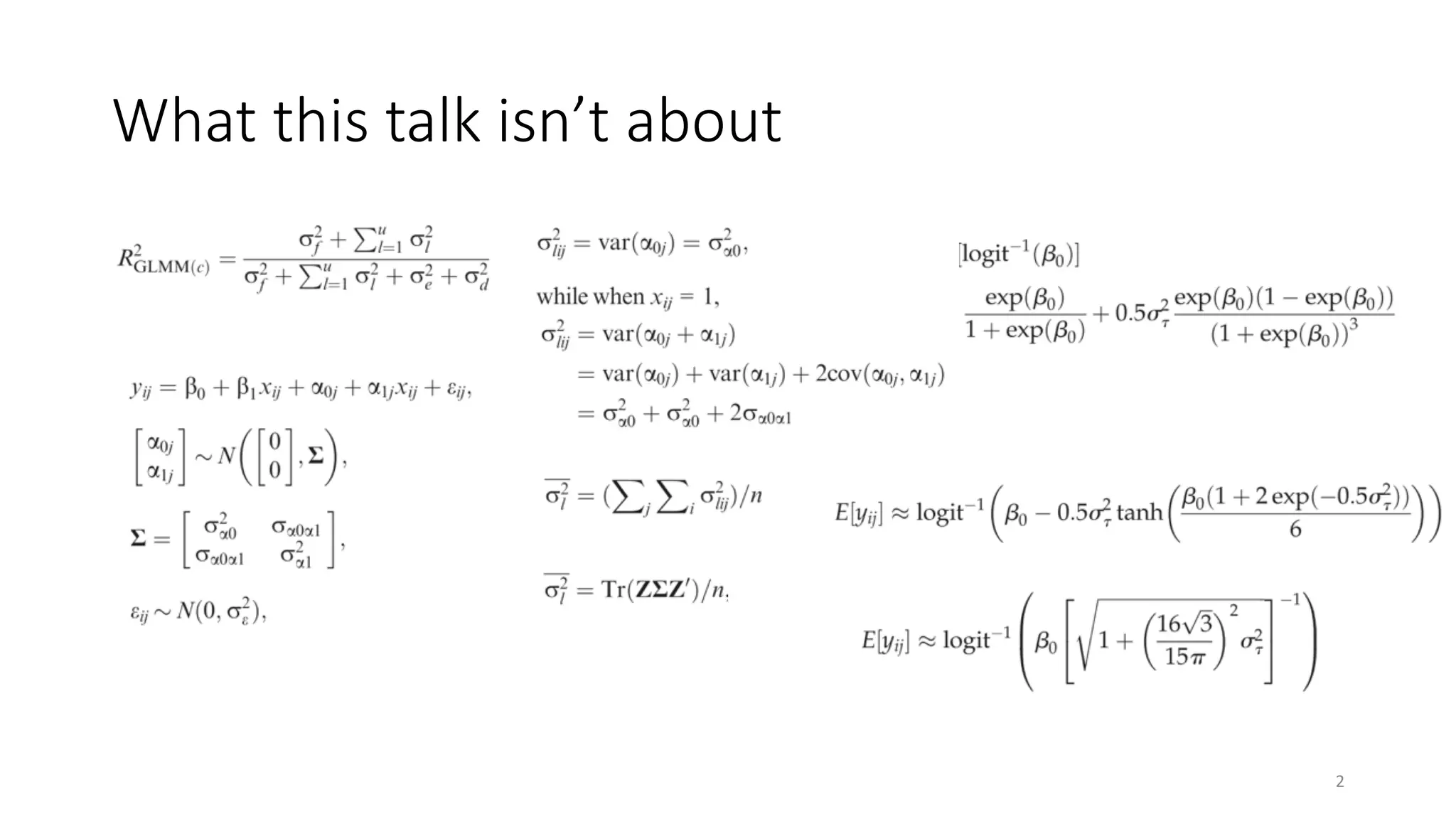
What this talk isn’t about
2
What this talk is about
• What is R2?
• Why is R2 useful?
• What are some of the limitation of R2?
• How have these limitations been overcome?
3
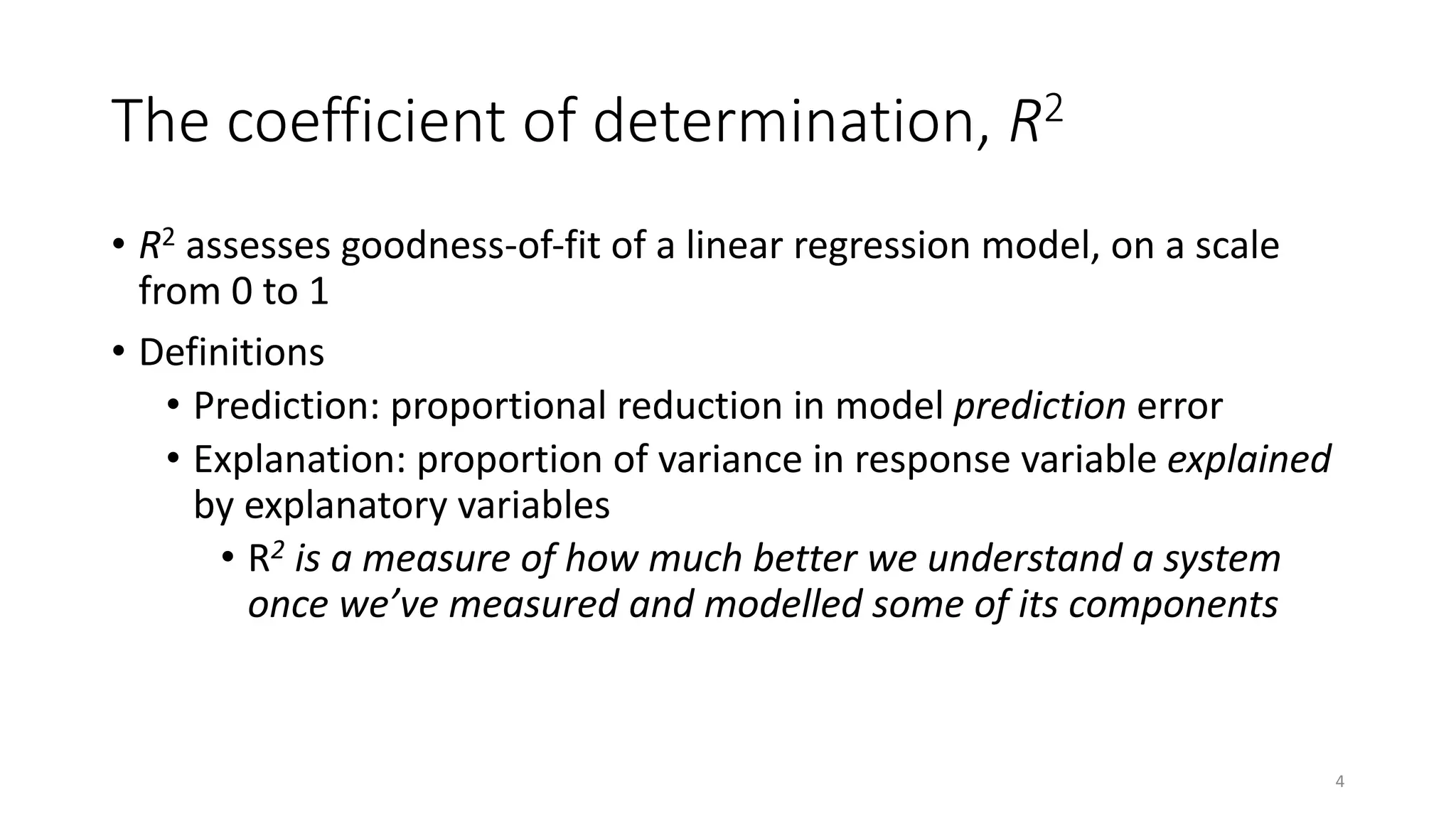
The coefficient of determination, R2
• R2 assesses goodness-of-fit of a linear regression model, on a scale
from 0 to 1
• Definitions
• Prediction: proportional reduction in model prediction error
• Explanation: proportion of variance in response variable explained
by explanatory variables
• R2 is a measure of how much better we understand a system
once we’ve measured and modelled some of its components
4
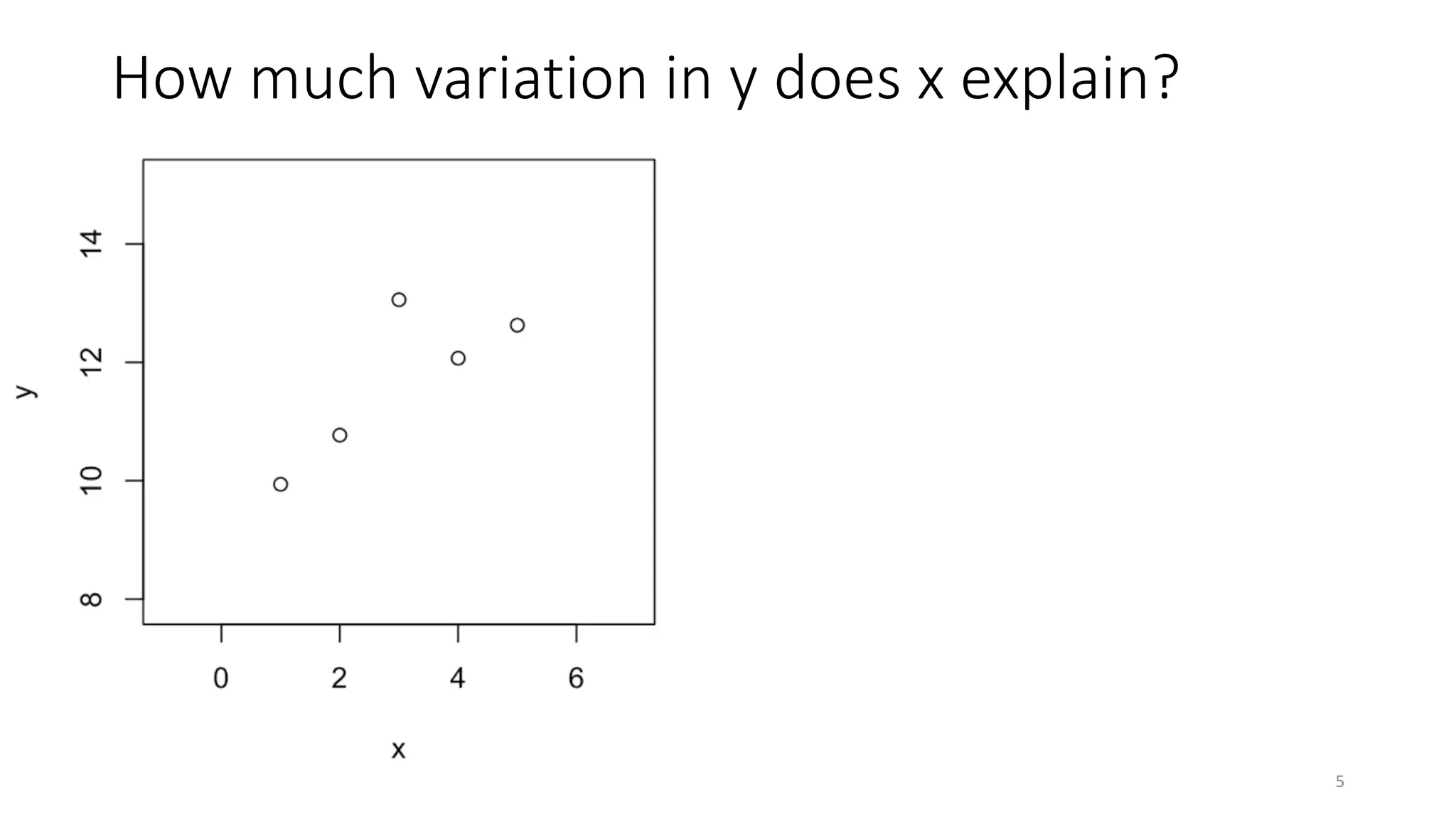
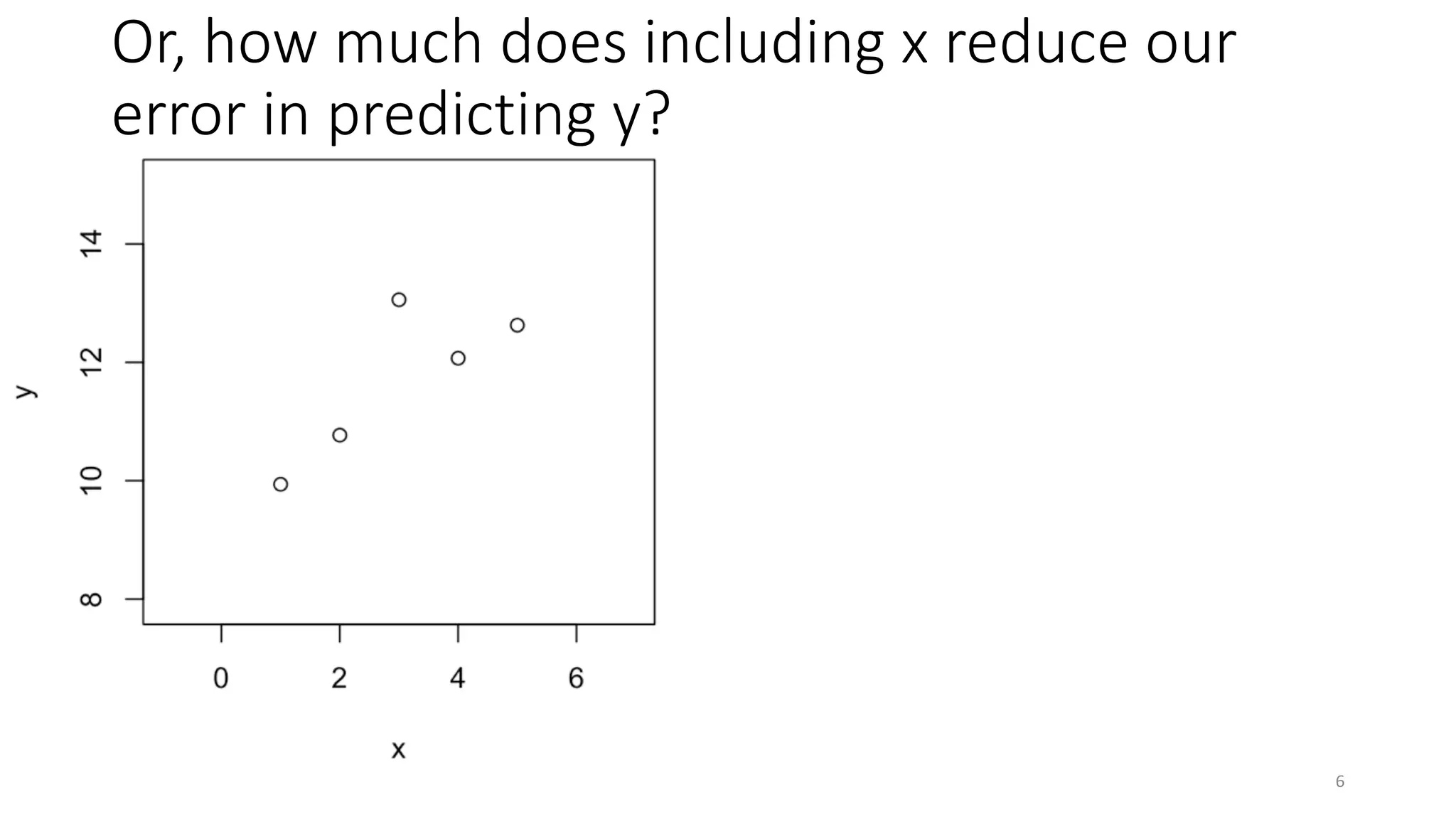
How much variation in y does x explain?
5
Or, how much does including x reduce our
error in predicting y?
6
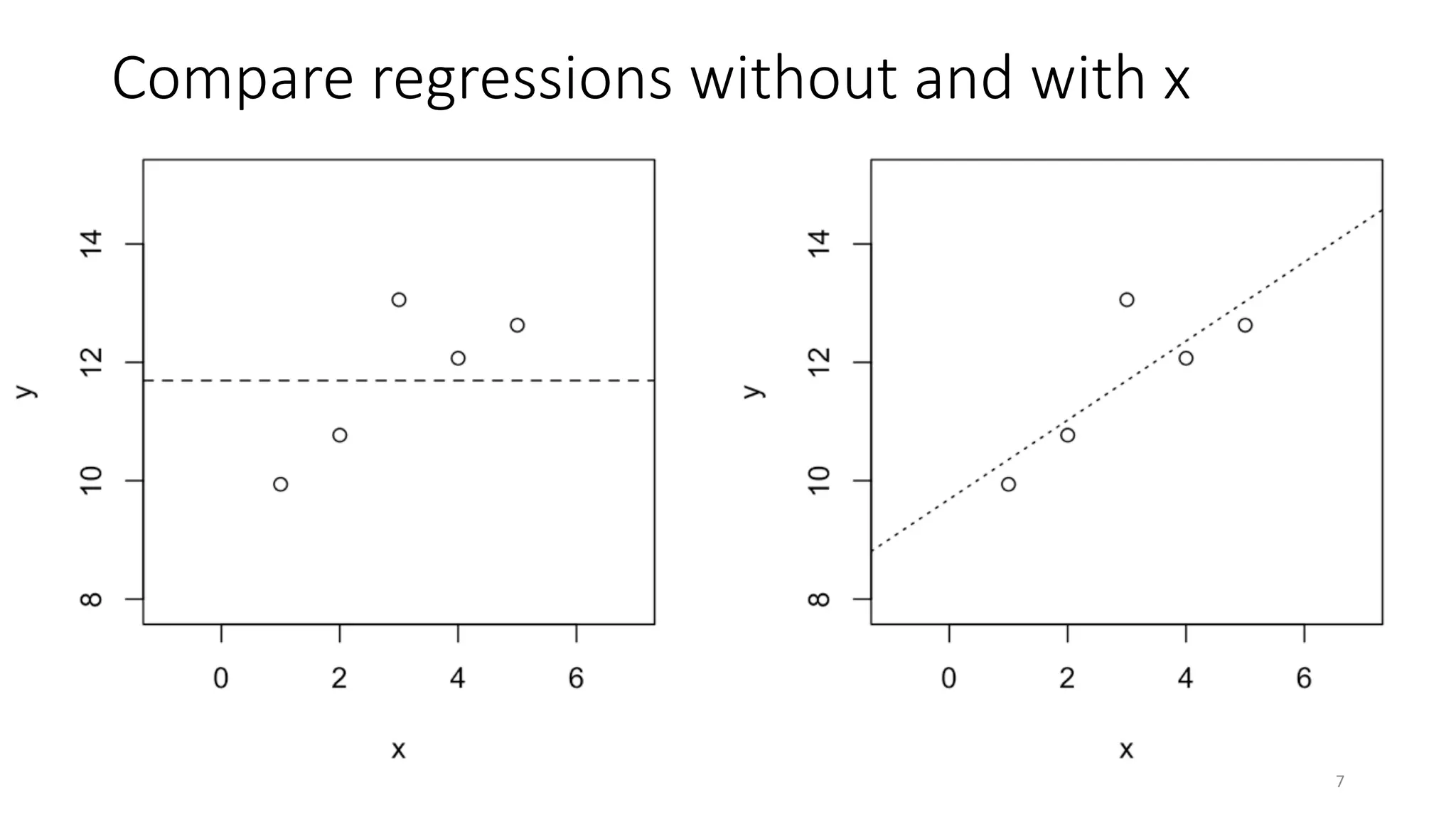
Compare regressions without and with x
7
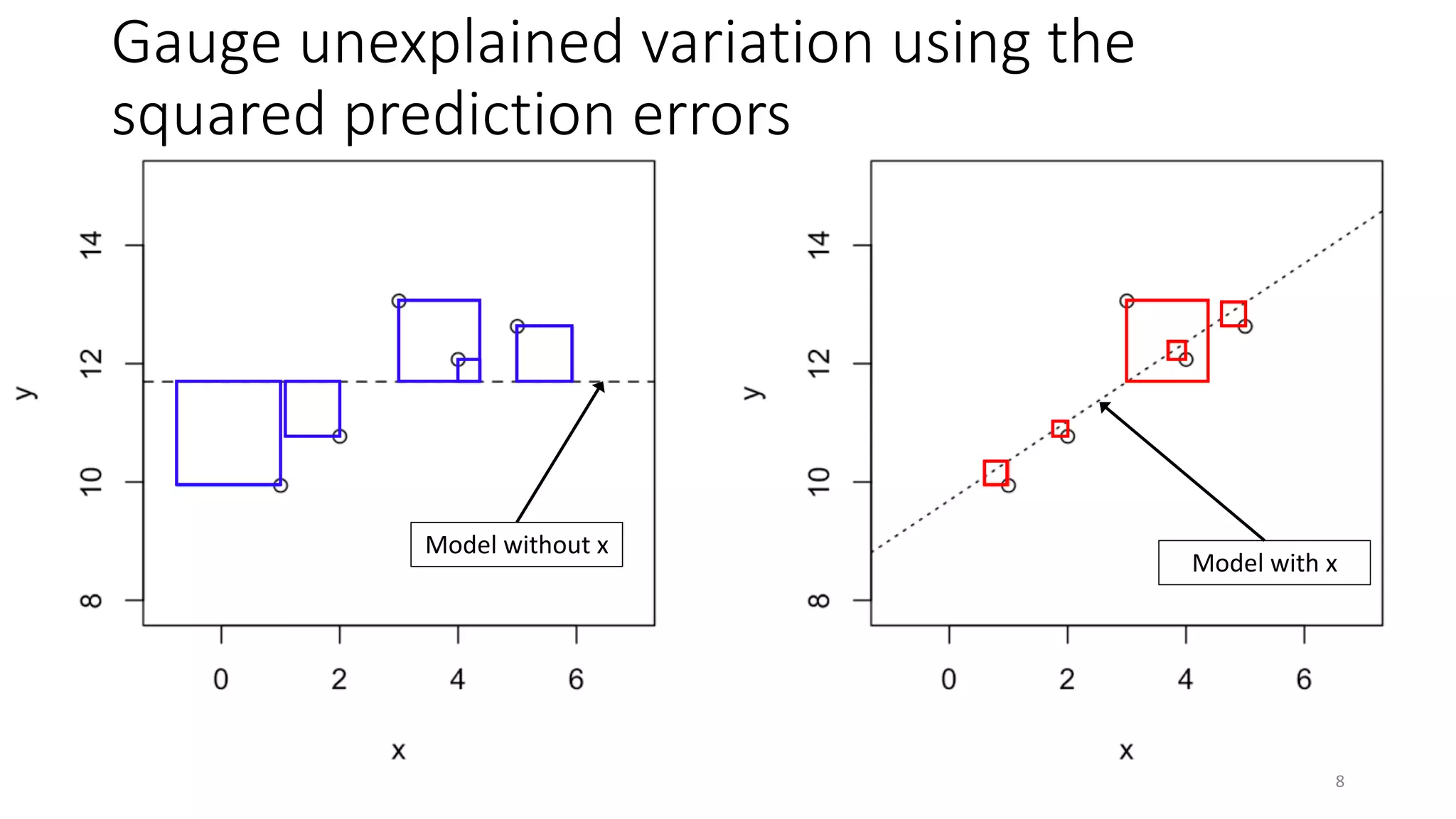
Gauge unexplained variation using the
squared prediction errors
8
Model without x
Model with x
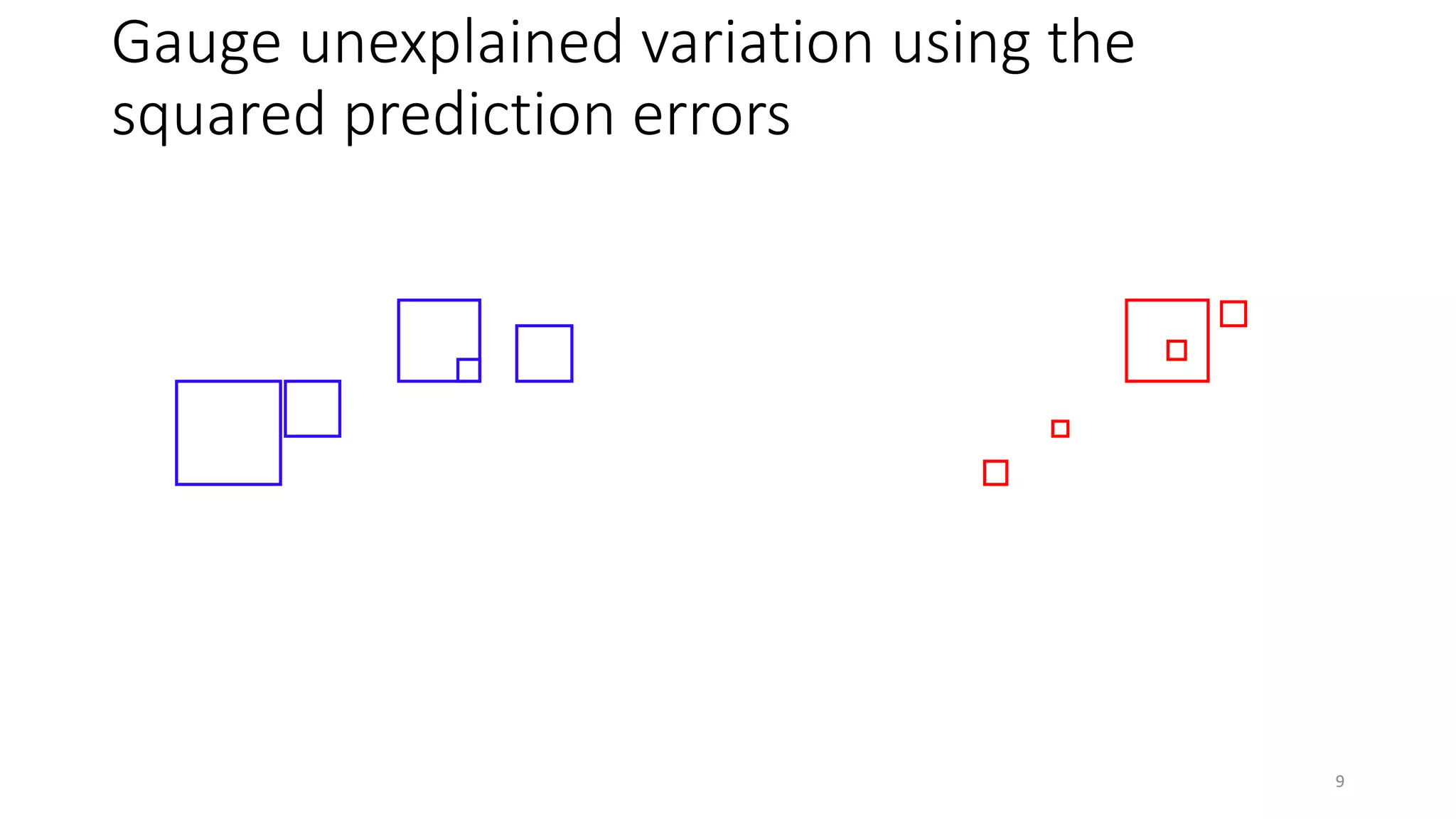
Gauge unexplained variation using the
squared prediction errors
9
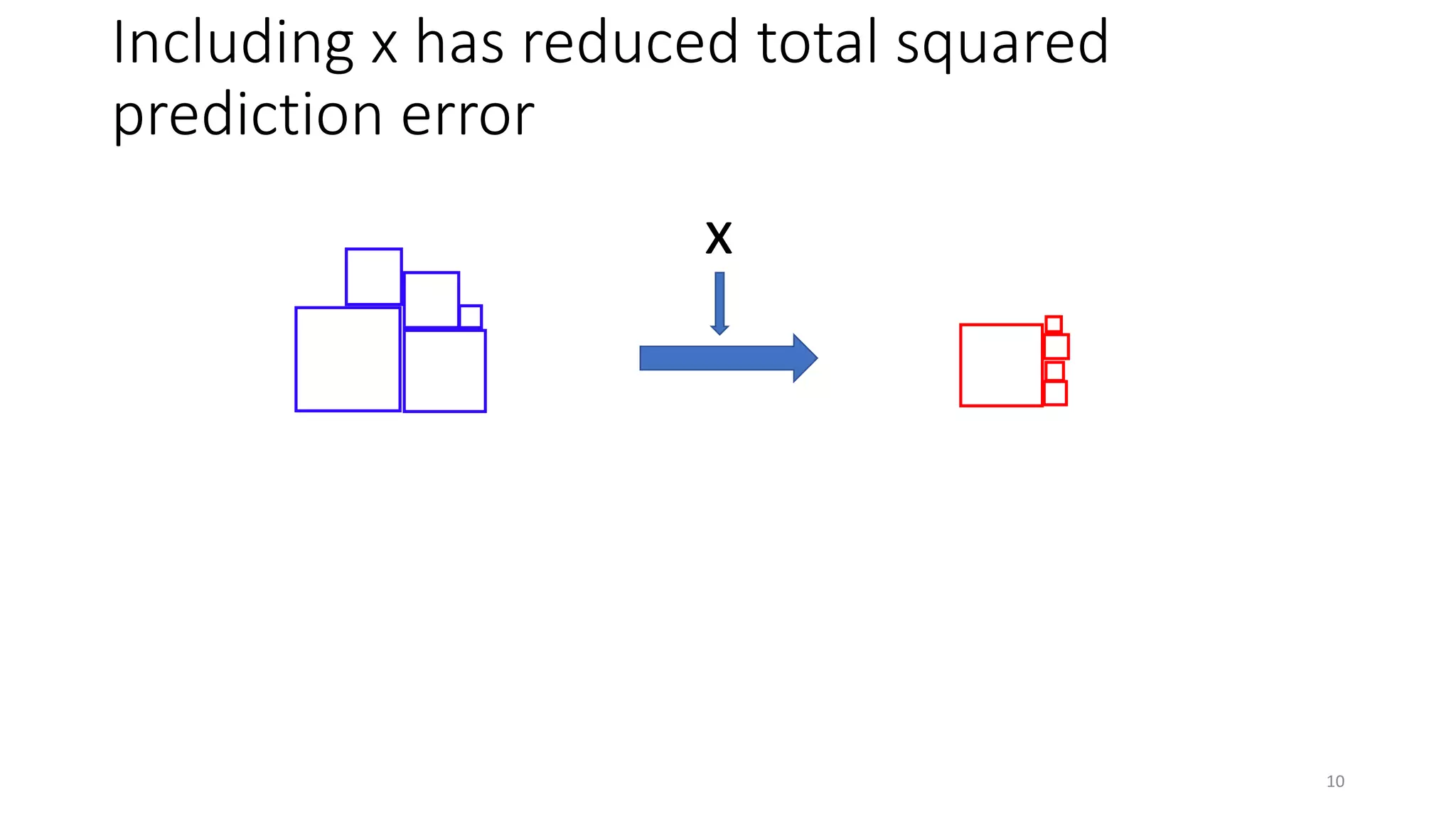
Including x has reduced total squared
prediction error
x
10
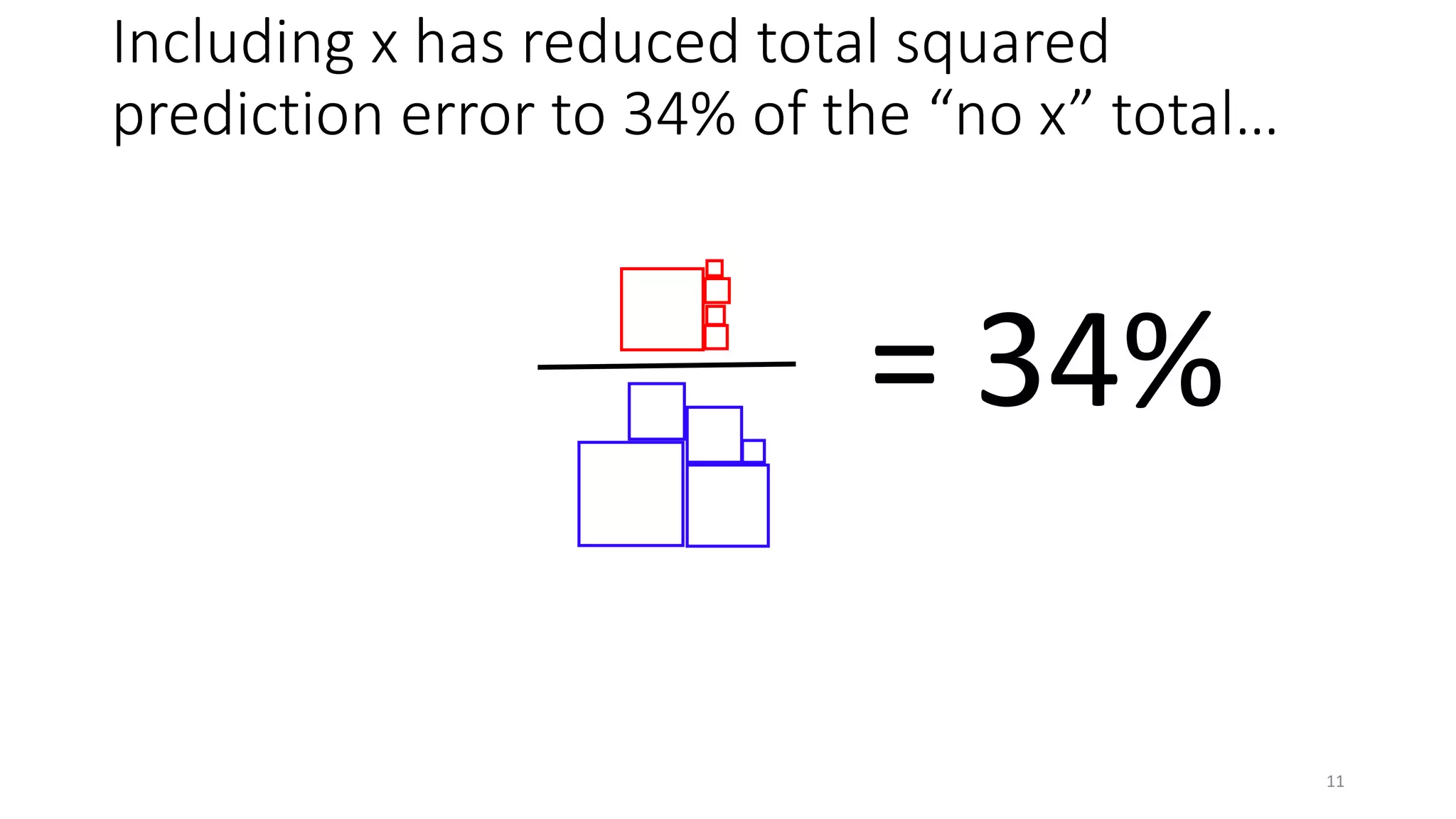
Including x has reduced total squared
prediction error to 34% of the “no x” total…
= 34%
11
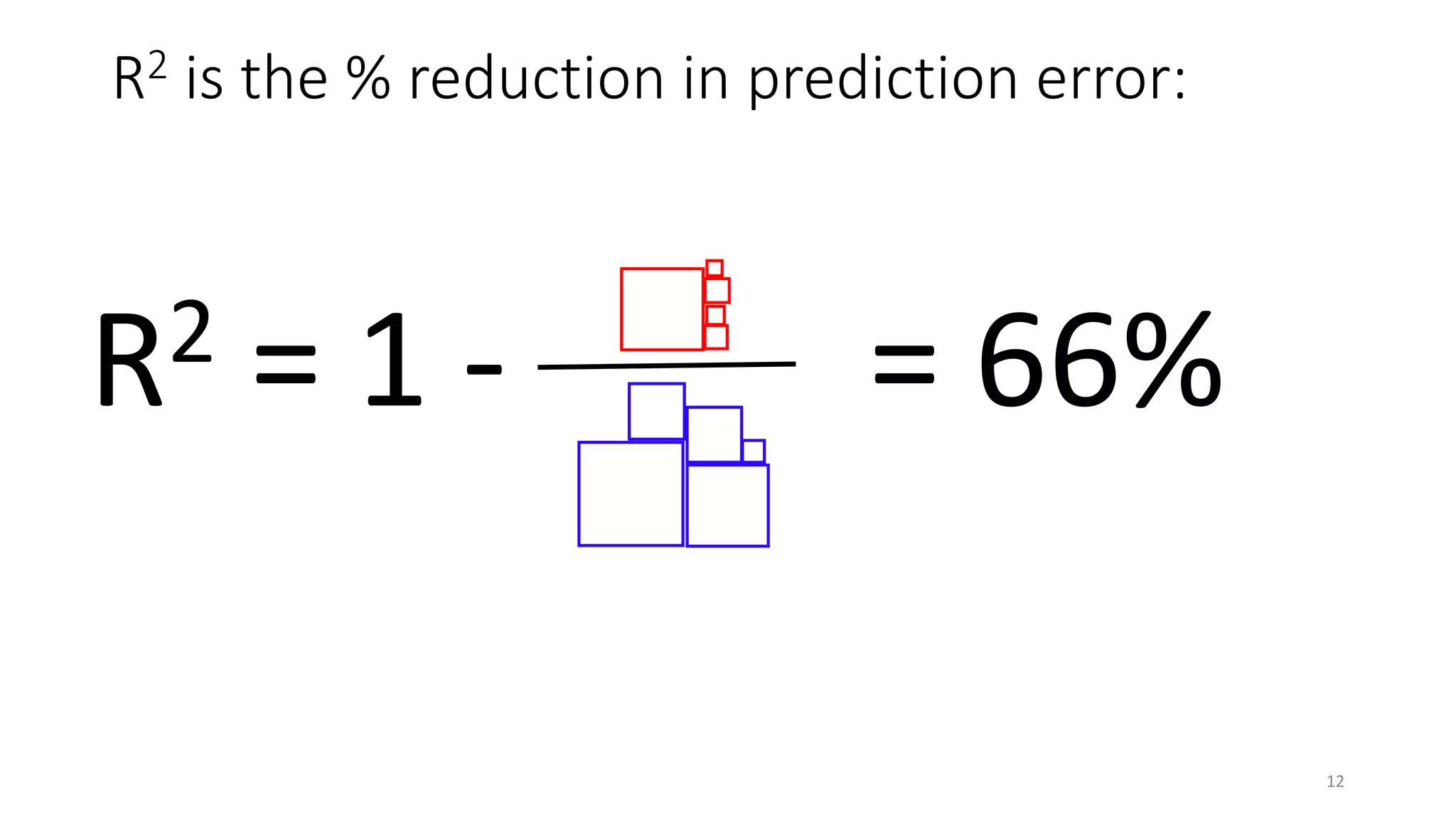
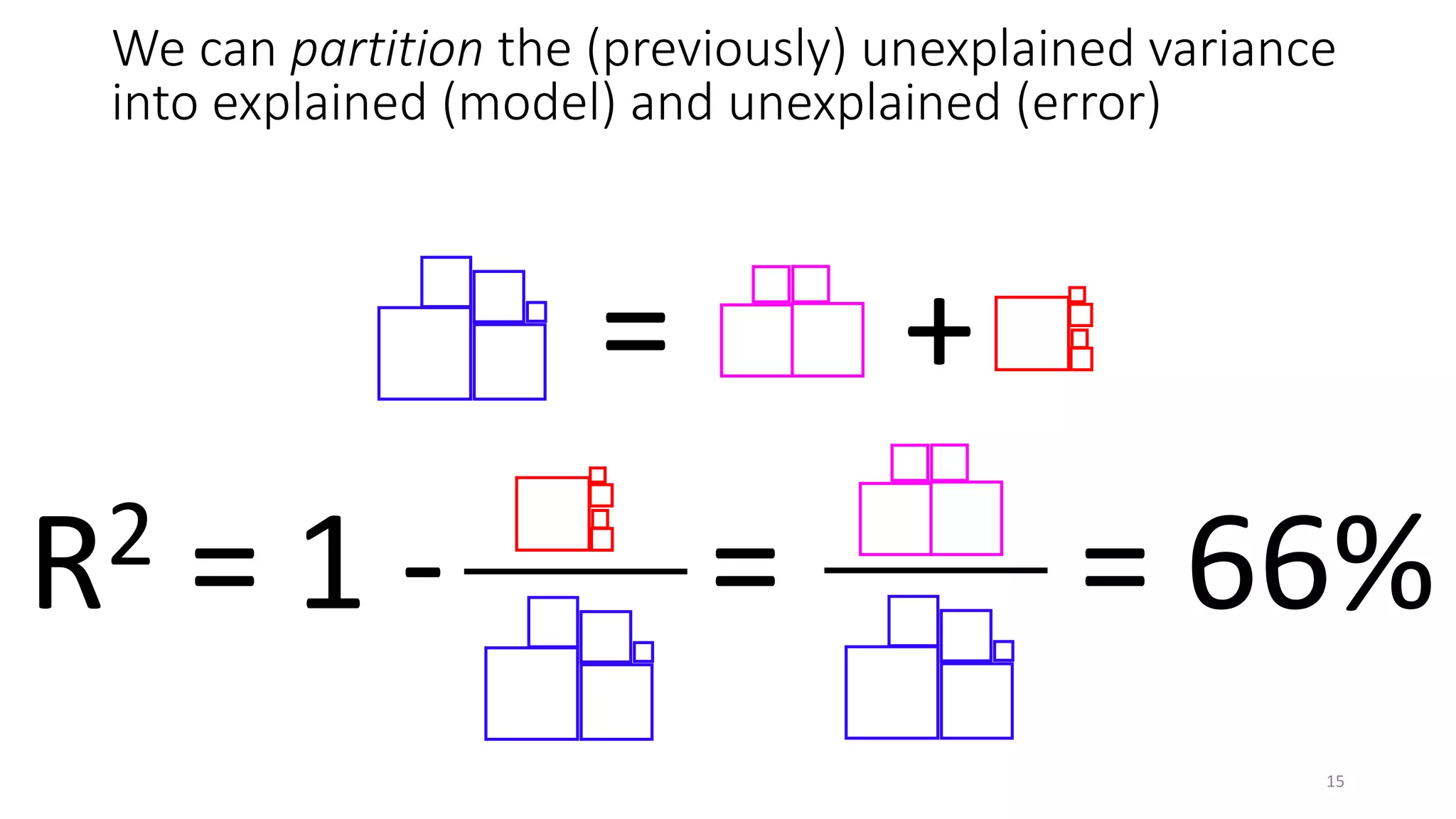
R2 is the % reduction in prediction error:
= 66%R2 = 1 -
12
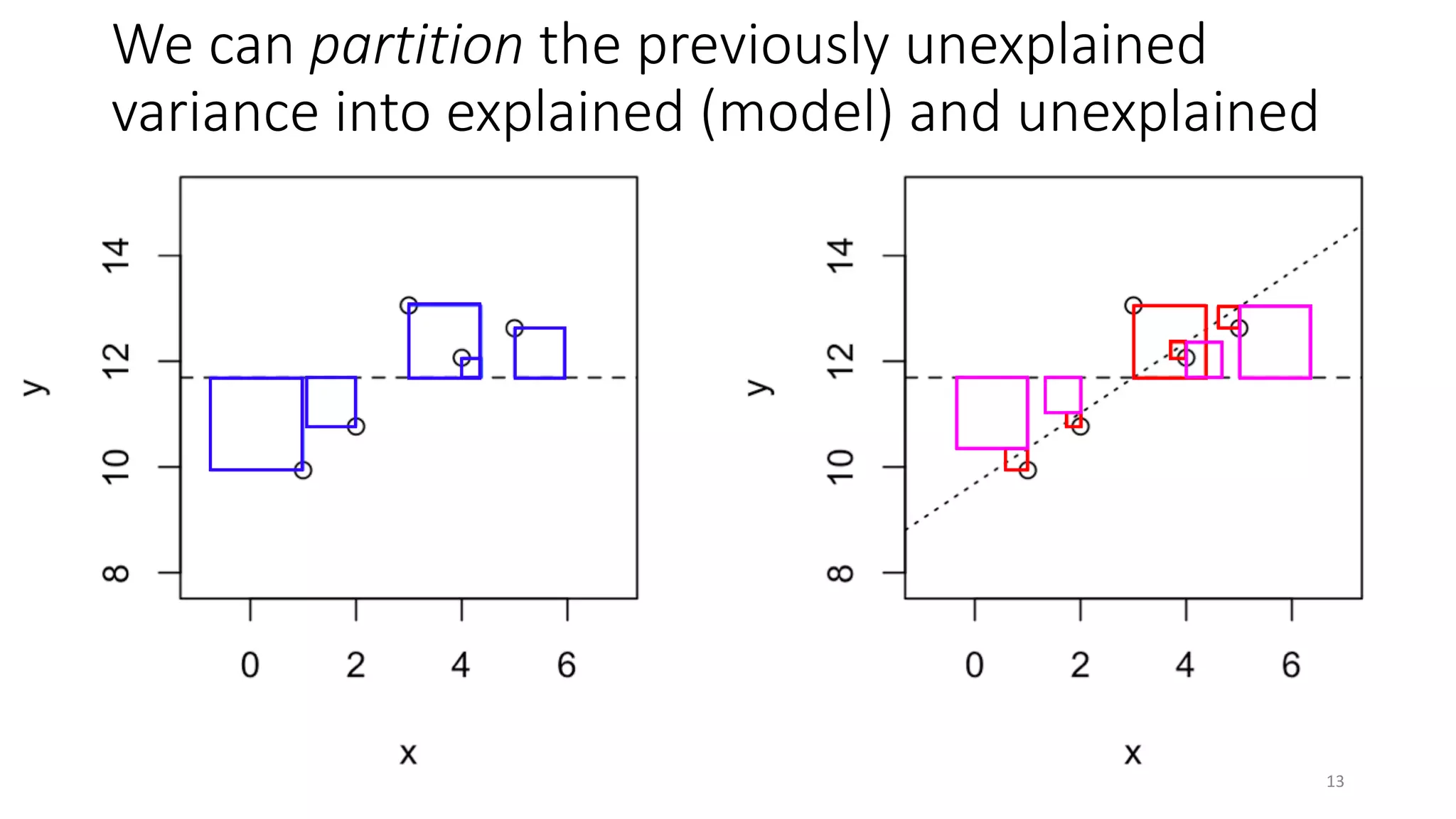
We can partition the previously unexplained
variance into explained (model) and unexplained
13
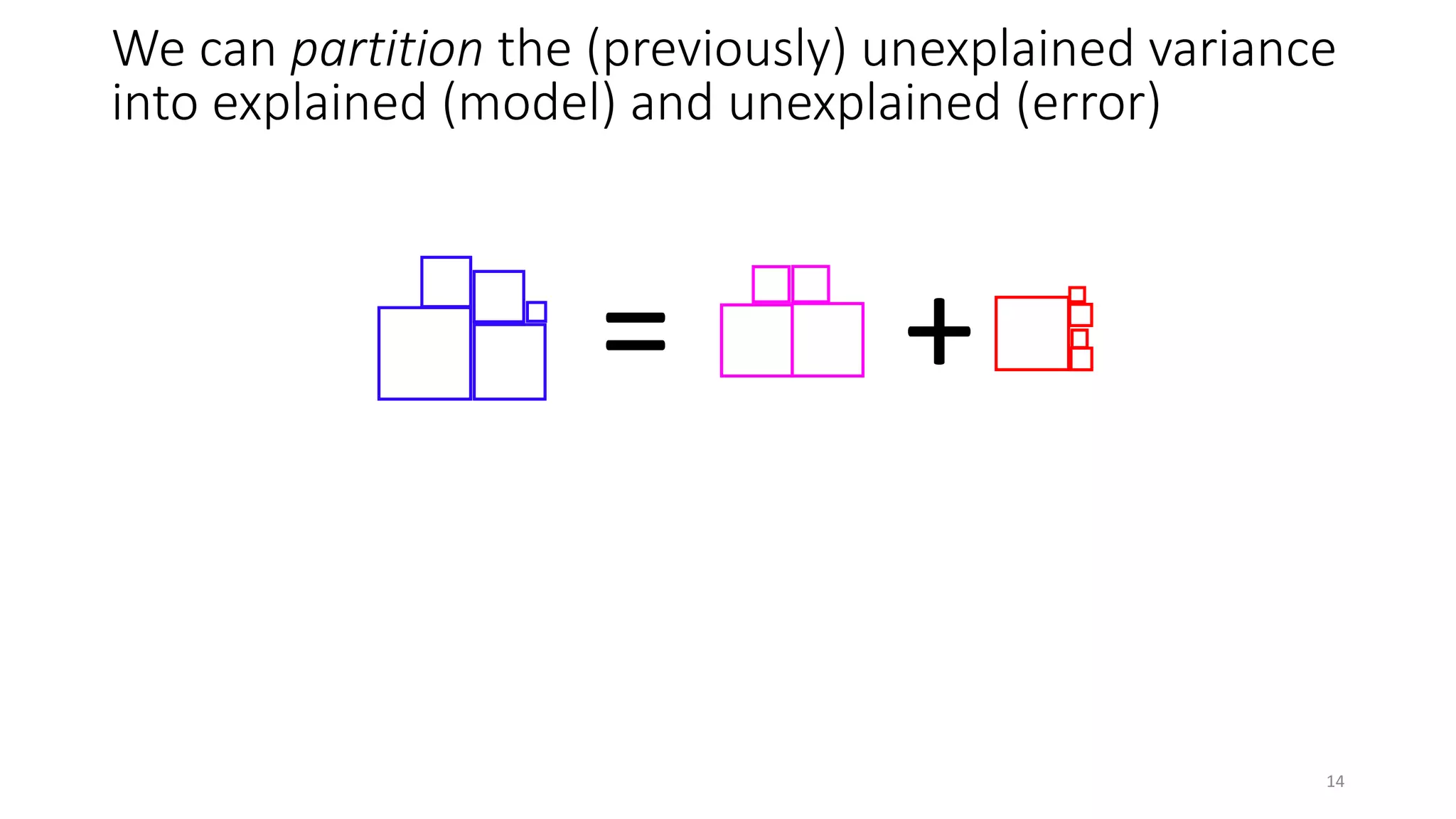
We can partition the (previously) unexplained variance
into explained (model) and unexplained (error)
= +
14
We can partition the (previously) unexplained variance
into explained (model) and unexplained (error)
= +
R2 = 1 - = = 66%
15
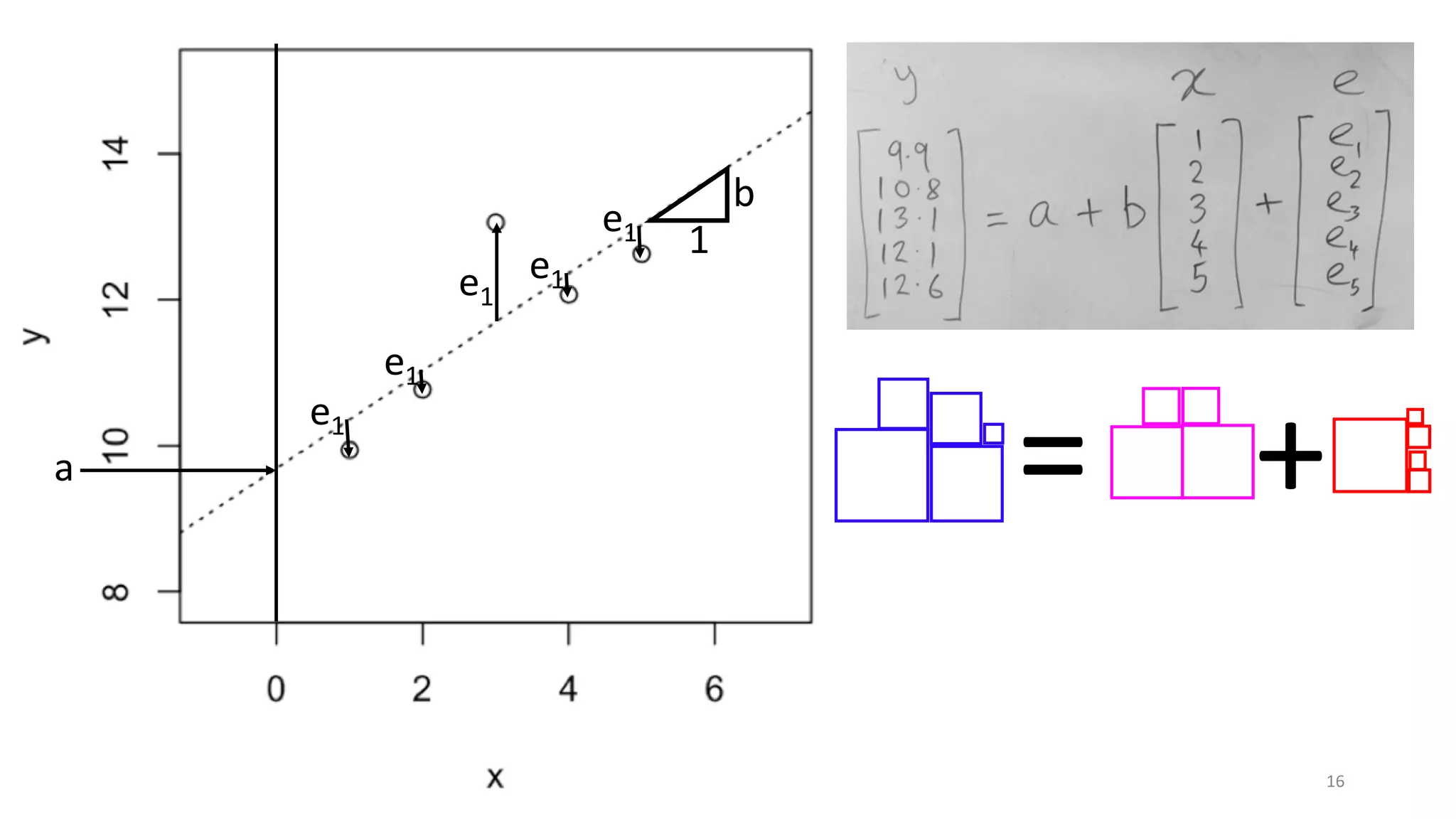
1
b
a
e1
e1
e1
e1
e1
= +
16
Is R2 useful?
17
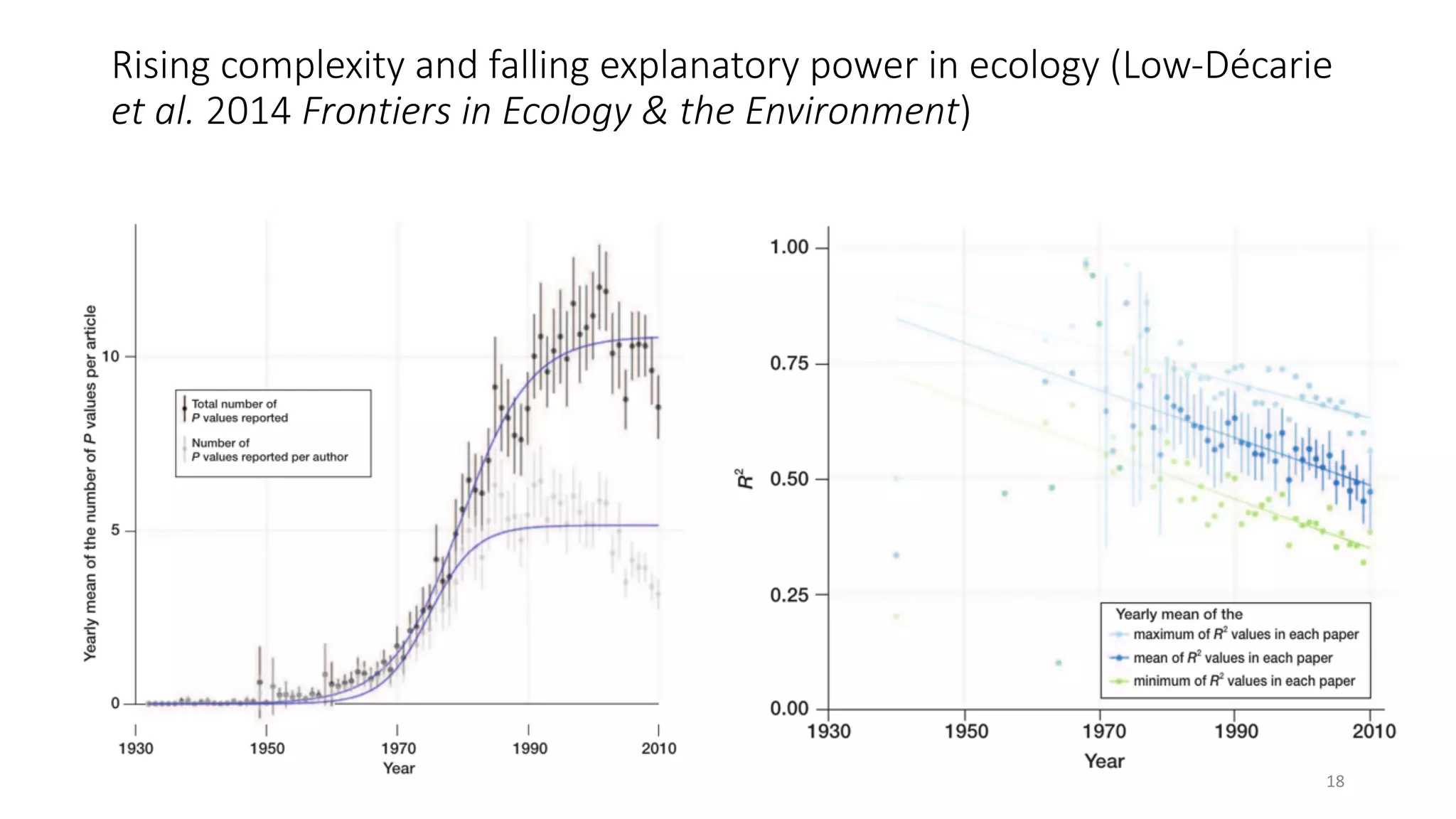
Rising complexity and falling explanatory power in ecology (Low-Décarie
et al. 2014 Frontiers in Ecology & the Environment)
18
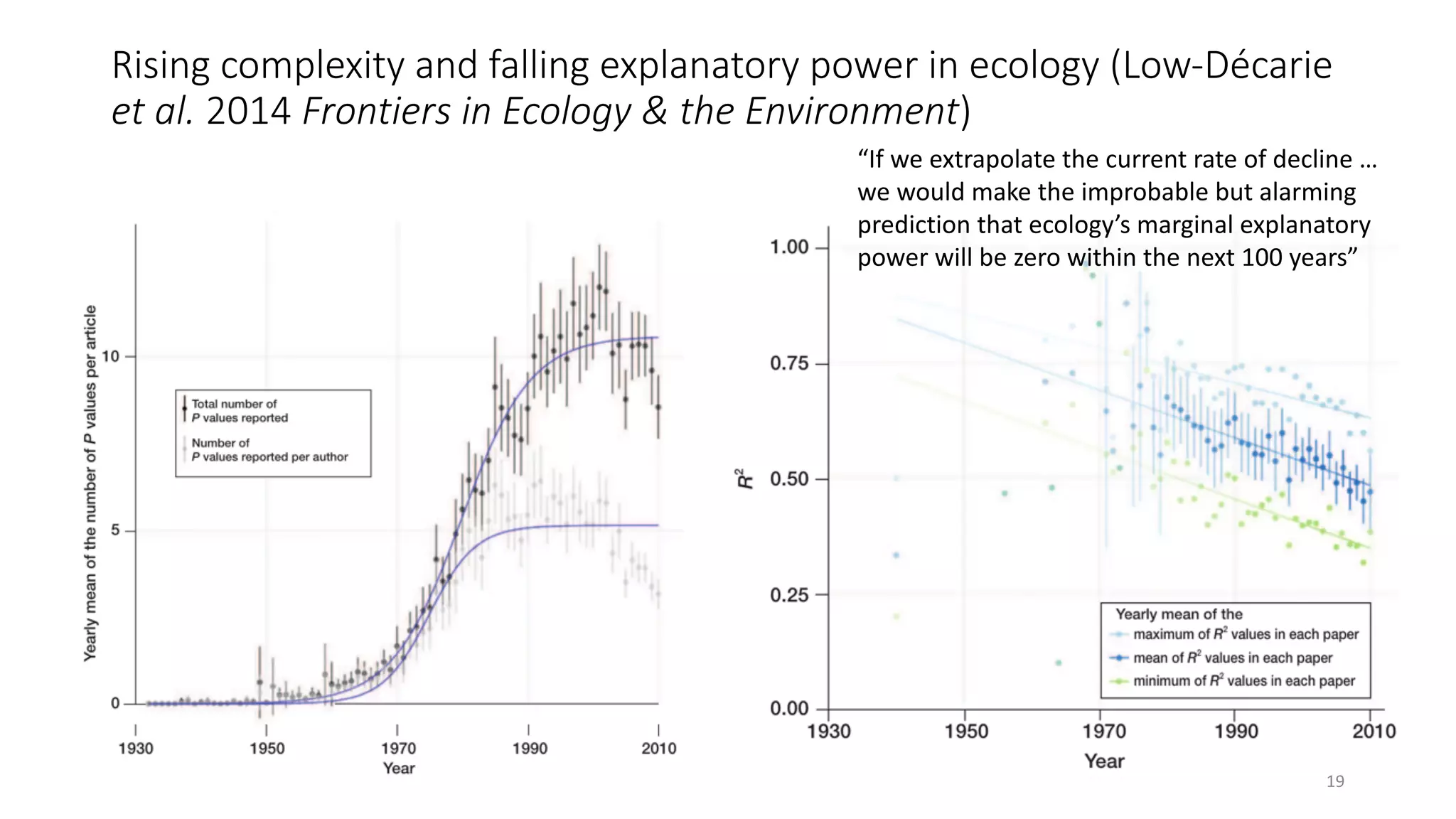
Rising complexity and falling explanatory power in ecology (Low-Décarie
et al. 2014 Frontiers in Ecology & the Environment)
“If we extrapolate the current rate of decline …
we would make the improbable but alarming
prediction that ecology’s marginal explanatory
power will be zero within the next 100 years”
19
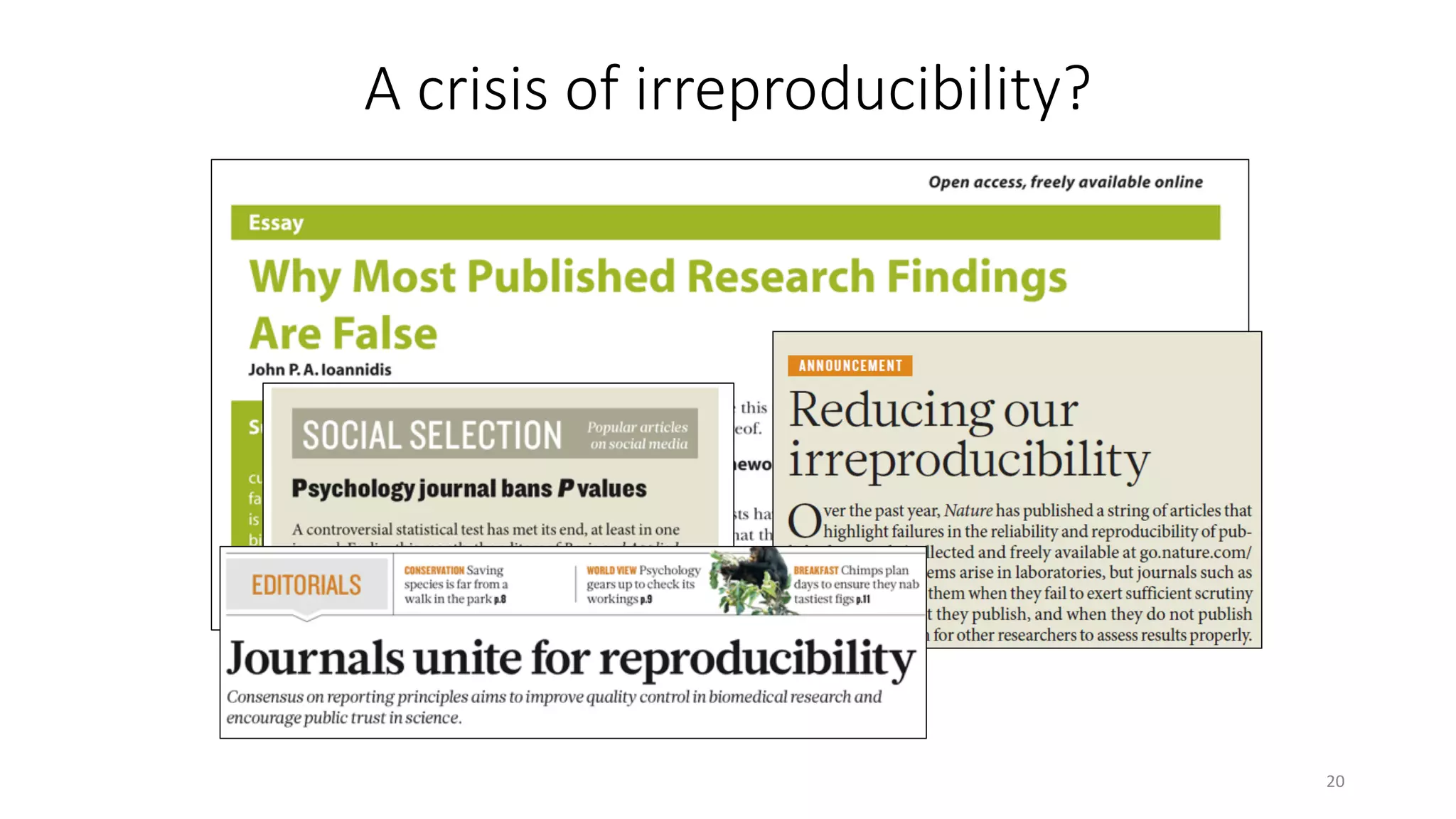
A crisis of irreproducibility?
20
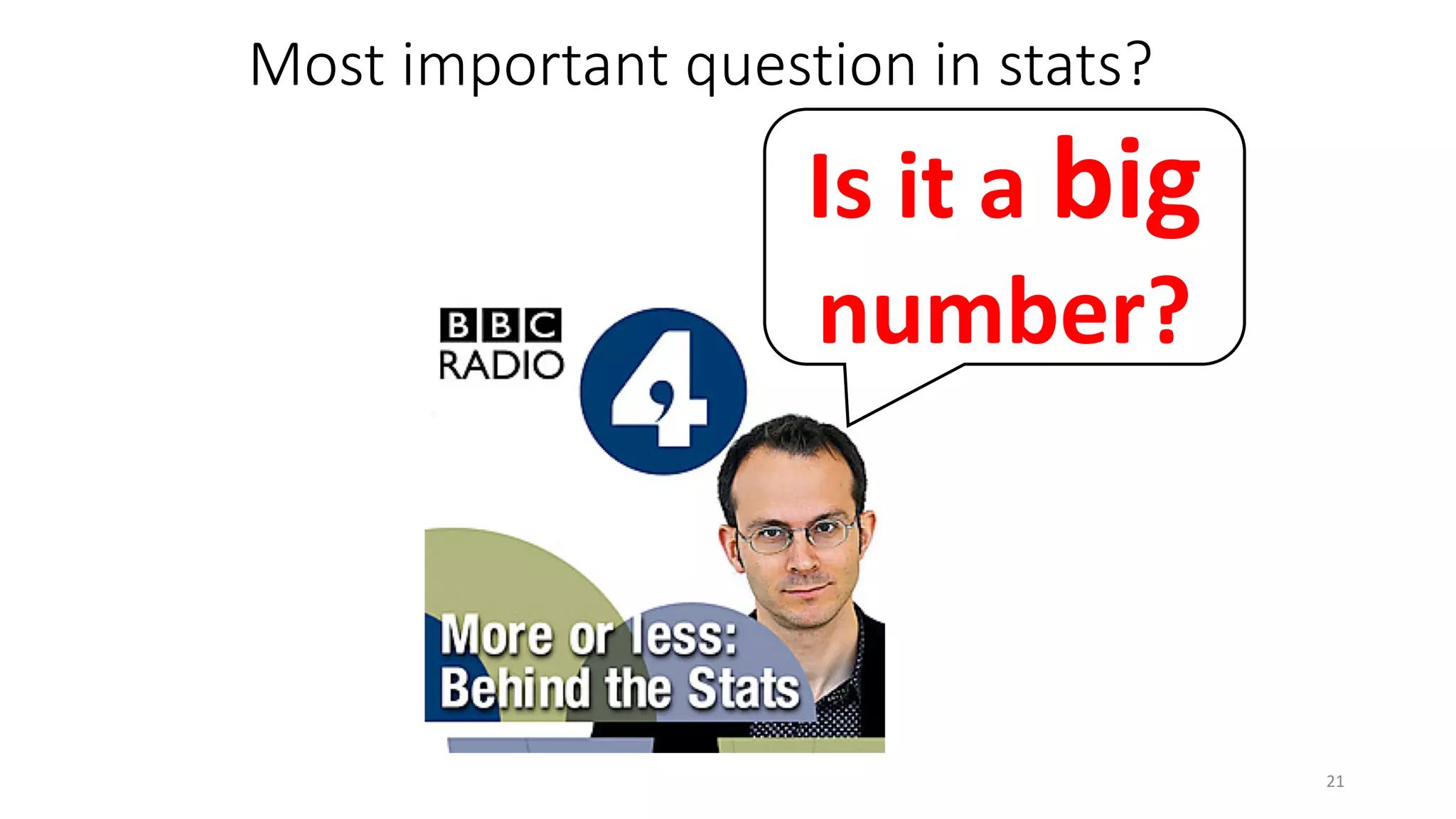
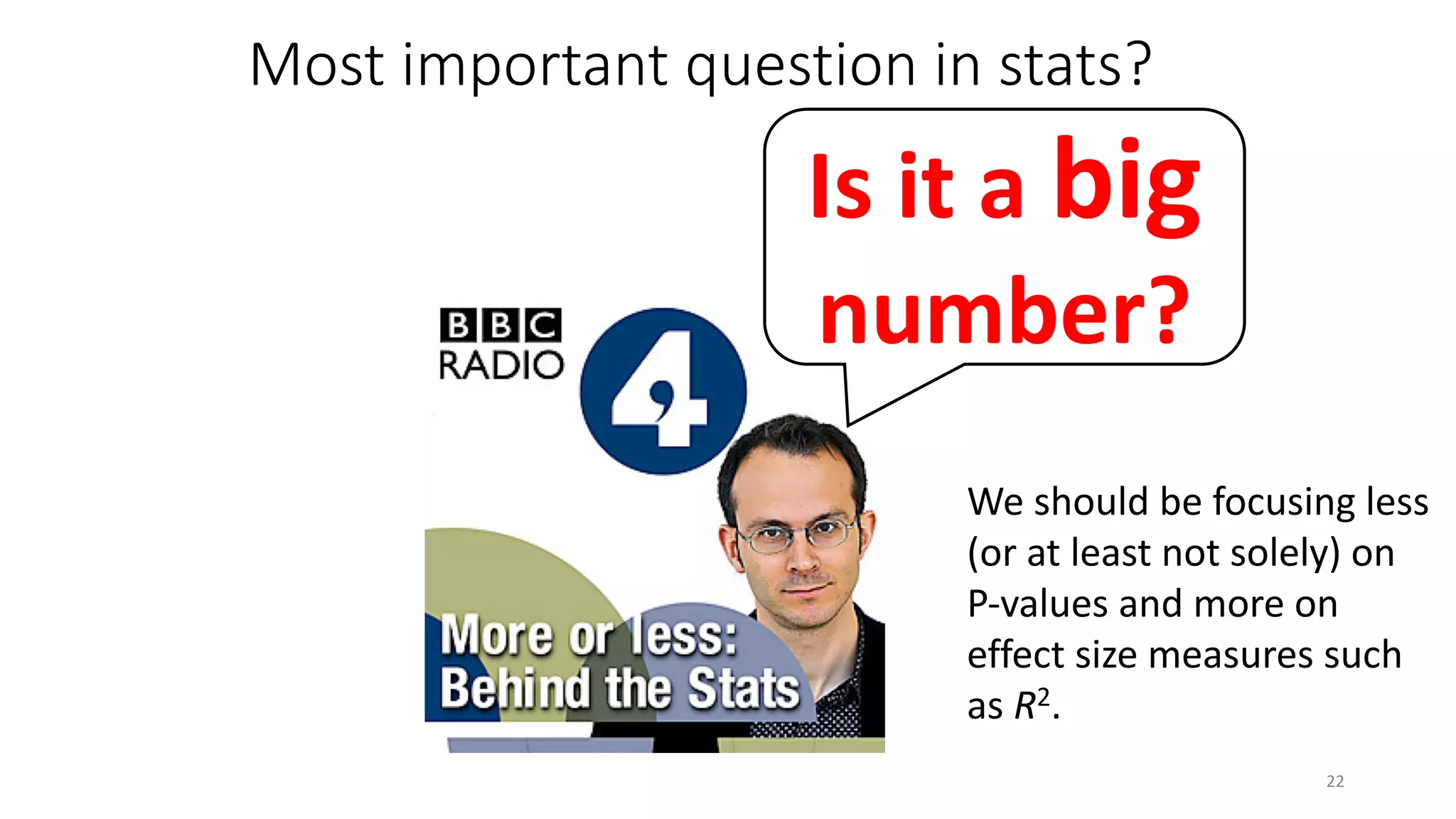
Most important question in stats?
Is it a big
number?
21
Most important question in stats?
Is it a big
number?
22
We should be focusing less
(or at least not solely) on
P-values and more on
effect size measures such
as R2.
Limitations of R2
• Gauges error in predicting your own data – not actually prediction
• Using R2 for model selection will always select the largest model
• Adjusted R2 penalises model complexity (here n = 5, p = 1):
• R2
adj = 1 – (1 – R2) (n – 1) / (n – p – 1)
• R2
adj = 100% – 34% x 4/3 = 54%
• Adjusted R2 still can’t be used for model selection (but still is)
• We want the “best” model also to have the maximum R2, similarly to
minimising AIC. This is “Final Prediction Error” R2 (Nicoleta & Goşoniu
2006):
• R2
FPE = [(n+p+1) x R2
adj - p] / (n + 1)
• R2
FPE = (7 x R2
adj – 1) / 6 = 46% (the most “honest” R2 , cf R2 = 66%!)
23
Limitations of R2
• Not clear how to generalise beyond linear regression models
• Generalised linear models (GLM)
• Linear mixed-effects models (LMM)
• Generalised linear mixed-effects models (GLMM = GLM + LMM)
24
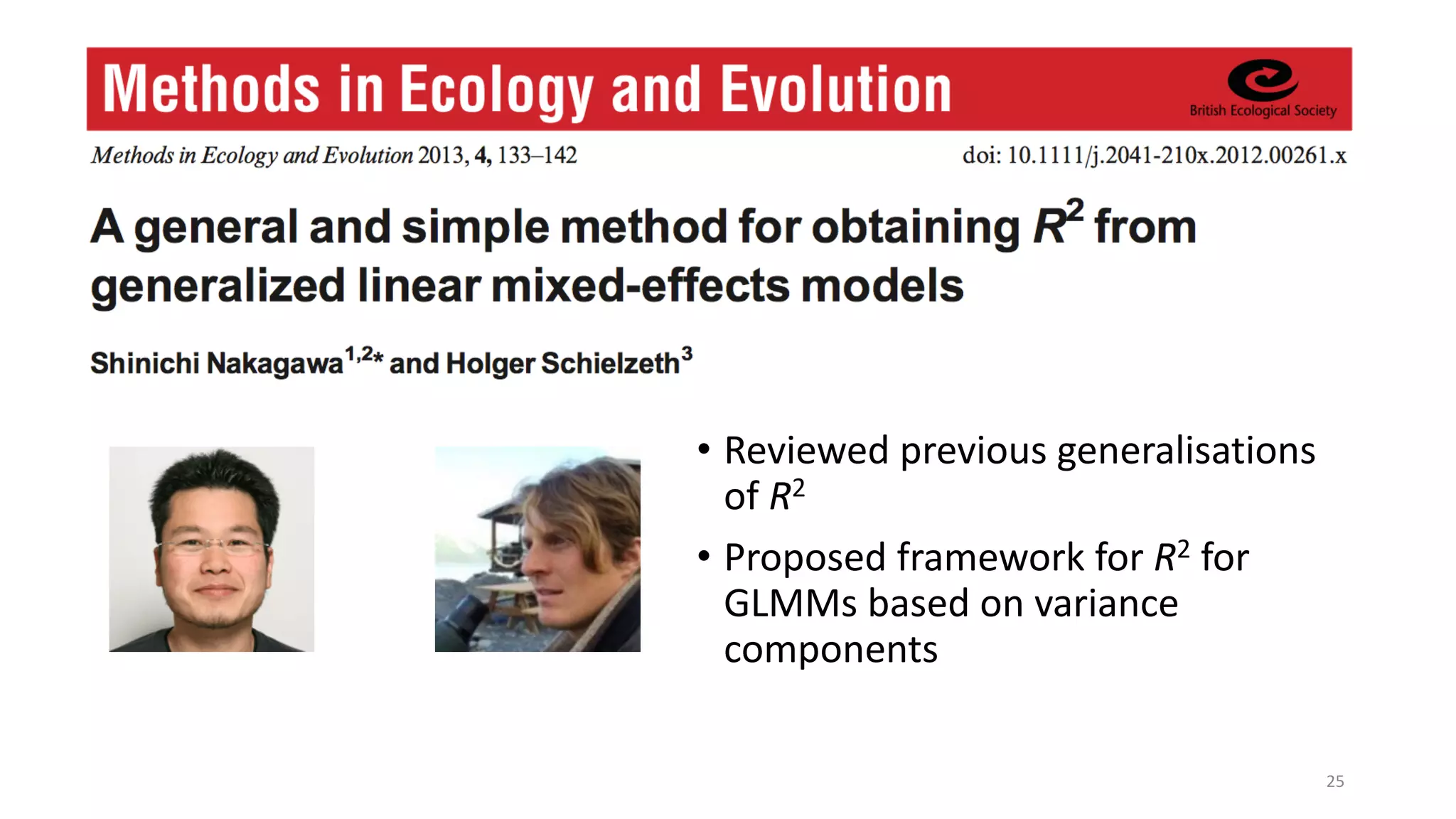
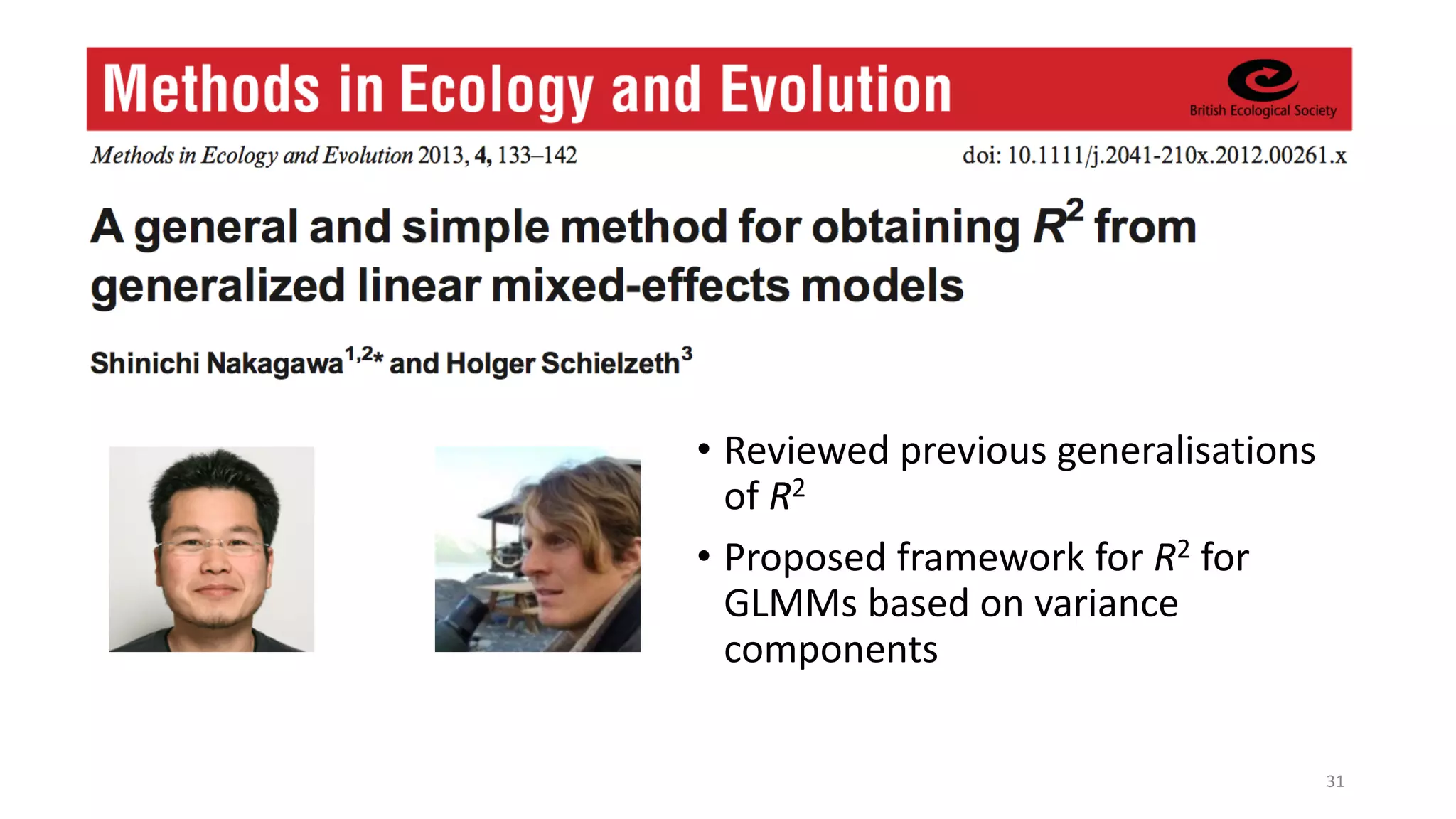
• Reviewed previous generalisations
of R2
• Proposed framework for R2 for
GLMMs based on variance
components
25
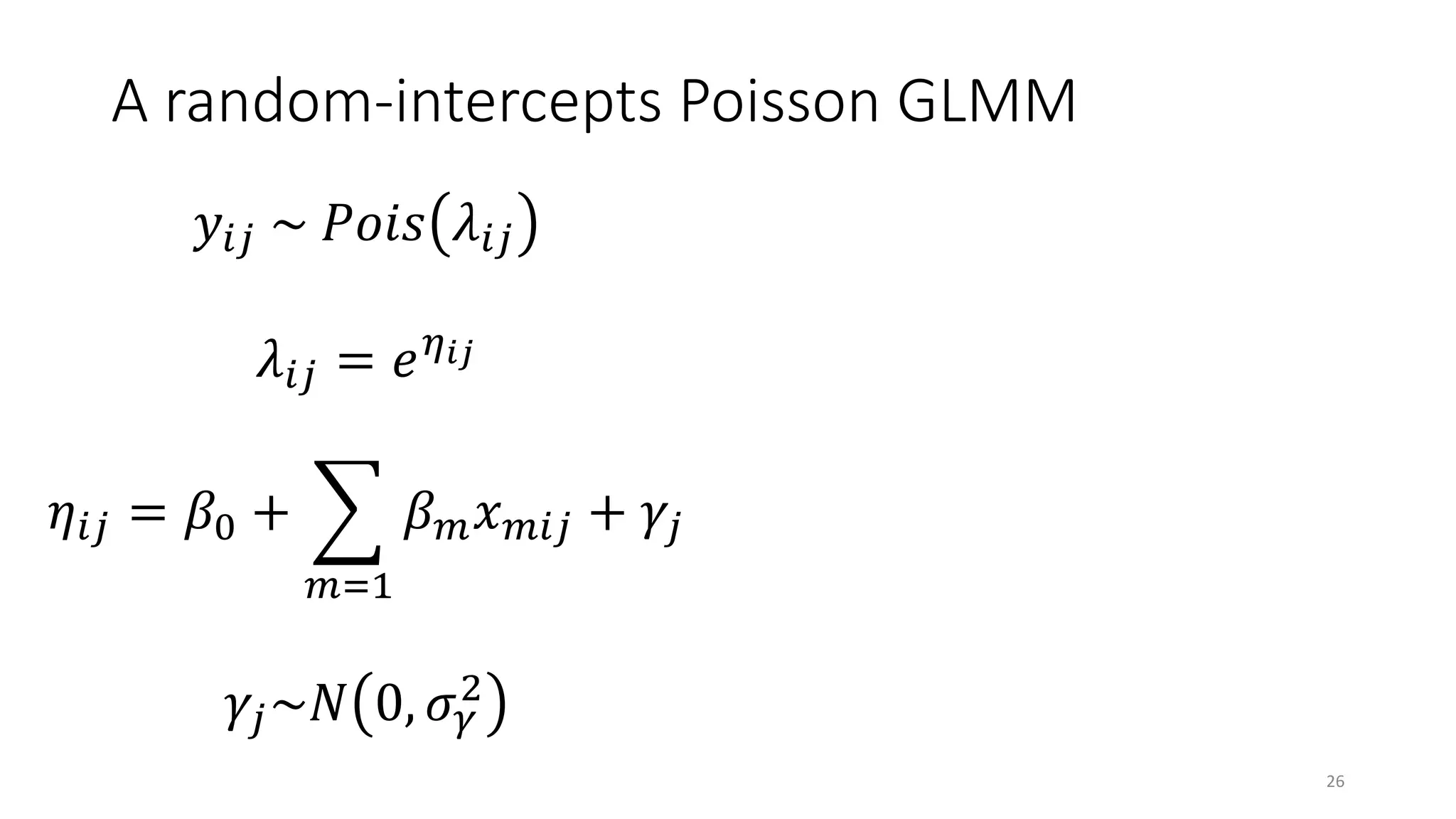
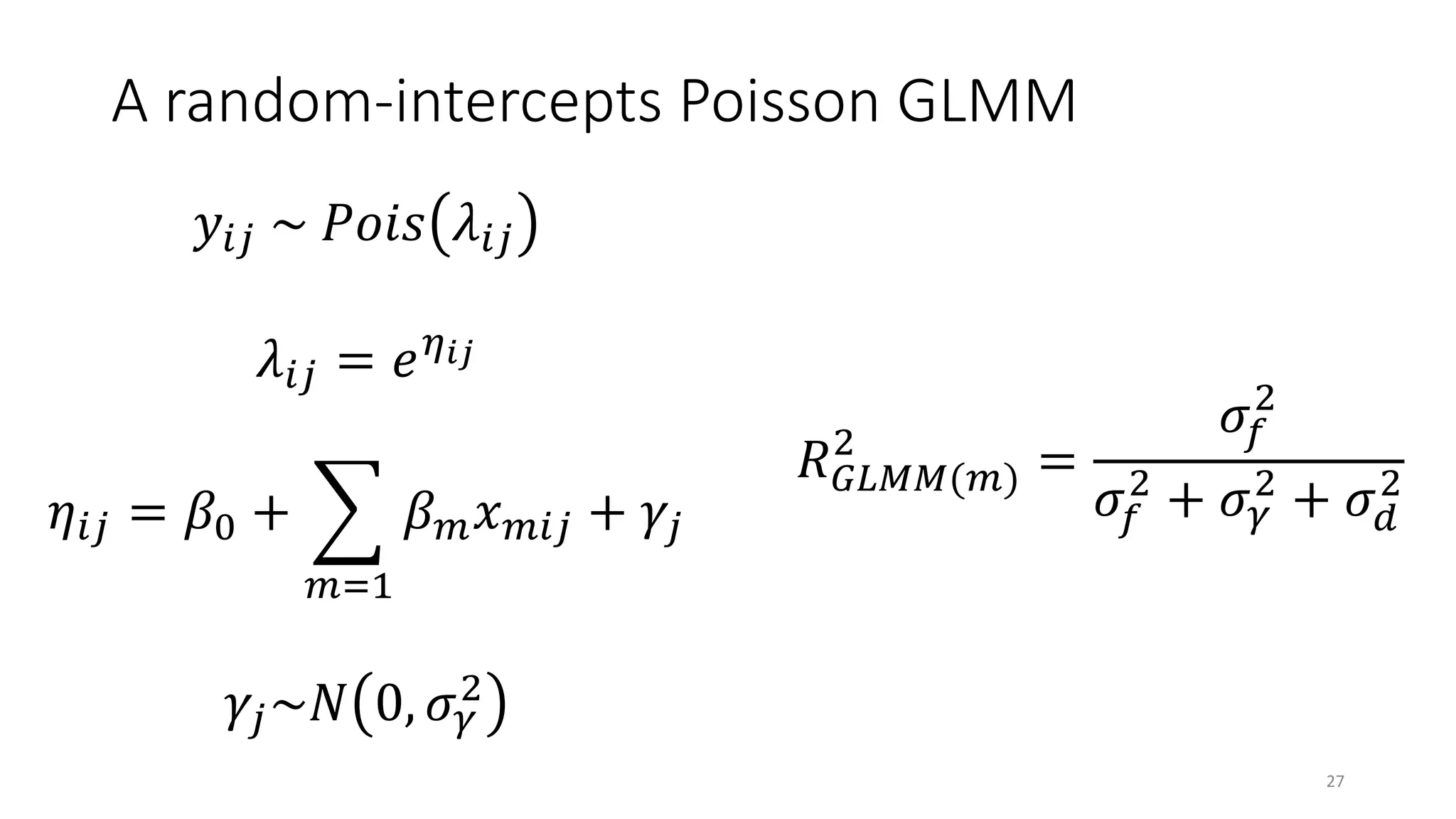
A random-intercepts Poisson GLMM
!"# ~ %&'( )"#
)"# = +,-.
/"# = 01 + 3
456
0474"# + 8#
8#~9 0, <=
>
26
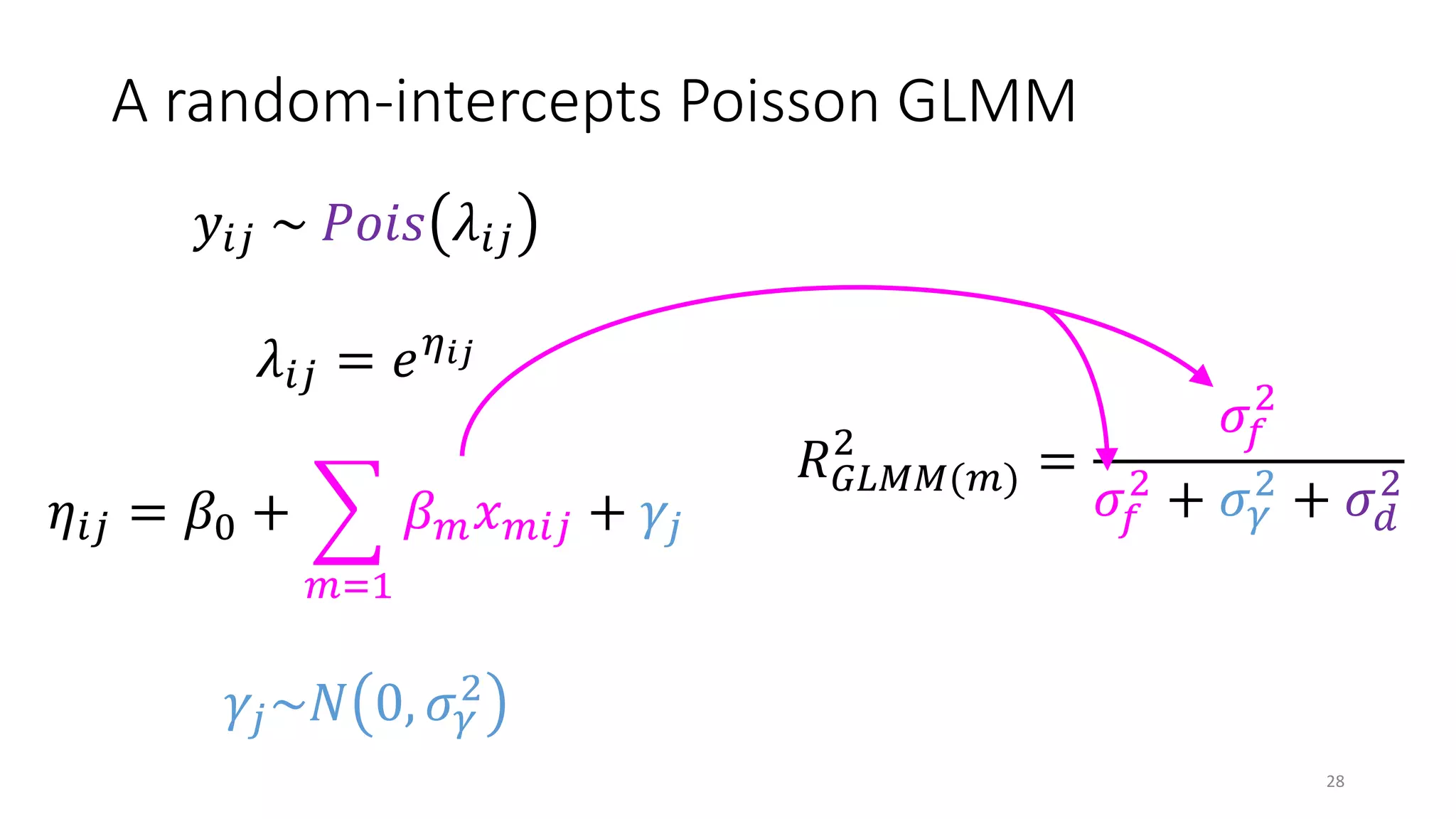
A random-intercepts Poisson GLMM
!"# ~ %&'( )"#
)"# = +,-.
/"# = 01 + 3
456
0474"# + 8#
8#~9 0, <=
>
?@ABB(4)
>
=
<E
>
<E
>
+ <=
>
+ <F
>
27
A random-intercepts Poisson GLMM
!"# ~ %&'( )"#
)"# = +,-.
/"# = 01 + 3
456
0474"# + 8#
8#~9 0, <=
>
?@ABB(4)
>
=
<E
>
<E
>
+ <=
>
+ <F
>
28
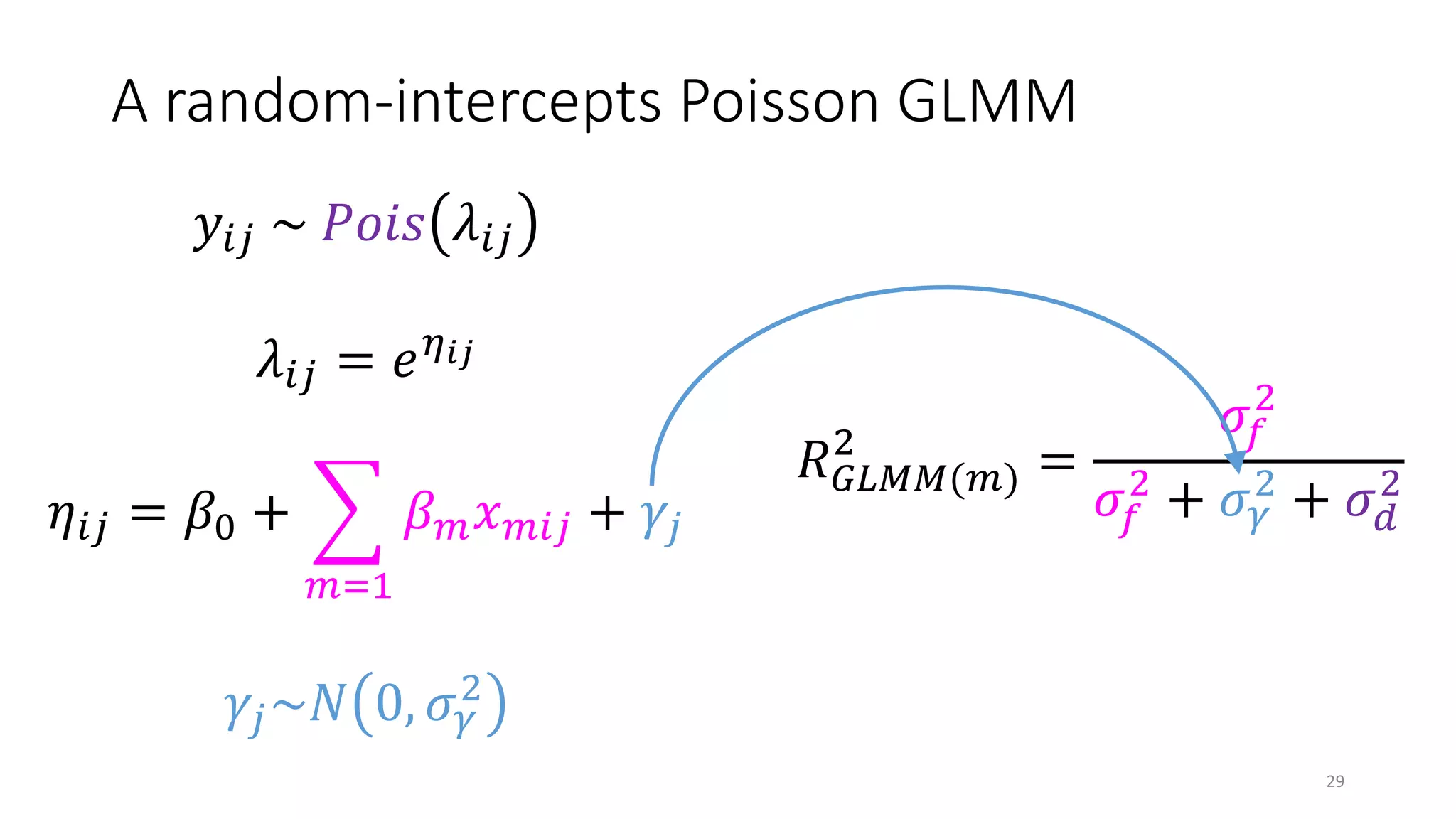
A random-intercepts Poisson GLMM
!"# ~ %&'( )"#
)"# = +,-.
/"# = 01 + 3
456
0474"# + 8#
8#~9 0, <=
>
?@ABB(4)
>
=
<E
>
<E
>
+ <=
>
+ <F
>
29
A random-intercepts Poisson GLMM
!"# ~ %&'( )"#
)"# = +,-.
/"# = 01 + 3
456
0474"# + 8#
8#~9 0, <=
>
?@ABB(4)
>
=
<E
>
<E
>
+ <=
>
+ <F
>
30
• Reviewed previous generalisations
of R2
• Proposed framework for R2 for
GLMMs based on variance
components
31
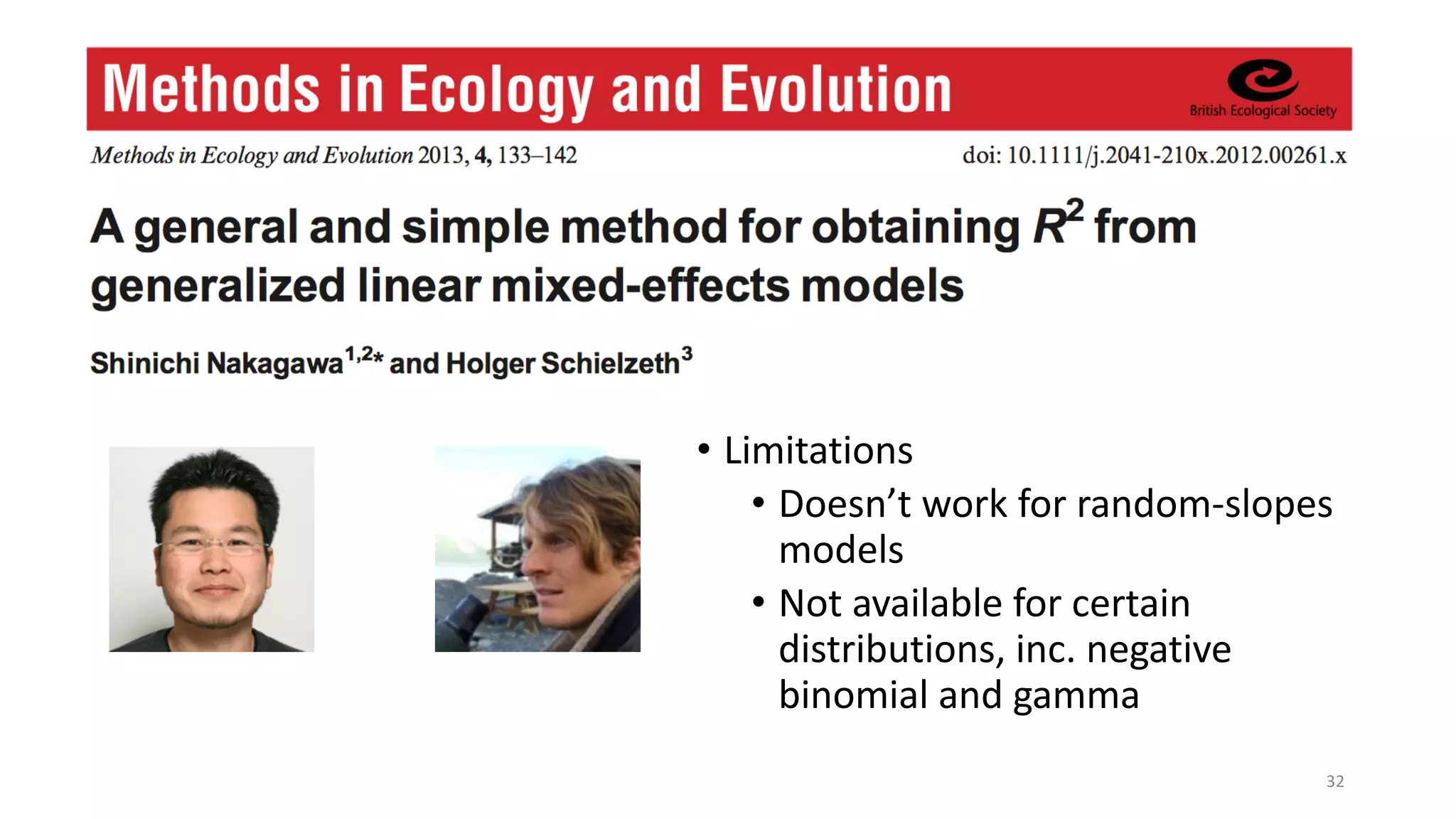
• Limitations
• Doesn’t work for random-slopes
models
• Not available for certain
distributions, inc. negative
binomial and gamma
32
2017
2014
R> library(piecewiseSEM) # by Jon Lefcheck
R> rsquared(glmer.mod)
Class Family Link n Marginal Conditional
1 glmerMod binomial logit 1431 0.5589205 0.629198 33
Thank you for listening
34

Extending R-squared beyond ordinary least-squares linear regression

  • 1.
    Extending R2 beyond ordinaryleast-squares linear regression Paul Johnson @paulcdjo 1
  • 2.
    What this talkisn’t about 2
  • 3.
    What this talkis about • What is R2? • Why is R2 useful? • What are some of the limitation of R2? • How have these limitations been overcome? 3
  • 4.
    The coefficient ofdetermination, R2 • R2 assesses goodness-of-fit of a linear regression model, on a scale from 0 to 1 • Definitions • Prediction: proportional reduction in model prediction error • Explanation: proportion of variance in response variable explained by explanatory variables • R2 is a measure of how much better we understand a system once we’ve measured and modelled some of its components 4
  • 5.
    How much variationin y does x explain? 5
  • 6.
    Or, how muchdoes including x reduce our error in predicting y? 6
  • 7.
  • 8.
    Gauge unexplained variationusing the squared prediction errors 8 Model without x Model with x
  • 9.
    Gauge unexplained variationusing the squared prediction errors 9
  • 10.
    Including x hasreduced total squared prediction error x 10
  • 11.
    Including x hasreduced total squared prediction error to 34% of the “no x” total… = 34% 11
  • 12.
    R2 is the% reduction in prediction error: = 66%R2 = 1 - 12
  • 13.
    We can partitionthe previously unexplained variance into explained (model) and unexplained 13
  • 14.
    We can partitionthe (previously) unexplained variance into explained (model) and unexplained (error) = + 14
  • 15.
    We can partitionthe (previously) unexplained variance into explained (model) and unexplained (error) = + R2 = 1 - = = 66% 15
  • 16.
  • 17.
  • 18.
    Rising complexity andfalling explanatory power in ecology (Low-Décarie et al. 2014 Frontiers in Ecology & the Environment) 18
  • 19.
    Rising complexity andfalling explanatory power in ecology (Low-Décarie et al. 2014 Frontiers in Ecology & the Environment) “If we extrapolate the current rate of decline … we would make the improbable but alarming prediction that ecology’s marginal explanatory power will be zero within the next 100 years” 19
  • 20.
    A crisis ofirreproducibility? 20
  • 21.
    Most important questionin stats? Is it a big number? 21
  • 22.
    Most important questionin stats? Is it a big number? 22 We should be focusing less (or at least not solely) on P-values and more on effect size measures such as R2.
  • 23.
    Limitations of R2 •Gauges error in predicting your own data – not actually prediction • Using R2 for model selection will always select the largest model • Adjusted R2 penalises model complexity (here n = 5, p = 1): • R2 adj = 1 – (1 – R2) (n – 1) / (n – p – 1) • R2 adj = 100% – 34% x 4/3 = 54% • Adjusted R2 still can’t be used for model selection (but still is) • We want the “best” model also to have the maximum R2, similarly to minimising AIC. This is “Final Prediction Error” R2 (Nicoleta & Goşoniu 2006): • R2 FPE = [(n+p+1) x R2 adj - p] / (n + 1) • R2 FPE = (7 x R2 adj – 1) / 6 = 46% (the most “honest” R2 , cf R2 = 66%!) 23
  • 24.
    Limitations of R2 •Not clear how to generalise beyond linear regression models • Generalised linear models (GLM) • Linear mixed-effects models (LMM) • Generalised linear mixed-effects models (GLMM = GLM + LMM) 24
  • 25.
    • Reviewed previousgeneralisations of R2 • Proposed framework for R2 for GLMMs based on variance components 25
  • 26.
    A random-intercepts PoissonGLMM !"# ~ %&'( )"# )"# = +,-. /"# = 01 + 3 456 0474"# + 8# 8#~9 0, <= > 26
  • 27.
    A random-intercepts PoissonGLMM !"# ~ %&'( )"# )"# = +,-. /"# = 01 + 3 456 0474"# + 8# 8#~9 0, <= > ?@ABB(4) > = <E > <E > + <= > + <F > 27
  • 28.
    A random-intercepts PoissonGLMM !"# ~ %&'( )"# )"# = +,-. /"# = 01 + 3 456 0474"# + 8# 8#~9 0, <= > ?@ABB(4) > = <E > <E > + <= > + <F > 28
  • 29.
    A random-intercepts PoissonGLMM !"# ~ %&'( )"# )"# = +,-. /"# = 01 + 3 456 0474"# + 8# 8#~9 0, <= > ?@ABB(4) > = <E > <E > + <= > + <F > 29
  • 30.
    A random-intercepts PoissonGLMM !"# ~ %&'( )"# )"# = +,-. /"# = 01 + 3 456 0474"# + 8# 8#~9 0, <= > ?@ABB(4) > = <E > <E > + <= > + <F > 30
  • 31.
    • Reviewed previousgeneralisations of R2 • Proposed framework for R2 for GLMMs based on variance components 31
  • 32.
    • Limitations • Doesn’twork for random-slopes models • Not available for certain distributions, inc. negative binomial and gamma 32
  • 33.
    2017 2014 R> library(piecewiseSEM) #by Jon Lefcheck R> rsquared(glmer.mod) Class Family Link n Marginal Conditional 1 glmerMod binomial logit 1431 0.5589205 0.629198 33
  • 34.
    Thank you forlistening 34