SEMINAR ON
BLAST DRILL HOLES
Presented by:- PAVANKUMAR
WHAT IS BLAST HOLE DRILL ?
 It is a technique used in mining whereby a hole
is drilled into the surface of the rock, packed
with explosive material and detonated.
DESCRIPTION
 Blast hole drilling is most commonly used in the
exploration of minerals.
 Blast hole drilling is done by the use of explosives. The
rock is blasted and crushing and removing of the rock
and other materials.
 Charging cavities are created and explosives are placed
into these cavities. Thus a blast hole is not the after effect
of an explosion, instead it is the hole created in which the
explosives, as well as the various components that go
along with the detonation of the explosives, are placed.
CONTINUE…
 The drilling part of the blast hole drilling process is that
most expensive part of the project.
 it is the most important part of the project. If the initial
drilling is done wrong then the future of the project
could end up being a problem.
LIMITATIONS :
 Fragmentation desired
 Rock quality/character
 Site condition
 Safety
 Equipments /materials
ADVANTAGES :
 Potential environmental impact in terms of
noise, dust and sensitive receive are significantly
reduced.
 Blast would significantly reduced vibration as
compared with bored tunneling.
DISADVANTAGES :
 Potential hazard associated with establishment of a
temporary magazine site for overnight of explosive shall
be addressed through avoiding populated areas in the site
selection process.
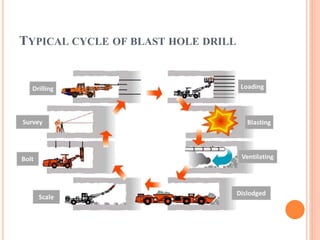
TYPICAL CYCLE OF BLAST HOLE DRILL
THE TYPICAL CYCLE OF EXCAVATION BY BLASTING IS
PERFORMED IN THE FOLLOWING STEPS:
 Drilling blast holes and loading them with
explosives.
 Detonating the blast, followed by ventilation to
remove blast fumes.
 Removal of the blasted rock (mucking).
 Scaling crown and walls to remove loosened
pieces of rock.
 Installing initial ground support.
 Advancing rail, ventilation, and utilities.
DRILLING AND BLASTING METHOD
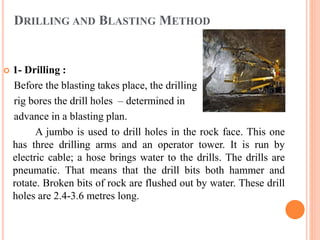
 1- Drilling :
Before the blasting takes place, the drilling
rig bores the drill holes – determined in
advance in a blasting plan.
A jumbo is used to drill holes in the rock face. This one
has three drilling arms and an operator tower. It is run by
electric cable; a hose brings water to the drills. The drills are
pneumatic. That means that the drill bits both hammer and
rotate. Broken bits of rock are flushed out by water. These drill
holes are 2.4-3.6 metres long.
 The first sets are straight holes (parallel cut) located around the
edge of the face and in the middle. A second set (V-cut) is
angled toward the center. These allow the rock to be blown
away from the face into the drift (tunnel).
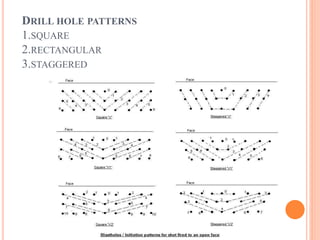
DRILL HOLE PATTERNS
1.SQUARE
2.RECTANGULAR
3.STAGGERED
2- LOADING AND BLASTING :
 The drill holes are now filled with explosives, detonators are
attached to the explosive devices and the individual explosive
devices are connected to one another.
 The holes are blasted in a proper sequence, from the center
outward, one after the other.
 Although more than 100 explosions may be set off, one after
the other, the blast sequence is completed in several seconds.
3- VENTILATING :
 The blast causes lots of rock to be flung through the tunnel,
dispersing clouds of dust that then mix with the combustion
gases of the explosion. So that the miners can resume work in
the tunnel, the bad air must be removed from the tunnel.
 This is done by using so-called air-ducting systems, long steel
or plastic pipes, which are attached to the roof of the tunnel and
blow fresh air onto the working face.
 This gives rise to localized excess pressure and the bad air is
pushed towards the tunnel exit.
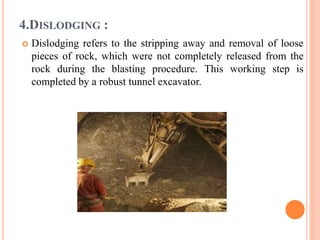
4.DISLODGING :
 Dislodging refers to the stripping away and removal of loose
pieces of rock, which were not completely released from the
rock during the blasting procedure. This working step is
completed by a robust tunnel excavator.
TYPES OF EXPLOSIVE ADDED
BASED ON DIFFERENT CONDITION
 DYNAMITE
 ANFO (AMMONIUM NITRATE & FUEL OIL
MIX)
 GUN POWDER
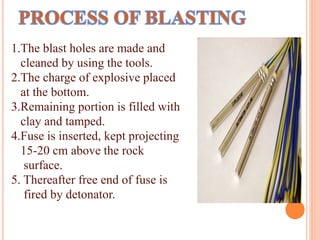
1.The blast holes are made and
cleaned by using the tools.
2.The charge of explosive placed
at the bottom.
3.Remaining portion is filled with
clay and tamped.
4.Fuse is inserted, kept projecting
15-20 cm above the rock
surface.
5. Thereafter free end of fuse is
fired by detonator.
Blast hole drill

Blast hole drill

  • 1.
    SEMINAR ON BLAST DRILLHOLES Presented by:- PAVANKUMAR
  • 2.
    WHAT IS BLASTHOLE DRILL ?  It is a technique used in mining whereby a hole is drilled into the surface of the rock, packed with explosive material and detonated.
  • 3.
    DESCRIPTION  Blast holedrilling is most commonly used in the exploration of minerals.  Blast hole drilling is done by the use of explosives. The rock is blasted and crushing and removing of the rock and other materials.  Charging cavities are created and explosives are placed into these cavities. Thus a blast hole is not the after effect of an explosion, instead it is the hole created in which the explosives, as well as the various components that go along with the detonation of the explosives, are placed.
  • 4.
    CONTINUE…  The drillingpart of the blast hole drilling process is that most expensive part of the project.  it is the most important part of the project. If the initial drilling is done wrong then the future of the project could end up being a problem.
  • 5.
    LIMITATIONS :  Fragmentationdesired  Rock quality/character  Site condition  Safety  Equipments /materials
  • 6.
    ADVANTAGES :  Potentialenvironmental impact in terms of noise, dust and sensitive receive are significantly reduced.  Blast would significantly reduced vibration as compared with bored tunneling.
  • 7.
    DISADVANTAGES :  Potentialhazard associated with establishment of a temporary magazine site for overnight of explosive shall be addressed through avoiding populated areas in the site selection process.
  • 8.
    TYPICAL CYCLE OFBLAST HOLE DRILL
  • 9.
    THE TYPICAL CYCLEOF EXCAVATION BY BLASTING IS PERFORMED IN THE FOLLOWING STEPS:  Drilling blast holes and loading them with explosives.  Detonating the blast, followed by ventilation to remove blast fumes.  Removal of the blasted rock (mucking).  Scaling crown and walls to remove loosened pieces of rock.  Installing initial ground support.  Advancing rail, ventilation, and utilities.
  • 10.
    DRILLING AND BLASTINGMETHOD  1- Drilling : Before the blasting takes place, the drilling rig bores the drill holes – determined in advance in a blasting plan. A jumbo is used to drill holes in the rock face. This one has three drilling arms and an operator tower. It is run by electric cable; a hose brings water to the drills. The drills are pneumatic. That means that the drill bits both hammer and rotate. Broken bits of rock are flushed out by water. These drill holes are 2.4-3.6 metres long.
  • 11.
     The firstsets are straight holes (parallel cut) located around the edge of the face and in the middle. A second set (V-cut) is angled toward the center. These allow the rock to be blown away from the face into the drift (tunnel).
  • 12.
  • 13.
    2- LOADING ANDBLASTING :  The drill holes are now filled with explosives, detonators are attached to the explosive devices and the individual explosive devices are connected to one another.  The holes are blasted in a proper sequence, from the center outward, one after the other.  Although more than 100 explosions may be set off, one after the other, the blast sequence is completed in several seconds.
  • 15.
    3- VENTILATING : The blast causes lots of rock to be flung through the tunnel, dispersing clouds of dust that then mix with the combustion gases of the explosion. So that the miners can resume work in the tunnel, the bad air must be removed from the tunnel.  This is done by using so-called air-ducting systems, long steel or plastic pipes, which are attached to the roof of the tunnel and blow fresh air onto the working face.  This gives rise to localized excess pressure and the bad air is pushed towards the tunnel exit.
  • 16.
    4.DISLODGING :  Dislodgingrefers to the stripping away and removal of loose pieces of rock, which were not completely released from the rock during the blasting procedure. This working step is completed by a robust tunnel excavator.
  • 17.
    TYPES OF EXPLOSIVEADDED BASED ON DIFFERENT CONDITION  DYNAMITE  ANFO (AMMONIUM NITRATE & FUEL OIL MIX)  GUN POWDER
  • 18.
    1.The blast holesare made and cleaned by using the tools. 2.The charge of explosive placed at the bottom. 3.Remaining portion is filled with clay and tamped. 4.Fuse is inserted, kept projecting 15-20 cm above the rock surface. 5. Thereafter free end of fuse is fired by detonator.