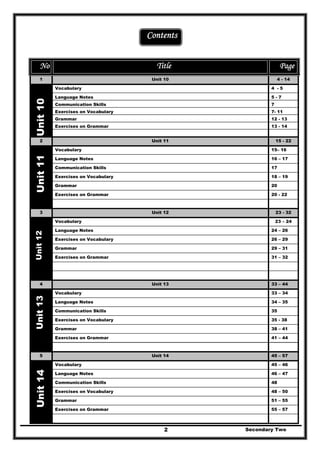
Contents
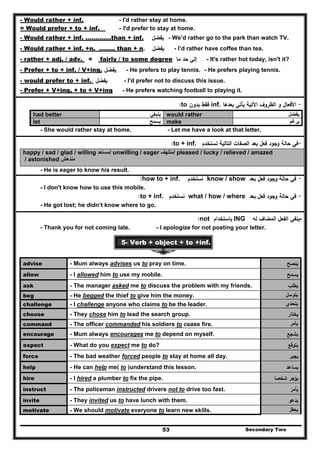
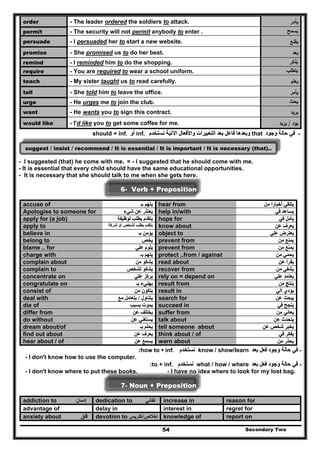
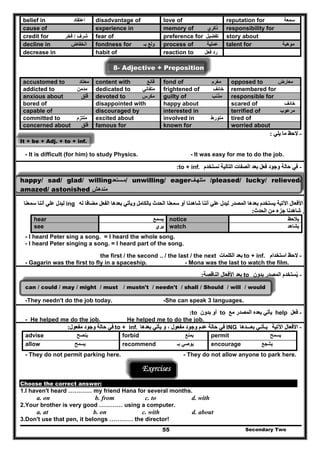
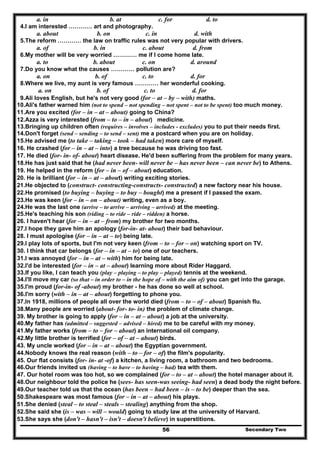
No Title Page
1 Unit 10 4 - 14
Vocabulary 4 - 5
Language Notes 5 - 7
Communication Skills 7
Exercises on Vocabulary 7- 11
Grammar 12 - 13
Exercises on Grammar 13 - 14
Unit10
2 Unit 11 15 - 22
Vocabulary 15– 16
Language Notes 16 – 17
Communication Skills 17
Exercises on Vocabulary 18 – 19
Grammar 20
Exercises on Grammar 20 - 22
Unit11
3 Unit 12 23 - 32
Vocabulary 23 – 24
Language Notes 24 – 26
Exercises on Vocabulary 26 – 29
Grammar 29 – 31
Exercises on Grammar
Secondary Two2
31 – 32
Unit12
4 Unit 13 33 – 44
Vocabulary 33 – 34
Language Notes 34 – 35
Communication Skills 35
Exercises on Vocabulary 35 - 38
Grammar 38 – 41
Unit13
Exercises on Grammar 41 – 44
5 Unit 14 45 – 57
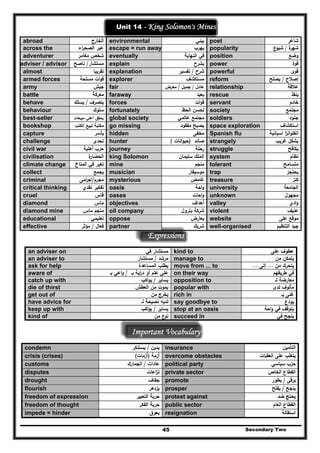
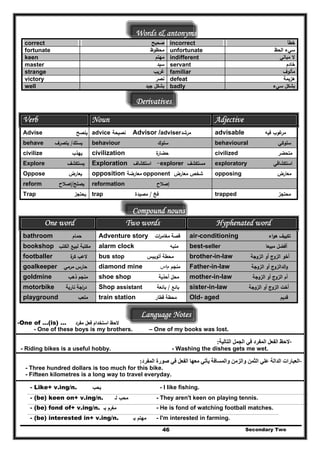
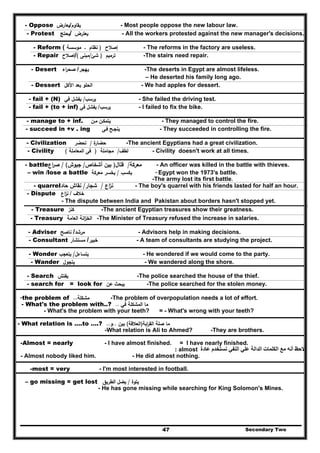
Vocabulary 45 – 46
Language Notes 46 – 47
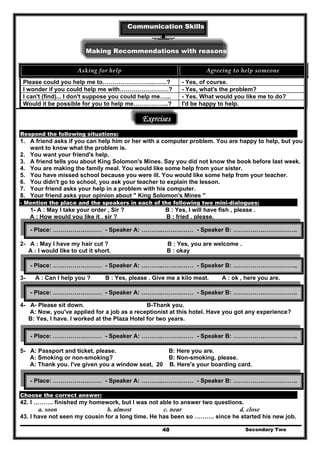
Communication Skills 48
Exercises on Vocabulary 48 – 50
Grammar 51 – 55
Exercises on Grammar 55 – 57
Unit14
Secondary Two3
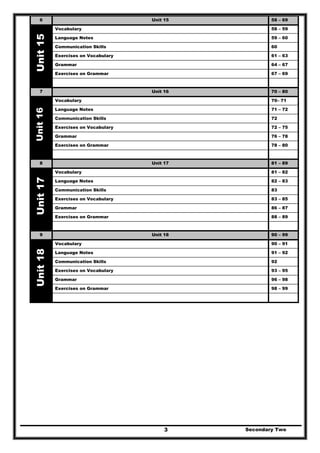
6 Unit 15 58 – 69
Vocabulary 58 – 59
Language Notes 59 – 60
Communication Skills 60
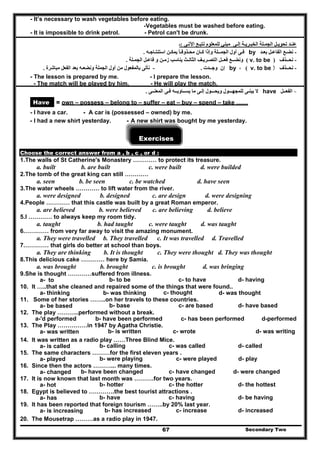
Exercises on Vocabulary 61 – 63
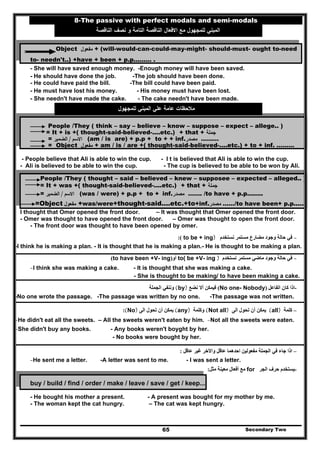
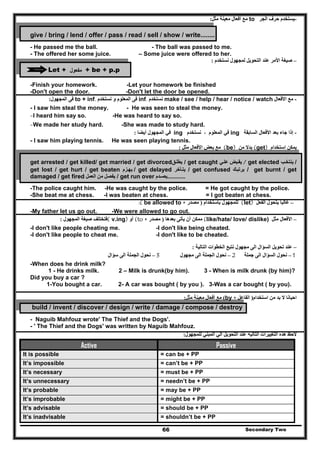
Grammar 64 – 67
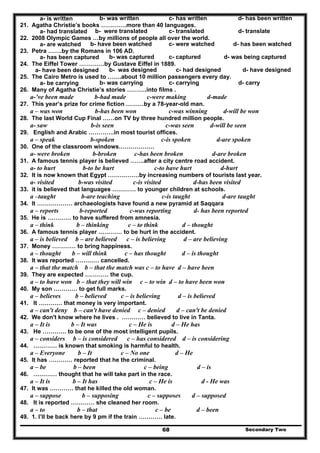
Exercises on Grammar 67 – 69
Unit15
7 Unit 16 70 – 80
Vocabulary 70– 71
Language Notes 71 – 72
Communication Skills 72
Exercises on Vocabulary 72 – 75
Grammar 76 – 78
Exercises on Grammar 78 – 80
Unit16
8 Unit 17 81 – 89
Vocabulary 81 – 82
Language Notes 82 – 83
Communication Skills 83
Exercises on Vocabulary 83 – 85
Grammar 86 – 87
Exercises on Grammar 88 – 89
Unit17
9 Unit 18 90 – 99
Vocabulary 90 – 91
Language Notes 91 – 92
Communication Skills 92
Exercises on Vocabulary 93 – 95
Grammar 96 – 98
Exercises on Grammar 98 – 99
Unit18
Secondary Two4
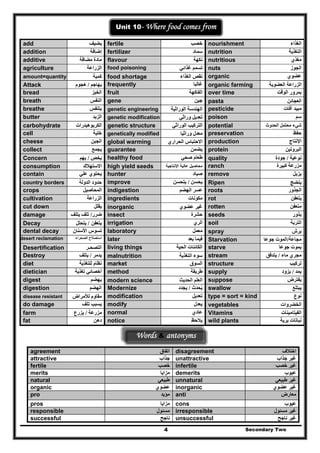
Unit 10- Where food comes from
add ‫يضيف‬ fertile ‫خصب‬ nourishment ‫الغذاء‬
addition ‫إضافة‬ fertilizer ‫سماد‬ nutrition ‫التغذية‬
additive ‫مضافة‬ ‫مادة‬ flavour ‫نكھة‬ nutritious ‫مغذي‬
agriculture ‫الزراعة‬ food poisoning ‫غذائي‬ ‫تسمم‬ nuts ‫الجوز‬
amount=quantity ‫كمي‬‫ة‬ food shortage ‫الغذاء‬ ‫نقص‬ organic ‫عضوي‬
Attack ‫يھاجم‬/‫ھجوم‬ frequently ‫غالبا‬ organic farming ‫العضوية‬ ‫الزراعة‬
bread ‫الخبز‬ fruit ‫الفاكھة‬ over time ‫الوقت‬ ‫بمرور‬
breath ‫النفس‬ gene ‫جين‬ pasta ‫العجائن‬
breathe ‫يتنفس‬ genetic engineering ‫الوراثية‬ ‫الھندسة‬ pesticide ‫آفات‬ ‫مبيد‬
butter ‫الزبد‬ genetic modification ‫وراثي‬ ‫تعديل‬ poison ‫سم‬
carbohydrate ‫الكربوھيدرات‬ genetic structure ‫الوراثي‬ ‫التركيب‬ potential ‫الحدوث‬ ‫محتمل‬ ‫شيء‬
cell ‫خلية‬ genetically modified ‫وراثيا‬ ‫معدل‬ preservation ‫حفظ‬
cheese ‫الجبن‬ global warming ‫الحراري‬ ‫االحتباس‬ production ‫اإلنتاج‬
collect ‫يجمع‬ guarantee ‫يضمن‬ protein ‫البروتين‬
Concern ‫يخص‬/‫يھم‬ healthy food ‫صحي‬ ‫طعام‬ quality ‫نوعية‬/‫جودة‬
consumption ‫االستھالك‬ high yield seeds ‫اإلنتاجية‬ ‫عالية‬ ‫محاصيل‬ ranch ‫كبيرة‬ ‫مزرعة‬
contain ‫علي‬ ‫يحتوي‬ hunter ‫صياد‬ remove ‫يزيل‬
country borders ‫الدول‬ ‫حدود‬‫ة‬ improve ‫يحسن‬/‫يتحسن‬ Ripen ‫ينضج‬
crops ‫المحاصيل‬ indigestion ‫الھضم‬ ‫عسر‬ roots ‫الجذور‬
cultivation ‫الزراعة‬ ingredients ‫مكونات‬ rot ‫يتعفن‬
cut down ‫يقلل‬ inorganic ‫عضوي‬ ‫غير‬ rotten ‫متعفن‬
damage ‫ضرر‬/‫تلف‬‫يتلف‬ insect ‫حشرة‬ seeds ‫بذور‬
Decay ‫يتعفن‬/‫يتحلل‬ irrigation ‫الري‬ soil ‫التربة‬
dental decay ‫األسنان‬ ‫تسوس‬ laboratory ‫معمل‬ spray ‫يرش‬
desert reclamation ‫الصحراء‬ ‫استصالح‬ later ‫بعد‬ ‫فيما‬ Starvation ‫مجاعة‬/‫جوع‬ ‫الموت‬‫ا‬
Desertification ‫التصحـر‬ living things ‫الحية‬ ‫الكائنات‬ starve ‫جوعا‬ ‫يموت‬
Destroy ‫يدمر‬/‫يتل‬‫ف‬ malnutrition ‫التغذية‬ ‫سوء‬ stream ‫ماء‬ ‫مجري‬/‫يتدفق‬
diet ‫للتغذية‬ ‫نظام‬ market ‫السوق‬ structure ‫تركيب‬
dietician ‫تغذية‬ ‫أخصائي‬ method ‫طريقة‬ supply ‫يمد‬/‫يزود‬
digest ‫يھضم‬ modern science ‫الحديث‬ ‫العلم‬ suppose ‫يفترض‬
digestion ‫الھضم‬ Modernize ‫يحدث‬ُ/‫يجدد‬ swallow ‫يبتلع‬
disease resistant ‫لألمراض‬ ‫مقاوم‬ modification ‫تعديل‬ type = sort = kind ‫نوع‬
do damage ‫تلف‬ ‫يسبب‬ modify ‫يعدل‬ vegetables ‫الخضروات‬
farm ‫مزرعة‬/‫يزرع‬ normal ‫عادي‬ Vitamins ‫الفيتامينات‬
fat ‫دھن‬ notice ‫يالحظ‬ wild plants ‫برية‬ ‫نباتات‬
Words & antonyms
agreement ‫اتفاق‬ disagreement ‫اختالف‬
attractive ‫جذاب‬ unattractive ‫جذاب‬ ‫غير‬
fertile ‫خصب‬ infertile ‫خصب‬ ‫غير‬
merits ‫مزايا‬ demerits ‫عيوب‬
natural ‫طبيعي‬ unnatural ‫طبيعي‬ ‫غير‬
organic ‫عضوي‬ inorganic ‫عضوي‬ ‫غير‬
pro ‫مؤيد‬ anti ‫معارض‬
pros ‫مزايا‬ cons ‫عيوب‬
responsible ‫مسئول‬ irresponsible ‫مسئول‬ ‫غير‬
successful ‫ناجح‬ unsuccessful ‫ناجح‬ ‫غير‬
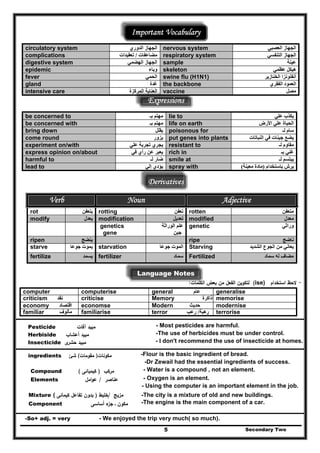
Important Vocabulary
‫الدوري‬ ‫الجھاز‬
Secondary Two5
circulatory system nervous system ‫العصبي‬ ‫الجھاز‬
complications ‫مضاعفات‬/‫تعقيدات‬ respiratory system ‫التنفسي‬ ‫الجھاز‬
‫الھ‬ ‫الجھاز‬‫ضمي‬digestive system sample ‫عينة‬
epidemic ‫وباء‬ skeleton ‫عظمي‬ ‫ھيكل‬
‫الحمي‬fever swine flu (H1N1) ‫الخنازير‬ ‫أنفلونزا‬
‫غدة‬gland the backbone ‫الفقري‬ ‫العمود‬
‫المركزة‬ ‫العناية‬intensive care vaccine ‫مصل‬
Expressions
‫بـ‬ ‫مھتم‬be concerned to lie to ‫علي‬ ‫يكذب‬
‫م‬‫بـ‬ ‫ھتم‬be concerned with life on earth ‫األرض‬ ‫علي‬ ‫الحياة‬
‫يقلل‬bring down poisonous for ‫لـ‬ ‫سام‬
‫يزور‬come round put genes into plants ‫النباتات‬ ‫في‬ ‫جينات‬ ‫يضع‬
‫علي‬ ‫تجربة‬ ‫يجري‬experiment on/with resistant to ‫لـ‬ ‫مقاوم‬
‫في‬ ‫رأي‬ ‫عن‬ ‫يعبر‬express opinion on/about rich in ‫بـ‬ ‫غني‬
‫لـ‬ ‫ضار‬harmful to smile at ‫لـ‬ ‫يبتسم‬
‫إلي‬ ‫يؤدي‬ spray withlead to ‫باستخدام‬ ‫يرش‬)‫معينة‬ ‫مادة‬(
Derivatives
Verb Noun Adjective
rot ‫يتعفن‬ ‫تعفن‬rotting rotten ‫متعفن‬
modify ‫يعدل‬ modification ‫تعديل‬ modified ‫معدل‬
‫ال‬ ‫علم‬‫وراثة‬
‫جين‬
genetics
gene
genetic ‫وراثي‬
ripen ‫ينضج‬ ripe ‫ناضج‬
‫جوعا‬ ‫يموت‬ ‫جوعا‬ ‫الموت‬ Starvingstarve starvation ‫الشديد‬ ‫الجوع‬ ‫من‬ ‫يعاني‬
fertilize ‫يسمد‬ fertilizer ‫سماد‬ Fertilized ‫سماد‬ ‫له‬ ‫مضاف‬
Language Notes
-‫اﺳﺗﺧدام‬ ‫ﻻﺣظ‬ise)(‫ﻟﺗﻛ‬‫اﻟﻛﻠﻣﺎت‬ ‫ﺑﻌض‬ ‫ﻣن‬ ‫اﻟﻔﻌﻝ‬ ‫وﻳن‬:
computer computerise general ‫عام‬ generalise
criticism ‫نقد‬ Memory ‫ذاكرة‬criticise memorise
economy ‫اقتصاد‬ Modern ‫حديث‬economse modernise
familiar ‫مألوف‬ terror ‫رھب‬‫ة‬/‫رعب‬familiarise terrorise
Pesticide ‫آﻓﺎت‬ ‫ﻣﺑﻳد‬ - Most pesticides are harmful.
Herbiside ‫أﻋﺷﺎب‬ ‫ﻣﺑﻳد‬ -The use of herbicides must be under control.
Insecticide - I don't recommend the use of insecticide at homes.‫ى‬‫ﺣﺷر‬ ‫ﻣﺑﻳد‬
‫ﺊ‬ingredients ‫ﻣﻛوﻧﺎت‬)‫ﻣﺎت‬(‫ﺷ‬ ‫ﻣﻘو‬ -Flour is the basic ingredient of bread.
-Dr Zewail had the essential ingredients of success.
Compound ‫ﻛﻳﻣﻳﺎﺋﻰ‬( ) ‫ﻣرﻛب‬ - Water is a compound , not an element.
Elements ‫اﻣﻝ‬‫و‬‫ﻋ‬ / ‫ﻋﻧﺎﺻر‬
- Using the computer is an important element in the job.
- Oxygen is an element.
Mixture ‫ﻳﺞ‬) ‫/ﺧﻠﻳط‬ ‫ﻣز‬‫ﻛﻳﻣﺎﺋﻰ‬ ‫ﺗﻔﺎﻋﻝ‬ ‫ﺑدون‬( -The city is a mixture of old and new buildings.
-The engine is the main component of a car.Component ‫أﺳﺎﺳﻰ‬ ‫ء‬‫ﺟز‬ ‫ـ‬ ‫ﻣﻛون‬
-So+ adj. = very - We enjoyed the trip very much( so much).
-Such+ adj. + n. = very -She is such a polite girl.
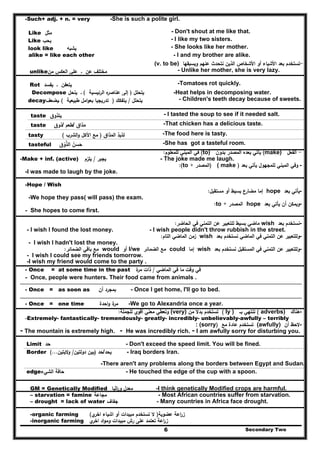
Like ‫ﻣﺛﻝ‬ - Don't shout at me like that.
Like ‫ﻳﺣب‬ - I like my two sisters.
look like ‫ﻳﺷﺑﻪ‬ - She looks like her mother.
alike = like each other - I and my brother are alike.
-
Secondary Two6
‫ﺗﺳﺗﺧدم‬‫ﺎ‬‫وﻳﺳﺑﻘﻬ‬ ‫ﻋﻧﻬم‬ ‫ﻧﺗﺣدث‬ ‫اﻟذﻳن‬ ‫اﻷﺷﺧﺎص‬ ‫أو‬ ‫اﻷﺷﻳﺎء‬ ‫ﺑﻌد‬(v. to be)
- Unlike her mother, she is very lazy.unlike‫ﻣن‬ ‫اﻟﻌﻛس‬ ‫ﻲ‬ ‫ﻋن‬ ‫ﻣﺧﺗﻠف‬‫ـ‬‫ﻋﻠ‬
Rot ‫ﻳﻔﺳد‬ ‫ـ‬ ‫ﻳﺗﻌﻔن‬ -Tomatoes rot quickly.
Decompose ‫ﻳﺗﺣﻠﻝ‬)‫ﺋﻳﺳﻳﺔ‬( ‫اﻟر‬ ‫ﻩ‬‫ﻋﻧﺎﺻر‬ ‫إﻟﻰ‬‫ﻳﻧﺣﻝ‬ ‫ـ‬ -Heat helps in decomposing water.
- Children's teeth decay because of sweets.decay ‫ﻳﺗﺣﻠﻝ‬/‫ﻳﺗﻔﻛك‬)‫طﺑﻳﻌﻳﺔ‬ ‫اﻣﻝ‬‫و‬‫ﺑﻌ‬ ‫ﺗدرﻳﺟﻳﺎ‬(‫ـﻳﺿﻌف‬
‫ﻳﺗذو‬‫ق‬taste - I tasted the soup to see if it needed salt.
taste ‫/ذوق‬ ‫/طﻌم‬ ‫ﻣذاق‬َ
-That chicken has a delicious taste.
tasty ‫اﻟﻣذاق‬ ‫ﻟذﻳذ‬َ)‫اﻟﺷرب‬‫و‬ ‫اﻷﻛﻝ‬ ‫ﻣﻊ‬( -The food here is tasty.
tasteful -She has got a tasteful room.‫ﺣﺳن‬ُ َ َ‫اﻟذوق‬ْ
‫ﱠ‬
-‫اﻟﻔﻌﻝ‬make)(‫ﺑدون‬ ‫اﻟﻣﺻدر‬ ‫ﺑﻌدﻩ‬ ‫ﻳﺄﺗﻲ‬to)(‫ﻟﻠﻣﻌﻠوم‬ ‫اﻟﻣﺑﻧﻲ‬ ‫ﻓﻲ‬:
-Make + inf. (active) ‫ﻳﺟﺑر‬/‫ﻳﻠزم‬ - The joke made me laugh.
-‫ﺑﻌد‬ ‫ﻳﺄﺗﻲ‬ ‫ﻟﻠﻣﺟﻬوﻝ‬ ‫اﻟﻣﺑﻧﻲ‬ ‫وﻓﻲ‬)( make)‫اﻟﻣﺻدر‬+to:(
-I was made to laugh by the joke.
-Hope / Wish
-‫ﺑﻌد‬ ‫ﻳﺄﺗﻲ‬hope‫ﻣﺳﺗﻘﺑﻝ‬ ‫أو‬ ‫ﺑﺳﻳط‬ ‫ﻣﺿﺎرع‬ ‫إﻣﺎ‬:
-We hope they pass( will pass) the exam.
-‫ﺑﻌد‬ ‫ﻳﺄﺗﻲ‬ ‫أن‬ ‫وﻳﻣﻛن‬hope‫اﻟﻣﺻدر‬+to:
- She hopes to come first.
-‫ﺑﻌد‬ ‫ﻧﺳﺗﺧدم‬wish‫ﻟﻠ‬ ‫ﺑﺳﻳط‬ ‫ﻣﺎﺿﻲ‬‫اﻟﺣﺎﺿر‬ ‫ﻓﻲ‬ ‫اﻟﺗﻣﻧﻲ‬ ‫ﻋن‬ ‫ﺗﻌﺑﻳر‬:
- I wish I found the lost money. - I wish people didn't throw rubbish in the street.
-‫ﺑﻌد‬ ‫ﻧﺳﺗﺧدم‬ ‫اﻟﻣﺎﺿﻲ‬ ‫ﻓﻲ‬ ‫اﻟﺗﻣﻧﻲ‬ ‫ﻋن‬ ‫وﻟﻠﺗﻌﺑﻳر‬wish‫اﻟﺗﺎم‬ ‫اﻟﻣﺎﺿﻲ‬ ‫زﻣن‬:
- I wish I hadn't lost the money.
‫اﻟﺗﻣﻧ‬ ‫ﻋن‬ ‫وﻟﻠﺗﻌﺑﻳر‬‫ﺑﻌد‬ ‫ﻧﺳﺗﺧدم‬ ‫اﻟﻣﺳﺗﻘﺑﻝ‬ ‫ﻓﻲ‬ ‫ﻲ‬wish‫إﻣﺎ‬could‫اﻟﺿﻣﺎﺋر‬ ‫ﻣﻊ‬I/we‫أو‬would‫اﻟﺿﻣﺎﺋر‬ ‫ﺑﺎﻗﻲ‬ ‫ﻣﻊ‬: -
- I wish I could see my friends tomorrow.
-I wish my friend would come to the party .
- Once = at some time in the past ‫اﻟﻣﺎﺿﻲ‬ ‫ﻓﻲ‬ ‫ﻣﺎ‬ ‫وﻗت‬ ‫ﻓﻲ‬/‫ذ‬‫ة‬‫ﻣر‬ ‫ات‬
- Once, people were hunters. Their food came from animals .
- Once = as soon as ‫أن‬ ‫ﺑﻣﺟرد‬ - Once I get home, I'll go to bed.
‫ة‬‫ﻣر‬‫اﺣدة‬‫و‬ -We go to Alexandria once a year.- Once = one time
-‫ﻫﻧﺎك‬adverbs)(‫ﺗﻧﺗﻬ‬‫ﺑــ‬ ‫ﻲ‬ly )(‫ﻣن‬ ‫ﺑدﻻ‬ ‫ﺗﺳﺗﺧدم‬(very)‫ﻟﻠﺟﻣﻠﺔ‬ ‫أﻗوي‬ ‫ﻣﻌﻧﻲ‬ ‫وﺗﻌطﻲ‬:
-Extremely- fantastically- tremendously- greatly- incredibly- unbelievably-awfully – terribly
-‫أن‬ ‫ﻻﺣظ‬(awfully)‫ﻣﻊ‬ ‫ﻋﺎدة‬ ‫ﺗﺳﺗﺧدم‬): (sorry
- The mountain is extremely high. - He was incredibly rich. - I am awfully sorry for disturbing you.
Limit ‫ﺣد‬ - Don't exceed the speed limit. You will be fined.
Border ‫ﺣد‬)‫دوﻟﺗﻳن‬ ‫ﺑﻳن‬/‫وﻻﻳﺗﻳن‬(... /‫ﻳﺣد‬ - Iraq borders Iran.
-There aren't any problems along the borders between Egypt and Sudan.
edge‫اﻟﺷﻲء‬ ‫ﺣﺎﻓﺔ‬ - He touched the edge of the cup with a spoon.
GM = Genetically Modified ‫اﺛﻳﺎ‬‫ر‬‫و‬ ‫ﻣﻌدﻝ‬ -I think genetically Modified crops are harmful.
– starvation = famine ‫ﻣﺟﺎﻋﺔ‬ - Most African countries suffer from starvation.
– drought = lack of water ‫ﺟﻔﺎف‬ - Many countries in Africa face drought.
-organic farming ‫ﻋﺿوﻳﺔ‬ ‫اﻋﺔ‬‫ر‬‫ز‬)‫ي‬‫اﺧر‬ ‫اﺷﻳﺎء‬ ‫أو‬ ‫ﻣﺑﻳدات‬ ‫ﺗﺳﺗﺧدم‬ ‫ﻻ‬(
-inorganic farming ‫ﺗﻌﺗﻣد‬ ‫اﻋﺔ‬‫ر‬‫ز‬‫ر‬ ‫ﻋﻠﻰ‬‫ي‬‫اﺧر‬ ‫اد‬‫و‬‫وﻣ‬ ‫ﻣﺑﻳدات‬ ‫ش‬
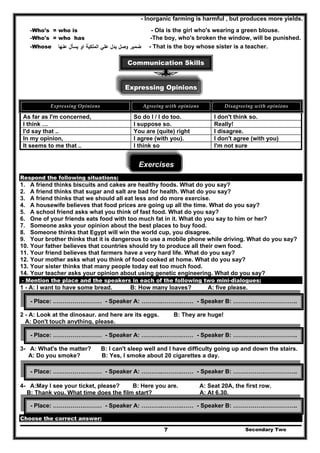
- Inorganic farming is harmful , but produces more yields.
-Who's = who is - Ola is the girl who's wearing a green blouse.
-Who's = who has -The boy, who's broken the window, will be punished.
-Whose ‫ﻋﻧﻬﺎ‬ ‫ﻳﺳﺄﻝ‬ ‫او‬ ‫اﻟﻣﻠﻛﻳﺔ‬ ‫ﻋﻠﻲ‬ ‫ﻳدﻝ‬ ‫وﺻﻝ‬ ‫ﺿﻣﻳر‬ - That is the boy whose sister is a teacher.
Communication Skills
Expressing Opinions
Expressing Opinions  Agreeing with opinions  Disagreeing with opinions 
As far as I'm concerned, So do I / I do too. I don't think so.
I think … I suppose so. Really!
I'd say that .. You are (quite) right I disagree.
In my opinion, I agree (with you). I don't agree (with you)
It seems to me that .. I think so I'm not sure
Exercises
Respond the following situations:
1. A friend thinks biscuits and cakes are healthy foods. What do you say?
2. A friend thinks that sugar and salt are bad for health. What do you say?
3. A friend thinks that we should all eat less and do more exercise.
4. A housewife believes that food prices are going up all the time. What do you say?
5. A school friend asks what you think of fast food. What do you say?
6. One of your friends eats food with too much fat in it. What do you say to him or her?
7. Someone asks your opinion about the best places to buy food.
8. Someone thinks that Egypt will win the world cup, you disagree.
9. Your brother thinks that it is dangerous to use a mobile phone while driving. What do you say?
10. Your father believes that countries should try to produce all their own food.
11. Your friend believes that farmers have a very hard life. What do you say?
12. Your mother asks what you think of food cooked at home. What do you say?
13. Your sister thinks that many people today eat too much food.
14. Your teacher asks your opinion about using genetic engineering. What do you say?
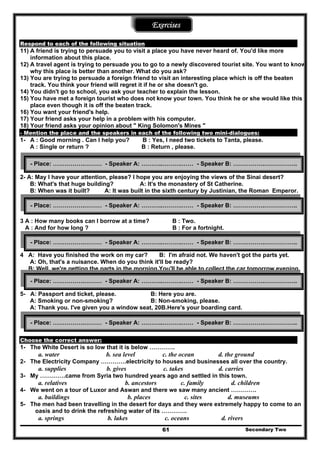
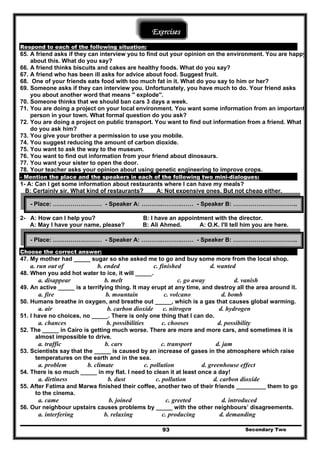
- Mention the place and the speakers in each of the following two mini-dialogues:
1 - A: I want to have some bread. B: How many loaves? A: five please.
2 - A: Look at the dinosaur. and here are its eggs. B: They are huge!
A: Don't touch anything, please.
3- A: What's the matter? B: I can't sleep well and I have difficulty going up and down the stairs.
A: Do you smoke? B: Yes, I smoke about 20 cigarettes a day.
4- A:May I see your ticket, please? B: Here you are. A: Seat 20A, the first row.
B: Thank you. What time does the film start? A: At 6.30.
Choose the correct answer:
Secondary Two7
- Place: …………….……… - Speaker A: ………..……….…… - Speaker B: …………….……………..
Secondary Two8
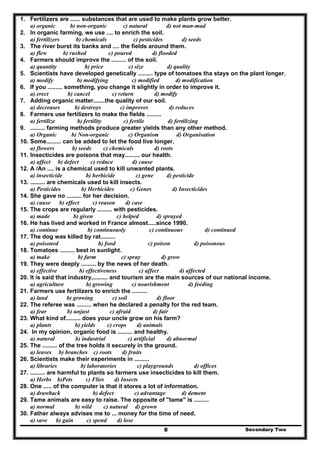
1. Fertilizers are ...... substances that are used to make plants grow better.
a) organic b) non-organic c) natural d) not man-mad
2. In organic farming, we use .... to enrich the soil.
a) fertilizers b) chemicals c) pesticides d) seeds
3. The river burst its banks and .... the fields around them.
a) flew b) rushed c) poured d) flooded
4. Farmers should improve the ......... of the soil.
a) quantity b) price c) size d) quality
5. Scientists have developed genetically ......... type of tomatoes tha stays on the plant longer.
a) modify b) modifying c) modified d) modification
6. If you ......... something, you change it slightly in order to improve it.
a) erect b) cancel c) return d) modify
7. Adding organic matter.......the quality of our soil.
a) decreases b) destroys c) improves d) reduces
8. Farmers use fertilizers to make the fields .........
a) fertilize b) fertility c) fertile d) fertilizing
9. ......... farming methods produce greater yields than any other method.
a) Organic b) Non-organic c) Organism d) Organisation
10. Some......... can be added to let the food live longer.
a) flowers b) seeds c) chemicals d) roots
11. Insecticides are poisons that may......... our health.
a) affect b) defect c) reduce d) cause
12. A /An .... is a chemical used to kill unwanted plants.
a) insecticide b) herbicide c) gene d) pesticide
13. ......... are chemicals used to kill insects.
a) Pesticides b) Herbicides c) Genes d) Insecticides
14. She gave no ......... for her decision.
a) cause b) effect c) reason d) case
15. The crops are regularly ......... with pesticides.
a) made b) given c) helped d) sprayed
16. He has lived and worked in France almost.....since 1990.
a) continue b) continuously c) continuous d) continued
17. The dog was killed by rat.........
a) poisoned b) food c) poison d) poisonous
18. Tomatoes ......... best in sunlight.
a) make b) farm c) spray d) grow
19. They were deeply ......... by the news of her death.
a) effective b) effectiveness c) affect d) affected
20. It is said that industry,......... and tourism are the main sources of our national income.
a) agriculture b) growing c) nourishment d) feeding
21. Farmers use fertilizers to enrich the .........
a) land b) growing c) soil d) floor
22. The referee was ......... when he declared a penalty for the red team.
a) fear b) unjust c) afraid d) fair
23. What kind of......... does your uncle grow on his farm?
a) plants b) yields c) crops d) animals
24. In my opinion, organic food is ......... and healthy.
a) natural b) industrial c) artificial d) abnormal
25. The ......... of the tree holds it securely in the ground.
a) leaves b) branches c) roots d) fruits
26. Scientists make their experiments in .........
a) libraries b) laboratories c) playgrounds d) offices
27. ......... are harmful to plants so farmers use insecticides to kill them.
a) Herbs b)Pets c) Flies d) Insects
28. One ..... of the computer is that it stores a lot of information.
a) drawback b) defect c) advantage d) dement
29. Tame animals are easy to raise. The opposite of "tame" is .........
a) normal b) wild c) natural d) grown
30. Father always advises me to ... money for the time of need.
a) save b) gain c) spend d) lose
Secondary Two9
31. 32-As a child, he learned to ......... and fish.
a) come b) hunt c) raise d) cheer
32. ....are the parts of the cells which control what a living thing will be like.
a) Genetical b) Genetically c) Genes d) Genetic
33. ......... engineering aims at improving the quality of crops.
a) Genetic b) Scientific c) Geological d) Genetically
34. They collected the peaches when they fully.........
a) fitted b) prepared c) provided d) ripened
35. This fruit isn't......... yet. We can't eat it.
a) ripen b) rip c) ripple d) ripe
36. Scientists can change the genetic structure of plants and animals by using genetic.........
a) agriculture b) chemistry c) biology d) engineering
37. Thousands of people in some African countries die of......... They have little food to eat.
a) feeding b) starvation c) eating d) nourishment
38. Mother prepared all the ...... she needed to make the cake.
a) parts b) ingredients c) divisions d) contents
39. The rain will make the grass .........
a) grow b) plant c) farm d) decrease
40. She suffers a lot from that disease, but we are very pleased that her temperature is .........
a) extraordinary b) unusual c) normal d) abnormal
41. A ......... is an amount of something that is produced by cultivating the land.
a) consumer b) producer c) gene d) yield
42. Samples were ......... from over 200 patients.
a) grown b) made c) developed d) collected
43. She was shaking with ......... when she saw the police arresting the criminal.
a) afraid b) fear c) fearful d) dreadful
44. These electric wires are ......... by a rubber covering.
a) made b) protected c) grown d) worked
45. The storm caused great.........
a) carelessness b) progress c) damage d) improvement
46. A ........ is a person who hunts wild animals for food or sport.
a) scientist b) pilot c) mechanic d) hunter
47. The lid of this bottle is too hard to .........
a) revise b) remove c) remember d) recover
48. A lot of people in Africa ......... to death. They are in bad need of help.
a) starve b) die c) live d) survive
49. Fruit is ready to eat when it has been......... by the sun.
a) made b) ripened c) sprayed d) given
50. The main ......... of the meal I'm cooking is cheese.
a) shape b)size c) ingredient d) colour
51. Scientists can ......... crops by adding or removing certain genes.
a) prevent b) spray c) return d) modify
52. People who do not have enough food to eat may die of..
a) thirst b) freedom c) starvation d) heat
53. If you want to grow vegetables, you have to put......... in the ground.
a) branches b) leaves c) sides d) seeds
54. ......... fruit usually tastes sweet.
a) Ripen b)Ripe c) Ripens d) Ripping
55. This tomato is ......... I can't eat it.
a) rot b) rotten c) rots d) rotting
56. Many people were very hungry after the storm. Some even began to.........
a) starved b) starve c) starving d) starvation
57. As ......... as I'm concerned, the answer isn't to continuously spray the land with chemicals.
a) fast b)long c)soon d)far
58. I'd ......... that modern fanning makes more money than organic farming, wouldn't you?
a) talk b) speak c)tell d)say
59. This library ......... a lot of useful books.
a) consists b) forms c) contains d) makes
60. I hate living in ......... villages. They lack a lot of services.
a) near b) nearby c)next d) remote
Secondary Two10
61. I'm not......... about her. She can take care of herself.
a) interested b) worried c) afraid d) fond
62. A woman was ......... and robbed by a gang of youths.
a) made b) attacked c) given d) done
63. After a long time of hard work, he became a ......... in business.
a) barter b) porter c) partner d) portion
64. All the products are ..... with comprehensive instructions.
a) labelled b) addressed c) developed d) entitled
65. We ......... the two reports carefully.
a) listened b) spoke c) compared d) hold
66. Put......... in the local paper to sell your car.
a) a menu b) a questionnaire c) a list d) an advertisement
67. Some people travel abroad to ......... money, others travel for sightseeing.
a) help b) beat c) make d) do
68. Farmers spray their crops ......... insecticides to protect them.
a) by b) for c) with d) in
69. The chairman started his meeting ......... a short word just to break the ice.
a) with b) on c) by d) from
70. Take an umbrella with you to protect yourself......... the heavy rain.
a) of b)from c)off d) at
71. Camping teaches our students how to depend ......... themselves
a) in b) about c) of d) on
72. A lot of people all over the world die ......... hunger.
a) out b) from c) of d) on
Find the mistake in each of the following sentences, then write them correctly:
1. A filter is a thing which farmers put on soil to help plants to grow.
2. A leaf is the part of a plant from which a new plant of the same kind can grow.
3. A library is a room or building used for scientific experiments.
4. Automatic farming does not use chemical fertilizers.
5. Carbons provide our bodies with heat and energy.
6. Chemical fertilizers are organic.
7. Does the corn ripen in the sun?
8. Electrical engineering is the science of changing the structure of the genes of a living thing in
order to make it healthier or stronger.
9. Fanners earn their money from culture.
10. Genetic modified crops can improve agriculture.
11. He needs to prove his French.
12. His uncle works in a farm.
13. I hope I am getting my university degree next month.
14. I hope you good health.
15. I want to study genetic at university.
16. I'd rather starving than work for that company.
17. I'd talk that the government should make more efforts to solve this problem.
18. If the pipe bursts, it will float the whole house.
19. If you want to grow vegetables, you have to put seats in the ground.
20. Imagination and hard work are the contents of success.
21. In organic farming, crops are sprayed with chemicals .
22. In organic farming, fruits are sprayed with chemical pesticides.
23. It's difficult to look unnatural when you're feeling nervous.
24. Michael Crichton wrote a book about phonetic engineering.
25. Millions of people face salutation because they don't have enough to eat.
26. Modern technology can protect people from starve.
27. Nobody saw the thieves who's robbed the gas station.
28. Nowadays we eat genetically modify food.
29. Our teacher made us to do our homework.
30. People get information at the internet
31. Protein is an animal which helps us to grow and be healthy.
32. Scientifically engineering means to make genes into plants and animals.
33. Scientists can exchange crops by adding or removing certain genes.
34. Sensation is suffering or death caused by lack of food.
35. She did the job well and neither did Hala.
36. Smoking has a bad affect on our health.
37. Some people in Africa died from starvation.
38. The boy whose written the e-mail is my cousin.
39. The cause why he died was lack of medical care.
40. The company who's employees went on strike closed down.
41. The crops are regularly covered with pesticide.
42. The doctor who's clinic is next to the bank is very clever.
43. The equality of the crops has unproved.
44. The fruit is starting to go rot.
45. The land must be infertile to produce good crops.
46. The man who's house collapsed during the earthquake was so sad.
47. The mountain is incredibly height.
48. The reason for the blood was all that heavy rain.
49. The software we use has been satisfied for us.
50. The stems of all living things control what they will be like.
51. The work of growing crops and raising animals is called engineering.
52. There are too much books in the bag.
53. These vegetables can be grown from seat.
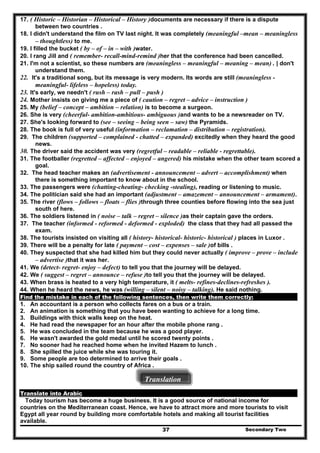
Translation
Translate into Arabic:
There are two main forms of farming, organic farming that uses natural additions. The second
type is inorganic farming that uses chemical fertilizers. it increases the quantity of yield , but it may
be harmful.
…………………………………………………………………………………………………………………………
……………………………………………………………………………………………………………………………
The problem of starvation affects many places in the world. the main reason why people are
hungry is not that there is food shortage, but that methods of cultivation are not sufficiently
advanced in some areas. Moreover, the food is not fairly distributed to all those who need it.
…………………………………………………………………………………………………………………………
……………………………………………………………………………………………………………………………
All living things contain genes which control what they will be like. Now scientists can modify
plants and animals' genes to change their characteristics and this is called “Genetic engineering”.
…………………………………………………………………………………………………………………………
……………………………………………………………………………………………………………………………
Translate into English:
–‫العالم‬ ‫يعاني‬ ‫سوف‬‫الحروب‬ ‫بسبب‬ ‫والمجاعة‬ ‫المياة‬ ‫نقص‬ ‫مشاكل‬ ‫من‬.
………………………………………………………………………………………………………………………
………………………………………………………………………………………………………………………
–‫؟‬ ‫عضوية‬ ‫الغير‬ ‫والزراعة‬ ‫العضوية‬ ‫الزراعة‬ ‫بين‬ ‫الفرق‬ ‫ھو‬ ‫ما‬
………………………………………………………………………………………………………………………
‫م‬ ‫الكثير‬ ‫تناول‬‫كذلك‬ ‫أليس‬ ،‫بالصحة‬ ‫ضار‬ ‫السكر‬ ‫و‬ ‫الدھون‬ ‫و‬ ‫الملح‬ ‫ن‬‫؟‬ -
………………………………………………………………………………………………………………………
‫تعتب‬‫ـ‬‫األلع‬ ‫ر‬‫ـ‬‫األولمبي‬ ‫اب‬‫ـ‬‫سن‬ ‫أربع‬ ‫كل‬ ‫يقام‬ ‫رياضيا‬ ‫مھرجانا‬ ‫ة‬‫ـ‬‫في‬ ‫تتنافس‬ ،‫وات‬‫ـ‬‫الع‬ ‫ه‬‫ـ‬‫الدول‬ ‫من‬ ‫ديد‬ -
………………………………………………………………………………………………………………………
………………………………………………………………………………………………………………………
-‫وراثيا‬ ‫المعدلة‬ ‫المكونات‬ ‫من‬ ‫العديد‬ ‫على‬ ‫نتناولھا‬ ‫التي‬ ‫األطعمة‬ ‫تحتوي‬.
………………………………………………………………………………………………………………………
-–‫؟‬ ‫الوراثية‬ ‫الھندسة‬ ‫ضد‬ ‫أم‬ ‫مع‬ ‫أنت‬ ‫ھل‬
………………………………………………………………………………………………………………………
Secondary Two11
Tag Question - Question Tag
-‫المنفية‬ ‫او‬ ‫المثبتة‬ ‫الجملة‬ ‫نھاية‬ ‫في‬ ‫يوضع‬ ‫قصير‬ ‫سؤال‬ ‫ھو‬ ‫المذيل‬ ‫السؤال‬:
- He is a clever young man, isn't he?
- He works in a secondary school, doesn't he?
- He will arrive at about twelve, won't he?
- He can speak two languages, can't he?
-‫مثبت‬ ‫مذيل‬ ‫سؤال‬ ‫يتبعھا‬ ‫المنفية‬ ‫الجملة‬ ‫و‬ ‫منفي‬ ‫مذيل‬ ‫سؤال‬ ‫يتبعھا‬ ‫المثبتة‬ ‫الجملة‬:
-‫دائمـا‬ ‫معناه‬ ‫للجملة‬ ‫المضاف‬ ‫السؤال‬"‫كذلك؟‬ ‫أليس‬"‫او‬"‫صواب؟‬ ‫علي‬ ‫انا‬ ‫ھل‬:"
-‫الم‬ ‫للفعل‬ ‫المختصرة‬ ‫بالصيغة‬ ‫يكون‬ ‫النفي‬ ‫و‬ ‫فاعل‬ ‫ضمير‬ ‫دائما‬ ‫نستخدم‬ ‫للجملة‬ ‫المضاف‬ ‫السؤال‬ ‫في‬‫الناقص‬ ‫او‬ ‫ساعد‬:
-‫كلھا‬ ‫الجملة‬ ‫تسمي‬(Tag Question )‫الخاص‬ ‫االخير‬ ‫الجزء‬ ‫يسمي‬ ‫بينما‬(Question Tag)
‫المذيل‬ ‫لسؤال‬ ‫علي‬ ‫عامة‬ ‫مالحظات‬
1--‫وجـود‬ ‫حالة‬ ‫في‬am‫السؤال‬ ‫في‬ ‫نستخدم‬aren’t‫وجود‬ ‫حالة‬ ‫وفي‬am not‫نستخدم‬am:
- I am a student, aren't I ? - I am not a doctor, am I ?
2-‫مثبت‬ ‫السؤال‬ ‫يكون‬ ‫ولذلك‬ ‫النفي‬ ‫عن‬ ‫تعبر‬ ‫اآلتية‬ ‫الكلمات‬:
seldom / never / scarcely / neither / little / few / hardly / rarely / no longer
-He no longer comes early, does he? -There’s hardly any food, is there?
3-‫بـ‬ ‫الجملـة‬ ‫بـدأت‬ ‫إذا‬Let’s‫المـذيل‬ ‫السـؤال‬ ‫يكـون‬shall we - shan’t we‫إقتراح‬ ‫عن‬ ‫تعبر‬ ‫ألنھا‬:
-Let’s go fishing , shall we / shan’t we ?
4-‫بـ‬ ‫الجملـة‬ ‫بـدأت‬ ‫إذا‬Let us‫المـذيـل‬ ‫السـؤال‬ ‫يكـون‬will you - won’t you.‫طلب‬ ‫عن‬ ‫تعبر‬ ‫ألنھا‬:
Let us go fishing, will you / won’t you ?-
5-‫الفعـل‬ ‫جـاء‬ ‫إذا‬need‫المـذي‬ ‫السـؤال‬ ‫يكـون‬ ‫اإلثبـات‬ ‫فـي‬‫ـ‬‫ل‬don’t.
- We need your agreement, don’t we ?
6-‫الفع‬ ‫جـاء‬ ‫إذا‬‫ـ‬‫ل‬needn’t‫نستخ‬‫ـ‬‫دم‬need‫ف‬‫ـ‬‫الس‬ ‫ي‬‫ـ‬‫الم‬ ‫ؤال‬‫ـذ‬‫ي‬‫ـ‬‫ل‬.
- I needn’t hurry, need I ?
7-‫الفعـل‬ ‫جـاء‬ ‫إذا‬dare‫نستخـدم‬ ‫اإلثبـات‬ ‫فـي‬don’t‫المـذي‬ ‫السـؤال‬ ‫فـي‬‫ـ‬‫ل‬.
-They dare to go out in such a hot weather, don’t they ?
8-‫الفعـل‬ ‫جـاء‬ ‫إذا‬daren’t‫نستخـدم‬dare‫المـذيل‬ ‫السـؤال‬ ‫فـي‬.
-They daren’t tell their father, dare they ?
9-‫الفاعـل‬ ‫كـان‬ ‫إذا‬This / That‫المـذيـل‬ ‫السـؤال‬ ‫في‬ ‫الضميـر‬ ‫يكـون‬it.
-That is your pen, isn’t it ?
10-‫الفاعـل‬ ‫كـان‬ ‫إذا‬These / Those‫الضمي‬ ‫يكـون‬‫ـ‬‫الس‬ ‫في‬ ‫ر‬‫ـ‬‫المذي‬ ‫ؤال‬‫ـ‬‫ل‬they.
-These are our friends, aren’t they ?
11-‫الفاعـل‬ ‫كـان‬ ‫إذا‬There‫المـذيـل‬ ‫السـؤال‬ ‫في‬ ‫الضميـر‬ ‫من‬ ‫بـدال‬ ‫نفسھـا‬ ‫نضعھـا‬ً.
-There is a cat under the bed, isn’t there ?
12-‫الكلمات‬ ‫أن‬ ‫الحظ‬everyone / someone / everybody / somebody / no one/ nobody‫السؤال‬ ‫في‬ ‫منھا‬ ‫بدال‬ ‫يأتي‬they:
-Everbody has finished the test, haven’t they? -Everyone is at the home, aren’t they?
13-‫الكلمات‬something / everything / nothing‫السؤال‬ ‫في‬ ‫منھا‬ ‫بدال‬ ‫يأتي‬it:
- Something has happened, hasn’t it? - Everything is OK , isn't it?
14-‫بـ‬ ‫تبدأ‬ ‫التي‬ ‫الجمل‬ ‫أن‬ ‫الحظ‬I think / I believe‫بـ‬ ‫تبدأ‬ ‫التي‬ ‫الجملة‬ ‫ولكن‬ ‫الثاني‬ ‫الجزء‬ ‫على‬ ‫المذيل‬ ‫السؤال‬ ‫يكون‬I don't
think /I don't believe‫منفية‬ ‫تعتبر‬:
- I think Ali will get up late, won’t he? -I don't believe they are thieves, are they?
15-‫وجود‬ ‫حالة‬ ‫في‬have‫أساسي‬ ‫كفعل‬)‫يملك‬ ‫بمعني‬(‫استخدام‬ ‫يمكن‬have‫أو‬do‫السؤال‬ ‫في‬:
- He has a camera, doesn’t he (hasn’t he) ?
16-‫جـاءت‬ ‫إذا‬a few‫يك‬‫ـ‬‫ون‬‫المذيـل‬ ‫السـؤال‬‫منفـى‬:
- He invited a few friends, didn't he ?
17-‫جـاءت‬ ‫إذا‬few‫يك‬‫ـ‬‫ون‬‫المذيـل‬ ‫السـؤال‬‫مثبـت‬:
Secondary Two12
- He invited few friends, did he ?
18-‫استخدام‬ ‫الحظ‬Question tag‫اآلتية‬ ‫التعبيرات‬ ‫مع‬:
- You'd better wait here, hadn't you? - I'd rather wait here, wouldn't I ?
19-‫وجود‬ ‫حالة‬ ‫في‬IF‫الج‬ ‫علي‬ ‫السؤال‬ ‫يكون‬‫الجملة‬ ‫من‬ ‫الثاني‬ ‫زء‬)‫الشرط‬ ‫جواب‬(:
- If she doesn't have a camera, she'll borrow mine, won't she?
20-‫وجود‬ ‫حالة‬ ‫في‬used to‫السؤال‬ ‫يكون‬‫بــ‬didn't:
-I used to get up early, didn’t I ?
21-‫ت‬ ‫جـاء‬ ‫إذا‬must have + pp‫نستخـدم‬didn’t‫ف‬‫ـ‬‫المذيـل‬ ‫السـؤال‬ ‫ي‬.
- He must have spilt the milk, didn't he ?
23-‫السؤال‬ ‫في‬ ‫نستخدم‬ ‫المنفي‬ ‫األمر‬ ‫حالة‬ ‫في‬will you:
-Don’t open the door, will you?
24-‫عادة‬ ‫نستخدم‬ ‫المثبت‬ ‫األمر‬ ‫حالة‬ ‫في‬won’t you‫استخدام‬ ‫أيضا‬ ‫يمكن‬ ‫و‬will you:
-Open the door, won’t you?
25-‫ا‬ ‫جاءت‬ ‫إذا‬‫المحاداثات‬ ‫في‬ ‫كما‬ ‫نستخدم‬ ‫منفردة‬ ‫لصفة‬isn't it
Fantastic, isn't it ? - Horrible, isn't it ?
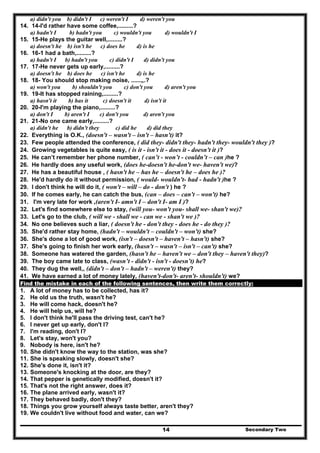
‫المذيل‬ ‫السؤال‬ ‫علي‬ ‫الرد‬Answers to tag questions
-‫ل‬ ‫مطابقا‬ ‫المذيل‬ ‫السؤال‬ ‫علي‬ ‫الرد‬ ‫يكون‬ ‫ان‬ ‫يجب‬‫منفيا‬ ‫او‬ ‫مثبتا‬ ‫المذيل‬ ‫السؤال‬ ‫كون‬ ‫عن‬ ‫النظر‬ ‫بغض‬ ‫لواقع‬:
Tag question  Correct answer   
-Snow is white, isn't it? Yes, (it is).
-Snow isn't white, is it? Yes, it is!
-‫ابيض‬ ‫الثلج‬ ‫الن‬ ‫الحالتين‬ ‫في‬ ‫واحدة‬ ‫االجابة‬ ‫ان‬ ‫الحظ‬
-Snow is black, isn't it? No, it isn't!
-Snow isn't black, is it? No, (it isn't).
-‫اسود‬ ‫ليس‬ ‫الثلج‬ ‫الن‬ ‫الحالتين‬ ‫في‬ ‫واحدة‬ ‫االجابة‬ ‫ان‬ ‫الحظ‬
Exercises
Choose the correct answerfrom a, b, c or d :
1.1. This car is very expensive, ………………. ?
a – isn't it b – isn't the car c – doesn't it d – is it
2.2- She can't read, ................?
a) isn't she b) doesn't she c) can she d) can't she
3.3- They arrived late, ………......?
a) don't they b) didn't they c) weren't they d) won't they
4.4- Amgad will visit us tomorrow,.........?
a) will he b) won't he c) wasn't he d) doesn't he
5.5- He's gone abroad,.........?
a) isn't he b) hasn't he c) doesn't he d) won't he
6.6- He won't come to the party,.........?
a) will he b) doesn't he c) isn't he d) can't he
7.7- You didn't tell me anything,.........?
a) did you b) did I c) were you d) was I
8.8- Manor doesn't like his teacher,.........?
a) is he b) does he c) does Maher d) likes he
9.9- I don't know French,.,.......?
a) am I b) do I c) do you d) are you
10. 10- You'd better meet him,.........?
a) hadn't you b) wouldn't you c) hadn't I d) wouldn't I
11. 11-Let us go,.........?
a) shall we b) shan't we c) won't you d) do you
12. 12-1 haven't done it yet, .„......?
a) have you b) have I c) do I d) do you
Secondary Two13
13. 13-You were late this morning,.........?
Secondary Two14
a) didn't you b) didn't I c) weren't I d) weren't you
14. 14-I'd rather have some coffee,.........?
a) hadn't I b) hadn't you c) wouldn't you d) wouldn't I
15. 15-He plays the guitar well,.........?
a) doesn't he b) isn't he c) does he d) is he
16. 16-1 had a bath,.........?
a) hadn't I b) hadn't you c) didn't I d) didn't you
17. 17-He never gets up early,.........?
a) doesn't he b) does he c) isn't he d) is he
18. 18- You should stop making noise, ......„.?
a) won't you b) shouldn't you c) don't you d) aren't you
19. 19-It has stopped raining,.........?
a) hasn't it b) has it c) doesn't it d) isn't it
20. 20-I'm playing the piano,.........?
a) don't I b) aren't I c) don't you d) aren't you
21. 21-No one came early,.........?
a) didn't he b) didn't they c) did he d) did they
22. Everything is O.K., (doesn't – wasn't – isn't – hasn't) it?
23. Few people attended the conference, ( did they- didn't they- hadn't they- wouldn't they )?
24. Growing vegetables is quite easy, ( is it - isn't it - does it - doesn't it )?
25. He can’t remember her phone number, ( can’t - won’t - couldn’t – can )he ?
26. He hardly does any useful work, (does he-doesn't he-don't we- haven't we)?
27. He has a beautiful house , ( hasn't he – has he – doesn't he – does he )?
28. He'd hardly do it without permission, ( would- wouldn't- had - hadn't )he ?
29. I don't think he will do it, ( won't – will – do - don't ) he ?
30. If he comes early, he can catch the bus, (can – does – can't – won't) he?
31. I'm very late for work ,(aren't I- amn't I – don't I- am I )?
32. Let's find somewhere else to stay, (will you- won't you- shall we- shan't we)?
33. Let's go to the club, ( will we - shall we - can we - shan't we )?
34. No one believes such a liar, ( doesn't he - don't they - does he - do they )?
35. She'd rather stay home, (hadn't – wouldn't – couldn't – won't) she?
36. She's done a lot of good work, (isn't – doesn't – haven't – hasn't) she?
37. She's going to finish her work early, (hasn't – wasn't – isn't – can't) she?
38. Someone has watered the garden, (hasn't he – haven't we – don't they – haven't they)?
39. The boy came late to class, (wasn’t - didn't - isn't - doesn’t) he?
40. They dug the well,, (didn't – don't – hadn't – weren't) they?
41. We have earned a lot of money lately, (haven't-don't- aren't- shouldn't) we?
Find the mistake in each of the following sentences, then write them correctly:
1. A lot of money has to be collected, has it?
2. He old us the truth, wasn't he?
3. He will come hack, doesn't he?
4. He will help us, will he?
5. I don't think he'll pass the driving test, can't he?
6. I never get up early, don't I?
7. I'm reading, don't I?
8. Let's stay, won't you?
9. Nobody is here, isn't he?
10. She didn't know the way to the station, was she?
11. She is speaking slowly, doesn't she?
12. She's done it, isn't it?
13. Someone's knocking at the door, are they?
14. That pepper is genetically modified, doesn't it?
15. That's not the right answer, does it?
16. The plane arrived early, wasn't it?
17. They behaved badly, don't they?
18. Things you grow yourself always taste better, aren't they?
19. We couldn't live without food and water, can we?
Secondary Two15
Unit 11- Moby Dick
aboard ‫ﻣﺗن‬ ‫ﻋﻠﻲ‬ determined ‫ﻣﺻﻣم‬/‫ﻋﺎزم‬ poems ‫ﻗﺻﺎﺋد‬
above ‫ﻓوق‬ development ‫ﺗطور‬/‫ﻧﻣو‬/‫ﺗﻧﻣﻳﺔ‬ primitive ‫ﺑداﺋﻲ‬
abroad ‫اﻟﺧﺎرج‬ distance ‫ﻣﺳﺎﻓﺔ‬ purpose ‫ﻏرض‬
actions ‫أﻓﻌﺎﻝ‬ drown ‫ﻳﻐرق‬ ram ‫ﺑـ‬ ‫ﺑﺷدة‬ ‫ﻳﺻطدم‬
adventure ‫ة‬‫ﻣﻐﺎﻣر‬ Ecologically friendly ‫ﻟﻠﺑﻳﺋﺔ‬ ‫ﺻدﻳق‬ recommendation ‫ﺗ‬‫وﺻﻳﺔ‬
adventurer ‫ﻣﻐﺎﻣر‬ ecology ‫اﻟﺑﻳﺋﺔ‬ ‫ﻋﻠم‬ remote ‫ﺑﻌﻳد‬/‫ﻧﺎﺋﻲ‬
adventurous ‫ة‬‫ﺑﺎﻟﻣﻐﺎﻣر‬ ‫ﻳﺗﺳم‬ Environmentally friendly ‫ﻟﻠﺑﻳﺋﺔ‬ ‫ﺻدﻳق‬ Remote control ‫ﻋن‬ ‫ﺗﺣﻛم‬ ‫ﺟﻬﺎز‬
ahead ‫أﻣﺎم‬ extinct ‫ﻣﻧﻘرض‬ remoteness ‫ﺑﻌد‬ُ
alternative routes ‫ﺑدﻳﻠﺔ‬ ‫طرق‬ extinction ‫اض‬‫ر‬‫اﻻﻧﻘ‬ rescue = save ‫ﻳﻧﻘذ‬
ambition ‫اﻟطﻣوح‬ float ‫ﻳطﻔو‬ review ‫ﻟﻛﺗﺎب‬ ‫ﻧﻘدي‬ ‫ﻋرض‬
ambitious ‫ﻟدﻳﻪ‬‫طﻣوح‬ Force ‫ﻗوة‬/‫ﻳﺟﺑر‬ُ reviewer ‫أدﺑﻲ‬ ‫ﻧﺎﻗد‬
armed ‫ﻣﺳﻠﺢ‬ foreign country ‫أﺟﻧﺑﻳﺔ‬ ‫دوﻟﺔ‬ row ‫ﻳﺟدف‬
ashore ‫اﻟﺷﺎطﺊ‬ ‫إﻟﻲ‬ get revenge ‫ﻳﺛﺄر‬/‫ﻳﻧﺗﻘم‬ sailor ‫ﺑﺣﺎر‬
attack ‫ﻳﻬﺎﺟم‬/‫ﻫﺟوم‬ give ‫ﻳﻌطﻲ‬ sandcastle ‫اﻟرﻣﺎﻝ‬ ‫ﻣن‬ ‫ﻗﻠﻌﺔ‬
balance ‫ازن‬‫و‬‫ﺗ‬ gold coin ‫ذﻫﺑﻳﺔ‬ ‫ﻋﻣﻠﺔ‬ scene ‫ﻣﺷﻬد‬/‫ﻣﻛﺎن‬
Be disappointed ‫ﺑﺧﻳﺑﺔ‬ ‫ﻳﺷﻌر‬
‫ﻷ‬
harpoons ‫ﻟﺻﻳد‬ ‫رﻣﺎح‬ serious ‫ﺟﺎد‬/‫ﺧطﻳر‬
blubber ‫دﻫن‬‫اﻟﺣوت‬ humanity ‫اﻟﺑﺷرﻳﺔ‬ serious problem ‫ﺧ‬ ‫ﻣﺷﻛﻠﺔ‬‫ة‬‫طﻳر‬
boredom ‫اﻟﻣﻠﻝ‬ humans ‫اﻟﺑﺷر‬ Seriousness ‫ﺟدﻳﺔ‬/‫ة‬‫ﺧطور‬
candles ‫ع‬‫ﺷﻣو‬ hunt ‫اﻟﺻﻳد‬ ‫ﺑﻐرض‬ ‫ﻳطﺎرد‬ sink ‫ﻳﻐوص‬/
cave ‫ﻛﻬف‬ in his twenties ‫ﻣن‬ ‫اﻟﻌﺷرﻳﻧﺎت‬ ‫ﻓﻲ‬‫ﻋﻣر‬‫ﻩ‬ spear ‫رﻣﺢ‬
character ‫ﺷﺧﺻﻳﺔ‬ Incredible ‫ﻳﺻدق‬ ‫ﻻ‬ُ stage ‫ﻣرﺣﻠﺔ‬
collection ‫ﻣﺟﻣوﻋﺔ‬ intelligent ‫ذﻛﻲ‬ storyteller ‫اﻟﻘﺻﺔ‬ ‫اوي‬‫ر‬
Consequences ‫ﻧﺗﺎﺋﺞ‬ island ‫ة‬‫ﺟزﻳر‬ strange ‫ﻏرﻳب‬
continent ‫ة‬‫ﻗﺎر‬ islanders ‫اﻟﺟزر‬ ‫ﺳﻛﺎن‬ stubborn ‫ﻋﻧﻳد‬
crew ‫طﺎﻗم‬‫ة‬‫طﺎﺋر‬/‫ﺳﻔﻳﻧﺔ‬ marine life ‫اﻟﺑﺣرﻳﺔ‬ ‫اﻟﺣﻳﺎة‬ the pacific ocean ‫اﻟﻬﺎدي‬ ‫اﻟﻣﺣﻳط‬
critic ‫ﻧﺎﻗد‬ message ‫رﺳﺎﻟﺔ‬ unfortunately ‫ﻟﺳو‬‫اﻟﺣظ‬ ‫ء‬
criticize ‫ﻳﻧﻘد‬ motorised boat ‫ﺑﻣﺣرك‬ ‫ﻳﻌﻣﻝ‬ ‫ﻗﺎرب‬ Vacuum cleaner ‫ﻣﻛﻧﺳﺔﻛﻬرﺑﺎﺋﻳﺔ‬
date ‫ﺗﺎرﻳﺦ‬ multimedia room ‫اﻟﻣﻌرﻓﺔ‬ ‫ﻣﻧﺎﻫﻝ‬ ‫ﻏرﻓﺔ‬ whale ‫ﺣوت‬
definitely ‫ﺑﺎﻟﺗﺄﻛﻳد‬ navy ship ‫ﺗﺎﺑﻌﺔ‬ ‫ﺳﻔﻳﻧﺔ‬
‫ﺔ‬
whaling ‫اﻟﺣﻳﺗﺎن‬ ‫ﺻﻳد‬
destroy ‫ﻳدﻣر‬ offer ‫ﻳﻘدم‬/‫ﻳﻌرض‬ whaling ship ‫ﻟﺻﻳد‬ ‫ﺳﻔﻳﻧﺔ‬
details ‫ﺗﻔﺎﺻﻳﻝ‬ painting ‫ﻟوﺣﺔ‬ whenever ‫وﻗت‬ ‫أي‬ ‫ﻓﻲ‬
Expressions
armed with ‫بـ‬ ‫مسلح‬ life at sea ‫البحر‬ ‫في‬ ‫الحياة‬
at first ‫أوال‬ live on an island ‫جزيرة‬ ‫على‬ ‫يعيش‬
at the age of ‫سن‬ ‫في‬ look for = search for ‫عن‬ ‫يبحث‬
at the beginning ‫البداية‬ ‫في‬ on his last voyage ‫بالسفينة‬ ‫األخيرة‬ ‫رحلته‬ ‫في‬
at the time of his death ‫وفاته‬ ‫وقت‬ ‫في‬ on the third day ‫الثالث‬ ‫اليوم‬ ‫في‬
at the weekend ‫األسبوع‬ ‫نھاية‬ ‫في‬ play a vital role in ‫في‬ ‫حيويا‬ ‫دورا‬ ‫يلعب‬
be bored with ‫من‬ ‫بالملل‬ ‫يشعر‬ pull out ‫يسحب‬
born into a rich family ‫غنية‬ ‫أسرة‬ ‫في‬ ‫ولد‬ pull up ‫يتوقف‬
by accident ‫بالصدفة‬ ready for+n. ‫لـ‬ ‫مستعد‬
collide with ‫بـ‬ ‫يصطدم‬ ready to+inf. ‫لـ‬ ‫مستعد‬
come out ‫يصدر‬)‫للكتب‬( sailor on a ship ‫سفينة‬ ‫علي‬ ‫بحار‬
crash into ‫بـ‬ ‫يصطدم‬ send off ‫بالبريد‬ ‫يرسل‬
essential to ‫ضروري‬/‫أسا‬‫لـ‬ ‫سي‬ send off ‫يطرد‬)‫العب‬(
fall to his death ‫ميتا‬ ‫يسقط‬ work in ordinary jobs ‫عادية‬ ‫وظائف‬ ‫في‬ ‫يعمل‬
hold onto ‫بـ‬ ‫يتشبث‬ work on a farm ‫مزرعة‬ ‫في‬ ‫يعمل‬
lend someone a hand ‫شخص‬ ‫يساعد‬ work on a novel ‫رواية‬ ‫تأليف‬ ‫في‬ ‫يعمل‬
Words & antonyms
‫مغامر‬
Secondary Two16
adventurous unadventurous ‫مغامر‬ ‫غير‬
‫أمام‬ahead behind ‫خلف‬
‫مسلح‬ unarmedarmed ‫أعزل‬/‫مسلح‬ ‫غير‬
‫بالخجل‬ ‫يشعر‬ashamed unashamed ‫بالخجل‬ ‫شاعر‬ ‫غير‬
‫يصدق‬ُcredible incredible ‫يصدق‬ ‫ال‬ُ
‫بالتأكيد‬definitely possibly ‫المحتمل‬ ‫من‬
‫يدمر‬destroy build ‫يبني‬
‫مفصل‬detailed brief ‫مختصر‬
‫عدو‬enemy friend ‫صديق‬
‫مثير‬exciting boring ‫ممل‬
‫سلبي‬negative positive ‫ايجابي‬
‫عادي‬ordinary unusual ‫معتاد‬ ‫غير‬
‫بدائي‬primitive civilized ‫متحضر‬
‫حقيقي‬real unreal ‫حقيقي‬ ‫غير‬
‫بعيد‬remote near / close ‫قريب‬
‫جاد‬serious funny ‫مضحك‬
‫يغرق‬sink float ‫يطفو‬
‫غريب‬strange familiar ‫مألوف‬
‫قوي‬strong weak ‫ضعيف‬
Derivatives
Verb Noun Adjective Adverb
seriousness ‫جدية‬/‫خطورة‬ serious ‫جاد‬/‫خطير‬ seriously ‫بطريقة‬‫جادة‬‫أو‬‫خطيرة‬
arm ‫يسلح‬ army ‫جيش‬
‫أسلحة‬
armed ‫مسلح‬
arms
determine ‫يص‬‫ــ‬‫م‬‫م‬/‫يحدد‬ determination ‫تصميم‬/‫تحديد‬ determined ‫مصمم‬/‫عازم‬
‫يدمر‬ destruction ‫تدمير‬ destructive ‫مدمر‬destroy
Language Notes
-‫اﻟﻣﻘطﻊ‬ ‫اﺳﺗﺧدام‬ ‫ﻻﺣظ‬multi-‫ﻣﺛﻝ‬ ‫ﻣﻌﻳﻧﺔ‬ ‫ﻛﻠﻣﺎت‬ ‫ﻣﻊ‬ ‫ﻣﺗﻌدد‬ ‫ﺑﻣﻌﻧﻲ‬:
‫الجنسيات‬ ‫متعدد‬multinational multicultural ‫الثقافات‬ ‫متعدد‬
‫األغراض‬ ‫متعدد‬multipurpose multidimensional ‫األبعاد‬ ‫متعدد‬
‫متعددة‬ ‫وسائط‬multimedia multilingual ‫اللغات‬ ‫متعدد‬
- Purpose‫ﻏرض‬ - My purpose is to get full marks.
- aim ‫دف‬ ‫ﻫدف‬‫ﻳﻬ‬ / - His aim is to help his parents. – He aims at helping his parents.
- Intention ‫ﻧﻳﺔ‬/‫ﻗﺻد‬ - His good intentions made people love him.
- Plan - This plan won't work. – He plans to travel abroad.‫ﺧطـﺔ‬ ‫ﺧطط‬/ ‫ﻳ‬
- Offer: ‫ﻳﻘدم‬/‫ﻳﻌرض‬ -I offered her another drink.
- Give : ‫ﻳﻌطﻲ‬/‫ﻳﻣﻧﺢ‬ -We gave him time to reply.
- primitive ‫ﺑداﺋﻰ‬/‫از‬‫ر‬‫اﻟط‬ ‫ﻗدﻳم‬ - Primitive tribes still exist in Middle Africa.
- crude ‫اﺿﺢ‬‫و‬ ‫أو‬ ‫ﻧﺎﺿﺞ‬ ‫ﻏﻳر‬/‫ﻣﻬذب‬ ‫ﻏﻳر‬ - His behaviour is still crude. - It is a crude draft of a poem.
- Vulgar ‫ﻣﺑﺗذﻝ‬/‫ﺳوﻗﻰ‬/‫ﺑذئ‬ - Her vulgar speech annoyed everybody.
-Think of …as … ‫ﺷ‬ ‫أو‬ ‫ﺷﻲء‬ ‫ﻓﻲ‬ ‫ﻳﻔﻛر‬‫ﻩ‬‫ﺑﺎﻋﺗﺑﺎر‬ ‫ﺧص‬.. -The teacher thought of me as a trouble maker.
- Ambitious ‫طﻣوح‬ - He is very ambitious . He never stops working.
- opportunist ‫ى‬‫إﻧﺗﻬﺎز‬ - Opportunists don't care for others.
- advise + ‫ﻋ‬‫ـ‬‫ﺎﻗ‬‫ـ‬‫ﻝ‬ to + ‫ا‬‫ﻟﻣﺻ‬‫ـ‬‫در‬ ‫ﻳﻧﺻﺢ‬ -The doctor advised me to live in the country.
- advise + ‫ﻋ‬‫ـ‬‫ﺎﻗ‬‫ـ‬‫ﻝ‬ not to + ‫اﻟﻣﺻ‬‫ـ‬‫در‬ ‫ﻳﻧﺻﺢ‬ -The doctor advised me not to live in crowded cities.
- advise about future -Teachers always advise us about future.
- Recommend.......... to ‫ﺷﺧ‬‫ـ‬‫ص‬ ‫ﻳوﺻ‬‫ـ‬‫ﺑـ‬ ‫ﻰ‬/‫ﻳرﺷ‬‫ـ‬‫ﺢ‬ -I recommend this film to you.
- recommend ....... for ‫ﺷ‬‫ــ‬‫ﺊ‬ - I recommended Ali for the job.
- Recommend ....... to ‫ﺷ‬‫ـــ‬‫ﺊ‬ - He recommended me a good film to watch.
- make recommendations ‫ﺗوﺻﻳﺎت‬ ‫ﻳﻘدم‬/‫اﺣﺎت‬‫ر‬‫اﻗﺗ‬ - Can you make recommendation of/ bout a book to read?
- coast ‫ﺳﺎﺣﻝ‬ - The North Coast has become a tourist site.
- beach ‫اﻟﺑﻼج‬/)‫ﻣن‬ ‫ء‬‫ﺟز‬(‫اﻟﺷﺎطﺊ‬ - The children built houses of sand on the beach.
- ashore (adv.) ‫إﻟﻲ‬‫اﻟﺷﺎطﺊ‬ - After the boat had reached the port, we went ashore.
-bank ‫ﺿﻔــﺔ‬‫اﻟﻧﻬر‬‫أو‬‫ة‬‫اﻟﺑﺣﻳر‬ - Most Egyptians live on the Nile banks.
‫ﻳﻐرق‬/‫ﻳﻐرق‬ُ)‫ارب‬‫و‬‫اﻟﻘ‬ ‫و‬ ‫ﻟﻠﺳﻔن‬ ‫ﻋﺎدة‬( -The mobile fell and sank to the bottom of the Nile.-Sink
-The explosion sank the fishing boat.
-Sink ‫ﻳﻘﻝ‬/‫ﻳﻧﺧﻔض‬ -The Euro has sunk against the dollar.
‫ﻳﻐرق‬)‫ﻟﻸﺷﺧﺎص‬ ‫ﻋﺎدة‬( -The boy drowned while he was swimming.-Drown :
Secondary Two17
Adventure ‫ة‬‫ﻣﻐﺎﻣر‬ - He never likes adventure. He plays on the safe side.
Risk ‫ة‬‫ﻣﺧﺎطر‬ - Smoking increases the risk of developing cancer.
-Remote ‫ﺑﻌﻳد‬/‫ﻧﺎﺋﻲ‬ (remoter / remotest) - Primitive tribes live in the remotest parts of Africa.
- I haven't the remotest idea. ‫ﻟﻳس‬‫ﻟدي‬‫أدﻧﻲ‬‫ة‬‫ﻓﻛر‬ -In the remote past ‫ﻓﻲ‬‫اﻟﻣﺎﺿﻲ‬‫اﻟﺑﻌﻳد‬
-In the remote future ‫ﻓﻲ‬‫اﻟﻣﺳﺗﻘﺑﻝ‬‫اﻟﺑﻌﻳد‬ -In the near future ‫اﻟﻘرﻳب‬ ‫اﻟﻣﺳﺗﻘﺑﻝ‬ ‫ﻓﻲ‬
-Matter ‫ﻳﻬم‬ -It doesn't matter to him when you leave.
-Matter ‫أﻣر‬/‫ﻣﺷﻛﻠﺔ‬/‫ﻣﺳﺄﻟﺔ‬ -What's the matter with you?
= What's wrong with you? =What's the problem with you?
‫ﺣﻳﺎة‬ ‫ﻣﺳﺄﻟﺔ‬‫أو‬‫ﻣوت‬ - As a matter of fact, … ‫اﻗﻊ‬‫و‬‫اﻟ‬ ‫ﻓﻲ‬/‫اﻟﺣﻘﻳﻘﺔ‬ ‫ﻓﻲ‬- It's a matter of life and death.
‫إﻧﻬﺎ‬‫ﻣﺳﺄﻟﺔ‬‫وﻗت‬- It's a matter of time.
- Whatever = anything or everything ‫اى‬‫ﺷﻲء‬ -I can do whatever I want.
- Whenever = every time or any time ‫ﺣﻳﻧﻣﺎ‬/‫ﻋﻧدﻣﺎ‬
- Whenever she talks, we all listen carefully. -I can visit you whenever you like.
- Wherever = to any place or every place ‫أﻳﻧﻣﺎ‬/‫ﺣﻳﺛﻣﺎ‬ -Wherever I goes, I see him.
‫ﺷﺧص‬ ‫اى‬/‫أﻳﺎ‬‫ﻛﺎن‬- Whoever = the person who or any person
-Whoever doesn't respect old people, no one respects him.
-Be determined to+ inf. ‫ﻋﺎزم‬ ‫أو‬ ‫ﻣﺻﻣم‬ ‫ﻳﻛون‬‫ﻋﻠﻲ‬..
-He was determined to succeed in his private business
- Hero& heroine ‫ﺑطﻝ‬&‫ﺑطﻠﺔ‬)‫اﻻدﺑﻳﺔ‬ ‫اﻻﻋﻣﺎﻝ‬ ‫ﻓﻲ‬ ‫او‬ ‫ﺣﻘﻳﻘﻲ‬(
- Nasser was a national hero. - Who is the hero of this novel?
- champion ‫ﺑطﻝ‬)‫ﻗﺿﻳﺔ‬ ‫أو‬ ‫ﺷﺧﺻﻳﺔ‬ ‫ﻋن‬ ‫اﻟﻣداﻓﻊ‬ ‫ـ‬ ‫رﻳﺎﺿﻰ‬(
- Martin Luther King champion of the poor all his life.
- The Undertaker was the heavy weight champion.
Communication Skills
Making Recommendations with reasons
Making Recommendation  Reasons 
I'm sure you'd enjoy/love …………………… It's a very exciting/interesting …………………..
You really should ……………………….. The ................. are so ........ .
I can really recommend ………….to you. You won't be able to put it down.
Exercises
Respond the following situations:
1.A friend asks if you are enjoying your book. Say that you are and recommend it to your friend.
2.Your friend asks why you would recommend the book. Say the main reason is that it is easy to read.
3.Ask your friend about the name of the book he is reading.
4.You have just bought a new CD by your favourite singer. Recommend it to a friend.
5.You recommended a book and your friend asks why?
6.You see a friend reading a book. Ask your friend what the book is called and who wrote it.
7.Your friend thinks that captain Ahab is a brave man, you disagree.
- Mention the place and the speakers in each of the following two mini-dialogues:
1- A: How much is this vacuum cleaner, please? B: It's 1200 pounds. A: O.K. I'll buy it.
2- A: You are too late, Hala. B: I'm so sorry sir. I missed the bus. A: OK.Type this letter, please.
3- A: How much is this vacuum cleaner, please? B: It's 1200 pounds. A: O.K. I'll buy it.
4- A: You are too late, Hala. B: I'm so sorry sir. I missed the bus.
A; O.K. Type this letter for me, please.
Choose the correct answer:
1. The old man lived in a very ………. area of the countryside, far away from people, shops and
businesses.
a) away b) far c) alone d) remote
2. Ahmed is very ………. about winning the chess championship. He has been practising non-stop
for the last five months.
a) definite b) serious c) thoughtful d) seriously
3. I don't understand what this machine is for. Do you know what its ………. is?
a) purpose b) reason c) story d) title
4. Smith joined the ………. of a large fishing boat.
a) population b) crew c) group d) staff
5. What is the quickest ………. to travel between London and Oxford?
a) road b) journey c) route d) map
6. After the rains came, there were terrible ………. and many people lost their homes.
a) waters b) floods c) flooding d) lakes
7. Europe and Asia are two ………. which lie next to each other.
a) continents b) places c) islands d) areas
8. I always go to the sea ………. I have the chance.
a) after b) upon c) while d) whenever
9.A (gang-team-cup– crew) is a group of people working together on a ship.
10. A (honeymoon – balloon – harpoon – cartoon) is a sharp metal used for hunting whales.
11. A (ruler– knife– harpoon– key) is a sharp metal used for hunting whales.
12. A (clue – crow – blue - crew) means the people that work together on a ship or a plane.
13. A (purpose – propose – dispose – compose) is what you want to achieve when you do something.
14. A whaling ship goes hunting( dogs– birds– flies– whales)
15. Ayman ( is– are– were– was)born into a very good family.
16. He (pretended - offered – intended - denied) a gold coin to the first sailor to see Moby Dick.
17. He has no idea of the (seriousness-carefulness- carelessness-awareness) of the situation.
Secondary Two18
18. He was disappointed as the film was ( boring– exciting– good– funny)
- Place: …………….……… - Speaker A: ………..……….…… - Speaker B: …………….……………..
19. He wrote two books (call– calls– calling– called)Typee and OMoo.
20. His father (imported– exported– sold– arranged) goods from France.
21. I am bored (to– too– with– in) this silly talk.
22. In a higher position means (abroad– ashore– aboard– above).
23. In the storm, the ship (sank-ate-hrank – held) and two people drowned.
24. Mid-twenties means about (twenty– thirty– forty– twenty five) years old.
25. (Shore – Bank – Ashore - Coast) means onto land by the side of the sea.
26. The (richness- roughness - remoteness - closeness) of my friend's village made me hesitate to visit him.
27. The elephant (attached- attended- attempted- attacked) the hunters and completely destroyed their car.
28. The last (accident – scenery– scene – since) of the film was usual.
29. The novel, Moby Dick came (in– out– back– to) in 1851.
30. The passengers were asked to (broad – abroad – broaden – board) the plane immediately.
31. The sailors (left – went – boarded – headed) their ship and went ashore in a small boat.
32. The word (effective – deceptive - primitive – aggressive) means very simple or old-fashioned.
33. The young girl (sank– drowned– flew– floated) yesterday.
34. They went on a (flight– voyage– picnic– walk) by ship.
35. This book is (furious – serious – cautious – curious) . It's not funny.
Find the mistake in each of the following sentences, then write them correctly:
1. All the passengers and chew survived the crash.
2. Asia is the largest city in the world.
3. Can you do some recommendations?
4. Egypt lies on the North bank of the sea.
5. He allowed us watch a new film.
6. He commented me a good book to read.
7. He couldn't finish the book because it was too serial.
8. He lives in a close village. It's far from the nearest town
9. He went board on business.
10. He went on a flight by boat.
11. I'll visit you wherever I have time.
12. Relative people inhabited this island 2000 years ago.
13. Turn left and you'll see the hospital above of you.
Translation
Translate into Arabic:
People need to be determined if the want to reach their goals in life. It is possible to be ambitious
and determined without hurting other people. You can achieve your goals by all means , but
remember the rights of the others.
………………………………………………………………………………………………………………………………
………………………………………………………………………………………………………………………………
Is our planet a safe place for animals? Unfortunately, it doesn't seem like it. Thousands of species
have become extinct and many more are now endangered. We need to do something fast before it is
too late for them.
………………………………………………………………………………………………………………………………
………………………………………………………………………………………………………………………………
In the past whales were hunted and killed for their meat, their teeth, for oil and blubber to make
candles. Whale meat is still very popular in some countries like Japan. The oil and fat from whales is
used in the production of things like soap.
………………………………………………………………………………………………………………………………
………………………………………………………………………………………………………………………………
Translate into English:
–‫األھداف‬ ‫تحقيق‬ ‫وسائل‬ ‫اھم‬ ‫من‬ ‫والتصميم‬ ‫الطموح‬.
………………………………………………………………………………………………………………………………
-‫اليومية‬ ‫حياتنا‬ ‫من‬ ‫ھاما‬ ‫جزءا‬ ‫اإلعالنات‬ ‫أصبحت‬.
………………………………………………………………………………………………………………………………
-‫المناخ‬ ‫علي‬ ‫خطيرة‬ ‫تأثيرات‬ ‫له‬ ‫تكون‬ ‫أن‬ ‫يمكن‬ ‫الغابات‬ ‫قطع‬ ‫إن‬.
………………………………………………………………………………………………………………………………
‫أيضا‬ ‫اآلخرين‬ ‫تراعى‬ ‫أن‬ ‫يجب‬ ‫بل‬ ‫فقط‬ ‫أھدافك‬ ‫و‬ ‫نفسك‬ ‫فى‬ ‫تفكر‬ ‫أال‬ ‫عليك‬ ‫ينبغى‬. -
Secondary Two19
………………………………………………………………………………………………………………………………
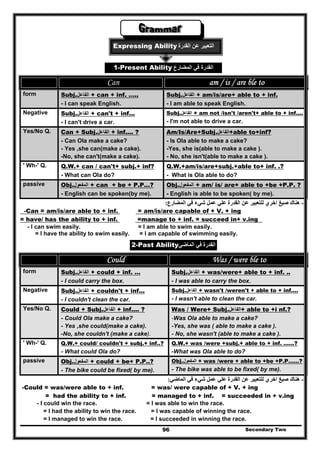
The past perfect continuous tense
Secondary Two20
Form Subj. ‫الفاعل‬ + had +been + v.ing. ………………. .
- He had been cleaning the room for two hours when I arrived home.
Negation Subject + hadn't +been + v.ing.…………. .
-They hadn't been waiting for a long time before the train arrived.
Yes / No Q. Had + Subj. ‫الفاعل‬ +been + v.ing.……….. ?
- He was tired. Had he been working since dawn?
-Yes, he had. -No, he hadn't.
‘ Wh-’ Q. Q.W.‫استفھام‬ ‫اداة‬ +had+ subject+been + v.ing.…………?
- What had he been doing when the accident happened?
-‫تام‬ ‫ماضي‬ ‫جملة‬ ‫الي‬ ‫تتحول‬ ‫للمجھول‬ ‫المستمر‬ ‫التام‬ ‫الماضي‬ ‫جملة‬ ‫بناء‬ ‫عند‬:
. .………….p.p+been+had+‫المفعول‬ObjPassive
- The room had been cleaned for two hours when I arrived home.
‫لفتر‬ ‫استمر‬ ‫حدث‬ ‫عن‬ ‫ليعبر‬ ‫المستمر‬ ‫التام‬ ‫الماضي‬ ‫يستخدم‬‫مع‬ ‫عادة‬ ‫ويستخدم‬ ‫آخر‬ ‫حدث‬ ‫وقوع‬ ‫قبل‬ ‫الماضي‬ ‫في‬ ‫ة‬: -
When/since / for/ all day / all weekend
‫مثل‬ ‫طويلة‬ ‫فترة‬ ‫تستغرق‬ ‫أن‬ ‫يمكن‬ ‫أفعال‬ ‫مع‬ ‫عادة‬ ‫ويأتي‬
(wait / do / study / live / work / stay / play / watch / sleep / paint / read / write / talk / run / walk /
travel, ..etc)
-There were floods because it had been raining for three days.
- He was covered in paint. He had been painting the room since we left.
- Our game of tennis was interrupted. We had been playing for an hour when it started to rain.
-‫ھ‬‫أفعال‬ ‫ناك‬‫المعرفة‬ ‫و‬ ‫الملكية‬ ‫و‬ ‫الحواس‬ ‫و‬ ‫الشعور‬ ‫افعال‬ ‫ھي‬ ‫المستمرو‬ ‫التام‬ ‫الماضي‬ ‫ومنھا‬ ‫عموما‬ ‫المستمرة‬ ‫األزمنة‬ ‫في‬ ‫تستخدم‬ ‫ال‬.
- We were good friends. We had known each other for 10 years.
‫حدو‬ ‫في‬ ‫طويلة‬ ‫فترة‬ ‫عادة‬ ‫تستغرق‬ ‫ال‬ ‫التي‬ ‫األفعال‬ ‫مع‬ ‫المستمر‬ ‫التام‬ ‫الماضي‬ ‫يستخدم‬ ‫ال‬ ‫كما‬‫التام‬ ‫الماضي‬ ‫نستخدم‬ ‫الحالة‬ ‫ھذه‬ ‫وفي‬ ‫مثل‬ ‫ثھا‬:
(break down / stop / close / open/ end / finish)
- She was late for the meeting because her car had broken down.
‫التام‬ ‫الماضي‬ ‫نستخدم‬ ‫بل‬ ‫المستمر‬ ‫التام‬ ‫الماضي‬ ‫يستخدم‬ ‫ال‬ ‫الفعل‬ ‫حدوث‬ ‫مرات‬ ‫ذكرنا‬ ‫إذا‬:
- When I met Ahmed, he had finished typing 3 reports.
Exercises
Choose the correct answer from a, b, c, or d:
1.After his father …………., she didn't send Alexander to school
d- have diedc- had diedb- has dieda- died
2.By the time Alexander … 20, his mother had spent all her money.
d- werec- has beenb- had beena- was
3.He found work as a secretary to someone who …………….. a friend of his father's in the army.
d- have beenc- has beenb- had beena- was
4.Before he wrote The Count of Monte Cristo, he …..famous as a playwright.
d- would becomec- had becomeb- becomesa- became
5.They discovered that Dumas …….other people to write for him.
d- is employingc- employedb- had been employinga- was employing
6.Before Dumas wrote his novels, he ………………………. plays .
d- have writtenc- has writtenb- had writtena- wrote
7.His father probably died young because he ………. in prison.
d- has spentc- was spendingb- had been spenta- spent
8.The man Dumas worked for in Paris ………….his father.
d- knowsc- has knownb- had knowna- knew
Secondary Two21
9.Dumas …………… already a successful writer when people realized that his books had been
written by other people.
d- isc- had beenb- wasa- had been
10. Dumas checked what his assistants ……………………..
d- ’d writec- had writtenb- has writtena- wrote
11. When he died in 1870, his son ..... after his finances for a few years.
d- was lookingc- had been lookingb- has been lookinga- looked
12. When he got home, Samy was not at all hungry. He ……. chocolate all day.
d- was eatingc- had been eatingb-Has been eatinga- ate
13. When he arrived at school, Ahmed's hair was wet. It ………….
d- rainedc- had rainedb- was raininga- had been raining
14. When we got up that morning, there was sand all over the streets, there …………… a sandstorm.
d-has beenc- had beenb- was raininga- was
15. Sara went into the kitchen and found lots of fresh bread on the table. her mother …………….
d- has been bakingc-Was bakingb- bakedA – had been baking
16. By the time he was 12, my brother ……, three languages. He spoke, Arabic , English and French.
a- learnt b- has learnt c- was learning d- had learnt
17. When I went to my friend's flat, she ………….for school.
a- already left b-has already left c- had already left d- was leaving
18. Last year, I spent a month in France. I ………… of going there since I was a child.
a- have dreamed b- had dreamed c- dreamt d- was dreaming
19. Leila and her husband ………... into their own flat last weekend. Before that, they had lived with
Leila's parents.
a- had moved b- moved c- has moved d- was moving
20. My father retired last week. He … for the same company all his life.
a- worked b- has worked c- had worked d- was working
21. Karim fell asleep during the football match because he …… to bed late the night before.
a- had gone b- went c- gone d- has gone
22. Ali ate a sandwich during the game because he ………… enough time to eat before it started.
a- didn’t have b- hasn’t had c- hadn’t had d- had no
23. Hassan borrowed money from Ali because he …… his money at home.
a- left b- has left c- had left d- was leaving
24. Adel ……….. which team was red because he had not seen these teams before.
a- asks b- was asking c- asked d- had asked
25. Jack knew Steve was at the match because Steve ……….. him before he went.
a- phoned b- was phoning c- has phoning d- had phoned
26. Paul …………….for work for over a year before he got a job.
a- looked b- was looking c- had been looking d- has been looking
27. By the time she ............... writing her report, she had drunk six cups of tea.
a- finished b- had finished c- has finished d- was finishing
28. The little children's clothes were dirty because they ……… in the park all day.
a- played b- were playing c- had been playing d- have been playing
29. He had been driving for only three weeks, so it is not surprising that he ………… his driving test.
a- had failed b- has failed c- fail d- failed
30. I ……….. to the doctor's yesterday evening because I had been feeling ill for nearly a week.
a- had gone b- have gone c- had been going d- went
Find the mistake in each of the following sentences, then write them correctly:
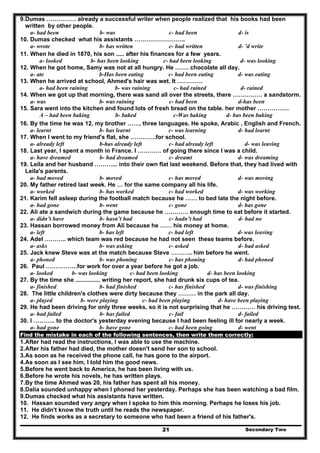
1.After had read the instructions, I was able to use the machine.
2.After his father had died, the mother doesn't send her son to school.
3.As soon as he received the phone call, he has gone to the airport.
4.As soon as I see him, I told him the good news.
5.Before he went back to America, he has been living with us.
6.Before he wrote his novels, he has written plays.
7.By the time Ahmed was 20, his father has spent all his money.
8.Dalia sounded unhappy when I phoned her yesterday. Perhaps she has been watching a bad film.
9.Dumas checked what his assistants have written.
10. Hassan sounded very angry when I spoke to him this morning. Perhaps he loses his job.
11. He didn't know the truth until he reads the newspaper.
12. He finds works as a secretary to someone who had been a friend of his father's.
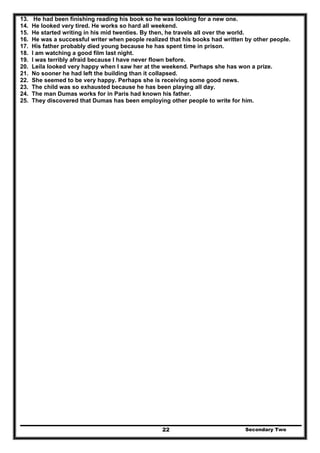
Secondary Two22
13. He had been finishing reading his book so he was looking for a new one.
14. He looked very tired. He works so hard all weekend.
15. He started writing in his mid twenties. By then, he travels all over the world.
16. He was a successful writer when people realized that his books had written by other people.
17. His father probably died young because he has spent time in prison.
18. I am watching a good film last night.
19. I was terribly afraid because I have never flown before.
20. Leila looked very happy when I saw her at the weekend. Perhaps she has won a prize.
21. No sooner he had left the building than it collapsed.
22. She seemed to be very happy. Perhaps she is receiving some good news.
23. The child was so exhausted because he has been playing all day.
24. The man Dumas works for in Paris had known his father.
25. They discovered that Dumas has been employing other people to write for him.
Secondary Two23
Unit 12- A Place to Live
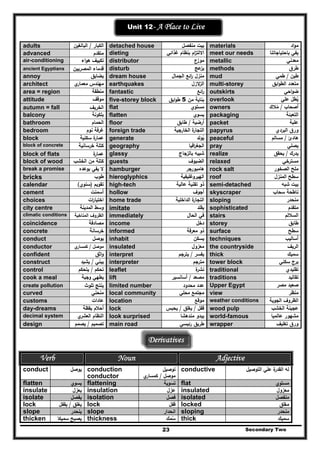
adults ‫اﻟﻛﺑﺎر‬/‫اﻟﺑﺎﻟﻐﻳن‬ detached house ‫ﻣﻧﻔﺻﻝ‬ ‫ﺑﻳت‬ materials ‫اد‬‫و‬‫ﻣ‬
advanced ‫ﻣﺗﻘدم‬ dieting ‫ﻏذاﺋﻲ‬ ‫ﺑﻧظﺎم‬ ‫ام‬‫ز‬‫اﻻﻟﺗ‬ meet our needs ‫ﺑﺎﺣﺗﻳﺎﺟﺎﺗﻧﺎ‬ ‫ﻳﻔﻲ‬
air-conditioning ‫اء‬‫و‬‫ﻫ‬ ‫ﺗﻛﻳﻳف‬ distributor ‫ﻣوزع‬ metallic ‫ﻣﻌدﻧﻲ‬
ancient Egyptians ‫اﻟﻣﺻرﻳﻳن‬ ‫ﻗدﻣﺎء‬ disturb ‫ﻋﺞ‬‫ﻳز‬ methods ‫طرق‬
annoy ‫ﻳﺿﺎﻳق‬ dream house ‫ا‬‫ر‬ ‫ﻣﻧزﻝ‬‫اﻟﺟﻣﺎﻝ‬ ‫ﺋﻊ‬ mud ‫طﻳن‬/‫طﻣﻲ‬
architect ‫ي‬‫ﻣﻌﻣﺎر‬ ‫ﻣﻬﻧدس‬ earthquakes ‫ﻻزﻝ‬‫اﻟز‬ multi-storey ‫اﺑق‬‫و‬‫اﻟط‬ ‫ﻣﺗﻌدد‬
area = region ‫ﻣﻧطﻘﺔ‬ fantastic ‫اﺋﻊ‬‫ر‬ outskirts ‫اﺣﻲ‬‫و‬‫ﺿ‬
attitude ‫ﻣوﻗف‬ five-storey block ‫ﻣن‬ ‫ﺑﻧﺎﻳﺔ‬5‫اﺑق‬‫و‬‫ط‬ overlook ‫ﻋﻠﻲ‬ ‫ﻳطﻝ‬ُ
autumn = fall ‫اﻟﺧرﻳف‬ flat ‫ﻣﺳﺗوي‬ owners ‫أﺻﺣﺎب‬/‫ﻣﻼك‬ُ
balcony ‫ﺑﻠﻛوﻧﺔ‬ flatten ‫ﻳﺳوي‬ packaging ‫اﻟﺗﻌﺑﺋﺔ‬
bathroom ‫اﻟﺣﻣﺎم‬ floor ‫أرﺿﻳﺔ‬/‫طﺎﺑق‬ packet ‫ﻋﻠﺑﺔ‬
bedroom ‫ﻧوم‬ ‫ﻏرﻓﺔ‬ foreign trade ‫اﻟﺧﺎرﺟﻳﺔ‬ ‫ة‬‫اﻟﺗﺟﺎر‬ papyrus ‫اﻟﺑردي‬ ‫ورق‬
block ‫ﺳﻛﻧﻳﺔ‬ ‫ة‬‫ﻋﻣﺎر‬ generate ‫ﻳوﻟد‬ُ peaceful ‫ﻫﺎدئ‬/‫ﻣﺳﺎﻟم‬
block of concrete ‫ﺧرﺳﺎﻧﻳﺔ‬ ‫ﻛﺗﻠﺔ‬ geography ‫اﻓﻳﺎ‬‫ر‬‫اﻟﺟﻐ‬ pray ‫ﻳﺻﻠﻲ‬
block of flats ‫ة‬‫ﻋﻣﺎر‬ glassy ‫ﺑﺎﻟزﺟﺎج‬ ‫ﺷﺑﻳﻪ‬ realize ‫ﻳدرك‬/‫ﻳﺣﻘق‬
block of wood ‫اﻟﺧﺷب‬ ‫ﻣن‬ ‫ﻛﺗﻠﺔ‬ guests ‫اﻟﺿﻳوف‬ relaxed ‫ﻣﺳﺗرﺧﻲ‬
break a promise ‫ﺑوﻋدﻩ‬ ‫ﻳﻔﻲ‬ ‫ﻻ‬ hamburger ‫ﻫﺎﻣﺑورﺟر‬ rock salt ‫اﻟﺻﺧور‬ ‫ﻣﻠﺢ‬
bricks ‫طوب‬ hieroglyphics ‫اﻟﻬﻳروﻏﻠﻳﻔﻳﺔ‬ roof ‫اﻟﻣﻧزﻝ‬ ‫ﺳطﺢ‬
calendar ‫ﺗﻘوﻳم‬)‫ﺳﻧوي‬( high-tech ‫ﻋﺎﻟﻳﺔ‬ ‫ﺗﻘﻧﻳﺔ‬ ‫ذو‬ semi-detached ‫ﺷﺑﻪ‬ ‫ﺑﻳت‬
cement ‫أﺳﻣﻧت‬ hollow ‫أﺟوف‬ skyscraper ‫ﺳﺣﺎب‬ ‫ﻧﺎطﺣﺔ‬
choices ‫ات‬‫ر‬‫اﺧﺗﻳﺎ‬ home trade ‫اﻟداﺧﻠﻳﺔ‬ ‫ة‬‫اﻟﺗﺟﺎر‬ sloping ‫ﻣﻧﺣدر‬
city centre ‫اﻟﻣدﻳﻧﺔ‬ ‫وﺳط‬ imitate ‫ﻳ‬‫ﻘﻠد‬ sophisticated ‫ﻣﺗﻘدم‬
climatic conditions ‫اﻟﻣﻧﺎﺧﻳﺔ‬ ‫اﻟظروف‬ immediately ‫اﻟﺣﺎﻝ‬ ‫ﻓﻲ‬ stairs ‫اﻟﺳﻼﻟم‬
coincidence ‫ﻣﺻﺎدﻓﺔ‬ income ‫دﺧﻝ‬ storey ‫طﺎﺑق‬
concrete ‫ﺧرﺳﺎﻧﺔ‬ informed ‫ﻣﻌرﻓﺔ‬ ‫ذو‬ surface ‫ﺳطﺢ‬
conduct ‫ﻳوﺻﻝ‬ inhabit ‫ﻳﺳﻛن‬ techniques ‫أﺳﺎﻟﻳب‬
conductor ‫ﻣوﺻﻝ‬/‫ﻛﻣﺳ‬‫ي‬‫ﺎر‬ insulated ‫ﻣﻌزوﻝ‬ the countryside ‫اﻟرﻳف‬
confident ‫اﺛق‬‫و‬ interpret ‫ﻳﻔﺳر‬/‫ﻳﺗرﺟم‬ thick ‫ﺳﻣﻳك‬
construct ‫ﻳﺑﻧﻲ‬/‫ﻳﺷﻳد‬ interpreter ‫ﻣﺗرﺟم‬ tower block ‫ﺳﻛﻧﻲ‬ ‫ﺑرج‬
control ‫ﺗﺣﻛم‬/‫ﻳﺗﺣﻛم‬ leaflet ‫ة‬‫ﻧﺷر‬ traditional ‫ﺗﻘﻠﻳدي‬
cook a meal ‫وﺟﺑﺔ‬ ‫ﻳطﻬﻲ‬ lift ‫ﻣﺻﻌد‬/‫أﺳﺎﻧﺳﻳر‬ traditions ‫ﺗﻘﺎﻟﻳد‬
create pollution ‫ﺗﻠوث‬ ‫ﻳﻧﺗﺞ‬ limited number ‫ﻣﺣدود‬ ‫ﻋدد‬ Upper Egypt ‫ﻣﺻر‬ ‫ﺻﻌﻳد‬
curved ‫ﻣﻧﺣﻧﻲ‬ local community ‫ﻣﺣﻠﻲ‬ ‫ﻣﺟﺗﻣﻊ‬ view ‫ﻣﻧظر‬
customs ‫ﻋﺎدات‬ location ‫ﻣوﻗﻊ‬ weather conditions ‫اﻟﺟوﻳﺔ‬ ‫اﻟظروف‬
day-dreams ‫ﻳﻘظﺔ‬ ‫أﺣﻼم‬ lock ‫ﻗﻔﻝ‬/‫ﻳﻐﻠق‬/‫ﻳﺣﺑس‬ wood pulp ‫اﻟﺧﺷب‬ ‫ﻋﺟﻳﻧﺔ‬
decimal system ‫ي‬‫اﻟﻌﺷر‬ ‫اﻟﻧظﺎم‬ look surprised ‫ﻣﻧدﻫﺷﺎ‬ ‫ﻳﺑدو‬ world-famous ‫ﻋﺎﻟﻣﻳﺎ‬ ‫ﻣﺷﻬور‬
design ‫ﺗﺻﻣﻳم‬/‫ﻳﺻﻣم‬ main road ‫رﺋﻳﺳﻲ‬ ‫طرﻳق‬ wrapper ‫ﺗﻐﻠﻳف‬ ‫ورق‬
Derivatives
Verb Noun Adjective
conduct ‫ﻳوﺻﻝ‬ conduction
conductor
‫ﺗوﺻﻳ‬‫ﻝ‬
‫ﻣوﺻﻝ‬/‫ي‬‫ﻛﻣﺳﺎر‬
conductive ‫اﻟﺗوﺻﻳﻝ‬ ‫ﻋﻠﻲ‬ ‫ة‬‫اﻟﻘدر‬ ‫ﻟﻪ‬
flatten ‫ﻳﺳوي‬ flattening ‫ﺗﺳوﻳﺔ‬ flat ‫ﻣﺳﺗوي‬
insulate ‫ﻳﻌزﻝ‬ insulation ‫ﻋزﻝ‬ insulated ‫ﻣﻌزوﻝ‬
isolate ‫ﻳﻔﺻﻝ‬ isolation ‫ﻓﺻﻝ‬ isolated ‫ﻣﻧﻔﺻﻝ‬
lock ‫ﻳﻐﻠق‬/‫ﻳﻘﻔﻝ‬ lock ‫ﻗﻔﻝ‬ locked ‫ﻣﻐﻠق‬
slope ‫ﻳﻧﺣدر‬ slope ‫اﻧﺣدار‬ sloping ‫ﻣﻧﺣدر‬
thicken ‫ﺳﻣﻳﻛﺎ‬ ‫ﻳﺻﺑﺢ‬ thickness ‫ﺳﻣك‬ُ thick ‫ﺳﻣﻳك‬
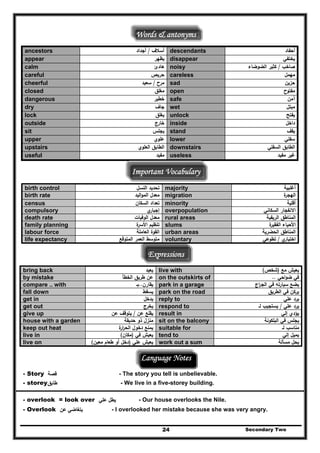
Words & antonyms
ancestors ‫أﺳﻼف‬/‫أﺟداد‬ ‫أﺣﻔﺎد‬descendants
‫ﻳظﻬر‬appear disappear ‫ﻳﺧﺗﻔﻲ‬
calm ‫ﻫﺎدئ‬ ‫ﺻﺎﺧب‬/‫اﻟﺿوﺿﺎء‬ ‫ﻛﺛﻳر‬noisy
‫ﺣرﻳص‬ ‫ﻣﻬﻣﻝ‬careful careless
‫ﻣرح‬/‫ﺳﻌﻳد‬ ‫ﺣزﻳن‬cheerful sad
‫ﻣﻐﻠق‬ ‫ﻣﻔﺗوح‬closed open
‫ﺧطﻳر‬ ‫آﻣن‬dangerous safe
‫ﺟﺎف‬ ‫ﻣﺑﺗﻝ‬dry wet
‫ﻳﻐﻠق‬ ‫ﻳﻔﺗﺢ‬lock unlock
‫ﺧﺎرج‬ ‫داﺧﻝ‬outside inside
‫ﻳﺟﻠس‬ ‫ﻳﻘف‬sit stand
‫ﻋﻠوي‬ ‫ﺳﻔﻠﻲ‬upper lower
‫اﻟﻌﻠوي‬ ‫اﻟطﺎﺑق‬ ‫اﻟط‬‫اﻟﺳﻔﻠﻲ‬ ‫ﺎﺑق‬upstairs downstairs
‫ﻣﻔﻳد‬ ‫ﻣﻔﻳد‬ ‫ﻏﻳر‬useful useless
Important Vocabulary
‫اﻟﻧﺳﻝ‬ ‫ﺗﺣدﻳد‬ ‫أﻏﻠﺑﻳﺔ‬
Secondary Two24
birth control majority
‫اﻟﻳد‬‫و‬‫اﻟﻣ‬ ‫ﻣﻌدﻝ‬ ‫ة‬‫اﻟﻬﺟر‬birth rate migration
‫اﻟﺳﻛﺎن‬ ‫ﺗﻌداد‬ ‫أﻗﻠﻳﺔ‬census minority
‫ي‬‫إﺟﺑﺎر‬ ‫اﻟﺳﻛﺎﻧﻲ‬ ‫اﻻﻧﻔﺟﺎر‬compulsory overpopulation
‫اﻟوﻓﻳﺎت‬ ‫ﻣﻌدﻝ‬ ‫اﻟرﻳﻔﻳﺔ‬ ‫اﻟﻣﻧﺎطق‬death rate rural areas
‫ة‬‫اﻷﺳر‬ ‫ﺗﻧظﻳم‬ ‫اﻟﻔﻘﻳ‬ ‫اﻷﺣﻳﺎء‬‫ة‬‫ر‬family planning slums
‫اﻟﻌﺎﻣﻠﺔ‬ ‫اﻟﻘوة‬ ‫اﻟﺣﺿرﻳﺔ‬ ‫اﻟﻣﻧﺎطق‬labour force urban areas
‫اﻟﻣﺗوﻗﻊ‬ ‫اﻟﻌﻣر‬ ‫ﻣﺗوﺳط‬ ‫ي‬‫اﺧﺗﻳﺎر‬/‫ﺗطوﻋﻲ‬life expectancy voluntary
Expressions
‫ﻳﻌﻳد‬ ‫ﻣﻊ‬ ‫ﻳﻌﻳش‬)‫ﺷﺧص‬(bring back live with
‫اﻟﺧطﺄ‬ ‫طرﻳق‬ ‫ﻋن‬ on the outskirts of ‫اﺣﻲ‬‫و‬‫ﺿ‬ ‫ﻓﻲ‬..by mistake
‫ﻳﻘﺎرن‬..‫ﺑـ‬ ‫اج‬‫ر‬‫اﻟﺟ‬ ‫ﻓﻲ‬ ‫ﺳﻳﺎرﺗﻪ‬ ‫ﻳﺿﻊ‬compare .. with park in a garage
‫ﻳﺳﻘط‬ ‫اﻟطرﻳق‬ ‫ﻓﻲ‬ ‫ﻳرﻛن‬fall down park on the road
‫ﻳدﺧﻝ‬ ‫ﻋﻠﻲ‬ ‫ﻳرد‬get in reply to
‫ﻳﺧرج‬ respond to ‫ﻋﻠﻲ‬ ‫ﻳرد‬/‫ﻟـ‬ ‫ﻳﺳﺗﺟﻳب‬get out
‫ﻋن‬ ‫ﻳﻘﻠﻊ‬/‫ﻋن‬ ‫ﻳﺗوﻗف‬ ‫إﻟﻲ‬ ‫ﻳؤدي‬give up result in
‫ﺣدﻳﻘﺔ‬ ‫ذو‬ ‫ﻣﻧزﻝ‬ sit on the balcony ‫اﻟﺑﻠﻛوﻧﺔ‬ ‫ﻓﻲ‬ ‫ﻳﺟﻠس‬house with a garden
‫ة‬‫ار‬‫ر‬‫اﻟﺣ‬ ‫دﺧوﻝ‬ ‫ﻳﻣﻧﻊ‬ ‫ﻟـ‬ ‫ﻣﻧﺎﺳب‬keep out heat suitable for
‫ﻓﻲ‬ ‫ﻳﻌﻳش‬)‫ﻣﻛﺎن‬( ‫إ‬ ‫ﻳﻣﻳﻝ‬‫ﻟﻲ‬live in tend to
work out a sum ‫ﻣﺳﺄﻟﺔ‬ ‫ﻳﺣﻝ‬‫ﻋﻠﻲ‬ ‫ﻳﻌﻳش‬)‫ﻣﻌﻳن‬ ‫طﻌﺎم‬ ‫أو‬ ‫دﺧﻝ‬(live on
Language Notes
- Story ‫ﻗﺻﺔ‬ - The story you tell is unbelievable.
- storey‫طﺎﺑق‬ - We live in a five-storey building.
‫ﻳطﻝ‬‫ﻋﻠﻲ‬- overlook = look over - Our house overlooks the Nile.
- Overlook ‫ﻳﺗﻐﺎﺿﻲ‬‫ﻋن‬ - I overlooked her mistake because she was very angry.
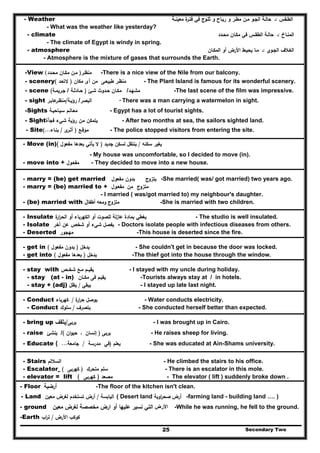
- Weather ‫اﻟطـﻘس‬:‫ـ‬‫ﻣﻌﻳﻧــﺔ‬ ‫ة‬‫ﻓﺗـر‬ ‫ﻓﻲ‬ ‫ﺛﻠـوج‬ ‫و‬ ‫رﻳـﺎح‬ ‫و‬ ‫ﻣطـر‬ ‫ﻣـن‬ ‫اﻟﺟـو‬ ‫ﺣﺎﻟـﺔ‬
- What was the weather like yesterday?
- climate ‫اﻟﻣﻧـﺎخ‬:‫ـ‬‫ﻣﺣـدد‬ ‫ﻣﻛـﺎن‬ ‫ﻓﻲ‬ ‫اﻟطﻘـس‬ ‫ﺣﺎﻟـﺔ‬
- The climate of Egypt is windy in spring.
- atmosphere ‫اﻟﺟـوي‬ ‫اﻟﻐـﻼف‬:‫ـ‬‫اﻟﻣﻛـﺎن‬ ‫أو‬ ‫اﻷرض‬ ‫ﻳﺣﻳـط‬ ‫ﻣـﺎ‬
- Atmosphere is the mixture of gases that surrounds the Earth.
‫ﻣﺣـدد‬ ‫ﺎن‬ )‫ﻣﻛـ‬ ‫ﻣـن‬ ‫ﻣﻧظـر‬-View ( -There is a nice view of the Nile from our balcony.
- scenery ‫ﻣﻛﺎن‬ ‫أى‬ ‫ﻣن‬ ‫طﺑﻳﻌـﻰ‬ ‫ﻣﻧظـر‬)‫ﻻﺗﻌـد‬( - The Plant Island is famous for its wonderful scenery.
- scene ‫ﺟـرﻳﻣـﺔ‬( / ‫ﺷـﺊ‬ ‫ﺣـدوث‬ ‫ﻣﻛـﺎن‬)‫ﺣـﺎدﺛـﺔ‬ /‫ﻣﺷﻬـد‬ -The last scene of the film was impressive.
- sight ‫رؤﻳـﺔ‬/‫ﻋﺎﺑـر‬‫ﻣﻧظـر‬ /‫اﻟﺑﺻر‬ - There was a man carrying a watermelon in sight.
-Sights ‫ﺳﻳـﺎﺣﻳـﺔ‬ ‫ﻣﻌـﺎﻟـم‬ - Egypt has a lot of tourist sights.
- Sight ‫ﻲء‬‫ﺟﺄة‬ ‫ﻳﺗﻣﻛن‬‫ن‬‫ؤﻳﺔ‬ - After two months at sea, the sailors sighted land.‫ﻓ‬ ‫ﺷ‬ ‫ر‬ ‫ﻣ‬
- Site ‫ﻣوﻗـﻊ‬)‫ى‬‫أﺛـر‬/‫ﺑﻧـﺎء‬(... - The police stopped visitors from entering the site.
.
Secondary Two25
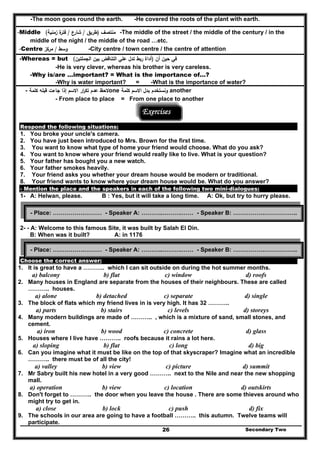
- Move (in) ‫ﻳﻐﻳر‬‫ﺳﻛﻧﻪ‬/‫ﺟدﻳد‬ ‫ﻟﺳﻛن‬ ‫ﻳﻧﺗﻘﻝ‬)‫ﻣﻔﻌوﻝ‬ ‫ﺑﻌدﻫﺎ‬ ‫ﻳﺄﺗﻲ‬ ‫ﻻ‬(
- My house was uncomfortable, so I decided to move (in).
- move into + ‫ﻣﻔﻌـوﻝ‬ - They decided to move into a new house.
‫ﺑدون‬‫ﻣﻔﻌوﻝ‬ ‫ﻳﺗز‬‫وج‬- marry = (be) get married -She married( was/ got married) two years ago.
- marry = (be) married to + ‫ﻣﻔﻌـوﻝ‬ ‫ﻣﺗزوج‬‫ﻣن‬
- I married ( was/got married to) my neighbour's daughter.
- (be) married with ‫ﻣﺗزوج‬‫وﻣﻌﻪ‬‫أطﻔﺎ‬‫ﻝ‬ -She is married with two children.
‫ة‬‫ار‬‫ر‬‫اﻟﺣ‬ ‫أو‬ ‫اﻟﻛﻬرﺑﺎء‬ ‫أو‬ ‫ﻟﻠﺻوت‬ ‫ﻟﺔ‬‫ز‬‫ﻋﺎ‬ ‫ﺑﻣﺎدة‬ ‫ﻳﻐطﻲ‬- Insulate - The studio is well insulated.
- Isolate ‫ﺷﺧص‬ ‫أو‬ ‫ﺷﻲء‬ ‫ﻳﻔﺻﻝ‬‫ﻋن‬‫أﺧر‬ - Doctors isolate people with infectious diseases from others.
- Deserted ‫ﻣﻬﺟور‬ -This house is deserted since the fire.
- get in ‫ﻳدﺧﻝ‬)‫ﻣﻔﻌوﻝ‬ ‫ﺑدون‬( - She couldn't get in because the door was locked.
- get into ‫ﻳدﺧﻝ‬)‫ﻣﻔﻌوﻝ‬ ‫ﺑﻌدﻫﺎ‬( -The thief got into the house through the window.
‫ﻣـﻊ‬ ‫ﻳﻘﻳــم‬‫ﺷﺧــص‬- stay with - I stayed with my uncle during holiday.
- stay (at - in) ‫ﻣﻛــﺎن‬ ‫ﻓﻰ‬ ‫ﻳﻘﻳـم‬ -Tourists always stay at / in hotels.
- stay + (adj) ‫ﻳﺑﻘﻲ‬/‫ﻳظﻝ‬ - I stayed up late last night.
- Conduct ‫ة‬‫ار‬‫ر‬‫ﺣ‬ ‫ﻳوﺻﻝ‬/‫ﻛﻬرﺑﺎء‬ - Water conducts electricity.
- Conduct ‫ﻳﺗﺻرف‬/‫ﺳﻠوك‬ - She conducted herself better than expected.
- bring up ‫ﻳرﺑﻰ‬/‫ﻳﺛﻘف‬ - I was brought up in Cairo.
- raise ‫ﻳﻧﺷﺊ‬ / ‫ﻳرﺑﻰ‬)‫ان‬‫و‬‫ﺣﻳ‬ ‫ـ‬ ‫إﻧﺳﺎن‬( - He raises sheep for living.
- Educate ‫ﻳﻌﻠم‬)‫ﻣدرﺳﺔ‬ ‫ﻓﻲ‬/‫ﺟﺎﻣﻌﺔ‬...( - She was educated at Ain-Shams university.
‫اﻟﺳﻼﻟم‬- Stairs - He climbed the stairs to his office.
- Escalator ‫ﻣﺗﺣرك‬ ‫ﺳﻠم‬)‫ﻛﻬرﺑﻰ‬( - There is an escalator in this mole.
- elevator = lift ‫ﻣﺻﻌد‬)‫ﻛﻬرﺑﻰ‬( - The elevator ( lift ) suddenly broke down .
- Floor ‫أرﺿﻳﺔ‬ -The floor of the kitchen isn't clean.
- Land ‫اﻟﻳﺎﺑﺳﺔ‬/‫ﻣﻌﻳن‬ ‫ﻟﻐرض‬ ‫ﺗﺳﺗﺧدم‬ ‫أرض‬ ( Desert land ‫أرض‬‫اوﻳﺔ‬‫ر‬‫ﺻﺣ‬ -farming land - building land …. )
‫األرض‬‫ﻋﻠﻳﻬﺎ‬ ‫ﻧﺳﻳر‬ ‫اﻟﺗﻲ‬‫ﻣﻌﻳن‬ ‫ﻟﻐرض‬ ‫ﻣﺧﺻﺻﺔ‬ ‫ارض‬ ‫أو‬ -While he was running, he fell to the ground.- ground
-Earth ‫اﻷرض‬ ‫ﻛوﻛب‬/‫اب‬‫ر‬‫ﺗ‬
-The moon goes round the earth. -He covered the roots of the plant with earth.
-Middle ‫ﻣﻧﺗﺻف‬)‫طرﻳق‬/‫ﺷﺎرع‬/‫زﻣﻧﻳﺔ‬ ‫ة‬‫ﻓﺗر‬( -The middle of the street / the middle of the century / in the
middle of the night / the middle of the road …etc.
-Centre ‫وﺳط‬/‫ﻣرﻛز‬ -City centre / town centre / the centre of attention
-Whereas = but ‫أن‬ ‫ﺣﻳن‬ ‫ﻓﻲ‬)‫اﻟﺟﻣﻠﺗﻳن‬ ‫ﺑﻳن‬ ‫اﻟﺗﻧﺎﻗض‬ ‫ﻋﻠﻲ‬ ‫ﺗدﻝ‬ ‫رﺑط‬ ‫أداة‬(
-He is very clever, whereas his brother is very careless.
-Why is/are …important? = What is the importance of…?
-Why is water important? = -What is the importance of water?
- ‫ﻻﺣظ‬‫ﻛﻠﻣﺔ‬ ‫ﻗﺑﻠﻪ‬ ‫ﺟﺎءت‬ ‫إذا‬ ‫اﻻﺳم‬ ‫ار‬‫ر‬‫ﺗﻛ‬ ‫ﻋدم‬ one ‫ﻛﻠﻣﺔ‬ ‫اﻻﺳم‬ ‫ﺑدﻝ‬ ‫وﻧﺳﺗﺧدم‬ another
- From place to place = From one place to another
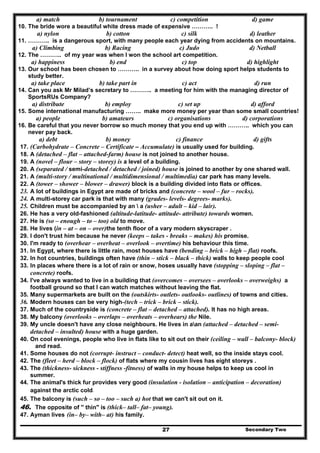
Exercises
Respond the following situations:
1. You broke your uncle's camera.
2. You have just been introduced to Mrs. Brown for the first time.
3. You want to know what type of home your friend would choose. What do you ask?
4. You want to know where your friend would really like to live. What is your question?
5. Your father has bought you a new watch.
6. Your father smokes heavily.
7. Your friend asks you whether your dream house would be modern or traditional.
8. Your friend wants to know where your dream house would be. What do you answer?
- Mention the place and the speakers in each of the following two mini-dialogues:
1- A: Helwan, please. B : Yes, but it will take a long time. A: Ok, but try to hurry please.
2- - A: Welcome to this famous Site, it was built by Salah El Din.
B: When was it built? A: in 1176
Choose the correct answer:
1. It is great to have a ……….. which I can sit outside on during the hot summer months.
a) balcony b) flat c) window d) roofs
Secondary Two26
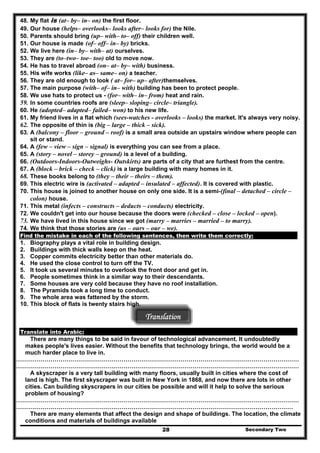
2. Many houses in England are separate from the houses of their neighbours. These are called
……….. houses.
a) alone b) detached c) separate d) single
3. The block of flats which my friend lives in is very high. It has 32 ………..
a) parts b) stairs c) levels d) storeys
4. Many modern buildings are made of ……….. , which is a mixture of sand, small stones, and
cement.
a) iron b) wood c) concrete d) glass
5. Houses where I live have ……….. roofs because it rains a lot here.
a) sloping b) flat c) long d) big
6. Can you imagine what it must be like on the top of that skyscraper? Imagine what an incredible
……….. there must be of all the city!
a) valley b) view c) picture d) summit
7. Mr Sabry built his new hotel in a very good ……….. next to the Nile and near the new shopping
mall.
a) operation b) view c) location d) outskirts
8. Don't forget to ……….. the door when you leave the house . There are some thieves around who
might try to get in.
a) close b) lock c) push d) fix
9. The schools in our area are going to have a football ……….. this autumn. Twelve teams will
participate.
- Place: …………….……… - Speaker A: ………..……….…… - Speaker B: …………….……………..
Secondary Two27
a) match b) tournament c) competition d) game
10. The bride wore a beautiful white dress made of expensive ……….. !
a) nylon b) cotton c) silk d) leather
11. ……….. is a dangerous sport, with many people each year dying from accidents on mountains.
a) Climbing b) Racing c) Judo d) Netball
12. The ……….. of my year was when I won the school art competition.
a) happiness b) end c) top d) highlight
13. Our school has been chosen to ……….. in a survey about how doing sport helps students to
study better.
a) take place b) take part in c) act d) run
14. Can you ask Mr Milad’s secretary to ……….. a meeting for him with the managing director of
SportsRUs Company?
a) distribute b) employ c) set up d) afford
15. Some international manufacturing …….. make more money per year than some small countries!
a) people b) amateurs c) organisations d) corporations
16. Be careful that you never borrow so much money that you end up with ……….. which you can
never pay back.
a) debt b) money c) finance d) gifts
17. (Carbohydrate – Concrete – Certificate – Accumulate) is usually used for building.
18. A (detached – flat – attached-farm) house is not joined to another house.
19. A (novel – flour – story – storey) is a level of a building.
20. A (separated / semi-detached / detached / joined) house is joined to another by one shared wall.
21. A (multi-story / multinational / multidimensional / multimedia) car park has many levels.
22. A (tower – shower – blower – drawer) block is a building divided into flats or offices.
23. A lot of buildings in Egypt are made of bricks and (concrete – wool – fur – rocks).
24. A multi-storey car park is that with many (grades- levels- degrees- marks).
25. Children must be accompanied by an  a (usher – adult – kid – lair).
26. He has a very old-fashioned (altitude-latitude- attitude- attribute) towards women.
27. He is (so – enough – to – too) old to move.
28. He lives (in – at – on – over)the tenth floor of a vary modern skyscraper .
29. I don't trust him because he never (keeps – takes - breaks – makes) his promise.
30. I'm ready to (overhear – overheat – overlook – overtime) his behaviour this time.
31. In Egypt, where there is little rain, most houses have (bending – brick – high – flat) roofs.
32. In hot countries, buildings often have (thin – stick – black – thick) walls to keep people cool
33. In places where there is a lot of rain or snow, hoses usually have (stopping – sloping – flat –
concrete) roofs.
34. I've always wanted to live in a building that (overcomes – oversees – overlooks – overweighs) a
football ground so that I can watch matches without leaving the flat.
35. Many supermarkets are built on the (outskirts- outlets- outlooks- outlines) of towns and cities.
36. Modern houses can be very high-(tech – trick – brick – stick).
37. Much of the countryside is (concrete – flat – detached – attached). It has no high areas.
38. My balcony (overlooks – overlaps – overheats – overhears) the Nile.
39. My uncle doesn't have any close neighbours. He lives in aan (attached – detached – semi-
detached – insulted) house with a huge garden.
40. On cool evenings, people who live in flats like to sit out on their (ceiling – wall – balcony- block)
and read.
41. Some houses do not (corrupt- instruct – conduct- detect) heat well, so the inside stays cool.
42. The (fleet – herd – block – flock) of flats where my cousin lives has eight storeys .
43. The (thickness- sickness - stiffness -fitness) of walls in my house helps to keep us cool in
summer.
44. The animal's thick fur provides very good (insulation - isolation – anticipation – decoration)
against the arctic cold.
45. The balcony is (such – so – too – such a) hot that we can't sit out on it.
46. The opposite of '' thin" is (thick– tall– fat– young).
47. Ayman lives (in– by– with– at) his family.
48. My flat is (at– by– in– on) the first floor.
49. Our house (helps– overlooks– looks after– looks for) the Nile.
50. Parents should bring (up– with– to– off) their children well.
51. Our house is made (of– off– in– by) bricks.
52. We live here (in– by– with– at) ourselves.
53. They are (to–two– toe– too) old to move now.
54. He has to travel abroad (on– at– by– with) business.
55. His wife works (like– as– same– on) a teacher.
56. They are old enough to look ( at– for– up– after)themselves.
57. The main purpose (with– of– in– with) building has been to protect people.
58. We use hats to protect us - (for– with– in– from) heat and rain.
59. In some countries roofs are (sleep– sloping– circle– triangle).
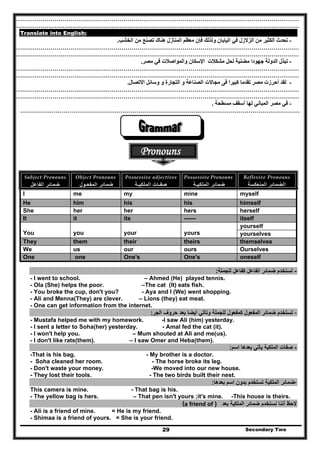
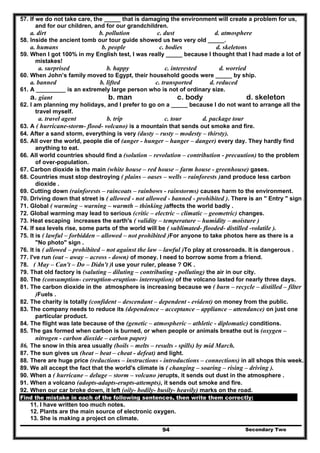
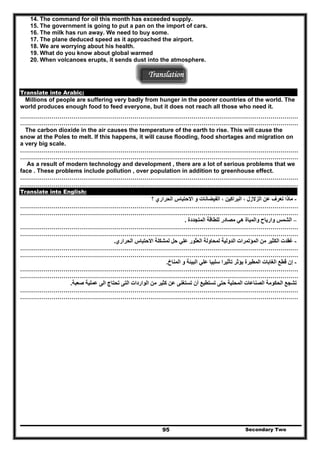
60. He (adopted– adapted– failed– won) to his new life.
61. My friend lives in a flat which (sees-watches - overlooks – looks) the market. It's always very noisy.
62. The opposite of thin is (big – large – thick – sick).
63. A (balcony – floor – ground – roof) is a small area outside an upstairs window where people can
sit or stand.
64. A (few – view – sign – signal) is everything you can see from a place.
65. A (story – novel – storey – ground) is a level of a building.
66. (Outdoors-Indoors-Outweighs- Outskirts) are parts of a city that are furthest from the centre.
67. A (block – brick – check – click) is a large building with many homes in it.
68. These books belong to (they – their – theirs – them).
69. This electric wire is (activated – adapted – insulated – affected). It is covered with plastic.
70. This house is joined to another house on only one side. It is a semi-(final – detached – circle –
colon) house.
71. This metal (infects – constructs – deducts – conducts) electricity.
72. We couldn't get into our house because the doors were (checked – close – locked – open).
73. We have lived in this house since we got (marry – marries – married – to marry).
74. We think that those stories are (us – ours – our – we).
Find the mistake in each of the following sentences, then write them correctly:
1. Biography plays a vital role in building design.
2. Buildings with thick walls keep on the heat.
3. Copper commits electricity better than other materials do.
4. He used the close control to turn off the TV.
5. It took us several minutes to overlook the front door and get in.
6. People sometimes think in a similar way to their descendants.
7. Some houses are very cold because they have no roof installation.
8. The Pyramids took a long time to conduct.
9. The whole area was fattened by the storm.
10. This block of flats is twenty stairs high.
Translation
Translate into Arabic:
There are many things to be said in favour of technological advancement. It undoubtedly
makes people's lives easier. Without the benefits that technology brings, the world would be a
much harder place to live in.
………………………………………………………………………………………………………………………………
………………………………………………………………………………………………………………………………
A skyscraper is a very tall building with many floors, usually built in cities where the cost of
land is high. The first skyscraper was built in New York in 1868, and now there are lots in other
cities. Can building skyscrapers in our cities be possible and will it help to solve the serious
problem of housing?
………………………………………………………………………………………………………………………………
……………………………………………………………………………………………………………………………
Secondary Two28
There are many elements that affect the design and shape of buildings. The location, the climate
conditions and materials of buildings available
………………………………………………………………………………………………………………………………
………………………………………………………………………………………………………………………………
Translate into English:
-‫الخشب‬ ‫من‬ ‫تصنع‬ ‫ھناك‬ ‫المنازل‬ ‫معظم‬ ‫فإن‬ ‫ولذلك‬ ‫اليابان‬ ‫في‬ ‫الزالزل‬ ‫من‬ ‫الكثير‬ ‫تحدث‬.
………………………………………………………………………………………………………………………………
………………………………………………………………………………………………………………………………
-‫مصر‬ ‫في‬ ‫والمواصالت‬ ‫اإلسكان‬ ‫مشكالت‬ ‫لحل‬ ‫مضنية‬ ‫جھودا‬ ‫الدولة‬ ‫تبذل‬.
………………………………………………………………………………………………………………………………
………………………………………………………………………………………………………………………………
-‫االتصال‬ ‫وسائل‬ ‫و‬ ‫التجارة‬ ‫و‬ ‫الصناعة‬ ‫مجاالت‬ ‫فى‬ ‫كبيرا‬ ‫تقدما‬ ‫مصر‬ ‫أحرزت‬ ‫لقد‬.
………………………………………………………………………………………………………………………………
………………………………………………………………………………………………………………………………
-‫مسطحة‬ ‫أسقف‬ ‫لھا‬ ‫المباني‬ ‫مصر‬ ‫في‬.
……………………………………………………………………………….……………………………………………
Secondary Two29
Pronouns
Subject Pronouns 
‫ضمائر‬‫الفاعل‬  
Object Pronouns 
 ‫المفعـول‬ ‫ض‬‫مائر‬  
Possessive adjectives
‫صفـات‬‫ـة‬ ‫الملك‬
Possessive Pronouns  
‫ي‬ ‫ضمائر‬‫ـة‬ ‫الملك‬
Reflexive Pronouns 
‫ي‬ ‫ر‬ ‫ال‬‫ضمائ‬‫ا‬‫لمنعكسة‬
I me my mine myself
He him his his himself
She her her hers herself
It it its ------ itself
yourself
You you your yours yourselves
They them their theirs themselves
We us our ours Ourselves
One one One's One's oneself
-‫للجملة‬ ‫كفاعل‬ ‫الفاعل‬ ‫ضمائر‬ ‫تستخدم‬:
- I went to school. – Ahmed (He) played tennis.
- Ola (She) helps the poor. –The cat (It) eats fish.
- You broke the cup, don't you? - Aya and I (We) went shopping.
- Ali and Menna(They) are clever. – Lions (they) eat meat.
- One can get information from the internet.
‫الجر‬ ‫حروف‬ ‫بعد‬ ‫أيضا‬ ‫وتأتي‬ ‫للجملة‬ ‫كمفعول‬ ‫المفعول‬ ‫ضمائر‬ ‫تستخدم‬: -
- Mustafa helped me with my homework. -I saw Ali (him) yesterday.
- I sent a letter to Soha(her) yesterday. - Amal fed the cat (it).
- I won't help you. – Mum shouted at Ali and me(us).
- I don't like rats(them). – I saw Omer and Heba(them).
-‫اسم‬ ‫بعدھا‬ ‫يأتي‬ ‫الملكية‬ ‫صفات‬:
- My brother is a doctor.-That is his bag.
- Soha cleaned her room. - The horse broke its leg.
- Don't waste your money. -We moved into our new house.
- They lost their tools. - The two birds built their nest.
-‫بعدھا‬ ‫اسم‬ ‫بدون‬ ‫تستخدم‬ ‫الملكية‬ ‫ضمائر‬:
This camera is mine. - That bag is his.
- The yellow bag is hers. – That pen isn't yours ;it's mine. -This house is theirs.
‫بعد‬ ‫الملكية‬ ‫ضمائر‬ ‫نستخدم‬ ‫أننا‬ ‫الحظ‬)(a friend of
- Ali is a friend of mine. = He is my friend.
- Shimaa is a friend of yours. = She is your friend.
‫مالحظات‬‫علي‬‫استخ‬‫دام‬‫الضمائر‬
-‫أن‬ ‫الحظ‬)(its‫اسم‬ ‫بعدھا‬ ‫صفة‬ ‫او‬ ‫اسم‬ ‫بعدھا‬ ‫يأتي‬ ‫و‬ ‫للملكية‬:
- The fox moved its long tail.-The dog ate its food.
-‫أما‬(it's)‫اختصار‬ ‫تكون‬it is / it has)(:
-It's a new car. -It's rained for two days.
-‫الضمير‬it‫المفرد‬ ‫العاقل‬ ‫لغير‬ ‫يستخدم‬)‫فاعل‬/‫مفعول‬(‫نستخدم‬ ‫الجمع‬ ‫حالة‬ ‫وفي‬they)(‫و‬ ‫للفاعل‬)them(‫للمفعول‬:
–The cat (It) eats fish. – Lions (they) eat meat.
– Amal fed the cat (it). - I don't like rats(them).
-‫استخدام‬ ‫الحظ‬it)(‫الطقس‬ ‫و‬ ‫المسافة‬ ‫و‬ ‫الزمن‬ ‫عن‬ ‫للتعبير‬:
- It is half past nine. – It is a long way to school.
– It is quite cold today.
-‫الضمير‬ ‫يستخدم‬one)(‫بمعني‬"‫المرء‬"‫ع‬ ‫وتدل‬‫استخدام‬ ‫ويمكن‬ ‫عامة‬ ‫بصفة‬ ‫الناس‬ ‫لي‬)you(‫منھا‬ ‫بدال‬:
-One(You) should eat healthy food.
-‫نستخدم‬ ‫الملكية‬ ‫حالة‬ ‫وفي‬)one's(‫استخدام‬ ‫ويمكن‬(your)‫منھا‬ ‫بدال‬:
-It is easy to lose one's ( your) money in a bus in Cairo.
-‫استخدام‬ ‫يمكن‬(one)‫اسم‬ ‫تكرار‬ ‫من‬ ‫بدال‬‫نستخدم‬ ‫الجمع‬ ‫حالة‬ ‫وفي‬ ‫يعد‬ ‫مفرد‬(ones):
-I want to buy a car. I'd like a second hand one.
-Japanese cars are always better than German ones.
-‫الملكية‬ ‫عن‬ ‫التالية‬ ‫السؤال‬ ‫صيغة‬ ‫الحظ‬:
Secondary Two30
-Whose pen is this? = Who does this pen belong to?
Reflexive Pronouns
-‫الفاعل‬ ‫يكون‬ ‫عندما‬ ‫المنعكس‬ ‫الضمير‬ ‫يستخدم‬‫نفسه‬ ‫ھو‬‫المفعول‬:
- Ali hurt himself.- I bought myself a cold drink.
- She saw herself in the mirror. - We’ll pay for ourselves.
‫للتأكيد‬ ‫المنعكس‬ ‫الضمير‬ ‫يستخدم‬‫الفاع‬ ‫بعد‬ ‫ويأتي‬‫ل‬/‫المفعول‬: -
I myself polished the shoes. = - I polished the shoes myself.
-‫بعد‬ ‫المنعكس‬ ‫الضمير‬ ‫يستخدم‬by)(‫بمعني‬"‫بمفرده‬"‫أو‬"‫مساعدة‬ ‫بدون‬: "
by myself = on my own = alone / without any help
- I went shopping on my own. = alone
- He lives on his own. = alone / by himself
- Did Ali paint that picture on his own? = without any help
- I learned to use this computer by myself. = without any help
-‫مثل‬ ‫معينة‬ ‫أفعال‬ ‫بعد‬ ‫المنعكسة‬ ‫الضمائر‬ ‫تستخدم‬ ‫ال‬:
approach ‫من‬ ‫يقترب‬ complain ‫يشكو‬ wonder ‫يتساءل‬
remember ‫يتذكر‬ Rest ‫يستريح‬ relax ‫يسترخي‬
shave ‫ي‬‫حلق‬ wash ‫يغسل‬ ‫قلق‬worry
wake up ‫يستيقظ‬ lie down ‫ينام‬ stand up ‫يقف‬
‫ال‬ ‫حروف‬ ‫بعد‬ ‫المنعكسة‬ ‫الضمائر‬ ‫تستخدم‬ ‫ال‬‫االتجاه‬ ‫أو‬ ‫المكان‬ ‫أو‬ ‫بالموقع‬ ‫الخاصة‬ ‫جر‬: -
- She doesn't want anyone to sit next to her. - We took our cameras with us.
-The car was coming fast towards me.
-‫نستخدم‬ ‫أن‬ ‫يمكن‬‫الجر‬ ‫حروف‬ ‫بعد‬ ‫المنعكسة‬ ‫الضمائر‬after / for / on
- The girls looked after themselves. - Always depend depend on yourself.
-‫ھناك‬‫بين‬ ‫فرق‬)On his ownOf his own /(
- on his own = alone / without help
- I live on my own. = I live alone .
- I cleaned the kitchen on my own. = I cleaned the kitchen without help.
Of his own = belonging to him and to no one else ‫الملكية‬ ‫علي‬ ‫تدل‬
- I’d like to have a room of my own.( belonging to me)
‫المنعكسة‬ ‫الضمائر‬ ‫فيھا‬ ‫تستخدم‬ ‫تعبيرات‬
- Enjoy yourself = have a good time - Take care of yourself
- Help yourself = take what you want
- Make yourself at home. = behave freely as if it were your own home
- Behave yourself = be polite /behave well ‫كن‬‫مھذبا‬
Secondary Two31
‫أصبح‬‫مشھورا‬- He made a name for himself = He became famous
Exercises
Choose the correct answer:
1.The Smith family's garden is much larger than ……………..
a) our b) ours c) ourself d) ourselves
2.Please take care with that camera. It has been …………….. for many years.
a) my b) owned c) mine d) mind
3.We painted the school walls …………….. without any help.
a) ourself b) us c) ours d) ourselves
4.Please tell Fatma that her mother would like to speak to ……………..
a) she b) hers c) her d) herself
5.I was surprised at how dirty I was when I saw …………….. in the mirror.
a) I b) me c) myself d) mine
6.My sisters and brothers and I are all married, so my parents live by …………….. now.
a) themselves b) themself c) theirself d) ourselves
7.We have five bedrooms. Three are for …………….. and the others are for guests.
a) ourselves b) us c) ours d) we
8.Did you hurt …………….. when you fell down the stairs?
a) they b) you c) yourself d) yours
9. Before I made the decision to move to a new country, I …………….. about it for years.
a. had thought b. had been thinking c. was thinking d. thought
10. Mona …………….. her report by the time it was due, and her boss was angry.
a. hadn’t been finishing b. hadn’t finished c. wasn’t finishing d. didn’t finish
11. In the hours before the accident happened, the children …….. in a dangerous old building site.
a. had been playing b. have played c. were playing d. played
12. By the time Hany was 25, he …………….. two books and five short stories.
a. had been writing b. was writing c. had written d. wrote
13. We cleaned up the garden …………….. without any help.
a. ourself b. us-self c. ours d. ourselves
14. Please tell Samia that her father would like to speak to ……………..
a. she b. hers c. her d. herself
15. She was surprised at how old she looked when she saw …………….. in the mirror.
a. me b. her c. herself d. hers
16. Omar’s collection of books is much bigger than ……………..
a. my b. mine c. myself d. me
17. Ahmed is a great friend of (me – I – mine – my).
18. Children sometimes hurt (them – themselves – himself – ourselves) when they are playing.
19. Did you both hurt (yourself – yourselves – herself – themselves)?
20. Do these keys belong to you? –No, they are (she – them – their – theirs).
21. Hala (cut – had cut – cut herself – cut themselves) on a piece of glass.
22. I (showered-showered myself – showered by myself – showered to myself) and dressed in ten minutes.
23. I love you for (yourself – itself – oneself – themselves), not for your money.
24. If you see Ali, can you tell (he – his – him – them) to phone me tomorrow.
25. Is she the owner of that red car? No, it's (me – mine – I – my).
26. Is that white scarf ( hers – she – her – Mona )?
27. Is this computers (you – you're – your – yours)?
28. Is this your brother's bike? No, it's (his – him – me – mine).
Secondary Two32
29. Make (themselves – yourself – you – your) a cup of tea.
30. My brothers hurt (ourselves – themselves – himself – yourselves) on a broken door.
31. Our house is not as modern as (her – your – their – hers).
32. Peter fell off his bike, but he wasn't (hurt – hurt himself – hurting – hurt itself).
33. Sally, did you and Mona paint the room (yourself – yourselves – themselves – herself)?
34. She fell down the stairs, but she didn't (hurt – hurt her – hurt herself – hurt hers).
35. Take an umbrella with (you – yourself – your – yours) in case it rains.
36. The dog barked on seeing (it – its – itself – herself) in a mirror.
37. The door of this room sometimes opens (himself – themselves – by itself – oneself).
38. The girl is feeling faint. Take (herself – yourself – hers – her) to hospital.
39. The house (themselves – itself – yourself- myself) is nice, but the garden is very small.
40. The house (it – its – itself – themselves) is nice, but it is in a emote area.
41. The woman looked surprised when she saw (herself -itself -himself- ourselves) in the mirror.
42. This book isn't (they – them – there's – theirs). It's ours.
43. We didn't ask for help. We did all the work (myself – yourself – ourselves – yourselves).
44. We got out of the water and dried (us – we – ourselves – themselves).
45. We wanted to buy the table, but (it's – it – itself – its) surface was damaged.
46. Would you like to try the new car out (itself – myself – yourself – oneself)?
47. You both must do the job by (you – your – yourself – yourselves).
48. You should take your umbrella. (It – Its – It's – They're) raining outside.
Find the mistake in each of the following sentences, then write them correctly:
1. Can you introduce your, please?
2. He cut him while shaving.
3. I mended the watch meself.
4. Make you at home.
5. My brother and I went to the club by himself.
6. People live in houses to protect ourselves from the weather.
7. Please help myself to more tea.
8. She dressed her self and went out.
9. She made a name for her as a painter.
10. She went to the cinema by her.
11. She went to the concert of her own.
12. The children cooked their meal by them.
13. The children enjoyed himself when they were on holiday.
14. The dog moved it's tail when it saw me.
15. The flat overlooking the park belongs to ours.
16. The job herself is good but the boss is unkind.
17. The patient is insulating from others.
18. There house is so big.
19. This car belongs to our neighbours. It's them.
20. This is not your camera. It's him.
21. This machine is automatic. It works by himself.
22. Very young children shouldn’t go swimming by them.
23. We designed our house by itself.
Secondary Two33
Unit 13- Wise words
accomplish ‫ﻳﺣﻘق‬ have an operation ‫ﻟﻪ‬ ‫ي‬‫ﺗﺟر‬ُ‫اﺣﺔ‬‫ر‬‫ﺟ‬ politician ‫ﺷﺧص‬‫ﺳﻳﺎﺳﻲ‬
ambition ‫اﻟطﻣوح‬ُ include ‫ﻳﺷﻣﻝ‬ postpone = put off ‫ﻳؤﺟﻝ‬
ambitious ‫طﻣوح‬ُ inclusion ‫ﺗﺿﻣﻳن‬/‫ﺿم‬ pour ‫ﻳﺳﻛب‬/‫ﻳﺻب‬
ambulance ‫إﺳﻌﺎف‬ ‫ة‬‫ﺳﻳﺎر‬ inform ‫ﻳﺧﺑر‬ priority ‫أوﻟوﻳﺔ‬
announcement ‫إﻋﻼن‬ interrupt ‫ﻳﻘﺎطﻊ‬ probably ‫اﻟﻣﺣﺗﻣﻝ‬ ‫ﻣن‬
arrival time ‫اﻟوﺻوﻝ‬ ‫وﻗت‬ jeweller ‫اﻫرﺟﻲ‬‫و‬‫ﺟ‬ professor ‫أ‬‫ﺟﺎﻣﻌﻲ‬ ‫ﺳﺗﺎذ‬
block the road ‫اﻟطرﻳق‬ ‫ﻳﺳد‬ keep trying ‫ﻓﻲ‬ ‫ﻳﺳﺗﻣر‬
‫ﺔ‬
proof ‫ﻫﺎن‬‫ﺑر‬/‫دﻟﻳﻝ‬
cancel ‫ﻳﻠﻐﻲ‬ lecturer ‫ﻣﺣﺎﺿر‬ُ prove ‫ﻳﺛﺑت‬/‫ﻳﺑ‬‫ﻫن‬‫ر‬
chat ‫ﻳ‬‫دردش‬/ meaningful ‫ى‬‫ﻣﻐز‬ ‫ذو‬ radio ‫ادﻳو‬‫ر‬/‫ﺟﻬﺎز‬
/civil engineer ‫ﻣدﻧﻲ‬ ‫ﻣﻬﻧدس‬ meaningless ‫ى‬‫ﻣﻐز‬ ‫ﺑﻼ‬ regret ‫ﻳﻧدم‬
conductor ‫ي‬‫ﻛﻣﺳﺎر‬/ mechanic ‫ﻣﻳﻛﺎﻧﻳﻛﻲ‬ rush ‫ﻳﻧدﻓﻊ‬
contact ‫ﺑـ‬ ‫ﻳﺗﺻﻝ‬ minister ‫وزﻳر‬ shake head ‫أﺳﻪ‬‫ر‬ ‫ﻳﻬز‬‫ر‬‫ا‬‫ﻓﺿ‬‫ﺎ‬
correction ‫ﺗﺻﺣﻳﺢ‬ ministry ‫ة‬‫ار‬‫ز‬‫و‬ silence ‫اﻟﺻﻣت‬
costs ‫ﺗﻛﺎﻟﻳف‬ moral ‫ى‬‫ﻣﻐز‬ ‫أو‬ ‫درس‬
‫ﺔ‬ ‫ﻗ‬
silent ‫ﺻﺎﻣت‬
customers ‫اﻟﻌﻣﻼء‬ newspaper ‫ﺻﺣﻳﻔﺔ‬ space ‫اغ‬‫ر‬‫ﻓ‬/‫اﻟﻔﺿﺎء‬
definition ‫ﺗﻌرﻳف‬ newsreader ‫اﻷﺧﺑﺎر‬ ‫ئ‬‫ﻗﺎر‬ surgery ‫اﺣﺔ‬‫ر‬‫ﺟ‬/‫ﻋﻳﺎدة‬
departure time ‫ة‬‫اﻟﻣﻐﺎدر‬ ‫وﻗت‬ nod ‫أﺳﻪ‬‫ر‬‫ﺑ‬ ‫ﻳﺷﻳر‬
‫ﻓ‬
tank ‫ان‬‫ز‬‫ﺧ‬
edge ‫ﺣﺎﻓﺔ‬ optician ‫ات‬‫ر‬‫اﻟﻧظﺎ‬ ‫ﺻﺎﻧﻊ‬ therapy ‫ﻋﻼج‬
emergency ‫طﺎرﺋﺔ‬ ‫ﺣﺎﻟﺔ‬ paramedic ‫ﻣﺳﻌف‬ time management ‫اﻟوﻗت‬ ‫ة‬‫إدار‬
eventually ‫اﻟﻧﻬﺎﻳﺔ‬ ‫ﻓﻲ‬ passenger ‫اﻛب‬‫ر‬/‫ﻣﺳﺎﻓر‬ traffic jam ‫اﻟﻣرور‬ ‫ازدﺣﺎم‬
frequent ‫ﻣﻌﺗﺎد‬/‫ﻣﺗﻛرر‬ place = put ‫ﻳﺿﻊ‬ transfer ‫ﻳﻧﻘﻝ‬
golf ball ‫ﺟوﻟف‬ ‫ة‬‫ﻛر‬ plumber ‫ﺳﺑﺎك‬ well-known ‫ﻣﻌروف‬/‫ﻣﺷﻬور‬
Words & antonyms
ambitious ‫طﻣوح‬ُ unambitious ‫طﻣوح‬ ‫ﻏﻳر‬
include ‫ﻳﺷﻣﻝ‬ exclude ‫ﻳﺳﺗﺑﻌد‬
silent ‫ﺻﺎﻣت‬ audible ‫ع‬‫ﻣﺳﻣو‬
ill ‫ﻣرﻳض‬ well ‫ﺟﻳدة‬ ‫ﺑﺻﺣﺔ‬
sufficient ‫ﻛﺎف‬ insufficient ‫ﻛﺎف‬ ‫ﻏﻳر‬
equal ‫ﻣﺗﺳﺎوي‬ unequal ‫ﻏﻳر‬‫ﻣﺗﺳﺎوي‬
regretful ‫ﺑﺎﻟﻧدم‬ ‫ﺷﺎﻋر‬ glad ‫ﺳﻌﻳد‬
tired ‫ﻫق‬‫ﻣر‬ energetic ‫ﺑﺎﻟﻧﺷﺎط‬ ‫ﻣﻠﻲء‬
front ‫أﻣﺎم‬ rear = back ‫ﺧﻠف‬
meaningful ‫ﻣﻌﻧﻲ‬ ‫ذو‬ meaningless ‫ﻣﻌﻧﻲ‬ ‫ﺑﻼ‬
hopeful ‫ﺑﺎﻷﻣﻝ‬ ‫ﻣﻔﻌم‬ hopeless ‫ﻳﺎﺋس‬/‫ﻣﻧﻪ‬ ‫ﻣﻳﺋوس‬
busy ‫ﻣﺷﻐوﻝ‬ free ‫ﻣﺷﻐوﻝ‬ ‫ﻏﻳر‬
winner ‫ﻓﺎﺋز‬ loser ‫ﺧﺎﺳر‬
understand ‫ﻳﻔ‬‫ﻬم‬ misunderstand ‫ﻓﻬم‬ ‫ﻳﺳﻲء‬
Important Vocabulary
a campaign against ‫ﺿد‬ ‫ﺣﻣﻠﺔ‬ negotiations ‫ﻣﻔﺎوﺿﺎت‬
agenda ‫اﻷﻋﻣﺎﻝ‬ ‫ﺟدوﻝ‬ physiotherapy ‫اﻟطﺑﻳﻌﻲ‬ ‫اﻟﻌﻼج‬
Arab League ‫اﻟﻌرﺑﻳﺔ‬ ‫اﻟدوﻝ‬ ‫ﺟﺎﻣﻌﺔ‬ press statement ‫ﺻﺣﻔﻲ‬ ‫ﺑﻳﺎن‬
compass ‫ﺑوﺻﻠﺔ‬ slight damage ‫ﺧﻔﻳف‬ ‫ﺿرر‬
counter attack ‫ﻣﺿﺎد‬ ‫ﻫﺟوم‬ sound effects ‫ﺻوﺗﻳﺔ‬ ‫ات‬‫ر‬‫ﻣؤﺛ‬
crushing defeat ‫ﺳﺎﺣﻘﺔ‬ ‫ﻫزﻳﻣﺔ‬ strengthen relations ‫اﻟﻌﻼﻗﺎت‬ ‫ﻳدﻋم‬
fight terrorism ‫ﻫﺎب‬‫اﻹر‬ ‫ﻳﺣﺎرب‬ summit conference ‫ﻗﻣﺔ‬ ‫ﻣؤﺗﻣر‬
local time ‫اﻟﻣﺣﻠﻲ‬ ‫اﻟﺗوﻗﻳت‬ underground water ‫ﺟوﻓﻳﺔ‬ ‫ﻣﻳﺎﻩ‬
Expressions
‫ﻟـ‬ ‫ﻳرﺗب‬ ‫ﻣﺷﻛﻠﺔ‬ ‫ﺣﻝ‬ ‫ﻓﻲ‬ ‫ﻳﺳﺎﻋد‬
Secondary Two34
arrange for + n. help with a problem
‫ﻟـ‬ ‫ﻳرﺗب‬ ‫ﻣن‬ ‫ﺑدﻻ‬arrange to + inf. instead of
‫ﻋن‬ ‫ﻳﺳﺄﻝ‬ ‫اﻟﻐرﻓﺔ‬ ‫أﻧﺣﺎء‬ ‫ﻓﻲ‬ ‫ﻳﺗﺣرك‬ask about move around the room
‫ﻳطﻠب‬ ‫اﻟﺑﻼج‬ ‫ﻋﻠﻲ‬ask for on the beach
‫ﻟـ‬ ‫ﺻدﻳﻘﺎ‬ ‫ﻳﺻﺑﺢ‬ ‫إﺳﻌﺎف‬ ‫ة‬‫ﺳﻳﺎر‬ ‫ﻟطﻠب‬ ‫ﻳﺗﺻﻝ‬become friends with phone for an ambulance
‫ﻳﺗﻌطﻝ‬ ‫اﻟﻣﺣﻣوﻝ‬ ‫ﺗﻠﻳﻔوﻧﻪ‬ ‫ﻋﻠﻲ‬ ‫ﺑﻪ‬ ‫ﻳﺗﺻﻝ‬break down phone him on his mobile
‫اﻟﻣﺳﺗﺷﻔﻲ‬ ‫ﻓﻲ‬ ‫ﺑﺷﺧص‬ ‫ﻳﺗﺻﻝ‬‫ﺷﺧص‬ ‫ﻋﻠﻲ‬ ‫ﻳﻧﺎدي‬call to someone phone someone at the hospital
‫اﻵﺧرﻳن‬ ‫ﻋن‬ ‫ﻧﻔﺳﻪ‬ ‫ﻳﻌزﻝ‬ ‫اﻻﻣﺗﺣﺎﻧﺎت‬ ‫أﺟﻝ‬ ‫ﻣن‬ ‫اﺟﻊ‬‫ر‬‫ﻳ‬cut off from others revise for exams
‫ﺑـ‬ ‫ﻣﻠﻲء‬ ‫ﻋﻠﻲ‬ ‫ﻳﻌﺗﺎد‬filled with take to
‫ﺑـ‬ ‫ﻣﻠﻲء‬ ‫ﺷﻲء‬ ‫ﻋن‬ ‫ﻳﻛﺗب‬full of write about something
‫ﺳﺎﻋﺔ‬ ‫ﻧﺻف‬ ‫ﺑﻌد‬ ‫ﻋﻠﻲ‬ ‫ﻟﺷﺧص‬ ‫ﻳﻛﺗب‬half an hour away from write to someone
Derivatives
Verb Noun Adjective
ambition ‫اﻟ‬‫طﻣوح‬ ambitious ‫ﻟدﻳﻪ‬‫اﻟ‬‫طﻣوح‬
Announce ‫ﻳذﻳﻊ‬/‫ﻳ‬‫ﻌﻠن‬ announcement ‫إﻋﻼن‬ / announcer ‫ﻣﻌﻠن‬/‫ﻣذﻳﻊ‬
Include ‫ﻳﺷﻣﻝ‬ Inclusion ‫ﺿم‬/‫اﺷﺗ‬‫ﻣﺎﻝ‬
inform ‫ﻳﺧﺑر‬ information ‫ﻣﻌﻠوﻣﺎت‬ Informed ‫ﻣطﻠﻊ‬ / ‫ﻣﻌﻠوﻣﺎﺗﻪ‬ ‫ﻓﻲ‬ ‫ﻣوﺛوق‬
mean ‫ﻳﻌﻧﻲ‬ meaning ‫ﻣﻌﻧﻲ‬ meaningful ‫له‬‫ﻣﻌﻧﻰ‬
regret ‫ﻳﻧدم‬ regret ‫اﻟﻧدم‬ regrettable ‫ﻣؤﺳف‬
silence ‫ﻳﺳﻛت‬ُ silence ‫ﺻﻣت‬ ‫ﺳﻛوت‬ silent ‫ﺻﺎﻣت‬
Language Notes
- Regret + n. ‫ﻋﻠﻰ‬ ‫ﻳﻧدم‬ - I regretted my carelessness
- Regret to + (inf) ‫ﻷ‬ ‫ﻳﺄﺳف‬‫ﻧ‬‫ﻟﻌﻣﻝ‬ ‫ﻣﺿطر‬ ‫ﻪ‬‫ﺷﻲء‬ - We regret to close our branch her.
- Regret to + (v+ing) ‫ﻗﺑﻝ‬ ‫ﻣن‬ ‫ﻋﻣﻠﻪ‬ ‫ﺷﻲء‬ ‫ﻋﻠﻰ‬ ‫ﻳﻧدم‬ - We regret wasting our time.
- Regrettable ‫ﻳؤﺳف‬‫ﻟﻪ‬ - Your carelessness in exams is regrettable.
- Regretful ‫ﻧﺎدم‬ - I was regretful when I missed the goal.
- Announcement ‫إﻋﻼن‬)‫رﺳﻣﻳﺔ‬ ‫ﺑﺻﻔﺔ‬ ‫ﻏﺎﻟﺑﺎ‬(‫ﻣطﻠوب‬ ‫ﺷﻲء‬ ‫او‬ ‫ﺳﻳﺣدث‬ ‫أو‬ ‫ﺣدث‬ ‫ﺷﻲء‬ ‫ﻋن‬....‫اﻟﺦ‬.
- The announcement was published in newspapers.
- Advertisement ‫ﻣﻌﻳﻧﺔ‬ ‫ﺧدﻣﺔ‬ ‫أو‬ ‫ﻣﻧﺗﺞ‬ ‫اء‬‫ر‬‫ﺑﺷ‬ ‫اﻟﻧﺎس‬ ‫إﻗﻧﺎع‬ ‫ﻣﻧﻪ‬ ‫اﻟﻬدف‬ ‫إﻋﻼن‬
- Most advertisements trick customers.
-Commercial ‫إﻋﻼن‬‫اﻣﺞ‬‫ر‬‫اﻟﺑ‬ ‫ﺑﻳن‬ ‫اﻟﺗﻠﻳﻔزﻳون‬ ‫أو‬ ‫ادﻳو‬‫ر‬‫اﻟ‬ ‫ﻓﻲ‬ ‫ﻳذاع‬ ‫ي‬‫ﺗﺟﺎر‬ُ
- Long commercials during programmes are boring.
-‫ﺗﺳﺗﺧدم‬)by(‫ﻣﻠﻛﻳﺔ‬ ‫ﺻﻔﺔ‬ ‫اداةاو‬ ‫ﻳﺳﺑﻘﻬﺎ‬ ‫ﻟم‬ ‫إذا‬ ‫اﺻﻼت‬‫و‬‫اﻟﻣ‬ ‫وﺳﺎﺋﻝ‬ ‫ﻗﺑﻝ‬::
- By (car- taxi-train –plane- boat- ship- bike …etc.)
- He travelled to London by plane. – I go to school by bike.
-‫ﺗﺳﺗﺧدم‬(in)‫ﻗﺑﻝ‬)car / taxi(‫ﻣﻠﻛﻳﺔ‬ ‫ﺻﻔﺔ‬ ‫او‬ ‫اداة‬ ‫ﺳﺑﻘﻬﻣﺎ‬ ‫إذا‬:
- I went to the party in my car. – I decided to go home in a taxi.
-‫وﺗﺳﺗﺧدم‬)on(‫ﻣﻠﻛﻳﺔ‬ ‫ﺻﻔﺔ‬ ‫او‬ ‫اداة‬ ‫ﺳﺑﻘﻬﺎ‬ ‫إذا‬ ‫اﺻﻼت‬‫و‬‫اﻟﻣ‬ ‫وﺳﺎﺋﻝ‬ ‫ﺑﺎﻗﻲ‬ ‫ﻗﺑﻝ‬::
-The passengers on the train were noisy.
- Compare ..to ‫ﻳﺷﺑﻪ‬ُ
- Compare..with ‫ع‬‫اﻟﻧو‬ ‫ﻧﻔس‬ ‫ﻣن‬ ‫آﺧر‬ ‫ﺑﺷﻲء‬ ‫ﺷﻲء‬ ‫ﻳﻘﺎرن‬
‫ﺷﻲء‬‫ﺑﺂﺧر‬ -You can't compare rats to small rabbits.
- If you compare your life with mine, you'll find yours much better.
- Compared to/with ‫ﺑﺎﻟﻣﻘﺎرﻧﺔ‬‫ﺑـ‬ - This student is quite clever compared to(with) my brother.
- remind someone to+inf. ‫ﻳــذﻛر‬ُ - Remind me to change the oil.
- remind someone of +v.ing /n. ‫ﻳــذﻛر‬ُ - He reminds me of my childhood.
- Remember ‫ﻳﺗـذﻛر‬)‫ﻧﻔﺳـﻪ‬ ‫ﺗﻠﻘﺎء‬ ‫ﻣن‬( - I remembered his name and address.
- remember me to… ‫ﺗﺣﻳﺎﺗﻲ‬ ‫ﺑﻠﻎ‬‫ﻟـ‬ - Rememer me to the big boss.
- remembering ‫اﻟﺗذﻛر‬ - He is good at remembering faces.
- Memory /‫ي‬‫ذﻛر‬ ‫اﻟذاﻛر‬‫ة‬ - Our brain stores past memories.
- on my mobile ‫ﺑﺎﻟﻣوﺑﺎﻳﻝ‬ - She will phone me on her mobile.
- have an operation ‫ى‬‫ﺗﺟر‬‫ﻋﻣﻠﻳﺔ‬ ‫ﻟﻪ‬‫اﺣﻳﺔ‬‫ر‬‫ﺟ‬ - My uncle had a serious operation last week.
Secondary Two35
- Thank ‫اﻟﻣﻔﻌو‬ /‫اﻟﺷﺧص‬ For ……… ‫ﻳﺷﻛر‬ - I want to thank you for your present.‫ﻝ‬
- Without + v + ing / n. - Without your help, I might have died.
‫ﻳﺻب‬...............‫ﻓﻲ‬ - He poured the petrol into the tank.- pour …………..into
- In what way = How - In what way(How)is this car better than my old one?
‫ﻳﺗطﻠﻊ‬‫اﻟﻲ‬ - I'm looking forward to going to Aswan.- Look forward to + V+ing
- Politician ‫رﺟﻝ‬‫ﺳﻳﺎﺳﺔ‬ - Most politicians are big liars
- diplomat ‫رﺟﻝ‬‫دﺑﻠوﻣﺎﺳﻰ‬ - Ehab El-Sherief was a diplomat in the Egyptian embassy in Baghdad.
‫ﻟﻠدﻋوة‬ ‫ﻳﺳﺗﺧدم‬ ‫أﺳﻠوب‬ - Come and have lunch with us.- Come and + inf…..
- Conductor ‫ﻣﺣﺻﻝ‬‫ﺗذاﻛر‬)‫ي‬‫ﻛﻣﺳﺎر‬( - The conductor forgot to ask me about the ticket.
- Conductor (… ‫ﻟـ‬ ‫ﻣوﺻﻝ‬)‫ة‬‫ار‬‫ر‬/‫ﻛﻬرﺑﺎء‬ ‫ﺣ‬ - Iron is a good conductor of heat and electricity.
- Including (‫ﺟر‬ ‫ﺣرف‬ ‫)ﺑدون‬ ‫ﻓﻳﻪ‬ ‫ﺑﻣﺎ‬/‫وﻫذا‬‫ﻳﺷﻣﻝ‬ -Take every thing with you including your food.
- Prove ‫ﻫن‬‫ﻳﺑر‬/‫ﻳﺛﺑـت‬ - Abu Terika proved that he is a great player.
- Proof ‫دﻟﻳﻝ‬/‫ﻫﺎن‬‫ﺑر‬ - The dollars in his bag were a proof against him.
Wise Sayings
- Good friends are hard to find, harder to leave, and impossible to forget.
- Life is not a race. It's a journey.
-It's not what you do that you should regret, it's what you don't do.
-If you do good things in your life, you will be remembered for these things.
-If you don't succeed, try, try and try again..
-The road to success is not straight.
-Some people are lonely because they build walls instead of bridges.
Exercises
Respond the following situations:
1. You ask your friend about the real subject of the story.
2. You ask your teacher about his opinion of your homework.
3. You have just read a magazine story. You understand the story, but you are not sure what its real
subject is. What do you say?
4. You have to phone a friend's mother and tell her that her child is ill. What do you say?
5. You visit your friend in hospital.
6. Your class has read a short story. You are not sure what it shows. What do you ask your teacher?
7. Your friend asks what the film you have just seen together is really about. You think it's about
helping people. What do you say?
8. Your friend spelt water on your new book.
- Mention the place and the speakers in each of the following two mini-dialogues:
1- A: What is the wrong with you? B: I have a toothache. A: let me examine you.
2- A) Thank you for rescuing me. I could have died.
B) You're going to be Ok. This oxygen mask ill help you breathe. A) Where are we going?
B) We're on our way to Kasr Al Aini Hospital.The doctors will take care of you there.
3- A : I understood the instructions for the new video player.
B : I'm sure you would be very pleased as you use our products. A : Thanks a lot for your help.
4- A: car hit mine and broke its door. B : Have you got the number of the car ?
A: Taxi 37645 B : O.K. we'll find the taxi driver.
Choose the correct answer:
1. The bus ………… asked all the people on the bus for their tickets.
a. man b. officer c. driver d. conductor
2. The ………… on the aeroplane were really afraid when the captain had to make an emergency
landing.
a. riders b. passengers c. people d. customers
3. What I love about biology, chemistry and physics are the different ………… we do at school.
a. experiments b. lessons c. games d. tests
4. When Peter is on holiday he likes to ………… visiting old buildings.
a. save his money b. spend his time c. travel d. use his money
5. Tomorrow I have to speak to my class about the Pharaohs. I am going to ………… in my talk
some examples of the well-known Pharaohs.
a. include b. make c. write d. speak
6. If you do not explain exactly what you are writing about, then it will be ………… for most
people.
a. no meaning b. meaningless c. messy d. easy
7. Our teacher told us not to talk during the exam — if we could not stay ………… then we would
have to leave the room.
a. noiseless b. peaceful c. not talking d. silent
8. The director ………… the employees by e-mail that new jobs were going to be created soon.
a. spoke to b. wrote c. informed d. announced
9. A (barometer – thermometer – parasitic – paramedic) is someone who is trained to help people
who are ill or injured but is not a doctor or nurse.
10. A (dentist-patient-passenger-paramedic)is someone who is trained to help people who are ill or
injured but is not a doctor or nurse.
11. A surgeon ( makes – performs – operates – trains)medical operations in a hospital .
12. A/An (department – advertisement – announcement – apartment) is an important official statement
about something that has happened or will happen.
13. British Airways regret ( announce – announcing – announced - to announce )the flight BA205 to
Madrid has been cancelled.
14. Could you please (remember – arrange – revise – remind) me of your birthday?
15. He failed to ( reveal – prove – modify – respect )himself in the USA .
Secondary Two36
16. He's quite a good player, but his (include – inclusion- closure – illusion) in the national team is a
surprise.
- Place: …………….……… - Speaker A: ………..……….…… - Speaker B: …………….……………..
17. ( Historic – Historian – Historical – History )documents are necessary if there is a dispute
between two countries .
18. I didn't understand the film on TV last night. It was completely (meaningful –mean – meaningless
– thoughtless) to me.
19. I filled the bucket ( by – of – in – with )water.
20. I rang Jill and ( remember- recall-mind-remind )her that the conference had been cancelled.
21. I'm not a scientist, so these numbers are (meaningless – meaningful – meaning – mean) . | don't
understand them.
22. It's a traditional song, but its message is very modern. Its words are still (meaningless -
meaningful- lifeless – hopeless) today.
23. It's early, we needn't ( rush – rash – pull – push )
24. Mother insists on giving me a piece of ( caution – regret – advice – instruction )
25. My (belief – concept – ambition – relation) is to become a surgeon.
26. She is very (cheerful- ambition-ambitious- ambiguous )and wants to be a newsreader on TV.
27. She's looking forward to (see – seeing – being seen – saw) the Pyramids.
28. The book is full of very useful (information – reclamation – distribution – registration).
29. The children (supported – complained - chatted – expanded) excitedly when they heard the good
news.
30. The driver said the accident was very (regretful – readable – reliable - regrettable).
31. The footballer (regretted – affected – enjoyed – angered) his mistake when the other team scored a
goal.
32. The head teacher makes an (advertisement - announcement – advert – accomplishment) when
there is something important to know about in the school.
33. The passengers were (chatting-cheating- checking -stealing), reading or listening to music.
34. The politician said she had an important (adjustment – amazement – announcement – armament).
35. The river (flows – follows – floats – flies )through three counties before flowing into the sea just
south of here.
36. The soldiers listened in ( noise – talk – regret – silence )as their captain gave the orders.
37. The teacher (informed - reformed - deformed - exploded) the class that they had all passed the
exam.
38. The tourists insisted on visiting all ( history- historical- historic- historical ) places in Luxor .
39. There will be a penalty for late ( payment – cost – expenses – sale )of bills .
40. They suspected that she had killed him but they could never actually ( improve – prove – include
– advertise )that it was her.
41. We (detect- regret- enjoy – defect) to tell you that the journey will be delayed.
42. We ( suggest – regret – announce – refuse )to tell you that the journey will be delayed.
43. When brass is heated to a very high temperature, it ( melts- refines-declines-refreshes ).
44. When he heard the news, he was (willing – silent – noisy – talking). He said nothing.
Find the mistake in each of the following sentences, then write them correctly:
1. An accountant is a person who collects fares on a bus or a train.
2. An animation is something that you have been wanting to achieve for a long time.
3. Buildings with thick walls keep on the heat.
4. He had read the newspaper for an hour after the mobile phone rang .
5. He was concluded in the team because he was a good player.
6. He wasn't awarded the gold medal until he scored twenty points .
7. No sooner had he reached home when he invited Hazem to lunch .
8. She spilled the juice while she was touring it.
9. Some people are too determined to arrive their goals .
10. The ship sailed round the country of Africa .
Translation
Translate into Arabic
Secondary Two37
Today tourism has become a huge business. It is a good source of national income for
countries on the Mediterranean coast. Hence, we have to attract more and more tourists to visit
Egypt all year round by building more comfortable hotels and making all tourist facilities
available.
………………………………………………………………………………………………………………………………………………………………………………………….………………………
………………………………………………………………………………………………………………………………………………………………………………………….………………………
There is no doubt that inventions are very important. But, I think , the most important one is the
mobile. It can save the life of a person in difficult situation or help a person to save himself.
………………………………………………………………………………………………………………………………………………………………………………………….………………………
………………………………………………………………………………………………………………………………………………………………………………………….………………………
Translate into English
-‫األمراض‬ ‫وانتشار‬ ‫الطعام‬ ‫و‬ ‫المياه‬ ‫نقص‬ ‫بسبب‬ ‫األفارقة‬ ‫من‬ ‫الكثير‬ ‫يموت‬.
………………………………………………………………………………………………………………………………………………………………………………………….………………………
………………………………………………………………………………………………………………………………………………………………………………………….………………………
-‫االتصال‬ ‫وسائل‬ ‫و‬ ‫التجارة‬ ‫و‬ ‫الصناعة‬ ‫مجاالت‬ ‫فى‬ ‫كبيرا‬ ‫تقدما‬ ‫مصر‬ ‫أحرزت‬ ‫لقد‬.
………………………………………………………………………………………………………………………………………………………………………………………….………………………
………………………………………………………………………………………………………………………………………………………………………………………….………………………
1-Zero Conditional
If + present simple + , + present simple
present simple + If + present simple
-‫حقيقة‬ ‫عن‬ ‫الحالة‬ ‫ھذه‬ ‫تعبر‬‫المسلم‬ ‫االخري‬ ‫الحقائق‬ ‫و‬ ‫العلمية‬ ‫الحقائق‬ ‫مثل‬ ‫معين‬ ‫بزمن‬ ‫ترتبط‬ ‫وال‬ ‫تتغير‬ ‫ال‬ ‫ثابتة‬‫بھا‬:
- If you heat ice, it melts. – Streets become wet if it rains.
- If water is frozen, it turns into ice. - If we mix red and green, we get orange.
-‫خاص‬ ‫الحقيقة‬ ‫كانت‬ ‫واذا‬ ‫خاصة‬ ‫ليست‬ ‫و‬ ‫عامة‬ ‫الحقيقة‬ ‫تكون‬ ‫ان‬ ‫البد‬‫االولي‬ ‫الحالة‬ ‫نستخدم‬ ‫ة‬:
- If you heat the ice in this pan, it will melt. – Streets will become wet if it rains tonight.
-‫استخدام‬ ‫يمكن‬(when )‫من‬ ‫بدال‬(if)‫الصفرية‬ ‫الحالة‬ ‫في‬:
- When you heat ice, it melts. – Streets become wet when it rains.
Secondary Two38
2-First Conditional
If + present simple , +subj.+ will/may/ can/ must/should/ might+inf……
subj.+ will/may/ can/ must/should/ might+inf…. If + present simple
-‫حدوثه‬ ‫شروط‬ ‫تـتوفر‬ ‫المستقبل‬ ‫في‬ ‫شىء‬ ‫لحدوث‬ ‫حقيقية‬ ‫امكانية‬ ‫االولي‬ ‫االشرطية‬ ‫الحالة‬ ‫تعبر‬:
IF Condition ‫الشرط‬ ‫النتيجة‬Result Possibility ‫الموقف/االمكانية‬
If Ola gets good marks, she will go to university. =If the condition is met, then she
definitely will go.
If Ola gets good marks, she may go to university. =The speaker is not sure .
If Ola gets good marks, she should go to university. =The speaker is expressing his or her
opinion, giving advice.
If Ola gets good marks, she can go to university. =This means that it is possible.
If Ola gets good marks, she could go to university. =This means that it is possible, but
not that likely.
If Ola gets good marks, she might go to university. =This means that it is possible, but
not that likely.
If Ola gets good marks, she must go to university. =The speaker is expressing his or her
strong opinion, giving strong advice.
‫المضارع‬ ‫في‬ ‫حقيقي‬ ‫يكون‬ ‫ربما‬ ‫موقف‬ ‫عن‬ ‫الحالة‬ ‫ھذه‬ ‫تعبر‬ ‫وقد‬: -
- If you are hungry, I'll get you a sandwich.
-‫ا‬ ‫صيغة‬ ‫في‬ ‫الشرط‬ ‫جواب‬ ‫جملة‬ ‫تكون‬ ‫ان‬ ‫يمكن‬‫المشروط‬ ‫االمر‬ ‫العطاء‬ ‫المر‬:
-If Ali phones, tell him to meet me at the cinema.
- If you meet the big boss, ask him for higher salaries.
-‫استخدام‬ ‫يمكن‬ ‫انه‬ ‫الحظ‬)it is + adj. + to + inf.(‫في‬‫الشرط‬ ‫جواب‬ ‫جملة‬:
- If I find a good flat, it is easy to get married. - It is difficult to breathe if you climb Mount Everest.
(If) ‫الشرط‬ ‫أداة‬ ‫بدائل‬
-‫أوال‬:‫من‬ ‫بدال‬ ‫اآلتية‬ ‫الكلمات‬ ‫استخدام‬ ‫يمكن‬If )(‫اداة‬ ‫كل‬ ‫معني‬ ‫مراعاة‬ ‫مع‬ ‫جملة‬ ‫ويليھا‬:
- only if ‫فقط‬‫لو‬ - in case ‫في‬‫حالة‬ - in the event(that) ‫في‬‫حالة‬‫حدوث‬ - providing(that) ‫بشرط‬‫أن‬
- provided(that) ‫بشرط‬‫أن‬ - As long as ‫طالما‬ - Whether…….or not ‫سواء‬.......‫ال‬ ‫أو‬.....
- I'll attend the party provided that he invites me.
- I'll lend you the money as long as you promise to pay it back soon.
- He will travel abroad in case he gets the passport.
- She will pass the test only if she studies hard.
Secondary Two39
-‫ثانيا‬:‫من‬ ‫بدال‬ ‫اآلتية‬ ‫الكلمات‬ ‫استخدام‬ ‫يمكن‬If )(‫ويليھا‬n. / v.ing ): (
In case of ‫في‬‫حالة‬ / With ‫بـ‬ / By ‫بـ‬ + noun/ v. ing………….
- In case of getting his passport, he will travel abroad.
- She will pass the test with / by studying hard.
Unless = Except if = If not + ‫جملة‬
- You will be late if you don't hurry. = You will be late unless you hurry.
= You will be late except if you hurry.
Without ( But for ) + noun/ v. ing………….
- Without (But for) hurrying, you will be late. - It is difficult to breathe if you climb Mount Everest.
‫االولي‬ ‫الحالة‬ ‫في‬ (If) ‫حذف‬‫الشرط‬ ‫أداة‬
-‫استخدام‬ ‫يمكن‬(should)‫من‬ ‫بدال‬If )(‫كالتالي‬ ‫االولي‬ ‫الشرطية‬ ‫الحالة‬ ‫في‬:
Should + subj. + inf……., subj.+ will+inf……….
- Should she study hard, she will pass the test.
- Should he get his passport, he will travel abroad.
3-Second Conditional
If + Past simple, subj. + would/could/might + inf….
subj. + would/could/might + inf... If + Past simple
-‫شيء‬ ‫أو‬ ‫محتمل‬ ‫غير‬ ‫موقف‬ ‫عن‬ ‫الثانية‬ ‫الحالة‬ ‫تعبر‬‫تخيلي‬‫المضارع‬ ‫في‬:
- If I had a million dollars, I would buy a big house.
= I would buy a big house if I had a million dollars.
- If he liked milk, he would drink this glass. – If I were a bird, I could fly.
-‫مست‬ ‫شيء‬ ‫عن‬ ‫أحيانا‬ ‫الثانية‬ ‫الحالة‬ ‫تعبر‬ ‫أن‬ ‫يمكن‬‫حيل‬:
- If dogs had wings, they would be able to fly.
-‫استخدام‬ ‫يمكن‬(was/were)‫مع‬‫المفرد‬:
- If I (was/were) a millionaire, I’d build a big hospital.
- If she (was/were) healthy, she could help her mum.
- It is difficult to breathe if you climb Mount Everest.
-‫الحالة‬ ‫تستخدم‬‫ايضا‬ ‫الثانية‬‫النصيحة‬ ‫عن‬ ‫للتعبير‬:
- If I were you, I’d help poor people. – If I were you, I wouldn't waste my time.
-‫للتخيل‬ ‫ايضا‬ ‫تستخدم‬ ‫السابقة‬ ‫الصيغة‬ ‫ان‬ ‫الحظ‬:
- If I were a car , I'd like to be a Mercedes. - If she were a boy, she wouldn't be more brave.
(If) ‫الشرط‬ ‫أداة‬ ‫بدائل‬
-‫أوال‬:‫من‬ ‫بدال‬ ‫اآلتية‬ ‫الكلمات‬ ‫استخدام‬ ‫يمكن‬If )(‫اداة‬ ‫كل‬ ‫معني‬ ‫مراعاة‬ ‫مع‬ ‫جملة‬ ‫ويليھا‬:
- only if ‫فقط‬‫لو‬ - in case ‫في‬‫حالة‬ - in the event(that) ‫في‬‫حالة‬‫حدوث‬ - providing(that) ‫بشرط‬‫أن‬
- provided(that) ‫بشرط‬‫أن‬ - Whether…….or not ‫سواء‬.......‫ال‬ ‫أو‬.....
- I'd attend the party only if he invited me.
- He would travel abroad in the event(that) he got the passport.
- She would pass the test in case she studied hard.
Secondary Two40
-‫ثانيا‬:‫من‬ ‫بدال‬ ‫اآلتية‬ ‫الكلمات‬ ‫استخدام‬ ‫يمكن‬If )(‫ويليھا‬n. / v.ing ): (
In case of ‫في‬‫حالة‬ / With ‫بـ‬ / By ‫بـ‬ + noun/ v. ing………….
- In case of getting his passport, he would travel abroad.
- She would pass the test with / by studying hard.
Unless = Except if = If not + ‫جملة‬
- You would be late if you didn't hurry. = You would be late unless you hurried.
= You would be late except if you hurried.
Without / But for / If it weren’t for + noun/ v. ing………….
- Without (But for) hurrying, you would be late.
-‫تح‬‫ــ‬‫ـل‬)V. ing /n.+( If it were not for‫محـ‬‫ــ‬‫ل‬)But for - without(‫الحال‬ ‫فى‬‫ـ‬‫الثاني‬ ‫ة‬‫ـ‬‫ة‬:
If it were not for + v.ing/n… subj.+ Would + inf. ….
- But for (Without) her cleverness, she would get low marks.
= If it weren't for her cleverness, she would get low marks.
‫الحالة‬ ‫في‬‫الثانية‬ (If) ‫حذف‬‫الشرط‬ ‫أداة‬
1-‫تحذف‬ ‫ان‬ ‫يمكن‬(if)‫و‬‫بـ‬ ‫الجملة‬ ‫تبدأ‬)were(‫بعدھا‬ ‫يأتي‬: (to + inf.)
Were+ subj. / obj. + to+ inf……., subj. / obj. + would+inf……….
- If he worked hard, he would succeed. = Were he to worked hard, he would succeed.
2-‫كانت‬ ‫وإذا‬were )(‫أساسي‬ ‫فعل‬‫مكان‬ ‫تأتي‬ ‫الجملة‬ ‫في‬)(if:
Were+ subj. / obj. ……., subj. / obj. + would+inf……….
- If I were tall, I would play basketball. = Were I tall, I would play basketball.
3‫ـ‬‫تح‬‫ــ‬‫ـل‬Had‫محـ‬‫ــ‬‫ل‬If‫الح‬ ‫فـى‬‫ــ‬‫ال‬‫ــ‬‫الث‬ ‫ة‬‫ـ‬‫اني‬‫ـ‬‫ويليـھ‬ ‫ة‬‫ـ‬‫ا‬‫ا‬‫س‬‫ـ‬‫ـم‬‫للجملة‬ ‫اساسي‬ ‫فعال‬ ‫تكون‬ ‫أن‬ ‫بشرط‬:
Had+ subj. ……., subj. / obj. + would+inf……….
- If I had a million dollars, I would buy a big house.
= Had I a million dollars, I would buy a big house.
4-‫استخدام‬ ‫يمكن‬(should)‫من‬ ‫بدال‬If )(‫كالتالي‬ ‫االولي‬ ‫الشرطية‬ ‫الحالة‬ ‫في‬:
Should + subj. + inf……., subj.+ would+inf……….
- Should I have a million dollars, I would buy a big house.
3-Third Conditional
If + Past perfect subj. + (would/could/might) have + PP…
subj. + (would/could/might) have + PP… If + Past perfect
-‫تستخدم‬‫الثالثة‬ ‫الحالة‬‫الندم‬ ‫عن‬ ‫التعبير‬ ‫او‬ ‫لالنتقاد‬ ‫تستخدم‬ ‫و‬ ‫الحدوث‬ ‫مستحيل‬ ‫شرط‬ ‫فھي‬ ‫بالتالي‬ ‫و‬ ‫الماضي‬ ‫في‬ ‫وقعت‬ ‫احداث‬ ‫عن‬ ‫للتعبير‬:
- If you had driven more carefully, you would not have had an accident.
- If we had played a little better, we could have won the game.
- You could have bought a computer If you had saved your money.
-‫تأتي‬ ‫أن‬ ‫يمكن‬)Had(‫من‬ ‫بدال‬( if ):
- Had you driven more carefully, you would not have had an accident.
- Had you played a little better, we could have won the game.
-‫تح‬‫ــ‬‫ـل‬)V. ing /n.+( If it hadn't been for‫محـ‬‫ــ‬‫ل‬)But for - without(‫الحال‬ ‫فى‬‫ـ‬‫الثا‬ ‫ة‬‫لثـ‬‫ة‬:
If it hadn't been for + v.ing/n… subj.+ Would + inf.
- Without (But for) his help, I would have failed.
Secondary Two41
= If it hadn’t been for his help, I would have failed.
‫الشرطية‬ ‫الجمل‬ ‫علي‬ ‫مالحظات‬
2-‫السؤال‬ ‫منھا‬ ‫يتكون‬ ‫التي‬ ‫ھي‬ ‫و‬ ‫الرئيسية‬ ‫الجملة‬ ‫ھي‬ ‫الشرط‬ ‫جواب‬ ‫جملة‬ ‫ان‬ ‫الحظ‬:
- If she wins the prize, she will buy a camera.
- Will she buy a camera if she wins the prize? - What will she do if she wins the prize?
Exercises
Choose the correct answer:
1- If I ………… hard, I will become really good at playing basketball.
a) will practise b) would practise c) practise d) practised
2- If my brother had a lot of money he ………… it all on music and clothes.
a) would spend b) will spend c) would have spent d) spends
3- If my mother ………… met my father, I would not have been born!
a) would not b) hadn't c) didn't d) will not
4- Ehab ………… fishing if he finishes all his work before the weekend.
a) will go b) had gone c) would go d) going
5- Even if you ………… no money, you can still have some fun.
a) would have b) are having c) had d) have
6- If I ………… I will become very fat.
a) wouldn't exercise b) haven't exercised c) don't exercise d) hadn't exercised
7- Ali would act in the school play if he ………… good at acting.
a) had been b) would be c) will be d) were
8- If I need advice about my life, I usually ………… to my mother.
a) would talk b) will talk c) had talked d) talk
9- If we didn't get heat and light from the sun, there….. no life on Earth.
a- would be b- will be c- is d- would have been
10-If you……. the temperature at its centre, you'd find it was 15 million degrees.
a- take c- took d- had taken d- ‘d take
11-If you look at the sun, you……….your sight.
a- damage b- ‘d damage c- ‘ll damage d- would have damage
12-………….. OK if you look at the sun wearing sunglasses?
a- was it b- will it be c- would it be d- Is it
13-If he …………….at the sun, he wouldn't have damaged his sight.
d-wouldn’t lookc- doesn’t lookb- didn’t looka- hadn't looked
14-If it hadn't rained so heavily, we ……….floods.
d- hadn’t hadc- wouldn’t have hadb- won’t havea- wouldn’t have
15- I …………….. to the moon if I were asked.
Secondary Two42
d- would have gonec- will gob- would goa- go
16- If it is very hot tomorrow, we …………….. to the beach.
a- don’t go b- wouldn’t go c- won’t go d- wouldn’t have gone
17-People who live near volcanoes leave home if they……….….
a- erupt b- erupted c- had erupted d- will erupt
18-If I were you, I........ to the weather forecast before deciding where to go tomorrow.
a- will listen b- would listen c- would have listened d- listen
19- If the storm had reached the city, houses and shops ................
a- will be destroyed b- would be destroyed c- would have destroyed d- would have been destroyed
20-What would happen if a huge storm …………….. the coast of Egypt?
a- hits b- hit c- would hit d- would have hit
21-If we didn't get heat and light from the sun, there would be no life on Earth, …………………..?
a- will they b- did we c- did there d- would there
22-If you took the temperature at the centre of the sun, you…. it was more like 15 million degrees.
a- 'd find b- will find c- would have found d- can find
23-If he hadn’t looked at the sun, he wouldn’t have damaged his Sight.
a- would damage b- would have damaged c- wouldn’t damage d- wouldn’t have damaged
24-If you ………at the sun, you will damage your sight.
a- look b- looked c- had looked d- are looking
25- If there are clouds in the sky tonight, you ………………..able to see the moon.
a- aren’t b- wouldn’t be c- wouldn’t have been d- will not be
26-If it ……………an eclipse, the sky would have gone dark .
a- were b- was c- had been d- is
27-If I discovered a new planet, I …………..it my mother's name.
a- would give b- will give c- give d- would have given
28-If there was an eclipse of the sun in my country, I …………..definitely watch it.
a- will b- would c- can d- would have
29-If you watch the sky on a clear night, you ……………….see stars and planets.
a- can b- would c- could d- might have
30-If the sun didn't give light and heat, there ……………….any life on Earth.
a-won’t be b-wouldn’t have been c- wouldn't be d- didn’t have
31-If you wear a hat, your face…………… burnt.
a- won't get b- wouldn’t get c- don’t get d- can get
32-It ……… better for your eyes if you wear sunglasses.
a- will be b- is c- would be d- can be
33- If you …………. so long in the sun, you wouldn't have got burnt.
a- didn’t spend b- don’t spend c- haven’t spent d- hadn’t spent
34- If it………… warm and sunny tomorrow, I'll go swimming
a- is b- was c- be d- will be
35-If the storm reaches our area, trees will be blown down and houses…………………….
a-will damage b- will be damaged c- damaged d- would be damaged
36-If the volcano …………, I'd be very surprised/we would leave quickly.
a- erupts b- erupt c- erupted d- was erupted
37-If the flood had been here, houses ………………… damaged.
a- would have damaged b- would have been damaged
c- had been damaged d- will be damaged
38-……….water is boiled , it turns into vapour.
a-While b- Because c- When d-Although
39-If those goats …………………..the bark on my trees, the trees will die.
a- had eaten b- are eating c- ate d- eat
40-If water freezes , It ………….into ice.
a- will turn b- is turning c- turns d- turned
41-If people don’t get enough food , they ………………..ill.
a- will become b- would become c- become d- would have become
42-If it ………….raining for much longer , the will flood.
a- goes on b- went on c- had gone on d- will go on
43-If the farmer's fields get very dry this summer , he …….them.
Secondary Two43
a- irrigates b- will irrigate c- would irrigate d- irrigated
44-If the wind is very strong, it ………….a lot of damage .
a- would do b- will do c- would have done d- did
45-If there is a sandstorm tonight, all buildings ……….dusty .
a- would be b- are c- will be d- be
46-If you mix yellow and blue , you …………..green.
a- will get b- get c- would get d- got
47-If you don’t water these plants soon, they …………. .
a- will die b- die c- would die d- would have died
48-If you heat ice, it ………… .
a- will melt b- would melt c- melts d- would have melted
49-If scientists study the rings of trees, they ……..information about our climate in the past.
a- could find b- can find c- would find d- would have found
50-If you pick those apples now, they ………taste very sweet.
a- won't b- don’t c- wouldn't d- didn't
51-If you leave now , you ………….catch the train.
a- would b- will c- ought to d- should
52-If a tree has deep roots, it …………….over in strong winds.
a- wouldn’t have fallen b- doesn’t fall c- wouldn’t fall d- won’t fall
53-water ……….if the temperature is zero or below.
a- freezes b- freeze c- will freeze d- would freeze
54-If you throw that stone , you …………a window.
a- break b- will break c-would break d- have broken
55-I will get a headache if I ………too long the computer.
a- spend b- will spend c- would spend d- spent
56-If she trains hard , she ………..next week's race.
a- wins b- will win c- would win d- won
57-If you will mix red and white , you ……..pink.
a- get b- will get c- would get d- got
58-If you practise a sport, you ….......in the sports team.
a- gets b- will get c- would get d- got
59-If you work hard , you …………the first.
a- will be b- are c- would be d- shall be
60-I want to make tea the English way .what …………I do ?
a- will b- can c- would d- should
61-It is a good ……….to wait for three or four minutes-the tea tastes better if you wait.
a- thought b- thinking c- idea d- way
62- (Unless – If – Without – But for) I had gone to England, I would have met my pen friend.
63- (Would it be – Could it be – Is it – Was it) OK if you look at the sun wearing sunglasses?
64- (Were -If- In case of- Unless) you watch the sky on a clear night, you can see stars and planets.
65- (If – Unless – Should – Had) you hadn't spent so long in the sun, you wouldn't have got burnt.
66- I would go to the moon if I (am asked – were asked – have been asked – had been asked).
67- If I (had discovered-discovered- discover -have discovered) a planet, I would give it my aunt's name.
68- If it (is – were – had been – was) very hot tomorrow, we will not go to the beach.
69- If it had been an eclipse, the sky (would have gone – will go – might go – should go) dark.
70- If it hadn't rained so heavily, we (would have – have – have had – wouldn't have had) floods.
71- If it's warm and sunny tomorrow, I (go – might go – would have gone – will go) swimming.
Find the mistake in each of the following sentences then write them correctly:
1.Don't worry if I was late tonight.
2.Had he been there, he would meet her.
3.Had he seen the signal, he wouldn't make that accident.
4.He can stay with me provided he agreed to help with the housework.
5.Hurry up! If we don't hurry, we'd be late
6.I will tell you if I saw anything unusual.
7.I would have been angry if it happens again.
8.If he arrive early, he will catch the bus.
9.If he were a lawyer, he helps me.
Secondary Two44
10. If he will be sick, he had better go to bed.
11. If his father hadn't help him, his business will fail.
12. If I felt tired, I will go to bed.
13. If I found any money at school, I will take it to the teacher.
14. If I haven't taken those photos, I wouldn't have remembered our holiday.
15. If I realize it was such a long way, I would have taken a taxi.
16. If I went to England, I would have met my pen friend.
17. If it has been an eclipse, the sky would have gone dark.
18. If it would have continued raining, the town would have flooded.
19. If metals heat, they expand.
20. If she ran all the way, she'll get there in time.
21. If she trains hard, she wins next week's race.
22. If she were honest, she will do her job well.
23. If she works hard, she earns more money.
24. If the bark of the tree was badly damaged, the tree dies.
25. If the film hadn't been funny, I wouldn't laugh.
26. If the volcano erupted yesterday, most people would have left their homes.
27. If there hadn't been a doctor on the train yesterday, the man would die.
28. If there is an eclipse of the sun in my country, I would definitely watch it.
29. If there was a lot of rain during the year, the rings are quite wide.
30. If they didn't come soon, I'm not going to wait.
31. If water is heated. it will evaporate.
32. If you didn't like this shirt, I'll bring you another.
33. If you heat ice, it would turn to water.
34. If you heat ice, it freezes.
35. If you look at the sun, you would damage your sight.
36. If you throw that stone, you break a window.
37. If you walked all the way, it will take about three hours.
38. If you will mix red and white, you get pink.
39. I'll call you if I needed any help.
40. In case of I find your passport, I'll telephone you at once.
41. In case of the flood had been here, houses would have been damaged.
42. It's raining hard. We get wet if we go out.
43. Metal floats if it puts in water.
44. The dog doesn't attack you if you sit quite still.
45. Unless I had had a quiet room, I won't be able to do any work.
46. Unless she had been absent from school last week, she will understand the lesson.
47. Unless you don't wear boots, you may get bitten by snakes.
48. Water will freeze if the temperature is zero or below.
49. We see the whole match if we leave now.
50. We will die if we don’t drink water.
51. Were he to arrives early, he would see us.
52. What would happen if the storm reaches our area?
Secondary Two45
Unit 14 - King Solomon's Mines
abroad ‫اﻟﺧﺎرج‬ environmental ‫ﺑﻳﺋﻲ‬ poet ‫ﺷﺎﻋر‬
across the ‫اء‬‫ر‬‫اﻟﺻﺣ‬ ‫ﻋﺑر‬ escape = run away ‫ﻳﻬرب‬ popularity ‫ة‬‫ﺷﻬر‬/‫ع‬‫ﺷﻳو‬
adventurer ‫ﻣﻐﺎﻣر‬ ‫ﺷﺧص‬ eventually ‫اﻟﻧﻬﺎﻳﺔ‬ ‫ﻓﻲ‬ position ‫وﺿﻊ‬
adviser / advisor ‫ﻣﺳﺗﺷﺎر‬/‫ﻧﺎﺻﺢ‬ explain ‫ﻳﺷرح‬ power ‫ﻗوة‬
almost ‫ﺗﻘرﻳﺑﺎ‬ explanation ‫ﺷرح‬/‫ﺗﻔﺳﻳر‬ powerful ‫ﻗوى‬
armed forces ‫ﻣﺳﻠﺣﺔ‬ ‫ات‬‫و‬‫ﻗ‬ explorer ‫ﻣﺳﺗﻛﺷف‬ reform ‫إﺻﻼح‬/‫ﻳﺻﻠﺢ‬
army ‫ﺟﻳش‬ fair ‫ﻋﺎدﻝ‬/‫ﺟﻣﻳﻝ‬/‫ﻣﻌرض‬ relationship ‫ﻋﻼﻗﺔ‬
battle ‫ﻣﻌرﻛﺔ‬ faraway ‫ﺑﻌﻳد‬ rescue ‫ﻳﻧﻘذ‬
behave ‫ﻳﺗﺻرف‬/‫ﻳﺳﻠك‬ forces ‫ات‬‫و‬‫ﻗ‬ servant ‫ﺧﺎدم‬
behaviour ‫ﺳﻠوك‬ fortunately ‫ﻟﺣ‬‫اﻟﺣظ‬ ‫ﺳن‬ society ‫ﻣﺟﺗﻣﻊ‬
best-seller ‫ﻣﺑﻳﻌﺎت‬ ‫أﻋﻠﻲ‬ ‫ﻳﺣﻘق‬ global society ‫ﻋﺎﻟﻣﻲ‬ ‫ﻣﺟﺗﻣﻊ‬ soldiers ‫ﺟﻧود‬
bookshop ‫اﻟﻛﺗب‬ ‫ﻟﺑﻳﻊ‬ ‫ﻣﻛﺗﺑﺔ‬ go missing ‫ﻣﻔﻘود‬ ‫ﻳﺻﺑﺢ‬ space exploration ‫اﺳﺗﻛﺷﺎف‬
capture ‫ﻳﺄﺳر‬ hidden ‫ﻣﺧﻔﻰ‬ Spanish flu ‫اﺳﺑﺎﻧﻳﺔ‬ ‫ا‬‫ز‬‫اﻧ‬‫و‬‫اﻧﻔﻠ‬
challenge ‫ﺗﺣدى‬ hunter ‫ﺻﺎ‬‫ﺋد‬)‫اﻧﺎت‬‫و‬‫ﺣﻳ‬( strangely ‫ﻏرﻳب‬ ‫ﺑﺷﻛﻝ‬
civil war ‫أﻫﻠﻳﺔ‬ ‫ﺣرب‬ journey ‫رﺣﻠﺔ‬ struggle ‫ﻳﻛﺎﻓﺢ‬
civilisation ‫ة‬‫اﻟﺣﺿﺎر‬ king Solomon ‫ﺳﻠﻳﻣﺎن‬ ‫اﻟﻣﻠك‬ system ‫ﻧظﺎم‬
climate change ‫اﻟ‬ ‫ﻓﻲ‬ ‫ﺗﻐﻳر‬‫ﻣﻧﺎخ‬ mine ‫ﻣﻧﺟم‬ tolerant ‫ﻣﺗﺳﺎﻣﺢ‬
collect ‫ﻳﺟﻣﻊ‬ musician ‫ﻣوﺳﻳﻘﺎر‬ trap ‫ﻳﺣﺗﺟز‬
criminal ‫ﻣﺟر‬‫م‬/‫اﻣﻰ‬‫ر‬‫اﺟ‬ mysterious ‫ﻏﺎﻣض‬ treasure ‫ﻛﻧز‬
critical thinking ‫ﻧﻘدي‬ ‫ﺗﻔﻛﻳر‬ oasis ‫اﺣﺔ‬‫و‬ university ‫اﻟﺟﺎﻣﻌﺔ‬
cruel ‫ﻗﺎس‬ oases ‫اﺣ‬‫و‬‫ﺎت‬ unknown ‫ﻣﺟﻬوﻝ‬
diamond ‫ﻣﺎس‬ objectives ‫أﻫداف‬ valley ‫ادي‬‫و‬
diamond mine ‫ﻣﺎس‬ ‫ﻣﻧﺟم‬ oil company ‫ﺑﺗروﻝ‬ ‫ﺷرﻛﺔ‬ violent ‫ﻋﻧﻳف‬
educational ‫ﺗﻌﻠﻳﻣﻲ‬ oppose ‫ﻳﻌﺎرض‬ website ‫ﻋﻠﻰ‬ ‫ﻣوﻗﻊ‬
effective ‫ﻓﻌﺎﻝ‬/‫ﻣؤﺛر‬ partner ‫ﺷرﻳك‬ well-organised ‫اﻟﺗﻧظﻳم‬ ‫ﺟﻳد‬
Expressions
an adviser on ‫ﻓﻲ‬ ‫ﻣﺳﺗﺷﺎر‬ kind to ‫ﻋﻠﻰ‬ ‫ﻋطوف‬
an adviser to ‫ﻣرﺷد‬/‫ﻣﺳﺗﺷﺎر‬ manage to ‫ﻣن‬ ‫ﻳﺗﻣﻛن‬
ask for help ‫اﻟﻣﺳﺎﻋدة‬ ‫ﻳطﻠب‬ move from ... to ‫ﻣن‬ ‫ﻳﺗﺣرك‬...‫إﻟﻰ‬...
aware of ‫ﺑـ‬ ‫اﻳﺔ‬‫ر‬‫د‬ ‫أو‬ ‫ﻋﻠم‬ ‫ﻋﻠﻰ‬/‫ﺑـ‬ ‫اﻋﻲ‬‫و‬ on their way ‫طرﻳﻘﻬم‬ ‫ﻓﻲ‬
catch up with ‫ﻳﺳﺎﻳر‬/‫اﻛب‬‫و‬‫ﻳ‬ opposition to ‫ﻟـ‬ ‫ﻣﻌﺎرﺿﺔ‬
die of thirst ‫اﻟﻌطش‬ ‫ﻣن‬ ‫ﻳﻣوت‬ popular with ‫ﻟدى‬ ‫ﻣﺄﻟوف‬
get out of ‫ﻣن‬ ‫ﻳﺧرج‬ rich in ‫ﺑـ‬ ‫ﻏﻧﻰ‬
have advice for ‫ﻟـ‬ ‫ﻧﺻﻳﺣﺔ‬ ‫ﻟدﻳﻪ‬ say goodbye to ‫ﻳودع‬
keep up with ‫ﻳﺳﺎﻳر‬/‫اﻛب‬‫و‬‫ﻳ‬ stop at an oasis ‫اﺣﺔ‬‫و‬ ‫ﻓﻲ‬ ‫ﻳﺗوﻗف‬
kind of ‫ﻣن‬ ‫ع‬‫ﻧو‬ succeed in ‫ﻓﻲ‬ ‫ﻳﻧﺟﺢ‬
Important Vocabulary
condemn ‫ﻳدﻳن‬/‫ﻳﺳﺗﻧﻛر‬ insurance ‫اﻟﺗﺄﻣﻳن‬
crisis (crises) ‫أزﻣﺔ‬)‫أزﻣﺎت‬( overcome obstacles ‫اﻟﻌ‬ ‫ﻋﻠﻰ‬ ‫ﻳﺗﻐﻠب‬‫ﻘﺑﺎت‬
customs ‫ﻋﺎدات‬/‫اﻟﺟﻣﺎرك‬ political party ‫ﺳﻳﺎﺳﻲ‬ ‫ﺣزب‬
disputes ‫اﻋﺎت‬‫ز‬‫ﻧ‬ private sector ‫اﻟﺧﺎص‬ ‫اﻟﻘطﺎع‬
drought ‫ﺟﻔﺎف‬ promote ‫ﻳرﻗﻰ‬/‫ﻳطور‬
flourish ‫ﻳزدﻫر‬ prosper ‫ﻳﻧﺟﺢ‬/‫ﻳﻔﻠﺢ‬
freedom of expression ‫اﻟﺗﻌﺑﻳر‬ ‫ﺣرﻳﺔ‬ protest against ‫ﺿد‬ ‫ﻳﺣﺗﺞ‬
freedom of thought ‫ﺣرﻳﺔ‬‫اﻟﻔﻛر‬ public sector ‫اﻟﻌﺎم‬ ‫اﻟﻘطﺎع‬
impede = hinder ‫ﻳﻌوق‬ resignation ‫اﺳﺗﻘﺎﻟﺔ‬
Words & antonyms
Secondary Two46
correct ‫ﺻﺣﻳﺢ‬ incorrect ‫ﺧطﺄ‬
‫ﻣﺣظوظ‬ ‫اﻟﺣظ‬ ‫ﺳﻲء‬fortunate unfortunate
keen ‫ﻣﻬﺗم‬ indifferent ‫ﻣﺑﺎﻟﻲ‬ ‫ﻻ‬
‫ﺳﻳد‬ ‫ﺧﺎدم‬master servant
strange ‫ﻏرﻳب‬ familiar ‫ﻣﺄﻟوف‬
‫ﻧﺻر‬ ‫ﻫزﻳﻣﺔ‬victory defeat
well ‫ﺟﻳد‬ ‫ﺑﺷﻛﻝ‬ badly ‫ﺳﻲء‬ ‫ﺑﺷﻛﻝ‬
Derivatives
Verb Noun Adjective
advisable ‫ﻓﻳﻪ‬Advise ‫ﻳﻧﺻﺢ‬ advice ‫ﻧﺻﻳﺣﺔ‬ Advisor /adviser‫ﻣرﺷد‬ ‫ﻏوب‬‫ﻣر‬
‫ﻳﺳﻠك‬/‫ﻳﺗﺻرف‬ behaviour ‫ﺳﻠوك‬behave behavioural ‫ﺳﻠوﻛ‬‫ﻲ‬
civilize ‫ﻳﻬذب‬ civilization ‫ة‬‫ﺣﺿﺎر‬ civilized ‫ﻣﺗﺣﺿر‬
‫ﻳﺳﺗﻛﺷف‬ Exploration -‫اﺳﺗﻛﺷﺎف‬ explorer ‫ﻣﺳﺗﻛﺷف‬Explore exploratory ‫اﺳﺗﻛﺷﺎﻓﻲ‬
Oppose ‫ﻳﻌﺎرض‬ opposition ‫ﻣﻌﺎرﺿﺔ‬ opponent ‫ﺷﺧص‬‫ﻣﻌﺎرض‬ opposing ‫ﻣﻌﺎرض‬
reform ‫ﻳﺻﻠﺢ‬/‫إﺻﻼح‬ ‫إﺻﻼح‬reformation
Trap ‫ﻳﺣﺗﺟز‬ trap ‫ﻓﺦ‬/‫ﻣﺻﻳدة‬ trapped ‫ﻣﺣﺗﺟز‬
Compound nouns
One word Two words Hyphenated word
bathroom ‫ﺣﻣﺎم‬ Adventure story ‫ﻗﺻﺔ‬‫ات‬‫ر‬‫ﻣﻐﺎﻣ‬ air-conditioning ‫ﺗ‬‫ﻛ‬‫ﻳ‬‫ﻳف‬‫اء‬‫و‬‫ﻫ‬
alarm clock ‫ﻣﻧﺑﻪ‬‫اﻟﻛﺗب‬ ‫ﻟﺑﻳﻊ‬ ‫ﻣﻛﺗﺑﺔ‬ best-seller ‫ﻣﺑﻳﻌﺎ‬bookshop ‫أﻓﺿﻝ‬
footballer ‫ﻻﻋب‬‫ة‬‫ﻛر‬ bus stop ‫ﻣﺣطﺔ‬‫أﺗوﺑﻳس‬ brother-in-law ‫أﺧو‬‫اﻟزوج‬‫أو‬‫اﻟزوﺟﺔ‬
goalkeeper ‫ﺣﺎرس‬‫ﻣرﻣﻲ‬ diamond mine ‫ﻣﻧﺟم‬‫م‬‫ا‬‫س‬ Father-in-law ‫اﻟداﻟزوج‬‫و‬‫أو‬‫اﻟزوﺟﺔ‬
goldmine ‫ﻣﻧﺟم‬‫ذﻫب‬ shoe shop ‫ﻣﺣﻝ‬‫أﺣذﻳﺔ‬ mother-in-law ‫أم‬‫اﻟزوج‬‫أو‬‫اﻟزوﺟﺔ‬
motorbike ‫اﺟﺔ‬‫ر‬‫د‬‫ﻧﺎرﻳﺔ‬ Shop assistant ‫ﺑﺎﺋﻊ‬/‫ﺑﺎﺋﻌﺔ‬ sister-in-law ‫أﺧت‬‫اﻟزوج‬‫أو‬‫اﻟزوﺟﺔ‬
playground ‫ﻣﻠﻌب‬ train station ‫ﻣﺣطﺔ‬‫ﻗطﺎر‬ Old- aged ‫ﻗدﻳم‬
Language Notes
-One of …(is) … ‫ﻻﺣظ‬‫اﺳﺗﺧدام‬‫ﻓﻌﻝ‬‫ﻣﻔرد‬
- One of these boys is my brothers. – One of my books was lost.
-‫التالية‬ ‫الجمل‬ ‫في‬ ‫المفرد‬ ‫الفعل‬ ‫الحظ‬:
- Riding bikes is a useful hobby. - Washing the dishes gets me wet.
-‫المفرد‬ ‫صورة‬ ‫في‬ ‫الفعل‬ ‫معھا‬ ‫يأتي‬ ‫والمسافة‬ ‫والزمن‬ ‫الثمن‬ ‫علي‬ ‫الدالة‬ ‫العبارات‬:
- Three hundred dollars is too much for this bike.
- Fifteen kilometres is a long way to travel everyday.
- Like+ v.ing/n. ‫ﻳﺣب‬ - I like fishing.
- (be) keen on+ v.ing/n. ‫ﻟـ‬ ‫ﻣﺣب‬ - They aren't keen on playing tennis.
- (be) fond of+ v.ing/n. ‫ﺑـ‬ ‫ﻣﻐرم‬ - He is fond of watching football matches.
- (be) interested in+ v.ing/n. ‫ﺑـ‬ ‫ﻣﻬﺗم‬ - I'm interested in farming.
- Oppose ‫/ﻳﻌﺎرض‬‫ﻳﻘﺎوم‬ - Most people oppose the new labour law.
- Protest ‫ﻳﺣﺗﺞ‬/ ‫ﻳﻌﺗرض‬ - All the workers protested against the new manager's decisions.
‫إﺻﻼح‬)‫ﻣوﺳﺳﺔ‬ ‫ـ‬ ‫ﻧظﺎم‬(- Reform - The reforms in the factory are useless.
- Repair ‫إﺻﻼح‬/ ‫ﺗرﻣﻳم‬)‫ﺷﺊ‬/‫ﻣﺑﻧﻰ‬( -The stairs need repair.
- Desert ‫اء‬‫ر‬‫ﺻﺣ‬ /‫ﻳﻬﺟر‬ -The deserts in Egypt are almost lifeless.
– He deserted his family long ago.
- Dessert ‫اﻟﺣﻠو‬‫ﺑﻌد‬‫اﻷﻛﻝ‬ - We had apples for dessert.
- fail + (N) ‫ﻳرﺳب‬/‫ﻓﻲ‬ ‫ﻳﻔﺷﻝ‬ - She failed the driving test.
- fail + (to + inf) ‫ﻳرﺳب‬/‫ﻳﻔﺷﻝ‬‫ﻓﻲ‬ - I failed to fix the bike.
‫ﻳﺗﻣﻛـن‬‫ﻣـن‬- manage to + inf. - They managed to control the fire.
- succeed in +v . ing ‫ﻳﻧﺟـﺢ‬‫ﻓـﻰ‬ - They succeeded in controlling the fire.
- Civilization ‫ة‬‫ﺣﺿﺎر‬/‫ﺗﺣﺿر‬ -The ancient Egyptians had a great civilization.
- Civility ‫ﻟطف‬/‫ﻣﺟﺎﻣﻠﺔ‬)‫اﻟﻣﻌﺎﻣﻠﺔ‬ ‫ﻓﻰ‬( - Civility doesn't work at all times.
- battle ‫ﻣﻌرﻛﺔ‬/‫ﻗﺗﺎﻝ‬)‫أﺷﺧﺎص‬ ‫ﺑﻳن‬/‫ﺟﻳوش‬/ (‫اع‬‫ر‬‫ﺻ‬ - An officer was killed in the battle with thieves.
– win /lose a battle ‫ﻳﻛﺳب‬/‫ﻣﻌرﻛﺔ‬ ‫ﻳﺧﺳر‬ - Egypt won the 1973's battle.
.
ur.
-The army lost its first battle
- quarrel ‫اع‬‫ز‬‫ﻧ‬/‫ﺷﺟﺎر‬/‫ﻧﻘﺎش‬‫ﺣﺎد‬ - The boy's quarrel with his friends lasted for half an ho
- Dispute ‫ﺧﻼف‬/‫اع‬‫ز‬‫ﻧ‬
- The dispute between India and Pakistan about borders hasn't stopped yet.
- Treasure ‫ﻛﻧز‬ -The ancient Egyptian treasures show their greatness.
- Treasury ‫اﻧﺔ‬‫ز‬‫اﻟﺧ‬‫اﻟﻌﺎﻣﺔ‬ -The Minister of Treasury refused the increase in salaries.
- Adviser ‫ﻧﺎﺻﺢ‬ /‫ﻣرﺷد‬ - Advisors help in making decisions.
- Consultant ‫ﻣﺳﺗﺷﺎر‬ /‫ﺧﺑﻳر‬ - A team of consultants are studying the project.
‫ﻳﺗﺳﺎءﻝ‬/‫ﻳﺗﻌﺟب‬- Wonder - He wondered if we would come to the party.
- Wander ‫ﻳﺗﺟوﻝ‬ - We wandered along the shore.
‫ﻳﻔﺗش‬- Search -The police searched the house of the thief.
‫ﻳﺑﺣث‬‫ﻋن‬- search for = look for -The police searched for the stolen money.
-the problem of ‫ﻣﺷﻛﻠﺔ‬.. -The problem of overpopulation needs a lot of effort.
- What's the problem with..? ‫ﻣﺎ‬‫ﻓﻲ‬ ‫اﻟﻣﺷﻛﻠﺔ‬..
- What's the problem with your teeth? = - What's wrong with your teeth?
‫اﺑﺔ‬‫ر‬‫اﻟﻘ‬ ‫ﺻﻠﺔ‬ ‫ﻣﺎ‬)‫اﻟﻌﻼﻗﺔ‬(‫ﺑﻳن‬..‫و‬..- What relation is ….to ….?
-What relation is Ali to Ahmed? -They are brothers.
-Almost = nearly - I have almost finished. = I have nearly finished.
-‫عادة‬ ‫نستخدم‬ ‫النفي‬ ‫علي‬ ‫الدالة‬ ‫الكلمات‬ ‫مع‬ ‫أنه‬ ‫الحظ‬almost:
- Almost nobody liked him. - He did almost nothing.
-most = very - I'm most interested in football.
– go missing = get lost ‫ﻳﺗوة‬/‫ﻳﺿﻝ‬‫اﻟطرﻳق‬
- He has gone missing while searching for King Solomon's Mines.
Secondary Two47
Communication Skills
Making Recommendations with reasonsons
Asking for help  Agreeing to help someone 
Please could you help me to……………………..…….? - Yes, of course.
I wonder if you could help me with…………………….? - Yes, what's the problem?
I can't (find)... I don't suppose you could help me…... - Yes. What would you like me to do?
Would it be possible for you to help me……………...? I'd be happy to help.
Exercises
Respond the following situations:
1. A friend asks if you can help him or her with a computer problem. You are happy to help, but you
want to know what the problem is.
2. You want your friend's help.
3. A friend tells you about King Solomon's Mines. Say you did not know the book before last week.
4. You are making the family meal. You would like some help from your sister.
5. You have missed school because you were ill. You would like some help from your teacher.
6. You didn't go to school, you ask your teacher to explain the lesson.
7. Your friend asks your help in a problem with his computer.
8. Your friend asks your opinion about " King Solomon's Mines "
- Mention the place and the speakers in each of the following two mini-dialogues:
1- A : May I take your order , Sir ? B : Yes, I will have fish , please .
A : How would you like it , sir ? B : fried , please.
2- A : May I have my hair cut ? B : Yes, you are welcome .
A : I would like to cut it short. B : okay
3- A : Can I help you ? B : Yes, please . Give me a kilo meat. A : ok , here you are.
4- A- Please sit down. B-Thank you.
A: Now, you've applied for a job as a receptionist at this hotel. Have you got any experience?
B: Yes, I have. I worked at the Plaza Hotel for two years.
5- A: Passport and ticket, please. B: Here you are.
A: Smoking or non-smoking? B: Non-smoking, please.
A: Thank you. I've given you a window seat, 20 B. Here's your boarding card.
Choose the correct answer:
42. I ………. finished my homework, but I was not able to answer two questions.
a. soon b. almost c. near d. close
43. I have not seen my cousin for a long time. He has been so ………. since he started his new job.
Secondary Two48
- Place: …………….……… - Speaker A: ………..……….…… - Speaker B: …………….……………..
Secondary Two49
a. working b. late c. away d. busy
44. My father really ………. the idea that women can have children and a job at the same time!
a. supposes b. opposes c. fights d. ignores
45. Our car was nearly running out of gasoline, but ………. we found a gas station just in time.
a. fortunately b. lucky c. almost d. after
46. Many people lost their lives in the terrible ………. of the Second World War.
a. fights b. battles c. wars d. captures
47. I love playing with words to give new meanings, and I love to write creatively, about romantic
things and important ideas. I would like to be ……….
a. a bestseller b. an author c. a poetry d. a poet
48. Robert F. Scott was a world-famous ………. who died while travelling and exploring in the
Antarctic.
a. traveller b. explorer c. writer d. adventurer
49. If I become a writer, I will not rest until I have written a ………. and my books are read all over
the world.
a. success b. novel c. bestseller d. lot
50. A lot of employees (opposed- poisoned-imprisoned- deposited) the manager's decision.
51. After the accident, the man was (tricked – stepped – stayed –trapped) in his car for two hours, but
someone heard him and rescued him.
52. An (adventurer- accountant- electrician- adviser) is someone whose job is to give advice.
53. An area where school children play during breaks is called a (play around – playground – play
floor – play earth).
54. Ancient Egyptian (organisation – colonization – civilization – privatization) began around 5000
years ago.
55. Common salt is aan ( element – mixture – blend – compound )of sodium and chlorine .
56. Could you work ( for – on – out – into )This sum, please ?
57. go out in the sun.
58. He ( thanked- apologized-complained )To his teacher for his late return .
59. He does a lot of volunteer work in the local ( association- community- society- assembly)
60. He is ( pleased – interested – fond – keen )To study German .
61. He was dismissed from the company due to his bad ( idea – notion – behaviour – mood ).
62. He was naughty as a child, but now his (behave-behaviour- behaving- behaved) is much better.
63. He was so thirsty that he (most – almost – most of – must) died.
64. He went (fishing – camping – swimming - missing). This means he became lost.
65. I didn't have much sleep last night, but (unluckily – fortunately – unfortunately – unusually) I don't
have to go to school today.
66. I didn't know it was so late. It's (almost – most – must – waste) 3 o'clock.
67. I think the man in the local shop is (offending – overusing – opposing – imposing) the opening of
the new supermarket.
68. If you visit Egypt, it is (achievable -advisable- adjustable- available) to wear a hat if you
69. I'm proud ( at – for – about – of )our Football National Team .
70. It was the most important (bottle- settle- battle- cattle) in the whole war.
71. James Bond novels have been (bestsellers - lost sellers – quick sellers – slow sellers) since they
were first written.
72. King Twala was (awarded – redressed – killed – rewarded) in the battle.
73. Love is a (rough – smooth – powerful – worried) emotion.
74. Many people (opposed – advertised – supported – collapsed) the construction of the new tower.
They didn't like it at all.
75. Marco Polo was an Italian (hunter- lecturer-explorer- shoemaker) who travelled to China.
76. My uncle is an (adviser – accuser -admirer- avenger) to the government on the economy.
77. Our football team beat the (opposed – opposing – oppose – depositing) team 3-1.
78. Shakespeare was one of England's greatest (poets-poems- bullets- parrots).
79. She is keen ( to – in – on – for )Visiting Saudi Arabia Kingdom .
80. That bike belongs ( to – for – with – of )My young cousin .
81. The (cause – idea – reason – motive) of the crash is quite clear now.
82. The crew of a small fishing boat has (done-made – acted – gone) during a storm at sea.
83. The new educational (reforms – fumes – frames – fans) mean that children will start learning
English when they are five years old.
84. There has been a decrease (about- in-on- of) the number of ships crossing the Suez Canal today.
85. There is growing (composition – preposition – opposition – position) in Europe to factories that
make a lot of pollution,
86. They waited for six hours. (Ending- Eventually- Secondly-Usually) they decided to leave.
87. To (trap – tap – trip – tick) means to put someone in a position they cannot escape from.
88. (Unfortunately – Interestingly – Hopefully – Normally), my brother failed his exam, even though he
had worked very hard,
89. We are (fortunate – stubborn – gloomy – unfortunate) to have one of the country's best musicians
visiting us today.
90. We are interested (on – in – about – with) studying Arabic.
91. When you're child, life is one big (adventure – serial – toy – episode).
Find the mistake in each of the following sentences, then write them correctly:
1) A playwright is a person who writes poems
2) Can you tell me the reason of his absence?
3) Don't worry for your exam.
4) His latest novel was a best sale.
5) I lost my book, can you help me look at it?
6) My brother was not very good for basketball.
7) The government does its best to reclaim the education system.
8) The police set a trip for the thieves.
9) They are keen in watching films.
10) We should all take part in the bottle against disease and poverty.
Translation
Translate into Arabic:
Global warming is a problem that affects all world countries nowadays. Scientists believe
that the main cause of global warming is the pollution from factories and the use of too many
cars. Global warming has a very serious effect on the earth's climate.
………………………………………………………………………………………………………………………………
………………………………………………………………………………………………………………………………
Pollution is considered as an environmental problem that arises from unwise use and dealing
with the natural resources such as air and water .
………………………………………………………………………………………………………………………………
………………………………………………………………………………………………………………………………
Translate into English:
–‫ً؟‬ ‫ليال‬ ‫النوم‬ ‫تستطع‬ ‫لم‬ ‫ان‬ ‫تفعل‬ ‫ماذا‬
…………………………………………………………………………………………………………………………………
……………………………………………………………………………………………………………………………
–‫خضراء‬ ‫أرض‬ ‫الى‬ ‫وتحويلھا‬ ‫الصحراء‬ ‫استصالح‬ ‫في‬ ‫الشباب‬ ‫يشارك‬ ‫أن‬ ‫يجب‬.
…………………………………………………………………………………………………………………………………
……………………………………………………………………………………………………………………………
-‫استغاللھا‬ ‫نحسن‬ ‫أن‬ ‫يجب‬ ‫التي‬ ‫الطبيعية‬ ‫الموارد‬ ‫من‬ ‫بالكثير‬ ‫غنية‬ ‫مصر‬.
………………………………………………………………………………………………………………………………
………………………………………………………………………………………………………………………………
Secondary Two50
Prepositions after nouns / verbs / and adjectives
1-verb+ to+ inf.
Secondary Two51
agree to ‫يوافق‬ fail to ‫يفشل‬ pretend to ‫يتظاھر‬
arrange to ‫يرتب‬ hope to ‫يأمل‬ promise to ‫يعد‬
attempt to ‫يحاول‬ learn to ‫يتعلم‬ refuse to ‫يرفض‬
choose to ‫يختار‬ Long to ‫إلي‬ ‫يشتاق‬ seem to ‫يبدو‬
dare to ‫يجرؤ‬ manage to ‫يتمكن‬ swear to ‫يحلف‬/‫يقسم‬
decide to ‫يقرر‬ mean to ‫يعني‬ tend to ‫إلي‬ ‫يميل‬
demand to ‫بـ‬ ‫يطالب‬ offer to ‫يعرض‬ threaten to ‫يھدد‬
deserve to ‫يستحق‬ plan to ‫يخطط‬ want to ‫يريد‬
expect to ‫يتوقع‬ prepare to ‫يستعد‬ wish to ‫يتمني‬
2-verb+ gerund (v.ing)
Admit ‫يتمتع‬ enjoy ‫يتمتع‬ postpone ‫يؤجل‬
appreciate ‫يقدر‬ fancy ‫يتوھم‬-‫يتخيل‬ practise ‫يمارس‬
avoid ‫يتجنب‬ finish ‫ينھي‬ prevent ‫يمنع‬
burst out ‫ينفجر‬ give up ‫عن‬ ‫يتوقف‬/‫يقلع‬ put off ‫يؤجل‬
can't help ‫يتوقف‬ ‫أن‬ ‫يستطيع‬ ‫ال‬ go on ‫يستمر‬ quit ‫يلغي‬
can't stand ‫يطيق‬ ‫ال‬ imagine ‫يتخيل‬ resist ‫يقاوم‬
complete ‫يكمل‬ include ‫يشمل‬ risk ‫يخاطر‬
consider ‫في‬ ‫يفكر‬ involve ‫يتضمن‬ spend ‫يقضي‬
delay ‫يؤجل‬ keep (on) ‫في‬ ‫يستمر‬ suggest ‫يقترح‬
deny ‫ينكر‬ mind ‫يمانع‬ understand ‫يفھم‬
dislike ‫يكره‬ miss ‫يفتقد‬ waste ‫يضيع‬/‫يبدد‬
3- Expression + gerund ( v.ing)
Be accustomed to ‫علي‬ ‫معتاد‬ How about ‫في‬ ‫رأيك‬ ‫ما‬
be busy ‫مشغول‬ in addition to ‫إلى‬ ‫باإلضافة‬
Be going to ‫سوف‬ It’s a waste of money ‫للمال‬ ‫مضيعة‬
‫مھتم‬Be interested in It’s a waste of time ‫للوقت‬ ‫مضيعة‬
be opposed to ‫لـ‬ ‫معارض‬ It’s no good = It’s no use ‫من‬ ‫فائدة‬ ‫ال‬
be used to ‫معتاد‬ It’s worth ‫يستحق‬
Be worth ‫يستحق‬ lead to ‫إلى‬ ‫يؤدي‬
can’t stand ‫يطيق‬ ‫ال‬/‫يكره‬ look forward to ‫إلي‬ ‫يتطلع‬
can't help ‫يسعنـى‬ ‫ال‬‫أن‬ ‫إال‬ owing to ‫بسبب‬
Don't mind ‫يمانع‬ ‫أل‬/‫يبالي‬ ‫أل‬ own up to ‫بـ‬ ‫يعترف‬
due to ‫بسبب‬ take to ‫علي‬ ‫يعتاد‬
Feel like ‫يود‬/‫يري‬‫د‬ thanks to ‫بفضل‬
get round to ‫لـ‬ ‫الوقت‬ ‫يجد‬ There is no point in ‫من‬ ‫فائدة‬ ‫ال‬
get used to ‫علي‬ ‫يعتاد‬ What about ‫في‬ ‫رأيك‬ ‫ما‬
Have difficulty (in) ‫في‬ ‫صعوبة‬ ‫يجد‬ Would you mind ‫تمانع‬ ‫ھل‬
Secondary Two52
4-Verb + object + preposition
accuse ……. of ‫يتھ‬‫ـ‬‫بـ‬ ‫م‬ lead (something) against ‫يق‬‫ـ‬‫ض‬ ‫ود‬‫ـ‬‫د‬
blame ……. for ‫يل‬‫ـ‬‫عل‬ ‫وم‬‫ـ‬‫ى‬ prefer (something) to ‫علـى‬ ‫يفضـل‬
blame (something) on ‫يل‬‫ـ‬‫عل‬ ‫وم‬‫ـ‬‫ى‬ protect (someone) from ‫يحم‬‫ـ‬‫م‬ ‫ى‬‫ـ‬‫ن‬
charge (someone) with ‫يتھ‬‫ـ‬‫بــ‬ ‫م‬ provide (someone) with ‫ي‬‫ـ‬‫بـ‬ ‫زود‬
congratulate (someone ) on ‫يھن‬‫ـ‬‫عل‬ ‫ئ‬‫ـ‬‫ى‬ remind (someone) of ‫ي‬‫ـ‬‫ذك‬‫ـ‬‫بـ‬ ‫ر‬
criticize (someone) for ‫ينتق‬‫ـ‬‫عل‬ ‫د‬‫ـ‬‫ى‬ remind (someone) to ‫ي‬‫ـ‬‫ذك‬‫ـ‬‫بـ‬ ‫ر‬
do (something) for ‫يفع‬‫ـ‬‫ش‬ ‫ل‬‫ـ‬‫أج‬ ‫من‬ ‫ئ‬‫ـ‬‫ل‬ set up (something) for ‫يقي‬‫ـ‬‫م‬ ‫م‬‫ـ‬‫أج‬ ‫ن‬‫ـ‬‫ل‬
hold (something) against ‫يعق‬‫ـ‬‫ض‬ ‫د‬‫ـ‬‫د‬ thank (someone) for ‫يشك‬‫ـ‬‫عل‬ ‫ر‬‫ـ‬‫ى‬
- I congratulated Ahmed on his success. - The police blamed the explosion on terrorists.
-‫ﻻﺣظ‬ ‫وﻟﻛن‬:‫ﻓﻲ‬‫ﺣ‬‫ـ‬‫اﻟﻣﺑﻧ‬ ‫ﺎﻟﺔ‬‫ـ‬‫ﻟﻠﻣﺟﻬ‬ ‫ﻰ‬‫ـ‬‫ﻳﺑﻘ‬ ‫وﻝ‬‫ـ‬‫ﺣ‬ ‫ﻰ‬‫ـ‬‫اﻟﺟ‬ ‫رف‬‫ـ‬‫ﺑﻌ‬ ‫ر‬‫ـ‬‫اﻟﻔﻌ‬ ‫د‬‫ـ‬‫ﻝ‬:
- We thanked them for their help. = They were thanked for their help.
‫ﺑﻌدﻫﺎ‬ ‫ﻳﺄﺗﻲ‬ ‫اﻵﺗﻳﺔ‬ ‫اﻷﻓﻌﺎﻝ‬to + inf.‫ﻟﻪ‬ ‫ﻣﺿﺎف‬ ‫ﻓﻌﻝ‬ ‫أو‬ing‫اﻟﻣﻌﻧﻲ‬ ‫ﻓﻲ‬ ‫اﺧﺗﻼف‬ ‫ﺑدون‬:
‫يكره‬hate like ‫يحب‬
‫يحب‬love prefer ‫يفضل‬
-‫اﺳﺗﺧدﻣﻧﺎ‬ ‫إذا‬ ‫أﻧﻪ‬ ‫ﻻﺣظ‬ ‫وﻟﻛن‬would‫ﺑﻌدﻫﺎ‬ ‫ﻳﺄﺗﻲ‬ ‫ﻓﺎﻧﻪ‬ ‫اﻟﺳﺎﺑﻘﺔ‬ ‫اﻷﻓﻌﺎﻝ‬ ‫ﻗﺑﻝ‬to + inf.
-I'd like to finish my work early today. -I'd prefer to drink coffee.
-‫اﻵﺗﻳﺔ‬ ‫اﻷﻓﻌﺎﻝ‬‫ﺑﻌدﻫﺎ‬ ‫ﻳﺄﺗﻲ‬ ‫أن‬ ‫ﻳﻣﻛن‬to + inf.‫ﻟﻪ‬ ‫ﻣﺿﺎف‬ ‫ﻓﻌﻝ‬ ‫أو‬ing‫اﻟﻣﻌﻧﻲ‬ ‫ﻓﻲ‬ ‫اﺧﺗﻼف‬ ‫وﺟود‬ ‫ﻣﻊ‬:
1 - Remember
-Remember to + infinitive ‫أن‬ ‫يتذكر‬‫يفعل‬‫شي‬‫يفعله‬ ‫ثم‬ ‫ء‬ - He remembered to close the gate.
- He remembered seeing the man.-Remember + gerund ‫فعله‬ ‫أنه‬ ‫يتذكر‬ ‫ثم‬ ‫شيء‬ ‫بعمل‬ ‫يقوم‬
= He saw the man and later remembered.
2 - Forget
- Nadia forgot to meet the customer.- Forget to + infinitive ‫شيئا‬ ‫يفعل‬ ‫أن‬ ‫ينسي‬)‫لم‬‫يفعله‬(
= She didn't meet the customer.
- Nadia forgot meeting the customer.- Forget + gerund ‫أن‬ ‫ينسي‬ ‫ثم‬ ‫شيئا‬ ‫يفعل‬‫فعله‬ ‫ه‬
= She met the customer but then forgot.
3- Regret
-Regret to + inf. ‫باألسف‬ ‫يشعر‬‫ما‬ ‫شيئا‬ ‫شخص‬ ‫يخبر‬ ‫أو‬ ‫يقول‬ ‫ألن‬ - He regretted to say that I didn't succeed.
= He was sorry that it was necessary to say it.
- He regretted saying that I didn't succeed.-Regret + gerund ‫يشعر‬‫حدث‬ ‫شيء‬ ‫علي‬ ‫بالندم‬
= He was sorry that he had said it.
4 - Try
-Try to + infinitive ‫شيء‬ ‫عمل‬ ‫يحاول‬)‫ينجح‬ ‫ال‬ ‫وغالبا‬( - He tried to fix the door.
-Try + gerund ‫ﻳﻘﻮ‬‫ﻧﺘﻴﺠﺘﻪ‬ ‫ﻟﲑي‬ ‫ﺷﻲء‬ ‫ﺑﻌﻤﻞ‬ ‫م‬/‫ﺷﻲء‬ ‫ﻋﻤﻞ‬ ‫ﳚﺮب‬ُ( ) - She tried using petrol to remove the spots.
5- Stop
-Stop to + infinitive ‫شيئا‬ ‫يفعل‬ ‫لكي‬ ‫يتوقف‬ - He stopped to read his newspaper.
= He stopped what he was doing to read the paper.
-Stop + gerund ‫شيء‬ ‫عمل‬ ‫عن‬ ‫يتوقف‬ - He stopped reading his newspaper.
= He had read what he wanted to read.
-‫اﻵﺗﻳﺔ‬ ‫اﻷﻓﻌﺎﻝ‬‫ﺑﻌـــدﻫﺎ‬ ‫ﻳـﺄﺗـﻲ‬ING‫ﺑﻌدﻫﺎ‬ ‫ﻳﺄﺗﻲ‬ ‫و‬ ، ‫ﻣﻔﻌوﻝ‬ ‫وﺟود‬ ‫ﻋدم‬ ‫ﺣﺎﻟﺔ‬ ‫ﻓﻲ‬to + inf.‫ﻣﻔﻌوﻝ‬ ‫وﺟود‬ ‫ﺣﺎﻟﺔ‬ ‫ﻓﻲ‬:
‫ينصح‬advise recommend ‫بـ‬ ‫يوصي‬
‫ي‬‫سمح‬allow permit ‫يسمح‬
‫يمنع‬ encourageforbid ‫يشجع‬
- We don’t allow smoking here. = we don’t allow anyone to smoke here
- Would rather + inf. - I'd rather stay at home.
= Would prefer + to + inf. - I'd prefer to stay at home.
- Would rather + inf. ………….than + inf. ‫ﻳﻔﺿﻝ‬ - We’d rather go to the park than watch TV.
- Would rather + inf. +n. …….. than + n. ‫ﻳﻔﺿﻝ‬ - I’d rather have coffee than tea.
Secondary Two53
- rather + adj. / adv. = fairly / to some degree ‫ﻣﺎ‬ ‫ﺣد‬ ‫إﻟﻲ‬ - It's rather hot today, isn't it?
- Prefer + to + inf. / V+ing. ‫ﻳﻔﺿﻝ‬ - He prefers to play tennis. - He prefers playing tennis.
- would prefer to + inf. ‫ﻳﻔﺿﻝ‬ - I'd prefer not to discuss this issue.
- Prefer + V+ing. + to + V+ing - He prefers watching football to playing it.
-‫ﺑﻌدﻫﺎ‬ ‫ﻳﺄﺗﻲ‬ ‫اﻵﺗﻳﺔ‬ ‫اﻟظروف‬ ‫و‬ ‫اﻷﻓﻌﺎﻝ‬inf.‫ﺑدون‬ ‫ﻓﻘط‬to:
‫ينبغي‬had better would rather ‫يفضل‬
‫يسمح‬let make ‫يرغم‬
- She would rather stay at home. - Let me have a look at that letter.
-‫وﺟ‬ ‫ﺣﺎﻟﺔ‬ ‫ﻓﻲ‬‫ﻧﺳﺗﺧدم‬ ‫اﻟﺗﺎﻟﻳﺔ‬ ‫اﻟﺻﻔﺎت‬ ‫ﺑﻌد‬ ‫ﻓﻌﻝ‬ ‫ود‬to + inf.:
happy / sad / glad / willing ‫/مستعد‬ unwilling / eager ‫/متلھف‬ pleased / lucky / relieved / amazed
/ astonished ‫مندھش‬
- He is eager to know his result.
-‫ﺑﻌد‬ ‫ﻓﻌﻝ‬ ‫وﺟود‬ ‫ﺣﺎﻟﺔ‬ ‫ﻓﻲ‬know / show‫ﻧﺳﺗﺧدم‬how to + inf.:
- I don't know how to use this mobile.
-‫ﺑﻌد‬ ‫ﻓﻌﻝ‬ ‫وﺟود‬ ‫ﺣﺎﻟﺔ‬ ‫ﻓﻲ‬what / how / where‫ﻧﺳﺗﺧدم‬to + inf.:
- He got lost; he didn’t know where to go.
-‫ﻟﻪ‬ ‫اﻟﻣﺿﺎف‬ ‫اﻟﻔﻌﻝ‬ ‫ﻳﻧﻔﻲ‬ING‫ﺑﺎﺳﺗﺧدام‬not:
- Thank you for not coming late. - I apologize for not posting your letter.
5- Verb + object + to +inf.
advise - Mum always advises us to pray on time. ‫ﻳﻧﺻﺢ‬
allow - I allowed him to use my mobile. ‫ﻳﺳﻣﺢ‬
ask - The manager asked me to discuss the problem with my friends. ‫ﻳطﻠب‬
beg - He begged the thief to give him the money. ‫يتوسل‬
challenge - I challenge anyone who claims to be the leader. ‫يتحدي‬
choose - They chose him to lead the search group. ‫ﻳﺧﺗﺎر‬
command - The officer commanded his soldiers to cease fire. ‫يأمر‬
encourage - Mum always encourages me to depend on myself. ‫ﻳﺷﺟﻊ‬
expect - What do you expect me to do? ‫ﻳﺗوﻗﻊ‬
- The bad weather forced people to stay at home all day.force ‫ﻳﺟﺑر‬
help - He can help me( to )understand this lesson. ‫ﻳﺳﺎﻋد‬
hire - I hired a plumber to fix the pipe. ‫ﺷﺧﺻﺎ‬ ‫ﻳؤﺟر‬
instruct - The policeman instructed drivers not to drive too fast. ‫ﻳﺄﻣر‬
- They invited us to have lunch with them.invite ‫ﻳدﻋو‬
motivate - We should motivate everyone to learn new skills. ‫يحفز‬
order - The leader ordered the soldiers to attack. ‫ﻳﺄﻣر‬
- The security will not permit anybody to enter .permit ‫يسمح‬
persuade - I persuaded her to start a new website. ‫ﻳﻘﻧﻊ‬
- She promised us to do her best.promise ‫ﻳﻌد‬
remind - I reminded him to do the shopping. ‫يذكر‬ُ
Secondary Two54
require - You are required to wear a school uniform. ‫يتطلب‬
teach - My sister taught us to read carefully. ‫ﻳﻌﻠم‬
- She told him to leave the office.tell ‫ﻳﺄﻣر‬
urge - He urges me to join the club. ‫يحث‬
want - He wants you to sign this contract. ‫ﻳرﻳد‬
would like - I'd like you to get some coffee for me. ‫ﻳود‬/‫ﻳرﻳد‬
--‫وجود‬ ‫حالة‬ ‫في‬‫وجود‬ ‫حالة‬ ‫في‬that‫فاعل‬ ‫وبعدھا‬‫فاعل‬ ‫وبعدھا‬‫نستخدم‬ ‫اآلتية‬ ‫واألفعال‬ ‫التعبيرات‬ ‫بعد‬‫نستخدم‬ ‫اآلتية‬ ‫واألفعال‬ ‫التعبيرات‬ ‫بعد‬inf..‫أو‬‫أو‬should + inf..
suggest / insist / recommend / It is essential / It is important / It is necessary (that)..
- I suggested (that) he come with me. = - I suggested that he should come with me.
- It is essential that every child should have the same educational opportunities.
- It is necessary that she should talk to me when she gets here.
6- Verb + Preposition
‫بـ‬ ‫يتھم‬‫بـ‬ ‫يتھم‬accuse of hear from ‫من‬ ‫أخبارا‬ ‫يتلقي‬‫من‬ ‫أخبارا‬ ‫يتلقي‬
‫شيء‬ ‫عن‬ ‫يعتذر‬‫شيء‬ ‫عن‬ ‫يعتذر‬Apologise to someone for help in/with ‫في‬ ‫يساعد‬‫في‬ ‫يساعد‬
‫لوظيفة‬ ‫بطلب‬ ‫يتقدم‬‫لوظيفة‬ ‫بطلب‬ ‫يتقدم‬apply for (a job) hope for ‫في‬ ‫يأمل‬‫في‬ ‫يأمل‬
apply to ‫شركة‬ ‫أو‬ ‫لشخص‬ ‫بطلب‬ ‫يتقدم‬‫شركة‬ ‫أو‬ ‫لشخص‬ ‫بطلب‬ ‫يتقدم‬ know about ‫عن‬ ‫يعرف‬‫عن‬ ‫يعرف‬
‫بـ‬ ‫يؤمن‬‫بـ‬ ‫يؤمن‬believe in object to ‫علي‬ ‫يعترض‬‫علي‬ ‫يعترض‬
belong to ‫يخص‬‫يخص‬ prevent from ‫من‬ ‫يمنع‬‫من‬ ‫يمنع‬
‫علي‬ ‫يلوم‬‫علي‬ ‫يلوم‬blame .. for prevent from ‫من‬ ‫يمنع‬‫من‬ ‫يمنع‬
‫بـ‬ ‫يتھم‬‫بـ‬ ‫يتھم‬charge with protect ..from / against ‫من‬ ‫يحمي‬‫من‬ ‫يحمي‬
‫من‬ ‫يشكو‬‫من‬ ‫يشكو‬complain about read about ‫عن‬ ‫يقرأ‬‫عن‬ ‫يقرأ‬
‫لشخص‬ ‫يشكو‬‫لشخص‬ ‫يشكو‬complain to recover from ‫من‬ ‫يشفي‬‫من‬ ‫يشفي‬
‫علي‬ ‫يركز‬‫علي‬ ‫يركز‬concentrate on rely on = depend on ‫يعت‬‫يعت‬‫علي‬ ‫مد‬‫علي‬ ‫مد‬
‫بـ‬ ‫بھنيء‬‫بـ‬ ‫بھنيء‬congratulate on result from ‫من‬ ‫ينتج‬‫من‬ ‫ينتج‬
‫من‬ ‫يتكون‬‫من‬ ‫يتكون‬consist of result in ‫الي‬ ‫يؤدي‬‫الي‬ ‫يؤدي‬
deal with ‫يتناول‬‫يتناول‬//‫مع‬ ‫يتعامل‬‫مع‬ ‫يتعامل‬ search for ‫عن‬ ‫يبحث‬‫عن‬ ‫يبحث‬
‫بسبب‬ ‫يموت‬‫بسبب‬ ‫يموت‬die of succeed in ‫في‬ ‫ينجح‬‫في‬ ‫ينجح‬
‫عن‬ ‫يختلف‬‫عن‬ ‫يختلف‬differ from suffer from ‫من‬ ‫يعاني‬‫من‬ ‫يعاني‬
‫عن‬ ‫يستغني‬‫عن‬ ‫يستغني‬do without talk about ‫عن‬ ‫يتحدث‬‫عن‬ ‫يتحدث‬
‫بـ‬ ‫يحلم‬‫بـ‬ ‫يحلم‬dream about/of tell someone about ‫عن‬ ‫شخص‬ ‫يخبر‬‫عن‬ ‫شخص‬ ‫يخبر‬
‫عن‬ ‫يعرف‬‫عن‬ ‫يعرف‬find out about think about / of ‫في‬ ‫يفكر‬‫في‬ ‫يفكر‬
‫عن‬ ‫يسمع‬‫عن‬ ‫يسمع‬hear about / of warn about ‫من‬ ‫يحذر‬‫من‬ ‫يحذر‬
--‫بعد‬ ‫فعل‬ ‫وجود‬ ‫حالة‬ ‫في‬‫بعد‬ ‫فعل‬ ‫وجود‬ ‫حالة‬ ‫في‬know / show/learn‫نستخدم‬‫نستخدم‬how to ++ inf..::
- I don't know how to use the computer.
--‫بعد‬ ‫فعل‬ ‫وجود‬ ‫حالة‬ ‫في‬‫بعد‬ ‫فعل‬ ‫وجود‬ ‫حالة‬ ‫في‬what / how / where‫نستخدم‬‫نستخدم‬to + inf.:
- I don't know where to put these books. - I have no idea where to look for my lost bag.
7- Noun + Preposition
addiction to ‫إدمان‬ dedication to ‫تفاني‬ increase in reason for
advantage of delay in interest in regret for
anxiety about ‫قلق‬ devotion to ‫إخالص‬/‫تكريس‬ knowledge of report on
belief in ‫اعتقاد‬ disadvantage of love of reputation for ‫سمعة‬
Secondary Two55
cause of experience in memory of ‫ذكري‬ responsibility for
credit for ‫شرف‬/‫فخر‬ fear of preference for ‫تفضيل‬ story about
decline in ‫انخفاض‬ fondness for ‫بـ‬ ‫ولع‬ process of ‫عملية‬ talent for ‫موھبة‬
reaction to ‫فعل‬ ‫رد‬decrease in habit of
8- Adjective + Preposition
accustomed to ‫معتاد‬ content with ‫قانع‬ fond of ‫مغرم‬ opposed to ‫معارض‬
addicted to ‫مدمن‬ dedicated to ‫متفاني‬ frightened of ‫خائف‬ remembered for
anxious about ‫قلق‬ِ َ devoted to ‫مكرس‬ guilty of ‫مذنب‬ responsible for
bored of disappointed with happy about scared of ‫خائف‬
capable of discouraged by interested in terrified of ‫مرعوب‬
committed to ‫ملتزم‬ excited about involved in ‫متورط‬ tired of
concerned about ‫قلق‬ famous for known for worried about
--‫يلي‬ ‫ما‬ ‫الحظ‬‫يلي‬ ‫ما‬ ‫الحظ‬::
It + be + Adj. + to + inf.
- It is difficult (for him) to study Physics. - It was easy for me to do the job.
--‫نستخدم‬ ‫التالية‬ ‫الصفات‬ ‫بعد‬ ‫فعل‬ ‫وجود‬ ‫حالة‬ ‫في‬‫نستخدم‬ ‫التالية‬ ‫الصفات‬ ‫بعد‬ ‫فعل‬ ‫وجود‬ ‫حالة‬ ‫في‬to + inf..::
happy/ sad/ glad/ willing‫ستعد‬‫م‬‫ستعد‬‫/م‬ unwilling/ eager‫ف‬‫متلھ‬‫ف‬‫متلھ‬ /pleased/ lucky/ relieved/
amazed/ astonished ‫مندھش‬‫مندھش‬
--‫اآل‬ ‫األفعال‬‫اآل‬ ‫األفعال‬‫له‬ ‫مضافا‬ ‫الفعل‬ ‫بعدھا‬ ‫ويأتي‬ ‫بالكامل‬ ‫الحدث‬ ‫سمعنا‬ ‫أو‬ ‫شاھدنا‬ ‫أننا‬ ‫علي‬ ‫ليدل‬ ‫المصدر‬ ‫بعدھا‬ ‫يستخدم‬ ‫تية‬‫له‬ ‫مضافا‬ ‫الفعل‬ ‫بعدھا‬ ‫ويأتي‬ ‫بالكامل‬ ‫الحدث‬ ‫سمعنا‬ ‫أو‬ ‫شاھدنا‬ ‫أننا‬ ‫علي‬ ‫ليدل‬ ‫المصدر‬ ‫بعدھا‬ ‫يستخدم‬ ‫تية‬ing‫سمعنا‬ ‫أننا‬ ‫علي‬ ‫ليدل‬‫سمعنا‬ ‫أننا‬ ‫علي‬ ‫ليدل‬
‫الحدث‬ ‫من‬ ‫جزء‬ ‫شاھدنا‬ ‫أو‬‫الحدث‬ ‫من‬ ‫جزء‬ ‫شاھدنا‬ ‫أو‬::
‫يالحظ‬‫يالحظ‬notice‫يسمع‬‫يسمع‬hear
‫يشاھد‬‫يشاھد‬watch‫يري‬‫يري‬see
- I heard Peter sing a song. = I heard the whole song.
- I heard Peter singing a song. = I heard part of the song.
--‫استخدام‬ ‫الحظ‬‫استخدام‬ ‫الحظ‬to + inf.‫الكلمات‬ ‫بعد‬‫الكلمات‬ ‫بعد‬the first / the second .. / the last / the next
- Gagarin was the first to fly in a spaceship. - Mona was the last to watch the film.
--‫يست‬ُ‫يست‬ُ‫بدون‬ ‫المصدر‬ ‫خدم‬‫بدون‬ ‫المصدر‬ ‫خدم‬to‫الناقصة‬ ‫األفعال‬ ‫بعد‬‫الناقصة‬ ‫األفعال‬ ‫بعد‬::
can / could / may / might / must / mustn't / needn't / shall / Should / will / would
-They needn't do the job today. -She can speak 3 languages.
--‫فعل‬‫فعل‬help‫المص‬ ‫بعده‬ ‫يأتي‬‫المص‬ ‫بعده‬ ‫يأتي‬‫مع‬ ‫در‬‫مع‬ ‫در‬to‫بدون‬ ‫أو‬‫بدون‬ ‫أو‬to::
- He helped me do the job. He helped me to do the job.
--‫اآلتية‬ ‫األفعال‬‫اآلتية‬ ‫األفعال‬‫بعـــدھا‬ ‫يـأتـي‬‫بعـــدھا‬ ‫يـأتـي‬ING‫بعدھا‬ ‫يأتي‬ ‫و‬ ، ‫مفعول‬ ‫وجود‬ ‫عدم‬ ‫حالة‬ ‫في‬‫بعدھا‬ ‫يأتي‬ ‫و‬ ، ‫مفعول‬ ‫وجود‬ ‫عدم‬ ‫حالة‬ ‫في‬to + inf..‫مفعول‬ ‫وجود‬ ‫حالة‬ ‫في‬‫مفعول‬ ‫وجود‬ ‫حالة‬ ‫في‬::
advise permit ‫يسمح‬forbid ‫يمنع‬‫ينصح‬
allow recommend ‫بـ‬ ‫يوصي‬ encourage ‫يشجع‬‫يسمح‬
- They do not permit parking here. - They do not allow anyone to park here.
Exercises
Choose the correct answer:
1.I haven't heard ………… my friend Hana for several months.
a. on b. from c. to d. with
2.Your brother is very good ………… using a computer.
a. at b. on c. with d. about
3.Don't use that pen, it belongs ………… the director!
Secondary Two56
a. in b. at c. for d. to
4.I am interested ………… art and photography.
a. about b. on c. in d. with
5.The reform ………… the law on traffic rules was not very popular with drivers.
a. of b. in c. about d. from
6.My mother will be very worried ………… me if I come home late.
a. to b. about c. on d. around
7.Do you know what the causes ………… pollution are?
a. on b. of c. to d. for
8.Where we live, my aunt is very famous ………… her wonderful cooking.
a. on b. of c. to d. for
9.Ali loves English, but he's not very good (for – at – by – with) maths.
10.Ali's father warned him (not to spend – not spending – not spent – not to be spent) too much money.
11.Are you excited (for – in – at – about) going to China?
12.Azza is very interested (from – to – in – about) medicine.
13.Bringing up children often (requires – involves – includes - excludes) you to put their needs first.
14.Don't forget (send – sending – to send – sent) me a postcard when you are on holiday.
15.He advised me (to take – taking – took – had taken) more care of myself.
16. He crashed (for – in – at – into) a tree because he was driving too fast.
17. He died (for- in- of- about) heart disease. He'd been suffering from the problem for many years.
18.He has just said that he (had never been- will never be – has never been – can never be) to Athens.
19. He helped in the reform (for – in – of – about) education.
20. He is brilliant (for – in – at – about) writing exciting stories.
21.He objected to (construct- constructing-constructs- constructed) a new factory near his house.
22.He promised (to buying – buying – to buy – bought) me a present if I passed the exam.
23.He was keen (for – in – on – about) writing, even as a boy.
24.He was the last one (arrive – to arrive – arriving – arrived) at the meeting.
25.He's teaching his son (riding – to ride – ride – ridden) a horse.
26. I haven't hear (for – in – at – from) my brother for two months.
27.I hope they gave him an apology (for-in- at- about) their bad behaviour.
28. I must apologise (for – in – at – to) being late.
29.I play lots of sports, but I'm not very keen (from – to – for – on) watching sport on TV.
30. I think that car belongs (for – in – at – to) one of our teachers.
31.I was annoyed (for – in – at – with) him for being late.
32.I'd be interested (for – in – at – about) learning more about Rider Haggard.
33.If you like, I can teach you (play – playing – to play – played) tennis at the weekend.
34.I'll move my car (so that – in order to – in the hope of – with the aim of) you can get into the garage.
35.I'm proud (for-in- of -about) my brother - he has done so well at school.
36.I'm sorry (with – in – at – about) forgetting to phone you.
37.In 1918, millions of people all over the world died (from – to – of – about) Spanish flu.
38.Many people are worried (about- for- to- in) the problem of climate change.
39. My brother is going to apply (for – in – at – about) a job at the university.
40.My father has (admitted – suggested – advised – hired) me to be careful with my money.
41.My father works (from – to – for – about) an international oil company.
42.My little brother is terrified (for – of – at – about) birds.
43. My uncle worked (for – in – at – about) the Egyptian government.
44.Nobody knows the real reason (with – to – for – of) the film's popularity.
45. Our flat consists (for- in- at -of) a kitchen, a living room, a bathroom and two bedrooms.
46.Our friends invited us (having – to have – to having – had) tea with them.
47. Our hotel room was too hot, so we complained (for – to – at – about) the hotel manager about it.
48.Our neighbour told the police he (sees- has seen-was seeing- had seen) a dead body the night before.
49.Our teacher told us that the ocean (has been – had been – is – to be) deeper than the sea.
50.Shakespeare was most famous (for – in – at – about) his plays.
51.She denied (steal – to steal – steals – stealing) anything from the shop.
52.She said she (is – was – will – would) going to study law at the university of Harvard.
53.She says she (don't – hasn't – isn't – doesn't believe) in superstitions.
Secondary Two57
54.She threatened (to call-calling-calls-to calling) the police if I didn't leave.
55.That little black car belongs (from – to – for – about) my uncle
56.The earthquake caused damage (about – for – to – in) many houses.
57. The explorers were looking (for – in – with – about) diamonds.
58.The officer ordered the soldiers (attack – attacking – attacked – to attack) the enemy.
59.The police instructed people (evacuates – evacuating – evacuated - to evacuate) the buildings.
60.The teacher (warned – hoped – wondered – opposed) the students not to talk during the test.
61.They are never late, so I (expect – accept – prepare – force) them to arrive in a few minutes.
62.They do not allow (smoke – to smoke - smoking – smoked) inside the building.
63. Until I read King Solomon's Mines, I'd never heard (for – in – at – of) Rider Haggard.
64.We were encouraged (learning - to learn – learn – of learning) foreign languages at school.
65.What was the reason (about – for – to – in) the accident?
66.When I finish university, I'm going to apply (from – to – for – about) a job abroad.
67.Where can I find out (for – in – at – about) climate change?
68.William Shakespeare is more famous (for – by – from – of) his plays than his novels.
69.You should apologise to your teacher (from – to – for – about) forgetting your homework.
70.You weren't at school yesterday, so how did you find out (from – to – for – about) the homework?
Find the mistake in each of the following sentences then write them correctly:
1.A lot of people admire the nationalization of ancient Egypt.
2.Don't worry for your exam. I'm sure you'll pass.
3.Egypt is most famous at its beautiful Pyramids.
4.He agreed on helping me with my homework.
5.He complained with hotel manager about the food he had for breakfast.
6.He has works very hardly. He needs some rest.
7.He is a well speaker of English.
8.He lowered his voice with the aim of she couldn't hear him.
9.He reminded me with buying a newspaper for him.
10.He suggested that she applies for the job.
11.He suggested to look for the information on the internet.
12.He told me phoned him the next day.
13. He went out to the Far East in order to he could set up his own import-export business.
14.Her parents wanted her gone to a good university.
15.Holidays in Egypt are popular for all kinds of tourists.
16.Ibn Batuta was a famous Arab exploiter.
17.I'd encourage everyone from working for a charity.
18.I'd like to find out more with studying in a different country.
19.I've lost one of my school books. Can you help me look at it?
20.Khaled is excepting his friends to arrive soon.
21.My brother isn't very good for playing basketball.
22.My elder brother decided for traveling abroad.
23.Oil prices rose sharp last week.
24.Salem encouraged his brother working harder.
25.She gave a loudly cry.
26.She recovered about her illness.
27.She told me she is going to buy a new house.
28.She was ashamed about herself when she made a mistake.
29.Smoking may result from cancer.
30.So that to be a doctor, you have to study for six years.
31.Teachers often forbid their students to work harder.
32.The main cause for global warming is the pollution from factories.
33.There was a remarkably improvement in the economy.
34.They went dismissing while they were searching for the treasure.
35.We must find an answer for the problem of climate change.
36.We should protect the environment with pollution.
37.When I was younger, I always wanted my mother read me stories.
38.When I was younger, my father often warmed me not to waste time.
39.You must eat sensibly so that you losing weight.
Secondary Two58
Unit 15 - Off The Beaten Track
abandon ‫ﻳﻬﺟر‬/‫ﻳﺗرك‬ history ‫اﻟﺗﺎرﻳﺦ‬ overland ‫ا‬‫ر‬‫ﺑ‬
agricultural ‫اﻋﻲ‬‫ر‬‫ز‬ huge ‫ﺿﺧم‬ palace ‫ﻗﺻر‬
allege = claim ‫ﻋم‬‫ﻳز‬/‫ﻳدﻋﻲ‬ impressive ‫ﻣ‬‫ؤﺛر‬/‫ﻣﺑﻬر‬ palm trees ‫اﻟﻧﺧﻳﻝ‬ ‫أﺷﺟﺎر‬
amphitheatre ‫ﻣدرج‬ inhabitants ‫ﺳﻛﺎن‬ period of time ‫اﻟوﻗت‬ ‫ﻣن‬ ‫ة‬‫ﻗﺗر‬
antiquities ‫آﺛﺎر‬ inspect ‫ﻳﻔﺣص‬/‫ﻳﻔﺗش‬ persuade ‫ﻳﻘﻧﻊ‬
archaeologist ‫آﺛﺎر‬ ‫ﻋﺎﻟم‬ invade ‫ﻳﻐزو‬ polishing ‫ﺗﻠﻣﻳﻊ‬
artifacts ‫أﺛرﻳﺔ‬ ‫ﻗطﻊ‬ invaders ‫اة‬‫ز‬‫اﻟﻐ‬ pond ‫ﺑرﻛﺔ‬
attractions ‫ﺟذب‬ ‫ﻣﻧﺎطق‬ invasion ‫ﻏزو‬ process ‫ﻋﻣﻠﻳﺔ‬
beauty ‫اﻟﺟﻣﺎﻝ‬ irrigate ‫ﻳروي‬ regularly ‫ﺑﺎﻧﺗظﺎم‬
beneath ‫ﺗﺣت‬ irrigation ‫ى‬‫ر‬ remain ‫ﻳﺑﻘﻲ‬/‫ﻳظﻝ‬
borders ‫ﺣدود‬ landscape ‫طﺑﻳﻌﻲ‬ ‫ﻣﻧظر‬ rethink ‫ﻓﻲ‬ ‫اﻟﺗﻔﻛﻳر‬ ‫ﻳﻌﻳد‬
capital ‫/ﻋﺎﺻﻣﺔ‬ ‫أس‬‫ر‬‫ﻣﺎﻝ‬ legend ‫ة‬‫أﺳطور‬ settle down ‫ﻳﺳﺗﻘر‬
church ‫ﻛﻧﻳﺳﺔ‬ lift ‫ﻳرﻓﻊ‬ settlement ‫ﻣﺳﺗوطﻧﺔ‬/‫ﺗﺳو‬‫ﻳﺔ‬
clearly ‫اﺿﺢ‬‫و‬‫اﻟ‬ ‫ﻣن‬ location ‫ﻣوﻗﻊ‬ site ‫ﻣﻛﺎن‬ ‫أو‬ ‫ﻣوﻗﻊ‬
comfortable ‫ﻣرﻳﺢ‬ magnificent ‫اﺋﻊ‬‫ر‬ spring ‫ﻣﺎء‬ ‫ع‬‫ﻳﻧﺑو‬
contain ‫ﻋﻠﻲ‬ ‫ﻳﺣﺗوي‬ man-made ‫اﻹﻧﺳﺎن‬ ‫ﺻﻧﻊ‬ ‫ﻣن‬ statue ‫ﺗﻣﺛﺎﻝ‬
convince ‫ﻳﻘﻧﻊ‬ massive ‫ﻫﺎﺋﻝ‬ supplies ‫إﻣدادات‬/‫ﻣؤن‬
/dinosaur ‫دﻳﻧﺎﺻور‬ monastery ‫دﻳــر‬ supply ‫ﻳزود‬/‫ﻳﻣد‬
disagreements ‫ﺧﻼﻓﺎت‬ monks ‫ﻫﺑﺎن‬‫ر‬ temples ‫ﻣﻌﺎﺑد‬
entrance ‫ﻣدﺧﻝ‬ monuments ‫آﺛﺎر‬ tombs ‫ﻣﻘﺎﺑر‬
expert ‫ﺧﺑﻳر‬ mosque ‫ﻣﺳﺟد‬ traditional style ‫ﺗﻘﻠﻳدي‬ ‫أﺳﻠوب‬
fertile ‫ﺧﺻب‬ museums ‫ﻣﺗﺎﺣف‬ treasures ‫ﻛﻧوز‬
floods ‫ﻓﻳﺿﺎﻧﺎت‬ mushroom ‫اب‬‫ر‬‫اﻟﻐ‬ ‫ﻋﻳش‬ ‫ﻓطر‬ tunnel ‫ﻧﻔق‬
forever ‫اﻷﺑد‬ ‫إﻟﻲ‬ naturally ‫طﺑﻳﻌﻲ‬ ‫ﺑﺷﻛﻝ‬ waterwheels ‫اﻟﻣﻳﺎﻩ‬ ‫اﻗﻲ‬‫و‬‫ﺳ‬
fortnight ‫أﺳﺑوﻋﻳن‬ nature lover ‫ﻟﻠطﺑﻳﻌﺔ‬ ‫ﻣﺣب‬ waves ‫اج‬‫و‬‫أﻣ‬
fortress ‫ﻗﻠﻌﺔ‬ Newly discovered ‫ﺣدﻳﺛ‬ ‫ﻣﻛﺗﺷف‬‫ﺎ‬ weight ‫وزن‬/‫ﺛﻘﻝ‬
fox ‫ﺛﻌﻠ‬‫ب‬ nuns ‫اﻫﺑﺎت‬‫ر‬ wildlife ‫اﻟﺑرﻳﺔ‬ ‫اﻟﺣﻳﺎة‬
historical places ‫ﺗﺎرﻳﺧﻳﺔ‬ ‫أﻣﺎﻛن‬ oasis ‫اﺣﺔ‬‫و‬ wolf ‫ذﺋب‬
Expressions
above sea level ‫اﻟﺑﺣر‬ ‫ﺳطﺢ‬ ‫ﻣﺳﺗوي‬ ‫ﻓوق‬ deprive of ‫ﻣن‬ ‫ﻳﺣرم‬
all over Egypt ‫ﻣﺻر‬ ‫أﻧﺣﺎء‬ ‫ﻛﻝ‬ ‫ﻓﻲ‬ find his way around ‫اﻟﻣﻛﺎن‬ ‫أﻧﺣﺎء‬ ‫ﻓﻲ‬ ‫طرﻳﻘﻪ‬ ‫ﻳﺟد‬
at any time ‫أ‬ ‫ﻓﻲ‬‫وﻗت‬ ‫ي‬ get to ‫اﻟﻲ‬ ‫ﻳﺻﻝ‬
attractive to ‫ﻟــ‬ ‫ﺟذاب‬ has a population of ‫ﻫو‬ ‫ﺑﻬﺎ‬ ‫اﻟﺳﻛﺎن‬ ‫ﻋدد‬
be cut into the hills ‫اﻟﺗﻼﻝ‬ ‫ﻓﻲ‬ ‫ة‬‫ﻣﺣﻔور‬ impressed by ‫ﺑــ‬ ‫ﻣﺗﺄﺛر‬ ‫أو‬ ‫ﻣﻧﺑﻬر‬
be home to ‫ﻟــ‬ ‫ﻣوطن‬ over time ‫اﻟوﻗت‬ ‫ﺑﻣرور‬
be/feel confident about ‫ﺑﺷﺄن‬ ‫ﺑﺎﻟﺛﻘﺔ‬ ‫ﻳﺷﻌر‬ show someone round/around ‫ﻣﻛﺎن‬ ‫ﻋﻠﻲ‬ ‫ﻟﺗﻌرﻳﻔﻪ‬ ‫ﺷﺧص‬ ‫ﻳﺻطﺣب‬
below sea level ‫اﻟﺑﺣر‬ ‫ﺳطﺢ‬ ‫ﻣﺳﺗوي‬ ‫ﺗﺣت‬ walk through forests ‫اﻟﻐﺎﺑﺎت‬ ‫ﻋﺑر‬ ‫ﻳﻣﺷﻲ‬
Words & antonyms
bearable ‫ﺗﺣﺗﻣﻠﻪ‬ ‫ﻳﻣﻛن‬ unbearable ‫ﻳﺣﺗﻣﻝ‬ ‫ﻻ‬
clear ‫اﺿﺢ‬‫و‬ unclear ‫اﺿﺢ‬‫و‬ ‫ﻏﻳر‬
convincing ‫ﻣﻘﻧﻊ‬ unconvincing ‫ﻣﻘﻧﻊ‬ ‫ﻏﻳر‬
demand ‫اﻟطﻠب‬ supply ‫اﻟﻌرض‬
facilitate ‫ﻳﺳﻬﻝ‬ impede/hinder ‫ﻳﻌوق‬
frequent ‫ﻣﻌﺗﺎد‬/‫ﻣﺗﻛرر‬ rare ‫ﻧﺎدر‬
limited ‫ﻣﺣدود‬ unlimited ‫ﻣﺣدود‬ ‫ﻏﻳر‬
Persuade.... to ‫ﻳﻘﻧﻊ‬)‫ﺷﺧص‬(‫ﺷﻲء‬ ‫ﺑﻌﻣﻝ‬ Dissuade.. from ‫ﻳﺛﻧﻲ‬)‫ﺷﺧص‬(‫ﻋن‬
provide ‫ﻳوﻓر‬ deprive ‫ﻳﺣرم‬
scream ‫ﻳﺻرخ‬ whisper ‫ﻳﻬﻣس‬
Important Vocabulary
‫اﻟﺟوي‬ ‫اﻟﻧﻘﻝ‬ ‫اﻟﺣﻛوﻣﻳﺔ‬ ‫ﻏﻳر‬
Secondary Two59
air transport non-governmental
‫أﻫﻠﻳﺔ‬ ‫ﺟﻣﻌﻳﺎت‬ ‫ﺳﻳﺎﺳﻳﺔ‬ ‫ﺣﻘوق‬civil societies political rights
‫اﻹﻋدام‬ ‫ﻋﻘوﺑﺔ‬ ‫اﻷﻣن‬ ‫ﻣﺟﻠس‬death penalty security council
‫ﻧﺎﺋب‬ ‫اﻟﻧﻔس‬ ‫ﻋن‬ ‫اﻟدﻓﺎع‬deputy self-defence
‫ﻳﺄس‬ ‫ارع‬‫و‬‫اﻟﺷ‬ ‫أطﻔﺎﻝ‬despair street children
‫ﺗﻧﻣﻳﺔ‬ ‫ﺧطﺔ‬ ‫اﻟﻣﺗﺣدة‬ ‫اﻷﻣم‬development plan the United Nations
‫اﻹﻧﺳﺎن‬ ‫ﺣﻘوق‬ ‫اﻟﻣﺳﺋوﻟﻳن‬ ‫ﻛﺑﺎر‬human rights top officials
‫ي‬‫اﻟﺑﺣر‬ ‫اﻟﻧﻘﻝ‬ ‫ﺿﺣﺎﻳﺎ‬marine transport victims
Derivatives
Verb Noun Adjective
abandon abandonment‫ﻳﺗرك‬/‫ﻳﻬﺟر‬ ‫ﻫﺟر‬/‫ﺗرك‬ abandoned ‫ﻣﻬﺟور‬
settle ‫ﻳﺳﺗﻘر‬ settlement ‫ار‬‫ر‬‫اﺳﺗﻘ‬/‫ﺗﺳوﻳﺔ‬/‫ﺻﻐﻳر‬ ‫ﻗرﻳﺔ‬‫ة‬
persuade ‫ﻳﻘﻧﻊ‬ ‫إﻗﻧﺎع‬ ‫ﻣﻘﻧﻊ‬persuasion persuasive
inhabit ‫ﻳﺳﻛن‬ inhabitant ‫ﺳﺎﻛن‬ inhabited ‫ﻣﺳﻛون‬
Language Notes
ect + to + inf ‫ﻳﺳﺗﺧـدم‬- use + obj - Carpenters use wood to make furniture .
- use + object + for + ( v + ing ) ‫ﻳﺳﺗﺧـدم‬ - Carpenters use wood for making furniture.
- She used to get up early.‫ن‬ ‫إﻋﺗـﺎد‬- used to + (inf) ‫أ‬
- (be) used to +v.ing /n. ‫ﻌﺗـﺎد‬ - I'm used to living alone .‫ﻰ‬ ‫ﻣ‬‫ﻋﻠـ‬
- Settlement ‫ﺔ‬‫ﺣﻝ‬ ‫ﺗﺳوﻳ‬/ -The settlement over borders has not been achieved yet.
- Settlement ‫ﻣﺳﺗوطﻧﺔ‬ ‫ن‬‫اﺳﺗطﺎ‬ - Israeli settlements in Palestine are ille/ gal.
- Historic ‫تاريخي‬/‫اﻟﺗﺎرﻳﺦ‬ ‫ﻣن‬/‫ﻓﻲ‬ ‫ﻫﺎم‬‫اﻟﺗﺎرﻳﺦ‬ (speech – event – sight – victory – moment)
-The 6th October war is a historic date for Egypt.
- Historical ‫ﺗﺎرﻳﺧﻲ‬)‫ﻣﺗﻌﻠق‬‫اﺳﺔ‬‫ر‬‫ﺑد‬‫اﻟﺗﺎرﻳﺦ‬/‫اﻟﺗﺎرﻳﺦ‬ ‫ﻋن‬ ‫ﻳﺗﺣدث‬( (Research –studies –novel – play –film –place – site)
- El-Resala is a great historical film.
- Historian ‫مؤرخ‬)‫ﻳﻛﺗب‬‫ﻋن‬‫اﻟﺗﺎرﻳﺦ‬( - El-Gabarty was an Egyptian historian.
- Rise / rose / risen ‫ﻻ‬‫ﻳﻠﻳﻬﺎ‬‫ﻣﻔﻌوﻝ‬
= (go up, increase ‫ﻳزداد‬, , stand up ‫ﻳﻘف‬/‫ﻳﻧﻬض‬ , get out of bed ‫ﻳﻧﻬض‬‫ﻣن‬‫اش‬‫ر‬‫اﻟﻔ‬ )
-Tomato prices are rising all the time. -Smoke rose from the chimneys of the factory.
-The sun rises at about six.
‫زﻳﺎدة‬/‫ارﺗﻔﺎع‬ -There was a sudden rise in temperature yesterday.- rise (n.)
-We got a 15% rise in 2005. ‫اﻷﺟر‬ ‫ﻓﻲ‬ ‫زﻳﺎدة‬
Raise / raised/ raised ‫ﻳﻠﻳﻬﺎ‬‫ﻣﻔﻌوﻝ‬
- Raise your hand if you know the answer. ‫ﻳرﻓــﻊ‬
-The government does its best to raise the standard of living.
-The match raised a lot of money for children's cancer hospital. ‫ﻳﺟﻣﻊ‬
- Raise your voice ‫ارﻓﻊ‬‫ﺻوﺗك‬ -Raise (hopes/ fears/ suspicions ‫ﻳﺛﻳر‬)‫اﻻﻣﻝ‬/‫اﻟﺧوف‬/‫اﻟﺷك‬(....)...
- Raise (a subject / question / point...) ‫ﺗﺳﺎؤ‬ ‫ﻳﺛﻳر‬ ‫أو‬ ‫ﻧﻘطﺔ‬ ‫أو‬ ‫ع‬‫ﻣوﺿو‬ ‫ﻟﻠﻣﻧﺎﻗﺷﺔ‬ ‫ﻳطرح‬‫ل‬
- Arise / arose / arisen (‫مفعول‬ ‫)بدون‬ = begin to happen ‫ﻳﻧﺷﺄ‬/‫ﻳﺣدث‬
- A lot of problems usually arise from nothing.
- Arouse/aroused/ (‫ﻣﻔﻌوﻝ‬ ‫)ﻳﻠﻳﻬﺎ‬ ‫ﻳﺛﻳــر‬)‫اﻷﺣﺎﺳﻳس‬‫و‬ ‫ﻟﻠﻣﺷﺎﻋر‬(
- Her behaviour aroused the suspicions of the police.
- Persuade ‫ﻳﻘﻧﻊ‬)‫ﺷﺊ‬ ‫ﺑﻌﻣﻝ‬ ‫ﻟﻳﻘوم‬ ‫ﺷﺧﺻﺎ‬( - I persuade him to go shopping with me.
- Convince ‫ﻳﻘﻧﻊ‬)‫ﺷ‬ ‫ﺑﺄن‬ ‫ﺷﺧﺻﺎ‬‫ﺻﺣﻳﺢ‬ ‫ﻣﺎ‬ ‫ﻲء‬( - I convinced them that he was wrong.
- be located on = be situated on = lie on ‫ﻳ‬
‫ﻳ‬
‫ﺑﺣر‬ ‫ﻋﻠﻲ‬ ‫ﻘﻊ‬‫ة‬‫ﺑﺣﻳر‬ ‫أو‬‫ﻣﺣﻳط‬ ‫أو‬ ‫ﻧﻬر‬ ‫أو‬)‫ﻣﺎﺋﻲ‬ ‫ﻣﺳطﺢ‬(
-The park is (situated) located on the Nile
‫دوﻟﺔ‬ ‫ﻓﻲ‬ ‫ﻘﻊ‬/‫ة‬‫ﻗﺎر‬/‫ﻣدﻳﻧﺔ‬...- be located in = be situated in
-Sinai is located in the north east of Egypt.
- Lie ‫ﻳﻘــﻊ‬ - The hospital lies in the city centre.
- lie to ‫ﻳﻛـذب‬‫ﻋﻠـﻰ‬ - I never lie to my mother.
- lie about ‫ﻳﻛـذب‬‫ﺑﺧﺻوص‬ - He lies about his job . He is not really a doctor.
- arrive in ‫ﻳﺻـﻝ‬‫ﻣﻛـﺎن‬‫ﻛﺑﻳـر‬ - We arrived in London.
- arrive at ‫ﻳﺻـﻝ‬‫ﻣﻛـﺎن‬‫ﺻﻐﻳـر‬ - He arrived at Luxor Airport at midnight.
- arrive ‫ﻳﺻـﻝ‬)‫ﺑـدون‬‫ﺟـر‬ ‫ﺣـرف‬( - She didn't arrive yet.
- reach + object ‫ﺟـر‬ )‫ﺑـدون‬‫ﺣـرف‬ ‫ﻳﺻـﻝ‬‫ﻣﻛـﺎن‬ - He reached the the stadium at about four.(
- get to ‫ﻳﺻــﻝ‬‫إﻟﻰ‬)‫ﺑﺷﻲء‬‫ﻣن‬‫اﻟﺻﻌــوﺑﺔ‬( - We got to the airport at 10:30.
- Spring ‫ﻓﺻﻝ‬‫اﻟرﺑﻳﻊ‬ - Spring is usually windy in Egypt.
- Spring ‫ﻧﺑﻊ‬‫ﻣﺎء‬ - Water springs are rare in mountains.
- Spring ‫ﻳﻘﻔز‬/‫ﻳﻧﺑﺛق‬/‫ﻳظﻬر‬‫ﻓﺟﺄة‬ - He looked at the clock and sprang out of bed.
- His success springs from his hard work. – A huge van sprang out in front of our car.
- Sight ‫ﺣﺎﺳﺔ‬‫اﻟﺑﺻر‬ - Taha Hussein lost his sight when he was young.
- Sight ‫رؤﻳـﺔ‬/‫ﻣﻧظـر‬‫ﻋﺎﺑـر‬ - We didn't agree with his sight.
- Sights ‫ﻣﻌـﺎﻟـم‬‫ﺳﻳـﺎﺣﻳـﺔ‬ - Luxor has the most sites that attract tourists.
- Site )‫ى‬‫أﺛـر‬/‫ﺑﻧـﺎء‬/‫ع‬‫ﻣﺷرو‬ ‫ﻣوﻗـﻊ‬( - There was only an engineer in the site.
- Site ‫ﻗﻊ‬‫ﻋﻠﻰ‬‫ﺷﺑﻛﺔ‬ ‫ﻣو‬‫اﻹﻧﺗرﻧت‬ - Our site has all the information about the project.
- abandon ‫ﻳﻬﺟر‬)‫طوﻳﻠﺔ‬ ‫ة‬‫ﻟﻔﺗر‬/(‫ﻋن‬ ‫ﻳﺗﺧﻠﻰ‬/‫ﻳﺑﻌد‬
-The president abandoned the prime minister after the accident.
- desert ‫ﻳﻬﺟر‬)‫ﻣﻛﺎن‬/‫إﻧﺳﺎن‬(
- He deserted his family long ago.
- Her courage deserted her as soon as she had seen the boss.
- give up ‫ﻋن‬ ‫ﻳﺗوﻗف‬/‫ﻋن‬ ‫ﻳﺗﺧﻠﻰ‬/‫ﻋن‬ ‫ﻳﻘﻠﻊ‬
- She will give up work when she has the baby. - He gave up smoking five years ago.
Secondary Two60
- hardly (any / ever) = almost not ‫ﺑﺎﻟﻛﺎد‬/‫ﻻ‬ ‫ﺗﻘرﻳﺑﺎ‬)‫اﻟﻧﻔﻲ‬ ‫ﻋﻠﻲ‬ ‫ﺗدﻝ‬(
- We have hardly any money. = We have almost no money.
-supply (someone / something) with ‫ﻳﻣد‬/‫ﻳزود‬‫ﺑـ‬
- We should supply our schools with modern technology.
‫ﻳﻣد‬/‫ﻳزود‬‫ﺑــ‬ - His parents supplied a lot of books to him.-Supply (something) to..
-Supplies = food or other items necessary for living ‫إﻣدادات‬)‫ﻏذاﺋﻳﺔ‬/‫طﺑﻳﺔ‬/‫ﻣﻳﺎﻩ‬(
-After the earthquake, a lot of people were in need of food and medical supplies.
Communication Skills
Persuading someone to do something 
‫بعمل‬ ‫شخص‬ ‫إقناع‬‫شيء‬‫معين‬  
Finding out more information
‫معرفة‬‫المعلومات‬ ‫من‬ ‫المزيد‬
I recommend (going to / visiting / reading.............etc.) Can you tell me more about..................…?
You really must (visit / read / go to.....................etc.) What would I see there?
Can't I persuade you to (visit / go to................etc.) What is special about...........................…?
It would be a pity if you didn't (see / read / go to..etc.) How is ........…different from...................…?
Exercises
Respond to each of the following situation
11) A friend is trying to persuade you to visit a place you have never heard of. You'd like more
information about this place.
12) A travel agent is trying to persuade you to go to a newly discovered tourist site. You want to know
why this place is better than another. What do you ask?
13) You are trying to persuade a foreign friend to visit an interesting place which is off the beaten
track. You think your friend will regret it if he or she doesn't go.
14) You didn't go to school, you ask your teacher to explain the lesson.
15) You have met a foreign tourist who does not know your town. You think he or she would like this
place even though it is off the beaten track.
16) You want your friend's help.
17) Your friend asks your help in a problem with his computer.
18) Your friend asks your opinion about " King Solomon's Mines "
- Mention the place and the speakers in each of the following two mini-dialogues:
1- A : Good morning . Can I help you? B : Yes, I need two tickets to Tanta, please.
A : Single or return ? B : Return , please.
2- A: May I have your attention, please? I hope you are enjoying the views of the Sinai desert?
B: What's that huge building? A: It's the monastery of St Catherine.
B: When was it built? A: It was built in the sixth century by Justinian, the Roman Emperor.
3 A : How many books can I borrow at a time? B : Two.
A : And for how long ? B : For a fortnight.
4 A: Have you finished the work on my car? B: I'm afraid not. We haven't got the parts yet.
A: Oh, that's a nuisance. When do you think it'll be ready?
B: Well, we're getting the parts in the morning.You'll be able to collect the car tomorrow evening.
5- A: Passport and ticket, please. B: Here you are.
A: Smoking or non-smoking? B: Non-smoking, please.
A: Thank you. I've given you a window seat, 20B.Here's your boarding card.
Choose the correct answer:
1- The White Desert is so low that it is below ………….
a. water b. sea level c. the ocean d. the ground
2- The Electricity Company ………….electricity to houses and businesses all over the country.
a. supplies b. gives c. takes d. carries
3- My ………….came from Syria two hundred years ago and settled in this town.
a. relatives b. ancestors c. family d. children
4- We went on a tour of Luxor and Aswan and there we saw many ancient ………….
a. buildings b. places c. sites d. museums
5- The men had been travelling in the desert for days and they were extremely happy to come to an
oasis and to drink the refreshing water of its ………….
Secondary Two61
a. springs b. lakes c. oceans d. rivers
- Place: …………….……… - Speaker A: ………..……….…… - Speaker B: …………….……………..
Secondary Two62
6- Some people say that there is not much ………….in the desert, but you can find some plants, as
well as foxes, birds, snakes and many other animals.
a. animals b. wildlife c. there d. around
7- It was a ………….event when Egypt won the African Football Championship.
a. real b. old c. important d. historic
8- The ………….of Siwa mainly make their money by producing oil from palm trees, selling figs,
and through tourism.
a. family b. inhabitants c. men d. livers
9- My mother was ………….when she saw how dirty my little sister had made her new dress.
a. regretful b. furious c. shouting d. aggressive
10- All that I care about when choosing a holiday destination is a beautiful ………….
a. travel b. challenge c. landscape d. reform
11- St Catherine’s ………….in the Sinai holds many important historical and religious documents.
a. monastery b. church c. site d. palace
12- I hope to become a writer and to write a ………….like Harry Potter that will make me rich.
a. story b. bestseller c. book d. novel
13- I have so much homework to do and I need to prepare for my exams. I am too ……to have fun!
a. busy b. crowded c. full d. empty
14- Please could you ………….the manager that Mrs Adams is here to meet him.
a. announce b. inform c. say d. request
15- I was not able to qualify to become a doctor, so instead I became a ………….to help the sick and
injured.
a. engineer b. consultant c. surgeon d. paramedic
16- I am not ………….swimming because the water always goes in my ears!
a. keen on b. liking c. interesting about d. happy with
17- A (kite – bite – fight - site) is a place where something important or interesting happened.
18- A (landscape – landmine – landslide - land rover) is a view across an area of land.
19- A (museum – village – oasis - monastery) is a place where monks live.
20- A person who lives in a place is a/an (absent- accent- dependent- inhabitant).
21- A/An (agreement – government – settlement – department) is a place where a group of people lives.
22- After years of travelling, he decided to (settle- stay- live- move) down and have a family.
23- Ahmed and Ali have reached a (disagreement- dispute - rage - settlement) over working conditions.
24- Although he was quite busy, Ali didn't need much (persuasion – presentation- situation - intention)
to come to the beach with us.
25- At the beginning of the school year, students are (implied – supplied – simplified – given) with a
lot of books.
26- Don't let your self (hear – heard – being heard – be heard).
27- Fayoum Oasis is a very fertile (economical – industrial – agricultural-commercial) area.
28- (Geography-Philosophy-Psychology-History) means all things that happened in the past.
29- He is strong enough to (elevate – raise – lift – leave) the bag easily.
30- If she doesn't want to go, nothing you can say will (persuade-decide- admit-deny) her.
31- ( Historic- Historian- History- Historical )Documents are always interesting and exciting .
32- It ( is believed – believes – believed – will believed )that he was attentive and alert .
33- Many people settle (about- with- in- down) in their twenties or early thirties.
34- Monks usually live in ( temples – monasteries – villas – tombs ).
35- Our ancient ( mills – waterwheels – monuments – landscapes )attract different tourists from
different countries .
36- Prices (raise – rise – arise – arouse) almost every day.
37- She likes herself (to praise – praised – to be praised – praises).
38- Some people believe that (spring – sting – string - sink) water is good for health.
39- Students (are asking- are asked- asked-will ask) to bring their books with them every day.
40- The farmers used a modern (irrigation- drainage- fertilization- harvest) system to save water.
41- The e-mails (are – were – are being – have been )Sent now .
42- The farmhouse we stayed in was completely off the beaten (truck – trick – track – duck).
43- The government is doing its best to (rise – arise – arouse – raise) the standard of living.
44- The mirror ( break – broke – broken – was broken )Yesterday .
45- The team went to the (phonological- archaeological- social – internet) site to kill the deadly spider .
46- The TV ( was broken- broke- breaks-will be broken)yesterday be accident .
47- The two countries are trying to reach a peaceful (disagreement – achievement – measurement –
settlement) of the conflict.
48- There are hardly (some – a lot – any – no) people living in this area.
49- There are so many tourist (infections – attractions – elections – injections) in Egypt.
50- This place is very (famous – furious – curious - porous). Many people know about it.
51- Vast areas of the desert ( will be reclaimed- are reclaimed- reclaimed- reclaim )next year .
52- We need a lot of water to (communicate – concentrate – irrigate delegate) this land.
53- When employees do not co-operate, many problems (raise – arouse – arise – praise).
Find the mistake in each of the following sentences, then write them correctly:
1. Cairo has a pollution of over 10 million people.
2. Giza is well-known for its waterwheels.
3. Historic buildings can be seen in the center of Cairo.
4. Iron expands if it cooled.
5. Many European tourists are interested in our modern history.
6. My advice is not to put off your homework.
7. My father raises at 5 every morning to do exercise.
8. Objects of historical interest are usually kept in companies.
9. She was made plant his flowers.
10. The hotel is in a lovely vacation overlooking the lake.
11. The Red Sea has two beautiful banks.
12. These remote islands are only inhibited by birds and animals.
13. Water from the Nile are used to irrigate farmers' fields.
14. We blame to inform you that one of our friends is not well.
Translation
Translate into Arabic:
The internet is the fastest communication system in human history. It provides information on
millions of different subjects. It also allows people to send messages and e-mails to any person
all over the world in seconds.
………………………………………………………………………………………………………………………………
………………………………………………………………………………………………………………………………
Due to the enormous progress in the means of communications, the world has become a global
society. No country can live in isolation any more. Therefore, all countries must co-operate to
solve their problems.
………………………………………………………………………………………………………………………………
………………………………………………………………………………………………………………………………
Today tourism has become a huge business. It is a good source of national income fro
countries on the Mediterranean cost . Hence , we have to attract more and more tourists to visit
Egypt all year round by building more comfortable hotels and facilities.
………………………………………………………………………………………………………………………………
………………………………………………………………………………………………………………………………
Translate into English:
-‫الجسور‬ ‫من‬ ‫بدال‬ ‫الحواجز‬ ‫يبنون‬ ‫ألنھم‬ ‫بالعزلة‬ ‫يشعرون‬ ‫الناس‬ ‫بعض‬
………………………………………………………………………………………………………………………………
………………………………………………………………………………………………………………………………
-‫فيه‬ ‫يعيشون‬ ‫الذي‬ ‫المكان‬ ‫عن‬ ‫تختلف‬ ‫التي‬ ‫األماكن‬ ‫زيارة‬ ‫عادة‬ ‫السياح‬ ‫يحب‬.
………………………………………………………………………………………………………………………………
………………………………………………………………………………………………………………………………
-‫السياح‬ ‫من‬ ‫المزيد‬ ‫لجذب‬ ‫السياحية‬ ‫القرى‬ ‫و‬ ‫الفنادق‬ ‫و‬ ‫الطرق‬ ‫من‬ ‫المزيد‬ ‫بناء‬ ‫من‬ ‫بد‬ ‫ال‬.
………………………………………………………………………………………………………………………………
………………………………………………………………………………………………………………………………
–‫األمراض‬ ‫وانتشار‬ ‫والطعام‬ ‫المياة‬ ‫نقص‬ ‫بسبب‬ ‫األفارقة‬ ‫من‬ ‫الكثير‬ ‫يموت‬.
………………………………………………………………………………………………………………………………
………………………………………………………………………………………………………………………………
Secondary Two63
‫اﻟﻣﺑﻧﻲ‬‫ﻟﻠﻣﺟﻬوﻝ‬The Passive Voice
‫ﻟﻠﻣﺟﻬوﻝ‬ ‫اﻟﻣﺑﻧﻲ‬ ‫اﻟﺑﺳﻳط‬ ‫اﻟﻣﺿﺎرع‬1-The passive present simple
Object ‫ﻣﻔﻌوﻝ‬+ am / is / are + p.p. ………….
-He plays table tennis. = Table tennis is played (by him).
-They don't watch films. = Films aren't watched (by them).
‫ﻟﻠﻣﺟﻬوﻝ‬ ‫اﻟﻣﺑﻧﻲ‬ ‫اﻟﻣﺳﺗﻣر‬ ‫اﻟﻣﺿﺎرع‬2-The passive present continuous
Object ‫ﻣﻔﻌوﻝ‬ + am / is /are + being + p.p.....
-She isn't eating a sandwich. = A sandwich isn't being eaten (by her).
- Ali is watering the plants. = The plants are being watered (by Ali).
‫اﻟﻣﺑﻧﻲ‬ ‫اﻟﺗﺎم‬ ‫اﻟﻣﺿﺎرع‬‫ﻟﻠﻣﺟﻬوﻝ‬3-The passive present Perfect
Object ‫ﻣﻔﻌوﻝ‬+ has / have + been + p.p............. .
-I have fed the baby. = The baby has been fed (by me).
- Mum has washed the dishes. = The dishes have been washed (by mum).
‫ﻟﻠﻣﺟﻬوﻝ‬ ‫اﻟﻣﺑﻧﻲ‬ ‫اﻟﺑﺳﻳط‬ ‫اﻟﻣﺎﺿﻲ‬4-The passive past simple
Object ‫ﻣﻔﻌوﻝ‬ + was / were + p.p................ .
-They built this house long ago. =This house was built long ago (by them).
- I didn't eat fish for lunch. = Fish wasn't eaten (for lunch) by me.
‫ﻟﻠﻣﺟﻬوﻝ‬ ‫اﻟﻣﺑﻧﻲ‬ ‫اﻟﻣﺳﺗﻣر‬ ‫اﻟﻣﺎﺿﻲ‬5-The passive past continuous
Object ‫ﻣﻔﻌوﻝ‬+ was / were + being + p.p. ……………………….
-Aya wasn't studying English. = English wasn't being studied (by Aya).
- We were doing homework. = Homework was being done (by us).
‫ﻟﻠﻣﺟﻬوﻝ‬ ‫اﻟﻣﺑﻧﻲ‬ ‫اﻟﺗﺎم‬ ‫اﻟﻣﺎﺿﻲ‬6-The passive past Perfect
‫ﻣﻔﻌوﻝ‬+ had + been + p.p.............. .Object
- She had sold the goat. = The goat hadn't been sold (by her).
- Omer hadn't seen a wolf before. = A wolf hadn't been seen (by Omer) before.
7-The passive with simple modals and semi-modals
‫اﻟﻧﺎﻗﺻﺔ‬ ‫ﻧﺻف‬ ‫و‬ ‫اﻟﺑﺳﻳطﺔ‬ ‫اﻟﻧﺎﻗﺻﺔ‬ ‫اﻻﻓﻌﺎﻝ‬ ‫ﻣﻊ‬ ‫ﻟﻠﻣﺟﻬوﻝ‬ ‫اﻟﻣﺑﻧﻲ‬
Object ‫ﻣﻔﻌوﻝ‬ + ( will-would-can-could-may-might-shall-should-must-have to- has to-
had to- will have to-ought to-need to- needn't-used to- be used to- be going to- be to- seem
to - appear to- be about to-be supposed to-would rather - had better )+ be +p.p…….. .
-He will feed the camel. = The camel will be fed.
- I can carry this bag. = This bag can be carried.
-He should use a spoon. = A spoon should be used.
- He used to help his mother. = His mother used to be helped.
- He needs to see a doctor. = A doctor needs to be seen.
-He is going to buy a mobile. = A mobile is going to be bought.
- He has to pay a fine. = A fine has to be paid.
Secondary Two64
8-The passive with perfect modals and semi-modals
‫اﻟﻧﺎﻗﺻﺔ‬ ‫ﻧﺻف‬ ‫و‬ ‫اﻟﺗﺎﻣﺔ‬ ‫اﻟﻧﺎﻗﺻﺔ‬ ‫اﻻﻓﻌﺎﻝ‬ ‫ﻣﻊ‬ ‫ﻟﻠﻣﺟﻬوﻝ‬ ‫اﻟﻣﺑﻧﻲ‬
Object ‫ﻣﻔﻌوﻝ‬ + (will-would-can-could-may-might- should-must- ought to-need
to- needn't..) +have + been + p.p......... .
- She will have saved enough money. -Enough money will have been saved.
- He should have done the job. -The job should have been done.
- He could have paid the bill. -The bill could have been paid.
- He must have lost his money. - His money must have been lost.
- She needn't have made the cake. - The cake needn't have been made.
Secondary Two65
‫ﻟﻠﻣﺟﻬوﻝ‬ ‫اﻟﻣﺑﻧﻲ‬ ‫ﻋﻠﻲ‬ ‫ﻋﺎﻣﺔ‬ ‫ﻣﻼﺣظﺎت‬
People /They ( think – say – believe – know – suppose – expect – allege.. )
= It + is +( thought-said-believed-....etc.) + that + ‫ﺟﻣﻠﺔ‬
= ‫اﻻﺳم‬/‫اﻟﺿﻣﻳر‬ (am / is are) + p.p + to + + inf.‫ﻣﺻدر‬ ………
= Object ‫ﻣﻔﻌوﻝ‬ + am / is / are +( thought-said-believed-....etc.) + to + inf. ………
- People believe that Ali is able to win the cup. - I t is believed that Ali is able to win the cup.
- Ali is believed to be able to win the cup. - The cup is believed to be able to be won by Ali.
People /They ( thought – said – believed – knew – supposee – expected – alleged.. )
= It + was +( thought-said-believed-....etc.) + that + ‫ﺟﻣﻠﺔ‬
= ‫اﻻﺳم‬/‫اﻟﺿﻣﻳر‬ (was / were) + p.p + to + inf. ‫ﻣﺻد‬‫ر‬ ……. /to have + p.p........
=Object ‫ﻣﻔﻌوﻝ‬ +was/were+thought-said....etc.+to+inf.‫ﻣﺻدر‬ ……/to have been+ p.p.....
I thought that Omer opened the front door. – It was thought that Omer opened the front door.
- Omer was thought to have opened the front door. – Omer was thought to open the front door.
- The front door was thought to have been opened by omer.
-‫نستخدم‬ ‫مستمر‬ ‫مضارع‬ ‫وجود‬ ‫حالة‬ ‫في‬to be + ing):(
-I think he is making a plan. - It is thought that he is making a plan.- He is thought to be making a plan.
-‫وجود‬ ‫حالة‬ ‫في‬‫ماضي‬‫نستخدم‬ ‫مستمر‬to( be +V- ing )‫أو‬)to have been +V- ing(
-I think she was making a cake. - It is thought that she was making a cake.
- She is thought to be making/ to have been making a cake.
-‫الفاعل‬ ‫كان‬ ‫اذا‬)No one- Nobody(‫ف‬‫أ‬ ‫يمكن‬‫نضع‬ ‫ال‬(by)‫الجملة‬ ‫وننفي‬
-No one wrote the passage. -The passage was written by no one. -The passage was not written.
–‫كلمة‬(all)‫أن‬ ‫يمكن‬‫الى‬ ‫تحول‬(Not all)‫وكلمة‬(any)‫أن‬ ‫يمكن‬‫الى‬ ‫تحول‬(No):
-He didn't eat all the sweets. – All the sweets weren't eaten by him. -Not all the sweets were eaten.
-She didn't buy any books. - Any books weren't boyght by her.
- No books were bought by her.
–‫عاقل‬ ‫غير‬ ‫واألخر‬ ‫عاقل‬ ‫احدھما‬ ‫مفعولين‬ ‫الجملة‬ ‫في‬ ‫جاء‬ ‫اذا‬:
-He sent me a letter. -A letter was sent to me. - I was sent a letter.
-‫الجر‬ ‫حرف‬ ‫يستخدم‬for‫مثل‬ ‫معينة‬ ‫أفعال‬ ‫مع‬:
buy / build / find / order / make / leave / save / get / keep....
- He bought his mother a present. - A present was bought for my mother by me.
- The woman kept the cat hungry. – The cat was kept hungry.
-‫الجر‬ ‫حرف‬ ‫يستخدم‬to‫م‬‫مثل‬ ‫معينة‬ ‫أفعال‬ ‫ع‬:
give / bring / lend / offer / pass / read / sell / show / write........
- He passed me the ball. - The ball was passed to me.
Secondary Two66
- The offered her some juice. – Some juice were offered to her.
–‫األم‬ ‫صيغة‬‫نستخدم‬ ‫لمجھول‬ ‫التحويل‬ ‫عند‬ ‫ر‬:
Let + ‫ﻣﻔﻌوﻝ‬ + be + p.p
-Finish your homework. -Let your homework be finished
-Don't open the door. -Don't let the door be opened.
-‫األفعال‬ ‫مع‬make / see / help / hear / notice / watch‫نستخدم‬inf.‫نستخدم‬ ‫و‬ ‫المعلوم‬ ‫فى‬to + inf.‫المجھول‬ ‫فى‬:
- I saw him steal the money. - He was seen to steal the money.
-I heard him say so. -He was heard to say so.
-We made her study hard. -She was made to study hard.
-‫السابقة‬ ‫األفعال‬ ‫بعد‬ ‫جاء‬ ‫إذا‬ing‫نستخدم‬ ، ‫المعلوم‬ ‫في‬ing‫أيضا‬ ‫المجھول‬ ‫في‬:
- I saw him playing tennis. He was seen playing tennis.
‫استخدام‬ ‫يمكن‬(get)‫من‬ ‫بدال‬(be)‫مثل‬ ‫األفعال‬ ‫بعض‬ ‫مع‬:
get arrested / get killed/ get married / get divorced ‫ي‬‫ق‬‫طل‬ / get caught ‫ي‬‫عل‬ ‫بض‬‫يق‬ / get elected ‫ب‬‫ينتخ‬ /
get lost / get hurt / get beaten ‫زم‬‫يھ‬ / get delayed ‫أخر‬‫يت‬ / get confused ‫ك‬‫يرتب‬ / get burnt / get
damaged / get fired ‫يفصل‬‫من‬‫العمل‬ / get run over ‫يصـدم‬...........
-The police caught him. -He was caught by the police. = He got caught by the police.
-She beat me at chess. -I was beaten at chess. = I got beaten at chess.
–‫الفعل‬ ‫يتحول‬ ‫غالبا‬(let)‫باستخدام‬ ‫للمجھول‬)‫مصدر‬:( be allowed to +
-My father let us go out. -We were allowed to go out.
–‫مثل‬ ‫األفعال‬(like/hate/ love/ dislike)‫بعدھا‬ ‫يأتى‬ ‫أن‬ ‫ممكن‬)‫مصدر‬(to +‫أو‬( v.ing)‫المجھول‬ ‫صيغة‬ ‫فتختلف‬:
-I don't like people cheating me. -I don't like being cheated.
-I don't like people to cheat me. -I don't like to be cheated.
–‫التالية‬ ‫الخطوات‬ ‫نتبع‬ ‫مجھول‬ ‫الى‬ ‫السؤال‬ ‫تحويل‬ ‫عند‬:
1–‫جملة‬ ‫الى‬ ‫السؤال‬ ‫نحول‬2–‫مجھول‬ ‫الى‬ ‫الجملة‬ ‫نحول‬3–‫سؤال‬ ‫الى‬ ‫الجملة‬ ‫نحول‬
-When does he drink milk?
1 - He drinks milk. 2 – Milk is drunk(by him). 3 - When is milk drunk (by him)?
Did you buy a car ?
1-You bought a car. 2- A car was bought ( by you ). 3-Was a car bought ( by you).
‫احيانا‬‫من‬ ‫بد‬ ‫ال‬‫استخدام‬)‫الفاعل‬+by(‫مثل‬ ‫معينة‬ ‫أفعال‬ ‫مع‬:
build / invent / discover / design / write / damage / compose / destroy
- Naguib Mahfouz wrote' The Thief and the Dogs'.
- ' The Thief and the Dogs' was written by Naguib Mahfouz.
‫ال‬ ‫التغييرات‬ ‫ھذه‬ ‫الحظ‬‫تا‬‫للمجھول‬ ‫المبني‬ ‫الي‬ ‫التحويل‬ ‫عند‬ ‫لية‬:
Active Passive
It is possible = can be + PP
It’s impossible = can’t be + PP
It’s necessary = must be + PP
It’s unnecessary = needn’t be + PP
It’s probable = may be + PP
It’s improbable = might be + PP
It’s advisable = should be + PP
It’s inadvisable = shouldn’t be + PP
- It’s necessary to wash vegetables before eating.
-Vegetables must be washed before eating.
- It is impossible to drink petrol. - Petrol can't be drunk.
‫اآلتـى‬ ‫نتبـع‬ ‫للمعلوم‬ ‫مبني‬ ‫إلـى‬ ‫الخبـريـة‬ ‫الجمـلة‬ ‫تحويـل‬ ‫عنـد‬:‫ـ‬
-‫بعـد‬ ‫الفاعـل‬ ‫نضـع‬by‫استنتـاجـه‬ ‫يمكـن‬ ‫محـذوفـا‬ ‫كـان‬ ‫وإذا‬ ‫الجمــلة‬ ‫أول‬ ‫فـى‬ً.
-‫نحــذف‬)v. to be(‫الجمـلة‬ ‫فاعـل‬ ‫و‬ ‫زمـن‬ ‫يناسب‬ ‫الثالـث‬ ‫التصـريـف‬ ‫فعــل‬ ‫ونضــع‬.
-‫نحــذف‬v. to be )(،by‫وجــدت‬ ‫إن‬.-‫مباشرة‬ ‫الفعل‬ ‫بعد‬ ‫ونضعـه‬ ‫الجملة‬ ‫أول‬ ‫من‬ ‫بالمفعول‬ ‫نأتى‬.
- The lesson is prepared by me. - I prepare the lesson.
- The match will be played by him. - He will play the match.
-‫الفع‬‫ـ‬‫ـل‬have‫للمجھـ‬ ‫يبنـى‬ ‫ال‬‫ــ‬‫ويحـ‬ ‫ول‬‫ــ‬‫يس‬ ‫ما‬ ‫إلـى‬ ‫ول‬‫ـ‬‫ـاوي‬‫ـ‬‫المعن‬ ‫فـى‬ ‫ـه‬‫ـ‬‫ـى‬.
Have = own – possess – belong to – suffer – eat – buy – spend – take ……
- I have a car. - A car is (possessed – owned) by me.
- I had a new shirt yesterday. - A new shirt was bought by me yesterday.
Exercises
Choose the correct answer from a , b , c , or d :
1.The walls of St Catherine's Monastery ………… to protect its treasure.
a. built b. are built c. were built d. were builded
2.The tomb of the great king can still …………
a. seen b. be seen c. be watched d. have seen
3.The water wheels ………… to lift water from the river.
a. were designed b. designed c. are design d. were designing
4.People ………… that this castle was built by a great Roman emperor.
a. are believed b. were believed c. are believing d. believe
5.I ………… to always keep my room tidy.
a. taught b. had taught c. were taught d. was taught
6.………… from very far away to visit the amazing monument.
a. They were travelled b. They travelled c. It was travelled d. Travelled
7.………… that girls do better at school than boys.
a. They are thinking b. It is thought c. They were thought d. They was thought
8.This delicious cake ………… here by Samia.
a. was brought b. brought c. is brought d. was bringing
9.She is thought …………suffered from illness.
b- to be c- to have d- havinga- to
10. It …..that she cleaned and repaired some of the things that were found..
c- thoughta- thinking b- was thinking d- was thought
11. Some of her stories ……..on her travels to these countries.
a- be based b- base c- are based d- have based
12. The play ………..performed without a break.
a-'d performed b- have been performed c- has been performed d-performed
13. The Play ……………in 1947 by Agatha Christie.
a- was written b- is written c- wrote d- was writing
14. It was written as a radio play ……Three Blind Mice.
a- is called b- calling c- was called d- called
15. The same characters ………for the first eleven years .
a- played b- were playing c- were played d- play
16. Since then the actors ………... many times.
a- changed b- have been changed c- have changed d- were changed
17. It is now known that last month was ……….for two years.
a- hot b- hotter c- the hotter d- the hottest
18. Egypt is believed to ………….the best tourist attractions .
a- has b- have c- having d- be having
19. It has been reported that foreign tourism ……..by 20% last year.
a- is increasing b- has increased c- increase d- increased
Secondary Two67
20. The Mousetrap ………as a radio play in 1947.
Secondary Two68
a- is written b- was written c- has written d- has been written
21. Agatha Christie’s books ………….more than 40 languages.
a- had translated b- were translated c- translated d- translate
22. 2008 Olympic Games …by millions of people all over the world.
a- are watched b- have been watched c- were watched d- has been watched
23. Petra …….by the Romans in 106 AD.
a- has been captured b- was captured c- captured d- was being captured
24. The Eiffel Tower ………….by Gustave Eiffel in 1889.
a- have been designed b- was designed c- had designed d- have designed
25. The Cairo Metro is used to …….about 10 million passengers every day.
a- be carrying b- was carrying c- carrying d- carry
26. Many of Agatha Christie’s stories ……….into films .
a-’ve been made b-had made c-were making d-made
27. This year’s prize for crime fiction ………by a 78-year-old man.
a – was won b-has been won c-was winning d-will be won
28. The last World Cup Final ……on TV by three hundred million people.
a- saw b-is seen c-was seen d-will be seen
29. English and Arabic ………….in most tourist offices.
a – speak b-spoken c-is spoken d-are spoken
30. One of the classroom windows………………
a- were broken b-broken c-has been broken d-are broken
31. A famous tennis player is believed …….after a city centre road accident.
a- to hurt b-to be hurt c-to have hurt d-hurt
32. It is now known that Egypt …………….by increasing numbers of tourists last year.
a- visited b-was visited c-is visited d-has been visited
33. it is believed that languages ………… to younger children at schools.
a –taught b-are teaching c-is taught d-are taught
34. It ……………… archaeologists have found a new pyramid at Saqqara
a – reports b-reported c-was reporting d- has been reported
35. He is ………… to have suffered from amnesia.
a – think b – thinking c – to think d – thought
36. A famous tennis player ………… to be hurt in the accident.
a – is believed b – are believed c – is believing d – are believing
37. Money ………… to bring happiness.
a – thought b – will think c – has thought d – is thought
38. It was reported ………… cancelled.
a – that the match b – that the match was c – to have d – have been
39. They are expected ………… the cup.
a – to have won b – that they will win c – to win d – to have been won
40. My son ………… to get full marks.
a – believes b – believed c – is believing d – is believed
41. It ………… that money is very important.
a – can't deny b – can't have denied c – denied d – can't be denied
42. We don't know where he lives . ………… believed to live in Tanta.
a – It is b – It was c – He is d – He has
43. He ………… to be one of the most intelligent pupils.
a – considers b – is considered c – has considered d – is considering
44. ………… is known that smoking is harmful to health.
a – Everyone b – It c – No one d – He
45. It has ………… reported that he the criminal.
a – be b – been c – being d – is
46. ………… thought that he will take part in the race.
a – It is b – It has c – He is d - He was
47. It was ………… that he killed the old woman.
a – suppose b – supposing c – supposes d – supposed
48. It is reported ………… she cleaned her room.
a – to b – that c – be d – been
49. 1. I’ll be back here by 9 pm if the train ………… late.
Secondary Two69
a. isn’t b. will not be c. wasn’t d. had been
50. 2. I believe that most people ………… if they won a million pounds.
a. will stop work b. would stop work c. stop work d. had stopped work
51. 3. ………… more you won’t fail your exams.
a. When you studied b. If you studied c. If you study d. If you would study
52. 4. ………… up earlier, I wouldn’t have missed the bus and arrived late.
a. When I woke b. If I wake c. If I woke d. If I had woken
53. 5. Cats ………… happy if you feed and look after them.
a. would be b. were c. are d. will be
54. 6. A big battle ………… on this historic site a long time ago.
a. was fought b. fought c. had fought d. been fought
55. 7. The plates in the kitchen ………… by the new waitress.
a. breaked b. were broke c. was broken d. were broken
56. 8. A new school ………… in this neighbourhood last year.
a. had been built b. has been built c. was built d. is built
Find the mistakes in each of the following sentences then write them correctly:
11. A 78-year old man has been won this year's prize for crime fiction.
12. A famous tennis player is believed to be hurting after a city centre road accident.
13. A new pyramid at Saqqara has found by archaeologists.
14. A terrible thing was happened yesterday.
15. He is said too be a thief.
16. He is thought to have making a plan.
17. Her best books have published in over a hundred countries.
18. It believes that the terrorists escaped.
19. It has been reporting that foreign tourism increased by 20% last year.
20. It has known that smoking causes serious diseases.
21. It is been reported that he took the money.
22. It is believed that young children can be teaching languages at school.
23. It is fear that there are no survivors of the crash.
24. It is know that he can help us.
25. It is now being known that last month was the hottest for two years.
26. It said that the Wall of China is the greatest building on Earth.
27. It thought that he is making a plan.
28. It was believed that he stole the bank.
29. It was reported that the team to lose the game.
30. Many of Agatha Christie's stories have made into films and TV programmes.
31. I remember being giving advice.
32. I want to be telling the truth.
33. It is saying that many people are homeless after the floods.
34. Karen is going to prepared the refreshments.
35. Mail doesn't deliver mail on Christmas Day.
36. Mona was severely punishing by her mother.
37. More money will spent on education.
38. My car has been damaging in the car park.
39. Our products export to many countries.
40. People are not allowing to park here.
41. She got hurting while cleaning the kitchen.
42. The contract must have checked before signing it.
43. The injured man couldn't walk and his friends had to be carried him.
44. The job is doing at the moment.
45. The man is questioning at the police station at the moment.
46. The secretary will have typing the letter before 5 pm.
47. They are repaired the streets this month.
48. This painting is going to exhibit at the art gallery.
49. This problem should solve soon.
50. Tickets can be buy on the day of the concert.
51. Today windmills are using to make electricity.
52. You may persuade to think again if you visit this oasis.
Secondary Two70
Unit 16- Tourism Today
accommodation ‫إﻗﺎﻣﺔ‬ excess luggage ‫وزن‬ ‫ﻓﻲ‬ ‫زﻳﺎدة‬ pretend ‫ﻳﺗظﺎﻫر‬
air travel ‫ا‬‫و‬‫ﺟ‬ ‫اﻟﺳﻔر‬ express feelings ‫اﻟﻣﺷﺎﻋر‬ ‫ﻋن‬ ‫ﻳﻌﺑر‬ promote ‫ﻳدﻋم‬/‫ﻳﺷﺟﻊ‬/‫ﻳﻧﻬض‬
air-conditioned ‫اء‬‫و‬‫اﻟﻬ‬ ‫ﻣﻛﻳف‬ extend stay ‫اﻹﻗﺎﻣﺔ‬ ‫ﻳﻣد‬ relaxing ‫ﻣرﻳﺢ‬
air-hostess ‫ﺟوﻳﺔ‬ ‫ﻣﺿﻳﻔﺔ‬ five star hotels ‫ﺧﻣ‬ ‫ﻓﻧﺎدق‬‫ﺳﺔ‬ reputation ‫ﺳﻣﻌﺔ‬
aliens' department ‫اﻷﺟﺎﻧب‬ ‫ة‬‫إدار‬ fixed price ‫ﺛﺎﺑت‬ ‫ﺳﻌر‬ resort ‫ﻣﻧﺗﺟﻊ‬
ancient history ‫اﻟﻘدﻳم‬ ‫اﻟﺗﺎرﻳﺦ‬ golf course ‫ﺟوﻟف‬ ‫ﻣﻠﻌب‬ school uniform ‫ﻣدرﺳﻲ‬ ‫ى‬‫ز‬
astronauts ‫ﻓﺿﺎء‬ ‫اد‬‫و‬‫ر‬ Greece ‫اﻟﻳوﻧﺎن‬ splendid ‫اﺋﻊ‬‫ر‬
block the way ‫اﻟطرﻳق‬ ‫ﻳﺳد‬ Greek times ‫اﻹﻏرﻳﻘﻳﺔ‬ ‫اﻟﻌﺻور‬ staff ‫ﻣوظﻔﻳن‬ ‫ﻫﻳﺋﺔ‬
book = reserve ‫ﻳﺣﺟز‬ holidaymakers ‫اﻟﺳﻳﺎح‬ stone floor ‫اﻟﺣﺟر‬ ‫ﻣن‬ ‫أرﺿﻳﺔ‬
building workers ‫اﻟﺑﻧﺎء‬ ‫ﻋﻣﺎﻝ‬ horse-riding ‫اﻟﺧﻳﻝ‬ ‫رﻛوب‬ take it easy ‫ﻳﺳﺗرﺧﻲ‬/‫ﻳﺗﻣﻬﻝ‬
cathedral ‫اﺋﻳﺔ‬‫ر‬‫ﻛﺎﺗد‬ hotel staff ‫ﺑﺎﻟﻔﻧدق‬ ‫اﻟﻌﺎﻣﻠﻳن‬ tourist industry ‫اﻟﺳﻳﺎﺣﺔ‬ ‫ﺻﻧﺎﻋﺔ‬
cause damage ‫ا‬‫ر‬‫ا‬‫ر‬‫أﺿ‬ ‫ﻳﺳﺑب‬ huge business ‫ﺿﺧم‬ ‫ي‬‫ﺗﺟﺎر‬ ‫ﻋﻣﻝ‬ tourist season ‫ﺳﻳﺎﺣﻲ‬ ‫ﻣوﺳم‬
consequences ‫ﻧﺗﺎﺋﺞ‬ indispensable ‫اﻻﺳﺗﻐﻧﺎء‬ ‫ﻳﻣﻛن‬ ‫ﻻ‬ tourist sites ‫ﺳﻳﺎﺣﻳﺔ‬ ‫أﻣﺎﻛن‬
cook ‫طﺎﻫﻲ‬ isle seat ‫اﻟﻣﻣر‬‫ر‬‫ا‬‫و‬‫ﺑﺟ‬ ‫ﻣﻘﻌد‬ traffic
congestion
‫اﻟﻣرور‬ ‫ﺗﻛدس‬
cooking ‫ا‬‫ﻟطﻬﻲ‬ local people ‫اﻟﻣﺣﻠﻳون‬ ‫اﻟﺳﻛﺎن‬ travel agency ‫ﺳﻔر‬ ‫وﻛﺎﻟﺔ‬
crowded ‫ﻣزدﺣم‬ maintain ‫ﻋﻠﻲ‬ ‫ﻳﺣﺎﻓظ‬ travel agent ‫ﺳﻔرﻳﺎت‬ ‫وﻛﻳﻝ‬
culture ‫ﺛﻘﺎﻓﺔ‬ manager ‫ﻣدﻳر‬ travel company ‫ﺳﻳﺎﺣﻳﺔ‬ ‫ﺷرﻛﺔ‬
currency ‫ﻋﻣﻠﺔ‬ mass tourism ‫ا‬‫ﻟﺳ‬‫اﻟﺟﻣﺎﻋﻳﺔ‬ ‫ﻳﺎﺣﺔ‬ vacancy ‫ـــــﺔ‬‫ـ‬‫ﺧﺎﻟﻳ‬ ‫ـــــﺔ‬‫ـ‬‫وظﻳﻔ‬/
customer ‫ﻋﻣﻳﻝ‬ mathematician ‫رﻳﺎﺿﻳﺎت‬ ‫ﻋﺎﻟم‬ valley of the kings ‫اﻟﻣﻠوك‬ ‫ادي‬‫و‬
demolish ‫ﻳﻬدم‬ mathematics ‫اﻟرﻳﺎﺿﻳﺎت‬ valley of the queens ‫اﻟﻣﻠﻛﺎت‬ ‫ادي‬‫و‬
destination ‫اﻟوﺻوﻝ‬ ‫ﺟﻬﺔ‬ Morocco ‫اﻟﻣﻐرب‬ value for money ‫ﻳدﻓﻊ‬ ‫ﻣﺎ‬ ‫ﻳﺳﺗﺣق‬ُ
disrupt ‫ﻳﻌطﻝ‬ necessitate ‫ﻳﺣﺗم‬ُ/‫ﻳﺳﺗﻠزم‬ waiter ‫ﻧﺎدﻝ‬)‫ﺟرﺳون‬(
earner ‫ﻣﺻدر‬)‫ﻟﻠدﺧﻝ‬( Nepalese family ‫ﻧﻳﺑﺎ‬ ‫ﻣن‬ ‫ة‬‫أﺳر‬‫ﻝ‬ waitress ‫ﻧﺎدﻟﺔ‬
ecotourism ‫اﻟﺑﻳﺋﻳﺔ‬ ‫اﻟﺳﻳﺎﺣﺔ‬ nuisance ‫ﻋﺎج‬‫إز‬/‫ﻣﺿﺎﻳﻘﺔ‬ wear away ‫ﻳﺗﺂﻛﻝ‬‫ﻟ‬‫ة‬‫ﻛﺛر‬
ecotourist ‫اﻋﻲ‬‫ر‬‫ﻳ‬ ‫ﺳﺎﺋﺢ‬ overcrowding ‫اﻟﺷدﻳ‬ ‫اﻻزدﺣﺎم‬‫د‬ welcome ‫ﻳرﺣب‬/‫ﺗ‬‫رﺣﻳب‬
employ ‫ﻳوظف‬/‫ﻳﺷﻐﻝ‬ُ
package tour ‫رﺣﻠﺔ‬‫ﺷﺎﻣﻠﺔ‬ window seat ‫اﻟﻧﺎﻓذة‬ ‫ار‬‫و‬‫ﺑﺟ‬ ‫ﻣﻘﻌد‬
Words & antonyms
chase ‫يطارد‬ run away from ‫من‬ ‫يھرب‬
check in ‫الوصول‬ ‫عند‬ ‫البيانات‬ ‫تسجيل‬ check out ‫الفاتورة‬ ‫دفع‬ ‫بعد‬ ‫الفندق‬ ‫مغادرة‬
conceited ‫مغرور‬ modest ‫متواضع‬
costly ‫الثمن‬ ‫غالي‬ cheap ‫رخيص‬
essential ‫أساسي‬/‫ضروري‬ inessential ‫ضروري‬ ‫غير‬
nearby ‫قريب‬ faraway ‫بعيد‬
negligent ‫مھمل‬ careful ‫حريص‬
object to ‫علي‬ ‫يعترض‬ accept ‫يقبل‬
obviously ‫الواضح‬ ‫من‬ perhaps ‫ربما‬
take off ‫تقلع‬)‫الطائرة‬( land ‫تھبط‬
tidy ‫منظم‬ untidy ‫منظم‬ ‫غير‬
Important Vocabulary
Secondary Two71
architecture ‫العمارة‬ ‫فن‬ panorama ‫عام‬ ‫منظر‬
conducted tour ‫منظمة‬ ‫جولة‬ pre-historic times ‫التاريخ‬ ‫قبل‬ ‫ما‬ ‫عصور‬
conference tourism ‫المؤتمرات‬ ‫سياحة‬ summer resort ‫مصيف‬
curative tourism ‫العالجية‬ ‫السياحة‬ the seven wonders of the world ‫السبع‬ ‫الدنيا‬ ‫عجائب‬
influx of tourists ‫السياح‬ ‫تدفق‬ tour leader ‫الرحلة‬ ‫قائد‬
inscriptions ‫نقوش‬ tourist revenue ‫السياحة‬ ‫من‬ ‫الدخل‬
labour camps ‫عمل‬ ‫معسكرات‬ tourist-related business ‫بالسياحة‬ ‫مرتبطة‬ ‫تجارية‬ ‫أنشطة‬
manuscripts ‫مخ‬‫طوطات‬ winter resort ‫مشتي‬
Derivatives
Verb Noun Adjective
‫اإلقام‬ ‫يوفر‬‫ة‬ ‫إقامة‬accommodate accommodation
culture ‫الثقافة‬ cultural ‫ثقافي‬
‫يتظاھر‬ ‫تظاھر‬pretend pretence
mass ‫من‬ ‫كبيرة‬ ‫كمية‬ ‫أو‬ ‫عدد‬ massive ‫ھائل‬/‫ضخم‬
Expressions
at its best ‫صورة‬ ‫أفضل‬ ‫في‬ in a friendly way ‫ودية‬ ‫بطريقة‬
at particular times ‫معينة‬ ‫أوقات‬ ‫في‬ knock down = pull down ‫يھدم‬
benefit from ‫من‬ ‫يستفيد‬ make money out of ‫من‬ ‫ماال‬ ‫يجني‬
bring in ‫يجلب‬ on the Red Sea coast ‫األحمر‬ ‫البحر‬ ‫ساحل‬ ‫علي‬
compared to ‫بـ‬ ‫بالمقارنة‬ stay at / in a hotel ‫فندق‬ ‫في‬ ‫يقيم‬
cut down ‫يقطع‬/‫يقلل‬ take a trip to ‫الي‬ ‫برحلة‬ ‫يقوم‬
fill in a form ‫استمارة‬ ‫يمأل‬ travel by public transport ‫العامة‬ ‫بالمواصالت‬ ‫يسافر‬
Language Notes
- wear away ‫االستخدا‬ ‫لكثرة‬ ‫نتيجة‬ ‫سمكا‬ ‫أقل‬ ‫ويصبح‬ ‫يتآكل‬‫م‬
- The rocks along the shore wear away because of waves.
- wear down ‫يضعف‬ُ/‫علي‬ ‫بالتدريج‬ ‫يتغلب‬ - Politicians always try to wear down their partners.
- wear off ‫يزول‬ ‫أو‬ ‫أثره‬ ‫يختفي‬‫بالتدريج‬ - The headache is slowly wearing off.
- wear on ‫ببطء‬ ‫يمر‬)‫للوقت‬( - As the time was wearing on, I had a good opinion about her.
- wear out ‫لالستخدام‬ ‫يصلح‬ ‫وال‬ ‫يبلي‬ - Almost all my clothes have worn out. I need to buy new clothes.
-‫استخدام‬ ‫يمكن‬to+inf.)(‫الكلمات‬ ‫بعد‬:(how / what / where)
- We have decided on where to spend our holiday.
- I don't know what to do with my noisy neighbours.
- He doesn't know how to operate this machine.
- recommend + V-ing / n. - I recommend visiting him in hospital.
-recommend someone to + inf. - They recommended Mona to take part in the competition
- Recommend + something + to + someone - I recommend this book to you.
- Recommend + someone + something + to + inf.. - He recommended me a good book to read.
Recommend + someone + for + something - We recommended Ali for the sales department.
- plan ‫خطة‬ - His plans for the future show that he is ambitious.
- plane ‫طائرة‬ - I don't like travelling by plane.
- plain ‫واضح‬ - It has become plain that he is selfish.
- plains ‫سھول‬ - Wild animals live in green plains and forests.
- Souvenir ‫ﻫدﻳﺔ‬‫ﺗذﻛﺎرﻳﺔ‬ - He sells souvenirs to tourists.
- memory ‫ي‬‫ذﻛر‬/‫ة‬‫ذاﻛر‬ - He has a good memory.
-memorial ‫تذكاري‬ ‫نصب‬ُ ُ -They visited the memorial of the great leader.
- Have you got anything to declare? ‫عنه؟‬ ‫تعلن‬ ‫ما‬ ‫لديك‬ ‫ھل‬)‫في‬‫اﻟﺟﻣﺎرك‬(
Encourage someone to + inf - My parents encourage me to be independent.-
- Encourage + V.ing / n. - We should encourage reading.
- discourage someone from +( v + ing) - My parents discouraged me from being dependent.
- Reputation ‫سمعة‬)‫الناس‬ ‫آراء‬( - The restaurant acquired reputation all over the city.
- Fame ‫شھرة‬ - Fame is a problem to famous people.
- Earner ‫رزق‬ ‫كاسب‬ /‫دخل‬ ‫أو‬ ‫ربح‬ ‫مصدر‬ - We have one earner in the family; my father.
- Breadwinner ‫األسرة‬ ‫عائل‬ - This old man is the only breadwinner of his family.
– Value for money ‫ﻣﺎﻝ‬ ‫ﻣن‬ ‫ﻓﻳﻪ‬ ‫دﻓﻊ‬ ‫ﻣﺎ‬ ‫ﻳﺳﺗﺣق‬ -This camera is good value for money.
– Take it easy ‫ﺑﺑﺳﺎطﺔ‬ ‫اﻻﻣور‬‫ؤ‬ ‫ﻳﺄﺧذ‬ -You shouldn't worry about everything, take it easy.
- For a fixed price ‫ﻣوﺣد‬ ‫ﺑﺳﻌر‬)‫ﺛﺎﺑت‬( -This company arranges package tours for a fixed price.
- Package tour ‫رﺣﻠﺔ‬‫ﺷﺎﻣﻠﺔ‬ -The travel agency will arrange a package tour including meals.
– Destination = arrival place ‫اﻟﻣﻘﺻودة‬ ‫اﻟﺟﻬﺔ‬/‫ﻣﻛﺎن‬‫اﻟوﺻوﻝ‬
- Can you tell us about your next destinations.
– Holiday- makers = tourists - Holiday- makers visit every place in Egypt.
Communication Skills
- I'd prefer to .........., but I'm happy to ......... instead. ‫أن‬ ‫أﻓﺿﻝ‬......‫أن‬ ‫ﺳﻌﻳد‬ ‫وﻟﻛﻧﻰ‬......‫ذﻟك‬ ‫ﻣن‬ ‫ﺑدﻻ‬.
- I'd like to ...., but it's probably better to....... ‫أﺗ‬ ‫اﻟﻣﺣﺗﻣﻝ‬ ‫ﻣن‬ ‫وﻟﻛن‬‫أن‬ ‫اﻷﻓﺿﻝ‬ ‫ﻣن‬ ‫ﺳﻳﻛون‬ ‫ﻪ‬ ‫أن‬ ‫أرﻳد‬......
-Do we all agree? So we're going to … ‫ﺳوف‬ ‫ﻧﺣن‬ ‫إذا‬ ‫ﺟﻣﻳﻌﺎ؟‬ ‫ﻧﺗﻔق‬ ‫ﻫﻝ‬......
- That's good – we all agree. ‫ﺣﺳﻧﺎ‬.‫ﺟﻣﻳﻌﺎ‬ ‫ﻧﺗﻔق‬ ‫ﻧﺣن‬.
Formal and informal language in letters‫اﻟرﺳﻣﻳﺔ‬ ‫اﻟﺧطﺎﺑﺎت‬ ‫ﻟﻐﺔ‬
Informal  formal 
Hi, Dear,
I got your name from a friend I was given your name by a friend
I'm looking for.............. I am searching for...........
I want to..................... I would like to................
Send me...................... Please could you send me.......?
As quickly as possible
Secondary Two72
Promptly.......................
I can't wait to hear from you. I look forward to hearing from you
Bye, ....... Yours faithfully, .....
Exercises
Respond to each of the following situation:
1- You advise someone who has touched a bird infected by bird flu.
2- You and three friends have just decided which film to see at the cinema. You are happy that the
decision has been made. What do you say?
3- You believe that countries should try to produce all their own food.
4- You can't hear what someone has said.
5- You chose a holiday to Spain, but your friends all chose Italy, which was cheaper. You think their
idea is probably better. What do you say?
6- You have just agreed to see a film at the cinema with two friends. You are quite happy, but you did
not choose the film. What do you say?
7- You offer help to a classmate with his bag.
8- You think that organic farming is the best way to farm. What do you say?
9- You think that pesticides can be poisonous.
10- You think that sugar and salt are bad for health. What do you say?
11- You want to borrow your friend's novel.
- Mention the place and the speakers in each of the following two mini-dialogues:
1-A : There is a good movie on space on channel 2.
B : You had better go to bed early. You have school in the morning. A : Ok, Mum.
2- A : What is he suffering from? B : He has high temperature and always cough.
A : Let me see. Oh he caught swine flu. B : Oh my God.
A : Don't worry I will give him the correct medicine.
3 A: Welcome to this famous Egyptian site.It was built by Salah El Din Al Ayyoubi.
B: When was it built? A: It was built in 1176. It was built to protect Cairo from enemies.
B: It’s amazing!
4 A: Helwan, please. B: Certainly, sir. But it will take a long time.
A: Yes, I understand. B: (after an hour) Here we are, sir. That will be twenty pounds.
A: Thank you. Here you are.
5 A: Can I help you? B: Yes, I'd like a pair of shoes, please. A: What size? B: 43.
6 A: This is not what I ordered. I want roast beef and rice.
B: I'm sorry, sir. We don't have any roast beef today.
A: Please let me have grilled steak.
Choose the correct answer:
1. We would like to visit Luxor but we do not know where we can find good ……………….
a. hotel b. accommodation c. rest d. sleeping
2. The package tour which my sister went on last year was very good ……… . The agreement was
that her two children could travel for free, and they had a lovely time!
a. value for money b. price c. cost d. deal
3. The Red Sea ………. is famous for its fish, corals and beautiful wildlife.
a. area b. beach c. coast d. ocean
4. It is …… that my uncle wears his glasses when he drives — he can hardly see without them!
a. essential b. important c. a duty d. interesting
5. The steps leading up to the old temple at Petra, in Jordan, have been ……….. by many visitors
over hundreds of years.
a. destroyed b. worn away c. broken d. tired
Secondary Two73
6. My sister has a ……….. for being a kind person and helping all other people.
- Place: …………….……… - Speaker A: ………..……….…… - Speaker B: …………….……………..
Secondary Two74
a. fame b. famous c. title d. reputation
7. Different countries use different kinds of money, which are called …………..
a. coins b. currencies c. dollars d. note
8. The doctor told Yousef to …………… after his operation and not to do any hard exercise.
a. take it easy b. take it out c. make it easy d. make over
9. A (cost – cast – coast – crust) is an area of land next to the sea.
10. Aeroplanes became cheaper, so the number of (fights- lights- weights- flights) increased.
11. After only a month, Adel had worn ( down – off – out – on )the soles of his shoes .
12. Alexandria is on the Mediterranean ( Coast – Bank – Horizon – Line ).
13. (Collect- Mass-Gather- Miss) tourism is very important to many countries.
14. Countries on the Mediterranean (coast- bank -water - limits) attract millions of tourists.
15. I enjoyed that meal and it didn't cost much. It was really good (range- value - change - respect) for
money .
16. I enjoyed that meal and it didn't cost much. It was really good (restaurant - value -argue - avenue) for
money.
17. I like taking it ( rash – easy – difficult – serious)on holiday so as not to get disturbed .
18. I really like to take it (lazy- easy- hard -relax) at the weekends, as I work hard in the week.
19. I want to be a doctor when I'm older, so it's (annual – initial – material – essential) that I go to a
good university.
20. If children play football for too long, they will (tear - wear – bear – clear) away the grass.
21. If you take this medicine now, it won't (wear off - wear down - wore on - wore away) until tomorrow.
22. In the second half, we (wore down – wore out – wore away – wore on) the other team and won the
match 3-2.
23. It became hotter as the day wore ( off – away – on – out ).
24. It is said that aan ( behaviour- belief – idea – culture )Of success exists in some school today .
25. It was hard work and as the day (wore away – wore out – wore off - wore on), I became more and
more tired.
26. Luxor is a popular Egyptian (deviation – vacation – deterioration - destination) for many visitors to
Egypt.
27. Millions of (dressmakers – peacemakers – troublemakers - holidaymakers) are carried by air to
destinations all over the world.
28. My brother and I used to play a game where we (pretended – extended – expanded – blended) to be
astronauts.
29. My friends and I used to play a game where we (donated - volunteered - pretended - attempted )to be
pilots .
30. Our family dentist has a very good (radiation – reclamation – reputation – recreation). Everyone
says how good he is.
31. Our school has a (stuff – staff – stiff – chief) of 40 people. Most of them are teachers.
32. Prices should (rise – soar – go up – be fixed) so as not to suffer more and more.
33. Sharm El-Sheikh is on the Red Sea (beach – coast – border - boast).
34. (Terrorism- Capitalism-Tourism- organism) is important because it brings money into countries.
35. The (deficiency – efficacy - currency – occurrence) of Britain is the pound.
36. The cost of a flight from Europe to Egypt is (fixed – faxed – mixed - taxed). It will not change until
next year.
37. The feet of tourists usually wear (down - on - off - away) the stone floors of many historic places.
38. These shoes are going to (wear off - wear on - wear out - wear) soon. I'll have to buy some more.
39. This company arranges (pack- packet- package- pocket) tours at good prices.
40. Tourism ( takes-brings-fetches-receives )foreign currencies into countries .
41. Tourism can cause damage to historical (minutes- departments-monuments- moments).
42. Tourism helps to (remote- promote- provoke- prevent) the cultures of different countries.
43. Tourists can (bankrupt – disrupt- erupt - interpret) the life of local people and change the feeling
of the location.
44. We should (discourage- encourage –coverage- enrage) tourists from polluting the environment.
45. When we went on holiday last year, we arranged our own (accommodation – accusation –
activation – accumulation) in a small hotel.
46. When I go somewhere on holiday, I like to find out about the (capture – creature – departure –
culture) of the people who live there.
Find the mistake in each of the following sentences, then write them correctly:
1.A distillation is the place you are going to.
2.A wreckage tour is a holiday arranged by a company for a fixed price.
3.Historic buildings can be seen in the center of Cairo.
4.Many European tourists are interested in our modern history.
5.Most hotels in Egypt have a good repetition.
6.She was made plant his flowers.
7.The current of Egypt is the pound.
8.The Red Sea has two beautiful banks.
9.Water from the Nile are used to irrigate farmers' fields.
10. We should protect our historic and famous moments.
Translation
Translate into Arabic:
Most tourists come to Egypt to visit the antiquities in Cairo and Upper Egypt. Yet, there are
other wonderful historic sites in other parts of the country, which are worth visiting, such as
Sinai, El Minya and Siwa Oasis. We should encourage tourists to visit these places.
……………………………………………………………………………………………………………………………
……………………………………………………………………………………………………………………………
Ecotourism is different from other kinds of tourism. It tries to respect the local environment. It
doesn't cause any damage to the local community or wildlife.
……………………………………………………………………………………………………………………………
……………………………………………………………………………………………………………………………
The egyptian government pays great attention to women and provides them with education,
jobs , health care and social welfare.
……………………………………………………………………………………………………………………………
……………………………………………………………………………………………………………………………
Translate into English:
-‫الرائع‬ ‫الطقس‬ ‫و‬ ‫الجذابة‬ ‫السياحية‬ ‫األماكن‬ ‫من‬ ‫الكثير‬ ‫مصر‬ ‫ﷲ‬ ‫وھب‬ ‫لقد‬.
……………………………………………………………………………………………………………………………
……………………………………………………………………………………………………………………………
-‫ب‬ ‫لمصر‬ ‫األجنبية‬ ‫للعملة‬ ‫مورد‬ ‫أھم‬ ‫ثاني‬ ‫ھي‬ ‫السياحة‬‫البترول‬ ‫عد‬.
……………………………………………………………………………………………………………………………
……………………………………………………………………………………………………………………………
-‫العالم‬ ‫فى‬ ‫الجارية‬ ‫باألحداث‬ ‫كثيرا‬ ‫السياحة‬ ‫تتأثر‬.
………………………………………………………………………………………………………………………………
-‫النا‬ ‫توعية‬ ‫في‬ ‫ھاما‬ ‫دورا‬ ‫اإلعالم‬ ‫وسائل‬ ‫تلعب‬‫بمخاطر‬ ‫س‬
……………………………………………………………………………………………………………………………
……………………………………………………………………………………………………………………………
-‫القومي‬ ‫الدخل‬ ‫مصادر‬ ‫من‬ ‫ھام‬ ‫مصدر‬ ‫السياحة‬ ‫تعتبر‬.
………………………………………………………………………………………………………………………………
-‫؟‬ ‫الخنازير‬ ‫انفلونزا‬ ‫أعراض‬ ‫ماھي‬
………………………………………………………………………………………………………………………………
Secondary Two75
1-Present Necessity ‫المضارع‬ ‫في‬ ‫الضرورة‬
1must + inf. ‫مصدر‬ …….
-‫تعبر‬must‫نظرة‬ ‫وجھة‬ ‫من‬ ‫او‬ ‫الشخص‬ ‫داخل‬ ‫من‬ ‫الزام‬ ‫او‬ ‫ضرورة‬ ‫عن‬‫الدعوة‬ ‫أو‬ ‫لشخص‬ ‫قوية‬ ‫نصيحة‬ ‫تقديم‬ ‫مثل‬ ‫حاالت‬ ‫في‬ ‫ايضا‬ ‫وتستخدم‬ ‫؛‬:
- I must go to bed earlier. - We must do something about their old house.
- You must come and see us some time. - I must say, I don't think you were very nice to him.
2 have to / has to + inf. ‫مصدر‬ …….
-‫أما‬have to‫او‬ ‫قواعد‬ ‫أو‬ ‫قوانين‬ ‫مثل‬ ‫خارجي‬ ‫الزام‬ ‫عن‬ ‫فتعبر‬‫اعراف‬)‫للفرد‬ ‫اختيار‬ ‫اليوجد‬ ‫اي‬(
- I have to arrive at work at 9 sharp. My boss is very strict.
- They have to give him our answer today or lose out on the contract.
- He has to pass his exams or the university will not accept him.
3 have got to / has got to + inf. ‫مصدر‬ …….
-‫تستخدم‬ ‫البريطانية‬ ‫االنجليزية‬ ‫في‬(have/has got to)‫معني‬ ‫بنفس‬(have to / has to):
- I've got to take this book back to the library or I'll pay a fine.
- We've got to finish now as somebody else needs this room.
4 need to / needs to + inf. ‫مصدر‬ …….
- I need to go to bed earlier. - He needs to something about his old house.
- You need to come and see us some time.
5 It is necessary for + ‫فاعل‬/‫ضمير‬‫مفعول‬ + to +inf. ‫مصدر‬ …….
-It is necessary for him to arrive early. -It is necessary for us to follow the rules.
-It is necessary for her to come to the party.
6 It is a necessity ( a must) for + ‫فاعل‬/‫ضمير‬‫مفعول‬ + to +inf. ‫مصدر‬ …….
-It is a necessity for him to arrive early. -It is a must for us to follow the rules.
-It is a necessity for her to come to the party.
Lack of Present Necessity ‫في‬‫المضارع‬ ‫نقـــص‬)‫عدم‬(‫الضـــرورة‬
1 don’t / doesn’t have to + inf. ‫مصدر‬ …….
- I don’t have to get up early on Fridays. - He doesn’t have to carry all the bags alone.
2 haven’t got to / hasn’t got to + inf. ‫مصدر‬ …….
- I haven’t got to do all the housework.
- She hasn’t got to water the plants in the garden as her sister has already watered them.
3 - don’t / doesn’t need to + inf. ‫مصدر‬ …….
- needn’t + inf. ‫مصدر‬ ……………………….….
- I don’t need to go to bed early. = I needn’t go to bed early.
- He doesn’t need to pay the bill now. = He needn’t pay the bill now.
4 It isn’t necessary for + ‫فاعل‬/‫مفعول‬ ‫ضمير‬ + to +inf. ‫ﻣﺼﺪر‬ …….
-It isn’t necessary for her to come to the party.
5 It isn’t a necessity ( a must) for + ‫فاعل‬/‫مفعول‬ ‫ضمير‬ + to +inf. ‫ﻣﺼﺪر‬ …….
-It isn’t a necessity for him to arrive early.
-‫استخدام‬ ‫بين‬ ‫الفرق‬ ‫الحظ‬need to‫واستخدام‬ ‫ناقص‬ ‫كفعل‬need‫يتطلب‬ ‫أو‬ ‫يحتاج‬ ‫بمعني‬ ‫عادي‬ ‫كفعل‬:
- This house needs a lot of repair.
-I need to get up early early. = - I must get up early.
-‫تستخدم‬Must‫مساعد‬ ‫فعل‬ ‫بدون‬ ‫السؤال‬ ‫في‬:
- Must he get up early? - What must I do when I see a fire ?
-‫حال‬ ‫في‬‫استخدام‬ ‫ة‬have to / need to‫مساعد‬ ‫فعل‬ ‫معھما‬ ‫نستخدم‬ ‫السؤال‬ ‫في‬:do/does
Secondary Two76
- Do you have to do the job now? - Does she need to go now?
Secondary Two77
-‫تستخدم‬have got to‫مساعد‬ ‫فعل‬ ‫بدون‬ ‫السؤال‬ ‫في‬:
- Have you got to be at the office every day?
‫ال‬‫الماضي‬ ‫في‬ ‫ضرورة‬2-Past Necessity
1 had to + inf. ‫مصدر‬ …….
-‫تستخدم‬had to‫ل‬‫اعراف‬ ‫او‬ ‫قواعد‬ ‫أو‬ ‫قوانين‬ ‫مثل‬ ‫خارجي‬ ‫الزام‬ ‫عن‬ ‫تعبر‬)‫للفرد‬ ‫اختيار‬ ‫اليوجد‬ ‫اي‬(
- I had to arrive at work at 9 sharp. - They had to give him their answer yesterday.
2 needed to + inf. ‫مصدر‬ …….
- I needed to go to bed earlier. - He needed to do something about his old house.
3 It was necessary for + ‫فاعل‬/‫ضمير‬‫مفعول‬ + to +inf. ‫مصدر‬ …….
-It was necessary for him to arrive early. - It was necessary for us to follow the rules.
-It was necessary for her to come to the party.
4 It was a necessity ( a must) for + ‫فاعل‬/‫ضمير‬‫مفعول‬ + to +inf. ‫مصدر‬ …….
-It was a necessity for him to arrive early. -It was a must for us to follow the rules.
Lack of past necessity ‫في‬‫الماضي‬ ‫نقـــص‬)‫عدم‬(‫الضـــرورة‬
1 didn’t have to + inf. ‫مصدر‬ …….
-‫نفعله‬ ‫لم‬ ‫لذلك‬ ‫؛‬ ‫ضروري‬ ‫غير‬ ‫شيء‬ ‫عن‬ ‫ھذا‬ ‫يعبر‬:
- I didn’t have to arrive at work at 9 sharp. - They didn’t have to give him their answer yesterday.
2 didn’t need to + inf. ‫مصدر‬ …….
-‫نفعله‬ ‫لم‬ ‫لذلك‬ ‫؛‬ ‫ضروري‬ ‫غير‬ ‫شيء‬ ‫عن‬ ‫ھذا‬ ‫يعبر‬:
- I didn't need to get up early because it was a holiday.
needn't have +p.p……
-‫فعلناه‬ ‫لكننا‬ ‫؛‬ ‫ضروري‬ ‫غير‬ ‫شيء‬ ‫عن‬ ‫ھذا‬ ‫يعبر‬ ‫و‬:
- You needn't have bought milk. Your father had bought a bottle.
3 It wasn’t necessary for + ‫فاعل‬/‫ضمير‬‫مفعول‬ + to +inf. ‫مصدر‬ …….
-‫نفعله‬ ‫لم‬ ‫لذلك‬ ‫؛‬ ‫ضروري‬ ‫غير‬ ‫شيء‬ ‫عن‬ ‫ھذا‬ ‫يعبر‬:
-It wasn’t necessary for him to arrive early. -It wasn’t necessary for her to come to the party.
4 It wasn’t a necessity ( a must) for + ‫فاعل‬/‫ضمير‬‫مفعول‬ + to +inf. ‫مصدر‬ …….
-‫نفعله‬ ‫لم‬ ‫لذلك‬ ‫؛‬ ‫ضروري‬ ‫غير‬ ‫شيء‬ ‫عن‬ ‫ھذا‬ ‫يعبر‬:
-It wasn’t a necessity for him to arrive early.
-It wasn’t a necessaity for her to come to the party.
‫المستقبل‬ ‫في‬ ‫الضرورة‬3-Future Necessity
1 must + inf. ‫مصدر‬ …….
-‫تعبر‬must‫نظرة‬ ‫وجھة‬ ‫من‬ ‫او‬ ‫الشخص‬ ‫داخل‬ ‫من‬ ‫الزام‬ ‫او‬ ‫ضرورة‬ ‫عن‬‫الدعوة‬ ‫أو‬ ‫لشخص‬ ‫قوية‬ ‫نصيحة‬ ‫تقديم‬ ‫مثل‬ ‫حاالت‬ ‫في‬ ‫ايضا‬ ‫وتستخدم‬ ‫؛‬:
- I must go to bed earlier tomorrow. - You must come and see us some time next week.
2 Will have to + inf. ‫مصدر‬ …….
-‫أما‬will have to‫اعراف‬ ‫او‬ ‫قواعد‬ ‫أو‬ ‫قوانين‬ ‫مثل‬ ‫خارجي‬ ‫الزام‬ ‫عن‬ ‫فتعبر‬)‫للفرد‬ ‫اختيار‬ ‫اليوجد‬ ‫اي‬(
- I will have to arrive at work at 9 sharp tomorrow. I have an important meeting.
- They will have to give him our answer next Monday or lose the contract.
3 Will need to + inf. ‫مصدر‬ …….
- I will need to go to bed earlier. - He will need to something about his old house.
4 It will be necessary for + ‫فاعل‬/‫مفعول‬ ‫ضمير‬ + to +inf. ‫مصدر‬ …….
-It will be necessary for him to arrive early. -It will be necessary for us to follow the rules.
-It will be necessary for her to come to the party.
5 It will be a necessity ( a must) for + ‫فاعل‬/‫مفعول‬ ‫ضمير‬ + to +inf. ‫ﻣﺼﺪر‬ …….
-It will be a necessity for him to arrive early. -It will be a must for us to follow the rules.
Lack of Future Necessity ‫في‬‫المستقبل‬ ‫نقـــص‬)‫عدم‬(‫الضـــرورة‬
1 won’t have to + inf. ‫مصدر‬ …….
-‫ل‬ ‫لذلك‬ ‫؛‬ ‫ضروري‬ ‫غير‬ ‫شيء‬ ‫عن‬ ‫ھذا‬ ‫يعبر‬‫ن‬‫نفعله‬:
- She won't have to cook lunch. Her mother will do that.
2 won’t need to + inf. ‫مص‬‫در‬ …….
-‫ل‬ ‫لذلك‬ ‫؛‬ ‫ضروري‬ ‫غير‬ ‫شيء‬ ‫عن‬ ‫ھذا‬ ‫يعبر‬‫ن‬‫نفعله‬:
- She won't need to cook lunch. Her mother will do that.
3 It won’t be necessary for + ‫فاعل‬/‫مفعول‬ ‫ضمير‬ + to +inf. ‫ﻣﺼﺪر‬ …….
-‫ل‬ ‫لذلك‬ ‫؛‬ ‫ضروري‬ ‫غير‬ ‫شيء‬ ‫عن‬ ‫ھذا‬ ‫يعبر‬‫ن‬‫نفعله‬:
-It won't be necessary for him to arrive early.
-It won't be necessary for her to come to the party.
4 It won’t be a necessity ( a must) for + ‫فاعل‬/‫ضمير‬‫مفعول‬ + to +inf. ‫مصدر‬ …….
-‫ل‬ ‫لذلك‬ ‫؛‬ ‫ضروري‬ ‫غير‬ ‫شيء‬ ‫عن‬ ‫ھذا‬ ‫يعبر‬‫ن‬‫نفعله‬:
-It won't be a necessity for him to arrive early. -It won't be a necessity for her to come to the party
Prohibition ‫المنع‬/‫التحريم‬
1 - Must not / mustn’t + inf. ‫مصدر‬ …….
-‫تستخدم‬Mustn'tMust not /‫به‬ ‫قمنا‬ ‫إذا‬ ‫سيئة‬ ‫نتيجة‬ ‫عليه‬ ‫تترتب‬ ‫أو‬ ‫به‬ ‫مسموح‬ ‫غير‬ ‫أو‬ ‫ممنوع‬ ‫شيء‬ ‫أن‬ ‫عن‬ ‫للتعبير‬:
- We mustn't talk about it. It's a secret. - I mustn't eat chocolate. It's bad for me.
- You mustn't phone me at work. We aren't allowed personal calls.
- They mustn't see us talking or they'll suspect something.
2 = (be) not allowed / against the law + to + inf. ‫......مصدر‬ .
-You aren't allowed to talk in class. = Talking in class isn’t allowed.
3 =(be) not permitted to+ inf. ‫......مصدر‬ .
-You aren't permitted to talk in class. = Talking in class isn’t permitted.
4 - It is banned + to +inf. ‫مصدر‬ ……. = (be) banned from + V.ing ….. .
-It is banned to park your car here. = You are banned from parking here .
5 - It is prohibited + to +inf. ‫مصدر‬ ……. = (be) prohibited from + V.ing ….. .
-It is prohibited to park your car here. = You are prohibited from parking here.
6 - It is forbidden / illegal + to +inf. ‫مصدر‬ ……. = (be) forbidden to + inf. ‫مصدر‬ ….. .
-It is forbidden to park your car here. = You are forbidden to park here.
Exercises
Choose the correct answer :
1. I _____ finish my homework until next week. The teacher wants it next Sunday.
a. don’t must b. have to c. mustn’t d. don’t have to
2. You _____ to be so rude! Why don’t you try saying “please” once in a while?
a. mustn’t b. don’t need c. haven’t d. needn’t
3. I _____ help my father with repairing things in the house yesterday.
a. have to b. had to c. need to d. must
4. Drivers _____ carry a valid driving license when operating a motor vehicle.
a. need to b. doesn’t need to c. must d. have to
5. Don't forget to take your wallet. You _____ have your driving license with you when you drive.
a. don't need to b. must c. need d. have to
6. We _____ forget to take the chicken out of the freezer.
Secondary Two78
a. don't have to b. haven’t to c. mustn’t d. don’t need to
Secondary Two79
7. I _____ study hard for my final geography exam. I want to get a good grade.
a. must b. had to c. have to d. had must
8. _____ work next weekend? If you’re free, let’s go out.
a. Do you have to b. Must you c. Mustn’t you d. Have you to
9. You _____ phone him because I have already talked to him.
a. mustn’t b. have to c. don’t have to d. hadn’t to
10. You _____ phone him because he’ll get angry. You’ve already asked him many times.
a. mustn’t b. have to c. don’t have to d. hadn’t to
11. You _____ phone him before 3 pm. He won’t be available after that.
a. must b. have to c. don’t have to d. hadn’t to
12. You _____ phone him now. It’s very urgent.
a. must b. have to c. don’t have to d. hadn’t
13. Does he (need– have to– ought to– have got) bring the money with him?
14. He didn't send the letter, he (should have sent– should send– mustn't send– has to send) it yesterday.
15. He had to come early because it ( is necessary– will be necessary- are necessary-was necessary)
16. He shouldn't have arrive late means he ( arrives early– arrived early– arrived late– arrived early)
17. I (don't have t- shouldn't- needn't have- must) hurry. My train leaves in 5 minutes.
18. I (mustn’t - have to – should have – needn't) be at work at 8 a.m. or my boss will be furious.
19. I (shouldn't – have to – must – need) get up early on school days.
20. I (have to – must – need – should have) phone my friend this evening. I promised him I would.
21. I (don't have – needn't have – didn't have to – should) cut the grass myself yesterday. The gardener
did it.
22. I (must– have to– has to– mustn't)get up early on school days.
23. I (needn’t– has to– have to– mustn't)be at work at 7.30 am or I will be punished.
24. I (need to take– needn't take– needn't have taken– don't need to take) the umbrella, it was not raining.
25. I (didn’t answer- needn't answer - may answer- needn't have answered) the question, but I am glad I
did.
26. I have been tired all week. I (needn't – have got – don't have to – must) get more sleep.
27. I think you (have to– may– should– ought) see a doctor.
28. I want to go to university. I (need to – mustn't – shouldn't – don't need) apply before the deadline.
29. In some countries, children (don't have – don't need – don't need to – mustn't) wear school uniform.
30. Most school children in Britain (need– have to– has to - shouldn't) wear a school uniform.
31. My friend sent me an e-mail this morning. I (don't have to – mustn't – don't need to – need to) reply
soon or he'll start to worry.
32. My son (has to – needn't – needn't have – need) study mathematics at school next year so that he
can join the faculty of engineering.
33. People (mustn't – don't have to – should – need to) drive too fast in the city center.
34. She's on holiday. She (doesn't have to – needs to – shouldn't have – needn't have) go to bed or get up
at particular times.
35. These old buildings (need – must – have to be – needn't) knocked down.
36. This is a private garage, you (may not– couldn't– needn't– mustn't) park here.
37. To (intend – blend – pretend – exist) is to behave as if something is true when it is not.
38. Tomorrow is a national holiday. I (will have to – need to – won't have to – should) get up early.
39. Try to avoid working too hard. You should really take it (light – heavy – easy – difficult).
40. We (have to – mustn't – won't have to – should have) forget that tourism is very important for Egypt.
41. We (should – need to – mustn't – don't have to) give our homework to the teacher until next week.
42. We (don't need to- need to - have to - should) cut the tree down – it can be part of the hotel garden.
43. When something is good value for (money – coins – currency – banknotes), it is high quality
considering the price.
44. When you arrive in another country, you (have to – don't need to – mustn't – haven't) show your
passport.
45. You (should – have to – need to – needn't) buy a pen. I can lend you one.
46. You (mustn't – don't have to – need to – needn't) speak so loudly. We are in the library.
47. You (have – have to – need to – don't need to) do all this hard work alone. I can help you.
48. You (had to write – didn't have to write – needn't have written – should have written) such a long
essay. The teacher asked for 300 words and you have written 700.
Secondary Two80
49. You (should add – didn't have to add – needn't have added – needn't add) any more salt to the food.
Now we can't eat it.
50. You (mustn’t– needn't– should– ought) smoke in petrol stations.
51. You (must– should– have to– mustn't) drive without a licence.
52. You (must– have to– don't have to– mustn't) take a taxi; I will give you a lift.
53. You (mustn’t– shouldn't - needn't– mightn't) have gone to the office. it wasn't necessary.
54. You (mustn't - should – have to – don't need to) spend too much money. You won't have any left for
your holiday.
55. You (must – don't have to – mustn't – need to) take that book back to the library yet. You can keep it
for another week.
56. You (have to – should – don't need to – must) take an umbrella if you are going to Egypt. It doesn't
often rain there.
57. You (mustn't- don't have to- must- can't) see a doctor. You look very ill.
58. Your marks are very bad. You (should– shouldn't– may– might) have studied hard.
Find the mistake in each of the following sentences, then write them correctly:
1. All the prices here are flexible. They cannot be changed.
2. Do you mind if I borrowing your dictionary?
3. Does it necessary for you to pay now?
4. Does she got to send the e-mail today?
5. He doesn't have to come, it wasn't necessary.
6. He is busy than his friend.
7. I advice you to study hard.
8. I gave him a souvenir for his birthday.
9. I got to finish this work at 7 p.m.
10. I needn't pay the telephone bill last year. My brother was here then and he paid it.
11. I'll needn't to go in a few minutes. I don't want to miss my plane.
12. It isn't allowed to park here , so you must park.
13. Should you have to clean the house yourself? – No, someone did it for me.
14. The Nile has two shores.
15. The place you are going to is your estimation.
16. We arrived at our desperation tired and hungry.
17. We didn't have waited long. A bus came at once.
18. We should encourage terrorism as it brings a lot of hard currency into our country.
19. We should look up tourists when they visit Egypt.
20. We went on a flight by train.
21. When I were you, I would revise well.
22. You can stay at home if you want. You mustn't come with us.
23. You don't need to take that medicine. You will get worse if you don't.
24. You have to buy that book. I can lend you mine.
25. You have to clean the kitchen today. I'll do it in a few hours.
26. You have to take any more pills. You are quite well now.
27. You must drink this liquid. It's poisonous.
28. You need to bring any food with you tomorrow. I'll have enough for us all.
Unit 17- Jurassic Park
Secondary Two81
admiration ‫إعجاب‬ fire alarm ‫اﻟﺣرﻳق‬ ‫ﺿد‬ ‫إﻧذار‬ ‫ﺟﻬﺎز‬ nuclear energy ‫النووية‬ ‫الطاقة‬
alarm clock ‫منبه‬ food production ‫الغذاء‬ ‫إنتاج‬ nuclear waste ‫النووية‬ ‫النفايات‬
alarm system ‫إنذار‬ ‫جھاز‬ forms of life ‫الحياة‬ ‫أشكال‬ organisation ‫مؤسسة‬/‫منظمة‬
anthropology ‫دراسة‬ ‫علم‬ fossils ‫حفريات‬ pack of animals ‫من‬ ‫قطيع‬
argue ‫يجادل‬ genetic engineering ‫الوراثية‬ ‫الھندسة‬ paleontologist ‫عالم‬‫في‬‫الحفريات‬
aspects of life ‫الحياة‬ ‫جوانب‬ ‫م‬‫وراثي‬ ‫ھندسة‬‫ا‬ paleontologygenetically engineered
‫اﻟﺣﻔرﻳﺎت‬ ‫اﺳﺔ‬‫ر‬‫د‬ ‫ﻋﻠم‬
avoid ‫يتجنب‬ germs ‫ج‬‫راثيم‬ park ‫محمية‬
award ‫جائزة‬/‫يمنح‬ global warming ‫الحراري‬ ‫االحتباس‬ prehistoric ‫التاريخ‬ ‫قبل‬ ‫ما‬
beliefs ‫معتقدات‬ human beings ‫البشر‬ produce ‫ينتج‬ُ
billionaire ‫اﻟﺑﻼﻳﻳن‬ ‫أﺻﺣﺎب‬ ‫ﻣن‬ illegal ‫قانوني‬ ‫غير‬ producer ‫منتج‬
brilliant student ‫متميز‬ ‫طالب‬ Improve human health ‫صحة‬ ‫يحسن‬ radiation ‫اشعاع‬
cautionary tale ‫تحذيرية‬ ‫قصة‬ infect ‫بالعدوى‬ ‫يصيب‬ُ remarkable ‫رائع‬/‫ملحوظ‬/‫غير‬
copy ‫نسخة‬ infected ‫معدى‬ safely ‫بأمان‬
create ‫يخلق‬ infection ‫عدوى‬ scientific experiments ‫علمية‬ ‫تجارب‬
‫يخلق‬‫مشكالت‬ inhabit ‫يسكن‬create problems scientific research ‫ﻳﺔ‬‫اﻟﻌﻠﻣ‬ ‫اﻷﺑﺣﺎث‬
customs ‫عادات‬/‫الجمارك‬ interfere ‫يتدخل‬ seize ‫ﺗوﻟﻲ‬ ‫ﻳ‬‫ﺳ‬ / ‫ﻳﻣﺳك‬‫ﻋﻠﻲ‬
danger ‫ﺧطر‬ interference ‫تدخـل‬ set up ‫ينشئ‬
deliberately ‫عمدا‬/‫قصد‬ ‫عن‬ it is too late ‫األوان‬ ‫فات‬ space travel ‫للفضاء‬ ‫السفر‬
deserve ‫يستحق‬ ivory tower ‫عاجي‬ ‫برج‬ state of fear ‫خوف‬ ‫حالة‬
director ‫مخرج‬/‫مدير‬ live naturally ‫بشكل‬ ‫يعيش‬ strain = breed ‫ساللة‬/‫نوع‬
enclose ‫يرفق‬ُ/‫بـ‬ ‫يحيط‬ lost world ‫المفقود‬ ‫العالم‬ survivor ‫ناجي‬
endanger ‫للخطر‬ ‫يعرض‬ُ mainland ‫الرئيسي‬ ‫البر‬ train as a doctor ‫كطبيب‬ ‫يتدرب‬
era ‫عصر‬/‫حقبة‬ ‫يحسن‬ُ uprightmake improvements ‫معتدل‬/‫مستقيم‬
excitement ‫إثارة‬ notably ‫وخصوصا‬ violence ‫العنف‬
feed ‫يطعم‬ُ noticeable ‫ملحوظ‬ wildlife ‫البرية‬ ‫الحياة‬
fence ‫سور‬ ‫النووي‬ ‫اإلشعاع‬ wooden postsNuclear radiation ‫خشبية‬ ‫أعمدة‬
Words & antonyms
capable ‫قادر‬ incapable ‫قادر‬ ‫غير‬
cautious ‫حذر‬/‫حريص‬ incautious ‫حذر‬ ‫غير‬
destroy ‫يدمر‬ preserve ‫علي‬ ‫يحافظ‬
direct ‫مباشر‬ indirect ‫مباشر‬ ‫غير‬
famous ‫مشھور‬ unknown = obscure ‫معروف‬ ‫غير‬/‫مغمور‬
global ‫عالمي‬ local ‫محلي‬
immense ‫ھائل‬ tiny ‫ضئيل‬
improve ‫يحسن‬ُ/‫يتحسن‬ worsen ‫يسوء‬/‫أسوأ‬ ‫يصبح‬
in general ‫عامة‬ ‫بصفة‬ in particular ‫خاصة‬ ‫بصفة‬
mature ‫ناضج‬ immature ‫ناضج‬ ‫غير‬
pure ‫نقي‬ impure ‫نقي‬ ‫غير‬
regular ‫منتظم‬ irregular ‫منتظم‬ ‫غير‬
Expressions
be fascinated by ‫بـ‬ ‫ينبھر‬ introduce…to ‫يقدم‬)‫شخص‬(‫إلى‬
become involved in ‫في‬ ‫متورط‬ ‫يصح‬ knock over ‫أو‬ ‫يصدم‬‫ي‬‫سقط‬
Divide…..into ‫يقســم‬ُ..‫إلي‬ off the coast ‫الساحل‬ ‫قبالة‬
find information on the internet ‫االنترنت‬ ‫على‬ ‫معلومات‬ ‫يجد‬ related to ‫بـ‬ ‫مرتبط‬
give instructions to ‫لـ‬ ‫تعليمات‬ ‫يعطي‬ sail towards ‫تجاه‬ ‫يبحر‬
have serious effects on ‫علي‬ ‫خطيرة‬ ‫تأثيرات‬ ‫لھا‬ threatened with extinction ‫باالنقراض‬ ‫مھددة‬
have the right to ‫في‬ ‫الحق‬ ‫لديه‬ turn off the alarm ‫اإلنذار‬ ‫جھاز‬ ‫يغلق‬ُ
in the same way ‫الطريقة‬ ‫بنفس‬ Warn…. of /against ‫يحذر‬ُ..‫من‬
Important Vocabulary
‫ثنائي‬
Secondary Two82
bilateral gross negligence ‫جسيم‬ ‫إھمال‬
‫يبتز‬/‫ابتزاز‬blackmail infrastructure ‫التحتية‬ ‫البنية‬
cautious optimism ‫حذر‬ ‫تفاؤل‬ multilateral ‫معدل‬‫األطراف‬ ‫متعدد‬
Destruction weapons of mass ‫أ‬‫الشامــل‬ ‫الدمار‬ ‫سلحة‬ return of capital ‫المال‬ ‫رأس‬ ‫عائد‬
‫الداخلية‬ ‫السياسة‬domestic policy security measures ‫أمنية‬ ‫إجراءات‬
‫التطرف‬extremism superpower ‫عظمي‬ ‫قوة‬
‫عيان‬ ‫شاھد‬eye witness terrorist acts ‫إرھابية‬ ‫أعمال‬
‫الخارجية‬ ‫السياسة‬foreign policy unrest ‫قالقل‬
Derivatives
Verb Noun Adjective
‫حذر‬ ‫حذر‬caution caution cautious ‫حذر‬ِ/‫حريص‬
Direct ‫يخرج‬ُ)‫فيلم‬(‫يدير‬/‫يوجه‬ director
direction
‫مخرج‬ُ
‫إخراج‬
‫تدخل‬ُ‫يتدخل‬interfere interference
produce ‫ينتج‬ producer
production
‫منتج‬ُ
‫إنتاج‬
productive ‫إنتا‬‫جي‬
‫ينجو‬/‫اة‬‫الحي‬ ‫د‬‫قي‬ ‫ي‬‫عل‬ ‫ي‬‫يبق‬ ‫ناجي‬survive survivor
‫البقاء‬/‫النجاة‬survival
remark ‫يعلق‬/‫مالحظة‬ ‫يبدي‬ remark ‫تعليق‬/‫مالحظة‬ remarkable ‫ملحوظ‬/‫رائع‬/‫عادي‬ ‫غير‬
Language Notes
award ‫يمنـح‬/‫م‬‫نحـة‬/‫جائـزة‬)‫باجـادة‬ ‫شـئ‬ ‫عمـل‬ ‫مقابـل‬(
- He was awarded his degree in 2008. - He won the university award last year.
reward ‫يكافـئ‬/‫مكـافـأة‬)‫حسـن‬ ‫سلـوك‬ ‫مقابـل‬/‫جيـد‬ ‫عمـل‬/‫للمجتمع‬ ‫خدمـة‬ ‫تقديـم‬(
- The teacher gives us pens as a reward.
Present=gift ‫ھدية‬‫بدون‬‫مقابل‬ - My sister gave me a camera as a present on my birthday.
a ward -The patient was taken to a ward No. six.‫جناح‬/‫عنبر‬‫فى‬‫مستشفى‬
‫جائزة‬)‫مثال‬ ‫رحلة‬ ‫أو‬ ‫نقدية‬(‫شيء‬ ‫عمل‬ ‫في‬ ‫نجح‬ ‫لشخص‬ ‫تمنح‬prize
- Shimaa got the first prize in painting.
go on + v. ing ‫الشئ‬ ‫نفس‬ ‫عمل‬ ‫فى‬ ‫يستمر‬ - She went on taking to herself as she left the room.
go on to + (inf) -Mum went on to clean the kitchen after cooking lunch.‫آخر‬ ‫شئ‬ ‫عمل‬ ‫فى‬ ‫يستمر‬
Caution ‫حذر‬/‫حرص‬ - Eggs must be carried with great caution.
Warning ‫تحذير‬/‫إنذار‬ - The leader gave a warning that we mustn't move.
- Our school is enclosed with a high fence.Fence ‫ســور‬
-My farm is surrounded with a beautiful hedge.hedge ‫األشجار/سياج‬ ‫من‬ ‫سور‬
- The fire alarm was heard at about midnight.alarm ‫إنذار‬ ‫جھاز‬/‫بخطر‬ ‫إنذار‬
- Women shouted loudly to raise the alarm.
ultimatum ‫خطير‬ ‫إنذار‬)‫لشخص‬/‫ما‬ ‫لشئ‬ ‫اوللخضوع‬ ‫عن‬ ‫للتوقف‬ ‫لدولة‬(
-The police gave an ultimatum to the robbers to surrender.
- intend to + inf. ‫ينوي‬/‫يقصد‬ -I intended to go to Aswan but I got up late.
- be intended to + inf. ‫به‬ ‫المقصود‬/‫منه‬ ‫الھدف‬
- Education is intended to provide people with the keys of knowledge.
= Be intended for + n. ‫به‬ ‫المقصود‬/‫منه‬ ‫الھدف‬
-This hospital is intended for young children.
-‫بعد‬‫األفعال‬begin / start""‫إما‬ ‫نستخدم‬to + inf.""‫له‬ ‫مضاف‬ ‫فعل‬ ‫أو‬"ing:"
- He started to do homework. = - He started doing homework.
-‫األفعال‬ ‫تكون‬ ‫عندما‬begin / start""‫بعدھما‬ ‫يأتي‬ ‫المستمر‬ ‫الماضي‬ ‫أو‬ ‫المستمر‬ ‫المضارع‬ ‫في‬"to + inf."‫فقط‬:
- It is starting to rain.
-‫تستخدم‬start‫تشغيل‬ ‫في‬ ‫يبدأ‬ ‫بمعني‬ ‫فقط‬)‫مثال‬ ‫آلة‬: (
- I can't start my car. – He started the computer.
– Holiday- makers = tourists - Holiday- makers visit every place in Egypt.
-‫له‬ ‫مضاف‬ ‫فعل‬ ‫استخدام‬ ‫احظ‬ing‫يلي‬ ‫ما‬ ‫بعد‬:
‫إلي‬ ‫يتطلع‬look forward to in addition to ‫إلي‬ ‫باإلضافة‬
‫معتاد‬‫علي‬be used to take to ‫علي‬ ‫يعتاد‬
‫في‬ ‫يسھم‬contribute to lead to ‫إلي‬ ‫يؤدي‬
Communication Skills
Making Comparisons ‫اﻟﻣﻘﺎرﻧﺎت‬ ‫ﻋﻣﻝ‬
Informal  Example 
-Compared to ............... , ............... - Compared to movies, books are more valuable.
-You can't compare ..... and ........ . - You can't compare books and movies. Books are more valuable.
-There's no comparison. ……….. . -There's no comparison. Books are more valuable than movies.
-I think that ........ more/less........ -I think that books are more valuable than movies.
-In my opinion, ............................... -In my opinion, books are more valuable than movies.
-If you ask me, ................................ -If you ask me, books are more valuable than movies.
Exercises
Respond to each of the following situation:
53. A friend asks you what you thought of the film.
54. A friend asks your opinion about a film director he or she likes. You don't agree with your friend.
55. A friend thinks that books are less useful than the internet.
56. A school friend asks what you think of fast food. What do you say?
57. Someone asks you about the place where you spend your holiday.
58. Someone stops you in the street to ask you some questions , but you are in a hurry.
59. You have just seen the film of a book you like. You did not enjoy the film as much as the book.
60. You think that it is dangerous to use a mobile phone while driving.
61. You think that many people today eat too much food.
62. You think that we should all eat less and do more exercise.
63. You want to know what your friend likes about this director's films.
64. You want your teacher to answer some questions.
- Mention the place and the speakers in each of the following two mini-dialogues:
1- A : Your ticket please. B : Here you are. What time do we arrive at Banha?
A : in half an hour. B : will we stop at Tanta ?
A : No, we are going straight to Alexandria.
2- A: Thank you for rescuing me. I could have died. B : You are going to be ok.
A : where are we going? B : We are on our way to Kasr Al Aini Hospital.
3 A. How much is that vacuum cleaner? B : It's 2000 pounds. A : O.K. I'll buy it.
Secondary Two83
- Place: …………….……… - Speaker A: ………..……….…… - Speaker B: …………….……………..
4. A: I'd like to get a visa to Spain, please. B: How long do you intend to stay? A: Three months.
Choose the correct answer:
1. The University of Rochester ……… an honorary degree to the man who invented the digital
camera.
a. rewarded b. awarded c. prized d. gifted
2. The story of Adrian Smith and how he lost all his money by spending it on failing businesses is
a …………..
a. cautionary tale b. loss c. message d. disaster
3. The ………… of the company is a very important and busy man, and it is difficult to get an
appointment with him.
a. employee b. officer c. producer d. director
4. When the ship sank, there was just one ………. who was a very strong swimmer.
a. crew b. survivor c. survived d. rescuer
5. My uncle did not want people to see into his house, so he built a tall ……….. all around it.
a. trees b. fence c. barrier d. gate
6. I was late for school because my …………. clock did not wake me up.
a. time b. warning c. alarm d. mobile
7. The owner of the luxury hotels here is so rich that he is a ………….
a. business man b. billion c. billionaire d. profit
8. You should not touch cats on the street because they may be carrying ………. which will make
you sick.
a. illness b. germs c. dirt d. survivors
9. A (defence- licence- fence-substance) is used to enclose an area of land.
10. A (revolutionary-cautionary-secondary- summary) tale is a story that warns people of something.
11. A (survivor-conductor- ambassador-ancestor) is someone who continues to live after an accident.
12. A (user- producer- director-manager) is a person who controls the making of a TV programme.
13. A (user-producer- director – manager) is someone who gives instructions to film actors.
14. Adel (is being awarded -awards - was awarded - has awarded) the first prize in running last Saturday .
15. Ahmed ( can introduce – could be introduced – introduced – introduces ) to all my friends provided
to came to the party .
16. Ahmed works for a television (assumption -production –preparation- investigation) company .
17. An (arm – army – inform – alarm) is a loud noise or light which warns people of danger.
18. ( Anthropology – psychology – pharmacology – ecology )is the scientific study of people, their
belief and customs .
19. Crichton went back to Harvard ( to train-is training- to be trained- trains ) as a doctor .
20. Crichton writes about humans (been infected- infects - being infected -infected )by germs from space .
21. Eman told her son a (love - historical - fiction - cautionary )tale about a boy who swims in a canal .
22. Genetic engineering can lead to (improve – improving – improves – improved) food production.
23. Having ( been infected – infected – infect – being infected )they called for the family doctor .
24. He (bears – borne – was born – was borne) in 1980.
25. He decided to (sit – seat – set – sat) up a company that makes furniture.
26. He deserved (get – getting – to get – gets) the first prize.
27. He trained (to be – being – to being – been) a film director.
28. He tried to avoid (meeting – to meeting – to meet – meets) his boss.
29. He wrote in a way that could ( understanding - understand - understood - be understood )by all students .
30. He's very rich, but I don't think he is a (solitaire – billionaire – wealth – fortune) yet.
31. I'd like (buying – to buying – to buy – buy) a new computer.
32. (Interruption – Independence – Interference – Reference) means getting involved in a situation
when you are not wanted.
33. Israel ( was defeated – invaded – conquered – shocked )during the October war,1973 .
Secondary Two84
- Place: …………….……… - Speaker A: ………..……….…… - Speaker B: …………….……………..
34. (Local – International – World – Global) warming is a very serious problem.
35. My car ( checks – is being checked – was checked – are being checked )at the garage now .
36. My job doesn't include (make – making – makes – to make) coffee for the boss.
37. My uncle is a very careful driver . he drives ( carelessly – quickly – cautiously – primarily ).
38. (Paleontology – Archaeology – Anthropology – Egyptology) is the study of people, their beliefs and
customs.
39. She got the Academy (gift – present – souvenir – award) for best actress.
40. The park is ( deserted – inhabited – abandoned-cultivated )by dinosaurs .
41. They always (forward – backward – ward – award) medals to the first, second and third athletes in
a race.
42. This man has a (remarkable – regrettable – removable - reusable) memory. He has the ability to
remember things in great detail after seeing them.
43. This novel is about genetic (engines- engineers-engineering- generations).
44. This year, my brother is (sitting-standing- setting- settling) up a computer repair business.
45. To (abbreviate- accommodate- create -advocate) is to make something happen or develop.
46. Unknown animals ( report – reported – are reported – have reported ) to be eating crops and
attacking animals in Costa Rica .
Find the mistake in each of the following sentences, then write them correctly:
1.A psychologist studies prehistoric forms of life.
2.Dr. Zewail got several international rewards for his achievements.
3.He needs a great deal of money to reduce the film.
4.Many wild animals are threatened with extension.
5.The boat sailed towards the main ground of France.
6.There were over 100 survival of the crash, but 50 people died.
7.We have a smoke arm in our kitchen to warn us in case of fire.
8.We should stop referring with nature.
9.You should be curious while driving your car or you'll have an accident.
10. Zoos have lenses to keep animals in and to keep people out.
Translation
Translate into Arabic:
Science can affect us in different ways. Science can help us improve health, food production
and nearly every aspect of our lives. However, modern science has created new problems such as
global warming and environmental pollution.
………………………………………………………………………………………………………………………………
…………………………………………………………………………………………………………………………
Ice cream is frozen food made of milk or cream and sugar. The Chinese were the first people to
invent ice cream in the fourth century BC. It is surprising that the amounts of ice cream eaten in
cold European countries are more than those eaten in hot countries.
………………………………………………………………………………………………………………………………
…………………………………………………………………………………………………………………………
Translate into English:
-‫باالنقراض‬ ‫المھددة‬ ‫البرية‬ ‫الحيوانات‬ ‫لحماية‬ ‫الجھود‬ ‫من‬ ‫المزيد‬ ‫بذل‬ ‫من‬ ‫بد‬ ‫ال‬.
………………………………………………………………………………………………………………………………
…………………………………………………………………………………………………………………………
-‫الوراثية‬ ‫الھندسة‬ ‫باستخدام‬ ‫النبات‬ ‫من‬ ‫جديدة‬ ‫سالالت‬ ‫إنتاج‬ ‫العلماء‬ ‫يحاول‬.
………………………………………………………………………………………………………………………………
…………………………………………………………………………………………………………………………
–‫االنترنت‬ ‫شبكة‬ ‫على‬ ‫موجودة‬ ‫تريدھا‬ ‫التى‬ ‫المعلومات‬ ‫كل‬.
………………………………………………………………………………………………………………………………
…………………………………………………………………………………………………………………………
–‫السيا‬ ‫تقود‬ ‫أن‬ ‫تستطيع‬ ‫ال‬‫قيادة‬ ‫رخصة‬ ‫على‬ ‫الحصول‬ ‫دون‬ ‫رة‬.
………………………………………………………………………………………………………………………………
…………………………………………………………………………………………………………………………
Secondary Two85
Secondary Two86
‫للمجھول‬ ‫المبنى‬ ‫فى‬ ‫المصدر‬ ‫صيغة‬
- Subj. + V.‫فعل‬ +Obj. ‫مفعول‬ + to +inf. ‫مصدر‬ = Obj. ‫مفعول‬ + be + p.p. + to + inf. ‫صدر‬
- Mr Mohamed has taught us to speak English. = - We have been taught to speak English.
-‫الطريقة‬ ‫بنفس‬ ‫تتحول‬ ‫التى‬ ‫األفعال‬ ‫من‬ ‫العديد‬ ‫وھناك‬‫مثل‬:advise / allow / ask / believe / consider / tell
- The manager allowed us to leave. - We were allowed to leave by the manager.
-‫ا‬ ‫يتحول‬ ‫الحاالت‬ ‫بعض‬ ‫وفى‬‫ل‬‫المجھول‬ ‫إلى‬ ‫فعلين‬
It + be + ‫مصدر‬ + ‫مفعول‬
- We expect the government to make improvements to education.
- It is expected that improvements to education are made.
- Subj. + V.‫فعل‬ + to + inf. ‫مصدر‬ + Obj. ‫مفعول‬ = Obj. ‫مفعول‬ + V.‫فعل‬ + be + p.p.
- Supermarkets started to sell fresh fish only in 1990.
- Fresh fish started to be sold by supermarkets only in 1990.
-‫الطرقة‬ ‫بنفس‬ ‫تتغير‬ ‫التى‬ ‫األفعال‬ ‫بعض‬ ‫وھناك‬‫مثل‬appear / begin / continue / seem / attempt / hope
The participle form of passive verbs‫للمجھول‬ ‫المبنى‬ ‫فى‬ ‫المفعول‬ ‫اسم‬ ‫أو‬ ‫الفاعل‬ ‫اسم‬ ‫صيغة‬
- Having + been + p.p.
- Having been freed from the island, the dinosaurs destroyed many building.
- Having been taught to swim, he won the gold medal.
Being + pp
- He is afraid that the police arrest him. - He is afraid of being arrested.
‫فاعل‬- + remember / hate / like / love / prefer + being + p.p.
- She remembered being asked about the accident. - I hate being laughed at.
Passive Questions
‫للمجھول‬ ‫المبني‬ ‫صيغة‬ ‫الي‬ ‫السؤال‬ ‫تحويل‬
-‫يلي‬ ‫ما‬ ‫نتبع‬ ‫للمجھول‬ ‫المبني‬ ‫إلي‬ ‫السؤال‬ ‫تحويل‬ ‫عامةعند‬ ‫بصفة‬:
1-‫نح‬‫جملة‬ ‫إلى‬ ‫السؤال‬ ‫ول‬2-‫نح‬‫إلى‬ ‫الجملة‬ ‫ول‬‫المبنى‬‫للمجھول‬3-‫تم‬ ‫التي‬ ‫الجملة‬ ‫نحول‬‫للمجھول‬ ‫بنائھا‬‫صيغة‬ ‫إلى‬‫السؤا‬‫ل‬
1-The passive present simple Questions ‫في‬ ‫السؤال‬‫ا‬‫للمجھول‬ ‫المبني‬ ‫البسيط‬ ‫لمضارع‬
-Does Omer play tennis on Friday? 1- Omer plays tennis on Friday.
2- Tennis is played on Friday by Omer. 3- Is tennis played on Friday by Omer.
- When do they cook lunch?
1- They cook Lunch. 2-Lunch is cooked. 3- When is lunch cooked?
2-The passive present continuous Questions ‫المبني‬ ‫المستمر‬ ‫المضارع‬‫للمجھول‬ ‫في‬ ‫السؤال‬
- Is she doing homework? 1- She is doing homework.
2- Homework is being done by her. 3- Is homework being done by her?
- Who is feeding the hens? 1- Someone is feeding the hens.
2- The hens are being fed . 3- By whom are the hens fed?
3-The passive present Perfect Questions‫للمجھول‬ ‫المبني‬ ‫التام‬ ‫المضارع‬ ‫في‬ ‫السؤال‬
- Has she watered the flowers. 1-She has watered the flowers.
2- The flowers have been watered. 3- Have the flowers been watered?
- How long have you taken this medicine? 1- I have taken this medicine.
2- This medicine have been taken? 3- How long has this medicine been taken?
Secondary Two87
4-The passive past simple Questions‫للمجھول‬ ‫المبني‬ ‫البسيط‬ ‫الماضي‬ ‫في‬ ‫السؤال‬
- Did they grow tomatoes? 1- They grew tomatoes.
2- Tomatoes were grown. 3- Were tomatoes grown by them ?
- How much water did you drink? 1- I drank much water.
2- Much water was drunk. 3- How much water was drunk by you?
‫السؤال‬‫في‬‫للمجھول‬ ‫المبني‬ ‫المستمر‬ ‫الماضي‬5-The passive past continuous Questions
- Was she sweeping the floor? 1- She was sweeping the floor.
2- The floor was being swept. 3- Was the floor being swept?
- Why was Mona collecting old books? 1- Mona was collecting old books.
2- Old books were being collected. 3- Why were old books being collected by Mona?
6-The passive past Perfect Questions ‫في‬ ‫السؤال‬‫للمجھول‬ ‫المبني‬ ‫التام‬ ‫الماضي‬
- Had she sold the goat? 1- She had sold the goat.
2– The goat had been sold (by her). 3- Had the goat been sold by her?
- How hadOmer crossed the rive? 1- Omer had crossed the river.
2- The river had been crossed by Omer. 3- How had the river been crossed?
7-The passive with simple modals and semi-modals Questions
‫في‬ ‫السؤال‬‫الناقصة‬ ‫نصف‬ ‫و‬ ‫البسيطة‬ ‫الناقصة‬ ‫االفعال‬ ‫مع‬ ‫للمجھول‬ ‫المبني‬
- Will he feed the camel? 1- He will feed the camel.
2– the camel will be fed. 3- Will the camel be fed?
-Why should he use a spoon? 1- He should use a spoon .
2– A spoon should be used. 3- Why should a spoon be used?
8-The passive with perfect modals and semi-modals Questions
‫في‬ ‫السؤال‬‫الناقصة‬ ‫نصف‬ ‫و‬ ‫التامة‬ ‫الناقصة‬ ‫االفعال‬ ‫مع‬ ‫للمجھول‬ ‫المبني‬
- Will she have saved enough money? 1- She will have saved enough money.
2-Enough money will have been saved. 3- Will enough money have been saved?
‫مالحظات‬‫للمجھول‬ ‫المبني‬ ‫علي‬ ‫عامة‬
-‫عند‬‫وجود‬( Who)‫تستخدم‬)( by‫للمجھول‬ ‫المبني‬ ‫السؤال‬ ‫نھاية‬ ‫في‬:
- Who discovered the Australia?
-Who was Australia discovered by? = By whom was Australia discovered?
-‫عند‬‫وجود‬)to + inf.(‫المجھول‬ ‫في‬ ‫نستخدم‬to be + P.P.): (
-He wanted us to tell him the truth. - He wanted to be told the truth.
-‫عند‬‫وجود‬)to have + PP.(‫المجھول‬ ‫في‬ ‫نستخدم‬)(to have been + P.P.:
-He seems to have caught a fish. - A fish seems to have been caught.
-‫عند‬‫وجود‬‫له‬ ‫مضاف‬ ‫فعل‬ing)(‫للمجھول‬ ‫المبني‬ ‫في‬ ‫نستخدم‬)being + P.P.:(
- I don't like you telling lies. - I don't like being told lies.
-He entered the building without anyone seeing him.
- He entered the building without being seen (by anyone).
-‫بعد‬ ‫التام‬ ‫الماضي‬ ‫في‬ ‫الجملة‬ ‫كانت‬ ‫اذا‬after / as soon as‫المجھول‬ ‫في‬ ‫نستخدم‬:
- Having been + P.P.
-After they had freed the dinosaurs from the island, they destroyed many buildings.
- Having been freed from the island, the dinosaurs destroyed many buildings.
-As soon as we had told her the news, she began to cry.
- Having been told the news, she began to cry.
-‫فعل‬ ‫أن‬ ‫الحظ‬have)(‫المعني‬ ‫في‬ ‫يساويه‬ ‫آخر‬ ‫بفعل‬ ‫للمجھول‬ ‫المبني‬ ‫في‬ ‫يستبدل‬ُ:
- She had an English test yesterday. = An English test was taken yesterday.
- I have two glasses of milk every morning. = Two glasses of milk are drunk every morning.
- I had an e-mail from Coca. = An e-mail was received from Coca.
-‫بــ‬ ‫الســـؤال‬ ‫بـدأ‬ ‫إذا‬)Whom(‫في‬‫للمعلوم‬ ‫المبني‬‫إلـى‬ ‫تتحــول‬)Who(‫للمجھول‬ ‫المبني‬ ‫في‬:
Whom did the teacher punish yesterday ?-
Who was punished by the teacher yesterday ?
Exercises
Choose the correct answer :
1. Salt _____ by humans many years ago instead of money.
a. is used b. used c. has been used d. was used
2. 500,000 copies of the latest book by JK Rowling _____ so far.
a. sold b. have been sold c. have sold d. were sold
3. My brother _____the flu virus from his school friend.
a. caught b. has been caught c. was caught d. have been caught
4. When we got home, we found that our front door _____ and all our valuable things taken by
thieves.
a. broken b. was broken c. had been broken d. broke
5. Sameh _____ all his money to buy himself a new mobile phone last week.
a. used b. was used c. were used d. uses
6. The dying woman _____ at the very last moment by the paramedics.
a. rescued b. was being rescued c. was rescued d. had rescued
7. The paramedics _____ the dying woman at the very last moment.
a. rescued b. was being rescued c. was rescued d. had rescued
8. _____ that birds might have similar genetic information to that of dinosaurs.
a. Scientists were believed b. People are believed c. It believed d. It is believed
9. (Had- Have – Has – Did) you ever been awarded a prize?
10. (Has Ali blamed / Has Ali been blamed / Has Ali been blaming / Had Ali blamed) for the mistake he
made?
11. (Have seen – Has seen – Having seen – Had seen) the robbers break into the building, she called the
police.
12. (Having arrested – Having to arrest – Having arresting – Having been arrested) for murder, he was
sentenced to life imprisonment.
13. (Having written – Having been written - Had written – Have to write) in a hurry, the letter was
completely unreadable.
14. (Is – Are – Have – Do) the applicants being interviewed at the moment?
15. A language that is too difficult for ordinary people (used often / is often used / had been using / have
been often used) by scientists.
16. Ahmed Zwail (has awarded / was award / was awarded / was awarding) the Noble Prize.
17. Amin (will be told / will tell / will be telling / will have told) that you are leaving.
18. Do you want to (woke – to be woken – be woken – waking) up early in the morning?
19. Father taught me (write / writing / to write / to writing) with my right hand.
20. Having (been deceived / being deceived / deceive / deceiving) by many people, he decided not to trust
anyone.
21. Having (eating / eats / ate / eaten) the whole meal, he felt severe pain.
22. He avoided (seeing – being seen – to see – to be seen) by the policeman.
23. He went to university (to be trained /be training / to be training / train) as a doctor.
24. He wrote about global warming in a way that (can understand – could be understood – could
understand – will understand) by ordinary people.
25. His science fiction story was a success because he wrote about scientific problems in away that
could (understand / have understand / be understood / been understood) by ordinary people.
26. How much (paid – will pay – was paid – is paying) for the dress?
27. Humans can be (affects / affecting /affect / affected) by wrong science experiments.
28. I can't remember (be telling / be told / telling / being told) about this arrangements.
29. I don’t enjoy being (laughed / laughs / laughing / laugh) at.
30. I don't know why, but the roads were (rapidly - recklessly - legally - remarkably) quiet this morning.
31. I expect (give – given – to be given – being given) a rise next week.
32. I hate (giving – being given – to give – be given) orders by other people.
33. I hate being (lies / lied / lying / lie) to.
Secondary Two88
34. I hope to (be chosen / chose / chosen / be choosing) for the team of volleyball.
Secondary Two89
35. I insist on (to meet / meeting / being met / to be met) by all my friends.
36. I remember (being taken – taking – taken – to take) to the national theatre when I was young.
37. I want to (be meeting / meet / met / be met) at the airport.
38. I was allowed to (answering / being answered / b answered / answer) the phone this morning.
39. I'd like to (be honoured / honoured / honour / have honoured) by people.
40. Information about genetic engineering can be (find / found / finds / finding) on the internet.
41. John Lange was one of the names (used- had used - was used- would use) by Michael Crichton.
42. Jurassic park (wrote / was writing / was written / written) in 1980.
43. Language that is too difficult for ordinary people (is using- used-has used- is used) by scientists.
44. Many people (has been introduced / introduced / were introduced / introduce) to the danger of genetic
engineering by Jurassic park.
45. Many people (introduce – are introducing – were introduced – is introduced) to the dangers of
genetic engineering.
46. Many people (were introduced / were introducing / introduced / are introducing) to the dangers of
genetic engineering.
47. Nuclear radiation (can lead – can be led – are leading – will be led) to serious diseases.
48. Plant and animal species (destroy / destroying / are destroyed / have destroyed) everyday.
49. Rainforests plants (using / are being used / are using / have been using) by many medical companies
in their products.
50. She insisted on (seeing- to see- seen- being seen) by the Prime Minister.
51. She would like (to be employed – employing – employ – to employ) as a secretary.
52. Soha hoped (to help / to being helped / to helping / to be helped) by some of her classmates.
53. The Andromeda Strain (written – wrote – is written - was written) in 1969.
54. The Great Wall of China could (seen / see / be seeing / be seen) from space.
55. The man asked (to give – to giving – to be given – be given) a chance to prove his innocence.
Find the mistake in each of the following sentences, then write them correctly:
1. Has been given the first prize, he invited all his friends to lunch.
2. Having interviewed for two hours, she was accepted for the job.
3. Having winning , the team received the medals.
4. He awarded a prize for one of his novels.
5. He disguised himself so as not to recognize by the police.
6. He hopes to promote to general manager.
7. He writes about humans be infected by germs.
8. In what ways can human affected by science?
9. More than 150 million copies of the books have sold.
10. New cities could build in the desert.
11. The car was robbed last week.
12. This island inhabits only by birds.
13. This scientific report can understand by ordinary people.
14. What must done to solve this problem?
15. When were they held the conference?
Unit 18- Global Issues
Secondary Two90
ability ‫قدرة‬ final plan ‫نھائية‬ ‫خطة‬ permission ‫إذن‬/‫سماح‬
‫في‬‫الواقع‬actually flood ‫فيضان‬ physical power ‫بدنية‬ ‫قوة‬
air pollution ‫الھواء‬ ‫تلوث‬ food waste ‫الطعام‬ ‫فضالت‬ politics ‫السياسة‬
amount ‫كمية‬/‫مقدار‬ fuel ‫وقود‬ possibility ‫احتمال‬
Antarctic ‫ب‬ ‫القط‬ ‫ة‬ ‫منطق‬ ‫الكھرباء‬ ‫يولد‬ powergenerate electricity ‫طاقة‬
Arctic ‫ب‬ ‫القط‬ ‫ة‬ ‫منطق‬ genetic family ‫وراثية‬ ‫فصيلة‬ produce oxygen ‫األكسجين‬ ‫ينتج‬
atmosphere ‫الجوي‬ ‫الغالف‬ get worse ‫أسوأ‬ ‫يصبح‬ protect the earth ‫األرض‬ ‫يحمي‬
‫اﻟﺟوﻳﺔ‬ ‫اﻟظروف‬atmospheric conditions globalization ‫العولمة‬ public transport ‫العامة‬ ‫المواصالت‬
authority ‫سلطة‬ ‫الصوبة‬ ‫تأثير‬ rainforestsgreenhouse effect ‫المطيرة‬ ‫الغابات‬
available ‫متاح‬/‫متوافر‬ heat and light ‫الضوء‬ ‫و‬ ‫الحرارة‬ reduce ‫يقلل‬
ban ‫يمنع‬/‫يحظر‬/‫منع‬ homeless ‫ﻣﺄوي‬ ‫ﺑﻼ‬/‫ﻣﺷ‬‫رد‬ remain ‫يبقي‬/‫يظل‬
barriers ‫حواجز‬ hunger ‫الجوع‬ remarkable discovery ‫رائع‬ ‫اكتشاف‬
burn ‫يحرق‬ ice caps ‫جليدية‬ ‫قمم‬ reproduce ‫يتكاثر‬/‫إنتاج‬ ‫يعيد‬
carbon dioxide ‫أكسيد‬ ‫ثاني‬ individuals ‫أفراد‬ run out (of) ‫يستنفذ‬/‫ينتھي‬
cattle ‫الماشية‬ issue ‫قضية‬/‫مسألة‬ sand storm ‫رملية‬ ‫عاصفة‬
climate ‫المناخ‬ last ‫يستمر‬ severe lack ‫حاد‬ ‫نقص‬
climate change ‫المناخ‬ ‫تغير‬ lift ‫يرفع‬ shortage ‫نقص‬
congestion ‫تكدس‬/‫ازدحام‬ light bulbs ‫إضاءة‬ ‫مصابيح‬ skeleton ‫عظمي‬ ‫ھيكل‬
convenient ‫مناسب‬/‫مالئم‬ mainly ‫أساسا‬ solve ‫يحل‬
demand ‫طلب‬/‫الطلب‬ melt ‫يذوب‬/‫ينصھر‬ suggestion ‫اقتراح‬
dependence ‫اعتماد‬ mental skill ‫عقلية‬ ‫قدرة‬ surprisingly ‫المدھش‬ ‫من‬
energy ‫طاقة‬ migration ‫الھجرة‬ temperature ‫الحرارة‬ ‫درجة‬
energy- recycling ‫إﻋﺎدة‬‫ا‬‫ﺳﺗﺧدام‬‫الطاقة‬ mixture ‫خليط‬ the wind ‫ال‬‫رياح‬
erupt ‫يثور‬)‫للبركان‬( molten rocks ‫منصھرة‬ ‫صخور‬ threat ‫تھديد‬
explode ‫ينفجر‬ movement ‫الحركة‬ threaten ‫يھدد‬
‫متطرف‬ ‫مناخ‬ natural reasons ‫طبيعية‬ ‫أسباب‬ waterfallsextreme weather ‫مياه‬ ‫شالالت‬
factories ‫مصانع‬ officially ‫رسمية‬ ‫بصورة‬ waves ‫أمواج‬
feathers ‫ري‬‫ش‬ oppose ‫يعارض‬ wind power ‫الرياح‬ ‫طاقة‬
Derivatives
Verb Noun Adjective
ban ‫يمنع‬/‫يحظر‬ ban ‫حظر‬/‫منع‬ banned ‫ممنوع‬
climate ‫المناخ‬ climatic ‫مناخي‬
demand ‫يطلب‬ demand ‫طلب‬ demanding ‫جھد‬ ‫و‬ ‫اھتمام‬ ‫يتطلب‬
depend ‫يعتمد‬ Dependence ‫اعتماد‬ Dependent ‫معتمد‬
dust ‫التراب‬ ‫ينفض‬ dust ‫التراب‬ dusty ‫مترب‬
erupt ‫يثور‬ eruption ‫ثوران‬
hunger ‫الجوع‬ hungry ‫جائع‬
oil ‫الزيت‬/‫البترول‬ oily ‫زيتي‬
Possibility ‫احتمال‬ possible ‫محتمل‬
reduce ‫يقلل‬ reduction ‫تخفيض‬
Words & antonyms
Secondary Two91
accept ‫يقبل‬ reject ‫يرفض‬
‫يتجنب‬avoid confront ‫يواجه‬
breathe in ‫يستنشق‬ breathe out ‫زفير‬ ‫يخرج‬
‫عالجه‬ ‫يمكن‬curable incurable ‫عالجه‬ ‫يمكن‬ ‫ال‬
faithful ‫مخلص‬ unfaithful ‫مخلص‬ ‫غير‬
‫يتجمد‬ meltfreeze ‫يذوب‬/‫ينصھر‬
hospitable ‫الضيافة‬ ‫كريم‬ inhospitable ‫مضياف‬ ‫غير‬
rise ‫يرتفع‬/‫ارتفاع‬ fall ‫ينخفض‬/‫انخفاض‬
solid ‫صلب‬ liquid ‫سائل‬
‫يعلي‬ turn dturn up own ‫يخفض‬
Expressions
‫علي‬ ‫يتأقلم‬adapt to = adjust to increase by 2 degrees ‫درجتين‬ ‫بمقدار‬ ‫يزداد‬
‫يسمح‬..‫بـ‬allow … to make way for ‫الطريق‬ ‫يفسح‬‫لـ‬
‫لـ‬ ‫إجابة‬ ‫أو‬ ‫حل‬answer to on a big scale ‫واسع‬ ‫نطاق‬ ‫علي‬
‫يمنع‬..‫من‬ban … from on account of ‫بسبب‬
‫يعيد‬bring back permit … to ‫يسمح‬..‫بـ‬
‫طريق‬ ‫عن‬ prohibit … fromby way of ‫يمنع‬..‫من‬
‫من‬ ‫يخرج‬come out of strange to (him) ‫علي‬ ‫غريب‬..
‫علي‬ ‫الطلب‬demand for take down ‫يدون‬/‫يسجل‬
‫عن‬ ‫بحث‬ ‫يعد‬do a project on/about take in ‫يمتص‬/‫يخدع‬/‫يفھم‬/‫يؤوي‬
Important Vocabulary
consent ‫موافقة‬ labour productivity ‫العاملة‬ ‫األيدي‬ ‫إنتاجية‬
discount ‫خصم‬ maximum ‫أقصي‬ ‫حد‬
economic recovery ‫اقتصادي‬ ‫انتعاش‬ minimum ‫أدني‬ ‫حد‬
financial crisis ‫مالية‬ ‫أزمة‬ over-consumption ‫االستھالك‬ ‫في‬ ‫إفراط‬
fiscal policy ‫المالية‬ ‫السياسة‬ promotion of exports ‫الصادرات‬ ‫تنمية‬
free zone ‫حرة‬ ‫منطقة‬ rationalize ‫يرشـد‬ُ
inflation ‫التضخم‬ supply and demand ‫الطلب‬ ‫و‬ ‫العرض‬
inputs ‫مستلزمات‬ surrender ‫يستسلم‬
Language Notes
- erupt ‫يثور‬/‫ينفجر‬)‫بركان‬( - The eruption of the volcano caused the cloud of volcanic ash.
- revolt - The Egyptians used to revolt against English occupation.‫على‬ ‫يثور‬)‫وضع‬/‫نظام‬(
-Trains in Egypt never arrive on time.- on time ‫تماما‬ ‫المحدد‬ ‫الموعد‬ ‫فى‬
- in time ‫المناسب‬ ‫الوقت‬ ‫في‬ - He was in time for the plane to London.
‫في‬ ‫الوقت‬ ‫يقضي‬- spend time + v. ing - She spends most of her time playing computer games.
- spend money on ‫على‬ ‫المال‬ ‫ينفق‬ - He spent one million pounds on his new house.
- It is rude of him to look at his sister's diary.‫ة‬diary- ‫ي‬‫ـ‬ ‫يوم‬ ‫مذكرات‬
- The manager wrote down my appointment in his diary.‫مفكرة‬- diary
‫ألبان‬ ‫معمل‬- dairy - I don't like dairy products. - Butter and cheese are made in the dairy.
- The dairy had different kinds of food.‫مائدة‬- dairy
-Did your father give you a permission to use his car.- permission ‫إذن‬/‫تصريح‬
- allowance ‫عالوة/مصروف‬ - His father gives him a suitable allowance.
- The ice in the freezer started to melt.- melt ‫يصھر‬/‫ينصھر‬)‫بالحرارة‬(
- Sugar dissolves easily in water.- dissolve ‫يذوب‬/‫يذيب‬)‫سائل‬ ‫فى‬(
- He has the ability to study six hours a day.- ability ‫قدرة‬ /‫مقدرة‬
- Capacity for ‫قدرة‬ - She has a real capacity for hard work.
-Cairo Stadium has a seating capacity of 65,000.- Capacity of
Secondary Two92
‫سعـة‬
- Feed ‫يطعم‬ - Mothers feed their babies. – Noha fed the cat.
- Eat - My baby brother eats every thing his hands can reach.‫يأكل‬
-by ‫كذا‬ ‫بمقدار‬ ‫أو‬ ‫سبة‬ alaries were increased by 10 percent.‫بن‬ - S
-be busy + V+ing ‫بـ‬ ‫مشغول‬ - He was busy doing the homework.
-When did …? = How long ago did…?
- When did he do the shopping? = How long ago did he do the shopping?
- In case + ‫بسيط‬ ‫مضارع‬ ‫لربما‬ُ/‫أن‬ ‫المحتمل‬ ‫من‬ ‫ألن‬...
-He wears two watches in case one of them stops. -I don't want to go out in case he phones.
– Cut ...... by ..... percent ‫ينقص‬‫بنسبة‬.......
The government plans to cut traffic pollution by fifty percent.
– Run out )‫مفعول‬ ‫بدون‬( ‫ينفذ‬/‫ينتھي‬ -Oil will run out soon.
– Run out of+ ‫مفعول‬ ‫من‬ ‫لديه‬ ‫ما‬ ‫ينفذ‬ -We will run out of oil soon.
– Find an answer to ‫لـ‬ ‫اجابة‬ ‫يجد‬ -Can you find an answer to this question?
– Find solution to ‫لـ‬ ‫حال‬ ‫يجد‬ً -We always try to find a solution to our problem.
– Give permission
- Have permission
‫اذن‬ ‫يعطي‬/‫يصرح‬ - He gave me a permission to go out.
‫اذن‬ ‫علي‬ ‫يحصل‬ - I had a permission to go out.
– On a big scale ‫واسع‬ ‫نطاق‬ ‫على‬ -There is migration on a big scale.
– Make matters worse ‫أسوأ‬ ‫األمور‬ ‫يجعل‬ -Pollution makes matters worse.
– Do a project on - He is doing a project on traffic in cities.
Holiday- makers = tourists - Holiday- makers visit every place in Egypt.
-‫ال‬ ‫الجمع‬ ‫الحظ‬‫اآلتية‬ ‫للكلمات‬ ‫شاذ‬:
Singular Plural singular plural
child children oasis oases
crisis crises phenomenon phenomena
foot feet thief thieves
knife knives tooth teeth
man men wife wives
mouse mice woman women
Communication Skills
Permission ‫اﻷذ‬‫ن‬
Asking for permission  Giving Permission  Refusing Permission 
May I + inf. ......................... ? Certainly. Sorry, I'm afraid you can't.
Can I + inf. ......................... ? Yes, of course. I'd rather you didn't.
Could I + inf. ......................... ? No problem. Sorry, I'm using it at the moment.
Do you mind if I + inf. ......................... ? Not at all. / No problem. Yes, I do.
Would you mind if I + past simple ......... ? No, of course not.
I wonder if I could + inf. ......................... ? Sure. I'm sorry you can't.
Exercises
Respond to each of the following situation:
65. A friend asks if they can interview you to find out your opinion on the environment. You are happy
about this. What do you say?
66. A friend thinks biscuits and cakes are healthy foods. What do you say?
67. A friend who has been ill asks for advice about food. Suggest fruit.
68. One of your friends eats food with too much fat in it. What do you say to him or her?
69. Someone asks if they can interview you. Unfortunately, you have much to do. Your friend asks
you about another word that means '' explode''.
70. Someone thinks that we should ban cars 3 days a week.
71. You are doing a project on your local environment. You want some information from an important
person in your town. What formal question do you ask?
72. You are doing a project on public transport. You want to find out information from a friend. What
do you ask him?
73. You give your brother a permission to use you mobile.
74. You suggest reducing the amount of carbon dioxide.
75. You want to ask the way to the museum.
76. You want to find out information from your friend about dinosaurs.
77. You want your sister to open the door.
78. Your teacher asks your opinion about using genetic engineering to improve crops.
- Mention the place and the speakers in each of the following two mini-dialogues:
1- A: Can I get some information about restaurants where I can have my meals?
B: Certainly sir. What kind of restaurants? A: Not expensive ones. But not cheap either.
Secondary Two93
- Place: …………….……… - Speaker A: ………..……….…… - Speaker B: …………….……………..
2- A: How can I help you? B: I have an appointment with the director.
A: May I have your name, please? B: Ali Ahmed. A: O.K. I'll tell him you are here.
Choose the correct answer:
- Place: …………….……… - Speaker A: ………..……….…… - Speaker B: …………….……………..
47. My mother had _____ sugar so she asked me to go and buy some more from the local shop.
a. run out of b. ended c. finished d. wanted
48. When you add hot water to ice, it will _____.
a. disappear b. melt c. go away d. vanish
49. An active _____ is a terrifying thing. It may erupt at any time, and destroy all the area around it.
a. fire b. mountain c. volcano d. bomb
50. Humans breathe in oxygen, and breathe out _____, which is a gas that causes global warming.
a. air b. carbon dioxide c. nitrogen d. hydrogen
51. I have no choices, no _____. There is only one thing that I can do.
a. chances b. possibilities c. chooses d. possibility
52. The _____ in Cairo is getting much worse. There are more and more cars, and sometimes it is
almost impossible to drive.
a. traffic b. cars c. transport d. jam
53. Scientists say that the _____ is caused by an increase of gases in the atmosphere which raise
temperatures on the earth and in the sea.
a. problem b. climate c. pollution d. greenhouse effect
54. There is so much _____ in my flat. I need to clean it at least once a day!
a. dirtiness b. dust c. pollution d. carbon dioxide
55. After Fatima and Marwa finished their coffee, another two of their friends _________ them to go
to the cinema.
a. came b. joined c. greeted d. introduced
56. Our neighbour upstairs causes problems by _____ with the other neighbours’ disagreements.
a. interfering b. relaxing c. producing d. demanding
Secondary Two94
57. If we do not take care, the _____ that is damaging the environment will create a problem for us,
and for our children, and for our grandchildren.
a. dirt b. pollution c. dust d. atmosphere
58. Inside the ancient tomb our tour guide showed us two very old _____.
a. humans b. people c. bodies d. skeletons
59. When I got 100% in my English test, I was really _____ because I thought that I had made a lot of
mistakes!
a. surprised b. happy c. interested d. worried
60. When John’s family moved to Egypt, their household goods were _____ by ship.
a. banned b. lifted c. transported d. reduced
61. A _________ is an extremely large person who is not of ordinary size.
a. giant b. man c. body d. skeleton
62. I am planning my holidays, and I prefer to go on a _____ because I do not want to arrange all the
travel myself.
a. travel agent b. trip c. tour d. package tour
63. A ( hurricane-storm- flood- volcano) is a mountain that sends out smoke and fire.
64. After a sand storm, everything is very (dusty – rusty – modesty – thirsty).
65. All over the world, people die of (anger - hunger – hanger – danger) every day. They hardly find
anything to eat.
66. All world countries should find a (solution – revolution – contribution - precaution) to the problem
of over-population.
67. Carbon dioxide is the main (white house – red house – farm house - greenhouse) gases.
68. Countries must stop destroying ( plains – oases – wells – rainforests )and produce less carbon
dioxide .
69. Cutting down (rainforests – raincoats – rainbows - rainstorms) causes harm to the environment.
70. Driving down that street is ( allowed - not allowed - banned - prohibited ). There is an " Entry " sign .
71. Global ( warming – warning – warmth – thinking )affects the world badly .
72. Global warming may lead to serious (critic – electric – climatic – geometric) changes.
73. Heat escaping increases the earth's ( validity – temperature – humidity – moisture )
74. If sea levels rise, some parts of the world will be ( sublimated- flooded- distilled -volatile ).
75. It is ( lawful – forbidden – allowed – not prohibited )For anyone to take photos here as there is a
"No photo" sign .
76. It is ( allowed – prohibited – not against the law – lawful )To play at crossroads. It is dangerous .
77. I've run (out – away – across - down) of money. I need to borrow some from a friend.
78. ( May – Can't – Do – Didn't )I use your ruler, please ? OK .
79. That old factory is (saluting – diluting – contributing - polluting) the air in our city.
80. The (consumption- corruption-eruption- interruption) of the volcano lasted for nearly three days.
81. The carbon dioxide in the atmosphere is increasing because we ( burn – recycle – distilled – filter
)Fuels .
82. The charity is totally (confident – descendant – dependent - evident) on money from the public.
83. The company needs to reduce its (dependence – acceptance – appliance – attendance) on just one
particular product.
84. The flight was late because of the (genetic – atmospheric – athletic - diplomatic) conditions.
85. The gas formed when carbon is burned, or when people or animals breathe out is (oxygen –
nitrogen - carbon dioxide – carbon paper)
86. The snow in this area usually (boils – melts – results - spills) by mid March.
87. The sun gives us (heat – beat – cheat - defeat) and light.
88. There are huge price (reductions – instructions - introductions – connections) in all shops this week.
89. We all accept the fact that the world's climate is ( changing – soaring – rising – driving ).
90. When a ( hurricane – deluge – storm – volcano )erupts, it sends out dust in the atmosphere .
91. When a volcano (adopts-adapts-erupts-attempts), it sends out smoke and fire.
92. When our car broke down, it left (oily- bodily- busily- heavily) marks on the road.
Find the mistake in each of the following sentences, then write them correctly:
11. I have written too much notes.
12. Plants are the main source of electronic oxygen.
13. She is making a project on climate.
14. The command for oil this month has exceeded supply.
15. The government is going to put a pan on the import of cars.
16. The milk has run away. We need to buy some.
17. The plane deduced speed as it approached the airport.
18. We are worrying about his health.
19. What do you know about global warmed
20. When volcanoes erupts, it sends dust into the atmosphere.
Translation
Translate into Arabic:
Millions of people are suffering very badly from hunger in the poorer countries of the world. The
world produces enough food to feed everyone, but it does not reach all those who need it.
……………………………………………………………………………………………………………………………
……………………………………………………………………………………………………………………………
The carbon dioxide in the air causes the temperature of the earth to rise. This will cause the
snow at the Poles to melt. If this happens, it will cause flooding, food shortages and migration on
a very big scale.
……………………………………………………………………………………………………………………………
……………………………………………………………………………………………………………………………
As a result of modern technology and development , there are a lot of serious problems that we
face . These problems include pollution , over population in addition to greenhouse effect.
……………………………………………………………………………………………………………………………
……………………………………………………………………………………………………………………………
Translate into English:
-‫؟‬ ‫الحراري‬ ‫االحتباس‬ ‫و‬ ‫الفيضانات‬ ، ‫البراكين‬ ، ‫الزالزل‬ ‫عن‬ ‫تعرف‬ ‫ماذا‬
……………………………………………………………………………………………………………………………
……………………………………………………………………………………………………………………………
–‫المتجددة‬ ‫للطاقة‬ ‫مصادر‬ ‫ھي‬ ‫والمياة‬ ‫وارياح‬ ‫الشمس‬.
……………………………………………………………………………………………………………………………
……………………………………………………………………………………………………………………………
-‫الحراري‬ ‫االحتباس‬ ‫لمشكلة‬ ‫حل‬ ‫علي‬ ‫العثور‬ ‫لمحاولة‬ ‫الدولية‬ ‫المؤتمرات‬ ‫من‬ ‫الكثير‬ ‫عقدت‬ُ.
……………………………………………………………………………………………………………………………
……………………………………………………………………………………………………………………………
-‫يؤ‬ ‫المطيرة‬ ‫الغابات‬ ‫قطع‬ ‫إن‬‫المناخ‬ ‫و‬ ‫البيئة‬ ‫علي‬ ‫سلبيا‬ ‫تأثيرا‬ ‫ثر‬.
……………………………………………………………………………………………………………………………
……………………………………………………………………………………………………………………………
‫صعبة‬ ‫عملية‬ ‫الى‬ ‫تحتاج‬ ‫التى‬ ‫الواردات‬ ‫من‬ ‫كثير‬ ‫عن‬ ‫تستغنى‬ ‫أن‬ ‫تستطيع‬ ‫حتى‬ ‫المحلية‬ ‫الصناعات‬ ‫الحكومة‬ ‫تشجع‬.
……………………………………………………………………………………………………………………………
……………………………………………………………………………………………………………………………
Secondary Two95
Expressing Ability ‫القدرة‬ ‫عن‬ ‫التعبير‬
‫القدرة‬‫المض‬ ‫في‬‫ارع‬1-Present Ability
  Can am / is / are ble to
form Subj.‫الفاعل‬ + can + inf. …..
- I can speak English.
Subj.‫الفاعل‬ + am/is/are+ able to + inf.
- I am able to speak English.
Negative Subj.‫الفاعل‬ + can't + inf...
Secondary Two96
- I can't drive a car.
Subj.‫الفاعل‬ + am not /isn't /aren't+ able to + inf....
- I'm not able to drive a car.
Yes/No Q. Can + Subj.‫الفاعل‬ + inf.... ?
- Can Ola make a cake?
- Yes ,she can(make a cake).
-No, she can't(make a cake).
Am/Is/Are+Subj.‫+الفاعل‬able to+inf?
- Is Ola able to make a cake?
-Yes, she is(able to make a cake ).
- No, she isn't(able to make a cake ).
' Wh-' Q. Q.W.+ can / can't+ subj.+ inf?
- What can Ola do?
Q.W.+am/is/are+subj.+able to+ inf. .?
- What is Ola able to do?
passive Obj.‫المفعول‬ + can + be + P.P…?
- English can be spoken(by me).
Obj.‫المفعول‬ + am/ is/ are+ able to +be +P.P. ?
- English is able to be spoken( by me).
-‫اخري‬ ‫صيغ‬ ‫ھناك‬‫المضارع‬ ‫في‬ ‫شيء‬ ‫عمل‬ ‫علي‬ ‫القدرة‬ ‫عن‬ ‫للتعبير‬:
-Can = am/is/are able to + inf. = am/is/are capable of + V. + ing
= have/ has the ability to + inf. =manage to + inf. = succeed in+ v.ing
- I can swim easily. = I am able to swim easily.
= I have the ability to swim easily. = I am capable of swimming easily.
‫الماضي‬ ‫في‬ ‫القدرة‬2-Past Ability
Could Was / were ble to
form Subj.‫الفاعل‬ + could + inf. …
- I could carry the box.
Subj.‫الفاعل‬ + was/were+ able to + inf. ..
- I was able to carry the box.
Negative Subj.‫الفاعل‬ + couldn't + inf...
- I couldn't clean the car.
Subj.‫الفاعل‬ + wasn't /weren't + able to + inf....
- I wasn't able to clean the car.
Yes/No Q. Could + Subj.‫الفاعل‬ + inf.... ?
- Could Ola make a cake?
- Yes ,she could(make a cake).
-No, she couldn't (make a cake).
Was / Were+ Subj.‫+الفاعل‬ able to +i nf.?
-Was Ola able to make a cake?
-Yes, she was ( able to make a cake ).
- No, she wasn't (able to make a cake ).
' Wh-' Q. Q.W.+ could/ couldn't + subj.+ inf..?
- What could Ola do?
Q.W.+ was /were +subj.+ able to + inf. ......?
-What was Ola able to do?
passive Obj.‫المفعول‬ + could + be+ P.P..?
- The bike could be fixed( by me).
Obj.‫المفعول‬ + was /were + able to +be +P.P……?
- The bike was able to be fixed( by me).
-‫اخري‬ ‫صيغ‬ ‫ھناك‬‫الماضي‬ ‫في‬ ‫شيء‬ ‫عمل‬ ‫علي‬ ‫القدرة‬ ‫عن‬ ‫للتعبير‬:
-Could = was/were able to + inf. = was/ were capable of + V. + ing
= had the ability to + inf. = managed to + inf. = succeeded in + v.ing
- I could win the race. = I was able to win the race.
= I had the ability to win the race. = I was capable of winning the race.
= I managed to win the race. = I succeeded in winning the race.
‫الحـــظ‬:‫ـ‬‫تستخـدم‬was - were able to/managed to / succeeded in )(‫بصعـوبة‬ ‫ولكـن‬ ‫الشئ‬ ‫فعـل‬ ‫أستطـاع‬ ‫أنـه‬ ‫عـن‬ ‫للتعبيـر‬
- He could operate the machine. ( He had the ability, so it was easy for him.)
- He managed to operate the machine. ( with some effort)
-He succeeded in operating the machine. ( with some effort)
-‫يفعلة‬ ‫لم‬ ‫ولكن‬ ‫الماضي‬ ‫في‬ ‫الشيء‬ ‫يفعل‬ ‫أن‬ ‫يستطيع‬ ‫كان‬ ‫الشخص‬ ‫ان‬ ‫عن‬ ‫للتعبير‬ ‫االتي‬ ‫الشكل‬ ‫نستخدم‬
- Could have + p.p.
- He could have watched TV , but he preferred to read. - She could have gone out, but she stayed at home.
Secondary Two97
‫المستقبل‬ ‫في‬ ‫القدرة‬3-Future Ability
Can Will be ble to
form Subj.‫الفاعل‬ + can + inf. …..
- I can go with you tomorrow.
Subj.‫الفاعل‬ + will be + able to + inf. ......
- I will be able to go with you tomorrow.
Negative Subj.‫الفاعل‬ + can't + inf...
- I can't leave next Monday.
Subj.‫الفاعل‬ + won't be + able to + inf....
- I won't be able to leave next Monday.
Yes/No Q. Can + Subj.‫الفاعل‬ + inf.... ?
- Can Ola make a cake tomorrow?
- Yes ,she can. -No, she can't .
Will + Subj.‫+الفاعل‬ able to + inf. ....... ?
Will Ola be able to make a cake tomorrow?
-Yes, she will. - No, she won't.
' Wh-' Q. Q.W.+ can/can't+subj.+ inf...?
- What can Ola do tomorrow?
Q.W.+ will +subj.+ be able to +inf. ..?
What will Ola able to do tomorrow?
passive Obj.‫المفعول‬ + can + be + P.P.…?
- A cake can be made by Ola
tomorrow.
Obj.‫+المفعول‬will be+ able to +be +P.P..?
- A cake will be able to be made by Ola
tomorrow.
-‫المستقبل‬ ‫في‬ ‫شيء‬ ‫عمل‬ ‫علي‬ ‫القدرة‬ ‫عن‬ ‫للتعبير‬ ‫اخري‬ ‫صيغ‬ ‫ھناك‬:
- Can = will be able to + inf. = will be capable of + V. + ing
= will have the ability to + inf. = will manage to + inf. = will succeed in + v.ing
- I can buy it next week. = I will be able to buy it next week.
= I will have the ability to buy it next week. = I will be capable of buying it next week.
= I will manage to buy it next week. = I will succeed in buying it next week.
‫االمكانية‬ ‫عن‬ ‫التعبير‬/‫االحتمال‬Expressing Possibility
-‫تستخدم‬)can / could(‫االحتمال‬ ‫عن‬ ‫للتعبير‬)Possibility(‫المضارع‬ ‫في‬:
-Cars can use electricity. (This is possible.)
-We could ban cars from cities. (This would be possible if we wanted it.)
- She can't be American – she doesn't speak English. (This is not possible)
Expressing Permission ‫االذن‬ ‫عن‬ ‫التعبير‬/‫السماح‬
-‫تستخدم‬can / can't)(‫المضارع‬ ‫في‬ ‫به‬ ‫مسموح‬ ‫غير‬ ‫أو‬ ‫به‬ ‫مسموح‬ ‫شيء‬ ‫أن‬ ‫عن‬ ‫للتعبير‬:
- Can / Could = Be allowed to / Be permitted to + inf. ‫له‬ ‫مسموح‬
- Can't / Couldn't = Be prohibited from +v. ing ‫من‬ ‫ممنوع‬
- You can use my mobile. = You are allowed to use my mobile. = You are permitted to use my mobile.
- In some countries, you can drive at the age of 17. (It is permitted by the law ‫قانونا‬ ‫به‬ ‫)مسموح‬
- In some cities, people can't use their cars every day.
= In some cities, people are prohibited from using their cars every day.
(It is against the law. ‫القانون‬ ‫)ضد‬
-‫تستخدم‬)could / couldn't(‫شيء‬ ‫أن‬ ‫عن‬ ‫للتعبير‬‫الماضي‬ ‫في‬ ‫به‬ ‫مسموح‬ ‫غير‬ ‫أو‬ ‫به‬ ‫مسموح‬ ‫كان‬:
- In the past, people could drive a car without passing a driving test .
- In the past women couldn't vote in elections.
-‫تستخدم‬)can / could(‫المستقبل‬ ‫في‬ ‫به‬ ‫مسموح‬ ‫سيكون‬ ‫شيء‬ ‫أن‬ ‫عن‬ ‫للتعبير‬:
- You can / could wait in my office tomorrow.
- Can / Could I borrow your car tomorrow?
-‫تستخدم‬ ‫أن‬ ‫أيضا‬ ‫يمكن‬)may(‫مھذبةا‬ ‫رسمية‬ ‫صيغة‬ ‫وھي‬ ‫المستقبل‬ ‫أو‬ ‫المضارع‬ ‫في‬ ‫به‬ ‫مسموح‬ ‫شيء‬ ‫أن‬ ‫عن‬ ‫للتعبير‬:
- May I use your pen, please? - You may borrow my CD player tomorrow.
Exercises
Choose the correct answer :
1.We _____ do our homework because we were watching the football match!
a. could b. can't c. can d. couldn't
2.Most birds _____ fly, but a few cannot.
a. could b. can't c. can d. couldn't
3.Two hundred years ago, not many people _____ read or write.
a. could b. can't c. can d. couldn't
4.Driving a car while talking on a mobile phone _____ be dangerous.
a. could b. can't c. can d. couldn't
5.My mother told me that I _____ go and play with my friends if I do my homework first.
a. could b. can't c. can d. couldn't
6.Without my glasses I can't see what that is on the wall, but it _____ be a spider.
a. could b. can't c. can d. couldn't
7.You _____ smoke inside the building. Smoking is forbidden indoors.
a. could b. can't c. can d. couldn't
8.If you go up to the roof of our building a fine day, you _____ see the Pyramids.
a. could b. can't c. can d. couldn't
9.Scientists say that if the earth's surface temperature increases, some places _____.
a. will have flooded b. would be flooded c. will be flooded d. will be flooding
10. People _____ end hunger if they thought it was important enough.
a. could b. can't c. can d. couldn't
11. Lots of information about global warming _____ on the internet.
a. could find b. can be found c. could be found d. can find
12. People _____ drive in central London without paying an extra charge.
a. could b. can't c. can d. couldn't
13. The school magazine _____ by students in Secondary Two.
a. was written b. written c. wrote d. can write
14. Samira _____ walk easily because she broke her leg recently.
a. could b. can c. can’t d. couldn't
15. Only 10 people in the accident _____.
a. were survived b. survived c. could survived d. were being survived
16. You _____ borrow my book if you promise to give it back to me next week.
a. could b. can't c. can d. couldn't
17. A hundred years ago, many people (can't – shouldn't – won't – couldn't) read or write.
18. A small dog had somehow (managed to – succeeded in – was able – could) surviving the fire.
19. Accidents (shall – mustn't – can – could have) happen if there are too many cars in city centers.
20. By the age of five, I (can – may – should – could) swim, but I couldn't go swimming on my own.
21. He (could have – may have – needn't have – won't have) gone to the cinema, but he preferred to
watch a film on TV.
22. He (must be – can't be – won't be – must have been) British. He speaks English fluently.
23. He (must be- can't be-won't be- must have been) ill. He eats like a horse.
24. He (will have – must have - could have – need to have) taken the early train. I'm really not sure.
25. He ( was able to- managed to- succeeded in- could )producing an exciting film .
Secondary Two98
26. He ( can – can't – couldn't – may )be Ahmed as he has gone to London .
Secondary Two99
27. He ( can – can't – could – couldn't )swim until the age of nine .
28. He worked on his bike for a long time. Finally, he (could- able- ability-managed) to mend it.
29. I (shouldn't – can't - couldn't – might not) find my keys this morning so I got into the house through
the window.
30. I (can't – mustn't – needn't – shouldn't) see well without my glasses.
31. I ( can – could – was able to – can't )smell well with no difficulty now .
32. I took my motorbike to the mechanic's where one of the mechanics( succeeded in – can't – can –
was able to )mend it .
33. If there is not enough food, people can die of (thirst – hunger – headache – drowning).
34. In my country, you (must – may – can't – ought) go on public roads until you are 18 even if you can
drive.
35. In the past, women (can't – will – shall – couldn't) do certain jobs.
36. In the future, more cars will use electricity instead of (oil- foil –boil- soil).
37. (May – Might – Should – Can) you buy me some stamps, please?
38. (Ought – May – Have – Don't) I ask you a few questions, please?
39. Parking is strictly (inhabited- indebted- prohibited- infected) in this area.
40. She (is capable – has the ability – can – could) to explain things clearly.
41. (Should – Might – Will – Could) I speak to Mr. Davis, please?
42. Some people believe we should (brain- ban- plan-draw)cars near schools.
43. The doctors are doing all that they (shall – will – may – can), but she's still not breathing properly.
44. The rain (might- must- shall-need) have stopped by now. I'm not sure.
45. There are cars which (may have- can't have- can- need) use electricity.
46. There is plenty of food in the world. We (can- won't- have- should have) feed everyone.
47. They (might have - must have- should have- will have) sold their old car. We can't be sure.
48. When I was younger I (could – can – was able – managed) stay up all night and not get tired.
49. You (ought to – might not – can – won't) borrow my car tomorrow as long as you drive carefully.
Find the mistake in each of the following sentences, then write them correctly:
56. Almost any information you need shall be found on the internet.
57. Excuse me, should you tell me the way to the station, please?
58. Hanger causes the death of thousands of people every year.
59. He can read or write. He is illiterate.
60. He had no keys. He must get into the house through the window.
61. He uses a stethoscope and wears a white coat. He can't be a doctor.
62. He was able of winning the match.
63. I don't see my neighbour any more. He must moved to a new house.
64. In the past, people can't find clean water, so there were a lot of diseases.
65. Mona is able to making dresses.
66. She can the ability to do her job very efficiently.
67. She could have buy a mobile.
68. She was capable of send me the e-mail.
69. She's been trying to pass her driving test for six years and she's finally managed in passing it.
70. The demand on oil is increasing all the time.
71. The government was manage to solve the traffic problems.
72. The volcano adapted and caused a lot of damage.
73. They can swam well.
74. We could get into our car because our keys were locked inside.
75. We will keep out of oil in 20 years.
76. When I was young, I can ride a bicycle.
77. You may not park your car here. It's against the law.

Units 2sc t2

  • 2.
    Contents No Title Page 1Unit 10 4 - 14 Vocabulary 4 - 5 Language Notes 5 - 7 Communication Skills 7 Exercises on Vocabulary 7- 11 Grammar 12 - 13 Exercises on Grammar 13 - 14 Unit10 2 Unit 11 15 - 22 Vocabulary 15– 16 Language Notes 16 – 17 Communication Skills 17 Exercises on Vocabulary 18 – 19 Grammar 20 Exercises on Grammar 20 - 22 Unit11 3 Unit 12 23 - 32 Vocabulary 23 – 24 Language Notes 24 – 26 Exercises on Vocabulary 26 – 29 Grammar 29 – 31 Exercises on Grammar Secondary Two2 31 – 32 Unit12 4 Unit 13 33 – 44 Vocabulary 33 – 34 Language Notes 34 – 35 Communication Skills 35 Exercises on Vocabulary 35 - 38 Grammar 38 – 41 Unit13 Exercises on Grammar 41 – 44 5 Unit 14 45 – 57 Vocabulary 45 – 46 Language Notes 46 – 47 Communication Skills 48 Exercises on Vocabulary 48 – 50 Grammar 51 – 55 Exercises on Grammar 55 – 57 Unit14
  • 3.
    Secondary Two3 6 Unit15 58 – 69 Vocabulary 58 – 59 Language Notes 59 – 60 Communication Skills 60 Exercises on Vocabulary 61 – 63 Grammar 64 – 67 Exercises on Grammar 67 – 69 Unit15 7 Unit 16 70 – 80 Vocabulary 70– 71 Language Notes 71 – 72 Communication Skills 72 Exercises on Vocabulary 72 – 75 Grammar 76 – 78 Exercises on Grammar 78 – 80 Unit16 8 Unit 17 81 – 89 Vocabulary 81 – 82 Language Notes 82 – 83 Communication Skills 83 Exercises on Vocabulary 83 – 85 Grammar 86 – 87 Exercises on Grammar 88 – 89 Unit17 9 Unit 18 90 – 99 Vocabulary 90 – 91 Language Notes 91 – 92 Communication Skills 92 Exercises on Vocabulary 93 – 95 Grammar 96 – 98 Exercises on Grammar 98 – 99 Unit18
  • 4.
    Secondary Two4 Unit 10-Where food comes from add ‫يضيف‬ fertile ‫خصب‬ nourishment ‫الغذاء‬ addition ‫إضافة‬ fertilizer ‫سماد‬ nutrition ‫التغذية‬ additive ‫مضافة‬ ‫مادة‬ flavour ‫نكھة‬ nutritious ‫مغذي‬ agriculture ‫الزراعة‬ food poisoning ‫غذائي‬ ‫تسمم‬ nuts ‫الجوز‬ amount=quantity ‫كمي‬‫ة‬ food shortage ‫الغذاء‬ ‫نقص‬ organic ‫عضوي‬ Attack ‫يھاجم‬/‫ھجوم‬ frequently ‫غالبا‬ organic farming ‫العضوية‬ ‫الزراعة‬ bread ‫الخبز‬ fruit ‫الفاكھة‬ over time ‫الوقت‬ ‫بمرور‬ breath ‫النفس‬ gene ‫جين‬ pasta ‫العجائن‬ breathe ‫يتنفس‬ genetic engineering ‫الوراثية‬ ‫الھندسة‬ pesticide ‫آفات‬ ‫مبيد‬ butter ‫الزبد‬ genetic modification ‫وراثي‬ ‫تعديل‬ poison ‫سم‬ carbohydrate ‫الكربوھيدرات‬ genetic structure ‫الوراثي‬ ‫التركيب‬ potential ‫الحدوث‬ ‫محتمل‬ ‫شيء‬ cell ‫خلية‬ genetically modified ‫وراثيا‬ ‫معدل‬ preservation ‫حفظ‬ cheese ‫الجبن‬ global warming ‫الحراري‬ ‫االحتباس‬ production ‫اإلنتاج‬ collect ‫يجمع‬ guarantee ‫يضمن‬ protein ‫البروتين‬ Concern ‫يخص‬/‫يھم‬ healthy food ‫صحي‬ ‫طعام‬ quality ‫نوعية‬/‫جودة‬ consumption ‫االستھالك‬ high yield seeds ‫اإلنتاجية‬ ‫عالية‬ ‫محاصيل‬ ranch ‫كبيرة‬ ‫مزرعة‬ contain ‫علي‬ ‫يحتوي‬ hunter ‫صياد‬ remove ‫يزيل‬ country borders ‫الدول‬ ‫حدود‬‫ة‬ improve ‫يحسن‬/‫يتحسن‬ Ripen ‫ينضج‬ crops ‫المحاصيل‬ indigestion ‫الھضم‬ ‫عسر‬ roots ‫الجذور‬ cultivation ‫الزراعة‬ ingredients ‫مكونات‬ rot ‫يتعفن‬ cut down ‫يقلل‬ inorganic ‫عضوي‬ ‫غير‬ rotten ‫متعفن‬ damage ‫ضرر‬/‫تلف‬‫يتلف‬ insect ‫حشرة‬ seeds ‫بذور‬ Decay ‫يتعفن‬/‫يتحلل‬ irrigation ‫الري‬ soil ‫التربة‬ dental decay ‫األسنان‬ ‫تسوس‬ laboratory ‫معمل‬ spray ‫يرش‬ desert reclamation ‫الصحراء‬ ‫استصالح‬ later ‫بعد‬ ‫فيما‬ Starvation ‫مجاعة‬/‫جوع‬ ‫الموت‬‫ا‬ Desertification ‫التصحـر‬ living things ‫الحية‬ ‫الكائنات‬ starve ‫جوعا‬ ‫يموت‬ Destroy ‫يدمر‬/‫يتل‬‫ف‬ malnutrition ‫التغذية‬ ‫سوء‬ stream ‫ماء‬ ‫مجري‬/‫يتدفق‬ diet ‫للتغذية‬ ‫نظام‬ market ‫السوق‬ structure ‫تركيب‬ dietician ‫تغذية‬ ‫أخصائي‬ method ‫طريقة‬ supply ‫يمد‬/‫يزود‬ digest ‫يھضم‬ modern science ‫الحديث‬ ‫العلم‬ suppose ‫يفترض‬ digestion ‫الھضم‬ Modernize ‫يحدث‬ُ/‫يجدد‬ swallow ‫يبتلع‬ disease resistant ‫لألمراض‬ ‫مقاوم‬ modification ‫تعديل‬ type = sort = kind ‫نوع‬ do damage ‫تلف‬ ‫يسبب‬ modify ‫يعدل‬ vegetables ‫الخضروات‬ farm ‫مزرعة‬/‫يزرع‬ normal ‫عادي‬ Vitamins ‫الفيتامينات‬ fat ‫دھن‬ notice ‫يالحظ‬ wild plants ‫برية‬ ‫نباتات‬ Words & antonyms agreement ‫اتفاق‬ disagreement ‫اختالف‬ attractive ‫جذاب‬ unattractive ‫جذاب‬ ‫غير‬ fertile ‫خصب‬ infertile ‫خصب‬ ‫غير‬ merits ‫مزايا‬ demerits ‫عيوب‬ natural ‫طبيعي‬ unnatural ‫طبيعي‬ ‫غير‬ organic ‫عضوي‬ inorganic ‫عضوي‬ ‫غير‬ pro ‫مؤيد‬ anti ‫معارض‬ pros ‫مزايا‬ cons ‫عيوب‬ responsible ‫مسئول‬ irresponsible ‫مسئول‬ ‫غير‬ successful ‫ناجح‬ unsuccessful ‫ناجح‬ ‫غير‬
  • 5.
    Important Vocabulary ‫الدوري‬ ‫الجھاز‬ SecondaryTwo5 circulatory system nervous system ‫العصبي‬ ‫الجھاز‬ complications ‫مضاعفات‬/‫تعقيدات‬ respiratory system ‫التنفسي‬ ‫الجھاز‬ ‫الھ‬ ‫الجھاز‬‫ضمي‬digestive system sample ‫عينة‬ epidemic ‫وباء‬ skeleton ‫عظمي‬ ‫ھيكل‬ ‫الحمي‬fever swine flu (H1N1) ‫الخنازير‬ ‫أنفلونزا‬ ‫غدة‬gland the backbone ‫الفقري‬ ‫العمود‬ ‫المركزة‬ ‫العناية‬intensive care vaccine ‫مصل‬ Expressions ‫بـ‬ ‫مھتم‬be concerned to lie to ‫علي‬ ‫يكذب‬ ‫م‬‫بـ‬ ‫ھتم‬be concerned with life on earth ‫األرض‬ ‫علي‬ ‫الحياة‬ ‫يقلل‬bring down poisonous for ‫لـ‬ ‫سام‬ ‫يزور‬come round put genes into plants ‫النباتات‬ ‫في‬ ‫جينات‬ ‫يضع‬ ‫علي‬ ‫تجربة‬ ‫يجري‬experiment on/with resistant to ‫لـ‬ ‫مقاوم‬ ‫في‬ ‫رأي‬ ‫عن‬ ‫يعبر‬express opinion on/about rich in ‫بـ‬ ‫غني‬ ‫لـ‬ ‫ضار‬harmful to smile at ‫لـ‬ ‫يبتسم‬ ‫إلي‬ ‫يؤدي‬ spray withlead to ‫باستخدام‬ ‫يرش‬)‫معينة‬ ‫مادة‬( Derivatives Verb Noun Adjective rot ‫يتعفن‬ ‫تعفن‬rotting rotten ‫متعفن‬ modify ‫يعدل‬ modification ‫تعديل‬ modified ‫معدل‬ ‫ال‬ ‫علم‬‫وراثة‬ ‫جين‬ genetics gene genetic ‫وراثي‬ ripen ‫ينضج‬ ripe ‫ناضج‬ ‫جوعا‬ ‫يموت‬ ‫جوعا‬ ‫الموت‬ Starvingstarve starvation ‫الشديد‬ ‫الجوع‬ ‫من‬ ‫يعاني‬ fertilize ‫يسمد‬ fertilizer ‫سماد‬ Fertilized ‫سماد‬ ‫له‬ ‫مضاف‬ Language Notes -‫اﺳﺗﺧدام‬ ‫ﻻﺣظ‬ise)(‫ﻟﺗﻛ‬‫اﻟﻛﻠﻣﺎت‬ ‫ﺑﻌض‬ ‫ﻣن‬ ‫اﻟﻔﻌﻝ‬ ‫وﻳن‬: computer computerise general ‫عام‬ generalise criticism ‫نقد‬ Memory ‫ذاكرة‬criticise memorise economy ‫اقتصاد‬ Modern ‫حديث‬economse modernise familiar ‫مألوف‬ terror ‫رھب‬‫ة‬/‫رعب‬familiarise terrorise Pesticide ‫آﻓﺎت‬ ‫ﻣﺑﻳد‬ - Most pesticides are harmful. Herbiside ‫أﻋﺷﺎب‬ ‫ﻣﺑﻳد‬ -The use of herbicides must be under control. Insecticide - I don't recommend the use of insecticide at homes.‫ى‬‫ﺣﺷر‬ ‫ﻣﺑﻳد‬ ‫ﺊ‬ingredients ‫ﻣﻛوﻧﺎت‬)‫ﻣﺎت‬(‫ﺷ‬ ‫ﻣﻘو‬ -Flour is the basic ingredient of bread. -Dr Zewail had the essential ingredients of success. Compound ‫ﻛﻳﻣﻳﺎﺋﻰ‬( ) ‫ﻣرﻛب‬ - Water is a compound , not an element. Elements ‫اﻣﻝ‬‫و‬‫ﻋ‬ / ‫ﻋﻧﺎﺻر‬ - Using the computer is an important element in the job. - Oxygen is an element. Mixture ‫ﻳﺞ‬) ‫/ﺧﻠﻳط‬ ‫ﻣز‬‫ﻛﻳﻣﺎﺋﻰ‬ ‫ﺗﻔﺎﻋﻝ‬ ‫ﺑدون‬( -The city is a mixture of old and new buildings. -The engine is the main component of a car.Component ‫أﺳﺎﺳﻰ‬ ‫ء‬‫ﺟز‬ ‫ـ‬ ‫ﻣﻛون‬ -So+ adj. = very - We enjoyed the trip very much( so much).
  • 6.
    -Such+ adj. +n. = very -She is such a polite girl. Like ‫ﻣﺛﻝ‬ - Don't shout at me like that. Like ‫ﻳﺣب‬ - I like my two sisters. look like ‫ﻳﺷﺑﻪ‬ - She looks like her mother. alike = like each other - I and my brother are alike. - Secondary Two6 ‫ﺗﺳﺗﺧدم‬‫ﺎ‬‫وﻳﺳﺑﻘﻬ‬ ‫ﻋﻧﻬم‬ ‫ﻧﺗﺣدث‬ ‫اﻟذﻳن‬ ‫اﻷﺷﺧﺎص‬ ‫أو‬ ‫اﻷﺷﻳﺎء‬ ‫ﺑﻌد‬(v. to be) - Unlike her mother, she is very lazy.unlike‫ﻣن‬ ‫اﻟﻌﻛس‬ ‫ﻲ‬ ‫ﻋن‬ ‫ﻣﺧﺗﻠف‬‫ـ‬‫ﻋﻠ‬ Rot ‫ﻳﻔﺳد‬ ‫ـ‬ ‫ﻳﺗﻌﻔن‬ -Tomatoes rot quickly. Decompose ‫ﻳﺗﺣﻠﻝ‬)‫ﺋﻳﺳﻳﺔ‬( ‫اﻟر‬ ‫ﻩ‬‫ﻋﻧﺎﺻر‬ ‫إﻟﻰ‬‫ﻳﻧﺣﻝ‬ ‫ـ‬ -Heat helps in decomposing water. - Children's teeth decay because of sweets.decay ‫ﻳﺗﺣﻠﻝ‬/‫ﻳﺗﻔﻛك‬)‫طﺑﻳﻌﻳﺔ‬ ‫اﻣﻝ‬‫و‬‫ﺑﻌ‬ ‫ﺗدرﻳﺟﻳﺎ‬(‫ـﻳﺿﻌف‬ ‫ﻳﺗذو‬‫ق‬taste - I tasted the soup to see if it needed salt. taste ‫/ذوق‬ ‫/طﻌم‬ ‫ﻣذاق‬َ -That chicken has a delicious taste. tasty ‫اﻟﻣذاق‬ ‫ﻟذﻳذ‬َ)‫اﻟﺷرب‬‫و‬ ‫اﻷﻛﻝ‬ ‫ﻣﻊ‬( -The food here is tasty. tasteful -She has got a tasteful room.‫ﺣﺳن‬ُ َ َ‫اﻟذوق‬ْ ‫ﱠ‬ -‫اﻟﻔﻌﻝ‬make)(‫ﺑدون‬ ‫اﻟﻣﺻدر‬ ‫ﺑﻌدﻩ‬ ‫ﻳﺄﺗﻲ‬to)(‫ﻟﻠﻣﻌﻠوم‬ ‫اﻟﻣﺑﻧﻲ‬ ‫ﻓﻲ‬: -Make + inf. (active) ‫ﻳﺟﺑر‬/‫ﻳﻠزم‬ - The joke made me laugh. -‫ﺑﻌد‬ ‫ﻳﺄﺗﻲ‬ ‫ﻟﻠﻣﺟﻬوﻝ‬ ‫اﻟﻣﺑﻧﻲ‬ ‫وﻓﻲ‬)( make)‫اﻟﻣﺻدر‬+to:( -I was made to laugh by the joke. -Hope / Wish -‫ﺑﻌد‬ ‫ﻳﺄﺗﻲ‬hope‫ﻣﺳﺗﻘﺑﻝ‬ ‫أو‬ ‫ﺑﺳﻳط‬ ‫ﻣﺿﺎرع‬ ‫إﻣﺎ‬: -We hope they pass( will pass) the exam. -‫ﺑﻌد‬ ‫ﻳﺄﺗﻲ‬ ‫أن‬ ‫وﻳﻣﻛن‬hope‫اﻟﻣﺻدر‬+to: - She hopes to come first. -‫ﺑﻌد‬ ‫ﻧﺳﺗﺧدم‬wish‫ﻟﻠ‬ ‫ﺑﺳﻳط‬ ‫ﻣﺎﺿﻲ‬‫اﻟﺣﺎﺿر‬ ‫ﻓﻲ‬ ‫اﻟﺗﻣﻧﻲ‬ ‫ﻋن‬ ‫ﺗﻌﺑﻳر‬: - I wish I found the lost money. - I wish people didn't throw rubbish in the street. -‫ﺑﻌد‬ ‫ﻧﺳﺗﺧدم‬ ‫اﻟﻣﺎﺿﻲ‬ ‫ﻓﻲ‬ ‫اﻟﺗﻣﻧﻲ‬ ‫ﻋن‬ ‫وﻟﻠﺗﻌﺑﻳر‬wish‫اﻟﺗﺎم‬ ‫اﻟﻣﺎﺿﻲ‬ ‫زﻣن‬: - I wish I hadn't lost the money. ‫اﻟﺗﻣﻧ‬ ‫ﻋن‬ ‫وﻟﻠﺗﻌﺑﻳر‬‫ﺑﻌد‬ ‫ﻧﺳﺗﺧدم‬ ‫اﻟﻣﺳﺗﻘﺑﻝ‬ ‫ﻓﻲ‬ ‫ﻲ‬wish‫إﻣﺎ‬could‫اﻟﺿﻣﺎﺋر‬ ‫ﻣﻊ‬I/we‫أو‬would‫اﻟﺿﻣﺎﺋر‬ ‫ﺑﺎﻗﻲ‬ ‫ﻣﻊ‬: - - I wish I could see my friends tomorrow. -I wish my friend would come to the party . - Once = at some time in the past ‫اﻟﻣﺎﺿﻲ‬ ‫ﻓﻲ‬ ‫ﻣﺎ‬ ‫وﻗت‬ ‫ﻓﻲ‬/‫ذ‬‫ة‬‫ﻣر‬ ‫ات‬ - Once, people were hunters. Their food came from animals . - Once = as soon as ‫أن‬ ‫ﺑﻣﺟرد‬ - Once I get home, I'll go to bed. ‫ة‬‫ﻣر‬‫اﺣدة‬‫و‬ -We go to Alexandria once a year.- Once = one time -‫ﻫﻧﺎك‬adverbs)(‫ﺗﻧﺗﻬ‬‫ﺑــ‬ ‫ﻲ‬ly )(‫ﻣن‬ ‫ﺑدﻻ‬ ‫ﺗﺳﺗﺧدم‬(very)‫ﻟﻠﺟﻣﻠﺔ‬ ‫أﻗوي‬ ‫ﻣﻌﻧﻲ‬ ‫وﺗﻌطﻲ‬: -Extremely- fantastically- tremendously- greatly- incredibly- unbelievably-awfully – terribly -‫أن‬ ‫ﻻﺣظ‬(awfully)‫ﻣﻊ‬ ‫ﻋﺎدة‬ ‫ﺗﺳﺗﺧدم‬): (sorry - The mountain is extremely high. - He was incredibly rich. - I am awfully sorry for disturbing you. Limit ‫ﺣد‬ - Don't exceed the speed limit. You will be fined. Border ‫ﺣد‬)‫دوﻟﺗﻳن‬ ‫ﺑﻳن‬/‫وﻻﻳﺗﻳن‬(... /‫ﻳﺣد‬ - Iraq borders Iran. -There aren't any problems along the borders between Egypt and Sudan. edge‫اﻟﺷﻲء‬ ‫ﺣﺎﻓﺔ‬ - He touched the edge of the cup with a spoon. GM = Genetically Modified ‫اﺛﻳﺎ‬‫ر‬‫و‬ ‫ﻣﻌدﻝ‬ -I think genetically Modified crops are harmful. – starvation = famine ‫ﻣﺟﺎﻋﺔ‬ - Most African countries suffer from starvation. – drought = lack of water ‫ﺟﻔﺎف‬ - Many countries in Africa face drought. -organic farming ‫ﻋﺿوﻳﺔ‬ ‫اﻋﺔ‬‫ر‬‫ز‬)‫ي‬‫اﺧر‬ ‫اﺷﻳﺎء‬ ‫أو‬ ‫ﻣﺑﻳدات‬ ‫ﺗﺳﺗﺧدم‬ ‫ﻻ‬( -inorganic farming ‫ﺗﻌﺗﻣد‬ ‫اﻋﺔ‬‫ر‬‫ز‬‫ر‬ ‫ﻋﻠﻰ‬‫ي‬‫اﺧر‬ ‫اد‬‫و‬‫وﻣ‬ ‫ﻣﺑﻳدات‬ ‫ش‬
  • 7.
    - Inorganic farmingis harmful , but produces more yields. -Who's = who is - Ola is the girl who's wearing a green blouse. -Who's = who has -The boy, who's broken the window, will be punished. -Whose ‫ﻋﻧﻬﺎ‬ ‫ﻳﺳﺄﻝ‬ ‫او‬ ‫اﻟﻣﻠﻛﻳﺔ‬ ‫ﻋﻠﻲ‬ ‫ﻳدﻝ‬ ‫وﺻﻝ‬ ‫ﺿﻣﻳر‬ - That is the boy whose sister is a teacher. Communication Skills Expressing Opinions Expressing Opinions  Agreeing with opinions  Disagreeing with opinions  As far as I'm concerned, So do I / I do too. I don't think so. I think … I suppose so. Really! I'd say that .. You are (quite) right I disagree. In my opinion, I agree (with you). I don't agree (with you) It seems to me that .. I think so I'm not sure Exercises Respond the following situations: 1. A friend thinks biscuits and cakes are healthy foods. What do you say? 2. A friend thinks that sugar and salt are bad for health. What do you say? 3. A friend thinks that we should all eat less and do more exercise. 4. A housewife believes that food prices are going up all the time. What do you say? 5. A school friend asks what you think of fast food. What do you say? 6. One of your friends eats food with too much fat in it. What do you say to him or her? 7. Someone asks your opinion about the best places to buy food. 8. Someone thinks that Egypt will win the world cup, you disagree. 9. Your brother thinks that it is dangerous to use a mobile phone while driving. What do you say? 10. Your father believes that countries should try to produce all their own food. 11. Your friend believes that farmers have a very hard life. What do you say? 12. Your mother asks what you think of food cooked at home. What do you say? 13. Your sister thinks that many people today eat too much food. 14. Your teacher asks your opinion about using genetic engineering. What do you say? - Mention the place and the speakers in each of the following two mini-dialogues: 1 - A: I want to have some bread. B: How many loaves? A: five please. 2 - A: Look at the dinosaur. and here are its eggs. B: They are huge! A: Don't touch anything, please. 3- A: What's the matter? B: I can't sleep well and I have difficulty going up and down the stairs. A: Do you smoke? B: Yes, I smoke about 20 cigarettes a day. 4- A:May I see your ticket, please? B: Here you are. A: Seat 20A, the first row. B: Thank you. What time does the film start? A: At 6.30. Choose the correct answer: Secondary Two7 - Place: …………….……… - Speaker A: ………..……….…… - Speaker B: …………….…………….. - Place: …………….……… - Speaker A: ………..……….…… - Speaker B: …………….…………….. - Place: …………….……… - Speaker A: ………..……….…… - Speaker B: …………….…………….. - Place: …………….……… - Speaker A: ………..……….…… - Speaker B: …………….……………..
  • 8.
    Secondary Two8 1. Fertilizersare ...... substances that are used to make plants grow better. a) organic b) non-organic c) natural d) not man-mad 2. In organic farming, we use .... to enrich the soil. a) fertilizers b) chemicals c) pesticides d) seeds 3. The river burst its banks and .... the fields around them. a) flew b) rushed c) poured d) flooded 4. Farmers should improve the ......... of the soil. a) quantity b) price c) size d) quality 5. Scientists have developed genetically ......... type of tomatoes tha stays on the plant longer. a) modify b) modifying c) modified d) modification 6. If you ......... something, you change it slightly in order to improve it. a) erect b) cancel c) return d) modify 7. Adding organic matter.......the quality of our soil. a) decreases b) destroys c) improves d) reduces 8. Farmers use fertilizers to make the fields ......... a) fertilize b) fertility c) fertile d) fertilizing 9. ......... farming methods produce greater yields than any other method. a) Organic b) Non-organic c) Organism d) Organisation 10. Some......... can be added to let the food live longer. a) flowers b) seeds c) chemicals d) roots 11. Insecticides are poisons that may......... our health. a) affect b) defect c) reduce d) cause 12. A /An .... is a chemical used to kill unwanted plants. a) insecticide b) herbicide c) gene d) pesticide 13. ......... are chemicals used to kill insects. a) Pesticides b) Herbicides c) Genes d) Insecticides 14. She gave no ......... for her decision. a) cause b) effect c) reason d) case 15. The crops are regularly ......... with pesticides. a) made b) given c) helped d) sprayed 16. He has lived and worked in France almost.....since 1990. a) continue b) continuously c) continuous d) continued 17. The dog was killed by rat......... a) poisoned b) food c) poison d) poisonous 18. Tomatoes ......... best in sunlight. a) make b) farm c) spray d) grow 19. They were deeply ......... by the news of her death. a) effective b) effectiveness c) affect d) affected 20. It is said that industry,......... and tourism are the main sources of our national income. a) agriculture b) growing c) nourishment d) feeding 21. Farmers use fertilizers to enrich the ......... a) land b) growing c) soil d) floor 22. The referee was ......... when he declared a penalty for the red team. a) fear b) unjust c) afraid d) fair 23. What kind of......... does your uncle grow on his farm? a) plants b) yields c) crops d) animals 24. In my opinion, organic food is ......... and healthy. a) natural b) industrial c) artificial d) abnormal 25. The ......... of the tree holds it securely in the ground. a) leaves b) branches c) roots d) fruits 26. Scientists make their experiments in ......... a) libraries b) laboratories c) playgrounds d) offices 27. ......... are harmful to plants so farmers use insecticides to kill them. a) Herbs b)Pets c) Flies d) Insects 28. One ..... of the computer is that it stores a lot of information. a) drawback b) defect c) advantage d) dement 29. Tame animals are easy to raise. The opposite of "tame" is ......... a) normal b) wild c) natural d) grown 30. Father always advises me to ... money for the time of need. a) save b) gain c) spend d) lose
  • 9.
    Secondary Two9 31. 32-Asa child, he learned to ......... and fish. a) come b) hunt c) raise d) cheer 32. ....are the parts of the cells which control what a living thing will be like. a) Genetical b) Genetically c) Genes d) Genetic 33. ......... engineering aims at improving the quality of crops. a) Genetic b) Scientific c) Geological d) Genetically 34. They collected the peaches when they fully......... a) fitted b) prepared c) provided d) ripened 35. This fruit isn't......... yet. We can't eat it. a) ripen b) rip c) ripple d) ripe 36. Scientists can change the genetic structure of plants and animals by using genetic......... a) agriculture b) chemistry c) biology d) engineering 37. Thousands of people in some African countries die of......... They have little food to eat. a) feeding b) starvation c) eating d) nourishment 38. Mother prepared all the ...... she needed to make the cake. a) parts b) ingredients c) divisions d) contents 39. The rain will make the grass ......... a) grow b) plant c) farm d) decrease 40. She suffers a lot from that disease, but we are very pleased that her temperature is ......... a) extraordinary b) unusual c) normal d) abnormal 41. A ......... is an amount of something that is produced by cultivating the land. a) consumer b) producer c) gene d) yield 42. Samples were ......... from over 200 patients. a) grown b) made c) developed d) collected 43. She was shaking with ......... when she saw the police arresting the criminal. a) afraid b) fear c) fearful d) dreadful 44. These electric wires are ......... by a rubber covering. a) made b) protected c) grown d) worked 45. The storm caused great......... a) carelessness b) progress c) damage d) improvement 46. A ........ is a person who hunts wild animals for food or sport. a) scientist b) pilot c) mechanic d) hunter 47. The lid of this bottle is too hard to ......... a) revise b) remove c) remember d) recover 48. A lot of people in Africa ......... to death. They are in bad need of help. a) starve b) die c) live d) survive 49. Fruit is ready to eat when it has been......... by the sun. a) made b) ripened c) sprayed d) given 50. The main ......... of the meal I'm cooking is cheese. a) shape b)size c) ingredient d) colour 51. Scientists can ......... crops by adding or removing certain genes. a) prevent b) spray c) return d) modify 52. People who do not have enough food to eat may die of.. a) thirst b) freedom c) starvation d) heat 53. If you want to grow vegetables, you have to put......... in the ground. a) branches b) leaves c) sides d) seeds 54. ......... fruit usually tastes sweet. a) Ripen b)Ripe c) Ripens d) Ripping 55. This tomato is ......... I can't eat it. a) rot b) rotten c) rots d) rotting 56. Many people were very hungry after the storm. Some even began to......... a) starved b) starve c) starving d) starvation 57. As ......... as I'm concerned, the answer isn't to continuously spray the land with chemicals. a) fast b)long c)soon d)far 58. I'd ......... that modern fanning makes more money than organic farming, wouldn't you? a) talk b) speak c)tell d)say 59. This library ......... a lot of useful books. a) consists b) forms c) contains d) makes 60. I hate living in ......... villages. They lack a lot of services. a) near b) nearby c)next d) remote
  • 10.
    Secondary Two10 61. I'mnot......... about her. She can take care of herself. a) interested b) worried c) afraid d) fond 62. A woman was ......... and robbed by a gang of youths. a) made b) attacked c) given d) done 63. After a long time of hard work, he became a ......... in business. a) barter b) porter c) partner d) portion 64. All the products are ..... with comprehensive instructions. a) labelled b) addressed c) developed d) entitled 65. We ......... the two reports carefully. a) listened b) spoke c) compared d) hold 66. Put......... in the local paper to sell your car. a) a menu b) a questionnaire c) a list d) an advertisement 67. Some people travel abroad to ......... money, others travel for sightseeing. a) help b) beat c) make d) do 68. Farmers spray their crops ......... insecticides to protect them. a) by b) for c) with d) in 69. The chairman started his meeting ......... a short word just to break the ice. a) with b) on c) by d) from 70. Take an umbrella with you to protect yourself......... the heavy rain. a) of b)from c)off d) at 71. Camping teaches our students how to depend ......... themselves a) in b) about c) of d) on 72. A lot of people all over the world die ......... hunger. a) out b) from c) of d) on Find the mistake in each of the following sentences, then write them correctly: 1. A filter is a thing which farmers put on soil to help plants to grow. 2. A leaf is the part of a plant from which a new plant of the same kind can grow. 3. A library is a room or building used for scientific experiments. 4. Automatic farming does not use chemical fertilizers. 5. Carbons provide our bodies with heat and energy. 6. Chemical fertilizers are organic. 7. Does the corn ripen in the sun? 8. Electrical engineering is the science of changing the structure of the genes of a living thing in order to make it healthier or stronger. 9. Fanners earn their money from culture. 10. Genetic modified crops can improve agriculture. 11. He needs to prove his French. 12. His uncle works in a farm. 13. I hope I am getting my university degree next month. 14. I hope you good health. 15. I want to study genetic at university. 16. I'd rather starving than work for that company. 17. I'd talk that the government should make more efforts to solve this problem. 18. If the pipe bursts, it will float the whole house. 19. If you want to grow vegetables, you have to put seats in the ground. 20. Imagination and hard work are the contents of success. 21. In organic farming, crops are sprayed with chemicals . 22. In organic farming, fruits are sprayed with chemical pesticides. 23. It's difficult to look unnatural when you're feeling nervous. 24. Michael Crichton wrote a book about phonetic engineering. 25. Millions of people face salutation because they don't have enough to eat. 26. Modern technology can protect people from starve. 27. Nobody saw the thieves who's robbed the gas station. 28. Nowadays we eat genetically modify food. 29. Our teacher made us to do our homework. 30. People get information at the internet 31. Protein is an animal which helps us to grow and be healthy. 32. Scientifically engineering means to make genes into plants and animals. 33. Scientists can exchange crops by adding or removing certain genes. 34. Sensation is suffering or death caused by lack of food.
  • 11.
    35. She didthe job well and neither did Hala. 36. Smoking has a bad affect on our health. 37. Some people in Africa died from starvation. 38. The boy whose written the e-mail is my cousin. 39. The cause why he died was lack of medical care. 40. The company who's employees went on strike closed down. 41. The crops are regularly covered with pesticide. 42. The doctor who's clinic is next to the bank is very clever. 43. The equality of the crops has unproved. 44. The fruit is starting to go rot. 45. The land must be infertile to produce good crops. 46. The man who's house collapsed during the earthquake was so sad. 47. The mountain is incredibly height. 48. The reason for the blood was all that heavy rain. 49. The software we use has been satisfied for us. 50. The stems of all living things control what they will be like. 51. The work of growing crops and raising animals is called engineering. 52. There are too much books in the bag. 53. These vegetables can be grown from seat. Translation Translate into Arabic: There are two main forms of farming, organic farming that uses natural additions. The second type is inorganic farming that uses chemical fertilizers. it increases the quantity of yield , but it may be harmful. ………………………………………………………………………………………………………………………… …………………………………………………………………………………………………………………………… The problem of starvation affects many places in the world. the main reason why people are hungry is not that there is food shortage, but that methods of cultivation are not sufficiently advanced in some areas. Moreover, the food is not fairly distributed to all those who need it. ………………………………………………………………………………………………………………………… …………………………………………………………………………………………………………………………… All living things contain genes which control what they will be like. Now scientists can modify plants and animals' genes to change their characteristics and this is called “Genetic engineering”. ………………………………………………………………………………………………………………………… …………………………………………………………………………………………………………………………… Translate into English: –‫العالم‬ ‫يعاني‬ ‫سوف‬‫الحروب‬ ‫بسبب‬ ‫والمجاعة‬ ‫المياة‬ ‫نقص‬ ‫مشاكل‬ ‫من‬. ……………………………………………………………………………………………………………………… ……………………………………………………………………………………………………………………… –‫؟‬ ‫عضوية‬ ‫الغير‬ ‫والزراعة‬ ‫العضوية‬ ‫الزراعة‬ ‫بين‬ ‫الفرق‬ ‫ھو‬ ‫ما‬ ……………………………………………………………………………………………………………………… ‫م‬ ‫الكثير‬ ‫تناول‬‫كذلك‬ ‫أليس‬ ،‫بالصحة‬ ‫ضار‬ ‫السكر‬ ‫و‬ ‫الدھون‬ ‫و‬ ‫الملح‬ ‫ن‬‫؟‬ - ……………………………………………………………………………………………………………………… ‫تعتب‬‫ـ‬‫األلع‬ ‫ر‬‫ـ‬‫األولمبي‬ ‫اب‬‫ـ‬‫سن‬ ‫أربع‬ ‫كل‬ ‫يقام‬ ‫رياضيا‬ ‫مھرجانا‬ ‫ة‬‫ـ‬‫في‬ ‫تتنافس‬ ،‫وات‬‫ـ‬‫الع‬ ‫ه‬‫ـ‬‫الدول‬ ‫من‬ ‫ديد‬ - ……………………………………………………………………………………………………………………… ……………………………………………………………………………………………………………………… -‫وراثيا‬ ‫المعدلة‬ ‫المكونات‬ ‫من‬ ‫العديد‬ ‫على‬ ‫نتناولھا‬ ‫التي‬ ‫األطعمة‬ ‫تحتوي‬. ……………………………………………………………………………………………………………………… -–‫؟‬ ‫الوراثية‬ ‫الھندسة‬ ‫ضد‬ ‫أم‬ ‫مع‬ ‫أنت‬ ‫ھل‬ ……………………………………………………………………………………………………………………… Secondary Two11
  • 12.
    Tag Question -Question Tag -‫المنفية‬ ‫او‬ ‫المثبتة‬ ‫الجملة‬ ‫نھاية‬ ‫في‬ ‫يوضع‬ ‫قصير‬ ‫سؤال‬ ‫ھو‬ ‫المذيل‬ ‫السؤال‬: - He is a clever young man, isn't he? - He works in a secondary school, doesn't he? - He will arrive at about twelve, won't he? - He can speak two languages, can't he? -‫مثبت‬ ‫مذيل‬ ‫سؤال‬ ‫يتبعھا‬ ‫المنفية‬ ‫الجملة‬ ‫و‬ ‫منفي‬ ‫مذيل‬ ‫سؤال‬ ‫يتبعھا‬ ‫المثبتة‬ ‫الجملة‬: -‫دائمـا‬ ‫معناه‬ ‫للجملة‬ ‫المضاف‬ ‫السؤال‬"‫كذلك؟‬ ‫أليس‬"‫او‬"‫صواب؟‬ ‫علي‬ ‫انا‬ ‫ھل‬:" -‫الم‬ ‫للفعل‬ ‫المختصرة‬ ‫بالصيغة‬ ‫يكون‬ ‫النفي‬ ‫و‬ ‫فاعل‬ ‫ضمير‬ ‫دائما‬ ‫نستخدم‬ ‫للجملة‬ ‫المضاف‬ ‫السؤال‬ ‫في‬‫الناقص‬ ‫او‬ ‫ساعد‬: -‫كلھا‬ ‫الجملة‬ ‫تسمي‬(Tag Question )‫الخاص‬ ‫االخير‬ ‫الجزء‬ ‫يسمي‬ ‫بينما‬(Question Tag) ‫المذيل‬ ‫لسؤال‬ ‫علي‬ ‫عامة‬ ‫مالحظات‬ 1--‫وجـود‬ ‫حالة‬ ‫في‬am‫السؤال‬ ‫في‬ ‫نستخدم‬aren’t‫وجود‬ ‫حالة‬ ‫وفي‬am not‫نستخدم‬am: - I am a student, aren't I ? - I am not a doctor, am I ? 2-‫مثبت‬ ‫السؤال‬ ‫يكون‬ ‫ولذلك‬ ‫النفي‬ ‫عن‬ ‫تعبر‬ ‫اآلتية‬ ‫الكلمات‬: seldom / never / scarcely / neither / little / few / hardly / rarely / no longer -He no longer comes early, does he? -There’s hardly any food, is there? 3-‫بـ‬ ‫الجملـة‬ ‫بـدأت‬ ‫إذا‬Let’s‫المـذيل‬ ‫السـؤال‬ ‫يكـون‬shall we - shan’t we‫إقتراح‬ ‫عن‬ ‫تعبر‬ ‫ألنھا‬: -Let’s go fishing , shall we / shan’t we ? 4-‫بـ‬ ‫الجملـة‬ ‫بـدأت‬ ‫إذا‬Let us‫المـذيـل‬ ‫السـؤال‬ ‫يكـون‬will you - won’t you.‫طلب‬ ‫عن‬ ‫تعبر‬ ‫ألنھا‬: Let us go fishing, will you / won’t you ?- 5-‫الفعـل‬ ‫جـاء‬ ‫إذا‬need‫المـذي‬ ‫السـؤال‬ ‫يكـون‬ ‫اإلثبـات‬ ‫فـي‬‫ـ‬‫ل‬don’t. - We need your agreement, don’t we ? 6-‫الفع‬ ‫جـاء‬ ‫إذا‬‫ـ‬‫ل‬needn’t‫نستخ‬‫ـ‬‫دم‬need‫ف‬‫ـ‬‫الس‬ ‫ي‬‫ـ‬‫الم‬ ‫ؤال‬‫ـذ‬‫ي‬‫ـ‬‫ل‬. - I needn’t hurry, need I ? 7-‫الفعـل‬ ‫جـاء‬ ‫إذا‬dare‫نستخـدم‬ ‫اإلثبـات‬ ‫فـي‬don’t‫المـذي‬ ‫السـؤال‬ ‫فـي‬‫ـ‬‫ل‬. -They dare to go out in such a hot weather, don’t they ? 8-‫الفعـل‬ ‫جـاء‬ ‫إذا‬daren’t‫نستخـدم‬dare‫المـذيل‬ ‫السـؤال‬ ‫فـي‬. -They daren’t tell their father, dare they ? 9-‫الفاعـل‬ ‫كـان‬ ‫إذا‬This / That‫المـذيـل‬ ‫السـؤال‬ ‫في‬ ‫الضميـر‬ ‫يكـون‬it. -That is your pen, isn’t it ? 10-‫الفاعـل‬ ‫كـان‬ ‫إذا‬These / Those‫الضمي‬ ‫يكـون‬‫ـ‬‫الس‬ ‫في‬ ‫ر‬‫ـ‬‫المذي‬ ‫ؤال‬‫ـ‬‫ل‬they. -These are our friends, aren’t they ? 11-‫الفاعـل‬ ‫كـان‬ ‫إذا‬There‫المـذيـل‬ ‫السـؤال‬ ‫في‬ ‫الضميـر‬ ‫من‬ ‫بـدال‬ ‫نفسھـا‬ ‫نضعھـا‬ً. -There is a cat under the bed, isn’t there ? 12-‫الكلمات‬ ‫أن‬ ‫الحظ‬everyone / someone / everybody / somebody / no one/ nobody‫السؤال‬ ‫في‬ ‫منھا‬ ‫بدال‬ ‫يأتي‬they: -Everbody has finished the test, haven’t they? -Everyone is at the home, aren’t they? 13-‫الكلمات‬something / everything / nothing‫السؤال‬ ‫في‬ ‫منھا‬ ‫بدال‬ ‫يأتي‬it: - Something has happened, hasn’t it? - Everything is OK , isn't it? 14-‫بـ‬ ‫تبدأ‬ ‫التي‬ ‫الجمل‬ ‫أن‬ ‫الحظ‬I think / I believe‫بـ‬ ‫تبدأ‬ ‫التي‬ ‫الجملة‬ ‫ولكن‬ ‫الثاني‬ ‫الجزء‬ ‫على‬ ‫المذيل‬ ‫السؤال‬ ‫يكون‬I don't think /I don't believe‫منفية‬ ‫تعتبر‬: - I think Ali will get up late, won’t he? -I don't believe they are thieves, are they? 15-‫وجود‬ ‫حالة‬ ‫في‬have‫أساسي‬ ‫كفعل‬)‫يملك‬ ‫بمعني‬(‫استخدام‬ ‫يمكن‬have‫أو‬do‫السؤال‬ ‫في‬: - He has a camera, doesn’t he (hasn’t he) ? 16-‫جـاءت‬ ‫إذا‬a few‫يك‬‫ـ‬‫ون‬‫المذيـل‬ ‫السـؤال‬‫منفـى‬: - He invited a few friends, didn't he ? 17-‫جـاءت‬ ‫إذا‬few‫يك‬‫ـ‬‫ون‬‫المذيـل‬ ‫السـؤال‬‫مثبـت‬: Secondary Two12 - He invited few friends, did he ?
  • 13.
    18-‫استخدام‬ ‫الحظ‬Question tag‫اآلتية‬‫التعبيرات‬ ‫مع‬: - You'd better wait here, hadn't you? - I'd rather wait here, wouldn't I ? 19-‫وجود‬ ‫حالة‬ ‫في‬IF‫الج‬ ‫علي‬ ‫السؤال‬ ‫يكون‬‫الجملة‬ ‫من‬ ‫الثاني‬ ‫زء‬)‫الشرط‬ ‫جواب‬(: - If she doesn't have a camera, she'll borrow mine, won't she? 20-‫وجود‬ ‫حالة‬ ‫في‬used to‫السؤال‬ ‫يكون‬‫بــ‬didn't: -I used to get up early, didn’t I ? 21-‫ت‬ ‫جـاء‬ ‫إذا‬must have + pp‫نستخـدم‬didn’t‫ف‬‫ـ‬‫المذيـل‬ ‫السـؤال‬ ‫ي‬. - He must have spilt the milk, didn't he ? 23-‫السؤال‬ ‫في‬ ‫نستخدم‬ ‫المنفي‬ ‫األمر‬ ‫حالة‬ ‫في‬will you: -Don’t open the door, will you? 24-‫عادة‬ ‫نستخدم‬ ‫المثبت‬ ‫األمر‬ ‫حالة‬ ‫في‬won’t you‫استخدام‬ ‫أيضا‬ ‫يمكن‬ ‫و‬will you: -Open the door, won’t you? 25-‫ا‬ ‫جاءت‬ ‫إذا‬‫المحاداثات‬ ‫في‬ ‫كما‬ ‫نستخدم‬ ‫منفردة‬ ‫لصفة‬isn't it Fantastic, isn't it ? - Horrible, isn't it ? ‫المذيل‬ ‫السؤال‬ ‫علي‬ ‫الرد‬Answers to tag questions -‫ل‬ ‫مطابقا‬ ‫المذيل‬ ‫السؤال‬ ‫علي‬ ‫الرد‬ ‫يكون‬ ‫ان‬ ‫يجب‬‫منفيا‬ ‫او‬ ‫مثبتا‬ ‫المذيل‬ ‫السؤال‬ ‫كون‬ ‫عن‬ ‫النظر‬ ‫بغض‬ ‫لواقع‬: Tag question  Correct answer    -Snow is white, isn't it? Yes, (it is). -Snow isn't white, is it? Yes, it is! -‫ابيض‬ ‫الثلج‬ ‫الن‬ ‫الحالتين‬ ‫في‬ ‫واحدة‬ ‫االجابة‬ ‫ان‬ ‫الحظ‬ -Snow is black, isn't it? No, it isn't! -Snow isn't black, is it? No, (it isn't). -‫اسود‬ ‫ليس‬ ‫الثلج‬ ‫الن‬ ‫الحالتين‬ ‫في‬ ‫واحدة‬ ‫االجابة‬ ‫ان‬ ‫الحظ‬ Exercises Choose the correct answerfrom a, b, c or d : 1.1. This car is very expensive, ………………. ? a – isn't it b – isn't the car c – doesn't it d – is it 2.2- She can't read, ................? a) isn't she b) doesn't she c) can she d) can't she 3.3- They arrived late, ………......? a) don't they b) didn't they c) weren't they d) won't they 4.4- Amgad will visit us tomorrow,.........? a) will he b) won't he c) wasn't he d) doesn't he 5.5- He's gone abroad,.........? a) isn't he b) hasn't he c) doesn't he d) won't he 6.6- He won't come to the party,.........? a) will he b) doesn't he c) isn't he d) can't he 7.7- You didn't tell me anything,.........? a) did you b) did I c) were you d) was I 8.8- Manor doesn't like his teacher,.........? a) is he b) does he c) does Maher d) likes he 9.9- I don't know French,.,.......? a) am I b) do I c) do you d) are you 10. 10- You'd better meet him,.........? a) hadn't you b) wouldn't you c) hadn't I d) wouldn't I 11. 11-Let us go,.........? a) shall we b) shan't we c) won't you d) do you 12. 12-1 haven't done it yet, .„......? a) have you b) have I c) do I d) do you Secondary Two13 13. 13-You were late this morning,.........?
  • 14.
    Secondary Two14 a) didn'tyou b) didn't I c) weren't I d) weren't you 14. 14-I'd rather have some coffee,.........? a) hadn't I b) hadn't you c) wouldn't you d) wouldn't I 15. 15-He plays the guitar well,.........? a) doesn't he b) isn't he c) does he d) is he 16. 16-1 had a bath,.........? a) hadn't I b) hadn't you c) didn't I d) didn't you 17. 17-He never gets up early,.........? a) doesn't he b) does he c) isn't he d) is he 18. 18- You should stop making noise, ......„.? a) won't you b) shouldn't you c) don't you d) aren't you 19. 19-It has stopped raining,.........? a) hasn't it b) has it c) doesn't it d) isn't it 20. 20-I'm playing the piano,.........? a) don't I b) aren't I c) don't you d) aren't you 21. 21-No one came early,.........? a) didn't he b) didn't they c) did he d) did they 22. Everything is O.K., (doesn't – wasn't – isn't – hasn't) it? 23. Few people attended the conference, ( did they- didn't they- hadn't they- wouldn't they )? 24. Growing vegetables is quite easy, ( is it - isn't it - does it - doesn't it )? 25. He can’t remember her phone number, ( can’t - won’t - couldn’t – can )he ? 26. He hardly does any useful work, (does he-doesn't he-don't we- haven't we)? 27. He has a beautiful house , ( hasn't he – has he – doesn't he – does he )? 28. He'd hardly do it without permission, ( would- wouldn't- had - hadn't )he ? 29. I don't think he will do it, ( won't – will – do - don't ) he ? 30. If he comes early, he can catch the bus, (can – does – can't – won't) he? 31. I'm very late for work ,(aren't I- amn't I – don't I- am I )? 32. Let's find somewhere else to stay, (will you- won't you- shall we- shan't we)? 33. Let's go to the club, ( will we - shall we - can we - shan't we )? 34. No one believes such a liar, ( doesn't he - don't they - does he - do they )? 35. She'd rather stay home, (hadn't – wouldn't – couldn't – won't) she? 36. She's done a lot of good work, (isn't – doesn't – haven't – hasn't) she? 37. She's going to finish her work early, (hasn't – wasn't – isn't – can't) she? 38. Someone has watered the garden, (hasn't he – haven't we – don't they – haven't they)? 39. The boy came late to class, (wasn’t - didn't - isn't - doesn’t) he? 40. They dug the well,, (didn't – don't – hadn't – weren't) they? 41. We have earned a lot of money lately, (haven't-don't- aren't- shouldn't) we? Find the mistake in each of the following sentences, then write them correctly: 1. A lot of money has to be collected, has it? 2. He old us the truth, wasn't he? 3. He will come hack, doesn't he? 4. He will help us, will he? 5. I don't think he'll pass the driving test, can't he? 6. I never get up early, don't I? 7. I'm reading, don't I? 8. Let's stay, won't you? 9. Nobody is here, isn't he? 10. She didn't know the way to the station, was she? 11. She is speaking slowly, doesn't she? 12. She's done it, isn't it? 13. Someone's knocking at the door, are they? 14. That pepper is genetically modified, doesn't it? 15. That's not the right answer, does it? 16. The plane arrived early, wasn't it? 17. They behaved badly, don't they? 18. Things you grow yourself always taste better, aren't they? 19. We couldn't live without food and water, can we?
  • 15.
    Secondary Two15 Unit 11-Moby Dick aboard ‫ﻣﺗن‬ ‫ﻋﻠﻲ‬ determined ‫ﻣﺻﻣم‬/‫ﻋﺎزم‬ poems ‫ﻗﺻﺎﺋد‬ above ‫ﻓوق‬ development ‫ﺗطور‬/‫ﻧﻣو‬/‫ﺗﻧﻣﻳﺔ‬ primitive ‫ﺑداﺋﻲ‬ abroad ‫اﻟﺧﺎرج‬ distance ‫ﻣﺳﺎﻓﺔ‬ purpose ‫ﻏرض‬ actions ‫أﻓﻌﺎﻝ‬ drown ‫ﻳﻐرق‬ ram ‫ﺑـ‬ ‫ﺑﺷدة‬ ‫ﻳﺻطدم‬ adventure ‫ة‬‫ﻣﻐﺎﻣر‬ Ecologically friendly ‫ﻟﻠﺑﻳﺋﺔ‬ ‫ﺻدﻳق‬ recommendation ‫ﺗ‬‫وﺻﻳﺔ‬ adventurer ‫ﻣﻐﺎﻣر‬ ecology ‫اﻟﺑﻳﺋﺔ‬ ‫ﻋﻠم‬ remote ‫ﺑﻌﻳد‬/‫ﻧﺎﺋﻲ‬ adventurous ‫ة‬‫ﺑﺎﻟﻣﻐﺎﻣر‬ ‫ﻳﺗﺳم‬ Environmentally friendly ‫ﻟﻠﺑﻳﺋﺔ‬ ‫ﺻدﻳق‬ Remote control ‫ﻋن‬ ‫ﺗﺣﻛم‬ ‫ﺟﻬﺎز‬ ahead ‫أﻣﺎم‬ extinct ‫ﻣﻧﻘرض‬ remoteness ‫ﺑﻌد‬ُ alternative routes ‫ﺑدﻳﻠﺔ‬ ‫طرق‬ extinction ‫اض‬‫ر‬‫اﻻﻧﻘ‬ rescue = save ‫ﻳﻧﻘذ‬ ambition ‫اﻟطﻣوح‬ float ‫ﻳطﻔو‬ review ‫ﻟﻛﺗﺎب‬ ‫ﻧﻘدي‬ ‫ﻋرض‬ ambitious ‫ﻟدﻳﻪ‬‫طﻣوح‬ Force ‫ﻗوة‬/‫ﻳﺟﺑر‬ُ reviewer ‫أدﺑﻲ‬ ‫ﻧﺎﻗد‬ armed ‫ﻣﺳﻠﺢ‬ foreign country ‫أﺟﻧﺑﻳﺔ‬ ‫دوﻟﺔ‬ row ‫ﻳﺟدف‬ ashore ‫اﻟﺷﺎطﺊ‬ ‫إﻟﻲ‬ get revenge ‫ﻳﺛﺄر‬/‫ﻳﻧﺗﻘم‬ sailor ‫ﺑﺣﺎر‬ attack ‫ﻳﻬﺎﺟم‬/‫ﻫﺟوم‬ give ‫ﻳﻌطﻲ‬ sandcastle ‫اﻟرﻣﺎﻝ‬ ‫ﻣن‬ ‫ﻗﻠﻌﺔ‬ balance ‫ازن‬‫و‬‫ﺗ‬ gold coin ‫ذﻫﺑﻳﺔ‬ ‫ﻋﻣﻠﺔ‬ scene ‫ﻣﺷﻬد‬/‫ﻣﻛﺎن‬ Be disappointed ‫ﺑﺧﻳﺑﺔ‬ ‫ﻳﺷﻌر‬ ‫ﻷ‬ harpoons ‫ﻟﺻﻳد‬ ‫رﻣﺎح‬ serious ‫ﺟﺎد‬/‫ﺧطﻳر‬ blubber ‫دﻫن‬‫اﻟﺣوت‬ humanity ‫اﻟﺑﺷرﻳﺔ‬ serious problem ‫ﺧ‬ ‫ﻣﺷﻛﻠﺔ‬‫ة‬‫طﻳر‬ boredom ‫اﻟﻣﻠﻝ‬ humans ‫اﻟﺑﺷر‬ Seriousness ‫ﺟدﻳﺔ‬/‫ة‬‫ﺧطور‬ candles ‫ع‬‫ﺷﻣو‬ hunt ‫اﻟﺻﻳد‬ ‫ﺑﻐرض‬ ‫ﻳطﺎرد‬ sink ‫ﻳﻐوص‬/ cave ‫ﻛﻬف‬ in his twenties ‫ﻣن‬ ‫اﻟﻌﺷرﻳﻧﺎت‬ ‫ﻓﻲ‬‫ﻋﻣر‬‫ﻩ‬ spear ‫رﻣﺢ‬ character ‫ﺷﺧﺻﻳﺔ‬ Incredible ‫ﻳﺻدق‬ ‫ﻻ‬ُ stage ‫ﻣرﺣﻠﺔ‬ collection ‫ﻣﺟﻣوﻋﺔ‬ intelligent ‫ذﻛﻲ‬ storyteller ‫اﻟﻘﺻﺔ‬ ‫اوي‬‫ر‬ Consequences ‫ﻧﺗﺎﺋﺞ‬ island ‫ة‬‫ﺟزﻳر‬ strange ‫ﻏرﻳب‬ continent ‫ة‬‫ﻗﺎر‬ islanders ‫اﻟﺟزر‬ ‫ﺳﻛﺎن‬ stubborn ‫ﻋﻧﻳد‬ crew ‫طﺎﻗم‬‫ة‬‫طﺎﺋر‬/‫ﺳﻔﻳﻧﺔ‬ marine life ‫اﻟﺑﺣرﻳﺔ‬ ‫اﻟﺣﻳﺎة‬ the pacific ocean ‫اﻟﻬﺎدي‬ ‫اﻟﻣﺣﻳط‬ critic ‫ﻧﺎﻗد‬ message ‫رﺳﺎﻟﺔ‬ unfortunately ‫ﻟﺳو‬‫اﻟﺣظ‬ ‫ء‬ criticize ‫ﻳﻧﻘد‬ motorised boat ‫ﺑﻣﺣرك‬ ‫ﻳﻌﻣﻝ‬ ‫ﻗﺎرب‬ Vacuum cleaner ‫ﻣﻛﻧﺳﺔﻛﻬرﺑﺎﺋﻳﺔ‬ date ‫ﺗﺎرﻳﺦ‬ multimedia room ‫اﻟﻣﻌرﻓﺔ‬ ‫ﻣﻧﺎﻫﻝ‬ ‫ﻏرﻓﺔ‬ whale ‫ﺣوت‬ definitely ‫ﺑﺎﻟﺗﺄﻛﻳد‬ navy ship ‫ﺗﺎﺑﻌﺔ‬ ‫ﺳﻔﻳﻧﺔ‬ ‫ﺔ‬ whaling ‫اﻟﺣﻳﺗﺎن‬ ‫ﺻﻳد‬ destroy ‫ﻳدﻣر‬ offer ‫ﻳﻘدم‬/‫ﻳﻌرض‬ whaling ship ‫ﻟﺻﻳد‬ ‫ﺳﻔﻳﻧﺔ‬ details ‫ﺗﻔﺎﺻﻳﻝ‬ painting ‫ﻟوﺣﺔ‬ whenever ‫وﻗت‬ ‫أي‬ ‫ﻓﻲ‬ Expressions armed with ‫بـ‬ ‫مسلح‬ life at sea ‫البحر‬ ‫في‬ ‫الحياة‬ at first ‫أوال‬ live on an island ‫جزيرة‬ ‫على‬ ‫يعيش‬ at the age of ‫سن‬ ‫في‬ look for = search for ‫عن‬ ‫يبحث‬ at the beginning ‫البداية‬ ‫في‬ on his last voyage ‫بالسفينة‬ ‫األخيرة‬ ‫رحلته‬ ‫في‬ at the time of his death ‫وفاته‬ ‫وقت‬ ‫في‬ on the third day ‫الثالث‬ ‫اليوم‬ ‫في‬ at the weekend ‫األسبوع‬ ‫نھاية‬ ‫في‬ play a vital role in ‫في‬ ‫حيويا‬ ‫دورا‬ ‫يلعب‬ be bored with ‫من‬ ‫بالملل‬ ‫يشعر‬ pull out ‫يسحب‬ born into a rich family ‫غنية‬ ‫أسرة‬ ‫في‬ ‫ولد‬ pull up ‫يتوقف‬ by accident ‫بالصدفة‬ ready for+n. ‫لـ‬ ‫مستعد‬ collide with ‫بـ‬ ‫يصطدم‬ ready to+inf. ‫لـ‬ ‫مستعد‬ come out ‫يصدر‬)‫للكتب‬( sailor on a ship ‫سفينة‬ ‫علي‬ ‫بحار‬ crash into ‫بـ‬ ‫يصطدم‬ send off ‫بالبريد‬ ‫يرسل‬ essential to ‫ضروري‬/‫أسا‬‫لـ‬ ‫سي‬ send off ‫يطرد‬)‫العب‬( fall to his death ‫ميتا‬ ‫يسقط‬ work in ordinary jobs ‫عادية‬ ‫وظائف‬ ‫في‬ ‫يعمل‬ hold onto ‫بـ‬ ‫يتشبث‬ work on a farm ‫مزرعة‬ ‫في‬ ‫يعمل‬ lend someone a hand ‫شخص‬ ‫يساعد‬ work on a novel ‫رواية‬ ‫تأليف‬ ‫في‬ ‫يعمل‬
  • 16.
    Words & antonyms ‫مغامر‬ SecondaryTwo16 adventurous unadventurous ‫مغامر‬ ‫غير‬ ‫أمام‬ahead behind ‫خلف‬ ‫مسلح‬ unarmedarmed ‫أعزل‬/‫مسلح‬ ‫غير‬ ‫بالخجل‬ ‫يشعر‬ashamed unashamed ‫بالخجل‬ ‫شاعر‬ ‫غير‬ ‫يصدق‬ُcredible incredible ‫يصدق‬ ‫ال‬ُ ‫بالتأكيد‬definitely possibly ‫المحتمل‬ ‫من‬ ‫يدمر‬destroy build ‫يبني‬ ‫مفصل‬detailed brief ‫مختصر‬ ‫عدو‬enemy friend ‫صديق‬ ‫مثير‬exciting boring ‫ممل‬ ‫سلبي‬negative positive ‫ايجابي‬ ‫عادي‬ordinary unusual ‫معتاد‬ ‫غير‬ ‫بدائي‬primitive civilized ‫متحضر‬ ‫حقيقي‬real unreal ‫حقيقي‬ ‫غير‬ ‫بعيد‬remote near / close ‫قريب‬ ‫جاد‬serious funny ‫مضحك‬ ‫يغرق‬sink float ‫يطفو‬ ‫غريب‬strange familiar ‫مألوف‬ ‫قوي‬strong weak ‫ضعيف‬ Derivatives Verb Noun Adjective Adverb seriousness ‫جدية‬/‫خطورة‬ serious ‫جاد‬/‫خطير‬ seriously ‫بطريقة‬‫جادة‬‫أو‬‫خطيرة‬ arm ‫يسلح‬ army ‫جيش‬ ‫أسلحة‬ armed ‫مسلح‬ arms determine ‫يص‬‫ــ‬‫م‬‫م‬/‫يحدد‬ determination ‫تصميم‬/‫تحديد‬ determined ‫مصمم‬/‫عازم‬ ‫يدمر‬ destruction ‫تدمير‬ destructive ‫مدمر‬destroy Language Notes -‫اﻟﻣﻘطﻊ‬ ‫اﺳﺗﺧدام‬ ‫ﻻﺣظ‬multi-‫ﻣﺛﻝ‬ ‫ﻣﻌﻳﻧﺔ‬ ‫ﻛﻠﻣﺎت‬ ‫ﻣﻊ‬ ‫ﻣﺗﻌدد‬ ‫ﺑﻣﻌﻧﻲ‬: ‫الجنسيات‬ ‫متعدد‬multinational multicultural ‫الثقافات‬ ‫متعدد‬ ‫األغراض‬ ‫متعدد‬multipurpose multidimensional ‫األبعاد‬ ‫متعدد‬ ‫متعددة‬ ‫وسائط‬multimedia multilingual ‫اللغات‬ ‫متعدد‬ - Purpose‫ﻏرض‬ - My purpose is to get full marks. - aim ‫دف‬ ‫ﻫدف‬‫ﻳﻬ‬ / - His aim is to help his parents. – He aims at helping his parents. - Intention ‫ﻧﻳﺔ‬/‫ﻗﺻد‬ - His good intentions made people love him. - Plan - This plan won't work. – He plans to travel abroad.‫ﺧطـﺔ‬ ‫ﺧطط‬/ ‫ﻳ‬ - Offer: ‫ﻳﻘدم‬/‫ﻳﻌرض‬ -I offered her another drink. - Give : ‫ﻳﻌطﻲ‬/‫ﻳﻣﻧﺢ‬ -We gave him time to reply. - primitive ‫ﺑداﺋﻰ‬/‫از‬‫ر‬‫اﻟط‬ ‫ﻗدﻳم‬ - Primitive tribes still exist in Middle Africa. - crude ‫اﺿﺢ‬‫و‬ ‫أو‬ ‫ﻧﺎﺿﺞ‬ ‫ﻏﻳر‬/‫ﻣﻬذب‬ ‫ﻏﻳر‬ - His behaviour is still crude. - It is a crude draft of a poem. - Vulgar ‫ﻣﺑﺗذﻝ‬/‫ﺳوﻗﻰ‬/‫ﺑذئ‬ - Her vulgar speech annoyed everybody. -Think of …as … ‫ﺷ‬ ‫أو‬ ‫ﺷﻲء‬ ‫ﻓﻲ‬ ‫ﻳﻔﻛر‬‫ﻩ‬‫ﺑﺎﻋﺗﺑﺎر‬ ‫ﺧص‬.. -The teacher thought of me as a trouble maker. - Ambitious ‫طﻣوح‬ - He is very ambitious . He never stops working. - opportunist ‫ى‬‫إﻧﺗﻬﺎز‬ - Opportunists don't care for others.
  • 17.
    - advise +‫ﻋ‬‫ـ‬‫ﺎﻗ‬‫ـ‬‫ﻝ‬ to + ‫ا‬‫ﻟﻣﺻ‬‫ـ‬‫در‬ ‫ﻳﻧﺻﺢ‬ -The doctor advised me to live in the country. - advise + ‫ﻋ‬‫ـ‬‫ﺎﻗ‬‫ـ‬‫ﻝ‬ not to + ‫اﻟﻣﺻ‬‫ـ‬‫در‬ ‫ﻳﻧﺻﺢ‬ -The doctor advised me not to live in crowded cities. - advise about future -Teachers always advise us about future. - Recommend.......... to ‫ﺷﺧ‬‫ـ‬‫ص‬ ‫ﻳوﺻ‬‫ـ‬‫ﺑـ‬ ‫ﻰ‬/‫ﻳرﺷ‬‫ـ‬‫ﺢ‬ -I recommend this film to you. - recommend ....... for ‫ﺷ‬‫ــ‬‫ﺊ‬ - I recommended Ali for the job. - Recommend ....... to ‫ﺷ‬‫ـــ‬‫ﺊ‬ - He recommended me a good film to watch. - make recommendations ‫ﺗوﺻﻳﺎت‬ ‫ﻳﻘدم‬/‫اﺣﺎت‬‫ر‬‫اﻗﺗ‬ - Can you make recommendation of/ bout a book to read? - coast ‫ﺳﺎﺣﻝ‬ - The North Coast has become a tourist site. - beach ‫اﻟﺑﻼج‬/)‫ﻣن‬ ‫ء‬‫ﺟز‬(‫اﻟﺷﺎطﺊ‬ - The children built houses of sand on the beach. - ashore (adv.) ‫إﻟﻲ‬‫اﻟﺷﺎطﺊ‬ - After the boat had reached the port, we went ashore. -bank ‫ﺿﻔــﺔ‬‫اﻟﻧﻬر‬‫أو‬‫ة‬‫اﻟﺑﺣﻳر‬ - Most Egyptians live on the Nile banks. ‫ﻳﻐرق‬/‫ﻳﻐرق‬ُ)‫ارب‬‫و‬‫اﻟﻘ‬ ‫و‬ ‫ﻟﻠﺳﻔن‬ ‫ﻋﺎدة‬( -The mobile fell and sank to the bottom of the Nile.-Sink -The explosion sank the fishing boat. -Sink ‫ﻳﻘﻝ‬/‫ﻳﻧﺧﻔض‬ -The Euro has sunk against the dollar. ‫ﻳﻐرق‬)‫ﻟﻸﺷﺧﺎص‬ ‫ﻋﺎدة‬( -The boy drowned while he was swimming.-Drown : Secondary Two17 Adventure ‫ة‬‫ﻣﻐﺎﻣر‬ - He never likes adventure. He plays on the safe side. Risk ‫ة‬‫ﻣﺧﺎطر‬ - Smoking increases the risk of developing cancer. -Remote ‫ﺑﻌﻳد‬/‫ﻧﺎﺋﻲ‬ (remoter / remotest) - Primitive tribes live in the remotest parts of Africa. - I haven't the remotest idea. ‫ﻟﻳس‬‫ﻟدي‬‫أدﻧﻲ‬‫ة‬‫ﻓﻛر‬ -In the remote past ‫ﻓﻲ‬‫اﻟﻣﺎﺿﻲ‬‫اﻟﺑﻌﻳد‬ -In the remote future ‫ﻓﻲ‬‫اﻟﻣﺳﺗﻘﺑﻝ‬‫اﻟﺑﻌﻳد‬ -In the near future ‫اﻟﻘرﻳب‬ ‫اﻟﻣﺳﺗﻘﺑﻝ‬ ‫ﻓﻲ‬ -Matter ‫ﻳﻬم‬ -It doesn't matter to him when you leave. -Matter ‫أﻣر‬/‫ﻣﺷﻛﻠﺔ‬/‫ﻣﺳﺄﻟﺔ‬ -What's the matter with you? = What's wrong with you? =What's the problem with you? ‫ﺣﻳﺎة‬ ‫ﻣﺳﺄﻟﺔ‬‫أو‬‫ﻣوت‬ - As a matter of fact, … ‫اﻗﻊ‬‫و‬‫اﻟ‬ ‫ﻓﻲ‬/‫اﻟﺣﻘﻳﻘﺔ‬ ‫ﻓﻲ‬- It's a matter of life and death. ‫إﻧﻬﺎ‬‫ﻣﺳﺄﻟﺔ‬‫وﻗت‬- It's a matter of time. - Whatever = anything or everything ‫اى‬‫ﺷﻲء‬ -I can do whatever I want. - Whenever = every time or any time ‫ﺣﻳﻧﻣﺎ‬/‫ﻋﻧدﻣﺎ‬ - Whenever she talks, we all listen carefully. -I can visit you whenever you like. - Wherever = to any place or every place ‫أﻳﻧﻣﺎ‬/‫ﺣﻳﺛﻣﺎ‬ -Wherever I goes, I see him. ‫ﺷﺧص‬ ‫اى‬/‫أﻳﺎ‬‫ﻛﺎن‬- Whoever = the person who or any person -Whoever doesn't respect old people, no one respects him. -Be determined to+ inf. ‫ﻋﺎزم‬ ‫أو‬ ‫ﻣﺻﻣم‬ ‫ﻳﻛون‬‫ﻋﻠﻲ‬.. -He was determined to succeed in his private business - Hero& heroine ‫ﺑطﻝ‬&‫ﺑطﻠﺔ‬)‫اﻻدﺑﻳﺔ‬ ‫اﻻﻋﻣﺎﻝ‬ ‫ﻓﻲ‬ ‫او‬ ‫ﺣﻘﻳﻘﻲ‬( - Nasser was a national hero. - Who is the hero of this novel? - champion ‫ﺑطﻝ‬)‫ﻗﺿﻳﺔ‬ ‫أو‬ ‫ﺷﺧﺻﻳﺔ‬ ‫ﻋن‬ ‫اﻟﻣداﻓﻊ‬ ‫ـ‬ ‫رﻳﺎﺿﻰ‬( - Martin Luther King champion of the poor all his life. - The Undertaker was the heavy weight champion. Communication Skills Making Recommendations with reasons Making Recommendation  Reasons  I'm sure you'd enjoy/love …………………… It's a very exciting/interesting ………………….. You really should ……………………….. The ................. are so ........ . I can really recommend ………….to you. You won't be able to put it down.
  • 18.
    Exercises Respond the followingsituations: 1.A friend asks if you are enjoying your book. Say that you are and recommend it to your friend. 2.Your friend asks why you would recommend the book. Say the main reason is that it is easy to read. 3.Ask your friend about the name of the book he is reading. 4.You have just bought a new CD by your favourite singer. Recommend it to a friend. 5.You recommended a book and your friend asks why? 6.You see a friend reading a book. Ask your friend what the book is called and who wrote it. 7.Your friend thinks that captain Ahab is a brave man, you disagree. - Mention the place and the speakers in each of the following two mini-dialogues: 1- A: How much is this vacuum cleaner, please? B: It's 1200 pounds. A: O.K. I'll buy it. 2- A: You are too late, Hala. B: I'm so sorry sir. I missed the bus. A: OK.Type this letter, please. 3- A: How much is this vacuum cleaner, please? B: It's 1200 pounds. A: O.K. I'll buy it. 4- A: You are too late, Hala. B: I'm so sorry sir. I missed the bus. A; O.K. Type this letter for me, please. Choose the correct answer: 1. The old man lived in a very ………. area of the countryside, far away from people, shops and businesses. a) away b) far c) alone d) remote 2. Ahmed is very ………. about winning the chess championship. He has been practising non-stop for the last five months. a) definite b) serious c) thoughtful d) seriously 3. I don't understand what this machine is for. Do you know what its ………. is? a) purpose b) reason c) story d) title 4. Smith joined the ………. of a large fishing boat. a) population b) crew c) group d) staff 5. What is the quickest ………. to travel between London and Oxford? a) road b) journey c) route d) map 6. After the rains came, there were terrible ………. and many people lost their homes. a) waters b) floods c) flooding d) lakes 7. Europe and Asia are two ………. which lie next to each other. a) continents b) places c) islands d) areas 8. I always go to the sea ………. I have the chance. a) after b) upon c) while d) whenever 9.A (gang-team-cup– crew) is a group of people working together on a ship. 10. A (honeymoon – balloon – harpoon – cartoon) is a sharp metal used for hunting whales. 11. A (ruler– knife– harpoon– key) is a sharp metal used for hunting whales. 12. A (clue – crow – blue - crew) means the people that work together on a ship or a plane. 13. A (purpose – propose – dispose – compose) is what you want to achieve when you do something. 14. A whaling ship goes hunting( dogs– birds– flies– whales) 15. Ayman ( is– are– were– was)born into a very good family. 16. He (pretended - offered – intended - denied) a gold coin to the first sailor to see Moby Dick. 17. He has no idea of the (seriousness-carefulness- carelessness-awareness) of the situation. Secondary Two18 18. He was disappointed as the film was ( boring– exciting– good– funny) - Place: …………….……… - Speaker A: ………..……….…… - Speaker B: …………….…………….. - Place: …………….……… - Speaker A: ………..……….…… - Speaker B: …………….…………….. - Place: …………….……… - Speaker A: ………..……….…… - Speaker B: …………….…………….. - Place: …………….……… - Speaker A: ………..……….…… - Speaker B: …………….……………..
  • 19.
    19. He wrotetwo books (call– calls– calling– called)Typee and OMoo. 20. His father (imported– exported– sold– arranged) goods from France. 21. I am bored (to– too– with– in) this silly talk. 22. In a higher position means (abroad– ashore– aboard– above). 23. In the storm, the ship (sank-ate-hrank – held) and two people drowned. 24. Mid-twenties means about (twenty– thirty– forty– twenty five) years old. 25. (Shore – Bank – Ashore - Coast) means onto land by the side of the sea. 26. The (richness- roughness - remoteness - closeness) of my friend's village made me hesitate to visit him. 27. The elephant (attached- attended- attempted- attacked) the hunters and completely destroyed their car. 28. The last (accident – scenery– scene – since) of the film was usual. 29. The novel, Moby Dick came (in– out– back– to) in 1851. 30. The passengers were asked to (broad – abroad – broaden – board) the plane immediately. 31. The sailors (left – went – boarded – headed) their ship and went ashore in a small boat. 32. The word (effective – deceptive - primitive – aggressive) means very simple or old-fashioned. 33. The young girl (sank– drowned– flew– floated) yesterday. 34. They went on a (flight– voyage– picnic– walk) by ship. 35. This book is (furious – serious – cautious – curious) . It's not funny. Find the mistake in each of the following sentences, then write them correctly: 1. All the passengers and chew survived the crash. 2. Asia is the largest city in the world. 3. Can you do some recommendations? 4. Egypt lies on the North bank of the sea. 5. He allowed us watch a new film. 6. He commented me a good book to read. 7. He couldn't finish the book because it was too serial. 8. He lives in a close village. It's far from the nearest town 9. He went board on business. 10. He went on a flight by boat. 11. I'll visit you wherever I have time. 12. Relative people inhabited this island 2000 years ago. 13. Turn left and you'll see the hospital above of you. Translation Translate into Arabic: People need to be determined if the want to reach their goals in life. It is possible to be ambitious and determined without hurting other people. You can achieve your goals by all means , but remember the rights of the others. ……………………………………………………………………………………………………………………………… ……………………………………………………………………………………………………………………………… Is our planet a safe place for animals? Unfortunately, it doesn't seem like it. Thousands of species have become extinct and many more are now endangered. We need to do something fast before it is too late for them. ……………………………………………………………………………………………………………………………… ……………………………………………………………………………………………………………………………… In the past whales were hunted and killed for their meat, their teeth, for oil and blubber to make candles. Whale meat is still very popular in some countries like Japan. The oil and fat from whales is used in the production of things like soap. ……………………………………………………………………………………………………………………………… ……………………………………………………………………………………………………………………………… Translate into English: –‫األھداف‬ ‫تحقيق‬ ‫وسائل‬ ‫اھم‬ ‫من‬ ‫والتصميم‬ ‫الطموح‬. ……………………………………………………………………………………………………………………………… -‫اليومية‬ ‫حياتنا‬ ‫من‬ ‫ھاما‬ ‫جزءا‬ ‫اإلعالنات‬ ‫أصبحت‬. ……………………………………………………………………………………………………………………………… -‫المناخ‬ ‫علي‬ ‫خطيرة‬ ‫تأثيرات‬ ‫له‬ ‫تكون‬ ‫أن‬ ‫يمكن‬ ‫الغابات‬ ‫قطع‬ ‫إن‬. ……………………………………………………………………………………………………………………………… ‫أيضا‬ ‫اآلخرين‬ ‫تراعى‬ ‫أن‬ ‫يجب‬ ‫بل‬ ‫فقط‬ ‫أھدافك‬ ‫و‬ ‫نفسك‬ ‫فى‬ ‫تفكر‬ ‫أال‬ ‫عليك‬ ‫ينبغى‬. - Secondary Two19 ………………………………………………………………………………………………………………………………
  • 20.
    The past perfect continuous tense Secondary Two20 Form Subj.‫الفاعل‬ + had +been + v.ing. ………………. . - He had been cleaning the room for two hours when I arrived home. Negation Subject + hadn't +been + v.ing.…………. . -They hadn't been waiting for a long time before the train arrived. Yes / No Q. Had + Subj. ‫الفاعل‬ +been + v.ing.……….. ? - He was tired. Had he been working since dawn? -Yes, he had. -No, he hadn't. ‘ Wh-’ Q. Q.W.‫استفھام‬ ‫اداة‬ +had+ subject+been + v.ing.…………? - What had he been doing when the accident happened? -‫تام‬ ‫ماضي‬ ‫جملة‬ ‫الي‬ ‫تتحول‬ ‫للمجھول‬ ‫المستمر‬ ‫التام‬ ‫الماضي‬ ‫جملة‬ ‫بناء‬ ‫عند‬: . .………….p.p+been+had+‫المفعول‬ObjPassive - The room had been cleaned for two hours when I arrived home. ‫لفتر‬ ‫استمر‬ ‫حدث‬ ‫عن‬ ‫ليعبر‬ ‫المستمر‬ ‫التام‬ ‫الماضي‬ ‫يستخدم‬‫مع‬ ‫عادة‬ ‫ويستخدم‬ ‫آخر‬ ‫حدث‬ ‫وقوع‬ ‫قبل‬ ‫الماضي‬ ‫في‬ ‫ة‬: - When/since / for/ all day / all weekend ‫مثل‬ ‫طويلة‬ ‫فترة‬ ‫تستغرق‬ ‫أن‬ ‫يمكن‬ ‫أفعال‬ ‫مع‬ ‫عادة‬ ‫ويأتي‬ (wait / do / study / live / work / stay / play / watch / sleep / paint / read / write / talk / run / walk / travel, ..etc) -There were floods because it had been raining for three days. - He was covered in paint. He had been painting the room since we left. - Our game of tennis was interrupted. We had been playing for an hour when it started to rain. -‫ھ‬‫أفعال‬ ‫ناك‬‫المعرفة‬ ‫و‬ ‫الملكية‬ ‫و‬ ‫الحواس‬ ‫و‬ ‫الشعور‬ ‫افعال‬ ‫ھي‬ ‫المستمرو‬ ‫التام‬ ‫الماضي‬ ‫ومنھا‬ ‫عموما‬ ‫المستمرة‬ ‫األزمنة‬ ‫في‬ ‫تستخدم‬ ‫ال‬. - We were good friends. We had known each other for 10 years. ‫حدو‬ ‫في‬ ‫طويلة‬ ‫فترة‬ ‫عادة‬ ‫تستغرق‬ ‫ال‬ ‫التي‬ ‫األفعال‬ ‫مع‬ ‫المستمر‬ ‫التام‬ ‫الماضي‬ ‫يستخدم‬ ‫ال‬ ‫كما‬‫التام‬ ‫الماضي‬ ‫نستخدم‬ ‫الحالة‬ ‫ھذه‬ ‫وفي‬ ‫مثل‬ ‫ثھا‬: (break down / stop / close / open/ end / finish) - She was late for the meeting because her car had broken down. ‫التام‬ ‫الماضي‬ ‫نستخدم‬ ‫بل‬ ‫المستمر‬ ‫التام‬ ‫الماضي‬ ‫يستخدم‬ ‫ال‬ ‫الفعل‬ ‫حدوث‬ ‫مرات‬ ‫ذكرنا‬ ‫إذا‬: - When I met Ahmed, he had finished typing 3 reports. Exercises Choose the correct answer from a, b, c, or d: 1.After his father …………., she didn't send Alexander to school d- have diedc- had diedb- has dieda- died 2.By the time Alexander … 20, his mother had spent all her money. d- werec- has beenb- had beena- was 3.He found work as a secretary to someone who …………….. a friend of his father's in the army. d- have beenc- has beenb- had beena- was 4.Before he wrote The Count of Monte Cristo, he …..famous as a playwright. d- would becomec- had becomeb- becomesa- became 5.They discovered that Dumas …….other people to write for him. d- is employingc- employedb- had been employinga- was employing 6.Before Dumas wrote his novels, he ………………………. plays . d- have writtenc- has writtenb- had writtena- wrote 7.His father probably died young because he ………. in prison. d- has spentc- was spendingb- had been spenta- spent 8.The man Dumas worked for in Paris ………….his father. d- knowsc- has knownb- had knowna- knew
  • 21.
    Secondary Two21 9.Dumas ……………already a successful writer when people realized that his books had been written by other people. d- isc- had beenb- wasa- had been 10. Dumas checked what his assistants …………………….. d- ’d writec- had writtenb- has writtena- wrote 11. When he died in 1870, his son ..... after his finances for a few years. d- was lookingc- had been lookingb- has been lookinga- looked 12. When he got home, Samy was not at all hungry. He ……. chocolate all day. d- was eatingc- had been eatingb-Has been eatinga- ate 13. When he arrived at school, Ahmed's hair was wet. It …………. d- rainedc- had rainedb- was raininga- had been raining 14. When we got up that morning, there was sand all over the streets, there …………… a sandstorm. d-has beenc- had beenb- was raininga- was 15. Sara went into the kitchen and found lots of fresh bread on the table. her mother ……………. d- has been bakingc-Was bakingb- bakedA – had been baking 16. By the time he was 12, my brother ……, three languages. He spoke, Arabic , English and French. a- learnt b- has learnt c- was learning d- had learnt 17. When I went to my friend's flat, she ………….for school. a- already left b-has already left c- had already left d- was leaving 18. Last year, I spent a month in France. I ………… of going there since I was a child. a- have dreamed b- had dreamed c- dreamt d- was dreaming 19. Leila and her husband ………... into their own flat last weekend. Before that, they had lived with Leila's parents. a- had moved b- moved c- has moved d- was moving 20. My father retired last week. He … for the same company all his life. a- worked b- has worked c- had worked d- was working 21. Karim fell asleep during the football match because he …… to bed late the night before. a- had gone b- went c- gone d- has gone 22. Ali ate a sandwich during the game because he ………… enough time to eat before it started. a- didn’t have b- hasn’t had c- hadn’t had d- had no 23. Hassan borrowed money from Ali because he …… his money at home. a- left b- has left c- had left d- was leaving 24. Adel ……….. which team was red because he had not seen these teams before. a- asks b- was asking c- asked d- had asked 25. Jack knew Steve was at the match because Steve ……….. him before he went. a- phoned b- was phoning c- has phoning d- had phoned 26. Paul …………….for work for over a year before he got a job. a- looked b- was looking c- had been looking d- has been looking 27. By the time she ............... writing her report, she had drunk six cups of tea. a- finished b- had finished c- has finished d- was finishing 28. The little children's clothes were dirty because they ……… in the park all day. a- played b- were playing c- had been playing d- have been playing 29. He had been driving for only three weeks, so it is not surprising that he ………… his driving test. a- had failed b- has failed c- fail d- failed 30. I ……….. to the doctor's yesterday evening because I had been feeling ill for nearly a week. a- had gone b- have gone c- had been going d- went Find the mistake in each of the following sentences, then write them correctly: 1.After had read the instructions, I was able to use the machine. 2.After his father had died, the mother doesn't send her son to school. 3.As soon as he received the phone call, he has gone to the airport. 4.As soon as I see him, I told him the good news. 5.Before he went back to America, he has been living with us. 6.Before he wrote his novels, he has written plays. 7.By the time Ahmed was 20, his father has spent all his money. 8.Dalia sounded unhappy when I phoned her yesterday. Perhaps she has been watching a bad film. 9.Dumas checked what his assistants have written. 10. Hassan sounded very angry when I spoke to him this morning. Perhaps he loses his job. 11. He didn't know the truth until he reads the newspaper. 12. He finds works as a secretary to someone who had been a friend of his father's.
  • 22.
    Secondary Two22 13. Hehad been finishing reading his book so he was looking for a new one. 14. He looked very tired. He works so hard all weekend. 15. He started writing in his mid twenties. By then, he travels all over the world. 16. He was a successful writer when people realized that his books had written by other people. 17. His father probably died young because he has spent time in prison. 18. I am watching a good film last night. 19. I was terribly afraid because I have never flown before. 20. Leila looked very happy when I saw her at the weekend. Perhaps she has won a prize. 21. No sooner he had left the building than it collapsed. 22. She seemed to be very happy. Perhaps she is receiving some good news. 23. The child was so exhausted because he has been playing all day. 24. The man Dumas works for in Paris had known his father. 25. They discovered that Dumas has been employing other people to write for him.
  • 23.
    Secondary Two23 Unit 12-A Place to Live adults ‫اﻟﻛﺑﺎر‬/‫اﻟﺑﺎﻟﻐﻳن‬ detached house ‫ﻣﻧﻔﺻﻝ‬ ‫ﺑﻳت‬ materials ‫اد‬‫و‬‫ﻣ‬ advanced ‫ﻣﺗﻘدم‬ dieting ‫ﻏذاﺋﻲ‬ ‫ﺑﻧظﺎم‬ ‫ام‬‫ز‬‫اﻻﻟﺗ‬ meet our needs ‫ﺑﺎﺣﺗﻳﺎﺟﺎﺗﻧﺎ‬ ‫ﻳﻔﻲ‬ air-conditioning ‫اء‬‫و‬‫ﻫ‬ ‫ﺗﻛﻳﻳف‬ distributor ‫ﻣوزع‬ metallic ‫ﻣﻌدﻧﻲ‬ ancient Egyptians ‫اﻟﻣﺻرﻳﻳن‬ ‫ﻗدﻣﺎء‬ disturb ‫ﻋﺞ‬‫ﻳز‬ methods ‫طرق‬ annoy ‫ﻳﺿﺎﻳق‬ dream house ‫ا‬‫ر‬ ‫ﻣﻧزﻝ‬‫اﻟﺟﻣﺎﻝ‬ ‫ﺋﻊ‬ mud ‫طﻳن‬/‫طﻣﻲ‬ architect ‫ي‬‫ﻣﻌﻣﺎر‬ ‫ﻣﻬﻧدس‬ earthquakes ‫ﻻزﻝ‬‫اﻟز‬ multi-storey ‫اﺑق‬‫و‬‫اﻟط‬ ‫ﻣﺗﻌدد‬ area = region ‫ﻣﻧطﻘﺔ‬ fantastic ‫اﺋﻊ‬‫ر‬ outskirts ‫اﺣﻲ‬‫و‬‫ﺿ‬ attitude ‫ﻣوﻗف‬ five-storey block ‫ﻣن‬ ‫ﺑﻧﺎﻳﺔ‬5‫اﺑق‬‫و‬‫ط‬ overlook ‫ﻋﻠﻲ‬ ‫ﻳطﻝ‬ُ autumn = fall ‫اﻟﺧرﻳف‬ flat ‫ﻣﺳﺗوي‬ owners ‫أﺻﺣﺎب‬/‫ﻣﻼك‬ُ balcony ‫ﺑﻠﻛوﻧﺔ‬ flatten ‫ﻳﺳوي‬ packaging ‫اﻟﺗﻌﺑﺋﺔ‬ bathroom ‫اﻟﺣﻣﺎم‬ floor ‫أرﺿﻳﺔ‬/‫طﺎﺑق‬ packet ‫ﻋﻠﺑﺔ‬ bedroom ‫ﻧوم‬ ‫ﻏرﻓﺔ‬ foreign trade ‫اﻟﺧﺎرﺟﻳﺔ‬ ‫ة‬‫اﻟﺗﺟﺎر‬ papyrus ‫اﻟﺑردي‬ ‫ورق‬ block ‫ﺳﻛﻧﻳﺔ‬ ‫ة‬‫ﻋﻣﺎر‬ generate ‫ﻳوﻟد‬ُ peaceful ‫ﻫﺎدئ‬/‫ﻣﺳﺎﻟم‬ block of concrete ‫ﺧرﺳﺎﻧﻳﺔ‬ ‫ﻛﺗﻠﺔ‬ geography ‫اﻓﻳﺎ‬‫ر‬‫اﻟﺟﻐ‬ pray ‫ﻳﺻﻠﻲ‬ block of flats ‫ة‬‫ﻋﻣﺎر‬ glassy ‫ﺑﺎﻟزﺟﺎج‬ ‫ﺷﺑﻳﻪ‬ realize ‫ﻳدرك‬/‫ﻳﺣﻘق‬ block of wood ‫اﻟﺧﺷب‬ ‫ﻣن‬ ‫ﻛﺗﻠﺔ‬ guests ‫اﻟﺿﻳوف‬ relaxed ‫ﻣﺳﺗرﺧﻲ‬ break a promise ‫ﺑوﻋدﻩ‬ ‫ﻳﻔﻲ‬ ‫ﻻ‬ hamburger ‫ﻫﺎﻣﺑورﺟر‬ rock salt ‫اﻟﺻﺧور‬ ‫ﻣﻠﺢ‬ bricks ‫طوب‬ hieroglyphics ‫اﻟﻬﻳروﻏﻠﻳﻔﻳﺔ‬ roof ‫اﻟﻣﻧزﻝ‬ ‫ﺳطﺢ‬ calendar ‫ﺗﻘوﻳم‬)‫ﺳﻧوي‬( high-tech ‫ﻋﺎﻟﻳﺔ‬ ‫ﺗﻘﻧﻳﺔ‬ ‫ذو‬ semi-detached ‫ﺷﺑﻪ‬ ‫ﺑﻳت‬ cement ‫أﺳﻣﻧت‬ hollow ‫أﺟوف‬ skyscraper ‫ﺳﺣﺎب‬ ‫ﻧﺎطﺣﺔ‬ choices ‫ات‬‫ر‬‫اﺧﺗﻳﺎ‬ home trade ‫اﻟداﺧﻠﻳﺔ‬ ‫ة‬‫اﻟﺗﺟﺎر‬ sloping ‫ﻣﻧﺣدر‬ city centre ‫اﻟﻣدﻳﻧﺔ‬ ‫وﺳط‬ imitate ‫ﻳ‬‫ﻘﻠد‬ sophisticated ‫ﻣﺗﻘدم‬ climatic conditions ‫اﻟﻣﻧﺎﺧﻳﺔ‬ ‫اﻟظروف‬ immediately ‫اﻟﺣﺎﻝ‬ ‫ﻓﻲ‬ stairs ‫اﻟﺳﻼﻟم‬ coincidence ‫ﻣﺻﺎدﻓﺔ‬ income ‫دﺧﻝ‬ storey ‫طﺎﺑق‬ concrete ‫ﺧرﺳﺎﻧﺔ‬ informed ‫ﻣﻌرﻓﺔ‬ ‫ذو‬ surface ‫ﺳطﺢ‬ conduct ‫ﻳوﺻﻝ‬ inhabit ‫ﻳﺳﻛن‬ techniques ‫أﺳﺎﻟﻳب‬ conductor ‫ﻣوﺻﻝ‬/‫ﻛﻣﺳ‬‫ي‬‫ﺎر‬ insulated ‫ﻣﻌزوﻝ‬ the countryside ‫اﻟرﻳف‬ confident ‫اﺛق‬‫و‬ interpret ‫ﻳﻔﺳر‬/‫ﻳﺗرﺟم‬ thick ‫ﺳﻣﻳك‬ construct ‫ﻳﺑﻧﻲ‬/‫ﻳﺷﻳد‬ interpreter ‫ﻣﺗرﺟم‬ tower block ‫ﺳﻛﻧﻲ‬ ‫ﺑرج‬ control ‫ﺗﺣﻛم‬/‫ﻳﺗﺣﻛم‬ leaflet ‫ة‬‫ﻧﺷر‬ traditional ‫ﺗﻘﻠﻳدي‬ cook a meal ‫وﺟﺑﺔ‬ ‫ﻳطﻬﻲ‬ lift ‫ﻣﺻﻌد‬/‫أﺳﺎﻧﺳﻳر‬ traditions ‫ﺗﻘﺎﻟﻳد‬ create pollution ‫ﺗﻠوث‬ ‫ﻳﻧﺗﺞ‬ limited number ‫ﻣﺣدود‬ ‫ﻋدد‬ Upper Egypt ‫ﻣﺻر‬ ‫ﺻﻌﻳد‬ curved ‫ﻣﻧﺣﻧﻲ‬ local community ‫ﻣﺣﻠﻲ‬ ‫ﻣﺟﺗﻣﻊ‬ view ‫ﻣﻧظر‬ customs ‫ﻋﺎدات‬ location ‫ﻣوﻗﻊ‬ weather conditions ‫اﻟﺟوﻳﺔ‬ ‫اﻟظروف‬ day-dreams ‫ﻳﻘظﺔ‬ ‫أﺣﻼم‬ lock ‫ﻗﻔﻝ‬/‫ﻳﻐﻠق‬/‫ﻳﺣﺑس‬ wood pulp ‫اﻟﺧﺷب‬ ‫ﻋﺟﻳﻧﺔ‬ decimal system ‫ي‬‫اﻟﻌﺷر‬ ‫اﻟﻧظﺎم‬ look surprised ‫ﻣﻧدﻫﺷﺎ‬ ‫ﻳﺑدو‬ world-famous ‫ﻋﺎﻟﻣﻳﺎ‬ ‫ﻣﺷﻬور‬ design ‫ﺗﺻﻣﻳم‬/‫ﻳﺻﻣم‬ main road ‫رﺋﻳﺳﻲ‬ ‫طرﻳق‬ wrapper ‫ﺗﻐﻠﻳف‬ ‫ورق‬ Derivatives Verb Noun Adjective conduct ‫ﻳوﺻﻝ‬ conduction conductor ‫ﺗوﺻﻳ‬‫ﻝ‬ ‫ﻣوﺻﻝ‬/‫ي‬‫ﻛﻣﺳﺎر‬ conductive ‫اﻟﺗوﺻﻳﻝ‬ ‫ﻋﻠﻲ‬ ‫ة‬‫اﻟﻘدر‬ ‫ﻟﻪ‬ flatten ‫ﻳﺳوي‬ flattening ‫ﺗﺳوﻳﺔ‬ flat ‫ﻣﺳﺗوي‬ insulate ‫ﻳﻌزﻝ‬ insulation ‫ﻋزﻝ‬ insulated ‫ﻣﻌزوﻝ‬ isolate ‫ﻳﻔﺻﻝ‬ isolation ‫ﻓﺻﻝ‬ isolated ‫ﻣﻧﻔﺻﻝ‬ lock ‫ﻳﻐﻠق‬/‫ﻳﻘﻔﻝ‬ lock ‫ﻗﻔﻝ‬ locked ‫ﻣﻐﻠق‬ slope ‫ﻳﻧﺣدر‬ slope ‫اﻧﺣدار‬ sloping ‫ﻣﻧﺣدر‬ thicken ‫ﺳﻣﻳﻛﺎ‬ ‫ﻳﺻﺑﺢ‬ thickness ‫ﺳﻣك‬ُ thick ‫ﺳﻣﻳك‬
  • 24.
    Words & antonyms ancestors‫أﺳﻼف‬/‫أﺟداد‬ ‫أﺣﻔﺎد‬descendants ‫ﻳظﻬر‬appear disappear ‫ﻳﺧﺗﻔﻲ‬ calm ‫ﻫﺎدئ‬ ‫ﺻﺎﺧب‬/‫اﻟﺿوﺿﺎء‬ ‫ﻛﺛﻳر‬noisy ‫ﺣرﻳص‬ ‫ﻣﻬﻣﻝ‬careful careless ‫ﻣرح‬/‫ﺳﻌﻳد‬ ‫ﺣزﻳن‬cheerful sad ‫ﻣﻐﻠق‬ ‫ﻣﻔﺗوح‬closed open ‫ﺧطﻳر‬ ‫آﻣن‬dangerous safe ‫ﺟﺎف‬ ‫ﻣﺑﺗﻝ‬dry wet ‫ﻳﻐﻠق‬ ‫ﻳﻔﺗﺢ‬lock unlock ‫ﺧﺎرج‬ ‫داﺧﻝ‬outside inside ‫ﻳﺟﻠس‬ ‫ﻳﻘف‬sit stand ‫ﻋﻠوي‬ ‫ﺳﻔﻠﻲ‬upper lower ‫اﻟﻌﻠوي‬ ‫اﻟطﺎﺑق‬ ‫اﻟط‬‫اﻟﺳﻔﻠﻲ‬ ‫ﺎﺑق‬upstairs downstairs ‫ﻣﻔﻳد‬ ‫ﻣﻔﻳد‬ ‫ﻏﻳر‬useful useless Important Vocabulary ‫اﻟﻧﺳﻝ‬ ‫ﺗﺣدﻳد‬ ‫أﻏﻠﺑﻳﺔ‬ Secondary Two24 birth control majority ‫اﻟﻳد‬‫و‬‫اﻟﻣ‬ ‫ﻣﻌدﻝ‬ ‫ة‬‫اﻟﻬﺟر‬birth rate migration ‫اﻟﺳﻛﺎن‬ ‫ﺗﻌداد‬ ‫أﻗﻠﻳﺔ‬census minority ‫ي‬‫إﺟﺑﺎر‬ ‫اﻟﺳﻛﺎﻧﻲ‬ ‫اﻻﻧﻔﺟﺎر‬compulsory overpopulation ‫اﻟوﻓﻳﺎت‬ ‫ﻣﻌدﻝ‬ ‫اﻟرﻳﻔﻳﺔ‬ ‫اﻟﻣﻧﺎطق‬death rate rural areas ‫ة‬‫اﻷﺳر‬ ‫ﺗﻧظﻳم‬ ‫اﻟﻔﻘﻳ‬ ‫اﻷﺣﻳﺎء‬‫ة‬‫ر‬family planning slums ‫اﻟﻌﺎﻣﻠﺔ‬ ‫اﻟﻘوة‬ ‫اﻟﺣﺿرﻳﺔ‬ ‫اﻟﻣﻧﺎطق‬labour force urban areas ‫اﻟﻣﺗوﻗﻊ‬ ‫اﻟﻌﻣر‬ ‫ﻣﺗوﺳط‬ ‫ي‬‫اﺧﺗﻳﺎر‬/‫ﺗطوﻋﻲ‬life expectancy voluntary Expressions ‫ﻳﻌﻳد‬ ‫ﻣﻊ‬ ‫ﻳﻌﻳش‬)‫ﺷﺧص‬(bring back live with ‫اﻟﺧطﺄ‬ ‫طرﻳق‬ ‫ﻋن‬ on the outskirts of ‫اﺣﻲ‬‫و‬‫ﺿ‬ ‫ﻓﻲ‬..by mistake ‫ﻳﻘﺎرن‬..‫ﺑـ‬ ‫اج‬‫ر‬‫اﻟﺟ‬ ‫ﻓﻲ‬ ‫ﺳﻳﺎرﺗﻪ‬ ‫ﻳﺿﻊ‬compare .. with park in a garage ‫ﻳﺳﻘط‬ ‫اﻟطرﻳق‬ ‫ﻓﻲ‬ ‫ﻳرﻛن‬fall down park on the road ‫ﻳدﺧﻝ‬ ‫ﻋﻠﻲ‬ ‫ﻳرد‬get in reply to ‫ﻳﺧرج‬ respond to ‫ﻋﻠﻲ‬ ‫ﻳرد‬/‫ﻟـ‬ ‫ﻳﺳﺗﺟﻳب‬get out ‫ﻋن‬ ‫ﻳﻘﻠﻊ‬/‫ﻋن‬ ‫ﻳﺗوﻗف‬ ‫إﻟﻲ‬ ‫ﻳؤدي‬give up result in ‫ﺣدﻳﻘﺔ‬ ‫ذو‬ ‫ﻣﻧزﻝ‬ sit on the balcony ‫اﻟﺑﻠﻛوﻧﺔ‬ ‫ﻓﻲ‬ ‫ﻳﺟﻠس‬house with a garden ‫ة‬‫ار‬‫ر‬‫اﻟﺣ‬ ‫دﺧوﻝ‬ ‫ﻳﻣﻧﻊ‬ ‫ﻟـ‬ ‫ﻣﻧﺎﺳب‬keep out heat suitable for ‫ﻓﻲ‬ ‫ﻳﻌﻳش‬)‫ﻣﻛﺎن‬( ‫إ‬ ‫ﻳﻣﻳﻝ‬‫ﻟﻲ‬live in tend to work out a sum ‫ﻣﺳﺄﻟﺔ‬ ‫ﻳﺣﻝ‬‫ﻋﻠﻲ‬ ‫ﻳﻌﻳش‬)‫ﻣﻌﻳن‬ ‫طﻌﺎم‬ ‫أو‬ ‫دﺧﻝ‬(live on Language Notes - Story ‫ﻗﺻﺔ‬ - The story you tell is unbelievable. - storey‫طﺎﺑق‬ - We live in a five-storey building. ‫ﻳطﻝ‬‫ﻋﻠﻲ‬- overlook = look over - Our house overlooks the Nile. - Overlook ‫ﻳﺗﻐﺎﺿﻲ‬‫ﻋن‬ - I overlooked her mistake because she was very angry.
  • 25.
    - Weather ‫اﻟطـﻘس‬:‫ـ‬‫ﻣﻌﻳﻧــﺔ‬‫ة‬‫ﻓﺗـر‬ ‫ﻓﻲ‬ ‫ﺛﻠـوج‬ ‫و‬ ‫رﻳـﺎح‬ ‫و‬ ‫ﻣطـر‬ ‫ﻣـن‬ ‫اﻟﺟـو‬ ‫ﺣﺎﻟـﺔ‬ - What was the weather like yesterday? - climate ‫اﻟﻣﻧـﺎخ‬:‫ـ‬‫ﻣﺣـدد‬ ‫ﻣﻛـﺎن‬ ‫ﻓﻲ‬ ‫اﻟطﻘـس‬ ‫ﺣﺎﻟـﺔ‬ - The climate of Egypt is windy in spring. - atmosphere ‫اﻟﺟـوي‬ ‫اﻟﻐـﻼف‬:‫ـ‬‫اﻟﻣﻛـﺎن‬ ‫أو‬ ‫اﻷرض‬ ‫ﻳﺣﻳـط‬ ‫ﻣـﺎ‬ - Atmosphere is the mixture of gases that surrounds the Earth. ‫ﻣﺣـدد‬ ‫ﺎن‬ )‫ﻣﻛـ‬ ‫ﻣـن‬ ‫ﻣﻧظـر‬-View ( -There is a nice view of the Nile from our balcony. - scenery ‫ﻣﻛﺎن‬ ‫أى‬ ‫ﻣن‬ ‫طﺑﻳﻌـﻰ‬ ‫ﻣﻧظـر‬)‫ﻻﺗﻌـد‬( - The Plant Island is famous for its wonderful scenery. - scene ‫ﺟـرﻳﻣـﺔ‬( / ‫ﺷـﺊ‬ ‫ﺣـدوث‬ ‫ﻣﻛـﺎن‬)‫ﺣـﺎدﺛـﺔ‬ /‫ﻣﺷﻬـد‬ -The last scene of the film was impressive. - sight ‫رؤﻳـﺔ‬/‫ﻋﺎﺑـر‬‫ﻣﻧظـر‬ /‫اﻟﺑﺻر‬ - There was a man carrying a watermelon in sight. -Sights ‫ﺳﻳـﺎﺣﻳـﺔ‬ ‫ﻣﻌـﺎﻟـم‬ - Egypt has a lot of tourist sights. - Sight ‫ﻲء‬‫ﺟﺄة‬ ‫ﻳﺗﻣﻛن‬‫ن‬‫ؤﻳﺔ‬ - After two months at sea, the sailors sighted land.‫ﻓ‬ ‫ﺷ‬ ‫ر‬ ‫ﻣ‬ - Site ‫ﻣوﻗـﻊ‬)‫ى‬‫أﺛـر‬/‫ﺑﻧـﺎء‬(... - The police stopped visitors from entering the site. . Secondary Two25 - Move (in) ‫ﻳﻐﻳر‬‫ﺳﻛﻧﻪ‬/‫ﺟدﻳد‬ ‫ﻟﺳﻛن‬ ‫ﻳﻧﺗﻘﻝ‬)‫ﻣﻔﻌوﻝ‬ ‫ﺑﻌدﻫﺎ‬ ‫ﻳﺄﺗﻲ‬ ‫ﻻ‬( - My house was uncomfortable, so I decided to move (in). - move into + ‫ﻣﻔﻌـوﻝ‬ - They decided to move into a new house. ‫ﺑدون‬‫ﻣﻔﻌوﻝ‬ ‫ﻳﺗز‬‫وج‬- marry = (be) get married -She married( was/ got married) two years ago. - marry = (be) married to + ‫ﻣﻔﻌـوﻝ‬ ‫ﻣﺗزوج‬‫ﻣن‬ - I married ( was/got married to) my neighbour's daughter. - (be) married with ‫ﻣﺗزوج‬‫وﻣﻌﻪ‬‫أطﻔﺎ‬‫ﻝ‬ -She is married with two children. ‫ة‬‫ار‬‫ر‬‫اﻟﺣ‬ ‫أو‬ ‫اﻟﻛﻬرﺑﺎء‬ ‫أو‬ ‫ﻟﻠﺻوت‬ ‫ﻟﺔ‬‫ز‬‫ﻋﺎ‬ ‫ﺑﻣﺎدة‬ ‫ﻳﻐطﻲ‬- Insulate - The studio is well insulated. - Isolate ‫ﺷﺧص‬ ‫أو‬ ‫ﺷﻲء‬ ‫ﻳﻔﺻﻝ‬‫ﻋن‬‫أﺧر‬ - Doctors isolate people with infectious diseases from others. - Deserted ‫ﻣﻬﺟور‬ -This house is deserted since the fire. - get in ‫ﻳدﺧﻝ‬)‫ﻣﻔﻌوﻝ‬ ‫ﺑدون‬( - She couldn't get in because the door was locked. - get into ‫ﻳدﺧﻝ‬)‫ﻣﻔﻌوﻝ‬ ‫ﺑﻌدﻫﺎ‬( -The thief got into the house through the window. ‫ﻣـﻊ‬ ‫ﻳﻘﻳــم‬‫ﺷﺧــص‬- stay with - I stayed with my uncle during holiday. - stay (at - in) ‫ﻣﻛــﺎن‬ ‫ﻓﻰ‬ ‫ﻳﻘﻳـم‬ -Tourists always stay at / in hotels. - stay + (adj) ‫ﻳﺑﻘﻲ‬/‫ﻳظﻝ‬ - I stayed up late last night. - Conduct ‫ة‬‫ار‬‫ر‬‫ﺣ‬ ‫ﻳوﺻﻝ‬/‫ﻛﻬرﺑﺎء‬ - Water conducts electricity. - Conduct ‫ﻳﺗﺻرف‬/‫ﺳﻠوك‬ - She conducted herself better than expected. - bring up ‫ﻳرﺑﻰ‬/‫ﻳﺛﻘف‬ - I was brought up in Cairo. - raise ‫ﻳﻧﺷﺊ‬ / ‫ﻳرﺑﻰ‬)‫ان‬‫و‬‫ﺣﻳ‬ ‫ـ‬ ‫إﻧﺳﺎن‬( - He raises sheep for living. - Educate ‫ﻳﻌﻠم‬)‫ﻣدرﺳﺔ‬ ‫ﻓﻲ‬/‫ﺟﺎﻣﻌﺔ‬...( - She was educated at Ain-Shams university. ‫اﻟﺳﻼﻟم‬- Stairs - He climbed the stairs to his office. - Escalator ‫ﻣﺗﺣرك‬ ‫ﺳﻠم‬)‫ﻛﻬرﺑﻰ‬( - There is an escalator in this mole. - elevator = lift ‫ﻣﺻﻌد‬)‫ﻛﻬرﺑﻰ‬( - The elevator ( lift ) suddenly broke down . - Floor ‫أرﺿﻳﺔ‬ -The floor of the kitchen isn't clean. - Land ‫اﻟﻳﺎﺑﺳﺔ‬/‫ﻣﻌﻳن‬ ‫ﻟﻐرض‬ ‫ﺗﺳﺗﺧدم‬ ‫أرض‬ ( Desert land ‫أرض‬‫اوﻳﺔ‬‫ر‬‫ﺻﺣ‬ -farming land - building land …. ) ‫األرض‬‫ﻋﻠﻳﻬﺎ‬ ‫ﻧﺳﻳر‬ ‫اﻟﺗﻲ‬‫ﻣﻌﻳن‬ ‫ﻟﻐرض‬ ‫ﻣﺧﺻﺻﺔ‬ ‫ارض‬ ‫أو‬ -While he was running, he fell to the ground.- ground -Earth ‫اﻷرض‬ ‫ﻛوﻛب‬/‫اب‬‫ر‬‫ﺗ‬
  • 26.
    -The moon goesround the earth. -He covered the roots of the plant with earth. -Middle ‫ﻣﻧﺗﺻف‬)‫طرﻳق‬/‫ﺷﺎرع‬/‫زﻣﻧﻳﺔ‬ ‫ة‬‫ﻓﺗر‬( -The middle of the street / the middle of the century / in the middle of the night / the middle of the road …etc. -Centre ‫وﺳط‬/‫ﻣرﻛز‬ -City centre / town centre / the centre of attention -Whereas = but ‫أن‬ ‫ﺣﻳن‬ ‫ﻓﻲ‬)‫اﻟﺟﻣﻠﺗﻳن‬ ‫ﺑﻳن‬ ‫اﻟﺗﻧﺎﻗض‬ ‫ﻋﻠﻲ‬ ‫ﺗدﻝ‬ ‫رﺑط‬ ‫أداة‬( -He is very clever, whereas his brother is very careless. -Why is/are …important? = What is the importance of…? -Why is water important? = -What is the importance of water? - ‫ﻻﺣظ‬‫ﻛﻠﻣﺔ‬ ‫ﻗﺑﻠﻪ‬ ‫ﺟﺎءت‬ ‫إذا‬ ‫اﻻﺳم‬ ‫ار‬‫ر‬‫ﺗﻛ‬ ‫ﻋدم‬ one ‫ﻛﻠﻣﺔ‬ ‫اﻻﺳم‬ ‫ﺑدﻝ‬ ‫وﻧﺳﺗﺧدم‬ another - From place to place = From one place to another Exercises Respond the following situations: 1. You broke your uncle's camera. 2. You have just been introduced to Mrs. Brown for the first time. 3. You want to know what type of home your friend would choose. What do you ask? 4. You want to know where your friend would really like to live. What is your question? 5. Your father has bought you a new watch. 6. Your father smokes heavily. 7. Your friend asks you whether your dream house would be modern or traditional. 8. Your friend wants to know where your dream house would be. What do you answer? - Mention the place and the speakers in each of the following two mini-dialogues: 1- A: Helwan, please. B : Yes, but it will take a long time. A: Ok, but try to hurry please. 2- - A: Welcome to this famous Site, it was built by Salah El Din. B: When was it built? A: in 1176 Choose the correct answer: 1. It is great to have a ……….. which I can sit outside on during the hot summer months. a) balcony b) flat c) window d) roofs Secondary Two26 2. Many houses in England are separate from the houses of their neighbours. These are called ……….. houses. a) alone b) detached c) separate d) single 3. The block of flats which my friend lives in is very high. It has 32 ……….. a) parts b) stairs c) levels d) storeys 4. Many modern buildings are made of ……….. , which is a mixture of sand, small stones, and cement. a) iron b) wood c) concrete d) glass 5. Houses where I live have ……….. roofs because it rains a lot here. a) sloping b) flat c) long d) big 6. Can you imagine what it must be like on the top of that skyscraper? Imagine what an incredible ……….. there must be of all the city! a) valley b) view c) picture d) summit 7. Mr Sabry built his new hotel in a very good ……….. next to the Nile and near the new shopping mall. a) operation b) view c) location d) outskirts 8. Don't forget to ……….. the door when you leave the house . There are some thieves around who might try to get in. a) close b) lock c) push d) fix 9. The schools in our area are going to have a football ……….. this autumn. Twelve teams will participate. - Place: …………….……… - Speaker A: ………..……….…… - Speaker B: …………….…………….. - Place: …………….……… - Speaker A: ………..……….…… - Speaker B: …………….……………..
  • 27.
    Secondary Two27 a) matchb) tournament c) competition d) game 10. The bride wore a beautiful white dress made of expensive ……….. ! a) nylon b) cotton c) silk d) leather 11. ……….. is a dangerous sport, with many people each year dying from accidents on mountains. a) Climbing b) Racing c) Judo d) Netball 12. The ……….. of my year was when I won the school art competition. a) happiness b) end c) top d) highlight 13. Our school has been chosen to ……….. in a survey about how doing sport helps students to study better. a) take place b) take part in c) act d) run 14. Can you ask Mr Milad’s secretary to ……….. a meeting for him with the managing director of SportsRUs Company? a) distribute b) employ c) set up d) afford 15. Some international manufacturing …….. make more money per year than some small countries! a) people b) amateurs c) organisations d) corporations 16. Be careful that you never borrow so much money that you end up with ……….. which you can never pay back. a) debt b) money c) finance d) gifts 17. (Carbohydrate – Concrete – Certificate – Accumulate) is usually used for building. 18. A (detached – flat – attached-farm) house is not joined to another house. 19. A (novel – flour – story – storey) is a level of a building. 20. A (separated / semi-detached / detached / joined) house is joined to another by one shared wall. 21. A (multi-story / multinational / multidimensional / multimedia) car park has many levels. 22. A (tower – shower – blower – drawer) block is a building divided into flats or offices. 23. A lot of buildings in Egypt are made of bricks and (concrete – wool – fur – rocks). 24. A multi-storey car park is that with many (grades- levels- degrees- marks). 25. Children must be accompanied by an a (usher – adult – kid – lair). 26. He has a very old-fashioned (altitude-latitude- attitude- attribute) towards women. 27. He is (so – enough – to – too) old to move. 28. He lives (in – at – on – over)the tenth floor of a vary modern skyscraper . 29. I don't trust him because he never (keeps – takes - breaks – makes) his promise. 30. I'm ready to (overhear – overheat – overlook – overtime) his behaviour this time. 31. In Egypt, where there is little rain, most houses have (bending – brick – high – flat) roofs. 32. In hot countries, buildings often have (thin – stick – black – thick) walls to keep people cool 33. In places where there is a lot of rain or snow, hoses usually have (stopping – sloping – flat – concrete) roofs. 34. I've always wanted to live in a building that (overcomes – oversees – overlooks – overweighs) a football ground so that I can watch matches without leaving the flat. 35. Many supermarkets are built on the (outskirts- outlets- outlooks- outlines) of towns and cities. 36. Modern houses can be very high-(tech – trick – brick – stick). 37. Much of the countryside is (concrete – flat – detached – attached). It has no high areas. 38. My balcony (overlooks – overlaps – overheats – overhears) the Nile. 39. My uncle doesn't have any close neighbours. He lives in aan (attached – detached – semi- detached – insulted) house with a huge garden. 40. On cool evenings, people who live in flats like to sit out on their (ceiling – wall – balcony- block) and read. 41. Some houses do not (corrupt- instruct – conduct- detect) heat well, so the inside stays cool. 42. The (fleet – herd – block – flock) of flats where my cousin lives has eight storeys . 43. The (thickness- sickness - stiffness -fitness) of walls in my house helps to keep us cool in summer. 44. The animal's thick fur provides very good (insulation - isolation – anticipation – decoration) against the arctic cold. 45. The balcony is (such – so – too – such a) hot that we can't sit out on it. 46. The opposite of '' thin" is (thick– tall– fat– young). 47. Ayman lives (in– by– with– at) his family.
  • 28.
    48. My flatis (at– by– in– on) the first floor. 49. Our house (helps– overlooks– looks after– looks for) the Nile. 50. Parents should bring (up– with– to– off) their children well. 51. Our house is made (of– off– in– by) bricks. 52. We live here (in– by– with– at) ourselves. 53. They are (to–two– toe– too) old to move now. 54. He has to travel abroad (on– at– by– with) business. 55. His wife works (like– as– same– on) a teacher. 56. They are old enough to look ( at– for– up– after)themselves. 57. The main purpose (with– of– in– with) building has been to protect people. 58. We use hats to protect us - (for– with– in– from) heat and rain. 59. In some countries roofs are (sleep– sloping– circle– triangle). 60. He (adopted– adapted– failed– won) to his new life. 61. My friend lives in a flat which (sees-watches - overlooks – looks) the market. It's always very noisy. 62. The opposite of thin is (big – large – thick – sick). 63. A (balcony – floor – ground – roof) is a small area outside an upstairs window where people can sit or stand. 64. A (few – view – sign – signal) is everything you can see from a place. 65. A (story – novel – storey – ground) is a level of a building. 66. (Outdoors-Indoors-Outweighs- Outskirts) are parts of a city that are furthest from the centre. 67. A (block – brick – check – click) is a large building with many homes in it. 68. These books belong to (they – their – theirs – them). 69. This electric wire is (activated – adapted – insulated – affected). It is covered with plastic. 70. This house is joined to another house on only one side. It is a semi-(final – detached – circle – colon) house. 71. This metal (infects – constructs – deducts – conducts) electricity. 72. We couldn't get into our house because the doors were (checked – close – locked – open). 73. We have lived in this house since we got (marry – marries – married – to marry). 74. We think that those stories are (us – ours – our – we). Find the mistake in each of the following sentences, then write them correctly: 1. Biography plays a vital role in building design. 2. Buildings with thick walls keep on the heat. 3. Copper commits electricity better than other materials do. 4. He used the close control to turn off the TV. 5. It took us several minutes to overlook the front door and get in. 6. People sometimes think in a similar way to their descendants. 7. Some houses are very cold because they have no roof installation. 8. The Pyramids took a long time to conduct. 9. The whole area was fattened by the storm. 10. This block of flats is twenty stairs high. Translation Translate into Arabic: There are many things to be said in favour of technological advancement. It undoubtedly makes people's lives easier. Without the benefits that technology brings, the world would be a much harder place to live in. ……………………………………………………………………………………………………………………………… ……………………………………………………………………………………………………………………………… A skyscraper is a very tall building with many floors, usually built in cities where the cost of land is high. The first skyscraper was built in New York in 1868, and now there are lots in other cities. Can building skyscrapers in our cities be possible and will it help to solve the serious problem of housing? ……………………………………………………………………………………………………………………………… …………………………………………………………………………………………………………………………… Secondary Two28 There are many elements that affect the design and shape of buildings. The location, the climate conditions and materials of buildings available
  • 29.
    ……………………………………………………………………………………………………………………………… ……………………………………………………………………………………………………………………………… Translate into English: -‫الخشب‬‫من‬ ‫تصنع‬ ‫ھناك‬ ‫المنازل‬ ‫معظم‬ ‫فإن‬ ‫ولذلك‬ ‫اليابان‬ ‫في‬ ‫الزالزل‬ ‫من‬ ‫الكثير‬ ‫تحدث‬. ……………………………………………………………………………………………………………………………… ……………………………………………………………………………………………………………………………… -‫مصر‬ ‫في‬ ‫والمواصالت‬ ‫اإلسكان‬ ‫مشكالت‬ ‫لحل‬ ‫مضنية‬ ‫جھودا‬ ‫الدولة‬ ‫تبذل‬. ……………………………………………………………………………………………………………………………… ……………………………………………………………………………………………………………………………… -‫االتصال‬ ‫وسائل‬ ‫و‬ ‫التجارة‬ ‫و‬ ‫الصناعة‬ ‫مجاالت‬ ‫فى‬ ‫كبيرا‬ ‫تقدما‬ ‫مصر‬ ‫أحرزت‬ ‫لقد‬. ……………………………………………………………………………………………………………………………… ……………………………………………………………………………………………………………………………… -‫مسطحة‬ ‫أسقف‬ ‫لھا‬ ‫المباني‬ ‫مصر‬ ‫في‬. ……………………………………………………………………………….…………………………………………… Secondary Two29 Pronouns Subject Pronouns  ‫ضمائر‬‫الفاعل‬   Object Pronouns   ‫المفعـول‬ ‫ض‬‫مائر‬   Possessive adjectives ‫صفـات‬‫ـة‬ ‫الملك‬ Possessive Pronouns   ‫ي‬ ‫ضمائر‬‫ـة‬ ‫الملك‬ Reflexive Pronouns  ‫ي‬ ‫ر‬ ‫ال‬‫ضمائ‬‫ا‬‫لمنعكسة‬ I me my mine myself He him his his himself She her her hers herself It it its ------ itself yourself You you your yours yourselves They them their theirs themselves We us our ours Ourselves One one One's One's oneself -‫للجملة‬ ‫كفاعل‬ ‫الفاعل‬ ‫ضمائر‬ ‫تستخدم‬: - I went to school. – Ahmed (He) played tennis. - Ola (She) helps the poor. –The cat (It) eats fish. - You broke the cup, don't you? - Aya and I (We) went shopping. - Ali and Menna(They) are clever. – Lions (they) eat meat. - One can get information from the internet. ‫الجر‬ ‫حروف‬ ‫بعد‬ ‫أيضا‬ ‫وتأتي‬ ‫للجملة‬ ‫كمفعول‬ ‫المفعول‬ ‫ضمائر‬ ‫تستخدم‬: - - Mustafa helped me with my homework. -I saw Ali (him) yesterday. - I sent a letter to Soha(her) yesterday. - Amal fed the cat (it). - I won't help you. – Mum shouted at Ali and me(us). - I don't like rats(them). – I saw Omer and Heba(them). -‫اسم‬ ‫بعدھا‬ ‫يأتي‬ ‫الملكية‬ ‫صفات‬: - My brother is a doctor.-That is his bag. - Soha cleaned her room. - The horse broke its leg. - Don't waste your money. -We moved into our new house. - They lost their tools. - The two birds built their nest. -‫بعدھا‬ ‫اسم‬ ‫بدون‬ ‫تستخدم‬ ‫الملكية‬ ‫ضمائر‬: This camera is mine. - That bag is his. - The yellow bag is hers. – That pen isn't yours ;it's mine. -This house is theirs. ‫بعد‬ ‫الملكية‬ ‫ضمائر‬ ‫نستخدم‬ ‫أننا‬ ‫الحظ‬)(a friend of - Ali is a friend of mine. = He is my friend. - Shimaa is a friend of yours. = She is your friend.
  • 30.
    ‫مالحظات‬‫علي‬‫استخ‬‫دام‬‫الضمائر‬ -‫أن‬ ‫الحظ‬)(its‫اسم‬ ‫بعدھا‬‫صفة‬ ‫او‬ ‫اسم‬ ‫بعدھا‬ ‫يأتي‬ ‫و‬ ‫للملكية‬: - The fox moved its long tail.-The dog ate its food. -‫أما‬(it's)‫اختصار‬ ‫تكون‬it is / it has)(: -It's a new car. -It's rained for two days. -‫الضمير‬it‫المفرد‬ ‫العاقل‬ ‫لغير‬ ‫يستخدم‬)‫فاعل‬/‫مفعول‬(‫نستخدم‬ ‫الجمع‬ ‫حالة‬ ‫وفي‬they)(‫و‬ ‫للفاعل‬)them(‫للمفعول‬: –The cat (It) eats fish. – Lions (they) eat meat. – Amal fed the cat (it). - I don't like rats(them). -‫استخدام‬ ‫الحظ‬it)(‫الطقس‬ ‫و‬ ‫المسافة‬ ‫و‬ ‫الزمن‬ ‫عن‬ ‫للتعبير‬: - It is half past nine. – It is a long way to school. – It is quite cold today. -‫الضمير‬ ‫يستخدم‬one)(‫بمعني‬"‫المرء‬"‫ع‬ ‫وتدل‬‫استخدام‬ ‫ويمكن‬ ‫عامة‬ ‫بصفة‬ ‫الناس‬ ‫لي‬)you(‫منھا‬ ‫بدال‬: -One(You) should eat healthy food. -‫نستخدم‬ ‫الملكية‬ ‫حالة‬ ‫وفي‬)one's(‫استخدام‬ ‫ويمكن‬(your)‫منھا‬ ‫بدال‬: -It is easy to lose one's ( your) money in a bus in Cairo. -‫استخدام‬ ‫يمكن‬(one)‫اسم‬ ‫تكرار‬ ‫من‬ ‫بدال‬‫نستخدم‬ ‫الجمع‬ ‫حالة‬ ‫وفي‬ ‫يعد‬ ‫مفرد‬(ones): -I want to buy a car. I'd like a second hand one. -Japanese cars are always better than German ones. -‫الملكية‬ ‫عن‬ ‫التالية‬ ‫السؤال‬ ‫صيغة‬ ‫الحظ‬: Secondary Two30 -Whose pen is this? = Who does this pen belong to? Reflexive Pronouns -‫الفاعل‬ ‫يكون‬ ‫عندما‬ ‫المنعكس‬ ‫الضمير‬ ‫يستخدم‬‫نفسه‬ ‫ھو‬‫المفعول‬: - Ali hurt himself.- I bought myself a cold drink. - She saw herself in the mirror. - We’ll pay for ourselves. ‫للتأكيد‬ ‫المنعكس‬ ‫الضمير‬ ‫يستخدم‬‫الفاع‬ ‫بعد‬ ‫ويأتي‬‫ل‬/‫المفعول‬: - I myself polished the shoes. = - I polished the shoes myself. -‫بعد‬ ‫المنعكس‬ ‫الضمير‬ ‫يستخدم‬by)(‫بمعني‬"‫بمفرده‬"‫أو‬"‫مساعدة‬ ‫بدون‬: " by myself = on my own = alone / without any help - I went shopping on my own. = alone - He lives on his own. = alone / by himself - Did Ali paint that picture on his own? = without any help - I learned to use this computer by myself. = without any help -‫مثل‬ ‫معينة‬ ‫أفعال‬ ‫بعد‬ ‫المنعكسة‬ ‫الضمائر‬ ‫تستخدم‬ ‫ال‬: approach ‫من‬ ‫يقترب‬ complain ‫يشكو‬ wonder ‫يتساءل‬ remember ‫يتذكر‬ Rest ‫يستريح‬ relax ‫يسترخي‬ shave ‫ي‬‫حلق‬ wash ‫يغسل‬ ‫قلق‬worry wake up ‫يستيقظ‬ lie down ‫ينام‬ stand up ‫يقف‬ ‫ال‬ ‫حروف‬ ‫بعد‬ ‫المنعكسة‬ ‫الضمائر‬ ‫تستخدم‬ ‫ال‬‫االتجاه‬ ‫أو‬ ‫المكان‬ ‫أو‬ ‫بالموقع‬ ‫الخاصة‬ ‫جر‬: - - She doesn't want anyone to sit next to her. - We took our cameras with us. -The car was coming fast towards me. -‫نستخدم‬ ‫أن‬ ‫يمكن‬‫الجر‬ ‫حروف‬ ‫بعد‬ ‫المنعكسة‬ ‫الضمائر‬after / for / on - The girls looked after themselves. - Always depend depend on yourself. -‫ھناك‬‫بين‬ ‫فرق‬)On his ownOf his own /( - on his own = alone / without help - I live on my own. = I live alone . - I cleaned the kitchen on my own. = I cleaned the kitchen without help. Of his own = belonging to him and to no one else ‫الملكية‬ ‫علي‬ ‫تدل‬ - I’d like to have a room of my own.( belonging to me)
  • 31.
    ‫المنعكسة‬ ‫الضمائر‬ ‫فيھا‬‫تستخدم‬ ‫تعبيرات‬ - Enjoy yourself = have a good time - Take care of yourself - Help yourself = take what you want - Make yourself at home. = behave freely as if it were your own home - Behave yourself = be polite /behave well ‫كن‬‫مھذبا‬ Secondary Two31 ‫أصبح‬‫مشھورا‬- He made a name for himself = He became famous Exercises Choose the correct answer: 1.The Smith family's garden is much larger than …………….. a) our b) ours c) ourself d) ourselves 2.Please take care with that camera. It has been …………….. for many years. a) my b) owned c) mine d) mind 3.We painted the school walls …………….. without any help. a) ourself b) us c) ours d) ourselves 4.Please tell Fatma that her mother would like to speak to …………….. a) she b) hers c) her d) herself 5.I was surprised at how dirty I was when I saw …………….. in the mirror. a) I b) me c) myself d) mine 6.My sisters and brothers and I are all married, so my parents live by …………….. now. a) themselves b) themself c) theirself d) ourselves 7.We have five bedrooms. Three are for …………….. and the others are for guests. a) ourselves b) us c) ours d) we 8.Did you hurt …………….. when you fell down the stairs? a) they b) you c) yourself d) yours 9. Before I made the decision to move to a new country, I …………….. about it for years. a. had thought b. had been thinking c. was thinking d. thought 10. Mona …………….. her report by the time it was due, and her boss was angry. a. hadn’t been finishing b. hadn’t finished c. wasn’t finishing d. didn’t finish 11. In the hours before the accident happened, the children …….. in a dangerous old building site. a. had been playing b. have played c. were playing d. played 12. By the time Hany was 25, he …………….. two books and five short stories. a. had been writing b. was writing c. had written d. wrote 13. We cleaned up the garden …………….. without any help. a. ourself b. us-self c. ours d. ourselves 14. Please tell Samia that her father would like to speak to …………….. a. she b. hers c. her d. herself 15. She was surprised at how old she looked when she saw …………….. in the mirror. a. me b. her c. herself d. hers 16. Omar’s collection of books is much bigger than …………….. a. my b. mine c. myself d. me 17. Ahmed is a great friend of (me – I – mine – my). 18. Children sometimes hurt (them – themselves – himself – ourselves) when they are playing. 19. Did you both hurt (yourself – yourselves – herself – themselves)? 20. Do these keys belong to you? –No, they are (she – them – their – theirs). 21. Hala (cut – had cut – cut herself – cut themselves) on a piece of glass. 22. I (showered-showered myself – showered by myself – showered to myself) and dressed in ten minutes. 23. I love you for (yourself – itself – oneself – themselves), not for your money. 24. If you see Ali, can you tell (he – his – him – them) to phone me tomorrow. 25. Is she the owner of that red car? No, it's (me – mine – I – my). 26. Is that white scarf ( hers – she – her – Mona )? 27. Is this computers (you – you're – your – yours)? 28. Is this your brother's bike? No, it's (his – him – me – mine).
  • 32.
    Secondary Two32 29. Make(themselves – yourself – you – your) a cup of tea. 30. My brothers hurt (ourselves – themselves – himself – yourselves) on a broken door. 31. Our house is not as modern as (her – your – their – hers). 32. Peter fell off his bike, but he wasn't (hurt – hurt himself – hurting – hurt itself). 33. Sally, did you and Mona paint the room (yourself – yourselves – themselves – herself)? 34. She fell down the stairs, but she didn't (hurt – hurt her – hurt herself – hurt hers). 35. Take an umbrella with (you – yourself – your – yours) in case it rains. 36. The dog barked on seeing (it – its – itself – herself) in a mirror. 37. The door of this room sometimes opens (himself – themselves – by itself – oneself). 38. The girl is feeling faint. Take (herself – yourself – hers – her) to hospital. 39. The house (themselves – itself – yourself- myself) is nice, but the garden is very small. 40. The house (it – its – itself – themselves) is nice, but it is in a emote area. 41. The woman looked surprised when she saw (herself -itself -himself- ourselves) in the mirror. 42. This book isn't (they – them – there's – theirs). It's ours. 43. We didn't ask for help. We did all the work (myself – yourself – ourselves – yourselves). 44. We got out of the water and dried (us – we – ourselves – themselves). 45. We wanted to buy the table, but (it's – it – itself – its) surface was damaged. 46. Would you like to try the new car out (itself – myself – yourself – oneself)? 47. You both must do the job by (you – your – yourself – yourselves). 48. You should take your umbrella. (It – Its – It's – They're) raining outside. Find the mistake in each of the following sentences, then write them correctly: 1. Can you introduce your, please? 2. He cut him while shaving. 3. I mended the watch meself. 4. Make you at home. 5. My brother and I went to the club by himself. 6. People live in houses to protect ourselves from the weather. 7. Please help myself to more tea. 8. She dressed her self and went out. 9. She made a name for her as a painter. 10. She went to the cinema by her. 11. She went to the concert of her own. 12. The children cooked their meal by them. 13. The children enjoyed himself when they were on holiday. 14. The dog moved it's tail when it saw me. 15. The flat overlooking the park belongs to ours. 16. The job herself is good but the boss is unkind. 17. The patient is insulating from others. 18. There house is so big. 19. This car belongs to our neighbours. It's them. 20. This is not your camera. It's him. 21. This machine is automatic. It works by himself. 22. Very young children shouldn’t go swimming by them. 23. We designed our house by itself.
  • 33.
    Secondary Two33 Unit 13-Wise words accomplish ‫ﻳﺣﻘق‬ have an operation ‫ﻟﻪ‬ ‫ي‬‫ﺗﺟر‬ُ‫اﺣﺔ‬‫ر‬‫ﺟ‬ politician ‫ﺷﺧص‬‫ﺳﻳﺎﺳﻲ‬ ambition ‫اﻟطﻣوح‬ُ include ‫ﻳﺷﻣﻝ‬ postpone = put off ‫ﻳؤﺟﻝ‬ ambitious ‫طﻣوح‬ُ inclusion ‫ﺗﺿﻣﻳن‬/‫ﺿم‬ pour ‫ﻳﺳﻛب‬/‫ﻳﺻب‬ ambulance ‫إﺳﻌﺎف‬ ‫ة‬‫ﺳﻳﺎر‬ inform ‫ﻳﺧﺑر‬ priority ‫أوﻟوﻳﺔ‬ announcement ‫إﻋﻼن‬ interrupt ‫ﻳﻘﺎطﻊ‬ probably ‫اﻟﻣﺣﺗﻣﻝ‬ ‫ﻣن‬ arrival time ‫اﻟوﺻوﻝ‬ ‫وﻗت‬ jeweller ‫اﻫرﺟﻲ‬‫و‬‫ﺟ‬ professor ‫أ‬‫ﺟﺎﻣﻌﻲ‬ ‫ﺳﺗﺎذ‬ block the road ‫اﻟطرﻳق‬ ‫ﻳﺳد‬ keep trying ‫ﻓﻲ‬ ‫ﻳﺳﺗﻣر‬ ‫ﺔ‬ proof ‫ﻫﺎن‬‫ﺑر‬/‫دﻟﻳﻝ‬ cancel ‫ﻳﻠﻐﻲ‬ lecturer ‫ﻣﺣﺎﺿر‬ُ prove ‫ﻳﺛﺑت‬/‫ﻳﺑ‬‫ﻫن‬‫ر‬ chat ‫ﻳ‬‫دردش‬/ meaningful ‫ى‬‫ﻣﻐز‬ ‫ذو‬ radio ‫ادﻳو‬‫ر‬/‫ﺟﻬﺎز‬ /civil engineer ‫ﻣدﻧﻲ‬ ‫ﻣﻬﻧدس‬ meaningless ‫ى‬‫ﻣﻐز‬ ‫ﺑﻼ‬ regret ‫ﻳﻧدم‬ conductor ‫ي‬‫ﻛﻣﺳﺎر‬/ mechanic ‫ﻣﻳﻛﺎﻧﻳﻛﻲ‬ rush ‫ﻳﻧدﻓﻊ‬ contact ‫ﺑـ‬ ‫ﻳﺗﺻﻝ‬ minister ‫وزﻳر‬ shake head ‫أﺳﻪ‬‫ر‬ ‫ﻳﻬز‬‫ر‬‫ا‬‫ﻓﺿ‬‫ﺎ‬ correction ‫ﺗﺻﺣﻳﺢ‬ ministry ‫ة‬‫ار‬‫ز‬‫و‬ silence ‫اﻟﺻﻣت‬ costs ‫ﺗﻛﺎﻟﻳف‬ moral ‫ى‬‫ﻣﻐز‬ ‫أو‬ ‫درس‬ ‫ﺔ‬ ‫ﻗ‬ silent ‫ﺻﺎﻣت‬ customers ‫اﻟﻌﻣﻼء‬ newspaper ‫ﺻﺣﻳﻔﺔ‬ space ‫اغ‬‫ر‬‫ﻓ‬/‫اﻟﻔﺿﺎء‬ definition ‫ﺗﻌرﻳف‬ newsreader ‫اﻷﺧﺑﺎر‬ ‫ئ‬‫ﻗﺎر‬ surgery ‫اﺣﺔ‬‫ر‬‫ﺟ‬/‫ﻋﻳﺎدة‬ departure time ‫ة‬‫اﻟﻣﻐﺎدر‬ ‫وﻗت‬ nod ‫أﺳﻪ‬‫ر‬‫ﺑ‬ ‫ﻳﺷﻳر‬ ‫ﻓ‬ tank ‫ان‬‫ز‬‫ﺧ‬ edge ‫ﺣﺎﻓﺔ‬ optician ‫ات‬‫ر‬‫اﻟﻧظﺎ‬ ‫ﺻﺎﻧﻊ‬ therapy ‫ﻋﻼج‬ emergency ‫طﺎرﺋﺔ‬ ‫ﺣﺎﻟﺔ‬ paramedic ‫ﻣﺳﻌف‬ time management ‫اﻟوﻗت‬ ‫ة‬‫إدار‬ eventually ‫اﻟﻧﻬﺎﻳﺔ‬ ‫ﻓﻲ‬ passenger ‫اﻛب‬‫ر‬/‫ﻣﺳﺎﻓر‬ traffic jam ‫اﻟﻣرور‬ ‫ازدﺣﺎم‬ frequent ‫ﻣﻌﺗﺎد‬/‫ﻣﺗﻛرر‬ place = put ‫ﻳﺿﻊ‬ transfer ‫ﻳﻧﻘﻝ‬ golf ball ‫ﺟوﻟف‬ ‫ة‬‫ﻛر‬ plumber ‫ﺳﺑﺎك‬ well-known ‫ﻣﻌروف‬/‫ﻣﺷﻬور‬ Words & antonyms ambitious ‫طﻣوح‬ُ unambitious ‫طﻣوح‬ ‫ﻏﻳر‬ include ‫ﻳﺷﻣﻝ‬ exclude ‫ﻳﺳﺗﺑﻌد‬ silent ‫ﺻﺎﻣت‬ audible ‫ع‬‫ﻣﺳﻣو‬ ill ‫ﻣرﻳض‬ well ‫ﺟﻳدة‬ ‫ﺑﺻﺣﺔ‬ sufficient ‫ﻛﺎف‬ insufficient ‫ﻛﺎف‬ ‫ﻏﻳر‬ equal ‫ﻣﺗﺳﺎوي‬ unequal ‫ﻏﻳر‬‫ﻣﺗﺳﺎوي‬ regretful ‫ﺑﺎﻟﻧدم‬ ‫ﺷﺎﻋر‬ glad ‫ﺳﻌﻳد‬ tired ‫ﻫق‬‫ﻣر‬ energetic ‫ﺑﺎﻟﻧﺷﺎط‬ ‫ﻣﻠﻲء‬ front ‫أﻣﺎم‬ rear = back ‫ﺧﻠف‬ meaningful ‫ﻣﻌﻧﻲ‬ ‫ذو‬ meaningless ‫ﻣﻌﻧﻲ‬ ‫ﺑﻼ‬ hopeful ‫ﺑﺎﻷﻣﻝ‬ ‫ﻣﻔﻌم‬ hopeless ‫ﻳﺎﺋس‬/‫ﻣﻧﻪ‬ ‫ﻣﻳﺋوس‬ busy ‫ﻣﺷﻐوﻝ‬ free ‫ﻣﺷﻐوﻝ‬ ‫ﻏﻳر‬ winner ‫ﻓﺎﺋز‬ loser ‫ﺧﺎﺳر‬ understand ‫ﻳﻔ‬‫ﻬم‬ misunderstand ‫ﻓﻬم‬ ‫ﻳﺳﻲء‬ Important Vocabulary a campaign against ‫ﺿد‬ ‫ﺣﻣﻠﺔ‬ negotiations ‫ﻣﻔﺎوﺿﺎت‬ agenda ‫اﻷﻋﻣﺎﻝ‬ ‫ﺟدوﻝ‬ physiotherapy ‫اﻟطﺑﻳﻌﻲ‬ ‫اﻟﻌﻼج‬ Arab League ‫اﻟﻌرﺑﻳﺔ‬ ‫اﻟدوﻝ‬ ‫ﺟﺎﻣﻌﺔ‬ press statement ‫ﺻﺣﻔﻲ‬ ‫ﺑﻳﺎن‬ compass ‫ﺑوﺻﻠﺔ‬ slight damage ‫ﺧﻔﻳف‬ ‫ﺿرر‬ counter attack ‫ﻣﺿﺎد‬ ‫ﻫﺟوم‬ sound effects ‫ﺻوﺗﻳﺔ‬ ‫ات‬‫ر‬‫ﻣؤﺛ‬ crushing defeat ‫ﺳﺎﺣﻘﺔ‬ ‫ﻫزﻳﻣﺔ‬ strengthen relations ‫اﻟﻌﻼﻗﺎت‬ ‫ﻳدﻋم‬ fight terrorism ‫ﻫﺎب‬‫اﻹر‬ ‫ﻳﺣﺎرب‬ summit conference ‫ﻗﻣﺔ‬ ‫ﻣؤﺗﻣر‬ local time ‫اﻟﻣﺣﻠﻲ‬ ‫اﻟﺗوﻗﻳت‬ underground water ‫ﺟوﻓﻳﺔ‬ ‫ﻣﻳﺎﻩ‬
  • 34.
    Expressions ‫ﻟـ‬ ‫ﻳرﺗب‬ ‫ﻣﺷﻛﻠﺔ‬‫ﺣﻝ‬ ‫ﻓﻲ‬ ‫ﻳﺳﺎﻋد‬ Secondary Two34 arrange for + n. help with a problem ‫ﻟـ‬ ‫ﻳرﺗب‬ ‫ﻣن‬ ‫ﺑدﻻ‬arrange to + inf. instead of ‫ﻋن‬ ‫ﻳﺳﺄﻝ‬ ‫اﻟﻐرﻓﺔ‬ ‫أﻧﺣﺎء‬ ‫ﻓﻲ‬ ‫ﻳﺗﺣرك‬ask about move around the room ‫ﻳطﻠب‬ ‫اﻟﺑﻼج‬ ‫ﻋﻠﻲ‬ask for on the beach ‫ﻟـ‬ ‫ﺻدﻳﻘﺎ‬ ‫ﻳﺻﺑﺢ‬ ‫إﺳﻌﺎف‬ ‫ة‬‫ﺳﻳﺎر‬ ‫ﻟطﻠب‬ ‫ﻳﺗﺻﻝ‬become friends with phone for an ambulance ‫ﻳﺗﻌطﻝ‬ ‫اﻟﻣﺣﻣوﻝ‬ ‫ﺗﻠﻳﻔوﻧﻪ‬ ‫ﻋﻠﻲ‬ ‫ﺑﻪ‬ ‫ﻳﺗﺻﻝ‬break down phone him on his mobile ‫اﻟﻣﺳﺗﺷﻔﻲ‬ ‫ﻓﻲ‬ ‫ﺑﺷﺧص‬ ‫ﻳﺗﺻﻝ‬‫ﺷﺧص‬ ‫ﻋﻠﻲ‬ ‫ﻳﻧﺎدي‬call to someone phone someone at the hospital ‫اﻵﺧرﻳن‬ ‫ﻋن‬ ‫ﻧﻔﺳﻪ‬ ‫ﻳﻌزﻝ‬ ‫اﻻﻣﺗﺣﺎﻧﺎت‬ ‫أﺟﻝ‬ ‫ﻣن‬ ‫اﺟﻊ‬‫ر‬‫ﻳ‬cut off from others revise for exams ‫ﺑـ‬ ‫ﻣﻠﻲء‬ ‫ﻋﻠﻲ‬ ‫ﻳﻌﺗﺎد‬filled with take to ‫ﺑـ‬ ‫ﻣﻠﻲء‬ ‫ﺷﻲء‬ ‫ﻋن‬ ‫ﻳﻛﺗب‬full of write about something ‫ﺳﺎﻋﺔ‬ ‫ﻧﺻف‬ ‫ﺑﻌد‬ ‫ﻋﻠﻲ‬ ‫ﻟﺷﺧص‬ ‫ﻳﻛﺗب‬half an hour away from write to someone Derivatives Verb Noun Adjective ambition ‫اﻟ‬‫طﻣوح‬ ambitious ‫ﻟدﻳﻪ‬‫اﻟ‬‫طﻣوح‬ Announce ‫ﻳذﻳﻊ‬/‫ﻳ‬‫ﻌﻠن‬ announcement ‫إﻋﻼن‬ / announcer ‫ﻣﻌﻠن‬/‫ﻣذﻳﻊ‬ Include ‫ﻳﺷﻣﻝ‬ Inclusion ‫ﺿم‬/‫اﺷﺗ‬‫ﻣﺎﻝ‬ inform ‫ﻳﺧﺑر‬ information ‫ﻣﻌﻠوﻣﺎت‬ Informed ‫ﻣطﻠﻊ‬ / ‫ﻣﻌﻠوﻣﺎﺗﻪ‬ ‫ﻓﻲ‬ ‫ﻣوﺛوق‬ mean ‫ﻳﻌﻧﻲ‬ meaning ‫ﻣﻌﻧﻲ‬ meaningful ‫له‬‫ﻣﻌﻧﻰ‬ regret ‫ﻳﻧدم‬ regret ‫اﻟﻧدم‬ regrettable ‫ﻣؤﺳف‬ silence ‫ﻳﺳﻛت‬ُ silence ‫ﺻﻣت‬ ‫ﺳﻛوت‬ silent ‫ﺻﺎﻣت‬ Language Notes - Regret + n. ‫ﻋﻠﻰ‬ ‫ﻳﻧدم‬ - I regretted my carelessness - Regret to + (inf) ‫ﻷ‬ ‫ﻳﺄﺳف‬‫ﻧ‬‫ﻟﻌﻣﻝ‬ ‫ﻣﺿطر‬ ‫ﻪ‬‫ﺷﻲء‬ - We regret to close our branch her. - Regret to + (v+ing) ‫ﻗﺑﻝ‬ ‫ﻣن‬ ‫ﻋﻣﻠﻪ‬ ‫ﺷﻲء‬ ‫ﻋﻠﻰ‬ ‫ﻳﻧدم‬ - We regret wasting our time. - Regrettable ‫ﻳؤﺳف‬‫ﻟﻪ‬ - Your carelessness in exams is regrettable. - Regretful ‫ﻧﺎدم‬ - I was regretful when I missed the goal. - Announcement ‫إﻋﻼن‬)‫رﺳﻣﻳﺔ‬ ‫ﺑﺻﻔﺔ‬ ‫ﻏﺎﻟﺑﺎ‬(‫ﻣطﻠوب‬ ‫ﺷﻲء‬ ‫او‬ ‫ﺳﻳﺣدث‬ ‫أو‬ ‫ﺣدث‬ ‫ﺷﻲء‬ ‫ﻋن‬....‫اﻟﺦ‬. - The announcement was published in newspapers. - Advertisement ‫ﻣﻌﻳﻧﺔ‬ ‫ﺧدﻣﺔ‬ ‫أو‬ ‫ﻣﻧﺗﺞ‬ ‫اء‬‫ر‬‫ﺑﺷ‬ ‫اﻟﻧﺎس‬ ‫إﻗﻧﺎع‬ ‫ﻣﻧﻪ‬ ‫اﻟﻬدف‬ ‫إﻋﻼن‬ - Most advertisements trick customers. -Commercial ‫إﻋﻼن‬‫اﻣﺞ‬‫ر‬‫اﻟﺑ‬ ‫ﺑﻳن‬ ‫اﻟﺗﻠﻳﻔزﻳون‬ ‫أو‬ ‫ادﻳو‬‫ر‬‫اﻟ‬ ‫ﻓﻲ‬ ‫ﻳذاع‬ ‫ي‬‫ﺗﺟﺎر‬ُ - Long commercials during programmes are boring. -‫ﺗﺳﺗﺧدم‬)by(‫ﻣﻠﻛﻳﺔ‬ ‫ﺻﻔﺔ‬ ‫اداةاو‬ ‫ﻳﺳﺑﻘﻬﺎ‬ ‫ﻟم‬ ‫إذا‬ ‫اﺻﻼت‬‫و‬‫اﻟﻣ‬ ‫وﺳﺎﺋﻝ‬ ‫ﻗﺑﻝ‬:: - By (car- taxi-train –plane- boat- ship- bike …etc.) - He travelled to London by plane. – I go to school by bike. -‫ﺗﺳﺗﺧدم‬(in)‫ﻗﺑﻝ‬)car / taxi(‫ﻣﻠﻛﻳﺔ‬ ‫ﺻﻔﺔ‬ ‫او‬ ‫اداة‬ ‫ﺳﺑﻘﻬﻣﺎ‬ ‫إذا‬: - I went to the party in my car. – I decided to go home in a taxi. -‫وﺗﺳﺗﺧدم‬)on(‫ﻣﻠﻛﻳﺔ‬ ‫ﺻﻔﺔ‬ ‫او‬ ‫اداة‬ ‫ﺳﺑﻘﻬﺎ‬ ‫إذا‬ ‫اﺻﻼت‬‫و‬‫اﻟﻣ‬ ‫وﺳﺎﺋﻝ‬ ‫ﺑﺎﻗﻲ‬ ‫ﻗﺑﻝ‬:: -The passengers on the train were noisy. - Compare ..to ‫ﻳﺷﺑﻪ‬ُ - Compare..with ‫ع‬‫اﻟﻧو‬ ‫ﻧﻔس‬ ‫ﻣن‬ ‫آﺧر‬ ‫ﺑﺷﻲء‬ ‫ﺷﻲء‬ ‫ﻳﻘﺎرن‬ ‫ﺷﻲء‬‫ﺑﺂﺧر‬ -You can't compare rats to small rabbits. - If you compare your life with mine, you'll find yours much better. - Compared to/with ‫ﺑﺎﻟﻣﻘﺎرﻧﺔ‬‫ﺑـ‬ - This student is quite clever compared to(with) my brother.
  • 35.
    - remind someoneto+inf. ‫ﻳــذﻛر‬ُ - Remind me to change the oil. - remind someone of +v.ing /n. ‫ﻳــذﻛر‬ُ - He reminds me of my childhood. - Remember ‫ﻳﺗـذﻛر‬)‫ﻧﻔﺳـﻪ‬ ‫ﺗﻠﻘﺎء‬ ‫ﻣن‬( - I remembered his name and address. - remember me to… ‫ﺗﺣﻳﺎﺗﻲ‬ ‫ﺑﻠﻎ‬‫ﻟـ‬ - Rememer me to the big boss. - remembering ‫اﻟﺗذﻛر‬ - He is good at remembering faces. - Memory /‫ي‬‫ذﻛر‬ ‫اﻟذاﻛر‬‫ة‬ - Our brain stores past memories. - on my mobile ‫ﺑﺎﻟﻣوﺑﺎﻳﻝ‬ - She will phone me on her mobile. - have an operation ‫ى‬‫ﺗﺟر‬‫ﻋﻣﻠﻳﺔ‬ ‫ﻟﻪ‬‫اﺣﻳﺔ‬‫ر‬‫ﺟ‬ - My uncle had a serious operation last week. Secondary Two35 - Thank ‫اﻟﻣﻔﻌو‬ /‫اﻟﺷﺧص‬ For ……… ‫ﻳﺷﻛر‬ - I want to thank you for your present.‫ﻝ‬ - Without + v + ing / n. - Without your help, I might have died. ‫ﻳﺻب‬...............‫ﻓﻲ‬ - He poured the petrol into the tank.- pour …………..into - In what way = How - In what way(How)is this car better than my old one? ‫ﻳﺗطﻠﻊ‬‫اﻟﻲ‬ - I'm looking forward to going to Aswan.- Look forward to + V+ing - Politician ‫رﺟﻝ‬‫ﺳﻳﺎﺳﺔ‬ - Most politicians are big liars - diplomat ‫رﺟﻝ‬‫دﺑﻠوﻣﺎﺳﻰ‬ - Ehab El-Sherief was a diplomat in the Egyptian embassy in Baghdad. ‫ﻟﻠدﻋوة‬ ‫ﻳﺳﺗﺧدم‬ ‫أﺳﻠوب‬ - Come and have lunch with us.- Come and + inf….. - Conductor ‫ﻣﺣﺻﻝ‬‫ﺗذاﻛر‬)‫ي‬‫ﻛﻣﺳﺎر‬( - The conductor forgot to ask me about the ticket. - Conductor (… ‫ﻟـ‬ ‫ﻣوﺻﻝ‬)‫ة‬‫ار‬‫ر‬/‫ﻛﻬرﺑﺎء‬ ‫ﺣ‬ - Iron is a good conductor of heat and electricity. - Including (‫ﺟر‬ ‫ﺣرف‬ ‫)ﺑدون‬ ‫ﻓﻳﻪ‬ ‫ﺑﻣﺎ‬/‫وﻫذا‬‫ﻳﺷﻣﻝ‬ -Take every thing with you including your food. - Prove ‫ﻫن‬‫ﻳﺑر‬/‫ﻳﺛﺑـت‬ - Abu Terika proved that he is a great player. - Proof ‫دﻟﻳﻝ‬/‫ﻫﺎن‬‫ﺑر‬ - The dollars in his bag were a proof against him. Wise Sayings - Good friends are hard to find, harder to leave, and impossible to forget. - Life is not a race. It's a journey. -It's not what you do that you should regret, it's what you don't do. -If you do good things in your life, you will be remembered for these things. -If you don't succeed, try, try and try again.. -The road to success is not straight. -Some people are lonely because they build walls instead of bridges. Exercises Respond the following situations: 1. You ask your friend about the real subject of the story. 2. You ask your teacher about his opinion of your homework. 3. You have just read a magazine story. You understand the story, but you are not sure what its real subject is. What do you say? 4. You have to phone a friend's mother and tell her that her child is ill. What do you say? 5. You visit your friend in hospital. 6. Your class has read a short story. You are not sure what it shows. What do you ask your teacher?
  • 36.
    7. Your friendasks what the film you have just seen together is really about. You think it's about helping people. What do you say? 8. Your friend spelt water on your new book. - Mention the place and the speakers in each of the following two mini-dialogues: 1- A: What is the wrong with you? B: I have a toothache. A: let me examine you. 2- A) Thank you for rescuing me. I could have died. B) You're going to be Ok. This oxygen mask ill help you breathe. A) Where are we going? B) We're on our way to Kasr Al Aini Hospital.The doctors will take care of you there. 3- A : I understood the instructions for the new video player. B : I'm sure you would be very pleased as you use our products. A : Thanks a lot for your help. 4- A: car hit mine and broke its door. B : Have you got the number of the car ? A: Taxi 37645 B : O.K. we'll find the taxi driver. Choose the correct answer: 1. The bus ………… asked all the people on the bus for their tickets. a. man b. officer c. driver d. conductor 2. The ………… on the aeroplane were really afraid when the captain had to make an emergency landing. a. riders b. passengers c. people d. customers 3. What I love about biology, chemistry and physics are the different ………… we do at school. a. experiments b. lessons c. games d. tests 4. When Peter is on holiday he likes to ………… visiting old buildings. a. save his money b. spend his time c. travel d. use his money 5. Tomorrow I have to speak to my class about the Pharaohs. I am going to ………… in my talk some examples of the well-known Pharaohs. a. include b. make c. write d. speak 6. If you do not explain exactly what you are writing about, then it will be ………… for most people. a. no meaning b. meaningless c. messy d. easy 7. Our teacher told us not to talk during the exam — if we could not stay ………… then we would have to leave the room. a. noiseless b. peaceful c. not talking d. silent 8. The director ………… the employees by e-mail that new jobs were going to be created soon. a. spoke to b. wrote c. informed d. announced 9. A (barometer – thermometer – parasitic – paramedic) is someone who is trained to help people who are ill or injured but is not a doctor or nurse. 10. A (dentist-patient-passenger-paramedic)is someone who is trained to help people who are ill or injured but is not a doctor or nurse. 11. A surgeon ( makes – performs – operates – trains)medical operations in a hospital . 12. A/An (department – advertisement – announcement – apartment) is an important official statement about something that has happened or will happen. 13. British Airways regret ( announce – announcing – announced - to announce )the flight BA205 to Madrid has been cancelled. 14. Could you please (remember – arrange – revise – remind) me of your birthday? 15. He failed to ( reveal – prove – modify – respect )himself in the USA . Secondary Two36 16. He's quite a good player, but his (include – inclusion- closure – illusion) in the national team is a surprise. - Place: …………….……… - Speaker A: ………..……….…… - Speaker B: …………….…………….. - Place: …………….……… - Speaker A: ………..……….…… - Speaker B: …………….…………….. - Place: …………….……… - Speaker A: ………..……….…… - Speaker B: …………….…………….. - Place: …………….……… - Speaker A: ………..……….…… - Speaker B: …………….……………..
  • 37.
    17. ( Historic– Historian – Historical – History )documents are necessary if there is a dispute between two countries . 18. I didn't understand the film on TV last night. It was completely (meaningful –mean – meaningless – thoughtless) to me. 19. I filled the bucket ( by – of – in – with )water. 20. I rang Jill and ( remember- recall-mind-remind )her that the conference had been cancelled. 21. I'm not a scientist, so these numbers are (meaningless – meaningful – meaning – mean) . | don't understand them. 22. It's a traditional song, but its message is very modern. Its words are still (meaningless - meaningful- lifeless – hopeless) today. 23. It's early, we needn't ( rush – rash – pull – push ) 24. Mother insists on giving me a piece of ( caution – regret – advice – instruction ) 25. My (belief – concept – ambition – relation) is to become a surgeon. 26. She is very (cheerful- ambition-ambitious- ambiguous )and wants to be a newsreader on TV. 27. She's looking forward to (see – seeing – being seen – saw) the Pyramids. 28. The book is full of very useful (information – reclamation – distribution – registration). 29. The children (supported – complained - chatted – expanded) excitedly when they heard the good news. 30. The driver said the accident was very (regretful – readable – reliable - regrettable). 31. The footballer (regretted – affected – enjoyed – angered) his mistake when the other team scored a goal. 32. The head teacher makes an (advertisement - announcement – advert – accomplishment) when there is something important to know about in the school. 33. The passengers were (chatting-cheating- checking -stealing), reading or listening to music. 34. The politician said she had an important (adjustment – amazement – announcement – armament). 35. The river (flows – follows – floats – flies )through three counties before flowing into the sea just south of here. 36. The soldiers listened in ( noise – talk – regret – silence )as their captain gave the orders. 37. The teacher (informed - reformed - deformed - exploded) the class that they had all passed the exam. 38. The tourists insisted on visiting all ( history- historical- historic- historical ) places in Luxor . 39. There will be a penalty for late ( payment – cost – expenses – sale )of bills . 40. They suspected that she had killed him but they could never actually ( improve – prove – include – advertise )that it was her. 41. We (detect- regret- enjoy – defect) to tell you that the journey will be delayed. 42. We ( suggest – regret – announce – refuse )to tell you that the journey will be delayed. 43. When brass is heated to a very high temperature, it ( melts- refines-declines-refreshes ). 44. When he heard the news, he was (willing – silent – noisy – talking). He said nothing. Find the mistake in each of the following sentences, then write them correctly: 1. An accountant is a person who collects fares on a bus or a train. 2. An animation is something that you have been wanting to achieve for a long time. 3. Buildings with thick walls keep on the heat. 4. He had read the newspaper for an hour after the mobile phone rang . 5. He was concluded in the team because he was a good player. 6. He wasn't awarded the gold medal until he scored twenty points . 7. No sooner had he reached home when he invited Hazem to lunch . 8. She spilled the juice while she was touring it. 9. Some people are too determined to arrive their goals . 10. The ship sailed round the country of Africa . Translation Translate into Arabic Secondary Two37 Today tourism has become a huge business. It is a good source of national income for countries on the Mediterranean coast. Hence, we have to attract more and more tourists to visit Egypt all year round by building more comfortable hotels and making all tourist facilities available.
  • 38.
    ………………………………………………………………………………………………………………………………………………………………………………………….……………………… ………………………………………………………………………………………………………………………………………………………………………………………….……………………… There is nodoubt that inventions are very important. But, I think , the most important one is the mobile. It can save the life of a person in difficult situation or help a person to save himself. ………………………………………………………………………………………………………………………………………………………………………………………….……………………… ………………………………………………………………………………………………………………………………………………………………………………………….……………………… Translate into English -‫األمراض‬ ‫وانتشار‬ ‫الطعام‬ ‫و‬ ‫المياه‬ ‫نقص‬ ‫بسبب‬ ‫األفارقة‬ ‫من‬ ‫الكثير‬ ‫يموت‬. ………………………………………………………………………………………………………………………………………………………………………………………….……………………… ………………………………………………………………………………………………………………………………………………………………………………………….……………………… -‫االتصال‬ ‫وسائل‬ ‫و‬ ‫التجارة‬ ‫و‬ ‫الصناعة‬ ‫مجاالت‬ ‫فى‬ ‫كبيرا‬ ‫تقدما‬ ‫مصر‬ ‫أحرزت‬ ‫لقد‬. ………………………………………………………………………………………………………………………………………………………………………………………….……………………… ………………………………………………………………………………………………………………………………………………………………………………………….……………………… 1-Zero Conditional If + present simple + , + present simple present simple + If + present simple -‫حقيقة‬ ‫عن‬ ‫الحالة‬ ‫ھذه‬ ‫تعبر‬‫المسلم‬ ‫االخري‬ ‫الحقائق‬ ‫و‬ ‫العلمية‬ ‫الحقائق‬ ‫مثل‬ ‫معين‬ ‫بزمن‬ ‫ترتبط‬ ‫وال‬ ‫تتغير‬ ‫ال‬ ‫ثابتة‬‫بھا‬: - If you heat ice, it melts. – Streets become wet if it rains. - If water is frozen, it turns into ice. - If we mix red and green, we get orange. -‫خاص‬ ‫الحقيقة‬ ‫كانت‬ ‫واذا‬ ‫خاصة‬ ‫ليست‬ ‫و‬ ‫عامة‬ ‫الحقيقة‬ ‫تكون‬ ‫ان‬ ‫البد‬‫االولي‬ ‫الحالة‬ ‫نستخدم‬ ‫ة‬: - If you heat the ice in this pan, it will melt. – Streets will become wet if it rains tonight. -‫استخدام‬ ‫يمكن‬(when )‫من‬ ‫بدال‬(if)‫الصفرية‬ ‫الحالة‬ ‫في‬: - When you heat ice, it melts. – Streets become wet when it rains. Secondary Two38 2-First Conditional If + present simple , +subj.+ will/may/ can/ must/should/ might+inf…… subj.+ will/may/ can/ must/should/ might+inf…. If + present simple -‫حدوثه‬ ‫شروط‬ ‫تـتوفر‬ ‫المستقبل‬ ‫في‬ ‫شىء‬ ‫لحدوث‬ ‫حقيقية‬ ‫امكانية‬ ‫االولي‬ ‫االشرطية‬ ‫الحالة‬ ‫تعبر‬: IF Condition ‫الشرط‬ ‫النتيجة‬Result Possibility ‫الموقف/االمكانية‬ If Ola gets good marks, she will go to university. =If the condition is met, then she definitely will go. If Ola gets good marks, she may go to university. =The speaker is not sure . If Ola gets good marks, she should go to university. =The speaker is expressing his or her opinion, giving advice. If Ola gets good marks, she can go to university. =This means that it is possible. If Ola gets good marks, she could go to university. =This means that it is possible, but not that likely. If Ola gets good marks, she might go to university. =This means that it is possible, but not that likely. If Ola gets good marks, she must go to university. =The speaker is expressing his or her strong opinion, giving strong advice.
  • 39.
    ‫المضارع‬ ‫في‬ ‫حقيقي‬‫يكون‬ ‫ربما‬ ‫موقف‬ ‫عن‬ ‫الحالة‬ ‫ھذه‬ ‫تعبر‬ ‫وقد‬: - - If you are hungry, I'll get you a sandwich. -‫ا‬ ‫صيغة‬ ‫في‬ ‫الشرط‬ ‫جواب‬ ‫جملة‬ ‫تكون‬ ‫ان‬ ‫يمكن‬‫المشروط‬ ‫االمر‬ ‫العطاء‬ ‫المر‬: -If Ali phones, tell him to meet me at the cinema. - If you meet the big boss, ask him for higher salaries. -‫استخدام‬ ‫يمكن‬ ‫انه‬ ‫الحظ‬)it is + adj. + to + inf.(‫في‬‫الشرط‬ ‫جواب‬ ‫جملة‬: - If I find a good flat, it is easy to get married. - It is difficult to breathe if you climb Mount Everest. (If) ‫الشرط‬ ‫أداة‬ ‫بدائل‬ -‫أوال‬:‫من‬ ‫بدال‬ ‫اآلتية‬ ‫الكلمات‬ ‫استخدام‬ ‫يمكن‬If )(‫اداة‬ ‫كل‬ ‫معني‬ ‫مراعاة‬ ‫مع‬ ‫جملة‬ ‫ويليھا‬: - only if ‫فقط‬‫لو‬ - in case ‫في‬‫حالة‬ - in the event(that) ‫في‬‫حالة‬‫حدوث‬ - providing(that) ‫بشرط‬‫أن‬ - provided(that) ‫بشرط‬‫أن‬ - As long as ‫طالما‬ - Whether…….or not ‫سواء‬.......‫ال‬ ‫أو‬..... - I'll attend the party provided that he invites me. - I'll lend you the money as long as you promise to pay it back soon. - He will travel abroad in case he gets the passport. - She will pass the test only if she studies hard. Secondary Two39 -‫ثانيا‬:‫من‬ ‫بدال‬ ‫اآلتية‬ ‫الكلمات‬ ‫استخدام‬ ‫يمكن‬If )(‫ويليھا‬n. / v.ing ): ( In case of ‫في‬‫حالة‬ / With ‫بـ‬ / By ‫بـ‬ + noun/ v. ing…………. - In case of getting his passport, he will travel abroad. - She will pass the test with / by studying hard. Unless = Except if = If not + ‫جملة‬ - You will be late if you don't hurry. = You will be late unless you hurry. = You will be late except if you hurry. Without ( But for ) + noun/ v. ing…………. - Without (But for) hurrying, you will be late. - It is difficult to breathe if you climb Mount Everest. ‫االولي‬ ‫الحالة‬ ‫في‬ (If) ‫حذف‬‫الشرط‬ ‫أداة‬ -‫استخدام‬ ‫يمكن‬(should)‫من‬ ‫بدال‬If )(‫كالتالي‬ ‫االولي‬ ‫الشرطية‬ ‫الحالة‬ ‫في‬: Should + subj. + inf……., subj.+ will+inf………. - Should she study hard, she will pass the test. - Should he get his passport, he will travel abroad. 3-Second Conditional If + Past simple, subj. + would/could/might + inf…. subj. + would/could/might + inf... If + Past simple -‫شيء‬ ‫أو‬ ‫محتمل‬ ‫غير‬ ‫موقف‬ ‫عن‬ ‫الثانية‬ ‫الحالة‬ ‫تعبر‬‫تخيلي‬‫المضارع‬ ‫في‬: - If I had a million dollars, I would buy a big house. = I would buy a big house if I had a million dollars. - If he liked milk, he would drink this glass. – If I were a bird, I could fly. -‫مست‬ ‫شيء‬ ‫عن‬ ‫أحيانا‬ ‫الثانية‬ ‫الحالة‬ ‫تعبر‬ ‫أن‬ ‫يمكن‬‫حيل‬: - If dogs had wings, they would be able to fly. -‫استخدام‬ ‫يمكن‬(was/were)‫مع‬‫المفرد‬: - If I (was/were) a millionaire, I’d build a big hospital. - If she (was/were) healthy, she could help her mum. - It is difficult to breathe if you climb Mount Everest.
  • 40.
    -‫الحالة‬ ‫تستخدم‬‫ايضا‬ ‫الثانية‬‫النصيحة‬‫عن‬ ‫للتعبير‬: - If I were you, I’d help poor people. – If I were you, I wouldn't waste my time. -‫للتخيل‬ ‫ايضا‬ ‫تستخدم‬ ‫السابقة‬ ‫الصيغة‬ ‫ان‬ ‫الحظ‬: - If I were a car , I'd like to be a Mercedes. - If she were a boy, she wouldn't be more brave. (If) ‫الشرط‬ ‫أداة‬ ‫بدائل‬ -‫أوال‬:‫من‬ ‫بدال‬ ‫اآلتية‬ ‫الكلمات‬ ‫استخدام‬ ‫يمكن‬If )(‫اداة‬ ‫كل‬ ‫معني‬ ‫مراعاة‬ ‫مع‬ ‫جملة‬ ‫ويليھا‬: - only if ‫فقط‬‫لو‬ - in case ‫في‬‫حالة‬ - in the event(that) ‫في‬‫حالة‬‫حدوث‬ - providing(that) ‫بشرط‬‫أن‬ - provided(that) ‫بشرط‬‫أن‬ - Whether…….or not ‫سواء‬.......‫ال‬ ‫أو‬..... - I'd attend the party only if he invited me. - He would travel abroad in the event(that) he got the passport. - She would pass the test in case she studied hard. Secondary Two40 -‫ثانيا‬:‫من‬ ‫بدال‬ ‫اآلتية‬ ‫الكلمات‬ ‫استخدام‬ ‫يمكن‬If )(‫ويليھا‬n. / v.ing ): ( In case of ‫في‬‫حالة‬ / With ‫بـ‬ / By ‫بـ‬ + noun/ v. ing…………. - In case of getting his passport, he would travel abroad. - She would pass the test with / by studying hard. Unless = Except if = If not + ‫جملة‬ - You would be late if you didn't hurry. = You would be late unless you hurried. = You would be late except if you hurried. Without / But for / If it weren’t for + noun/ v. ing…………. - Without (But for) hurrying, you would be late. -‫تح‬‫ــ‬‫ـل‬)V. ing /n.+( If it were not for‫محـ‬‫ــ‬‫ل‬)But for - without(‫الحال‬ ‫فى‬‫ـ‬‫الثاني‬ ‫ة‬‫ـ‬‫ة‬: If it were not for + v.ing/n… subj.+ Would + inf. …. - But for (Without) her cleverness, she would get low marks. = If it weren't for her cleverness, she would get low marks. ‫الحالة‬ ‫في‬‫الثانية‬ (If) ‫حذف‬‫الشرط‬ ‫أداة‬ 1-‫تحذف‬ ‫ان‬ ‫يمكن‬(if)‫و‬‫بـ‬ ‫الجملة‬ ‫تبدأ‬)were(‫بعدھا‬ ‫يأتي‬: (to + inf.) Were+ subj. / obj. + to+ inf……., subj. / obj. + would+inf………. - If he worked hard, he would succeed. = Were he to worked hard, he would succeed. 2-‫كانت‬ ‫وإذا‬were )(‫أساسي‬ ‫فعل‬‫مكان‬ ‫تأتي‬ ‫الجملة‬ ‫في‬)(if: Were+ subj. / obj. ……., subj. / obj. + would+inf………. - If I were tall, I would play basketball. = Were I tall, I would play basketball. 3‫ـ‬‫تح‬‫ــ‬‫ـل‬Had‫محـ‬‫ــ‬‫ل‬If‫الح‬ ‫فـى‬‫ــ‬‫ال‬‫ــ‬‫الث‬ ‫ة‬‫ـ‬‫اني‬‫ـ‬‫ويليـھ‬ ‫ة‬‫ـ‬‫ا‬‫ا‬‫س‬‫ـ‬‫ـم‬‫للجملة‬ ‫اساسي‬ ‫فعال‬ ‫تكون‬ ‫أن‬ ‫بشرط‬: Had+ subj. ……., subj. / obj. + would+inf………. - If I had a million dollars, I would buy a big house. = Had I a million dollars, I would buy a big house. 4-‫استخدام‬ ‫يمكن‬(should)‫من‬ ‫بدال‬If )(‫كالتالي‬ ‫االولي‬ ‫الشرطية‬ ‫الحالة‬ ‫في‬: Should + subj. + inf……., subj.+ would+inf………. - Should I have a million dollars, I would buy a big house.
  • 41.
    3-Third Conditional If +Past perfect subj. + (would/could/might) have + PP… subj. + (would/could/might) have + PP… If + Past perfect -‫تستخدم‬‫الثالثة‬ ‫الحالة‬‫الندم‬ ‫عن‬ ‫التعبير‬ ‫او‬ ‫لالنتقاد‬ ‫تستخدم‬ ‫و‬ ‫الحدوث‬ ‫مستحيل‬ ‫شرط‬ ‫فھي‬ ‫بالتالي‬ ‫و‬ ‫الماضي‬ ‫في‬ ‫وقعت‬ ‫احداث‬ ‫عن‬ ‫للتعبير‬: - If you had driven more carefully, you would not have had an accident. - If we had played a little better, we could have won the game. - You could have bought a computer If you had saved your money. -‫تأتي‬ ‫أن‬ ‫يمكن‬)Had(‫من‬ ‫بدال‬( if ): - Had you driven more carefully, you would not have had an accident. - Had you played a little better, we could have won the game. -‫تح‬‫ــ‬‫ـل‬)V. ing /n.+( If it hadn't been for‫محـ‬‫ــ‬‫ل‬)But for - without(‫الحال‬ ‫فى‬‫ـ‬‫الثا‬ ‫ة‬‫لثـ‬‫ة‬: If it hadn't been for + v.ing/n… subj.+ Would + inf. - Without (But for) his help, I would have failed. Secondary Two41 = If it hadn’t been for his help, I would have failed. ‫الشرطية‬ ‫الجمل‬ ‫علي‬ ‫مالحظات‬ 2-‫السؤال‬ ‫منھا‬ ‫يتكون‬ ‫التي‬ ‫ھي‬ ‫و‬ ‫الرئيسية‬ ‫الجملة‬ ‫ھي‬ ‫الشرط‬ ‫جواب‬ ‫جملة‬ ‫ان‬ ‫الحظ‬: - If she wins the prize, she will buy a camera. - Will she buy a camera if she wins the prize? - What will she do if she wins the prize? Exercises Choose the correct answer: 1- If I ………… hard, I will become really good at playing basketball. a) will practise b) would practise c) practise d) practised 2- If my brother had a lot of money he ………… it all on music and clothes. a) would spend b) will spend c) would have spent d) spends 3- If my mother ………… met my father, I would not have been born! a) would not b) hadn't c) didn't d) will not 4- Ehab ………… fishing if he finishes all his work before the weekend. a) will go b) had gone c) would go d) going 5- Even if you ………… no money, you can still have some fun. a) would have b) are having c) had d) have 6- If I ………… I will become very fat. a) wouldn't exercise b) haven't exercised c) don't exercise d) hadn't exercised 7- Ali would act in the school play if he ………… good at acting. a) had been b) would be c) will be d) were 8- If I need advice about my life, I usually ………… to my mother. a) would talk b) will talk c) had talked d) talk 9- If we didn't get heat and light from the sun, there….. no life on Earth. a- would be b- will be c- is d- would have been 10-If you……. the temperature at its centre, you'd find it was 15 million degrees. a- take c- took d- had taken d- ‘d take 11-If you look at the sun, you……….your sight. a- damage b- ‘d damage c- ‘ll damage d- would have damage 12-………….. OK if you look at the sun wearing sunglasses? a- was it b- will it be c- would it be d- Is it 13-If he …………….at the sun, he wouldn't have damaged his sight. d-wouldn’t lookc- doesn’t lookb- didn’t looka- hadn't looked 14-If it hadn't rained so heavily, we ……….floods. d- hadn’t hadc- wouldn’t have hadb- won’t havea- wouldn’t have 15- I …………….. to the moon if I were asked.
  • 42.
    Secondary Two42 d- wouldhave gonec- will gob- would goa- go 16- If it is very hot tomorrow, we …………….. to the beach. a- don’t go b- wouldn’t go c- won’t go d- wouldn’t have gone 17-People who live near volcanoes leave home if they……….…. a- erupt b- erupted c- had erupted d- will erupt 18-If I were you, I........ to the weather forecast before deciding where to go tomorrow. a- will listen b- would listen c- would have listened d- listen 19- If the storm had reached the city, houses and shops ................ a- will be destroyed b- would be destroyed c- would have destroyed d- would have been destroyed 20-What would happen if a huge storm …………….. the coast of Egypt? a- hits b- hit c- would hit d- would have hit 21-If we didn't get heat and light from the sun, there would be no life on Earth, …………………..? a- will they b- did we c- did there d- would there 22-If you took the temperature at the centre of the sun, you…. it was more like 15 million degrees. a- 'd find b- will find c- would have found d- can find 23-If he hadn’t looked at the sun, he wouldn’t have damaged his Sight. a- would damage b- would have damaged c- wouldn’t damage d- wouldn’t have damaged 24-If you ………at the sun, you will damage your sight. a- look b- looked c- had looked d- are looking 25- If there are clouds in the sky tonight, you ………………..able to see the moon. a- aren’t b- wouldn’t be c- wouldn’t have been d- will not be 26-If it ……………an eclipse, the sky would have gone dark . a- were b- was c- had been d- is 27-If I discovered a new planet, I …………..it my mother's name. a- would give b- will give c- give d- would have given 28-If there was an eclipse of the sun in my country, I …………..definitely watch it. a- will b- would c- can d- would have 29-If you watch the sky on a clear night, you ……………….see stars and planets. a- can b- would c- could d- might have 30-If the sun didn't give light and heat, there ……………….any life on Earth. a-won’t be b-wouldn’t have been c- wouldn't be d- didn’t have 31-If you wear a hat, your face…………… burnt. a- won't get b- wouldn’t get c- don’t get d- can get 32-It ……… better for your eyes if you wear sunglasses. a- will be b- is c- would be d- can be 33- If you …………. so long in the sun, you wouldn't have got burnt. a- didn’t spend b- don’t spend c- haven’t spent d- hadn’t spent 34- If it………… warm and sunny tomorrow, I'll go swimming a- is b- was c- be d- will be 35-If the storm reaches our area, trees will be blown down and houses……………………. a-will damage b- will be damaged c- damaged d- would be damaged 36-If the volcano …………, I'd be very surprised/we would leave quickly. a- erupts b- erupt c- erupted d- was erupted 37-If the flood had been here, houses ………………… damaged. a- would have damaged b- would have been damaged c- had been damaged d- will be damaged 38-……….water is boiled , it turns into vapour. a-While b- Because c- When d-Although 39-If those goats …………………..the bark on my trees, the trees will die. a- had eaten b- are eating c- ate d- eat 40-If water freezes , It ………….into ice. a- will turn b- is turning c- turns d- turned 41-If people don’t get enough food , they ………………..ill. a- will become b- would become c- become d- would have become 42-If it ………….raining for much longer , the will flood. a- goes on b- went on c- had gone on d- will go on 43-If the farmer's fields get very dry this summer , he …….them.
  • 43.
    Secondary Two43 a- irrigatesb- will irrigate c- would irrigate d- irrigated 44-If the wind is very strong, it ………….a lot of damage . a- would do b- will do c- would have done d- did 45-If there is a sandstorm tonight, all buildings ……….dusty . a- would be b- are c- will be d- be 46-If you mix yellow and blue , you …………..green. a- will get b- get c- would get d- got 47-If you don’t water these plants soon, they …………. . a- will die b- die c- would die d- would have died 48-If you heat ice, it ………… . a- will melt b- would melt c- melts d- would have melted 49-If scientists study the rings of trees, they ……..information about our climate in the past. a- could find b- can find c- would find d- would have found 50-If you pick those apples now, they ………taste very sweet. a- won't b- don’t c- wouldn't d- didn't 51-If you leave now , you ………….catch the train. a- would b- will c- ought to d- should 52-If a tree has deep roots, it …………….over in strong winds. a- wouldn’t have fallen b- doesn’t fall c- wouldn’t fall d- won’t fall 53-water ……….if the temperature is zero or below. a- freezes b- freeze c- will freeze d- would freeze 54-If you throw that stone , you …………a window. a- break b- will break c-would break d- have broken 55-I will get a headache if I ………too long the computer. a- spend b- will spend c- would spend d- spent 56-If she trains hard , she ………..next week's race. a- wins b- will win c- would win d- won 57-If you will mix red and white , you ……..pink. a- get b- will get c- would get d- got 58-If you practise a sport, you ….......in the sports team. a- gets b- will get c- would get d- got 59-If you work hard , you …………the first. a- will be b- are c- would be d- shall be 60-I want to make tea the English way .what …………I do ? a- will b- can c- would d- should 61-It is a good ……….to wait for three or four minutes-the tea tastes better if you wait. a- thought b- thinking c- idea d- way 62- (Unless – If – Without – But for) I had gone to England, I would have met my pen friend. 63- (Would it be – Could it be – Is it – Was it) OK if you look at the sun wearing sunglasses? 64- (Were -If- In case of- Unless) you watch the sky on a clear night, you can see stars and planets. 65- (If – Unless – Should – Had) you hadn't spent so long in the sun, you wouldn't have got burnt. 66- I would go to the moon if I (am asked – were asked – have been asked – had been asked). 67- If I (had discovered-discovered- discover -have discovered) a planet, I would give it my aunt's name. 68- If it (is – were – had been – was) very hot tomorrow, we will not go to the beach. 69- If it had been an eclipse, the sky (would have gone – will go – might go – should go) dark. 70- If it hadn't rained so heavily, we (would have – have – have had – wouldn't have had) floods. 71- If it's warm and sunny tomorrow, I (go – might go – would have gone – will go) swimming. Find the mistake in each of the following sentences then write them correctly: 1.Don't worry if I was late tonight. 2.Had he been there, he would meet her. 3.Had he seen the signal, he wouldn't make that accident. 4.He can stay with me provided he agreed to help with the housework. 5.Hurry up! If we don't hurry, we'd be late 6.I will tell you if I saw anything unusual. 7.I would have been angry if it happens again. 8.If he arrive early, he will catch the bus. 9.If he were a lawyer, he helps me.
  • 44.
    Secondary Two44 10. Ifhe will be sick, he had better go to bed. 11. If his father hadn't help him, his business will fail. 12. If I felt tired, I will go to bed. 13. If I found any money at school, I will take it to the teacher. 14. If I haven't taken those photos, I wouldn't have remembered our holiday. 15. If I realize it was such a long way, I would have taken a taxi. 16. If I went to England, I would have met my pen friend. 17. If it has been an eclipse, the sky would have gone dark. 18. If it would have continued raining, the town would have flooded. 19. If metals heat, they expand. 20. If she ran all the way, she'll get there in time. 21. If she trains hard, she wins next week's race. 22. If she were honest, she will do her job well. 23. If she works hard, she earns more money. 24. If the bark of the tree was badly damaged, the tree dies. 25. If the film hadn't been funny, I wouldn't laugh. 26. If the volcano erupted yesterday, most people would have left their homes. 27. If there hadn't been a doctor on the train yesterday, the man would die. 28. If there is an eclipse of the sun in my country, I would definitely watch it. 29. If there was a lot of rain during the year, the rings are quite wide. 30. If they didn't come soon, I'm not going to wait. 31. If water is heated. it will evaporate. 32. If you didn't like this shirt, I'll bring you another. 33. If you heat ice, it would turn to water. 34. If you heat ice, it freezes. 35. If you look at the sun, you would damage your sight. 36. If you throw that stone, you break a window. 37. If you walked all the way, it will take about three hours. 38. If you will mix red and white, you get pink. 39. I'll call you if I needed any help. 40. In case of I find your passport, I'll telephone you at once. 41. In case of the flood had been here, houses would have been damaged. 42. It's raining hard. We get wet if we go out. 43. Metal floats if it puts in water. 44. The dog doesn't attack you if you sit quite still. 45. Unless I had had a quiet room, I won't be able to do any work. 46. Unless she had been absent from school last week, she will understand the lesson. 47. Unless you don't wear boots, you may get bitten by snakes. 48. Water will freeze if the temperature is zero or below. 49. We see the whole match if we leave now. 50. We will die if we don’t drink water. 51. Were he to arrives early, he would see us. 52. What would happen if the storm reaches our area?
  • 45.
    Secondary Two45 Unit 14- King Solomon's Mines abroad ‫اﻟﺧﺎرج‬ environmental ‫ﺑﻳﺋﻲ‬ poet ‫ﺷﺎﻋر‬ across the ‫اء‬‫ر‬‫اﻟﺻﺣ‬ ‫ﻋﺑر‬ escape = run away ‫ﻳﻬرب‬ popularity ‫ة‬‫ﺷﻬر‬/‫ع‬‫ﺷﻳو‬ adventurer ‫ﻣﻐﺎﻣر‬ ‫ﺷﺧص‬ eventually ‫اﻟﻧﻬﺎﻳﺔ‬ ‫ﻓﻲ‬ position ‫وﺿﻊ‬ adviser / advisor ‫ﻣﺳﺗﺷﺎر‬/‫ﻧﺎﺻﺢ‬ explain ‫ﻳﺷرح‬ power ‫ﻗوة‬ almost ‫ﺗﻘرﻳﺑﺎ‬ explanation ‫ﺷرح‬/‫ﺗﻔﺳﻳر‬ powerful ‫ﻗوى‬ armed forces ‫ﻣﺳﻠﺣﺔ‬ ‫ات‬‫و‬‫ﻗ‬ explorer ‫ﻣﺳﺗﻛﺷف‬ reform ‫إﺻﻼح‬/‫ﻳﺻﻠﺢ‬ army ‫ﺟﻳش‬ fair ‫ﻋﺎدﻝ‬/‫ﺟﻣﻳﻝ‬/‫ﻣﻌرض‬ relationship ‫ﻋﻼﻗﺔ‬ battle ‫ﻣﻌرﻛﺔ‬ faraway ‫ﺑﻌﻳد‬ rescue ‫ﻳﻧﻘذ‬ behave ‫ﻳﺗﺻرف‬/‫ﻳﺳﻠك‬ forces ‫ات‬‫و‬‫ﻗ‬ servant ‫ﺧﺎدم‬ behaviour ‫ﺳﻠوك‬ fortunately ‫ﻟﺣ‬‫اﻟﺣظ‬ ‫ﺳن‬ society ‫ﻣﺟﺗﻣﻊ‬ best-seller ‫ﻣﺑﻳﻌﺎت‬ ‫أﻋﻠﻲ‬ ‫ﻳﺣﻘق‬ global society ‫ﻋﺎﻟﻣﻲ‬ ‫ﻣﺟﺗﻣﻊ‬ soldiers ‫ﺟﻧود‬ bookshop ‫اﻟﻛﺗب‬ ‫ﻟﺑﻳﻊ‬ ‫ﻣﻛﺗﺑﺔ‬ go missing ‫ﻣﻔﻘود‬ ‫ﻳﺻﺑﺢ‬ space exploration ‫اﺳﺗﻛﺷﺎف‬ capture ‫ﻳﺄﺳر‬ hidden ‫ﻣﺧﻔﻰ‬ Spanish flu ‫اﺳﺑﺎﻧﻳﺔ‬ ‫ا‬‫ز‬‫اﻧ‬‫و‬‫اﻧﻔﻠ‬ challenge ‫ﺗﺣدى‬ hunter ‫ﺻﺎ‬‫ﺋد‬)‫اﻧﺎت‬‫و‬‫ﺣﻳ‬( strangely ‫ﻏرﻳب‬ ‫ﺑﺷﻛﻝ‬ civil war ‫أﻫﻠﻳﺔ‬ ‫ﺣرب‬ journey ‫رﺣﻠﺔ‬ struggle ‫ﻳﻛﺎﻓﺢ‬ civilisation ‫ة‬‫اﻟﺣﺿﺎر‬ king Solomon ‫ﺳﻠﻳﻣﺎن‬ ‫اﻟﻣﻠك‬ system ‫ﻧظﺎم‬ climate change ‫اﻟ‬ ‫ﻓﻲ‬ ‫ﺗﻐﻳر‬‫ﻣﻧﺎخ‬ mine ‫ﻣﻧﺟم‬ tolerant ‫ﻣﺗﺳﺎﻣﺢ‬ collect ‫ﻳﺟﻣﻊ‬ musician ‫ﻣوﺳﻳﻘﺎر‬ trap ‫ﻳﺣﺗﺟز‬ criminal ‫ﻣﺟر‬‫م‬/‫اﻣﻰ‬‫ر‬‫اﺟ‬ mysterious ‫ﻏﺎﻣض‬ treasure ‫ﻛﻧز‬ critical thinking ‫ﻧﻘدي‬ ‫ﺗﻔﻛﻳر‬ oasis ‫اﺣﺔ‬‫و‬ university ‫اﻟﺟﺎﻣﻌﺔ‬ cruel ‫ﻗﺎس‬ oases ‫اﺣ‬‫و‬‫ﺎت‬ unknown ‫ﻣﺟﻬوﻝ‬ diamond ‫ﻣﺎس‬ objectives ‫أﻫداف‬ valley ‫ادي‬‫و‬ diamond mine ‫ﻣﺎس‬ ‫ﻣﻧﺟم‬ oil company ‫ﺑﺗروﻝ‬ ‫ﺷرﻛﺔ‬ violent ‫ﻋﻧﻳف‬ educational ‫ﺗﻌﻠﻳﻣﻲ‬ oppose ‫ﻳﻌﺎرض‬ website ‫ﻋﻠﻰ‬ ‫ﻣوﻗﻊ‬ effective ‫ﻓﻌﺎﻝ‬/‫ﻣؤﺛر‬ partner ‫ﺷرﻳك‬ well-organised ‫اﻟﺗﻧظﻳم‬ ‫ﺟﻳد‬ Expressions an adviser on ‫ﻓﻲ‬ ‫ﻣﺳﺗﺷﺎر‬ kind to ‫ﻋﻠﻰ‬ ‫ﻋطوف‬ an adviser to ‫ﻣرﺷد‬/‫ﻣﺳﺗﺷﺎر‬ manage to ‫ﻣن‬ ‫ﻳﺗﻣﻛن‬ ask for help ‫اﻟﻣﺳﺎﻋدة‬ ‫ﻳطﻠب‬ move from ... to ‫ﻣن‬ ‫ﻳﺗﺣرك‬...‫إﻟﻰ‬... aware of ‫ﺑـ‬ ‫اﻳﺔ‬‫ر‬‫د‬ ‫أو‬ ‫ﻋﻠم‬ ‫ﻋﻠﻰ‬/‫ﺑـ‬ ‫اﻋﻲ‬‫و‬ on their way ‫طرﻳﻘﻬم‬ ‫ﻓﻲ‬ catch up with ‫ﻳﺳﺎﻳر‬/‫اﻛب‬‫و‬‫ﻳ‬ opposition to ‫ﻟـ‬ ‫ﻣﻌﺎرﺿﺔ‬ die of thirst ‫اﻟﻌطش‬ ‫ﻣن‬ ‫ﻳﻣوت‬ popular with ‫ﻟدى‬ ‫ﻣﺄﻟوف‬ get out of ‫ﻣن‬ ‫ﻳﺧرج‬ rich in ‫ﺑـ‬ ‫ﻏﻧﻰ‬ have advice for ‫ﻟـ‬ ‫ﻧﺻﻳﺣﺔ‬ ‫ﻟدﻳﻪ‬ say goodbye to ‫ﻳودع‬ keep up with ‫ﻳﺳﺎﻳر‬/‫اﻛب‬‫و‬‫ﻳ‬ stop at an oasis ‫اﺣﺔ‬‫و‬ ‫ﻓﻲ‬ ‫ﻳﺗوﻗف‬ kind of ‫ﻣن‬ ‫ع‬‫ﻧو‬ succeed in ‫ﻓﻲ‬ ‫ﻳﻧﺟﺢ‬ Important Vocabulary condemn ‫ﻳدﻳن‬/‫ﻳﺳﺗﻧﻛر‬ insurance ‫اﻟﺗﺄﻣﻳن‬ crisis (crises) ‫أزﻣﺔ‬)‫أزﻣﺎت‬( overcome obstacles ‫اﻟﻌ‬ ‫ﻋﻠﻰ‬ ‫ﻳﺗﻐﻠب‬‫ﻘﺑﺎت‬ customs ‫ﻋﺎدات‬/‫اﻟﺟﻣﺎرك‬ political party ‫ﺳﻳﺎﺳﻲ‬ ‫ﺣزب‬ disputes ‫اﻋﺎت‬‫ز‬‫ﻧ‬ private sector ‫اﻟﺧﺎص‬ ‫اﻟﻘطﺎع‬ drought ‫ﺟﻔﺎف‬ promote ‫ﻳرﻗﻰ‬/‫ﻳطور‬ flourish ‫ﻳزدﻫر‬ prosper ‫ﻳﻧﺟﺢ‬/‫ﻳﻔﻠﺢ‬ freedom of expression ‫اﻟﺗﻌﺑﻳر‬ ‫ﺣرﻳﺔ‬ protest against ‫ﺿد‬ ‫ﻳﺣﺗﺞ‬ freedom of thought ‫ﺣرﻳﺔ‬‫اﻟﻔﻛر‬ public sector ‫اﻟﻌﺎم‬ ‫اﻟﻘطﺎع‬ impede = hinder ‫ﻳﻌوق‬ resignation ‫اﺳﺗﻘﺎﻟﺔ‬
  • 46.
    Words & antonyms SecondaryTwo46 correct ‫ﺻﺣﻳﺢ‬ incorrect ‫ﺧطﺄ‬ ‫ﻣﺣظوظ‬ ‫اﻟﺣظ‬ ‫ﺳﻲء‬fortunate unfortunate keen ‫ﻣﻬﺗم‬ indifferent ‫ﻣﺑﺎﻟﻲ‬ ‫ﻻ‬ ‫ﺳﻳد‬ ‫ﺧﺎدم‬master servant strange ‫ﻏرﻳب‬ familiar ‫ﻣﺄﻟوف‬ ‫ﻧﺻر‬ ‫ﻫزﻳﻣﺔ‬victory defeat well ‫ﺟﻳد‬ ‫ﺑﺷﻛﻝ‬ badly ‫ﺳﻲء‬ ‫ﺑﺷﻛﻝ‬ Derivatives Verb Noun Adjective advisable ‫ﻓﻳﻪ‬Advise ‫ﻳﻧﺻﺢ‬ advice ‫ﻧﺻﻳﺣﺔ‬ Advisor /adviser‫ﻣرﺷد‬ ‫ﻏوب‬‫ﻣر‬ ‫ﻳﺳﻠك‬/‫ﻳﺗﺻرف‬ behaviour ‫ﺳﻠوك‬behave behavioural ‫ﺳﻠوﻛ‬‫ﻲ‬ civilize ‫ﻳﻬذب‬ civilization ‫ة‬‫ﺣﺿﺎر‬ civilized ‫ﻣﺗﺣﺿر‬ ‫ﻳﺳﺗﻛﺷف‬ Exploration -‫اﺳﺗﻛﺷﺎف‬ explorer ‫ﻣﺳﺗﻛﺷف‬Explore exploratory ‫اﺳﺗﻛﺷﺎﻓﻲ‬ Oppose ‫ﻳﻌﺎرض‬ opposition ‫ﻣﻌﺎرﺿﺔ‬ opponent ‫ﺷﺧص‬‫ﻣﻌﺎرض‬ opposing ‫ﻣﻌﺎرض‬ reform ‫ﻳﺻﻠﺢ‬/‫إﺻﻼح‬ ‫إﺻﻼح‬reformation Trap ‫ﻳﺣﺗﺟز‬ trap ‫ﻓﺦ‬/‫ﻣﺻﻳدة‬ trapped ‫ﻣﺣﺗﺟز‬ Compound nouns One word Two words Hyphenated word bathroom ‫ﺣﻣﺎم‬ Adventure story ‫ﻗﺻﺔ‬‫ات‬‫ر‬‫ﻣﻐﺎﻣ‬ air-conditioning ‫ﺗ‬‫ﻛ‬‫ﻳ‬‫ﻳف‬‫اء‬‫و‬‫ﻫ‬ alarm clock ‫ﻣﻧﺑﻪ‬‫اﻟﻛﺗب‬ ‫ﻟﺑﻳﻊ‬ ‫ﻣﻛﺗﺑﺔ‬ best-seller ‫ﻣﺑﻳﻌﺎ‬bookshop ‫أﻓﺿﻝ‬ footballer ‫ﻻﻋب‬‫ة‬‫ﻛر‬ bus stop ‫ﻣﺣطﺔ‬‫أﺗوﺑﻳس‬ brother-in-law ‫أﺧو‬‫اﻟزوج‬‫أو‬‫اﻟزوﺟﺔ‬ goalkeeper ‫ﺣﺎرس‬‫ﻣرﻣﻲ‬ diamond mine ‫ﻣﻧﺟم‬‫م‬‫ا‬‫س‬ Father-in-law ‫اﻟداﻟزوج‬‫و‬‫أو‬‫اﻟزوﺟﺔ‬ goldmine ‫ﻣﻧﺟم‬‫ذﻫب‬ shoe shop ‫ﻣﺣﻝ‬‫أﺣذﻳﺔ‬ mother-in-law ‫أم‬‫اﻟزوج‬‫أو‬‫اﻟزوﺟﺔ‬ motorbike ‫اﺟﺔ‬‫ر‬‫د‬‫ﻧﺎرﻳﺔ‬ Shop assistant ‫ﺑﺎﺋﻊ‬/‫ﺑﺎﺋﻌﺔ‬ sister-in-law ‫أﺧت‬‫اﻟزوج‬‫أو‬‫اﻟزوﺟﺔ‬ playground ‫ﻣﻠﻌب‬ train station ‫ﻣﺣطﺔ‬‫ﻗطﺎر‬ Old- aged ‫ﻗدﻳم‬ Language Notes -One of …(is) … ‫ﻻﺣظ‬‫اﺳﺗﺧدام‬‫ﻓﻌﻝ‬‫ﻣﻔرد‬ - One of these boys is my brothers. – One of my books was lost. -‫التالية‬ ‫الجمل‬ ‫في‬ ‫المفرد‬ ‫الفعل‬ ‫الحظ‬: - Riding bikes is a useful hobby. - Washing the dishes gets me wet. -‫المفرد‬ ‫صورة‬ ‫في‬ ‫الفعل‬ ‫معھا‬ ‫يأتي‬ ‫والمسافة‬ ‫والزمن‬ ‫الثمن‬ ‫علي‬ ‫الدالة‬ ‫العبارات‬: - Three hundred dollars is too much for this bike. - Fifteen kilometres is a long way to travel everyday. - Like+ v.ing/n. ‫ﻳﺣب‬ - I like fishing. - (be) keen on+ v.ing/n. ‫ﻟـ‬ ‫ﻣﺣب‬ - They aren't keen on playing tennis. - (be) fond of+ v.ing/n. ‫ﺑـ‬ ‫ﻣﻐرم‬ - He is fond of watching football matches. - (be) interested in+ v.ing/n. ‫ﺑـ‬ ‫ﻣﻬﺗم‬ - I'm interested in farming.
  • 47.
    - Oppose ‫/ﻳﻌﺎرض‬‫ﻳﻘﺎوم‬- Most people oppose the new labour law. - Protest ‫ﻳﺣﺗﺞ‬/ ‫ﻳﻌﺗرض‬ - All the workers protested against the new manager's decisions. ‫إﺻﻼح‬)‫ﻣوﺳﺳﺔ‬ ‫ـ‬ ‫ﻧظﺎم‬(- Reform - The reforms in the factory are useless. - Repair ‫إﺻﻼح‬/ ‫ﺗرﻣﻳم‬)‫ﺷﺊ‬/‫ﻣﺑﻧﻰ‬( -The stairs need repair. - Desert ‫اء‬‫ر‬‫ﺻﺣ‬ /‫ﻳﻬﺟر‬ -The deserts in Egypt are almost lifeless. – He deserted his family long ago. - Dessert ‫اﻟﺣﻠو‬‫ﺑﻌد‬‫اﻷﻛﻝ‬ - We had apples for dessert. - fail + (N) ‫ﻳرﺳب‬/‫ﻓﻲ‬ ‫ﻳﻔﺷﻝ‬ - She failed the driving test. - fail + (to + inf) ‫ﻳرﺳب‬/‫ﻳﻔﺷﻝ‬‫ﻓﻲ‬ - I failed to fix the bike. ‫ﻳﺗﻣﻛـن‬‫ﻣـن‬- manage to + inf. - They managed to control the fire. - succeed in +v . ing ‫ﻳﻧﺟـﺢ‬‫ﻓـﻰ‬ - They succeeded in controlling the fire. - Civilization ‫ة‬‫ﺣﺿﺎر‬/‫ﺗﺣﺿر‬ -The ancient Egyptians had a great civilization. - Civility ‫ﻟطف‬/‫ﻣﺟﺎﻣﻠﺔ‬)‫اﻟﻣﻌﺎﻣﻠﺔ‬ ‫ﻓﻰ‬( - Civility doesn't work at all times. - battle ‫ﻣﻌرﻛﺔ‬/‫ﻗﺗﺎﻝ‬)‫أﺷﺧﺎص‬ ‫ﺑﻳن‬/‫ﺟﻳوش‬/ (‫اع‬‫ر‬‫ﺻ‬ - An officer was killed in the battle with thieves. – win /lose a battle ‫ﻳﻛﺳب‬/‫ﻣﻌرﻛﺔ‬ ‫ﻳﺧﺳر‬ - Egypt won the 1973's battle. . ur. -The army lost its first battle - quarrel ‫اع‬‫ز‬‫ﻧ‬/‫ﺷﺟﺎر‬/‫ﻧﻘﺎش‬‫ﺣﺎد‬ - The boy's quarrel with his friends lasted for half an ho - Dispute ‫ﺧﻼف‬/‫اع‬‫ز‬‫ﻧ‬ - The dispute between India and Pakistan about borders hasn't stopped yet. - Treasure ‫ﻛﻧز‬ -The ancient Egyptian treasures show their greatness. - Treasury ‫اﻧﺔ‬‫ز‬‫اﻟﺧ‬‫اﻟﻌﺎﻣﺔ‬ -The Minister of Treasury refused the increase in salaries. - Adviser ‫ﻧﺎﺻﺢ‬ /‫ﻣرﺷد‬ - Advisors help in making decisions. - Consultant ‫ﻣﺳﺗﺷﺎر‬ /‫ﺧﺑﻳر‬ - A team of consultants are studying the project. ‫ﻳﺗﺳﺎءﻝ‬/‫ﻳﺗﻌﺟب‬- Wonder - He wondered if we would come to the party. - Wander ‫ﻳﺗﺟوﻝ‬ - We wandered along the shore. ‫ﻳﻔﺗش‬- Search -The police searched the house of the thief. ‫ﻳﺑﺣث‬‫ﻋن‬- search for = look for -The police searched for the stolen money. -the problem of ‫ﻣﺷﻛﻠﺔ‬.. -The problem of overpopulation needs a lot of effort. - What's the problem with..? ‫ﻣﺎ‬‫ﻓﻲ‬ ‫اﻟﻣﺷﻛﻠﺔ‬.. - What's the problem with your teeth? = - What's wrong with your teeth? ‫اﺑﺔ‬‫ر‬‫اﻟﻘ‬ ‫ﺻﻠﺔ‬ ‫ﻣﺎ‬)‫اﻟﻌﻼﻗﺔ‬(‫ﺑﻳن‬..‫و‬..- What relation is ….to ….? -What relation is Ali to Ahmed? -They are brothers. -Almost = nearly - I have almost finished. = I have nearly finished. -‫عادة‬ ‫نستخدم‬ ‫النفي‬ ‫علي‬ ‫الدالة‬ ‫الكلمات‬ ‫مع‬ ‫أنه‬ ‫الحظ‬almost: - Almost nobody liked him. - He did almost nothing. -most = very - I'm most interested in football. – go missing = get lost ‫ﻳﺗوة‬/‫ﻳﺿﻝ‬‫اﻟطرﻳق‬ - He has gone missing while searching for King Solomon's Mines. Secondary Two47
  • 48.
    Communication Skills Making Recommendationswith reasonsons Asking for help  Agreeing to help someone  Please could you help me to……………………..…….? - Yes, of course. I wonder if you could help me with…………………….? - Yes, what's the problem? I can't (find)... I don't suppose you could help me…... - Yes. What would you like me to do? Would it be possible for you to help me……………...? I'd be happy to help. Exercises Respond the following situations: 1. A friend asks if you can help him or her with a computer problem. You are happy to help, but you want to know what the problem is. 2. You want your friend's help. 3. A friend tells you about King Solomon's Mines. Say you did not know the book before last week. 4. You are making the family meal. You would like some help from your sister. 5. You have missed school because you were ill. You would like some help from your teacher. 6. You didn't go to school, you ask your teacher to explain the lesson. 7. Your friend asks your help in a problem with his computer. 8. Your friend asks your opinion about " King Solomon's Mines " - Mention the place and the speakers in each of the following two mini-dialogues: 1- A : May I take your order , Sir ? B : Yes, I will have fish , please . A : How would you like it , sir ? B : fried , please. 2- A : May I have my hair cut ? B : Yes, you are welcome . A : I would like to cut it short. B : okay 3- A : Can I help you ? B : Yes, please . Give me a kilo meat. A : ok , here you are. 4- A- Please sit down. B-Thank you. A: Now, you've applied for a job as a receptionist at this hotel. Have you got any experience? B: Yes, I have. I worked at the Plaza Hotel for two years. 5- A: Passport and ticket, please. B: Here you are. A: Smoking or non-smoking? B: Non-smoking, please. A: Thank you. I've given you a window seat, 20 B. Here's your boarding card. Choose the correct answer: 42. I ………. finished my homework, but I was not able to answer two questions. a. soon b. almost c. near d. close 43. I have not seen my cousin for a long time. He has been so ………. since he started his new job. Secondary Two48 - Place: …………….……… - Speaker A: ………..……….…… - Speaker B: …………….…………….. - Place: …………….……… - Speaker A: ………..……….…… - Speaker B: …………….…………….. - Place: …………….……… - Speaker A: ………..……….…… - Speaker B: …………….…………….. - Place: …………….……… - Speaker A: ………..……….…… - Speaker B: …………….…………….. - Place: …………….……… - Speaker A: ………..……….…… - Speaker B: …………….……………..
  • 49.
    Secondary Two49 a. workingb. late c. away d. busy 44. My father really ………. the idea that women can have children and a job at the same time! a. supposes b. opposes c. fights d. ignores 45. Our car was nearly running out of gasoline, but ………. we found a gas station just in time. a. fortunately b. lucky c. almost d. after 46. Many people lost their lives in the terrible ………. of the Second World War. a. fights b. battles c. wars d. captures 47. I love playing with words to give new meanings, and I love to write creatively, about romantic things and important ideas. I would like to be ………. a. a bestseller b. an author c. a poetry d. a poet 48. Robert F. Scott was a world-famous ………. who died while travelling and exploring in the Antarctic. a. traveller b. explorer c. writer d. adventurer 49. If I become a writer, I will not rest until I have written a ………. and my books are read all over the world. a. success b. novel c. bestseller d. lot 50. A lot of employees (opposed- poisoned-imprisoned- deposited) the manager's decision. 51. After the accident, the man was (tricked – stepped – stayed –trapped) in his car for two hours, but someone heard him and rescued him. 52. An (adventurer- accountant- electrician- adviser) is someone whose job is to give advice. 53. An area where school children play during breaks is called a (play around – playground – play floor – play earth). 54. Ancient Egyptian (organisation – colonization – civilization – privatization) began around 5000 years ago. 55. Common salt is aan ( element – mixture – blend – compound )of sodium and chlorine . 56. Could you work ( for – on – out – into )This sum, please ? 57. go out in the sun. 58. He ( thanked- apologized-complained )To his teacher for his late return . 59. He does a lot of volunteer work in the local ( association- community- society- assembly) 60. He is ( pleased – interested – fond – keen )To study German . 61. He was dismissed from the company due to his bad ( idea – notion – behaviour – mood ). 62. He was naughty as a child, but now his (behave-behaviour- behaving- behaved) is much better. 63. He was so thirsty that he (most – almost – most of – must) died. 64. He went (fishing – camping – swimming - missing). This means he became lost. 65. I didn't have much sleep last night, but (unluckily – fortunately – unfortunately – unusually) I don't have to go to school today. 66. I didn't know it was so late. It's (almost – most – must – waste) 3 o'clock. 67. I think the man in the local shop is (offending – overusing – opposing – imposing) the opening of the new supermarket. 68. If you visit Egypt, it is (achievable -advisable- adjustable- available) to wear a hat if you 69. I'm proud ( at – for – about – of )our Football National Team . 70. It was the most important (bottle- settle- battle- cattle) in the whole war. 71. James Bond novels have been (bestsellers - lost sellers – quick sellers – slow sellers) since they were first written. 72. King Twala was (awarded – redressed – killed – rewarded) in the battle. 73. Love is a (rough – smooth – powerful – worried) emotion. 74. Many people (opposed – advertised – supported – collapsed) the construction of the new tower. They didn't like it at all. 75. Marco Polo was an Italian (hunter- lecturer-explorer- shoemaker) who travelled to China. 76. My uncle is an (adviser – accuser -admirer- avenger) to the government on the economy. 77. Our football team beat the (opposed – opposing – oppose – depositing) team 3-1. 78. Shakespeare was one of England's greatest (poets-poems- bullets- parrots). 79. She is keen ( to – in – on – for )Visiting Saudi Arabia Kingdom . 80. That bike belongs ( to – for – with – of )My young cousin . 81. The (cause – idea – reason – motive) of the crash is quite clear now. 82. The crew of a small fishing boat has (done-made – acted – gone) during a storm at sea.
  • 50.
    83. The neweducational (reforms – fumes – frames – fans) mean that children will start learning English when they are five years old. 84. There has been a decrease (about- in-on- of) the number of ships crossing the Suez Canal today. 85. There is growing (composition – preposition – opposition – position) in Europe to factories that make a lot of pollution, 86. They waited for six hours. (Ending- Eventually- Secondly-Usually) they decided to leave. 87. To (trap – tap – trip – tick) means to put someone in a position they cannot escape from. 88. (Unfortunately – Interestingly – Hopefully – Normally), my brother failed his exam, even though he had worked very hard, 89. We are (fortunate – stubborn – gloomy – unfortunate) to have one of the country's best musicians visiting us today. 90. We are interested (on – in – about – with) studying Arabic. 91. When you're child, life is one big (adventure – serial – toy – episode). Find the mistake in each of the following sentences, then write them correctly: 1) A playwright is a person who writes poems 2) Can you tell me the reason of his absence? 3) Don't worry for your exam. 4) His latest novel was a best sale. 5) I lost my book, can you help me look at it? 6) My brother was not very good for basketball. 7) The government does its best to reclaim the education system. 8) The police set a trip for the thieves. 9) They are keen in watching films. 10) We should all take part in the bottle against disease and poverty. Translation Translate into Arabic: Global warming is a problem that affects all world countries nowadays. Scientists believe that the main cause of global warming is the pollution from factories and the use of too many cars. Global warming has a very serious effect on the earth's climate. ……………………………………………………………………………………………………………………………… ……………………………………………………………………………………………………………………………… Pollution is considered as an environmental problem that arises from unwise use and dealing with the natural resources such as air and water . ……………………………………………………………………………………………………………………………… ……………………………………………………………………………………………………………………………… Translate into English: –‫ً؟‬ ‫ليال‬ ‫النوم‬ ‫تستطع‬ ‫لم‬ ‫ان‬ ‫تفعل‬ ‫ماذا‬ ………………………………………………………………………………………………………………………………… …………………………………………………………………………………………………………………………… –‫خضراء‬ ‫أرض‬ ‫الى‬ ‫وتحويلھا‬ ‫الصحراء‬ ‫استصالح‬ ‫في‬ ‫الشباب‬ ‫يشارك‬ ‫أن‬ ‫يجب‬. ………………………………………………………………………………………………………………………………… …………………………………………………………………………………………………………………………… -‫استغاللھا‬ ‫نحسن‬ ‫أن‬ ‫يجب‬ ‫التي‬ ‫الطبيعية‬ ‫الموارد‬ ‫من‬ ‫بالكثير‬ ‫غنية‬ ‫مصر‬. ……………………………………………………………………………………………………………………………… ……………………………………………………………………………………………………………………………… Secondary Two50
  • 51.
    Prepositions after nouns/ verbs / and adjectives 1-verb+ to+ inf. Secondary Two51 agree to ‫يوافق‬ fail to ‫يفشل‬ pretend to ‫يتظاھر‬ arrange to ‫يرتب‬ hope to ‫يأمل‬ promise to ‫يعد‬ attempt to ‫يحاول‬ learn to ‫يتعلم‬ refuse to ‫يرفض‬ choose to ‫يختار‬ Long to ‫إلي‬ ‫يشتاق‬ seem to ‫يبدو‬ dare to ‫يجرؤ‬ manage to ‫يتمكن‬ swear to ‫يحلف‬/‫يقسم‬ decide to ‫يقرر‬ mean to ‫يعني‬ tend to ‫إلي‬ ‫يميل‬ demand to ‫بـ‬ ‫يطالب‬ offer to ‫يعرض‬ threaten to ‫يھدد‬ deserve to ‫يستحق‬ plan to ‫يخطط‬ want to ‫يريد‬ expect to ‫يتوقع‬ prepare to ‫يستعد‬ wish to ‫يتمني‬ 2-verb+ gerund (v.ing) Admit ‫يتمتع‬ enjoy ‫يتمتع‬ postpone ‫يؤجل‬ appreciate ‫يقدر‬ fancy ‫يتوھم‬-‫يتخيل‬ practise ‫يمارس‬ avoid ‫يتجنب‬ finish ‫ينھي‬ prevent ‫يمنع‬ burst out ‫ينفجر‬ give up ‫عن‬ ‫يتوقف‬/‫يقلع‬ put off ‫يؤجل‬ can't help ‫يتوقف‬ ‫أن‬ ‫يستطيع‬ ‫ال‬ go on ‫يستمر‬ quit ‫يلغي‬ can't stand ‫يطيق‬ ‫ال‬ imagine ‫يتخيل‬ resist ‫يقاوم‬ complete ‫يكمل‬ include ‫يشمل‬ risk ‫يخاطر‬ consider ‫في‬ ‫يفكر‬ involve ‫يتضمن‬ spend ‫يقضي‬ delay ‫يؤجل‬ keep (on) ‫في‬ ‫يستمر‬ suggest ‫يقترح‬ deny ‫ينكر‬ mind ‫يمانع‬ understand ‫يفھم‬ dislike ‫يكره‬ miss ‫يفتقد‬ waste ‫يضيع‬/‫يبدد‬ 3- Expression + gerund ( v.ing) Be accustomed to ‫علي‬ ‫معتاد‬ How about ‫في‬ ‫رأيك‬ ‫ما‬ be busy ‫مشغول‬ in addition to ‫إلى‬ ‫باإلضافة‬ Be going to ‫سوف‬ It’s a waste of money ‫للمال‬ ‫مضيعة‬ ‫مھتم‬Be interested in It’s a waste of time ‫للوقت‬ ‫مضيعة‬ be opposed to ‫لـ‬ ‫معارض‬ It’s no good = It’s no use ‫من‬ ‫فائدة‬ ‫ال‬ be used to ‫معتاد‬ It’s worth ‫يستحق‬ Be worth ‫يستحق‬ lead to ‫إلى‬ ‫يؤدي‬ can’t stand ‫يطيق‬ ‫ال‬/‫يكره‬ look forward to ‫إلي‬ ‫يتطلع‬ can't help ‫يسعنـى‬ ‫ال‬‫أن‬ ‫إال‬ owing to ‫بسبب‬ Don't mind ‫يمانع‬ ‫أل‬/‫يبالي‬ ‫أل‬ own up to ‫بـ‬ ‫يعترف‬ due to ‫بسبب‬ take to ‫علي‬ ‫يعتاد‬ Feel like ‫يود‬/‫يري‬‫د‬ thanks to ‫بفضل‬ get round to ‫لـ‬ ‫الوقت‬ ‫يجد‬ There is no point in ‫من‬ ‫فائدة‬ ‫ال‬ get used to ‫علي‬ ‫يعتاد‬ What about ‫في‬ ‫رأيك‬ ‫ما‬ Have difficulty (in) ‫في‬ ‫صعوبة‬ ‫يجد‬ Would you mind ‫تمانع‬ ‫ھل‬
  • 52.
    Secondary Two52 4-Verb +object + preposition accuse ……. of ‫يتھ‬‫ـ‬‫بـ‬ ‫م‬ lead (something) against ‫يق‬‫ـ‬‫ض‬ ‫ود‬‫ـ‬‫د‬ blame ……. for ‫يل‬‫ـ‬‫عل‬ ‫وم‬‫ـ‬‫ى‬ prefer (something) to ‫علـى‬ ‫يفضـل‬ blame (something) on ‫يل‬‫ـ‬‫عل‬ ‫وم‬‫ـ‬‫ى‬ protect (someone) from ‫يحم‬‫ـ‬‫م‬ ‫ى‬‫ـ‬‫ن‬ charge (someone) with ‫يتھ‬‫ـ‬‫بــ‬ ‫م‬ provide (someone) with ‫ي‬‫ـ‬‫بـ‬ ‫زود‬ congratulate (someone ) on ‫يھن‬‫ـ‬‫عل‬ ‫ئ‬‫ـ‬‫ى‬ remind (someone) of ‫ي‬‫ـ‬‫ذك‬‫ـ‬‫بـ‬ ‫ر‬ criticize (someone) for ‫ينتق‬‫ـ‬‫عل‬ ‫د‬‫ـ‬‫ى‬ remind (someone) to ‫ي‬‫ـ‬‫ذك‬‫ـ‬‫بـ‬ ‫ر‬ do (something) for ‫يفع‬‫ـ‬‫ش‬ ‫ل‬‫ـ‬‫أج‬ ‫من‬ ‫ئ‬‫ـ‬‫ل‬ set up (something) for ‫يقي‬‫ـ‬‫م‬ ‫م‬‫ـ‬‫أج‬ ‫ن‬‫ـ‬‫ل‬ hold (something) against ‫يعق‬‫ـ‬‫ض‬ ‫د‬‫ـ‬‫د‬ thank (someone) for ‫يشك‬‫ـ‬‫عل‬ ‫ر‬‫ـ‬‫ى‬ - I congratulated Ahmed on his success. - The police blamed the explosion on terrorists. -‫ﻻﺣظ‬ ‫وﻟﻛن‬:‫ﻓﻲ‬‫ﺣ‬‫ـ‬‫اﻟﻣﺑﻧ‬ ‫ﺎﻟﺔ‬‫ـ‬‫ﻟﻠﻣﺟﻬ‬ ‫ﻰ‬‫ـ‬‫ﻳﺑﻘ‬ ‫وﻝ‬‫ـ‬‫ﺣ‬ ‫ﻰ‬‫ـ‬‫اﻟﺟ‬ ‫رف‬‫ـ‬‫ﺑﻌ‬ ‫ر‬‫ـ‬‫اﻟﻔﻌ‬ ‫د‬‫ـ‬‫ﻝ‬: - We thanked them for their help. = They were thanked for their help. ‫ﺑﻌدﻫﺎ‬ ‫ﻳﺄﺗﻲ‬ ‫اﻵﺗﻳﺔ‬ ‫اﻷﻓﻌﺎﻝ‬to + inf.‫ﻟﻪ‬ ‫ﻣﺿﺎف‬ ‫ﻓﻌﻝ‬ ‫أو‬ing‫اﻟﻣﻌﻧﻲ‬ ‫ﻓﻲ‬ ‫اﺧﺗﻼف‬ ‫ﺑدون‬: ‫يكره‬hate like ‫يحب‬ ‫يحب‬love prefer ‫يفضل‬ -‫اﺳﺗﺧدﻣﻧﺎ‬ ‫إذا‬ ‫أﻧﻪ‬ ‫ﻻﺣظ‬ ‫وﻟﻛن‬would‫ﺑﻌدﻫﺎ‬ ‫ﻳﺄﺗﻲ‬ ‫ﻓﺎﻧﻪ‬ ‫اﻟﺳﺎﺑﻘﺔ‬ ‫اﻷﻓﻌﺎﻝ‬ ‫ﻗﺑﻝ‬to + inf. -I'd like to finish my work early today. -I'd prefer to drink coffee. -‫اﻵﺗﻳﺔ‬ ‫اﻷﻓﻌﺎﻝ‬‫ﺑﻌدﻫﺎ‬ ‫ﻳﺄﺗﻲ‬ ‫أن‬ ‫ﻳﻣﻛن‬to + inf.‫ﻟﻪ‬ ‫ﻣﺿﺎف‬ ‫ﻓﻌﻝ‬ ‫أو‬ing‫اﻟﻣﻌﻧﻲ‬ ‫ﻓﻲ‬ ‫اﺧﺗﻼف‬ ‫وﺟود‬ ‫ﻣﻊ‬: 1 - Remember -Remember to + infinitive ‫أن‬ ‫يتذكر‬‫يفعل‬‫شي‬‫يفعله‬ ‫ثم‬ ‫ء‬ - He remembered to close the gate. - He remembered seeing the man.-Remember + gerund ‫فعله‬ ‫أنه‬ ‫يتذكر‬ ‫ثم‬ ‫شيء‬ ‫بعمل‬ ‫يقوم‬ = He saw the man and later remembered. 2 - Forget - Nadia forgot to meet the customer.- Forget to + infinitive ‫شيئا‬ ‫يفعل‬ ‫أن‬ ‫ينسي‬)‫لم‬‫يفعله‬( = She didn't meet the customer. - Nadia forgot meeting the customer.- Forget + gerund ‫أن‬ ‫ينسي‬ ‫ثم‬ ‫شيئا‬ ‫يفعل‬‫فعله‬ ‫ه‬ = She met the customer but then forgot. 3- Regret -Regret to + inf. ‫باألسف‬ ‫يشعر‬‫ما‬ ‫شيئا‬ ‫شخص‬ ‫يخبر‬ ‫أو‬ ‫يقول‬ ‫ألن‬ - He regretted to say that I didn't succeed. = He was sorry that it was necessary to say it. - He regretted saying that I didn't succeed.-Regret + gerund ‫يشعر‬‫حدث‬ ‫شيء‬ ‫علي‬ ‫بالندم‬ = He was sorry that he had said it. 4 - Try -Try to + infinitive ‫شيء‬ ‫عمل‬ ‫يحاول‬)‫ينجح‬ ‫ال‬ ‫وغالبا‬( - He tried to fix the door. -Try + gerund ‫ﻳﻘﻮ‬‫ﻧﺘﻴﺠﺘﻪ‬ ‫ﻟﲑي‬ ‫ﺷﻲء‬ ‫ﺑﻌﻤﻞ‬ ‫م‬/‫ﺷﻲء‬ ‫ﻋﻤﻞ‬ ‫ﳚﺮب‬ُ( ) - She tried using petrol to remove the spots. 5- Stop -Stop to + infinitive ‫شيئا‬ ‫يفعل‬ ‫لكي‬ ‫يتوقف‬ - He stopped to read his newspaper. = He stopped what he was doing to read the paper. -Stop + gerund ‫شيء‬ ‫عمل‬ ‫عن‬ ‫يتوقف‬ - He stopped reading his newspaper. = He had read what he wanted to read. -‫اﻵﺗﻳﺔ‬ ‫اﻷﻓﻌﺎﻝ‬‫ﺑﻌـــدﻫﺎ‬ ‫ﻳـﺄﺗـﻲ‬ING‫ﺑﻌدﻫﺎ‬ ‫ﻳﺄﺗﻲ‬ ‫و‬ ، ‫ﻣﻔﻌوﻝ‬ ‫وﺟود‬ ‫ﻋدم‬ ‫ﺣﺎﻟﺔ‬ ‫ﻓﻲ‬to + inf.‫ﻣﻔﻌوﻝ‬ ‫وﺟود‬ ‫ﺣﺎﻟﺔ‬ ‫ﻓﻲ‬: ‫ينصح‬advise recommend ‫بـ‬ ‫يوصي‬ ‫ي‬‫سمح‬allow permit ‫يسمح‬ ‫يمنع‬ encourageforbid ‫يشجع‬ - We don’t allow smoking here. = we don’t allow anyone to smoke here
  • 53.
    - Would rather+ inf. - I'd rather stay at home. = Would prefer + to + inf. - I'd prefer to stay at home. - Would rather + inf. ………….than + inf. ‫ﻳﻔﺿﻝ‬ - We’d rather go to the park than watch TV. - Would rather + inf. +n. …….. than + n. ‫ﻳﻔﺿﻝ‬ - I’d rather have coffee than tea. Secondary Two53 - rather + adj. / adv. = fairly / to some degree ‫ﻣﺎ‬ ‫ﺣد‬ ‫إﻟﻲ‬ - It's rather hot today, isn't it? - Prefer + to + inf. / V+ing. ‫ﻳﻔﺿﻝ‬ - He prefers to play tennis. - He prefers playing tennis. - would prefer to + inf. ‫ﻳﻔﺿﻝ‬ - I'd prefer not to discuss this issue. - Prefer + V+ing. + to + V+ing - He prefers watching football to playing it. -‫ﺑﻌدﻫﺎ‬ ‫ﻳﺄﺗﻲ‬ ‫اﻵﺗﻳﺔ‬ ‫اﻟظروف‬ ‫و‬ ‫اﻷﻓﻌﺎﻝ‬inf.‫ﺑدون‬ ‫ﻓﻘط‬to: ‫ينبغي‬had better would rather ‫يفضل‬ ‫يسمح‬let make ‫يرغم‬ - She would rather stay at home. - Let me have a look at that letter. -‫وﺟ‬ ‫ﺣﺎﻟﺔ‬ ‫ﻓﻲ‬‫ﻧﺳﺗﺧدم‬ ‫اﻟﺗﺎﻟﻳﺔ‬ ‫اﻟﺻﻔﺎت‬ ‫ﺑﻌد‬ ‫ﻓﻌﻝ‬ ‫ود‬to + inf.: happy / sad / glad / willing ‫/مستعد‬ unwilling / eager ‫/متلھف‬ pleased / lucky / relieved / amazed / astonished ‫مندھش‬ - He is eager to know his result. -‫ﺑﻌد‬ ‫ﻓﻌﻝ‬ ‫وﺟود‬ ‫ﺣﺎﻟﺔ‬ ‫ﻓﻲ‬know / show‫ﻧﺳﺗﺧدم‬how to + inf.: - I don't know how to use this mobile. -‫ﺑﻌد‬ ‫ﻓﻌﻝ‬ ‫وﺟود‬ ‫ﺣﺎﻟﺔ‬ ‫ﻓﻲ‬what / how / where‫ﻧﺳﺗﺧدم‬to + inf.: - He got lost; he didn’t know where to go. -‫ﻟﻪ‬ ‫اﻟﻣﺿﺎف‬ ‫اﻟﻔﻌﻝ‬ ‫ﻳﻧﻔﻲ‬ING‫ﺑﺎﺳﺗﺧدام‬not: - Thank you for not coming late. - I apologize for not posting your letter. 5- Verb + object + to +inf. advise - Mum always advises us to pray on time. ‫ﻳﻧﺻﺢ‬ allow - I allowed him to use my mobile. ‫ﻳﺳﻣﺢ‬ ask - The manager asked me to discuss the problem with my friends. ‫ﻳطﻠب‬ beg - He begged the thief to give him the money. ‫يتوسل‬ challenge - I challenge anyone who claims to be the leader. ‫يتحدي‬ choose - They chose him to lead the search group. ‫ﻳﺧﺗﺎر‬ command - The officer commanded his soldiers to cease fire. ‫يأمر‬ encourage - Mum always encourages me to depend on myself. ‫ﻳﺷﺟﻊ‬ expect - What do you expect me to do? ‫ﻳﺗوﻗﻊ‬ - The bad weather forced people to stay at home all day.force ‫ﻳﺟﺑر‬ help - He can help me( to )understand this lesson. ‫ﻳﺳﺎﻋد‬ hire - I hired a plumber to fix the pipe. ‫ﺷﺧﺻﺎ‬ ‫ﻳؤﺟر‬ instruct - The policeman instructed drivers not to drive too fast. ‫ﻳﺄﻣر‬ - They invited us to have lunch with them.invite ‫ﻳدﻋو‬ motivate - We should motivate everyone to learn new skills. ‫يحفز‬
  • 54.
    order - Theleader ordered the soldiers to attack. ‫ﻳﺄﻣر‬ - The security will not permit anybody to enter .permit ‫يسمح‬ persuade - I persuaded her to start a new website. ‫ﻳﻘﻧﻊ‬ - She promised us to do her best.promise ‫ﻳﻌد‬ remind - I reminded him to do the shopping. ‫يذكر‬ُ Secondary Two54 require - You are required to wear a school uniform. ‫يتطلب‬ teach - My sister taught us to read carefully. ‫ﻳﻌﻠم‬ - She told him to leave the office.tell ‫ﻳﺄﻣر‬ urge - He urges me to join the club. ‫يحث‬ want - He wants you to sign this contract. ‫ﻳرﻳد‬ would like - I'd like you to get some coffee for me. ‫ﻳود‬/‫ﻳرﻳد‬ --‫وجود‬ ‫حالة‬ ‫في‬‫وجود‬ ‫حالة‬ ‫في‬that‫فاعل‬ ‫وبعدھا‬‫فاعل‬ ‫وبعدھا‬‫نستخدم‬ ‫اآلتية‬ ‫واألفعال‬ ‫التعبيرات‬ ‫بعد‬‫نستخدم‬ ‫اآلتية‬ ‫واألفعال‬ ‫التعبيرات‬ ‫بعد‬inf..‫أو‬‫أو‬should + inf.. suggest / insist / recommend / It is essential / It is important / It is necessary (that).. - I suggested (that) he come with me. = - I suggested that he should come with me. - It is essential that every child should have the same educational opportunities. - It is necessary that she should talk to me when she gets here. 6- Verb + Preposition ‫بـ‬ ‫يتھم‬‫بـ‬ ‫يتھم‬accuse of hear from ‫من‬ ‫أخبارا‬ ‫يتلقي‬‫من‬ ‫أخبارا‬ ‫يتلقي‬ ‫شيء‬ ‫عن‬ ‫يعتذر‬‫شيء‬ ‫عن‬ ‫يعتذر‬Apologise to someone for help in/with ‫في‬ ‫يساعد‬‫في‬ ‫يساعد‬ ‫لوظيفة‬ ‫بطلب‬ ‫يتقدم‬‫لوظيفة‬ ‫بطلب‬ ‫يتقدم‬apply for (a job) hope for ‫في‬ ‫يأمل‬‫في‬ ‫يأمل‬ apply to ‫شركة‬ ‫أو‬ ‫لشخص‬ ‫بطلب‬ ‫يتقدم‬‫شركة‬ ‫أو‬ ‫لشخص‬ ‫بطلب‬ ‫يتقدم‬ know about ‫عن‬ ‫يعرف‬‫عن‬ ‫يعرف‬ ‫بـ‬ ‫يؤمن‬‫بـ‬ ‫يؤمن‬believe in object to ‫علي‬ ‫يعترض‬‫علي‬ ‫يعترض‬ belong to ‫يخص‬‫يخص‬ prevent from ‫من‬ ‫يمنع‬‫من‬ ‫يمنع‬ ‫علي‬ ‫يلوم‬‫علي‬ ‫يلوم‬blame .. for prevent from ‫من‬ ‫يمنع‬‫من‬ ‫يمنع‬ ‫بـ‬ ‫يتھم‬‫بـ‬ ‫يتھم‬charge with protect ..from / against ‫من‬ ‫يحمي‬‫من‬ ‫يحمي‬ ‫من‬ ‫يشكو‬‫من‬ ‫يشكو‬complain about read about ‫عن‬ ‫يقرأ‬‫عن‬ ‫يقرأ‬ ‫لشخص‬ ‫يشكو‬‫لشخص‬ ‫يشكو‬complain to recover from ‫من‬ ‫يشفي‬‫من‬ ‫يشفي‬ ‫علي‬ ‫يركز‬‫علي‬ ‫يركز‬concentrate on rely on = depend on ‫يعت‬‫يعت‬‫علي‬ ‫مد‬‫علي‬ ‫مد‬ ‫بـ‬ ‫بھنيء‬‫بـ‬ ‫بھنيء‬congratulate on result from ‫من‬ ‫ينتج‬‫من‬ ‫ينتج‬ ‫من‬ ‫يتكون‬‫من‬ ‫يتكون‬consist of result in ‫الي‬ ‫يؤدي‬‫الي‬ ‫يؤدي‬ deal with ‫يتناول‬‫يتناول‬//‫مع‬ ‫يتعامل‬‫مع‬ ‫يتعامل‬ search for ‫عن‬ ‫يبحث‬‫عن‬ ‫يبحث‬ ‫بسبب‬ ‫يموت‬‫بسبب‬ ‫يموت‬die of succeed in ‫في‬ ‫ينجح‬‫في‬ ‫ينجح‬ ‫عن‬ ‫يختلف‬‫عن‬ ‫يختلف‬differ from suffer from ‫من‬ ‫يعاني‬‫من‬ ‫يعاني‬ ‫عن‬ ‫يستغني‬‫عن‬ ‫يستغني‬do without talk about ‫عن‬ ‫يتحدث‬‫عن‬ ‫يتحدث‬ ‫بـ‬ ‫يحلم‬‫بـ‬ ‫يحلم‬dream about/of tell someone about ‫عن‬ ‫شخص‬ ‫يخبر‬‫عن‬ ‫شخص‬ ‫يخبر‬ ‫عن‬ ‫يعرف‬‫عن‬ ‫يعرف‬find out about think about / of ‫في‬ ‫يفكر‬‫في‬ ‫يفكر‬ ‫عن‬ ‫يسمع‬‫عن‬ ‫يسمع‬hear about / of warn about ‫من‬ ‫يحذر‬‫من‬ ‫يحذر‬ --‫بعد‬ ‫فعل‬ ‫وجود‬ ‫حالة‬ ‫في‬‫بعد‬ ‫فعل‬ ‫وجود‬ ‫حالة‬ ‫في‬know / show/learn‫نستخدم‬‫نستخدم‬how to ++ inf..:: - I don't know how to use the computer. --‫بعد‬ ‫فعل‬ ‫وجود‬ ‫حالة‬ ‫في‬‫بعد‬ ‫فعل‬ ‫وجود‬ ‫حالة‬ ‫في‬what / how / where‫نستخدم‬‫نستخدم‬to + inf.: - I don't know where to put these books. - I have no idea where to look for my lost bag. 7- Noun + Preposition addiction to ‫إدمان‬ dedication to ‫تفاني‬ increase in reason for advantage of delay in interest in regret for anxiety about ‫قلق‬ devotion to ‫إخالص‬/‫تكريس‬ knowledge of report on
  • 55.
    belief in ‫اعتقاد‬disadvantage of love of reputation for ‫سمعة‬ Secondary Two55 cause of experience in memory of ‫ذكري‬ responsibility for credit for ‫شرف‬/‫فخر‬ fear of preference for ‫تفضيل‬ story about decline in ‫انخفاض‬ fondness for ‫بـ‬ ‫ولع‬ process of ‫عملية‬ talent for ‫موھبة‬ reaction to ‫فعل‬ ‫رد‬decrease in habit of 8- Adjective + Preposition accustomed to ‫معتاد‬ content with ‫قانع‬ fond of ‫مغرم‬ opposed to ‫معارض‬ addicted to ‫مدمن‬ dedicated to ‫متفاني‬ frightened of ‫خائف‬ remembered for anxious about ‫قلق‬ِ َ devoted to ‫مكرس‬ guilty of ‫مذنب‬ responsible for bored of disappointed with happy about scared of ‫خائف‬ capable of discouraged by interested in terrified of ‫مرعوب‬ committed to ‫ملتزم‬ excited about involved in ‫متورط‬ tired of concerned about ‫قلق‬ famous for known for worried about --‫يلي‬ ‫ما‬ ‫الحظ‬‫يلي‬ ‫ما‬ ‫الحظ‬:: It + be + Adj. + to + inf. - It is difficult (for him) to study Physics. - It was easy for me to do the job. --‫نستخدم‬ ‫التالية‬ ‫الصفات‬ ‫بعد‬ ‫فعل‬ ‫وجود‬ ‫حالة‬ ‫في‬‫نستخدم‬ ‫التالية‬ ‫الصفات‬ ‫بعد‬ ‫فعل‬ ‫وجود‬ ‫حالة‬ ‫في‬to + inf..:: happy/ sad/ glad/ willing‫ستعد‬‫م‬‫ستعد‬‫/م‬ unwilling/ eager‫ف‬‫متلھ‬‫ف‬‫متلھ‬ /pleased/ lucky/ relieved/ amazed/ astonished ‫مندھش‬‫مندھش‬ --‫اآل‬ ‫األفعال‬‫اآل‬ ‫األفعال‬‫له‬ ‫مضافا‬ ‫الفعل‬ ‫بعدھا‬ ‫ويأتي‬ ‫بالكامل‬ ‫الحدث‬ ‫سمعنا‬ ‫أو‬ ‫شاھدنا‬ ‫أننا‬ ‫علي‬ ‫ليدل‬ ‫المصدر‬ ‫بعدھا‬ ‫يستخدم‬ ‫تية‬‫له‬ ‫مضافا‬ ‫الفعل‬ ‫بعدھا‬ ‫ويأتي‬ ‫بالكامل‬ ‫الحدث‬ ‫سمعنا‬ ‫أو‬ ‫شاھدنا‬ ‫أننا‬ ‫علي‬ ‫ليدل‬ ‫المصدر‬ ‫بعدھا‬ ‫يستخدم‬ ‫تية‬ing‫سمعنا‬ ‫أننا‬ ‫علي‬ ‫ليدل‬‫سمعنا‬ ‫أننا‬ ‫علي‬ ‫ليدل‬ ‫الحدث‬ ‫من‬ ‫جزء‬ ‫شاھدنا‬ ‫أو‬‫الحدث‬ ‫من‬ ‫جزء‬ ‫شاھدنا‬ ‫أو‬:: ‫يالحظ‬‫يالحظ‬notice‫يسمع‬‫يسمع‬hear ‫يشاھد‬‫يشاھد‬watch‫يري‬‫يري‬see - I heard Peter sing a song. = I heard the whole song. - I heard Peter singing a song. = I heard part of the song. --‫استخدام‬ ‫الحظ‬‫استخدام‬ ‫الحظ‬to + inf.‫الكلمات‬ ‫بعد‬‫الكلمات‬ ‫بعد‬the first / the second .. / the last / the next - Gagarin was the first to fly in a spaceship. - Mona was the last to watch the film. --‫يست‬ُ‫يست‬ُ‫بدون‬ ‫المصدر‬ ‫خدم‬‫بدون‬ ‫المصدر‬ ‫خدم‬to‫الناقصة‬ ‫األفعال‬ ‫بعد‬‫الناقصة‬ ‫األفعال‬ ‫بعد‬:: can / could / may / might / must / mustn't / needn't / shall / Should / will / would -They needn't do the job today. -She can speak 3 languages. --‫فعل‬‫فعل‬help‫المص‬ ‫بعده‬ ‫يأتي‬‫المص‬ ‫بعده‬ ‫يأتي‬‫مع‬ ‫در‬‫مع‬ ‫در‬to‫بدون‬ ‫أو‬‫بدون‬ ‫أو‬to:: - He helped me do the job. He helped me to do the job. --‫اآلتية‬ ‫األفعال‬‫اآلتية‬ ‫األفعال‬‫بعـــدھا‬ ‫يـأتـي‬‫بعـــدھا‬ ‫يـأتـي‬ING‫بعدھا‬ ‫يأتي‬ ‫و‬ ، ‫مفعول‬ ‫وجود‬ ‫عدم‬ ‫حالة‬ ‫في‬‫بعدھا‬ ‫يأتي‬ ‫و‬ ، ‫مفعول‬ ‫وجود‬ ‫عدم‬ ‫حالة‬ ‫في‬to + inf..‫مفعول‬ ‫وجود‬ ‫حالة‬ ‫في‬‫مفعول‬ ‫وجود‬ ‫حالة‬ ‫في‬:: advise permit ‫يسمح‬forbid ‫يمنع‬‫ينصح‬ allow recommend ‫بـ‬ ‫يوصي‬ encourage ‫يشجع‬‫يسمح‬ - They do not permit parking here. - They do not allow anyone to park here. Exercises Choose the correct answer: 1.I haven't heard ………… my friend Hana for several months. a. on b. from c. to d. with 2.Your brother is very good ………… using a computer. a. at b. on c. with d. about 3.Don't use that pen, it belongs ………… the director!
  • 56.
    Secondary Two56 a. inb. at c. for d. to 4.I am interested ………… art and photography. a. about b. on c. in d. with 5.The reform ………… the law on traffic rules was not very popular with drivers. a. of b. in c. about d. from 6.My mother will be very worried ………… me if I come home late. a. to b. about c. on d. around 7.Do you know what the causes ………… pollution are? a. on b. of c. to d. for 8.Where we live, my aunt is very famous ………… her wonderful cooking. a. on b. of c. to d. for 9.Ali loves English, but he's not very good (for – at – by – with) maths. 10.Ali's father warned him (not to spend – not spending – not spent – not to be spent) too much money. 11.Are you excited (for – in – at – about) going to China? 12.Azza is very interested (from – to – in – about) medicine. 13.Bringing up children often (requires – involves – includes - excludes) you to put their needs first. 14.Don't forget (send – sending – to send – sent) me a postcard when you are on holiday. 15.He advised me (to take – taking – took – had taken) more care of myself. 16. He crashed (for – in – at – into) a tree because he was driving too fast. 17. He died (for- in- of- about) heart disease. He'd been suffering from the problem for many years. 18.He has just said that he (had never been- will never be – has never been – can never be) to Athens. 19. He helped in the reform (for – in – of – about) education. 20. He is brilliant (for – in – at – about) writing exciting stories. 21.He objected to (construct- constructing-constructs- constructed) a new factory near his house. 22.He promised (to buying – buying – to buy – bought) me a present if I passed the exam. 23.He was keen (for – in – on – about) writing, even as a boy. 24.He was the last one (arrive – to arrive – arriving – arrived) at the meeting. 25.He's teaching his son (riding – to ride – ride – ridden) a horse. 26. I haven't hear (for – in – at – from) my brother for two months. 27.I hope they gave him an apology (for-in- at- about) their bad behaviour. 28. I must apologise (for – in – at – to) being late. 29.I play lots of sports, but I'm not very keen (from – to – for – on) watching sport on TV. 30. I think that car belongs (for – in – at – to) one of our teachers. 31.I was annoyed (for – in – at – with) him for being late. 32.I'd be interested (for – in – at – about) learning more about Rider Haggard. 33.If you like, I can teach you (play – playing – to play – played) tennis at the weekend. 34.I'll move my car (so that – in order to – in the hope of – with the aim of) you can get into the garage. 35.I'm proud (for-in- of -about) my brother - he has done so well at school. 36.I'm sorry (with – in – at – about) forgetting to phone you. 37.In 1918, millions of people all over the world died (from – to – of – about) Spanish flu. 38.Many people are worried (about- for- to- in) the problem of climate change. 39. My brother is going to apply (for – in – at – about) a job at the university. 40.My father has (admitted – suggested – advised – hired) me to be careful with my money. 41.My father works (from – to – for – about) an international oil company. 42.My little brother is terrified (for – of – at – about) birds. 43. My uncle worked (for – in – at – about) the Egyptian government. 44.Nobody knows the real reason (with – to – for – of) the film's popularity. 45. Our flat consists (for- in- at -of) a kitchen, a living room, a bathroom and two bedrooms. 46.Our friends invited us (having – to have – to having – had) tea with them. 47. Our hotel room was too hot, so we complained (for – to – at – about) the hotel manager about it. 48.Our neighbour told the police he (sees- has seen-was seeing- had seen) a dead body the night before. 49.Our teacher told us that the ocean (has been – had been – is – to be) deeper than the sea. 50.Shakespeare was most famous (for – in – at – about) his plays. 51.She denied (steal – to steal – steals – stealing) anything from the shop. 52.She said she (is – was – will – would) going to study law at the university of Harvard. 53.She says she (don't – hasn't – isn't – doesn't believe) in superstitions.
  • 57.
    Secondary Two57 54.She threatened(to call-calling-calls-to calling) the police if I didn't leave. 55.That little black car belongs (from – to – for – about) my uncle 56.The earthquake caused damage (about – for – to – in) many houses. 57. The explorers were looking (for – in – with – about) diamonds. 58.The officer ordered the soldiers (attack – attacking – attacked – to attack) the enemy. 59.The police instructed people (evacuates – evacuating – evacuated - to evacuate) the buildings. 60.The teacher (warned – hoped – wondered – opposed) the students not to talk during the test. 61.They are never late, so I (expect – accept – prepare – force) them to arrive in a few minutes. 62.They do not allow (smoke – to smoke - smoking – smoked) inside the building. 63. Until I read King Solomon's Mines, I'd never heard (for – in – at – of) Rider Haggard. 64.We were encouraged (learning - to learn – learn – of learning) foreign languages at school. 65.What was the reason (about – for – to – in) the accident? 66.When I finish university, I'm going to apply (from – to – for – about) a job abroad. 67.Where can I find out (for – in – at – about) climate change? 68.William Shakespeare is more famous (for – by – from – of) his plays than his novels. 69.You should apologise to your teacher (from – to – for – about) forgetting your homework. 70.You weren't at school yesterday, so how did you find out (from – to – for – about) the homework? Find the mistake in each of the following sentences then write them correctly: 1.A lot of people admire the nationalization of ancient Egypt. 2.Don't worry for your exam. I'm sure you'll pass. 3.Egypt is most famous at its beautiful Pyramids. 4.He agreed on helping me with my homework. 5.He complained with hotel manager about the food he had for breakfast. 6.He has works very hardly. He needs some rest. 7.He is a well speaker of English. 8.He lowered his voice with the aim of she couldn't hear him. 9.He reminded me with buying a newspaper for him. 10.He suggested that she applies for the job. 11.He suggested to look for the information on the internet. 12.He told me phoned him the next day. 13. He went out to the Far East in order to he could set up his own import-export business. 14.Her parents wanted her gone to a good university. 15.Holidays in Egypt are popular for all kinds of tourists. 16.Ibn Batuta was a famous Arab exploiter. 17.I'd encourage everyone from working for a charity. 18.I'd like to find out more with studying in a different country. 19.I've lost one of my school books. Can you help me look at it? 20.Khaled is excepting his friends to arrive soon. 21.My brother isn't very good for playing basketball. 22.My elder brother decided for traveling abroad. 23.Oil prices rose sharp last week. 24.Salem encouraged his brother working harder. 25.She gave a loudly cry. 26.She recovered about her illness. 27.She told me she is going to buy a new house. 28.She was ashamed about herself when she made a mistake. 29.Smoking may result from cancer. 30.So that to be a doctor, you have to study for six years. 31.Teachers often forbid their students to work harder. 32.The main cause for global warming is the pollution from factories. 33.There was a remarkably improvement in the economy. 34.They went dismissing while they were searching for the treasure. 35.We must find an answer for the problem of climate change. 36.We should protect the environment with pollution. 37.When I was younger, I always wanted my mother read me stories. 38.When I was younger, my father often warmed me not to waste time. 39.You must eat sensibly so that you losing weight.
  • 58.
    Secondary Two58 Unit 15- Off The Beaten Track abandon ‫ﻳﻬﺟر‬/‫ﻳﺗرك‬ history ‫اﻟﺗﺎرﻳﺦ‬ overland ‫ا‬‫ر‬‫ﺑ‬ agricultural ‫اﻋﻲ‬‫ر‬‫ز‬ huge ‫ﺿﺧم‬ palace ‫ﻗﺻر‬ allege = claim ‫ﻋم‬‫ﻳز‬/‫ﻳدﻋﻲ‬ impressive ‫ﻣ‬‫ؤﺛر‬/‫ﻣﺑﻬر‬ palm trees ‫اﻟﻧﺧﻳﻝ‬ ‫أﺷﺟﺎر‬ amphitheatre ‫ﻣدرج‬ inhabitants ‫ﺳﻛﺎن‬ period of time ‫اﻟوﻗت‬ ‫ﻣن‬ ‫ة‬‫ﻗﺗر‬ antiquities ‫آﺛﺎر‬ inspect ‫ﻳﻔﺣص‬/‫ﻳﻔﺗش‬ persuade ‫ﻳﻘﻧﻊ‬ archaeologist ‫آﺛﺎر‬ ‫ﻋﺎﻟم‬ invade ‫ﻳﻐزو‬ polishing ‫ﺗﻠﻣﻳﻊ‬ artifacts ‫أﺛرﻳﺔ‬ ‫ﻗطﻊ‬ invaders ‫اة‬‫ز‬‫اﻟﻐ‬ pond ‫ﺑرﻛﺔ‬ attractions ‫ﺟذب‬ ‫ﻣﻧﺎطق‬ invasion ‫ﻏزو‬ process ‫ﻋﻣﻠﻳﺔ‬ beauty ‫اﻟﺟﻣﺎﻝ‬ irrigate ‫ﻳروي‬ regularly ‫ﺑﺎﻧﺗظﺎم‬ beneath ‫ﺗﺣت‬ irrigation ‫ى‬‫ر‬ remain ‫ﻳﺑﻘﻲ‬/‫ﻳظﻝ‬ borders ‫ﺣدود‬ landscape ‫طﺑﻳﻌﻲ‬ ‫ﻣﻧظر‬ rethink ‫ﻓﻲ‬ ‫اﻟﺗﻔﻛﻳر‬ ‫ﻳﻌﻳد‬ capital ‫/ﻋﺎﺻﻣﺔ‬ ‫أس‬‫ر‬‫ﻣﺎﻝ‬ legend ‫ة‬‫أﺳطور‬ settle down ‫ﻳﺳﺗﻘر‬ church ‫ﻛﻧﻳﺳﺔ‬ lift ‫ﻳرﻓﻊ‬ settlement ‫ﻣﺳﺗوطﻧﺔ‬/‫ﺗﺳو‬‫ﻳﺔ‬ clearly ‫اﺿﺢ‬‫و‬‫اﻟ‬ ‫ﻣن‬ location ‫ﻣوﻗﻊ‬ site ‫ﻣﻛﺎن‬ ‫أو‬ ‫ﻣوﻗﻊ‬ comfortable ‫ﻣرﻳﺢ‬ magnificent ‫اﺋﻊ‬‫ر‬ spring ‫ﻣﺎء‬ ‫ع‬‫ﻳﻧﺑو‬ contain ‫ﻋﻠﻲ‬ ‫ﻳﺣﺗوي‬ man-made ‫اﻹﻧﺳﺎن‬ ‫ﺻﻧﻊ‬ ‫ﻣن‬ statue ‫ﺗﻣﺛﺎﻝ‬ convince ‫ﻳﻘﻧﻊ‬ massive ‫ﻫﺎﺋﻝ‬ supplies ‫إﻣدادات‬/‫ﻣؤن‬ /dinosaur ‫دﻳﻧﺎﺻور‬ monastery ‫دﻳــر‬ supply ‫ﻳزود‬/‫ﻳﻣد‬ disagreements ‫ﺧﻼﻓﺎت‬ monks ‫ﻫﺑﺎن‬‫ر‬ temples ‫ﻣﻌﺎﺑد‬ entrance ‫ﻣدﺧﻝ‬ monuments ‫آﺛﺎر‬ tombs ‫ﻣﻘﺎﺑر‬ expert ‫ﺧﺑﻳر‬ mosque ‫ﻣﺳﺟد‬ traditional style ‫ﺗﻘﻠﻳدي‬ ‫أﺳﻠوب‬ fertile ‫ﺧﺻب‬ museums ‫ﻣﺗﺎﺣف‬ treasures ‫ﻛﻧوز‬ floods ‫ﻓﻳﺿﺎﻧﺎت‬ mushroom ‫اب‬‫ر‬‫اﻟﻐ‬ ‫ﻋﻳش‬ ‫ﻓطر‬ tunnel ‫ﻧﻔق‬ forever ‫اﻷﺑد‬ ‫إﻟﻲ‬ naturally ‫طﺑﻳﻌﻲ‬ ‫ﺑﺷﻛﻝ‬ waterwheels ‫اﻟﻣﻳﺎﻩ‬ ‫اﻗﻲ‬‫و‬‫ﺳ‬ fortnight ‫أﺳﺑوﻋﻳن‬ nature lover ‫ﻟﻠطﺑﻳﻌﺔ‬ ‫ﻣﺣب‬ waves ‫اج‬‫و‬‫أﻣ‬ fortress ‫ﻗﻠﻌﺔ‬ Newly discovered ‫ﺣدﻳﺛ‬ ‫ﻣﻛﺗﺷف‬‫ﺎ‬ weight ‫وزن‬/‫ﺛﻘﻝ‬ fox ‫ﺛﻌﻠ‬‫ب‬ nuns ‫اﻫﺑﺎت‬‫ر‬ wildlife ‫اﻟﺑرﻳﺔ‬ ‫اﻟﺣﻳﺎة‬ historical places ‫ﺗﺎرﻳﺧﻳﺔ‬ ‫أﻣﺎﻛن‬ oasis ‫اﺣﺔ‬‫و‬ wolf ‫ذﺋب‬ Expressions above sea level ‫اﻟﺑﺣر‬ ‫ﺳطﺢ‬ ‫ﻣﺳﺗوي‬ ‫ﻓوق‬ deprive of ‫ﻣن‬ ‫ﻳﺣرم‬ all over Egypt ‫ﻣﺻر‬ ‫أﻧﺣﺎء‬ ‫ﻛﻝ‬ ‫ﻓﻲ‬ find his way around ‫اﻟﻣﻛﺎن‬ ‫أﻧﺣﺎء‬ ‫ﻓﻲ‬ ‫طرﻳﻘﻪ‬ ‫ﻳﺟد‬ at any time ‫أ‬ ‫ﻓﻲ‬‫وﻗت‬ ‫ي‬ get to ‫اﻟﻲ‬ ‫ﻳﺻﻝ‬ attractive to ‫ﻟــ‬ ‫ﺟذاب‬ has a population of ‫ﻫو‬ ‫ﺑﻬﺎ‬ ‫اﻟﺳﻛﺎن‬ ‫ﻋدد‬ be cut into the hills ‫اﻟﺗﻼﻝ‬ ‫ﻓﻲ‬ ‫ة‬‫ﻣﺣﻔور‬ impressed by ‫ﺑــ‬ ‫ﻣﺗﺄﺛر‬ ‫أو‬ ‫ﻣﻧﺑﻬر‬ be home to ‫ﻟــ‬ ‫ﻣوطن‬ over time ‫اﻟوﻗت‬ ‫ﺑﻣرور‬ be/feel confident about ‫ﺑﺷﺄن‬ ‫ﺑﺎﻟﺛﻘﺔ‬ ‫ﻳﺷﻌر‬ show someone round/around ‫ﻣﻛﺎن‬ ‫ﻋﻠﻲ‬ ‫ﻟﺗﻌرﻳﻔﻪ‬ ‫ﺷﺧص‬ ‫ﻳﺻطﺣب‬ below sea level ‫اﻟﺑﺣر‬ ‫ﺳطﺢ‬ ‫ﻣﺳﺗوي‬ ‫ﺗﺣت‬ walk through forests ‫اﻟﻐﺎﺑﺎت‬ ‫ﻋﺑر‬ ‫ﻳﻣﺷﻲ‬ Words & antonyms bearable ‫ﺗﺣﺗﻣﻠﻪ‬ ‫ﻳﻣﻛن‬ unbearable ‫ﻳﺣﺗﻣﻝ‬ ‫ﻻ‬ clear ‫اﺿﺢ‬‫و‬ unclear ‫اﺿﺢ‬‫و‬ ‫ﻏﻳر‬ convincing ‫ﻣﻘﻧﻊ‬ unconvincing ‫ﻣﻘﻧﻊ‬ ‫ﻏﻳر‬ demand ‫اﻟطﻠب‬ supply ‫اﻟﻌرض‬ facilitate ‫ﻳﺳﻬﻝ‬ impede/hinder ‫ﻳﻌوق‬ frequent ‫ﻣﻌﺗﺎد‬/‫ﻣﺗﻛرر‬ rare ‫ﻧﺎدر‬ limited ‫ﻣﺣدود‬ unlimited ‫ﻣﺣدود‬ ‫ﻏﻳر‬ Persuade.... to ‫ﻳﻘﻧﻊ‬)‫ﺷﺧص‬(‫ﺷﻲء‬ ‫ﺑﻌﻣﻝ‬ Dissuade.. from ‫ﻳﺛﻧﻲ‬)‫ﺷﺧص‬(‫ﻋن‬ provide ‫ﻳوﻓر‬ deprive ‫ﻳﺣرم‬ scream ‫ﻳﺻرخ‬ whisper ‫ﻳﻬﻣس‬
  • 59.
    Important Vocabulary ‫اﻟﺟوي‬ ‫اﻟﻧﻘﻝ‬‫اﻟﺣﻛوﻣﻳﺔ‬ ‫ﻏﻳر‬ Secondary Two59 air transport non-governmental ‫أﻫﻠﻳﺔ‬ ‫ﺟﻣﻌﻳﺎت‬ ‫ﺳﻳﺎﺳﻳﺔ‬ ‫ﺣﻘوق‬civil societies political rights ‫اﻹﻋدام‬ ‫ﻋﻘوﺑﺔ‬ ‫اﻷﻣن‬ ‫ﻣﺟﻠس‬death penalty security council ‫ﻧﺎﺋب‬ ‫اﻟﻧﻔس‬ ‫ﻋن‬ ‫اﻟدﻓﺎع‬deputy self-defence ‫ﻳﺄس‬ ‫ارع‬‫و‬‫اﻟﺷ‬ ‫أطﻔﺎﻝ‬despair street children ‫ﺗﻧﻣﻳﺔ‬ ‫ﺧطﺔ‬ ‫اﻟﻣﺗﺣدة‬ ‫اﻷﻣم‬development plan the United Nations ‫اﻹﻧﺳﺎن‬ ‫ﺣﻘوق‬ ‫اﻟﻣﺳﺋوﻟﻳن‬ ‫ﻛﺑﺎر‬human rights top officials ‫ي‬‫اﻟﺑﺣر‬ ‫اﻟﻧﻘﻝ‬ ‫ﺿﺣﺎﻳﺎ‬marine transport victims Derivatives Verb Noun Adjective abandon abandonment‫ﻳﺗرك‬/‫ﻳﻬﺟر‬ ‫ﻫﺟر‬/‫ﺗرك‬ abandoned ‫ﻣﻬﺟور‬ settle ‫ﻳﺳﺗﻘر‬ settlement ‫ار‬‫ر‬‫اﺳﺗﻘ‬/‫ﺗﺳوﻳﺔ‬/‫ﺻﻐﻳر‬ ‫ﻗرﻳﺔ‬‫ة‬ persuade ‫ﻳﻘﻧﻊ‬ ‫إﻗﻧﺎع‬ ‫ﻣﻘﻧﻊ‬persuasion persuasive inhabit ‫ﻳﺳﻛن‬ inhabitant ‫ﺳﺎﻛن‬ inhabited ‫ﻣﺳﻛون‬ Language Notes ect + to + inf ‫ﻳﺳﺗﺧـدم‬- use + obj - Carpenters use wood to make furniture . - use + object + for + ( v + ing ) ‫ﻳﺳﺗﺧـدم‬ - Carpenters use wood for making furniture. - She used to get up early.‫ن‬ ‫إﻋﺗـﺎد‬- used to + (inf) ‫أ‬ - (be) used to +v.ing /n. ‫ﻌﺗـﺎد‬ - I'm used to living alone .‫ﻰ‬ ‫ﻣ‬‫ﻋﻠـ‬ - Settlement ‫ﺔ‬‫ﺣﻝ‬ ‫ﺗﺳوﻳ‬/ -The settlement over borders has not been achieved yet. - Settlement ‫ﻣﺳﺗوطﻧﺔ‬ ‫ن‬‫اﺳﺗطﺎ‬ - Israeli settlements in Palestine are ille/ gal. - Historic ‫تاريخي‬/‫اﻟﺗﺎرﻳﺦ‬ ‫ﻣن‬/‫ﻓﻲ‬ ‫ﻫﺎم‬‫اﻟﺗﺎرﻳﺦ‬ (speech – event – sight – victory – moment) -The 6th October war is a historic date for Egypt. - Historical ‫ﺗﺎرﻳﺧﻲ‬)‫ﻣﺗﻌﻠق‬‫اﺳﺔ‬‫ر‬‫ﺑد‬‫اﻟﺗﺎرﻳﺦ‬/‫اﻟﺗﺎرﻳﺦ‬ ‫ﻋن‬ ‫ﻳﺗﺣدث‬( (Research –studies –novel – play –film –place – site) - El-Resala is a great historical film. - Historian ‫مؤرخ‬)‫ﻳﻛﺗب‬‫ﻋن‬‫اﻟﺗﺎرﻳﺦ‬( - El-Gabarty was an Egyptian historian. - Rise / rose / risen ‫ﻻ‬‫ﻳﻠﻳﻬﺎ‬‫ﻣﻔﻌوﻝ‬ = (go up, increase ‫ﻳزداد‬, , stand up ‫ﻳﻘف‬/‫ﻳﻧﻬض‬ , get out of bed ‫ﻳﻧﻬض‬‫ﻣن‬‫اش‬‫ر‬‫اﻟﻔ‬ ) -Tomato prices are rising all the time. -Smoke rose from the chimneys of the factory. -The sun rises at about six. ‫زﻳﺎدة‬/‫ارﺗﻔﺎع‬ -There was a sudden rise in temperature yesterday.- rise (n.) -We got a 15% rise in 2005. ‫اﻷﺟر‬ ‫ﻓﻲ‬ ‫زﻳﺎدة‬ Raise / raised/ raised ‫ﻳﻠﻳﻬﺎ‬‫ﻣﻔﻌوﻝ‬ - Raise your hand if you know the answer. ‫ﻳرﻓــﻊ‬ -The government does its best to raise the standard of living. -The match raised a lot of money for children's cancer hospital. ‫ﻳﺟﻣﻊ‬ - Raise your voice ‫ارﻓﻊ‬‫ﺻوﺗك‬ -Raise (hopes/ fears/ suspicions ‫ﻳﺛﻳر‬)‫اﻻﻣﻝ‬/‫اﻟﺧوف‬/‫اﻟﺷك‬(....)... - Raise (a subject / question / point...) ‫ﺗﺳﺎؤ‬ ‫ﻳﺛﻳر‬ ‫أو‬ ‫ﻧﻘطﺔ‬ ‫أو‬ ‫ع‬‫ﻣوﺿو‬ ‫ﻟﻠﻣﻧﺎﻗﺷﺔ‬ ‫ﻳطرح‬‫ل‬ - Arise / arose / arisen (‫مفعول‬ ‫)بدون‬ = begin to happen ‫ﻳﻧﺷﺄ‬/‫ﻳﺣدث‬ - A lot of problems usually arise from nothing. - Arouse/aroused/ (‫ﻣﻔﻌوﻝ‬ ‫)ﻳﻠﻳﻬﺎ‬ ‫ﻳﺛﻳــر‬)‫اﻷﺣﺎﺳﻳس‬‫و‬ ‫ﻟﻠﻣﺷﺎﻋر‬( - Her behaviour aroused the suspicions of the police. - Persuade ‫ﻳﻘﻧﻊ‬)‫ﺷﺊ‬ ‫ﺑﻌﻣﻝ‬ ‫ﻟﻳﻘوم‬ ‫ﺷﺧﺻﺎ‬( - I persuade him to go shopping with me. - Convince ‫ﻳﻘﻧﻊ‬)‫ﺷ‬ ‫ﺑﺄن‬ ‫ﺷﺧﺻﺎ‬‫ﺻﺣﻳﺢ‬ ‫ﻣﺎ‬ ‫ﻲء‬( - I convinced them that he was wrong.
  • 60.
    - be locatedon = be situated on = lie on ‫ﻳ‬ ‫ﻳ‬ ‫ﺑﺣر‬ ‫ﻋﻠﻲ‬ ‫ﻘﻊ‬‫ة‬‫ﺑﺣﻳر‬ ‫أو‬‫ﻣﺣﻳط‬ ‫أو‬ ‫ﻧﻬر‬ ‫أو‬)‫ﻣﺎﺋﻲ‬ ‫ﻣﺳطﺢ‬( -The park is (situated) located on the Nile ‫دوﻟﺔ‬ ‫ﻓﻲ‬ ‫ﻘﻊ‬/‫ة‬‫ﻗﺎر‬/‫ﻣدﻳﻧﺔ‬...- be located in = be situated in -Sinai is located in the north east of Egypt. - Lie ‫ﻳﻘــﻊ‬ - The hospital lies in the city centre. - lie to ‫ﻳﻛـذب‬‫ﻋﻠـﻰ‬ - I never lie to my mother. - lie about ‫ﻳﻛـذب‬‫ﺑﺧﺻوص‬ - He lies about his job . He is not really a doctor. - arrive in ‫ﻳﺻـﻝ‬‫ﻣﻛـﺎن‬‫ﻛﺑﻳـر‬ - We arrived in London. - arrive at ‫ﻳﺻـﻝ‬‫ﻣﻛـﺎن‬‫ﺻﻐﻳـر‬ - He arrived at Luxor Airport at midnight. - arrive ‫ﻳﺻـﻝ‬)‫ﺑـدون‬‫ﺟـر‬ ‫ﺣـرف‬( - She didn't arrive yet. - reach + object ‫ﺟـر‬ )‫ﺑـدون‬‫ﺣـرف‬ ‫ﻳﺻـﻝ‬‫ﻣﻛـﺎن‬ - He reached the the stadium at about four.( - get to ‫ﻳﺻــﻝ‬‫إﻟﻰ‬)‫ﺑﺷﻲء‬‫ﻣن‬‫اﻟﺻﻌــوﺑﺔ‬( - We got to the airport at 10:30. - Spring ‫ﻓﺻﻝ‬‫اﻟرﺑﻳﻊ‬ - Spring is usually windy in Egypt. - Spring ‫ﻧﺑﻊ‬‫ﻣﺎء‬ - Water springs are rare in mountains. - Spring ‫ﻳﻘﻔز‬/‫ﻳﻧﺑﺛق‬/‫ﻳظﻬر‬‫ﻓﺟﺄة‬ - He looked at the clock and sprang out of bed. - His success springs from his hard work. – A huge van sprang out in front of our car. - Sight ‫ﺣﺎﺳﺔ‬‫اﻟﺑﺻر‬ - Taha Hussein lost his sight when he was young. - Sight ‫رؤﻳـﺔ‬/‫ﻣﻧظـر‬‫ﻋﺎﺑـر‬ - We didn't agree with his sight. - Sights ‫ﻣﻌـﺎﻟـم‬‫ﺳﻳـﺎﺣﻳـﺔ‬ - Luxor has the most sites that attract tourists. - Site )‫ى‬‫أﺛـر‬/‫ﺑﻧـﺎء‬/‫ع‬‫ﻣﺷرو‬ ‫ﻣوﻗـﻊ‬( - There was only an engineer in the site. - Site ‫ﻗﻊ‬‫ﻋﻠﻰ‬‫ﺷﺑﻛﺔ‬ ‫ﻣو‬‫اﻹﻧﺗرﻧت‬ - Our site has all the information about the project. - abandon ‫ﻳﻬﺟر‬)‫طوﻳﻠﺔ‬ ‫ة‬‫ﻟﻔﺗر‬/(‫ﻋن‬ ‫ﻳﺗﺧﻠﻰ‬/‫ﻳﺑﻌد‬ -The president abandoned the prime minister after the accident. - desert ‫ﻳﻬﺟر‬)‫ﻣﻛﺎن‬/‫إﻧﺳﺎن‬( - He deserted his family long ago. - Her courage deserted her as soon as she had seen the boss. - give up ‫ﻋن‬ ‫ﻳﺗوﻗف‬/‫ﻋن‬ ‫ﻳﺗﺧﻠﻰ‬/‫ﻋن‬ ‫ﻳﻘﻠﻊ‬ - She will give up work when she has the baby. - He gave up smoking five years ago. Secondary Two60 - hardly (any / ever) = almost not ‫ﺑﺎﻟﻛﺎد‬/‫ﻻ‬ ‫ﺗﻘرﻳﺑﺎ‬)‫اﻟﻧﻔﻲ‬ ‫ﻋﻠﻲ‬ ‫ﺗدﻝ‬( - We have hardly any money. = We have almost no money. -supply (someone / something) with ‫ﻳﻣد‬/‫ﻳزود‬‫ﺑـ‬ - We should supply our schools with modern technology. ‫ﻳﻣد‬/‫ﻳزود‬‫ﺑــ‬ - His parents supplied a lot of books to him.-Supply (something) to.. -Supplies = food or other items necessary for living ‫إﻣدادات‬)‫ﻏذاﺋﻳﺔ‬/‫طﺑﻳﺔ‬/‫ﻣﻳﺎﻩ‬( -After the earthquake, a lot of people were in need of food and medical supplies. Communication Skills Persuading someone to do something  ‫بعمل‬ ‫شخص‬ ‫إقناع‬‫شيء‬‫معين‬   Finding out more information ‫معرفة‬‫المعلومات‬ ‫من‬ ‫المزيد‬ I recommend (going to / visiting / reading.............etc.) Can you tell me more about..................…? You really must (visit / read / go to.....................etc.) What would I see there? Can't I persuade you to (visit / go to................etc.) What is special about...........................…? It would be a pity if you didn't (see / read / go to..etc.) How is ........…different from...................…?
  • 61.
    Exercises Respond to eachof the following situation 11) A friend is trying to persuade you to visit a place you have never heard of. You'd like more information about this place. 12) A travel agent is trying to persuade you to go to a newly discovered tourist site. You want to know why this place is better than another. What do you ask? 13) You are trying to persuade a foreign friend to visit an interesting place which is off the beaten track. You think your friend will regret it if he or she doesn't go. 14) You didn't go to school, you ask your teacher to explain the lesson. 15) You have met a foreign tourist who does not know your town. You think he or she would like this place even though it is off the beaten track. 16) You want your friend's help. 17) Your friend asks your help in a problem with his computer. 18) Your friend asks your opinion about " King Solomon's Mines " - Mention the place and the speakers in each of the following two mini-dialogues: 1- A : Good morning . Can I help you? B : Yes, I need two tickets to Tanta, please. A : Single or return ? B : Return , please. 2- A: May I have your attention, please? I hope you are enjoying the views of the Sinai desert? B: What's that huge building? A: It's the monastery of St Catherine. B: When was it built? A: It was built in the sixth century by Justinian, the Roman Emperor. 3 A : How many books can I borrow at a time? B : Two. A : And for how long ? B : For a fortnight. 4 A: Have you finished the work on my car? B: I'm afraid not. We haven't got the parts yet. A: Oh, that's a nuisance. When do you think it'll be ready? B: Well, we're getting the parts in the morning.You'll be able to collect the car tomorrow evening. 5- A: Passport and ticket, please. B: Here you are. A: Smoking or non-smoking? B: Non-smoking, please. A: Thank you. I've given you a window seat, 20B.Here's your boarding card. Choose the correct answer: 1- The White Desert is so low that it is below …………. a. water b. sea level c. the ocean d. the ground 2- The Electricity Company ………….electricity to houses and businesses all over the country. a. supplies b. gives c. takes d. carries 3- My ………….came from Syria two hundred years ago and settled in this town. a. relatives b. ancestors c. family d. children 4- We went on a tour of Luxor and Aswan and there we saw many ancient …………. a. buildings b. places c. sites d. museums 5- The men had been travelling in the desert for days and they were extremely happy to come to an oasis and to drink the refreshing water of its …………. Secondary Two61 a. springs b. lakes c. oceans d. rivers - Place: …………….……… - Speaker A: ………..……….…… - Speaker B: …………….…………….. - Place: …………….……… - Speaker A: ………..……….…… - Speaker B: …………….…………….. - Place: …………….……… - Speaker A: ………..……….…… - Speaker B: …………….…………….. - Place: …………….……… - Speaker A: ………..……….…… - Speaker B: …………….…………….. - Place: …………….……… - Speaker A: ………..……….…… - Speaker B: …………….……………..
  • 62.
    Secondary Two62 6- Somepeople say that there is not much ………….in the desert, but you can find some plants, as well as foxes, birds, snakes and many other animals. a. animals b. wildlife c. there d. around 7- It was a ………….event when Egypt won the African Football Championship. a. real b. old c. important d. historic 8- The ………….of Siwa mainly make their money by producing oil from palm trees, selling figs, and through tourism. a. family b. inhabitants c. men d. livers 9- My mother was ………….when she saw how dirty my little sister had made her new dress. a. regretful b. furious c. shouting d. aggressive 10- All that I care about when choosing a holiday destination is a beautiful …………. a. travel b. challenge c. landscape d. reform 11- St Catherine’s ………….in the Sinai holds many important historical and religious documents. a. monastery b. church c. site d. palace 12- I hope to become a writer and to write a ………….like Harry Potter that will make me rich. a. story b. bestseller c. book d. novel 13- I have so much homework to do and I need to prepare for my exams. I am too ……to have fun! a. busy b. crowded c. full d. empty 14- Please could you ………….the manager that Mrs Adams is here to meet him. a. announce b. inform c. say d. request 15- I was not able to qualify to become a doctor, so instead I became a ………….to help the sick and injured. a. engineer b. consultant c. surgeon d. paramedic 16- I am not ………….swimming because the water always goes in my ears! a. keen on b. liking c. interesting about d. happy with 17- A (kite – bite – fight - site) is a place where something important or interesting happened. 18- A (landscape – landmine – landslide - land rover) is a view across an area of land. 19- A (museum – village – oasis - monastery) is a place where monks live. 20- A person who lives in a place is a/an (absent- accent- dependent- inhabitant). 21- A/An (agreement – government – settlement – department) is a place where a group of people lives. 22- After years of travelling, he decided to (settle- stay- live- move) down and have a family. 23- Ahmed and Ali have reached a (disagreement- dispute - rage - settlement) over working conditions. 24- Although he was quite busy, Ali didn't need much (persuasion – presentation- situation - intention) to come to the beach with us. 25- At the beginning of the school year, students are (implied – supplied – simplified – given) with a lot of books. 26- Don't let your self (hear – heard – being heard – be heard). 27- Fayoum Oasis is a very fertile (economical – industrial – agricultural-commercial) area. 28- (Geography-Philosophy-Psychology-History) means all things that happened in the past. 29- He is strong enough to (elevate – raise – lift – leave) the bag easily. 30- If she doesn't want to go, nothing you can say will (persuade-decide- admit-deny) her. 31- ( Historic- Historian- History- Historical )Documents are always interesting and exciting . 32- It ( is believed – believes – believed – will believed )that he was attentive and alert . 33- Many people settle (about- with- in- down) in their twenties or early thirties. 34- Monks usually live in ( temples – monasteries – villas – tombs ). 35- Our ancient ( mills – waterwheels – monuments – landscapes )attract different tourists from different countries . 36- Prices (raise – rise – arise – arouse) almost every day. 37- She likes herself (to praise – praised – to be praised – praises). 38- Some people believe that (spring – sting – string - sink) water is good for health. 39- Students (are asking- are asked- asked-will ask) to bring their books with them every day. 40- The farmers used a modern (irrigation- drainage- fertilization- harvest) system to save water. 41- The e-mails (are – were – are being – have been )Sent now . 42- The farmhouse we stayed in was completely off the beaten (truck – trick – track – duck). 43- The government is doing its best to (rise – arise – arouse – raise) the standard of living. 44- The mirror ( break – broke – broken – was broken )Yesterday .
  • 63.
    45- The teamwent to the (phonological- archaeological- social – internet) site to kill the deadly spider . 46- The TV ( was broken- broke- breaks-will be broken)yesterday be accident . 47- The two countries are trying to reach a peaceful (disagreement – achievement – measurement – settlement) of the conflict. 48- There are hardly (some – a lot – any – no) people living in this area. 49- There are so many tourist (infections – attractions – elections – injections) in Egypt. 50- This place is very (famous – furious – curious - porous). Many people know about it. 51- Vast areas of the desert ( will be reclaimed- are reclaimed- reclaimed- reclaim )next year . 52- We need a lot of water to (communicate – concentrate – irrigate delegate) this land. 53- When employees do not co-operate, many problems (raise – arouse – arise – praise). Find the mistake in each of the following sentences, then write them correctly: 1. Cairo has a pollution of over 10 million people. 2. Giza is well-known for its waterwheels. 3. Historic buildings can be seen in the center of Cairo. 4. Iron expands if it cooled. 5. Many European tourists are interested in our modern history. 6. My advice is not to put off your homework. 7. My father raises at 5 every morning to do exercise. 8. Objects of historical interest are usually kept in companies. 9. She was made plant his flowers. 10. The hotel is in a lovely vacation overlooking the lake. 11. The Red Sea has two beautiful banks. 12. These remote islands are only inhibited by birds and animals. 13. Water from the Nile are used to irrigate farmers' fields. 14. We blame to inform you that one of our friends is not well. Translation Translate into Arabic: The internet is the fastest communication system in human history. It provides information on millions of different subjects. It also allows people to send messages and e-mails to any person all over the world in seconds. ……………………………………………………………………………………………………………………………… ……………………………………………………………………………………………………………………………… Due to the enormous progress in the means of communications, the world has become a global society. No country can live in isolation any more. Therefore, all countries must co-operate to solve their problems. ……………………………………………………………………………………………………………………………… ……………………………………………………………………………………………………………………………… Today tourism has become a huge business. It is a good source of national income fro countries on the Mediterranean cost . Hence , we have to attract more and more tourists to visit Egypt all year round by building more comfortable hotels and facilities. ……………………………………………………………………………………………………………………………… ……………………………………………………………………………………………………………………………… Translate into English: -‫الجسور‬ ‫من‬ ‫بدال‬ ‫الحواجز‬ ‫يبنون‬ ‫ألنھم‬ ‫بالعزلة‬ ‫يشعرون‬ ‫الناس‬ ‫بعض‬ ……………………………………………………………………………………………………………………………… ……………………………………………………………………………………………………………………………… -‫فيه‬ ‫يعيشون‬ ‫الذي‬ ‫المكان‬ ‫عن‬ ‫تختلف‬ ‫التي‬ ‫األماكن‬ ‫زيارة‬ ‫عادة‬ ‫السياح‬ ‫يحب‬. ……………………………………………………………………………………………………………………………… ……………………………………………………………………………………………………………………………… -‫السياح‬ ‫من‬ ‫المزيد‬ ‫لجذب‬ ‫السياحية‬ ‫القرى‬ ‫و‬ ‫الفنادق‬ ‫و‬ ‫الطرق‬ ‫من‬ ‫المزيد‬ ‫بناء‬ ‫من‬ ‫بد‬ ‫ال‬. ……………………………………………………………………………………………………………………………… ……………………………………………………………………………………………………………………………… –‫األمراض‬ ‫وانتشار‬ ‫والطعام‬ ‫المياة‬ ‫نقص‬ ‫بسبب‬ ‫األفارقة‬ ‫من‬ ‫الكثير‬ ‫يموت‬. ……………………………………………………………………………………………………………………………… ……………………………………………………………………………………………………………………………… Secondary Two63
  • 64.
    ‫اﻟﻣﺑﻧﻲ‬‫ﻟﻠﻣﺟﻬوﻝ‬The Passive Voice ‫ﻟﻠﻣﺟﻬوﻝ‬‫اﻟﻣﺑﻧﻲ‬ ‫اﻟﺑﺳﻳط‬ ‫اﻟﻣﺿﺎرع‬1-The passive present simple Object ‫ﻣﻔﻌوﻝ‬+ am / is / are + p.p. …………. -He plays table tennis. = Table tennis is played (by him). -They don't watch films. = Films aren't watched (by them). ‫ﻟﻠﻣﺟﻬوﻝ‬ ‫اﻟﻣﺑﻧﻲ‬ ‫اﻟﻣﺳﺗﻣر‬ ‫اﻟﻣﺿﺎرع‬2-The passive present continuous Object ‫ﻣﻔﻌوﻝ‬ + am / is /are + being + p.p..... -She isn't eating a sandwich. = A sandwich isn't being eaten (by her). - Ali is watering the plants. = The plants are being watered (by Ali). ‫اﻟﻣﺑﻧﻲ‬ ‫اﻟﺗﺎم‬ ‫اﻟﻣﺿﺎرع‬‫ﻟﻠﻣﺟﻬوﻝ‬3-The passive present Perfect Object ‫ﻣﻔﻌوﻝ‬+ has / have + been + p.p............. . -I have fed the baby. = The baby has been fed (by me). - Mum has washed the dishes. = The dishes have been washed (by mum). ‫ﻟﻠﻣﺟﻬوﻝ‬ ‫اﻟﻣﺑﻧﻲ‬ ‫اﻟﺑﺳﻳط‬ ‫اﻟﻣﺎﺿﻲ‬4-The passive past simple Object ‫ﻣﻔﻌوﻝ‬ + was / were + p.p................ . -They built this house long ago. =This house was built long ago (by them). - I didn't eat fish for lunch. = Fish wasn't eaten (for lunch) by me. ‫ﻟﻠﻣﺟﻬوﻝ‬ ‫اﻟﻣﺑﻧﻲ‬ ‫اﻟﻣﺳﺗﻣر‬ ‫اﻟﻣﺎﺿﻲ‬5-The passive past continuous Object ‫ﻣﻔﻌوﻝ‬+ was / were + being + p.p. ………………………. -Aya wasn't studying English. = English wasn't being studied (by Aya). - We were doing homework. = Homework was being done (by us). ‫ﻟﻠﻣﺟﻬوﻝ‬ ‫اﻟﻣﺑﻧﻲ‬ ‫اﻟﺗﺎم‬ ‫اﻟﻣﺎﺿﻲ‬6-The passive past Perfect ‫ﻣﻔﻌوﻝ‬+ had + been + p.p.............. .Object - She had sold the goat. = The goat hadn't been sold (by her). - Omer hadn't seen a wolf before. = A wolf hadn't been seen (by Omer) before. 7-The passive with simple modals and semi-modals ‫اﻟﻧﺎﻗﺻﺔ‬ ‫ﻧﺻف‬ ‫و‬ ‫اﻟﺑﺳﻳطﺔ‬ ‫اﻟﻧﺎﻗﺻﺔ‬ ‫اﻻﻓﻌﺎﻝ‬ ‫ﻣﻊ‬ ‫ﻟﻠﻣﺟﻬوﻝ‬ ‫اﻟﻣﺑﻧﻲ‬ Object ‫ﻣﻔﻌوﻝ‬ + ( will-would-can-could-may-might-shall-should-must-have to- has to- had to- will have to-ought to-need to- needn't-used to- be used to- be going to- be to- seem to - appear to- be about to-be supposed to-would rather - had better )+ be +p.p…….. . -He will feed the camel. = The camel will be fed. - I can carry this bag. = This bag can be carried. -He should use a spoon. = A spoon should be used. - He used to help his mother. = His mother used to be helped. - He needs to see a doctor. = A doctor needs to be seen. -He is going to buy a mobile. = A mobile is going to be bought. - He has to pay a fine. = A fine has to be paid. Secondary Two64
  • 65.
    8-The passive withperfect modals and semi-modals ‫اﻟﻧﺎﻗﺻﺔ‬ ‫ﻧﺻف‬ ‫و‬ ‫اﻟﺗﺎﻣﺔ‬ ‫اﻟﻧﺎﻗﺻﺔ‬ ‫اﻻﻓﻌﺎﻝ‬ ‫ﻣﻊ‬ ‫ﻟﻠﻣﺟﻬوﻝ‬ ‫اﻟﻣﺑﻧﻲ‬ Object ‫ﻣﻔﻌوﻝ‬ + (will-would-can-could-may-might- should-must- ought to-need to- needn't..) +have + been + p.p......... . - She will have saved enough money. -Enough money will have been saved. - He should have done the job. -The job should have been done. - He could have paid the bill. -The bill could have been paid. - He must have lost his money. - His money must have been lost. - She needn't have made the cake. - The cake needn't have been made. Secondary Two65 ‫ﻟﻠﻣﺟﻬوﻝ‬ ‫اﻟﻣﺑﻧﻲ‬ ‫ﻋﻠﻲ‬ ‫ﻋﺎﻣﺔ‬ ‫ﻣﻼﺣظﺎت‬ People /They ( think – say – believe – know – suppose – expect – allege.. ) = It + is +( thought-said-believed-....etc.) + that + ‫ﺟﻣﻠﺔ‬ = ‫اﻻﺳم‬/‫اﻟﺿﻣﻳر‬ (am / is are) + p.p + to + + inf.‫ﻣﺻدر‬ ……… = Object ‫ﻣﻔﻌوﻝ‬ + am / is / are +( thought-said-believed-....etc.) + to + inf. ……… - People believe that Ali is able to win the cup. - I t is believed that Ali is able to win the cup. - Ali is believed to be able to win the cup. - The cup is believed to be able to be won by Ali. People /They ( thought – said – believed – knew – supposee – expected – alleged.. ) = It + was +( thought-said-believed-....etc.) + that + ‫ﺟﻣﻠﺔ‬ = ‫اﻻﺳم‬/‫اﻟﺿﻣﻳر‬ (was / were) + p.p + to + inf. ‫ﻣﺻد‬‫ر‬ ……. /to have + p.p........ =Object ‫ﻣﻔﻌوﻝ‬ +was/were+thought-said....etc.+to+inf.‫ﻣﺻدر‬ ……/to have been+ p.p..... I thought that Omer opened the front door. – It was thought that Omer opened the front door. - Omer was thought to have opened the front door. – Omer was thought to open the front door. - The front door was thought to have been opened by omer. -‫نستخدم‬ ‫مستمر‬ ‫مضارع‬ ‫وجود‬ ‫حالة‬ ‫في‬to be + ing):( -I think he is making a plan. - It is thought that he is making a plan.- He is thought to be making a plan. -‫وجود‬ ‫حالة‬ ‫في‬‫ماضي‬‫نستخدم‬ ‫مستمر‬to( be +V- ing )‫أو‬)to have been +V- ing( -I think she was making a cake. - It is thought that she was making a cake. - She is thought to be making/ to have been making a cake. -‫الفاعل‬ ‫كان‬ ‫اذا‬)No one- Nobody(‫ف‬‫أ‬ ‫يمكن‬‫نضع‬ ‫ال‬(by)‫الجملة‬ ‫وننفي‬ -No one wrote the passage. -The passage was written by no one. -The passage was not written. –‫كلمة‬(all)‫أن‬ ‫يمكن‬‫الى‬ ‫تحول‬(Not all)‫وكلمة‬(any)‫أن‬ ‫يمكن‬‫الى‬ ‫تحول‬(No): -He didn't eat all the sweets. – All the sweets weren't eaten by him. -Not all the sweets were eaten. -She didn't buy any books. - Any books weren't boyght by her. - No books were bought by her. –‫عاقل‬ ‫غير‬ ‫واألخر‬ ‫عاقل‬ ‫احدھما‬ ‫مفعولين‬ ‫الجملة‬ ‫في‬ ‫جاء‬ ‫اذا‬: -He sent me a letter. -A letter was sent to me. - I was sent a letter. -‫الجر‬ ‫حرف‬ ‫يستخدم‬for‫مثل‬ ‫معينة‬ ‫أفعال‬ ‫مع‬: buy / build / find / order / make / leave / save / get / keep.... - He bought his mother a present. - A present was bought for my mother by me. - The woman kept the cat hungry. – The cat was kept hungry.
  • 66.
    -‫الجر‬ ‫حرف‬ ‫يستخدم‬to‫م‬‫مثل‬‫معينة‬ ‫أفعال‬ ‫ع‬: give / bring / lend / offer / pass / read / sell / show / write........ - He passed me the ball. - The ball was passed to me. Secondary Two66 - The offered her some juice. – Some juice were offered to her. –‫األم‬ ‫صيغة‬‫نستخدم‬ ‫لمجھول‬ ‫التحويل‬ ‫عند‬ ‫ر‬: Let + ‫ﻣﻔﻌوﻝ‬ + be + p.p -Finish your homework. -Let your homework be finished -Don't open the door. -Don't let the door be opened. -‫األفعال‬ ‫مع‬make / see / help / hear / notice / watch‫نستخدم‬inf.‫نستخدم‬ ‫و‬ ‫المعلوم‬ ‫فى‬to + inf.‫المجھول‬ ‫فى‬: - I saw him steal the money. - He was seen to steal the money. -I heard him say so. -He was heard to say so. -We made her study hard. -She was made to study hard. -‫السابقة‬ ‫األفعال‬ ‫بعد‬ ‫جاء‬ ‫إذا‬ing‫نستخدم‬ ، ‫المعلوم‬ ‫في‬ing‫أيضا‬ ‫المجھول‬ ‫في‬: - I saw him playing tennis. He was seen playing tennis. ‫استخدام‬ ‫يمكن‬(get)‫من‬ ‫بدال‬(be)‫مثل‬ ‫األفعال‬ ‫بعض‬ ‫مع‬: get arrested / get killed/ get married / get divorced ‫ي‬‫ق‬‫طل‬ / get caught ‫ي‬‫عل‬ ‫بض‬‫يق‬ / get elected ‫ب‬‫ينتخ‬ / get lost / get hurt / get beaten ‫زم‬‫يھ‬ / get delayed ‫أخر‬‫يت‬ / get confused ‫ك‬‫يرتب‬ / get burnt / get damaged / get fired ‫يفصل‬‫من‬‫العمل‬ / get run over ‫يصـدم‬........... -The police caught him. -He was caught by the police. = He got caught by the police. -She beat me at chess. -I was beaten at chess. = I got beaten at chess. –‫الفعل‬ ‫يتحول‬ ‫غالبا‬(let)‫باستخدام‬ ‫للمجھول‬)‫مصدر‬:( be allowed to + -My father let us go out. -We were allowed to go out. –‫مثل‬ ‫األفعال‬(like/hate/ love/ dislike)‫بعدھا‬ ‫يأتى‬ ‫أن‬ ‫ممكن‬)‫مصدر‬(to +‫أو‬( v.ing)‫المجھول‬ ‫صيغة‬ ‫فتختلف‬: -I don't like people cheating me. -I don't like being cheated. -I don't like people to cheat me. -I don't like to be cheated. –‫التالية‬ ‫الخطوات‬ ‫نتبع‬ ‫مجھول‬ ‫الى‬ ‫السؤال‬ ‫تحويل‬ ‫عند‬: 1–‫جملة‬ ‫الى‬ ‫السؤال‬ ‫نحول‬2–‫مجھول‬ ‫الى‬ ‫الجملة‬ ‫نحول‬3–‫سؤال‬ ‫الى‬ ‫الجملة‬ ‫نحول‬ -When does he drink milk? 1 - He drinks milk. 2 – Milk is drunk(by him). 3 - When is milk drunk (by him)? Did you buy a car ? 1-You bought a car. 2- A car was bought ( by you ). 3-Was a car bought ( by you). ‫احيانا‬‫من‬ ‫بد‬ ‫ال‬‫استخدام‬)‫الفاعل‬+by(‫مثل‬ ‫معينة‬ ‫أفعال‬ ‫مع‬: build / invent / discover / design / write / damage / compose / destroy - Naguib Mahfouz wrote' The Thief and the Dogs'. - ' The Thief and the Dogs' was written by Naguib Mahfouz. ‫ال‬ ‫التغييرات‬ ‫ھذه‬ ‫الحظ‬‫تا‬‫للمجھول‬ ‫المبني‬ ‫الي‬ ‫التحويل‬ ‫عند‬ ‫لية‬: Active Passive It is possible = can be + PP It’s impossible = can’t be + PP It’s necessary = must be + PP It’s unnecessary = needn’t be + PP It’s probable = may be + PP It’s improbable = might be + PP It’s advisable = should be + PP It’s inadvisable = shouldn’t be + PP
  • 67.
    - It’s necessaryto wash vegetables before eating. -Vegetables must be washed before eating. - It is impossible to drink petrol. - Petrol can't be drunk. ‫اآلتـى‬ ‫نتبـع‬ ‫للمعلوم‬ ‫مبني‬ ‫إلـى‬ ‫الخبـريـة‬ ‫الجمـلة‬ ‫تحويـل‬ ‫عنـد‬:‫ـ‬ -‫بعـد‬ ‫الفاعـل‬ ‫نضـع‬by‫استنتـاجـه‬ ‫يمكـن‬ ‫محـذوفـا‬ ‫كـان‬ ‫وإذا‬ ‫الجمــلة‬ ‫أول‬ ‫فـى‬ً. -‫نحــذف‬)v. to be(‫الجمـلة‬ ‫فاعـل‬ ‫و‬ ‫زمـن‬ ‫يناسب‬ ‫الثالـث‬ ‫التصـريـف‬ ‫فعــل‬ ‫ونضــع‬. -‫نحــذف‬v. to be )(،by‫وجــدت‬ ‫إن‬.-‫مباشرة‬ ‫الفعل‬ ‫بعد‬ ‫ونضعـه‬ ‫الجملة‬ ‫أول‬ ‫من‬ ‫بالمفعول‬ ‫نأتى‬. - The lesson is prepared by me. - I prepare the lesson. - The match will be played by him. - He will play the match. -‫الفع‬‫ـ‬‫ـل‬have‫للمجھـ‬ ‫يبنـى‬ ‫ال‬‫ــ‬‫ويحـ‬ ‫ول‬‫ــ‬‫يس‬ ‫ما‬ ‫إلـى‬ ‫ول‬‫ـ‬‫ـاوي‬‫ـ‬‫المعن‬ ‫فـى‬ ‫ـه‬‫ـ‬‫ـى‬. Have = own – possess – belong to – suffer – eat – buy – spend – take …… - I have a car. - A car is (possessed – owned) by me. - I had a new shirt yesterday. - A new shirt was bought by me yesterday. Exercises Choose the correct answer from a , b , c , or d : 1.The walls of St Catherine's Monastery ………… to protect its treasure. a. built b. are built c. were built d. were builded 2.The tomb of the great king can still ………… a. seen b. be seen c. be watched d. have seen 3.The water wheels ………… to lift water from the river. a. were designed b. designed c. are design d. were designing 4.People ………… that this castle was built by a great Roman emperor. a. are believed b. were believed c. are believing d. believe 5.I ………… to always keep my room tidy. a. taught b. had taught c. were taught d. was taught 6.………… from very far away to visit the amazing monument. a. They were travelled b. They travelled c. It was travelled d. Travelled 7.………… that girls do better at school than boys. a. They are thinking b. It is thought c. They were thought d. They was thought 8.This delicious cake ………… here by Samia. a. was brought b. brought c. is brought d. was bringing 9.She is thought …………suffered from illness. b- to be c- to have d- havinga- to 10. It …..that she cleaned and repaired some of the things that were found.. c- thoughta- thinking b- was thinking d- was thought 11. Some of her stories ……..on her travels to these countries. a- be based b- base c- are based d- have based 12. The play ………..performed without a break. a-'d performed b- have been performed c- has been performed d-performed 13. The Play ……………in 1947 by Agatha Christie. a- was written b- is written c- wrote d- was writing 14. It was written as a radio play ……Three Blind Mice. a- is called b- calling c- was called d- called 15. The same characters ………for the first eleven years . a- played b- were playing c- were played d- play 16. Since then the actors ………... many times. a- changed b- have been changed c- have changed d- were changed 17. It is now known that last month was ……….for two years. a- hot b- hotter c- the hotter d- the hottest 18. Egypt is believed to ………….the best tourist attractions . a- has b- have c- having d- be having 19. It has been reported that foreign tourism ……..by 20% last year. a- is increasing b- has increased c- increase d- increased Secondary Two67 20. The Mousetrap ………as a radio play in 1947.
  • 68.
    Secondary Two68 a- iswritten b- was written c- has written d- has been written 21. Agatha Christie’s books ………….more than 40 languages. a- had translated b- were translated c- translated d- translate 22. 2008 Olympic Games …by millions of people all over the world. a- are watched b- have been watched c- were watched d- has been watched 23. Petra …….by the Romans in 106 AD. a- has been captured b- was captured c- captured d- was being captured 24. The Eiffel Tower ………….by Gustave Eiffel in 1889. a- have been designed b- was designed c- had designed d- have designed 25. The Cairo Metro is used to …….about 10 million passengers every day. a- be carrying b- was carrying c- carrying d- carry 26. Many of Agatha Christie’s stories ……….into films . a-’ve been made b-had made c-were making d-made 27. This year’s prize for crime fiction ………by a 78-year-old man. a – was won b-has been won c-was winning d-will be won 28. The last World Cup Final ……on TV by three hundred million people. a- saw b-is seen c-was seen d-will be seen 29. English and Arabic ………….in most tourist offices. a – speak b-spoken c-is spoken d-are spoken 30. One of the classroom windows……………… a- were broken b-broken c-has been broken d-are broken 31. A famous tennis player is believed …….after a city centre road accident. a- to hurt b-to be hurt c-to have hurt d-hurt 32. It is now known that Egypt …………….by increasing numbers of tourists last year. a- visited b-was visited c-is visited d-has been visited 33. it is believed that languages ………… to younger children at schools. a –taught b-are teaching c-is taught d-are taught 34. It ……………… archaeologists have found a new pyramid at Saqqara a – reports b-reported c-was reporting d- has been reported 35. He is ………… to have suffered from amnesia. a – think b – thinking c – to think d – thought 36. A famous tennis player ………… to be hurt in the accident. a – is believed b – are believed c – is believing d – are believing 37. Money ………… to bring happiness. a – thought b – will think c – has thought d – is thought 38. It was reported ………… cancelled. a – that the match b – that the match was c – to have d – have been 39. They are expected ………… the cup. a – to have won b – that they will win c – to win d – to have been won 40. My son ………… to get full marks. a – believes b – believed c – is believing d – is believed 41. It ………… that money is very important. a – can't deny b – can't have denied c – denied d – can't be denied 42. We don't know where he lives . ………… believed to live in Tanta. a – It is b – It was c – He is d – He has 43. He ………… to be one of the most intelligent pupils. a – considers b – is considered c – has considered d – is considering 44. ………… is known that smoking is harmful to health. a – Everyone b – It c – No one d – He 45. It has ………… reported that he the criminal. a – be b – been c – being d – is 46. ………… thought that he will take part in the race. a – It is b – It has c – He is d - He was 47. It was ………… that he killed the old woman. a – suppose b – supposing c – supposes d – supposed 48. It is reported ………… she cleaned her room. a – to b – that c – be d – been 49. 1. I’ll be back here by 9 pm if the train ………… late.
  • 69.
    Secondary Two69 a. isn’tb. will not be c. wasn’t d. had been 50. 2. I believe that most people ………… if they won a million pounds. a. will stop work b. would stop work c. stop work d. had stopped work 51. 3. ………… more you won’t fail your exams. a. When you studied b. If you studied c. If you study d. If you would study 52. 4. ………… up earlier, I wouldn’t have missed the bus and arrived late. a. When I woke b. If I wake c. If I woke d. If I had woken 53. 5. Cats ………… happy if you feed and look after them. a. would be b. were c. are d. will be 54. 6. A big battle ………… on this historic site a long time ago. a. was fought b. fought c. had fought d. been fought 55. 7. The plates in the kitchen ………… by the new waitress. a. breaked b. were broke c. was broken d. were broken 56. 8. A new school ………… in this neighbourhood last year. a. had been built b. has been built c. was built d. is built Find the mistakes in each of the following sentences then write them correctly: 11. A 78-year old man has been won this year's prize for crime fiction. 12. A famous tennis player is believed to be hurting after a city centre road accident. 13. A new pyramid at Saqqara has found by archaeologists. 14. A terrible thing was happened yesterday. 15. He is said too be a thief. 16. He is thought to have making a plan. 17. Her best books have published in over a hundred countries. 18. It believes that the terrorists escaped. 19. It has been reporting that foreign tourism increased by 20% last year. 20. It has known that smoking causes serious diseases. 21. It is been reported that he took the money. 22. It is believed that young children can be teaching languages at school. 23. It is fear that there are no survivors of the crash. 24. It is know that he can help us. 25. It is now being known that last month was the hottest for two years. 26. It said that the Wall of China is the greatest building on Earth. 27. It thought that he is making a plan. 28. It was believed that he stole the bank. 29. It was reported that the team to lose the game. 30. Many of Agatha Christie's stories have made into films and TV programmes. 31. I remember being giving advice. 32. I want to be telling the truth. 33. It is saying that many people are homeless after the floods. 34. Karen is going to prepared the refreshments. 35. Mail doesn't deliver mail on Christmas Day. 36. Mona was severely punishing by her mother. 37. More money will spent on education. 38. My car has been damaging in the car park. 39. Our products export to many countries. 40. People are not allowing to park here. 41. She got hurting while cleaning the kitchen. 42. The contract must have checked before signing it. 43. The injured man couldn't walk and his friends had to be carried him. 44. The job is doing at the moment. 45. The man is questioning at the police station at the moment. 46. The secretary will have typing the letter before 5 pm. 47. They are repaired the streets this month. 48. This painting is going to exhibit at the art gallery. 49. This problem should solve soon. 50. Tickets can be buy on the day of the concert. 51. Today windmills are using to make electricity. 52. You may persuade to think again if you visit this oasis.
  • 70.
    Secondary Two70 Unit 16-Tourism Today accommodation ‫إﻗﺎﻣﺔ‬ excess luggage ‫وزن‬ ‫ﻓﻲ‬ ‫زﻳﺎدة‬ pretend ‫ﻳﺗظﺎﻫر‬ air travel ‫ا‬‫و‬‫ﺟ‬ ‫اﻟﺳﻔر‬ express feelings ‫اﻟﻣﺷﺎﻋر‬ ‫ﻋن‬ ‫ﻳﻌﺑر‬ promote ‫ﻳدﻋم‬/‫ﻳﺷﺟﻊ‬/‫ﻳﻧﻬض‬ air-conditioned ‫اء‬‫و‬‫اﻟﻬ‬ ‫ﻣﻛﻳف‬ extend stay ‫اﻹﻗﺎﻣﺔ‬ ‫ﻳﻣد‬ relaxing ‫ﻣرﻳﺢ‬ air-hostess ‫ﺟوﻳﺔ‬ ‫ﻣﺿﻳﻔﺔ‬ five star hotels ‫ﺧﻣ‬ ‫ﻓﻧﺎدق‬‫ﺳﺔ‬ reputation ‫ﺳﻣﻌﺔ‬ aliens' department ‫اﻷﺟﺎﻧب‬ ‫ة‬‫إدار‬ fixed price ‫ﺛﺎﺑت‬ ‫ﺳﻌر‬ resort ‫ﻣﻧﺗﺟﻊ‬ ancient history ‫اﻟﻘدﻳم‬ ‫اﻟﺗﺎرﻳﺦ‬ golf course ‫ﺟوﻟف‬ ‫ﻣﻠﻌب‬ school uniform ‫ﻣدرﺳﻲ‬ ‫ى‬‫ز‬ astronauts ‫ﻓﺿﺎء‬ ‫اد‬‫و‬‫ر‬ Greece ‫اﻟﻳوﻧﺎن‬ splendid ‫اﺋﻊ‬‫ر‬ block the way ‫اﻟطرﻳق‬ ‫ﻳﺳد‬ Greek times ‫اﻹﻏرﻳﻘﻳﺔ‬ ‫اﻟﻌﺻور‬ staff ‫ﻣوظﻔﻳن‬ ‫ﻫﻳﺋﺔ‬ book = reserve ‫ﻳﺣﺟز‬ holidaymakers ‫اﻟﺳﻳﺎح‬ stone floor ‫اﻟﺣﺟر‬ ‫ﻣن‬ ‫أرﺿﻳﺔ‬ building workers ‫اﻟﺑﻧﺎء‬ ‫ﻋﻣﺎﻝ‬ horse-riding ‫اﻟﺧﻳﻝ‬ ‫رﻛوب‬ take it easy ‫ﻳﺳﺗرﺧﻲ‬/‫ﻳﺗﻣﻬﻝ‬ cathedral ‫اﺋﻳﺔ‬‫ر‬‫ﻛﺎﺗد‬ hotel staff ‫ﺑﺎﻟﻔﻧدق‬ ‫اﻟﻌﺎﻣﻠﻳن‬ tourist industry ‫اﻟﺳﻳﺎﺣﺔ‬ ‫ﺻﻧﺎﻋﺔ‬ cause damage ‫ا‬‫ر‬‫ا‬‫ر‬‫أﺿ‬ ‫ﻳﺳﺑب‬ huge business ‫ﺿﺧم‬ ‫ي‬‫ﺗﺟﺎر‬ ‫ﻋﻣﻝ‬ tourist season ‫ﺳﻳﺎﺣﻲ‬ ‫ﻣوﺳم‬ consequences ‫ﻧﺗﺎﺋﺞ‬ indispensable ‫اﻻﺳﺗﻐﻧﺎء‬ ‫ﻳﻣﻛن‬ ‫ﻻ‬ tourist sites ‫ﺳﻳﺎﺣﻳﺔ‬ ‫أﻣﺎﻛن‬ cook ‫طﺎﻫﻲ‬ isle seat ‫اﻟﻣﻣر‬‫ر‬‫ا‬‫و‬‫ﺑﺟ‬ ‫ﻣﻘﻌد‬ traffic congestion ‫اﻟﻣرور‬ ‫ﺗﻛدس‬ cooking ‫ا‬‫ﻟطﻬﻲ‬ local people ‫اﻟﻣﺣﻠﻳون‬ ‫اﻟﺳﻛﺎن‬ travel agency ‫ﺳﻔر‬ ‫وﻛﺎﻟﺔ‬ crowded ‫ﻣزدﺣم‬ maintain ‫ﻋﻠﻲ‬ ‫ﻳﺣﺎﻓظ‬ travel agent ‫ﺳﻔرﻳﺎت‬ ‫وﻛﻳﻝ‬ culture ‫ﺛﻘﺎﻓﺔ‬ manager ‫ﻣدﻳر‬ travel company ‫ﺳﻳﺎﺣﻳﺔ‬ ‫ﺷرﻛﺔ‬ currency ‫ﻋﻣﻠﺔ‬ mass tourism ‫ا‬‫ﻟﺳ‬‫اﻟﺟﻣﺎﻋﻳﺔ‬ ‫ﻳﺎﺣﺔ‬ vacancy ‫ـــــﺔ‬‫ـ‬‫ﺧﺎﻟﻳ‬ ‫ـــــﺔ‬‫ـ‬‫وظﻳﻔ‬/ customer ‫ﻋﻣﻳﻝ‬ mathematician ‫رﻳﺎﺿﻳﺎت‬ ‫ﻋﺎﻟم‬ valley of the kings ‫اﻟﻣﻠوك‬ ‫ادي‬‫و‬ demolish ‫ﻳﻬدم‬ mathematics ‫اﻟرﻳﺎﺿﻳﺎت‬ valley of the queens ‫اﻟﻣﻠﻛﺎت‬ ‫ادي‬‫و‬ destination ‫اﻟوﺻوﻝ‬ ‫ﺟﻬﺔ‬ Morocco ‫اﻟﻣﻐرب‬ value for money ‫ﻳدﻓﻊ‬ ‫ﻣﺎ‬ ‫ﻳﺳﺗﺣق‬ُ disrupt ‫ﻳﻌطﻝ‬ necessitate ‫ﻳﺣﺗم‬ُ/‫ﻳﺳﺗﻠزم‬ waiter ‫ﻧﺎدﻝ‬)‫ﺟرﺳون‬( earner ‫ﻣﺻدر‬)‫ﻟﻠدﺧﻝ‬( Nepalese family ‫ﻧﻳﺑﺎ‬ ‫ﻣن‬ ‫ة‬‫أﺳر‬‫ﻝ‬ waitress ‫ﻧﺎدﻟﺔ‬ ecotourism ‫اﻟﺑﻳﺋﻳﺔ‬ ‫اﻟﺳﻳﺎﺣﺔ‬ nuisance ‫ﻋﺎج‬‫إز‬/‫ﻣﺿﺎﻳﻘﺔ‬ wear away ‫ﻳﺗﺂﻛﻝ‬‫ﻟ‬‫ة‬‫ﻛﺛر‬ ecotourist ‫اﻋﻲ‬‫ر‬‫ﻳ‬ ‫ﺳﺎﺋﺢ‬ overcrowding ‫اﻟﺷدﻳ‬ ‫اﻻزدﺣﺎم‬‫د‬ welcome ‫ﻳرﺣب‬/‫ﺗ‬‫رﺣﻳب‬ employ ‫ﻳوظف‬/‫ﻳﺷﻐﻝ‬ُ package tour ‫رﺣﻠﺔ‬‫ﺷﺎﻣﻠﺔ‬ window seat ‫اﻟﻧﺎﻓذة‬ ‫ار‬‫و‬‫ﺑﺟ‬ ‫ﻣﻘﻌد‬ Words & antonyms chase ‫يطارد‬ run away from ‫من‬ ‫يھرب‬ check in ‫الوصول‬ ‫عند‬ ‫البيانات‬ ‫تسجيل‬ check out ‫الفاتورة‬ ‫دفع‬ ‫بعد‬ ‫الفندق‬ ‫مغادرة‬ conceited ‫مغرور‬ modest ‫متواضع‬ costly ‫الثمن‬ ‫غالي‬ cheap ‫رخيص‬ essential ‫أساسي‬/‫ضروري‬ inessential ‫ضروري‬ ‫غير‬ nearby ‫قريب‬ faraway ‫بعيد‬ negligent ‫مھمل‬ careful ‫حريص‬ object to ‫علي‬ ‫يعترض‬ accept ‫يقبل‬ obviously ‫الواضح‬ ‫من‬ perhaps ‫ربما‬ take off ‫تقلع‬)‫الطائرة‬( land ‫تھبط‬ tidy ‫منظم‬ untidy ‫منظم‬ ‫غير‬
  • 71.
    Important Vocabulary Secondary Two71 architecture‫العمارة‬ ‫فن‬ panorama ‫عام‬ ‫منظر‬ conducted tour ‫منظمة‬ ‫جولة‬ pre-historic times ‫التاريخ‬ ‫قبل‬ ‫ما‬ ‫عصور‬ conference tourism ‫المؤتمرات‬ ‫سياحة‬ summer resort ‫مصيف‬ curative tourism ‫العالجية‬ ‫السياحة‬ the seven wonders of the world ‫السبع‬ ‫الدنيا‬ ‫عجائب‬ influx of tourists ‫السياح‬ ‫تدفق‬ tour leader ‫الرحلة‬ ‫قائد‬ inscriptions ‫نقوش‬ tourist revenue ‫السياحة‬ ‫من‬ ‫الدخل‬ labour camps ‫عمل‬ ‫معسكرات‬ tourist-related business ‫بالسياحة‬ ‫مرتبطة‬ ‫تجارية‬ ‫أنشطة‬ manuscripts ‫مخ‬‫طوطات‬ winter resort ‫مشتي‬ Derivatives Verb Noun Adjective ‫اإلقام‬ ‫يوفر‬‫ة‬ ‫إقامة‬accommodate accommodation culture ‫الثقافة‬ cultural ‫ثقافي‬ ‫يتظاھر‬ ‫تظاھر‬pretend pretence mass ‫من‬ ‫كبيرة‬ ‫كمية‬ ‫أو‬ ‫عدد‬ massive ‫ھائل‬/‫ضخم‬ Expressions at its best ‫صورة‬ ‫أفضل‬ ‫في‬ in a friendly way ‫ودية‬ ‫بطريقة‬ at particular times ‫معينة‬ ‫أوقات‬ ‫في‬ knock down = pull down ‫يھدم‬ benefit from ‫من‬ ‫يستفيد‬ make money out of ‫من‬ ‫ماال‬ ‫يجني‬ bring in ‫يجلب‬ on the Red Sea coast ‫األحمر‬ ‫البحر‬ ‫ساحل‬ ‫علي‬ compared to ‫بـ‬ ‫بالمقارنة‬ stay at / in a hotel ‫فندق‬ ‫في‬ ‫يقيم‬ cut down ‫يقطع‬/‫يقلل‬ take a trip to ‫الي‬ ‫برحلة‬ ‫يقوم‬ fill in a form ‫استمارة‬ ‫يمأل‬ travel by public transport ‫العامة‬ ‫بالمواصالت‬ ‫يسافر‬ Language Notes - wear away ‫االستخدا‬ ‫لكثرة‬ ‫نتيجة‬ ‫سمكا‬ ‫أقل‬ ‫ويصبح‬ ‫يتآكل‬‫م‬ - The rocks along the shore wear away because of waves. - wear down ‫يضعف‬ُ/‫علي‬ ‫بالتدريج‬ ‫يتغلب‬ - Politicians always try to wear down their partners. - wear off ‫يزول‬ ‫أو‬ ‫أثره‬ ‫يختفي‬‫بالتدريج‬ - The headache is slowly wearing off. - wear on ‫ببطء‬ ‫يمر‬)‫للوقت‬( - As the time was wearing on, I had a good opinion about her. - wear out ‫لالستخدام‬ ‫يصلح‬ ‫وال‬ ‫يبلي‬ - Almost all my clothes have worn out. I need to buy new clothes. -‫استخدام‬ ‫يمكن‬to+inf.)(‫الكلمات‬ ‫بعد‬:(how / what / where) - We have decided on where to spend our holiday. - I don't know what to do with my noisy neighbours. - He doesn't know how to operate this machine. - recommend + V-ing / n. - I recommend visiting him in hospital. -recommend someone to + inf. - They recommended Mona to take part in the competition - Recommend + something + to + someone - I recommend this book to you. - Recommend + someone + something + to + inf.. - He recommended me a good book to read. Recommend + someone + for + something - We recommended Ali for the sales department. - plan ‫خطة‬ - His plans for the future show that he is ambitious. - plane ‫طائرة‬ - I don't like travelling by plane. - plain ‫واضح‬ - It has become plain that he is selfish. - plains ‫سھول‬ - Wild animals live in green plains and forests.
  • 72.
    - Souvenir ‫ﻫدﻳﺔ‬‫ﺗذﻛﺎرﻳﺔ‬- He sells souvenirs to tourists. - memory ‫ي‬‫ذﻛر‬/‫ة‬‫ذاﻛر‬ - He has a good memory. -memorial ‫تذكاري‬ ‫نصب‬ُ ُ -They visited the memorial of the great leader. - Have you got anything to declare? ‫عنه؟‬ ‫تعلن‬ ‫ما‬ ‫لديك‬ ‫ھل‬)‫في‬‫اﻟﺟﻣﺎرك‬( Encourage someone to + inf - My parents encourage me to be independent.- - Encourage + V.ing / n. - We should encourage reading. - discourage someone from +( v + ing) - My parents discouraged me from being dependent. - Reputation ‫سمعة‬)‫الناس‬ ‫آراء‬( - The restaurant acquired reputation all over the city. - Fame ‫شھرة‬ - Fame is a problem to famous people. - Earner ‫رزق‬ ‫كاسب‬ /‫دخل‬ ‫أو‬ ‫ربح‬ ‫مصدر‬ - We have one earner in the family; my father. - Breadwinner ‫األسرة‬ ‫عائل‬ - This old man is the only breadwinner of his family. – Value for money ‫ﻣﺎﻝ‬ ‫ﻣن‬ ‫ﻓﻳﻪ‬ ‫دﻓﻊ‬ ‫ﻣﺎ‬ ‫ﻳﺳﺗﺣق‬ -This camera is good value for money. – Take it easy ‫ﺑﺑﺳﺎطﺔ‬ ‫اﻻﻣور‬‫ؤ‬ ‫ﻳﺄﺧذ‬ -You shouldn't worry about everything, take it easy. - For a fixed price ‫ﻣوﺣد‬ ‫ﺑﺳﻌر‬)‫ﺛﺎﺑت‬( -This company arranges package tours for a fixed price. - Package tour ‫رﺣﻠﺔ‬‫ﺷﺎﻣﻠﺔ‬ -The travel agency will arrange a package tour including meals. – Destination = arrival place ‫اﻟﻣﻘﺻودة‬ ‫اﻟﺟﻬﺔ‬/‫ﻣﻛﺎن‬‫اﻟوﺻوﻝ‬ - Can you tell us about your next destinations. – Holiday- makers = tourists - Holiday- makers visit every place in Egypt. Communication Skills - I'd prefer to .........., but I'm happy to ......... instead. ‫أن‬ ‫أﻓﺿﻝ‬......‫أن‬ ‫ﺳﻌﻳد‬ ‫وﻟﻛﻧﻰ‬......‫ذﻟك‬ ‫ﻣن‬ ‫ﺑدﻻ‬. - I'd like to ...., but it's probably better to....... ‫أﺗ‬ ‫اﻟﻣﺣﺗﻣﻝ‬ ‫ﻣن‬ ‫وﻟﻛن‬‫أن‬ ‫اﻷﻓﺿﻝ‬ ‫ﻣن‬ ‫ﺳﻳﻛون‬ ‫ﻪ‬ ‫أن‬ ‫أرﻳد‬...... -Do we all agree? So we're going to … ‫ﺳوف‬ ‫ﻧﺣن‬ ‫إذا‬ ‫ﺟﻣﻳﻌﺎ؟‬ ‫ﻧﺗﻔق‬ ‫ﻫﻝ‬...... - That's good – we all agree. ‫ﺣﺳﻧﺎ‬.‫ﺟﻣﻳﻌﺎ‬ ‫ﻧﺗﻔق‬ ‫ﻧﺣن‬. Formal and informal language in letters‫اﻟرﺳﻣﻳﺔ‬ ‫اﻟﺧطﺎﺑﺎت‬ ‫ﻟﻐﺔ‬ Informal  formal  Hi, Dear, I got your name from a friend I was given your name by a friend I'm looking for.............. I am searching for........... I want to..................... I would like to................ Send me...................... Please could you send me.......? As quickly as possible Secondary Two72 Promptly....................... I can't wait to hear from you. I look forward to hearing from you Bye, ....... Yours faithfully, ..... Exercises Respond to each of the following situation: 1- You advise someone who has touched a bird infected by bird flu. 2- You and three friends have just decided which film to see at the cinema. You are happy that the decision has been made. What do you say?
  • 73.
    3- You believethat countries should try to produce all their own food. 4- You can't hear what someone has said. 5- You chose a holiday to Spain, but your friends all chose Italy, which was cheaper. You think their idea is probably better. What do you say? 6- You have just agreed to see a film at the cinema with two friends. You are quite happy, but you did not choose the film. What do you say? 7- You offer help to a classmate with his bag. 8- You think that organic farming is the best way to farm. What do you say? 9- You think that pesticides can be poisonous. 10- You think that sugar and salt are bad for health. What do you say? 11- You want to borrow your friend's novel. - Mention the place and the speakers in each of the following two mini-dialogues: 1-A : There is a good movie on space on channel 2. B : You had better go to bed early. You have school in the morning. A : Ok, Mum. 2- A : What is he suffering from? B : He has high temperature and always cough. A : Let me see. Oh he caught swine flu. B : Oh my God. A : Don't worry I will give him the correct medicine. 3 A: Welcome to this famous Egyptian site.It was built by Salah El Din Al Ayyoubi. B: When was it built? A: It was built in 1176. It was built to protect Cairo from enemies. B: It’s amazing! 4 A: Helwan, please. B: Certainly, sir. But it will take a long time. A: Yes, I understand. B: (after an hour) Here we are, sir. That will be twenty pounds. A: Thank you. Here you are. 5 A: Can I help you? B: Yes, I'd like a pair of shoes, please. A: What size? B: 43. 6 A: This is not what I ordered. I want roast beef and rice. B: I'm sorry, sir. We don't have any roast beef today. A: Please let me have grilled steak. Choose the correct answer: 1. We would like to visit Luxor but we do not know where we can find good ………………. a. hotel b. accommodation c. rest d. sleeping 2. The package tour which my sister went on last year was very good ……… . The agreement was that her two children could travel for free, and they had a lovely time! a. value for money b. price c. cost d. deal 3. The Red Sea ………. is famous for its fish, corals and beautiful wildlife. a. area b. beach c. coast d. ocean 4. It is …… that my uncle wears his glasses when he drives — he can hardly see without them! a. essential b. important c. a duty d. interesting 5. The steps leading up to the old temple at Petra, in Jordan, have been ……….. by many visitors over hundreds of years. a. destroyed b. worn away c. broken d. tired Secondary Two73 6. My sister has a ……….. for being a kind person and helping all other people. - Place: …………….……… - Speaker A: ………..……….…… - Speaker B: …………….…………….. - Place: …………….……… - Speaker A: ………..……….…… - Speaker B: …………….…………….. - Place: …………….……… - Speaker A: ………..……….…… - Speaker B: …………….…………….. - Place: …………….……… - Speaker A: ………..……….…… - Speaker B: …………….…………….. - Place: …………….……… - Speaker A: ………..……….…… - Speaker B: …………….…………….. - Place: …………….……… - Speaker A: ………..……….…… - Speaker B: …………….……………..
  • 74.
    Secondary Two74 a. fameb. famous c. title d. reputation 7. Different countries use different kinds of money, which are called ………….. a. coins b. currencies c. dollars d. note 8. The doctor told Yousef to …………… after his operation and not to do any hard exercise. a. take it easy b. take it out c. make it easy d. make over 9. A (cost – cast – coast – crust) is an area of land next to the sea. 10. Aeroplanes became cheaper, so the number of (fights- lights- weights- flights) increased. 11. After only a month, Adel had worn ( down – off – out – on )the soles of his shoes . 12. Alexandria is on the Mediterranean ( Coast – Bank – Horizon – Line ). 13. (Collect- Mass-Gather- Miss) tourism is very important to many countries. 14. Countries on the Mediterranean (coast- bank -water - limits) attract millions of tourists. 15. I enjoyed that meal and it didn't cost much. It was really good (range- value - change - respect) for money . 16. I enjoyed that meal and it didn't cost much. It was really good (restaurant - value -argue - avenue) for money. 17. I like taking it ( rash – easy – difficult – serious)on holiday so as not to get disturbed . 18. I really like to take it (lazy- easy- hard -relax) at the weekends, as I work hard in the week. 19. I want to be a doctor when I'm older, so it's (annual – initial – material – essential) that I go to a good university. 20. If children play football for too long, they will (tear - wear – bear – clear) away the grass. 21. If you take this medicine now, it won't (wear off - wear down - wore on - wore away) until tomorrow. 22. In the second half, we (wore down – wore out – wore away – wore on) the other team and won the match 3-2. 23. It became hotter as the day wore ( off – away – on – out ). 24. It is said that aan ( behaviour- belief – idea – culture )Of success exists in some school today . 25. It was hard work and as the day (wore away – wore out – wore off - wore on), I became more and more tired. 26. Luxor is a popular Egyptian (deviation – vacation – deterioration - destination) for many visitors to Egypt. 27. Millions of (dressmakers – peacemakers – troublemakers - holidaymakers) are carried by air to destinations all over the world. 28. My brother and I used to play a game where we (pretended – extended – expanded – blended) to be astronauts. 29. My friends and I used to play a game where we (donated - volunteered - pretended - attempted )to be pilots . 30. Our family dentist has a very good (radiation – reclamation – reputation – recreation). Everyone says how good he is. 31. Our school has a (stuff – staff – stiff – chief) of 40 people. Most of them are teachers. 32. Prices should (rise – soar – go up – be fixed) so as not to suffer more and more. 33. Sharm El-Sheikh is on the Red Sea (beach – coast – border - boast). 34. (Terrorism- Capitalism-Tourism- organism) is important because it brings money into countries. 35. The (deficiency – efficacy - currency – occurrence) of Britain is the pound. 36. The cost of a flight from Europe to Egypt is (fixed – faxed – mixed - taxed). It will not change until next year. 37. The feet of tourists usually wear (down - on - off - away) the stone floors of many historic places. 38. These shoes are going to (wear off - wear on - wear out - wear) soon. I'll have to buy some more. 39. This company arranges (pack- packet- package- pocket) tours at good prices. 40. Tourism ( takes-brings-fetches-receives )foreign currencies into countries . 41. Tourism can cause damage to historical (minutes- departments-monuments- moments). 42. Tourism helps to (remote- promote- provoke- prevent) the cultures of different countries. 43. Tourists can (bankrupt – disrupt- erupt - interpret) the life of local people and change the feeling of the location. 44. We should (discourage- encourage –coverage- enrage) tourists from polluting the environment. 45. When we went on holiday last year, we arranged our own (accommodation – accusation – activation – accumulation) in a small hotel.
  • 75.
    46. When Igo somewhere on holiday, I like to find out about the (capture – creature – departure – culture) of the people who live there. Find the mistake in each of the following sentences, then write them correctly: 1.A distillation is the place you are going to. 2.A wreckage tour is a holiday arranged by a company for a fixed price. 3.Historic buildings can be seen in the center of Cairo. 4.Many European tourists are interested in our modern history. 5.Most hotels in Egypt have a good repetition. 6.She was made plant his flowers. 7.The current of Egypt is the pound. 8.The Red Sea has two beautiful banks. 9.Water from the Nile are used to irrigate farmers' fields. 10. We should protect our historic and famous moments. Translation Translate into Arabic: Most tourists come to Egypt to visit the antiquities in Cairo and Upper Egypt. Yet, there are other wonderful historic sites in other parts of the country, which are worth visiting, such as Sinai, El Minya and Siwa Oasis. We should encourage tourists to visit these places. …………………………………………………………………………………………………………………………… …………………………………………………………………………………………………………………………… Ecotourism is different from other kinds of tourism. It tries to respect the local environment. It doesn't cause any damage to the local community or wildlife. …………………………………………………………………………………………………………………………… …………………………………………………………………………………………………………………………… The egyptian government pays great attention to women and provides them with education, jobs , health care and social welfare. …………………………………………………………………………………………………………………………… …………………………………………………………………………………………………………………………… Translate into English: -‫الرائع‬ ‫الطقس‬ ‫و‬ ‫الجذابة‬ ‫السياحية‬ ‫األماكن‬ ‫من‬ ‫الكثير‬ ‫مصر‬ ‫ﷲ‬ ‫وھب‬ ‫لقد‬. …………………………………………………………………………………………………………………………… …………………………………………………………………………………………………………………………… -‫ب‬ ‫لمصر‬ ‫األجنبية‬ ‫للعملة‬ ‫مورد‬ ‫أھم‬ ‫ثاني‬ ‫ھي‬ ‫السياحة‬‫البترول‬ ‫عد‬. …………………………………………………………………………………………………………………………… …………………………………………………………………………………………………………………………… -‫العالم‬ ‫فى‬ ‫الجارية‬ ‫باألحداث‬ ‫كثيرا‬ ‫السياحة‬ ‫تتأثر‬. ……………………………………………………………………………………………………………………………… -‫النا‬ ‫توعية‬ ‫في‬ ‫ھاما‬ ‫دورا‬ ‫اإلعالم‬ ‫وسائل‬ ‫تلعب‬‫بمخاطر‬ ‫س‬ …………………………………………………………………………………………………………………………… …………………………………………………………………………………………………………………………… -‫القومي‬ ‫الدخل‬ ‫مصادر‬ ‫من‬ ‫ھام‬ ‫مصدر‬ ‫السياحة‬ ‫تعتبر‬. ……………………………………………………………………………………………………………………………… -‫؟‬ ‫الخنازير‬ ‫انفلونزا‬ ‫أعراض‬ ‫ماھي‬ ……………………………………………………………………………………………………………………………… Secondary Two75
  • 76.
    1-Present Necessity ‫المضارع‬‫في‬ ‫الضرورة‬ 1must + inf. ‫مصدر‬ ……. -‫تعبر‬must‫نظرة‬ ‫وجھة‬ ‫من‬ ‫او‬ ‫الشخص‬ ‫داخل‬ ‫من‬ ‫الزام‬ ‫او‬ ‫ضرورة‬ ‫عن‬‫الدعوة‬ ‫أو‬ ‫لشخص‬ ‫قوية‬ ‫نصيحة‬ ‫تقديم‬ ‫مثل‬ ‫حاالت‬ ‫في‬ ‫ايضا‬ ‫وتستخدم‬ ‫؛‬: - I must go to bed earlier. - We must do something about their old house. - You must come and see us some time. - I must say, I don't think you were very nice to him. 2 have to / has to + inf. ‫مصدر‬ ……. -‫أما‬have to‫او‬ ‫قواعد‬ ‫أو‬ ‫قوانين‬ ‫مثل‬ ‫خارجي‬ ‫الزام‬ ‫عن‬ ‫فتعبر‬‫اعراف‬)‫للفرد‬ ‫اختيار‬ ‫اليوجد‬ ‫اي‬( - I have to arrive at work at 9 sharp. My boss is very strict. - They have to give him our answer today or lose out on the contract. - He has to pass his exams or the university will not accept him. 3 have got to / has got to + inf. ‫مصدر‬ ……. -‫تستخدم‬ ‫البريطانية‬ ‫االنجليزية‬ ‫في‬(have/has got to)‫معني‬ ‫بنفس‬(have to / has to): - I've got to take this book back to the library or I'll pay a fine. - We've got to finish now as somebody else needs this room. 4 need to / needs to + inf. ‫مصدر‬ ……. - I need to go to bed earlier. - He needs to something about his old house. - You need to come and see us some time. 5 It is necessary for + ‫فاعل‬/‫ضمير‬‫مفعول‬ + to +inf. ‫مصدر‬ ……. -It is necessary for him to arrive early. -It is necessary for us to follow the rules. -It is necessary for her to come to the party. 6 It is a necessity ( a must) for + ‫فاعل‬/‫ضمير‬‫مفعول‬ + to +inf. ‫مصدر‬ ……. -It is a necessity for him to arrive early. -It is a must for us to follow the rules. -It is a necessity for her to come to the party. Lack of Present Necessity ‫في‬‫المضارع‬ ‫نقـــص‬)‫عدم‬(‫الضـــرورة‬ 1 don’t / doesn’t have to + inf. ‫مصدر‬ ……. - I don’t have to get up early on Fridays. - He doesn’t have to carry all the bags alone. 2 haven’t got to / hasn’t got to + inf. ‫مصدر‬ ……. - I haven’t got to do all the housework. - She hasn’t got to water the plants in the garden as her sister has already watered them. 3 - don’t / doesn’t need to + inf. ‫مصدر‬ ……. - needn’t + inf. ‫مصدر‬ ……………………….…. - I don’t need to go to bed early. = I needn’t go to bed early. - He doesn’t need to pay the bill now. = He needn’t pay the bill now. 4 It isn’t necessary for + ‫فاعل‬/‫مفعول‬ ‫ضمير‬ + to +inf. ‫ﻣﺼﺪر‬ ……. -It isn’t necessary for her to come to the party. 5 It isn’t a necessity ( a must) for + ‫فاعل‬/‫مفعول‬ ‫ضمير‬ + to +inf. ‫ﻣﺼﺪر‬ ……. -It isn’t a necessity for him to arrive early. -‫استخدام‬ ‫بين‬ ‫الفرق‬ ‫الحظ‬need to‫واستخدام‬ ‫ناقص‬ ‫كفعل‬need‫يتطلب‬ ‫أو‬ ‫يحتاج‬ ‫بمعني‬ ‫عادي‬ ‫كفعل‬: - This house needs a lot of repair. -I need to get up early early. = - I must get up early. -‫تستخدم‬Must‫مساعد‬ ‫فعل‬ ‫بدون‬ ‫السؤال‬ ‫في‬: - Must he get up early? - What must I do when I see a fire ? -‫حال‬ ‫في‬‫استخدام‬ ‫ة‬have to / need to‫مساعد‬ ‫فعل‬ ‫معھما‬ ‫نستخدم‬ ‫السؤال‬ ‫في‬:do/does Secondary Two76 - Do you have to do the job now? - Does she need to go now?
  • 77.
    Secondary Two77 -‫تستخدم‬have gotto‫مساعد‬ ‫فعل‬ ‫بدون‬ ‫السؤال‬ ‫في‬: - Have you got to be at the office every day? ‫ال‬‫الماضي‬ ‫في‬ ‫ضرورة‬2-Past Necessity 1 had to + inf. ‫مصدر‬ ……. -‫تستخدم‬had to‫ل‬‫اعراف‬ ‫او‬ ‫قواعد‬ ‫أو‬ ‫قوانين‬ ‫مثل‬ ‫خارجي‬ ‫الزام‬ ‫عن‬ ‫تعبر‬)‫للفرد‬ ‫اختيار‬ ‫اليوجد‬ ‫اي‬( - I had to arrive at work at 9 sharp. - They had to give him their answer yesterday. 2 needed to + inf. ‫مصدر‬ ……. - I needed to go to bed earlier. - He needed to do something about his old house. 3 It was necessary for + ‫فاعل‬/‫ضمير‬‫مفعول‬ + to +inf. ‫مصدر‬ ……. -It was necessary for him to arrive early. - It was necessary for us to follow the rules. -It was necessary for her to come to the party. 4 It was a necessity ( a must) for + ‫فاعل‬/‫ضمير‬‫مفعول‬ + to +inf. ‫مصدر‬ ……. -It was a necessity for him to arrive early. -It was a must for us to follow the rules. Lack of past necessity ‫في‬‫الماضي‬ ‫نقـــص‬)‫عدم‬(‫الضـــرورة‬ 1 didn’t have to + inf. ‫مصدر‬ ……. -‫نفعله‬ ‫لم‬ ‫لذلك‬ ‫؛‬ ‫ضروري‬ ‫غير‬ ‫شيء‬ ‫عن‬ ‫ھذا‬ ‫يعبر‬: - I didn’t have to arrive at work at 9 sharp. - They didn’t have to give him their answer yesterday. 2 didn’t need to + inf. ‫مصدر‬ ……. -‫نفعله‬ ‫لم‬ ‫لذلك‬ ‫؛‬ ‫ضروري‬ ‫غير‬ ‫شيء‬ ‫عن‬ ‫ھذا‬ ‫يعبر‬: - I didn't need to get up early because it was a holiday. needn't have +p.p…… -‫فعلناه‬ ‫لكننا‬ ‫؛‬ ‫ضروري‬ ‫غير‬ ‫شيء‬ ‫عن‬ ‫ھذا‬ ‫يعبر‬ ‫و‬: - You needn't have bought milk. Your father had bought a bottle. 3 It wasn’t necessary for + ‫فاعل‬/‫ضمير‬‫مفعول‬ + to +inf. ‫مصدر‬ ……. -‫نفعله‬ ‫لم‬ ‫لذلك‬ ‫؛‬ ‫ضروري‬ ‫غير‬ ‫شيء‬ ‫عن‬ ‫ھذا‬ ‫يعبر‬: -It wasn’t necessary for him to arrive early. -It wasn’t necessary for her to come to the party. 4 It wasn’t a necessity ( a must) for + ‫فاعل‬/‫ضمير‬‫مفعول‬ + to +inf. ‫مصدر‬ ……. -‫نفعله‬ ‫لم‬ ‫لذلك‬ ‫؛‬ ‫ضروري‬ ‫غير‬ ‫شيء‬ ‫عن‬ ‫ھذا‬ ‫يعبر‬: -It wasn’t a necessity for him to arrive early. -It wasn’t a necessaity for her to come to the party. ‫المستقبل‬ ‫في‬ ‫الضرورة‬3-Future Necessity 1 must + inf. ‫مصدر‬ ……. -‫تعبر‬must‫نظرة‬ ‫وجھة‬ ‫من‬ ‫او‬ ‫الشخص‬ ‫داخل‬ ‫من‬ ‫الزام‬ ‫او‬ ‫ضرورة‬ ‫عن‬‫الدعوة‬ ‫أو‬ ‫لشخص‬ ‫قوية‬ ‫نصيحة‬ ‫تقديم‬ ‫مثل‬ ‫حاالت‬ ‫في‬ ‫ايضا‬ ‫وتستخدم‬ ‫؛‬: - I must go to bed earlier tomorrow. - You must come and see us some time next week. 2 Will have to + inf. ‫مصدر‬ ……. -‫أما‬will have to‫اعراف‬ ‫او‬ ‫قواعد‬ ‫أو‬ ‫قوانين‬ ‫مثل‬ ‫خارجي‬ ‫الزام‬ ‫عن‬ ‫فتعبر‬)‫للفرد‬ ‫اختيار‬ ‫اليوجد‬ ‫اي‬( - I will have to arrive at work at 9 sharp tomorrow. I have an important meeting. - They will have to give him our answer next Monday or lose the contract. 3 Will need to + inf. ‫مصدر‬ ……. - I will need to go to bed earlier. - He will need to something about his old house. 4 It will be necessary for + ‫فاعل‬/‫مفعول‬ ‫ضمير‬ + to +inf. ‫مصدر‬ ……. -It will be necessary for him to arrive early. -It will be necessary for us to follow the rules. -It will be necessary for her to come to the party. 5 It will be a necessity ( a must) for + ‫فاعل‬/‫مفعول‬ ‫ضمير‬ + to +inf. ‫ﻣﺼﺪر‬ ……. -It will be a necessity for him to arrive early. -It will be a must for us to follow the rules.
  • 78.
    Lack of FutureNecessity ‫في‬‫المستقبل‬ ‫نقـــص‬)‫عدم‬(‫الضـــرورة‬ 1 won’t have to + inf. ‫مصدر‬ ……. -‫ل‬ ‫لذلك‬ ‫؛‬ ‫ضروري‬ ‫غير‬ ‫شيء‬ ‫عن‬ ‫ھذا‬ ‫يعبر‬‫ن‬‫نفعله‬: - She won't have to cook lunch. Her mother will do that. 2 won’t need to + inf. ‫مص‬‫در‬ ……. -‫ل‬ ‫لذلك‬ ‫؛‬ ‫ضروري‬ ‫غير‬ ‫شيء‬ ‫عن‬ ‫ھذا‬ ‫يعبر‬‫ن‬‫نفعله‬: - She won't need to cook lunch. Her mother will do that. 3 It won’t be necessary for + ‫فاعل‬/‫مفعول‬ ‫ضمير‬ + to +inf. ‫ﻣﺼﺪر‬ ……. -‫ل‬ ‫لذلك‬ ‫؛‬ ‫ضروري‬ ‫غير‬ ‫شيء‬ ‫عن‬ ‫ھذا‬ ‫يعبر‬‫ن‬‫نفعله‬: -It won't be necessary for him to arrive early. -It won't be necessary for her to come to the party. 4 It won’t be a necessity ( a must) for + ‫فاعل‬/‫ضمير‬‫مفعول‬ + to +inf. ‫مصدر‬ ……. -‫ل‬ ‫لذلك‬ ‫؛‬ ‫ضروري‬ ‫غير‬ ‫شيء‬ ‫عن‬ ‫ھذا‬ ‫يعبر‬‫ن‬‫نفعله‬: -It won't be a necessity for him to arrive early. -It won't be a necessity for her to come to the party Prohibition ‫المنع‬/‫التحريم‬ 1 - Must not / mustn’t + inf. ‫مصدر‬ ……. -‫تستخدم‬Mustn'tMust not /‫به‬ ‫قمنا‬ ‫إذا‬ ‫سيئة‬ ‫نتيجة‬ ‫عليه‬ ‫تترتب‬ ‫أو‬ ‫به‬ ‫مسموح‬ ‫غير‬ ‫أو‬ ‫ممنوع‬ ‫شيء‬ ‫أن‬ ‫عن‬ ‫للتعبير‬: - We mustn't talk about it. It's a secret. - I mustn't eat chocolate. It's bad for me. - You mustn't phone me at work. We aren't allowed personal calls. - They mustn't see us talking or they'll suspect something. 2 = (be) not allowed / against the law + to + inf. ‫......مصدر‬ . -You aren't allowed to talk in class. = Talking in class isn’t allowed. 3 =(be) not permitted to+ inf. ‫......مصدر‬ . -You aren't permitted to talk in class. = Talking in class isn’t permitted. 4 - It is banned + to +inf. ‫مصدر‬ ……. = (be) banned from + V.ing ….. . -It is banned to park your car here. = You are banned from parking here . 5 - It is prohibited + to +inf. ‫مصدر‬ ……. = (be) prohibited from + V.ing ….. . -It is prohibited to park your car here. = You are prohibited from parking here. 6 - It is forbidden / illegal + to +inf. ‫مصدر‬ ……. = (be) forbidden to + inf. ‫مصدر‬ ….. . -It is forbidden to park your car here. = You are forbidden to park here. Exercises Choose the correct answer : 1. I _____ finish my homework until next week. The teacher wants it next Sunday. a. don’t must b. have to c. mustn’t d. don’t have to 2. You _____ to be so rude! Why don’t you try saying “please” once in a while? a. mustn’t b. don’t need c. haven’t d. needn’t 3. I _____ help my father with repairing things in the house yesterday. a. have to b. had to c. need to d. must 4. Drivers _____ carry a valid driving license when operating a motor vehicle. a. need to b. doesn’t need to c. must d. have to 5. Don't forget to take your wallet. You _____ have your driving license with you when you drive. a. don't need to b. must c. need d. have to 6. We _____ forget to take the chicken out of the freezer. Secondary Two78 a. don't have to b. haven’t to c. mustn’t d. don’t need to
  • 79.
    Secondary Two79 7. I_____ study hard for my final geography exam. I want to get a good grade. a. must b. had to c. have to d. had must 8. _____ work next weekend? If you’re free, let’s go out. a. Do you have to b. Must you c. Mustn’t you d. Have you to 9. You _____ phone him because I have already talked to him. a. mustn’t b. have to c. don’t have to d. hadn’t to 10. You _____ phone him because he’ll get angry. You’ve already asked him many times. a. mustn’t b. have to c. don’t have to d. hadn’t to 11. You _____ phone him before 3 pm. He won’t be available after that. a. must b. have to c. don’t have to d. hadn’t to 12. You _____ phone him now. It’s very urgent. a. must b. have to c. don’t have to d. hadn’t 13. Does he (need– have to– ought to– have got) bring the money with him? 14. He didn't send the letter, he (should have sent– should send– mustn't send– has to send) it yesterday. 15. He had to come early because it ( is necessary– will be necessary- are necessary-was necessary) 16. He shouldn't have arrive late means he ( arrives early– arrived early– arrived late– arrived early) 17. I (don't have t- shouldn't- needn't have- must) hurry. My train leaves in 5 minutes. 18. I (mustn’t - have to – should have – needn't) be at work at 8 a.m. or my boss will be furious. 19. I (shouldn't – have to – must – need) get up early on school days. 20. I (have to – must – need – should have) phone my friend this evening. I promised him I would. 21. I (don't have – needn't have – didn't have to – should) cut the grass myself yesterday. The gardener did it. 22. I (must– have to– has to– mustn't)get up early on school days. 23. I (needn’t– has to– have to– mustn't)be at work at 7.30 am or I will be punished. 24. I (need to take– needn't take– needn't have taken– don't need to take) the umbrella, it was not raining. 25. I (didn’t answer- needn't answer - may answer- needn't have answered) the question, but I am glad I did. 26. I have been tired all week. I (needn't – have got – don't have to – must) get more sleep. 27. I think you (have to– may– should– ought) see a doctor. 28. I want to go to university. I (need to – mustn't – shouldn't – don't need) apply before the deadline. 29. In some countries, children (don't have – don't need – don't need to – mustn't) wear school uniform. 30. Most school children in Britain (need– have to– has to - shouldn't) wear a school uniform. 31. My friend sent me an e-mail this morning. I (don't have to – mustn't – don't need to – need to) reply soon or he'll start to worry. 32. My son (has to – needn't – needn't have – need) study mathematics at school next year so that he can join the faculty of engineering. 33. People (mustn't – don't have to – should – need to) drive too fast in the city center. 34. She's on holiday. She (doesn't have to – needs to – shouldn't have – needn't have) go to bed or get up at particular times. 35. These old buildings (need – must – have to be – needn't) knocked down. 36. This is a private garage, you (may not– couldn't– needn't– mustn't) park here. 37. To (intend – blend – pretend – exist) is to behave as if something is true when it is not. 38. Tomorrow is a national holiday. I (will have to – need to – won't have to – should) get up early. 39. Try to avoid working too hard. You should really take it (light – heavy – easy – difficult). 40. We (have to – mustn't – won't have to – should have) forget that tourism is very important for Egypt. 41. We (should – need to – mustn't – don't have to) give our homework to the teacher until next week. 42. We (don't need to- need to - have to - should) cut the tree down – it can be part of the hotel garden. 43. When something is good value for (money – coins – currency – banknotes), it is high quality considering the price. 44. When you arrive in another country, you (have to – don't need to – mustn't – haven't) show your passport. 45. You (should – have to – need to – needn't) buy a pen. I can lend you one. 46. You (mustn't – don't have to – need to – needn't) speak so loudly. We are in the library. 47. You (have – have to – need to – don't need to) do all this hard work alone. I can help you. 48. You (had to write – didn't have to write – needn't have written – should have written) such a long essay. The teacher asked for 300 words and you have written 700.
  • 80.
    Secondary Two80 49. You(should add – didn't have to add – needn't have added – needn't add) any more salt to the food. Now we can't eat it. 50. You (mustn’t– needn't– should– ought) smoke in petrol stations. 51. You (must– should– have to– mustn't) drive without a licence. 52. You (must– have to– don't have to– mustn't) take a taxi; I will give you a lift. 53. You (mustn’t– shouldn't - needn't– mightn't) have gone to the office. it wasn't necessary. 54. You (mustn't - should – have to – don't need to) spend too much money. You won't have any left for your holiday. 55. You (must – don't have to – mustn't – need to) take that book back to the library yet. You can keep it for another week. 56. You (have to – should – don't need to – must) take an umbrella if you are going to Egypt. It doesn't often rain there. 57. You (mustn't- don't have to- must- can't) see a doctor. You look very ill. 58. Your marks are very bad. You (should– shouldn't– may– might) have studied hard. Find the mistake in each of the following sentences, then write them correctly: 1. All the prices here are flexible. They cannot be changed. 2. Do you mind if I borrowing your dictionary? 3. Does it necessary for you to pay now? 4. Does she got to send the e-mail today? 5. He doesn't have to come, it wasn't necessary. 6. He is busy than his friend. 7. I advice you to study hard. 8. I gave him a souvenir for his birthday. 9. I got to finish this work at 7 p.m. 10. I needn't pay the telephone bill last year. My brother was here then and he paid it. 11. I'll needn't to go in a few minutes. I don't want to miss my plane. 12. It isn't allowed to park here , so you must park. 13. Should you have to clean the house yourself? – No, someone did it for me. 14. The Nile has two shores. 15. The place you are going to is your estimation. 16. We arrived at our desperation tired and hungry. 17. We didn't have waited long. A bus came at once. 18. We should encourage terrorism as it brings a lot of hard currency into our country. 19. We should look up tourists when they visit Egypt. 20. We went on a flight by train. 21. When I were you, I would revise well. 22. You can stay at home if you want. You mustn't come with us. 23. You don't need to take that medicine. You will get worse if you don't. 24. You have to buy that book. I can lend you mine. 25. You have to clean the kitchen today. I'll do it in a few hours. 26. You have to take any more pills. You are quite well now. 27. You must drink this liquid. It's poisonous. 28. You need to bring any food with you tomorrow. I'll have enough for us all.
  • 81.
    Unit 17- JurassicPark Secondary Two81 admiration ‫إعجاب‬ fire alarm ‫اﻟﺣرﻳق‬ ‫ﺿد‬ ‫إﻧذار‬ ‫ﺟﻬﺎز‬ nuclear energy ‫النووية‬ ‫الطاقة‬ alarm clock ‫منبه‬ food production ‫الغذاء‬ ‫إنتاج‬ nuclear waste ‫النووية‬ ‫النفايات‬ alarm system ‫إنذار‬ ‫جھاز‬ forms of life ‫الحياة‬ ‫أشكال‬ organisation ‫مؤسسة‬/‫منظمة‬ anthropology ‫دراسة‬ ‫علم‬ fossils ‫حفريات‬ pack of animals ‫من‬ ‫قطيع‬ argue ‫يجادل‬ genetic engineering ‫الوراثية‬ ‫الھندسة‬ paleontologist ‫عالم‬‫في‬‫الحفريات‬ aspects of life ‫الحياة‬ ‫جوانب‬ ‫م‬‫وراثي‬ ‫ھندسة‬‫ا‬ paleontologygenetically engineered ‫اﻟﺣﻔرﻳﺎت‬ ‫اﺳﺔ‬‫ر‬‫د‬ ‫ﻋﻠم‬ avoid ‫يتجنب‬ germs ‫ج‬‫راثيم‬ park ‫محمية‬ award ‫جائزة‬/‫يمنح‬ global warming ‫الحراري‬ ‫االحتباس‬ prehistoric ‫التاريخ‬ ‫قبل‬ ‫ما‬ beliefs ‫معتقدات‬ human beings ‫البشر‬ produce ‫ينتج‬ُ billionaire ‫اﻟﺑﻼﻳﻳن‬ ‫أﺻﺣﺎب‬ ‫ﻣن‬ illegal ‫قانوني‬ ‫غير‬ producer ‫منتج‬ brilliant student ‫متميز‬ ‫طالب‬ Improve human health ‫صحة‬ ‫يحسن‬ radiation ‫اشعاع‬ cautionary tale ‫تحذيرية‬ ‫قصة‬ infect ‫بالعدوى‬ ‫يصيب‬ُ remarkable ‫رائع‬/‫ملحوظ‬/‫غير‬ copy ‫نسخة‬ infected ‫معدى‬ safely ‫بأمان‬ create ‫يخلق‬ infection ‫عدوى‬ scientific experiments ‫علمية‬ ‫تجارب‬ ‫يخلق‬‫مشكالت‬ inhabit ‫يسكن‬create problems scientific research ‫ﻳﺔ‬‫اﻟﻌﻠﻣ‬ ‫اﻷﺑﺣﺎث‬ customs ‫عادات‬/‫الجمارك‬ interfere ‫يتدخل‬ seize ‫ﺗوﻟﻲ‬ ‫ﻳ‬‫ﺳ‬ / ‫ﻳﻣﺳك‬‫ﻋﻠﻲ‬ danger ‫ﺧطر‬ interference ‫تدخـل‬ set up ‫ينشئ‬ deliberately ‫عمدا‬/‫قصد‬ ‫عن‬ it is too late ‫األوان‬ ‫فات‬ space travel ‫للفضاء‬ ‫السفر‬ deserve ‫يستحق‬ ivory tower ‫عاجي‬ ‫برج‬ state of fear ‫خوف‬ ‫حالة‬ director ‫مخرج‬/‫مدير‬ live naturally ‫بشكل‬ ‫يعيش‬ strain = breed ‫ساللة‬/‫نوع‬ enclose ‫يرفق‬ُ/‫بـ‬ ‫يحيط‬ lost world ‫المفقود‬ ‫العالم‬ survivor ‫ناجي‬ endanger ‫للخطر‬ ‫يعرض‬ُ mainland ‫الرئيسي‬ ‫البر‬ train as a doctor ‫كطبيب‬ ‫يتدرب‬ era ‫عصر‬/‫حقبة‬ ‫يحسن‬ُ uprightmake improvements ‫معتدل‬/‫مستقيم‬ excitement ‫إثارة‬ notably ‫وخصوصا‬ violence ‫العنف‬ feed ‫يطعم‬ُ noticeable ‫ملحوظ‬ wildlife ‫البرية‬ ‫الحياة‬ fence ‫سور‬ ‫النووي‬ ‫اإلشعاع‬ wooden postsNuclear radiation ‫خشبية‬ ‫أعمدة‬ Words & antonyms capable ‫قادر‬ incapable ‫قادر‬ ‫غير‬ cautious ‫حذر‬/‫حريص‬ incautious ‫حذر‬ ‫غير‬ destroy ‫يدمر‬ preserve ‫علي‬ ‫يحافظ‬ direct ‫مباشر‬ indirect ‫مباشر‬ ‫غير‬ famous ‫مشھور‬ unknown = obscure ‫معروف‬ ‫غير‬/‫مغمور‬ global ‫عالمي‬ local ‫محلي‬ immense ‫ھائل‬ tiny ‫ضئيل‬ improve ‫يحسن‬ُ/‫يتحسن‬ worsen ‫يسوء‬/‫أسوأ‬ ‫يصبح‬ in general ‫عامة‬ ‫بصفة‬ in particular ‫خاصة‬ ‫بصفة‬ mature ‫ناضج‬ immature ‫ناضج‬ ‫غير‬ pure ‫نقي‬ impure ‫نقي‬ ‫غير‬ regular ‫منتظم‬ irregular ‫منتظم‬ ‫غير‬ Expressions be fascinated by ‫بـ‬ ‫ينبھر‬ introduce…to ‫يقدم‬)‫شخص‬(‫إلى‬ become involved in ‫في‬ ‫متورط‬ ‫يصح‬ knock over ‫أو‬ ‫يصدم‬‫ي‬‫سقط‬ Divide…..into ‫يقســم‬ُ..‫إلي‬ off the coast ‫الساحل‬ ‫قبالة‬ find information on the internet ‫االنترنت‬ ‫على‬ ‫معلومات‬ ‫يجد‬ related to ‫بـ‬ ‫مرتبط‬ give instructions to ‫لـ‬ ‫تعليمات‬ ‫يعطي‬ sail towards ‫تجاه‬ ‫يبحر‬ have serious effects on ‫علي‬ ‫خطيرة‬ ‫تأثيرات‬ ‫لھا‬ threatened with extinction ‫باالنقراض‬ ‫مھددة‬ have the right to ‫في‬ ‫الحق‬ ‫لديه‬ turn off the alarm ‫اإلنذار‬ ‫جھاز‬ ‫يغلق‬ُ in the same way ‫الطريقة‬ ‫بنفس‬ Warn…. of /against ‫يحذر‬ُ..‫من‬
  • 82.
    Important Vocabulary ‫ثنائي‬ Secondary Two82 bilateralgross negligence ‫جسيم‬ ‫إھمال‬ ‫يبتز‬/‫ابتزاز‬blackmail infrastructure ‫التحتية‬ ‫البنية‬ cautious optimism ‫حذر‬ ‫تفاؤل‬ multilateral ‫معدل‬‫األطراف‬ ‫متعدد‬ Destruction weapons of mass ‫أ‬‫الشامــل‬ ‫الدمار‬ ‫سلحة‬ return of capital ‫المال‬ ‫رأس‬ ‫عائد‬ ‫الداخلية‬ ‫السياسة‬domestic policy security measures ‫أمنية‬ ‫إجراءات‬ ‫التطرف‬extremism superpower ‫عظمي‬ ‫قوة‬ ‫عيان‬ ‫شاھد‬eye witness terrorist acts ‫إرھابية‬ ‫أعمال‬ ‫الخارجية‬ ‫السياسة‬foreign policy unrest ‫قالقل‬ Derivatives Verb Noun Adjective ‫حذر‬ ‫حذر‬caution caution cautious ‫حذر‬ِ/‫حريص‬ Direct ‫يخرج‬ُ)‫فيلم‬(‫يدير‬/‫يوجه‬ director direction ‫مخرج‬ُ ‫إخراج‬ ‫تدخل‬ُ‫يتدخل‬interfere interference produce ‫ينتج‬ producer production ‫منتج‬ُ ‫إنتاج‬ productive ‫إنتا‬‫جي‬ ‫ينجو‬/‫اة‬‫الحي‬ ‫د‬‫قي‬ ‫ي‬‫عل‬ ‫ي‬‫يبق‬ ‫ناجي‬survive survivor ‫البقاء‬/‫النجاة‬survival remark ‫يعلق‬/‫مالحظة‬ ‫يبدي‬ remark ‫تعليق‬/‫مالحظة‬ remarkable ‫ملحوظ‬/‫رائع‬/‫عادي‬ ‫غير‬ Language Notes award ‫يمنـح‬/‫م‬‫نحـة‬/‫جائـزة‬)‫باجـادة‬ ‫شـئ‬ ‫عمـل‬ ‫مقابـل‬( - He was awarded his degree in 2008. - He won the university award last year. reward ‫يكافـئ‬/‫مكـافـأة‬)‫حسـن‬ ‫سلـوك‬ ‫مقابـل‬/‫جيـد‬ ‫عمـل‬/‫للمجتمع‬ ‫خدمـة‬ ‫تقديـم‬( - The teacher gives us pens as a reward. Present=gift ‫ھدية‬‫بدون‬‫مقابل‬ - My sister gave me a camera as a present on my birthday. a ward -The patient was taken to a ward No. six.‫جناح‬/‫عنبر‬‫فى‬‫مستشفى‬ ‫جائزة‬)‫مثال‬ ‫رحلة‬ ‫أو‬ ‫نقدية‬(‫شيء‬ ‫عمل‬ ‫في‬ ‫نجح‬ ‫لشخص‬ ‫تمنح‬prize - Shimaa got the first prize in painting. go on + v. ing ‫الشئ‬ ‫نفس‬ ‫عمل‬ ‫فى‬ ‫يستمر‬ - She went on taking to herself as she left the room. go on to + (inf) -Mum went on to clean the kitchen after cooking lunch.‫آخر‬ ‫شئ‬ ‫عمل‬ ‫فى‬ ‫يستمر‬ Caution ‫حذر‬/‫حرص‬ - Eggs must be carried with great caution. Warning ‫تحذير‬/‫إنذار‬ - The leader gave a warning that we mustn't move. - Our school is enclosed with a high fence.Fence ‫ســور‬ -My farm is surrounded with a beautiful hedge.hedge ‫األشجار/سياج‬ ‫من‬ ‫سور‬ - The fire alarm was heard at about midnight.alarm ‫إنذار‬ ‫جھاز‬/‫بخطر‬ ‫إنذار‬ - Women shouted loudly to raise the alarm. ultimatum ‫خطير‬ ‫إنذار‬)‫لشخص‬/‫ما‬ ‫لشئ‬ ‫اوللخضوع‬ ‫عن‬ ‫للتوقف‬ ‫لدولة‬( -The police gave an ultimatum to the robbers to surrender. - intend to + inf. ‫ينوي‬/‫يقصد‬ -I intended to go to Aswan but I got up late. - be intended to + inf. ‫به‬ ‫المقصود‬/‫منه‬ ‫الھدف‬ - Education is intended to provide people with the keys of knowledge. = Be intended for + n. ‫به‬ ‫المقصود‬/‫منه‬ ‫الھدف‬ -This hospital is intended for young children.
  • 83.
    -‫بعد‬‫األفعال‬begin / start""‫إما‬‫نستخدم‬to + inf.""‫له‬ ‫مضاف‬ ‫فعل‬ ‫أو‬"ing:" - He started to do homework. = - He started doing homework. -‫األفعال‬ ‫تكون‬ ‫عندما‬begin / start""‫بعدھما‬ ‫يأتي‬ ‫المستمر‬ ‫الماضي‬ ‫أو‬ ‫المستمر‬ ‫المضارع‬ ‫في‬"to + inf."‫فقط‬: - It is starting to rain. -‫تستخدم‬start‫تشغيل‬ ‫في‬ ‫يبدأ‬ ‫بمعني‬ ‫فقط‬)‫مثال‬ ‫آلة‬: ( - I can't start my car. – He started the computer. – Holiday- makers = tourists - Holiday- makers visit every place in Egypt. -‫له‬ ‫مضاف‬ ‫فعل‬ ‫استخدام‬ ‫احظ‬ing‫يلي‬ ‫ما‬ ‫بعد‬: ‫إلي‬ ‫يتطلع‬look forward to in addition to ‫إلي‬ ‫باإلضافة‬ ‫معتاد‬‫علي‬be used to take to ‫علي‬ ‫يعتاد‬ ‫في‬ ‫يسھم‬contribute to lead to ‫إلي‬ ‫يؤدي‬ Communication Skills Making Comparisons ‫اﻟﻣﻘﺎرﻧﺎت‬ ‫ﻋﻣﻝ‬ Informal  Example  -Compared to ............... , ............... - Compared to movies, books are more valuable. -You can't compare ..... and ........ . - You can't compare books and movies. Books are more valuable. -There's no comparison. ……….. . -There's no comparison. Books are more valuable than movies. -I think that ........ more/less........ -I think that books are more valuable than movies. -In my opinion, ............................... -In my opinion, books are more valuable than movies. -If you ask me, ................................ -If you ask me, books are more valuable than movies. Exercises Respond to each of the following situation: 53. A friend asks you what you thought of the film. 54. A friend asks your opinion about a film director he or she likes. You don't agree with your friend. 55. A friend thinks that books are less useful than the internet. 56. A school friend asks what you think of fast food. What do you say? 57. Someone asks you about the place where you spend your holiday. 58. Someone stops you in the street to ask you some questions , but you are in a hurry. 59. You have just seen the film of a book you like. You did not enjoy the film as much as the book. 60. You think that it is dangerous to use a mobile phone while driving. 61. You think that many people today eat too much food. 62. You think that we should all eat less and do more exercise. 63. You want to know what your friend likes about this director's films. 64. You want your teacher to answer some questions. - Mention the place and the speakers in each of the following two mini-dialogues: 1- A : Your ticket please. B : Here you are. What time do we arrive at Banha? A : in half an hour. B : will we stop at Tanta ? A : No, we are going straight to Alexandria. 2- A: Thank you for rescuing me. I could have died. B : You are going to be ok. A : where are we going? B : We are on our way to Kasr Al Aini Hospital. 3 A. How much is that vacuum cleaner? B : It's 2000 pounds. A : O.K. I'll buy it. Secondary Two83 - Place: …………….……… - Speaker A: ………..……….…… - Speaker B: …………….…………….. - Place: …………….……… - Speaker A: ………..……….…… - Speaker B: …………….……………..
  • 84.
    4. A: I'dlike to get a visa to Spain, please. B: How long do you intend to stay? A: Three months. Choose the correct answer: 1. The University of Rochester ……… an honorary degree to the man who invented the digital camera. a. rewarded b. awarded c. prized d. gifted 2. The story of Adrian Smith and how he lost all his money by spending it on failing businesses is a ………….. a. cautionary tale b. loss c. message d. disaster 3. The ………… of the company is a very important and busy man, and it is difficult to get an appointment with him. a. employee b. officer c. producer d. director 4. When the ship sank, there was just one ………. who was a very strong swimmer. a. crew b. survivor c. survived d. rescuer 5. My uncle did not want people to see into his house, so he built a tall ……….. all around it. a. trees b. fence c. barrier d. gate 6. I was late for school because my …………. clock did not wake me up. a. time b. warning c. alarm d. mobile 7. The owner of the luxury hotels here is so rich that he is a …………. a. business man b. billion c. billionaire d. profit 8. You should not touch cats on the street because they may be carrying ………. which will make you sick. a. illness b. germs c. dirt d. survivors 9. A (defence- licence- fence-substance) is used to enclose an area of land. 10. A (revolutionary-cautionary-secondary- summary) tale is a story that warns people of something. 11. A (survivor-conductor- ambassador-ancestor) is someone who continues to live after an accident. 12. A (user- producer- director-manager) is a person who controls the making of a TV programme. 13. A (user-producer- director – manager) is someone who gives instructions to film actors. 14. Adel (is being awarded -awards - was awarded - has awarded) the first prize in running last Saturday . 15. Ahmed ( can introduce – could be introduced – introduced – introduces ) to all my friends provided to came to the party . 16. Ahmed works for a television (assumption -production –preparation- investigation) company . 17. An (arm – army – inform – alarm) is a loud noise or light which warns people of danger. 18. ( Anthropology – psychology – pharmacology – ecology )is the scientific study of people, their belief and customs . 19. Crichton went back to Harvard ( to train-is training- to be trained- trains ) as a doctor . 20. Crichton writes about humans (been infected- infects - being infected -infected )by germs from space . 21. Eman told her son a (love - historical - fiction - cautionary )tale about a boy who swims in a canal . 22. Genetic engineering can lead to (improve – improving – improves – improved) food production. 23. Having ( been infected – infected – infect – being infected )they called for the family doctor . 24. He (bears – borne – was born – was borne) in 1980. 25. He decided to (sit – seat – set – sat) up a company that makes furniture. 26. He deserved (get – getting – to get – gets) the first prize. 27. He trained (to be – being – to being – been) a film director. 28. He tried to avoid (meeting – to meeting – to meet – meets) his boss. 29. He wrote in a way that could ( understanding - understand - understood - be understood )by all students . 30. He's very rich, but I don't think he is a (solitaire – billionaire – wealth – fortune) yet. 31. I'd like (buying – to buying – to buy – buy) a new computer. 32. (Interruption – Independence – Interference – Reference) means getting involved in a situation when you are not wanted. 33. Israel ( was defeated – invaded – conquered – shocked )during the October war,1973 . Secondary Two84 - Place: …………….……… - Speaker A: ………..……….…… - Speaker B: …………….…………….. - Place: …………….……… - Speaker A: ………..……….…… - Speaker B: …………….……………..
  • 85.
    34. (Local –International – World – Global) warming is a very serious problem. 35. My car ( checks – is being checked – was checked – are being checked )at the garage now . 36. My job doesn't include (make – making – makes – to make) coffee for the boss. 37. My uncle is a very careful driver . he drives ( carelessly – quickly – cautiously – primarily ). 38. (Paleontology – Archaeology – Anthropology – Egyptology) is the study of people, their beliefs and customs. 39. She got the Academy (gift – present – souvenir – award) for best actress. 40. The park is ( deserted – inhabited – abandoned-cultivated )by dinosaurs . 41. They always (forward – backward – ward – award) medals to the first, second and third athletes in a race. 42. This man has a (remarkable – regrettable – removable - reusable) memory. He has the ability to remember things in great detail after seeing them. 43. This novel is about genetic (engines- engineers-engineering- generations). 44. This year, my brother is (sitting-standing- setting- settling) up a computer repair business. 45. To (abbreviate- accommodate- create -advocate) is to make something happen or develop. 46. Unknown animals ( report – reported – are reported – have reported ) to be eating crops and attacking animals in Costa Rica . Find the mistake in each of the following sentences, then write them correctly: 1.A psychologist studies prehistoric forms of life. 2.Dr. Zewail got several international rewards for his achievements. 3.He needs a great deal of money to reduce the film. 4.Many wild animals are threatened with extension. 5.The boat sailed towards the main ground of France. 6.There were over 100 survival of the crash, but 50 people died. 7.We have a smoke arm in our kitchen to warn us in case of fire. 8.We should stop referring with nature. 9.You should be curious while driving your car or you'll have an accident. 10. Zoos have lenses to keep animals in and to keep people out. Translation Translate into Arabic: Science can affect us in different ways. Science can help us improve health, food production and nearly every aspect of our lives. However, modern science has created new problems such as global warming and environmental pollution. ……………………………………………………………………………………………………………………………… ………………………………………………………………………………………………………………………… Ice cream is frozen food made of milk or cream and sugar. The Chinese were the first people to invent ice cream in the fourth century BC. It is surprising that the amounts of ice cream eaten in cold European countries are more than those eaten in hot countries. ……………………………………………………………………………………………………………………………… ………………………………………………………………………………………………………………………… Translate into English: -‫باالنقراض‬ ‫المھددة‬ ‫البرية‬ ‫الحيوانات‬ ‫لحماية‬ ‫الجھود‬ ‫من‬ ‫المزيد‬ ‫بذل‬ ‫من‬ ‫بد‬ ‫ال‬. ……………………………………………………………………………………………………………………………… ………………………………………………………………………………………………………………………… -‫الوراثية‬ ‫الھندسة‬ ‫باستخدام‬ ‫النبات‬ ‫من‬ ‫جديدة‬ ‫سالالت‬ ‫إنتاج‬ ‫العلماء‬ ‫يحاول‬. ……………………………………………………………………………………………………………………………… ………………………………………………………………………………………………………………………… –‫االنترنت‬ ‫شبكة‬ ‫على‬ ‫موجودة‬ ‫تريدھا‬ ‫التى‬ ‫المعلومات‬ ‫كل‬. ……………………………………………………………………………………………………………………………… ………………………………………………………………………………………………………………………… –‫السيا‬ ‫تقود‬ ‫أن‬ ‫تستطيع‬ ‫ال‬‫قيادة‬ ‫رخصة‬ ‫على‬ ‫الحصول‬ ‫دون‬ ‫رة‬. ……………………………………………………………………………………………………………………………… ………………………………………………………………………………………………………………………… Secondary Two85
  • 86.
    Secondary Two86 ‫للمجھول‬ ‫المبنى‬‫فى‬ ‫المصدر‬ ‫صيغة‬ - Subj. + V.‫فعل‬ +Obj. ‫مفعول‬ + to +inf. ‫مصدر‬ = Obj. ‫مفعول‬ + be + p.p. + to + inf. ‫صدر‬ - Mr Mohamed has taught us to speak English. = - We have been taught to speak English. -‫الطريقة‬ ‫بنفس‬ ‫تتحول‬ ‫التى‬ ‫األفعال‬ ‫من‬ ‫العديد‬ ‫وھناك‬‫مثل‬:advise / allow / ask / believe / consider / tell - The manager allowed us to leave. - We were allowed to leave by the manager. -‫ا‬ ‫يتحول‬ ‫الحاالت‬ ‫بعض‬ ‫وفى‬‫ل‬‫المجھول‬ ‫إلى‬ ‫فعلين‬ It + be + ‫مصدر‬ + ‫مفعول‬ - We expect the government to make improvements to education. - It is expected that improvements to education are made. - Subj. + V.‫فعل‬ + to + inf. ‫مصدر‬ + Obj. ‫مفعول‬ = Obj. ‫مفعول‬ + V.‫فعل‬ + be + p.p. - Supermarkets started to sell fresh fish only in 1990. - Fresh fish started to be sold by supermarkets only in 1990. -‫الطرقة‬ ‫بنفس‬ ‫تتغير‬ ‫التى‬ ‫األفعال‬ ‫بعض‬ ‫وھناك‬‫مثل‬appear / begin / continue / seem / attempt / hope The participle form of passive verbs‫للمجھول‬ ‫المبنى‬ ‫فى‬ ‫المفعول‬ ‫اسم‬ ‫أو‬ ‫الفاعل‬ ‫اسم‬ ‫صيغة‬ - Having + been + p.p. - Having been freed from the island, the dinosaurs destroyed many building. - Having been taught to swim, he won the gold medal. Being + pp - He is afraid that the police arrest him. - He is afraid of being arrested. ‫فاعل‬- + remember / hate / like / love / prefer + being + p.p. - She remembered being asked about the accident. - I hate being laughed at. Passive Questions ‫للمجھول‬ ‫المبني‬ ‫صيغة‬ ‫الي‬ ‫السؤال‬ ‫تحويل‬ -‫يلي‬ ‫ما‬ ‫نتبع‬ ‫للمجھول‬ ‫المبني‬ ‫إلي‬ ‫السؤال‬ ‫تحويل‬ ‫عامةعند‬ ‫بصفة‬: 1-‫نح‬‫جملة‬ ‫إلى‬ ‫السؤال‬ ‫ول‬2-‫نح‬‫إلى‬ ‫الجملة‬ ‫ول‬‫المبنى‬‫للمجھول‬3-‫تم‬ ‫التي‬ ‫الجملة‬ ‫نحول‬‫للمجھول‬ ‫بنائھا‬‫صيغة‬ ‫إلى‬‫السؤا‬‫ل‬ 1-The passive present simple Questions ‫في‬ ‫السؤال‬‫ا‬‫للمجھول‬ ‫المبني‬ ‫البسيط‬ ‫لمضارع‬ -Does Omer play tennis on Friday? 1- Omer plays tennis on Friday. 2- Tennis is played on Friday by Omer. 3- Is tennis played on Friday by Omer. - When do they cook lunch? 1- They cook Lunch. 2-Lunch is cooked. 3- When is lunch cooked? 2-The passive present continuous Questions ‫المبني‬ ‫المستمر‬ ‫المضارع‬‫للمجھول‬ ‫في‬ ‫السؤال‬ - Is she doing homework? 1- She is doing homework. 2- Homework is being done by her. 3- Is homework being done by her? - Who is feeding the hens? 1- Someone is feeding the hens. 2- The hens are being fed . 3- By whom are the hens fed? 3-The passive present Perfect Questions‫للمجھول‬ ‫المبني‬ ‫التام‬ ‫المضارع‬ ‫في‬ ‫السؤال‬ - Has she watered the flowers. 1-She has watered the flowers. 2- The flowers have been watered. 3- Have the flowers been watered? - How long have you taken this medicine? 1- I have taken this medicine. 2- This medicine have been taken? 3- How long has this medicine been taken?
  • 87.
    Secondary Two87 4-The passivepast simple Questions‫للمجھول‬ ‫المبني‬ ‫البسيط‬ ‫الماضي‬ ‫في‬ ‫السؤال‬ - Did they grow tomatoes? 1- They grew tomatoes. 2- Tomatoes were grown. 3- Were tomatoes grown by them ? - How much water did you drink? 1- I drank much water. 2- Much water was drunk. 3- How much water was drunk by you? ‫السؤال‬‫في‬‫للمجھول‬ ‫المبني‬ ‫المستمر‬ ‫الماضي‬5-The passive past continuous Questions - Was she sweeping the floor? 1- She was sweeping the floor. 2- The floor was being swept. 3- Was the floor being swept? - Why was Mona collecting old books? 1- Mona was collecting old books. 2- Old books were being collected. 3- Why were old books being collected by Mona? 6-The passive past Perfect Questions ‫في‬ ‫السؤال‬‫للمجھول‬ ‫المبني‬ ‫التام‬ ‫الماضي‬ - Had she sold the goat? 1- She had sold the goat. 2– The goat had been sold (by her). 3- Had the goat been sold by her? - How hadOmer crossed the rive? 1- Omer had crossed the river. 2- The river had been crossed by Omer. 3- How had the river been crossed? 7-The passive with simple modals and semi-modals Questions ‫في‬ ‫السؤال‬‫الناقصة‬ ‫نصف‬ ‫و‬ ‫البسيطة‬ ‫الناقصة‬ ‫االفعال‬ ‫مع‬ ‫للمجھول‬ ‫المبني‬ - Will he feed the camel? 1- He will feed the camel. 2– the camel will be fed. 3- Will the camel be fed? -Why should he use a spoon? 1- He should use a spoon . 2– A spoon should be used. 3- Why should a spoon be used? 8-The passive with perfect modals and semi-modals Questions ‫في‬ ‫السؤال‬‫الناقصة‬ ‫نصف‬ ‫و‬ ‫التامة‬ ‫الناقصة‬ ‫االفعال‬ ‫مع‬ ‫للمجھول‬ ‫المبني‬ - Will she have saved enough money? 1- She will have saved enough money. 2-Enough money will have been saved. 3- Will enough money have been saved? ‫مالحظات‬‫للمجھول‬ ‫المبني‬ ‫علي‬ ‫عامة‬ -‫عند‬‫وجود‬( Who)‫تستخدم‬)( by‫للمجھول‬ ‫المبني‬ ‫السؤال‬ ‫نھاية‬ ‫في‬: - Who discovered the Australia? -Who was Australia discovered by? = By whom was Australia discovered? -‫عند‬‫وجود‬)to + inf.(‫المجھول‬ ‫في‬ ‫نستخدم‬to be + P.P.): ( -He wanted us to tell him the truth. - He wanted to be told the truth. -‫عند‬‫وجود‬)to have + PP.(‫المجھول‬ ‫في‬ ‫نستخدم‬)(to have been + P.P.: -He seems to have caught a fish. - A fish seems to have been caught. -‫عند‬‫وجود‬‫له‬ ‫مضاف‬ ‫فعل‬ing)(‫للمجھول‬ ‫المبني‬ ‫في‬ ‫نستخدم‬)being + P.P.:( - I don't like you telling lies. - I don't like being told lies. -He entered the building without anyone seeing him. - He entered the building without being seen (by anyone). -‫بعد‬ ‫التام‬ ‫الماضي‬ ‫في‬ ‫الجملة‬ ‫كانت‬ ‫اذا‬after / as soon as‫المجھول‬ ‫في‬ ‫نستخدم‬: - Having been + P.P. -After they had freed the dinosaurs from the island, they destroyed many buildings. - Having been freed from the island, the dinosaurs destroyed many buildings. -As soon as we had told her the news, she began to cry. - Having been told the news, she began to cry. -‫فعل‬ ‫أن‬ ‫الحظ‬have)(‫المعني‬ ‫في‬ ‫يساويه‬ ‫آخر‬ ‫بفعل‬ ‫للمجھول‬ ‫المبني‬ ‫في‬ ‫يستبدل‬ُ: - She had an English test yesterday. = An English test was taken yesterday. - I have two glasses of milk every morning. = Two glasses of milk are drunk every morning. - I had an e-mail from Coca. = An e-mail was received from Coca. -‫بــ‬ ‫الســـؤال‬ ‫بـدأ‬ ‫إذا‬)Whom(‫في‬‫للمعلوم‬ ‫المبني‬‫إلـى‬ ‫تتحــول‬)Who(‫للمجھول‬ ‫المبني‬ ‫في‬: Whom did the teacher punish yesterday ?- Who was punished by the teacher yesterday ?
  • 88.
    Exercises Choose the correctanswer : 1. Salt _____ by humans many years ago instead of money. a. is used b. used c. has been used d. was used 2. 500,000 copies of the latest book by JK Rowling _____ so far. a. sold b. have been sold c. have sold d. were sold 3. My brother _____the flu virus from his school friend. a. caught b. has been caught c. was caught d. have been caught 4. When we got home, we found that our front door _____ and all our valuable things taken by thieves. a. broken b. was broken c. had been broken d. broke 5. Sameh _____ all his money to buy himself a new mobile phone last week. a. used b. was used c. were used d. uses 6. The dying woman _____ at the very last moment by the paramedics. a. rescued b. was being rescued c. was rescued d. had rescued 7. The paramedics _____ the dying woman at the very last moment. a. rescued b. was being rescued c. was rescued d. had rescued 8. _____ that birds might have similar genetic information to that of dinosaurs. a. Scientists were believed b. People are believed c. It believed d. It is believed 9. (Had- Have – Has – Did) you ever been awarded a prize? 10. (Has Ali blamed / Has Ali been blamed / Has Ali been blaming / Had Ali blamed) for the mistake he made? 11. (Have seen – Has seen – Having seen – Had seen) the robbers break into the building, she called the police. 12. (Having arrested – Having to arrest – Having arresting – Having been arrested) for murder, he was sentenced to life imprisonment. 13. (Having written – Having been written - Had written – Have to write) in a hurry, the letter was completely unreadable. 14. (Is – Are – Have – Do) the applicants being interviewed at the moment? 15. A language that is too difficult for ordinary people (used often / is often used / had been using / have been often used) by scientists. 16. Ahmed Zwail (has awarded / was award / was awarded / was awarding) the Noble Prize. 17. Amin (will be told / will tell / will be telling / will have told) that you are leaving. 18. Do you want to (woke – to be woken – be woken – waking) up early in the morning? 19. Father taught me (write / writing / to write / to writing) with my right hand. 20. Having (been deceived / being deceived / deceive / deceiving) by many people, he decided not to trust anyone. 21. Having (eating / eats / ate / eaten) the whole meal, he felt severe pain. 22. He avoided (seeing – being seen – to see – to be seen) by the policeman. 23. He went to university (to be trained /be training / to be training / train) as a doctor. 24. He wrote about global warming in a way that (can understand – could be understood – could understand – will understand) by ordinary people. 25. His science fiction story was a success because he wrote about scientific problems in away that could (understand / have understand / be understood / been understood) by ordinary people. 26. How much (paid – will pay – was paid – is paying) for the dress? 27. Humans can be (affects / affecting /affect / affected) by wrong science experiments. 28. I can't remember (be telling / be told / telling / being told) about this arrangements. 29. I don’t enjoy being (laughed / laughs / laughing / laugh) at. 30. I don't know why, but the roads were (rapidly - recklessly - legally - remarkably) quiet this morning. 31. I expect (give – given – to be given – being given) a rise next week. 32. I hate (giving – being given – to give – be given) orders by other people. 33. I hate being (lies / lied / lying / lie) to. Secondary Two88 34. I hope to (be chosen / chose / chosen / be choosing) for the team of volleyball.
  • 89.
    Secondary Two89 35. Iinsist on (to meet / meeting / being met / to be met) by all my friends. 36. I remember (being taken – taking – taken – to take) to the national theatre when I was young. 37. I want to (be meeting / meet / met / be met) at the airport. 38. I was allowed to (answering / being answered / b answered / answer) the phone this morning. 39. I'd like to (be honoured / honoured / honour / have honoured) by people. 40. Information about genetic engineering can be (find / found / finds / finding) on the internet. 41. John Lange was one of the names (used- had used - was used- would use) by Michael Crichton. 42. Jurassic park (wrote / was writing / was written / written) in 1980. 43. Language that is too difficult for ordinary people (is using- used-has used- is used) by scientists. 44. Many people (has been introduced / introduced / were introduced / introduce) to the danger of genetic engineering by Jurassic park. 45. Many people (introduce – are introducing – were introduced – is introduced) to the dangers of genetic engineering. 46. Many people (were introduced / were introducing / introduced / are introducing) to the dangers of genetic engineering. 47. Nuclear radiation (can lead – can be led – are leading – will be led) to serious diseases. 48. Plant and animal species (destroy / destroying / are destroyed / have destroyed) everyday. 49. Rainforests plants (using / are being used / are using / have been using) by many medical companies in their products. 50. She insisted on (seeing- to see- seen- being seen) by the Prime Minister. 51. She would like (to be employed – employing – employ – to employ) as a secretary. 52. Soha hoped (to help / to being helped / to helping / to be helped) by some of her classmates. 53. The Andromeda Strain (written – wrote – is written - was written) in 1969. 54. The Great Wall of China could (seen / see / be seeing / be seen) from space. 55. The man asked (to give – to giving – to be given – be given) a chance to prove his innocence. Find the mistake in each of the following sentences, then write them correctly: 1. Has been given the first prize, he invited all his friends to lunch. 2. Having interviewed for two hours, she was accepted for the job. 3. Having winning , the team received the medals. 4. He awarded a prize for one of his novels. 5. He disguised himself so as not to recognize by the police. 6. He hopes to promote to general manager. 7. He writes about humans be infected by germs. 8. In what ways can human affected by science? 9. More than 150 million copies of the books have sold. 10. New cities could build in the desert. 11. The car was robbed last week. 12. This island inhabits only by birds. 13. This scientific report can understand by ordinary people. 14. What must done to solve this problem? 15. When were they held the conference?
  • 90.
    Unit 18- GlobalIssues Secondary Two90 ability ‫قدرة‬ final plan ‫نھائية‬ ‫خطة‬ permission ‫إذن‬/‫سماح‬ ‫في‬‫الواقع‬actually flood ‫فيضان‬ physical power ‫بدنية‬ ‫قوة‬ air pollution ‫الھواء‬ ‫تلوث‬ food waste ‫الطعام‬ ‫فضالت‬ politics ‫السياسة‬ amount ‫كمية‬/‫مقدار‬ fuel ‫وقود‬ possibility ‫احتمال‬ Antarctic ‫ب‬ ‫القط‬ ‫ة‬ ‫منطق‬ ‫الكھرباء‬ ‫يولد‬ powergenerate electricity ‫طاقة‬ Arctic ‫ب‬ ‫القط‬ ‫ة‬ ‫منطق‬ genetic family ‫وراثية‬ ‫فصيلة‬ produce oxygen ‫األكسجين‬ ‫ينتج‬ atmosphere ‫الجوي‬ ‫الغالف‬ get worse ‫أسوأ‬ ‫يصبح‬ protect the earth ‫األرض‬ ‫يحمي‬ ‫اﻟﺟوﻳﺔ‬ ‫اﻟظروف‬atmospheric conditions globalization ‫العولمة‬ public transport ‫العامة‬ ‫المواصالت‬ authority ‫سلطة‬ ‫الصوبة‬ ‫تأثير‬ rainforestsgreenhouse effect ‫المطيرة‬ ‫الغابات‬ available ‫متاح‬/‫متوافر‬ heat and light ‫الضوء‬ ‫و‬ ‫الحرارة‬ reduce ‫يقلل‬ ban ‫يمنع‬/‫يحظر‬/‫منع‬ homeless ‫ﻣﺄوي‬ ‫ﺑﻼ‬/‫ﻣﺷ‬‫رد‬ remain ‫يبقي‬/‫يظل‬ barriers ‫حواجز‬ hunger ‫الجوع‬ remarkable discovery ‫رائع‬ ‫اكتشاف‬ burn ‫يحرق‬ ice caps ‫جليدية‬ ‫قمم‬ reproduce ‫يتكاثر‬/‫إنتاج‬ ‫يعيد‬ carbon dioxide ‫أكسيد‬ ‫ثاني‬ individuals ‫أفراد‬ run out (of) ‫يستنفذ‬/‫ينتھي‬ cattle ‫الماشية‬ issue ‫قضية‬/‫مسألة‬ sand storm ‫رملية‬ ‫عاصفة‬ climate ‫المناخ‬ last ‫يستمر‬ severe lack ‫حاد‬ ‫نقص‬ climate change ‫المناخ‬ ‫تغير‬ lift ‫يرفع‬ shortage ‫نقص‬ congestion ‫تكدس‬/‫ازدحام‬ light bulbs ‫إضاءة‬ ‫مصابيح‬ skeleton ‫عظمي‬ ‫ھيكل‬ convenient ‫مناسب‬/‫مالئم‬ mainly ‫أساسا‬ solve ‫يحل‬ demand ‫طلب‬/‫الطلب‬ melt ‫يذوب‬/‫ينصھر‬ suggestion ‫اقتراح‬ dependence ‫اعتماد‬ mental skill ‫عقلية‬ ‫قدرة‬ surprisingly ‫المدھش‬ ‫من‬ energy ‫طاقة‬ migration ‫الھجرة‬ temperature ‫الحرارة‬ ‫درجة‬ energy- recycling ‫إﻋﺎدة‬‫ا‬‫ﺳﺗﺧدام‬‫الطاقة‬ mixture ‫خليط‬ the wind ‫ال‬‫رياح‬ erupt ‫يثور‬)‫للبركان‬( molten rocks ‫منصھرة‬ ‫صخور‬ threat ‫تھديد‬ explode ‫ينفجر‬ movement ‫الحركة‬ threaten ‫يھدد‬ ‫متطرف‬ ‫مناخ‬ natural reasons ‫طبيعية‬ ‫أسباب‬ waterfallsextreme weather ‫مياه‬ ‫شالالت‬ factories ‫مصانع‬ officially ‫رسمية‬ ‫بصورة‬ waves ‫أمواج‬ feathers ‫ري‬‫ش‬ oppose ‫يعارض‬ wind power ‫الرياح‬ ‫طاقة‬ Derivatives Verb Noun Adjective ban ‫يمنع‬/‫يحظر‬ ban ‫حظر‬/‫منع‬ banned ‫ممنوع‬ climate ‫المناخ‬ climatic ‫مناخي‬ demand ‫يطلب‬ demand ‫طلب‬ demanding ‫جھد‬ ‫و‬ ‫اھتمام‬ ‫يتطلب‬ depend ‫يعتمد‬ Dependence ‫اعتماد‬ Dependent ‫معتمد‬ dust ‫التراب‬ ‫ينفض‬ dust ‫التراب‬ dusty ‫مترب‬ erupt ‫يثور‬ eruption ‫ثوران‬ hunger ‫الجوع‬ hungry ‫جائع‬ oil ‫الزيت‬/‫البترول‬ oily ‫زيتي‬ Possibility ‫احتمال‬ possible ‫محتمل‬ reduce ‫يقلل‬ reduction ‫تخفيض‬
  • 91.
    Words & antonyms SecondaryTwo91 accept ‫يقبل‬ reject ‫يرفض‬ ‫يتجنب‬avoid confront ‫يواجه‬ breathe in ‫يستنشق‬ breathe out ‫زفير‬ ‫يخرج‬ ‫عالجه‬ ‫يمكن‬curable incurable ‫عالجه‬ ‫يمكن‬ ‫ال‬ faithful ‫مخلص‬ unfaithful ‫مخلص‬ ‫غير‬ ‫يتجمد‬ meltfreeze ‫يذوب‬/‫ينصھر‬ hospitable ‫الضيافة‬ ‫كريم‬ inhospitable ‫مضياف‬ ‫غير‬ rise ‫يرتفع‬/‫ارتفاع‬ fall ‫ينخفض‬/‫انخفاض‬ solid ‫صلب‬ liquid ‫سائل‬ ‫يعلي‬ turn dturn up own ‫يخفض‬ Expressions ‫علي‬ ‫يتأقلم‬adapt to = adjust to increase by 2 degrees ‫درجتين‬ ‫بمقدار‬ ‫يزداد‬ ‫يسمح‬..‫بـ‬allow … to make way for ‫الطريق‬ ‫يفسح‬‫لـ‬ ‫لـ‬ ‫إجابة‬ ‫أو‬ ‫حل‬answer to on a big scale ‫واسع‬ ‫نطاق‬ ‫علي‬ ‫يمنع‬..‫من‬ban … from on account of ‫بسبب‬ ‫يعيد‬bring back permit … to ‫يسمح‬..‫بـ‬ ‫طريق‬ ‫عن‬ prohibit … fromby way of ‫يمنع‬..‫من‬ ‫من‬ ‫يخرج‬come out of strange to (him) ‫علي‬ ‫غريب‬.. ‫علي‬ ‫الطلب‬demand for take down ‫يدون‬/‫يسجل‬ ‫عن‬ ‫بحث‬ ‫يعد‬do a project on/about take in ‫يمتص‬/‫يخدع‬/‫يفھم‬/‫يؤوي‬ Important Vocabulary consent ‫موافقة‬ labour productivity ‫العاملة‬ ‫األيدي‬ ‫إنتاجية‬ discount ‫خصم‬ maximum ‫أقصي‬ ‫حد‬ economic recovery ‫اقتصادي‬ ‫انتعاش‬ minimum ‫أدني‬ ‫حد‬ financial crisis ‫مالية‬ ‫أزمة‬ over-consumption ‫االستھالك‬ ‫في‬ ‫إفراط‬ fiscal policy ‫المالية‬ ‫السياسة‬ promotion of exports ‫الصادرات‬ ‫تنمية‬ free zone ‫حرة‬ ‫منطقة‬ rationalize ‫يرشـد‬ُ inflation ‫التضخم‬ supply and demand ‫الطلب‬ ‫و‬ ‫العرض‬ inputs ‫مستلزمات‬ surrender ‫يستسلم‬ Language Notes - erupt ‫يثور‬/‫ينفجر‬)‫بركان‬( - The eruption of the volcano caused the cloud of volcanic ash. - revolt - The Egyptians used to revolt against English occupation.‫على‬ ‫يثور‬)‫وضع‬/‫نظام‬( -Trains in Egypt never arrive on time.- on time ‫تماما‬ ‫المحدد‬ ‫الموعد‬ ‫فى‬ - in time ‫المناسب‬ ‫الوقت‬ ‫في‬ - He was in time for the plane to London. ‫في‬ ‫الوقت‬ ‫يقضي‬- spend time + v. ing - She spends most of her time playing computer games. - spend money on ‫على‬ ‫المال‬ ‫ينفق‬ - He spent one million pounds on his new house. - It is rude of him to look at his sister's diary.‫ة‬diary- ‫ي‬‫ـ‬ ‫يوم‬ ‫مذكرات‬ - The manager wrote down my appointment in his diary.‫مفكرة‬- diary ‫ألبان‬ ‫معمل‬- dairy - I don't like dairy products. - Butter and cheese are made in the dairy. - The dairy had different kinds of food.‫مائدة‬- dairy -Did your father give you a permission to use his car.- permission ‫إذن‬/‫تصريح‬ - allowance ‫عالوة/مصروف‬ - His father gives him a suitable allowance.
  • 92.
    - The icein the freezer started to melt.- melt ‫يصھر‬/‫ينصھر‬)‫بالحرارة‬( - Sugar dissolves easily in water.- dissolve ‫يذوب‬/‫يذيب‬)‫سائل‬ ‫فى‬( - He has the ability to study six hours a day.- ability ‫قدرة‬ /‫مقدرة‬ - Capacity for ‫قدرة‬ - She has a real capacity for hard work. -Cairo Stadium has a seating capacity of 65,000.- Capacity of Secondary Two92 ‫سعـة‬ - Feed ‫يطعم‬ - Mothers feed their babies. – Noha fed the cat. - Eat - My baby brother eats every thing his hands can reach.‫يأكل‬ -by ‫كذا‬ ‫بمقدار‬ ‫أو‬ ‫سبة‬ alaries were increased by 10 percent.‫بن‬ - S -be busy + V+ing ‫بـ‬ ‫مشغول‬ - He was busy doing the homework. -When did …? = How long ago did…? - When did he do the shopping? = How long ago did he do the shopping? - In case + ‫بسيط‬ ‫مضارع‬ ‫لربما‬ُ/‫أن‬ ‫المحتمل‬ ‫من‬ ‫ألن‬... -He wears two watches in case one of them stops. -I don't want to go out in case he phones. – Cut ...... by ..... percent ‫ينقص‬‫بنسبة‬....... The government plans to cut traffic pollution by fifty percent. – Run out )‫مفعول‬ ‫بدون‬( ‫ينفذ‬/‫ينتھي‬ -Oil will run out soon. – Run out of+ ‫مفعول‬ ‫من‬ ‫لديه‬ ‫ما‬ ‫ينفذ‬ -We will run out of oil soon. – Find an answer to ‫لـ‬ ‫اجابة‬ ‫يجد‬ -Can you find an answer to this question? – Find solution to ‫لـ‬ ‫حال‬ ‫يجد‬ً -We always try to find a solution to our problem. – Give permission - Have permission ‫اذن‬ ‫يعطي‬/‫يصرح‬ - He gave me a permission to go out. ‫اذن‬ ‫علي‬ ‫يحصل‬ - I had a permission to go out. – On a big scale ‫واسع‬ ‫نطاق‬ ‫على‬ -There is migration on a big scale. – Make matters worse ‫أسوأ‬ ‫األمور‬ ‫يجعل‬ -Pollution makes matters worse. – Do a project on - He is doing a project on traffic in cities. Holiday- makers = tourists - Holiday- makers visit every place in Egypt. -‫ال‬ ‫الجمع‬ ‫الحظ‬‫اآلتية‬ ‫للكلمات‬ ‫شاذ‬: Singular Plural singular plural child children oasis oases crisis crises phenomenon phenomena foot feet thief thieves knife knives tooth teeth man men wife wives mouse mice woman women Communication Skills Permission ‫اﻷذ‬‫ن‬ Asking for permission  Giving Permission  Refusing Permission  May I + inf. ......................... ? Certainly. Sorry, I'm afraid you can't. Can I + inf. ......................... ? Yes, of course. I'd rather you didn't. Could I + inf. ......................... ? No problem. Sorry, I'm using it at the moment. Do you mind if I + inf. ......................... ? Not at all. / No problem. Yes, I do. Would you mind if I + past simple ......... ? No, of course not. I wonder if I could + inf. ......................... ? Sure. I'm sorry you can't.
  • 93.
    Exercises Respond to eachof the following situation: 65. A friend asks if they can interview you to find out your opinion on the environment. You are happy about this. What do you say? 66. A friend thinks biscuits and cakes are healthy foods. What do you say? 67. A friend who has been ill asks for advice about food. Suggest fruit. 68. One of your friends eats food with too much fat in it. What do you say to him or her? 69. Someone asks if they can interview you. Unfortunately, you have much to do. Your friend asks you about another word that means '' explode''. 70. Someone thinks that we should ban cars 3 days a week. 71. You are doing a project on your local environment. You want some information from an important person in your town. What formal question do you ask? 72. You are doing a project on public transport. You want to find out information from a friend. What do you ask him? 73. You give your brother a permission to use you mobile. 74. You suggest reducing the amount of carbon dioxide. 75. You want to ask the way to the museum. 76. You want to find out information from your friend about dinosaurs. 77. You want your sister to open the door. 78. Your teacher asks your opinion about using genetic engineering to improve crops. - Mention the place and the speakers in each of the following two mini-dialogues: 1- A: Can I get some information about restaurants where I can have my meals? B: Certainly sir. What kind of restaurants? A: Not expensive ones. But not cheap either. Secondary Two93 - Place: …………….……… - Speaker A: ………..……….…… - Speaker B: …………….…………….. 2- A: How can I help you? B: I have an appointment with the director. A: May I have your name, please? B: Ali Ahmed. A: O.K. I'll tell him you are here. Choose the correct answer: - Place: …………….……… - Speaker A: ………..……….…… - Speaker B: …………….…………….. 47. My mother had _____ sugar so she asked me to go and buy some more from the local shop. a. run out of b. ended c. finished d. wanted 48. When you add hot water to ice, it will _____. a. disappear b. melt c. go away d. vanish 49. An active _____ is a terrifying thing. It may erupt at any time, and destroy all the area around it. a. fire b. mountain c. volcano d. bomb 50. Humans breathe in oxygen, and breathe out _____, which is a gas that causes global warming. a. air b. carbon dioxide c. nitrogen d. hydrogen 51. I have no choices, no _____. There is only one thing that I can do. a. chances b. possibilities c. chooses d. possibility 52. The _____ in Cairo is getting much worse. There are more and more cars, and sometimes it is almost impossible to drive. a. traffic b. cars c. transport d. jam 53. Scientists say that the _____ is caused by an increase of gases in the atmosphere which raise temperatures on the earth and in the sea. a. problem b. climate c. pollution d. greenhouse effect 54. There is so much _____ in my flat. I need to clean it at least once a day! a. dirtiness b. dust c. pollution d. carbon dioxide 55. After Fatima and Marwa finished their coffee, another two of their friends _________ them to go to the cinema. a. came b. joined c. greeted d. introduced 56. Our neighbour upstairs causes problems by _____ with the other neighbours’ disagreements. a. interfering b. relaxing c. producing d. demanding
  • 94.
    Secondary Two94 57. Ifwe do not take care, the _____ that is damaging the environment will create a problem for us, and for our children, and for our grandchildren. a. dirt b. pollution c. dust d. atmosphere 58. Inside the ancient tomb our tour guide showed us two very old _____. a. humans b. people c. bodies d. skeletons 59. When I got 100% in my English test, I was really _____ because I thought that I had made a lot of mistakes! a. surprised b. happy c. interested d. worried 60. When John’s family moved to Egypt, their household goods were _____ by ship. a. banned b. lifted c. transported d. reduced 61. A _________ is an extremely large person who is not of ordinary size. a. giant b. man c. body d. skeleton 62. I am planning my holidays, and I prefer to go on a _____ because I do not want to arrange all the travel myself. a. travel agent b. trip c. tour d. package tour 63. A ( hurricane-storm- flood- volcano) is a mountain that sends out smoke and fire. 64. After a sand storm, everything is very (dusty – rusty – modesty – thirsty). 65. All over the world, people die of (anger - hunger – hanger – danger) every day. They hardly find anything to eat. 66. All world countries should find a (solution – revolution – contribution - precaution) to the problem of over-population. 67. Carbon dioxide is the main (white house – red house – farm house - greenhouse) gases. 68. Countries must stop destroying ( plains – oases – wells – rainforests )and produce less carbon dioxide . 69. Cutting down (rainforests – raincoats – rainbows - rainstorms) causes harm to the environment. 70. Driving down that street is ( allowed - not allowed - banned - prohibited ). There is an " Entry " sign . 71. Global ( warming – warning – warmth – thinking )affects the world badly . 72. Global warming may lead to serious (critic – electric – climatic – geometric) changes. 73. Heat escaping increases the earth's ( validity – temperature – humidity – moisture ) 74. If sea levels rise, some parts of the world will be ( sublimated- flooded- distilled -volatile ). 75. It is ( lawful – forbidden – allowed – not prohibited )For anyone to take photos here as there is a "No photo" sign . 76. It is ( allowed – prohibited – not against the law – lawful )To play at crossroads. It is dangerous . 77. I've run (out – away – across - down) of money. I need to borrow some from a friend. 78. ( May – Can't – Do – Didn't )I use your ruler, please ? OK . 79. That old factory is (saluting – diluting – contributing - polluting) the air in our city. 80. The (consumption- corruption-eruption- interruption) of the volcano lasted for nearly three days. 81. The carbon dioxide in the atmosphere is increasing because we ( burn – recycle – distilled – filter )Fuels . 82. The charity is totally (confident – descendant – dependent - evident) on money from the public. 83. The company needs to reduce its (dependence – acceptance – appliance – attendance) on just one particular product. 84. The flight was late because of the (genetic – atmospheric – athletic - diplomatic) conditions. 85. The gas formed when carbon is burned, or when people or animals breathe out is (oxygen – nitrogen - carbon dioxide – carbon paper) 86. The snow in this area usually (boils – melts – results - spills) by mid March. 87. The sun gives us (heat – beat – cheat - defeat) and light. 88. There are huge price (reductions – instructions - introductions – connections) in all shops this week. 89. We all accept the fact that the world's climate is ( changing – soaring – rising – driving ). 90. When a ( hurricane – deluge – storm – volcano )erupts, it sends out dust in the atmosphere . 91. When a volcano (adopts-adapts-erupts-attempts), it sends out smoke and fire. 92. When our car broke down, it left (oily- bodily- busily- heavily) marks on the road. Find the mistake in each of the following sentences, then write them correctly: 11. I have written too much notes. 12. Plants are the main source of electronic oxygen. 13. She is making a project on climate.
  • 95.
    14. The commandfor oil this month has exceeded supply. 15. The government is going to put a pan on the import of cars. 16. The milk has run away. We need to buy some. 17. The plane deduced speed as it approached the airport. 18. We are worrying about his health. 19. What do you know about global warmed 20. When volcanoes erupts, it sends dust into the atmosphere. Translation Translate into Arabic: Millions of people are suffering very badly from hunger in the poorer countries of the world. The world produces enough food to feed everyone, but it does not reach all those who need it. …………………………………………………………………………………………………………………………… …………………………………………………………………………………………………………………………… The carbon dioxide in the air causes the temperature of the earth to rise. This will cause the snow at the Poles to melt. If this happens, it will cause flooding, food shortages and migration on a very big scale. …………………………………………………………………………………………………………………………… …………………………………………………………………………………………………………………………… As a result of modern technology and development , there are a lot of serious problems that we face . These problems include pollution , over population in addition to greenhouse effect. …………………………………………………………………………………………………………………………… …………………………………………………………………………………………………………………………… Translate into English: -‫؟‬ ‫الحراري‬ ‫االحتباس‬ ‫و‬ ‫الفيضانات‬ ، ‫البراكين‬ ، ‫الزالزل‬ ‫عن‬ ‫تعرف‬ ‫ماذا‬ …………………………………………………………………………………………………………………………… …………………………………………………………………………………………………………………………… –‫المتجددة‬ ‫للطاقة‬ ‫مصادر‬ ‫ھي‬ ‫والمياة‬ ‫وارياح‬ ‫الشمس‬. …………………………………………………………………………………………………………………………… …………………………………………………………………………………………………………………………… -‫الحراري‬ ‫االحتباس‬ ‫لمشكلة‬ ‫حل‬ ‫علي‬ ‫العثور‬ ‫لمحاولة‬ ‫الدولية‬ ‫المؤتمرات‬ ‫من‬ ‫الكثير‬ ‫عقدت‬ُ. …………………………………………………………………………………………………………………………… …………………………………………………………………………………………………………………………… -‫يؤ‬ ‫المطيرة‬ ‫الغابات‬ ‫قطع‬ ‫إن‬‫المناخ‬ ‫و‬ ‫البيئة‬ ‫علي‬ ‫سلبيا‬ ‫تأثيرا‬ ‫ثر‬. …………………………………………………………………………………………………………………………… …………………………………………………………………………………………………………………………… ‫صعبة‬ ‫عملية‬ ‫الى‬ ‫تحتاج‬ ‫التى‬ ‫الواردات‬ ‫من‬ ‫كثير‬ ‫عن‬ ‫تستغنى‬ ‫أن‬ ‫تستطيع‬ ‫حتى‬ ‫المحلية‬ ‫الصناعات‬ ‫الحكومة‬ ‫تشجع‬. …………………………………………………………………………………………………………………………… …………………………………………………………………………………………………………………………… Secondary Two95
  • 96.
    Expressing Ability ‫القدرة‬‫عن‬ ‫التعبير‬ ‫القدرة‬‫المض‬ ‫في‬‫ارع‬1-Present Ability   Can am / is / are ble to form Subj.‫الفاعل‬ + can + inf. ….. - I can speak English. Subj.‫الفاعل‬ + am/is/are+ able to + inf. - I am able to speak English. Negative Subj.‫الفاعل‬ + can't + inf... Secondary Two96 - I can't drive a car. Subj.‫الفاعل‬ + am not /isn't /aren't+ able to + inf.... - I'm not able to drive a car. Yes/No Q. Can + Subj.‫الفاعل‬ + inf.... ? - Can Ola make a cake? - Yes ,she can(make a cake). -No, she can't(make a cake). Am/Is/Are+Subj.‫+الفاعل‬able to+inf? - Is Ola able to make a cake? -Yes, she is(able to make a cake ). - No, she isn't(able to make a cake ). ' Wh-' Q. Q.W.+ can / can't+ subj.+ inf? - What can Ola do? Q.W.+am/is/are+subj.+able to+ inf. .? - What is Ola able to do? passive Obj.‫المفعول‬ + can + be + P.P…? - English can be spoken(by me). Obj.‫المفعول‬ + am/ is/ are+ able to +be +P.P. ? - English is able to be spoken( by me). -‫اخري‬ ‫صيغ‬ ‫ھناك‬‫المضارع‬ ‫في‬ ‫شيء‬ ‫عمل‬ ‫علي‬ ‫القدرة‬ ‫عن‬ ‫للتعبير‬: -Can = am/is/are able to + inf. = am/is/are capable of + V. + ing = have/ has the ability to + inf. =manage to + inf. = succeed in+ v.ing - I can swim easily. = I am able to swim easily. = I have the ability to swim easily. = I am capable of swimming easily. ‫الماضي‬ ‫في‬ ‫القدرة‬2-Past Ability Could Was / were ble to form Subj.‫الفاعل‬ + could + inf. … - I could carry the box. Subj.‫الفاعل‬ + was/were+ able to + inf. .. - I was able to carry the box. Negative Subj.‫الفاعل‬ + couldn't + inf... - I couldn't clean the car. Subj.‫الفاعل‬ + wasn't /weren't + able to + inf.... - I wasn't able to clean the car. Yes/No Q. Could + Subj.‫الفاعل‬ + inf.... ? - Could Ola make a cake? - Yes ,she could(make a cake). -No, she couldn't (make a cake). Was / Were+ Subj.‫+الفاعل‬ able to +i nf.? -Was Ola able to make a cake? -Yes, she was ( able to make a cake ). - No, she wasn't (able to make a cake ). ' Wh-' Q. Q.W.+ could/ couldn't + subj.+ inf..? - What could Ola do? Q.W.+ was /were +subj.+ able to + inf. ......? -What was Ola able to do? passive Obj.‫المفعول‬ + could + be+ P.P..? - The bike could be fixed( by me). Obj.‫المفعول‬ + was /were + able to +be +P.P……? - The bike was able to be fixed( by me). -‫اخري‬ ‫صيغ‬ ‫ھناك‬‫الماضي‬ ‫في‬ ‫شيء‬ ‫عمل‬ ‫علي‬ ‫القدرة‬ ‫عن‬ ‫للتعبير‬: -Could = was/were able to + inf. = was/ were capable of + V. + ing = had the ability to + inf. = managed to + inf. = succeeded in + v.ing - I could win the race. = I was able to win the race. = I had the ability to win the race. = I was capable of winning the race. = I managed to win the race. = I succeeded in winning the race.
  • 97.
    ‫الحـــظ‬:‫ـ‬‫تستخـدم‬was - wereable to/managed to / succeeded in )(‫بصعـوبة‬ ‫ولكـن‬ ‫الشئ‬ ‫فعـل‬ ‫أستطـاع‬ ‫أنـه‬ ‫عـن‬ ‫للتعبيـر‬ - He could operate the machine. ( He had the ability, so it was easy for him.) - He managed to operate the machine. ( with some effort) -He succeeded in operating the machine. ( with some effort) -‫يفعلة‬ ‫لم‬ ‫ولكن‬ ‫الماضي‬ ‫في‬ ‫الشيء‬ ‫يفعل‬ ‫أن‬ ‫يستطيع‬ ‫كان‬ ‫الشخص‬ ‫ان‬ ‫عن‬ ‫للتعبير‬ ‫االتي‬ ‫الشكل‬ ‫نستخدم‬ - Could have + p.p. - He could have watched TV , but he preferred to read. - She could have gone out, but she stayed at home. Secondary Two97 ‫المستقبل‬ ‫في‬ ‫القدرة‬3-Future Ability Can Will be ble to form Subj.‫الفاعل‬ + can + inf. ….. - I can go with you tomorrow. Subj.‫الفاعل‬ + will be + able to + inf. ...... - I will be able to go with you tomorrow. Negative Subj.‫الفاعل‬ + can't + inf... - I can't leave next Monday. Subj.‫الفاعل‬ + won't be + able to + inf.... - I won't be able to leave next Monday. Yes/No Q. Can + Subj.‫الفاعل‬ + inf.... ? - Can Ola make a cake tomorrow? - Yes ,she can. -No, she can't . Will + Subj.‫+الفاعل‬ able to + inf. ....... ? Will Ola be able to make a cake tomorrow? -Yes, she will. - No, she won't. ' Wh-' Q. Q.W.+ can/can't+subj.+ inf...? - What can Ola do tomorrow? Q.W.+ will +subj.+ be able to +inf. ..? What will Ola able to do tomorrow? passive Obj.‫المفعول‬ + can + be + P.P.…? - A cake can be made by Ola tomorrow. Obj.‫+المفعول‬will be+ able to +be +P.P..? - A cake will be able to be made by Ola tomorrow. -‫المستقبل‬ ‫في‬ ‫شيء‬ ‫عمل‬ ‫علي‬ ‫القدرة‬ ‫عن‬ ‫للتعبير‬ ‫اخري‬ ‫صيغ‬ ‫ھناك‬: - Can = will be able to + inf. = will be capable of + V. + ing = will have the ability to + inf. = will manage to + inf. = will succeed in + v.ing - I can buy it next week. = I will be able to buy it next week. = I will have the ability to buy it next week. = I will be capable of buying it next week. = I will manage to buy it next week. = I will succeed in buying it next week. ‫االمكانية‬ ‫عن‬ ‫التعبير‬/‫االحتمال‬Expressing Possibility -‫تستخدم‬)can / could(‫االحتمال‬ ‫عن‬ ‫للتعبير‬)Possibility(‫المضارع‬ ‫في‬: -Cars can use electricity. (This is possible.) -We could ban cars from cities. (This would be possible if we wanted it.) - She can't be American – she doesn't speak English. (This is not possible) Expressing Permission ‫االذن‬ ‫عن‬ ‫التعبير‬/‫السماح‬ -‫تستخدم‬can / can't)(‫المضارع‬ ‫في‬ ‫به‬ ‫مسموح‬ ‫غير‬ ‫أو‬ ‫به‬ ‫مسموح‬ ‫شيء‬ ‫أن‬ ‫عن‬ ‫للتعبير‬: - Can / Could = Be allowed to / Be permitted to + inf. ‫له‬ ‫مسموح‬ - Can't / Couldn't = Be prohibited from +v. ing ‫من‬ ‫ممنوع‬ - You can use my mobile. = You are allowed to use my mobile. = You are permitted to use my mobile. - In some countries, you can drive at the age of 17. (It is permitted by the law ‫قانونا‬ ‫به‬ ‫)مسموح‬ - In some cities, people can't use their cars every day. = In some cities, people are prohibited from using their cars every day. (It is against the law. ‫القانون‬ ‫)ضد‬
  • 98.
    -‫تستخدم‬)could / couldn't(‫شيء‬‫أن‬ ‫عن‬ ‫للتعبير‬‫الماضي‬ ‫في‬ ‫به‬ ‫مسموح‬ ‫غير‬ ‫أو‬ ‫به‬ ‫مسموح‬ ‫كان‬: - In the past, people could drive a car without passing a driving test . - In the past women couldn't vote in elections. -‫تستخدم‬)can / could(‫المستقبل‬ ‫في‬ ‫به‬ ‫مسموح‬ ‫سيكون‬ ‫شيء‬ ‫أن‬ ‫عن‬ ‫للتعبير‬: - You can / could wait in my office tomorrow. - Can / Could I borrow your car tomorrow? -‫تستخدم‬ ‫أن‬ ‫أيضا‬ ‫يمكن‬)may(‫مھذبةا‬ ‫رسمية‬ ‫صيغة‬ ‫وھي‬ ‫المستقبل‬ ‫أو‬ ‫المضارع‬ ‫في‬ ‫به‬ ‫مسموح‬ ‫شيء‬ ‫أن‬ ‫عن‬ ‫للتعبير‬: - May I use your pen, please? - You may borrow my CD player tomorrow. Exercises Choose the correct answer : 1.We _____ do our homework because we were watching the football match! a. could b. can't c. can d. couldn't 2.Most birds _____ fly, but a few cannot. a. could b. can't c. can d. couldn't 3.Two hundred years ago, not many people _____ read or write. a. could b. can't c. can d. couldn't 4.Driving a car while talking on a mobile phone _____ be dangerous. a. could b. can't c. can d. couldn't 5.My mother told me that I _____ go and play with my friends if I do my homework first. a. could b. can't c. can d. couldn't 6.Without my glasses I can't see what that is on the wall, but it _____ be a spider. a. could b. can't c. can d. couldn't 7.You _____ smoke inside the building. Smoking is forbidden indoors. a. could b. can't c. can d. couldn't 8.If you go up to the roof of our building a fine day, you _____ see the Pyramids. a. could b. can't c. can d. couldn't 9.Scientists say that if the earth's surface temperature increases, some places _____. a. will have flooded b. would be flooded c. will be flooded d. will be flooding 10. People _____ end hunger if they thought it was important enough. a. could b. can't c. can d. couldn't 11. Lots of information about global warming _____ on the internet. a. could find b. can be found c. could be found d. can find 12. People _____ drive in central London without paying an extra charge. a. could b. can't c. can d. couldn't 13. The school magazine _____ by students in Secondary Two. a. was written b. written c. wrote d. can write 14. Samira _____ walk easily because she broke her leg recently. a. could b. can c. can’t d. couldn't 15. Only 10 people in the accident _____. a. were survived b. survived c. could survived d. were being survived 16. You _____ borrow my book if you promise to give it back to me next week. a. could b. can't c. can d. couldn't 17. A hundred years ago, many people (can't – shouldn't – won't – couldn't) read or write. 18. A small dog had somehow (managed to – succeeded in – was able – could) surviving the fire. 19. Accidents (shall – mustn't – can – could have) happen if there are too many cars in city centers. 20. By the age of five, I (can – may – should – could) swim, but I couldn't go swimming on my own. 21. He (could have – may have – needn't have – won't have) gone to the cinema, but he preferred to watch a film on TV. 22. He (must be – can't be – won't be – must have been) British. He speaks English fluently. 23. He (must be- can't be-won't be- must have been) ill. He eats like a horse. 24. He (will have – must have - could have – need to have) taken the early train. I'm really not sure. 25. He ( was able to- managed to- succeeded in- could )producing an exciting film . Secondary Two98 26. He ( can – can't – couldn't – may )be Ahmed as he has gone to London .
  • 99.
    Secondary Two99 27. He( can – can't – could – couldn't )swim until the age of nine . 28. He worked on his bike for a long time. Finally, he (could- able- ability-managed) to mend it. 29. I (shouldn't – can't - couldn't – might not) find my keys this morning so I got into the house through the window. 30. I (can't – mustn't – needn't – shouldn't) see well without my glasses. 31. I ( can – could – was able to – can't )smell well with no difficulty now . 32. I took my motorbike to the mechanic's where one of the mechanics( succeeded in – can't – can – was able to )mend it . 33. If there is not enough food, people can die of (thirst – hunger – headache – drowning). 34. In my country, you (must – may – can't – ought) go on public roads until you are 18 even if you can drive. 35. In the past, women (can't – will – shall – couldn't) do certain jobs. 36. In the future, more cars will use electricity instead of (oil- foil –boil- soil). 37. (May – Might – Should – Can) you buy me some stamps, please? 38. (Ought – May – Have – Don't) I ask you a few questions, please? 39. Parking is strictly (inhabited- indebted- prohibited- infected) in this area. 40. She (is capable – has the ability – can – could) to explain things clearly. 41. (Should – Might – Will – Could) I speak to Mr. Davis, please? 42. Some people believe we should (brain- ban- plan-draw)cars near schools. 43. The doctors are doing all that they (shall – will – may – can), but she's still not breathing properly. 44. The rain (might- must- shall-need) have stopped by now. I'm not sure. 45. There are cars which (may have- can't have- can- need) use electricity. 46. There is plenty of food in the world. We (can- won't- have- should have) feed everyone. 47. They (might have - must have- should have- will have) sold their old car. We can't be sure. 48. When I was younger I (could – can – was able – managed) stay up all night and not get tired. 49. You (ought to – might not – can – won't) borrow my car tomorrow as long as you drive carefully. Find the mistake in each of the following sentences, then write them correctly: 56. Almost any information you need shall be found on the internet. 57. Excuse me, should you tell me the way to the station, please? 58. Hanger causes the death of thousands of people every year. 59. He can read or write. He is illiterate. 60. He had no keys. He must get into the house through the window. 61. He uses a stethoscope and wears a white coat. He can't be a doctor. 62. He was able of winning the match. 63. I don't see my neighbour any more. He must moved to a new house. 64. In the past, people can't find clean water, so there were a lot of diseases. 65. Mona is able to making dresses. 66. She can the ability to do her job very efficiently. 67. She could have buy a mobile. 68. She was capable of send me the e-mail. 69. She's been trying to pass her driving test for six years and she's finally managed in passing it. 70. The demand on oil is increasing all the time. 71. The government was manage to solve the traffic problems. 72. The volcano adapted and caused a lot of damage. 73. They can swam well. 74. We could get into our car because our keys were locked inside. 75. We will keep out of oil in 20 years. 76. When I was young, I can ride a bicycle. 77. You may not park your car here. It's against the law.