Harmonization
of Laboratory
Testing
Ola H. Elgaddar
MD, PhD, MBA, CPHQ
Lecturer of Chemical Pathology
Medical Research Institute
Alexandria University
Ola.elgaddar@alexu.edu.eg
Harmonization
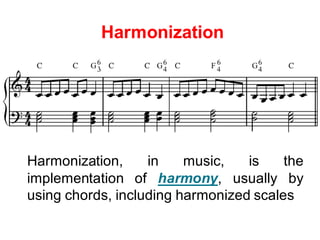
Harmonization, in music, is the
implementation of harmony, usually by
using chords, including harmonized scales
Harmonization
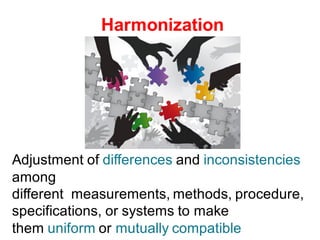
Adjustment of differences and inconsistencies
among
different measurements, methods, procedure,
specifications, or systems to make
them uniform or mutually compatible
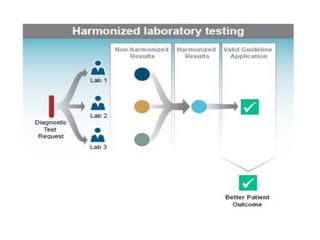
Clinical laboratory tests performed
by different laboratories have
comparable results
Unfortunately, some guidelines base decisions
on test results from a specific laboratory
measurement procedure without considering
the possibility or likelihood of differences
between various procedures. When this
happens, aggregation of data from different
clinical research investigations will be flawed,
and erroneous decisions will be made
regarding a specific patient's care
The electronic record enables clinicians to
easily compare and evaluate test results over
time. However, the patient’s laboratory results
may be from multiple testing facilities that use
different measurement procedures.
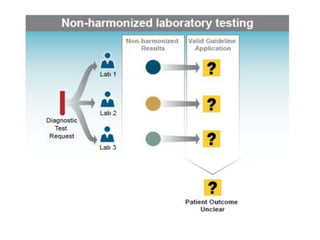
Comparing laboratory results from different
non-harmonized measurement procedures
may be confusing, which may contribute to
medical errors and unnecessary ordering of
repeat tests
Harmonization of Measurements
Any process that enables the establishment
of equivalence of reported values produced
by different measurement procedures for the
same measurand, (i.e. the quantity
intended to be measured)
Harmonization is achieved via:
1) Method #1 = Standardization:
The conventional approach which depends
on the application of a well-understood
reference measurement procedure (RMP)
and commutable reference materials to
establish the calibration for each available
routine measurement procedure.
The core component of standardization is
the “establishment of metrological
traceability” which requires the availability of
an ISO conform reference measurement
system (RMS)
Components of ISO conform RMS:
ØDefined measurand,
ØUnits for expression of measurement
results (ideally the Système International
d’Unités or SI),
ØDifferent hierarchical levels of materials
and measurement procedures.
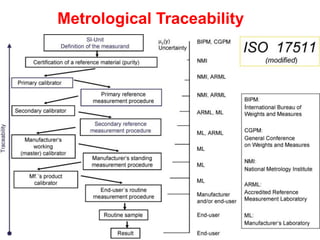
Metrological Traceability
Accordingly, the provided lab results in the
lower part of the hierarchy (routine IVD
methods), will provide measurements
traceable to the top of the hierarchy, within
stated uncertainty constraints.
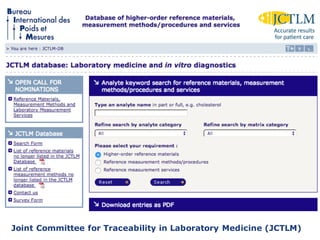
Joint Committee for Traceability in Laboratory Medicine (JCTLM)
Harmonization is achieved via:
2) Method #2:
Considered only when RMPs are not
available and is based on application of
sound statistical methodology to produce
arbitrary equivalence of otherwise disparate
results generated by the various non-
standardized routine measurement
procedures (i.e: surrogate RMPs)
Key Stakeholders
ØClinical laboratory community,
ØDiagnostic industry,
ØClinicians,
ØProfessional societies,
ØInformation technology providers,
ØRegulatory and governmental bodies
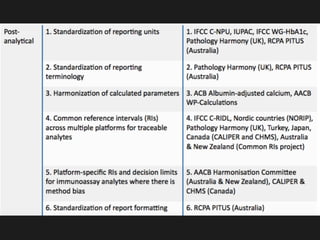
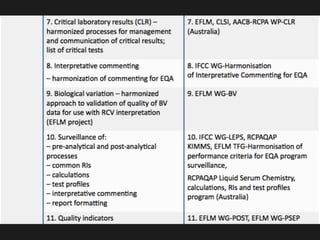
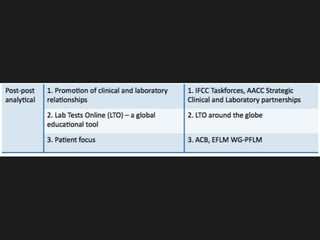
What is the status of harmonization
activities globally?
The Working Group on the Harmonization of
the Total Testing Process (WG-H) was
formed aiming at coordinating and
disseminating promising harmonization
initiatives among the EFLM member
societies, and specifically to harmonize
nomenclature, units and reference intervals
where possible at a European level.
A Global Effort to Improve Patient Care
• In October 2010 the AACC convened an
international leadership conference to
address how to improve harmonization of
laboratory test results for which there are no
higher-order reference measurement
procedures
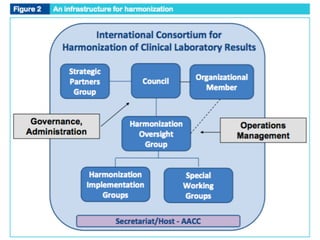
• The conference proposed a roadmap and an
infrastructure to coordinate harmonization
activities worldwide
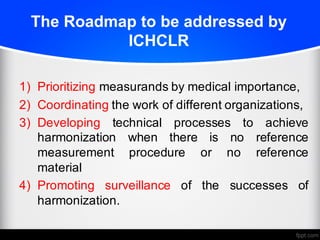
The Roadmap to be addressed by
ICHCLR
1) Prioritizing measurands by medical importance,
2) Coordinating the work of different organizations,
3) Developing technical processes to achieve
harmonization when there is no reference
measurement procedure or no reference
material
4) Promoting surveillance of the successes of
harmonization.
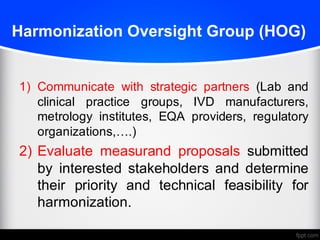
Harmonization Oversight Group (HOG)
1) Communicate with strategic partners (Lab and
clinical practice groups, IVD manufacturers,
metrology institutes, EQA providers, regulatory
organizations,….)
2) Evaluate measurand proposals submitted
by interested stakeholders and determine
their priority and technical feasibility for
harmonization.
Factors affecting Harmonization
A) Factors related to properties of the
measurement procedures
B) Factors related to harmonization tools.
A) Factors related to properties of the
measurement procedures
1. Reproducibility within one
measurement procedure:
Variability of results within one measurement
procedure can derive from within laboratory
imprecision, batch to batch variability of reagents or
calibrators, lack of robustness resulting in between
laboratory, between instrument, between operator
and between environmental conditions differences.
A) Factors related to properties of the
measurement procedures
2. Linearity of methods
In ideal measurement procedures, there is a
linear relation between the measured quantity
and the concentration of the measurand. A
non-linear relationship will have an impact on
equivalence of results of different
measurement procedures.
A) Factors related to properties of the
measurement procedures
3. Heterogeneity
For many analytes, the measurand is
heterogeneous (e.g. different epitopes in
immunoassays) and in many measurement
procedures the reagent is heterogeneous
(e.g. reacts with different epitopes in
immunoassays). This heterogeneity in both
measurand and reagent should be taken into
account.
A) Factors related to properties of the
measurement procedures
4. Calibration
Variability in results of a laboratory
measurement procedure can derive from
differences in calibration among different
procedures. Such differences are typically
reflected by simple relations like
Y = aX or Y = aX + b.

Now, assess the possibility of
harmonization!!
The assessment should clarify the contribution of
each of these parameters to the variability. If the
major source of variability is calibration,
harmonization can be achieved right away (using a
simple factor). If the major source is a non-linear
relationship, harmonization - although less simple -
can be achieved with appropriate statistical
methods to manage non-linear relationship factors.
Now, assess the possibility of
harmonization!!
If either reproducibility or heterogeneity is the
major source of variability for one or more
measurement procedures, harmonization is
likely not possible until the affected
measurement procedures are changed.
B) Factors related to Harmonization
Tools
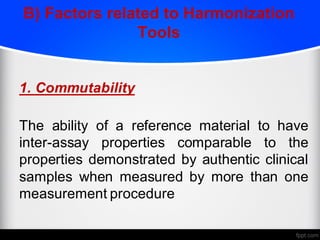
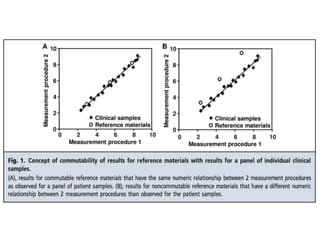
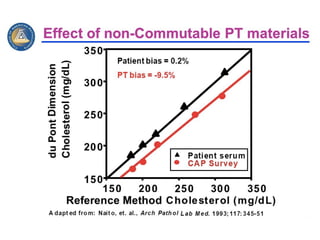
1. Commutability
The ability of a reference material to have
inter-assay properties comparable to the
properties demonstrated by authentic clinical
samples when measured by more than one
measurement procedure
B) Factors related to Harmonization
Tools
2. Stability
It must be possible to store the calibrator for a
long time.
B) Factors related to Harmonization
Tools
3. Sustainability
Once a batch of calibrator is finished, the next
batch should have the same properties to
maintain the continuity of harmonization.
B) Factors related to Harmonization
Tools
4. Value Assignment
There must be a sustainable and generally
accepted way to assign a target value to the
calibrator.
B) Factors related to Harmonization
Tools
5. Cost and Availability
Where are we now?
Few measurands were successfully
harmonized:
HbA1c
Cholesterol
Glucose
Harmonization of Laboratory Testing, 08 04-2017

Harmonization of Laboratory Testing, 08 04-2017

  • 1.
    Harmonization of Laboratory Testing Ola H.Elgaddar MD, PhD, MBA, CPHQ Lecturer of Chemical Pathology Medical Research Institute Alexandria University Ola.elgaddar@alexu.edu.eg
  • 2.
    Harmonization Harmonization, in music,is the implementation of harmony, usually by using chords, including harmonized scales
  • 3.
    Harmonization Adjustment of differencesand inconsistencies among different measurements, methods, procedure, specifications, or systems to make them uniform or mutually compatible
  • 4.
    Clinical laboratory testsperformed by different laboratories have comparable results
  • 7.
    Unfortunately, some guidelinesbase decisions on test results from a specific laboratory measurement procedure without considering the possibility or likelihood of differences between various procedures. When this happens, aggregation of data from different clinical research investigations will be flawed, and erroneous decisions will be made regarding a specific patient's care
  • 8.
    The electronic recordenables clinicians to easily compare and evaluate test results over time. However, the patient’s laboratory results may be from multiple testing facilities that use different measurement procedures. Comparing laboratory results from different non-harmonized measurement procedures may be confusing, which may contribute to medical errors and unnecessary ordering of repeat tests
  • 9.
    Harmonization of Measurements Anyprocess that enables the establishment of equivalence of reported values produced by different measurement procedures for the same measurand, (i.e. the quantity intended to be measured)
  • 10.
    Harmonization is achievedvia: 1) Method #1 = Standardization: The conventional approach which depends on the application of a well-understood reference measurement procedure (RMP) and commutable reference materials to establish the calibration for each available routine measurement procedure.
  • 11.
    The core componentof standardization is the “establishment of metrological traceability” which requires the availability of an ISO conform reference measurement system (RMS)
  • 12.
    Components of ISOconform RMS: ØDefined measurand, ØUnits for expression of measurement results (ideally the Système International d’Unités or SI), ØDifferent hierarchical levels of materials and measurement procedures.
  • 13.
  • 14.
    Accordingly, the providedlab results in the lower part of the hierarchy (routine IVD methods), will provide measurements traceable to the top of the hierarchy, within stated uncertainty constraints.
  • 15.
    Joint Committee forTraceability in Laboratory Medicine (JCTLM)
  • 16.
    Harmonization is achievedvia: 2) Method #2: Considered only when RMPs are not available and is based on application of sound statistical methodology to produce arbitrary equivalence of otherwise disparate results generated by the various non- standardized routine measurement procedures (i.e: surrogate RMPs)
  • 17.
    Key Stakeholders ØClinical laboratorycommunity, ØDiagnostic industry, ØClinicians, ØProfessional societies, ØInformation technology providers, ØRegulatory and governmental bodies
  • 18.
    What is thestatus of harmonization activities globally? The Working Group on the Harmonization of the Total Testing Process (WG-H) was formed aiming at coordinating and disseminating promising harmonization initiatives among the EFLM member societies, and specifically to harmonize nomenclature, units and reference intervals where possible at a European level.
  • 24.
    A Global Effortto Improve Patient Care • In October 2010 the AACC convened an international leadership conference to address how to improve harmonization of laboratory test results for which there are no higher-order reference measurement procedures • The conference proposed a roadmap and an infrastructure to coordinate harmonization activities worldwide
  • 26.
    The Roadmap tobe addressed by ICHCLR 1) Prioritizing measurands by medical importance, 2) Coordinating the work of different organizations, 3) Developing technical processes to achieve harmonization when there is no reference measurement procedure or no reference material 4) Promoting surveillance of the successes of harmonization.
  • 27.
    Harmonization Oversight Group(HOG) 1) Communicate with strategic partners (Lab and clinical practice groups, IVD manufacturers, metrology institutes, EQA providers, regulatory organizations,….) 2) Evaluate measurand proposals submitted by interested stakeholders and determine their priority and technical feasibility for harmonization.
  • 29.
    Factors affecting Harmonization A)Factors related to properties of the measurement procedures B) Factors related to harmonization tools.
  • 30.
    A) Factors relatedto properties of the measurement procedures 1. Reproducibility within one measurement procedure: Variability of results within one measurement procedure can derive from within laboratory imprecision, batch to batch variability of reagents or calibrators, lack of robustness resulting in between laboratory, between instrument, between operator and between environmental conditions differences.
  • 31.
    A) Factors relatedto properties of the measurement procedures 2. Linearity of methods In ideal measurement procedures, there is a linear relation between the measured quantity and the concentration of the measurand. A non-linear relationship will have an impact on equivalence of results of different measurement procedures.
  • 32.
    A) Factors relatedto properties of the measurement procedures 3. Heterogeneity For many analytes, the measurand is heterogeneous (e.g. different epitopes in immunoassays) and in many measurement procedures the reagent is heterogeneous (e.g. reacts with different epitopes in immunoassays). This heterogeneity in both measurand and reagent should be taken into account.
  • 33.
    A) Factors relatedto properties of the measurement procedures 4. Calibration Variability in results of a laboratory measurement procedure can derive from differences in calibration among different procedures. Such differences are typically reflected by simple relations like Y = aX or Y = aX + b.
  • 34.
    Now, assess thepossibility of harmonization!! The assessment should clarify the contribution of each of these parameters to the variability. If the major source of variability is calibration, harmonization can be achieved right away (using a simple factor). If the major source is a non-linear relationship, harmonization - although less simple - can be achieved with appropriate statistical methods to manage non-linear relationship factors.
  • 35.
    Now, assess thepossibility of harmonization!! If either reproducibility or heterogeneity is the major source of variability for one or more measurement procedures, harmonization is likely not possible until the affected measurement procedures are changed.
  • 36.
    B) Factors relatedto Harmonization Tools 1. Commutability The ability of a reference material to have inter-assay properties comparable to the properties demonstrated by authentic clinical samples when measured by more than one measurement procedure
  • 41.
    B) Factors relatedto Harmonization Tools 2. Stability It must be possible to store the calibrator for a long time.
  • 42.
    B) Factors relatedto Harmonization Tools 3. Sustainability Once a batch of calibrator is finished, the next batch should have the same properties to maintain the continuity of harmonization.
  • 43.
    B) Factors relatedto Harmonization Tools 4. Value Assignment There must be a sustainable and generally accepted way to assign a target value to the calibrator.
  • 44.
    B) Factors relatedto Harmonization Tools 5. Cost and Availability
  • 45.
    Where are wenow? Few measurands were successfully harmonized: HbA1c Cholesterol Glucose