Poetry Terms and
Techniques
Ms. Aixa Rodriguez
Belmont Preparatory High School
ESL/ELA
So.. you think you knowSo.. you think you know
All about poetry?All about poetry?
Let’s see!Let’s see!
Yes, you must take notes!Yes, you must take notes!
I am not kidding!I am not kidding!
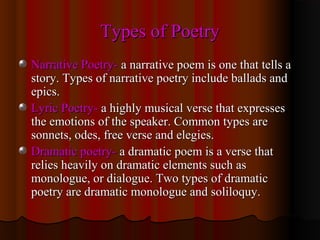
Types of PoetryTypes of Poetry
Narrative Poetry-Narrative Poetry- a narrative poem is one that tells aa narrative poem is one that tells a
story. Types of narrative poetry include ballads andstory. Types of narrative poetry include ballads and
epics.epics.
Lyric Poetry-Lyric Poetry- a highly musical verse that expressesa highly musical verse that expresses
the emotions of the speaker. Common types arethe emotions of the speaker. Common types are
sonnets, odes, free verse and elegies.sonnets, odes, free verse and elegies.
Dramatic poetry-Dramatic poetry- a dramatic poem is a verse thata dramatic poem is a verse that
relies heavily on dramatic elements such asrelies heavily on dramatic elements such as
monologue, or dialogue. Two types of dramaticmonologue, or dialogue. Two types of dramatic
poetry are dramatic monologue and soliloquy.poetry are dramatic monologue and soliloquy.
What’s a Ballad?
Come on… I know you can
guess…
Ballad: a narrative poem, sometimes
sung, that tells a dramatic story.
What about….
An acrostic poem?
What’s that?
Acrostic poem: The first letters of the lines in an
spell a word, often the subject of the poem.
Another very incredibly
Intelligent and intuitive
Xena type warrior princess teacher with
An attitude.
Domo arigato
gozaimashita
Ok hotshots!
What’s an epic poem?
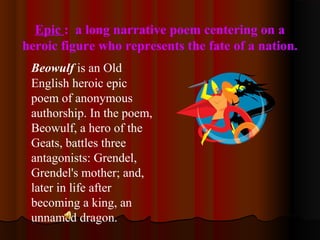
Epic : a long narrative poem centering on a
heroic figure who represents the fate of a nation.
Beowulf is an Old
English heroic epic
poem of anonymous
authorship. In the poem,
Beowulf, a hero of the
Geats, battles three
antagonists: Grendel,
Grendel's mother; and,
later in life after
becoming a king, an
unnamed dragon.
Ah…Obi-wan has taught you well.
The force is with you young Skywalker,
but you are not a Jedi yet.
- Darth Vader
Define concrete poem.
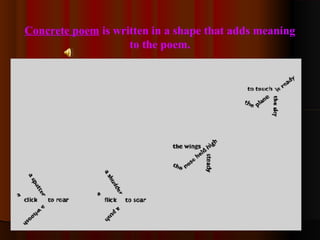
Concrete poem is written in a shape that adds meaning
to the poem.
A little too easy…- Darth Vader
Define free verse..
Free verse : poetry with no set
rhythm or rhyme.
Ha! Impressive… most impressive..-
Darth Vader
A challenge you say!
Here you are! Define blank verse!
Blank verse: unrhymed
iambic pentameter.
A bit of tutoring you need hmmm..- Yoda
And if a person is to become one with the
force….what type of poem shall we write for
them hmmmm?
Elegy or Elegiac poem: a meditative poem
mourning the death of an individual.
What’s a …
Dramatic Monologue?Dramatic Monologue?
SoliloquySoliloquy
Dramatic monologue: a poem in which a
character addresses an audience.
A fictional character, at a critical or dramaticA fictional character, at a critical or dramatic
point in life, addresses a particular “audience”,point in life, addresses a particular “audience”,
which his identifiable but silent. In the coursewhich his identifiable but silent. In the course
of the monologue, we learn a great deal, oftenof the monologue, we learn a great deal, often
ironically, about the character who is speakingironically, about the character who is speaking
and the circumstance that have led to theand the circumstance that have led to the
speech.speech.
SoliloquySoliloquy
A form of monologue found most often inA form of monologue found most often in
drama. It differs from a dramatic monologue indrama. It differs from a dramatic monologue in
that the speaker is alone, revealing thoughtsthat the speaker is alone, revealing thoughts
and feelings to or for oneself that areand feelings to or for oneself that are
intentionally unheard by other characters inintentionally unheard by other characters in
Shakespeare’s plays for example the principalShakespeare’s plays for example the principal
characters’ reflections on how to act orcharacters’ reflections on how to act or
questions of conscience are revealed in theirquestions of conscience are revealed in their
soliloquies. “To be or not to be…”soliloquies. “To be or not to be…”
(Shakespeare’s(Shakespeare’s HamletHamlet))
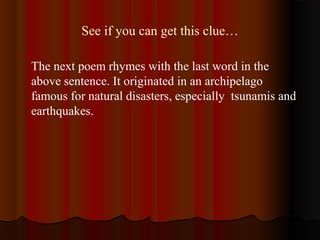
See if you can get this clue…
The next poem rhymes with the last word in the
above sentence. It originated in an archipelago
famous for natural disasters, especially tsunamis and
earthquakes.
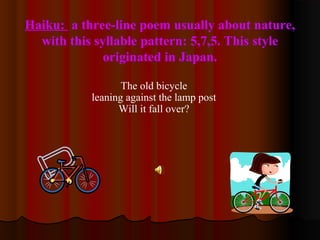
Haiku: a three-line poem usually about nature,
with this syllable pattern: 5,7,5. This style
originated in Japan.
The old bicycle
leaning against the lamp post
Will it fall over?
Alright poetic geniuses…
What is another poemWhat is another poem
similar to haiku butsimilar to haiku but
longer?longer?
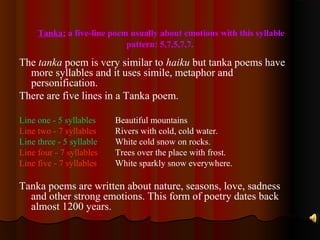
Tanka: a five-line poem usually about emotions with this syllable
pattern: 5,7,5,7,7.
The tanka poem is very similar to haiku but tanka poems have
more syllables and it uses simile, metaphor and
personification.
There are five lines in a Tanka poem.
Line one - 5 syllables Beautiful mountains
Line two - 7 syllables Rivers with cold, cold water.
Line three - 5 syllable White cold snow on rocks.
Line four - 7 syllables Trees over the place with frost.
Line five - 7 syllables White sparkly snow everywhere.
Tanka poems are written about nature, seasons, love, sadness
and other strong emotions. This form of poetry dates back
almost 1200 years.
Ok champs.. Lets see you get this one…
???:???: a meditation or celebration of a specific subject.
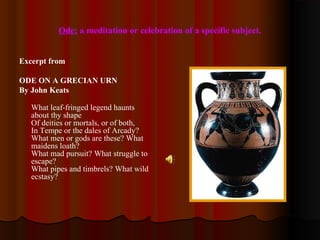
Ode: a meditation or celebration of a specific subject.
Excerpt from
ODE ON A GRECIAN URN
By John Keats
What leaf-fringed legend haunts
about thy shape
Of deities or mortals, or of both,
In Tempe or the dales of Arcady?
What men or gods are these? What
maidens loath?
What mad pursuit? What struggle to
escape?
What pipes and timbrels? What wild
ecstasy?
Let’s see if you get this one….
___________ :___________ : a
poem of fourteen lines in
iambic pentameter.
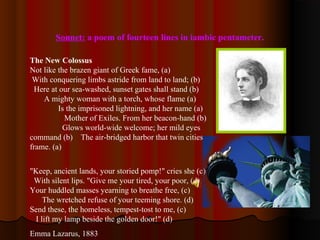
Sonnet: a poem of fourteen lines in iambic pentameter.
The New Colossus
Not like the brazen giant of Greek fame, (a)
With conquering limbs astride from land to land; (b)
Here at our sea-washed, sunset gates shall stand (b)
A mighty woman with a torch, whose flame (a)
Is the imprisoned lightning, and her name (a)
Mother of Exiles. From her beacon-hand (b)
Glows world-wide welcome; her mild eyes
command (b) The air-bridged harbor that twin cities
frame. (a)
"Keep, ancient lands, your storied pomp!" cries she (c)
With silent lips. "Give me your tired, your poor, (d)
Your huddled masses yearning to breathe free, (c)
The wretched refuse of your teeming shore. (d)
Send these, the homeless, tempest-tost to me, (c)
I lift my lamp beside the golden door!" (d)
Emma Lazarus, 1883
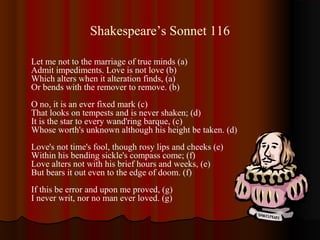
Shakespeare’s Sonnet 116
Let me not to the marriage of true minds (a)
Admit impediments. Love is not love (b)
Which alters when it alteration finds, (a)
Or bends with the remover to remove. (b)
O no, it is an ever fixed mark (c)
That looks on tempests and is never shaken; (d)
It is the star to every wand'ring barque, (c)
Whose worth's unknown although his height be taken. (d)
Love's not time's fool, though rosy lips and cheeks (e)
Within his bending sickle's compass come; (f)
Love alters not with his brief hours and weeks, (e)
But bears it out even to the edge of doom. (f)
If this be error and upon me proved, (g)
I never writ, nor no man ever loved. (g)
A quick quiz: Do you know…
 Stanza_________________
 Rhyme ________________
 Rhyme scheme ______________
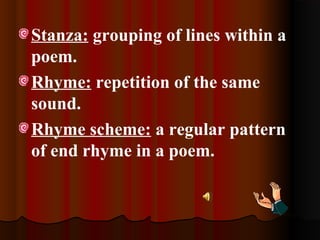
Stanza: grouping of lines within a
poem.
Rhyme: repetition of the same
sound.
Rhyme scheme: a regular pattern
of end rhyme in a poem.
Ok, so lets now go over commonOk, so lets now go over common
FORMS OF STANZA!FORMS OF STANZA!
What’s a couplet?
What’s a couplet?
Je
nais
se
pas!
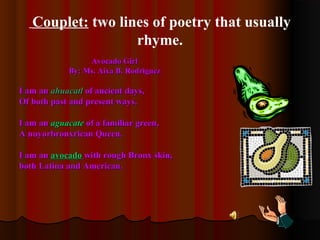
Couplet: two lines of poetry that usually
rhyme.
Avocado GirlAvocado Girl
By: Ms. Aixa B. RodriguezBy: Ms. Aixa B. Rodriguez
I am anI am an ahuacatlahuacatl of ancient days,of ancient days,
Of both past and present ways.Of both past and present ways.
I am anI am an aguacateaguacate of a familiar green,of a familiar green,
A nuyorbronxrican Queen.A nuyorbronxrican Queen.
I am anI am an avocadoavocado with rough Bronx skin,with rough Bronx skin,
both Latina and American.both Latina and American.
Not bad.. Not bad..
How about a tercet? Or triplet?
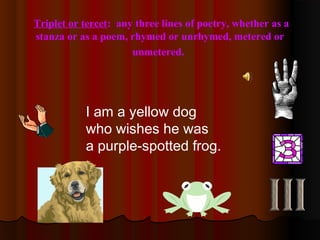
Triplet or tercet: any three lines of poetry, whether as a
stanza or as a poem, rhymed or unrhymed, metered or
unmetered.
I am a yellow dog
who wishes he was
a purple-spotted frog.
You are getting it!
And now.. a quatrain?
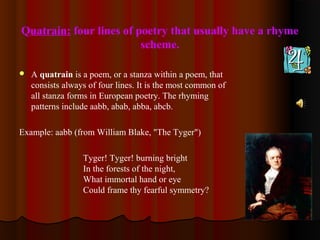
Quatrain: four lines of poetry that usually have a rhyme
scheme.
 A quatrain is a poem, or a stanza within a poem, that
consists always of four lines. It is the most common of
all stanza forms in European poetry. The rhyming
patterns include aabb, abab, abba, abcb.
Example: aabb (from William Blake, "The Tyger")
Tyger! Tyger! burning bright
In the forests of the night,
What immortal hand or eye
Could frame thy fearful symmetry?
A cinquain? A quintain? It’s
driving me insane!
You can do it!
USE THE FORCE!
Cinquain: a five-line poem
In summertime on BredonIn summertime on Bredon
The bells they sound so clear;The bells they sound so clear;
Round both the shires they ring themRound both the shires they ring them
In steeples far and near,In steeples far and near,
A happy noise to hear.A happy noise to hear.
-A.E. Houseman, “Bredon Hill”-A.E. Houseman, “Bredon Hill”
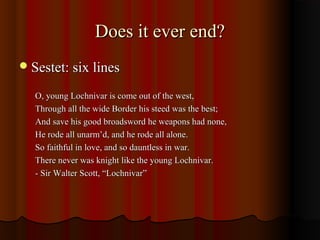
Does it ever end?Does it ever end?
Sestet: six linesSestet: six lines
O, young Lochnivar is come out of the west,O, young Lochnivar is come out of the west,
Through all the wide Border his steed was the best;Through all the wide Border his steed was the best;
And save his good broadsword he weapons had none,And save his good broadsword he weapons had none,
He rode all unarm’d, and he rode all alone.He rode all unarm’d, and he rode all alone.
So faithful in love, and so dauntless in war.So faithful in love, and so dauntless in war.
There never was knight like the young Lochnivar.There never was knight like the young Lochnivar.
- Sir Walter Scott, “Lochnivar”- Sir Walter Scott, “Lochnivar”
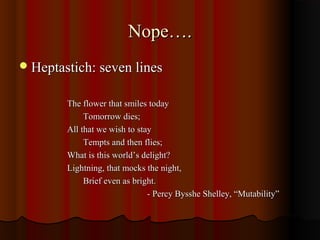
Nope….Nope….
Heptastich: seven linesHeptastich: seven lines
The flower that smiles todayThe flower that smiles today
Tomorrow dies;Tomorrow dies;
All that we wish to stayAll that we wish to stay
Tempts and then flies;Tempts and then flies;
What is this world’s delight?What is this world’s delight?
Lightning, that mocks the night,Lightning, that mocks the night,
Brief even as bright.Brief even as bright.
- Percy Bysshe Shelley, “Mutability”- Percy Bysshe Shelley, “Mutability”
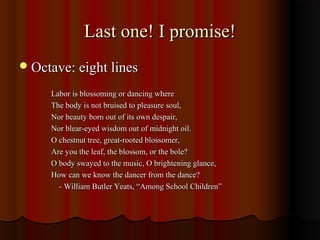
Last one! I promise!Last one! I promise!
Octave: eight linesOctave: eight lines
Labor is blossoming or dancing whereLabor is blossoming or dancing where
The body is not bruised to pleasure soul,The body is not bruised to pleasure soul,
Nor beauty born out of its own despair,Nor beauty born out of its own despair,
Nor blear-eyed wisdom out of midnight oil.Nor blear-eyed wisdom out of midnight oil.
O chestnut tree, great-rooted blossomer,O chestnut tree, great-rooted blossomer,
Are you the leaf, the blossom, or the bole?Are you the leaf, the blossom, or the bole?
O body swayed to the music, O brightening glance,O body swayed to the music, O brightening glance,
How can we know the dancer from the dance?How can we know the dancer from the dance?
- William Butler Yeats, “Among School Children”- William Butler Yeats, “Among School Children”
Quick quizQuick quiz
Sestet: _________________________Sestet: _________________________
Heptastich: ______________________Heptastich: ______________________
Octave: _________________________Octave: _________________________
Ok.. now Rhythm and Rhyme!Ok.. now Rhythm and Rhyme!
Techniques of Poetry: SoundTechniques of Poetry: Sound
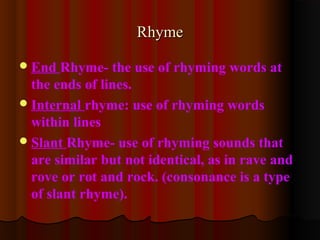
End Rhyme- the use of rhyming words at
the ends of lines.
Internal rhyme: use of rhyming words
within lines
Slant Rhyme- use of rhyming sounds that
are similar but not identical, as in rave and
rove or rot and rock. (consonance is a type
of slant rhyme).
RhymeRhyme
Ok, ok… how about
Alliteration and consonance?
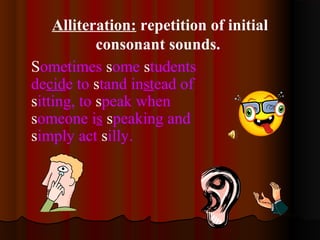
Alliteration: repetition of initial
consonant sounds.
Sometimes some students
decide to stand instead of
sitting, to speak when
someone is speaking and
simply act silly.
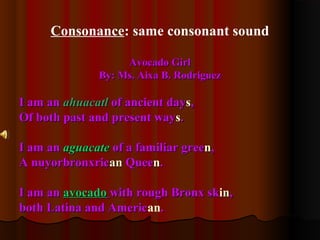
Consonance: same consonant sound
Avocado GirlAvocado Girl
By: Ms. Aixa B. RodriguezBy: Ms. Aixa B. Rodriguez
I am anI am an ahuacatlahuacatl of ancient dayof ancient dayss,,
Of both past and present wayOf both past and present wayss..
I am anI am an aguacateaguacate of a familiar greeof a familiar greenn,,
A nuyorbronxricA nuyorbronxricanan QueeQueenn..
I am anI am an avocadoavocado with rough Bronx skwith rough Bronx skinin,,
both Latina and Americboth Latina and American..
Ok keep it clean…
What is assonance?
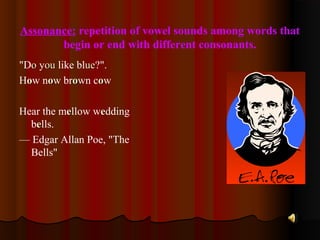
Assonance: repetition of vowel sounds among words that
begin or end with different consonants.
"Doo youou like blueue?".
Hoow noow broown coow
Hear the meellow weedding
beells.
— Edgar Allan Poe, "The
Bells"
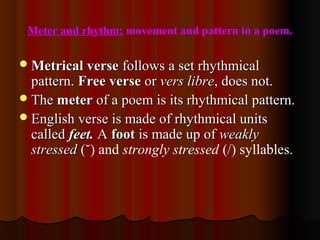
Meter and rhythm: movement and pattern in a poem.
Metrical verseMetrical verse follows a set rhythmicalfollows a set rhythmical
pattern.pattern. Free verseFree verse oror vers librevers libre, does not., does not.
TheThe metermeter of a poem is its rhythmical pattern.of a poem is its rhythmical pattern.
English verse is made of rhythmical unitsEnglish verse is made of rhythmical units
calledcalled feet.feet. AA footfoot is made up ofis made up of weaklyweakly
stressedstressed ((˘) and strongly stressed (/) syllables.
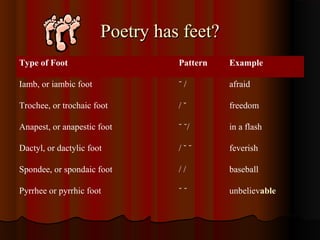
Poetry has feet?Poetry has feet?
Type of Foot Pattern Example
Iamb, or iambic foot ˘ / afraid
Trochee, or trochaic foot / ˘ freedom
Anapest, or anapestic foot ˘ ˘/ in a flash
Dactyl, or dactylic foot / ˘ ˘ feverish
Spondee, or spondaic foot / / baseball
Pyrrhee or pyrrhic foot ˘ ˘ unbelievable
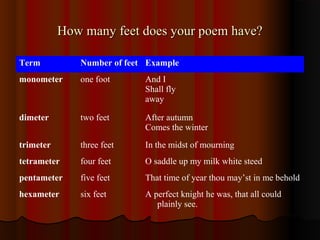
How many feet does your poem have?How many feet does your poem have?
Term Number of feet Example
monometer one foot And I
Shall fly
away
dimeter two feet After autumn
Comes the winter
trimeter three feet In the midst of mourning
tetrameter four feet O saddle up my milk white steed
pentameter five feet That time of year thou may’st in me behold
hexameter six feet A perfect knight he was, that all could
plainly see.
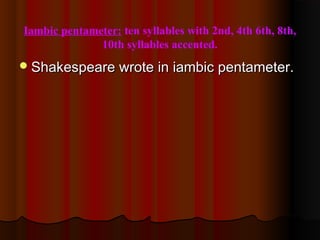
Iambic pentameter: ten syllables with 2nd, 4th 6th, 8th,
10th syllables accented.
Shakespeare wrote in iambic pentameter.Shakespeare wrote in iambic pentameter.
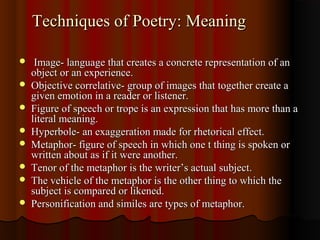
Techniques of Poetry: MeaningTechniques of Poetry: Meaning
 Image- language that creates a concrete representation of anImage- language that creates a concrete representation of an
object or an experience.object or an experience.
 Objective correlative- group of images that together create aObjective correlative- group of images that together create a
given emotion in a reader or listener.given emotion in a reader or listener.
 Figure of speech or trope is an expression that has more than aFigure of speech or trope is an expression that has more than a
literal meaning.literal meaning.
 Hyperbole- an exaggeration made for rhetorical effect.Hyperbole- an exaggeration made for rhetorical effect.
 Metaphor- figure of speech in which one t thing is spoken orMetaphor- figure of speech in which one t thing is spoken or
written about as if it were another.written about as if it were another.
 Tenor of the metaphor is the writer’s actual subject.Tenor of the metaphor is the writer’s actual subject.
 The vehicle of the metaphor is the other thing to which theThe vehicle of the metaphor is the other thing to which the
subject is compared or likened.subject is compared or likened.
 Personification and similes are types of metaphor.Personification and similes are types of metaphor.
Techniques of Poetry: Meaning cont’dTechniques of Poetry: Meaning cont’d
 Metonymy- the naming of an object associated with aMetonymy- the naming of an object associated with a
thing instead of the name of the thing itself. Ex: Thething instead of the name of the thing itself. Ex: The
White House for the President, or The Crown for theWhite House for the President, or The Crown for the
King.King.
 Simile- a comparison using like or as.Simile- a comparison using like or as.
 Synaesthesia- a figure of speech that combines in aSynaesthesia- a figure of speech that combines in a
single expression images related to two or moresingle expression images related to two or more
different senses. Ex. Singing light.different senses. Ex. Singing light.
 Synecdoche- a figure of speech in which the name ofSynecdoche- a figure of speech in which the name of
a part of something is used in place of the name of thea part of something is used in place of the name of the
whole or vice versa. Ex. Hired hands = laborerswhole or vice versa. Ex. Hired hands = laborers
Rhetorical techniquesRhetorical techniques
 Rhetorical techniques are extraordinary but literal use of language to achieve aRhetorical techniques are extraordinary but literal use of language to achieve a
particular effect.particular effect.
 Antithesis- a rhetorical technique in which words, phrases or ideas are stronglyAntithesis- a rhetorical technique in which words, phrases or ideas are strongly
contrasted often by repeating a grammatical structure. Ex; to err is human, tocontrasted often by repeating a grammatical structure. Ex; to err is human, to
forgive divine.”forgive divine.”
 Apostrophe- rhetorical technique in which an object or person is directly addressed.Apostrophe- rhetorical technique in which an object or person is directly addressed.
 Catalog- a list of people or thingsCatalog- a list of people or things
 Chiasmus- a rhetorical technique in which the order of occurrence of words orChiasmus- a rhetorical technique in which the order of occurrence of words or
phrases is reversed. Ex.: we can weather changes but we can’t change the weather.phrases is reversed. Ex.: we can weather changes but we can’t change the weather.
 Parallelism- a rhetorical technique in which a writer emphasizes the equal value orParallelism- a rhetorical technique in which a writer emphasizes the equal value or
weight of two or more ideas by expressing them in the same grammatical form, asweight of two or more ideas by expressing them in the same grammatical form, as
in the phrase “with hope, with joy, and with love.”in the phrase “with hope, with joy, and with love.”
 Repetition- writers conscious reuse of a sound, a word, phrase sentence or otherRepetition- writers conscious reuse of a sound, a word, phrase sentence or other
element.element.
 Rhetorical question: a question asked for effect but not meant to be answeredRhetorical question: a question asked for effect but not meant to be answered
because the answer is clear from the context.because the answer is clear from the context.
Structure and Language in PoetryStructure and Language in Poetry
Allegory- a narrative in prose or verse, inAllegory- a narrative in prose or verse, in
which abstract ideas, principles human valueswhich abstract ideas, principles human values
or states d of mind are personified. Theor states d of mind are personified. The
purpose of the allegory is to illustrate thepurpose of the allegory is to illustrate the
significance of the ideas by dramatizing them.significance of the ideas by dramatizing them.
Parable and fable are kinds of allegory inParable and fable are kinds of allegory in
which a moral I illustrated in the form of awhich a moral I illustrated in the form of a
story.story.
AllusionAllusion
 A reference to a historical event, to Biblical,A reference to a historical event, to Biblical,
mythological or literary characters and incidents withmythological or literary characters and incidents with
which the reader is assumed to be familiar. Allusionwhich the reader is assumed to be familiar. Allusion
may , with few words, enrich or extend the meaningmay , with few words, enrich or extend the meaning
of a phrase or idea or image, Allusion may also beof a phrase or idea or image, Allusion may also be
used for ironic effect. In his poem Out Rober frostused for ironic effect. In his poem Out Rober frost
expects the reader to recall from Macbeth’s finalexpects the reader to recall from Macbeth’s final
soliloquy the line “Out out brief candle “ Suchsoliloquy the line “Out out brief candle “ Such
expressions as “ a Herculean task” or “Achilles heel”expressions as “ a Herculean task” or “Achilles heel”
are also forms of allusion.are also forms of allusion.
AmbiguityAmbiguity
Denotes uncertainty of meaning. In literatureDenotes uncertainty of meaning. In literature
and especially poetry, we speak of intentionaland especially poetry, we speak of intentional
ambiguity, the use of language and images toambiguity, the use of language and images to
suggest more than one meaning at the samesuggest more than one meaning at the same
time.time.
ConnotationConnotation
The feelings attitudes images and associationsThe feelings attitudes images and associations
of a word or expression. Connotations areof a word or expression. Connotations are
usually said to be “positive’ or “negative”usually said to be “positive’ or “negative”
DenotationDenotation
That which a word actually names, identifies,That which a word actually names, identifies,
or “points to” Denotation is sometimesor “points to” Denotation is sometimes
referred to as “the dictionary definition” of areferred to as “the dictionary definition” of a
work.work.
Figurative LanguageFigurative Language
The intentional and imaginative use of wordsThe intentional and imaginative use of words
and comparisons that are not literal but thatand comparisons that are not literal but that
create original, vivid, and often unexpectedcreate original, vivid, and often unexpected
images and associations .images and associations .
HyperboleHyperbole
An exaggerated expression also calledAn exaggerated expression also called
overstatement, for a particular effect, whichoverstatement, for a particular effect, which
may be humorous, satirical, or intenselymay be humorous, satirical, or intensely
emotional. Hyperbole is the expression ofemotional. Hyperbole is the expression of
folktales and legends.folktales and legends.
Ex. I have mountains of work to do.Ex. I have mountains of work to do.
IronyIrony
In general a tone or figure of speech in whichIn general a tone or figure of speech in which
there is a discrepancy a striking difference orthere is a discrepancy a striking difference or
contradiction between what is expressed andcontradiction between what is expressed and
what is meant or expected. Irony maybe usedwhat is meant or expected. Irony maybe used
to achieve a powerful effect indir4ectly. Into achieve a powerful effect indir4ectly. In
satire, for example it may be used to ridiculesatire, for example it may be used to ridicule
or criticize.or criticize.
MetaphorMetaphor
Form of analogy or comparison where theForm of analogy or comparison where the
author finds and expresses similarity betweenauthor finds and expresses similarity between
dissimilar things.dissimilar things.
OnomatopoeiaOnomatopoeia
The use of words or phrases that sound like theThe use of words or phrases that sound like the
things to which they refer. Examples includethings to which they refer. Examples include
the words meow, clink, boom, and mumble.the words meow, clink, boom, and mumble.
OxymoronOxymoron
Related to paradox, oxymoron is a figure ofRelated to paradox, oxymoron is a figure of
speech in which two contradictory or sharplyspeech in which two contradictory or sharply
contrasting terms are paired fro emphasis orcontrasting terms are paired fro emphasis or
ironic effect. Students favorite examplesironic effect. Students favorite examples
include “jumbo shrimp” and “armyinclude “jumbo shrimp” and “army
Intelligence.” Poets have written of the “wiseIntelligence.” Poets have written of the “wise
fool” “ Joyful sadness” or and “eloquentfool” “ Joyful sadness” or and “eloquent
silence.”silence.”
ParadoxParadox
An expression concept of situation whoseAn expression concept of situation whose
literal statement is contradictory , yet whichliteral statement is contradictory , yet which
makes a truthful and meaningful observation.makes a truthful and meaningful observation.
“ Less is more”“ Less is more”
SatireSatire
A form or style that uses elements of irony,A form or style that uses elements of irony,
ridicule, exaggeration , understatement,ridicule, exaggeration , understatement,
sarcasm, humor or absurdity to criticize humansarcasm, humor or absurdity to criticize human
behavior or a society.behavior or a society.
SimileSimile
An expression that is a direct comparison ofAn expression that is a direct comparison of
two things using words as like a s as if seemstwo things using words as like a s as if seems
and appears.and appears.
““ I wandered lonely as a cloud” (WilliamI wandered lonely as a cloud” (William
WordsworthWordsworth
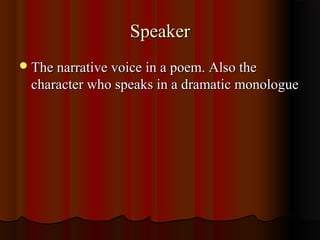
SpeakerSpeaker
The narrative voice in a poem. Also theThe narrative voice in a poem. Also the
character who speaks in a dramatic monologuecharacter who speaks in a dramatic monologue
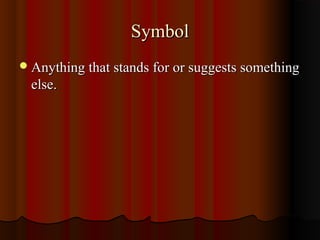
SymbolSymbol
Anything that stands for or suggests somethingAnything that stands for or suggests something
else.else.
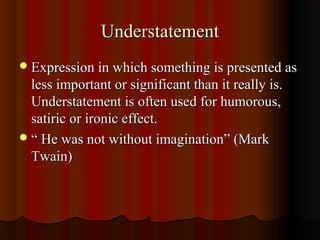
UnderstatementUnderstatement
Expression in which something is presented asExpression in which something is presented as
less important or significant than it really is.less important or significant than it really is.
Understatement is often used for humorous,Understatement is often used for humorous,
satiric or ironic effect.satiric or ironic effect.
““ He was not without imagination” (MarkHe was not without imagination” (Mark
Twain)Twain)
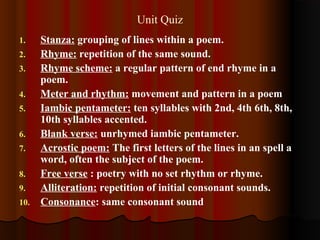
Unit Quiz
1. Stanza: grouping of lines within a poem.
2. Rhyme: repetition of the same sound.
3. Rhyme scheme: a regular pattern of end rhyme in a
poem.
4. Meter and rhythm: movement and pattern in a poem
5. Iambic pentameter: ten syllables with 2nd, 4th 6th, 8th,
10th syllables accented.
6. Blank verse: unrhymed iambic pentameter.
7. Acrostic poem: The first letters of the lines in an spell a
word, often the subject of the poem.
8. Free verse : poetry with no set rhythm or rhyme.
9. Alliteration: repetition of initial consonant sounds.
10. Consonance: same consonant sound
Quiz cont’dQuiz cont’d
11. Assonance: repetition of vowel sounds among words that begin or end with different
consonants.
12. Internal rhyme: pattern where words within a line rhyme with the one that ends it.
13. Couplet: two lines of poetry that usually rhyme.
14. Triplet or tercet: any three lines of poetry, whether as a stanza or as a poem, rhymed or
unrhymed, metered or unmetered.
15. Quatrain: four lines of poetry that usually have a rhyme scheme.
16. Cinquain: a five-line poem, with this syllable pattern 2, 4, 6, 8, 2.
17. Ballad: a narrative poem, sometimes sung, that tells a dramatic story.
18. Epic : a long narrative poem centering on a heroic figure who represents the fate of a
nation.
19. Concrete poem is written in a shape that adds meaning to the poem.
20. Elegy: a meditative poem mourning the death of an individual.
21. Dramatic monologue: a poem in which a character addresses an audience.
22. Haiku: a three-line poem usually about nature, with this syllable pattern: 5,7,5. This
style originated in Japan.
23. Tanka: a five-line poem usually about emotions with this syllable pattern: 5,7,5,7,7.
24. Lyric: poems that are brief and express a powerful emotion Ode: a meditation or
celebration of a specific subject.

Poetry terms and Techniques

  • 1.
    Poetry Terms and Techniques Ms.Aixa Rodriguez Belmont Preparatory High School ESL/ELA
  • 2.
    So.. you thinkyou knowSo.. you think you know All about poetry?All about poetry? Let’s see!Let’s see! Yes, you must take notes!Yes, you must take notes! I am not kidding!I am not kidding!
  • 3.
    Types of PoetryTypesof Poetry Narrative Poetry-Narrative Poetry- a narrative poem is one that tells aa narrative poem is one that tells a story. Types of narrative poetry include ballads andstory. Types of narrative poetry include ballads and epics.epics. Lyric Poetry-Lyric Poetry- a highly musical verse that expressesa highly musical verse that expresses the emotions of the speaker. Common types arethe emotions of the speaker. Common types are sonnets, odes, free verse and elegies.sonnets, odes, free verse and elegies. Dramatic poetry-Dramatic poetry- a dramatic poem is a verse thata dramatic poem is a verse that relies heavily on dramatic elements such asrelies heavily on dramatic elements such as monologue, or dialogue. Two types of dramaticmonologue, or dialogue. Two types of dramatic poetry are dramatic monologue and soliloquy.poetry are dramatic monologue and soliloquy.
  • 4.
    What’s a Ballad? Comeon… I know you can guess…
  • 5.
    Ballad: a narrativepoem, sometimes sung, that tells a dramatic story.
  • 6.
    What about…. An acrosticpoem? What’s that?
  • 7.
    Acrostic poem: Thefirst letters of the lines in an spell a word, often the subject of the poem. Another very incredibly Intelligent and intuitive Xena type warrior princess teacher with An attitude. Domo arigato gozaimashita
  • 8.
  • 9.
    Epic : along narrative poem centering on a heroic figure who represents the fate of a nation. Beowulf is an Old English heroic epic poem of anonymous authorship. In the poem, Beowulf, a hero of the Geats, battles three antagonists: Grendel, Grendel's mother; and, later in life after becoming a king, an unnamed dragon.
  • 10.
    Ah…Obi-wan has taughtyou well. The force is with you young Skywalker, but you are not a Jedi yet. - Darth Vader Define concrete poem.
  • 11.
    Concrete poem iswritten in a shape that adds meaning to the poem.
  • 12.
    A little tooeasy…- Darth Vader Define free verse..
  • 13.
    Free verse :poetry with no set rhythm or rhyme.
  • 14.
    Ha! Impressive… mostimpressive..- Darth Vader A challenge you say! Here you are! Define blank verse!
  • 15.
  • 16.
    A bit oftutoring you need hmmm..- Yoda And if a person is to become one with the force….what type of poem shall we write for them hmmmm?
  • 17.
    Elegy or Elegiacpoem: a meditative poem mourning the death of an individual.
  • 18.
    What’s a … DramaticMonologue?Dramatic Monologue? SoliloquySoliloquy
  • 19.
    Dramatic monologue: apoem in which a character addresses an audience. A fictional character, at a critical or dramaticA fictional character, at a critical or dramatic point in life, addresses a particular “audience”,point in life, addresses a particular “audience”, which his identifiable but silent. In the coursewhich his identifiable but silent. In the course of the monologue, we learn a great deal, oftenof the monologue, we learn a great deal, often ironically, about the character who is speakingironically, about the character who is speaking and the circumstance that have led to theand the circumstance that have led to the speech.speech.
  • 20.
    SoliloquySoliloquy A form ofmonologue found most often inA form of monologue found most often in drama. It differs from a dramatic monologue indrama. It differs from a dramatic monologue in that the speaker is alone, revealing thoughtsthat the speaker is alone, revealing thoughts and feelings to or for oneself that areand feelings to or for oneself that are intentionally unheard by other characters inintentionally unheard by other characters in Shakespeare’s plays for example the principalShakespeare’s plays for example the principal characters’ reflections on how to act orcharacters’ reflections on how to act or questions of conscience are revealed in theirquestions of conscience are revealed in their soliloquies. “To be or not to be…”soliloquies. “To be or not to be…” (Shakespeare’s(Shakespeare’s HamletHamlet))
  • 21.
    See if youcan get this clue… The next poem rhymes with the last word in the above sentence. It originated in an archipelago famous for natural disasters, especially tsunamis and earthquakes.
  • 22.
    Haiku: a three-linepoem usually about nature, with this syllable pattern: 5,7,5. This style originated in Japan. The old bicycle leaning against the lamp post Will it fall over?
  • 23.
    Alright poetic geniuses… Whatis another poemWhat is another poem similar to haiku butsimilar to haiku but longer?longer?
  • 24.
    Tanka: a five-linepoem usually about emotions with this syllable pattern: 5,7,5,7,7. The tanka poem is very similar to haiku but tanka poems have more syllables and it uses simile, metaphor and personification. There are five lines in a Tanka poem. Line one - 5 syllables Beautiful mountains Line two - 7 syllables Rivers with cold, cold water. Line three - 5 syllable White cold snow on rocks. Line four - 7 syllables Trees over the place with frost. Line five - 7 syllables White sparkly snow everywhere. Tanka poems are written about nature, seasons, love, sadness and other strong emotions. This form of poetry dates back almost 1200 years.
  • 25.
    Ok champs.. Letssee you get this one… ???:???: a meditation or celebration of a specific subject.
  • 26.
    Ode: a meditationor celebration of a specific subject. Excerpt from ODE ON A GRECIAN URN By John Keats What leaf-fringed legend haunts about thy shape Of deities or mortals, or of both, In Tempe or the dales of Arcady? What men or gods are these? What maidens loath? What mad pursuit? What struggle to escape? What pipes and timbrels? What wild ecstasy?
  • 27.
    Let’s see ifyou get this one…. ___________ :___________ : a poem of fourteen lines in iambic pentameter.
  • 28.
    Sonnet: a poemof fourteen lines in iambic pentameter. The New Colossus Not like the brazen giant of Greek fame, (a) With conquering limbs astride from land to land; (b) Here at our sea-washed, sunset gates shall stand (b) A mighty woman with a torch, whose flame (a) Is the imprisoned lightning, and her name (a) Mother of Exiles. From her beacon-hand (b) Glows world-wide welcome; her mild eyes command (b) The air-bridged harbor that twin cities frame. (a) "Keep, ancient lands, your storied pomp!" cries she (c) With silent lips. "Give me your tired, your poor, (d) Your huddled masses yearning to breathe free, (c) The wretched refuse of your teeming shore. (d) Send these, the homeless, tempest-tost to me, (c) I lift my lamp beside the golden door!" (d) Emma Lazarus, 1883
  • 29.
    Shakespeare’s Sonnet 116 Letme not to the marriage of true minds (a) Admit impediments. Love is not love (b) Which alters when it alteration finds, (a) Or bends with the remover to remove. (b) O no, it is an ever fixed mark (c) That looks on tempests and is never shaken; (d) It is the star to every wand'ring barque, (c) Whose worth's unknown although his height be taken. (d) Love's not time's fool, though rosy lips and cheeks (e) Within his bending sickle's compass come; (f) Love alters not with his brief hours and weeks, (e) But bears it out even to the edge of doom. (f) If this be error and upon me proved, (g) I never writ, nor no man ever loved. (g)
  • 30.
    A quick quiz:Do you know…  Stanza_________________  Rhyme ________________  Rhyme scheme ______________
  • 31.
    Stanza: grouping oflines within a poem. Rhyme: repetition of the same sound. Rhyme scheme: a regular pattern of end rhyme in a poem.
  • 32.
    Ok, so letsnow go over commonOk, so lets now go over common FORMS OF STANZA!FORMS OF STANZA!
  • 33.
    What’s a couplet? What’sa couplet? Je nais se pas!
  • 34.
    Couplet: two linesof poetry that usually rhyme. Avocado GirlAvocado Girl By: Ms. Aixa B. RodriguezBy: Ms. Aixa B. Rodriguez I am anI am an ahuacatlahuacatl of ancient days,of ancient days, Of both past and present ways.Of both past and present ways. I am anI am an aguacateaguacate of a familiar green,of a familiar green, A nuyorbronxrican Queen.A nuyorbronxrican Queen. I am anI am an avocadoavocado with rough Bronx skin,with rough Bronx skin, both Latina and American.both Latina and American.
  • 35.
    Not bad.. Notbad.. How about a tercet? Or triplet?
  • 36.
    Triplet or tercet:any three lines of poetry, whether as a stanza or as a poem, rhymed or unrhymed, metered or unmetered. I am a yellow dog who wishes he was a purple-spotted frog.
  • 37.
    You are gettingit! And now.. a quatrain?
  • 38.
    Quatrain: four linesof poetry that usually have a rhyme scheme.  A quatrain is a poem, or a stanza within a poem, that consists always of four lines. It is the most common of all stanza forms in European poetry. The rhyming patterns include aabb, abab, abba, abcb. Example: aabb (from William Blake, "The Tyger") Tyger! Tyger! burning bright In the forests of the night, What immortal hand or eye Could frame thy fearful symmetry?
  • 39.
    A cinquain? Aquintain? It’s driving me insane! You can do it! USE THE FORCE!
  • 40.
    Cinquain: a five-linepoem In summertime on BredonIn summertime on Bredon The bells they sound so clear;The bells they sound so clear; Round both the shires they ring themRound both the shires they ring them In steeples far and near,In steeples far and near, A happy noise to hear.A happy noise to hear. -A.E. Houseman, “Bredon Hill”-A.E. Houseman, “Bredon Hill”
  • 41.
    Does it everend?Does it ever end? Sestet: six linesSestet: six lines O, young Lochnivar is come out of the west,O, young Lochnivar is come out of the west, Through all the wide Border his steed was the best;Through all the wide Border his steed was the best; And save his good broadsword he weapons had none,And save his good broadsword he weapons had none, He rode all unarm’d, and he rode all alone.He rode all unarm’d, and he rode all alone. So faithful in love, and so dauntless in war.So faithful in love, and so dauntless in war. There never was knight like the young Lochnivar.There never was knight like the young Lochnivar. - Sir Walter Scott, “Lochnivar”- Sir Walter Scott, “Lochnivar”
  • 42.
    Nope….Nope…. Heptastich: seven linesHeptastich:seven lines The flower that smiles todayThe flower that smiles today Tomorrow dies;Tomorrow dies; All that we wish to stayAll that we wish to stay Tempts and then flies;Tempts and then flies; What is this world’s delight?What is this world’s delight? Lightning, that mocks the night,Lightning, that mocks the night, Brief even as bright.Brief even as bright. - Percy Bysshe Shelley, “Mutability”- Percy Bysshe Shelley, “Mutability”
  • 43.
    Last one! Ipromise!Last one! I promise! Octave: eight linesOctave: eight lines Labor is blossoming or dancing whereLabor is blossoming or dancing where The body is not bruised to pleasure soul,The body is not bruised to pleasure soul, Nor beauty born out of its own despair,Nor beauty born out of its own despair, Nor blear-eyed wisdom out of midnight oil.Nor blear-eyed wisdom out of midnight oil. O chestnut tree, great-rooted blossomer,O chestnut tree, great-rooted blossomer, Are you the leaf, the blossom, or the bole?Are you the leaf, the blossom, or the bole? O body swayed to the music, O brightening glance,O body swayed to the music, O brightening glance, How can we know the dancer from the dance?How can we know the dancer from the dance? - William Butler Yeats, “Among School Children”- William Butler Yeats, “Among School Children”
  • 44.
    Quick quizQuick quiz Sestet:_________________________Sestet: _________________________ Heptastich: ______________________Heptastich: ______________________ Octave: _________________________Octave: _________________________
  • 45.
    Ok.. now Rhythmand Rhyme!Ok.. now Rhythm and Rhyme! Techniques of Poetry: SoundTechniques of Poetry: Sound
  • 46.
    End Rhyme- theuse of rhyming words at the ends of lines. Internal rhyme: use of rhyming words within lines Slant Rhyme- use of rhyming sounds that are similar but not identical, as in rave and rove or rot and rock. (consonance is a type of slant rhyme). RhymeRhyme
  • 47.
    Ok, ok… howabout Alliteration and consonance?
  • 48.
    Alliteration: repetition ofinitial consonant sounds. Sometimes some students decide to stand instead of sitting, to speak when someone is speaking and simply act silly.
  • 49.
    Consonance: same consonantsound Avocado GirlAvocado Girl By: Ms. Aixa B. RodriguezBy: Ms. Aixa B. Rodriguez I am anI am an ahuacatlahuacatl of ancient dayof ancient dayss,, Of both past and present wayOf both past and present wayss.. I am anI am an aguacateaguacate of a familiar greeof a familiar greenn,, A nuyorbronxricA nuyorbronxricanan QueeQueenn.. I am anI am an avocadoavocado with rough Bronx skwith rough Bronx skinin,, both Latina and Americboth Latina and American..
  • 50.
    Ok keep itclean… What is assonance?
  • 51.
    Assonance: repetition ofvowel sounds among words that begin or end with different consonants. "Doo youou like blueue?". Hoow noow broown coow Hear the meellow weedding beells. — Edgar Allan Poe, "The Bells"
  • 52.
    Meter and rhythm:movement and pattern in a poem. Metrical verseMetrical verse follows a set rhythmicalfollows a set rhythmical pattern.pattern. Free verseFree verse oror vers librevers libre, does not., does not. TheThe metermeter of a poem is its rhythmical pattern.of a poem is its rhythmical pattern. English verse is made of rhythmical unitsEnglish verse is made of rhythmical units calledcalled feet.feet. AA footfoot is made up ofis made up of weaklyweakly stressedstressed ((˘) and strongly stressed (/) syllables.
  • 53.
    Poetry has feet?Poetryhas feet? Type of Foot Pattern Example Iamb, or iambic foot ˘ / afraid Trochee, or trochaic foot / ˘ freedom Anapest, or anapestic foot ˘ ˘/ in a flash Dactyl, or dactylic foot / ˘ ˘ feverish Spondee, or spondaic foot / / baseball Pyrrhee or pyrrhic foot ˘ ˘ unbelievable
  • 54.
    How many feetdoes your poem have?How many feet does your poem have? Term Number of feet Example monometer one foot And I Shall fly away dimeter two feet After autumn Comes the winter trimeter three feet In the midst of mourning tetrameter four feet O saddle up my milk white steed pentameter five feet That time of year thou may’st in me behold hexameter six feet A perfect knight he was, that all could plainly see.
  • 55.
    Iambic pentameter: tensyllables with 2nd, 4th 6th, 8th, 10th syllables accented. Shakespeare wrote in iambic pentameter.Shakespeare wrote in iambic pentameter.
  • 56.
    Techniques of Poetry:MeaningTechniques of Poetry: Meaning  Image- language that creates a concrete representation of anImage- language that creates a concrete representation of an object or an experience.object or an experience.  Objective correlative- group of images that together create aObjective correlative- group of images that together create a given emotion in a reader or listener.given emotion in a reader or listener.  Figure of speech or trope is an expression that has more than aFigure of speech or trope is an expression that has more than a literal meaning.literal meaning.  Hyperbole- an exaggeration made for rhetorical effect.Hyperbole- an exaggeration made for rhetorical effect.  Metaphor- figure of speech in which one t thing is spoken orMetaphor- figure of speech in which one t thing is spoken or written about as if it were another.written about as if it were another.  Tenor of the metaphor is the writer’s actual subject.Tenor of the metaphor is the writer’s actual subject.  The vehicle of the metaphor is the other thing to which theThe vehicle of the metaphor is the other thing to which the subject is compared or likened.subject is compared or likened.  Personification and similes are types of metaphor.Personification and similes are types of metaphor.
  • 57.
    Techniques of Poetry:Meaning cont’dTechniques of Poetry: Meaning cont’d  Metonymy- the naming of an object associated with aMetonymy- the naming of an object associated with a thing instead of the name of the thing itself. Ex: Thething instead of the name of the thing itself. Ex: The White House for the President, or The Crown for theWhite House for the President, or The Crown for the King.King.  Simile- a comparison using like or as.Simile- a comparison using like or as.  Synaesthesia- a figure of speech that combines in aSynaesthesia- a figure of speech that combines in a single expression images related to two or moresingle expression images related to two or more different senses. Ex. Singing light.different senses. Ex. Singing light.  Synecdoche- a figure of speech in which the name ofSynecdoche- a figure of speech in which the name of a part of something is used in place of the name of thea part of something is used in place of the name of the whole or vice versa. Ex. Hired hands = laborerswhole or vice versa. Ex. Hired hands = laborers
  • 58.
    Rhetorical techniquesRhetorical techniques Rhetorical techniques are extraordinary but literal use of language to achieve aRhetorical techniques are extraordinary but literal use of language to achieve a particular effect.particular effect.  Antithesis- a rhetorical technique in which words, phrases or ideas are stronglyAntithesis- a rhetorical technique in which words, phrases or ideas are strongly contrasted often by repeating a grammatical structure. Ex; to err is human, tocontrasted often by repeating a grammatical structure. Ex; to err is human, to forgive divine.”forgive divine.”  Apostrophe- rhetorical technique in which an object or person is directly addressed.Apostrophe- rhetorical technique in which an object or person is directly addressed.  Catalog- a list of people or thingsCatalog- a list of people or things  Chiasmus- a rhetorical technique in which the order of occurrence of words orChiasmus- a rhetorical technique in which the order of occurrence of words or phrases is reversed. Ex.: we can weather changes but we can’t change the weather.phrases is reversed. Ex.: we can weather changes but we can’t change the weather.  Parallelism- a rhetorical technique in which a writer emphasizes the equal value orParallelism- a rhetorical technique in which a writer emphasizes the equal value or weight of two or more ideas by expressing them in the same grammatical form, asweight of two or more ideas by expressing them in the same grammatical form, as in the phrase “with hope, with joy, and with love.”in the phrase “with hope, with joy, and with love.”  Repetition- writers conscious reuse of a sound, a word, phrase sentence or otherRepetition- writers conscious reuse of a sound, a word, phrase sentence or other element.element.  Rhetorical question: a question asked for effect but not meant to be answeredRhetorical question: a question asked for effect but not meant to be answered because the answer is clear from the context.because the answer is clear from the context.
  • 59.
    Structure and Languagein PoetryStructure and Language in Poetry Allegory- a narrative in prose or verse, inAllegory- a narrative in prose or verse, in which abstract ideas, principles human valueswhich abstract ideas, principles human values or states d of mind are personified. Theor states d of mind are personified. The purpose of the allegory is to illustrate thepurpose of the allegory is to illustrate the significance of the ideas by dramatizing them.significance of the ideas by dramatizing them. Parable and fable are kinds of allegory inParable and fable are kinds of allegory in which a moral I illustrated in the form of awhich a moral I illustrated in the form of a story.story.
  • 60.
    AllusionAllusion  A referenceto a historical event, to Biblical,A reference to a historical event, to Biblical, mythological or literary characters and incidents withmythological or literary characters and incidents with which the reader is assumed to be familiar. Allusionwhich the reader is assumed to be familiar. Allusion may , with few words, enrich or extend the meaningmay , with few words, enrich or extend the meaning of a phrase or idea or image, Allusion may also beof a phrase or idea or image, Allusion may also be used for ironic effect. In his poem Out Rober frostused for ironic effect. In his poem Out Rober frost expects the reader to recall from Macbeth’s finalexpects the reader to recall from Macbeth’s final soliloquy the line “Out out brief candle “ Suchsoliloquy the line “Out out brief candle “ Such expressions as “ a Herculean task” or “Achilles heel”expressions as “ a Herculean task” or “Achilles heel” are also forms of allusion.are also forms of allusion.
  • 61.
    AmbiguityAmbiguity Denotes uncertainty ofmeaning. In literatureDenotes uncertainty of meaning. In literature and especially poetry, we speak of intentionaland especially poetry, we speak of intentional ambiguity, the use of language and images toambiguity, the use of language and images to suggest more than one meaning at the samesuggest more than one meaning at the same time.time.
  • 62.
    ConnotationConnotation The feelings attitudesimages and associationsThe feelings attitudes images and associations of a word or expression. Connotations areof a word or expression. Connotations are usually said to be “positive’ or “negative”usually said to be “positive’ or “negative”
  • 63.
    DenotationDenotation That which aword actually names, identifies,That which a word actually names, identifies, or “points to” Denotation is sometimesor “points to” Denotation is sometimes referred to as “the dictionary definition” of areferred to as “the dictionary definition” of a work.work.
  • 64.
    Figurative LanguageFigurative Language Theintentional and imaginative use of wordsThe intentional and imaginative use of words and comparisons that are not literal but thatand comparisons that are not literal but that create original, vivid, and often unexpectedcreate original, vivid, and often unexpected images and associations .images and associations .
  • 65.
    HyperboleHyperbole An exaggerated expressionalso calledAn exaggerated expression also called overstatement, for a particular effect, whichoverstatement, for a particular effect, which may be humorous, satirical, or intenselymay be humorous, satirical, or intensely emotional. Hyperbole is the expression ofemotional. Hyperbole is the expression of folktales and legends.folktales and legends. Ex. I have mountains of work to do.Ex. I have mountains of work to do.
  • 66.
    IronyIrony In general atone or figure of speech in whichIn general a tone or figure of speech in which there is a discrepancy a striking difference orthere is a discrepancy a striking difference or contradiction between what is expressed andcontradiction between what is expressed and what is meant or expected. Irony maybe usedwhat is meant or expected. Irony maybe used to achieve a powerful effect indir4ectly. Into achieve a powerful effect indir4ectly. In satire, for example it may be used to ridiculesatire, for example it may be used to ridicule or criticize.or criticize.
  • 67.
    MetaphorMetaphor Form of analogyor comparison where theForm of analogy or comparison where the author finds and expresses similarity betweenauthor finds and expresses similarity between dissimilar things.dissimilar things.
  • 68.
    OnomatopoeiaOnomatopoeia The use ofwords or phrases that sound like theThe use of words or phrases that sound like the things to which they refer. Examples includethings to which they refer. Examples include the words meow, clink, boom, and mumble.the words meow, clink, boom, and mumble.
  • 69.
    OxymoronOxymoron Related to paradox,oxymoron is a figure ofRelated to paradox, oxymoron is a figure of speech in which two contradictory or sharplyspeech in which two contradictory or sharply contrasting terms are paired fro emphasis orcontrasting terms are paired fro emphasis or ironic effect. Students favorite examplesironic effect. Students favorite examples include “jumbo shrimp” and “armyinclude “jumbo shrimp” and “army Intelligence.” Poets have written of the “wiseIntelligence.” Poets have written of the “wise fool” “ Joyful sadness” or and “eloquentfool” “ Joyful sadness” or and “eloquent silence.”silence.”
  • 70.
    ParadoxParadox An expression conceptof situation whoseAn expression concept of situation whose literal statement is contradictory , yet whichliteral statement is contradictory , yet which makes a truthful and meaningful observation.makes a truthful and meaningful observation. “ Less is more”“ Less is more”
  • 71.
    SatireSatire A form orstyle that uses elements of irony,A form or style that uses elements of irony, ridicule, exaggeration , understatement,ridicule, exaggeration , understatement, sarcasm, humor or absurdity to criticize humansarcasm, humor or absurdity to criticize human behavior or a society.behavior or a society.
  • 72.
    SimileSimile An expression thatis a direct comparison ofAn expression that is a direct comparison of two things using words as like a s as if seemstwo things using words as like a s as if seems and appears.and appears. ““ I wandered lonely as a cloud” (WilliamI wandered lonely as a cloud” (William WordsworthWordsworth
  • 73.
    SpeakerSpeaker The narrative voicein a poem. Also theThe narrative voice in a poem. Also the character who speaks in a dramatic monologuecharacter who speaks in a dramatic monologue
  • 74.
    SymbolSymbol Anything that standsfor or suggests somethingAnything that stands for or suggests something else.else.
  • 75.
    UnderstatementUnderstatement Expression in whichsomething is presented asExpression in which something is presented as less important or significant than it really is.less important or significant than it really is. Understatement is often used for humorous,Understatement is often used for humorous, satiric or ironic effect.satiric or ironic effect. ““ He was not without imagination” (MarkHe was not without imagination” (Mark Twain)Twain)
  • 76.
    Unit Quiz 1. Stanza:grouping of lines within a poem. 2. Rhyme: repetition of the same sound. 3. Rhyme scheme: a regular pattern of end rhyme in a poem. 4. Meter and rhythm: movement and pattern in a poem 5. Iambic pentameter: ten syllables with 2nd, 4th 6th, 8th, 10th syllables accented. 6. Blank verse: unrhymed iambic pentameter. 7. Acrostic poem: The first letters of the lines in an spell a word, often the subject of the poem. 8. Free verse : poetry with no set rhythm or rhyme. 9. Alliteration: repetition of initial consonant sounds. 10. Consonance: same consonant sound
  • 77.
    Quiz cont’dQuiz cont’d 11.Assonance: repetition of vowel sounds among words that begin or end with different consonants. 12. Internal rhyme: pattern where words within a line rhyme with the one that ends it. 13. Couplet: two lines of poetry that usually rhyme. 14. Triplet or tercet: any three lines of poetry, whether as a stanza or as a poem, rhymed or unrhymed, metered or unmetered. 15. Quatrain: four lines of poetry that usually have a rhyme scheme. 16. Cinquain: a five-line poem, with this syllable pattern 2, 4, 6, 8, 2. 17. Ballad: a narrative poem, sometimes sung, that tells a dramatic story. 18. Epic : a long narrative poem centering on a heroic figure who represents the fate of a nation. 19. Concrete poem is written in a shape that adds meaning to the poem. 20. Elegy: a meditative poem mourning the death of an individual. 21. Dramatic monologue: a poem in which a character addresses an audience. 22. Haiku: a three-line poem usually about nature, with this syllable pattern: 5,7,5. This style originated in Japan. 23. Tanka: a five-line poem usually about emotions with this syllable pattern: 5,7,5,7,7. 24. Lyric: poems that are brief and express a powerful emotion Ode: a meditation or celebration of a specific subject.