POETIC TECHNIQUES:
What is Personification?
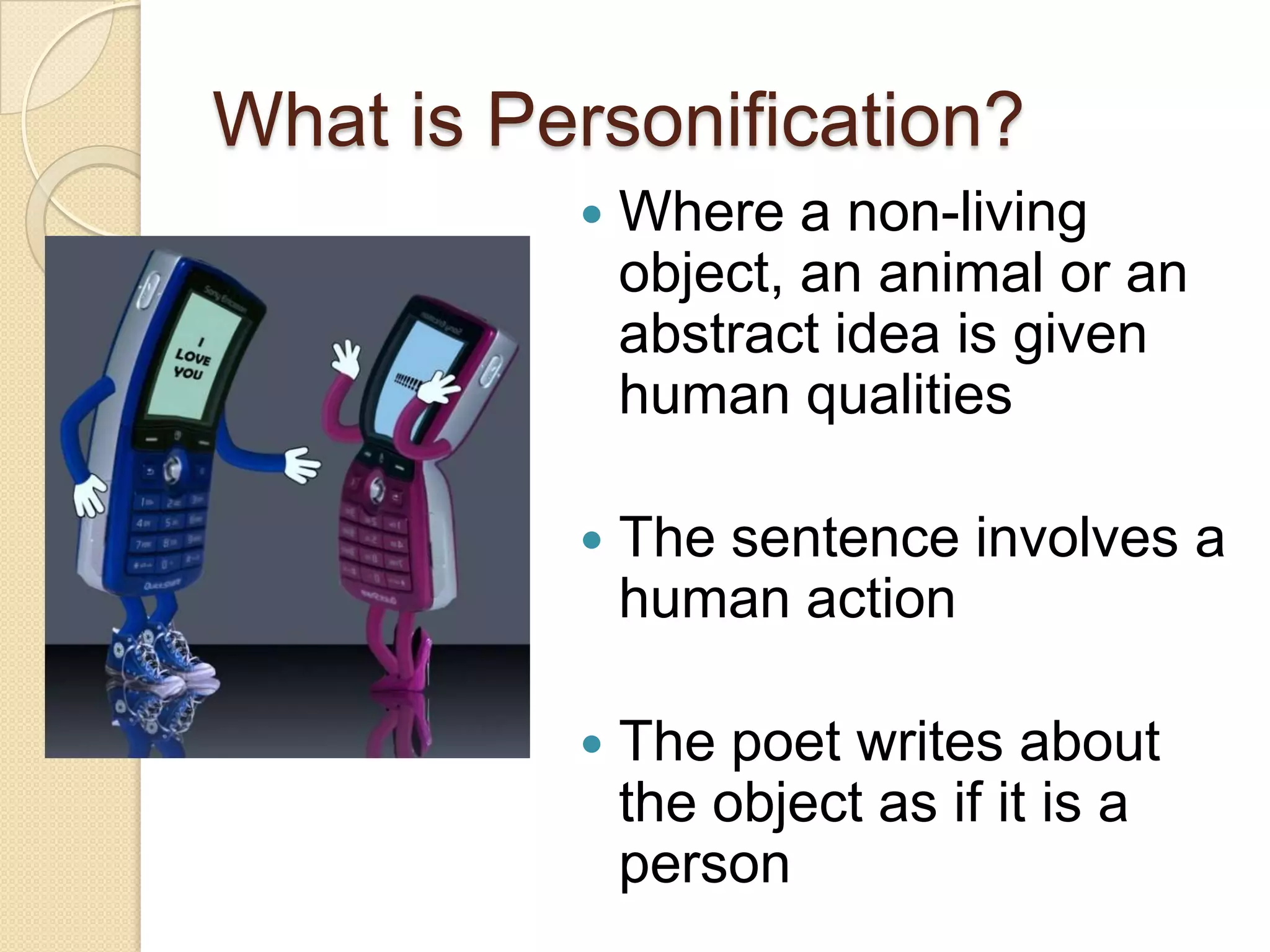
             Where a non-living
              object, an animal or an
              abstract idea is given
              human qualities

             The sentence involves a
              human action

             The poet writes about
              the object as if it is a
              person
For example:
"Wind yells while blowing"
 "Wind yells while blowing" is an
 example of personification because
 wind cannot yell. Only a living thing
 can yell.

“Necklace is a friend”

 "Necklace is a friend" is an example
 of personification because a
 necklace is a thing, and necklaces
 cannot be friends. Only living things
 can have friends.
Why
Personify?

   Personification can make things easier to
    imagine when you read them.

    For example, you can’t see the wind, but
    if someone wrote “the wind raged with
    fierce anger” you might get a better
    impression of how the wind blew that
    day.
Is Personification used in other
mediums apart from Poetry?

 Personification is used in many forms
 of literature, music, advertising, art
 and drama. These may include (but
 are not limited to) novels, short
 stories, fairytales, sculptures,
 television shows, films, and theatre.
Personification – Origins
 Personification is strongly associated with art
  and storytelling where it has ancient roots.
 Most cultures possess a long-standing
  storytelling tradition with personified animals
  as characters. For example in the children’s
  story Alice in Wonderland there are several
  anthropomorphic characters including the
  white rabbit or the cheshire cat.

   Artists have always thought there was
    something important about the connection
    between people and objects.
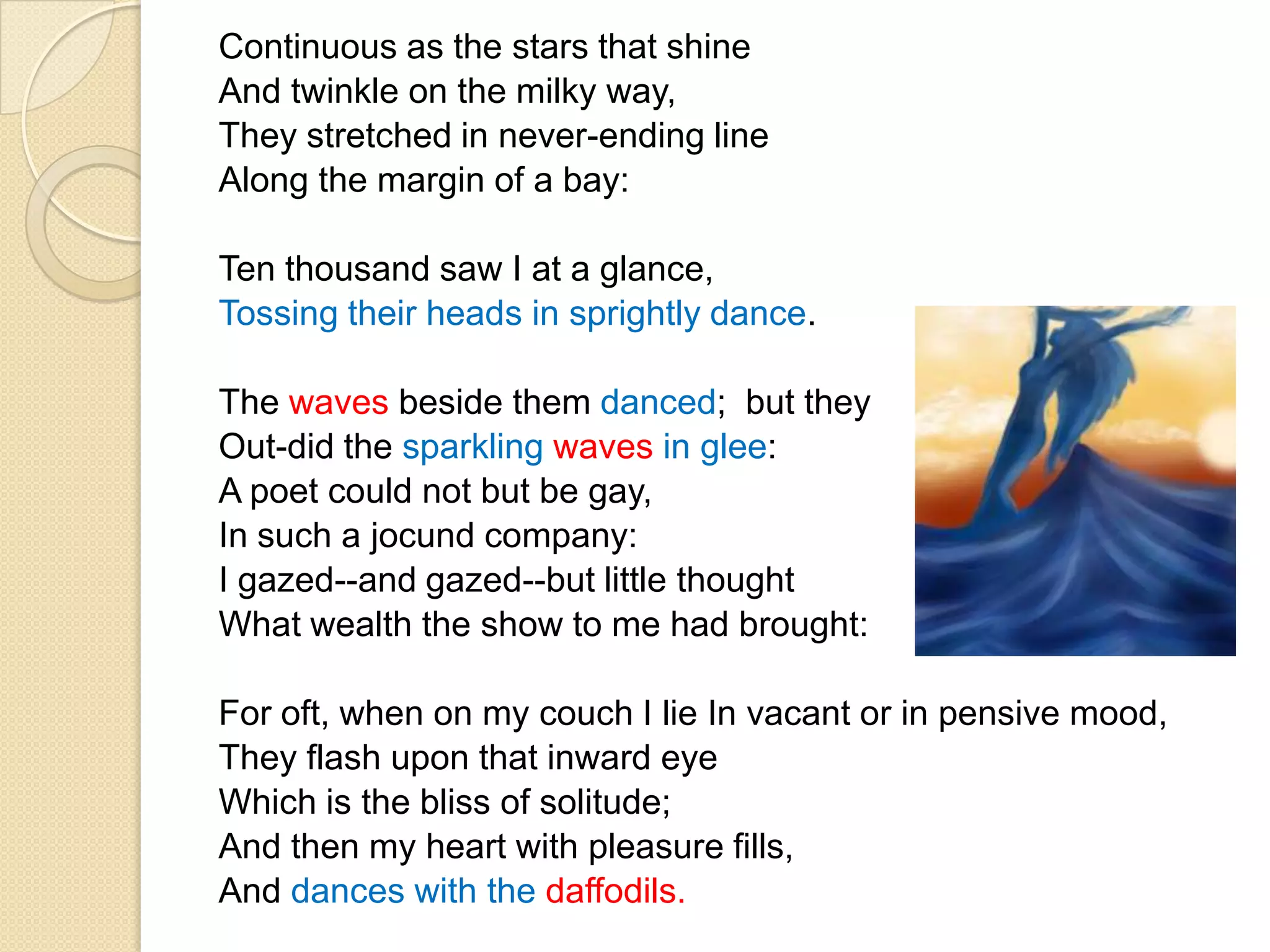
   For example in the drawing to the right the
    artist has personified the waves through the
    image of a woman.
Personification in Advertising
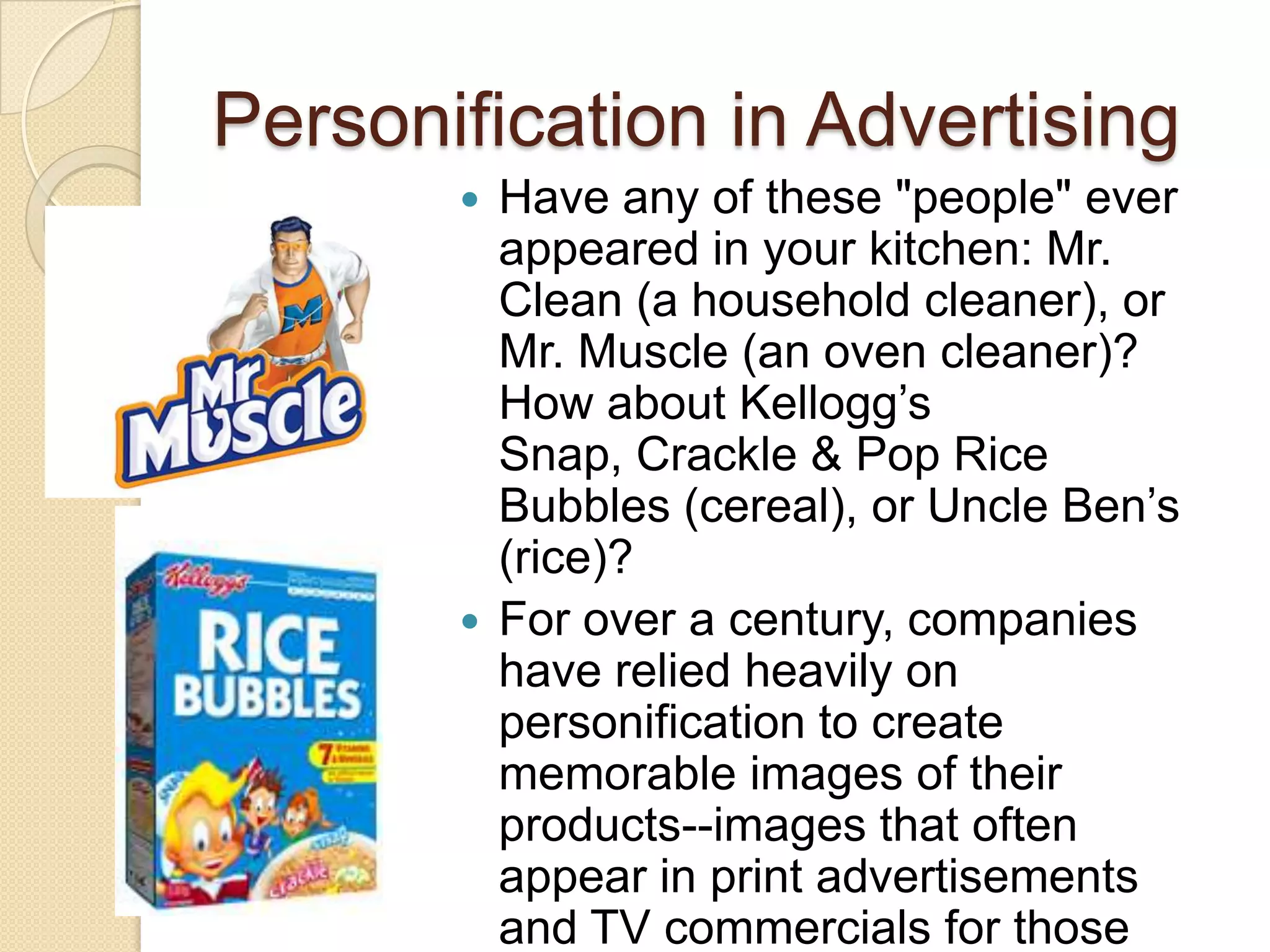
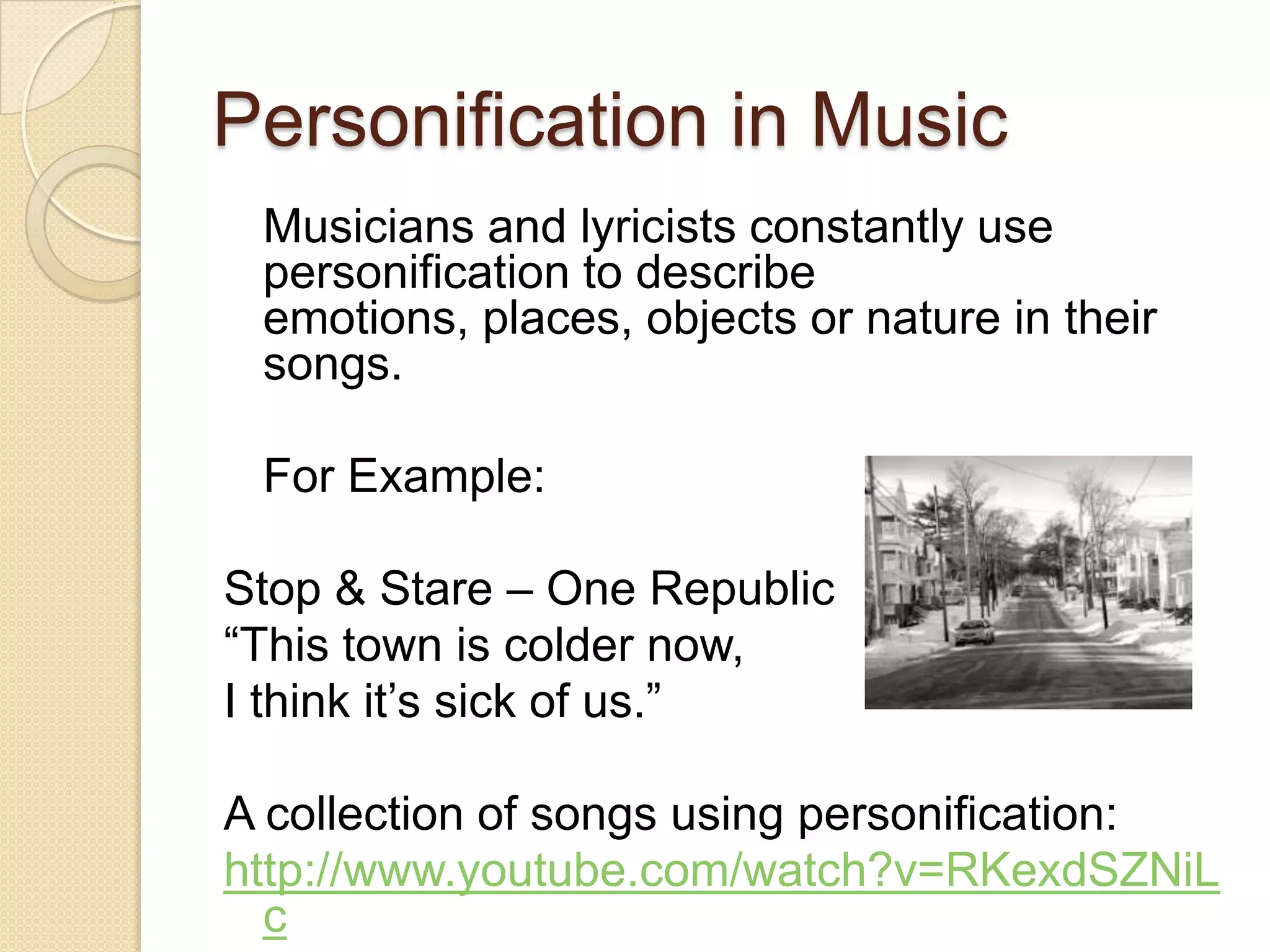
        Have any of these "people" ever
         appeared in your kitchen: Mr.
         Clean (a household cleaner), or
         Mr. Muscle (an oven cleaner)?
         How about Kellogg’s
         Snap, Crackle & Pop Rice
         Bubbles (cereal), or Uncle Ben’s
         (rice)?
        For over a century, companies
         have relied heavily on
         personification to create
         memorable images of their
         products--images that often
         appear in print advertisements
         and TV commercials for those
Personification in Music
 Musicians and lyricists constantly use
 personification to describe
 emotions, places, objects or nature in their
 songs.

 For Example:

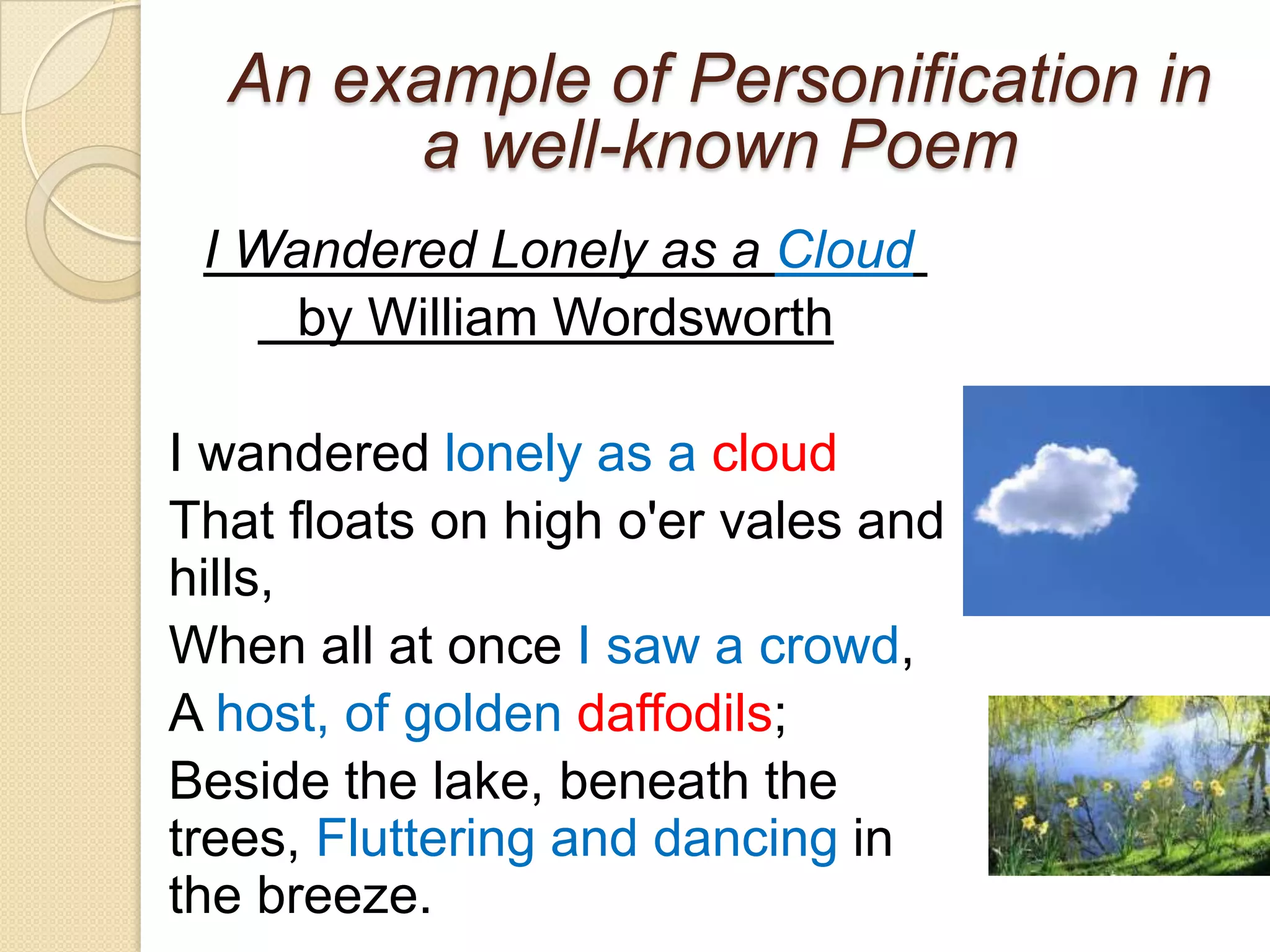
Stop & Stare – One Republic
“This town is colder now,
I think it’s sick of us.”

A collection of songs using personification:
http://www.youtube.com/watch?v=RKexdSZNiL
  c
An example of Personification in
       a well-known Poem
 I Wandered Lonely as a Cloud
     by William Wordsworth

I wandered lonely as a cloud
That floats on high o'er vales and
hills,
When all at once I saw a crowd,
A host, of golden daffodils;
Beside the lake, beneath the
trees, Fluttering and dancing in
the breeze.
Continuous as the stars that shine
And twinkle on the milky way,
They stretched in never-ending line
Along the margin of a bay:

Ten thousand saw I at a glance,
Tossing their heads in sprightly dance.

The waves beside them danced; but they
Out-did the sparkling waves in glee:
A poet could not but be gay,
In such a jocund company:
I gazed--and gazed--but little thought
What wealth the show to me had brought:

For oft, when on my couch I lie In vacant or in pensive mood,
They flash upon that inward eye
Which is the bliss of solitude;
And then my heart with pleasure fills,
And dances with the daffodils.
References
 Cummings, M. (2008). Study Guide: I Wandered Lonely as a
 Cloud. Retrieved April 26, 2012 from
 http://www.cummingsstudyguides.net/Guides3/IWandered.htm
 l

 Nordquist, R. (2012). What is Personification? Retrieved April
 24, 2012 from
 http://grammar.about.com/od/qaaboutrhetoric/a/faqpersonificat
 ion.htm

 Packard, W. (1994). The Poet’s Dictionary: A Handbook of
 Prosody and Poetic Devices. New York: Collins Reference.

 Paxson, J. (1994). The Poetics of Personification. London:
 Cambridge University Press.

 Wing Jan, L. (2009). Write Ways: Modelling Writing Forms (3rd
 ed). South Melbourne: Oxford University Press.

Personification in Poetry Presentation

  • 1.
  • 2.
    What is Personification?  Where a non-living object, an animal or an abstract idea is given human qualities  The sentence involves a human action  The poet writes about the object as if it is a person
  • 3.
    For example: "Wind yellswhile blowing" "Wind yells while blowing" is an example of personification because wind cannot yell. Only a living thing can yell. “Necklace is a friend” "Necklace is a friend" is an example of personification because a necklace is a thing, and necklaces cannot be friends. Only living things can have friends.
  • 4.
    Why Personify?  Personification can make things easier to imagine when you read them. For example, you can’t see the wind, but if someone wrote “the wind raged with fierce anger” you might get a better impression of how the wind blew that day.
  • 5.
    Is Personification usedin other mediums apart from Poetry? Personification is used in many forms of literature, music, advertising, art and drama. These may include (but are not limited to) novels, short stories, fairytales, sculptures, television shows, films, and theatre.
  • 6.
    Personification – Origins Personification is strongly associated with art and storytelling where it has ancient roots.  Most cultures possess a long-standing storytelling tradition with personified animals as characters. For example in the children’s story Alice in Wonderland there are several anthropomorphic characters including the white rabbit or the cheshire cat.  Artists have always thought there was something important about the connection between people and objects.  For example in the drawing to the right the artist has personified the waves through the image of a woman.
  • 7.
    Personification in Advertising  Have any of these "people" ever appeared in your kitchen: Mr. Clean (a household cleaner), or Mr. Muscle (an oven cleaner)? How about Kellogg’s Snap, Crackle & Pop Rice Bubbles (cereal), or Uncle Ben’s (rice)?  For over a century, companies have relied heavily on personification to create memorable images of their products--images that often appear in print advertisements and TV commercials for those
  • 8.
    Personification in Music Musicians and lyricists constantly use personification to describe emotions, places, objects or nature in their songs. For Example: Stop & Stare – One Republic “This town is colder now, I think it’s sick of us.” A collection of songs using personification: http://www.youtube.com/watch?v=RKexdSZNiL c
  • 9.
    An example ofPersonification in a well-known Poem I Wandered Lonely as a Cloud by William Wordsworth I wandered lonely as a cloud That floats on high o'er vales and hills, When all at once I saw a crowd, A host, of golden daffodils; Beside the lake, beneath the trees, Fluttering and dancing in the breeze.
  • 10.
    Continuous as thestars that shine And twinkle on the milky way, They stretched in never-ending line Along the margin of a bay: Ten thousand saw I at a glance, Tossing their heads in sprightly dance. The waves beside them danced; but they Out-did the sparkling waves in glee: A poet could not but be gay, In such a jocund company: I gazed--and gazed--but little thought What wealth the show to me had brought: For oft, when on my couch I lie In vacant or in pensive mood, They flash upon that inward eye Which is the bliss of solitude; And then my heart with pleasure fills, And dances with the daffodils.
  • 11.
    References Cummings, M.(2008). Study Guide: I Wandered Lonely as a Cloud. Retrieved April 26, 2012 from http://www.cummingsstudyguides.net/Guides3/IWandered.htm l Nordquist, R. (2012). What is Personification? Retrieved April 24, 2012 from http://grammar.about.com/od/qaaboutrhetoric/a/faqpersonificat ion.htm Packard, W. (1994). The Poet’s Dictionary: A Handbook of Prosody and Poetic Devices. New York: Collins Reference. Paxson, J. (1994). The Poetics of Personification. London: Cambridge University Press. Wing Jan, L. (2009). Write Ways: Modelling Writing Forms (3rd ed). South Melbourne: Oxford University Press.

Editor's Notes

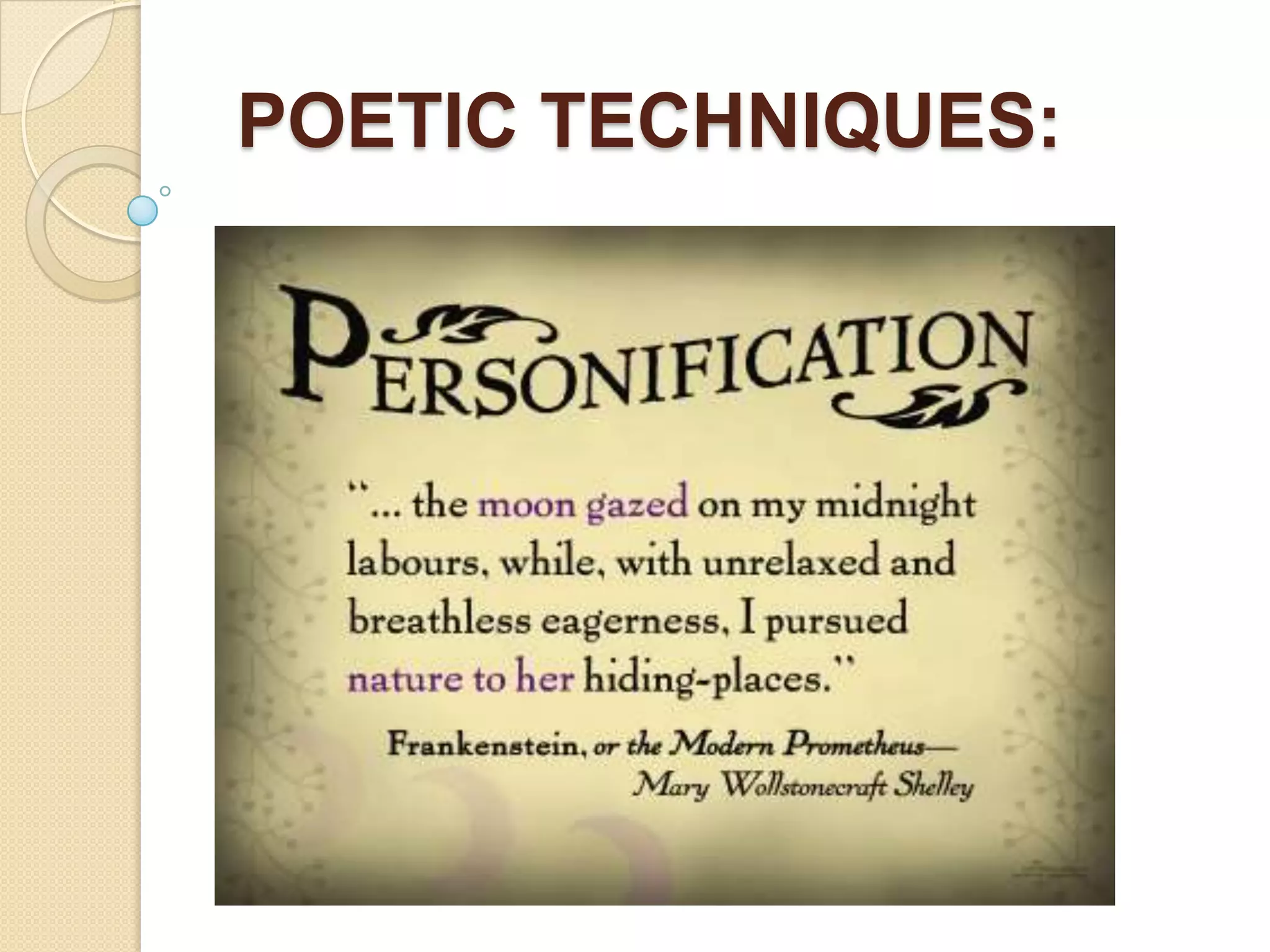
  • #2 Good morning/afternoon ladies and gentleman of the Poetry Forum. Today I will be exploring the poetic device of Personification. Before I begin let me read this example for you – read from slide. The moon does not gaze and nature is not a person that hides away. Yet in this extract we (the reader) can interpret these suggestions and see them almost as truths. This is the power of Personification. It is a device that can be used in all forms of literature, including Poetry.
  • #3 But what is Personificationyou ask? Personification or Anthropomorphism (the official name for the device, coined in the 1700s)is – read from slide above. Examples include animals and plants and forces of nature such as winds, rain or the sundepicted as creatures with human motivations, and/or the abilities to reason and converse.
  • #4 Let’s have a look at some examples of personification-
  • #5 So why do poets, artists, writers, singers or playwrights use personification? What is the point? Read from slide.
  • #6 Whilst Personification is often linked to discussions on Poetry, it is not a device used only for this form of literature. On the contrary (read from slide).
  • #7 Read from slide.
  • #8 Read slide first. Giving a human face to a product. Or human characteristics to an abstract idea, like "hunger" or "greed."Personificationcan help advertisers create ads that are more interesting, and relevant to viewers. More human and engaging.Theycan literally turn the product into a person. Or give it human abilities, such as speech, thought or emotion.
  • #9 Personification is an important device in music as it can help listeners to engage and connect to the feelings and emotions depicted in a song.
  • #10 William Wordsworth's "I Wandered Lonely as a Cloud” is a lyric poem focusing on the poet's response to the beauty of nature. A lyric poem presents the deep feelings and emotions of the poet rather than telling a story or presenting a witty observation.The final version of the poem, with four stanzas, was first published in Collected Poems in 1815. Wordsworth wrote the earlier version in 1804, two years after seeing the lakeside daffodils that inspired the poem. Throughout this poem Wordsworth has personified different elements of nature including clouds, daffodils and waves. Read the poem from the slides.
  • #11 Continue reading poem from slide.
  • #12 Thank you for listening to this short PechaKucha Presentation on Personification in Poetry.