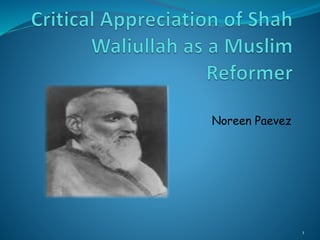
Noreen Paevez
1
Introduction
History witnessed that whenever the enemies of Islam
have created problems to crush it, God sends his pious
persons to defend Islam. Shah Waliullah is also one of
these Pious people who supported Muslims and their
believes in the subcontinent in a very critical situation.
He even stood against the corrupt Mughal government
in 18th century which was very risky task. He not only
reformed the religious, economic, political and social
conditions of Muslims but also prevented them from
Marhattas.
2
Biography
Born on 21st February 1703 (14th of Shawal 1114 Hijri) in
a respectable family of Delhi.
His complete name was Qutub-ud-Din Ahmad Ibn e
Abdul Raheem, but because of his pious nature people
call him as Shah Waliullah.
His father Shah Abdul Raheem was famous for his
knowledge and greater understanding of Islam as he
was a leading Hanafi Jurist, Islamic Scholar and
founder of Madrassa e Raheemiya.
Hazrat Shah Waliullah died in 1762.
3
Education
Shah Wali Ullah received his early education in
Madrassa e Raheemiya from his Father.
In his childhood, he memorized the Holy Quran as
well as learnt Hadees and Tafseer.
He studied Arabic and Persian grammar and literature.
He studied metaphysical, juridical, mystical,
philosophical and theological texts and in the age of
fifteen, he graduated and started teaching in the same
madrassa (Raheemiya).
After the death of his father he became the head of
that Madrassa and taught there for twelve years.
4
Pilgrimage
Went to Hijaz to perform Hujj and remained there for
eight years to study Haddees and Fiqah from scholars
like Abu Tahir bin ibrahim al-Kurdi al-Madani, Wafd
Allah al-Makki, and Taj al-Din al-Qali.
Informed about the situations prevailing in different
Muslim States of the world.
He saw there a dream and came back to Delhi with a
new task.
Training of pupils to enlighten the Muslims of
subcontinent.
5
Conditions of India
He was born four years before the death of the Mughal
Emperor Aurangzeb. After Aurangzeb, the Mughal
Empire was handed over to unable successors due to
which the Muslim Community of India experienced
severe problems and un-Islamic practices were
growing quickly. That spiritual confusion created
political chaos, and that later resulted in the
disintegration of the Muslim rule in India as well as
impact upon the socio-economic spheres in the region.
6
Causes of Muslim Decline
The officers and nobles of Humayiun (Iranian) were doing
interference.
The foreign influence on puppet government.
No understanding of Islam according to its proper meaning and
spirit.
Division in class status like feudal lords, poor people and nobles
sank.
Overlooking of the principles of real Khilafat and kingship.
Sectarian conflicts.
Money obtained from the exchequer by those who do not
perform any corresponding duty.
Exploitation of merchants, farmers and workers by Heavy
taxation.
7
Reforms
Religious Reforms
Social Reforms
Political Reforms
Economic Reforms
8
Crusade against sectarianism
(Shiah & Sunnis)
The entire Muslim community was disintegrated and nolils
had been grouped into two parties of Turani and Srani
which were affecting the innocent people. Shah Wali Ullah
opines that an unhealthy conditions which had impact in
Muslim beliefs, thoughts, practices, morality, culture
and socio-political administrative, lay in two things; (1) The
transfer of political authority from the caliphs to absolute
monarchs, and (2) The irrational following of Islam in the
absence of Ijitihad. In such critical situations Shah
Waliullah tried to wipe out differences based on religious
convictions. He wrote Izalat-ul-Khifa and Rhilafat-e-
Khulafat to remove misunderstandings between Shiah and
Sunnis.
9
Translation of Quran into Persian
language
The differences on the minute details of interpretation
were magnified into disputes. These controversies on
minor issue tended to take the mind of the believers
from the fundamentals and instead of uniting them,
created division in their ranks. Shah Waliullah
emphasized on the fundamentals of Islam. He
introduced the people once again to the main sources
of Islamic doctrine and law. In order to make it
understandable to all he translated Quran into Persian
language that was literary language at that time.
10
Balance between four schools of
thought
He wrote Al Insaf Fi Bayan Sahab Al Ikhtilaf in order to
create a balance between the four schools; Hanafi,
Hanbali, Shafi and Malike. This is a brief but a very
interesting and informative history of the Islamic
Jurisprudence of the last five centuries.
Importance of Jihad
He educated the Muslim soldiers on importance of
Jihad and asked them to go for Jihad for Islam.
11
Controversy between Sufis and Ulamas
Shah Waliullah tried to reconcile the controversy
between Sufis and Ulamas about Wahdat-ul-Wajud
and Whdat-ul-Shahud. He had urged for the reform of
Sufism and not its rejection. He wrote several
pamphlets on this subject in which he analyzed the
evils and virtues of Sufism. By giving an Islamic
interpretation to the Sufi doctrines, Shah Waliullah
removed the distaste which the Ulema had felt for
Sufism and the Sufis. Shah Waliullah has, therefore,
not only bridged the gulf between the Sufis and the
Ulema but also harmonized the differences prevalent
among different sects of Sufis.
12
School for Hadith
He established a school for study of Hadith in which
he has left behind several works including an Arabic
and Persian Commentaries on "Mu'atta", the well-
known collection of the traditions of the Holy Prophet
(PBUH) compiled by Imam Malik. He attached great
importance to this collection of traditions by Imam
Malik, even greater than those of Imam Bukhari and
Imam Muslim.
13
Reintroduced Ijtihad
At that time it had been established by the orthodox
circles that after the final codification of Islamic law by
the four great jurists, the doors of interpretation were
closed for ever. Shah Waliullah denounced this
principle and adopted Ijtihad richly. He wrote a
pamphlet on the principles of Ijtihad (independent
interpretation) and Taqlid (conformity). But the most
outstanding of all his works “Hujjat-Ullah-il-Baaligha”
which deals with such aspects of Islam that are
common among all Muslim countries.
14
Social Reforms
Social-moral regeneration
It was not enough to remove
doctrinal differences among
the Indian Muslims as at that
time they were experiencing
moral crisis and adopting un-
Islamic practices.
In response to this Shah
Walilluh presented Islamic
teachings in a rational way
and inspired people to spend
their lives in accordance to
the teachings of Islam.
He set up a social order on
the basis of unity,
brotherhood, fraternity and
economic equality and these
were characteristics of
Islamic Socialist system at the
time pious Caliphs.
He educated people to do not
spend extra expanses on
different festivals and
marriage ceremonies. He
criticised the luxurious life of
Mughal rulers and their
nobility.
15
Political Services
Letter to Mughal Emperor letter to Ahmad Shah Abdali
He wrote letter to Mughal
Empror to woke up them
from ignprance and boldly
criticised their luxurious life
and advised them to come
bake to their real
responsibilities
Shah Waliullaha requested
Ahmad Shah Abdali, who
came to defend India and
defeated Marhattas at the
third bloody battle of
Paanipat in 1761. The victory
blasted the power of
Marhattas and opened new
ways for the revival of Islam
in Subcontinent.
16
Economic Reforms
Economic Equilibrium
Rights of Labourers; The laborers, farmers and those
who render intellectual services to the society, rightly
and richly deserve a pretty share from the national
wealth which they produce.
Low Taxes; the government is prohibited to tax the
people beyond their capacity.
He criticized the concept of poverty, which was
common among Muslims that God likes poverty and
real Muslims do not struggle for wealth.
17
Socialism
Hazrat Shah walullah is considered as the forerunner
socialist leader Karl Marx as he propagated equal
distribution of money on socialistic basis. In his book,
“Hujjat-Ullah-il-Baaligah” he criticised capitalism as it
exploits the poor people and therefore is the main
cause of the downfall of the Sassanid and Roman
Empires. He was of the opinion that capitalism has
caused different revolutions in the past which suffered
the world and created unrest in the society. He
favoured intellectual Revolution and wanted to bring
peacefull changes to the society.
18
Descendants of Shah Wali Ullah
Shah waliullah married twice. From his first wife he have
one son Sheikh Muhammad and one daughter Ammatul
Azeez. The second wife of shah Waliullah was the daughter
of Shah Sanaullah and she had four sons. When shah
Waliullah died, his son Shah Abdul Azeez has taken the
responsibility and cared for his sister and brothers. Every
descendant of Shah Waliullah contributed to the Islamic
academia after him.
19
Legacy
When he returned to Delhi from Hijaz in 1732, he
wrote many books and produced various precious
works until his death in 1763. His most important work
is Ḥujjat Allah al Baligha. In this book he has
presented the Islamic teachings in light of scientific
objectivity. He also worked on theology, Meta physics,
politics, economy, social and religious aspects of life.
His interest and understanding of Islamic learning
made him to contribute a lot and only within a short
period of 30 years he produced more than 50 works of
extremely good quality in two famous languages like
Arabic and Persian.
20
Conclusion
His dynamic personality presented him as a good writer,
brave soldier and warrior/ Mujahid, Mujtahid, Reformer,
scholar, economist, socialist and a great leader of the
Indian Muslims. Through his writings, he presented
comprehensive effect and contributed by training Muslims
to found a school of thought that later completed his
mission. He lighted the candle of Islamic revivalism which
was kept aloft by his son and worthy successors. His
outstanding characteristics made Allama Muhammad
Iqbal remarks that “he was the first Muslim to feel the urge
for rethinking the whole system of Islam without any way
breaking away from its past”.
21
Than
k
You
22

Shah Waliullah as a Muslim Reformer

  • 1.
  • 2.
    Introduction History witnessed thatwhenever the enemies of Islam have created problems to crush it, God sends his pious persons to defend Islam. Shah Waliullah is also one of these Pious people who supported Muslims and their believes in the subcontinent in a very critical situation. He even stood against the corrupt Mughal government in 18th century which was very risky task. He not only reformed the religious, economic, political and social conditions of Muslims but also prevented them from Marhattas. 2
  • 3.
    Biography Born on 21stFebruary 1703 (14th of Shawal 1114 Hijri) in a respectable family of Delhi. His complete name was Qutub-ud-Din Ahmad Ibn e Abdul Raheem, but because of his pious nature people call him as Shah Waliullah. His father Shah Abdul Raheem was famous for his knowledge and greater understanding of Islam as he was a leading Hanafi Jurist, Islamic Scholar and founder of Madrassa e Raheemiya. Hazrat Shah Waliullah died in 1762. 3
  • 4.
    Education Shah Wali Ullahreceived his early education in Madrassa e Raheemiya from his Father. In his childhood, he memorized the Holy Quran as well as learnt Hadees and Tafseer. He studied Arabic and Persian grammar and literature. He studied metaphysical, juridical, mystical, philosophical and theological texts and in the age of fifteen, he graduated and started teaching in the same madrassa (Raheemiya). After the death of his father he became the head of that Madrassa and taught there for twelve years. 4
  • 5.
    Pilgrimage Went to Hijazto perform Hujj and remained there for eight years to study Haddees and Fiqah from scholars like Abu Tahir bin ibrahim al-Kurdi al-Madani, Wafd Allah al-Makki, and Taj al-Din al-Qali. Informed about the situations prevailing in different Muslim States of the world. He saw there a dream and came back to Delhi with a new task. Training of pupils to enlighten the Muslims of subcontinent. 5
  • 6.
    Conditions of India Hewas born four years before the death of the Mughal Emperor Aurangzeb. After Aurangzeb, the Mughal Empire was handed over to unable successors due to which the Muslim Community of India experienced severe problems and un-Islamic practices were growing quickly. That spiritual confusion created political chaos, and that later resulted in the disintegration of the Muslim rule in India as well as impact upon the socio-economic spheres in the region. 6
  • 7.
    Causes of MuslimDecline The officers and nobles of Humayiun (Iranian) were doing interference. The foreign influence on puppet government. No understanding of Islam according to its proper meaning and spirit. Division in class status like feudal lords, poor people and nobles sank. Overlooking of the principles of real Khilafat and kingship. Sectarian conflicts. Money obtained from the exchequer by those who do not perform any corresponding duty. Exploitation of merchants, farmers and workers by Heavy taxation. 7
  • 8.
  • 9.
    Crusade against sectarianism (Shiah& Sunnis) The entire Muslim community was disintegrated and nolils had been grouped into two parties of Turani and Srani which were affecting the innocent people. Shah Wali Ullah opines that an unhealthy conditions which had impact in Muslim beliefs, thoughts, practices, morality, culture and socio-political administrative, lay in two things; (1) The transfer of political authority from the caliphs to absolute monarchs, and (2) The irrational following of Islam in the absence of Ijitihad. In such critical situations Shah Waliullah tried to wipe out differences based on religious convictions. He wrote Izalat-ul-Khifa and Rhilafat-e- Khulafat to remove misunderstandings between Shiah and Sunnis. 9
  • 10.
    Translation of Quraninto Persian language The differences on the minute details of interpretation were magnified into disputes. These controversies on minor issue tended to take the mind of the believers from the fundamentals and instead of uniting them, created division in their ranks. Shah Waliullah emphasized on the fundamentals of Islam. He introduced the people once again to the main sources of Islamic doctrine and law. In order to make it understandable to all he translated Quran into Persian language that was literary language at that time. 10
  • 11.
    Balance between fourschools of thought He wrote Al Insaf Fi Bayan Sahab Al Ikhtilaf in order to create a balance between the four schools; Hanafi, Hanbali, Shafi and Malike. This is a brief but a very interesting and informative history of the Islamic Jurisprudence of the last five centuries. Importance of Jihad He educated the Muslim soldiers on importance of Jihad and asked them to go for Jihad for Islam. 11
  • 12.
    Controversy between Sufisand Ulamas Shah Waliullah tried to reconcile the controversy between Sufis and Ulamas about Wahdat-ul-Wajud and Whdat-ul-Shahud. He had urged for the reform of Sufism and not its rejection. He wrote several pamphlets on this subject in which he analyzed the evils and virtues of Sufism. By giving an Islamic interpretation to the Sufi doctrines, Shah Waliullah removed the distaste which the Ulema had felt for Sufism and the Sufis. Shah Waliullah has, therefore, not only bridged the gulf between the Sufis and the Ulema but also harmonized the differences prevalent among different sects of Sufis. 12
  • 13.
    School for Hadith Heestablished a school for study of Hadith in which he has left behind several works including an Arabic and Persian Commentaries on "Mu'atta", the well- known collection of the traditions of the Holy Prophet (PBUH) compiled by Imam Malik. He attached great importance to this collection of traditions by Imam Malik, even greater than those of Imam Bukhari and Imam Muslim. 13
  • 14.
    Reintroduced Ijtihad At thattime it had been established by the orthodox circles that after the final codification of Islamic law by the four great jurists, the doors of interpretation were closed for ever. Shah Waliullah denounced this principle and adopted Ijtihad richly. He wrote a pamphlet on the principles of Ijtihad (independent interpretation) and Taqlid (conformity). But the most outstanding of all his works “Hujjat-Ullah-il-Baaligha” which deals with such aspects of Islam that are common among all Muslim countries. 14
  • 15.
    Social Reforms Social-moral regeneration Itwas not enough to remove doctrinal differences among the Indian Muslims as at that time they were experiencing moral crisis and adopting un- Islamic practices. In response to this Shah Walilluh presented Islamic teachings in a rational way and inspired people to spend their lives in accordance to the teachings of Islam. He set up a social order on the basis of unity, brotherhood, fraternity and economic equality and these were characteristics of Islamic Socialist system at the time pious Caliphs. He educated people to do not spend extra expanses on different festivals and marriage ceremonies. He criticised the luxurious life of Mughal rulers and their nobility. 15
  • 16.
    Political Services Letter toMughal Emperor letter to Ahmad Shah Abdali He wrote letter to Mughal Empror to woke up them from ignprance and boldly criticised their luxurious life and advised them to come bake to their real responsibilities Shah Waliullaha requested Ahmad Shah Abdali, who came to defend India and defeated Marhattas at the third bloody battle of Paanipat in 1761. The victory blasted the power of Marhattas and opened new ways for the revival of Islam in Subcontinent. 16
  • 17.
    Economic Reforms Economic Equilibrium Rightsof Labourers; The laborers, farmers and those who render intellectual services to the society, rightly and richly deserve a pretty share from the national wealth which they produce. Low Taxes; the government is prohibited to tax the people beyond their capacity. He criticized the concept of poverty, which was common among Muslims that God likes poverty and real Muslims do not struggle for wealth. 17
  • 18.
    Socialism Hazrat Shah walullahis considered as the forerunner socialist leader Karl Marx as he propagated equal distribution of money on socialistic basis. In his book, “Hujjat-Ullah-il-Baaligah” he criticised capitalism as it exploits the poor people and therefore is the main cause of the downfall of the Sassanid and Roman Empires. He was of the opinion that capitalism has caused different revolutions in the past which suffered the world and created unrest in the society. He favoured intellectual Revolution and wanted to bring peacefull changes to the society. 18
  • 19.
    Descendants of ShahWali Ullah Shah waliullah married twice. From his first wife he have one son Sheikh Muhammad and one daughter Ammatul Azeez. The second wife of shah Waliullah was the daughter of Shah Sanaullah and she had four sons. When shah Waliullah died, his son Shah Abdul Azeez has taken the responsibility and cared for his sister and brothers. Every descendant of Shah Waliullah contributed to the Islamic academia after him. 19
  • 20.
    Legacy When he returnedto Delhi from Hijaz in 1732, he wrote many books and produced various precious works until his death in 1763. His most important work is Ḥujjat Allah al Baligha. In this book he has presented the Islamic teachings in light of scientific objectivity. He also worked on theology, Meta physics, politics, economy, social and religious aspects of life. His interest and understanding of Islamic learning made him to contribute a lot and only within a short period of 30 years he produced more than 50 works of extremely good quality in two famous languages like Arabic and Persian. 20
  • 21.
    Conclusion His dynamic personalitypresented him as a good writer, brave soldier and warrior/ Mujahid, Mujtahid, Reformer, scholar, economist, socialist and a great leader of the Indian Muslims. Through his writings, he presented comprehensive effect and contributed by training Muslims to found a school of thought that later completed his mission. He lighted the candle of Islamic revivalism which was kept aloft by his son and worthy successors. His outstanding characteristics made Allama Muhammad Iqbal remarks that “he was the first Muslim to feel the urge for rethinking the whole system of Islam without any way breaking away from its past”. 21
  • 22.

Editor's Notes