ROLE OF SHAH WALIULLAH & HIS
ISLAMIC REVIVALIST MOVEMENT
Lecture no 03
Political, Social and Religious Conditions of Shah Waliullah’s India
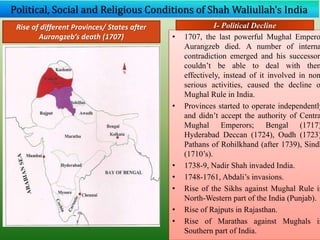
• 1707, the last powerful Mughal Empero
Aurangzeb died. A number of interna
contradiction emerged and his successor
couldn’t be able to deal with them
effectively, instead of it involved in non
serious activities, caused the decline o
Mughal Rule in India.
• Provinces started to operate independently
and didn’t accept the authority of Centra
Mughal Emperors; Bengal (1717)
Hyderabad Deccan (1724), Oudh (1723)
Pathans of Rohilkhand (after 1739), Sindh
(1710’s).
• 1738-9, Nadir Shah invaded India.
• 1748-1761, Abdali’s invasions.
• Rise of the Sikhs against Mughal Rule in
North-Western part of the India (Punjab).
• Rise of Rajputs in Rajasthan.
• Rise of Marathas against Mughals in
Southern part of India.
I- Political Decline
Rise of different Provinces/ States after
Aurangzeb’s death (1707)
Muslim India during the Rise of Shah Waliullah
Moral Decline:
• Even in Aurangzeb’s period, his own
sons were trying to betray him on the
greed of handsome amount, offered by
Marathas, during a battle b/w Mughals &
Marhathas. So, corruption, dishonesty,
wealth-worship were common practices.
Religious Decline:
• Shia-Sunni conflict,
• Hanafi-Shafai conflict,
• Wahdat-ul-Wujudi & Wahdat-ul-Shuhudi
conflicts.
• These were the conditions of sub-
continent which compelled a pious
Muslim scholar of Dehli to introduce
reforms in the society in order to stop
decline of his nation fellow. His name
was Syed Qutub-ud-Din and later he was
called by Shah Waliullah.
• Complete Name: Qutub-ul-Din
• Title: Shah Waliullah
• Born: 21st February 1703 near Delhi
• F/Name: Shah Abdul Rahim, a renown
religious scholar, who contributed in the
compilation of Fatawa Aalamgeeri.
• Teaching Career: In 1718 Shah Waliullah
began teaching at the Madrassa.
• Visit to Arabia: In 1724 Shah Waliullah
went to Arabia to perform Haj and to
further his studies. He studied under the
famous scholar Sheikh Abu Tahir bin
Ibrahim.
• Returned to India & Initiating of
Movement: In 1732, he returned to India
and started to contribute for the
development of Muslim society.
Who was Shah Waliullah?
Moral & Religious Decline of Muslims
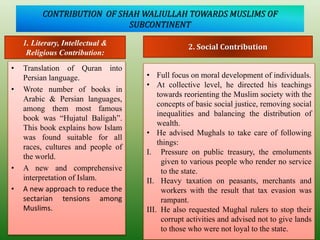
CONTRIBUTION OF SHAH WALIULLAH TOWARDS MUSLIMS OF
SUBCONTINENT
• Translation of Quran into
Persian language.
• Wrote number of books in
Arabic & Persian languages,
among them most famous
book was “Hujatul Baligah”.
This book explains how Islam
was found suitable for all
races, cultures and people of
the world.
• A new and comprehensive
interpretation of Islam.
• A new approach to reduce the
sectarian tensions among
Muslims.
1. Literary, Intellectual &
Religious Contribution:
2. Social Contribution
• Full focus on moral development of individuals.
• At collective level, he directed his teachings
towards reorienting the Muslim society with the
concepts of basic social justice, removing social
inequalities and balancing the distribution of
wealth.
• He advised Mughals to take care of following
things:
I. Pressure on public treasury, the emoluments
given to various people who render no service
to the state.
II. Heavy taxation on peasants, merchants and
workers with the result that tax evasion was
rampant.
III. He also requested Mughal rulers to stop their
corrupt activities and advised not to give lands
to those who were not loyal to the state.
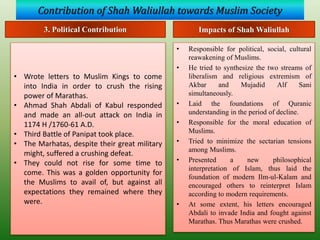
Contribution of Shah Waliullah towards Muslim Society
• Responsible for political, social, cultural
reawakening of Muslims.
• He tried to synthesize the two streams of
liberalism and religious extremism of
Akbar and Mujadid Alf Sani
simultaneously.
• Laid the foundations of Quranic
understanding in the period of decline.
• Responsible for the moral education of
Muslims.
• Tried to minimize the sectarian tensions
among Muslims.
• Presented a new philosophical
interpretation of Islam, thus laid the
foundation of modern Ilm-ul-Kalam and
encouraged others to reinterpret Islam
according to modern requirements.
• At some extent, his letters encouraged
Abdali to invade India and fought against
Marathas. Thus Marathas were crushed.
3. Political Contribution
• Wrote letters to Muslim Kings to come
into India in order to crush the rising
power of Marathas.
• Ahmad Shah Abdali of Kabul responded
and made an all-out attack on India in
1174 H /1760-61 A.D.
• Third Battle of Panipat took place.
• The Marhatas, despite their great military
might, suffered a crushing defeat.
• They could not rise for some time to
come. This was a golden opportunity for
the Muslims to avail of, but against all
expectations they remained where they
were.
Impacts of Shah Waliullah
Suggested Readings
1. S. M. Ikram, “History of Muslim Civilization in India & Pakistan”,
Institute of Islamic Culture
2. S. M. Ikram, “Rod-e-Kausar”, Idara Saqafat-e-Islamia
3. Annemarie Schimmel, “Islam in the Indian Subcontinent”, Sang-e-Meel
Publications
4. I. H. Qureshi, “Bar-e-Sageer Ki Millat-e-Islamiya”
5. Ghulam Hussain Jalbani, “Shah Waliullah G Taleem”, Sindhica Academy
Karachi
6. M.R.Kazmi, “Pakistan Studies: A Textbook”, Oxford University Press

Lecture 03 shah waliullah

  • 1.
    ROLE OF SHAHWALIULLAH & HIS ISLAMIC REVIVALIST MOVEMENT Lecture no 03
  • 2.
    Political, Social andReligious Conditions of Shah Waliullah’s India • 1707, the last powerful Mughal Empero Aurangzeb died. A number of interna contradiction emerged and his successor couldn’t be able to deal with them effectively, instead of it involved in non serious activities, caused the decline o Mughal Rule in India. • Provinces started to operate independently and didn’t accept the authority of Centra Mughal Emperors; Bengal (1717) Hyderabad Deccan (1724), Oudh (1723) Pathans of Rohilkhand (after 1739), Sindh (1710’s). • 1738-9, Nadir Shah invaded India. • 1748-1761, Abdali’s invasions. • Rise of the Sikhs against Mughal Rule in North-Western part of the India (Punjab). • Rise of Rajputs in Rajasthan. • Rise of Marathas against Mughals in Southern part of India. I- Political Decline Rise of different Provinces/ States after Aurangzeb’s death (1707)
  • 3.
    Muslim India duringthe Rise of Shah Waliullah Moral Decline: • Even in Aurangzeb’s period, his own sons were trying to betray him on the greed of handsome amount, offered by Marathas, during a battle b/w Mughals & Marhathas. So, corruption, dishonesty, wealth-worship were common practices. Religious Decline: • Shia-Sunni conflict, • Hanafi-Shafai conflict, • Wahdat-ul-Wujudi & Wahdat-ul-Shuhudi conflicts. • These were the conditions of sub- continent which compelled a pious Muslim scholar of Dehli to introduce reforms in the society in order to stop decline of his nation fellow. His name was Syed Qutub-ud-Din and later he was called by Shah Waliullah. • Complete Name: Qutub-ul-Din • Title: Shah Waliullah • Born: 21st February 1703 near Delhi • F/Name: Shah Abdul Rahim, a renown religious scholar, who contributed in the compilation of Fatawa Aalamgeeri. • Teaching Career: In 1718 Shah Waliullah began teaching at the Madrassa. • Visit to Arabia: In 1724 Shah Waliullah went to Arabia to perform Haj and to further his studies. He studied under the famous scholar Sheikh Abu Tahir bin Ibrahim. • Returned to India & Initiating of Movement: In 1732, he returned to India and started to contribute for the development of Muslim society. Who was Shah Waliullah? Moral & Religious Decline of Muslims
  • 4.
    CONTRIBUTION OF SHAHWALIULLAH TOWARDS MUSLIMS OF SUBCONTINENT • Translation of Quran into Persian language. • Wrote number of books in Arabic & Persian languages, among them most famous book was “Hujatul Baligah”. This book explains how Islam was found suitable for all races, cultures and people of the world. • A new and comprehensive interpretation of Islam. • A new approach to reduce the sectarian tensions among Muslims. 1. Literary, Intellectual & Religious Contribution: 2. Social Contribution • Full focus on moral development of individuals. • At collective level, he directed his teachings towards reorienting the Muslim society with the concepts of basic social justice, removing social inequalities and balancing the distribution of wealth. • He advised Mughals to take care of following things: I. Pressure on public treasury, the emoluments given to various people who render no service to the state. II. Heavy taxation on peasants, merchants and workers with the result that tax evasion was rampant. III. He also requested Mughal rulers to stop their corrupt activities and advised not to give lands to those who were not loyal to the state.
  • 5.
    Contribution of ShahWaliullah towards Muslim Society • Responsible for political, social, cultural reawakening of Muslims. • He tried to synthesize the two streams of liberalism and religious extremism of Akbar and Mujadid Alf Sani simultaneously. • Laid the foundations of Quranic understanding in the period of decline. • Responsible for the moral education of Muslims. • Tried to minimize the sectarian tensions among Muslims. • Presented a new philosophical interpretation of Islam, thus laid the foundation of modern Ilm-ul-Kalam and encouraged others to reinterpret Islam according to modern requirements. • At some extent, his letters encouraged Abdali to invade India and fought against Marathas. Thus Marathas were crushed. 3. Political Contribution • Wrote letters to Muslim Kings to come into India in order to crush the rising power of Marathas. • Ahmad Shah Abdali of Kabul responded and made an all-out attack on India in 1174 H /1760-61 A.D. • Third Battle of Panipat took place. • The Marhatas, despite their great military might, suffered a crushing defeat. • They could not rise for some time to come. This was a golden opportunity for the Muslims to avail of, but against all expectations they remained where they were. Impacts of Shah Waliullah
  • 6.
    Suggested Readings 1. S.M. Ikram, “History of Muslim Civilization in India & Pakistan”, Institute of Islamic Culture 2. S. M. Ikram, “Rod-e-Kausar”, Idara Saqafat-e-Islamia 3. Annemarie Schimmel, “Islam in the Indian Subcontinent”, Sang-e-Meel Publications 4. I. H. Qureshi, “Bar-e-Sageer Ki Millat-e-Islamiya” 5. Ghulam Hussain Jalbani, “Shah Waliullah G Taleem”, Sindhica Academy Karachi 6. M.R.Kazmi, “Pakistan Studies: A Textbook”, Oxford University Press

Editor's Notes

  • #3 (Source: Keynoyer, “Ancient Cities of Indus Civilization”, Oxford University Press)
  • #5 (Source: Athar Mubarakpur, “Arab O Hind: Ahd-e-Risalt Men”, & “Arab O Hind Ahd-e-Khilafat-e-Rashida Men”, Fikr o Nazar Publications Sukkur)
  • #6 (Source: Baladhri, Futuh-ul-Buladan, & Chachnama)