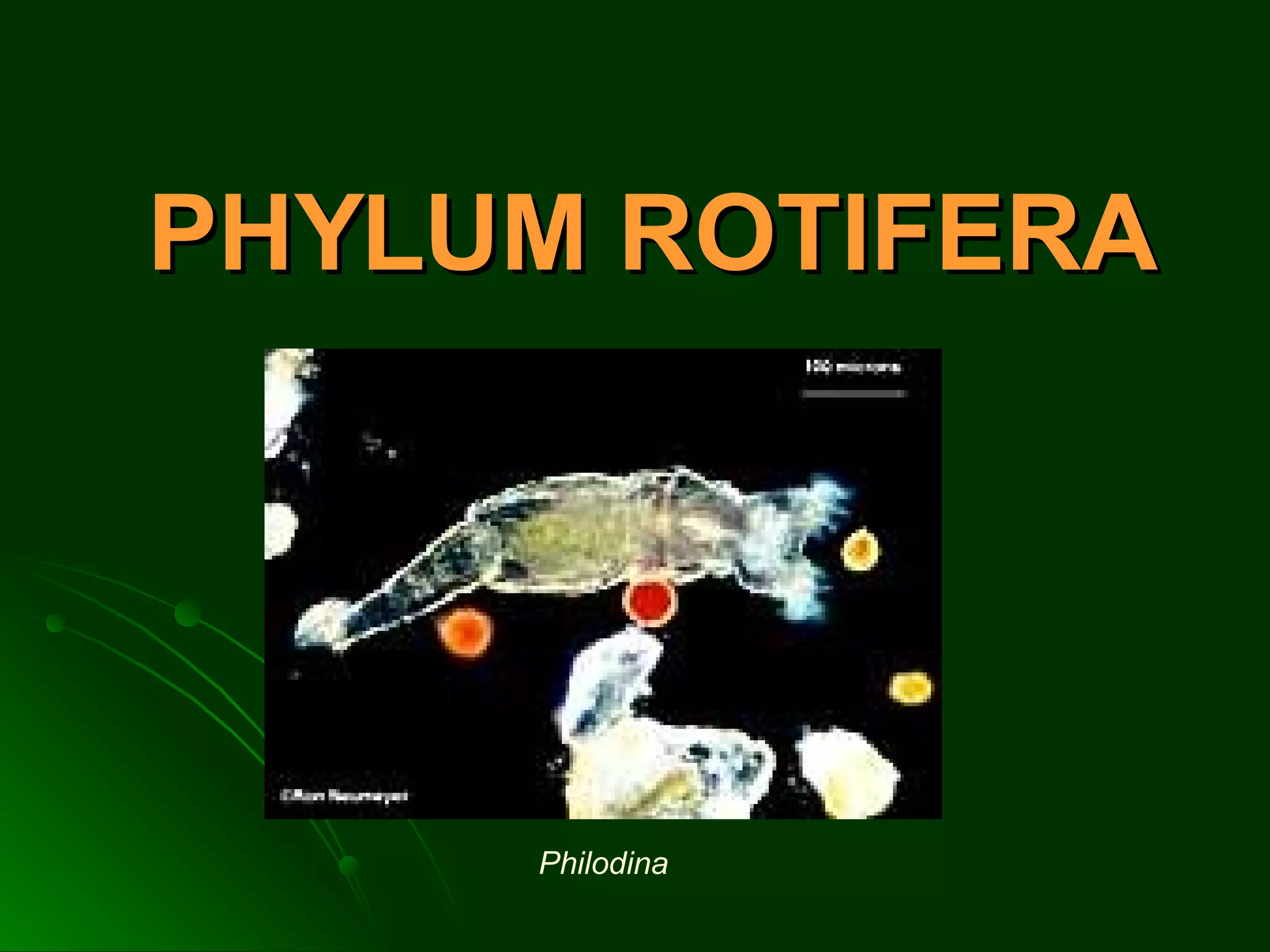
PHYLUM ROTIFERA Philodina
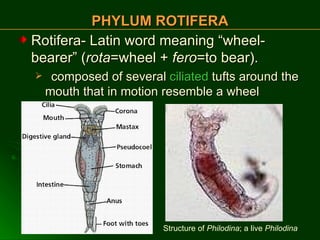
PHYLUM ROTIFERA Rotifera- Latin word meaning “wheel-bearer” ( rota =wheel +  fero =to bear). composed of several  ciliated  tufts around the mouth that in motion resemble a wheel  Structure of  Philodina ; a live  Philodina
2000 species throughout the world. - freshwater inhabitants - marine - terrestrial - epizoic or parasitic - benthic – swim or creep on vegetation Range in size – 40 µ m- 3mm in length. - most are between 100-500 µm long. Some have beautiful colors, most are transparent. PHYLUM ROTIFERA
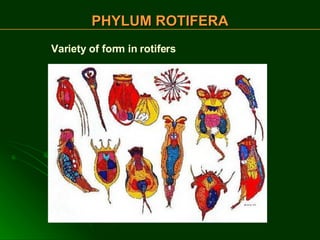
The morphology is very diverse, but their body is cylindrical or spherical. Floaters - globular & saclike Creepers & swimmers – elongated and wormlike Sessile - vaselike  PHYLUM ROTIFERA
PHYLUM ROTIFERA Variety of form in rotifers
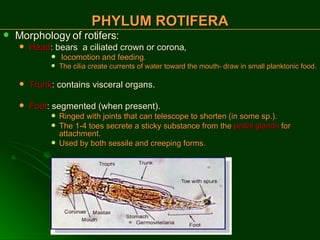
PHYLUM ROTIFERA Morphology of rotifers: Head : bears  a ciliated crown or corona , locomotion and feeding . The cilia create currents of water toward the mouth- draw in small planktonic food. Trunk : contains visceral organs. Foot : segmented (when present). Ringed with joints that can telescope to shorten (in some sp.). The 1-4 toes secrete a sticky substance from the  pedal glands  for attachment. Used by both sessile and creeping forms.
 
Digestive system- complete Omnivorous: feed by sweeping minute organic particles / algae forward the mouth by the beating of the coronal cilia. Carnivorous (some sp.)- feed on protozoa & small metazoans- capture by trapping or grasping. Trappers - funnel-shape area around the mouth to capture prey. Hunters - trophi that can be projected & used like forceps to seize prey. PHYLUM ROTIFERA
Pharynx  ( mastax ) fitted with a muscular portion that is equipped with hard jaws ( trophi )- sucking & grinding up food particles. Absorption occurs in the stomach. PHYLUM ROTIFERA
 
 
Reproduction: Female rotifers (have 1 or 2 syncytial ovaries  (germovitellaria) . Produce yolk as well as oocytes. Rotifers are dioecous, but males are unknown in many species. (Dioecous- having male & female organs in separate individuals). PHYLUM ROTIFERA
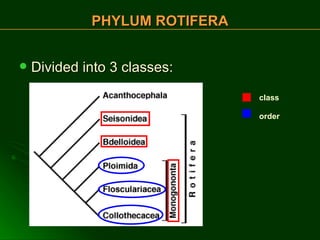
Divided into 3 classes: PHYLUM ROTIFERA class order
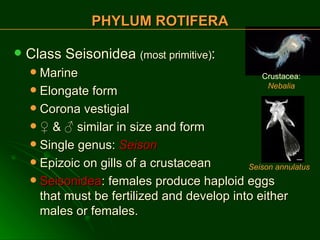
Class Seisonidea  (most primitive) : Marine Elongate form Corona vestigial ♀   & ♂  similar in size and form Single genus:  Seison Epizoic on gills of a crustacean Seisonidea : females produce haploid eggs that must be fertilized and develop into either males or females. PHYLUM ROTIFERA Crustacea:  Nebalia Seison annulatus
Class Bdelloidea: Swimming or creeping forms Anterior end rectractile Corona usually with pair of trochal discs Males unknown 2 germovitellaria PHYLUM ROTIFERA
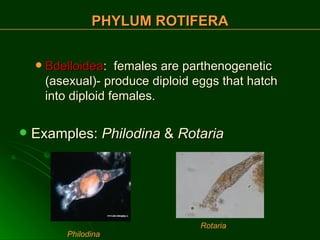
Bdelloidea :  females are parthenogenetic (asexual)- produce diploid eggs that hatch into diploid females. Examples:  Philodina  &  Rotaria PHYLUM ROTIFERA Philodina Rotaria
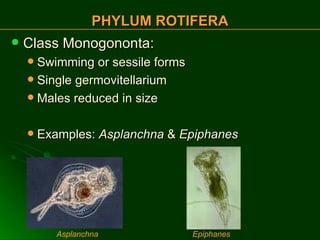
Class Monogononta:  Swimming or sessile forms Single germovitellarium Males reduced in size Examples:  Asplanchna  &  Epiphanes PHYLUM ROTIFERA Asplanchna Epiphanes
PHYLUM ROTIFERA Monogononta : females produce two kinds of eggs; Amictic  eggs- diploid eggs that have not undergone reduction division, cannot be fertilized & develop only into females.  Mictic  eggs- undergone meiosis and are haploid- if: Unfertilized- develop quickly into males. Fertilized- they secrete a thick shell and become dormant for several months before developing into females.
The importance of rotifers in the ecosystems??? PHYLUM ROTIFERA

Phylum Rotifera

  • 1.
  • 2.
    PHYLUM ROTIFERA Rotifera-Latin word meaning “wheel-bearer” ( rota =wheel + fero =to bear). composed of several ciliated tufts around the mouth that in motion resemble a wheel Structure of Philodina ; a live Philodina
  • 3.
    2000 species throughoutthe world. - freshwater inhabitants - marine - terrestrial - epizoic or parasitic - benthic – swim or creep on vegetation Range in size – 40 µ m- 3mm in length. - most are between 100-500 µm long. Some have beautiful colors, most are transparent. PHYLUM ROTIFERA
  • 4.
    The morphology isvery diverse, but their body is cylindrical or spherical. Floaters - globular & saclike Creepers & swimmers – elongated and wormlike Sessile - vaselike PHYLUM ROTIFERA
  • 5.
    PHYLUM ROTIFERA Varietyof form in rotifers
  • 6.
    PHYLUM ROTIFERA Morphologyof rotifers: Head : bears  a ciliated crown or corona , locomotion and feeding . The cilia create currents of water toward the mouth- draw in small planktonic food. Trunk : contains visceral organs. Foot : segmented (when present). Ringed with joints that can telescope to shorten (in some sp.). The 1-4 toes secrete a sticky substance from the pedal glands for attachment. Used by both sessile and creeping forms.
  • 7.
  • 8.
    Digestive system- completeOmnivorous: feed by sweeping minute organic particles / algae forward the mouth by the beating of the coronal cilia. Carnivorous (some sp.)- feed on protozoa & small metazoans- capture by trapping or grasping. Trappers - funnel-shape area around the mouth to capture prey. Hunters - trophi that can be projected & used like forceps to seize prey. PHYLUM ROTIFERA
  • 9.
    Pharynx (mastax ) fitted with a muscular portion that is equipped with hard jaws ( trophi )- sucking & grinding up food particles. Absorption occurs in the stomach. PHYLUM ROTIFERA
  • 10.
  • 11.
  • 12.
    Reproduction: Female rotifers(have 1 or 2 syncytial ovaries (germovitellaria) . Produce yolk as well as oocytes. Rotifers are dioecous, but males are unknown in many species. (Dioecous- having male & female organs in separate individuals). PHYLUM ROTIFERA
  • 13.
    Divided into 3classes: PHYLUM ROTIFERA class order
  • 14.
    Class Seisonidea (most primitive) : Marine Elongate form Corona vestigial ♀ & ♂ similar in size and form Single genus: Seison Epizoic on gills of a crustacean Seisonidea : females produce haploid eggs that must be fertilized and develop into either males or females. PHYLUM ROTIFERA Crustacea: Nebalia Seison annulatus
  • 15.
    Class Bdelloidea: Swimmingor creeping forms Anterior end rectractile Corona usually with pair of trochal discs Males unknown 2 germovitellaria PHYLUM ROTIFERA
  • 16.
    Bdelloidea : females are parthenogenetic (asexual)- produce diploid eggs that hatch into diploid females. Examples: Philodina & Rotaria PHYLUM ROTIFERA Philodina Rotaria
  • 17.
    Class Monogononta: Swimming or sessile forms Single germovitellarium Males reduced in size Examples: Asplanchna & Epiphanes PHYLUM ROTIFERA Asplanchna Epiphanes
  • 18.
    PHYLUM ROTIFERA Monogononta: females produce two kinds of eggs; Amictic eggs- diploid eggs that have not undergone reduction division, cannot be fertilized & develop only into females. Mictic eggs- undergone meiosis and are haploid- if: Unfertilized- develop quickly into males. Fertilized- they secrete a thick shell and become dormant for several months before developing into females.
  • 19.
    The importance ofrotifers in the ecosystems??? PHYLUM ROTIFERA