SUMMER TRAINING
AT
Satellite Communication
By:
Vandana Manral
ECE-B, 4th Year
Univ. roll no.: 120070102121
To:
Dr. Sandeep Sharma
HOD
ECE DEPT. DITU
Overview
 About ONGC.
 Introduction.
 Advantages and Disadvantages.
 Orbit Types.
 Satellite Modules.
 How Satellites are used.
 Frequency Bands.
 Multiple Access Techniques.
 Earth Station.
 Specification of Earth Station at ONGC.
ONGC
 ONGC is an Indian multinational oil and gas company
headquartered in Dehradun. ONGC was set up under the
visionary leadership of Pandit Jawaharlal Nehru.
 It is a public sector undertaking of government of India, under
the administrative control of the ministry of petroleum and
natural gas.
 It produces around 72% of India’s crude oil and around 48% of
its natural gas.
 It is involved in exploring hydrocarbons in 26 sedimentary
basins of India, and owns and operates over 1100km of
pipelines in the country.
INTRODUCTION:
 A satellite is an object which has been placed into orbit by
human endeavour.
 Satellites are used for a large number of purposes. Common
types include military (spy) and Earth observation satellites,
communication satellites, navigation satellites, weather
satellites, and research satellites.
 Satellites are usually semi-independent computer controlled
systems. Satellite subsystems attend many tasks, such as
power generation, thermal control, telemetry, altitude control
and orbit control.
Advantages and disadvantages
 Advantages:
 The coverage area of a satellite greatly exceeds that of a
terrestrial system.
 Transmission cost of a satellite is independent of the
distance from the center of the coverage area.
 Higher Bandwidths are available for use.
 Disadvantages:
 Launching satellites into orbit is costly.
 There is a larger propagation delay in satellite
communication than in terrestrial communication.
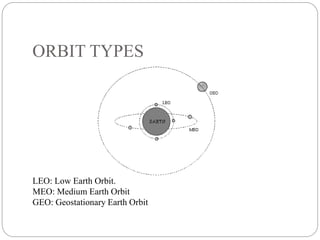
ORBIT TYPES
LEO: Low Earth Orbit.
MEO: Medium Earth Orbit
GEO: Geostationary Earth Orbit
Low Earth Orbit (LEO):
 LEO satellites are much closer to the earth than GEO
satellites, ranging from 500 to 1,500 km above the surface.
 A LEO satellite’s proximity to earth compared to a GEO
satellite gives it a better signal strength and less of a time
delay, which makes it better for point to point
communication.
 A network of LEO satellites is needed, which can be
costly.
Medium Earth Orbit (MEO):
 A MEO satellite is in orbit somewhere between 8,000 km
and 18,000 km above the earth’s surface.
 MEO satellites have a larger coverage area than LEO
satellites.
 A MEO satellite’s longer duration of visibility and wider
footprint means fewer satellites are needed in a MEO
network than a LEO network.
 A MEO satellite’s distance gives it a longer time delay and
weaker signal than a LEO satellite, though not as bad as a
GEO satellite.
Geostationary Earth Orbit (GEO):
 These satellites are in orbit 35,863 km above the earth’s
surface along the equator.
 Objects in Geostationary orbit revolve around the earth at
the same speed as the earth rotates. This means GEO
satellites remain in the same position relative to the surface
of earth.
 A GEO satellite’s distance from earth gives it a large
coverage area, almost a fourth of the earth’s surface.
GEO (contd.)
 A GEO satellite’s distance also cause it to have both a
comparatively weak signal and a time delay in the signal,
which is bad for point to point communication.
 GEO satellites, centred above the equator, have difficulty
broadcasting signals to near Polar Regions.
 At the Geostationary orbit the satellite covers 42.2% of the
earth’s surface.
 Theoretically 3 geostationary satellites provide 100% earth
coverage.
Satellite Modules
 Spacecraft bus or service module
 The Structural Subsystems: The structural subsystem provides
the mechanical base structure, shields the satellite from extreme
temperature changes and micro-meteorite damage, and controls
the satellite’s spin functions.
 The Telemetry Subsystems :The telemetry subsystem monitors
the on-board equipment operations, transmits equipment
operation data to the earth control station, and receives the earth
control station’s commands to perform equipment operation
adjustments.
 The Power Subsystems: The power subsystem consists of solar
panels and backup batteries that generate power when the
satellite passes into the earth’s shadow.
Satellite Module (contd.)
 The Thermal Control Subsystems: The thermal control
subsystem helps protect electronic equipment from
extreme temperatures due to intense sunlight or the lack of
sun exposure on different sides of the satellite’s body (e.g.
Optical Solar Reflector)
 The Orbit Controlled Control Subsystems: The orbit
controlled subsystem consists of small rocket thrusters that
keep the satellite in the correct orbital position and keep
antennas positioning in the right directions.
Satellite Module (contd.)
 Communication payload:
The second major module is the communication payload,
which is made up of transponders. Transponders are
capable of:
 Receiving uplinked radio signals from earth satellite
transmission stations (antennas).
 Amplifying received radio signals
 Sorting the input signals and directing the output signals
through input/output signal multiplexers to the proper
downlink antennas for retransmission to earth satellite
receiving stations (antennas).
How Satellites are used
 Service Types
 Fixed Service Satellites (FSS)
Example: Point to Point Communication
 Broadcast Service Satellites (BSS)
Example: Satellite Television/Radio
Also called Direct Broadcast Service (DBS).
 Mobile Service Satellites (MSS)
Example: Satellite Phones
Frequency Bands
 Different kinds of satellites use different frequency bands.
 L–Band: 1 to 2 GHz, used by MSS
 S-Band: 2 to 4 GHz, used by MSS, NASA, deep space
research
 C-Band: 4 to 8 GHz, used by FSS
 X-Band: 8 to 12.5 GHz, used by FSS and in terrestrial
imaging, ex: military and meteorological satellites
 Ku-Band: 12.5 to 18 GHz: used by FSS and BSS (DBS)
 K-Band: 18 to 26.5 GHz: used by FSS and BSS
 Ka-Band: 26.5 to 40 GHz: used by FSS
Multiple Access Techniques
 Multiple accesses is defined as the technique where in more
than one pair of earth stations can simultaneously use a satellite
transponder. It is a technique used to explore the satellite’s
geometric advantages and is at the core of satellite networking.
 If the different transmissions are differentiated only for the
frequency band, we have the Frequency Division Multiple
Access (FDMA).
 If transmissions are distinguished on the basis of time, then they
are considered as Time Division Multiple Access (TDMA).
 Finally, if a different code is adopted to separate simultaneous
transmissions, we have the Code Division Multiple Access
(CDMA).
Earth Station:
 Earth Stations are a vital element in any satellite
communication network. The function of an earth station
receive from and transmit information to the satellite
network in the most cost efficient and reliable manner
while retaining the desired signal quality.
 Depending on the earth application, an earth station may
have both transmit and receive capabilities or may only be
capable of either transmission or reception.
Components of Earth Station
 The transmitter is a ground station which sends information to
the satellite. The transmission is done by means of the
transmitting antenna. The uplink frequency ranges from 5.9-5 to
6.4-5 GHz or may also vary from 10.95-11.26GHz.
 From a transmitter, the link between satellite and receiver is
known as downlink and frequency used is called as downlink
frequency. The downlink frequency ranges from 3.70-4,2GHz or
may also vary from 11.45-11.70GHz.
 Satellite is a device that performs two functions at the same
time. One is that it receives the information originated from
ground station (transmitter) and then secondly it sends this
information to another ground station (receiver).
Specification of Earth Station at
ONGC
 Satellite: In ONGC INSAT 3B was used earlier but now
GSAT 10 is used.
 Location: 83 degree
 Frequency:
Uplink: 6.050MHz
Downlink:3.825 MHz
 Transponder no.: 15
 Bandwidth: 36MHz
 Antenna: Cassegrain antennas ( in C-band frequency
range which are generally 11m in diameter and are centre
feed).
References
 Wertz, James R. and Wiley J.Larson, Space Mission Analysis and Design, Microcosm Press, El
Segundo CA 1999
 Peterson and Davie, on reserve in Barker Library
http://www.isl.stanford.edu/people/gray/fundcom.pdf
 Center for Satellite and Hybrid Communication Networks: http://www.isr.umd.edu/CSHCN// Lloyd's
satellite constellations http://www.sat-net.com/L.Wood/constellations/
 Feldman, Phillip M., An overview and comparison of demand assignment multiple access (DAMA)
concepts for satellite communications networks Santa Monica, CA: RAND, 1996. , Student Project
Report, 2000.
 F. Ananasso, F. Delli Pricoli, "The Role of Satellites in Personal Communications Services," IEEE
Journal on Selected Areas in Communications," V 13, N 2, (February 1995), pp.180-195.
 A. Guntsch. Analysis of the ATDMA/PRMA++ Protocol in a Mobile Satellite Environment. In
Proceedings 46th IEEE Vehicular Technology Conference '96, pp. 1225-1229, Atlanta, U.S.A., April
1996.
Questions?
THANK YOU

ongc satellite communication

  • 1.
  • 2.
    Satellite Communication By: Vandana Manral ECE-B,4th Year Univ. roll no.: 120070102121 To: Dr. Sandeep Sharma HOD ECE DEPT. DITU
  • 3.
    Overview  About ONGC. Introduction.  Advantages and Disadvantages.  Orbit Types.  Satellite Modules.  How Satellites are used.  Frequency Bands.  Multiple Access Techniques.  Earth Station.  Specification of Earth Station at ONGC.
  • 4.
    ONGC  ONGC isan Indian multinational oil and gas company headquartered in Dehradun. ONGC was set up under the visionary leadership of Pandit Jawaharlal Nehru.  It is a public sector undertaking of government of India, under the administrative control of the ministry of petroleum and natural gas.  It produces around 72% of India’s crude oil and around 48% of its natural gas.  It is involved in exploring hydrocarbons in 26 sedimentary basins of India, and owns and operates over 1100km of pipelines in the country.
  • 5.
    INTRODUCTION:  A satelliteis an object which has been placed into orbit by human endeavour.  Satellites are used for a large number of purposes. Common types include military (spy) and Earth observation satellites, communication satellites, navigation satellites, weather satellites, and research satellites.  Satellites are usually semi-independent computer controlled systems. Satellite subsystems attend many tasks, such as power generation, thermal control, telemetry, altitude control and orbit control.
  • 6.
    Advantages and disadvantages Advantages:  The coverage area of a satellite greatly exceeds that of a terrestrial system.  Transmission cost of a satellite is independent of the distance from the center of the coverage area.  Higher Bandwidths are available for use.  Disadvantages:  Launching satellites into orbit is costly.  There is a larger propagation delay in satellite communication than in terrestrial communication.
  • 7.
    ORBIT TYPES LEO: LowEarth Orbit. MEO: Medium Earth Orbit GEO: Geostationary Earth Orbit
  • 8.
    Low Earth Orbit(LEO):  LEO satellites are much closer to the earth than GEO satellites, ranging from 500 to 1,500 km above the surface.  A LEO satellite’s proximity to earth compared to a GEO satellite gives it a better signal strength and less of a time delay, which makes it better for point to point communication.  A network of LEO satellites is needed, which can be costly.
  • 9.
    Medium Earth Orbit(MEO):  A MEO satellite is in orbit somewhere between 8,000 km and 18,000 km above the earth’s surface.  MEO satellites have a larger coverage area than LEO satellites.  A MEO satellite’s longer duration of visibility and wider footprint means fewer satellites are needed in a MEO network than a LEO network.  A MEO satellite’s distance gives it a longer time delay and weaker signal than a LEO satellite, though not as bad as a GEO satellite.
  • 10.
    Geostationary Earth Orbit(GEO):  These satellites are in orbit 35,863 km above the earth’s surface along the equator.  Objects in Geostationary orbit revolve around the earth at the same speed as the earth rotates. This means GEO satellites remain in the same position relative to the surface of earth.  A GEO satellite’s distance from earth gives it a large coverage area, almost a fourth of the earth’s surface.
  • 11.
    GEO (contd.)  AGEO satellite’s distance also cause it to have both a comparatively weak signal and a time delay in the signal, which is bad for point to point communication.  GEO satellites, centred above the equator, have difficulty broadcasting signals to near Polar Regions.  At the Geostationary orbit the satellite covers 42.2% of the earth’s surface.  Theoretically 3 geostationary satellites provide 100% earth coverage.
  • 12.
    Satellite Modules  Spacecraftbus or service module  The Structural Subsystems: The structural subsystem provides the mechanical base structure, shields the satellite from extreme temperature changes and micro-meteorite damage, and controls the satellite’s spin functions.  The Telemetry Subsystems :The telemetry subsystem monitors the on-board equipment operations, transmits equipment operation data to the earth control station, and receives the earth control station’s commands to perform equipment operation adjustments.  The Power Subsystems: The power subsystem consists of solar panels and backup batteries that generate power when the satellite passes into the earth’s shadow.
  • 13.
    Satellite Module (contd.) The Thermal Control Subsystems: The thermal control subsystem helps protect electronic equipment from extreme temperatures due to intense sunlight or the lack of sun exposure on different sides of the satellite’s body (e.g. Optical Solar Reflector)  The Orbit Controlled Control Subsystems: The orbit controlled subsystem consists of small rocket thrusters that keep the satellite in the correct orbital position and keep antennas positioning in the right directions.
  • 14.
    Satellite Module (contd.) Communication payload: The second major module is the communication payload, which is made up of transponders. Transponders are capable of:  Receiving uplinked radio signals from earth satellite transmission stations (antennas).  Amplifying received radio signals  Sorting the input signals and directing the output signals through input/output signal multiplexers to the proper downlink antennas for retransmission to earth satellite receiving stations (antennas).
  • 15.
    How Satellites areused  Service Types  Fixed Service Satellites (FSS) Example: Point to Point Communication  Broadcast Service Satellites (BSS) Example: Satellite Television/Radio Also called Direct Broadcast Service (DBS).  Mobile Service Satellites (MSS) Example: Satellite Phones
  • 16.
    Frequency Bands  Differentkinds of satellites use different frequency bands.  L–Band: 1 to 2 GHz, used by MSS  S-Band: 2 to 4 GHz, used by MSS, NASA, deep space research  C-Band: 4 to 8 GHz, used by FSS  X-Band: 8 to 12.5 GHz, used by FSS and in terrestrial imaging, ex: military and meteorological satellites  Ku-Band: 12.5 to 18 GHz: used by FSS and BSS (DBS)  K-Band: 18 to 26.5 GHz: used by FSS and BSS  Ka-Band: 26.5 to 40 GHz: used by FSS
  • 17.
    Multiple Access Techniques Multiple accesses is defined as the technique where in more than one pair of earth stations can simultaneously use a satellite transponder. It is a technique used to explore the satellite’s geometric advantages and is at the core of satellite networking.  If the different transmissions are differentiated only for the frequency band, we have the Frequency Division Multiple Access (FDMA).  If transmissions are distinguished on the basis of time, then they are considered as Time Division Multiple Access (TDMA).  Finally, if a different code is adopted to separate simultaneous transmissions, we have the Code Division Multiple Access (CDMA).
  • 18.
    Earth Station:  EarthStations are a vital element in any satellite communication network. The function of an earth station receive from and transmit information to the satellite network in the most cost efficient and reliable manner while retaining the desired signal quality.  Depending on the earth application, an earth station may have both transmit and receive capabilities or may only be capable of either transmission or reception.
  • 19.
    Components of EarthStation  The transmitter is a ground station which sends information to the satellite. The transmission is done by means of the transmitting antenna. The uplink frequency ranges from 5.9-5 to 6.4-5 GHz or may also vary from 10.95-11.26GHz.  From a transmitter, the link between satellite and receiver is known as downlink and frequency used is called as downlink frequency. The downlink frequency ranges from 3.70-4,2GHz or may also vary from 11.45-11.70GHz.  Satellite is a device that performs two functions at the same time. One is that it receives the information originated from ground station (transmitter) and then secondly it sends this information to another ground station (receiver).
  • 20.
    Specification of EarthStation at ONGC  Satellite: In ONGC INSAT 3B was used earlier but now GSAT 10 is used.  Location: 83 degree  Frequency: Uplink: 6.050MHz Downlink:3.825 MHz  Transponder no.: 15  Bandwidth: 36MHz  Antenna: Cassegrain antennas ( in C-band frequency range which are generally 11m in diameter and are centre feed).
  • 21.
    References  Wertz, JamesR. and Wiley J.Larson, Space Mission Analysis and Design, Microcosm Press, El Segundo CA 1999  Peterson and Davie, on reserve in Barker Library http://www.isl.stanford.edu/people/gray/fundcom.pdf  Center for Satellite and Hybrid Communication Networks: http://www.isr.umd.edu/CSHCN// Lloyd's satellite constellations http://www.sat-net.com/L.Wood/constellations/  Feldman, Phillip M., An overview and comparison of demand assignment multiple access (DAMA) concepts for satellite communications networks Santa Monica, CA: RAND, 1996. , Student Project Report, 2000.  F. Ananasso, F. Delli Pricoli, "The Role of Satellites in Personal Communications Services," IEEE Journal on Selected Areas in Communications," V 13, N 2, (February 1995), pp.180-195.  A. Guntsch. Analysis of the ATDMA/PRMA++ Protocol in a Mobile Satellite Environment. In Proceedings 46th IEEE Vehicular Technology Conference '96, pp. 1225-1229, Atlanta, U.S.A., April 1996.
  • 22.
  • 23.