Solar food processing
By- Nisarg Shah (13BME100)
What is solar food processing?
 Increasing population and high cost of fuels have created
opportunities for using alternate energies for post-harvest
processing of foods.
 Solar food processing is an emerging technology that
provides good quality foods at low or no additional fuel
costs with the help of solar energy
Why do we need solar food processing?
 Most of the times food needs to be processed before it is
consumed in its final form.
 For example :- pasteurization of milk, roasting of Coffee
etc.
 Dehydration is one of the most important steps for
preservation and value addition of food products through
moisture control.
Dehydration of foods
 Conduction, convection and radiation are the basic
techniques by which water is forced to vapourise and the
resulting vapour is removed either naturally or by force
resulting in dehydration. Conventional convective drying is
used for drying fruits and vegetables .However, this
process also brings in some important changes in physical
and chemical properties such as loss of color and change of
texture, flavour and loss of nutrients.
 While high temperature used during the processing are
responsible for the alterations, lowering temperature
increases the time of dehydration therefore increase in
cost. Since fresh fruits and vegetables contain over 80 %
moisture, the process of dehydration to a desirable lower
moisture content such as 5–10 % is very energy
consuming.
 The process of dehydration alone contributes up to 30 % of
the total cost of processing of most fresh produce. Thus,
the cost of dehydration and energy consumption and
quality of dried products play very important role in
choosing an appropriate drying process.
 Solar food processing brings in two emerging technologies
together to solve the two major problems the world facing
in 21st century, namely:
 How to generate energy enough for an expanding global
population?
 How to feed the constantly expanding world population?
 Open sun drying is one of the oldest methods and
traditionally practiced for preserving many vegetables,
fruits and marine products all over the world.
 Dehydrated foods have higher shelf life, making them
available throughout the year, even in off season.
 Because of their relatively low weight and low volume, the
dehydrated products are easy to store as well as transport
across distances.
Solar collectors, concentrators and
dryers in food processing
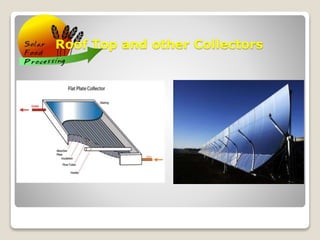
 Roof Top and other Collectors
 Double Pass Solar Collector backed Solar Drying System
 Fresnel Paraboloid Concentrating Solar Collector System
 Scheffler Reflectors
Roof Top and other Collectors
Double Pass Solar Collector backed
Solar Drying System
Fresnel Paraboloid Concentrating Solar
Collector System
Scheffler Reflectors
Solar Dryers
 Open air
 Direct solar dryer
 Indirect solar dryer
 Hybrid dryer
 Mixed dryers
Open air
 Food is exposed to Sun in open containers or on the
ground. No protection from extraneous
contamination
Chilli drying in Peru
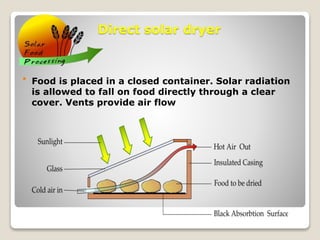
Direct solar dryer
 Food is placed in a closed container. Solar radiation
is allowed to fall on food directly through a clear
cover. Vents provide air flow
Indirect solar dryer
 Fresh air is heated in a solar heat collector and
passed through the food placed in a drying chamber.
Thus the food is not directly exposed to solar
radiation
Hybrid dryer
 Drying is done using Solar heat as well as
conventional electricity, fossil fuel/biomass
Mixed dryers
 Food is dried through direct sun as well as by hot air
heated through a separate solar heat collector
Bibliography
 J Food Sci Technol (March–April 2013) 50(2):209–227
DOI 10.1007/s13197-012-0739-3
 https://en.wikipedia.org/wiki/Concentrated_solar_power
 European Journal of Sustainable Development (2013), 2, 4,
131-140 ISSN: 2239-5938
 Energy Procedia 48 ( 2014 ) 1194 – 1201
doi: 10.1016/j.egypro.2014.02.135
SHC 2013, International Conference on Solar Heating and
Cooling for Buildings and Industry, September 23-25,
2013, Freiburg, Germany
 Pics –google images
Thank you

Solar food processing

  • 1.
    Solar food processing By-Nisarg Shah (13BME100)
  • 2.
    What is solarfood processing?  Increasing population and high cost of fuels have created opportunities for using alternate energies for post-harvest processing of foods.  Solar food processing is an emerging technology that provides good quality foods at low or no additional fuel costs with the help of solar energy
  • 3.
    Why do weneed solar food processing?  Most of the times food needs to be processed before it is consumed in its final form.  For example :- pasteurization of milk, roasting of Coffee etc.  Dehydration is one of the most important steps for preservation and value addition of food products through moisture control.
  • 4.
    Dehydration of foods Conduction, convection and radiation are the basic techniques by which water is forced to vapourise and the resulting vapour is removed either naturally or by force resulting in dehydration. Conventional convective drying is used for drying fruits and vegetables .However, this process also brings in some important changes in physical and chemical properties such as loss of color and change of texture, flavour and loss of nutrients.
  • 5.
     While hightemperature used during the processing are responsible for the alterations, lowering temperature increases the time of dehydration therefore increase in cost. Since fresh fruits and vegetables contain over 80 % moisture, the process of dehydration to a desirable lower moisture content such as 5–10 % is very energy consuming.  The process of dehydration alone contributes up to 30 % of the total cost of processing of most fresh produce. Thus, the cost of dehydration and energy consumption and quality of dried products play very important role in choosing an appropriate drying process.
  • 6.
     Solar foodprocessing brings in two emerging technologies together to solve the two major problems the world facing in 21st century, namely:  How to generate energy enough for an expanding global population?  How to feed the constantly expanding world population?
  • 7.
     Open sundrying is one of the oldest methods and traditionally practiced for preserving many vegetables, fruits and marine products all over the world.  Dehydrated foods have higher shelf life, making them available throughout the year, even in off season.  Because of their relatively low weight and low volume, the dehydrated products are easy to store as well as transport across distances.
  • 8.
    Solar collectors, concentratorsand dryers in food processing  Roof Top and other Collectors  Double Pass Solar Collector backed Solar Drying System  Fresnel Paraboloid Concentrating Solar Collector System  Scheffler Reflectors
  • 9.
    Roof Top andother Collectors
  • 10.
    Double Pass SolarCollector backed Solar Drying System
  • 11.
    Fresnel Paraboloid ConcentratingSolar Collector System
  • 12.
  • 13.
    Solar Dryers  Openair  Direct solar dryer  Indirect solar dryer  Hybrid dryer  Mixed dryers
  • 14.
    Open air  Foodis exposed to Sun in open containers or on the ground. No protection from extraneous contamination Chilli drying in Peru
  • 15.
    Direct solar dryer Food is placed in a closed container. Solar radiation is allowed to fall on food directly through a clear cover. Vents provide air flow
  • 16.
    Indirect solar dryer Fresh air is heated in a solar heat collector and passed through the food placed in a drying chamber. Thus the food is not directly exposed to solar radiation
  • 17.
    Hybrid dryer  Dryingis done using Solar heat as well as conventional electricity, fossil fuel/biomass
  • 18.
    Mixed dryers  Foodis dried through direct sun as well as by hot air heated through a separate solar heat collector
  • 19.
    Bibliography  J FoodSci Technol (March–April 2013) 50(2):209–227 DOI 10.1007/s13197-012-0739-3  https://en.wikipedia.org/wiki/Concentrated_solar_power  European Journal of Sustainable Development (2013), 2, 4, 131-140 ISSN: 2239-5938  Energy Procedia 48 ( 2014 ) 1194 – 1201 doi: 10.1016/j.egypro.2014.02.135 SHC 2013, International Conference on Solar Heating and Cooling for Buildings and Industry, September 23-25, 2013, Freiburg, Germany  Pics –google images
  • 20.