SOLAR DRYER
D. KESAVEDEV
MECHANICAL ENGINEERING
CONTENTS
• INTRODUCTION
• SOLAR DRYER
• TYPES OF SOLAR DRYERS
• PRINCIPLE OF SOLAR DRYER
• NEED OF SOLAR DRYER
• ADVANTAGE AND DISADVANTAGE OF SOLAR DRYER
• APPLICATION OF SOLAR DRYER
• CONCLUSION
• REFERENCES
INTRODUCTION
• Solar energy is one of the greatest source of renewable energy that comes from the sun‘s
rays. The purpose of solar drying is to minimize the moisture content of products to a
level that can prevents its spoilage.
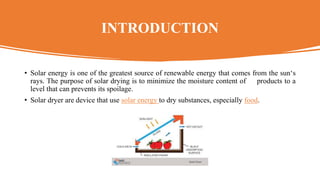
• Solar dryer are device that use solar energy to dry substances, especially food.
TYPES OF SOLAR DRYER
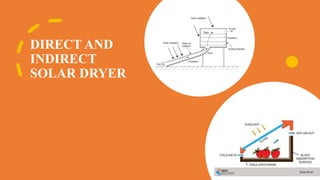
• DIRECT SOLAR DRYER
Direct solar dryer expose the substance to be dehydrated to direct sunlight they have a
black absorbing surface which collects the light and converts it to heat; the substance to be
dried us placed directly on this surface. These driers may have enclosures, glass covers and/
or vents to in order to increase efficiency.
• INDIRECT SOLAR DRYER
In Indirect solar dryer , the black surface heats incoming air, rather than directly
heating the substance to be dried. This heated air is then passed over the substance and exits
through a chimney, taking moisture from the substance with it.
DIRECT AND
INDIRECT
SOLAR DRYER
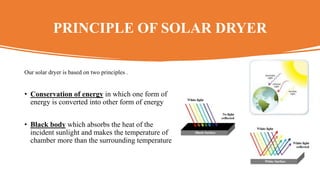
PRINCIPLE OF SOLAR DRYER
Our solar dryer is based on two principles .
• Conservation of energy in which one form of
energy is converted into other form of energy
• Black body which absorbs the heat of the
incident sunlight and makes the temperature of
chamber more than the surrounding temperature.
NEED OF
SOLAR
DRYER
• Heat intensity is double than open sun’s heat –
A solar dryer can get inside temperature like
72°C while the outdoor temperature is still
32°C. This makes the dryers take away
moisture from food products and dry it rapidly
which is 5 times faster than sunlight heating.
This will increase operational productivity with
a reduced drying period.
• Can be used even on rainy days – A Rainy
climate is not suitable for the drying process.
But using solar dryers can retain heat up to a
maximum of 46°C compared to a mere outside
temperature of 26°C. Reducing the reliance on
labor to keep and store products in case of rain
and strong winds can be avoided.
• Normal drying methods not only attract flies,
dust, and other microbes, it also hassles during
the rainy season. As Solar dryers have enclosed
space this is no longer a problem.
ADVANTAGES OF SOLAR DRYER
• Mush less time is required for drying as compared to direct drying because of black body.
• Protection of the drying products from insects but also from birds, dogs, especially for
drying meat and fish.
• The product is hygienic because microorganisms, insects and flies are killed
• Protection of rain.
• Protection of pollution by dust etc.
• Protection of the wind which can blow away the food.
DISADVANTAGES OF SOLAR DRYER
• Not workable at night.
• Efficiency decreases to a large extent on cloudy days.
• Over heating may occur if regular attention is not paid.
• Change in taste and flavor of food may occur if regular monitoring is not done.
• We can not get the accurate amount of sun rays and heat.
APPLICATION
OF SOLAR
DRYER
• Textiles
• Wood
• Fruits and food processing
• Paper
• Pharmaceutical
• Agro-Industry
CONCLUSION
• In a country like India where 300 days out of 365 days are sunny have a huge assets of
solar energy. Government is also promoting the use of renewable sources energy like
solar energy by providing subsidies on solar pumps, solar water heater, solar panels, solar
lights etc.
• Use of solar energy costs us nothing just only solar panel, sunlight is free of cost and sun
is a non finishing source of energy.
• Almost every year there are news of rotten food grains in newspaper which causes a huge
loss to farmers but if we design those go downs on the concept of black body then such
condition will not occur.
REFERENCES
[1] Abhay Bhanudas Lingayat, V.P. Chandramohan, V.R.K. Raju, Venkatesh Meda. A review
on indirect type solar dryers for agricultural crops – Dryer setup, its performance, energy
storage and important highlights. Applied Energy 258 (2020) 114005.
[2] S. Dhanushkodi, Vincent H. Wilson, K. Sudhakar, Mathematical modeling of drying
behaviour of cashew in a solar biomass hybrid dryer, Resource-Efficient Technologies
(2016), doi: 10.1016/j.reffit.2016.12.002.
THANK YOU

solar dryer.pptx

  • 1.
  • 2.
    CONTENTS • INTRODUCTION • SOLARDRYER • TYPES OF SOLAR DRYERS • PRINCIPLE OF SOLAR DRYER • NEED OF SOLAR DRYER • ADVANTAGE AND DISADVANTAGE OF SOLAR DRYER • APPLICATION OF SOLAR DRYER • CONCLUSION • REFERENCES
  • 3.
    INTRODUCTION • Solar energyis one of the greatest source of renewable energy that comes from the sun‘s rays. The purpose of solar drying is to minimize the moisture content of products to a level that can prevents its spoilage. • Solar dryer are device that use solar energy to dry substances, especially food.
  • 4.
    TYPES OF SOLARDRYER • DIRECT SOLAR DRYER Direct solar dryer expose the substance to be dehydrated to direct sunlight they have a black absorbing surface which collects the light and converts it to heat; the substance to be dried us placed directly on this surface. These driers may have enclosures, glass covers and/ or vents to in order to increase efficiency. • INDIRECT SOLAR DRYER In Indirect solar dryer , the black surface heats incoming air, rather than directly heating the substance to be dried. This heated air is then passed over the substance and exits through a chimney, taking moisture from the substance with it.
  • 5.
  • 6.
    PRINCIPLE OF SOLARDRYER Our solar dryer is based on two principles . • Conservation of energy in which one form of energy is converted into other form of energy • Black body which absorbs the heat of the incident sunlight and makes the temperature of chamber more than the surrounding temperature.
  • 7.
    NEED OF SOLAR DRYER • Heatintensity is double than open sun’s heat – A solar dryer can get inside temperature like 72°C while the outdoor temperature is still 32°C. This makes the dryers take away moisture from food products and dry it rapidly which is 5 times faster than sunlight heating. This will increase operational productivity with a reduced drying period. • Can be used even on rainy days – A Rainy climate is not suitable for the drying process. But using solar dryers can retain heat up to a maximum of 46°C compared to a mere outside temperature of 26°C. Reducing the reliance on labor to keep and store products in case of rain and strong winds can be avoided. • Normal drying methods not only attract flies, dust, and other microbes, it also hassles during the rainy season. As Solar dryers have enclosed space this is no longer a problem.
  • 8.
    ADVANTAGES OF SOLARDRYER • Mush less time is required for drying as compared to direct drying because of black body. • Protection of the drying products from insects but also from birds, dogs, especially for drying meat and fish. • The product is hygienic because microorganisms, insects and flies are killed • Protection of rain. • Protection of pollution by dust etc. • Protection of the wind which can blow away the food.
  • 9.
    DISADVANTAGES OF SOLARDRYER • Not workable at night. • Efficiency decreases to a large extent on cloudy days. • Over heating may occur if regular attention is not paid. • Change in taste and flavor of food may occur if regular monitoring is not done. • We can not get the accurate amount of sun rays and heat.
  • 10.
    APPLICATION OF SOLAR DRYER • Textiles •Wood • Fruits and food processing • Paper • Pharmaceutical • Agro-Industry
  • 11.
    CONCLUSION • In acountry like India where 300 days out of 365 days are sunny have a huge assets of solar energy. Government is also promoting the use of renewable sources energy like solar energy by providing subsidies on solar pumps, solar water heater, solar panels, solar lights etc. • Use of solar energy costs us nothing just only solar panel, sunlight is free of cost and sun is a non finishing source of energy. • Almost every year there are news of rotten food grains in newspaper which causes a huge loss to farmers but if we design those go downs on the concept of black body then such condition will not occur.
  • 12.
    REFERENCES [1] Abhay BhanudasLingayat, V.P. Chandramohan, V.R.K. Raju, Venkatesh Meda. A review on indirect type solar dryers for agricultural crops – Dryer setup, its performance, energy storage and important highlights. Applied Energy 258 (2020) 114005. [2] S. Dhanushkodi, Vincent H. Wilson, K. Sudhakar, Mathematical modeling of drying behaviour of cashew in a solar biomass hybrid dryer, Resource-Efficient Technologies (2016), doi: 10.1016/j.reffit.2016.12.002.
  • 13.