9((99
FLOW
 Radiation induced cell death
 Cell survival curve
 LQ model
 Clinical application
 Limitations
CELL DEATH
 Differentiated cells that do not proliferate (eg. Nerve,
Muscle, Secretory cells) death can be defined as the loss of
specific function.
 Proliferating cells (eg. Haematopoietic system, Intestinal
epithelium) death can be defined as loss of capacity of
sustained proliferation i.e. Reproductive Death.
 The most common form of cell death from radiation is
MITOTIC DEATH (Cells die attempting to divide becoz of
damaged chromosomes)
Radiation Induced Cell Death
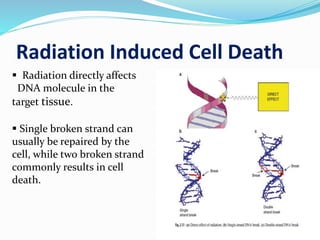
 Radiation directly affects
DNA molecule in the
target tissue.
 Single broken strand can
usually be repaired by the
cell, while two broken strand
commonly results in cell
death.
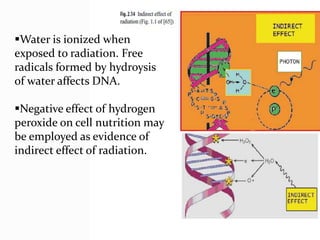
Water is ionized when
exposed to radiation. Free
radicals formed by hydroysis
of water affects DNA.
Negative effect of hydrogen
peroxide on cell nutrition may
be employed as evidence of
indirect effect of radiation.
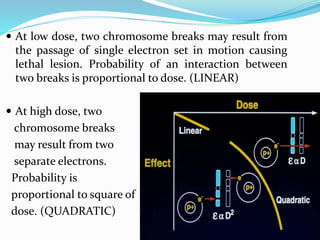
 At low dose, two chromosome breaks may result from
the passage of single electron set in motion causing
lethal lesion. Probability of an interaction between
two breaks is proportional to dose. (LINEAR)
 At high dose, two
chromosome breaks
may result from two
separate electrons.
Probability is
proportional to square of
dose. (QUADRATIC)
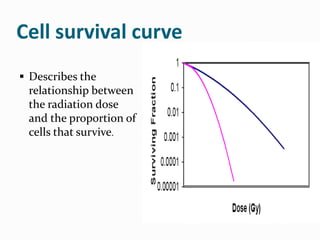
Cell survival curve
 Describes the
relationship between
the radiation dose
and the proportion of
cells that survive.
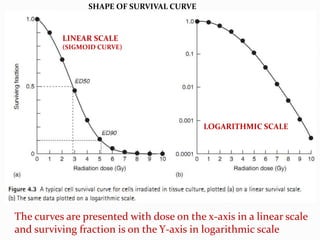
LINEAR SCALE
(SIGMOID CURVE)
LOGARITHMIC SCALE
SHAPE OF SURVIVAL CURVE
The curves are presented with dose on the x-axis in a linear scale
and surviving fraction is on the Y-axis in logarithmic scale
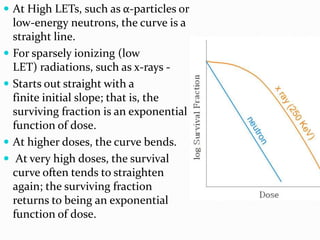
 At High LETs, such as α-particles or
low-energy neutrons, the curve is a
straight line.
 For sparsely ionizing (low
LET) radiations, such as x-rays -
 Starts out straight with a
finite initial slope; that is, the
surviving fraction is an exponential
function of dose.
 At higher doses, the curve bends.
 At very high doses, the survival
curve often tends to straighten
again; the surviving fraction
returns to being an exponential
function of dose.
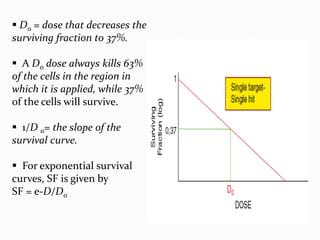
 D0 = dose that decreases the
surviving fraction to 37%.
 A D0 dose always kills 63%
of the cells in the region in
which it is applied, while 37%
of the cells will survive.
 1/D 0= the slope of the
survival curve.
 For exponential survival
curves, SF is given by
SF = e-D/D0
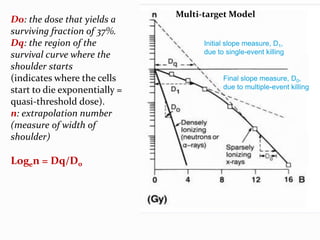
D0: the dose that yields a
surviving fraction of 37%.
Dq: the region of the
survival curve where the
shoulder starts
(indicates where the cells
start to die exponentially =
quasi-threshold dose).
n: extrapolation number
(measure of width of
shoulder)
Logen = Dq/D0
Multi-target Model
Initial slope measure, D1,
due to single-event killing
Final slope measure, D0,
due to multiple-event killing
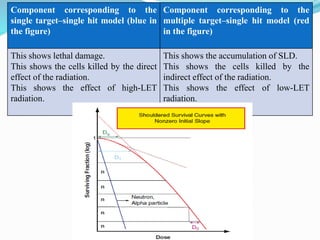
Component corresponding to the
single target–single hit model (blue in
the figure)
Component corresponding to the
multiple target–single hit model (red
in the figure)
This shows lethal damage.
This shows the cells killed by the direct
effect of the radiation.
This shows the effect of high-LET
radiation.
This shows the accumulation of SLD.
This shows the cells killed by the
indirect effect of the radiation.
This shows the effect of low-LET
radiation.
Model Used Before The LQ Model
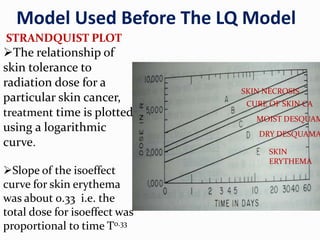
STRANDQUIST PLOT
The relationship of
skin tolerance to
radiation dose for a
particular skin cancer,
treatment time is plotted
using a logarithmic
curve.
Slope of the isoeffect
curve for skin erythema
was about 0.33 i.e. the
total dose for isoeffect was
proportional to time T0.33
SKIN
ERYTHEMA
DRY DESQUAMA
MOIST DESQUAM
CURE OF SKIN CA
SKIN NECROSIS
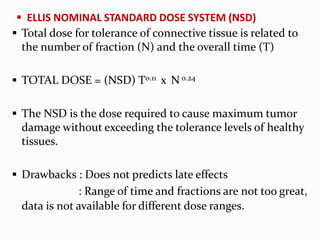
 ELLIS NOMINAL STANDARD DOSE SYSTEM (NSD)
 Total dose for tolerance of connective tissue is related to
the number of fraction (N) and the overall time (T)
 TOTAL DOSE = (NSD) T0.11 x N 0.24
 The NSD is the dose required to cause maximum tumor
damage without exceeding the tolerance levels of healthy
tissues.
 Drawbacks : Does not predicts late effects
: Range of time and fractions are not too great,
data is not available for different dose ranges.
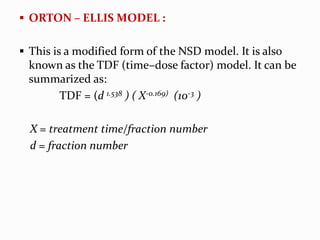
 ORTON – ELLIS MODEL :
 This is a modified form of the NSD model. It is also
known as the TDF (time–dose factor) model. It can be
summarized as:
TDF = (d 1.538 ) ( X-0.169) (10-3 )
X = treatment time/fraction number
d = fraction number
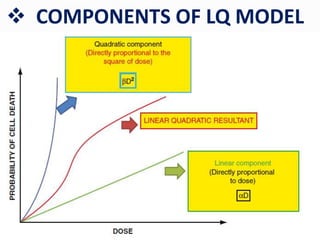
 COMPONENTS OF LQ MODEL
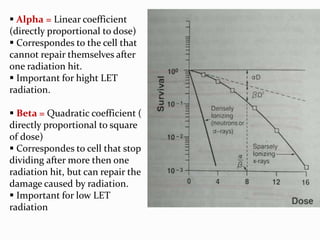
 Alpha = Linear coefficient
(directly proportional to dose)
 Correspondes to the cell that
cannot repair themselves after
one radiation hit.
 Important for hight LET
radiation.
 Beta = Quadratic coefficient (
directly proportional to square
of dose)
 Correspondes to cell that stop
dividing after more then one
radiation hit, but can repair the
damage caused by radiation.
 Important for low LET
radiation
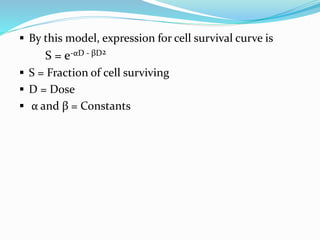
 By this model, expression for cell survival curve is
S = e-αD - βD2
 S = Fraction of cell surviving
 D = Dose
 α and β = Constants
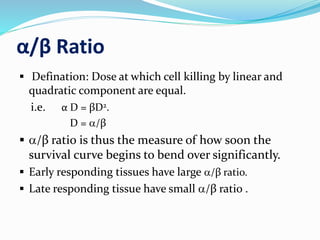
α/β Ratio
 Defination: Dose at which cell killing by linear and
quadratic component are equal.
i.e. α D = βD2.
D = a/β
 a/β ratio is thus the measure of how soon the
survival curve begins to bend over significantly.
 Early responding tissues have large a/β ratio.
 Late responding tissue have small a/β ratio .
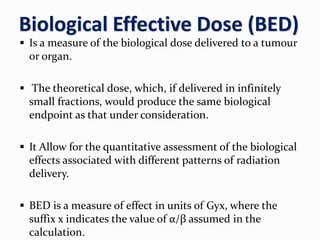
Biological Effective Dose (BED)
 Is a measure of the biological dose delivered to a tumour
or organ.
 The theoretical dose, which, if delivered in infinitely
small fractions, would produce the same biological
endpoint as that under consideration.
 It Allow for the quantitative assessment of the biological
effects associated with different patterns of radiation
delivery.
 BED is a measure of effect in units of Gyx, where the
suffix x indicates the value of α/β assumed in the
calculation.
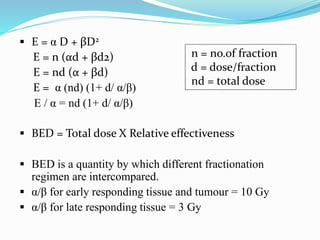
 E = α D + βD2
E = n (αd + βd2)
E = nd (α + βd)
E = α (nd) (1+ d/ α/β)
E / α = nd (1+ d/ α/β)
 BED = Total dose X Relative effectiveness
 BED is a quantity by which different fractionation
regimen are intercompared.
 α/β for early responding tissue and tumour = 10 Gy
 α/β for late responding tissue = 3 Gy
n = no.of fraction
d = dose/fraction
nd = total dose
Tissue Response To Radiation
 Early responding tissue : skin, mucosa, intestinal
epithelium, testis
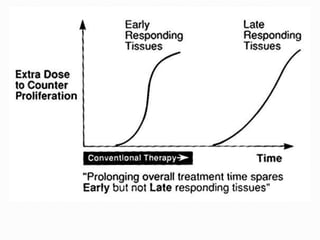
 Late responding tissue : spinal cord, kidney, lung, bladder
 Early responding tissue are fast proliferating, so
redistribution occurs through all the phases of the cell
cycle, which is considered as SELF SENSITIZING
ACTIVITY.
 Fast proliferation itself is a form of resistance becoz new
cells produced by division offset those killed by dose
fractions. This applies to acutely responding tissues and
tumour.
 Late responding tissue are resistant becoz of presence
of many resting cells.
 This type of resistance applies particularly to small
doses per fraction and disappears at large doses per
fraction.
 Fraction size is the dominant factor in determining
late effects, overall treatment time has little influence.
 By contrast, fraction size and overall treatment time
both determine the response of acutely responding
tissue.
 Late responding tissues are more sensitive to changes
in fractionation pattern than early responding tissue.
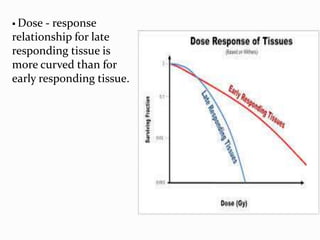
 Dose - response
relationship for late
responding tissue is
more curved than for
early responding tissue.
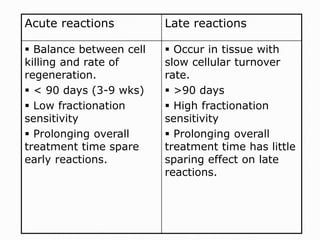
Acute reactions Late reactions
 Balance between cell
killing and rate of
regeneration.
 < 90 days (3-9 wks)
 Low fractionation
sensitivity
 Prolonging overall
treatment time spare
early reactions.
 Occur in tissue with
slow cellular turnover
rate.
 >90 days
 High fractionation
sensitivity
 Prolonging overall
treatment time has little
sparing effect on late
reactions.
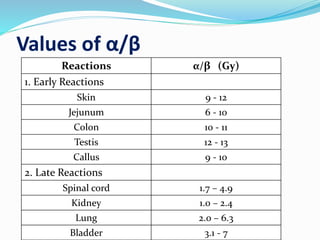
Values of α/β
Reactions α/β (Gy)
1. Early Reactions
Skin 9 - 12
Jejunum 6 - 10
Colon 10 - 11
Testis 12 - 13
Callus 9 - 10
2. Late Reactions
Spinal cord 1.7 – 4.9
Kidney 1.0 – 2.4
Lung 2.0 – 6.3
Bladder 3.1 - 7
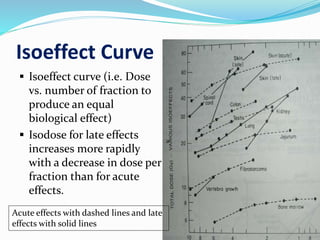
Isoeffect Curve
 Isoeffect curve (i.e. Dose
vs. number of fraction to
produce an equal
biological effect)
 Isodose for late effects
increases more rapidly
with a decrease in dose per
fraction than for acute
effects.
Acute effects with dashed lines and late
effects with solid lines
Clinical Application Of LQ Model
 Comparing different fractionation schemes
 Calculate ‘equivalent’ fractionation schemes
 Changing dose per fraction
 Correcting treatment gaps
 Changing overall treatment time
 Changing time interval between dose fractions
 Allowance for tumour proliferation
 To get information on acute and late responses
FRACTIONATION
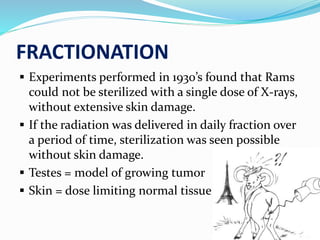
 Experiments performed in 1930’s found that Rams
could not be sterilized with a single dose of X-rays,
without extensive skin damage.
 If the radiation was delivered in daily fraction over
a period of time, sterilization was seen possible
without skin damage.
 Testes = model of growing tumor
 Skin = dose limiting normal tissue
 Dividing a dose into a no. of fraction
1. Spares normal tissue:
-repair of sublethal damage.
-repopulation of normal cells.
2. Increases damage to tumour cells:
-reoxgenation.
-reassortment.
-radiosensitivity
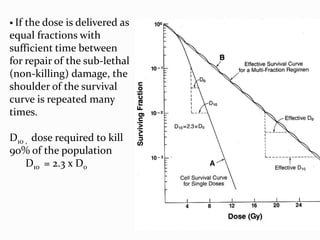
 If the dose is delivered as
equal fractions with
sufficient time between
for repair of the sub-lethal
(non-killing) damage, the
shoulder of the survival
curve is repeated many
times.
D10 , dose required to kill
90% of the population
D10 = 2.3 x D0
Comparison Of Various Head Neck Cancers
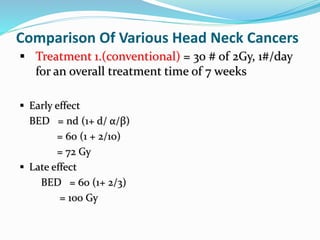
 Treatment 1.(conventional) = 30 # of 2Gy, 1#/day
for an overall treatment time of 7 weeks
 Early effect
BED = nd (1+ d/ α/β)
= 60 (1 + 2/10)
= 72 Gy
 Late effect
BED = 60 (1+ 2/3)
= 100 Gy
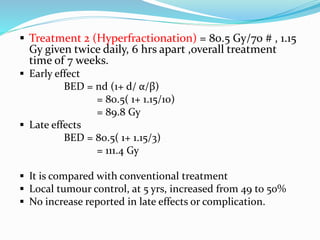
 Treatment 2 (Hyperfractionation) = 80.5 Gy/70 # , 1.15
Gy given twice daily, 6 hrs apart ,overall treatment
time of 7 weeks.
 Early effect
BED = nd (1+ d/ α/β)
= 80.5( 1+ 1.15/10)
= 89.8 Gy
 Late effects
BED = 80.5( 1+ 1.15/3)
= 111.4 Gy
 It is compared with conventional treatment
 Local tumour control, at 5 yrs, increased from 49 to 50%
 No increase reported in late effects or complication.
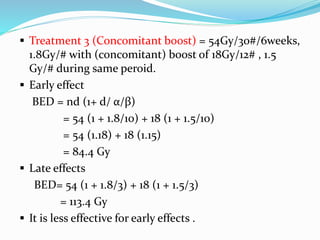
 Treatment 3 (Concomitant boost) = 54Gy/30#/6weeks,
1.8Gy/# with (concomitant) boost of 18Gy/12# , 1.5
Gy/# during same peroid.
 Early effect
BED = nd (1+ d/ α/β)
= 54 (1 + 1.8/10) + 18 (1 + 1.5/10)
= 54 (1.18) + 18 (1.15)
= 84.4 Gy
 Late effects
BED= 54 (1 + 1.8/3) + 18 (1 + 1.5/3)
= 113.4 Gy
 It is less effective for early effects .
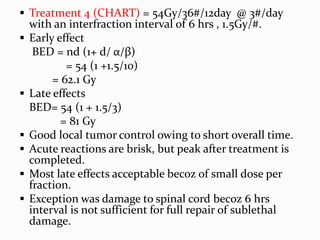
 Treatment 4 (CHART) = 54Gy/36#/12day @ 3#/day
with an interfraction interval of 6 hrs , 1.5Gy/#.
 Early effect
BED = nd (1+ d/ α/β)
= 54 (1 +1.5/10)
= 62.1 Gy
 Late effects
BED= 54 (1 + 1.5/3)
= 81 Gy
 Good local tumor control owing to short overall time.
 Acute reactions are brisk, but peak after treatment is
completed.
 Most late effects acceptable becoz of small dose per
fraction.
 Exception was damage to spinal cord becoz 6 hrs
interval is not sufficient for full repair of sublethal
damage.
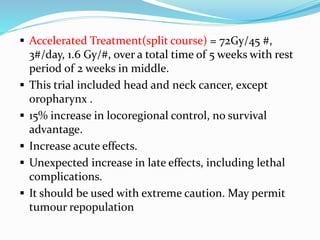
 Accelerated Treatment(split course) = 72Gy/45 #,
3#/day, 1.6 Gy/#, over a total time of 5 weeks with rest
period of 2 weeks in middle.
 This trial included head and neck cancer, except
oropharynx .
 15% increase in locoregional control, no survival
advantage.
 Increase acute effects.
 Unexpected increase in late effects, including lethal
complications.
 It should be used with extreme caution. May permit
tumour repopulation
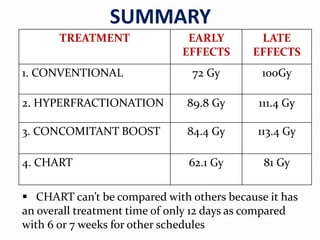
SUMMARY
TREATMENT EARLY
EFFECTS
LATE
EFFECTS
1. CONVENTIONAL 72 Gy 100Gy
2. HYPERFRACTIONATION 89.8 Gy 111.4 Gy
3. CONCOMITANT BOOST 84.4 Gy 113.4 Gy
4. CHART 62.1 Gy 81 Gy
 CHART can’t be compared with others because it has
an overall treatment time of only 12 days as compared
with 6 or 7 weeks for other schedules
HYPOFRACTIONATION
 Increased dose per fraction but it would lead to
increased late toxicity.
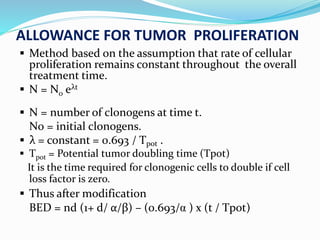
ALLOWANCE FOR TUMOR PROLIFERATION
 Method based on the assumption that rate of cellular
proliferation remains constant throughout the overall
treatment time.
 N = N0 eλt
 N = number of clonogens at time t.
N0 = initial clonogens.
 λ = constant = 0.693 / Tpot .
 Tpot = Potential tumor doubling time (Tpot)
It is the time required for clonogenic cells to double if cell
loss factor is zero.
 Thus after modification
BED = nd (1+ d/ α/β) – (0.693/α ) x (t / Tpot)
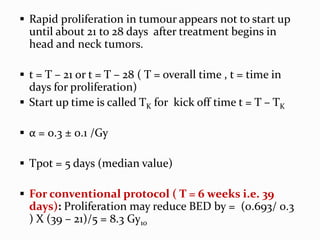
 Rapid proliferation in tumour appears not to start up
until about 21 to 28 days after treatment begins in
head and neck tumors.
 t = T – 21 or t = T – 28 ( T = overall time , t = time in
days for proliferation)
 Start up time is called TK for kick off time t = T – TK
 α = 0.3 ± 0.1 /Gy
 Tpot = 5 days (median value)
 For conventional protocol ( T = 6 weeks i.e. 39
days): Proliferation may reduce BED by = (0.693/ 0.3
) X (39 – 21)/5 = 8.3 Gy10
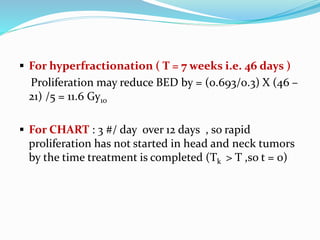
 For hyperfractionation ( T = 7 weeks i.e. 46 days )
Proliferation may reduce BED by = (0.693/0.3) X (46 –
21) /5 = 11.6 Gy10
 For CHART : 3 #/ day over 12 days , so rapid
proliferation has not started in head and neck tumors
by the time treatment is completed (Tk > T ,so t = 0)
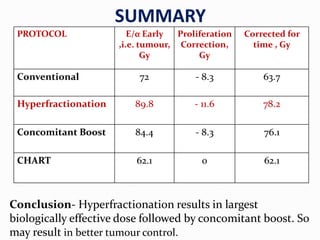
SUMMARY
PROTOCOL E/α Early
,i.e. tumour,
Gy
Proliferation
Correction,
Gy
Corrected for
time , Gy
Conventional 72 - 8.3 63.7
Hyperfractionation 89.8 - 11.6 78.2
Concomitant Boost 84.4 - 8.3 76.1
CHART 62.1 0 62.1
Conclusion- Hyperfractionation results in largest
biologically effective dose followed by concomitant boost. So
may result in better tumour control.
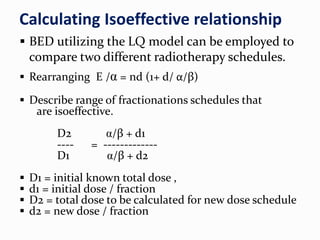
Calculating Isoeffective relationship
 BED utilizing the LQ model can be employed to
compare two different radiotherapy schedules.
 Rearranging E /α = nd (1+ d/ α/β)
 Describe range of fractionations schedules that
are isoeffective.
D2 α/β + d1
---- = -------------
D1 α/β + d2
 D1 = initial known total dose ,
 d1 = initial dose / fraction
 D2 = total dose to be calculated for new dose schedule
 d2 = new dose / fraction
EXAMPLE : Let us suppose we are giving 40Gy/16# for a tumour
@ 2.5Gy/#. But we want to give4Gy/#.
i.e. D1 = 40 Gy, d1 = 2.5 Gy, d2 = 4 Gy
D2/D1 = d1+ (α /β ) / d2 + (α /β)
D2=40 [2.5 + 10/4 +10 ]
D2=40[12.5/14]
D2=35.72Gy
So we have to give 35.72 Gy in 9 #.
Limitations of LQ model
 Applies best within dose range of 2-8 Gy /#
application beyond that is not established.
THANK YOU

Linear quadratic model ppt

  • 1.
  • 2.
    FLOW  Radiation inducedcell death  Cell survival curve  LQ model  Clinical application  Limitations
  • 3.
    CELL DEATH  Differentiatedcells that do not proliferate (eg. Nerve, Muscle, Secretory cells) death can be defined as the loss of specific function.  Proliferating cells (eg. Haematopoietic system, Intestinal epithelium) death can be defined as loss of capacity of sustained proliferation i.e. Reproductive Death.  The most common form of cell death from radiation is MITOTIC DEATH (Cells die attempting to divide becoz of damaged chromosomes)
  • 4.
    Radiation Induced CellDeath  Radiation directly affects DNA molecule in the target tissue.  Single broken strand can usually be repaired by the cell, while two broken strand commonly results in cell death.
  • 5.
    Water is ionizedwhen exposed to radiation. Free radicals formed by hydroysis of water affects DNA. Negative effect of hydrogen peroxide on cell nutrition may be employed as evidence of indirect effect of radiation.
  • 6.
     At lowdose, two chromosome breaks may result from the passage of single electron set in motion causing lethal lesion. Probability of an interaction between two breaks is proportional to dose. (LINEAR)  At high dose, two chromosome breaks may result from two separate electrons. Probability is proportional to square of dose. (QUADRATIC)
  • 7.
    Cell survival curve Describes the relationship between the radiation dose and the proportion of cells that survive.
  • 8.
    LINEAR SCALE (SIGMOID CURVE) LOGARITHMICSCALE SHAPE OF SURVIVAL CURVE The curves are presented with dose on the x-axis in a linear scale and surviving fraction is on the Y-axis in logarithmic scale
  • 9.
     At HighLETs, such as α-particles or low-energy neutrons, the curve is a straight line.  For sparsely ionizing (low LET) radiations, such as x-rays -  Starts out straight with a finite initial slope; that is, the surviving fraction is an exponential function of dose.  At higher doses, the curve bends.  At very high doses, the survival curve often tends to straighten again; the surviving fraction returns to being an exponential function of dose.
  • 10.
     D0 =dose that decreases the surviving fraction to 37%.  A D0 dose always kills 63% of the cells in the region in which it is applied, while 37% of the cells will survive.  1/D 0= the slope of the survival curve.  For exponential survival curves, SF is given by SF = e-D/D0
  • 11.
    D0: the dosethat yields a surviving fraction of 37%. Dq: the region of the survival curve where the shoulder starts (indicates where the cells start to die exponentially = quasi-threshold dose). n: extrapolation number (measure of width of shoulder) Logen = Dq/D0 Multi-target Model Initial slope measure, D1, due to single-event killing Final slope measure, D0, due to multiple-event killing
  • 12.
    Component corresponding tothe single target–single hit model (blue in the figure) Component corresponding to the multiple target–single hit model (red in the figure) This shows lethal damage. This shows the cells killed by the direct effect of the radiation. This shows the effect of high-LET radiation. This shows the accumulation of SLD. This shows the cells killed by the indirect effect of the radiation. This shows the effect of low-LET radiation.
  • 13.
    Model Used BeforeThe LQ Model STRANDQUIST PLOT The relationship of skin tolerance to radiation dose for a particular skin cancer, treatment time is plotted using a logarithmic curve. Slope of the isoeffect curve for skin erythema was about 0.33 i.e. the total dose for isoeffect was proportional to time T0.33 SKIN ERYTHEMA DRY DESQUAMA MOIST DESQUAM CURE OF SKIN CA SKIN NECROSIS
  • 14.
     ELLIS NOMINALSTANDARD DOSE SYSTEM (NSD)  Total dose for tolerance of connective tissue is related to the number of fraction (N) and the overall time (T)  TOTAL DOSE = (NSD) T0.11 x N 0.24  The NSD is the dose required to cause maximum tumor damage without exceeding the tolerance levels of healthy tissues.  Drawbacks : Does not predicts late effects : Range of time and fractions are not too great, data is not available for different dose ranges.
  • 15.
     ORTON –ELLIS MODEL :  This is a modified form of the NSD model. It is also known as the TDF (time–dose factor) model. It can be summarized as: TDF = (d 1.538 ) ( X-0.169) (10-3 ) X = treatment time/fraction number d = fraction number
  • 16.
  • 17.
     Alpha =Linear coefficient (directly proportional to dose)  Correspondes to the cell that cannot repair themselves after one radiation hit.  Important for hight LET radiation.  Beta = Quadratic coefficient ( directly proportional to square of dose)  Correspondes to cell that stop dividing after more then one radiation hit, but can repair the damage caused by radiation.  Important for low LET radiation
  • 18.
     By thismodel, expression for cell survival curve is S = e-αD - βD2  S = Fraction of cell surviving  D = Dose  α and β = Constants
  • 19.
    α/β Ratio  Defination:Dose at which cell killing by linear and quadratic component are equal. i.e. α D = βD2. D = a/β  a/β ratio is thus the measure of how soon the survival curve begins to bend over significantly.  Early responding tissues have large a/β ratio.  Late responding tissue have small a/β ratio .
  • 20.
    Biological Effective Dose(BED)  Is a measure of the biological dose delivered to a tumour or organ.  The theoretical dose, which, if delivered in infinitely small fractions, would produce the same biological endpoint as that under consideration.  It Allow for the quantitative assessment of the biological effects associated with different patterns of radiation delivery.  BED is a measure of effect in units of Gyx, where the suffix x indicates the value of α/β assumed in the calculation.
  • 21.
     E =α D + βD2 E = n (αd + βd2) E = nd (α + βd) E = α (nd) (1+ d/ α/β) E / α = nd (1+ d/ α/β)  BED = Total dose X Relative effectiveness  BED is a quantity by which different fractionation regimen are intercompared.  α/β for early responding tissue and tumour = 10 Gy  α/β for late responding tissue = 3 Gy n = no.of fraction d = dose/fraction nd = total dose
  • 22.
    Tissue Response ToRadiation  Early responding tissue : skin, mucosa, intestinal epithelium, testis  Late responding tissue : spinal cord, kidney, lung, bladder  Early responding tissue are fast proliferating, so redistribution occurs through all the phases of the cell cycle, which is considered as SELF SENSITIZING ACTIVITY.  Fast proliferation itself is a form of resistance becoz new cells produced by division offset those killed by dose fractions. This applies to acutely responding tissues and tumour.
  • 23.
     Late respondingtissue are resistant becoz of presence of many resting cells.  This type of resistance applies particularly to small doses per fraction and disappears at large doses per fraction.  Fraction size is the dominant factor in determining late effects, overall treatment time has little influence.  By contrast, fraction size and overall treatment time both determine the response of acutely responding tissue.  Late responding tissues are more sensitive to changes in fractionation pattern than early responding tissue.
  • 24.
     Dose -response relationship for late responding tissue is more curved than for early responding tissue.
  • 25.
    Acute reactions Latereactions  Balance between cell killing and rate of regeneration.  < 90 days (3-9 wks)  Low fractionation sensitivity  Prolonging overall treatment time spare early reactions.  Occur in tissue with slow cellular turnover rate.  >90 days  High fractionation sensitivity  Prolonging overall treatment time has little sparing effect on late reactions.
  • 27.
    Values of α/β Reactionsα/β (Gy) 1. Early Reactions Skin 9 - 12 Jejunum 6 - 10 Colon 10 - 11 Testis 12 - 13 Callus 9 - 10 2. Late Reactions Spinal cord 1.7 – 4.9 Kidney 1.0 – 2.4 Lung 2.0 – 6.3 Bladder 3.1 - 7
  • 28.
    Isoeffect Curve  Isoeffectcurve (i.e. Dose vs. number of fraction to produce an equal biological effect)  Isodose for late effects increases more rapidly with a decrease in dose per fraction than for acute effects. Acute effects with dashed lines and late effects with solid lines
  • 29.
    Clinical Application OfLQ Model  Comparing different fractionation schemes  Calculate ‘equivalent’ fractionation schemes  Changing dose per fraction  Correcting treatment gaps  Changing overall treatment time  Changing time interval between dose fractions  Allowance for tumour proliferation  To get information on acute and late responses
  • 30.
    FRACTIONATION  Experiments performedin 1930’s found that Rams could not be sterilized with a single dose of X-rays, without extensive skin damage.  If the radiation was delivered in daily fraction over a period of time, sterilization was seen possible without skin damage.  Testes = model of growing tumor  Skin = dose limiting normal tissue
  • 31.
     Dividing adose into a no. of fraction 1. Spares normal tissue: -repair of sublethal damage. -repopulation of normal cells. 2. Increases damage to tumour cells: -reoxgenation. -reassortment. -radiosensitivity
  • 32.
     If thedose is delivered as equal fractions with sufficient time between for repair of the sub-lethal (non-killing) damage, the shoulder of the survival curve is repeated many times. D10 , dose required to kill 90% of the population D10 = 2.3 x D0
  • 33.
    Comparison Of VariousHead Neck Cancers  Treatment 1.(conventional) = 30 # of 2Gy, 1#/day for an overall treatment time of 7 weeks  Early effect BED = nd (1+ d/ α/β) = 60 (1 + 2/10) = 72 Gy  Late effect BED = 60 (1+ 2/3) = 100 Gy
  • 34.
     Treatment 2(Hyperfractionation) = 80.5 Gy/70 # , 1.15 Gy given twice daily, 6 hrs apart ,overall treatment time of 7 weeks.  Early effect BED = nd (1+ d/ α/β) = 80.5( 1+ 1.15/10) = 89.8 Gy  Late effects BED = 80.5( 1+ 1.15/3) = 111.4 Gy  It is compared with conventional treatment  Local tumour control, at 5 yrs, increased from 49 to 50%  No increase reported in late effects or complication.
  • 35.
     Treatment 3(Concomitant boost) = 54Gy/30#/6weeks, 1.8Gy/# with (concomitant) boost of 18Gy/12# , 1.5 Gy/# during same peroid.  Early effect BED = nd (1+ d/ α/β) = 54 (1 + 1.8/10) + 18 (1 + 1.5/10) = 54 (1.18) + 18 (1.15) = 84.4 Gy  Late effects BED= 54 (1 + 1.8/3) + 18 (1 + 1.5/3) = 113.4 Gy  It is less effective for early effects .
  • 36.
     Treatment 4(CHART) = 54Gy/36#/12day @ 3#/day with an interfraction interval of 6 hrs , 1.5Gy/#.  Early effect BED = nd (1+ d/ α/β) = 54 (1 +1.5/10) = 62.1 Gy  Late effects BED= 54 (1 + 1.5/3) = 81 Gy  Good local tumor control owing to short overall time.  Acute reactions are brisk, but peak after treatment is completed.  Most late effects acceptable becoz of small dose per fraction.  Exception was damage to spinal cord becoz 6 hrs interval is not sufficient for full repair of sublethal damage.
  • 37.
     Accelerated Treatment(splitcourse) = 72Gy/45 #, 3#/day, 1.6 Gy/#, over a total time of 5 weeks with rest period of 2 weeks in middle.  This trial included head and neck cancer, except oropharynx .  15% increase in locoregional control, no survival advantage.  Increase acute effects.  Unexpected increase in late effects, including lethal complications.  It should be used with extreme caution. May permit tumour repopulation
  • 38.
    SUMMARY TREATMENT EARLY EFFECTS LATE EFFECTS 1. CONVENTIONAL72 Gy 100Gy 2. HYPERFRACTIONATION 89.8 Gy 111.4 Gy 3. CONCOMITANT BOOST 84.4 Gy 113.4 Gy 4. CHART 62.1 Gy 81 Gy  CHART can’t be compared with others because it has an overall treatment time of only 12 days as compared with 6 or 7 weeks for other schedules
  • 39.
    HYPOFRACTIONATION  Increased doseper fraction but it would lead to increased late toxicity.
  • 40.
    ALLOWANCE FOR TUMORPROLIFERATION  Method based on the assumption that rate of cellular proliferation remains constant throughout the overall treatment time.  N = N0 eλt  N = number of clonogens at time t. N0 = initial clonogens.  λ = constant = 0.693 / Tpot .  Tpot = Potential tumor doubling time (Tpot) It is the time required for clonogenic cells to double if cell loss factor is zero.  Thus after modification BED = nd (1+ d/ α/β) – (0.693/α ) x (t / Tpot)
  • 41.
     Rapid proliferationin tumour appears not to start up until about 21 to 28 days after treatment begins in head and neck tumors.  t = T – 21 or t = T – 28 ( T = overall time , t = time in days for proliferation)  Start up time is called TK for kick off time t = T – TK  α = 0.3 ± 0.1 /Gy  Tpot = 5 days (median value)  For conventional protocol ( T = 6 weeks i.e. 39 days): Proliferation may reduce BED by = (0.693/ 0.3 ) X (39 – 21)/5 = 8.3 Gy10
  • 42.
     For hyperfractionation( T = 7 weeks i.e. 46 days ) Proliferation may reduce BED by = (0.693/0.3) X (46 – 21) /5 = 11.6 Gy10  For CHART : 3 #/ day over 12 days , so rapid proliferation has not started in head and neck tumors by the time treatment is completed (Tk > T ,so t = 0)
  • 43.
    SUMMARY PROTOCOL E/α Early ,i.e.tumour, Gy Proliferation Correction, Gy Corrected for time , Gy Conventional 72 - 8.3 63.7 Hyperfractionation 89.8 - 11.6 78.2 Concomitant Boost 84.4 - 8.3 76.1 CHART 62.1 0 62.1 Conclusion- Hyperfractionation results in largest biologically effective dose followed by concomitant boost. So may result in better tumour control.
  • 44.
    Calculating Isoeffective relationship BED utilizing the LQ model can be employed to compare two different radiotherapy schedules.  Rearranging E /α = nd (1+ d/ α/β)  Describe range of fractionations schedules that are isoeffective. D2 α/β + d1 ---- = ------------- D1 α/β + d2  D1 = initial known total dose ,  d1 = initial dose / fraction  D2 = total dose to be calculated for new dose schedule  d2 = new dose / fraction
  • 45.
    EXAMPLE : Letus suppose we are giving 40Gy/16# for a tumour @ 2.5Gy/#. But we want to give4Gy/#. i.e. D1 = 40 Gy, d1 = 2.5 Gy, d2 = 4 Gy D2/D1 = d1+ (α /β ) / d2 + (α /β) D2=40 [2.5 + 10/4 +10 ] D2=40[12.5/14] D2=35.72Gy So we have to give 35.72 Gy in 9 #.
  • 46.
    Limitations of LQmodel  Applies best within dose range of 2-8 Gy /# application beyond that is not established.
  • 47.

Editor's Notes

  • #14 . 60 gy in 30 # in 6 wks will have different effect if the same total dose is given in 4 wks at 3 Gy per # in20#.
  • #18 Linear energy transfer is energy transferred to the tissue by ionizing radiation per unit tract length . LET of alpha particle is higher then beta particle. Lethal effects increases as LET increases.
  • #37 Chart = continuous hyperfractionated accelerated radiotherapy
  • #44 Effect o tumour proliferation on BED