PubMed, PubMed Central,
MEDLINE, MedlinePlus…
What’s the difference?
Annette Parde-Maass
Education and Outreach Coordinator
Creighton University Health Sciences Library
Objectives
Participants will be able to:
• Differentiate between PubMed, PubMed Central,
MEDLINE, and MedlinePlus
• Know where to seek help with these resources
• Recognize when to use resources and for which
audience or questions
A little introduction
• NLM = National Library of
Medicine
• NNLM = National Network of
Libraries of Medicine
• MCR = MidContinental Region
(of NNLM)
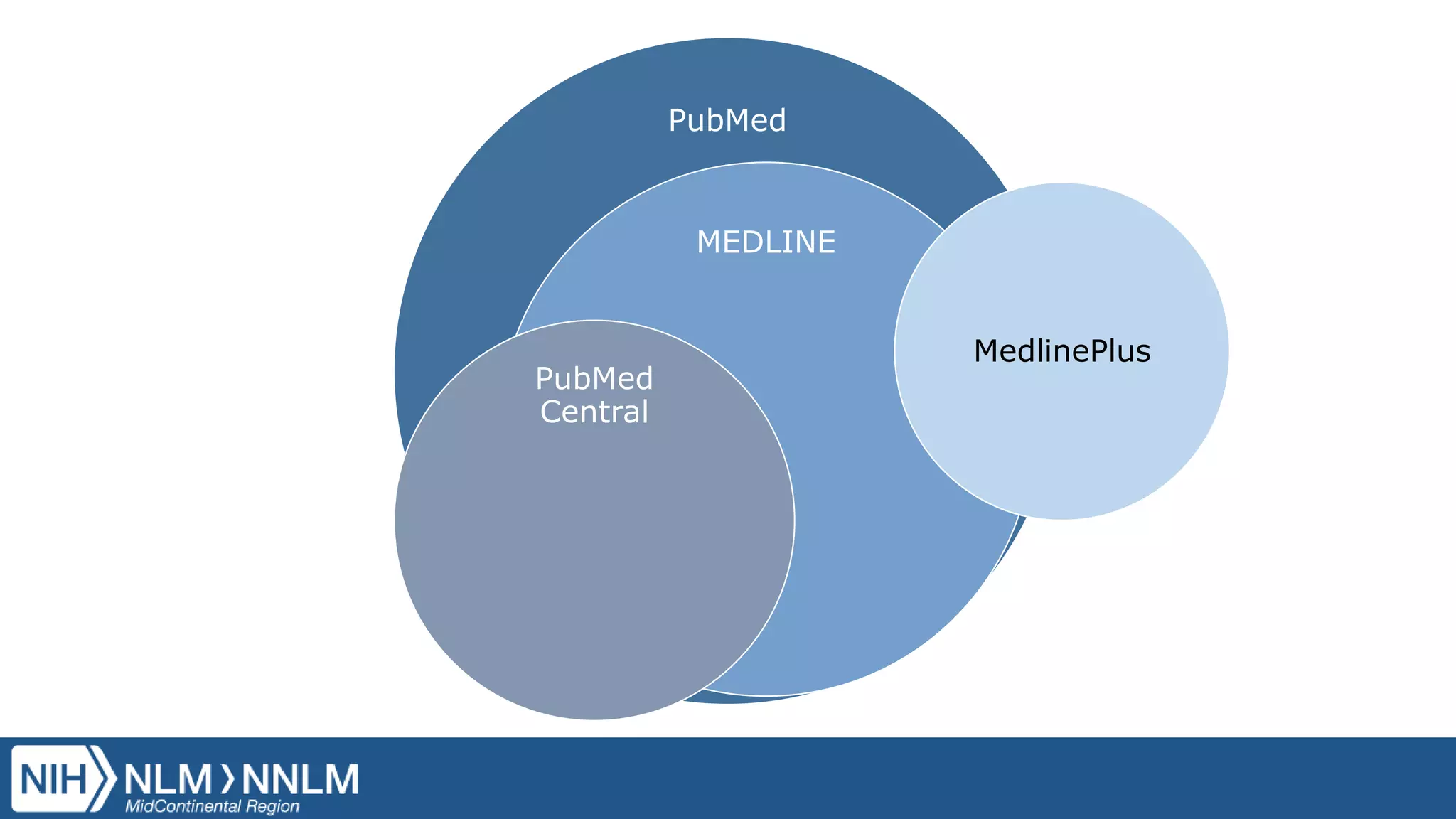
PubMed
MEDLINE
PubMed
Central
MedlinePlus
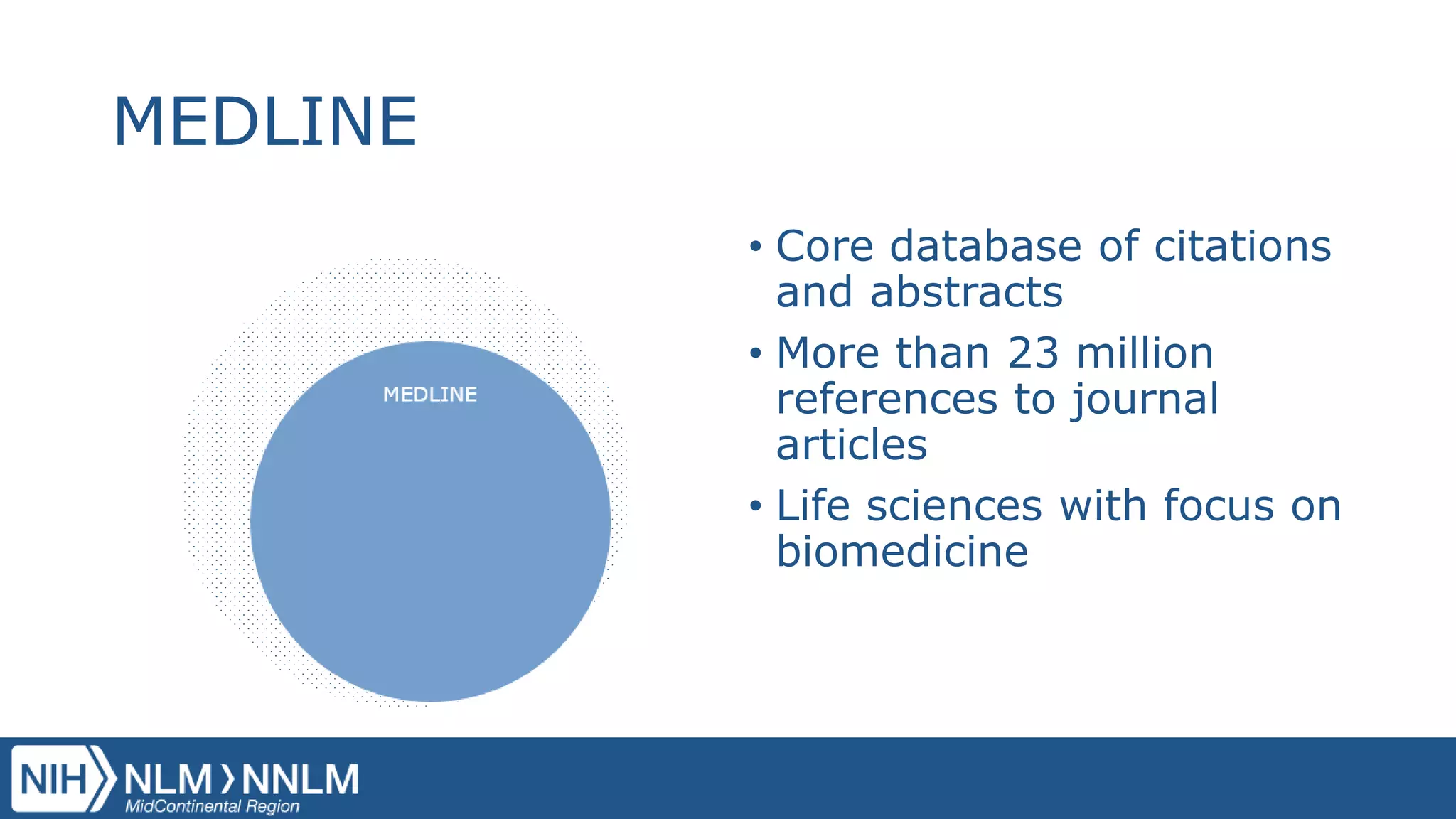
MEDLINE
• Core database of citations
and abstracts
• More than 23 million
references to journal
articles
• Life sciences with focus on
biomedicine
PubMed
• 26 million references
• MEDLINE database
• In-process or pre-MEDLINE
citations
• Out-of-scope articles from
MEDLINE journals (e.g.
plate tectonics)
• Books on NCBI Bookshelf
• Citations to some PubMed
Central journals
• Links to full-text articles via
PMC and LinkOut
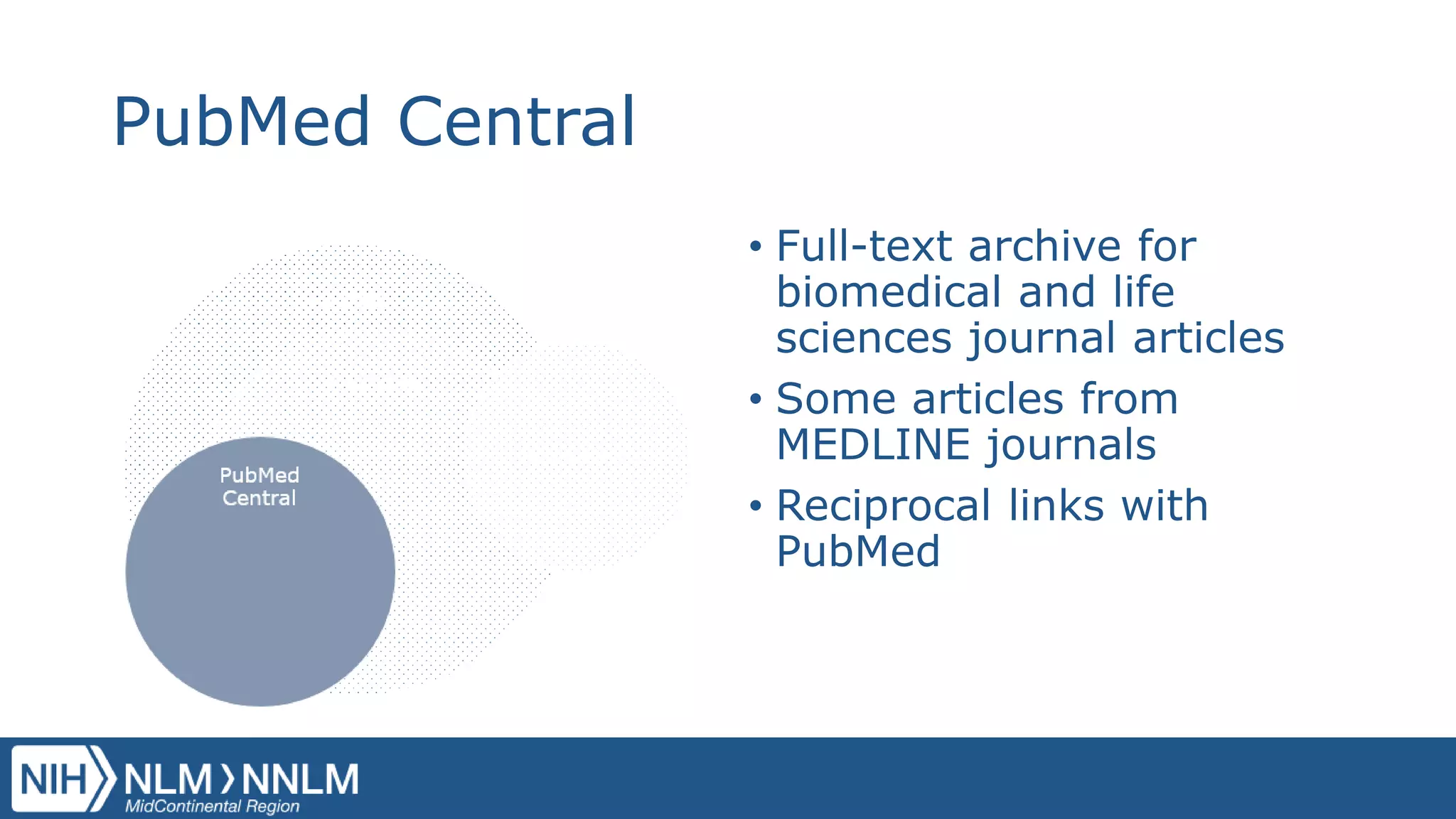
PubMed Central
• Full-text archive for
biomedical and life
sciences journal articles
• Some articles from
MEDLINE journals
• Reciprocal links with
PubMed
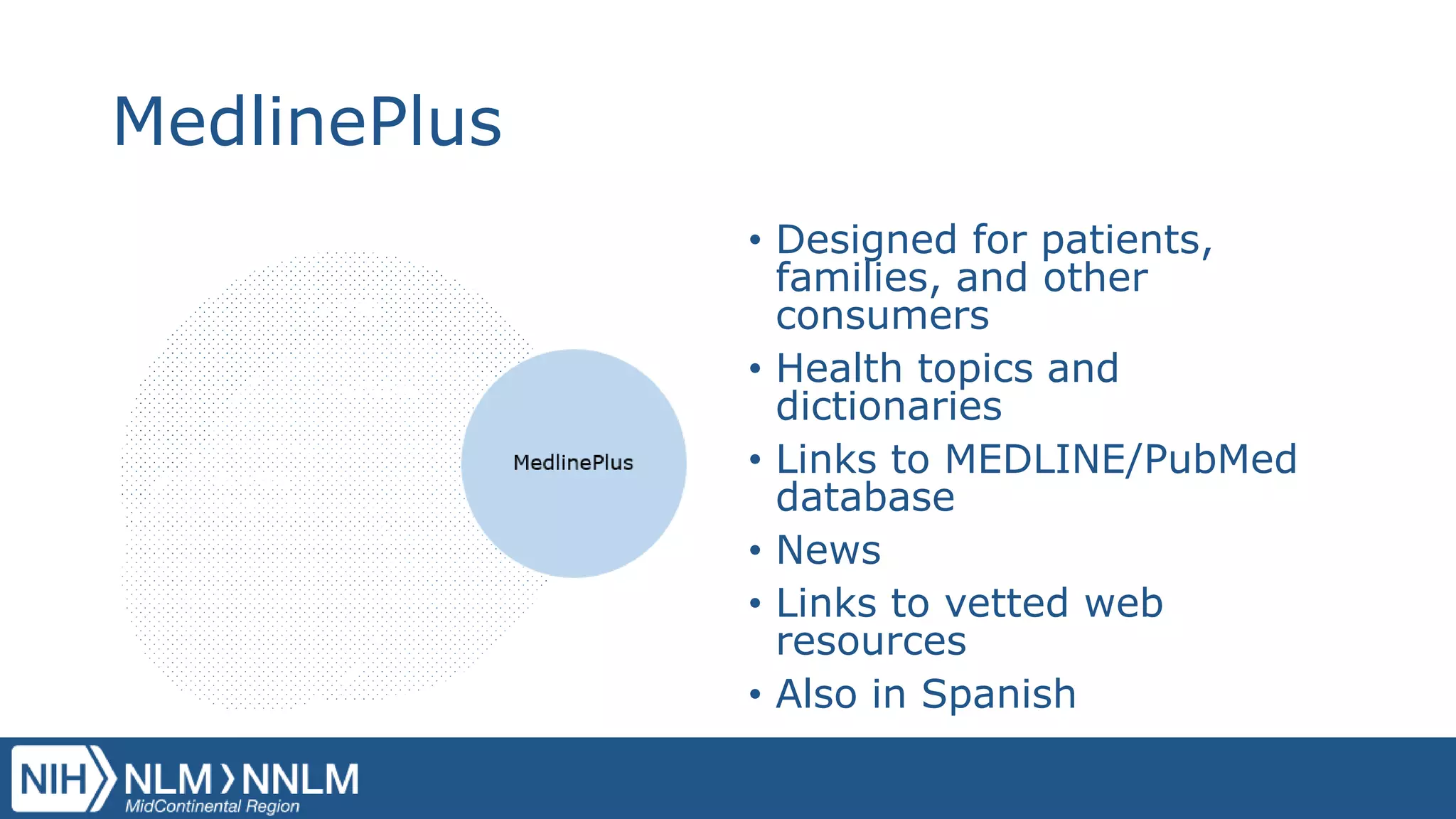
MedlinePlus
• Designed for patients,
families, and other
consumers
• Health topics and
dictionaries
• Links to MEDLINE/PubMed
database
• News
• Links to vetted web
resources
• Also in Spanish
PubMed
MEDLINE
PubMed
Central
MedlinePlus
Let’s take a quick tour: PubMed
PubMed, Pubmed.gov
• Limit PubMed search to MEDLINE only
• Search for full-text resources
• Find help
• PubMed Online Training
• https://learn.nlm.nih.gov/rest/training-packets/T0042010P.html
• NLM Learning Resources Database,
• https://learn.nlm.nih.gov/
• Help, support, and NLM contacts (any PubMed page)
Let’s take a quick tour: MedlinePlus
MedlinePlus, MedlinePlus.gov
• Overview of Home Page
• Videos and Tools
• About MedlinePlus
• Information for Librarians and Trainers page
• Customer Support
• Evaluating Health Information topic page
Activity: Let’s search
PubMed.gov
MedlinePlus.gov
1. Epipen
2. “epinephrine injection”
• How many results for
each search?
• How would you describe
the types of results and
resources?
• Who is the audience?
Activity: Let’s search again
PubMed.gov
MedlinePlus.gov
1. “stomach flu”
2. gastroenteritis
• How many results for
each search?
• How would you describe
the types of results and
resources?
• Who is the audience?
Recap
• Findings
• Ponderings
• Applications
This project has been funded in whole or in part with Federal funds from the Department of
Health and Human Services, National Institutes of Health, National Library of Medicine,
under cooperative agreement number UG4LM012344 with the University of Utah, Spencer
S. Eccles Health Sciences Library.
Thank you!
Annette Parde-Maass
NNLM MCR
Education and Outreach Coordinator
AnnetteParde-Maass@Creighton.edu
402-280-4156
Provide in-person and online training
Scheduled NNLM webinars
https://nnlm.gov/mcr/training/schedule
This project has been funded in whole or in part with Federal funds from the Department of Health and Human Services, National
Institutes of Health, National Library of Medicine, under cooperative agreement number UG4LM012344 with the University of Utah,
Spencer S. Eccles Health Sciences Library.
Evaluation
http://www.surveygizmo.com/s3/3529624/2017-
07NCompassLive
Please complete this. It helps me to enhance my
trainings and report on what I do.

NCompass Live: PubMed, PubMed Central, MEDLINE, MedlinePlus...What's the difference?

  • 1.
    PubMed, PubMed Central, MEDLINE,MedlinePlus… What’s the difference? Annette Parde-Maass Education and Outreach Coordinator Creighton University Health Sciences Library
  • 2.
    Objectives Participants will beable to: • Differentiate between PubMed, PubMed Central, MEDLINE, and MedlinePlus • Know where to seek help with these resources • Recognize when to use resources and for which audience or questions
  • 3.
    A little introduction •NLM = National Library of Medicine • NNLM = National Network of Libraries of Medicine • MCR = MidContinental Region (of NNLM)
  • 4.
  • 5.
    MEDLINE • Core databaseof citations and abstracts • More than 23 million references to journal articles • Life sciences with focus on biomedicine
  • 6.
    PubMed • 26 millionreferences • MEDLINE database • In-process or pre-MEDLINE citations • Out-of-scope articles from MEDLINE journals (e.g. plate tectonics) • Books on NCBI Bookshelf • Citations to some PubMed Central journals • Links to full-text articles via PMC and LinkOut
  • 7.
    PubMed Central • Full-textarchive for biomedical and life sciences journal articles • Some articles from MEDLINE journals • Reciprocal links with PubMed
  • 8.
    MedlinePlus • Designed forpatients, families, and other consumers • Health topics and dictionaries • Links to MEDLINE/PubMed database • News • Links to vetted web resources • Also in Spanish
  • 9.
  • 10.
    Let’s take aquick tour: PubMed PubMed, Pubmed.gov • Limit PubMed search to MEDLINE only • Search for full-text resources • Find help • PubMed Online Training • https://learn.nlm.nih.gov/rest/training-packets/T0042010P.html • NLM Learning Resources Database, • https://learn.nlm.nih.gov/ • Help, support, and NLM contacts (any PubMed page)
  • 11.
    Let’s take aquick tour: MedlinePlus MedlinePlus, MedlinePlus.gov • Overview of Home Page • Videos and Tools • About MedlinePlus • Information for Librarians and Trainers page • Customer Support • Evaluating Health Information topic page
  • 12.
    Activity: Let’s search PubMed.gov MedlinePlus.gov 1.Epipen 2. “epinephrine injection” • How many results for each search? • How would you describe the types of results and resources? • Who is the audience?
  • 13.
    Activity: Let’s searchagain PubMed.gov MedlinePlus.gov 1. “stomach flu” 2. gastroenteritis • How many results for each search? • How would you describe the types of results and resources? • Who is the audience?
  • 14.
    Recap • Findings • Ponderings •Applications This project has been funded in whole or in part with Federal funds from the Department of Health and Human Services, National Institutes of Health, National Library of Medicine, under cooperative agreement number UG4LM012344 with the University of Utah, Spencer S. Eccles Health Sciences Library.
  • 15.
    Thank you! Annette Parde-Maass NNLMMCR Education and Outreach Coordinator AnnetteParde-Maass@Creighton.edu 402-280-4156 Provide in-person and online training Scheduled NNLM webinars https://nnlm.gov/mcr/training/schedule This project has been funded in whole or in part with Federal funds from the Department of Health and Human Services, National Institutes of Health, National Library of Medicine, under cooperative agreement number UG4LM012344 with the University of Utah, Spencer S. Eccles Health Sciences Library.
  • 16.
    Evaluation http://www.surveygizmo.com/s3/3529624/2017- 07NCompassLive Please complete this.It helps me to enhance my trainings and report on what I do.

Editor's Notes

  • #2 They’re not the same? What’s the difference? How would I use them? If these are questions you have, join Annette Parde-Maass, from the National Network of Libraries of Medicine, as she gives a brief overview of these free databases from the National Library of Medicine, showcases some useful features, and takes your questions about these robust sites.