Protein
Purification
Techniques
Navaira Arif
Roll No. 18
The basic aim in protein
purification is to isolate one
particular protein of interest from
other contaminating proteins to
study its structure and function,
increasing its stability and large
scale production
Protein Purification
• Purification of proteins is an essential first step
in understanding their function
• Proteins must be released from the cell to be
purified
• Based on the basic properties of proteins like
solubility, size, charge and binding affinity
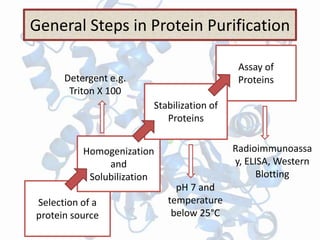
General Steps in Protein Purification
Selection of a
protein source
Assay of
Proteins
Homogenization
and
Solubilization
Stabilization of
Proteins
Detergent e.g.
Triton X 100
pH 7 and
temperature
below 25°C
Radioimmunoassa
y, ELISA, Western
Blotting
1. Ammonium Sulfate Precipitation
• This technique exploits the fact that the
solubility of most proteins is lowered at high
salt concentrations
• The concentration of ammonium sulfate at
which a particular protein comes out of
solution and precipitates is different from
other proteins in the mixture
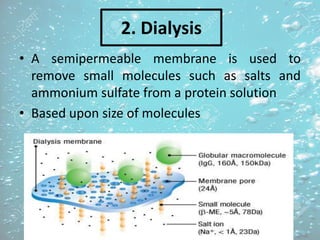
2. Dialysis
• A semipermeable membrane is used to
remove small molecules such as salts and
ammonium sulfate from a protein solution
• Based upon size of molecules
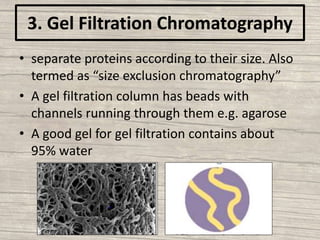
3. Gel Filtration Chromatography
• separate proteins according to their size. Also
termed as “size exclusion chromatography”
• A gel filtration column has beads with
channels running through them e.g. agarose
• A good gel for gel filtration contains about
95% water
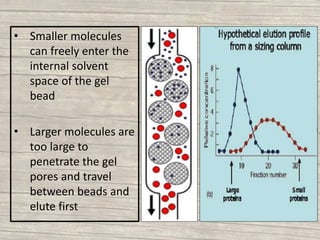
• Smaller molecules
can freely enter the
internal solvent
space of the gel
bead
• Larger molecules are
too large to
penetrate the gel
pores and travel
between beads and
elute first
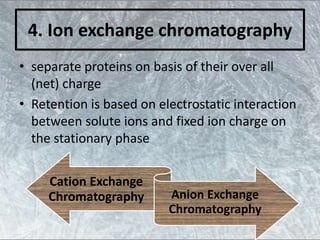
4. Ion exchange chromatography
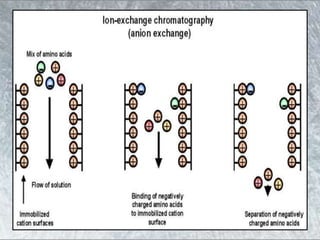
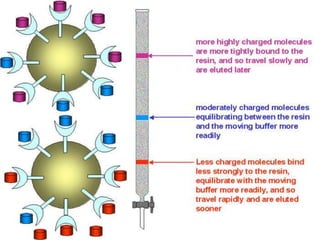
• separate proteins on basis of their over all
(net) charge
• Retention is based on electrostatic interaction
between solute ions and fixed ion charge on
the stationary phase
Cation Exchange
Chromatography Anion Exchange
Chromatography
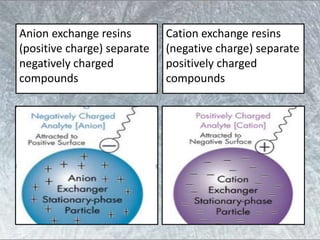
Anion exchange resins
(positive charge) separate
negatively charged
compounds
Cation exchange resins
(negative charge) separate
positively charged
compounds
5. Affinity chromatography
• Based upon molecular conformation
• Exploits the specific, high affinity, non-
covalent binding of a protein to another
molecule, the ligand
• Ligands function in a fashion similar to
that of antigen-antibody interactions
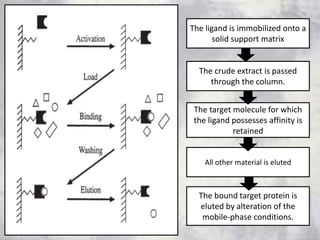
The ligand is immobilized onto a
solid support matrix
The crude extract is passed
through the column.
The target molecule for which
the ligand possesses affinity is
retained
All other material is eluted
The bound target protein is
eluted by alteration of the
mobile-phase conditions.
6. Fast Performance Liquid
Chromatography
• A type of liquid chromatography where the
flow rate of the solvent is set through
computer input and controlled by pumps
• The chromatographic bed is composed by the
gel beads alone when they are inside the
column
• The sample is introduced into the injector and
then carried into the column by the flowing
solvent
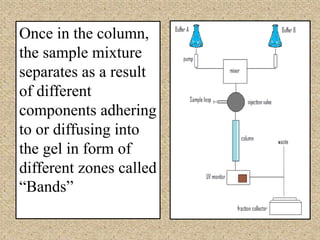
Once in the column,
the sample mixture
separates as a result
of different
components adhering
to or diffusing into
the gel in form of
different zones called
“Bands”
7. Gel Electrophoresis
• When placed in an electric field, proteins
(having net charge) will move towards one
electrode or the other
• The greater the net charge the faster the
molecule will move
• PAGE – Polyacrylamide Gel Electrophoresis
(carried out in a gel which serves as a
molecular sieve)
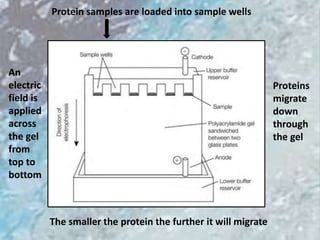
Protein samples are loaded into sample wells
An
electric
field is
applied
across
the gel
from
top to
bottom
Proteins
migrate
down
through
the gel
The smaller the protein the further it will migrate
SDS- PAGE
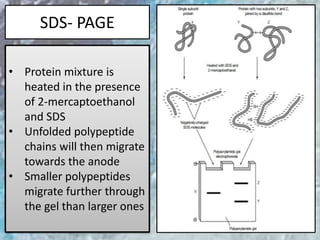
• Protein mixture is
heated in the presence
of 2-mercaptoethanol
and SDS
• Unfolded polypeptide
chains will then migrate
towards the anode
• Smaller polypeptides
migrate further through
the gel than larger ones
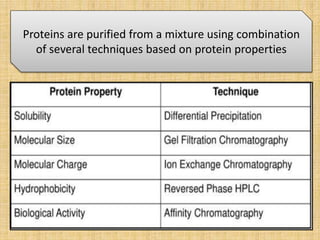
Proteins are purified from a mixture using combination
of several techniques based on protein properties
Protein purification techniques

Protein purification techniques

  • 1.
  • 2.
    The basic aimin protein purification is to isolate one particular protein of interest from other contaminating proteins to study its structure and function, increasing its stability and large scale production
  • 3.
    Protein Purification • Purificationof proteins is an essential first step in understanding their function • Proteins must be released from the cell to be purified • Based on the basic properties of proteins like solubility, size, charge and binding affinity
  • 4.
    General Steps inProtein Purification Selection of a protein source Assay of Proteins Homogenization and Solubilization Stabilization of Proteins Detergent e.g. Triton X 100 pH 7 and temperature below 25°C Radioimmunoassa y, ELISA, Western Blotting
  • 5.
    1. Ammonium SulfatePrecipitation • This technique exploits the fact that the solubility of most proteins is lowered at high salt concentrations • The concentration of ammonium sulfate at which a particular protein comes out of solution and precipitates is different from other proteins in the mixture
  • 6.
    2. Dialysis • Asemipermeable membrane is used to remove small molecules such as salts and ammonium sulfate from a protein solution • Based upon size of molecules
  • 7.
    3. Gel FiltrationChromatography • separate proteins according to their size. Also termed as “size exclusion chromatography” • A gel filtration column has beads with channels running through them e.g. agarose • A good gel for gel filtration contains about 95% water
  • 8.
    • Smaller molecules canfreely enter the internal solvent space of the gel bead • Larger molecules are too large to penetrate the gel pores and travel between beads and elute first
  • 9.
    4. Ion exchangechromatography • separate proteins on basis of their over all (net) charge • Retention is based on electrostatic interaction between solute ions and fixed ion charge on the stationary phase Cation Exchange Chromatography Anion Exchange Chromatography
  • 10.
    Anion exchange resins (positivecharge) separate negatively charged compounds Cation exchange resins (negative charge) separate positively charged compounds
  • 13.
    5. Affinity chromatography •Based upon molecular conformation • Exploits the specific, high affinity, non- covalent binding of a protein to another molecule, the ligand • Ligands function in a fashion similar to that of antigen-antibody interactions
  • 14.
    The ligand isimmobilized onto a solid support matrix The crude extract is passed through the column. The target molecule for which the ligand possesses affinity is retained All other material is eluted The bound target protein is eluted by alteration of the mobile-phase conditions.
  • 15.
    6. Fast PerformanceLiquid Chromatography • A type of liquid chromatography where the flow rate of the solvent is set through computer input and controlled by pumps • The chromatographic bed is composed by the gel beads alone when they are inside the column • The sample is introduced into the injector and then carried into the column by the flowing solvent
  • 16.
    Once in thecolumn, the sample mixture separates as a result of different components adhering to or diffusing into the gel in form of different zones called “Bands”
  • 17.
    7. Gel Electrophoresis •When placed in an electric field, proteins (having net charge) will move towards one electrode or the other • The greater the net charge the faster the molecule will move • PAGE – Polyacrylamide Gel Electrophoresis (carried out in a gel which serves as a molecular sieve)
  • 18.
    Protein samples areloaded into sample wells An electric field is applied across the gel from top to bottom Proteins migrate down through the gel The smaller the protein the further it will migrate
  • 19.
    SDS- PAGE • Proteinmixture is heated in the presence of 2-mercaptoethanol and SDS • Unfolded polypeptide chains will then migrate towards the anode • Smaller polypeptides migrate further through the gel than larger ones
  • 20.
    Proteins are purifiedfrom a mixture using combination of several techniques based on protein properties

Editor's Notes

  • #5 Starting material should be abundant and present in large amounts Next step is obtain the protein in solution and for this cell needs to be disrupted and lysed and then treated with detergent triton X 100 to disrupt lipid bilayer and release integral membrane proteins into solution pH of the solutions used needs to be carefully buffered at a pH in which the protein is stable, usually around pH 7. and temp below 25 Detection of proteins using radioimmunoassay, enzymelinked immunosorbent assay (ELISA), or Western blot analysis
  • #15 The protein mixture is then passed down a column containing the immobilized ligand. The protein of interest will bind to the ligand, whereas all other proteins pass straight through the column
  • #19 Sample wells are formed in the gel