Tips for Speaking
Structure A good presentation has a clear structure, like a good book or film. A good presentation has: a beginning (introduction & preview)   a middle (main message)   an end (review & conclusion)
Structure Say what you are going to say,  say it,  then say what you have just said.
The Introduction welcome your audience   introduce your subject   outline the structure of your presentation   give instructions about questions
The Introduction We will start by exploring After that, we will consider Then we will look at After delivery, we will examine before moving on to Finally, we will conclude with Afterwards, you will be invited to
The Introduction A Roadmap You got a mouse in your pocket?
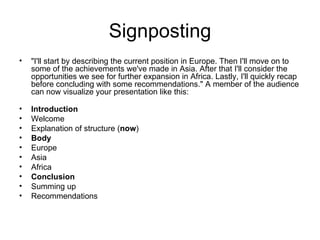
Signposting "I'll start by describing the current position in Europe. Then I'll move on to some of the achievements we've made in Asia. After that I'll consider the opportunities we see for further expansion in Africa. Lastly, I'll quickly recap before concluding with some recommendations." A member of the audience can now visualize your presentation like this: Introduction Welcome  Explanation of structure ( now ) Body Europe  Asia  Africa Conclusion Summing up  Recommendations
Signposting Like a book Let's begin by...   That's all I have to say about...   Now we'll move on to...   Let's consider this in more detail...   I'd like to deal with this question later, if I may...   I'd like now to recap...   To start with...later...to finish up...
The Body do not hurry  be enthusiastic  give time on visuals  maintain eye contact  modulate your voice  look friendly  keep to your structure  use your notes  signpost throughout  remain polite when dealing with difficult questions
Voice Quality speed:  you can speak at normal speed, you can speak faster, you can speak more slowly - and you can stop completely! You can pause. This is a very good technique for gaining your audience's attention.  intonation:  you can change the pitch of your voice. You can speak in a high tone. You can speak in a low tone.  volume:  you can speak at normal volume, you can speak loudly and you can speak quietly. Lowering your voice and speaking quietly can again attract your audience's interest.
Simplicity and Clarity In general, talk about concrete facts rather than abstract ideas. Toyota sold two million cars last year.  Two million cars were sold by Toyota last year.
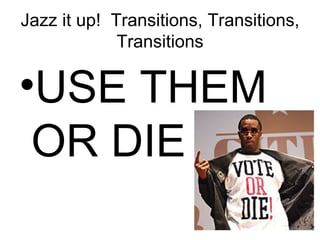
Jazz it up!  Transitions, Transitions, Transitions USE THEM OR DIE
Rhetorical Questions, The Call and Response! Easy Rhetorical Questions I do it all the time! Powerful idea in American culture because of its relation to slavery, subsequent use in popular music
The Conclusion Sum up   (Give recommendations if appropriate)   Thank your audience   Invite questions
What about in small settings? Mini-signposts Clarity Opinion signifiers


Tips for speaking

  • 1.
  • 2.
    Structure A goodpresentation has a clear structure, like a good book or film. A good presentation has: a beginning (introduction & preview) a middle (main message) an end (review & conclusion)
  • 3.
    Structure Say whatyou are going to say, say it, then say what you have just said.
  • 4.
    The Introduction welcomeyour audience introduce your subject outline the structure of your presentation give instructions about questions
  • 5.
    The Introduction Wewill start by exploring After that, we will consider Then we will look at After delivery, we will examine before moving on to Finally, we will conclude with Afterwards, you will be invited to
  • 6.
    The Introduction ARoadmap You got a mouse in your pocket?
  • 7.
    Signposting "I'll startby describing the current position in Europe. Then I'll move on to some of the achievements we've made in Asia. After that I'll consider the opportunities we see for further expansion in Africa. Lastly, I'll quickly recap before concluding with some recommendations." A member of the audience can now visualize your presentation like this: Introduction Welcome Explanation of structure ( now ) Body Europe Asia Africa Conclusion Summing up Recommendations
  • 8.
    Signposting Like abook Let's begin by... That's all I have to say about... Now we'll move on to... Let's consider this in more detail... I'd like to deal with this question later, if I may... I'd like now to recap... To start with...later...to finish up...
  • 9.
    The Body donot hurry be enthusiastic give time on visuals maintain eye contact modulate your voice look friendly keep to your structure use your notes signpost throughout remain polite when dealing with difficult questions
  • 10.
    Voice Quality speed: you can speak at normal speed, you can speak faster, you can speak more slowly - and you can stop completely! You can pause. This is a very good technique for gaining your audience's attention. intonation: you can change the pitch of your voice. You can speak in a high tone. You can speak in a low tone. volume: you can speak at normal volume, you can speak loudly and you can speak quietly. Lowering your voice and speaking quietly can again attract your audience's interest.
  • 11.
    Simplicity and ClarityIn general, talk about concrete facts rather than abstract ideas. Toyota sold two million cars last year. Two million cars were sold by Toyota last year.
  • 12.
    Jazz it up! Transitions, Transitions, Transitions USE THEM OR DIE
  • 13.
    Rhetorical Questions, TheCall and Response! Easy Rhetorical Questions I do it all the time! Powerful idea in American culture because of its relation to slavery, subsequent use in popular music
  • 14.
    The Conclusion Sumup (Give recommendations if appropriate) Thank your audience Invite questions
  • 15.
    What about insmall settings? Mini-signposts Clarity Opinion signifiers
  • 16.
  • 17.
  • 18.
  • 19.