Theories of Migration
Sreya Chatterjee
Nand Lal Mishra
Why People Migrate & …
From
Where
To
Where
Migration Theories
 Ravenstein’s Laws of Migration
 Zipf’s Gravity Model
 Everett Lee’s Theory of Migration
 Push-Pull hypothesis
 Lewis-Fei-Ranis Model of Development
 Todaro’s Model of Migration
 Mobility Field Theory
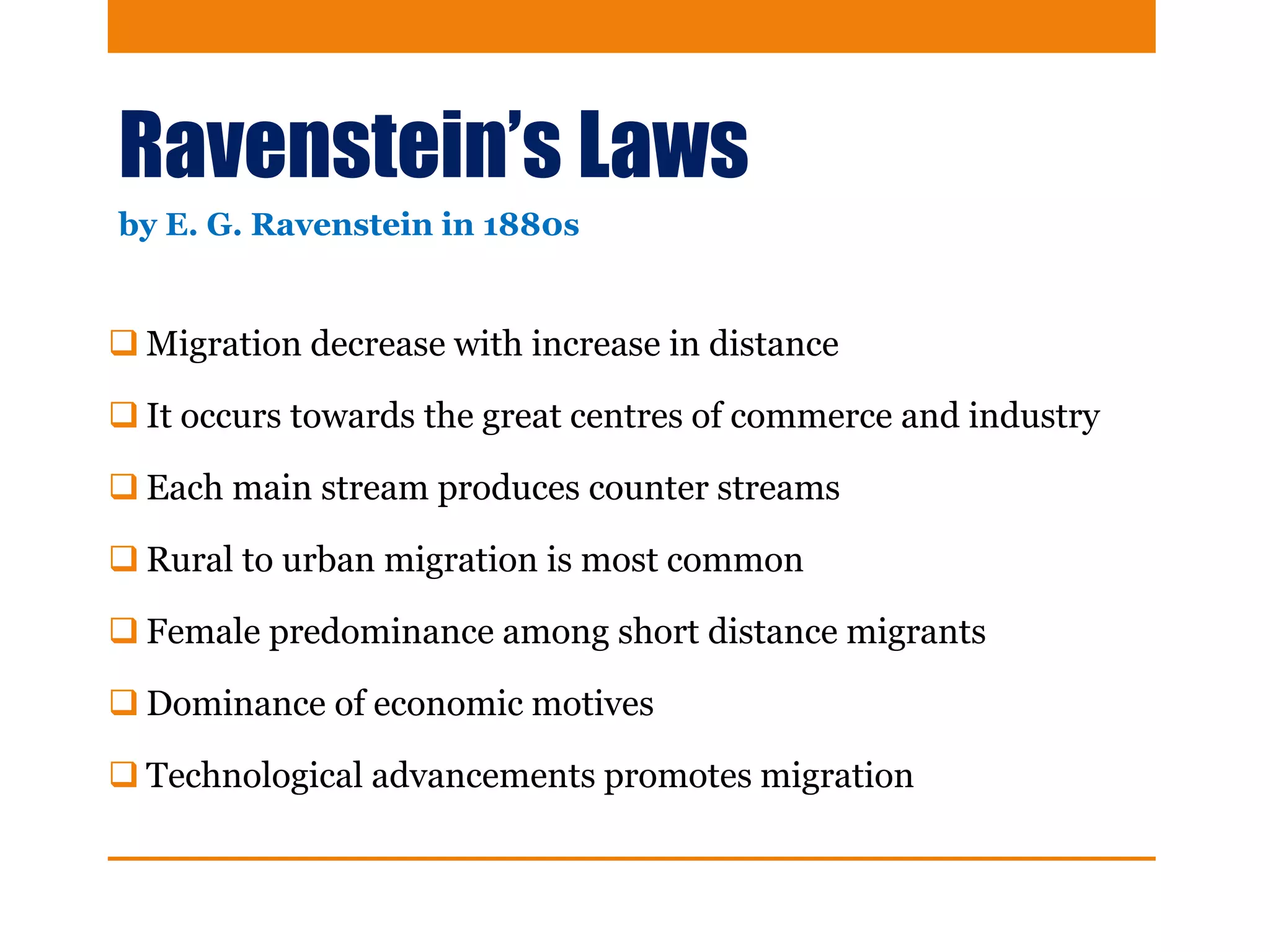
Ravenstein’s Laws
 Migration decrease with increase in distance
 It occurs towards the great centres of commerce and industry
 Each main stream produces counter streams
 Rural to urban migration is most common
 Female predominance among short distance migrants
 Dominance of economic motives
 Technological advancements promotes migration
by E. G. Ravenstein in 1880s
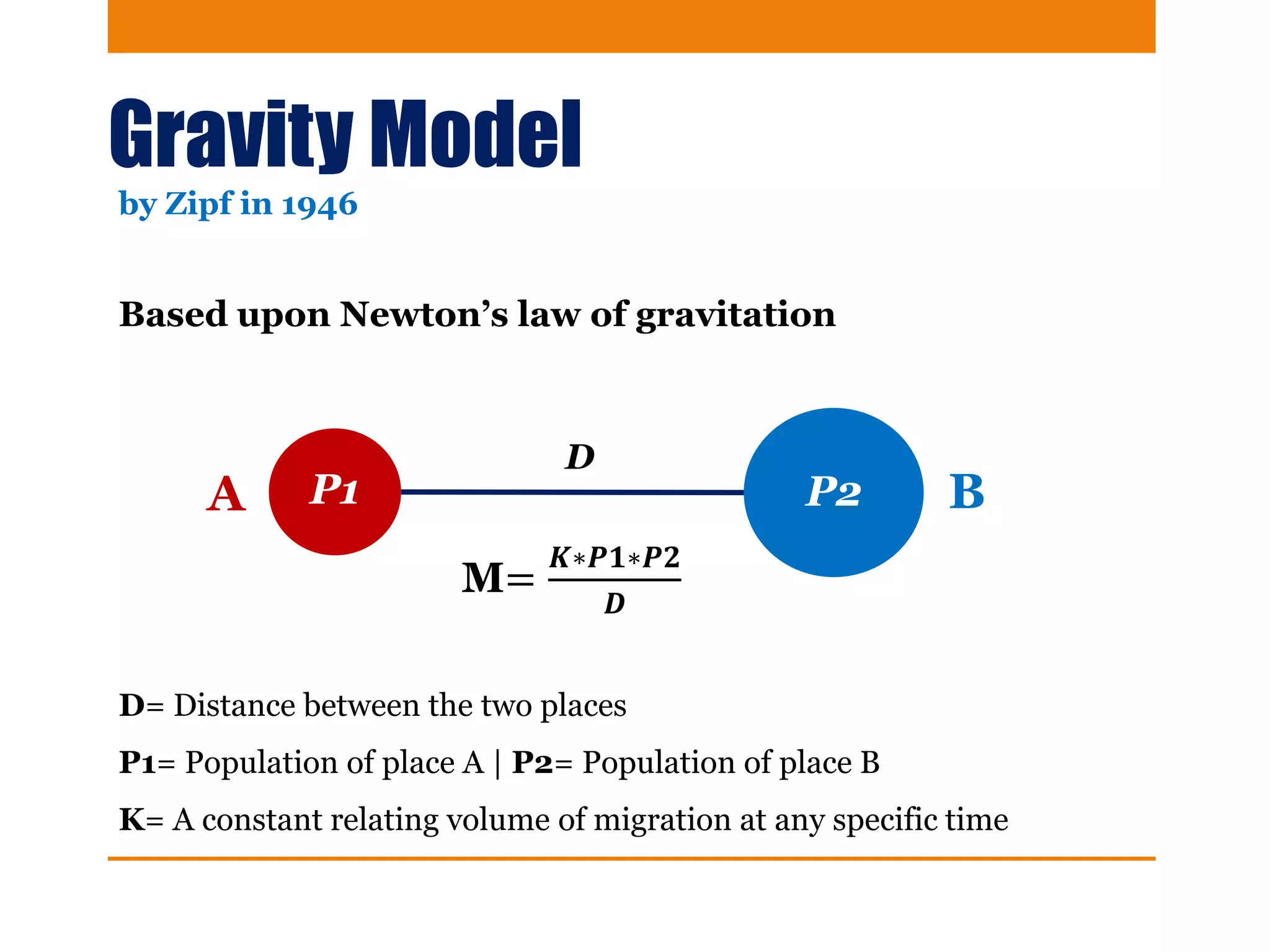
Gravity Model
by Zipf in 1946
D
P1 P2
M=
𝑲∗𝑷𝟏∗𝑷𝟐
𝑫
D= Distance between the two places
P1= Population of place A | P2= Population of place B
K= A constant relating volume of migration at any specific time
Based upon Newton’s law of gravitation
A B
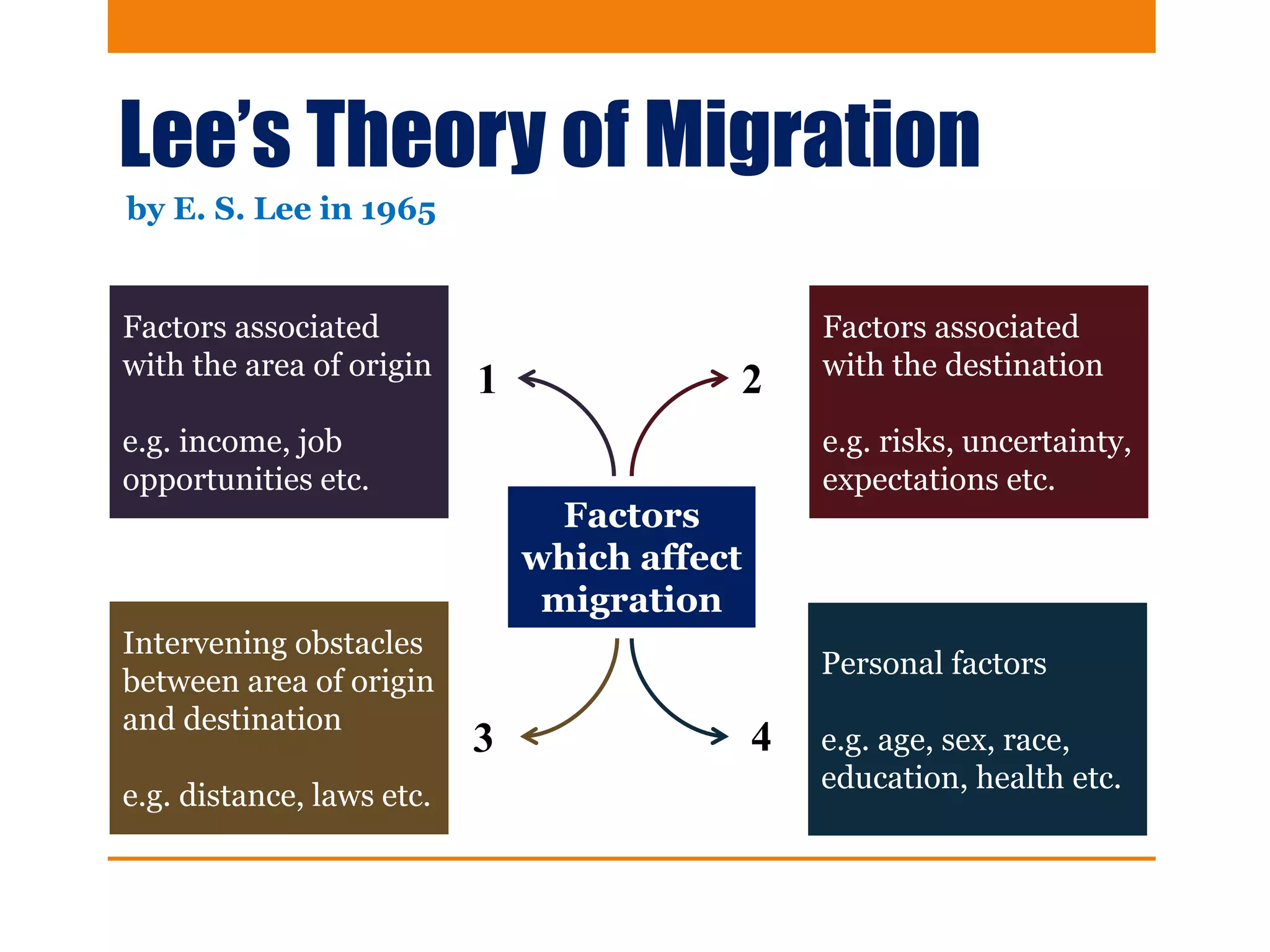
Lee’s Theory of Migration
by E. S. Lee in 1965
Factors
which affect
migration
Factors associated
with the area of origin
e.g. income, job
opportunities etc.
Personal factors
e.g. age, sex, race,
education, health etc.
Intervening obstacles
between area of origin
and destination
e.g. distance, laws etc.
Factors associated
with the destination
e.g. risks, uncertainty,
expectations etc.
1
43
2
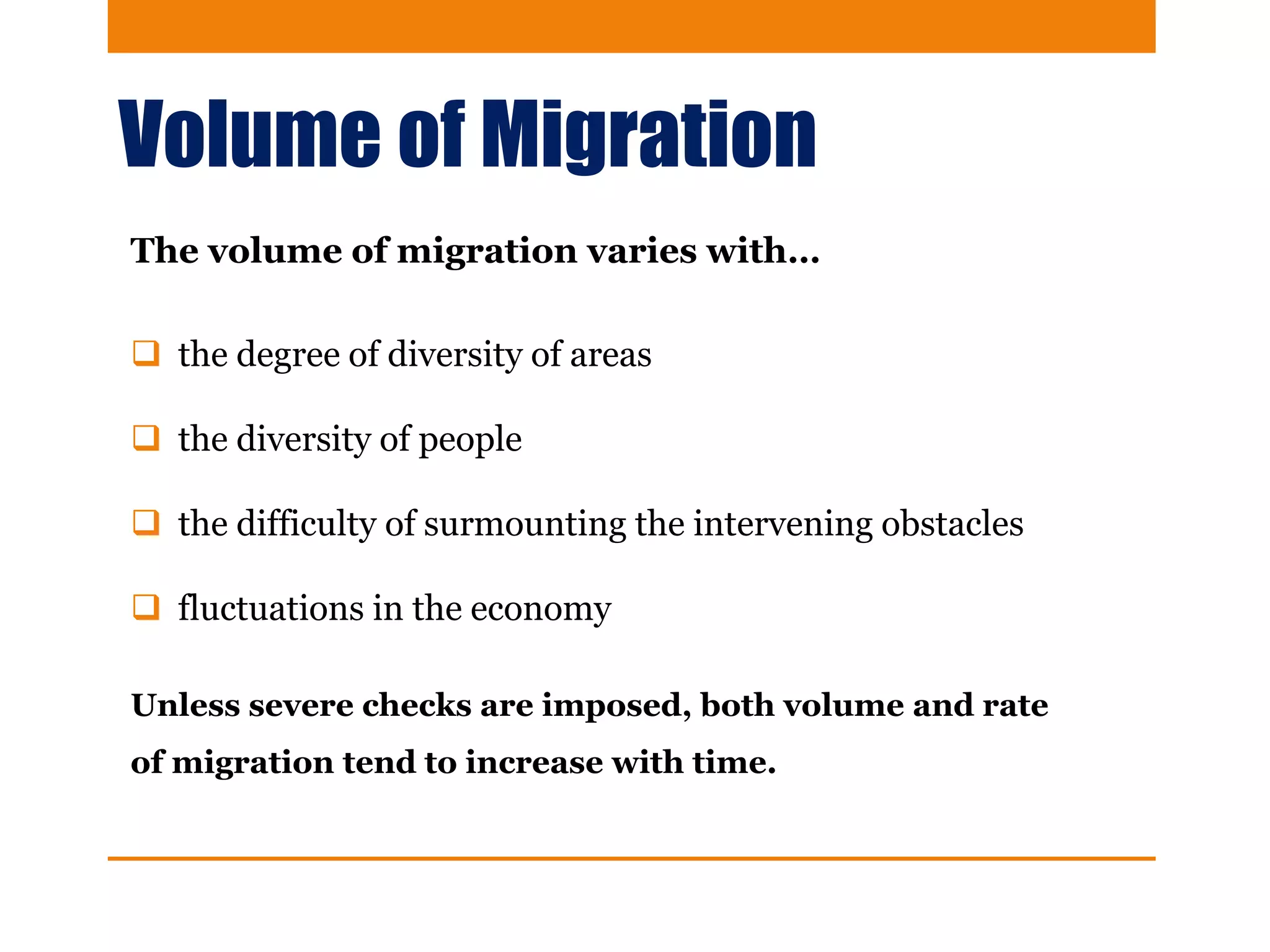
Volume of Migration
 the degree of diversity of areas
 the diversity of people
 the difficulty of surmounting the intervening obstacles
 fluctuations in the economy
The volume of migration varies with…
Unless severe checks are imposed, both volume and rate
of migration tend to increase with time.
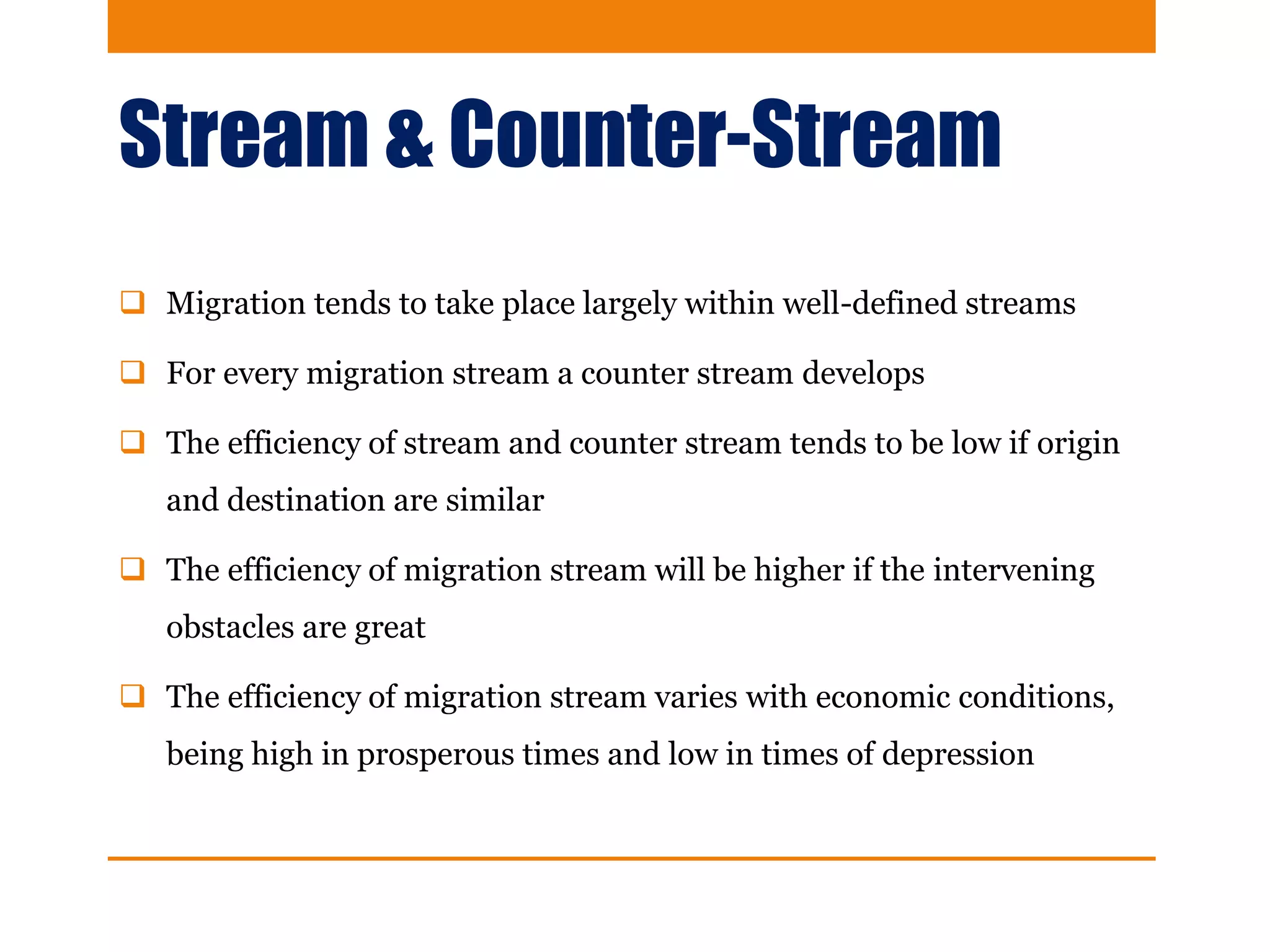
Stream & Counter-Stream
 Migration tends to take place largely within well-defined streams
 For every migration stream a counter stream develops
 The efficiency of stream and counter stream tends to be low if origin
and destination are similar
 The efficiency of migration stream will be higher if the intervening
obstacles are great
 The efficiency of migration stream varies with economic conditions,
being high in prosperous times and low in times of depression
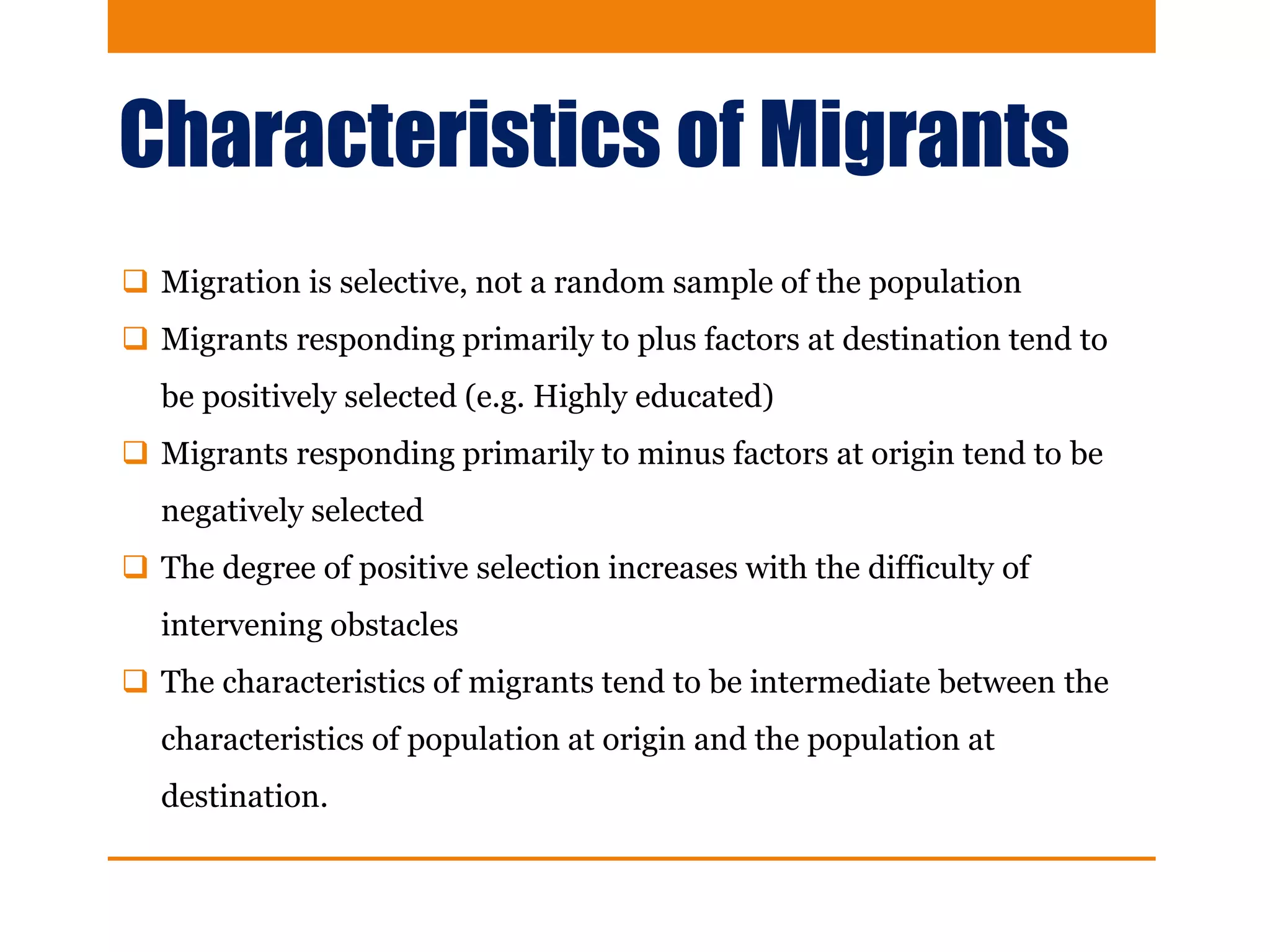
Characteristics of Migrants
 Migration is selective, not a random sample of the population
 Migrants responding primarily to plus factors at destination tend to
be positively selected (e.g. Highly educated)
 Migrants responding primarily to minus factors at origin tend to be
negatively selected
 The degree of positive selection increases with the difficulty of
intervening obstacles
 The characteristics of migrants tend to be intermediate between the
characteristics of population at origin and the population at
destination.
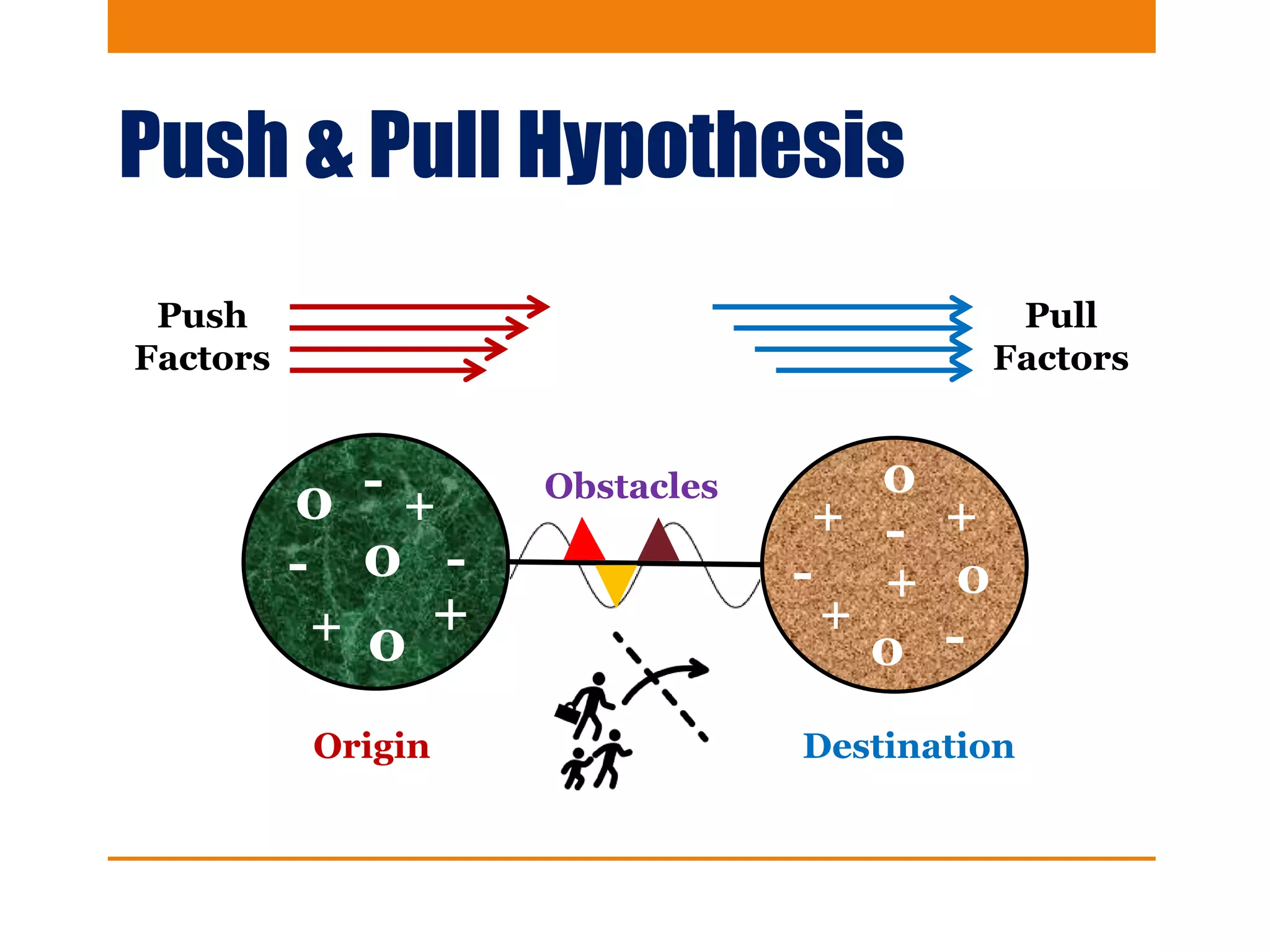
Push & Pull Hypothesis
+
+
-
+
+
0
0
+
0
-
-
0 +
+
0
-
0 --
Origin Destination
Push
Factors
Pull
Factors
Obstacles
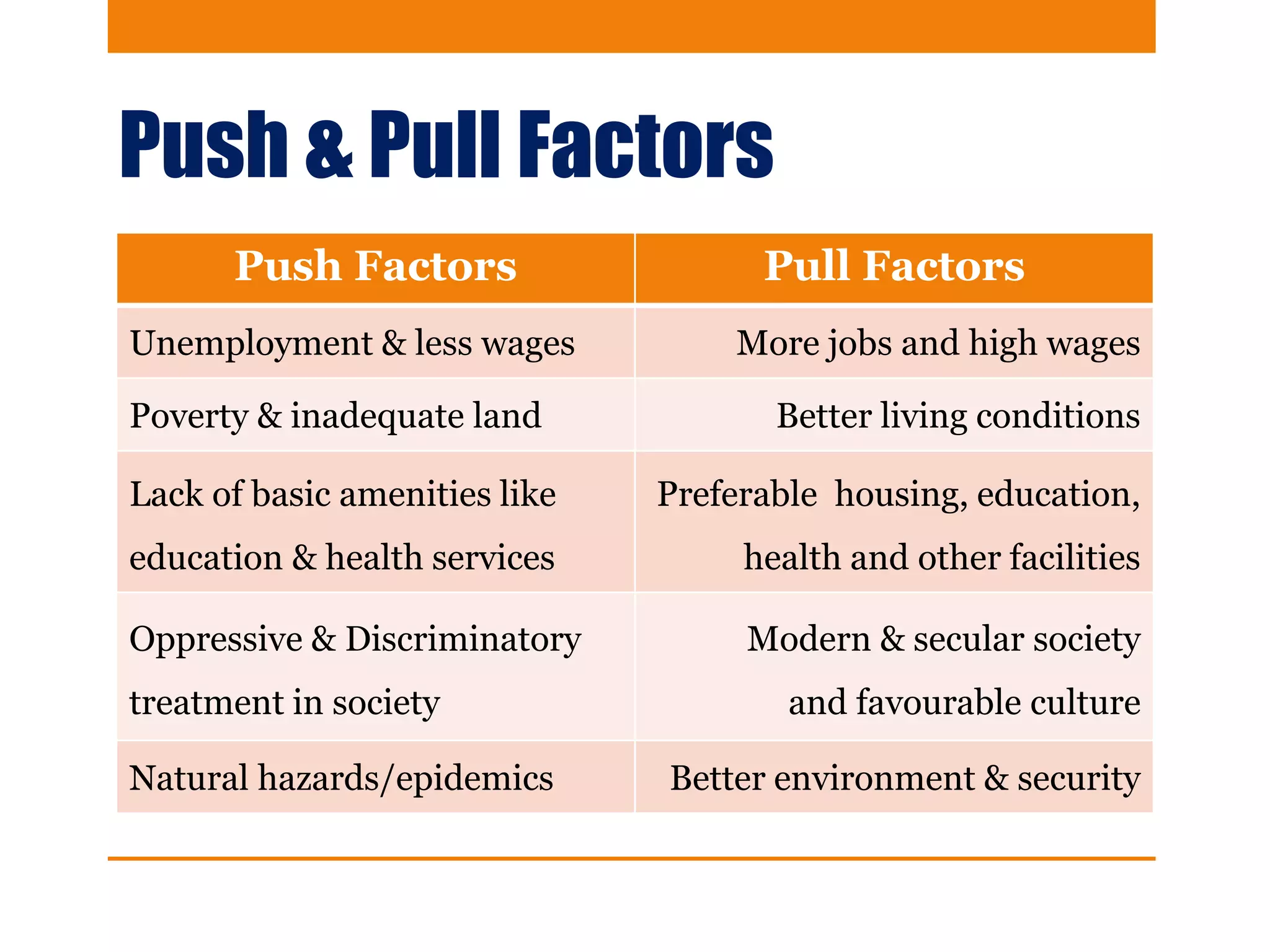
Push & Pull Factors
Push Factors Pull Factors
Unemployment & less wages More jobs and high wages
Poverty & inadequate land Better living conditions
Lack of basic amenities like
education & health services
Preferable housing, education,
health and other facilities
Oppressive & Discriminatory
treatment in society
Modern & secular society
and favourable culture
Natural hazards/epidemics Better environment & security
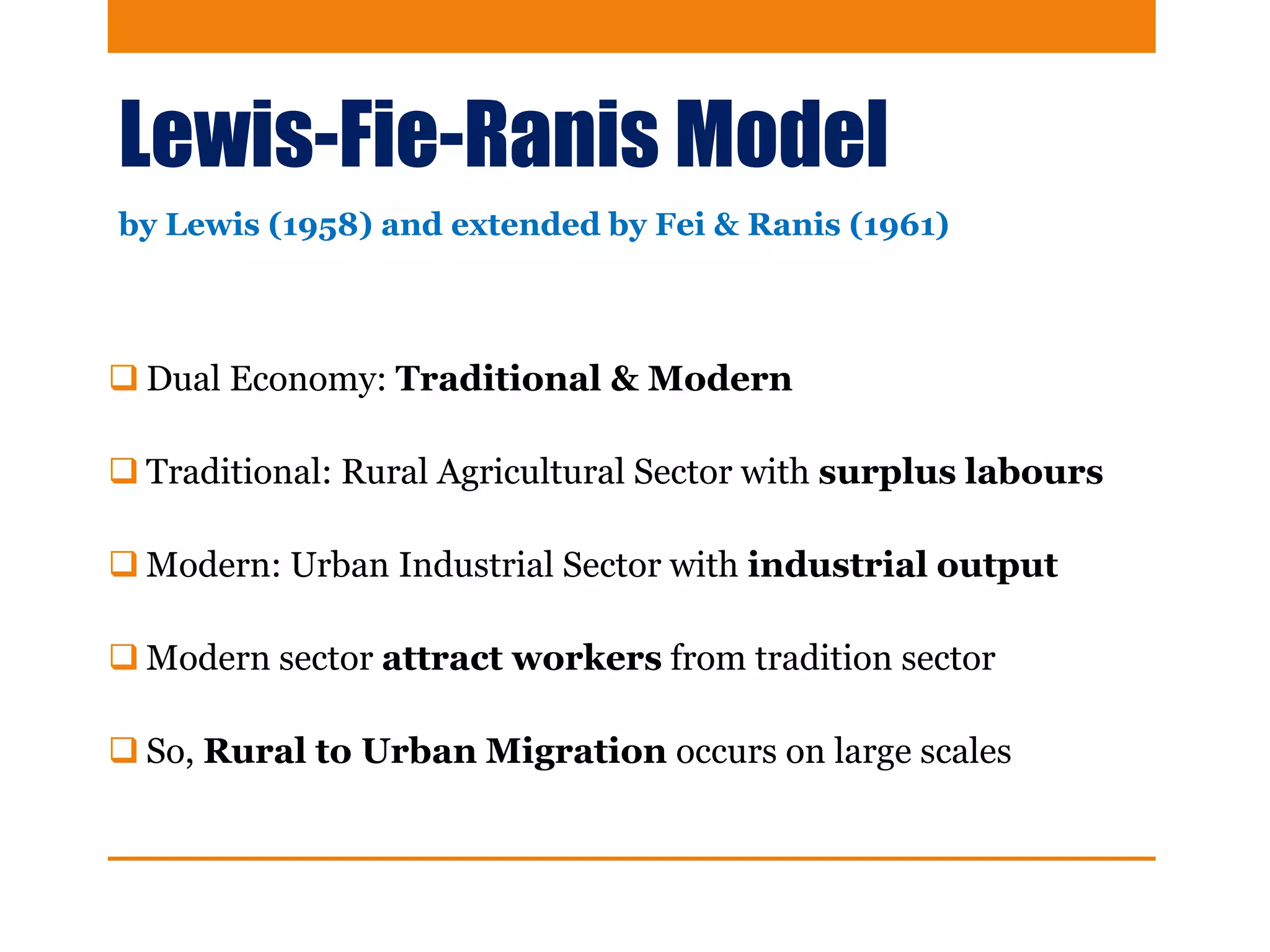
Lewis-Fie-Ranis Model
 Dual Economy: Traditional & Modern
 Traditional: Rural Agricultural Sector with surplus labours
 Modern: Urban Industrial Sector with industrial output
 Modern sector attract workers from tradition sector
 So, Rural to Urban Migration occurs on large scales
by Lewis (1958) and extended by Fei & Ranis (1961)
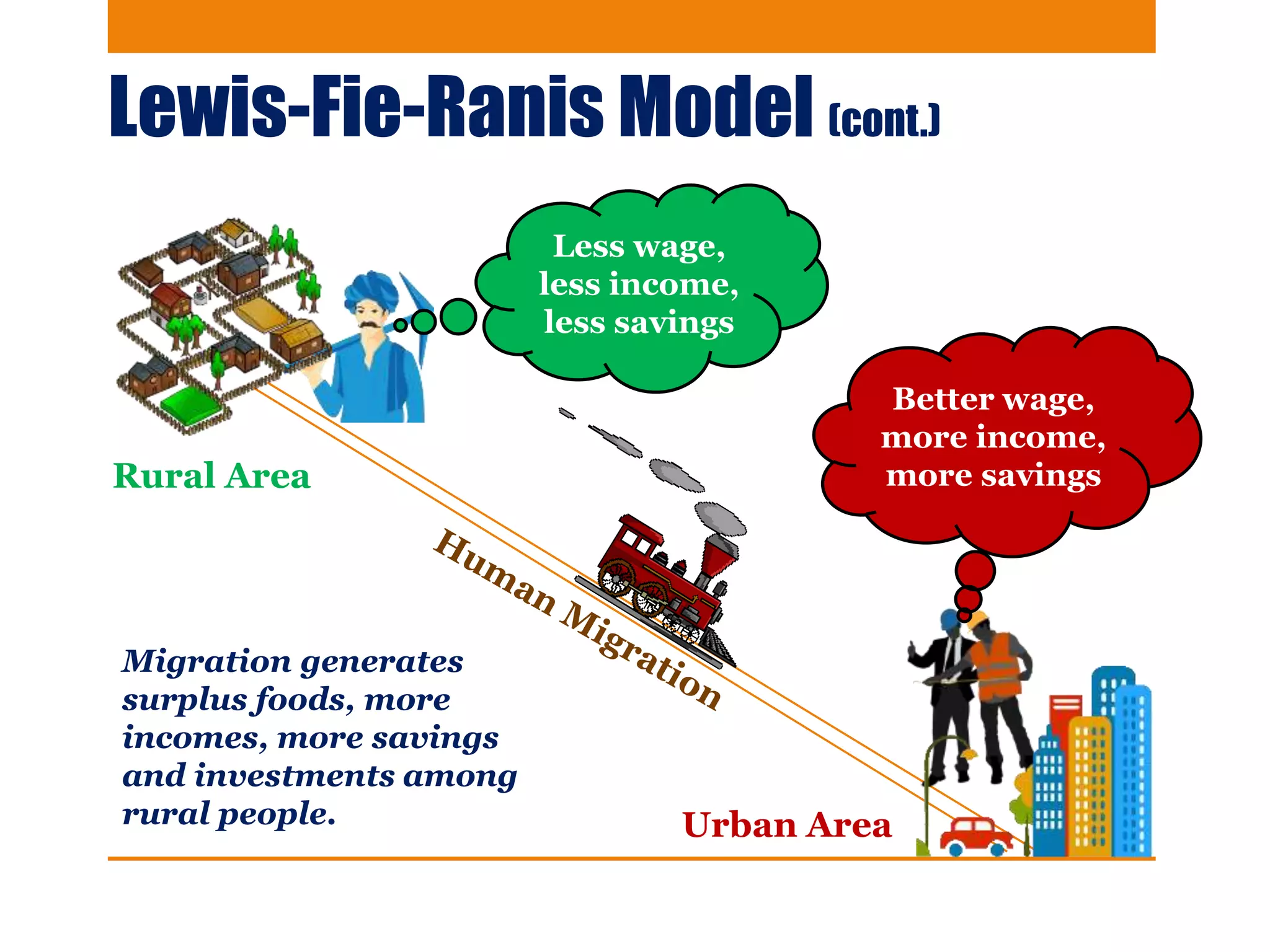
Lewis-Fie-Ranis Model (cont.)
Rural Area
Urban Area
Less wage,
less income,
less savings
Better wage,
more income,
more savings
Migration generates
surplus foods, more
incomes, more savings
and investments among
rural people.
Todaro’s Model
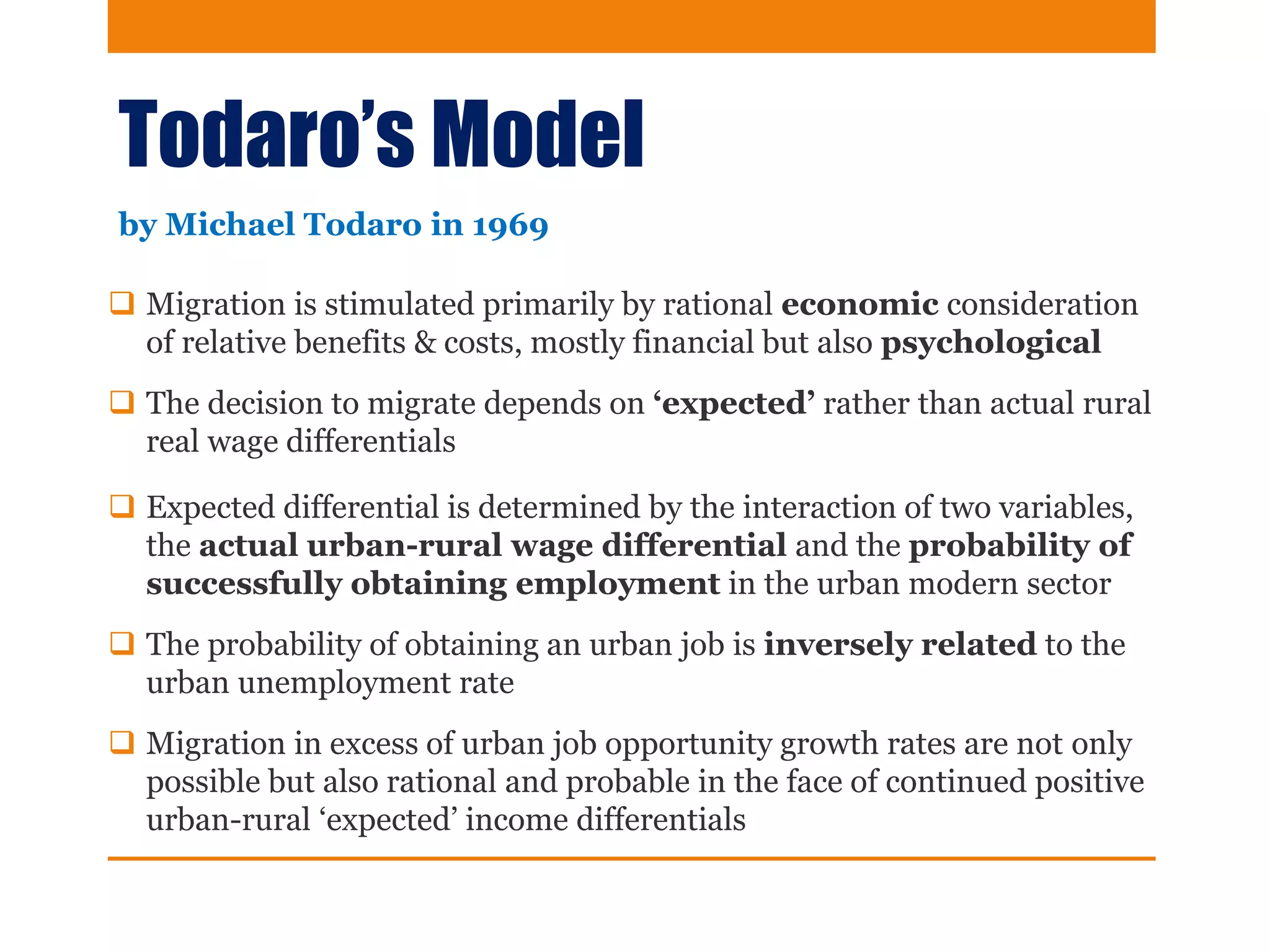
 Migration is stimulated primarily by rational economic consideration
of relative benefits & costs, mostly financial but also psychological
 The decision to migrate depends on ‘expected’ rather than actual rural
real wage differentials
 Expected differential is determined by the interaction of two variables,
the actual urban-rural wage differential and the probability of
successfully obtaining employment in the urban modern sector
 The probability of obtaining an urban job is inversely related to the
urban unemployment rate
 Migration in excess of urban job opportunity growth rates are not only
possible but also rational and probable in the face of continued positive
urban-rural ‘expected’ income differentials
by Michael Todaro in 1969
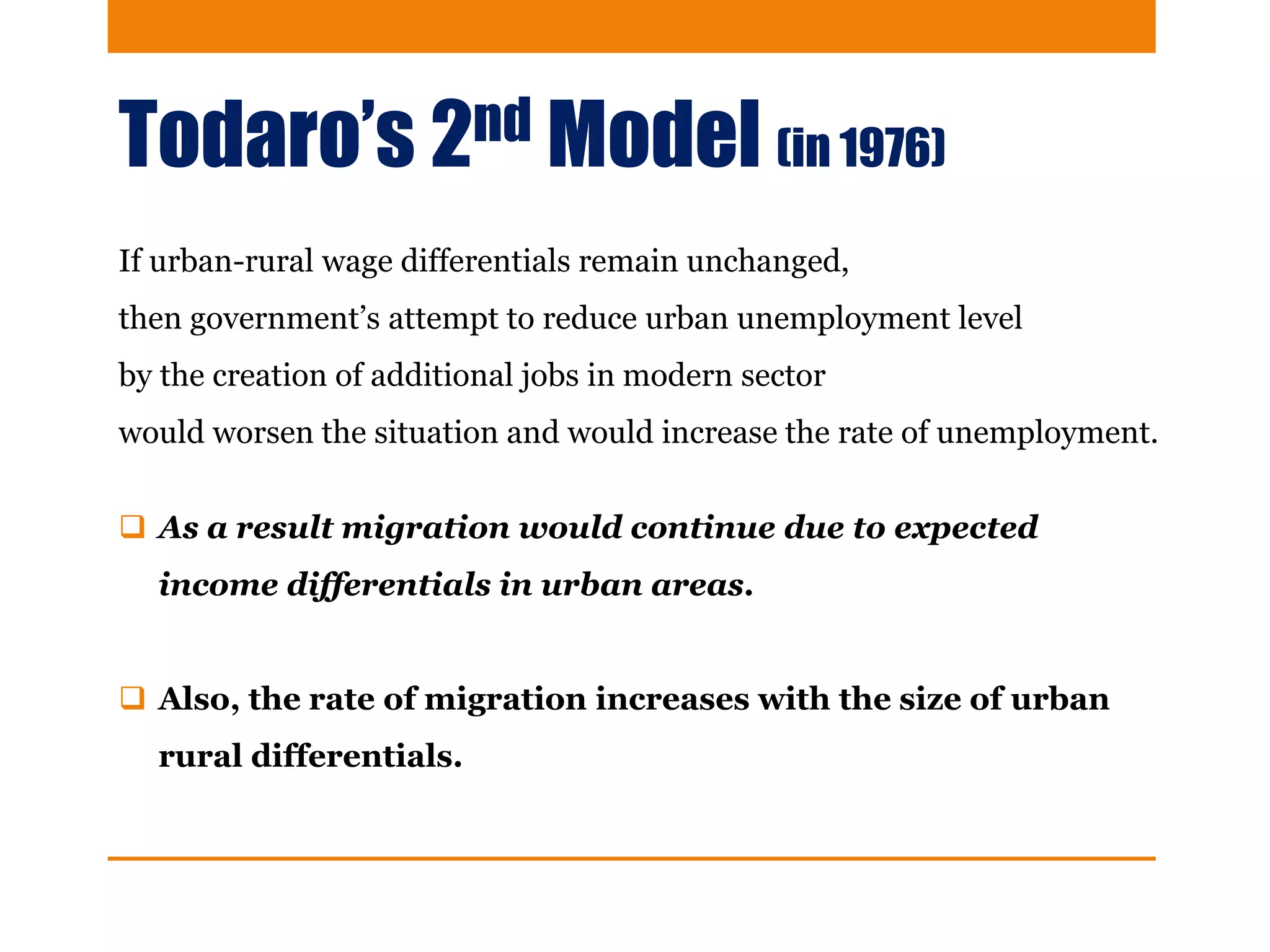
Todaro’s 2nd Model (in 1976)
If urban-rural wage differentials remain unchanged,
then government’s attempt to reduce urban unemployment level
by the creation of additional jobs in modern sector
would worsen the situation and would increase the rate of unemployment.
 As a result migration would continue due to expected
income differentials in urban areas.
 Also, the rate of migration increases with the size of urban
rural differentials.
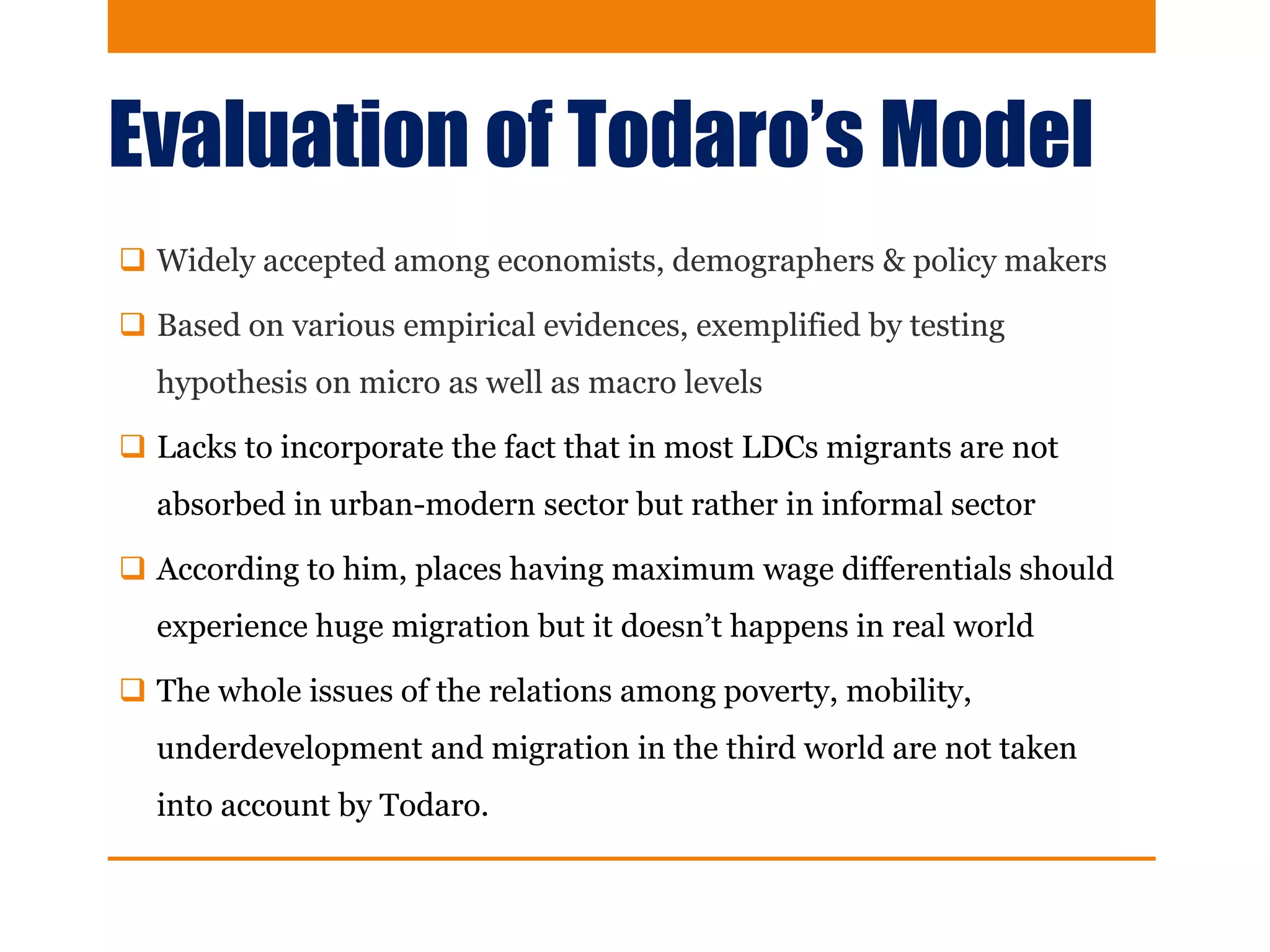
Evaluation of Todaro’s Model
 Widely accepted among economists, demographers & policy makers
 Based on various empirical evidences, exemplified by testing
hypothesis on micro as well as macro levels
 Lacks to incorporate the fact that in most LDCs migrants are not
absorbed in urban-modern sector but rather in informal sector
 According to him, places having maximum wage differentials should
experience huge migration but it doesn’t happens in real world
 The whole issues of the relations among poverty, mobility,
underdevelopment and migration in the third world are not taken
into account by Todaro.
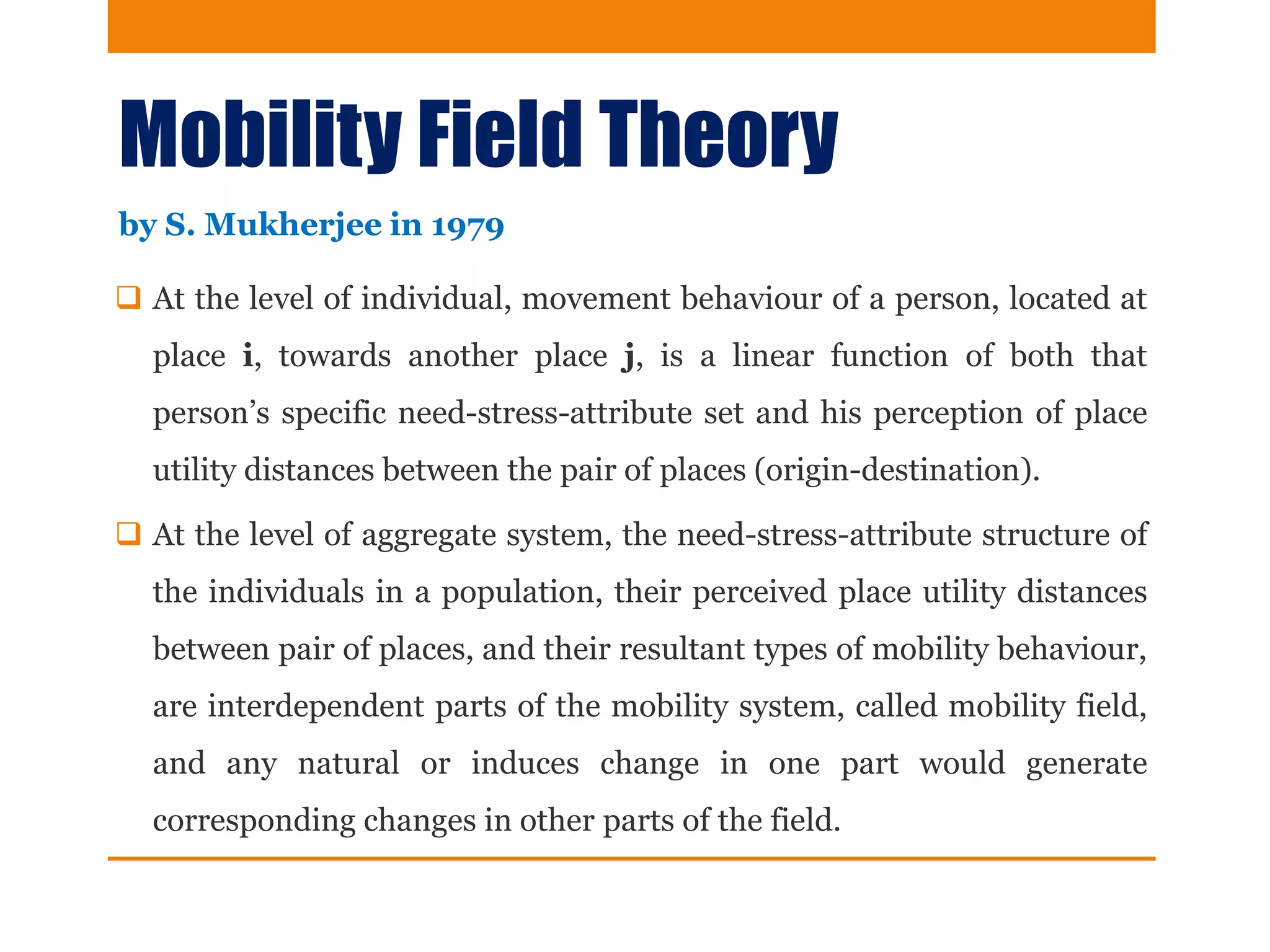
Mobility Field Theory
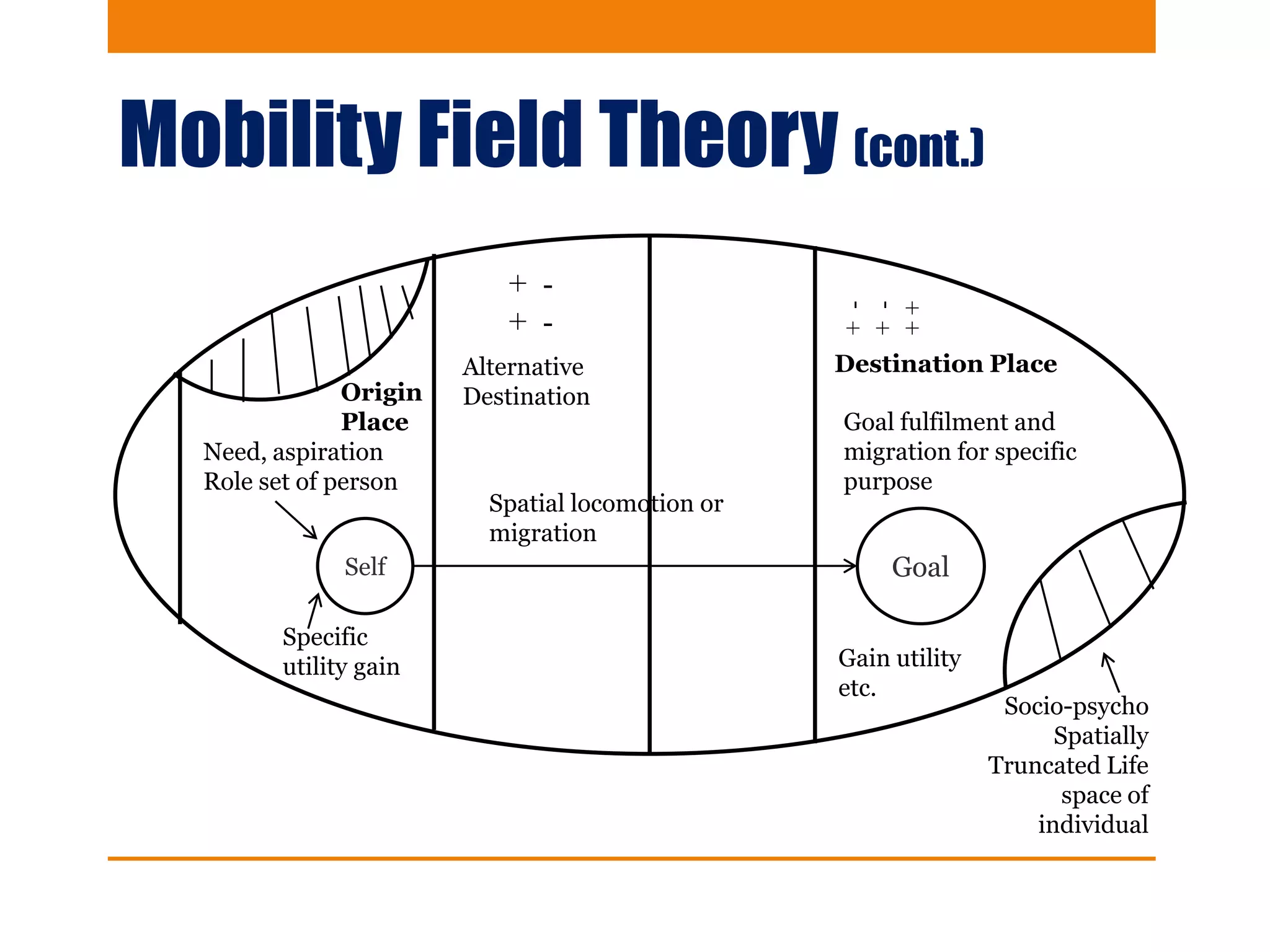
 At the level of individual, movement behaviour of a person, located at
place i, towards another place j, is a linear function of both that
person’s specific need-stress-attribute set and his perception of place
utility distances between the pair of places (origin-destination).
 At the level of aggregate system, the need-stress-attribute structure of
the individuals in a population, their perceived place utility distances
between pair of places, and their resultant types of mobility behaviour,
are interdependent parts of the mobility system, called mobility field,
and any natural or induces change in one part would generate
corresponding changes in other parts of the field.
by S. Mukherjee in 1979
Mobility Field Theory (cont.)
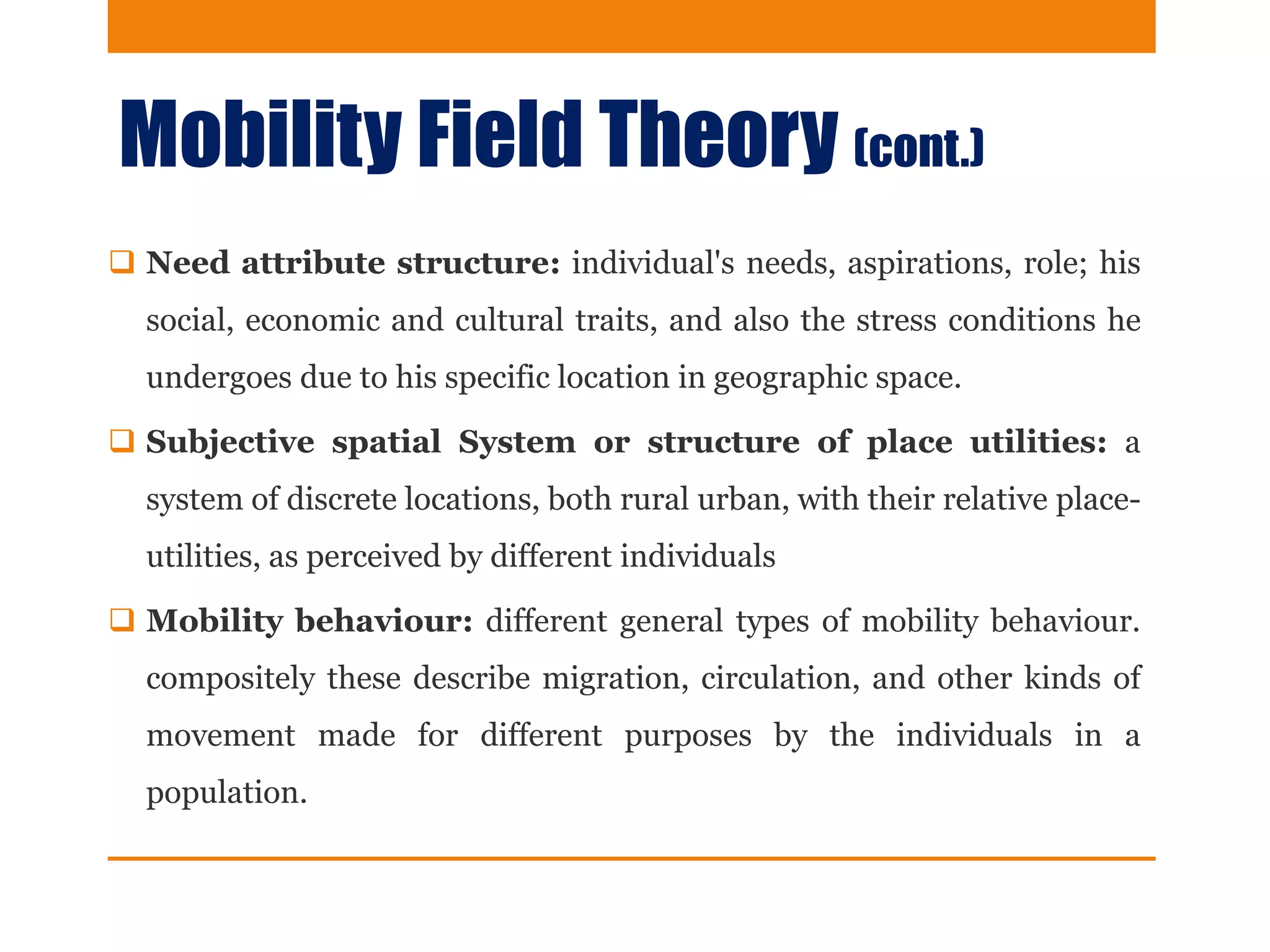
 Need attribute structure: individual's needs, aspirations, role; his
social, economic and cultural traits, and also the stress conditions he
undergoes due to his specific location in geographic space.
 Subjective spatial System or structure of place utilities: a
system of discrete locations, both rural urban, with their relative place-
utilities, as perceived by different individuals
 Mobility behaviour: different general types of mobility behaviour.
compositely these describe migration, circulation, and other kinds of
movement made for different purposes by the individuals in a
population.
S
Mobility Field Theory (cont.)
Self Goal
Spatial locomotion or
migration
Origin
Place
Destination Place
Specific
utility gain
Need, aspiration
Role set of person
+ -
+ -
Alternative
Destination
Gain utility
etc.
Goal fulfilment and
migration for specific
purpose
+-
+-
++
Socio-psycho
Spatially
Truncated Life
space of
individual
THANK YOU !
nandlal.iips@gmail.com | chatsrea@gmail.com
“No matter how beautiful the theory, one irritating
fact can dismiss the entire formulism, so it has to be
proven.”
- Michio Kaku

Theories of Migration

  • 1.
    Theories of Migration SreyaChatterjee Nand Lal Mishra
  • 2.
    Why People Migrate& … From Where To Where
  • 3.
    Migration Theories  Ravenstein’sLaws of Migration  Zipf’s Gravity Model  Everett Lee’s Theory of Migration  Push-Pull hypothesis  Lewis-Fei-Ranis Model of Development  Todaro’s Model of Migration  Mobility Field Theory
  • 4.
    Ravenstein’s Laws  Migrationdecrease with increase in distance  It occurs towards the great centres of commerce and industry  Each main stream produces counter streams  Rural to urban migration is most common  Female predominance among short distance migrants  Dominance of economic motives  Technological advancements promotes migration by E. G. Ravenstein in 1880s
  • 5.
    Gravity Model by Zipfin 1946 D P1 P2 M= 𝑲∗𝑷𝟏∗𝑷𝟐 𝑫 D= Distance between the two places P1= Population of place A | P2= Population of place B K= A constant relating volume of migration at any specific time Based upon Newton’s law of gravitation A B
  • 6.
    Lee’s Theory ofMigration by E. S. Lee in 1965 Factors which affect migration Factors associated with the area of origin e.g. income, job opportunities etc. Personal factors e.g. age, sex, race, education, health etc. Intervening obstacles between area of origin and destination e.g. distance, laws etc. Factors associated with the destination e.g. risks, uncertainty, expectations etc. 1 43 2
  • 7.
    Volume of Migration the degree of diversity of areas  the diversity of people  the difficulty of surmounting the intervening obstacles  fluctuations in the economy The volume of migration varies with… Unless severe checks are imposed, both volume and rate of migration tend to increase with time.
  • 8.
    Stream & Counter-Stream Migration tends to take place largely within well-defined streams  For every migration stream a counter stream develops  The efficiency of stream and counter stream tends to be low if origin and destination are similar  The efficiency of migration stream will be higher if the intervening obstacles are great  The efficiency of migration stream varies with economic conditions, being high in prosperous times and low in times of depression
  • 9.
    Characteristics of Migrants Migration is selective, not a random sample of the population  Migrants responding primarily to plus factors at destination tend to be positively selected (e.g. Highly educated)  Migrants responding primarily to minus factors at origin tend to be negatively selected  The degree of positive selection increases with the difficulty of intervening obstacles  The characteristics of migrants tend to be intermediate between the characteristics of population at origin and the population at destination.
  • 10.
    Push & PullHypothesis + + - + + 0 0 + 0 - - 0 + + 0 - 0 -- Origin Destination Push Factors Pull Factors Obstacles
  • 11.
    Push & PullFactors Push Factors Pull Factors Unemployment & less wages More jobs and high wages Poverty & inadequate land Better living conditions Lack of basic amenities like education & health services Preferable housing, education, health and other facilities Oppressive & Discriminatory treatment in society Modern & secular society and favourable culture Natural hazards/epidemics Better environment & security
  • 12.
    Lewis-Fie-Ranis Model  DualEconomy: Traditional & Modern  Traditional: Rural Agricultural Sector with surplus labours  Modern: Urban Industrial Sector with industrial output  Modern sector attract workers from tradition sector  So, Rural to Urban Migration occurs on large scales by Lewis (1958) and extended by Fei & Ranis (1961)
  • 13.
    Lewis-Fie-Ranis Model (cont.) RuralArea Urban Area Less wage, less income, less savings Better wage, more income, more savings Migration generates surplus foods, more incomes, more savings and investments among rural people.
  • 14.
    Todaro’s Model  Migrationis stimulated primarily by rational economic consideration of relative benefits & costs, mostly financial but also psychological  The decision to migrate depends on ‘expected’ rather than actual rural real wage differentials  Expected differential is determined by the interaction of two variables, the actual urban-rural wage differential and the probability of successfully obtaining employment in the urban modern sector  The probability of obtaining an urban job is inversely related to the urban unemployment rate  Migration in excess of urban job opportunity growth rates are not only possible but also rational and probable in the face of continued positive urban-rural ‘expected’ income differentials by Michael Todaro in 1969
  • 15.
    Todaro’s 2nd Model(in 1976) If urban-rural wage differentials remain unchanged, then government’s attempt to reduce urban unemployment level by the creation of additional jobs in modern sector would worsen the situation and would increase the rate of unemployment.  As a result migration would continue due to expected income differentials in urban areas.  Also, the rate of migration increases with the size of urban rural differentials.
  • 16.
    Evaluation of Todaro’sModel  Widely accepted among economists, demographers & policy makers  Based on various empirical evidences, exemplified by testing hypothesis on micro as well as macro levels  Lacks to incorporate the fact that in most LDCs migrants are not absorbed in urban-modern sector but rather in informal sector  According to him, places having maximum wage differentials should experience huge migration but it doesn’t happens in real world  The whole issues of the relations among poverty, mobility, underdevelopment and migration in the third world are not taken into account by Todaro.
  • 17.
    Mobility Field Theory At the level of individual, movement behaviour of a person, located at place i, towards another place j, is a linear function of both that person’s specific need-stress-attribute set and his perception of place utility distances between the pair of places (origin-destination).  At the level of aggregate system, the need-stress-attribute structure of the individuals in a population, their perceived place utility distances between pair of places, and their resultant types of mobility behaviour, are interdependent parts of the mobility system, called mobility field, and any natural or induces change in one part would generate corresponding changes in other parts of the field. by S. Mukherjee in 1979
  • 18.
    Mobility Field Theory(cont.)  Need attribute structure: individual's needs, aspirations, role; his social, economic and cultural traits, and also the stress conditions he undergoes due to his specific location in geographic space.  Subjective spatial System or structure of place utilities: a system of discrete locations, both rural urban, with their relative place- utilities, as perceived by different individuals  Mobility behaviour: different general types of mobility behaviour. compositely these describe migration, circulation, and other kinds of movement made for different purposes by the individuals in a population.
  • 19.
    S Mobility Field Theory(cont.) Self Goal Spatial locomotion or migration Origin Place Destination Place Specific utility gain Need, aspiration Role set of person + - + - Alternative Destination Gain utility etc. Goal fulfilment and migration for specific purpose +- +- ++ Socio-psycho Spatially Truncated Life space of individual
  • 20.
    THANK YOU ! nandlal.iips@gmail.com| chatsrea@gmail.com “No matter how beautiful the theory, one irritating fact can dismiss the entire formulism, so it has to be proven.” - Michio Kaku