The Future of Packet Handling Alan Taylor
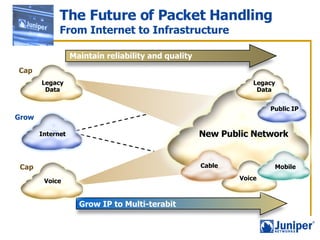
The Future of Packet Handling From Internet to Infrastructure Legacy Data Internet Internet New Public Network Voice Cap Grow Cap Mobile Public IP Legacy Data Voice Maintain reliability and quality Grow IP to Multi-terabit Cable
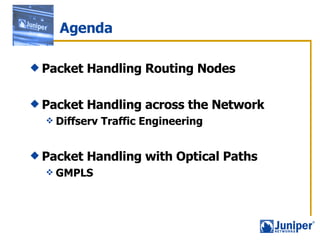
Agenda Packet Handling Routing Nodes Packet Handling across the Network Diffserv Traffic Engineering Packet Handling with Optical Paths GMPLS
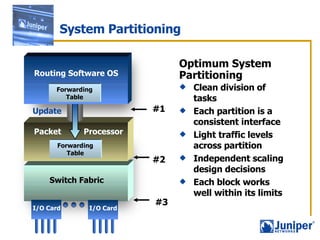
System Partitioning Clean division of tasks Each partition is a consistent interface Light traffic levels across partition Independent scaling design decisions Each block works well within its limits Optimum System Partitioning  #1  #2  #3  Update Forwarding Table Packet Processor Switch Fabric Forwarding Table Routing Software OS I/O Card I/O Card
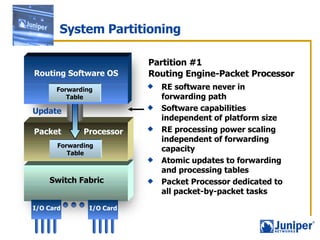
System Partitioning RE software never in forwarding path Software capabilities independent of platform size RE processing power scaling independent of forwarding capacity Atomic updates to forwarding and processing tables  Packet Processor dedicated to all packet-by-packet tasks Partition #1 Routing Engine-Packet Processor   Update Forwarding Table Packet Processor Switch Fabric Forwarding Table Routing Software OS I/O Card I/O Card
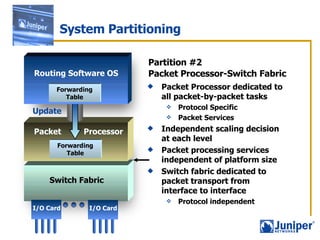
System Partitioning Packet Processor dedicated to all packet-by-packet tasks Protocol Specific Packet Services  Independent scaling decision at each level Packet processing services independent of platform size Switch fabric dedicated to packet transport from interface to interface Protocol independent Partition #2 Packet Processor-Switch Fabric   Update Forwarding Table Packet Processor Switch Fabric Forwarding Table Routing Software OS I/O Card I/O Card
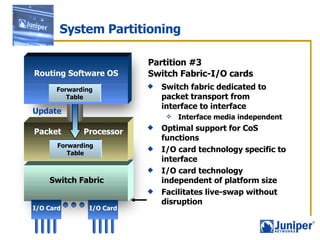
System Partitioning Switch fabric dedicated to packet transport from interface to interface Interface media independent Optimal support for CoS functions I/O card technology specific to interface I/O card technology independent of platform size Facilitates live-swap without disruption Partition #3 Switch Fabric-I/O cards   Update Forwarding Table Packet Processor Switch Fabric Forwarding Table Routing Software OS I/O Card I/O Card
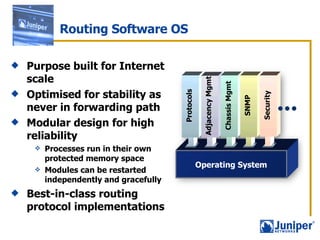
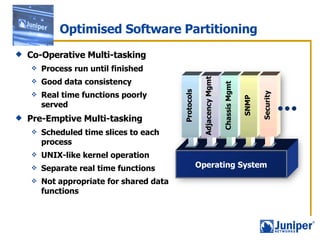
Routing Software OS Purpose built for Internet scale Optimised for stability as never in forwarding path Modular design for high reliability  Processes run in their own protected memory space Modules can be restarted independently and gracefully Best-in-class routing protocol implementations Operating System Protocols Adjacency Mgmt Chassis Mgmt SNMP Security
Optimised Software Partitioning Co-Operative Multi-tasking Process run until finished Good data consistency Real time functions poorly served Pre-Emptive Multi-tasking Scheduled time slices to each process UNIX-like kernel operation Separate real time functions Not appropriate for shared data functions Operating System Protocols Adjacency Mgmt Chassis Mgmt SNMP Security
Agenda Packet Handling Routing Nodes Packet Handling across the Network Diffserv Traffic Engineering Packet Handling with Optical Paths GMPLS
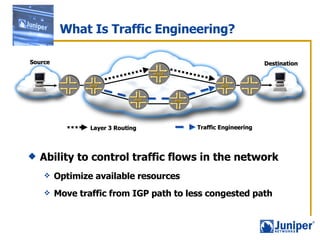
What Is Traffic Engineering? Ability to control traffic flows in the network Optimize available resources Move traffic from IGP path to less congested path Source Destination Layer 3 Routing Traffic Engineering
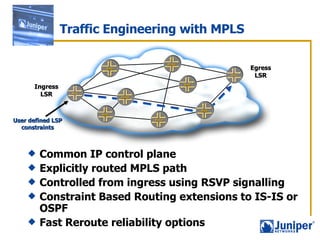
Traffic Engineering with MPLS Common IP control plane Explicitly routed MPLS path Controlled from ingress using RSVP signalling Constraint Based Routing extensions to IS-IS or OSPF Fast Reroute reliability options Ingress LSR Egress LSR User defined LSP  constraints
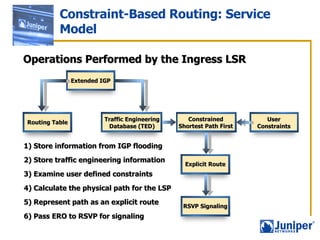
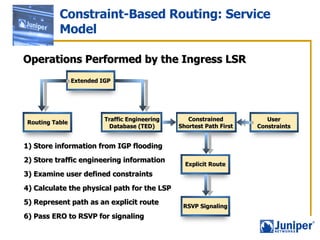
Constraint-Based Routing: Service Model Operations Performed by the Ingress LSR 1) Store information from IGP flooding 3) Examine user defined constraints 4) Calculate the physical path for the LSP 5) Represent path as an explicit route 6) Pass ERO to RSVP for signaling 2) Store traffic engineering information Routing Table Extended IGP Traffic Engineering Database (TED) User Constraints Constrained Shortest Path First Explicit Route RSVP Signaling
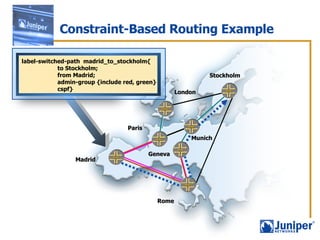
Constraint-Based Routing Example Paris London Stockholm Madrid Rome Geneva Munich label-switched-path  madrid_to_stockholm{ to Stockholm; from Madrid; admin-group {include red, green} cspf}
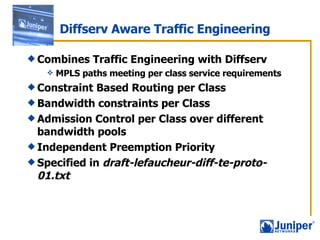
Combines Traffic Engineering with Diffserv MPLS paths meeting per class service requirements Constraint Based Routing per Class  Bandwidth constraints per Class Admission Control per Class over different bandwidth pools  Independent Preemption Priority Specified in  draft-lefaucheur-diff-te-proto-01.txt Diffserv Aware Traffic Engineering
Constraint-Based Routing: Service Model Operations Performed by the Ingress LSR 1) Store information from IGP flooding 3) Examine user defined constraints 4) Calculate the physical path for the LSP 5) Represent path as an explicit route 6) Pass ERO to RSVP for signaling 2) Store traffic engineering information Routing Table Extended IGP Traffic Engineering Database (TED) User Constraints Constrained Shortest Path First Explicit Route RSVP Signaling
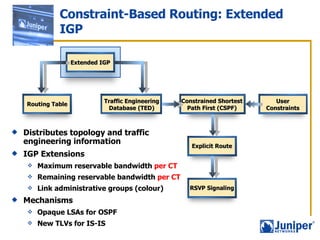
Constraint-Based Routing: Extended IGP Distributes topology and traffic engineering information  IGP Extensions Maximum reservable bandwidth  per CT Remaining reservable bandwidth  per CT Link administrative groups (colour) Mechanisms Opaque LSAs for OSPF New TLVs for IS-IS Routing Table Extended IGP Traffic Engineering Database (TED) User Constraints Constrained Shortest Path First (CSPF) Explicit Route RSVP Signaling
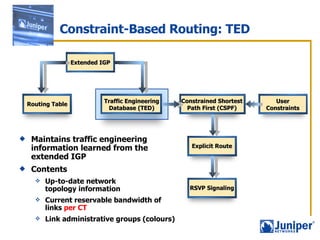
Constraint-Based Routing: TED Maintains traffic engineering information learned from the extended IGP  Contents Up-to-date network topology information Current reservable bandwidth of links  per CT Link administrative groups (colours) Routing Table Extended IGP Traffic Engineering Database (TED) User Constraints Constrained Shortest Path First (CSPF) Explicit Route RSVP Signaling
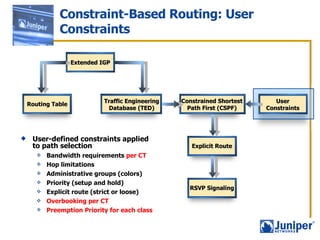
Constraint-Based Routing: User Constraints User-defined constraints applied to path selection Bandwidth requirements  per CT Hop limitations Administrative groups (colors) Priority (setup and hold) Explicit route (strict or loose) Overbooking per CT Preemption Priority for each class Routing Table Extended IGP Traffic Engineering Database (TED) User Constraints Constrained Shortest Path First (CSPF) Explicit Route RSVP Signaling
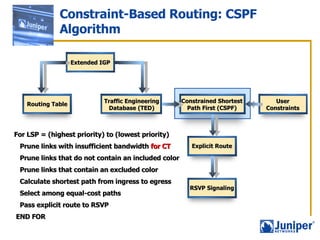
Constraint-Based Routing: CSPF Algorithm Routing Table Extended IGP Traffic Engineering Database (TED) User Constraints Constrained Shortest Path First (CSPF) Explicit Route For LSP = (highest priority) to (lowest priority) Prune links with insufficient bandwidth  for CT Prune links that do not contain an included color Prune links that contain an excluded color Calculate shortest path from ingress to egress Select among equal-cost paths Pass explicit route to RSVP END FOR RSVP Signaling
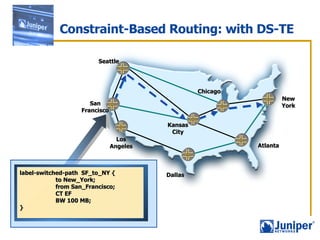
Constraint-Based Routing: with DS-TE New York Atlanta Chicago Seattle Los Angeles San Francisco Kansas City Dallas label-switched-path  SF_to_NY { to New_York; from San_Francisco; CT EF BW 100 MB; }
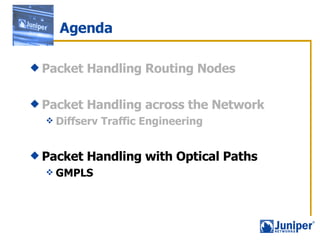
Agenda Packet Handling Routing Nodes Packet Handling across the Network Diffserv Traffic Engineering Packet Handling with Optical Paths GMPLS
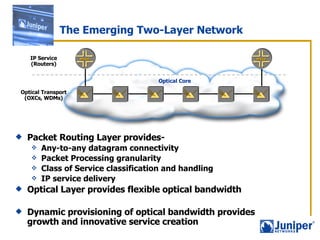
The Emerging Two-Layer Network Packet Routing Layer provides- Any-to-any datagram connectivity Packet Processing granularity Class of Service classification and handling IP service delivery Optical Layer provides flexible optical bandwidth Dynamic provisioning of optical bandwidth provides growth and innovative service creation IP Service (Routers) Optical Transport (OXCs, WDMs) Optical Core
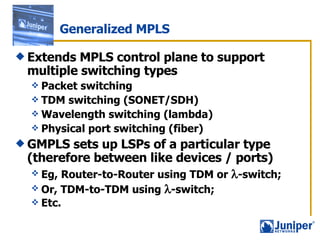
Generalized MPLS Extends MPLS control plane to support multiple switching types Packet switching TDM switching (SONET/SDH) Wavelength switching (lambda) Physical port switching (fiber) GMPLS sets up LSPs of a particular type (therefore between like devices / ports)  Eg, Router-to-Router using TDM or   -switch; Or, TDM-to-TDM using   -switch;  Etc.
Generalized MPLS Uses existing and evolving technologies Based on IP routing and signaling Builds on MPLS, and  includes  MPLS Distinction: packet vs. non-packet MPLS Is not a protocol, but a suite of protocols Just as MPLS is not a protocol Facilitates parallel evolution in the IP  and transmission domains “Supports” peer and overlay models
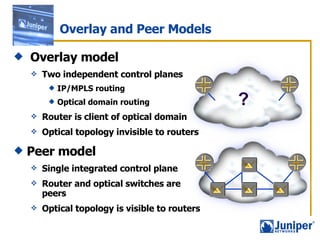
Overlay and Peer Models Overlay model Two independent control planes IP/MPLS routing  Optical domain routing Router is client of optical domain Optical topology invisible to routers Peer model Single integrated control plane Router and optical switches are peers Optical topology is visible to routers ?
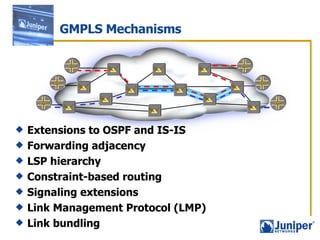
GMPLS Mechanisms Extensions to OSPF and IS-IS  Forwarding adjacency LSP hierarchy Constraint-based routing Signaling extensions Link Management Protocol (LMP) Link bundling
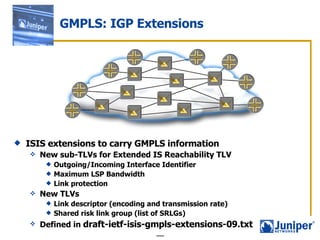
ISIS extensions to carry GMPLS information  New sub-TLVs for Extended IS Reachability TLV Outgoing/Incoming Interface Identifier Maximum LSP Bandwidth Link protection New TLVs Link descriptor (encoding and transmission rate) Shared risk link group (list of SRLGs) Defined in  draft-ietf-isis-gmpls-extensions-09.txt  GMPLS: IGP Extensions
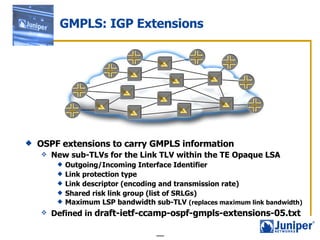
OSPF extensions to carry GMPLS information New sub-TLVs for the Link TLV within the TE Opaque LSA Outgoing/Incoming Interface Identifier Link protection type Link descriptor (encoding and transmission rate) Shared risk link group (list of SRLGs) Maximum LSP bandwidth sub-TLV  (replaces maximum link bandwidth)   Defined in  draft-ietf-ccamp-ospf-gmpls-extensions-05.txt GMPLS: IGP Extensions
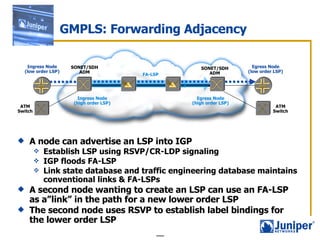
GMPLS: Forwarding Adjacency A node can advertise an LSP into IGP Establish LSP using RSVP/CR-LDP signaling IGP floods FA-LSP Link state database and traffic engineering database maintains conventional links & FA-LSPs A second node wanting to create an LSP can use an FA-LSP as a”link” in the path for a new lower order LSP  The second node uses RSVP to establish label bindings for the lower order LSP ATM Switch ATM Switch SONET/SDH ADM SONET/SDH ADM Ingress Node (high order LSP) Egress Node (high order LSP) FA-LSP Ingress Node (low order LSP) Egress Node (low order LSP)
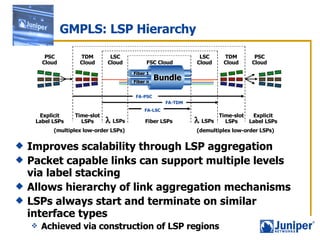
GMPLS: LSP Hierarchy Improves scalability through LSP aggregation Packet capable links can support multiple levels via label stacking Allows hierarchy of link aggregation mechanisms LSPs always start and terminate on similar interface types Achieved via construction of LSP regions FA-LSC FA-TDM FA-PSC Bundle Fiber n Fiber 1 FSC Cloud LSC Cloud TDM Cloud PSC Cloud LSC Cloud TDM Cloud PSC Cloud Explicit Label LSPs Time-slot LSPs Fiber LSPs  LSPs Explicit Label LSPs Time-slot LSPs  LSPs (multiplex low-order LSPs) (demultiplex low-order LSPs)
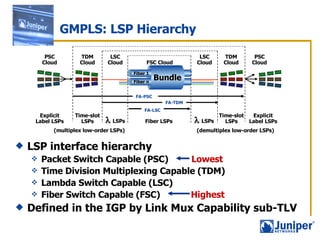
GMPLS: LSP Hierarchy LSP interface hierarchy Packet Switch Capable (PSC)  Lowest Time Division Multiplexing Capable (TDM) Lambda Switch Capable (LSC) Fiber Switch Capable (FSC)  Highest Defined in the IGP by Link Mux Capability sub-TLV FA-LSC FA-TDM FA-PSC Bundle Fiber n Fiber 1 FSC Cloud LSC Cloud TDM Cloud PSC Cloud LSC Cloud TDM Cloud PSC Cloud Explicit Label LSPs Time-slot LSPs Fiber LSPs  LSPs Explicit Label LSPs Time-slot LSPs  LSPs (multiplex low-order LSPs) (demultiplex low-order LSPs)
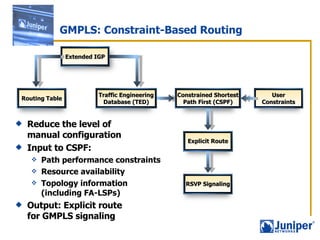
GMPLS: Constraint-Based Routing Reduce the level of manual configuration Input to CSPF: Path performance constraints Resource availability Topology information (including FA-LSPs) Output: Explicit route for GMPLS signaling RSVP Signaling Traffic Engineering Database (TED) User Constraints Constrained Shortest Path First (CSPF) Explicit Route Routing Table Extended IGP
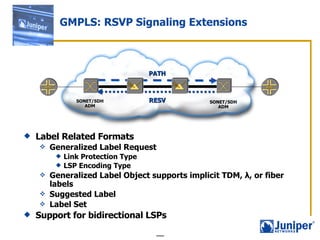
Label Related Formats Generalized Label Request Link Protection Type LSP Encoding Type Generalized Label Object supports implicit TDM,  λ , or fiber labels Suggested Label Label Set Support for bidirectional LSPs GMPLS: RSVP Signaling Extensions SONET/SDH ADM SONET/SDH ADM RESV PATH
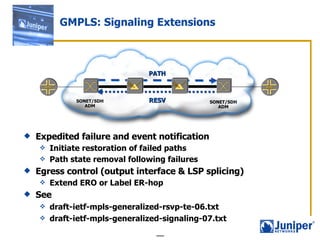
Expedited failure and event notification Initiate restoration of failed paths Path state removal following failures Egress control (output interface & LSP splicing) Extend ERO or Label ER-hop See draft-ietf-mpls-generalized-rsvp-te-06.txt  draft-ietf-mpls-generalized-signaling-07.txt GMPLS: Signaling Extensions SONET/SDH ADM SONET/SDH ADM RESV PATH
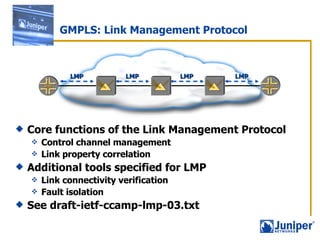
GMPLS: Link Management Protocol Core functions of the Link Management Protocol Control channel management Link property correlation Additional tools specified for LMP Link connectivity verification  Fault isolation See draft-ietf-ccamp-lmp-03.txt  LMP LMP LMP LMP
Conclusion Routing Nodes based on clean and consistent partitioning Hardware and software Handling different traffic classes across the Network Diffserv Traffic Engineering Routing Layer interaction with Optical Paths GMPLS
Thank You http://www.juniper.net

Sl3c3

  • 1.
    The Future ofPacket Handling Alan Taylor
  • 2.
    The Future ofPacket Handling From Internet to Infrastructure Legacy Data Internet Internet New Public Network Voice Cap Grow Cap Mobile Public IP Legacy Data Voice Maintain reliability and quality Grow IP to Multi-terabit Cable
  • 3.
    Agenda Packet HandlingRouting Nodes Packet Handling across the Network Diffserv Traffic Engineering Packet Handling with Optical Paths GMPLS
  • 4.
    Agenda Packet HandlingRouting Nodes Packet Handling across the Network Diffserv Traffic Engineering Packet Handling with Optical Paths GMPLS
  • 5.
    System Partitioning Cleandivision of tasks Each partition is a consistent interface Light traffic levels across partition Independent scaling design decisions Each block works well within its limits Optimum System Partitioning #1 #2 #3 Update Forwarding Table Packet Processor Switch Fabric Forwarding Table Routing Software OS I/O Card I/O Card
  • 6.
    System Partitioning REsoftware never in forwarding path Software capabilities independent of platform size RE processing power scaling independent of forwarding capacity Atomic updates to forwarding and processing tables Packet Processor dedicated to all packet-by-packet tasks Partition #1 Routing Engine-Packet Processor Update Forwarding Table Packet Processor Switch Fabric Forwarding Table Routing Software OS I/O Card I/O Card
  • 7.
    System Partitioning PacketProcessor dedicated to all packet-by-packet tasks Protocol Specific Packet Services Independent scaling decision at each level Packet processing services independent of platform size Switch fabric dedicated to packet transport from interface to interface Protocol independent Partition #2 Packet Processor-Switch Fabric Update Forwarding Table Packet Processor Switch Fabric Forwarding Table Routing Software OS I/O Card I/O Card
  • 8.
    System Partitioning Switchfabric dedicated to packet transport from interface to interface Interface media independent Optimal support for CoS functions I/O card technology specific to interface I/O card technology independent of platform size Facilitates live-swap without disruption Partition #3 Switch Fabric-I/O cards Update Forwarding Table Packet Processor Switch Fabric Forwarding Table Routing Software OS I/O Card I/O Card
  • 9.
    Routing Software OSPurpose built for Internet scale Optimised for stability as never in forwarding path Modular design for high reliability Processes run in their own protected memory space Modules can be restarted independently and gracefully Best-in-class routing protocol implementations Operating System Protocols Adjacency Mgmt Chassis Mgmt SNMP Security
  • 10.
    Optimised Software PartitioningCo-Operative Multi-tasking Process run until finished Good data consistency Real time functions poorly served Pre-Emptive Multi-tasking Scheduled time slices to each process UNIX-like kernel operation Separate real time functions Not appropriate for shared data functions Operating System Protocols Adjacency Mgmt Chassis Mgmt SNMP Security
  • 11.
    Agenda Packet HandlingRouting Nodes Packet Handling across the Network Diffserv Traffic Engineering Packet Handling with Optical Paths GMPLS
  • 12.
    What Is TrafficEngineering? Ability to control traffic flows in the network Optimize available resources Move traffic from IGP path to less congested path Source Destination Layer 3 Routing Traffic Engineering
  • 13.
    Traffic Engineering withMPLS Common IP control plane Explicitly routed MPLS path Controlled from ingress using RSVP signalling Constraint Based Routing extensions to IS-IS or OSPF Fast Reroute reliability options Ingress LSR Egress LSR User defined LSP constraints
  • 14.
    Constraint-Based Routing: ServiceModel Operations Performed by the Ingress LSR 1) Store information from IGP flooding 3) Examine user defined constraints 4) Calculate the physical path for the LSP 5) Represent path as an explicit route 6) Pass ERO to RSVP for signaling 2) Store traffic engineering information Routing Table Extended IGP Traffic Engineering Database (TED) User Constraints Constrained Shortest Path First Explicit Route RSVP Signaling
  • 15.
    Constraint-Based Routing ExampleParis London Stockholm Madrid Rome Geneva Munich label-switched-path madrid_to_stockholm{ to Stockholm; from Madrid; admin-group {include red, green} cspf}
  • 16.
    Combines Traffic Engineeringwith Diffserv MPLS paths meeting per class service requirements Constraint Based Routing per Class Bandwidth constraints per Class Admission Control per Class over different bandwidth pools Independent Preemption Priority Specified in draft-lefaucheur-diff-te-proto-01.txt Diffserv Aware Traffic Engineering
  • 17.
    Constraint-Based Routing: ServiceModel Operations Performed by the Ingress LSR 1) Store information from IGP flooding 3) Examine user defined constraints 4) Calculate the physical path for the LSP 5) Represent path as an explicit route 6) Pass ERO to RSVP for signaling 2) Store traffic engineering information Routing Table Extended IGP Traffic Engineering Database (TED) User Constraints Constrained Shortest Path First Explicit Route RSVP Signaling
  • 18.
    Constraint-Based Routing: ExtendedIGP Distributes topology and traffic engineering information IGP Extensions Maximum reservable bandwidth per CT Remaining reservable bandwidth per CT Link administrative groups (colour) Mechanisms Opaque LSAs for OSPF New TLVs for IS-IS Routing Table Extended IGP Traffic Engineering Database (TED) User Constraints Constrained Shortest Path First (CSPF) Explicit Route RSVP Signaling
  • 19.
    Constraint-Based Routing: TEDMaintains traffic engineering information learned from the extended IGP Contents Up-to-date network topology information Current reservable bandwidth of links per CT Link administrative groups (colours) Routing Table Extended IGP Traffic Engineering Database (TED) User Constraints Constrained Shortest Path First (CSPF) Explicit Route RSVP Signaling
  • 20.
    Constraint-Based Routing: UserConstraints User-defined constraints applied to path selection Bandwidth requirements per CT Hop limitations Administrative groups (colors) Priority (setup and hold) Explicit route (strict or loose) Overbooking per CT Preemption Priority for each class Routing Table Extended IGP Traffic Engineering Database (TED) User Constraints Constrained Shortest Path First (CSPF) Explicit Route RSVP Signaling
  • 21.
    Constraint-Based Routing: CSPFAlgorithm Routing Table Extended IGP Traffic Engineering Database (TED) User Constraints Constrained Shortest Path First (CSPF) Explicit Route For LSP = (highest priority) to (lowest priority) Prune links with insufficient bandwidth for CT Prune links that do not contain an included color Prune links that contain an excluded color Calculate shortest path from ingress to egress Select among equal-cost paths Pass explicit route to RSVP END FOR RSVP Signaling
  • 22.
    Constraint-Based Routing: withDS-TE New York Atlanta Chicago Seattle Los Angeles San Francisco Kansas City Dallas label-switched-path SF_to_NY { to New_York; from San_Francisco; CT EF BW 100 MB; }
  • 23.
    Agenda Packet HandlingRouting Nodes Packet Handling across the Network Diffserv Traffic Engineering Packet Handling with Optical Paths GMPLS
  • 24.
    The Emerging Two-LayerNetwork Packet Routing Layer provides- Any-to-any datagram connectivity Packet Processing granularity Class of Service classification and handling IP service delivery Optical Layer provides flexible optical bandwidth Dynamic provisioning of optical bandwidth provides growth and innovative service creation IP Service (Routers) Optical Transport (OXCs, WDMs) Optical Core
  • 25.
    Generalized MPLS ExtendsMPLS control plane to support multiple switching types Packet switching TDM switching (SONET/SDH) Wavelength switching (lambda) Physical port switching (fiber) GMPLS sets up LSPs of a particular type (therefore between like devices / ports) Eg, Router-to-Router using TDM or  -switch; Or, TDM-to-TDM using  -switch; Etc.
  • 26.
    Generalized MPLS Usesexisting and evolving technologies Based on IP routing and signaling Builds on MPLS, and includes MPLS Distinction: packet vs. non-packet MPLS Is not a protocol, but a suite of protocols Just as MPLS is not a protocol Facilitates parallel evolution in the IP and transmission domains “Supports” peer and overlay models
  • 27.
    Overlay and PeerModels Overlay model Two independent control planes IP/MPLS routing Optical domain routing Router is client of optical domain Optical topology invisible to routers Peer model Single integrated control plane Router and optical switches are peers Optical topology is visible to routers ?
  • 28.
    GMPLS Mechanisms Extensionsto OSPF and IS-IS Forwarding adjacency LSP hierarchy Constraint-based routing Signaling extensions Link Management Protocol (LMP) Link bundling
  • 29.
    ISIS extensions tocarry GMPLS information New sub-TLVs for Extended IS Reachability TLV Outgoing/Incoming Interface Identifier Maximum LSP Bandwidth Link protection New TLVs Link descriptor (encoding and transmission rate) Shared risk link group (list of SRLGs) Defined in draft-ietf-isis-gmpls-extensions-09.txt GMPLS: IGP Extensions
  • 30.
    OSPF extensions tocarry GMPLS information New sub-TLVs for the Link TLV within the TE Opaque LSA Outgoing/Incoming Interface Identifier Link protection type Link descriptor (encoding and transmission rate) Shared risk link group (list of SRLGs) Maximum LSP bandwidth sub-TLV (replaces maximum link bandwidth) Defined in draft-ietf-ccamp-ospf-gmpls-extensions-05.txt GMPLS: IGP Extensions
  • 31.
    GMPLS: Forwarding AdjacencyA node can advertise an LSP into IGP Establish LSP using RSVP/CR-LDP signaling IGP floods FA-LSP Link state database and traffic engineering database maintains conventional links & FA-LSPs A second node wanting to create an LSP can use an FA-LSP as a”link” in the path for a new lower order LSP The second node uses RSVP to establish label bindings for the lower order LSP ATM Switch ATM Switch SONET/SDH ADM SONET/SDH ADM Ingress Node (high order LSP) Egress Node (high order LSP) FA-LSP Ingress Node (low order LSP) Egress Node (low order LSP)
  • 32.
    GMPLS: LSP HierarchyImproves scalability through LSP aggregation Packet capable links can support multiple levels via label stacking Allows hierarchy of link aggregation mechanisms LSPs always start and terminate on similar interface types Achieved via construction of LSP regions FA-LSC FA-TDM FA-PSC Bundle Fiber n Fiber 1 FSC Cloud LSC Cloud TDM Cloud PSC Cloud LSC Cloud TDM Cloud PSC Cloud Explicit Label LSPs Time-slot LSPs Fiber LSPs  LSPs Explicit Label LSPs Time-slot LSPs  LSPs (multiplex low-order LSPs) (demultiplex low-order LSPs)
  • 33.
    GMPLS: LSP HierarchyLSP interface hierarchy Packet Switch Capable (PSC) Lowest Time Division Multiplexing Capable (TDM) Lambda Switch Capable (LSC) Fiber Switch Capable (FSC) Highest Defined in the IGP by Link Mux Capability sub-TLV FA-LSC FA-TDM FA-PSC Bundle Fiber n Fiber 1 FSC Cloud LSC Cloud TDM Cloud PSC Cloud LSC Cloud TDM Cloud PSC Cloud Explicit Label LSPs Time-slot LSPs Fiber LSPs  LSPs Explicit Label LSPs Time-slot LSPs  LSPs (multiplex low-order LSPs) (demultiplex low-order LSPs)
  • 34.
    GMPLS: Constraint-Based RoutingReduce the level of manual configuration Input to CSPF: Path performance constraints Resource availability Topology information (including FA-LSPs) Output: Explicit route for GMPLS signaling RSVP Signaling Traffic Engineering Database (TED) User Constraints Constrained Shortest Path First (CSPF) Explicit Route Routing Table Extended IGP
  • 35.
    Label Related FormatsGeneralized Label Request Link Protection Type LSP Encoding Type Generalized Label Object supports implicit TDM, λ , or fiber labels Suggested Label Label Set Support for bidirectional LSPs GMPLS: RSVP Signaling Extensions SONET/SDH ADM SONET/SDH ADM RESV PATH
  • 36.
    Expedited failure andevent notification Initiate restoration of failed paths Path state removal following failures Egress control (output interface & LSP splicing) Extend ERO or Label ER-hop See draft-ietf-mpls-generalized-rsvp-te-06.txt draft-ietf-mpls-generalized-signaling-07.txt GMPLS: Signaling Extensions SONET/SDH ADM SONET/SDH ADM RESV PATH
  • 37.
    GMPLS: Link ManagementProtocol Core functions of the Link Management Protocol Control channel management Link property correlation Additional tools specified for LMP Link connectivity verification Fault isolation See draft-ietf-ccamp-lmp-03.txt LMP LMP LMP LMP
  • 38.
    Conclusion Routing Nodesbased on clean and consistent partitioning Hardware and software Handling different traffic classes across the Network Diffserv Traffic Engineering Routing Layer interaction with Optical Paths GMPLS
  • 39.

Editor's Notes