Epidemiology
 Mean age – mid 60”s
 Men > women
 Bilateral in 1 – 2%
 May have other retinal vascular disease
Etiology
 Systemic hypertension seen in two thirds of patients
 Diabetes mellitus
 Cardiac valvular disease seen in one fourth of patients
 Cardiac anomalies, such as patent foramen ovale
 Embolism
Embolism is the most common cause. The
carotid artery and the heart are the most
common sources.
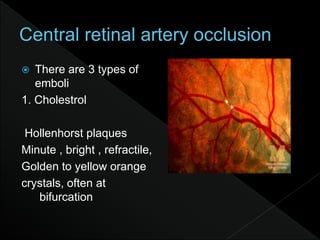
 There are 3 types of
emboli
1. Cholestrol
Hollenhorst plaques
Minute , bright , refractile,
Golden to yellow orange
crystals, often at
bifurcation
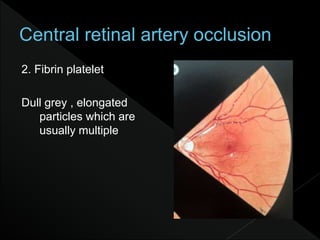
2. Fibrin platelet
Dull grey , elongated
particles which are
usually multiple
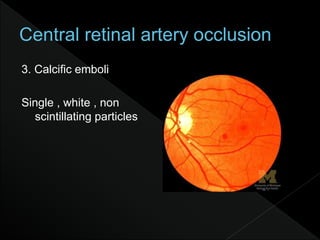
3. Calcific emboli
Single , white , non
scintillating particles
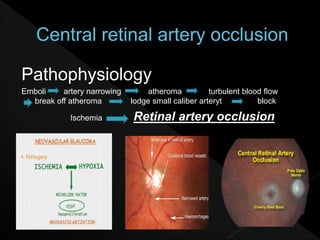
Pathophysiology
Emboli artery narrowing atheroma turbulent blood flow
break off atheroma lodge small caliber arteryt block
Ischemia Retinal artery occlusion
Characteristics
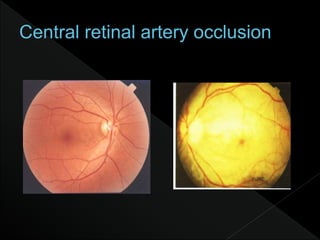
Sudden severe visual loss in 1 eye
Painless
Retinal appearance
 Opaque and edematous
 Retina artery narrow,mild hemorrhage
 Most prominent in posterior pole
 Thickest ganglion cell layer
 Cherry-red spot
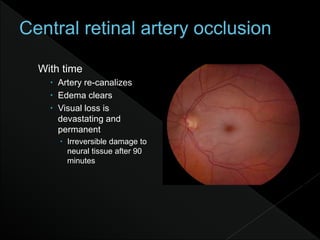
With time
 Artery re-canalizes
 Edema clears
 Visual loss is
devastating and
permanent
 Irreversible damage to
neural tissue after 90
minutes
Diagnosis
 Ocular examintain
 Cardiovascular examination
 Labortory studies are helpful
/ blood sugar , cholesterol , triglycerid /
 Carotid ultrasound
 Fluorescein angiography
 Electroretinogram
 ECG and echocardiogram
Dislodge the Embolus
 “Burst the Dam”
 Digital massage to
dislodge embolus
 A/C paracentesis
 IV acetazolamide
 Retrobulbar vasodilators
 Inject fibrinolytic in
supraorbital artery
 Retrobulbar vasodilators
 YAG laser embolysis
 Surgical embolysis
Keep the Retina Alive
 Carbogen inhalation
 Oxygen inhalatioN
 Hyperbaric oxygen
therapy
 Emergent TPPV with or
without perfluorocarbon
liquid infusion
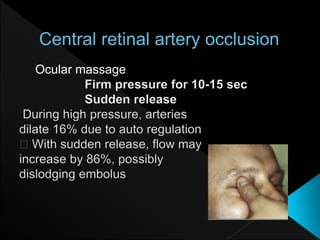
Ocular massage
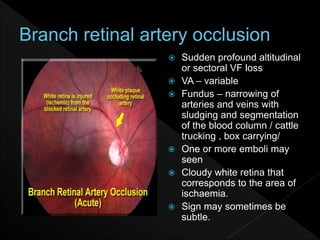
 Sudden profound altitudinal
or sectoral VF loss
 VA – variable
 Fundus – narrowing of
arteries and veins with
sludging and segmentation
of the blood column / cattle
trucking , box carrying/
 One or more emboli may
seen
 Cloudy white retina that
corresponds to the area of
ischaemia.
 Sign may sometimes be
subtle.
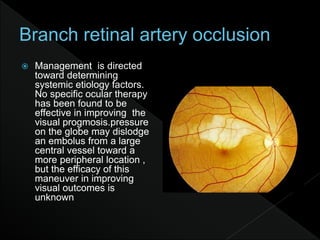
 Management is directed
toward determining
systemic etiology factors.
No specific ocular therapy
has been found to be
effective in improving the
visual progmosis.pressure
on the globe may dislodge
an embolus from a large
central vessel toward a
more peripheral location ,
but the efficacy of this
maneuver in improving
visual outcomes is
unknown
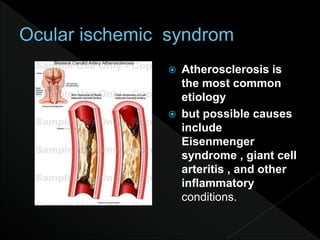
 Atherosclerosis is
the most common
etiology
 but possible causes
include
Eisenmenger
syndrome , giant cell
arteritis , and other
inflammatory
conditions.
 A severe form of
chronic ischemia of
both anterior and
posterior segments
of the eye as well as
other orbital
structures supplied
by the ophthalmic
artery.
 Usually unilateral
 Age: 50-80 yrs
 M&F 2:1
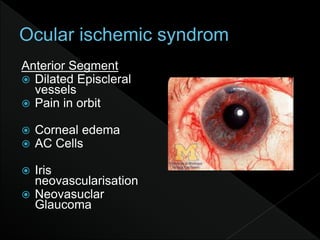
Anterior Segment
 Dilated Episcleral
vessels
 Pain in orbit
 Corneal edema
 AC Cells
 Iris
neovascularisation
 Neovasuclar
Glaucoma
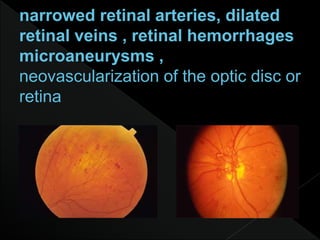
 Proliferative diabetic
retinopathy
 Ischemic CRVO
 Carotid artery
ultrasound
Carotid occlusion, usually
90% or more
 ERG
Diminished b- and a- waves
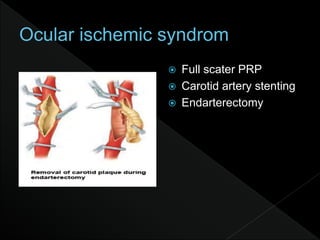
 Full scater PRP
 Carotid artery stenting
 Endarterectomy
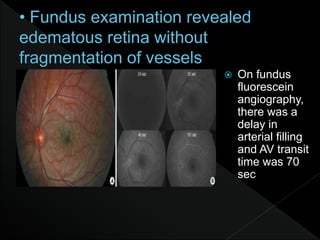
 On fundus
fluorescein
angiography,
there was a
delay in
arterial filling
and AV transit
time was 70
sec
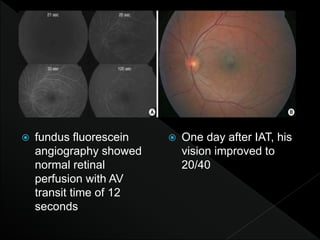
 fundus fluorescein
angiography showed
normal retinal
perfusion with AV
transit time of 12
seconds
 One day after IAT, his
vision improved to
20/40
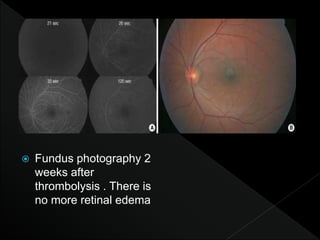
 Fundus photography 2
weeks after
thrombolysis . There is
no more retinal edema
CRAO and BRAO

CRAO and BRAO

  • 3.
    Epidemiology  Mean age– mid 60”s  Men > women  Bilateral in 1 – 2%  May have other retinal vascular disease
  • 4.
    Etiology  Systemic hypertensionseen in two thirds of patients  Diabetes mellitus  Cardiac valvular disease seen in one fourth of patients  Cardiac anomalies, such as patent foramen ovale  Embolism Embolism is the most common cause. The carotid artery and the heart are the most common sources.
  • 5.
     There are3 types of emboli 1. Cholestrol Hollenhorst plaques Minute , bright , refractile, Golden to yellow orange crystals, often at bifurcation
  • 6.
    2. Fibrin platelet Dullgrey , elongated particles which are usually multiple
  • 7.
    3. Calcific emboli Single, white , non scintillating particles
  • 8.
    Pathophysiology Emboli artery narrowingatheroma turbulent blood flow break off atheroma lodge small caliber arteryt block Ischemia Retinal artery occlusion
  • 9.
    Characteristics Sudden severe visualloss in 1 eye Painless Retinal appearance  Opaque and edematous  Retina artery narrow,mild hemorrhage  Most prominent in posterior pole  Thickest ganglion cell layer  Cherry-red spot
  • 11.
    With time  Arteryre-canalizes  Edema clears  Visual loss is devastating and permanent  Irreversible damage to neural tissue after 90 minutes
  • 12.
    Diagnosis  Ocular examintain Cardiovascular examination  Labortory studies are helpful / blood sugar , cholesterol , triglycerid /  Carotid ultrasound  Fluorescein angiography  Electroretinogram  ECG and echocardiogram
  • 13.
    Dislodge the Embolus “Burst the Dam”  Digital massage to dislodge embolus  A/C paracentesis  IV acetazolamide  Retrobulbar vasodilators  Inject fibrinolytic in supraorbital artery  Retrobulbar vasodilators  YAG laser embolysis  Surgical embolysis Keep the Retina Alive  Carbogen inhalation  Oxygen inhalatioN  Hyperbaric oxygen therapy  Emergent TPPV with or without perfluorocarbon liquid infusion
  • 14.
  • 15.
     Sudden profoundaltitudinal or sectoral VF loss  VA – variable  Fundus – narrowing of arteries and veins with sludging and segmentation of the blood column / cattle trucking , box carrying/  One or more emboli may seen  Cloudy white retina that corresponds to the area of ischaemia.  Sign may sometimes be subtle.
  • 16.
     Management isdirected toward determining systemic etiology factors. No specific ocular therapy has been found to be effective in improving the visual progmosis.pressure on the globe may dislodge an embolus from a large central vessel toward a more peripheral location , but the efficacy of this maneuver in improving visual outcomes is unknown
  • 17.
     Atherosclerosis is themost common etiology  but possible causes include Eisenmenger syndrome , giant cell arteritis , and other inflammatory conditions.
  • 18.
     A severeform of chronic ischemia of both anterior and posterior segments of the eye as well as other orbital structures supplied by the ophthalmic artery.  Usually unilateral  Age: 50-80 yrs  M&F 2:1
  • 19.
    Anterior Segment  DilatedEpiscleral vessels  Pain in orbit  Corneal edema  AC Cells  Iris neovascularisation  Neovasuclar Glaucoma
  • 21.
     Proliferative diabetic retinopathy Ischemic CRVO  Carotid artery ultrasound Carotid occlusion, usually 90% or more  ERG Diminished b- and a- waves
  • 22.
     Full scaterPRP  Carotid artery stenting  Endarterectomy
  • 24.
     On fundus fluorescein angiography, therewas a delay in arterial filling and AV transit time was 70 sec
  • 26.
     fundus fluorescein angiographyshowed normal retinal perfusion with AV transit time of 12 seconds  One day after IAT, his vision improved to 20/40
  • 27.
     Fundus photography2 weeks after thrombolysis . There is no more retinal edema