Structure and Principles
Objective- describe the structure of the
Constitution and list its parts. Explain how
and why power is separated.
Constitution USA with Peter Sagal | PBS
Essential Questions
1. What are the three parts of the
Constitution?
2. Why did the Framers separate power into
3 branches?
3. Give examples of checks and balances.
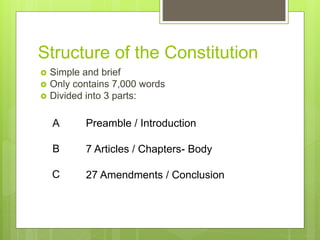
Structure of the Constitution
 Simple and brief
 Only contains 7,000 words
 Divided into 3 parts:
A
B
C
Preamble / Introduction
7 Articles / Chapters- Body
27 Amendments / Conclusion
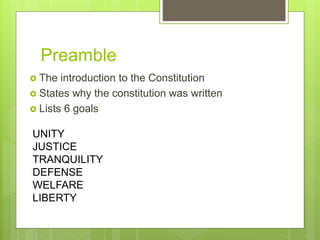
Preamble
 The introduction to the Constitution
 States why the constitution was written
 Lists 6 goals
UNITY
JUSTICE
TRANQUILITY
DEFENSE
WELFARE
LIBERTY
Preamble
 The introduction to the Constitution
 States why the constitution was written
 Lists 6 goals
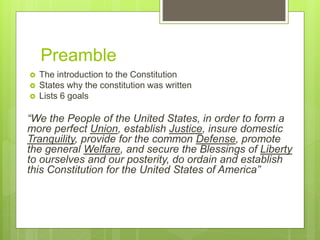
“We the People of the United States, in order to form a
more perfect Union, establish Justice, insure domestic
Tranquility, provide for the common Defense, promote
the general Welfare, and secure the Blessings of Liberty
to ourselves and our posterity, do ordain and establish
this Constitution for the United States of America”
Seven Articles- L E J S A S 9/13
ARTICLE I:
ARTICLE II:
ARTICLE III:
ARTICLE IV:
ARTICLE V:
ARTICLE VI:
ARTICLE VII:
Legislative Branch / Congress
Executive Branch / President
Judicial Branch / Supreme Court
State’s Relations / Reserved Powers
Amendment Process / How to guide
Supremacy Clause / Const. law of land
9/13 Ratification / to pass the Const.
Amendments
Changes or Additions to the Constitution
 The Constitution has 27 amendments
 The first ten are called the Bill of Rights
Make a list of the rights found in the Bill of
Rights
Major Principles
1. Popular Sovereignty
2. Federalism
3. Separation of Powers
4. Checks and Balances
5. Judicial Review
6. Limited Government
Popular Sovereignty
 United States gov’t is based upon consent
from the people
Examples:
Popular Sovereignty
 United States gov’t is based upon consent
from the people
Examples:
- Representation in Congress
- Democracy
- Voting Rights
Federalism
 Power is divided b/w Federal and state gov’t
Federalism was a compromise
 The central gov’t was too weak under the
Articles
 States did not want to lose all their power to a
strong central gov’t
Examples:
Federalism
 Power is divided b/w Federal and state gov’t
Federalism was a compromise
 The central gov’t was too weak under the Articles
 States did not want to lose all their power to a strong
central gov’t
Examples:
- State laws / Federal laws
- State courts / Federal courts
- Expressed Federal powers / Reserved State powers
Separation of Powers
 Central gov’t is divided into 3 branches:
- Legislative
- Executive
- Judicial
Separation of Powers
 Central gov’t is divided into 3 branches:
- Legislative (to make laws)- Congress
- Executive (to execute laws)- President
- Judicial (to interpret laws) – Supreme Court
Checks and Balances
 Each branch has the authority to check the
power of the other branches
Examples
- President can veto (reject) a law
- Congress can override a veto (2/3rd vote)
- Supreme Court can determine a law
unconstitutional (Judicial Review)
Marbury v. Madison 1803
Judicial Review
- Supreme Court can determine a law
unconstitutional
Marbury v. Madison 1803
Limited Government
 The Constitution specifically lists powers the
gov’t has and does not have.
Example-
Limited Government
 The Constitution specifically lists powers the gov’t
has and does not have.
Example- Market economy
Term limits
Reserved powers for the states
Expressed Powers
Bill of Rights

3 1 Structure and Principles

  • 1.
    Structure and Principles Objective-describe the structure of the Constitution and list its parts. Explain how and why power is separated. Constitution USA with Peter Sagal | PBS
  • 2.
    Essential Questions 1. Whatare the three parts of the Constitution? 2. Why did the Framers separate power into 3 branches? 3. Give examples of checks and balances.
  • 3.
    Structure of theConstitution  Simple and brief  Only contains 7,000 words  Divided into 3 parts: A B C Preamble / Introduction 7 Articles / Chapters- Body 27 Amendments / Conclusion
  • 4.
    Preamble  The introductionto the Constitution  States why the constitution was written  Lists 6 goals UNITY JUSTICE TRANQUILITY DEFENSE WELFARE LIBERTY
  • 5.
    Preamble  The introductionto the Constitution  States why the constitution was written  Lists 6 goals “We the People of the United States, in order to form a more perfect Union, establish Justice, insure domestic Tranquility, provide for the common Defense, promote the general Welfare, and secure the Blessings of Liberty to ourselves and our posterity, do ordain and establish this Constitution for the United States of America”
  • 6.
    Seven Articles- LE J S A S 9/13 ARTICLE I: ARTICLE II: ARTICLE III: ARTICLE IV: ARTICLE V: ARTICLE VI: ARTICLE VII: Legislative Branch / Congress Executive Branch / President Judicial Branch / Supreme Court State’s Relations / Reserved Powers Amendment Process / How to guide Supremacy Clause / Const. law of land 9/13 Ratification / to pass the Const.
  • 7.
    Amendments Changes or Additionsto the Constitution  The Constitution has 27 amendments  The first ten are called the Bill of Rights Make a list of the rights found in the Bill of Rights
  • 8.
    Major Principles 1. PopularSovereignty 2. Federalism 3. Separation of Powers 4. Checks and Balances 5. Judicial Review 6. Limited Government
  • 9.
    Popular Sovereignty  UnitedStates gov’t is based upon consent from the people Examples:
  • 10.
    Popular Sovereignty  UnitedStates gov’t is based upon consent from the people Examples: - Representation in Congress - Democracy - Voting Rights
  • 11.
    Federalism  Power isdivided b/w Federal and state gov’t Federalism was a compromise  The central gov’t was too weak under the Articles  States did not want to lose all their power to a strong central gov’t Examples:
  • 12.
    Federalism  Power isdivided b/w Federal and state gov’t Federalism was a compromise  The central gov’t was too weak under the Articles  States did not want to lose all their power to a strong central gov’t Examples: - State laws / Federal laws - State courts / Federal courts - Expressed Federal powers / Reserved State powers
  • 13.
    Separation of Powers Central gov’t is divided into 3 branches: - Legislative - Executive - Judicial
  • 14.
    Separation of Powers Central gov’t is divided into 3 branches: - Legislative (to make laws)- Congress - Executive (to execute laws)- President - Judicial (to interpret laws) – Supreme Court
  • 15.
    Checks and Balances Each branch has the authority to check the power of the other branches Examples - President can veto (reject) a law - Congress can override a veto (2/3rd vote) - Supreme Court can determine a law unconstitutional (Judicial Review) Marbury v. Madison 1803
  • 16.
    Judicial Review - SupremeCourt can determine a law unconstitutional Marbury v. Madison 1803
  • 17.
    Limited Government  TheConstitution specifically lists powers the gov’t has and does not have. Example-
  • 18.
    Limited Government  TheConstitution specifically lists powers the gov’t has and does not have. Example- Market economy Term limits Reserved powers for the states Expressed Powers Bill of Rights