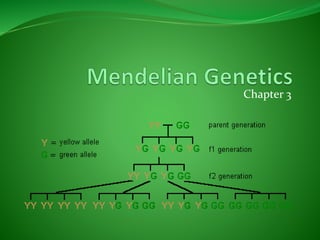
Chapter 3
Mendelian (Transmission) Genetics
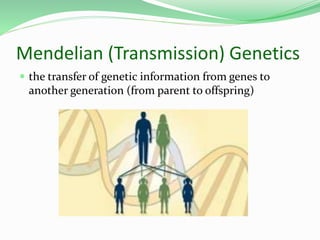
 the transfer of genetic information from genes to
another generation (from parent to offspring)
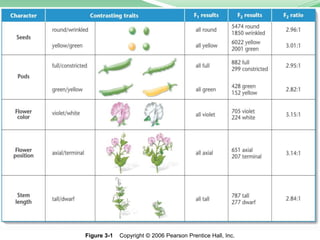
Figure 3-1 Copyright © 2006 Pearson Prentice Hall, Inc.
Mendel’s Findings
• Determined there are distinct units of inheritance
• Behavior of units could be predicted during the
formation of gametes
• Later researchers linked the behavior of chromosomes
during meiosis to Mendel’s principles of inheritance
• The study of transfer of inheritance in this manner to
offspring is called Mendelian (or transmission) genetics
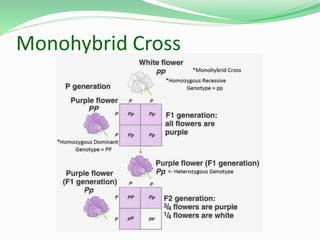
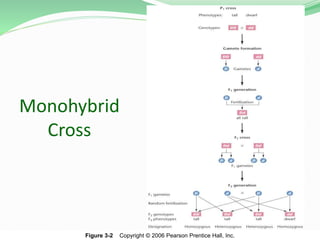
Monohybrid Cross
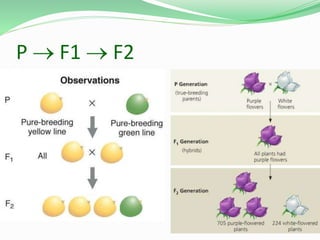
P  F1  F2
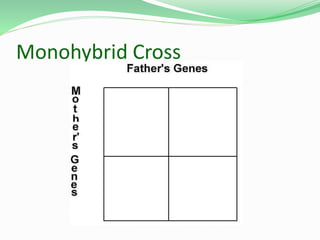
Monohybrid Cross
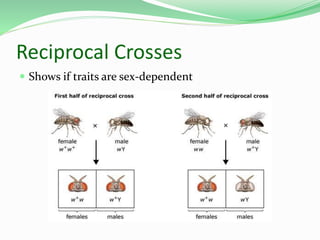
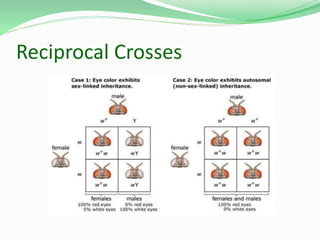
Reciprocal Crosses
 Shows if traits are sex-dependent
Reciprocal Crosses
Mendel’s three postulates
• (1) Unit factors in pairs
• (2) Dominance/Recessiveness
• (3) Segregation
• Random, gametes have equal chance
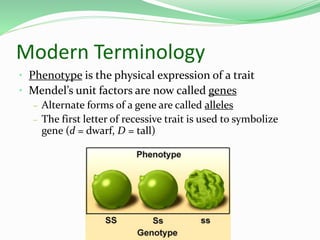
Modern Terminology
• Phenotype is the physical expression of a trait
• Mendel’s unit factors are now called genes
– Alternate forms of a gene are called alleles
– The first letter of recessive trait is used to symbolize
gene (d = dwarf, D = tall)
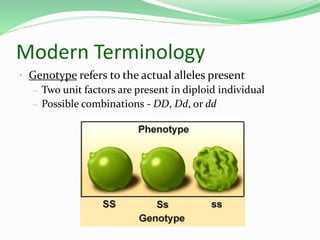
Modern Terminology
• Genotype refers to the actual alleles present
– Two unit factors are present in diploid individual
– Possible combinations - DD, Dd, or dd
Monohybrid
Cross
Figure 3-2 Copyright © 2006 Pearson Prentice Hall, Inc.
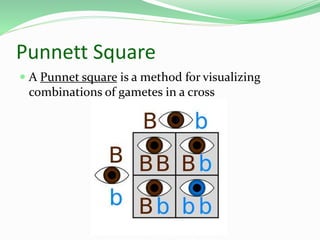
Punnett Square
 A Punnet square is a method for visualizing
combinations of gametes in a cross
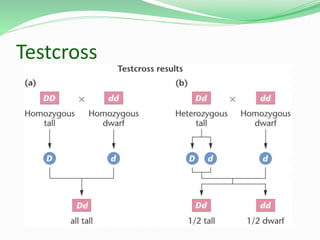
Testcross
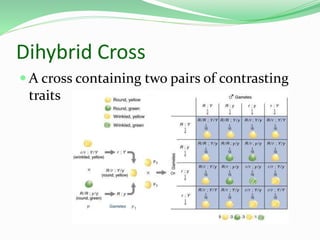
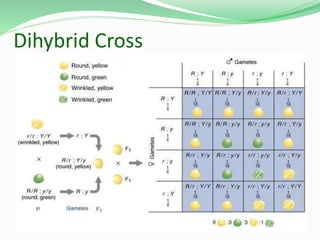
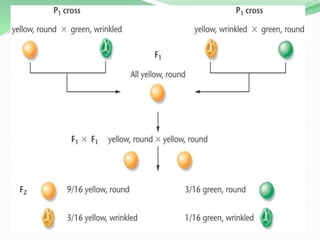
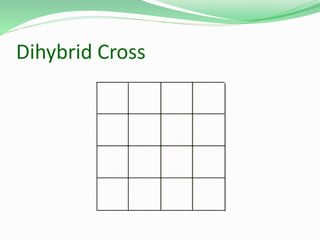
Dihybrid Cross
 A cross containing two pairs of contrasting
traits
Dihybrid Cross
Dihybrid Cross
Dihybrid Cross
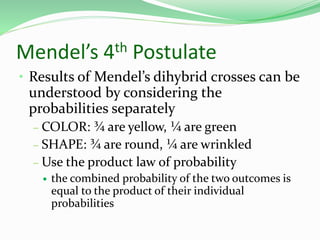
Mendel’s 4th Postulate
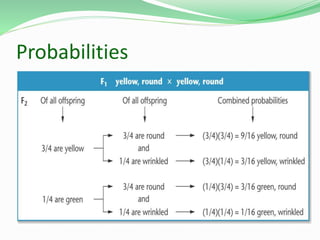
• Results of Mendel’s dihybrid crosses can be
understood by considering the
probabilities separately
– COLOR: ¾ are yellow, ¼ are green
– SHAPE: ¾ are round, ¼ are wrinkled
– Use the product law of probability
 the combined probability of the two outcomes is
equal to the product of their individual
probabilities
Probabilities
Mendel’s 4th Postulate
– (4)Independent Assortment
 During gamete formation, segregating pairs of
unit factors assort independently of each other
 This means that all possible combinations of
gametes will be formed with equal frequency
 Final dihybrid ratio (assumes independent
assortment and random fertilization) is 9:3:3:1
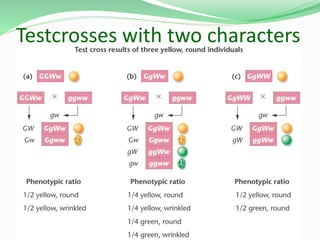
Testcrosses with two characters
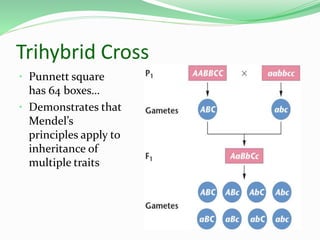
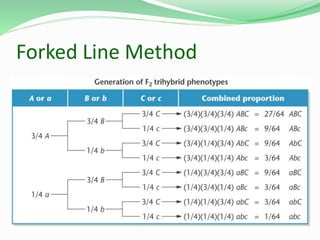
Trihybrid Cross
• Punnett square
has 64 boxes…
• Demonstrates that
Mendel’s
principles apply to
inheritance of
multiple traits
Forked Line Method
Useful Rules
Examples:
1. Aa [A, a]  [AA, Aa, aa]  [A or a]
2. AaBb  [AB, Ab, aB, ab]  [AABB, AaBB, aaBB, AABb,
AaBb, aaBb, aaBB, aaBb, aabb]  [AB, Ab, aB, BB]
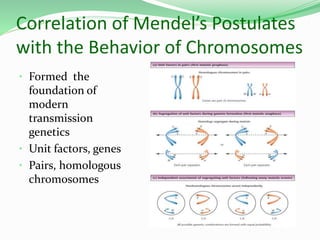
Correlation of Mendel’s Postulates
with the Behavior of Chromosomes
• Formed the
foundation of
modern
transmission
genetics
• Unit factors, genes
• Pairs, homologous
chromosomes
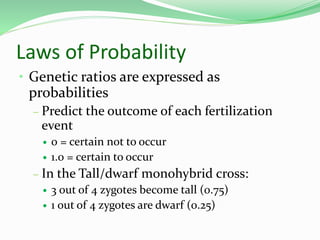
Laws of Probability
• Genetic ratios are expressed as
probabilities
– Predict the outcome of each fertilization
event
 0 = certain not to occur
 1.0 = certain to occur
– In the Tall/dwarf monohybrid cross:
 3 out of 4 zygotes become tall (0.75)
 1 out of 4 zygotes are dwarf (0.25)
Laws of Probability
• Product Law
– Discussed in relation to independent assortment
– Probability of two or more outcomes occurring
simultaneously is equal to the product of their
individual probabilities
– Example: Coin toss (penny and nickel)
• Sum Law
– Generalized outcomes can be predicted by adding
probabilities (head/tails + tails/heads)
Laws of Probability
Sum Law (cont.)
• Example: one heads, one tails
 PH:NT = ¼
 PT:NH = ¼
 ¼ + ¼ = ½
• Sample Problem: In an F1 self-cross
(Tall/dwarf parents), what is the
probability that an F2 generation plant is
true-breeding (homozygous) for the trait
Laws of Probability
• Conditional Probability
– Probability of an outcome dependent on a specific
condition of that outcome
 Example: probability that any tall F2 plant from a
Tall/dwarf monohybrid cross will be heterozygous
 Condition is to consider only tall plants (we already
know that dwarfs are homozygous)
– pc = pa/pb (pa, probability of heterozygote, pb;
probability of dominant phenotype, pc;
probability of dominant phenotype being a
carrier)
– Can be applied to genetic counseling
 Chances if a “normal” person being a carrier
Binomial Theorem
– Used to calculate probability of outcomes
for any number of potential events
Binomial theorem: (a+b)n = 1
 a and b are respective probabilities of the two
alternate outcomes
 n = the number of trials
 a2 + 2ab + b2 [n = 2]
 a3+ 3a2b + 3ab2 + b3 [n = 3]
 a4 + 4a3b + 6a2b2 + 4ab3 + b4 [n = 4]
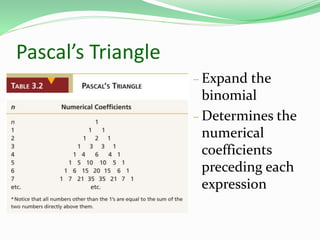
Pascal’s Triangle
– Expand the
binomial
– Determines the
numerical
coefficients
preceding each
expression
More Binomial Theorem
 Example: Probability of a family of four
having two boys and two girls
 Exponent of a represents # of boys
 Exponent of b represents # of girls
 p = 6a2b2
 Formula for determining numerical
coefficients for any set of exponents
 n!/(s!t!) where n = total # of events, s = # of times
a occurs and t = # of times b occurs
 “!” means factorial
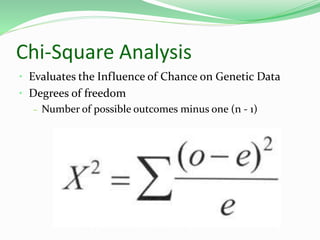
Chi-Square Analysis
• Evaluates the Influence of Chance on Genetic Data
• Degrees of freedom
– Number of possible outcomes minus one (n - 1)
Chi-Square Analysis
• “Null Hypothesis” – assumes there is no real difference
between the measured (experimental) and predicted
values
– The apparent difference can be attributed to chance
(Null hypothesis “proven”)
– Null hypothesis “fails” if chance cannot reasonably
explain deviation from expected
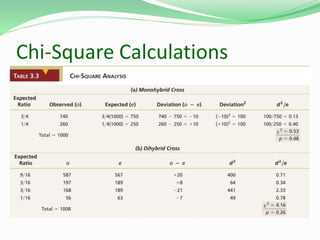
Chi-Square Calculations
Figure 3-12ab Copyright © 2006 Pearson Prentice Hall, Inc.
[difference may be real]
Random variation
Interpreting X2 and p value
calculations
• What do p values mean????
• As 2 values increase, p values decrease
– Dihybrid cross, p = 0.26
 Then 26% of the time the value obtained from an experiment
would vary from the expected value by this much or more
based solely upon chance
Interpreting X2 and p value
calculations
– Traditionally a p value of 0.05 is the accepted standard to
accept the null hypothesis
 More than 0.05 is considered confirmatory (chance variation
is thus the likely explanation for any deviation from expected
results)
 Less than 0.05 means chance variation is an unlikely
explanation (though still a possible one, probability
depending upon the actual p value) – Null Hypothesis fails
Pedigrees reveal patterns of
inheritance in humans
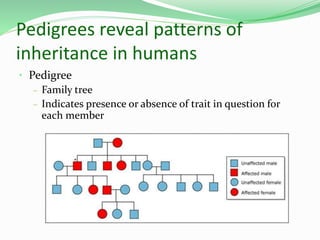
• Pedigree
– Family tree
– Indicates presence or absence of trait in question for
each member
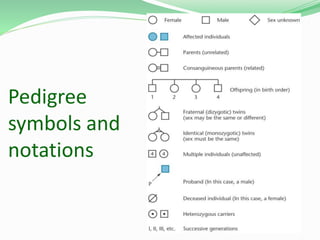
Pedigree Conventions
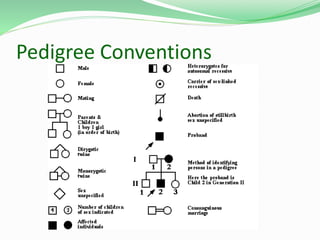
• Circles for females, squares for males
• Parents connected by horizontal line, offspring by
vertical lines connected to horizontal one
• Related parents (cousins) said to be consanguineous and
connected by double line
• Siblings written in birth order, left to right
• Generations indicated by Roman numerals
• Twins indicated by forked line, identical twins by fork
connected by horizontal line
• For single trait, shaded symbols indicate trait expressed
• Shaded with dot indicates known carriers
• Line through symbol indicates deceased
Pedigree Conventions
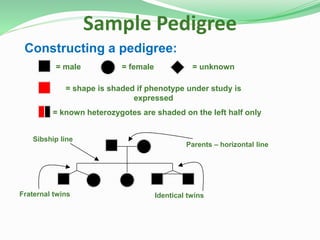
Sample Pedigree
Constructing a pedigree:
= male = female = unknown
= shape is shaded if phenotype under study is
expressed
= known heterozygotes are shaded on the left half only
Parents – horizontal line
Sibship line
Fraternal twins Identical twins
Pedigree
symbols and
notations
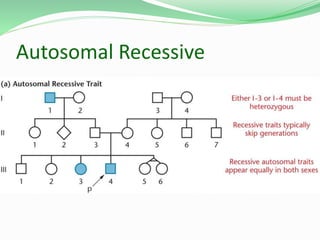
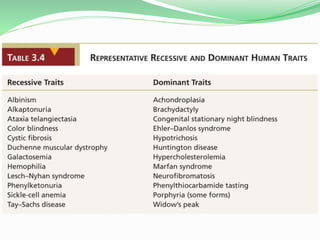
Autosomal Recessive
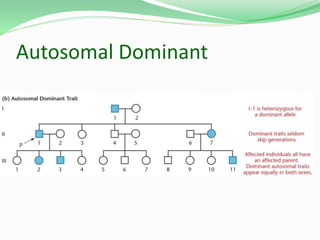
Autosomal Dominant
Familial Hypercholesterolemia
• Dominant
– but note varied phenotype of homozygote vs.
heterozygote
• LDL receptor for cholesterol uptake by cells
• Heterozygotes have about 2X LDL levels in blood,
heart attacks by 40 yrs common
• Homozygotes have no receptors, 10X LDL levels and
may have heart attach by 5 yrs of age, rarely survive to
age 20

Mendelian Genetics

  • 1.
  • 2.
    Mendelian (Transmission) Genetics the transfer of genetic information from genes to another generation (from parent to offspring)
  • 3.
    Figure 3-1 Copyright© 2006 Pearson Prentice Hall, Inc.
  • 4.
    Mendel’s Findings • Determinedthere are distinct units of inheritance • Behavior of units could be predicted during the formation of gametes • Later researchers linked the behavior of chromosomes during meiosis to Mendel’s principles of inheritance • The study of transfer of inheritance in this manner to offspring is called Mendelian (or transmission) genetics
  • 5.
  • 6.
    P  F1 F2
  • 7.
  • 8.
    Reciprocal Crosses  Showsif traits are sex-dependent
  • 9.
  • 10.
    Mendel’s three postulates •(1) Unit factors in pairs • (2) Dominance/Recessiveness • (3) Segregation • Random, gametes have equal chance
  • 11.
    Modern Terminology • Phenotypeis the physical expression of a trait • Mendel’s unit factors are now called genes – Alternate forms of a gene are called alleles – The first letter of recessive trait is used to symbolize gene (d = dwarf, D = tall)
  • 12.
    Modern Terminology • Genotyperefers to the actual alleles present – Two unit factors are present in diploid individual – Possible combinations - DD, Dd, or dd
  • 13.
    Monohybrid Cross Figure 3-2 Copyright© 2006 Pearson Prentice Hall, Inc.
  • 14.
    Punnett Square  APunnet square is a method for visualizing combinations of gametes in a cross
  • 15.
  • 16.
    Dihybrid Cross  Across containing two pairs of contrasting traits
  • 17.
  • 18.
  • 19.
  • 20.
    Mendel’s 4th Postulate •Results of Mendel’s dihybrid crosses can be understood by considering the probabilities separately – COLOR: ¾ are yellow, ¼ are green – SHAPE: ¾ are round, ¼ are wrinkled – Use the product law of probability  the combined probability of the two outcomes is equal to the product of their individual probabilities
  • 21.
  • 22.
    Mendel’s 4th Postulate –(4)Independent Assortment  During gamete formation, segregating pairs of unit factors assort independently of each other  This means that all possible combinations of gametes will be formed with equal frequency  Final dihybrid ratio (assumes independent assortment and random fertilization) is 9:3:3:1
  • 23.
  • 24.
    Trihybrid Cross • Punnettsquare has 64 boxes… • Demonstrates that Mendel’s principles apply to inheritance of multiple traits
  • 25.
  • 26.
    Useful Rules Examples: 1. Aa[A, a]  [AA, Aa, aa]  [A or a] 2. AaBb  [AB, Ab, aB, ab]  [AABB, AaBB, aaBB, AABb, AaBb, aaBb, aaBB, aaBb, aabb]  [AB, Ab, aB, BB]
  • 27.
    Correlation of Mendel’sPostulates with the Behavior of Chromosomes • Formed the foundation of modern transmission genetics • Unit factors, genes • Pairs, homologous chromosomes
  • 28.
    Laws of Probability •Genetic ratios are expressed as probabilities – Predict the outcome of each fertilization event  0 = certain not to occur  1.0 = certain to occur – In the Tall/dwarf monohybrid cross:  3 out of 4 zygotes become tall (0.75)  1 out of 4 zygotes are dwarf (0.25)
  • 29.
    Laws of Probability •Product Law – Discussed in relation to independent assortment – Probability of two or more outcomes occurring simultaneously is equal to the product of their individual probabilities – Example: Coin toss (penny and nickel) • Sum Law – Generalized outcomes can be predicted by adding probabilities (head/tails + tails/heads)
  • 30.
    Laws of Probability SumLaw (cont.) • Example: one heads, one tails  PH:NT = ¼  PT:NH = ¼  ¼ + ¼ = ½ • Sample Problem: In an F1 self-cross (Tall/dwarf parents), what is the probability that an F2 generation plant is true-breeding (homozygous) for the trait
  • 31.
    Laws of Probability •Conditional Probability – Probability of an outcome dependent on a specific condition of that outcome  Example: probability that any tall F2 plant from a Tall/dwarf monohybrid cross will be heterozygous  Condition is to consider only tall plants (we already know that dwarfs are homozygous) – pc = pa/pb (pa, probability of heterozygote, pb; probability of dominant phenotype, pc; probability of dominant phenotype being a carrier) – Can be applied to genetic counseling  Chances if a “normal” person being a carrier
  • 32.
    Binomial Theorem – Usedto calculate probability of outcomes for any number of potential events Binomial theorem: (a+b)n = 1  a and b are respective probabilities of the two alternate outcomes  n = the number of trials  a2 + 2ab + b2 [n = 2]  a3+ 3a2b + 3ab2 + b3 [n = 3]  a4 + 4a3b + 6a2b2 + 4ab3 + b4 [n = 4]
  • 33.
    Pascal’s Triangle – Expandthe binomial – Determines the numerical coefficients preceding each expression
  • 34.
    More Binomial Theorem Example: Probability of a family of four having two boys and two girls  Exponent of a represents # of boys  Exponent of b represents # of girls  p = 6a2b2  Formula for determining numerical coefficients for any set of exponents  n!/(s!t!) where n = total # of events, s = # of times a occurs and t = # of times b occurs  “!” means factorial
  • 35.
    Chi-Square Analysis • Evaluatesthe Influence of Chance on Genetic Data • Degrees of freedom – Number of possible outcomes minus one (n - 1)
  • 36.
    Chi-Square Analysis • “NullHypothesis” – assumes there is no real difference between the measured (experimental) and predicted values – The apparent difference can be attributed to chance (Null hypothesis “proven”) – Null hypothesis “fails” if chance cannot reasonably explain deviation from expected
  • 37.
  • 38.
    Figure 3-12ab Copyright© 2006 Pearson Prentice Hall, Inc. [difference may be real] Random variation
  • 39.
    Interpreting X2 andp value calculations • What do p values mean???? • As 2 values increase, p values decrease – Dihybrid cross, p = 0.26  Then 26% of the time the value obtained from an experiment would vary from the expected value by this much or more based solely upon chance
  • 40.
    Interpreting X2 andp value calculations – Traditionally a p value of 0.05 is the accepted standard to accept the null hypothesis  More than 0.05 is considered confirmatory (chance variation is thus the likely explanation for any deviation from expected results)  Less than 0.05 means chance variation is an unlikely explanation (though still a possible one, probability depending upon the actual p value) – Null Hypothesis fails
  • 41.
    Pedigrees reveal patternsof inheritance in humans • Pedigree – Family tree – Indicates presence or absence of trait in question for each member
  • 42.
    Pedigree Conventions • Circlesfor females, squares for males • Parents connected by horizontal line, offspring by vertical lines connected to horizontal one • Related parents (cousins) said to be consanguineous and connected by double line • Siblings written in birth order, left to right • Generations indicated by Roman numerals • Twins indicated by forked line, identical twins by fork connected by horizontal line • For single trait, shaded symbols indicate trait expressed • Shaded with dot indicates known carriers • Line through symbol indicates deceased
  • 43.
  • 44.
    Sample Pedigree Constructing apedigree: = male = female = unknown = shape is shaded if phenotype under study is expressed = known heterozygotes are shaded on the left half only Parents – horizontal line Sibship line Fraternal twins Identical twins
  • 45.
  • 46.
  • 47.
  • 49.
    Familial Hypercholesterolemia • Dominant –but note varied phenotype of homozygote vs. heterozygote • LDL receptor for cholesterol uptake by cells • Heterozygotes have about 2X LDL levels in blood, heart attacks by 40 yrs common • Homozygotes have no receptors, 10X LDL levels and may have heart attach by 5 yrs of age, rarely survive to age 20