Experiments of Radiation Physics
Laps. / second stage
T The First experiment
“Electron diffraction”
‫وتحضير‬ ‫اعداد‬
‫م‬.‫م‬.‫اسماعيل‬ ‫محمد‬
‫بأشراف‬
‫يوسف‬ ‫نوفل‬ ‫الدكتور‬
The aim of experiment :
1. Achieve the wave property of the electron by finding
his wavelength.
2. Calculation of the interlayer distance between levels
in a graphite crystal .
Apparatus :
1. Electron diffraction tube .
2. Electron diffraction tube holder .
3. Power supply ( 0- 10 Kv) .
(2)
 Electron Diffraction experiment
The particle-wave property of the electron is one of the most
important properties of quantum physics.
 The particle property of the electron was verified through a
series of experiments, the most important of which was that by
the scientist Thompson in tracking the path of electrons as they
passed between two fields: electric and magnetic.
 As for the wave property of the electron, the scientist De
Broglie took the lead in crystallizing the idea that,
The moving electrons may have both the particle and the wave
properties at the same time. Based on this assumption, the
wavelength of the particle will be inversely proportional to its
linear momentum, (3)
 Theory of experiment
𝝀 =
𝒉
𝒑
=
𝒉
𝒎𝒗
---------(1)
Where h is Plank constant = 6.62 *𝟏𝟎−𝟑𝟒
J. sec ,
P= 𝒎𝒗 is ( Liner momentum) .
 In this experiment we will apply equation (1) to prove the
particle property of the electron by studying the diffraction of
accelerated electrons that drop a sample of polycrystalline
graphite (hexagonal crystal structure), and from there to a
display screen
(4)
 Theory of experiment
‫وتحضير‬ ‫اعداد‬
‫م‬.‫م‬‫اسماعيل‬ ‫محمد‬
‫بأشراف‬
‫يوسف‬ ‫نوفل‬ ‫الدكتور‬
‫االشعاعية‬ ‫الفيزياء‬ ‫مختبر‬
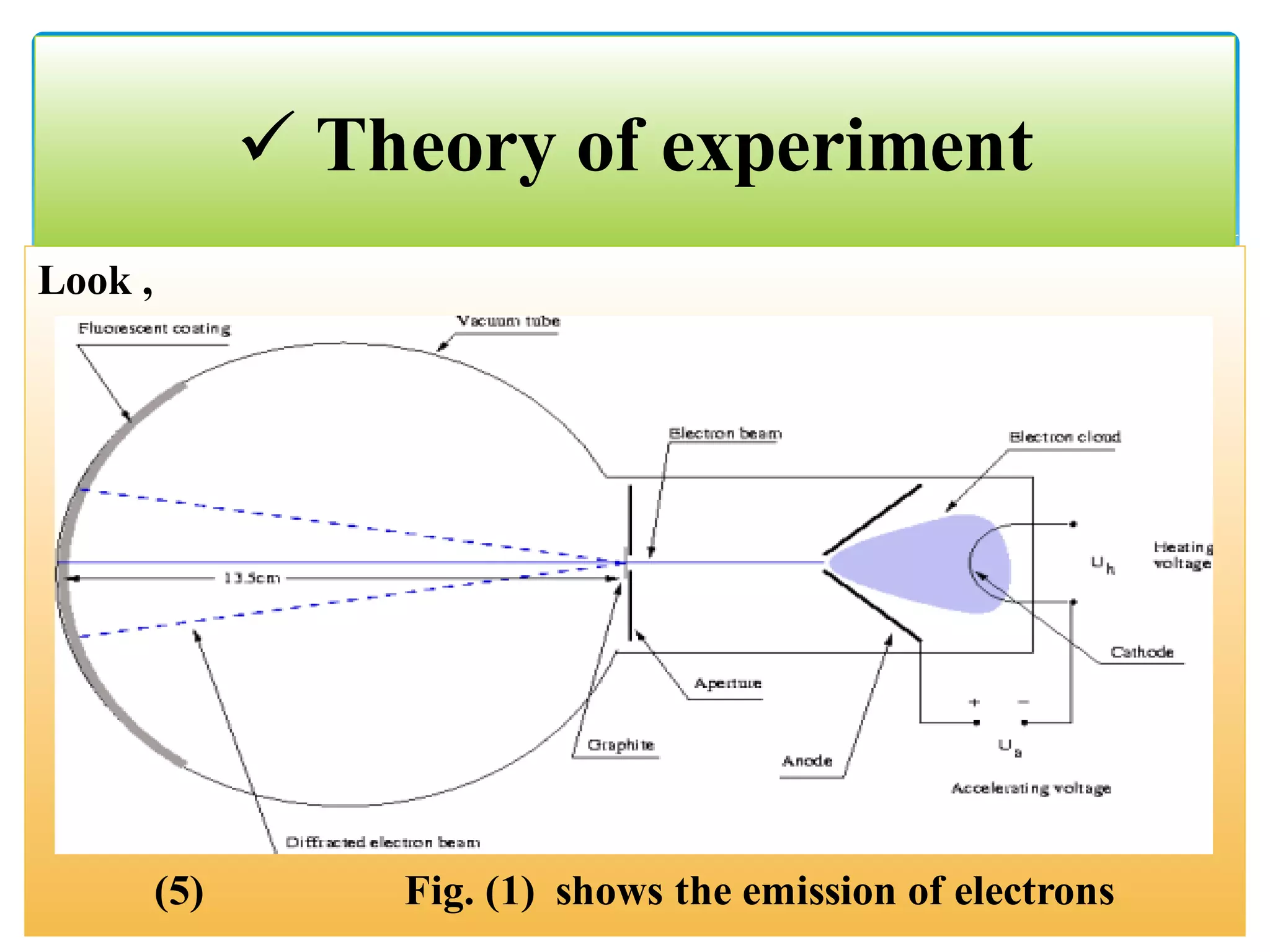
Look ,
(5) Fig. (1) shows the emission of electrons
 Theory of experiment
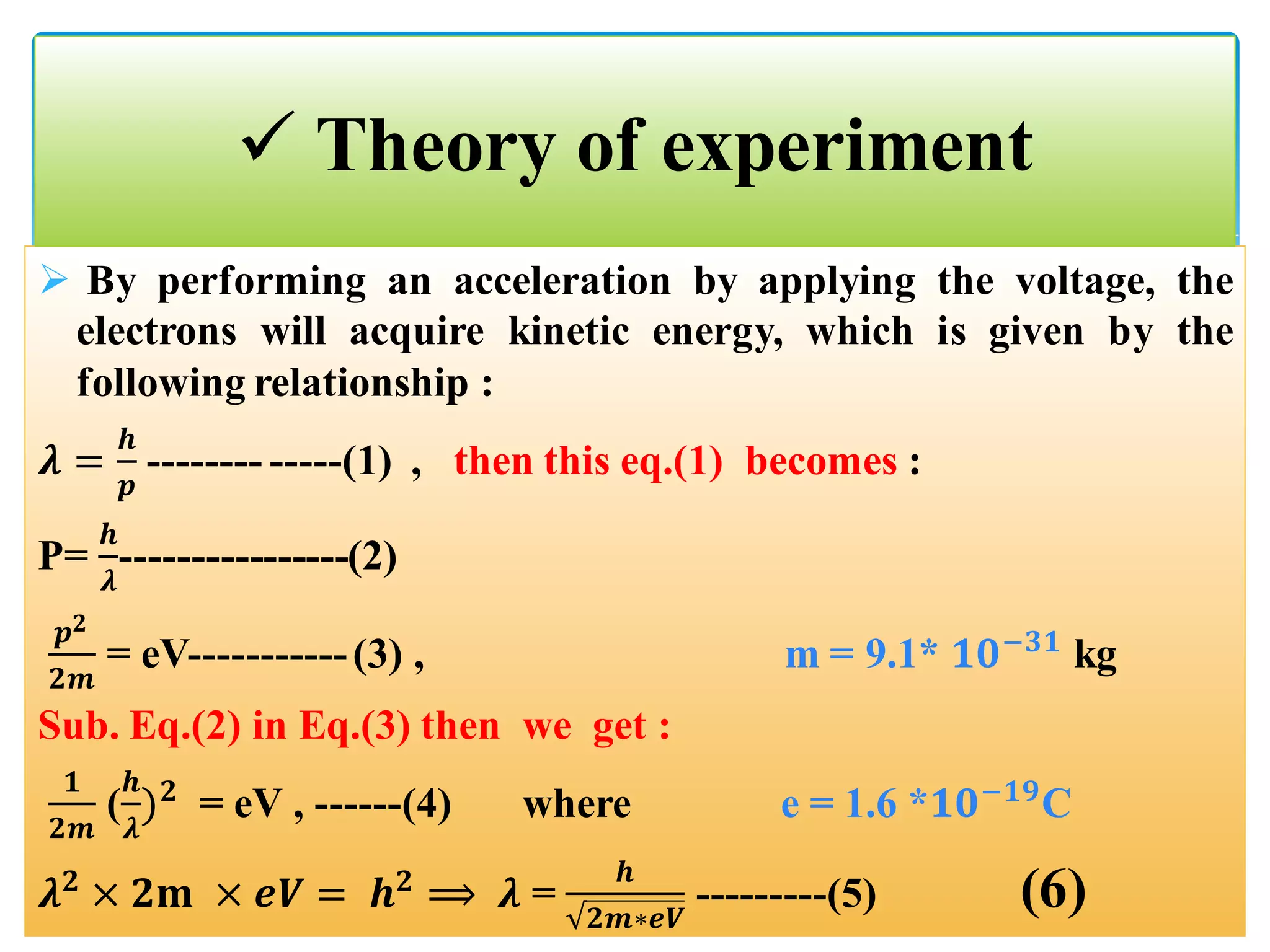
 By performing an acceleration by applying the voltage, the
electrons will acquire kinetic energy, which is given by the
following relationship :
𝝀 =
𝒉
𝒑
-------- -----(1) , then this eq.(1) becomes :
P=
𝒉
𝝀
----------------(2)
𝒑 𝟐
𝟐𝒎
= eV-----------(3) , m = 9.1* 𝟏𝟎−𝟑𝟏
kg
Sub. Eq.(2) in Eq.(3) then we get :
𝟏
𝟐𝒎
(
𝒉
𝝀
) 𝟐
= eV , ------(4) where e = 1.6 *𝟏𝟎−𝟏𝟗
C
𝝀 𝟐
× 𝟐𝐦 × 𝒆𝑽 = 𝒉 𝟐
⟹ 𝝀 =
𝒉
𝟐𝒎∗𝒆𝑽
---------(5) (6)
 Theory of experiment
If the accelerated electrons possess the wave characteristics, the
two phenomena of diffraction and interference will appear on the
screen, which are among the most important characteristics of the
wave.
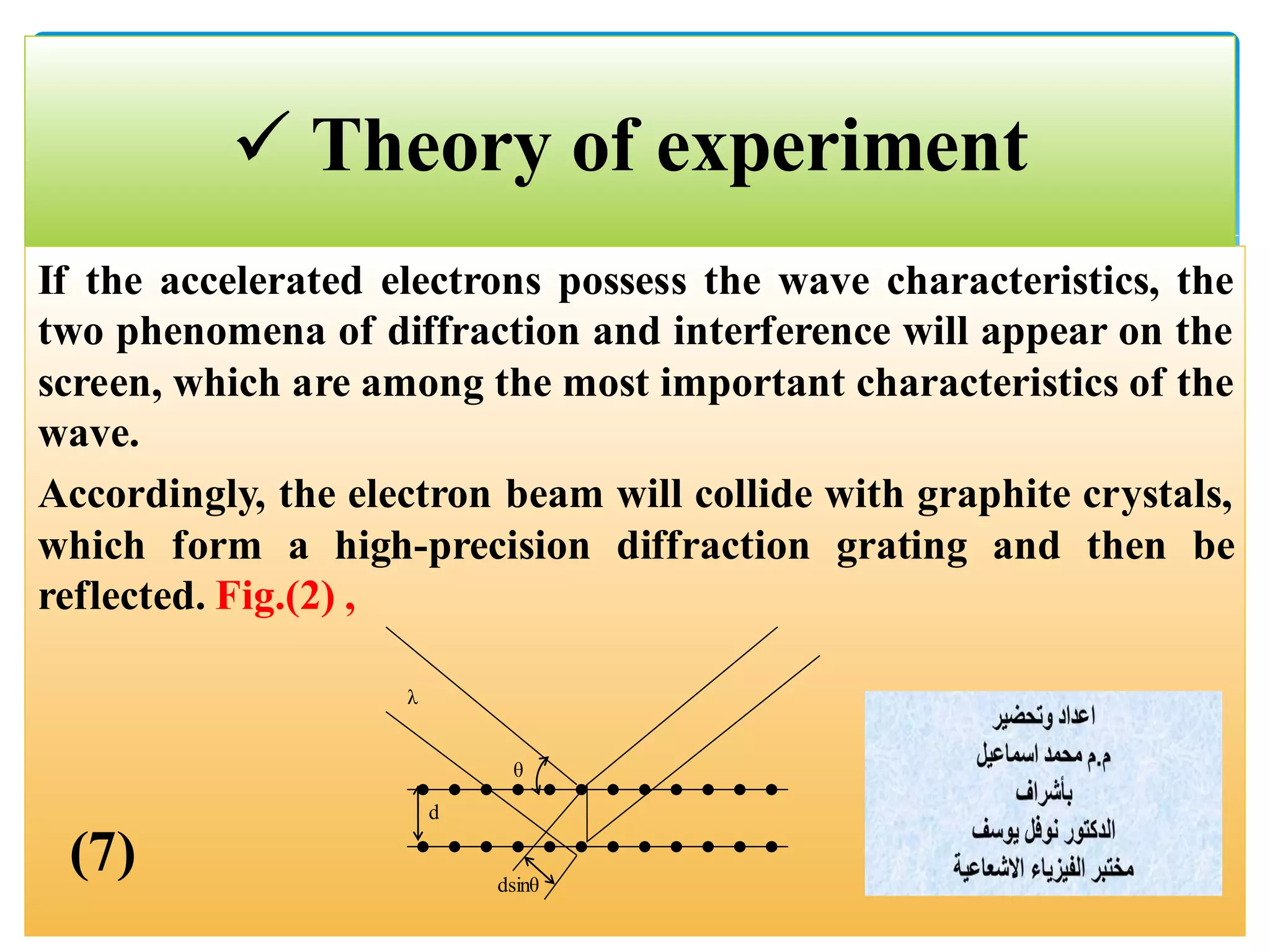
Accordingly, the electron beam will collide with graphite crystals,
which form a high-precision diffraction grating and then be
reflected. Fig.(2) ,
(7)
 Theory of experiment
d
dsinθ
λ
θ
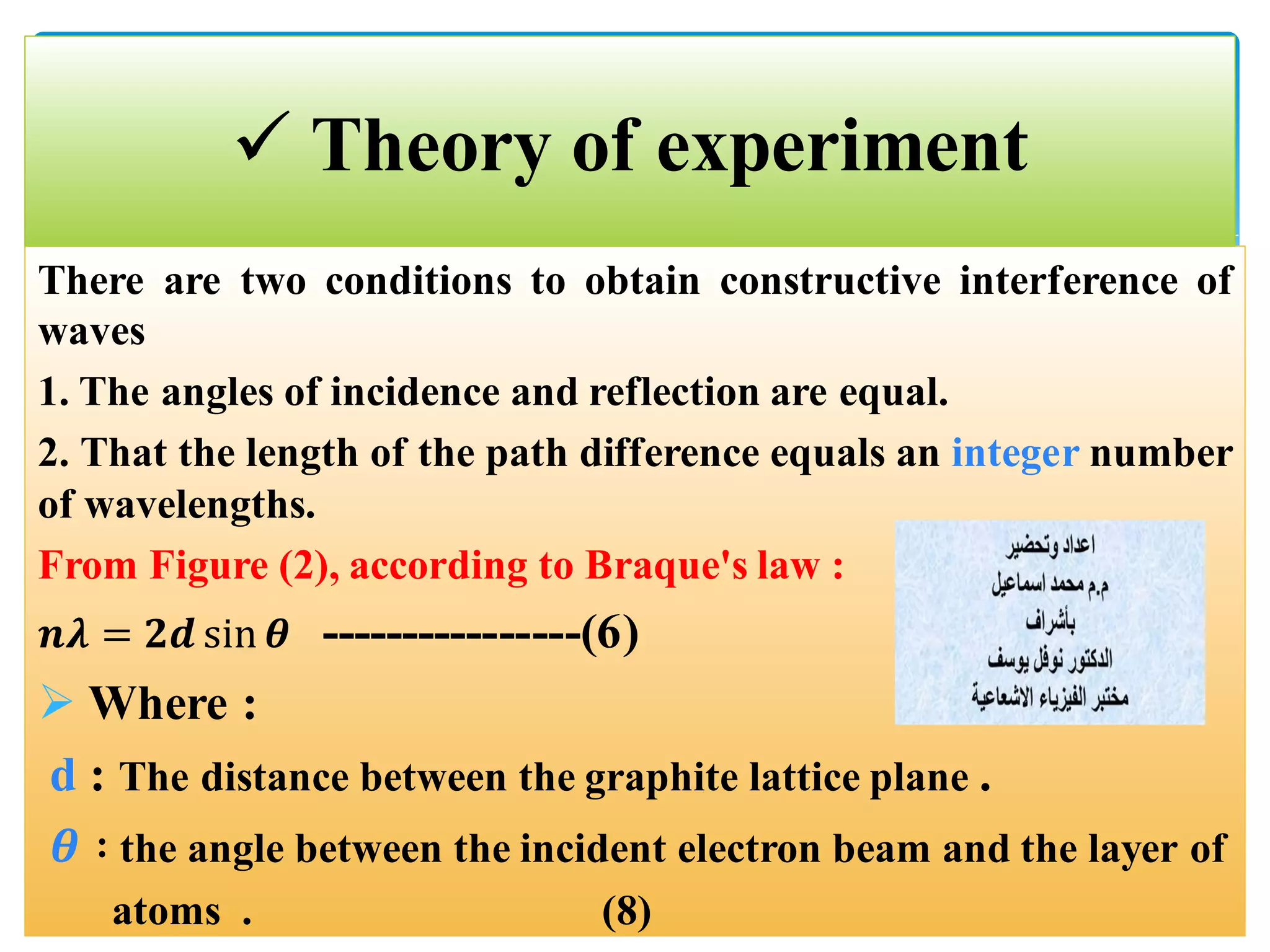
There are two conditions to obtain constructive interference of
waves
1. The angles of incidence and reflection are equal.
2. That the length of the path difference equals an integer number
of wavelengths.
From Figure (2), according to Braque's law :
𝒏𝝀 = 𝟐𝒅 sin 𝜽 ----------------(6)
 Where :
d : The distance between the graphite lattice plane .
𝜽 ∶ the angle between the incident electron beam and the layer of
atoms . (8)
 Theory of experiment
n: diffraction rank .
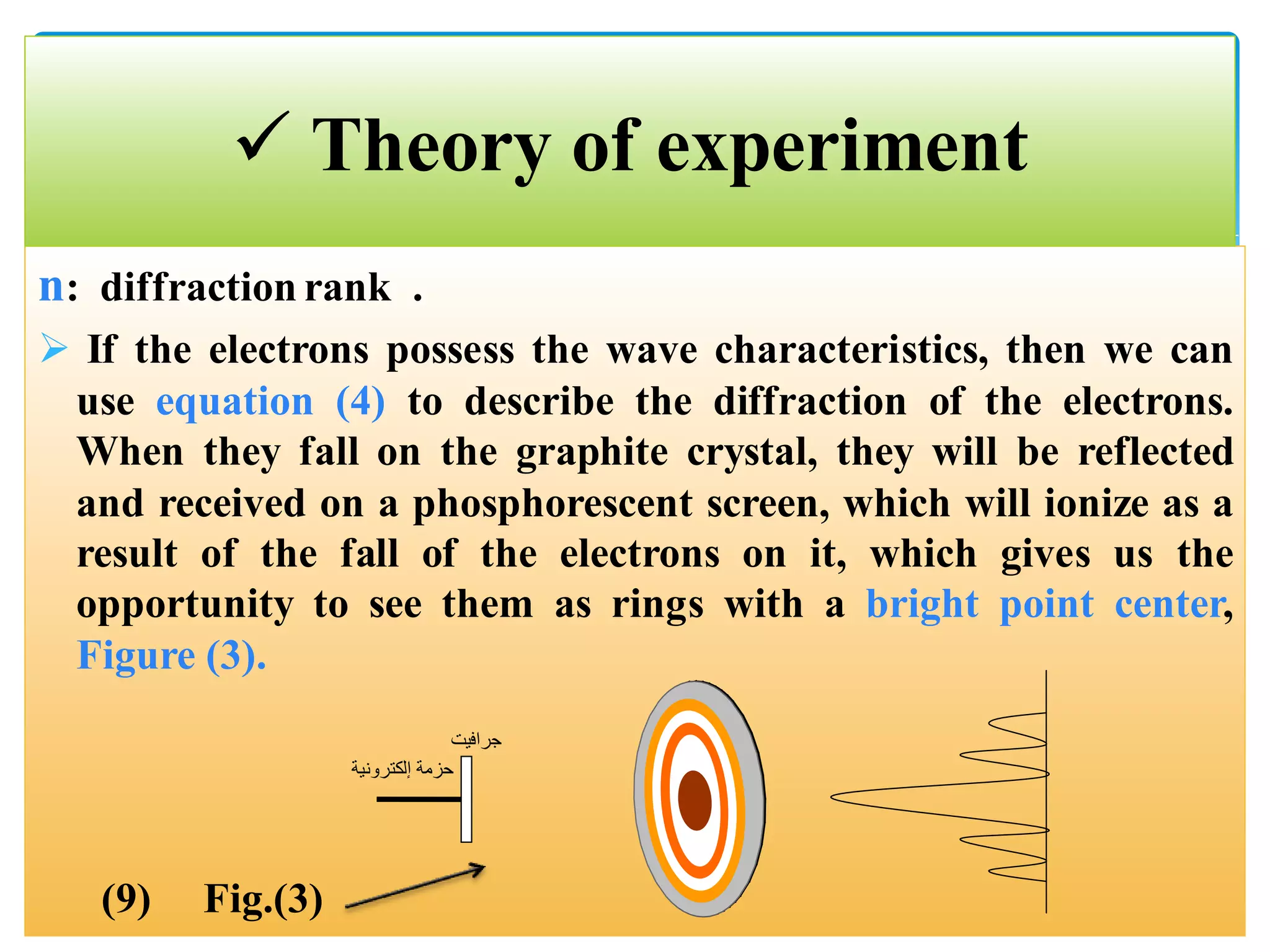
 If the electrons possess the wave characteristics, then we can
use equation (4) to describe the diffraction of the electrons.
When they fall on the graphite crystal, they will be reflected
and received on a phosphorescent screen, which will ionize as a
result of the fall of the electrons on it, which gives us the
opportunity to see them as rings with a bright point center,
Figure (3).
(9) Fig.(3)
 Theory of experiment
‫جرافيت‬
‫إلكترونية‬ ‫حزمة‬
 Where the Fig.(3) is represented an image of the diffraction of
electrons as a ring with a bright spot center .
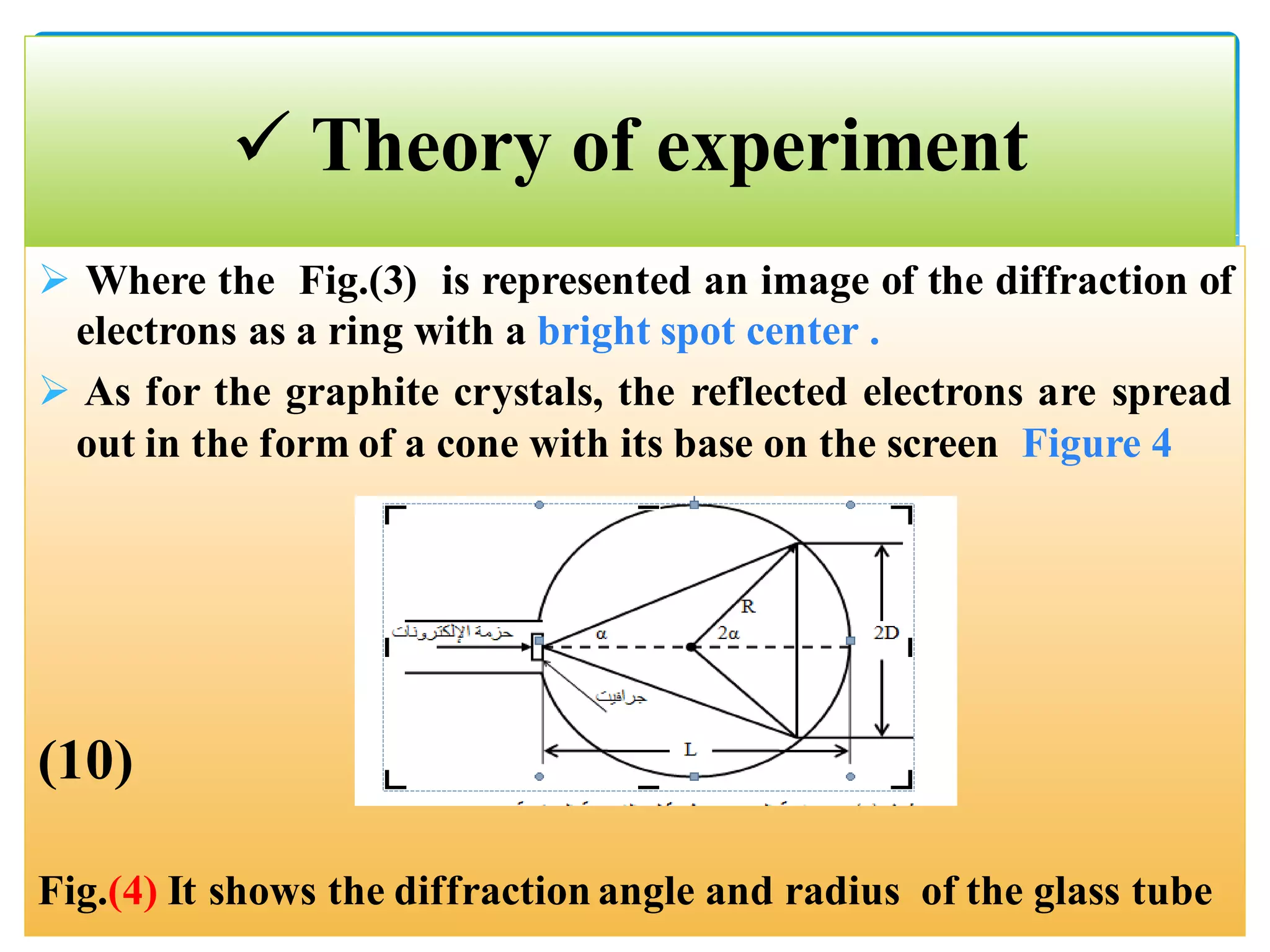
 As for the graphite crystals, the reflected electrons are spread
out in the form of a cone with its base on the screen Figure 4
(10)
Fig.(4) It shows the diffraction angle and radius of the glass tube
 Theory of experiment
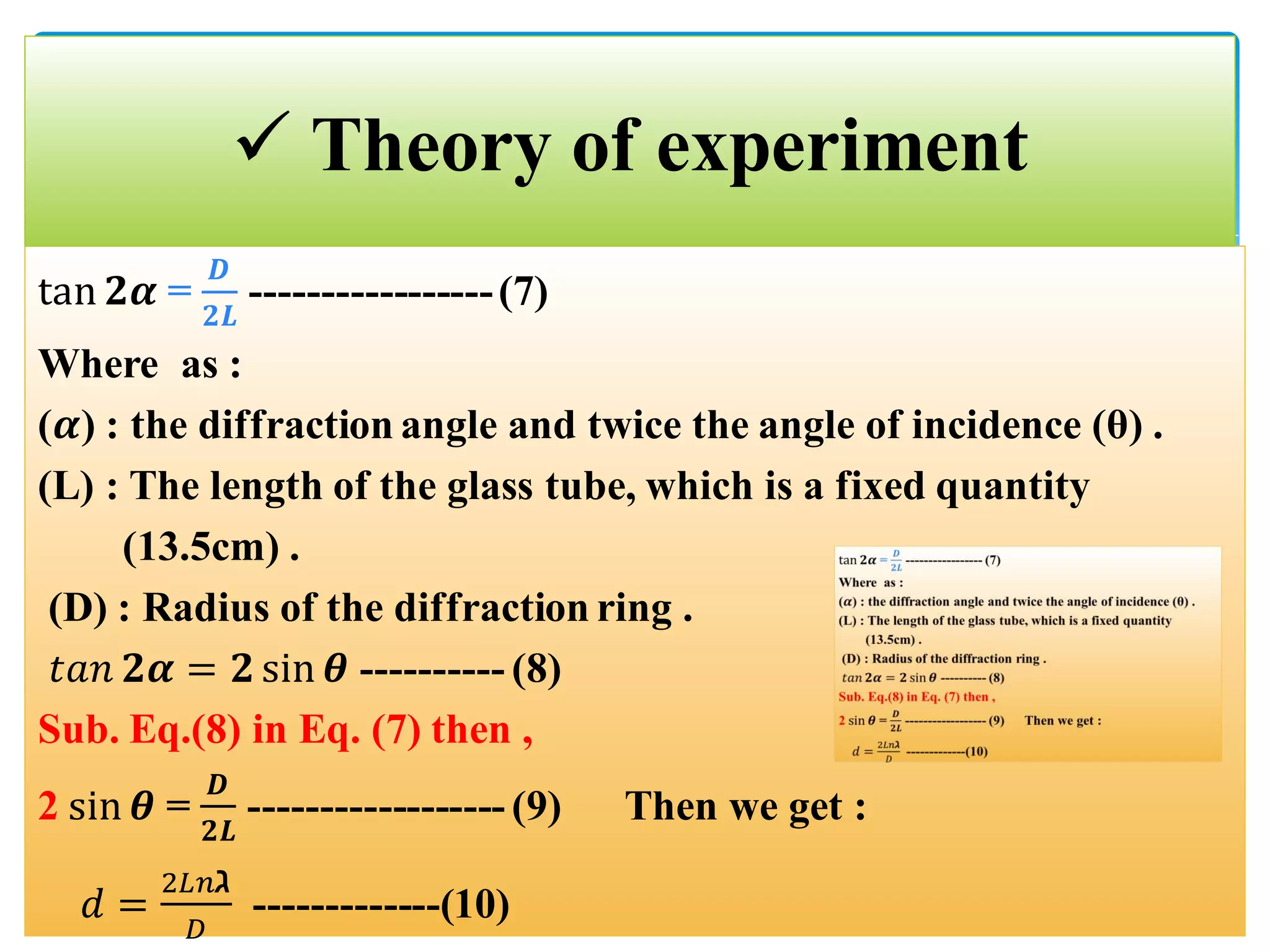
tan 𝟐𝜶 =
𝑫
𝟐𝑳
-----------------(7)
Where as :
(𝜶) : the diffraction angle and twice the angle of incidence (θ) .
(L) : The length of the glass tube, which is a fixed quantity
(13.5cm) .
(D) : Radius of the diffraction ring .
𝑡𝑎𝑛 𝟐𝜶 = 𝟐 sin 𝜽 ---------- (8)
Sub. Eq.(8) in Eq. (7) then ,
2 sin 𝜽 =
𝑫
𝟐𝑳
------------------ (9) Then we get :
𝑑 =
2𝐿𝑛‫ג‬
𝐷
-------------(10)
 Theory of experiment
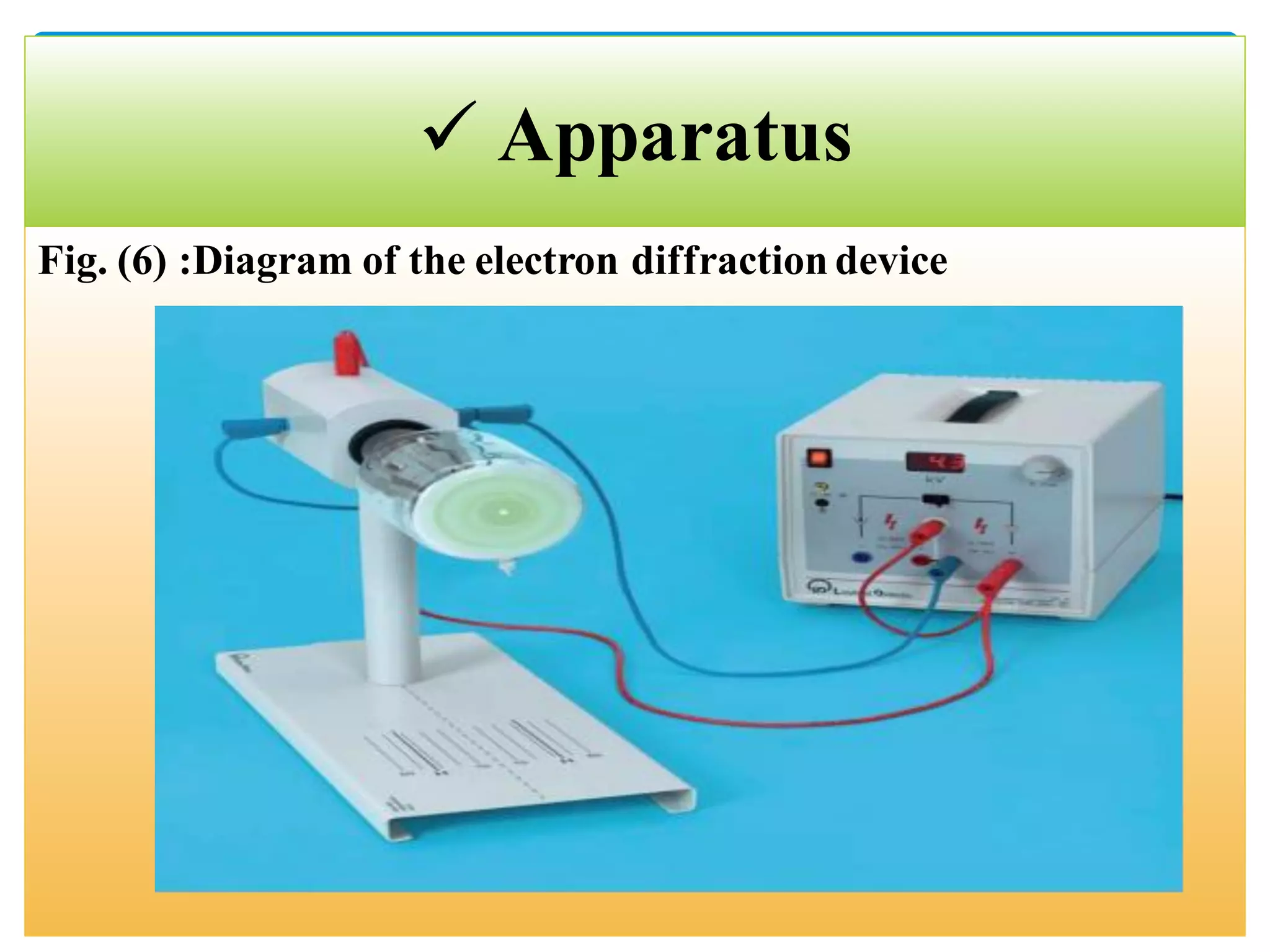
Fig. (6) :Diagram of the electron diffraction device
 Apparatus
1. Apply an acceleration voltage of (5KV).
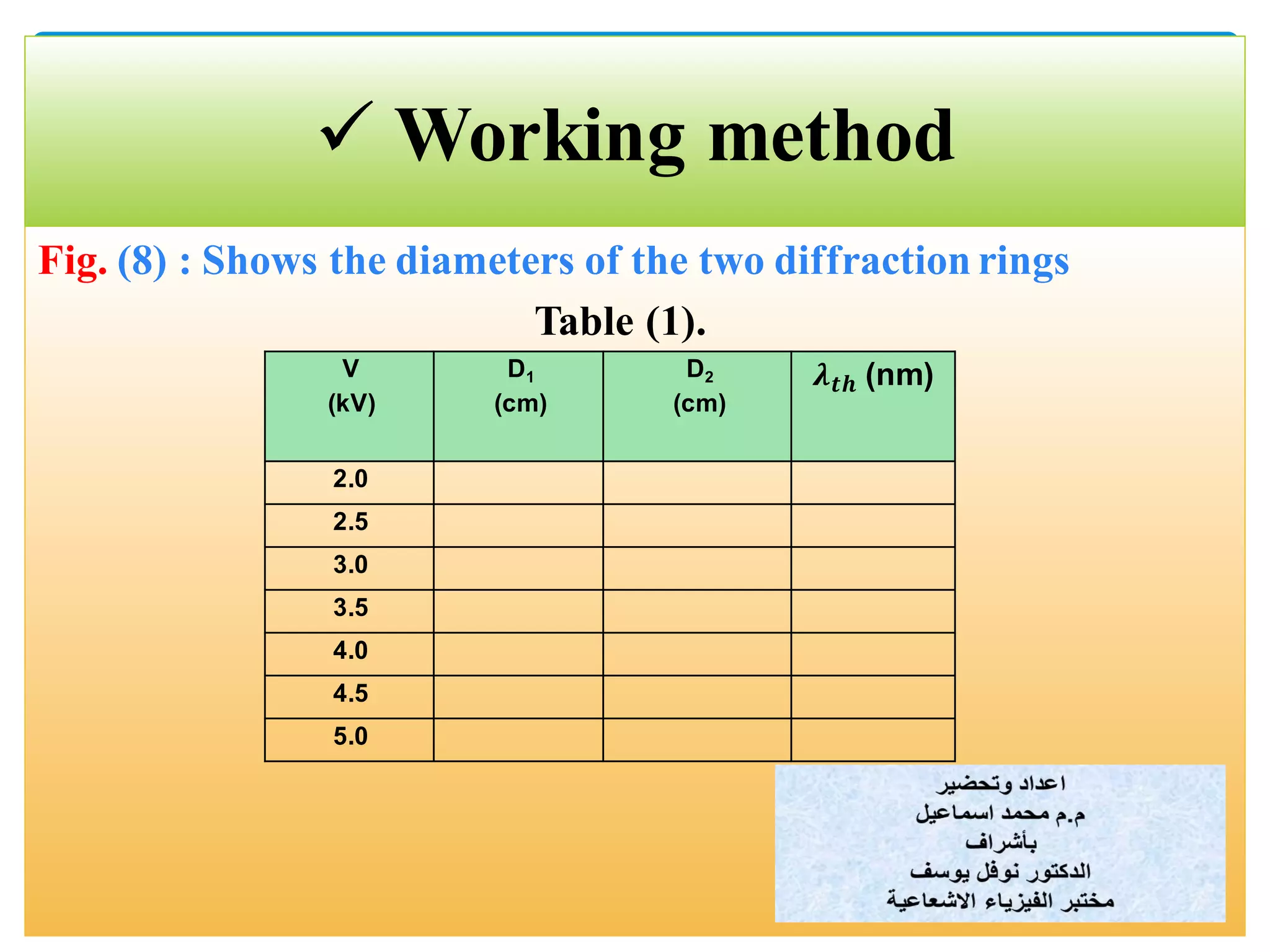
2. Change the acceleration voltage between (2-5 KV by (0.5Kv))
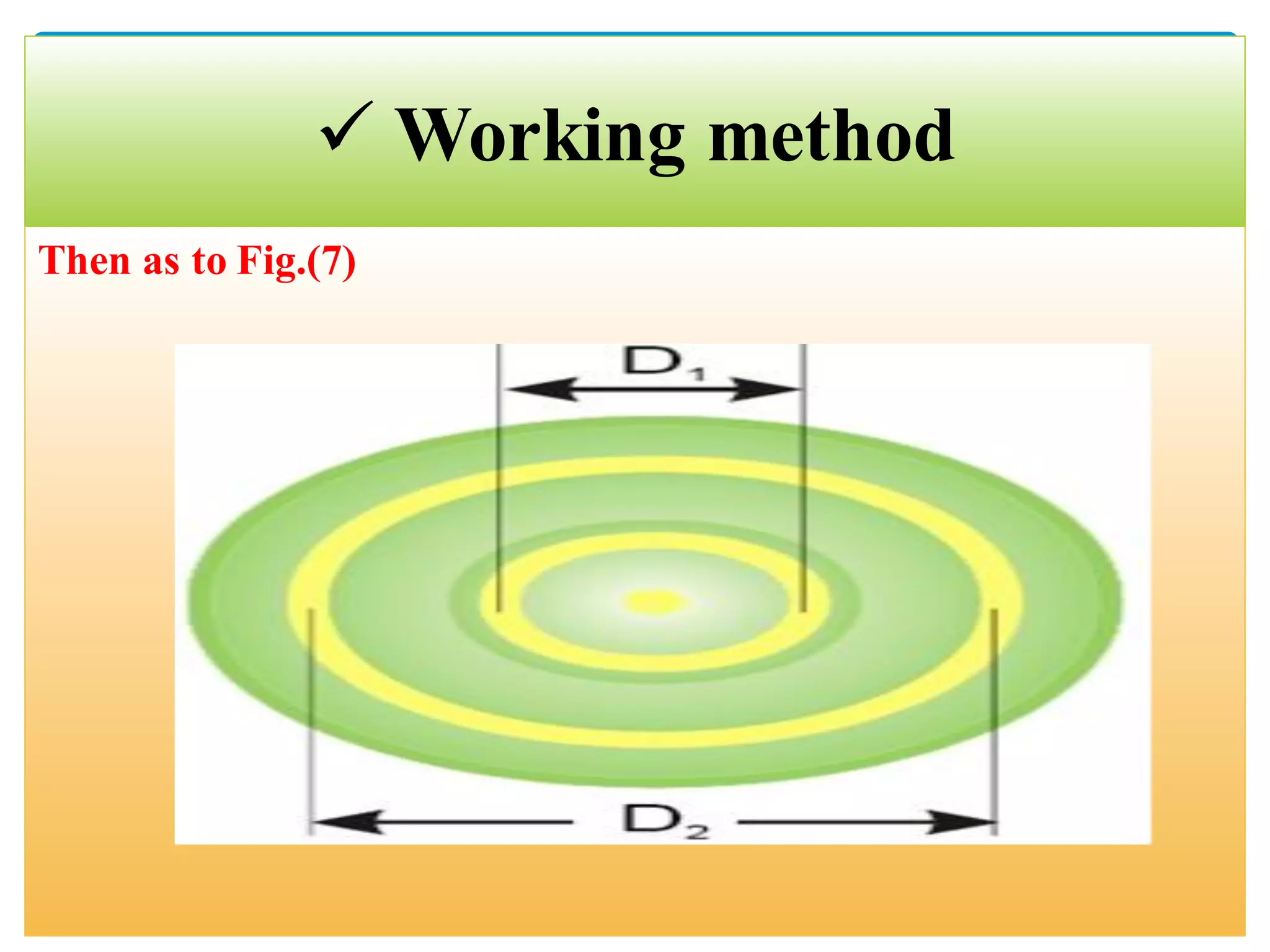
and every time measure both D1 and D2 from the diffraction tube
screen, as shown in Figure (7), and then record the results in
Table (1).
3. We take the distance between the graphite crystal and the
screen (L = 13.5cm).
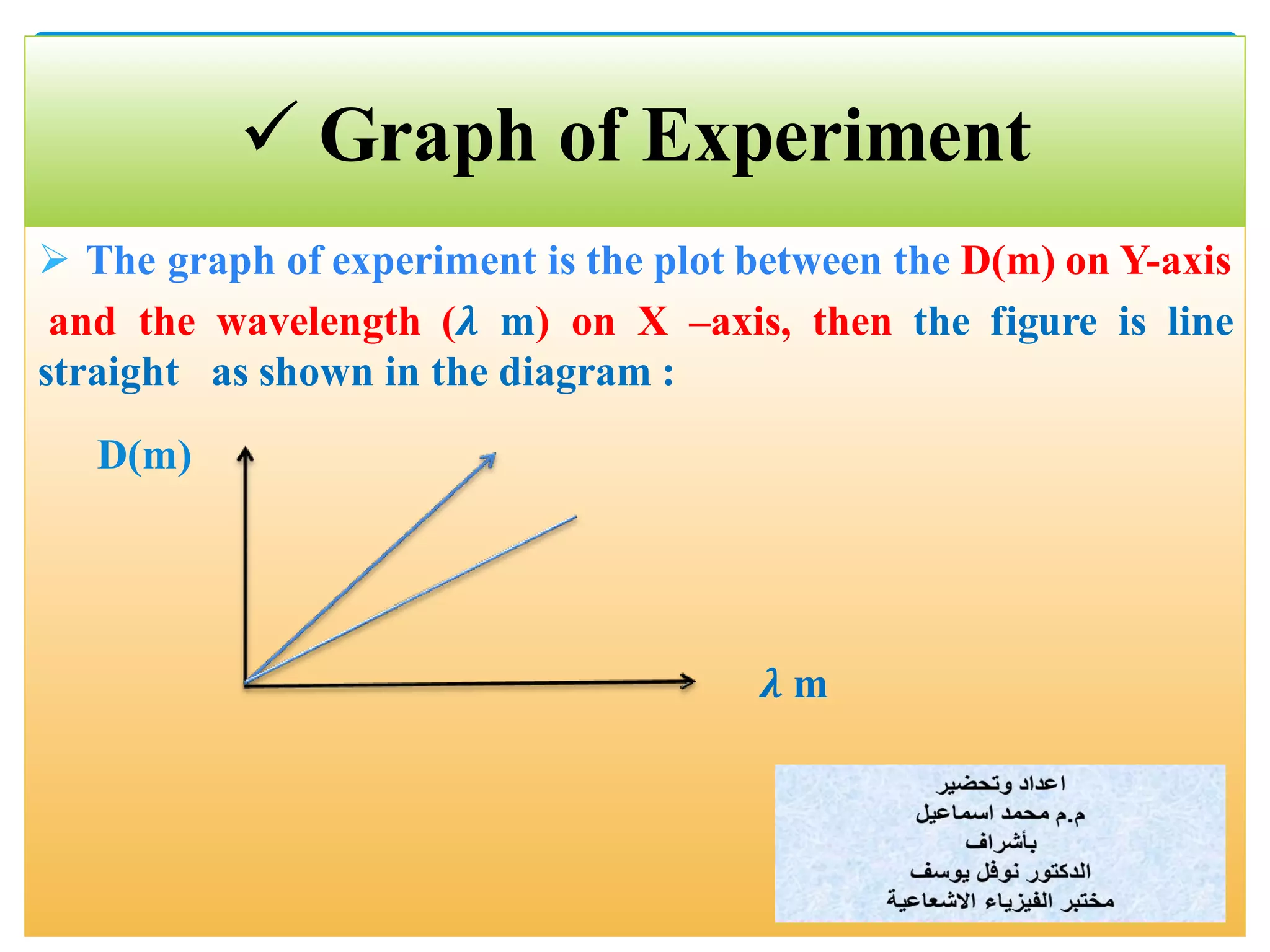
4. Plot the relationship between D1 and D2 on the y-axis and 𝝀 on
the x-axis as in Figure (8).
5. Use equation (7) to calculate d1 and d2
 Working method
Then as to Fig.(7)
 Working method
Fig. (8) : Shows the diameters of the two diffraction rings
Table (1).
 Working method
V
(kV)
D1
(cm)
D2
(cm)
𝝀 𝒕𝒉 (nm)
2.0
2.5
3.0
3.5
4.0
4.5
5.0
 The graph of experiment is the plot between the D(m) on Y-axis
and the wavelength (𝝀 m) on X –axis, then the figure is line
straight as shown in the diagram :
 Graph of Experiment
𝝀 m
D(m)

Electron diffraction experiment

  • 1.
    Experiments of RadiationPhysics Laps. / second stage T The First experiment “Electron diffraction” ‫وتحضير‬ ‫اعداد‬ ‫م‬.‫م‬.‫اسماعيل‬ ‫محمد‬ ‫بأشراف‬ ‫يوسف‬ ‫نوفل‬ ‫الدكتور‬
  • 2.
    The aim ofexperiment : 1. Achieve the wave property of the electron by finding his wavelength. 2. Calculation of the interlayer distance between levels in a graphite crystal . Apparatus : 1. Electron diffraction tube . 2. Electron diffraction tube holder . 3. Power supply ( 0- 10 Kv) . (2)  Electron Diffraction experiment
  • 3.
    The particle-wave propertyof the electron is one of the most important properties of quantum physics.  The particle property of the electron was verified through a series of experiments, the most important of which was that by the scientist Thompson in tracking the path of electrons as they passed between two fields: electric and magnetic.  As for the wave property of the electron, the scientist De Broglie took the lead in crystallizing the idea that, The moving electrons may have both the particle and the wave properties at the same time. Based on this assumption, the wavelength of the particle will be inversely proportional to its linear momentum, (3)  Theory of experiment
  • 4.
    𝝀 = 𝒉 𝒑 = 𝒉 𝒎𝒗 ---------(1) Where his Plank constant = 6.62 *𝟏𝟎−𝟑𝟒 J. sec , P= 𝒎𝒗 is ( Liner momentum) .  In this experiment we will apply equation (1) to prove the particle property of the electron by studying the diffraction of accelerated electrons that drop a sample of polycrystalline graphite (hexagonal crystal structure), and from there to a display screen (4)  Theory of experiment ‫وتحضير‬ ‫اعداد‬ ‫م‬.‫م‬‫اسماعيل‬ ‫محمد‬ ‫بأشراف‬ ‫يوسف‬ ‫نوفل‬ ‫الدكتور‬ ‫االشعاعية‬ ‫الفيزياء‬ ‫مختبر‬
  • 5.
    Look , (5) Fig.(1) shows the emission of electrons  Theory of experiment
  • 6.
     By performingan acceleration by applying the voltage, the electrons will acquire kinetic energy, which is given by the following relationship : 𝝀 = 𝒉 𝒑 -------- -----(1) , then this eq.(1) becomes : P= 𝒉 𝝀 ----------------(2) 𝒑 𝟐 𝟐𝒎 = eV-----------(3) , m = 9.1* 𝟏𝟎−𝟑𝟏 kg Sub. Eq.(2) in Eq.(3) then we get : 𝟏 𝟐𝒎 ( 𝒉 𝝀 ) 𝟐 = eV , ------(4) where e = 1.6 *𝟏𝟎−𝟏𝟗 C 𝝀 𝟐 × 𝟐𝐦 × 𝒆𝑽 = 𝒉 𝟐 ⟹ 𝝀 = 𝒉 𝟐𝒎∗𝒆𝑽 ---------(5) (6)  Theory of experiment
  • 7.
    If the acceleratedelectrons possess the wave characteristics, the two phenomena of diffraction and interference will appear on the screen, which are among the most important characteristics of the wave. Accordingly, the electron beam will collide with graphite crystals, which form a high-precision diffraction grating and then be reflected. Fig.(2) , (7)  Theory of experiment d dsinθ λ θ
  • 8.
    There are twoconditions to obtain constructive interference of waves 1. The angles of incidence and reflection are equal. 2. That the length of the path difference equals an integer number of wavelengths. From Figure (2), according to Braque's law : 𝒏𝝀 = 𝟐𝒅 sin 𝜽 ----------------(6)  Where : d : The distance between the graphite lattice plane . 𝜽 ∶ the angle between the incident electron beam and the layer of atoms . (8)  Theory of experiment
  • 9.
    n: diffraction rank.  If the electrons possess the wave characteristics, then we can use equation (4) to describe the diffraction of the electrons. When they fall on the graphite crystal, they will be reflected and received on a phosphorescent screen, which will ionize as a result of the fall of the electrons on it, which gives us the opportunity to see them as rings with a bright point center, Figure (3). (9) Fig.(3)  Theory of experiment ‫جرافيت‬ ‫إلكترونية‬ ‫حزمة‬
  • 10.
     Where theFig.(3) is represented an image of the diffraction of electrons as a ring with a bright spot center .  As for the graphite crystals, the reflected electrons are spread out in the form of a cone with its base on the screen Figure 4 (10) Fig.(4) It shows the diffraction angle and radius of the glass tube  Theory of experiment
  • 11.
    tan 𝟐𝜶 = 𝑫 𝟐𝑳 -----------------(7) Whereas : (𝜶) : the diffraction angle and twice the angle of incidence (θ) . (L) : The length of the glass tube, which is a fixed quantity (13.5cm) . (D) : Radius of the diffraction ring . 𝑡𝑎𝑛 𝟐𝜶 = 𝟐 sin 𝜽 ---------- (8) Sub. Eq.(8) in Eq. (7) then , 2 sin 𝜽 = 𝑫 𝟐𝑳 ------------------ (9) Then we get : 𝑑 = 2𝐿𝑛‫ג‬ 𝐷 -------------(10)  Theory of experiment
  • 12.
    Fig. (6) :Diagramof the electron diffraction device  Apparatus
  • 13.
    1. Apply anacceleration voltage of (5KV). 2. Change the acceleration voltage between (2-5 KV by (0.5Kv)) and every time measure both D1 and D2 from the diffraction tube screen, as shown in Figure (7), and then record the results in Table (1). 3. We take the distance between the graphite crystal and the screen (L = 13.5cm). 4. Plot the relationship between D1 and D2 on the y-axis and 𝝀 on the x-axis as in Figure (8). 5. Use equation (7) to calculate d1 and d2  Working method
  • 14.
    Then as toFig.(7)  Working method
  • 15.
    Fig. (8) :Shows the diameters of the two diffraction rings Table (1).  Working method V (kV) D1 (cm) D2 (cm) 𝝀 𝒕𝒉 (nm) 2.0 2.5 3.0 3.5 4.0 4.5 5.0
  • 16.
     The graphof experiment is the plot between the D(m) on Y-axis and the wavelength (𝝀 m) on X –axis, then the figure is line straight as shown in the diagram :  Graph of Experiment 𝝀 m D(m)