Industrial Sectors/Business Activity Year 10 Business
Learning Objectives To understand the different types of  industrial sectors To be able to explain what types of workers operate in the sectors To be able to explain the main activity of a particular  business
Classification of business sectors All businesses are classified, or put into different industrial sectors, depending upon their main activity. Below are the main industrial sectors used to classify different types of businesses:
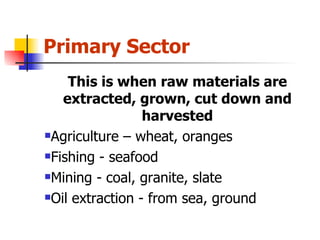
Primary Sector This is when raw materials are extracted, grown, cut down and harvested Agriculture – wheat, oranges Fishing - seafood Mining - coal, granite, slate Oil extraction - from sea, ground
Secondary Sector This is the creation of  goods from raw materials supplied by the  Primary Sector Goods can be seen or touched Production, Construction and Manufacturing Car components, steel, paper, clothes. Supply of energy (gas, electricity), water
Tertiary Sector This is often called the  Services Sector Services are intangible - they cannot be stored Distribution and sale of goods produced by  Secondary Sector Financial services - accountancy, insurance Legal service. Armed Forces, fire brigade Waitress, Sales assistant
Business activity The main activity of a business is closely connected with the industrial sectors in which it operates.  The main activity of WH Smith is retailing-selling books & stationery. This is a tertiary sector activity.
Sort these into primary, secondary and tertiary sectors 1 2 3 4 5 6 7 8 9 10 11 12 13
 
 
Chain of Production Wheat Flour Bread Sold in shop Primary Sector Secondary Sector Tertiary Sector Business to Business Business to Business Business to Business Business to Consumer
Extension Work-  Explain what do you think about each of the following sentences (agree/disagree) 1. It doesn’t matter if manufacturing disappears in Britain as we have plenty of service industries here  2. All countries need a manufacturing base otherwise they are totally dependent on imports from abroad. 3. Large scale organisations, like Microsoft, bring immense benefits because they can invest a lot of money in developing new products. This helps us to move forwards.

Industrial sectors

  • 1.
  • 2.
    Learning Objectives Tounderstand the different types of industrial sectors To be able to explain what types of workers operate in the sectors To be able to explain the main activity of a particular business
  • 3.
    Classification of businesssectors All businesses are classified, or put into different industrial sectors, depending upon their main activity. Below are the main industrial sectors used to classify different types of businesses:
  • 4.
    Primary Sector Thisis when raw materials are extracted, grown, cut down and harvested Agriculture – wheat, oranges Fishing - seafood Mining - coal, granite, slate Oil extraction - from sea, ground
  • 5.
    Secondary Sector Thisis the creation of goods from raw materials supplied by the Primary Sector Goods can be seen or touched Production, Construction and Manufacturing Car components, steel, paper, clothes. Supply of energy (gas, electricity), water
  • 6.
    Tertiary Sector Thisis often called the Services Sector Services are intangible - they cannot be stored Distribution and sale of goods produced by Secondary Sector Financial services - accountancy, insurance Legal service. Armed Forces, fire brigade Waitress, Sales assistant
  • 7.
    Business activity Themain activity of a business is closely connected with the industrial sectors in which it operates. The main activity of WH Smith is retailing-selling books & stationery. This is a tertiary sector activity.
  • 8.
    Sort these intoprimary, secondary and tertiary sectors 1 2 3 4 5 6 7 8 9 10 11 12 13
  • 9.
  • 10.
  • 11.
    Chain of ProductionWheat Flour Bread Sold in shop Primary Sector Secondary Sector Tertiary Sector Business to Business Business to Business Business to Business Business to Consumer
  • 12.
    Extension Work- Explain what do you think about each of the following sentences (agree/disagree) 1. It doesn’t matter if manufacturing disappears in Britain as we have plenty of service industries here 2. All countries need a manufacturing base otherwise they are totally dependent on imports from abroad. 3. Large scale organisations, like Microsoft, bring immense benefits because they can invest a lot of money in developing new products. This helps us to move forwards.