Speaker-Dr. Mithilesh Ranjan
Acetabular Fracture
Introduction
 Elderly pt.-
 Due to fall
 As isolated injury
 Younger pt.-
 MVA
 High incidence of major associated injuries
Anatomy
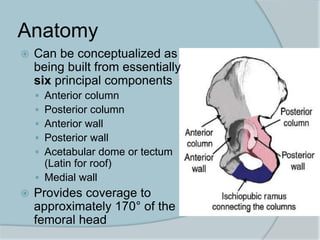
 Can be conceptualized as
being built from essentially
six principal components
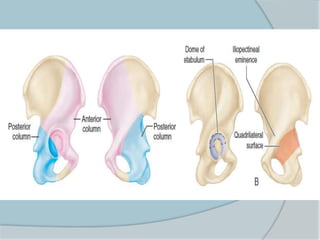
 Anterior column
 Posterior column
 Anterior wall
 Posterior wall
 Acetabular dome or tectum
(Latin for roof)
 Medial wall
 Provides coverage to
approximately 170° of the
femoral head
Anatomy
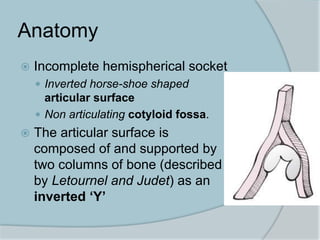
 Incomplete hemispherical socket
 Inverted horse-shoe shaped
articular surface
 Non articulating cotyloid fossa.
 The articular surface is
composed of and supported by
two columns of bone (described
by Letournel and Judet) as an
inverted ‘Y’
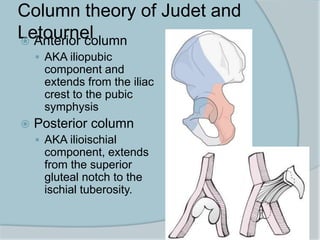
Column theory of Judet and
Letournel Anterior column
 AKA iliopubic
component and
extends from the iliac
crest to the pubic
symphysis
 Posterior column
 AKA ilioischial
component, extends
from the superior
gluteal notch to the
ischial tuberosity.
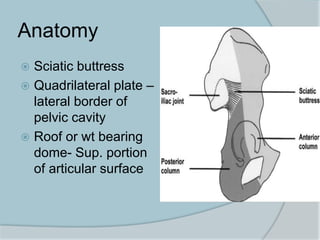
Anatomy
 Sciatic buttress
 Quadrilateral plate –
lateral border of
pelvic cavity
 Roof or wt bearing
dome- Sup. portion
of articular surface
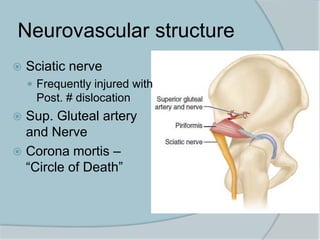
Neurovascular structure
 Sciatic nerve
 Frequently injured with
Post. # dislocation
 Sup. Gluteal artery
and Nerve
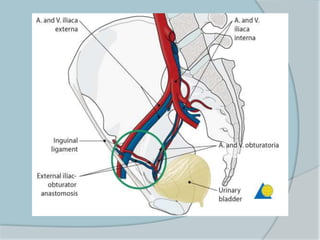
 Corona mortis –
“Circle of Death”
The classification of acetabular
fracture
 Letournel and Judet - commonly used
 5 elementary and 5 asscociated types
 Simple types –
 Posterior wall #
 Posterior column #
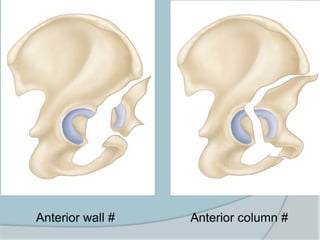
 Anterior wall #
 Anterior column #
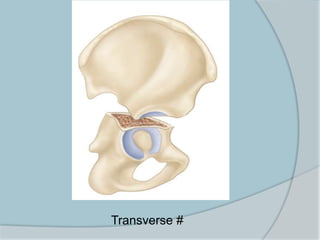
 Trasverse #
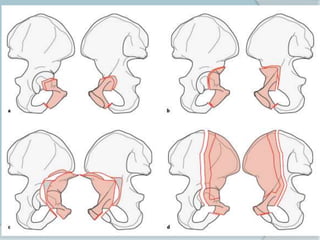
 Associated # types
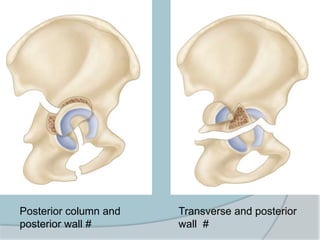
 Posterior column and posterior wall #
 Transverse and posterior wall #
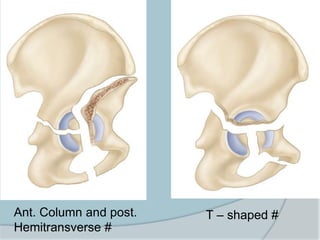
 Anterior column (or wall) and posterior
hemitransverse #
 T-shaped #
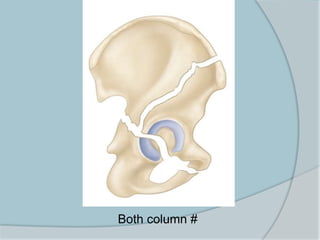
 Both-column #
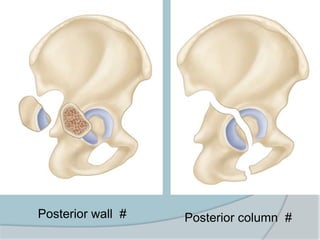
Posterior wall # Posterior column #
Anterior wall # Anterior column #
Transverse #
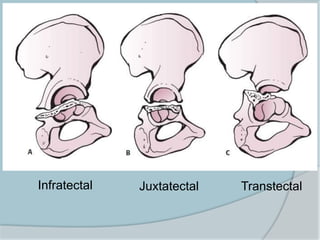
Infratectal Juxtatectal Transtectal
Posterior column and
posterior wall #
Transverse and posterior
wall #
T – shaped #Ant. Column and post.
Hemitransverse #
Both column #
Comprehensive
classification
 Type A: Partial articular fractures, one
column involved
 A1: Posterior wall fracture
 A2: Posterior column fracture
 A3: Anterior wall or anterior column
fracture
Comprehensive
classification
 Type B: Partial articular fractures
(transverse or T-type fracture, both
columns involved)
 B1: Transverse fracture
 B2: T-shaped fracture
 B3: Anterior column plus posterior
hemitransverse fracture
Comprehensive
classification
 Type C: Complete articular fracture (both
column fracture; floating acetabulum)
 C1: Both column #, high variety (anterior
column fracture extends to the iliac crest)
 C2: Both column #, low variety (anterior
column fracture extends to the anterior
border of the ilium)
 C3: Both column # involving the
sacroiliac joint
Mechanisms of Injury for
Acetabulum Fractures
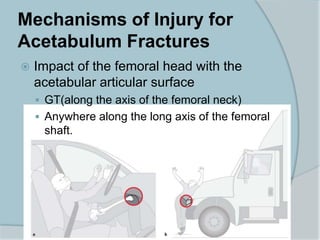
 Impact of the femoral head with the
acetabular articular surface
 GT(along the axis of the femoral neck)
 Anywhere along the long axis of the femoral
shaft.
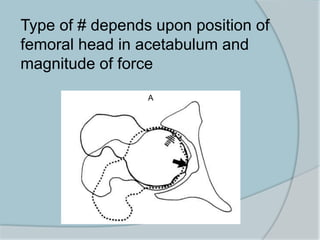
Type of # depends upon position of
femoral head in acetabulum and
magnitude of force
A
Signs and symptoms
 History – cause of injury
 ATLS protocol
 Visceral injuries common
 Associated fractures common
 Elderly pt. (underlying cardiac or
neurologic condition)
 Assess and document NV status
Signs and symptoms
 Shortening present if hip is dislocated
 Flexion, adduction, and internal rotation
of the hip may not be present
Radiographic Evaluation
 X-Rays- 3 views
 Standard AP view
 450 Obturator oblique view
 450 Iliac oblique view
 CT scan
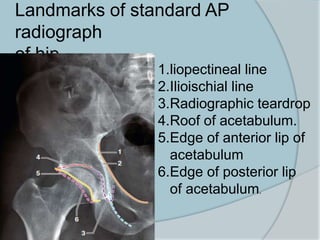
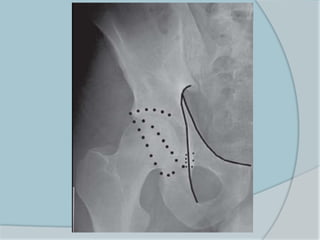
Landmarks of standard AP
radiograph
of hip
1.liopectineal line
2.Ilioischial line
3.Radiographic teardrop
4.Roof of acetabulum.
5.Edge of anterior lip of
acetabulum
6.Edge of posterior lip
of acetabulum.
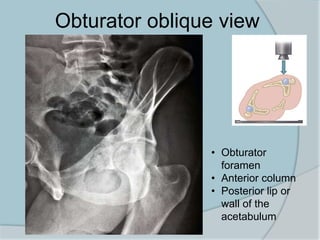
Obturator oblique view
• Obturator
foramen
• Anterior column
• Posterior lip or
wall of the
acetabulum
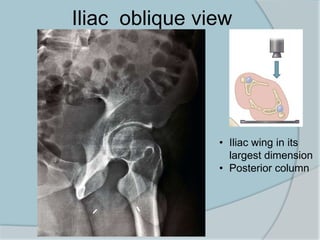
Iliac oblique view
• Iliac wing in its
largest dimension
• Posterior column
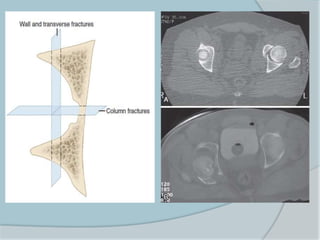
CT scan
 Axial cuts should be taken with thin slices
 Extent and location of acetabular wall
fractures
 Presence of intra-articular free fragments
 Orientation of fracture lines and Marginal
impaction
 Femoral head defect
 Rotation of fracture fragments
 Pelvic hematoma
 Sacroiliac joint integrity
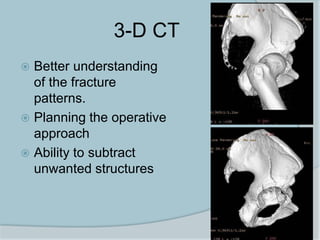
3-D CT
 Better understanding
of the fracture
patterns.
 Planning the operative
approach
 Ability to subtract
unwanted structures
Management
 Initial treatment – follow ATLS protocols
 Operative treatment are usually not
performed as an emergency
 Closed reduction of hip dislocations
should be performed  Skeletal
traction
 Allow soft tissue healing initially
 Maintain limb length
 Maintain femoral head reduction
Management
The goal of the treatment is
restoration of articular surface,
prevent post traumatic arthritis and
to mobilise the patient as early as
possible
Management
Factors to be considered are-
 Patient factors
 Fracture factors
 Expertise available
Patients factors
 Age
 Pre injury activity level
 Medical comorbidities
 Associated injuries
 Functional demands
Non-operative Indications
 Hip stable and congruous.
 Patient factors
 Medical contraindications
 Severe osteoporosis in elderly
 Undisplaced/Minimally displaced fractures
 Fractures with secondary congruence (both-column)
 Preexistent arthritis of hip
 Local soft tissue problems
 Morel Lavelle’ lesion
 Open wound
 Suprapubic catheter (C/I to Ilioinguinal and Stoppa)
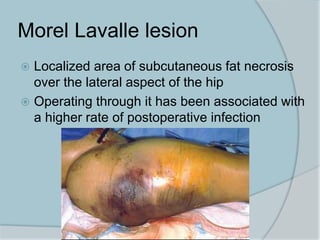
Morel Lavalle lesion
 Localized area of subcutaneous fat necrosis
over the lateral aspect of the hip
 Operating through it has been associated with
a higher rate of postoperative infection
Non operative Treatment
 Bed rest is necessary in the acute injury phase
only
 Mobilization as soon as symptoms allow
 Patients should begin with touch-down partial
weight-bearing
 Radiographs at frequent intervals
 Gradually progress to full weight bearing when
there is adequate fracture healing, usually by 6
to 12 weeks
 Joint mobilization should be continued
throughout the rehabilitation period
Operative Treatment
 Instability
 Incongruity.
Instability
 Usually associated with posterior
fracture types
 Less commonly anterior
 May be central if large fragment of
quadrilateral plate is fractured
Incongruity
 The curve of femoral head should fit
exactly in to dome of acetabulum in
all three radiographic views
 Matta has recommended use of roof
arc measurements to measure
incongruity
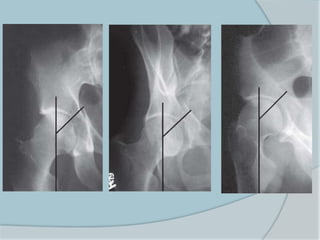
Roof arc angle
 Is an estimation of amount of WBD involved
 Measured on all three radiograph views with
the leg out of traction
 Medial roof arc angle is measured on AP view
 Anterior roof arc angle is measured on
obturator oblique view
 Posterior roof arc angle is measured on Iliac
oblique view
 WBD is considered to be intact and hip joint
congruous if measurement > 45o (Matta)
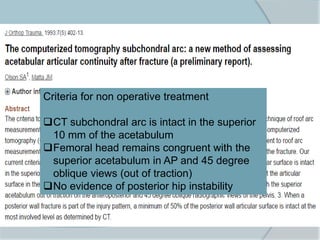
Criteria for non operative treatment
CT subchondral arc is intact in the superior
10 mm of the acetabulum
Femoral head remains congruent with the
superior acetabulum in AP and 45 degree
oblique views (out of traction)
No evidence of posterior hip instability
Operative Indications
 Hip joint instability and Incongruity
 Significant displacement (≥ 2 mm) of
the weight-bearing dome on any of the
three standard x-rays
 Fractures judged to be unstable on image
intensification stress examination under
anesthesia
 Posterior wall fractures involving more than
50% of the posterior wall
 Incarcerated bone fragments in the joint
 Lack of secondary congruence
 Displaced associated femoral head fractures
Timing of surgery
Delay of 3-5 days advisable to allow
patient’s general condition to stabilize
Indications for Emergency
ORIF
 Recurrent hip dislocation following
reduction despite traction
 Irreducible hip dislocation
 Progressive sciatic nerve deficit
 Associated vascular injury
 Open fractures
 Ipsilateral femoral neck fracture
Surgical Approaches
 Main determinants
 Fracture type
 Elapsed time from injury
 Magnitude and location of maximal
fracture displacement
 Single surgical approach is generally
selected
Surgical approaches
 Posterior (Kocher-Langenbach)
approach
 Ilioinguinal approach
 Stoppa’s approach
 Combined approach
 Iliofemoral approach
 Extended Iliofemoral approach
 Triradiate approach
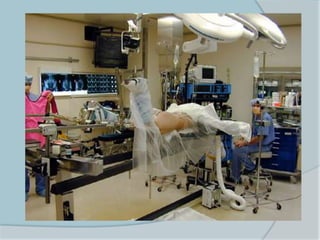
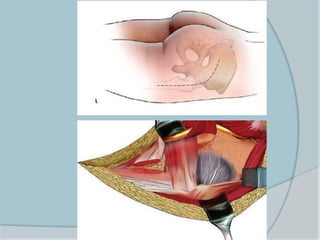
Kocher-Langenbeck
approach Position- Prone or lateral with hip in slight
extension and knee flexed
 Provides access to posterior column and entire
posterior wall
 Advantages-
 Familiarty to most surgeons
 Muscle dissection and blood loss minimal
 Disadvantages are-
 Limited exposure
 Possible injury to sciatic nerve and superior gluteal
artery& nerve,Pudendal nerve, medial circumflex
femoral artery
 Increased risk of HO
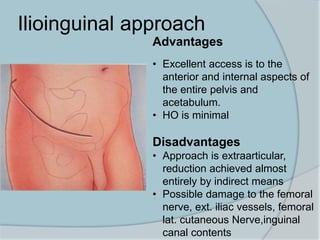
Ilioinguinal approach
 Position- Supine
 Approach of choice for all anterior wall and anterior
column fractures
 Creates three working portals or windows
 Lateral window exposes entire iliac fossa, S I joint,
sacral ala, and the superior iliopectineal eminence
 Middle window exposes the pelvic brim and
quadrilateral surface
 Medial window provides access to pubic ramus,
pubic symphysis and the retropubic space of Retzius
Ilioinguinal approach
Advantages
• Excellent access is to the
anterior and internal aspects of
the entire pelvis and
acetabulum.
• HO is minimal
Disadvantages
• Approach is extraarticular,
reduction achieved almost
entirely by indirect means
• Possible damage to the femoral
nerve, ext. iliac vessels, femoral
lat. cutaneous Nerve,inguinal
canal contents
Extended Iliofemoral approach
 Indicated for selected complex acetabular
fracture types and for surgery delayed more
than 2 weeks following injury
 Direct access to the iliac crest and the entire
internal iliac fossa
 Position- Lateral and the knee in flexed
position to relax the sciatic nerve
 Provides access to entire posterior column,
external ilium, S I joint, and anterior column up
to iliopectineal eminence
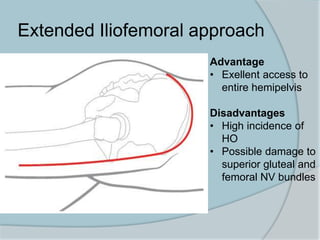
Extended Iliofemoral approach
Advantage
• Exellent access to
entire hemipelvis
Disadvantages
• High incidence of
HO
• Possible damage to
superior gluteal and
femoral NV bundles
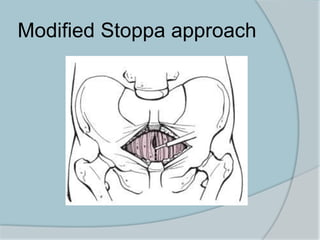
Modified Stoppa Approach
 Position- Supine
 Provides improved exposure of the
quadrilateral surface and posterior column
 Commonly used in conjunction with the lateral
window
 Advantage over the ilioinguinal is that
dissection of the iliac vessels is not required
 Risk of injury to Corona mortis and bladder
Modified Stoppa approach
Treatment of specific fracture
pattern
 Posterior wall fractures
 Kocher–Langenbeck approach is ideal for posterior
wall fractures
 Special circumstances like large wall fragments
incarcerated in the joint trochanteric flip osteotomy
may be needed
Treatment of specific fracture
pattern
 Posterior column fracture
 Kocher–Langenbeck
 Anterior Column Fractures and Anterior Wall
Fractures
 Ilioinguinal approach
 If the quadrilateral surface is comminuted the
modified Stoppa approach may be a better choice
Treatment of specific fracture
pattern
 Transverse Fractures
 Kocher–Langenbeck approach as posterior
column usually is the site of greatest fracture
displacement
 Transverse and Post. Wall Fractures
 Kocher–Langenbeck approach
Treatment of specific fracture
pattern
 Anterior Column (or Wall) and Posterior
Hemitransverse Fractures
 Posterior column component is only
minimally displaced in this fracture type.
Therefore ilioinguinal approach is used.
 Modified Stoppa approach alternative
 Posterior column is widely displaced (more
than 5 mm), or it cannot be reduced through
the anterior approach, the Kocher–
Langenbeck is added
Treatment of specific fracture
pattern
 T- shaped Fractures
 Kocher–Langenbeck approach
 If the anterior column fracture cannot be
reduced ,subsequent patient repositioning
and an anterior approach is required
(Ilioinguinal or Modified Stoppa)
 Both column Fractures
 Commonly operated on using an anterior
approach (ilioinguinal or modified Stoppa)
with the patient supine
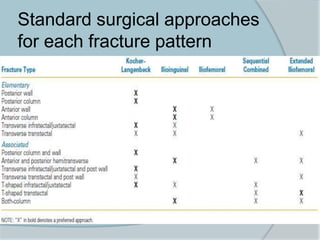
Standard surgical approaches
for each fracture pattern
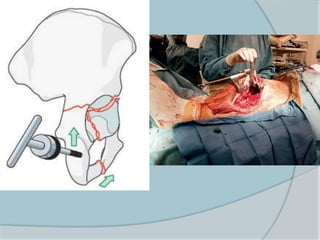
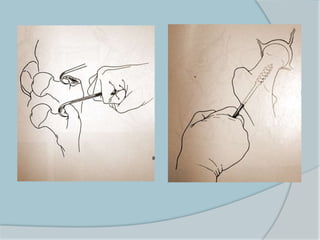
Methods of Reduction
Traction-
 With Traction table
 Manual Traction-
 Traction on extremity by manual pull
 Corkscrew
 Large sharp hook
 Schanz pin
Post operative care
 Suction drain
 Antibiotic for 48 – 72 hours
 Thromboprophylaxis- Mechanical
compressive device with LMWH
 Indomethacin 25 mg tds beginning within 24
hours of surgery and continued for 4 to 6
weeks to prevent HO
 Passive motion of the hip on the 2nd or 3rd
day.
 Touch down ambulation & crutches on 2nd
to 4th day
 Progression to FWB must be tailored to the
individual
Complications
Early:
 Mortality (0-3.6%)
 Thromboembolism
 Infection
 Neurological injury
 Vascular injury
 Intraarticular
hardware
 Malreduction
 Loss of reduction
Late:
 Avascular necrosis
 Heterotopoic
ossification
 Pseudoarthrosis
 Post traumatic
arthritis
Complications
 Thromboembolism
 Risk of PE 1%- 5 %
 Use of intermittent compression device plus
a form of chemical anticoagulation (eg-
LMWH or Warfarin) recommended for
prophylaxis
Complications
 Infection
 1-10 % patients
 Incidence of infection related to surgeons experience
 Other factors -skin necrosis, hematoma formation, and
obesity
 Prophylactic antibiotics should be administered within 1
hour before the skin incision and continued for 24-48
hours after surgery
 Multiple suction drains should be used
Complications
 Nerve Injury
 Sciatic nerve
 Preoperative incidence 12-31 %
 Prevalence of postoperative sciatic nerve injury is 2–
16%
 Peroneal division commonly involved
 Management of sciatic nerve injury is expectant and
prognosis is variable
 Iatrogenic injury to the femoral nerve is very rare
with a prevalence of 0.2% to 0.4%
Complications
 Heterotropic ossification
 Incidence varies from 3–69%
 Related to extensile surgical exposures, male
gender, associated head injury, significant delays to
surgery, fracture type, the severity of the injury
 Rare with ilioinguinal approach
 “Significant HO” -loss of active range of motion
>20% of normal.
 Indomethacin 25 mg tds for 6 weeks or 75 mg SR
capsule OD for 6 weeks
 Radiation therapy- 7–8 Gy in a single dose or 10
Gy in five doses
Complications
 Posttraumatic Arthritis
 Prevalence of osteoarthritis 4–48%
 Quality of the fracture reduction main
determinant
 Incidence following perfect reduction was
10%
 Anatomical reduction and restoration of joint
congruency is the best prophylaxis
Conclusion
 High velocity injuries with significant accompanying
injuries
 ATLS protocol
 Fracture management depends on
 Proper case selection for surgical and conservative
treatment
 3 dimensional understanding of anatomy,
 Proper interpretation of radiographs
 Realistic expectations
 Specialized instrumentation
 Surgical expertise
Conclusion
 Many perioperative complications are a
consequence of the injury
 Acetabular fracture fixation surgery is complex
and demanding and has the potential for many
serious complications
 Anatomical reduction of the WBD , congruent
reduction of the femoral head and timely
surgical intervention are the keys to success
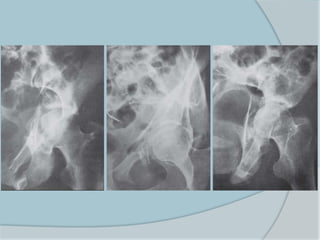
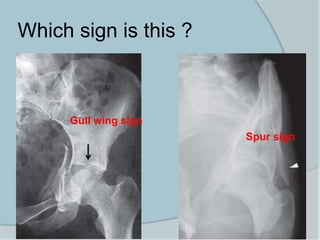
Which sign is this ?
Gull wing sign
Spur sign
Which of th following statement
are true ?
 Widespread availability of CT and MRI has
rendered plain radiograph almost obsolete for
acetabular fracture.
 Undisplaced fractures are treated by a period of 4-
6 weeks on skeletal traction.
 Fracture of anterior wall and column make up over
60 % of displaced acetabular fractures
 Recovery is complete in 50 % patients with sciatic
nerve palsy associated with acetabular fractures
and posterior dislocation of hip
 Heterotopic ossification can occur in 25-30 % of
cases of posterior or extensile approaches for
displaced fractures of acetabulum
Criteria for non operative management of
acetabular fracture includes all except :
 Stability demonstrated by dynamic stress
radiographs
 Femoral head subluxation of 3 mm
 Congruence of femoral head with
acetabular roof on AP and judet views
 Roof arc measurement of greater than or
equal to 45
 Acetabular articular surface is intact in the
superior 10 mm of the joint on CT
evaluation

Acetabulum fractures

  • 1.
  • 2.
    Introduction  Elderly pt.- Due to fall  As isolated injury  Younger pt.-  MVA  High incidence of major associated injuries
  • 3.
    Anatomy  Can beconceptualized as being built from essentially six principal components  Anterior column  Posterior column  Anterior wall  Posterior wall  Acetabular dome or tectum (Latin for roof)  Medial wall  Provides coverage to approximately 170° of the femoral head
  • 4.
    Anatomy  Incomplete hemisphericalsocket  Inverted horse-shoe shaped articular surface  Non articulating cotyloid fossa.  The articular surface is composed of and supported by two columns of bone (described by Letournel and Judet) as an inverted ‘Y’
  • 5.
    Column theory ofJudet and Letournel Anterior column  AKA iliopubic component and extends from the iliac crest to the pubic symphysis  Posterior column  AKA ilioischial component, extends from the superior gluteal notch to the ischial tuberosity.
  • 6.
    Anatomy  Sciatic buttress Quadrilateral plate – lateral border of pelvic cavity  Roof or wt bearing dome- Sup. portion of articular surface
  • 8.
    Neurovascular structure  Sciaticnerve  Frequently injured with Post. # dislocation  Sup. Gluteal artery and Nerve  Corona mortis – “Circle of Death”
  • 10.
    The classification ofacetabular fracture  Letournel and Judet - commonly used  5 elementary and 5 asscociated types  Simple types –  Posterior wall #  Posterior column #  Anterior wall #  Anterior column #  Trasverse #
  • 11.
     Associated #types  Posterior column and posterior wall #  Transverse and posterior wall #  Anterior column (or wall) and posterior hemitransverse #  T-shaped #  Both-column #
  • 12.
    Posterior wall #Posterior column #
  • 13.
    Anterior wall #Anterior column #
  • 15.
  • 16.
  • 17.
    Posterior column and posteriorwall # Transverse and posterior wall #
  • 18.
    T – shaped#Ant. Column and post. Hemitransverse #
  • 19.
  • 20.
    Comprehensive classification  Type A:Partial articular fractures, one column involved  A1: Posterior wall fracture  A2: Posterior column fracture  A3: Anterior wall or anterior column fracture
  • 21.
    Comprehensive classification  Type B:Partial articular fractures (transverse or T-type fracture, both columns involved)  B1: Transverse fracture  B2: T-shaped fracture  B3: Anterior column plus posterior hemitransverse fracture
  • 22.
    Comprehensive classification  Type C:Complete articular fracture (both column fracture; floating acetabulum)  C1: Both column #, high variety (anterior column fracture extends to the iliac crest)  C2: Both column #, low variety (anterior column fracture extends to the anterior border of the ilium)  C3: Both column # involving the sacroiliac joint
  • 23.
    Mechanisms of Injuryfor Acetabulum Fractures  Impact of the femoral head with the acetabular articular surface  GT(along the axis of the femoral neck)  Anywhere along the long axis of the femoral shaft.
  • 24.
    Type of #depends upon position of femoral head in acetabulum and magnitude of force A
  • 25.
    Signs and symptoms History – cause of injury  ATLS protocol  Visceral injuries common  Associated fractures common  Elderly pt. (underlying cardiac or neurologic condition)  Assess and document NV status
  • 26.
    Signs and symptoms Shortening present if hip is dislocated  Flexion, adduction, and internal rotation of the hip may not be present
  • 27.
    Radiographic Evaluation  X-Rays-3 views  Standard AP view  450 Obturator oblique view  450 Iliac oblique view  CT scan
  • 28.
    Landmarks of standardAP radiograph of hip 1.liopectineal line 2.Ilioischial line 3.Radiographic teardrop 4.Roof of acetabulum. 5.Edge of anterior lip of acetabulum 6.Edge of posterior lip of acetabulum.
  • 30.
    Obturator oblique view •Obturator foramen • Anterior column • Posterior lip or wall of the acetabulum
  • 31.
    Iliac oblique view •Iliac wing in its largest dimension • Posterior column
  • 32.
    CT scan  Axialcuts should be taken with thin slices  Extent and location of acetabular wall fractures  Presence of intra-articular free fragments  Orientation of fracture lines and Marginal impaction  Femoral head defect  Rotation of fracture fragments  Pelvic hematoma  Sacroiliac joint integrity
  • 34.
    3-D CT  Betterunderstanding of the fracture patterns.  Planning the operative approach  Ability to subtract unwanted structures
  • 35.
    Management  Initial treatment– follow ATLS protocols  Operative treatment are usually not performed as an emergency  Closed reduction of hip dislocations should be performed  Skeletal traction  Allow soft tissue healing initially  Maintain limb length  Maintain femoral head reduction
  • 36.
    Management The goal ofthe treatment is restoration of articular surface, prevent post traumatic arthritis and to mobilise the patient as early as possible
  • 37.
    Management Factors to beconsidered are-  Patient factors  Fracture factors  Expertise available
  • 38.
    Patients factors  Age Pre injury activity level  Medical comorbidities  Associated injuries  Functional demands
  • 39.
    Non-operative Indications  Hipstable and congruous.  Patient factors  Medical contraindications  Severe osteoporosis in elderly  Undisplaced/Minimally displaced fractures  Fractures with secondary congruence (both-column)  Preexistent arthritis of hip  Local soft tissue problems  Morel Lavelle’ lesion  Open wound  Suprapubic catheter (C/I to Ilioinguinal and Stoppa)
  • 41.
    Morel Lavalle lesion Localized area of subcutaneous fat necrosis over the lateral aspect of the hip  Operating through it has been associated with a higher rate of postoperative infection
  • 42.
    Non operative Treatment Bed rest is necessary in the acute injury phase only  Mobilization as soon as symptoms allow  Patients should begin with touch-down partial weight-bearing  Radiographs at frequent intervals  Gradually progress to full weight bearing when there is adequate fracture healing, usually by 6 to 12 weeks  Joint mobilization should be continued throughout the rehabilitation period
  • 43.
  • 44.
    Instability  Usually associatedwith posterior fracture types  Less commonly anterior  May be central if large fragment of quadrilateral plate is fractured
  • 45.
    Incongruity  The curveof femoral head should fit exactly in to dome of acetabulum in all three radiographic views  Matta has recommended use of roof arc measurements to measure incongruity
  • 46.
    Roof arc angle Is an estimation of amount of WBD involved  Measured on all three radiograph views with the leg out of traction  Medial roof arc angle is measured on AP view  Anterior roof arc angle is measured on obturator oblique view  Posterior roof arc angle is measured on Iliac oblique view  WBD is considered to be intact and hip joint congruous if measurement > 45o (Matta)
  • 47.
    Criteria for nonoperative treatment CT subchondral arc is intact in the superior 10 mm of the acetabulum Femoral head remains congruent with the superior acetabulum in AP and 45 degree oblique views (out of traction) No evidence of posterior hip instability
  • 49.
    Operative Indications  Hipjoint instability and Incongruity  Significant displacement (≥ 2 mm) of the weight-bearing dome on any of the three standard x-rays  Fractures judged to be unstable on image intensification stress examination under anesthesia  Posterior wall fractures involving more than 50% of the posterior wall  Incarcerated bone fragments in the joint  Lack of secondary congruence  Displaced associated femoral head fractures
  • 50.
    Timing of surgery Delayof 3-5 days advisable to allow patient’s general condition to stabilize
  • 51.
    Indications for Emergency ORIF Recurrent hip dislocation following reduction despite traction  Irreducible hip dislocation  Progressive sciatic nerve deficit  Associated vascular injury  Open fractures  Ipsilateral femoral neck fracture
  • 52.
    Surgical Approaches  Maindeterminants  Fracture type  Elapsed time from injury  Magnitude and location of maximal fracture displacement  Single surgical approach is generally selected
  • 53.
    Surgical approaches  Posterior(Kocher-Langenbach) approach  Ilioinguinal approach  Stoppa’s approach  Combined approach  Iliofemoral approach  Extended Iliofemoral approach  Triradiate approach
  • 54.
    Kocher-Langenbeck approach Position- Proneor lateral with hip in slight extension and knee flexed  Provides access to posterior column and entire posterior wall  Advantages-  Familiarty to most surgeons  Muscle dissection and blood loss minimal  Disadvantages are-  Limited exposure  Possible injury to sciatic nerve and superior gluteal artery& nerve,Pudendal nerve, medial circumflex femoral artery  Increased risk of HO
  • 57.
    Ilioinguinal approach  Position-Supine  Approach of choice for all anterior wall and anterior column fractures  Creates three working portals or windows  Lateral window exposes entire iliac fossa, S I joint, sacral ala, and the superior iliopectineal eminence  Middle window exposes the pelvic brim and quadrilateral surface  Medial window provides access to pubic ramus, pubic symphysis and the retropubic space of Retzius
  • 58.
    Ilioinguinal approach Advantages • Excellentaccess is to the anterior and internal aspects of the entire pelvis and acetabulum. • HO is minimal Disadvantages • Approach is extraarticular, reduction achieved almost entirely by indirect means • Possible damage to the femoral nerve, ext. iliac vessels, femoral lat. cutaneous Nerve,inguinal canal contents
  • 59.
    Extended Iliofemoral approach Indicated for selected complex acetabular fracture types and for surgery delayed more than 2 weeks following injury  Direct access to the iliac crest and the entire internal iliac fossa  Position- Lateral and the knee in flexed position to relax the sciatic nerve  Provides access to entire posterior column, external ilium, S I joint, and anterior column up to iliopectineal eminence
  • 60.
    Extended Iliofemoral approach Advantage •Exellent access to entire hemipelvis Disadvantages • High incidence of HO • Possible damage to superior gluteal and femoral NV bundles
  • 61.
    Modified Stoppa Approach Position- Supine  Provides improved exposure of the quadrilateral surface and posterior column  Commonly used in conjunction with the lateral window  Advantage over the ilioinguinal is that dissection of the iliac vessels is not required  Risk of injury to Corona mortis and bladder
  • 62.
  • 63.
    Treatment of specificfracture pattern  Posterior wall fractures  Kocher–Langenbeck approach is ideal for posterior wall fractures  Special circumstances like large wall fragments incarcerated in the joint trochanteric flip osteotomy may be needed
  • 64.
    Treatment of specificfracture pattern  Posterior column fracture  Kocher–Langenbeck  Anterior Column Fractures and Anterior Wall Fractures  Ilioinguinal approach  If the quadrilateral surface is comminuted the modified Stoppa approach may be a better choice
  • 65.
    Treatment of specificfracture pattern  Transverse Fractures  Kocher–Langenbeck approach as posterior column usually is the site of greatest fracture displacement  Transverse and Post. Wall Fractures  Kocher–Langenbeck approach
  • 66.
    Treatment of specificfracture pattern  Anterior Column (or Wall) and Posterior Hemitransverse Fractures  Posterior column component is only minimally displaced in this fracture type. Therefore ilioinguinal approach is used.  Modified Stoppa approach alternative  Posterior column is widely displaced (more than 5 mm), or it cannot be reduced through the anterior approach, the Kocher– Langenbeck is added
  • 67.
    Treatment of specificfracture pattern  T- shaped Fractures  Kocher–Langenbeck approach  If the anterior column fracture cannot be reduced ,subsequent patient repositioning and an anterior approach is required (Ilioinguinal or Modified Stoppa)  Both column Fractures  Commonly operated on using an anterior approach (ilioinguinal or modified Stoppa) with the patient supine
  • 68.
    Standard surgical approaches foreach fracture pattern
  • 69.
    Methods of Reduction Traction- With Traction table  Manual Traction-  Traction on extremity by manual pull  Corkscrew  Large sharp hook  Schanz pin
  • 73.
    Post operative care Suction drain  Antibiotic for 48 – 72 hours  Thromboprophylaxis- Mechanical compressive device with LMWH  Indomethacin 25 mg tds beginning within 24 hours of surgery and continued for 4 to 6 weeks to prevent HO  Passive motion of the hip on the 2nd or 3rd day.  Touch down ambulation & crutches on 2nd to 4th day  Progression to FWB must be tailored to the individual
  • 74.
    Complications Early:  Mortality (0-3.6%) Thromboembolism  Infection  Neurological injury  Vascular injury  Intraarticular hardware  Malreduction  Loss of reduction Late:  Avascular necrosis  Heterotopoic ossification  Pseudoarthrosis  Post traumatic arthritis
  • 75.
    Complications  Thromboembolism  Riskof PE 1%- 5 %  Use of intermittent compression device plus a form of chemical anticoagulation (eg- LMWH or Warfarin) recommended for prophylaxis
  • 76.
    Complications  Infection  1-10% patients  Incidence of infection related to surgeons experience  Other factors -skin necrosis, hematoma formation, and obesity  Prophylactic antibiotics should be administered within 1 hour before the skin incision and continued for 24-48 hours after surgery  Multiple suction drains should be used
  • 77.
    Complications  Nerve Injury Sciatic nerve  Preoperative incidence 12-31 %  Prevalence of postoperative sciatic nerve injury is 2– 16%  Peroneal division commonly involved  Management of sciatic nerve injury is expectant and prognosis is variable  Iatrogenic injury to the femoral nerve is very rare with a prevalence of 0.2% to 0.4%
  • 78.
    Complications  Heterotropic ossification Incidence varies from 3–69%  Related to extensile surgical exposures, male gender, associated head injury, significant delays to surgery, fracture type, the severity of the injury  Rare with ilioinguinal approach  “Significant HO” -loss of active range of motion >20% of normal.  Indomethacin 25 mg tds for 6 weeks or 75 mg SR capsule OD for 6 weeks  Radiation therapy- 7–8 Gy in a single dose or 10 Gy in five doses
  • 79.
    Complications  Posttraumatic Arthritis Prevalence of osteoarthritis 4–48%  Quality of the fracture reduction main determinant  Incidence following perfect reduction was 10%  Anatomical reduction and restoration of joint congruency is the best prophylaxis
  • 80.
    Conclusion  High velocityinjuries with significant accompanying injuries  ATLS protocol  Fracture management depends on  Proper case selection for surgical and conservative treatment  3 dimensional understanding of anatomy,  Proper interpretation of radiographs  Realistic expectations  Specialized instrumentation  Surgical expertise
  • 81.
    Conclusion  Many perioperativecomplications are a consequence of the injury  Acetabular fracture fixation surgery is complex and demanding and has the potential for many serious complications  Anatomical reduction of the WBD , congruent reduction of the femoral head and timely surgical intervention are the keys to success
  • 83.
    Which sign isthis ? Gull wing sign Spur sign
  • 84.
    Which of thfollowing statement are true ?  Widespread availability of CT and MRI has rendered plain radiograph almost obsolete for acetabular fracture.  Undisplaced fractures are treated by a period of 4- 6 weeks on skeletal traction.  Fracture of anterior wall and column make up over 60 % of displaced acetabular fractures  Recovery is complete in 50 % patients with sciatic nerve palsy associated with acetabular fractures and posterior dislocation of hip  Heterotopic ossification can occur in 25-30 % of cases of posterior or extensile approaches for displaced fractures of acetabulum
  • 85.
    Criteria for nonoperative management of acetabular fracture includes all except :  Stability demonstrated by dynamic stress radiographs  Femoral head subluxation of 3 mm  Congruence of femoral head with acetabular roof on AP and judet views  Roof arc measurement of greater than or equal to 45  Acetabular articular surface is intact in the superior 10 mm of the joint on CT evaluation

Editor's Notes

  • #3 Associated injuries like pelvic ring # , knee injury, proximal femur # are common.Elderly pt commonly presents with acetabular fracture as an isolated injury.
  • #4 Successful treatment of an acetabular fracture is based on a thorough understanding of the complex three-dimensional anatomy of the innominate bone
  • #5 Acetabular socket is incomplete hemispeherical structure
  • #6 Ant column- ant limb of inverted Y
  • #7 These two columns are connected to sacroilac joint by thick strut of bone known as sciatic buttress.Two columns meet medially to form quadrilateral plate. # through this region leads to rotational displacements, correction of which is critical part of surgery.
  • #8 Anatomic restoration of the dome with concentric reduction of the femoral head beneath this dome is the goal of both operative and nonoperative treatment.
  • #9 These structures are at risk during the original injury and during fracture fixation.sciatic nerve exiting greater sciatic notch inferior to pyriformis. The superior gluteal artery and nerve exit the greater sciatic notch at its most superior aspect.Fractures that enter the superior portion of the greater sciatic notch can lead to injury of this vessel and subsequnet significant hemorrhage, possibly requiring angiography with embolization .
  • #10 large anastomosis between the external iliac artery or inferior epigastric artery and the obturator artery present in 40% .It is located behind the superior pubic ramus at a distance of 4-5 cm from the symphysis pubis. Failure to ligate this vascular connection during the ilioinguinal or Stoppa approach can lead to significant hemorrhage
  • #11 This system informs the surgeon where the fracture is located and usually indicates what surgical approach to use. it is based on anatomic pattern of fracture. Elementary fractures consist of one fracture line. associated fractures are defined by two or more fractures lines.
  • #12 Associated fracture types have more complex fracture geometries and include
  • #13 MC type of acetabular #.Post wall # usually caused by dashboard injury- knee injury, Post dislocation of hip common.It is complicated by communition, marginal impaction frequently. Post colm # are usually unstable and frequently involves the greater sciatic notch at or above the location of the superior gluteal neurovascular bundle
  • #14 Anterior wall fractures are rare, and constitute only 1% to 2% of all fractures. Ant column 3-5 % and it is classified into high,intermediate,low and very low depending upon location where the fracture exits the anterior aspect of the bone.
  • #15 A -very low
  • #16 The fracture separates the innominate bone into two pieces: The upper iliac and the lower ischiopubic segment.
  • #17 Where the fracture line crosses the acetabular articular surface. Higer the # line worse is the prognosis
  • #19 associated anterior plus posterior hemitransverse and the isolated anterior column fractures are common fracture patterns seen in the elderly after a fall. Involves a transverse fracture with an associated inferior vertical fracture line known as the stem of the T
  • #20 both-column fracture is the most common of the associated fractures. it represents an acetabulum completely disconnected from the axial skeleton
  • #23 both columns are fractured and all articular segments, including the roof, are detached from the remaining segment of the intact ilium, “the floating acetabulum”
  • #24 This force to the femoral head may be applied via Degree of fracture displacement, communition, articular impaction depend upon magnitude of force as well as quality of bone
  • #25 With force applied along femoral neck ER- ANT. # IR- POST #
  • #26 a history of being a passenger or driver involved in a motor vehicle accident as opposed to being a pedestrian struck by a motor vehicle or having experienced a fall from a height can provide an expectation of the fracture type
  • #29 6 basic landmarks. The restoration of the radiographic landmarks is a guide to the adequacy of fracture reduction. Iliopect- ant column, ilioischial - post column, interruption of roof - # involving sup. acetabulum. The teardrop outlines an ant. portion quadrilateral plate medially, anteroinferior portion of the acetabular fossa laterally. Teardrop identifies the position of the medial wall of the acetabulum. Opposite hip should also be included radiographic field in the anteroposterior and Judet views.The medial clear space between the femoral head and the radiographic teardrop in the injured and uninjured hips should be compared on the anteroposterior view as an indication of femoral head subluxation.
  • #31 Shows obturator foramen in its greatest dimension and also outlines ant. clmn and post rim of acetabulum
  • #32 Hemipelvis is tilted 45 degrees away from the x-ray beam. Involvement of the Posterior column is often best seen on this view
  • #33 One main advantage of CT is that the examination can be completed without moving or turning the patient
  • #40 Secondary congruence defined as congruency between the femoral head and the acetabular articular fragments without skeletal traction being applied.Parallelism between the femoral head and acetabular articular surface must be maintained in all three radiographic views
  • #41 Both-column fracture showing secondary congruence
  • #42 It is closed degloving injury over GT.This area must be debrided during or before definitive surgical procedure to decrease chance of infection
  • #44 Operative treatment is indicated for all acetabular fractures that result in hip joint instability and/or incongruity, regardless of the classification type.
  • #49 Rotation of the pelvis on the oblique views can vary with positioning. To overcome this limitation, Olson and Matta proposed the use of CT to assess the superior acetabulum in place of roof-arc measurements
  • #50 the first line is a vertical line through the center of the femoral head and the second line is drawn from the center of the femoral head to the fracture location at the articular surface
  • #51 Operative treatment is indicated for all acetabular fractures that result in hip joint instability and/or incongruity, regardless of the classification type
  • #54 with the expectation that the fracture reduction and fixation can be completely performed through the one approach
  • #56 Transecting the piriformis and obturator internus tendons must be performed at least 1.5 cm from the greater trochanter to avoid injury to medial femoral circumflex artery
  • #58 incision is directed towards PSIS and 6 cm distal to it and extended distally approx 15 cm along midlateral aspect of thigh
  • #60 incision begins at midline 3-4cm proximal to symphysis pubis proceeds laterally to ASIS, along anterior 2/3's of iliac crest
  • #61 As fracture healing interferes with indirect manipulation.
  • #62 inverted J incision is used, extending from the posterior superior iliac spine along the iliac crest to the anterior superior iliac spine and then continued distally to the midpoint of the thigh along anterolateral aspect
  • #63 Modified Stoppa approach is gaining wide acceptance as substitute for the ilioinguinal approach. It is especially useful for fractures requiring buttress plating of the quadrilateral surface
  • #64 transverse skin incision is made 2 cm above the pubic symphysis extending approximately from one external inguinal ring to the other
  • #66 Preferred surgical approach is the Kocher–Langenbeck
  • #67 Kocher–Langenbeck is preferred approach as posterior column usually is the site of greatest fracture displacement
  • #71 Anatomic reduction & stable fixation of fracture is the goal . Without adequate traction, anatomical reduction is impossible to achieve
  • #72 Schanz pin,Femoral distractor-allows inspection of the hip joint to assess impaction for loose bodies, femoral head injury, acetabular articular cartilage, and the reduction
  • #73 Sharp hook, cork screw
  • #74 Pelvis set. implants of choice are 3.5-mm reconstruction-type plates, either curved or straight.very long fully threaded screws, Large reduction forceps with points; pelvic reduction clamp ;large pelvic reduction forceps with pointed ball tips; straight ball-spiked pusher; Farabeuf reduction forceps
  • #75 Indomethacin usually used in post approach
  • #85 Gull wing sign- indicative of articular surface impaction and is poor prognostic sign , Spur sign –best seen in obturator oblique view and is pathognomonic of associated both column fracture