


Peace be upon you
Brothers and
Sisters
The Communicative LanguageThe Communicative Language
Teaching (CLT)Teaching (CLT)
• Presented by :
- Laggoun Mohamed
- Mechattah Mohamed Amine
• Supervision by :
-
Mrs. Hachani
The layoutThe layout
• Introduction
• Background
• Scholars’ views
• Characteristics
• Influences
• Principales (practice)
• Comparison
• Practice in classroom
• critics
• Conclusion
IntroductionIntroduction
What is CLT ?What is CLT ?
It’s a functional approach applied in 1970s;
brought mainly by the British linguists.
However, CLT follows an Oral Approach
or Situational Language Teaching.
It came as a reaction to the cognitivist
Approach who considered learning
language only as a mental process not
broadly communicative.
BackgroundBackground
This approach was found in the changes of the
British language teaching tradition dating from
the late 1960s. A lot of British linguists and
American sociolinguists contributed to the
formation of the Communicative Approach
which aims to make communicative competence
(Hymes, 1972) the goal of language teaching and
develop procedures for the teaching of the four
language skills that enhance the real
communication.
Communicative competence is what a
speaker needs to know in order to be
communicatively competent in a speech
community.
Canale and Swain (1998) identify four
dimensions of communicative
competence:
• Grammatical competence- similar to
linguistic competence by Chomsky by what
is formally possible
• Sociolinguistic competence- understanding
of the social context in which
communication takes place, including role
relationships, the shared information of the
participants, and the purpose for their
interaction
• Discourse competence- the interpretation
of individual message elements in terms
of cohesion and coherence (Accuracy and
Fluency).
• Strategic competence- the coping
strategies to initiate, terminate, maintain,
repair, and redirect communication
Scholars’ viewsScholars’ views
 In Hyme’s view, a person who acquires
communicative competence acquires both
knowledge and ability for language use. He
proposes Communicative competence as an
alternative and expansion of linguistic
competence. Moreover, he said that when we
communicate we need to know:
• Formal accuracy
• Feasibility
• Appropriateness
• Contextual entailments (done, actually performed or
what it entails)
 Halliday emphasized functions of language:
• Instrumental (gettings things and getting things done)
• Regulatory (controlling others)
• Interactional (interact with others)
• Personal (express the self)
• Heuristic (to learn, discover)
• Imaginative (create imagination)
• Representational function (convey meaning)
 Richards and Rodgers (1986) described
CLT as an approach rather than a method,
since it represents a philosophy of
teaching that is based on communicative
language use. Advocated by many applied
linguists, CLT in their views emphasizes
notional-functional concepts and
communicative competence, rather than
grammatical structures, as central to
teaching.
CharacteristicsCharacteristics
• Meaning is primary;
contextualization is basic.
• Attempts to communicate in TL are
encouraged in the beginning of
instruction.
• Material sequencing is determined
by the content, meaning, and
function.
• L1 is acceptable when feasible.
• Activities and strategies for learning
are varied.
• Communicative competence is the
InfluencesInfluences
• The primary function of language is for interaction
and communication.
• Language is a system for the expression of meaning.
• The activities that truly communicative have features
of information gap, choice, and feedback; they must
be guided by the teacher for unrehearsed situations.
• Authentic materials should be used.
• True communication is purposeful.
• Activities are better carried out in small groups in
which interaction among students are maximized.
Three principles in practiceThree principles in practice
• Communication, task, meaningfulness
principles
• The true communication principle: Activities
that involve communication promote language
learning.
• The task principle: Activities that involve the
completion of real-world tasks promote
learning.
• The meaningfulness principle: Learners must
be engaged in meaningful and authentic
language use for learning to take place.
ComparisonComparison
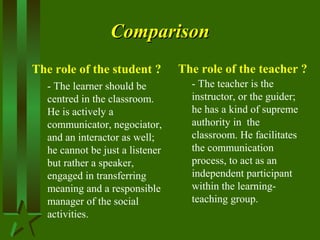
The role of the student ?
- The learner should be
centred in the classroom.
He is actively a
communicator, negociator,
and an interactor as well;
he cannot be just a listener
but rather a speaker,
engaged in transferring
meaning and a responsible
manager of the social
activities.
The role of the teacher ?
- The teacher is the
instructor, or the guider;
he has a kind of supreme
authority in the
classroom. He facilitates
the communication
process, to act as an
independent participant
within the learning-
teaching group.
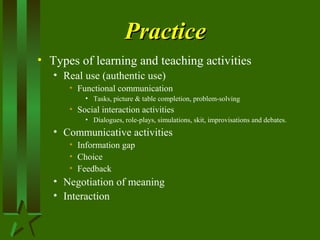
PracticePractice
• Types of learning and teaching activities
• Real use (authentic use)
• Functional communication
• Tasks, picture & table completion, problem-solving
• Social interaction activities
• Dialogues, role-plays, simulations, skit, improvisations and debates.
• Communicative activities
• Information gap
• Choice
• Feedback
• Negotiation of meaning
• Interaction
Classroom activities in CLTClassroom activities in CLT
• Accuracy vs. fluency
• Activity types:
• information gap
• jigsaw
• task-completion
• information-gathering
• opinion-sharing
• information-transfer
• reasoning-gap
• role plays
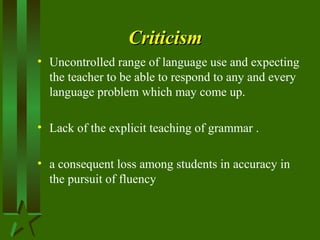
CriticismCriticism
• Uncontrolled range of language use and expecting
the teacher to be able to respond to any and every
language problem which may come up.
• Lack of the explicit teaching of grammar .
• a consequent loss among students in accuracy in
the pursuit of fluency
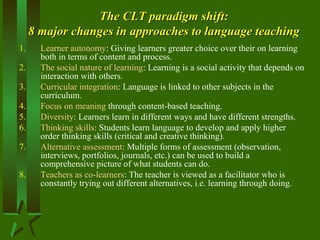
The CLT paradigm shift:The CLT paradigm shift:
8 major changes in approaches to language teaching8 major changes in approaches to language teaching
1. Learner autonomy: Giving learners greater choice over their on learning
both in terms of content and process.
2. The social nature of learning: Learning is a social activity that depends on
interaction with others.
3. Curricular integration: Language is linked to other subjects in the
curriculum.
4. Focus on meaning through content-based teaching.
5. Diversity: Learners learn in different ways and have different strengths.
6. Thinking skills: Students learn language to develop and apply higher
order thinking skills (critical and creative thinking).
7. Alternative assessment: Multiple forms of assessment (observation,
interviews, portfolios, journals, etc.) can be used to build a
comprehensive picture of what students can do.
8. Teachers as co-learners: The teacher is viewed as a facilitator who is
constantly trying out different alternatives, i.e. learning through doing.
ConclusionConclusion
Unlike the traditional methods in learning
language, CLT Approach became successful
and thanks to its contributions on the learners
motivation, they became much more active,
creative, effecive and competent in terms of
fluency and accuracy through enhancing all
the four skills for the learning process.
However in CLT, true communication is the
main concern to achieve the perspective goal
of this Approach.
Thank youThank you
for keepingfor keeping
paTiencepaTience..

Communicative language-teaching

  • 1.
    Peace be uponyou Brothers and Sisters
  • 2.
    The Communicative LanguageTheCommunicative Language Teaching (CLT)Teaching (CLT) • Presented by : - Laggoun Mohamed - Mechattah Mohamed Amine • Supervision by : - Mrs. Hachani
  • 3.
    The layoutThe layout •Introduction • Background • Scholars’ views • Characteristics • Influences • Principales (practice) • Comparison • Practice in classroom • critics • Conclusion
  • 4.
    IntroductionIntroduction What is CLT?What is CLT ? It’s a functional approach applied in 1970s; brought mainly by the British linguists. However, CLT follows an Oral Approach or Situational Language Teaching. It came as a reaction to the cognitivist Approach who considered learning language only as a mental process not broadly communicative.
  • 5.
    BackgroundBackground This approach wasfound in the changes of the British language teaching tradition dating from the late 1960s. A lot of British linguists and American sociolinguists contributed to the formation of the Communicative Approach which aims to make communicative competence (Hymes, 1972) the goal of language teaching and develop procedures for the teaching of the four language skills that enhance the real communication. Communicative competence is what a speaker needs to know in order to be communicatively competent in a speech community.
  • 6.
    Canale and Swain(1998) identify four dimensions of communicative competence: • Grammatical competence- similar to linguistic competence by Chomsky by what is formally possible • Sociolinguistic competence- understanding of the social context in which communication takes place, including role relationships, the shared information of the participants, and the purpose for their interaction
  • 7.
    • Discourse competence-the interpretation of individual message elements in terms of cohesion and coherence (Accuracy and Fluency). • Strategic competence- the coping strategies to initiate, terminate, maintain, repair, and redirect communication
  • 8.
    Scholars’ viewsScholars’ views In Hyme’s view, a person who acquires communicative competence acquires both knowledge and ability for language use. He proposes Communicative competence as an alternative and expansion of linguistic competence. Moreover, he said that when we communicate we need to know: • Formal accuracy • Feasibility • Appropriateness • Contextual entailments (done, actually performed or what it entails)
  • 9.
     Halliday emphasizedfunctions of language: • Instrumental (gettings things and getting things done) • Regulatory (controlling others) • Interactional (interact with others) • Personal (express the self) • Heuristic (to learn, discover) • Imaginative (create imagination) • Representational function (convey meaning)
  • 10.
     Richards andRodgers (1986) described CLT as an approach rather than a method, since it represents a philosophy of teaching that is based on communicative language use. Advocated by many applied linguists, CLT in their views emphasizes notional-functional concepts and communicative competence, rather than grammatical structures, as central to teaching.
  • 11.
    CharacteristicsCharacteristics • Meaning isprimary; contextualization is basic. • Attempts to communicate in TL are encouraged in the beginning of instruction. • Material sequencing is determined by the content, meaning, and function. • L1 is acceptable when feasible. • Activities and strategies for learning are varied. • Communicative competence is the
  • 12.
    InfluencesInfluences • The primaryfunction of language is for interaction and communication. • Language is a system for the expression of meaning. • The activities that truly communicative have features of information gap, choice, and feedback; they must be guided by the teacher for unrehearsed situations. • Authentic materials should be used. • True communication is purposeful. • Activities are better carried out in small groups in which interaction among students are maximized.
  • 13.
    Three principles inpracticeThree principles in practice • Communication, task, meaningfulness principles • The true communication principle: Activities that involve communication promote language learning. • The task principle: Activities that involve the completion of real-world tasks promote learning. • The meaningfulness principle: Learners must be engaged in meaningful and authentic language use for learning to take place.
  • 14.
    ComparisonComparison The role ofthe student ? - The learner should be centred in the classroom. He is actively a communicator, negociator, and an interactor as well; he cannot be just a listener but rather a speaker, engaged in transferring meaning and a responsible manager of the social activities. The role of the teacher ? - The teacher is the instructor, or the guider; he has a kind of supreme authority in the classroom. He facilitates the communication process, to act as an independent participant within the learning- teaching group.
  • 15.
    PracticePractice • Types oflearning and teaching activities • Real use (authentic use) • Functional communication • Tasks, picture & table completion, problem-solving • Social interaction activities • Dialogues, role-plays, simulations, skit, improvisations and debates. • Communicative activities • Information gap • Choice • Feedback • Negotiation of meaning • Interaction
  • 16.
    Classroom activities inCLTClassroom activities in CLT • Accuracy vs. fluency • Activity types: • information gap • jigsaw • task-completion • information-gathering • opinion-sharing • information-transfer • reasoning-gap • role plays
  • 17.
    CriticismCriticism • Uncontrolled rangeof language use and expecting the teacher to be able to respond to any and every language problem which may come up. • Lack of the explicit teaching of grammar . • a consequent loss among students in accuracy in the pursuit of fluency
  • 18.
    The CLT paradigmshift:The CLT paradigm shift: 8 major changes in approaches to language teaching8 major changes in approaches to language teaching 1. Learner autonomy: Giving learners greater choice over their on learning both in terms of content and process. 2. The social nature of learning: Learning is a social activity that depends on interaction with others. 3. Curricular integration: Language is linked to other subjects in the curriculum. 4. Focus on meaning through content-based teaching. 5. Diversity: Learners learn in different ways and have different strengths. 6. Thinking skills: Students learn language to develop and apply higher order thinking skills (critical and creative thinking). 7. Alternative assessment: Multiple forms of assessment (observation, interviews, portfolios, journals, etc.) can be used to build a comprehensive picture of what students can do. 8. Teachers as co-learners: The teacher is viewed as a facilitator who is constantly trying out different alternatives, i.e. learning through doing.
  • 19.
    ConclusionConclusion Unlike the traditionalmethods in learning language, CLT Approach became successful and thanks to its contributions on the learners motivation, they became much more active, creative, effecive and competent in terms of fluency and accuracy through enhancing all the four skills for the learning process. However in CLT, true communication is the main concern to achieve the perspective goal of this Approach.
  • 20.
    Thank youThank you forkeepingfor keeping paTiencepaTience..