Animals used for medical research By: Merci Cueva M.
Research animals provide scientists with complex living systems consisting of cells, tissues and organs.  Animal models can interact and react to stimulus, giving researchers a picture of a compound moving through a living system and an idea of how that stimulus might react in a human. 
Animals are biologically similar to humans in many ways and they are vulnerable to over 200 of the same health problems.  This makes them an effective model for researchers to study.  The majority of research animals are used in experiments focused on disease treatment and prevention, and the treatment of injuries.  Laboratory animals are also used in basic medical research, breeding other research animals and diagnosis. 
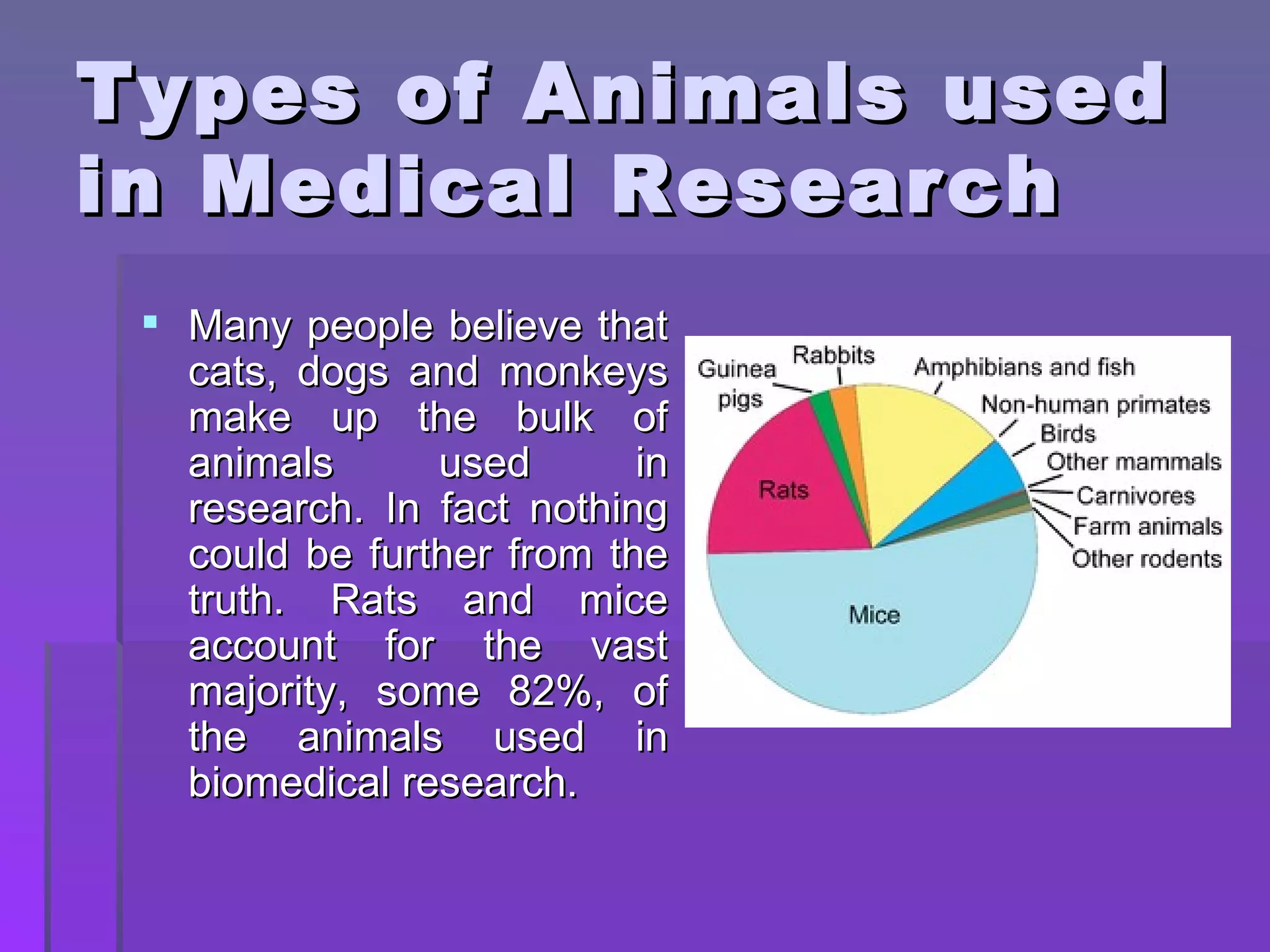
Types of Animals used in Medical Research Many people believe that cats, dogs and monkeys make up the bulk of animals used in research. In fact nothing could be further from the truth. Rats and mice account for the vast majority, some 82%, of the animals used in biomedical research.
Numbers of Animals used for medical research The number of animals used annually in medical research has halved over the last 20 years It is estimated that 50 to 100 million  vertebrate  animals worldwide — from  zebrafish  to  non-human primates  — are used annually.
Pain and suffering In 2006 about 670,000 animals (not including rats, mice, birds, or invertebrates) were used in procedures that did not include more than momentary pain or distress. About 420,000 were used in procedures in which pain or distress was relieved by anaesthesia, while 84,000 were used in studies that would cause pain or distress that would not be relieved.

Animals Used For Medical Research

  • 1.
    Animals used formedical research By: Merci Cueva M.
  • 2.
    Research animals providescientists with complex living systems consisting of cells, tissues and organs.  Animal models can interact and react to stimulus, giving researchers a picture of a compound moving through a living system and an idea of how that stimulus might react in a human. 
  • 3.
    Animals are biologicallysimilar to humans in many ways and they are vulnerable to over 200 of the same health problems.  This makes them an effective model for researchers to study. The majority of research animals are used in experiments focused on disease treatment and prevention, and the treatment of injuries.  Laboratory animals are also used in basic medical research, breeding other research animals and diagnosis. 
  • 4.
    Types of Animalsused in Medical Research Many people believe that cats, dogs and monkeys make up the bulk of animals used in research. In fact nothing could be further from the truth. Rats and mice account for the vast majority, some 82%, of the animals used in biomedical research.
  • 5.
    Numbers of Animalsused for medical research The number of animals used annually in medical research has halved over the last 20 years It is estimated that 50 to 100 million vertebrate animals worldwide — from zebrafish to non-human primates — are used annually.
  • 6.
    Pain and sufferingIn 2006 about 670,000 animals (not including rats, mice, birds, or invertebrates) were used in procedures that did not include more than momentary pain or distress. About 420,000 were used in procedures in which pain or distress was relieved by anaesthesia, while 84,000 were used in studies that would cause pain or distress that would not be relieved.