Dr. Layth Mahmoud Alkattan
Types of animals were used
 Wide groups of lab animals were used in research
 Rodents and rabbits jointly made up 82.2 %of the
total number of animals used.
 In this group, mice and rats accounted for most of
the animals, comprising 59.4%.
 Cold-blooded organisms – which in this case
generally refers to fish, amphibians, and reptiles).
 The third-most common animals used were birds
Preparations for anesthesia
 Good pre-operative care will reduce the incidence
of many of the complications that can occur during
anesthesia, and thorough preparation of facilities
and equipment contributes to the smooth running
of a research protocol.
 It is important to consider preparation of not
only the animals to be anaesthetized but also
the equipment, drugs, facilities and personnel
involved in the procedure.
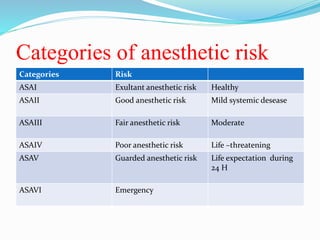
Categories of anesthetic risk
Categories Risk
ASAΙ Exultant anesthetic risk Healthy
ASAΙΙ Good anesthetic risk Mild systemic desease
ASAΙΙΙ Fair anesthetic risk Moderate
ASAΙV Poor anesthetic risk Life –threatening
ASAV Guarded anesthetic risk Life expectation during
24 H
ASAVΙ Emergency
Effects of anesthesia on the physiological processes
 Anesthesia has profound effects on the physiological
processes of animals, and this can have a marked
effect on experimental data.
 These effects can arise as a direct result of the
anesthetic agents used, for example, hyperglycemia
caused by medetomidine.
 Other effects such as hypothermia may be secondary
to the depression of various body systems.
 Some effects persist only during the period of
anesthesia, other effects may continue for hours or
 Sometimes, the effects of a poor choice of
anesthetic agent can be dramatic, for example, ileus
(gut stasis) after administration of chloral hydrate.
 More usually, the effects are less obvious, but
 even subtle changes can result in an increase in the
variability of study data.
 This increased variability can require an increased
number of animals to be used to demonstrate
treatment effects
Fasting
 Pre-anesthetic fasting is usually not necessary
for rats due to their inability to vomit.
 However, if fasting is employed limit to no more than
two to three hours due to the high metabolic rate of
small rodents.
Dose
 In general, smaller animals have higher metabolic rates and
 frequently require higher doses of anesthetics and analgesics at
more frequent intervals to achieve the desired effect.
 Species, strain and age differences often overshadow this
 general principle however.
 It is always best to start with a drug regimen developed in the sp
ecies, age and strain with which the Principal Investigator is
 working, rather than extrapolate from one species or strain to an
other.
Requirements for injectable anesthesia
 Plastic disposable syringes are almost universally used for
delivering anesthetics.
 These single-use syringes should not be resterilized for
further use.
 Ensure that an appropriate-volume syringe is used so that the
required dose of anesthetic can be administered accurately.
 The syringes designed for insulin administration to human
patients are particularly useful for administering small doses
of drugs to rodents
 Avoid using syringes which have been stored for a
length of time which exceeds the period
 recommended by the manufacturers, as the plastic
may have become brittle and can fracture during use.
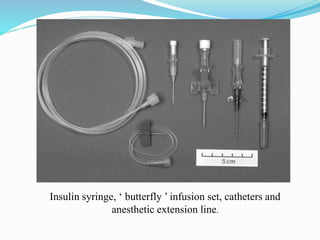
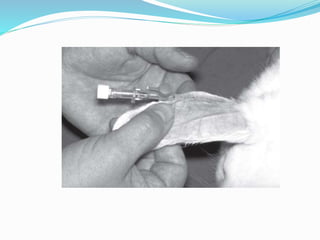
Insulin syringe, ‘ butterfly ’ infusion set, catheters and
anesthetic extension line.
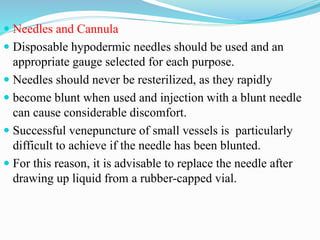
 Needles and Cannula
 Disposable hypodermic needles should be used and an
appropriate gauge selected for each purpose.
 Needles should never be resterilized, as they rapidly
 become blunt when used and injection with a blunt needle
can cause considerable discomfort.
 Successful venepuncture of small vessels is particularly
difficult to achieve if the needle has been blunted.
 For this reason, it is advisable to replace the needle after
drawing up liquid from a rubber-capped vial.
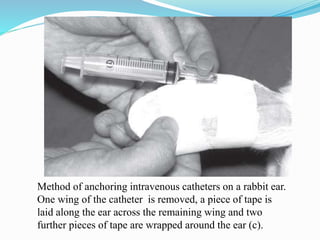
Method of anchoring intravenous catheters on a rabbit ear.
One wing of the catheter is removed, a piece of tape is
laid along the ear across the remaining wing and two
further pieces of tape are wrapped around the ear (c).
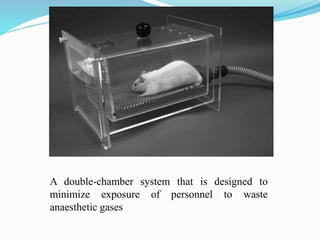
A double-chamber system that is designed to
minimize exposure of personnel to waste
anaesthetic gases
 Inhalant anesthetic :
 Anesthetic ether is now difficult to obtain, although the
agent can still be purchased from specialist suppliers.
 Induction of and recovery from anesthesia are
 relatively slow.
 This is advantageous for inexperienced anesthetists, as it
makes accidental overdose less likely.
 Conversely, a prolonged induction period can
 present problems in restraining the animal, particularly as
most animals strongly resent inhaling the vapor.
 Administration of ether stimulates catecholamine
release
Monitoring
 Monitoring of general anesthesia becomes more
difficult
 when the patient size is reduced.
 The laboratory animal veterinarian is uniquely tasked
with conducting anesthesia in a wide variety of
species, most of which are small.
 The nature of their small body size makes routine
techniques used to monitor anesthesia (i.e., manual
pulse, observations of respiratory effort, etc.) difficult.
 Minimum monitoring should include
 ◦ Heart rate/rhythm and pulse pressure
 ◦ Respiratory rate and pattern
 ◦ CRT/mucous membrane color
 ◦ Temperature
 ◦ Blood loss
 ◦ Anesthetic record
 Monitoring anesthesia includes:
 1. Assessing the animal’s responsiveness to painful
stimuli,
 2. Character of respiration, and color of the ears, tail,
mucous membranes, or foot pads, and adjusting
anesthetic depth as needed.
 Pedal withdrawal reflex (toe pinch) is recommended
for assuring adequate depth of anesthesia prior to first
incision and as a repeated check throughout the
procedure.
 Rectal temperature and heart rate should be
monitored electronically during long or involved
procedures.

Lab animals anesthesia

  • 1.
  • 2.
    Types of animalswere used  Wide groups of lab animals were used in research  Rodents and rabbits jointly made up 82.2 %of the total number of animals used.  In this group, mice and rats accounted for most of the animals, comprising 59.4%.  Cold-blooded organisms – which in this case generally refers to fish, amphibians, and reptiles).  The third-most common animals used were birds
  • 4.
    Preparations for anesthesia Good pre-operative care will reduce the incidence of many of the complications that can occur during anesthesia, and thorough preparation of facilities and equipment contributes to the smooth running of a research protocol.
  • 5.
     It isimportant to consider preparation of not only the animals to be anaesthetized but also the equipment, drugs, facilities and personnel involved in the procedure.
  • 6.
    Categories of anestheticrisk Categories Risk ASAΙ Exultant anesthetic risk Healthy ASAΙΙ Good anesthetic risk Mild systemic desease ASAΙΙΙ Fair anesthetic risk Moderate ASAΙV Poor anesthetic risk Life –threatening ASAV Guarded anesthetic risk Life expectation during 24 H ASAVΙ Emergency
  • 7.
    Effects of anesthesiaon the physiological processes  Anesthesia has profound effects on the physiological processes of animals, and this can have a marked effect on experimental data.  These effects can arise as a direct result of the anesthetic agents used, for example, hyperglycemia caused by medetomidine.  Other effects such as hypothermia may be secondary to the depression of various body systems.  Some effects persist only during the period of anesthesia, other effects may continue for hours or
  • 8.
     Sometimes, theeffects of a poor choice of anesthetic agent can be dramatic, for example, ileus (gut stasis) after administration of chloral hydrate.  More usually, the effects are less obvious, but  even subtle changes can result in an increase in the variability of study data.  This increased variability can require an increased number of animals to be used to demonstrate treatment effects
  • 9.
    Fasting  Pre-anesthetic fastingis usually not necessary for rats due to their inability to vomit.  However, if fasting is employed limit to no more than two to three hours due to the high metabolic rate of small rodents.
  • 10.
    Dose  In general,smaller animals have higher metabolic rates and  frequently require higher doses of anesthetics and analgesics at more frequent intervals to achieve the desired effect.  Species, strain and age differences often overshadow this  general principle however.  It is always best to start with a drug regimen developed in the sp ecies, age and strain with which the Principal Investigator is  working, rather than extrapolate from one species or strain to an other.
  • 11.
    Requirements for injectableanesthesia  Plastic disposable syringes are almost universally used for delivering anesthetics.  These single-use syringes should not be resterilized for further use.  Ensure that an appropriate-volume syringe is used so that the required dose of anesthetic can be administered accurately.  The syringes designed for insulin administration to human patients are particularly useful for administering small doses of drugs to rodents
  • 12.
     Avoid usingsyringes which have been stored for a length of time which exceeds the period  recommended by the manufacturers, as the plastic may have become brittle and can fracture during use.
  • 13.
    Insulin syringe, ‘butterfly ’ infusion set, catheters and anesthetic extension line.
  • 14.
     Needles andCannula  Disposable hypodermic needles should be used and an appropriate gauge selected for each purpose.  Needles should never be resterilized, as they rapidly  become blunt when used and injection with a blunt needle can cause considerable discomfort.  Successful venepuncture of small vessels is particularly difficult to achieve if the needle has been blunted.  For this reason, it is advisable to replace the needle after drawing up liquid from a rubber-capped vial.
  • 16.
    Method of anchoringintravenous catheters on a rabbit ear. One wing of the catheter is removed, a piece of tape is laid along the ear across the remaining wing and two further pieces of tape are wrapped around the ear (c).
  • 17.
    A double-chamber systemthat is designed to minimize exposure of personnel to waste anaesthetic gases
  • 18.
     Inhalant anesthetic:  Anesthetic ether is now difficult to obtain, although the agent can still be purchased from specialist suppliers.  Induction of and recovery from anesthesia are  relatively slow.  This is advantageous for inexperienced anesthetists, as it makes accidental overdose less likely.  Conversely, a prolonged induction period can  present problems in restraining the animal, particularly as most animals strongly resent inhaling the vapor.
  • 19.
     Administration ofether stimulates catecholamine release
  • 20.
    Monitoring  Monitoring ofgeneral anesthesia becomes more difficult  when the patient size is reduced.  The laboratory animal veterinarian is uniquely tasked with conducting anesthesia in a wide variety of species, most of which are small.  The nature of their small body size makes routine techniques used to monitor anesthesia (i.e., manual pulse, observations of respiratory effort, etc.) difficult.
  • 21.
     Minimum monitoringshould include  ◦ Heart rate/rhythm and pulse pressure  ◦ Respiratory rate and pattern  ◦ CRT/mucous membrane color  ◦ Temperature  ◦ Blood loss  ◦ Anesthetic record
  • 22.
     Monitoring anesthesiaincludes:  1. Assessing the animal’s responsiveness to painful stimuli,  2. Character of respiration, and color of the ears, tail, mucous membranes, or foot pads, and adjusting anesthetic depth as needed.  Pedal withdrawal reflex (toe pinch) is recommended for assuring adequate depth of anesthesia prior to first incision and as a repeated check throughout the procedure.  Rectal temperature and heart rate should be monitored electronically during long or involved procedures.