Edward B. Rastetter, Ruth Yanai, R. Quinn Thomas,
Matt Vadeboncoeur, Tim Fahey, Melany Fisk,
Bonnie Kwiatkowski, and Steven Hamburg
Hubbard Brook Annual Meeting
July 2014
Recovery from disturbance requires
resynchronization of ecosystem
nutrient cycles
Ecological Applications 23: 621-642. 2013
C
H2O
N
P
Plants
Soil
Organic
Matter
Soil
Solution
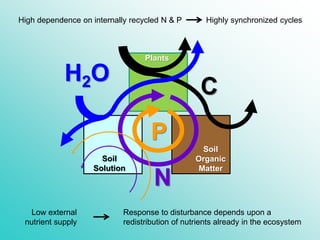
High dependence on internally recycled N & P Highly synchronized cycles
Low external
nutrient supply
Response to disturbance depends upon a
redistribution of nutrients already in the ecosystem
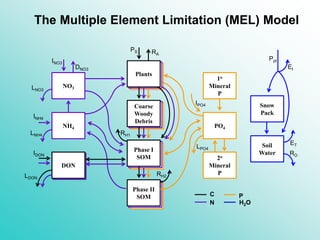
The Multiple Element Limitation (MEL) Model
Plants
Coarse
Woody
Debris
Phase I
SOM
Phase II
SOM
PO4
2o
Mineral
P
1o
Mineral
P
NH4
DON
NO3
PS RA
RH1
RH2
LNH4
LDON
LNO3
LPO4
INO3
INH4
IDON
IPO4
DNO3
C
N
P
Snow
Pack
Soil
Water
Ppt
RO
ET
EI
H2O
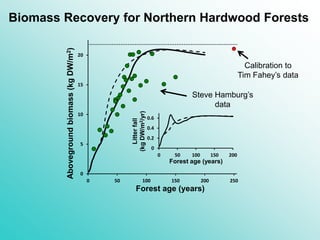
Biomass Recovery for Northern Hardwood Forests
Steve Hamburg’s
data
0
5
10
15
20
25
0 50 100 150 200 250
Bole only harvest
Series8
Series9
Constant turnover
Series3
Abovegroundbiomass(kgDW/m2)
Forest age (years)
Forest age (years)
Litterfall
(kgDW/m2/yr)
0
0.2
0.4
0.6
0 50 100 150 200
Calibration to
Tim Fahey’s data
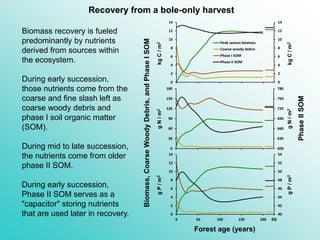
Biomass recovery is fueled
predominantly by nutrients
derived from sources within
the ecosystem.
During early succession,
Phase II SOM serves as a
"capacitor" storing nutrients
that are used later in recovery.
During mid to late succession,
the nutrients come from older
phase II SOM.
During early succession,
those nutrients come from the
coarse and fine slash left as
coarse woody debris and
phase I soil organic matter
(SOM).
0
2
4
6
8
10
12
14
0
2
4
6
8
10
12
14
0 50 100 150 200
Peak season biomass
Coarse woody debris
Phase I SOM
Phase II SOM
40
42
44
46
48
50
52
54
0
2
4
6
8
10
12
14
0 50 100 150 200
600
630
660
690
720
750
780
0
30
60
90
120
150
180
0 50 100 150 200
kgC/m2gN/m2gP/m2
kgC/m2gN/m2gP/m2
Biomass,CoarseWoodyDebris,andPhaseISOM
PhaseIISOM
Forest age (years)
SS
Recovery from a bole-only harvest
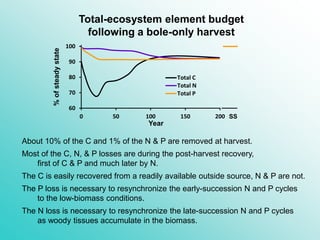
Total-ecosystem element budget
following a bole-only harvest
The N loss is necessary to resynchronize the late-succession N and P cycles
as woody tissues accumulate in the biomass.
About 10% of the C and 1% of the N & P are removed at harvest.
Most of the C, N, & P losses are during the post-harvest recovery,
first of C & P and much later by N.
The C is easily recovered from a readily available outside source, N & P are not.
The P loss is necessary to resynchronize the early-succession N and P cycles
to the low-biomass conditions.
60
70
80
90
100
0 50 100 150 200
Total C
Total N
Total P
%ofsteadystate
Year
SS
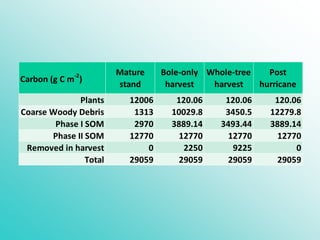
Carbon (g C m-2
)
Mature
stand
Bole-only
harvest
Whole-tree
harvest
Post
hurricane
Plants 12006 120.06 120.06 120.06
Coarse Woody Debris 1313 10029.8 3450.5 12279.8
Phase I SOM 2970 3889.14 3493.44 3889.14
Phase II SOM 12770 12770 12770 12770
Removed in harvest 0 2250 9225 0
Total 29059 29059 29059 29059
0
2
4
6
8
10
12
14
0 50 100 150 200
Whole tree harvest
Bole only harvest
Hurricane blowdown
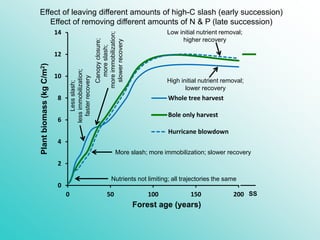
Effect of leaving different amounts of high-C slash (early succession)
Effect of removing different amounts of N & P (late succession)
Plantbiomass(kgC/m2)
Forest age (years)
SS
Lessslash;
lessimmobilization;
fasterrecovery
Canopyclosure;
moreslash;
moreimmobilization;
slowerrecovery
More slash; more immobilization; slower recovery
High initial nutrient removal;
lower recovery
Low initial nutrient removal;
higher recovery
Nutrients not limiting; all trajectories the same
4) If those resources lost early in succession cannot be recovered quickly
enough, then the loss of the other resources might be necessary to
reestablish the synchronization among resource cycles late in succession.
3) Even disturbances that result in only small losses of resource capital can
disrupt the synchronization among resource cycles and thereby cause
the loss of some resources early in succession.
1) Many mineral resources are tightly cycled within ecosystems and have
only small exchanges with external sources and sinks. This tight
recycling means that the resource cycles have to be synchronized.
Conclusions
2) Because of changes in allometry and stoichiometry, the element cycles
synchronize to different relative cycling rates ad different times in
succession
C
H2O
N
P
Plants
Soil
Organic
Matter
Soil
Solution 0
2
4
6
8
10
12
14
0 50 100 150 200
Whole tree harvest
Bole only harvest
Hurricane blowdown
Plantbiomass(kgC/m2) Forest age (years)
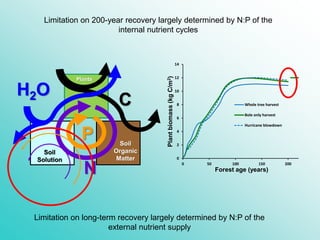
Limitation on 200-year recovery largely determined by N:P of the
internal nutrient cycles
Limitation on long-term recovery largely determined by N:P of the
external nutrient supply

Shoestring2014 2-recovery

  • 1.
    Edward B. Rastetter,Ruth Yanai, R. Quinn Thomas, Matt Vadeboncoeur, Tim Fahey, Melany Fisk, Bonnie Kwiatkowski, and Steven Hamburg Hubbard Brook Annual Meeting July 2014 Recovery from disturbance requires resynchronization of ecosystem nutrient cycles Ecological Applications 23: 621-642. 2013
  • 2.
    C H2O N P Plants Soil Organic Matter Soil Solution High dependence oninternally recycled N & P Highly synchronized cycles Low external nutrient supply Response to disturbance depends upon a redistribution of nutrients already in the ecosystem
  • 3.
    The Multiple ElementLimitation (MEL) Model Plants Coarse Woody Debris Phase I SOM Phase II SOM PO4 2o Mineral P 1o Mineral P NH4 DON NO3 PS RA RH1 RH2 LNH4 LDON LNO3 LPO4 INO3 INH4 IDON IPO4 DNO3 C N P Snow Pack Soil Water Ppt RO ET EI H2O
  • 4.
    Biomass Recovery forNorthern Hardwood Forests Steve Hamburg’s data 0 5 10 15 20 25 0 50 100 150 200 250 Bole only harvest Series8 Series9 Constant turnover Series3 Abovegroundbiomass(kgDW/m2) Forest age (years) Forest age (years) Litterfall (kgDW/m2/yr) 0 0.2 0.4 0.6 0 50 100 150 200 Calibration to Tim Fahey’s data
  • 5.
    Biomass recovery isfueled predominantly by nutrients derived from sources within the ecosystem. During early succession, Phase II SOM serves as a "capacitor" storing nutrients that are used later in recovery. During mid to late succession, the nutrients come from older phase II SOM. During early succession, those nutrients come from the coarse and fine slash left as coarse woody debris and phase I soil organic matter (SOM). 0 2 4 6 8 10 12 14 0 2 4 6 8 10 12 14 0 50 100 150 200 Peak season biomass Coarse woody debris Phase I SOM Phase II SOM 40 42 44 46 48 50 52 54 0 2 4 6 8 10 12 14 0 50 100 150 200 600 630 660 690 720 750 780 0 30 60 90 120 150 180 0 50 100 150 200 kgC/m2gN/m2gP/m2 kgC/m2gN/m2gP/m2 Biomass,CoarseWoodyDebris,andPhaseISOM PhaseIISOM Forest age (years) SS Recovery from a bole-only harvest
  • 6.
    Total-ecosystem element budget followinga bole-only harvest The N loss is necessary to resynchronize the late-succession N and P cycles as woody tissues accumulate in the biomass. About 10% of the C and 1% of the N & P are removed at harvest. Most of the C, N, & P losses are during the post-harvest recovery, first of C & P and much later by N. The C is easily recovered from a readily available outside source, N & P are not. The P loss is necessary to resynchronize the early-succession N and P cycles to the low-biomass conditions. 60 70 80 90 100 0 50 100 150 200 Total C Total N Total P %ofsteadystate Year SS
  • 7.
    Carbon (g Cm-2 ) Mature stand Bole-only harvest Whole-tree harvest Post hurricane Plants 12006 120.06 120.06 120.06 Coarse Woody Debris 1313 10029.8 3450.5 12279.8 Phase I SOM 2970 3889.14 3493.44 3889.14 Phase II SOM 12770 12770 12770 12770 Removed in harvest 0 2250 9225 0 Total 29059 29059 29059 29059
  • 8.
    0 2 4 6 8 10 12 14 0 50 100150 200 Whole tree harvest Bole only harvest Hurricane blowdown Effect of leaving different amounts of high-C slash (early succession) Effect of removing different amounts of N & P (late succession) Plantbiomass(kgC/m2) Forest age (years) SS Lessslash; lessimmobilization; fasterrecovery Canopyclosure; moreslash; moreimmobilization; slowerrecovery More slash; more immobilization; slower recovery High initial nutrient removal; lower recovery Low initial nutrient removal; higher recovery Nutrients not limiting; all trajectories the same
  • 9.
    4) If thoseresources lost early in succession cannot be recovered quickly enough, then the loss of the other resources might be necessary to reestablish the synchronization among resource cycles late in succession. 3) Even disturbances that result in only small losses of resource capital can disrupt the synchronization among resource cycles and thereby cause the loss of some resources early in succession. 1) Many mineral resources are tightly cycled within ecosystems and have only small exchanges with external sources and sinks. This tight recycling means that the resource cycles have to be synchronized. Conclusions 2) Because of changes in allometry and stoichiometry, the element cycles synchronize to different relative cycling rates ad different times in succession
  • 10.
    C H2O N P Plants Soil Organic Matter Soil Solution 0 2 4 6 8 10 12 14 0 50100 150 200 Whole tree harvest Bole only harvest Hurricane blowdown Plantbiomass(kgC/m2) Forest age (years) Limitation on 200-year recovery largely determined by N:P of the internal nutrient cycles Limitation on long-term recovery largely determined by N:P of the external nutrient supply