2.6 Coppice system
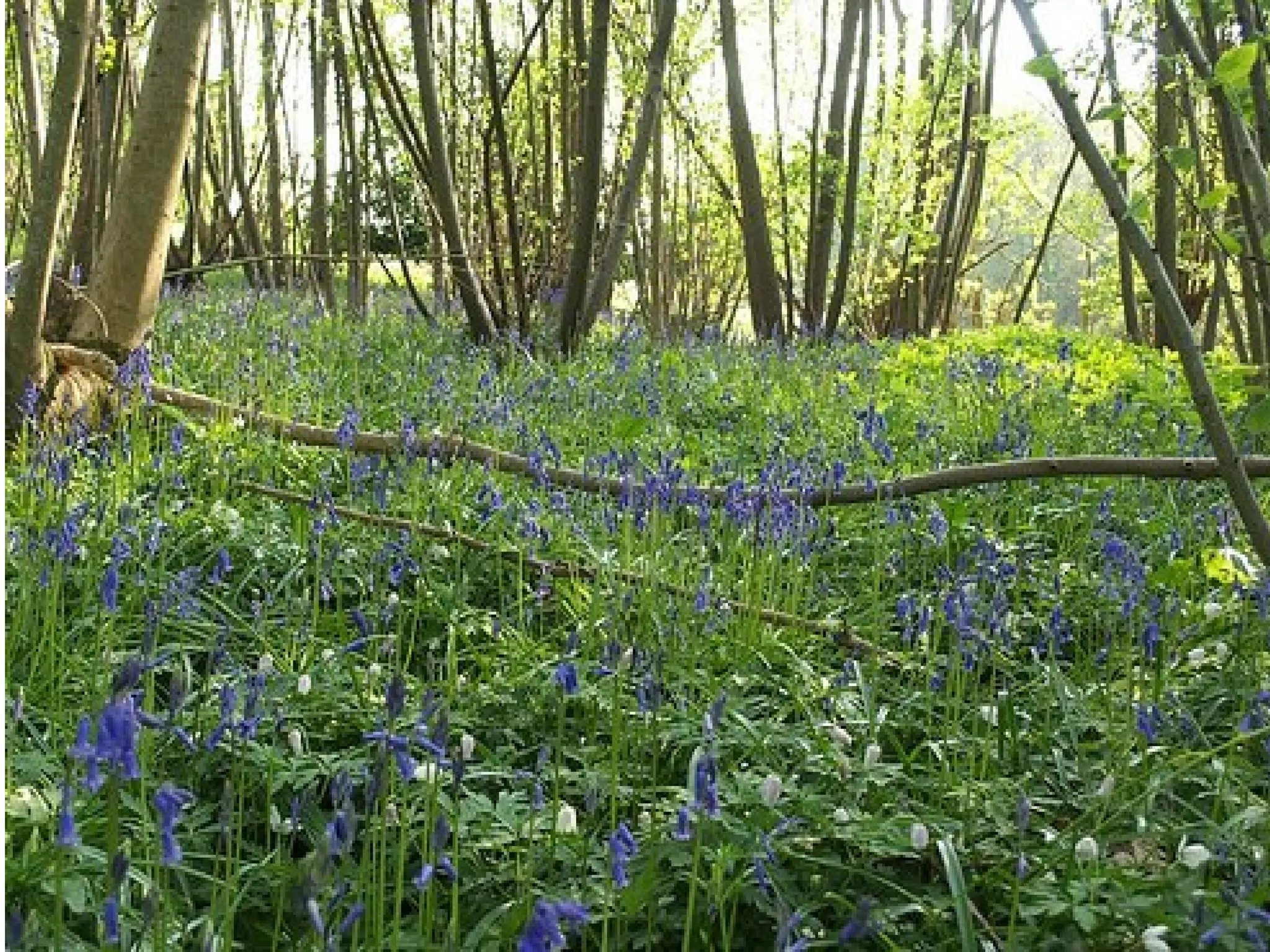
A silvicultural systems in which the
new crop originates mainly from
stool coppice
The rotation of the coppice is short
Limited to hardwood species
Also called low forest system
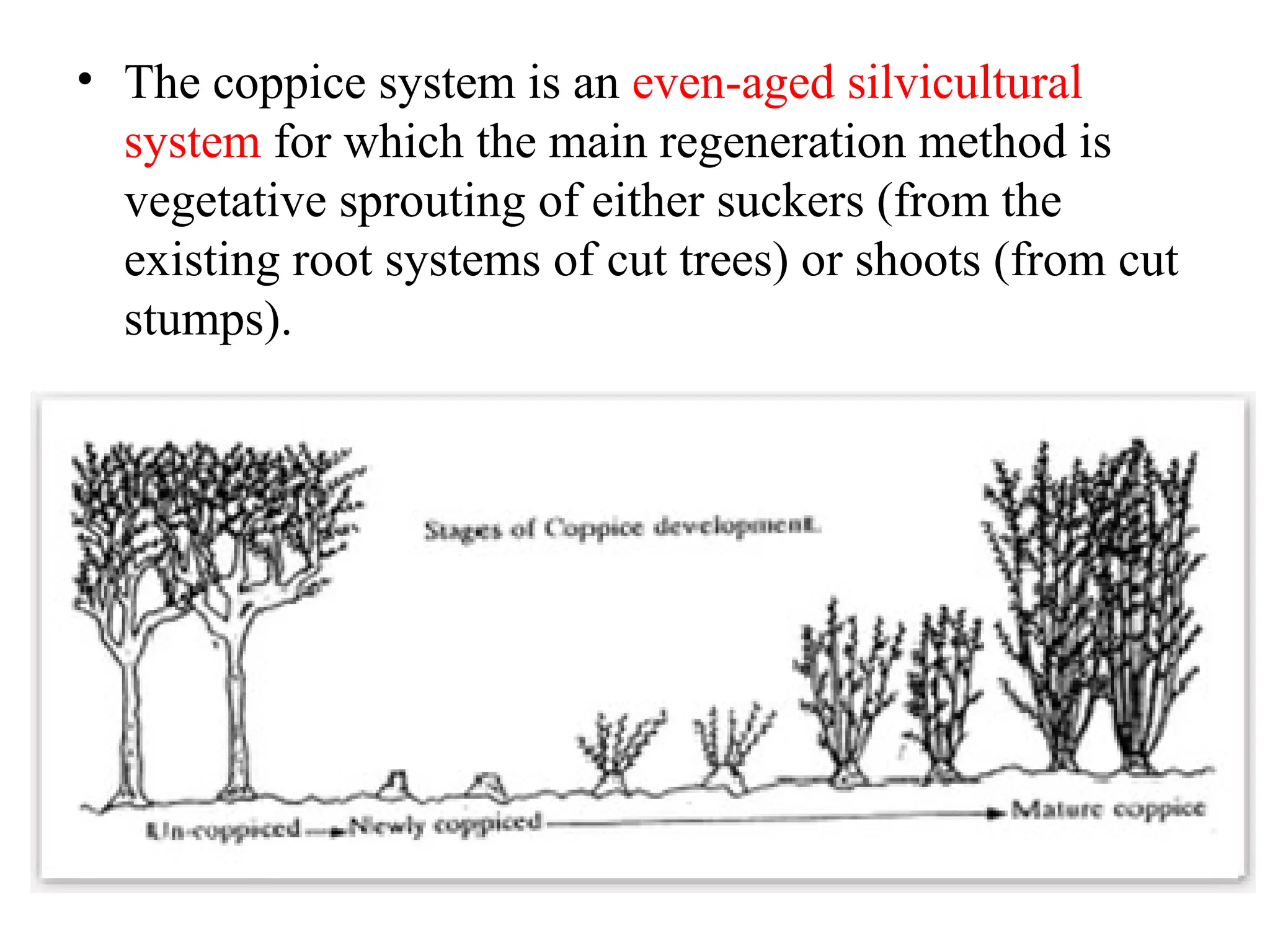
• The coppice system is an even-aged silvicultural
system for which the main regeneration method is
vegetative sprouting of either suckers (from the
existing root systems of cut trees) or shoots (from cut
stumps).
Method of Coppicing
• Best season for coppicing: little before the growth
starts in spring.
• Large working area: felling is allowed over a period
of dormancy, i.e. from November to March but not
later from March and before November.
• The stumps ht: usually 5 to 25 cm
Types of coppice system
1. Simple coppice system
2. Coppice with standard system
3. Coppice with reserve system
4. Coppice of two rotation system
5. Shelter wood coppice system
Simple coppice system
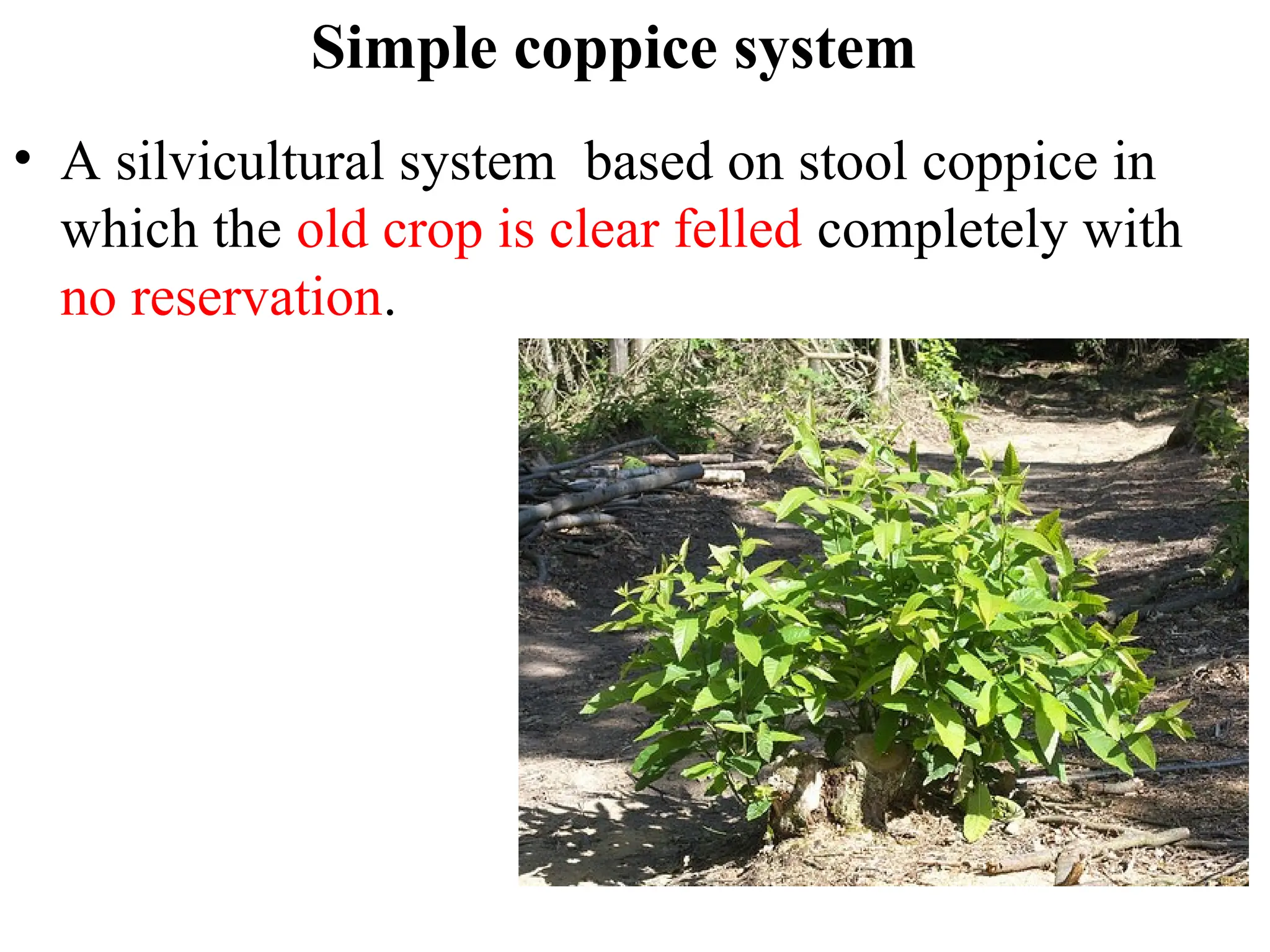
• A silvicultural system based on stool coppice in
which the old crop is clear felled completely with
no reservation.
Method of felling:
• The stump should neither be too low/high.
• The lower the stump, the better it is for coppice
shoot.
• But if the trees are cut very low there is a danger
of the stump splitting and or drying up from top.
• On the other hand, the higher the stumps, the
greater the possibility of shoots being damaged
by wind or animals.
• Stumps are usually kept, 15-25 cm high. (10 cm
for eucalyptus)
Precaution during felling
• Stump should not split during felling trees.
• The bark should not get detach from the wood.
• Stump should slope slightly in one direction.
Tending
• Cleaning is done to remove climbers and inferior
sp. and to reduce the no. of shoots to two or three.
• Thinning if necessary is carried out in fifth year
and the no. of shoot is reduced to one/stool.
Advantage:
• The system is very simple and does not require any
skill in making.
• As coppice shoot grow faster in the beginning the
cost of weeding, cleaning and protection is much
less than in case of reproduction by seed.
• The net returns on investment are relatively higher
primarily due to short rotation and less investment.
• Although it is shortsighted system but very
suitable for producing fuel wood and small sized
timber to fulfill the immediate need of the society.
Disadvantage:
• This system is not permanent because the
trees cannot keep on coppicing indefinitely.
• The coppice crop is liable to great damage
by frost and wind.
• This is not a very desirable system from
aesthetic point of view.
• Risk of site deterioration (Soil erosion, weed
invasion etc.)
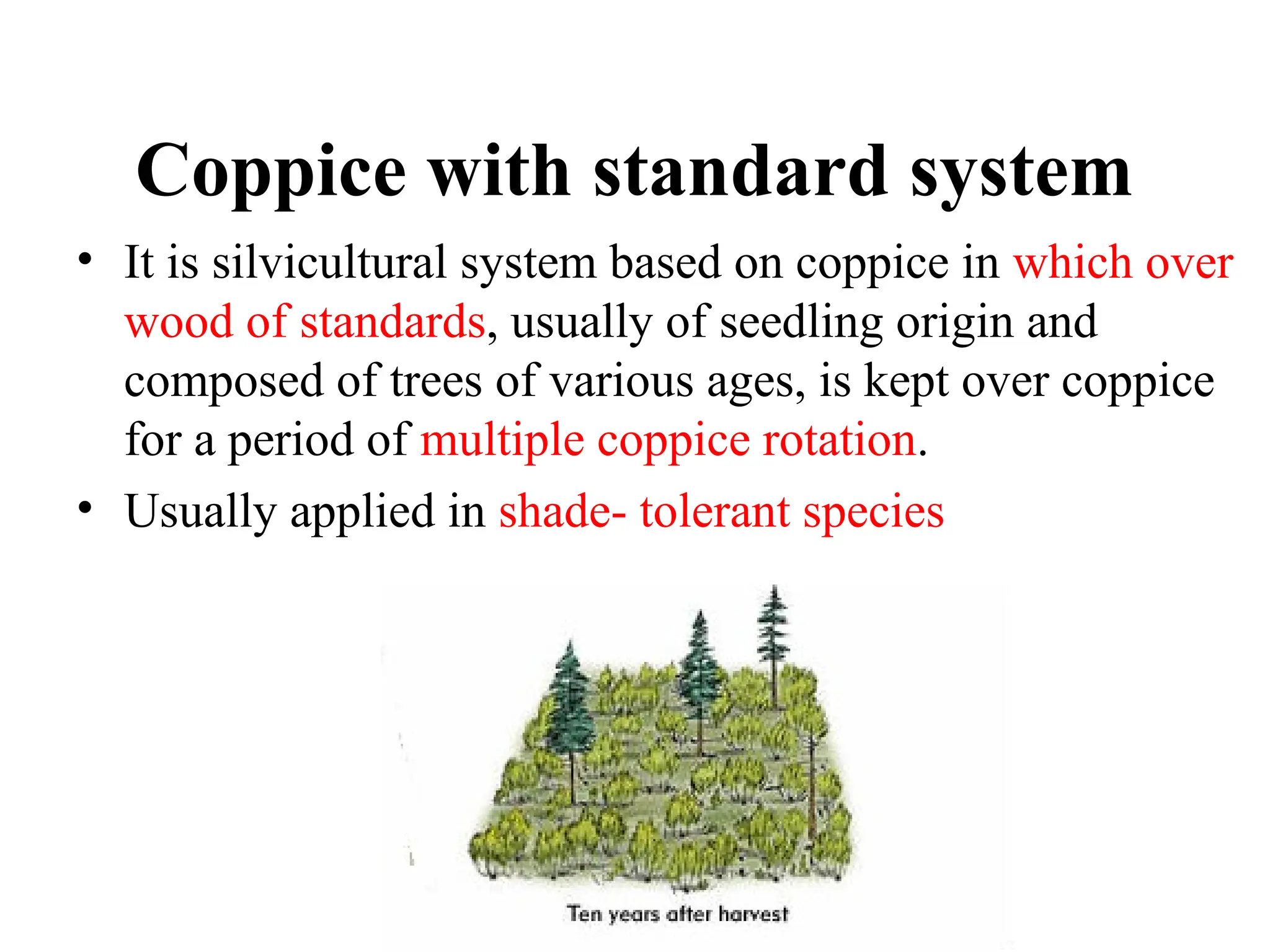
Coppice with standard system
• It is silvicultural system based on coppice in which over
wood of standards, usually of seedling origin and
composed of trees of various ages, is kept over coppice
for a period of multiple coppice rotation.
• Usually applied in shade- tolerant species
Purpose of standards
• Supply of large size timber
• Protection against frost
• Enrichment of coppice
• To provide seedling regeneration
• Increase in revenue
Advantage:
• There is greater protection to the soil.
• Standards serve as seed bearers and provide seed.
• The investment is small and the net return is
higher.
• Aesthetically superior than simple coppice
Disadvantage:
• It requires great skill in maintaining correct
balance between standards and coppice and
between standards of different age classes.
• Felling and extraction cost is higher than
high forest system.
Coppice with Reserve system
• A silvicultural system in which felling is done only in
suitable areas after reserving all financially immature
growth.
• Reservation by areas:
Eroded area
Strips of land along streams.
Around springs, wells, worship
Dense pole crop
• Reservation by species:
Edible or commercial fruit
Important minor forest produce
Industrial timber
Advantage:
• It helps in improving the quality of locality as a result of soil
and moisture conservation, maintenance of crop mixture.
• It helps in improving the condition and composition of crop.
• It fulfills the needs of local population and the requirement
of industries.
• It avoids the sacrifice of financially immature crop whose
value increases. Thus it offers best financial returns per unit
area.
Disadvantage:
• Its execution requires a high degree of skill.
• Reservation of a large number of trees
affects coppice growth adversely
Other variation in coppice system
The coppice of two rotation system
• At the end of the first rotation, a few selected
poles are left scattered singly over the coupe
in the second rotation to attain bigger size
The shelter wood coppice system
Modification of simple coppice system for
frosty localities by leaving shelter trees.
Application
• Some best species for coppicing are: Shorea
robusta, Acacia catechu, Schima walichii,
Syzigium cumini, Litsea monopetala, Dalbergia ,
Albizia , Eucalyptus , Castanopsis , quercus etc
• Very simple in application, suitable for
private or village common lands, Near
settlements
• Reproduction is usually cheaper in
comparision to seed
Application
• The yield from the first coppice crop is
higher than that of the original
seedling crop of the same age
• In the earlier stages, coppice growth is
more rapid, and the poles produced are
straighter and cleaner than in the same
species when raised from seed
Application in Nepal and their findings
• Research plots on Silvicultural systems were
established at Butwal in 1988. It was found
simple coppice is potentially the best one to
produce fuel and fodder from tropical Sal forest
in short rotation
• Sagarnath and Nepalgunj Forest Development
Project appied simple coppice system on
Eucalyptus and sisoo plantations
At Tarahara: Two plots of Cassia siamea and
Eucalyptus camaldulensis on simple coppice
system were established in 1990. The result
showed both the species are good for fuel wood
production. cassia siamea is rather better than E.
camaldulensis
Application .......

Coppice system , methods, types, purposes

  • 3.
    2.6 Coppice system Asilvicultural systems in which the new crop originates mainly from stool coppice The rotation of the coppice is short Limited to hardwood species Also called low forest system
  • 4.
    • The coppicesystem is an even-aged silvicultural system for which the main regeneration method is vegetative sprouting of either suckers (from the existing root systems of cut trees) or shoots (from cut stumps).
  • 5.
    Method of Coppicing •Best season for coppicing: little before the growth starts in spring. • Large working area: felling is allowed over a period of dormancy, i.e. from November to March but not later from March and before November. • The stumps ht: usually 5 to 25 cm
  • 6.
    Types of coppicesystem 1. Simple coppice system 2. Coppice with standard system 3. Coppice with reserve system 4. Coppice of two rotation system 5. Shelter wood coppice system
  • 7.
    Simple coppice system •A silvicultural system based on stool coppice in which the old crop is clear felled completely with no reservation.
  • 8.
    Method of felling: •The stump should neither be too low/high. • The lower the stump, the better it is for coppice shoot. • But if the trees are cut very low there is a danger of the stump splitting and or drying up from top. • On the other hand, the higher the stumps, the greater the possibility of shoots being damaged by wind or animals. • Stumps are usually kept, 15-25 cm high. (10 cm for eucalyptus)
  • 9.
    Precaution during felling •Stump should not split during felling trees. • The bark should not get detach from the wood. • Stump should slope slightly in one direction. Tending • Cleaning is done to remove climbers and inferior sp. and to reduce the no. of shoots to two or three. • Thinning if necessary is carried out in fifth year and the no. of shoot is reduced to one/stool.
  • 10.
    Advantage: • The systemis very simple and does not require any skill in making. • As coppice shoot grow faster in the beginning the cost of weeding, cleaning and protection is much less than in case of reproduction by seed. • The net returns on investment are relatively higher primarily due to short rotation and less investment. • Although it is shortsighted system but very suitable for producing fuel wood and small sized timber to fulfill the immediate need of the society.
  • 11.
    Disadvantage: • This systemis not permanent because the trees cannot keep on coppicing indefinitely. • The coppice crop is liable to great damage by frost and wind. • This is not a very desirable system from aesthetic point of view. • Risk of site deterioration (Soil erosion, weed invasion etc.)
  • 12.
    Coppice with standardsystem • It is silvicultural system based on coppice in which over wood of standards, usually of seedling origin and composed of trees of various ages, is kept over coppice for a period of multiple coppice rotation. • Usually applied in shade- tolerant species
  • 13.
    Purpose of standards •Supply of large size timber • Protection against frost • Enrichment of coppice • To provide seedling regeneration • Increase in revenue
  • 14.
    Advantage: • There isgreater protection to the soil. • Standards serve as seed bearers and provide seed. • The investment is small and the net return is higher. • Aesthetically superior than simple coppice
  • 15.
    Disadvantage: • It requiresgreat skill in maintaining correct balance between standards and coppice and between standards of different age classes. • Felling and extraction cost is higher than high forest system.
  • 16.
    Coppice with Reservesystem • A silvicultural system in which felling is done only in suitable areas after reserving all financially immature growth. • Reservation by areas: Eroded area Strips of land along streams. Around springs, wells, worship Dense pole crop • Reservation by species: Edible or commercial fruit Important minor forest produce Industrial timber
  • 17.
    Advantage: • It helpsin improving the quality of locality as a result of soil and moisture conservation, maintenance of crop mixture. • It helps in improving the condition and composition of crop. • It fulfills the needs of local population and the requirement of industries. • It avoids the sacrifice of financially immature crop whose value increases. Thus it offers best financial returns per unit area.
  • 18.
    Disadvantage: • Its executionrequires a high degree of skill. • Reservation of a large number of trees affects coppice growth adversely
  • 19.
    Other variation incoppice system The coppice of two rotation system • At the end of the first rotation, a few selected poles are left scattered singly over the coupe in the second rotation to attain bigger size The shelter wood coppice system Modification of simple coppice system for frosty localities by leaving shelter trees.
  • 20.
    Application • Some bestspecies for coppicing are: Shorea robusta, Acacia catechu, Schima walichii, Syzigium cumini, Litsea monopetala, Dalbergia , Albizia , Eucalyptus , Castanopsis , quercus etc • Very simple in application, suitable for private or village common lands, Near settlements • Reproduction is usually cheaper in comparision to seed
  • 21.
    Application • The yieldfrom the first coppice crop is higher than that of the original seedling crop of the same age • In the earlier stages, coppice growth is more rapid, and the poles produced are straighter and cleaner than in the same species when raised from seed
  • 22.
    Application in Nepaland their findings • Research plots on Silvicultural systems were established at Butwal in 1988. It was found simple coppice is potentially the best one to produce fuel and fodder from tropical Sal forest in short rotation • Sagarnath and Nepalgunj Forest Development Project appied simple coppice system on Eucalyptus and sisoo plantations
  • 23.
    At Tarahara: Twoplots of Cassia siamea and Eucalyptus camaldulensis on simple coppice system were established in 1990. The result showed both the species are good for fuel wood production. cassia siamea is rather better than E. camaldulensis Application .......