Endodontic SurgeryEndodontic Surgery
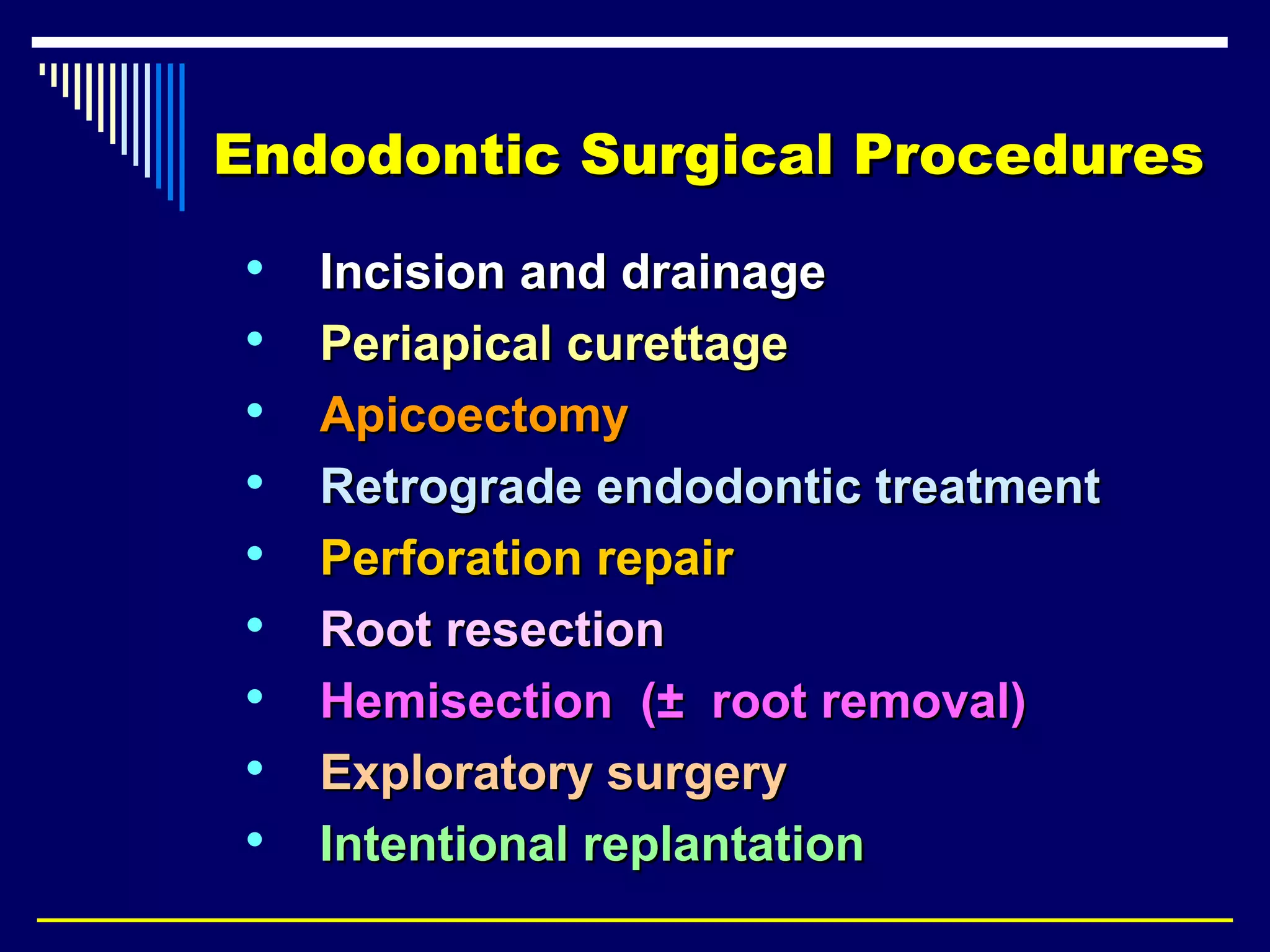
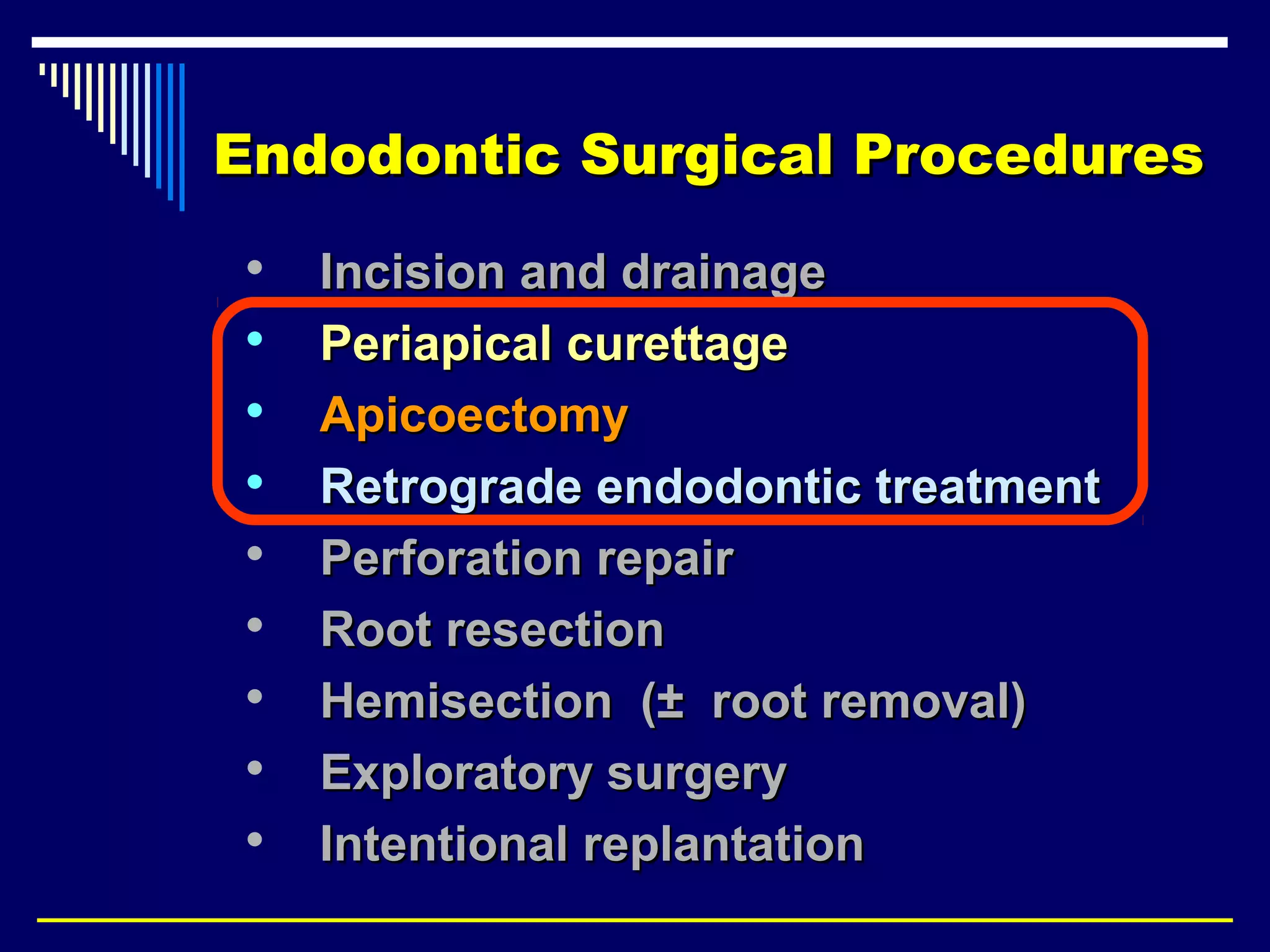
Endodontic Surgical ProceduresEndodontic Surgical Procedures

Incision and drainageIncision and drainage

Periapical curettagePeriapical curettage

ApicoectomyApicoectomy

Retrograde endodontic treatmentRetrograde endodontic treatment

Perforation repairPerforation repair

Root resectionRoot resection

Hemisection (± root removal)Hemisection (± root removal)

Exploratory surgeryExploratory surgery

Intentional replantationIntentional replantation
Endodontic Surgical ProceduresEndodontic Surgical Procedures

Incision and drainageIncision and drainage

Periapical curettagePeriapical curettage

ApicoectomyApicoectomy

Retrograde endodontic treatmentRetrograde endodontic treatment

Perforation repairPerforation repair

Root resectionRoot resection

Hemisection (± root removal)Hemisection (± root removal)

Exploratory surgeryExploratory surgery

Intentional replantationIntentional replantation
Possible Indications forPossible Indications for
Periapical SurgeryPeriapical Surgery
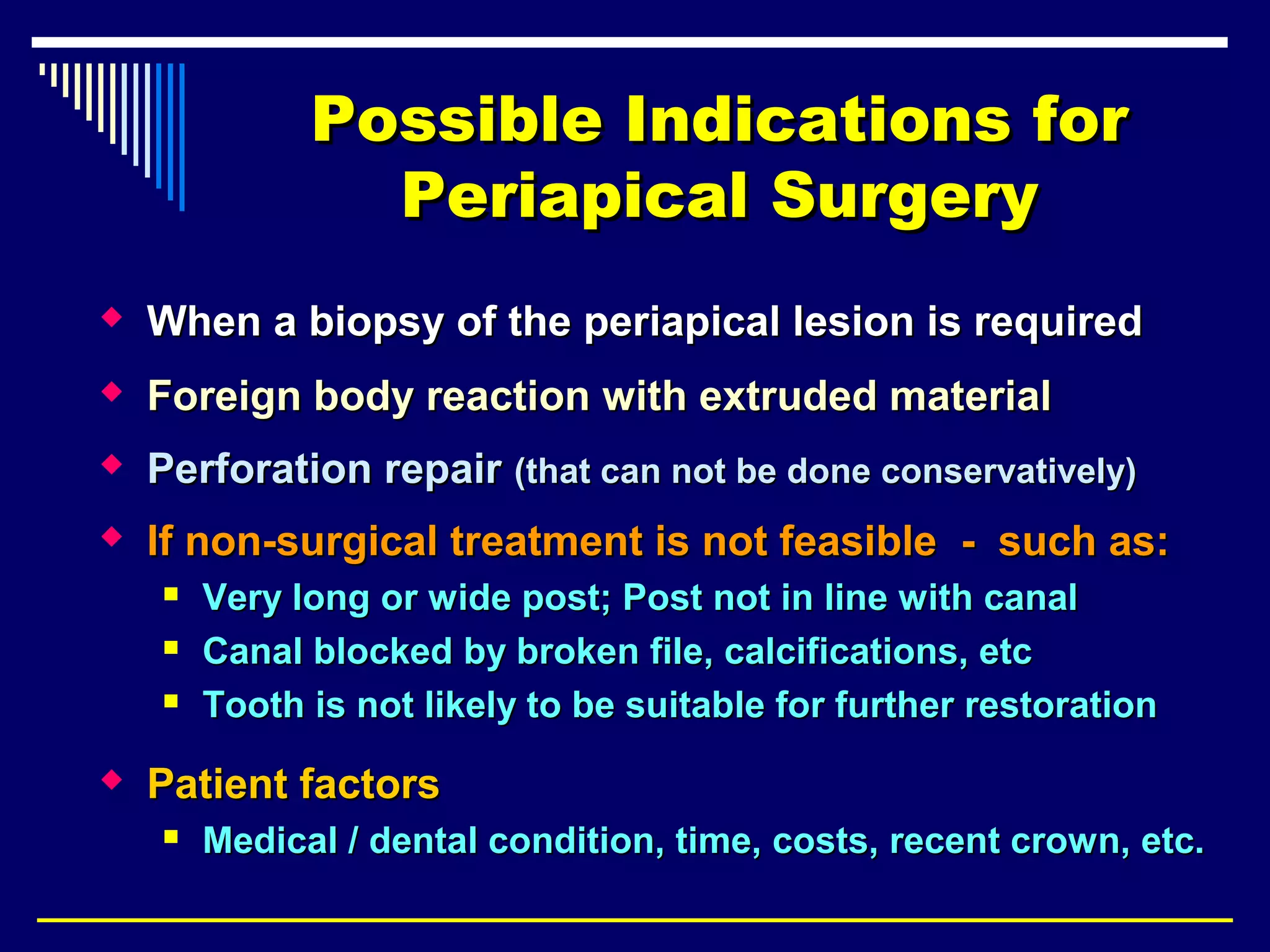
 When a biopsy of the periapical lesion is requiredWhen a biopsy of the periapical lesion is required
Possible Indications forPossible Indications for
Periapical SurgeryPeriapical Surgery
 When a biopsy of the periapical lesion is requiredWhen a biopsy of the periapical lesion is required
 Foreign body reaction with extruded materialForeign body reaction with extruded material
Possible Indications forPossible Indications for
Periapical SurgeryPeriapical Surgery
 When a biopsy of the periapical lesion is requiredWhen a biopsy of the periapical lesion is required
 Foreign body reaction with extruded materialForeign body reaction with extruded material
 Perforation repairPerforation repair (that can not be done conservatively)(that can not be done conservatively)
Possible Indications forPossible Indications for
Periapical SurgeryPeriapical Surgery
 When a biopsy of the periapical lesion is requiredWhen a biopsy of the periapical lesion is required
 Foreign body reaction with extruded materialForeign body reaction with extruded material
 Perforation repairPerforation repair (that can not be done conservatively)(that can not be done conservatively)
 If non-surgical treatment is not feasible - such as:If non-surgical treatment is not feasible - such as:
 Very long or wide post; Post not in line with canalVery long or wide post; Post not in line with canal
 Canal blocked by broken file, calcifications, etcCanal blocked by broken file, calcifications, etc
 Tooth is not likely to be suitable for further restorationTooth is not likely to be suitable for further restoration
Possible Indications forPossible Indications for
Periapical SurgeryPeriapical Surgery
 When a biopsy of the periapical lesion is requiredWhen a biopsy of the periapical lesion is required
 Foreign body reaction with extruded materialForeign body reaction with extruded material
 Perforation repairPerforation repair (that can not be done conservatively)(that can not be done conservatively)
 If non-surgical treatment is not feasible - such as:If non-surgical treatment is not feasible - such as:
 Very long or wide post; Post not in line with canalVery long or wide post; Post not in line with canal
 Canal blocked by broken file, calcifications, etcCanal blocked by broken file, calcifications, etc
 Tooth is not likely to be suitable for further restorationTooth is not likely to be suitable for further restoration
 Patient factorsPatient factors
 Medical / dental condition, time, costs, recent crown, etc.Medical / dental condition, time, costs, recent crown, etc.
Periapical SurgeryPeriapical Surgery
ConsiderationsConsiderations
 Psychological aspectsPsychological aspects
 Patients are reluctant to have any form of surgeryPatients are reluctant to have any form of surgery
Periapical SurgeryPeriapical Surgery
ConsiderationsConsiderations
 Psychological aspectsPsychological aspects
 Patients are reluctant to have any form of surgeryPatients are reluctant to have any form of surgery
 Non-surgical endodontics has a higher success rateNon-surgical endodontics has a higher success rate
 GrungGrung et alet al - 28% higher success if non-surgical- 28% higher success if non-surgical
re-treatment was done prior to surgeryre-treatment was done prior to surgery
Periapical SurgeryPeriapical Surgery
ConsiderationsConsiderations
 Psychological aspectsPsychological aspects
 Patients are reluctant to have any form of surgeryPatients are reluctant to have any form of surgery
 Non-surgical endodontics has a higher success rateNon-surgical endodontics has a higher success rate
 GrungGrung et alet al - 28% higher success if non-surgical- 28% higher success if non-surgical
re-treatment was done prior to surgeryre-treatment was done prior to surgery
 Surgery is a “one visit” techniqueSurgery is a “one visit” technique
 Can not disinfect the canal with irrigants and/or medicamentsCan not disinfect the canal with irrigants and/or medicaments
Periapical SurgeryPeriapical Surgery
ConsiderationsConsiderations
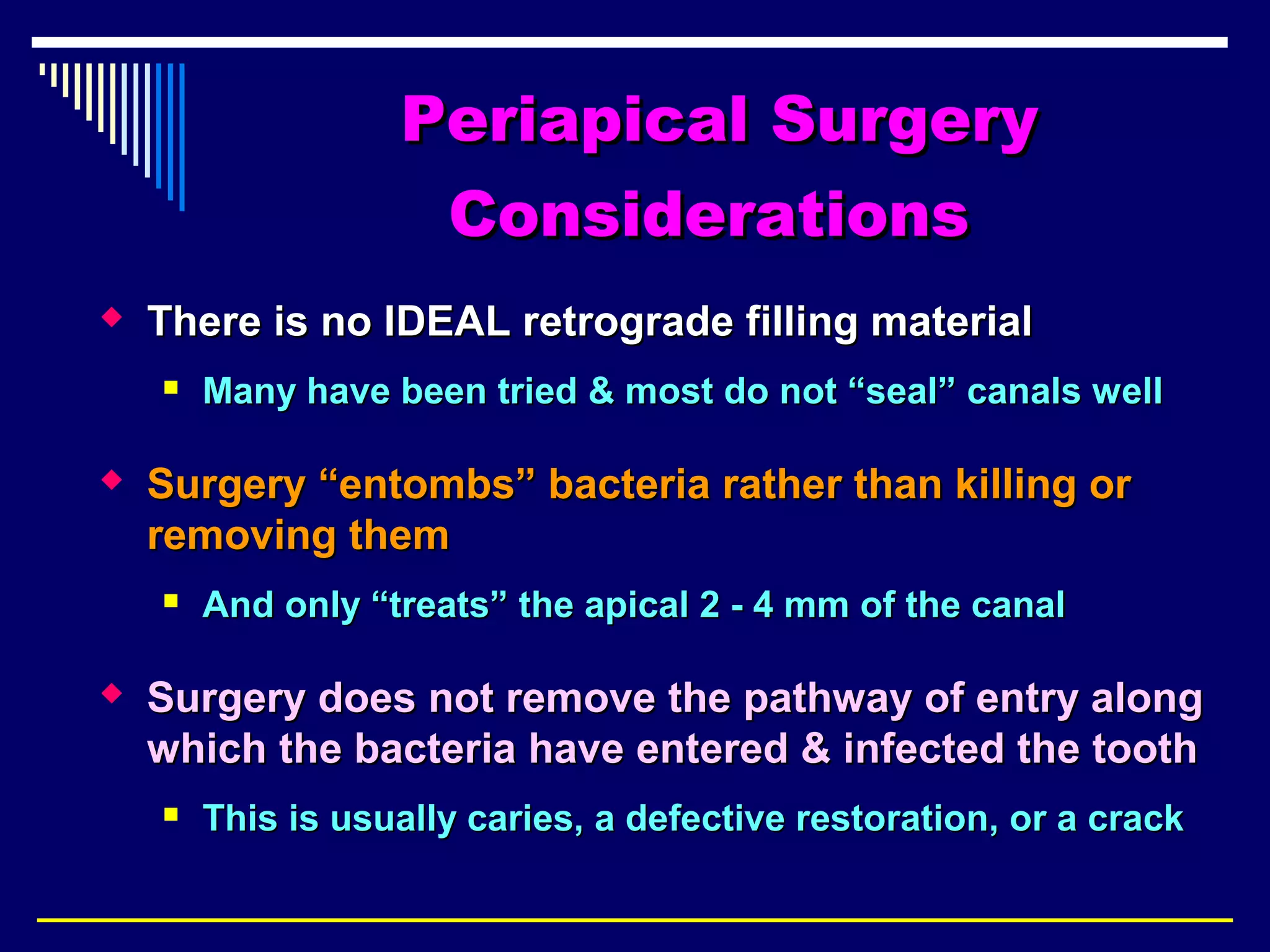
 There is no IDEAL retrograde filling materialThere is no IDEAL retrograde filling material
 Many have been tried & most do not “seal” canals wellMany have been tried & most do not “seal” canals well
Periapical SurgeryPeriapical Surgery
ConsiderationsConsiderations
 There is no IDEAL retrograde filling materialThere is no IDEAL retrograde filling material
 Many have been tried & most do not “seal” canals wellMany have been tried & most do not “seal” canals well
 Surgery “entombs” bacteria rather than killing orSurgery “entombs” bacteria rather than killing or
removing themremoving them
 And only “treats” the apical 2 - 4 mm of the canalAnd only “treats” the apical 2 - 4 mm of the canal
Periapical SurgeryPeriapical Surgery
ConsiderationsConsiderations
 There is no IDEAL retrograde filling materialThere is no IDEAL retrograde filling material
 Many have been tried & most do not “seal” canals wellMany have been tried & most do not “seal” canals well
 Surgery “entombs” bacteria rather than killing orSurgery “entombs” bacteria rather than killing or
removing themremoving them
 And only “treats” the apical 2 - 4 mm of the canalAnd only “treats” the apical 2 - 4 mm of the canal
 Surgery does not remove the pathway of entry alongSurgery does not remove the pathway of entry along
which the bacteria have entered & infected the toothwhich the bacteria have entered & infected the tooth
 This is usually caries, a defective restoration, or a crackThis is usually caries, a defective restoration, or a crack
Periapical SurgeryPeriapical Surgery
ConsiderationsConsiderations
 Over-extended root filling materialsOver-extended root filling materials
 Will not always cause a foreign body reactionWill not always cause a foreign body reaction
 Hence, always watch and reassess over timeHence, always watch and reassess over time
Periapical SurgeryPeriapical Surgery
ConsiderationsConsiderations
 Over-extended root filling materialsOver-extended root filling materials
 Will not always cause a foreign body reactionWill not always cause a foreign body reaction
 Hence, always watch and reassess over timeHence, always watch and reassess over time
 Large, well-defined radiolucenciesLarge, well-defined radiolucencies
 Are not always cysts as often thought by many dentistsAre not always cysts as often thought by many dentists
 Can be any form of periapical pathosisCan be any form of periapical pathosis
 Size and borders indicate time & speed of developmentSize and borders indicate time & speed of development
Periapical SurgeryPeriapical Surgery
ConsiderationsConsiderations
 Potential post-operative sequelaePotential post-operative sequelae
 Swelling and bruisingSwelling and bruising
 InfectionInfection
 Pain / discomfortPain / discomfort
 Anaesthesia / ParaesthesiaAnaesthesia / Paraesthesia
 Tissue discolourationTissue discolouration
 ScarringScarring
 Gingival recessionGingival recession
 Loss of interdental papillaLoss of interdental papilla
 Altered aestheticsAltered aesthetics
Possible Indications forPossible Indications for
Periapical SurgeryPeriapical Surgery
 ““It must be recognised that few trueIt must be recognised that few true
indications exist for the endodonticindications exist for the endodontic
surgical approach”surgical approach”
 Gutman JL.Gutman JL. Surgical EndodonticsSurgical Endodontics 1991: 501991: 50
Endodontic SurgeryEndodontic Surgery
Endodontic Surgery - StagesEndodontic Surgery - Stages
a)a) Consultation, Diagnosis, Treatment PlanConsultation, Diagnosis, Treatment Plan
b)b) Local AnaesthesiaLocal Anaesthesia
c)c) Periosteal FlapPeriosteal Flap
d)d) CurettageCurettage
e)e) ApicoectomyApicoectomy
f)f) Retrograde Endodontic TreatmentRetrograde Endodontic Treatment
 Apical Bevel, Canal Preparation, Root FillingApical Bevel, Canal Preparation, Root Filling
a)a) Wound Closure - suturesWound Closure - sutures
b)b) Post-operative InstructionsPost-operative Instructions
c)c) Follow-up & ReviewFollow-up & Review
Endodontic SurgeryEndodontic Surgery
But first – some general principlesBut first – some general principles
Flap DesignsFlap Designs
 Semi-LunarSemi-Lunar
 Gingival crestGingival crest
 TriangularTriangular
 TrapezoidalTrapezoidal
 GingivalGingival
 Luebke-OschenbeinLuebke-Oschenbein
Semi-Lunar FlapSemi-Lunar Flap
 In the mucobuccal fold and attached gingivaIn the mucobuccal fold and attached gingiva
Semi-Lunar FlapSemi-Lunar Flap
 In the mucobuccal fold and attached gingivaIn the mucobuccal fold and attached gingiva
 Poor accessPoor access
 Incision often over the lesionIncision often over the lesion
 Difficult moisture controlDifficult moisture control (haemorrhage)(haemorrhage)
 Difficult to repositionDifficult to reposition
 Uncomfortable during healingUncomfortable during healing
 Leaves scarsLeaves scars
Semi-Lunar FlapSemi-Lunar Flap
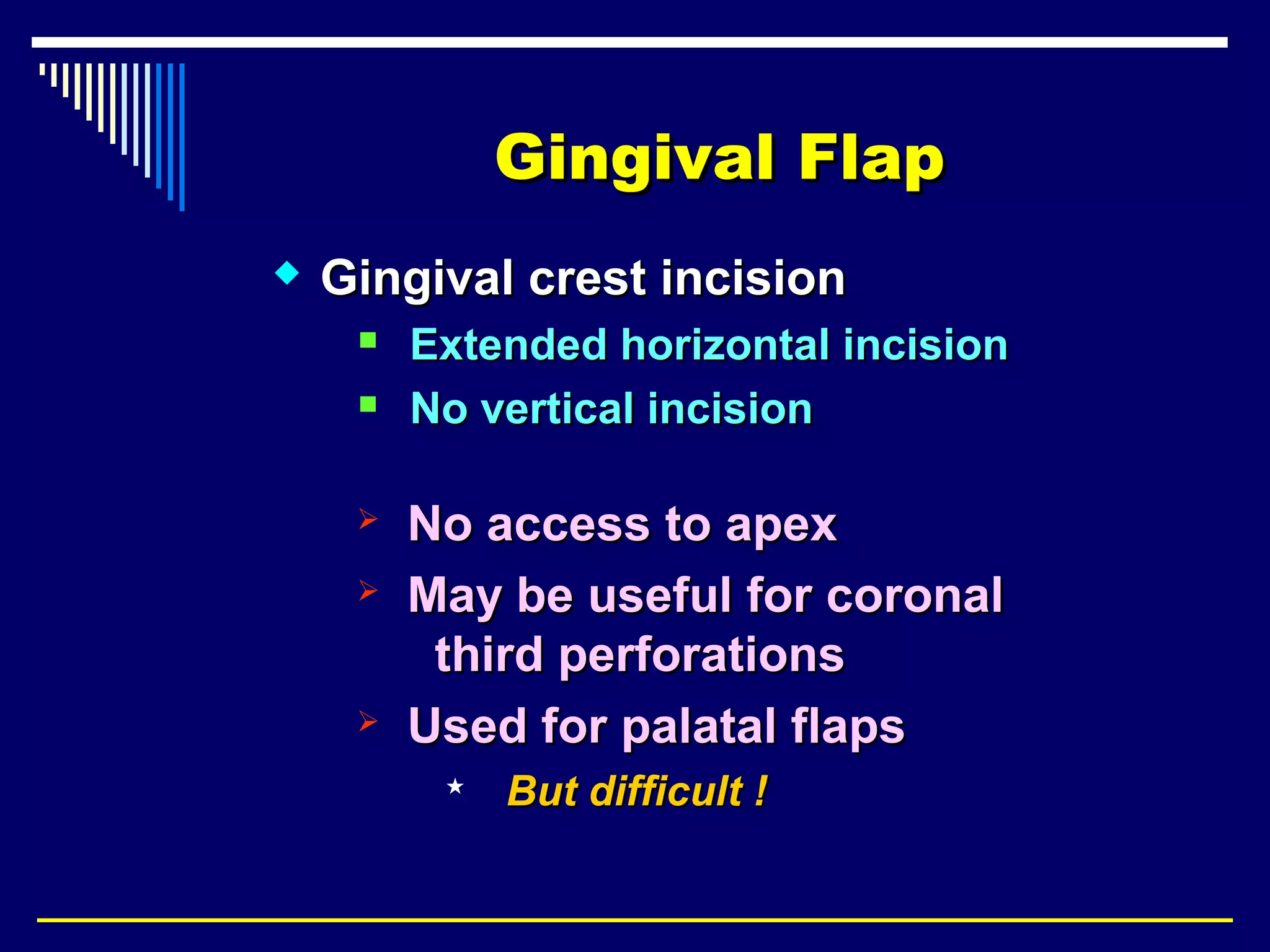
Gingival FlapGingival Flap
 Gingival crest incisionGingival crest incision
 Extended horizontal incisionExtended horizontal incision
 No vertical incisionNo vertical incision
 No access to apexNo access to apex
 May be useful for coronalMay be useful for coronal
third perforationsthird perforations
 Used for palatal flapsUsed for palatal flaps
 But difficult !But difficult !
Gingival FlapGingival Flap
 Gingival crest incisionGingival crest incision
 Extended horizontal incisionExtended horizontal incision
 No vertical incisionNo vertical incision
Gingival FlapGingival Flap
 Horizontal incision in the gingival sulcusHorizontal incision in the gingival sulcus
 One vertical incisionOne vertical incision
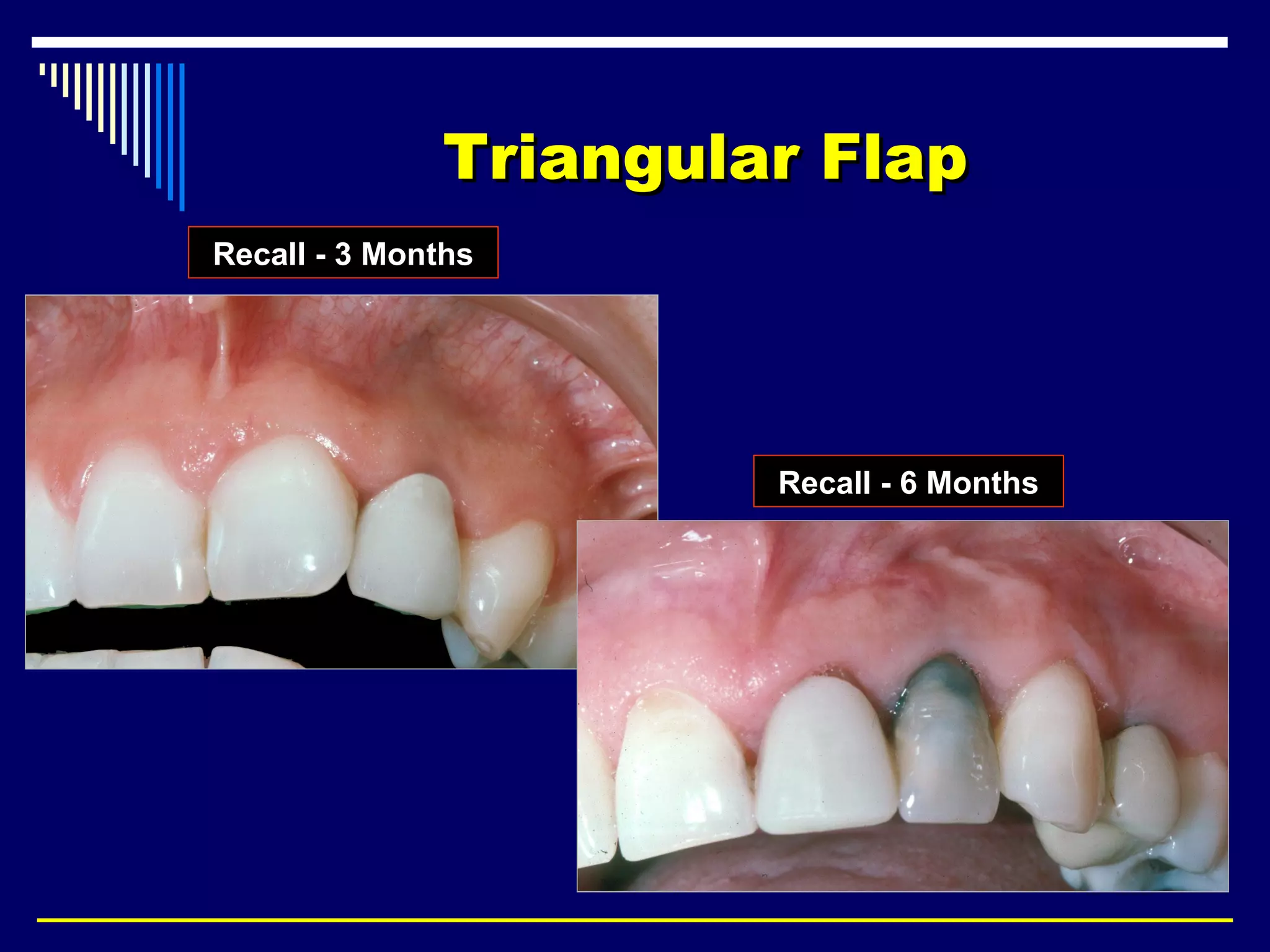
Triangular FlapTriangular Flap
 Horizontal incision in the gingival sulcusHorizontal incision in the gingival sulcus
 One vertical incisionOne vertical incision
 ““First choice” flap for endodontic surgeryFirst choice” flap for endodontic surgery
 Good accessGood access
 Good visionGood vision
 Good moisture controlGood moisture control
 Heals without scarsHeals without scars
 Easy to repositionEasy to reposition
Triangular FlapTriangular Flap
Recall - 6 Months
Triangular FlapTriangular Flap
Recall - 3 Months
Triangular FlapTriangular Flap
Recall - 6 Months
 Horizontal incision in the gingival sulcusHorizontal incision in the gingival sulcus
 Two vertical incisionsTwo vertical incisions
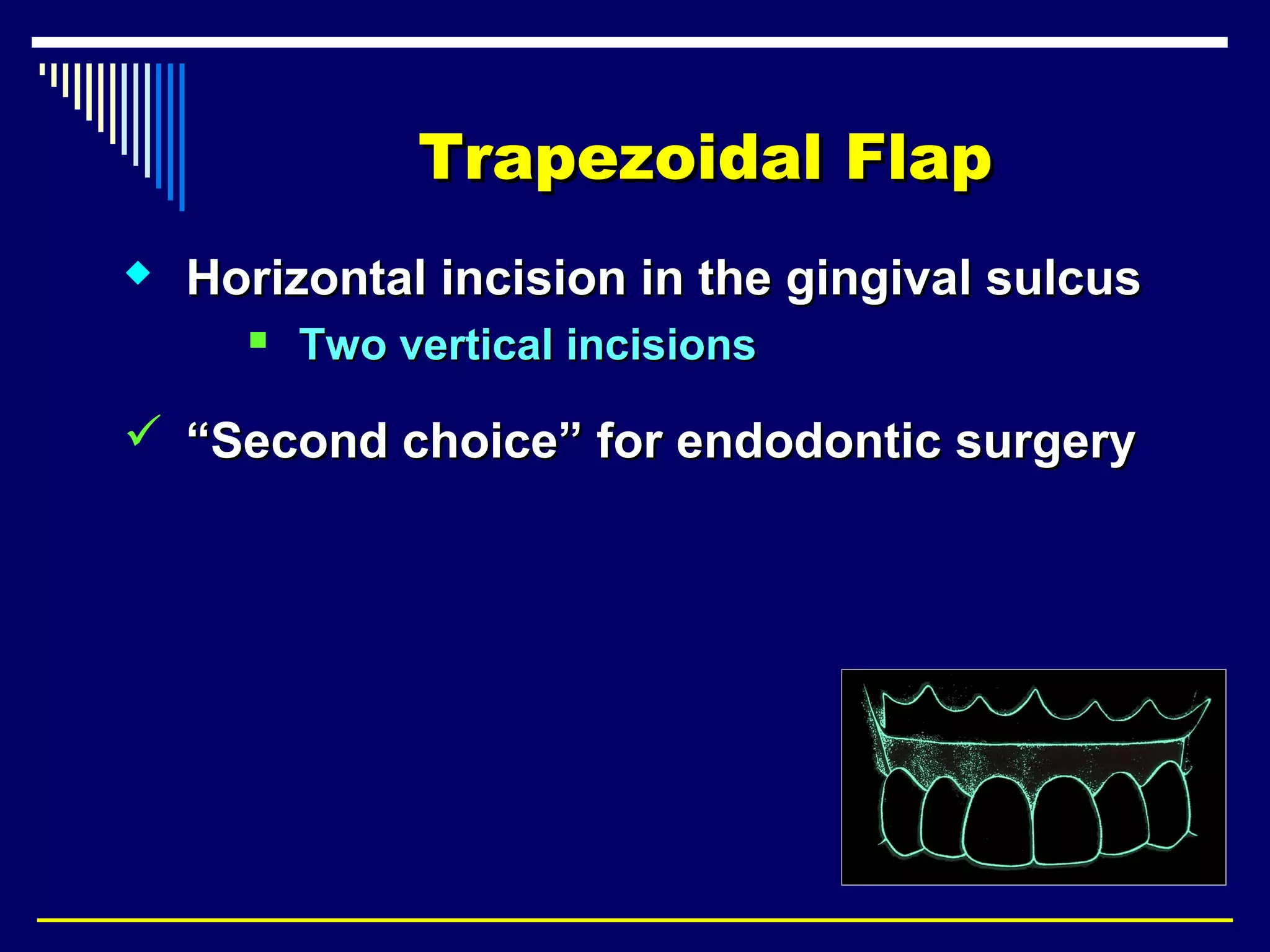
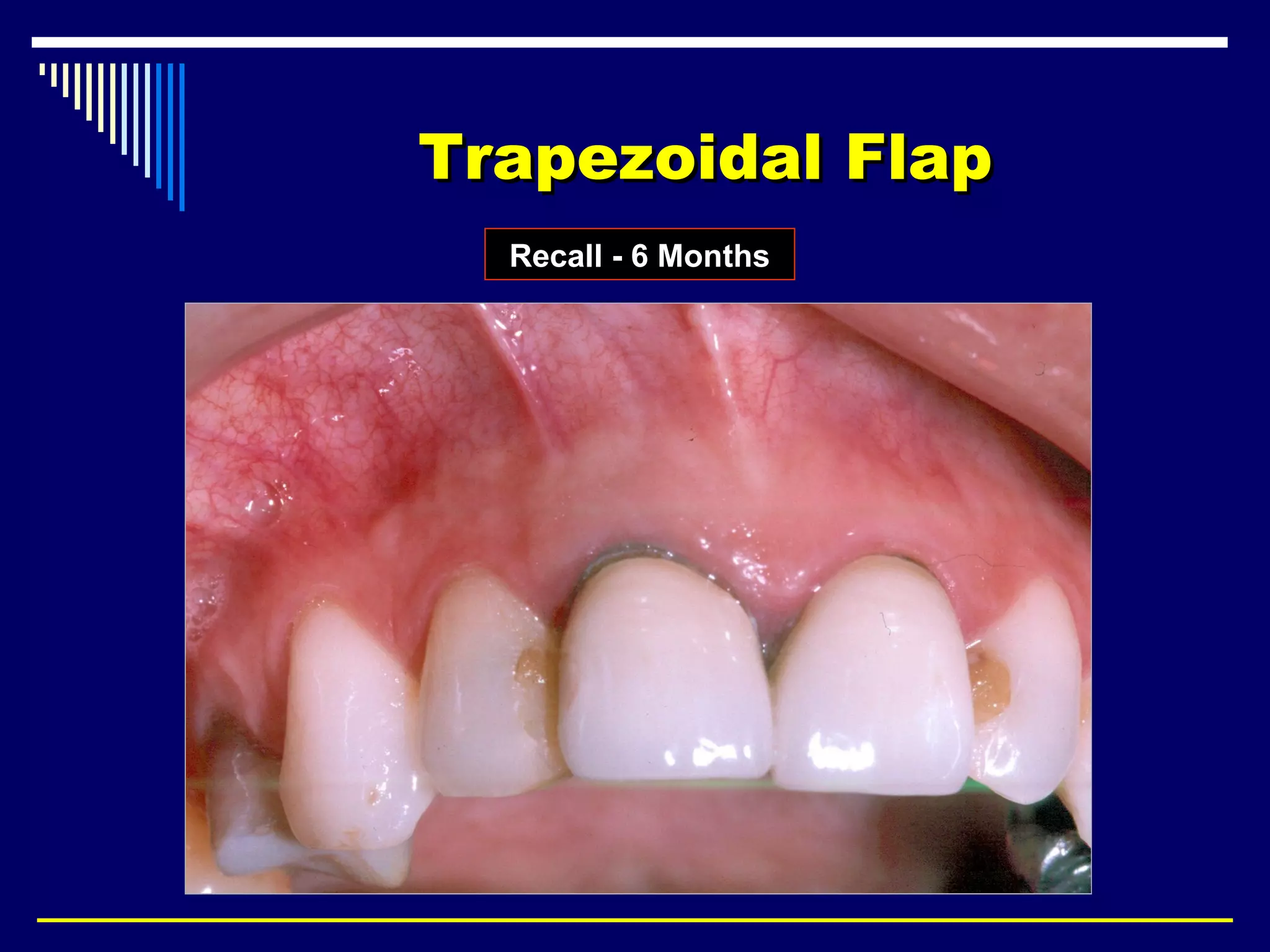
Trapezoidal FlapTrapezoidal Flap
 Horizontal incision in the gingival sulcusHorizontal incision in the gingival sulcus
 Two vertical incisionsTwo vertical incisions
 ““Second choice” for endodontic surgerySecond choice” for endodontic surgery
Trapezoidal FlapTrapezoidal Flap
 Horizontal incision in the gingival sulcusHorizontal incision in the gingival sulcus
 Two vertical incisionsTwo vertical incisions
 ““Second choice” for endodontic surgerySecond choice” for endodontic surgery
 Begin as a triangular flap and then do 2Begin as a triangular flap and then do 2ndnd
vertical incision if extra access requiredvertical incision if extra access required
 Good access & visionGood access & vision
 Good moisture controlGood moisture control
 Heals without scarsHeals without scars
 Easy to repositionEasy to reposition
Trapezoidal FlapTrapezoidal Flap
Recall - 6 Months
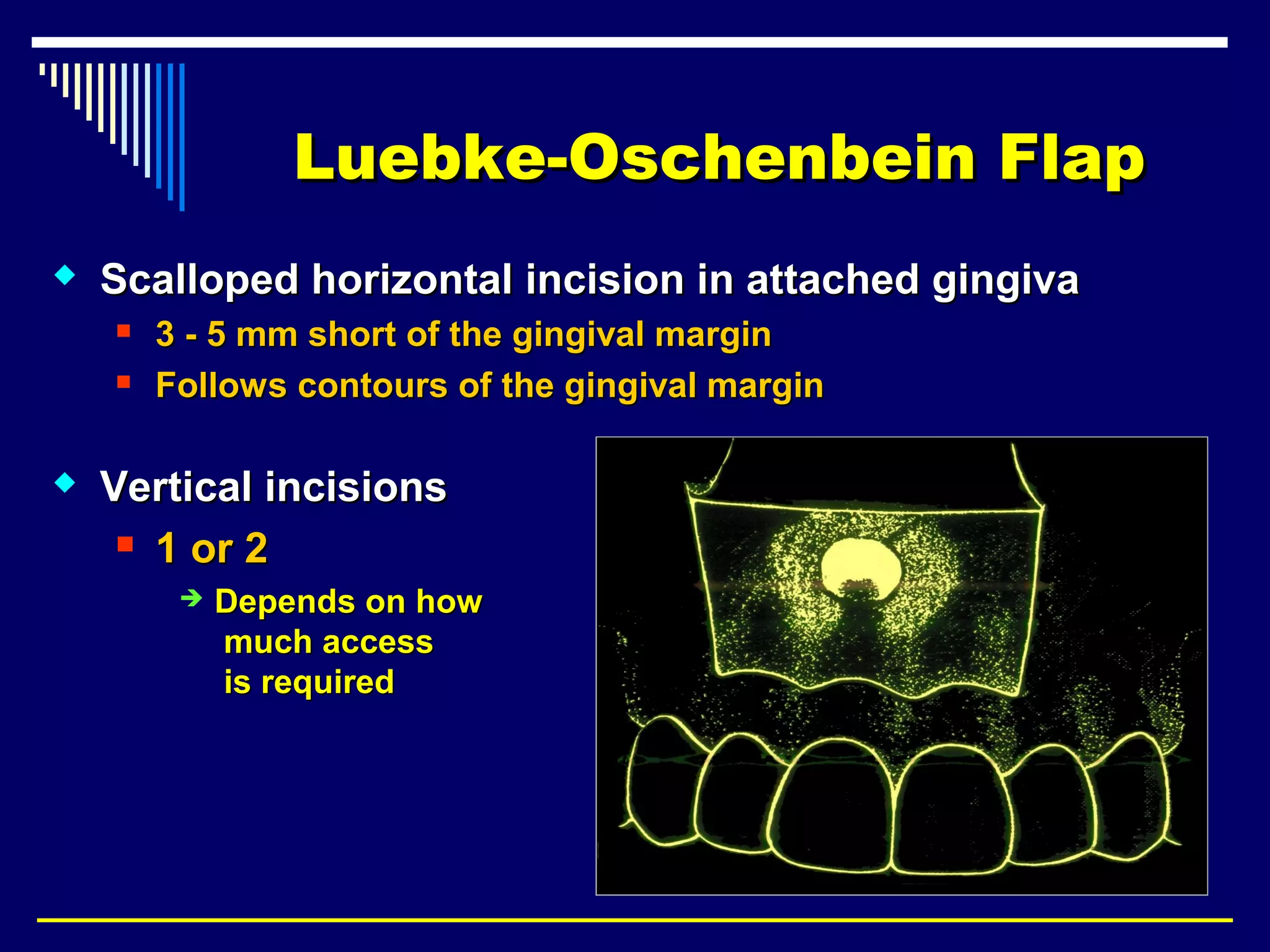
Luebke-Oschenbein FlapLuebke-Oschenbein Flap
 Scalloped horizontal incision in attached gingivaScalloped horizontal incision in attached gingiva
 3 - 5 mm short of the gingival margin3 - 5 mm short of the gingival margin
 Follows contours of the gingival marginFollows contours of the gingival margin
Luebke-Oschenbein FlapLuebke-Oschenbein Flap
 Scalloped horizontal incision in attached gingivaScalloped horizontal incision in attached gingiva
 3 - 5 mm short of the gingival margin3 - 5 mm short of the gingival margin
 Follows contours of the gingival marginFollows contours of the gingival margin
 Vertical incisionsVertical incisions
 1 or 21 or 2
 Depends on howDepends on how
much accessmuch access
is requiredis required
Luebke-Oschenbein FlapLuebke-Oschenbein Flap
 Scalloped horizontal incision in attached gingivaScalloped horizontal incision in attached gingiva
 3 - 5 mm short of the gingival margin3 - 5 mm short of the gingival margin
 Follows contours of the gingival marginFollows contours of the gingival margin
 Vertical incisionsVertical incisions
 1 or 21 or 2
 Depends on howDepends on how
much accessmuch access
is requiredis required
 Little, if any, scarringLittle, if any, scarring
Luebke-Oschenbein FlapLuebke-Oschenbein Flap
 Use for anterior teeth with crownsUse for anterior teeth with crowns
 To avoid gingival recessionTo avoid gingival recession
Luebke-Oschenbein FlapLuebke-Oschenbein Flap
Recall - 6 Months
 No. 15 - for periosteal flapsNo. 15 - for periosteal flaps
 No. 11 - for incision and drainageNo. 11 - for incision and drainage
 Stabbing actionStabbing action
Scalpel BladesScalpel Blades
General Principles forGeneral Principles for
Periosteal FlapsPeriosteal Flaps
General Principles forGeneral Principles for
Periosteal FlapsPeriosteal Flaps
Apical BevelApical Bevel
Micro-MirrorsMicro-Mirrors
CurettageCurettage
TechniquesTechniques
Curettage TechniquesCurettage Techniques
RetrogradeRetrograde
Filling MaterialsFilling Materials
Materials– Past and PresentMaterials– Past and Present
 AmalgamAmalgam
 CavitCavit
 IRMIRM
 Super-EBASuper-EBA
 Composite resinsComposite resins
 Gutta perchaGutta percha
 Glass ionomersGlass ionomers
 MTA (ProRoot)MTA (ProRoot)
 CorrosionCorrosion
 Galvanism (with posts)Galvanism (with posts)
 Tattoo on mucosaTattoo on mucosa
 ExpansionExpansion
 Dimensional changesDimensional changes
 Marginal breakdownMarginal breakdown
 Excess not absorbableExcess not absorbable
 Mercury releaseMercury release
 Difficult to condenseDifficult to condense
 Condensation scatterCondensation scatter
 Cavity largeCavity large
 Undercuts neededUndercuts needed
 Poor adaptation to wallsPoor adaptation to walls
 No anti-bacterial actionNo anti-bacterial action
 Difficult to remove forDifficult to remove for
re-treatmentre-treatment
Amalgam
Disadvantages & Problems
Amalgam
Amalgam
Amalgam
Amalgam
 Poor tissue compatibilityPoor tissue compatibility
 Due to continuous release of eugenolDue to continuous release of eugenol
 Fibrosis of adjacent tissueFibrosis of adjacent tissue
 SolubleSoluble
 Large cavity requiredLarge cavity required
 Difficult to handle materialDifficult to handle material
 Esp. Super-EBAEsp. Super-EBA
IRM + Super-EBA
Disadvantages & Problems
 Low tissue toxicityLow tissue toxicity
 Bone appositionBone apposition
 Good sealing abilityGood sealing ability
 Chemical bond to dentineChemical bond to dentine
 RadiopaqueRadiopaque
 Easy to mix & placeEasy to mix & place
 Colour contrast to toothColour contrast to tooth
 Short setting timeShort setting time
 Moisture controlMoisture control
 HaemorrhageHaemorrhage
 Relatively largeRelatively large
cavity requiredcavity required
Glass Ionomer
Advantages Disadvantages
Gutta Percha + Sealer
 Low tissue toxicityLow tissue toxicity
 Good sealing abilityGood sealing ability
 RadiopaqueRadiopaque
 Colour contrast to toothColour contrast to tooth
 Conservative cavity onlyConservative cavity only
 Anti-bacterial (sealer)Anti-bacterial (sealer)
Advantages
 Easy to mix & placeEasy to mix & place
 Good physical propertiesGood physical properties
 Satisfies requirements ofSatisfies requirements of
root filling materialsroot filling materials
 Proven and acceptableProven and acceptable
material for RCF’s formaterial for RCF’s for
over 120 yearsover 120 years
ReferenceReference FavourableFavourable Uncertain UnfavourableUncertain Unfavourable
NordenramNordenram et alet al 19701970 56 %56 % 36 %36 % 8 %8 %
HartyHarty et alet al 19701970 9090 -- 1010
RudRud et alet al 19721972 8383 1414 33
MalmströmMalmström et alet al 19821982 7474 1717 99
ForsellForsell et alet al 19881988 6868 2121 1111
AmagasaAmagasa et alet al 19891989 9595 -- 55
GrungGrung et alet al 19901990 8585 1414 11
FriedmanFriedman et alet al 19911991 7070 3030 --
RappRapp et alet al 19911991 5656 3333 1111
Abbott 1999Abbott 1999 92.392.3 4.24.2 3.53.5
Treatment Outcome StudiesTreatment Outcome Studies
All re-treats after
retro. amalgam
Endodontic SurgeryEndodontic Surgery
-- with GP + AH26with GP + AH26
Endodontic Surgery - StagesEndodontic Surgery - Stages
a)a) Consultation, Diagnosis, Treatment PlanConsultation, Diagnosis, Treatment Plan
b)b) Local AnaesthesiaLocal Anaesthesia
c)c) Periosteal FlapPeriosteal Flap
d)d) CurettageCurettage
e)e) ApicoectomyApicoectomy
f)f) Retrograde Endodontic TreatmentRetrograde Endodontic Treatment
 Apical Bevel, Canal Preparation, Root FillingApical Bevel, Canal Preparation, Root Filling
a)a) Wound Closure - suturesWound Closure - sutures
b)b) Post-operative InstructionsPost-operative Instructions
c)c) Follow-up & ReviewFollow-up & Review
ConsultationConsultation
Local AnaesthesiaLocal Anaesthesia
InstrumentsInstruments
Incision + Periosteal FlapIncision + Periosteal Flap
Bone Removal & CurettageBone Removal & Curettage
Retrograde Canal PreparationRetrograde Canal Preparation

Retrograde Canal PreparationRetrograde Canal Preparation
Haemorrhage ControlHaemorrhage Control
Paper PointsPaper Points
Sealer - AH 26Sealer - AH 26
Gutta PerchaGutta Percha
Sealer - PlacementSealer - Placement
Retrograde Root FillingRetrograde Root Filling
SuturingSuturing
Post-Operative InstructionsPost-Operative Instructions
ALSO:ALSO:
1.1. Post-op RadiographPost-op Radiograph
2.2. Suture RemovalSuture Removal
 4-5 days4-5 days
3.3. ReviewsReviews
 3-4 months3-4 months
 12 months12 months
 3 years3 years
Pre-op
Mid-surgery
Review - 3 months
Review - 12 months
Review - 3 years
Post-op
Review - 8 years

Periapical surgery

  • 1.
  • 2.
    Endodontic Surgical ProceduresEndodonticSurgical Procedures  Incision and drainageIncision and drainage  Periapical curettagePeriapical curettage  ApicoectomyApicoectomy  Retrograde endodontic treatmentRetrograde endodontic treatment  Perforation repairPerforation repair  Root resectionRoot resection  Hemisection (± root removal)Hemisection (± root removal)  Exploratory surgeryExploratory surgery  Intentional replantationIntentional replantation
  • 3.
    Endodontic Surgical ProceduresEndodonticSurgical Procedures  Incision and drainageIncision and drainage  Periapical curettagePeriapical curettage  ApicoectomyApicoectomy  Retrograde endodontic treatmentRetrograde endodontic treatment  Perforation repairPerforation repair  Root resectionRoot resection  Hemisection (± root removal)Hemisection (± root removal)  Exploratory surgeryExploratory surgery  Intentional replantationIntentional replantation
  • 4.
    Possible Indications forPossibleIndications for Periapical SurgeryPeriapical Surgery  When a biopsy of the periapical lesion is requiredWhen a biopsy of the periapical lesion is required
  • 5.
    Possible Indications forPossibleIndications for Periapical SurgeryPeriapical Surgery  When a biopsy of the periapical lesion is requiredWhen a biopsy of the periapical lesion is required  Foreign body reaction with extruded materialForeign body reaction with extruded material
  • 6.
    Possible Indications forPossibleIndications for Periapical SurgeryPeriapical Surgery  When a biopsy of the periapical lesion is requiredWhen a biopsy of the periapical lesion is required  Foreign body reaction with extruded materialForeign body reaction with extruded material  Perforation repairPerforation repair (that can not be done conservatively)(that can not be done conservatively)
  • 7.
    Possible Indications forPossibleIndications for Periapical SurgeryPeriapical Surgery  When a biopsy of the periapical lesion is requiredWhen a biopsy of the periapical lesion is required  Foreign body reaction with extruded materialForeign body reaction with extruded material  Perforation repairPerforation repair (that can not be done conservatively)(that can not be done conservatively)  If non-surgical treatment is not feasible - such as:If non-surgical treatment is not feasible - such as:  Very long or wide post; Post not in line with canalVery long or wide post; Post not in line with canal  Canal blocked by broken file, calcifications, etcCanal blocked by broken file, calcifications, etc  Tooth is not likely to be suitable for further restorationTooth is not likely to be suitable for further restoration
  • 8.
    Possible Indications forPossibleIndications for Periapical SurgeryPeriapical Surgery  When a biopsy of the periapical lesion is requiredWhen a biopsy of the periapical lesion is required  Foreign body reaction with extruded materialForeign body reaction with extruded material  Perforation repairPerforation repair (that can not be done conservatively)(that can not be done conservatively)  If non-surgical treatment is not feasible - such as:If non-surgical treatment is not feasible - such as:  Very long or wide post; Post not in line with canalVery long or wide post; Post not in line with canal  Canal blocked by broken file, calcifications, etcCanal blocked by broken file, calcifications, etc  Tooth is not likely to be suitable for further restorationTooth is not likely to be suitable for further restoration  Patient factorsPatient factors  Medical / dental condition, time, costs, recent crown, etc.Medical / dental condition, time, costs, recent crown, etc.
  • 9.
    Periapical SurgeryPeriapical Surgery ConsiderationsConsiderations Psychological aspectsPsychological aspects  Patients are reluctant to have any form of surgeryPatients are reluctant to have any form of surgery
  • 10.
    Periapical SurgeryPeriapical Surgery ConsiderationsConsiderations Psychological aspectsPsychological aspects  Patients are reluctant to have any form of surgeryPatients are reluctant to have any form of surgery  Non-surgical endodontics has a higher success rateNon-surgical endodontics has a higher success rate  GrungGrung et alet al - 28% higher success if non-surgical- 28% higher success if non-surgical re-treatment was done prior to surgeryre-treatment was done prior to surgery
  • 11.
    Periapical SurgeryPeriapical Surgery ConsiderationsConsiderations Psychological aspectsPsychological aspects  Patients are reluctant to have any form of surgeryPatients are reluctant to have any form of surgery  Non-surgical endodontics has a higher success rateNon-surgical endodontics has a higher success rate  GrungGrung et alet al - 28% higher success if non-surgical- 28% higher success if non-surgical re-treatment was done prior to surgeryre-treatment was done prior to surgery  Surgery is a “one visit” techniqueSurgery is a “one visit” technique  Can not disinfect the canal with irrigants and/or medicamentsCan not disinfect the canal with irrigants and/or medicaments
  • 12.
    Periapical SurgeryPeriapical Surgery ConsiderationsConsiderations There is no IDEAL retrograde filling materialThere is no IDEAL retrograde filling material  Many have been tried & most do not “seal” canals wellMany have been tried & most do not “seal” canals well
  • 13.
    Periapical SurgeryPeriapical Surgery ConsiderationsConsiderations There is no IDEAL retrograde filling materialThere is no IDEAL retrograde filling material  Many have been tried & most do not “seal” canals wellMany have been tried & most do not “seal” canals well  Surgery “entombs” bacteria rather than killing orSurgery “entombs” bacteria rather than killing or removing themremoving them  And only “treats” the apical 2 - 4 mm of the canalAnd only “treats” the apical 2 - 4 mm of the canal
  • 14.
    Periapical SurgeryPeriapical Surgery ConsiderationsConsiderations There is no IDEAL retrograde filling materialThere is no IDEAL retrograde filling material  Many have been tried & most do not “seal” canals wellMany have been tried & most do not “seal” canals well  Surgery “entombs” bacteria rather than killing orSurgery “entombs” bacteria rather than killing or removing themremoving them  And only “treats” the apical 2 - 4 mm of the canalAnd only “treats” the apical 2 - 4 mm of the canal  Surgery does not remove the pathway of entry alongSurgery does not remove the pathway of entry along which the bacteria have entered & infected the toothwhich the bacteria have entered & infected the tooth  This is usually caries, a defective restoration, or a crackThis is usually caries, a defective restoration, or a crack
  • 15.
    Periapical SurgeryPeriapical Surgery ConsiderationsConsiderations Over-extended root filling materialsOver-extended root filling materials  Will not always cause a foreign body reactionWill not always cause a foreign body reaction  Hence, always watch and reassess over timeHence, always watch and reassess over time
  • 16.
    Periapical SurgeryPeriapical Surgery ConsiderationsConsiderations Over-extended root filling materialsOver-extended root filling materials  Will not always cause a foreign body reactionWill not always cause a foreign body reaction  Hence, always watch and reassess over timeHence, always watch and reassess over time  Large, well-defined radiolucenciesLarge, well-defined radiolucencies  Are not always cysts as often thought by many dentistsAre not always cysts as often thought by many dentists  Can be any form of periapical pathosisCan be any form of periapical pathosis  Size and borders indicate time & speed of developmentSize and borders indicate time & speed of development
  • 17.
    Periapical SurgeryPeriapical Surgery ConsiderationsConsiderations Potential post-operative sequelaePotential post-operative sequelae  Swelling and bruisingSwelling and bruising  InfectionInfection  Pain / discomfortPain / discomfort  Anaesthesia / ParaesthesiaAnaesthesia / Paraesthesia  Tissue discolourationTissue discolouration  ScarringScarring  Gingival recessionGingival recession  Loss of interdental papillaLoss of interdental papilla  Altered aestheticsAltered aesthetics
  • 18.
    Possible Indications forPossibleIndications for Periapical SurgeryPeriapical Surgery  ““It must be recognised that few trueIt must be recognised that few true indications exist for the endodonticindications exist for the endodontic surgical approach”surgical approach”  Gutman JL.Gutman JL. Surgical EndodonticsSurgical Endodontics 1991: 501991: 50
  • 19.
  • 20.
    Endodontic Surgery -StagesEndodontic Surgery - Stages a)a) Consultation, Diagnosis, Treatment PlanConsultation, Diagnosis, Treatment Plan b)b) Local AnaesthesiaLocal Anaesthesia c)c) Periosteal FlapPeriosteal Flap d)d) CurettageCurettage e)e) ApicoectomyApicoectomy f)f) Retrograde Endodontic TreatmentRetrograde Endodontic Treatment  Apical Bevel, Canal Preparation, Root FillingApical Bevel, Canal Preparation, Root Filling a)a) Wound Closure - suturesWound Closure - sutures b)b) Post-operative InstructionsPost-operative Instructions c)c) Follow-up & ReviewFollow-up & Review
  • 21.
    Endodontic SurgeryEndodontic Surgery Butfirst – some general principlesBut first – some general principles
  • 22.
    Flap DesignsFlap Designs Semi-LunarSemi-Lunar  Gingival crestGingival crest  TriangularTriangular  TrapezoidalTrapezoidal  GingivalGingival  Luebke-OschenbeinLuebke-Oschenbein
  • 23.
    Semi-Lunar FlapSemi-Lunar Flap In the mucobuccal fold and attached gingivaIn the mucobuccal fold and attached gingiva
  • 24.
    Semi-Lunar FlapSemi-Lunar Flap In the mucobuccal fold and attached gingivaIn the mucobuccal fold and attached gingiva  Poor accessPoor access  Incision often over the lesionIncision often over the lesion  Difficult moisture controlDifficult moisture control (haemorrhage)(haemorrhage)  Difficult to repositionDifficult to reposition  Uncomfortable during healingUncomfortable during healing  Leaves scarsLeaves scars
  • 25.
  • 26.
    Gingival FlapGingival Flap Gingival crest incisionGingival crest incision  Extended horizontal incisionExtended horizontal incision  No vertical incisionNo vertical incision
  • 27.
     No accessto apexNo access to apex  May be useful for coronalMay be useful for coronal third perforationsthird perforations  Used for palatal flapsUsed for palatal flaps  But difficult !But difficult ! Gingival FlapGingival Flap  Gingival crest incisionGingival crest incision  Extended horizontal incisionExtended horizontal incision  No vertical incisionNo vertical incision
  • 28.
  • 29.
     Horizontal incisionin the gingival sulcusHorizontal incision in the gingival sulcus  One vertical incisionOne vertical incision Triangular FlapTriangular Flap
  • 30.
     Horizontal incisionin the gingival sulcusHorizontal incision in the gingival sulcus  One vertical incisionOne vertical incision  ““First choice” flap for endodontic surgeryFirst choice” flap for endodontic surgery  Good accessGood access  Good visionGood vision  Good moisture controlGood moisture control  Heals without scarsHeals without scars  Easy to repositionEasy to reposition Triangular FlapTriangular Flap
  • 31.
  • 32.
  • 33.
    Recall - 6Months Triangular FlapTriangular Flap
  • 34.
    Recall - 3Months Triangular FlapTriangular Flap Recall - 6 Months
  • 35.
     Horizontal incisionin the gingival sulcusHorizontal incision in the gingival sulcus  Two vertical incisionsTwo vertical incisions Trapezoidal FlapTrapezoidal Flap
  • 36.
     Horizontal incisionin the gingival sulcusHorizontal incision in the gingival sulcus  Two vertical incisionsTwo vertical incisions  ““Second choice” for endodontic surgerySecond choice” for endodontic surgery Trapezoidal FlapTrapezoidal Flap
  • 37.
     Horizontal incisionin the gingival sulcusHorizontal incision in the gingival sulcus  Two vertical incisionsTwo vertical incisions  ““Second choice” for endodontic surgerySecond choice” for endodontic surgery  Begin as a triangular flap and then do 2Begin as a triangular flap and then do 2ndnd vertical incision if extra access requiredvertical incision if extra access required  Good access & visionGood access & vision  Good moisture controlGood moisture control  Heals without scarsHeals without scars  Easy to repositionEasy to reposition Trapezoidal FlapTrapezoidal Flap
  • 38.
  • 39.
  • 40.
    Luebke-Oschenbein FlapLuebke-Oschenbein Flap Scalloped horizontal incision in attached gingivaScalloped horizontal incision in attached gingiva  3 - 5 mm short of the gingival margin3 - 5 mm short of the gingival margin  Follows contours of the gingival marginFollows contours of the gingival margin
  • 41.
    Luebke-Oschenbein FlapLuebke-Oschenbein Flap Scalloped horizontal incision in attached gingivaScalloped horizontal incision in attached gingiva  3 - 5 mm short of the gingival margin3 - 5 mm short of the gingival margin  Follows contours of the gingival marginFollows contours of the gingival margin  Vertical incisionsVertical incisions  1 or 21 or 2  Depends on howDepends on how much accessmuch access is requiredis required
  • 42.
    Luebke-Oschenbein FlapLuebke-Oschenbein Flap Scalloped horizontal incision in attached gingivaScalloped horizontal incision in attached gingiva  3 - 5 mm short of the gingival margin3 - 5 mm short of the gingival margin  Follows contours of the gingival marginFollows contours of the gingival margin  Vertical incisionsVertical incisions  1 or 21 or 2  Depends on howDepends on how much accessmuch access is requiredis required  Little, if any, scarringLittle, if any, scarring
  • 43.
    Luebke-Oschenbein FlapLuebke-Oschenbein Flap Use for anterior teeth with crownsUse for anterior teeth with crowns  To avoid gingival recessionTo avoid gingival recession
  • 44.
  • 45.
  • 46.
  • 47.
     No. 15- for periosteal flapsNo. 15 - for periosteal flaps  No. 11 - for incision and drainageNo. 11 - for incision and drainage  Stabbing actionStabbing action Scalpel BladesScalpel Blades
  • 48.
  • 49.
    General Principles forGeneralPrinciples for Periosteal FlapsPeriosteal Flaps
  • 50.
    General Principles forGeneralPrinciples for Periosteal FlapsPeriosteal Flaps
  • 51.
  • 52.
  • 53.
  • 54.
  • 55.
  • 56.
  • 57.
  • 58.
  • 59.
  • 60.
  • 61.
  • 62.
  • 63.
  • 64.
  • 65.
  • 66.
  • 67.
  • 68.
  • 69.
    Materials– Past andPresentMaterials– Past and Present  AmalgamAmalgam  CavitCavit  IRMIRM  Super-EBASuper-EBA  Composite resinsComposite resins  Gutta perchaGutta percha  Glass ionomersGlass ionomers  MTA (ProRoot)MTA (ProRoot)
  • 70.
     CorrosionCorrosion  Galvanism(with posts)Galvanism (with posts)  Tattoo on mucosaTattoo on mucosa  ExpansionExpansion  Dimensional changesDimensional changes  Marginal breakdownMarginal breakdown  Excess not absorbableExcess not absorbable  Mercury releaseMercury release  Difficult to condenseDifficult to condense  Condensation scatterCondensation scatter  Cavity largeCavity large  Undercuts neededUndercuts needed  Poor adaptation to wallsPoor adaptation to walls  No anti-bacterial actionNo anti-bacterial action  Difficult to remove forDifficult to remove for re-treatmentre-treatment Amalgam Disadvantages & Problems
  • 71.
  • 72.
  • 73.
  • 74.
  • 75.
     Poor tissuecompatibilityPoor tissue compatibility  Due to continuous release of eugenolDue to continuous release of eugenol  Fibrosis of adjacent tissueFibrosis of adjacent tissue  SolubleSoluble  Large cavity requiredLarge cavity required  Difficult to handle materialDifficult to handle material  Esp. Super-EBAEsp. Super-EBA IRM + Super-EBA Disadvantages & Problems
  • 76.
     Low tissuetoxicityLow tissue toxicity  Bone appositionBone apposition  Good sealing abilityGood sealing ability  Chemical bond to dentineChemical bond to dentine  RadiopaqueRadiopaque  Easy to mix & placeEasy to mix & place  Colour contrast to toothColour contrast to tooth  Short setting timeShort setting time  Moisture controlMoisture control  HaemorrhageHaemorrhage  Relatively largeRelatively large cavity requiredcavity required Glass Ionomer Advantages Disadvantages
  • 77.
    Gutta Percha +Sealer  Low tissue toxicityLow tissue toxicity  Good sealing abilityGood sealing ability  RadiopaqueRadiopaque  Colour contrast to toothColour contrast to tooth  Conservative cavity onlyConservative cavity only  Anti-bacterial (sealer)Anti-bacterial (sealer) Advantages  Easy to mix & placeEasy to mix & place  Good physical propertiesGood physical properties  Satisfies requirements ofSatisfies requirements of root filling materialsroot filling materials  Proven and acceptableProven and acceptable material for RCF’s formaterial for RCF’s for over 120 yearsover 120 years
  • 78.
    ReferenceReference FavourableFavourable UncertainUnfavourableUncertain Unfavourable NordenramNordenram et alet al 19701970 56 %56 % 36 %36 % 8 %8 % HartyHarty et alet al 19701970 9090 -- 1010 RudRud et alet al 19721972 8383 1414 33 MalmströmMalmström et alet al 19821982 7474 1717 99 ForsellForsell et alet al 19881988 6868 2121 1111 AmagasaAmagasa et alet al 19891989 9595 -- 55 GrungGrung et alet al 19901990 8585 1414 11 FriedmanFriedman et alet al 19911991 7070 3030 -- RappRapp et alet al 19911991 5656 3333 1111 Abbott 1999Abbott 1999 92.392.3 4.24.2 3.53.5 Treatment Outcome StudiesTreatment Outcome Studies All re-treats after retro. amalgam
  • 79.
    Endodontic SurgeryEndodontic Surgery --with GP + AH26with GP + AH26
  • 80.
    Endodontic Surgery -StagesEndodontic Surgery - Stages a)a) Consultation, Diagnosis, Treatment PlanConsultation, Diagnosis, Treatment Plan b)b) Local AnaesthesiaLocal Anaesthesia c)c) Periosteal FlapPeriosteal Flap d)d) CurettageCurettage e)e) ApicoectomyApicoectomy f)f) Retrograde Endodontic TreatmentRetrograde Endodontic Treatment  Apical Bevel, Canal Preparation, Root FillingApical Bevel, Canal Preparation, Root Filling a)a) Wound Closure - suturesWound Closure - sutures b)b) Post-operative InstructionsPost-operative Instructions c)c) Follow-up & ReviewFollow-up & Review
  • 81.
  • 82.
  • 83.
  • 84.
    Incision + PeriostealFlapIncision + Periosteal Flap
  • 85.
    Bone Removal &CurettageBone Removal & Curettage
  • 86.
  • 87.
  • 88.
  • 89.
  • 90.
  • 91.
  • 92.
    Sealer - AH26Sealer - AH 26
  • 93.
  • 94.
  • 95.
  • 96.
  • 97.
  • 98.
  • 99.
  • 100.
  • 101.
  • 102.
    Post-Operative InstructionsPost-Operative Instructions ALSO:ALSO: 1.1.Post-op RadiographPost-op Radiograph 2.2. Suture RemovalSuture Removal  4-5 days4-5 days 3.3. ReviewsReviews  3-4 months3-4 months  12 months12 months  3 years3 years
  • 103.
  • 104.
  • 105.
    Review - 3months
  • 106.
  • 107.
  • 109.
  • 110.