Teaching Listening
Trainee: M. Bedraoui Trainer: A. Oulbouch
1 1/15/2016teaching listening
Objectives
2
1. To identify the features of the listening process.
2. To specify the challenges of listening in a foreign
language.
3. To discuss a framework for teaching listening
4. To present a listening lesson plan.
5. To discuss the components of the lesson plan.
1/15/2016teaching listening
Is this statement true or False?
Listening is a highly active
process.
1/15/20163 teaching listening
Is this statement true or False?
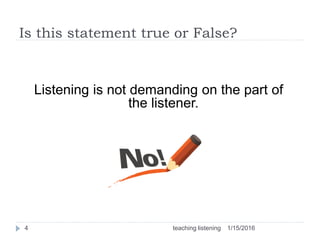
Listening is not demanding on the part of
the listener.
1/15/20164 teaching listening
Is this statement true or False?
Listening in a foreign language is
different from listening in the first
language.
1/15/20165 teaching listening
Is this statement true or False?
Listening in a foreign language classroom
takes place in a natural environment.
1/15/20166 teaching listening
Is this statement true or False?
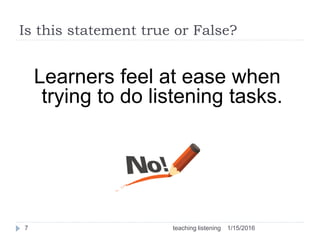
Learners feel at ease when
trying to do listening tasks.
1/15/20167 teaching listening
Is this statement true or False?
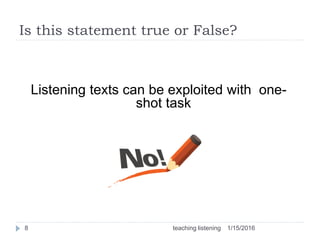
Listening texts can be exploited with one-
shot task
1/15/20168 teaching listening
Is this statement true or False?
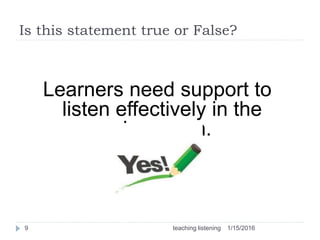
Learners need support to
listen effectively in the
classroom.
1/15/20169 teaching listening
Is this statement true or False?
Second language learners
need training on strategic
listening.
1/15/201610 teaching listening
Is this statement true or False?
Listening for specific information
is a beginning note-taking
exercise.
1/15/201611 teaching listening
What is listening?
1/15/201612 teaching listening
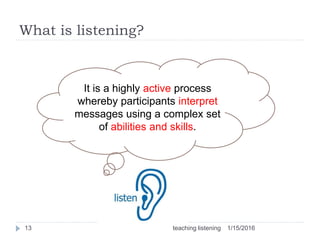
What is listening?
13
It is a highly active process
whereby participants interpret
messages using a complex set
of abilities and skills.
1/15/2016teaching listening
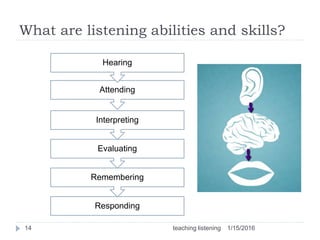
What are listening abilities and skills?
1/15/2016teaching listening14
Responding
Remembering
Evaluating
Interpreting
Attending
Hearing
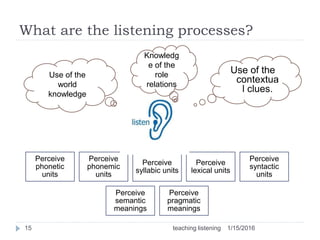
What are the listening processes?
1/15/2016teaching listening15
Perceive
phonetic
units
Perceive
phonemic
units
Perceive
syllabic units
Perceive
lexical units
Perceive
syntactic
units
Perceive
semantic
meanings
Perceive
pragmatic
meanings
Use of the
world
knowledge
Use of the
contextua
l clues.
Knowledg
e of the
role
relations
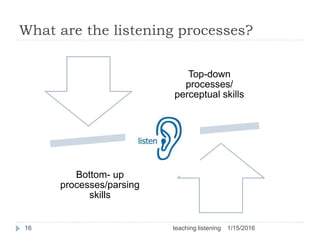
What are the listening processes?
1/15/2016teaching listening16
Top-down
processes/
perceptual skills
Bottom- up
processes/parsing
skills
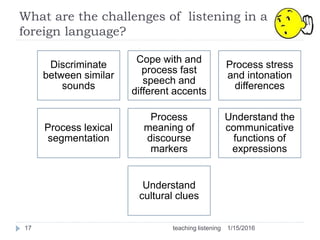
What are the challenges of listening in a
foreign language?
1/15/2016teaching listening17
Discriminate
between similar
sounds
Cope with and
process fast
speech and
different accents
Process stress
and intonation
differences
Process lexical
segmentation
Process
meaning of
discourse
markers
Understand the
communicative
functions of
expressions
Understand
cultural clues
What are the challenges of listening in a
foreign language classroom?
1/15/2016teaching listening18
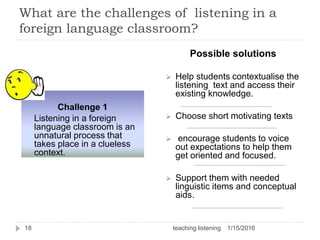
Challenge 1
Listening in a foreign
language classroom is an
unnatural process that
takes place in a clueless
context.
Possible solutions
 Help students contextualise the
listening text and access their
existing knowledge.
 Choose short motivating texts
 encourage students to voice
out expectations to help them
get oriented and focused.
 Support them with needed
linguistic items and conceptual
aids.
What are the challenges of listening in a
foreign language classroom?
1/15/2016teaching listening19
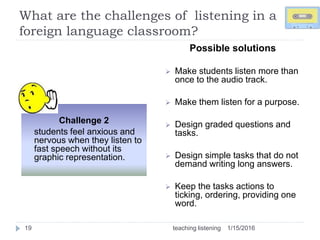
Challenge 2
students feel anxious and
nervous when they listen to
fast speech without its
graphic representation.
Possible solutions
 Make students listen more than
once to the audio track.
 Make them listen for a purpose.
 Design graded questions and
tasks.
 Design simple tasks that do not
demand writing long answers.
 Keep the tasks actions to
ticking, ordering, providing one
word.
What are the challenges of listening in a
foreign language classroom?
1/15/2016teaching listening20
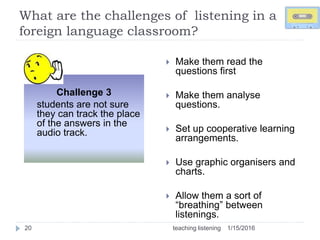
 Make them read the
questions first
 Make them analyse
questions.
 Set up cooperative learning
arrangements.
 Use graphic organisers and
charts.
 Allow them a sort of
“breathing” between
listenings.
Challenge 3
students are not sure
they can track the place
of the answers in the
audio track.
What are the challenges of listening in a
foreign language classroom?
1/15/2016teaching listening21
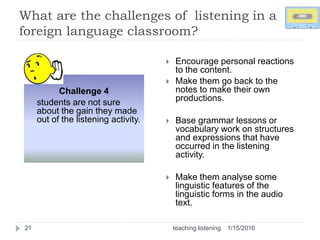
 Encourage personal reactions
to the content.
 Make them go back to the
notes to make their own
productions.
 Base grammar lessons or
vocabulary work on structures
and expressions that have
occurred in the listening
activity.
 Make them analyse some
linguistic features of the
linguistic forms in the audio
text.
Challenge 4
students are not sure
about the gain they made
out of the listening activity.

Teaching listening

  • 1.
    Teaching Listening Trainee: M.Bedraoui Trainer: A. Oulbouch 1 1/15/2016teaching listening
  • 2.
    Objectives 2 1. To identifythe features of the listening process. 2. To specify the challenges of listening in a foreign language. 3. To discuss a framework for teaching listening 4. To present a listening lesson plan. 5. To discuss the components of the lesson plan. 1/15/2016teaching listening
  • 3.
    Is this statementtrue or False? Listening is a highly active process. 1/15/20163 teaching listening
  • 4.
    Is this statementtrue or False? Listening is not demanding on the part of the listener. 1/15/20164 teaching listening
  • 5.
    Is this statementtrue or False? Listening in a foreign language is different from listening in the first language. 1/15/20165 teaching listening
  • 6.
    Is this statementtrue or False? Listening in a foreign language classroom takes place in a natural environment. 1/15/20166 teaching listening
  • 7.
    Is this statementtrue or False? Learners feel at ease when trying to do listening tasks. 1/15/20167 teaching listening
  • 8.
    Is this statementtrue or False? Listening texts can be exploited with one- shot task 1/15/20168 teaching listening
  • 9.
    Is this statementtrue or False? Learners need support to listen effectively in the classroom. 1/15/20169 teaching listening
  • 10.
    Is this statementtrue or False? Second language learners need training on strategic listening. 1/15/201610 teaching listening
  • 11.
    Is this statementtrue or False? Listening for specific information is a beginning note-taking exercise. 1/15/201611 teaching listening
  • 12.
  • 13.
    What is listening? 13 Itis a highly active process whereby participants interpret messages using a complex set of abilities and skills. 1/15/2016teaching listening
  • 14.
    What are listeningabilities and skills? 1/15/2016teaching listening14 Responding Remembering Evaluating Interpreting Attending Hearing
  • 15.
    What are thelistening processes? 1/15/2016teaching listening15 Perceive phonetic units Perceive phonemic units Perceive syllabic units Perceive lexical units Perceive syntactic units Perceive semantic meanings Perceive pragmatic meanings Use of the world knowledge Use of the contextua l clues. Knowledg e of the role relations
  • 16.
    What are thelistening processes? 1/15/2016teaching listening16 Top-down processes/ perceptual skills Bottom- up processes/parsing skills
  • 17.
    What are thechallenges of listening in a foreign language? 1/15/2016teaching listening17 Discriminate between similar sounds Cope with and process fast speech and different accents Process stress and intonation differences Process lexical segmentation Process meaning of discourse markers Understand the communicative functions of expressions Understand cultural clues
  • 18.
    What are thechallenges of listening in a foreign language classroom? 1/15/2016teaching listening18 Challenge 1 Listening in a foreign language classroom is an unnatural process that takes place in a clueless context. Possible solutions  Help students contextualise the listening text and access their existing knowledge.  Choose short motivating texts  encourage students to voice out expectations to help them get oriented and focused.  Support them with needed linguistic items and conceptual aids.
  • 19.
    What are thechallenges of listening in a foreign language classroom? 1/15/2016teaching listening19 Challenge 2 students feel anxious and nervous when they listen to fast speech without its graphic representation. Possible solutions  Make students listen more than once to the audio track.  Make them listen for a purpose.  Design graded questions and tasks.  Design simple tasks that do not demand writing long answers.  Keep the tasks actions to ticking, ordering, providing one word.
  • 20.
    What are thechallenges of listening in a foreign language classroom? 1/15/2016teaching listening20  Make them read the questions first  Make them analyse questions.  Set up cooperative learning arrangements.  Use graphic organisers and charts.  Allow them a sort of “breathing” between listenings. Challenge 3 students are not sure they can track the place of the answers in the audio track.
  • 21.
    What are thechallenges of listening in a foreign language classroom? 1/15/2016teaching listening21  Encourage personal reactions to the content.  Make them go back to the notes to make their own productions.  Base grammar lessons or vocabulary work on structures and expressions that have occurred in the listening activity.  Make them analyse some linguistic features of the linguistic forms in the audio text. Challenge 4 students are not sure about the gain they made out of the listening activity.