The Sheltering Sky:
From Print to Screen
Mariam Bedraoui
Master Student
Moroccan American Studies
Hassan II University, Casablanca
Outline
1. A Few Notes on Adaptation (What? How?
Where and When?)
2. Analysis
1. Root Narrative
2. Main Thesis
3. Illustration
3. Conclusion
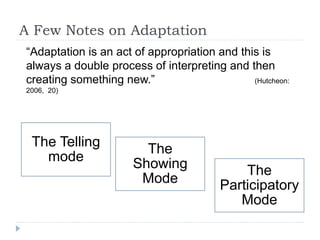
A Few Notes on Adaptation
“Adaptation is an act of appropriation and this is
always a double process of interpreting and then
creating something new.” (Hutcheon:
2006, 20)
The Telling
mode
The
Showing
Mode
The
Participatory
Mode
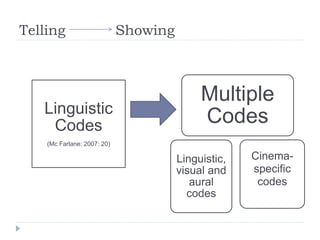
Telling Showing
Linguistic
Codes
(Mc Farlane: 2007: 20)
Multiple
Codes
Linguistic,
visual and
aural
codes
Cinema-
specific
codes
What Happens in the Process of Adaptation?
“Such movement into a new environment is
never unimpeded. It necessarily involves
processes of representation and
institutionalization different from those at
the point of origin. This complicates any
account of the transplantation, transference,
circulation, and commerce of theories and
ideas.” (Said: 1987,226)
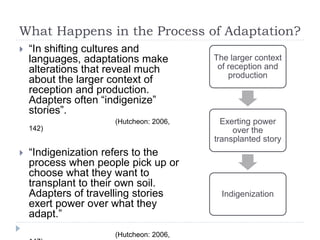
What Happens in the Process of Adaptation?
 “In shifting cultures and
languages, adaptations make
alterations that reveal much
about the larger context of
reception and production.
Adapters often “indigenize”
stories”.
(Hutcheon: 2006,
142)
 “Indigenization refers to the
process when people pick up or
choose what they want to
transplant to their own soil.
Adapters of travelling stories
exert power over what they
adapt.”
(Hutcheon: 2006,
The larger context
of reception and
production
Exerting power
over the
transplanted story
Indigenization
The Sheltering Sky:
American Identity between Print and
Screen
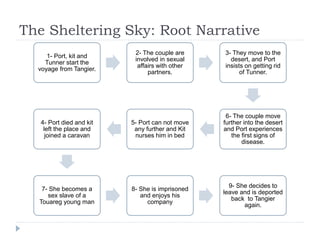
The Sheltering Sky: Root Narrative
1- Port, kit and
Tunner start the
voyage from Tangier.
2- The couple are
involved in sexual
affairs with other
partners.
3- They move to the
desert, and Port
insists on getting rid
of Tunner.
6- The couple move
further into the desert
and Port experiences
the first signs of
disease.
5- Port can not move
any further and Kit
nurses him in bed
4- Port died and kit
left the place and
joined a caravan
7- She becomes a
sex slave of a
Touareg young man
8- She is imprisoned
and enjoys his
company
9- She decides to
leave and is deported
back to Tangier
again.
Main Thesis
• Both the novel and film are concerned with
exploring the dangerous boundaries of individuality.
• They both make use of a foreign space to allegorise
the painful experience of an inner journey.
• However, The journey leads to opposite
destinations.
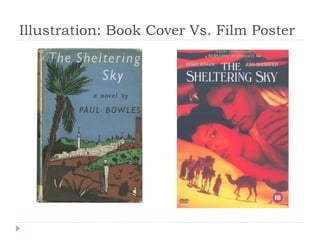
Illustration: Book Cover vs. Film Poster
Illustration: Book Cover Vs. Film Poster
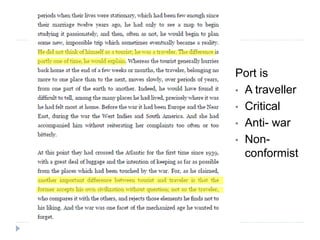
1- Port
Port is
• A traveller
• Critical
• Anti- war
• Non-
conformist
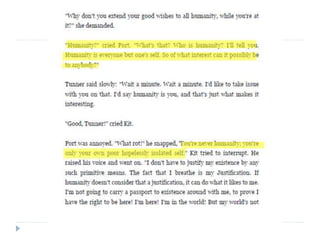
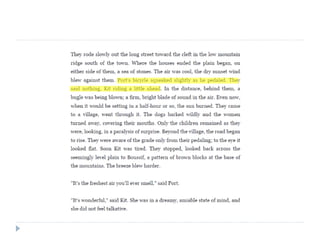
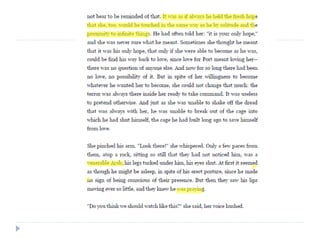
2- Port and Kit
The Outing in the Film
Kit’s Journey
Bertolucci’s Comment on the Final Part
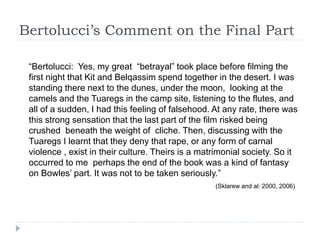
“Bertolucci: Yes, my great “betrayal” took place before filming the
first night that Kit and Belqassim spend together in the desert. I was
standing there next to the dunes, under the moon, looking at the
camels and the Tuaregs in the camp site, listening to the flutes, and
all of a sudden, I had this feeling of falsehood. At any rate, there was
this strong sensation that the last part of the film risked being
crushed beneath the weight of cliche. Then, discussing with the
Tuaregs I learnt that they deny that rape, or any form of carnal
violence , exist in their culture. Theirs is a matrimonial society. So it
occurred to me perhaps the end of the book was a kind of fantasy
on Bowles’ part. It was not to be taken seriously.”
(Sklarew and al: 2000, 2006)
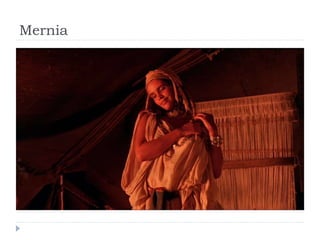
Mernia
Conclusion
 The film attenuates the tensions between the
characters.
 It shifts the focus of themes from a quest for an
individual form of existence to a quest for belonging.
 It targets an American domestic audience and falls in
line with Hollywood’s romantic adventures.
 It nurtures the popular images of the orient revealed
in the novel.
 It made the novel accessible to a larger audience
and reinscribes the story within a collective
discourse.
References
 Bowles, Paul. The Sheltering Sky. New York: Vintage Books, 1990.
Print.
 Cartmell, Deborah, and Imelda Wheelman. The Cambridge
Companion to Literature on Screen. Cambridge companions to
literature. Cambridge, UK: Cambridge University Press, 2007. Print.
 Hutcheon, Linda. A Theory of Adaptation. New York: Routledge,
2006. Print.
 Kerrigan, Finola. Film Marketing. Amsterdam: Elsevier/Butterworth-
Heinemann, 2010. Print.
 Said, Edward W. The World, the Text, and the Critic. Cambridge,
Mass: Harvard University Press, 1983. Print.
 Sklarew, Bruce, Jefferson Kline, and Fabien S. Gerard.Bernardo
Bertolucci Interviews. Jackson, Miss: University Press of Mississippi,
2000. Print.

The sheltering sky

  • 1.
    The Sheltering Sky: FromPrint to Screen Mariam Bedraoui Master Student Moroccan American Studies Hassan II University, Casablanca
  • 2.
    Outline 1. A FewNotes on Adaptation (What? How? Where and When?) 2. Analysis 1. Root Narrative 2. Main Thesis 3. Illustration 3. Conclusion
  • 3.
    A Few Noteson Adaptation “Adaptation is an act of appropriation and this is always a double process of interpreting and then creating something new.” (Hutcheon: 2006, 20) The Telling mode The Showing Mode The Participatory Mode
  • 4.
    Telling Showing Linguistic Codes (Mc Farlane:2007: 20) Multiple Codes Linguistic, visual and aural codes Cinema- specific codes
  • 5.
    What Happens inthe Process of Adaptation? “Such movement into a new environment is never unimpeded. It necessarily involves processes of representation and institutionalization different from those at the point of origin. This complicates any account of the transplantation, transference, circulation, and commerce of theories and ideas.” (Said: 1987,226)
  • 6.
    What Happens inthe Process of Adaptation?  “In shifting cultures and languages, adaptations make alterations that reveal much about the larger context of reception and production. Adapters often “indigenize” stories”. (Hutcheon: 2006, 142)  “Indigenization refers to the process when people pick up or choose what they want to transplant to their own soil. Adapters of travelling stories exert power over what they adapt.” (Hutcheon: 2006, The larger context of reception and production Exerting power over the transplanted story Indigenization
  • 7.
    The Sheltering Sky: AmericanIdentity between Print and Screen
  • 8.
    The Sheltering Sky:Root Narrative 1- Port, kit and Tunner start the voyage from Tangier. 2- The couple are involved in sexual affairs with other partners. 3- They move to the desert, and Port insists on getting rid of Tunner. 6- The couple move further into the desert and Port experiences the first signs of disease. 5- Port can not move any further and Kit nurses him in bed 4- Port died and kit left the place and joined a caravan 7- She becomes a sex slave of a Touareg young man 8- She is imprisoned and enjoys his company 9- She decides to leave and is deported back to Tangier again.
  • 9.
    Main Thesis • Boththe novel and film are concerned with exploring the dangerous boundaries of individuality. • They both make use of a foreign space to allegorise the painful experience of an inner journey. • However, The journey leads to opposite destinations.
  • 10.
    Illustration: Book Covervs. Film Poster
  • 11.
    Illustration: Book CoverVs. Film Poster
  • 12.
  • 13.
    Port is • Atraveller • Critical • Anti- war • Non- conformist
  • 15.
  • 17.
    The Outing inthe Film
  • 19.
  • 21.
    Bertolucci’s Comment onthe Final Part “Bertolucci: Yes, my great “betrayal” took place before filming the first night that Kit and Belqassim spend together in the desert. I was standing there next to the dunes, under the moon, looking at the camels and the Tuaregs in the camp site, listening to the flutes, and all of a sudden, I had this feeling of falsehood. At any rate, there was this strong sensation that the last part of the film risked being crushed beneath the weight of cliche. Then, discussing with the Tuaregs I learnt that they deny that rape, or any form of carnal violence , exist in their culture. Theirs is a matrimonial society. So it occurred to me perhaps the end of the book was a kind of fantasy on Bowles’ part. It was not to be taken seriously.” (Sklarew and al: 2000, 2006)
  • 22.
  • 23.
    Conclusion  The filmattenuates the tensions between the characters.  It shifts the focus of themes from a quest for an individual form of existence to a quest for belonging.  It targets an American domestic audience and falls in line with Hollywood’s romantic adventures.  It nurtures the popular images of the orient revealed in the novel.  It made the novel accessible to a larger audience and reinscribes the story within a collective discourse.
  • 24.
    References  Bowles, Paul.The Sheltering Sky. New York: Vintage Books, 1990. Print.  Cartmell, Deborah, and Imelda Wheelman. The Cambridge Companion to Literature on Screen. Cambridge companions to literature. Cambridge, UK: Cambridge University Press, 2007. Print.  Hutcheon, Linda. A Theory of Adaptation. New York: Routledge, 2006. Print.  Kerrigan, Finola. Film Marketing. Amsterdam: Elsevier/Butterworth- Heinemann, 2010. Print.  Said, Edward W. The World, the Text, and the Critic. Cambridge, Mass: Harvard University Press, 1983. Print.  Sklarew, Bruce, Jefferson Kline, and Fabien S. Gerard.Bernardo Bertolucci Interviews. Jackson, Miss: University Press of Mississippi, 2000. Print.