Machining… with a difference!!
That’s what Non-conventional Machining is all
about…!!!!
Objective of Presentation
At the end of this presentation, audience will be aware of merits
of Non conventional machining processes over their traditional
counter-parts.
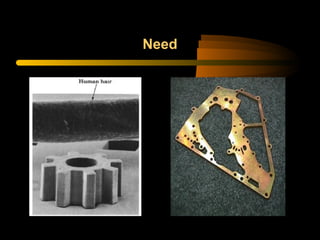
Need
Why NCM?
• In-House machining of complex and less machinable jobs.
• Economical and Faster than purchasing readymade job.
• Processes are computer-controlled, so negligible human
intervention during machining,
Outline
– Ultrasonic Machining
– Water Jet Machining
– Electro-chemical Machining
– Electro-chemical Grinding
– Electrodischarge Machining
– Conclusion
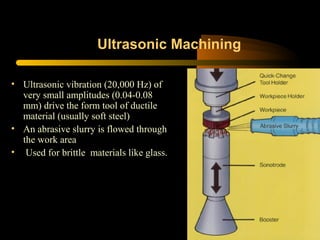
Ultrasonic Machining
• Ultrasonic vibration (20,000 Hz) of
very small amplitudes (0.04-0.08
mm) drive the form tool of ductile
material (usually soft steel)
• An abrasive slurry is flowed through
the work area
• Used for brittle materials like glass.
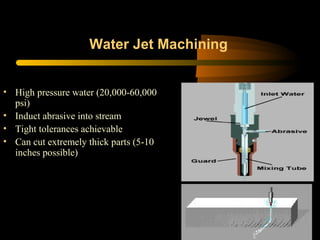
Water Jet Machining
• High pressure water (20,000-60,000
psi)
• Induct abrasive into stream
• Tight tolerances achievable
• Can cut extremely thick parts (5-10
inches possible)
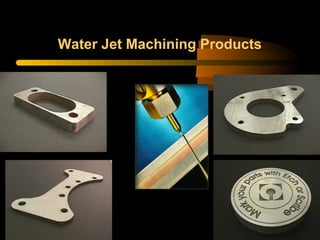
Water Jet Machining Products
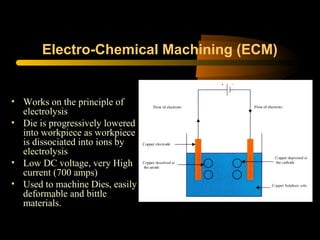
Electro-Chemical Machining (ECM)
• Works on the principle of
electrolysis
• Die is progressively lowered
into workpiece as workpiece
is dissociated into ions by
electrolysis
• Low DC voltage, very High
current (700 amps)
• Used to machine Dies, easily
deformable and bittle
materials.
Electrochemical grinding
• Combines electrochemical machining with conventional
grinding
• Grinding wheel is the cathode
• Metal bonded wheel with diamond or Al2O3 abrasive
• Majority of material removal from electrolytic action (95%)
therefore very low wheel wear
• Much faster than conventional grinding
• Used to grind brittle and thin jobs.
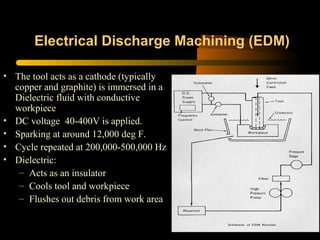
Electrical Discharge Machining (EDM)
• The tool acts as a cathode (typically
copper and graphite) is immersed in a
Dielectric fluid with conductive
workpiece
• DC voltage 40-400V is applied.
• Sparking at around 12,000 deg F.
• Cycle repeated at 200,000-500,000 Hz
• Dielectric:
– Acts as an insulator
– Cools tool and workpiece
– Flushes out debris from work area
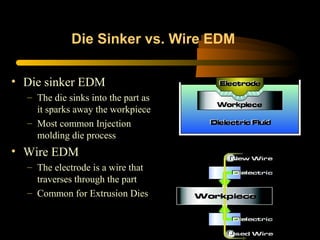
Die Sinker vs. Wire EDM
• Die sinker EDM
– The die sinks into the part as
it sparks away the workpiece
– Most common Injection
molding die process
• Wire EDM
– The electrode is a wire that
traverses through the part
– Common for Extrusion Dies
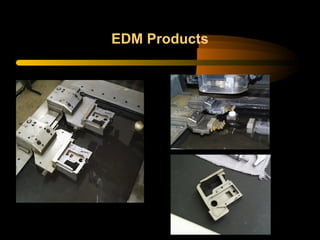
EDM Products
Conclusion
Non Conventional machining processes are used when
required attributes are impossible to achieve with
traditional machining processes.
Any Queries???
Thank You!!!

Non Conventional machining processes

  • 1.
    Machining… with adifference!! That’s what Non-conventional Machining is all about…!!!!
  • 2.
    Objective of Presentation Atthe end of this presentation, audience will be aware of merits of Non conventional machining processes over their traditional counter-parts.
  • 3.
  • 4.
    Why NCM? • In-Housemachining of complex and less machinable jobs. • Economical and Faster than purchasing readymade job. • Processes are computer-controlled, so negligible human intervention during machining,
  • 5.
    Outline – Ultrasonic Machining –Water Jet Machining – Electro-chemical Machining – Electro-chemical Grinding – Electrodischarge Machining – Conclusion
  • 6.
    Ultrasonic Machining • Ultrasonicvibration (20,000 Hz) of very small amplitudes (0.04-0.08 mm) drive the form tool of ductile material (usually soft steel) • An abrasive slurry is flowed through the work area • Used for brittle materials like glass.
  • 7.
    Water Jet Machining •High pressure water (20,000-60,000 psi) • Induct abrasive into stream • Tight tolerances achievable • Can cut extremely thick parts (5-10 inches possible)
  • 8.
  • 9.
    Electro-Chemical Machining (ECM) •Works on the principle of electrolysis • Die is progressively lowered into workpiece as workpiece is dissociated into ions by electrolysis • Low DC voltage, very High current (700 amps) • Used to machine Dies, easily deformable and bittle materials.
  • 10.
    Electrochemical grinding • Combineselectrochemical machining with conventional grinding • Grinding wheel is the cathode • Metal bonded wheel with diamond or Al2O3 abrasive • Majority of material removal from electrolytic action (95%) therefore very low wheel wear • Much faster than conventional grinding • Used to grind brittle and thin jobs.
  • 11.
    Electrical Discharge Machining(EDM) • The tool acts as a cathode (typically copper and graphite) is immersed in a Dielectric fluid with conductive workpiece • DC voltage 40-400V is applied. • Sparking at around 12,000 deg F. • Cycle repeated at 200,000-500,000 Hz • Dielectric: – Acts as an insulator – Cools tool and workpiece – Flushes out debris from work area
  • 12.
    Die Sinker vs.Wire EDM • Die sinker EDM – The die sinks into the part as it sparks away the workpiece – Most common Injection molding die process • Wire EDM – The electrode is a wire that traverses through the part – Common for Extrusion Dies
  • 13.
  • 15.
    Conclusion Non Conventional machiningprocesses are used when required attributes are impossible to achieve with traditional machining processes.
  • 16.
  • 17.