S. MANEESH AHAMED
ROLL NO : 12
FINAL YEAR PART 1
• INTRODUCTION
• OSSEOUS DEFECTS
• CLASSIFICATION OF OSSEOUS DEFECTS
• HORIZONTAL BONE LOSS
• VERTICAL/ANGULAR BONE LOSS
- TYPES OF ANGULAR BONE LOSS
• OSSEOUS CRATERS
• BULBOUS BONY CONTOURS
•LEDGES
•FURCATION INVOLVEMENT
- CLASSIFICATION OF FURCATION INVOLVEMENT
•CONCLUSION
•BIBLIOGRAPHY
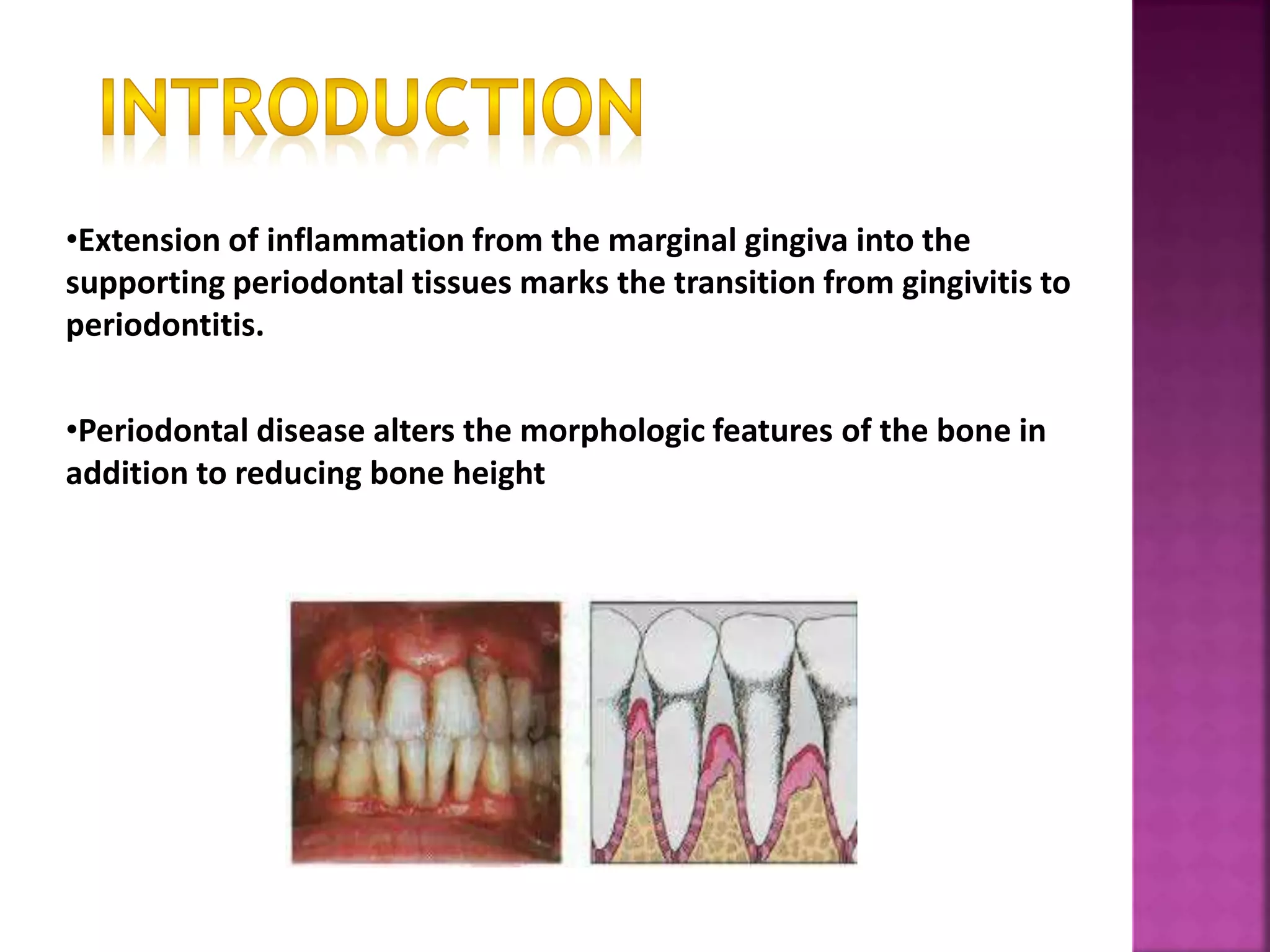
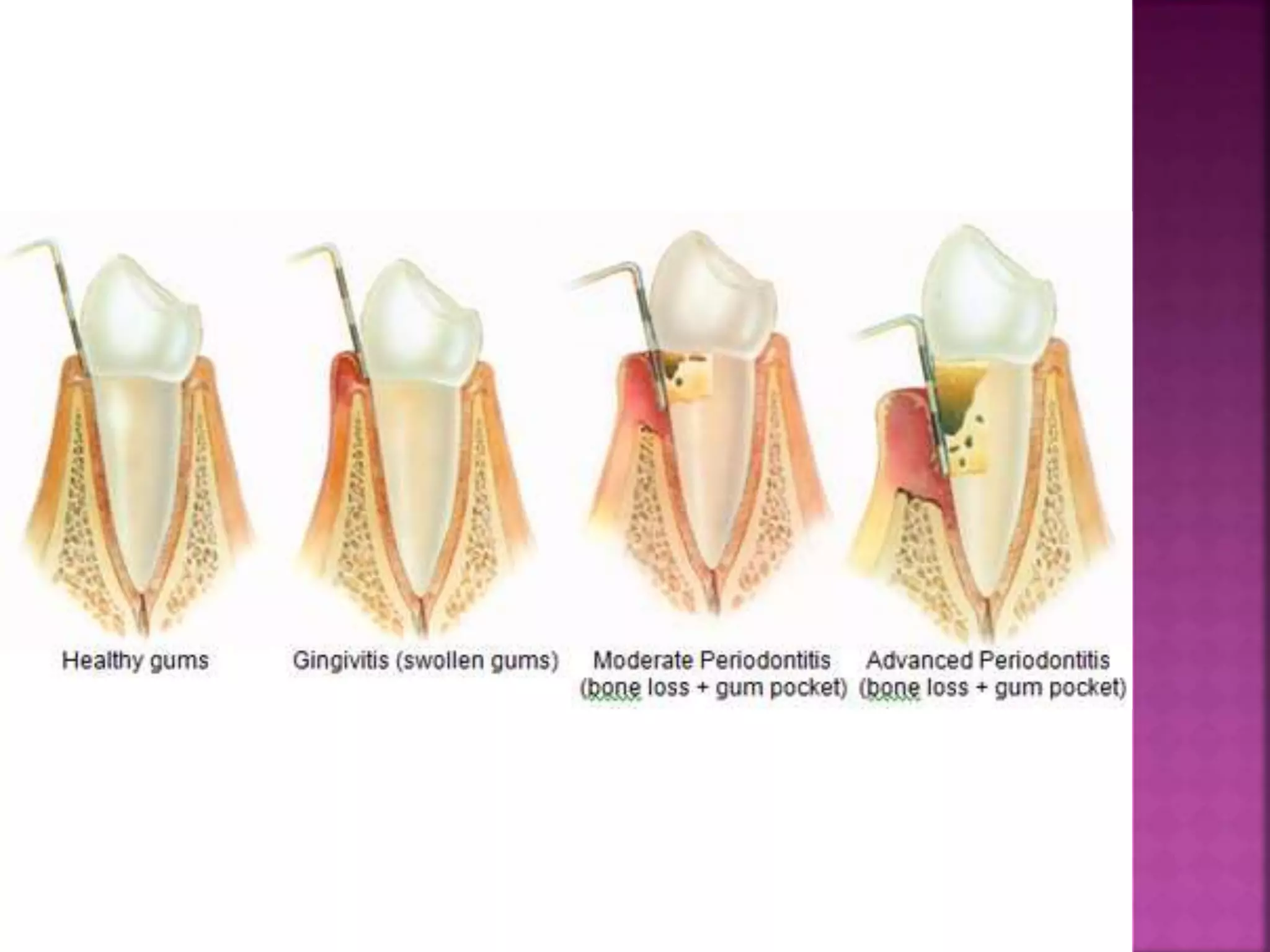
•Extension of inflammation from the marginal gingiva into the
supporting periodontal tissues marks the transition from gingivitis to
periodontitis.
•Periodontal disease alters the morphologic features of the bone in
addition to reducing bone height
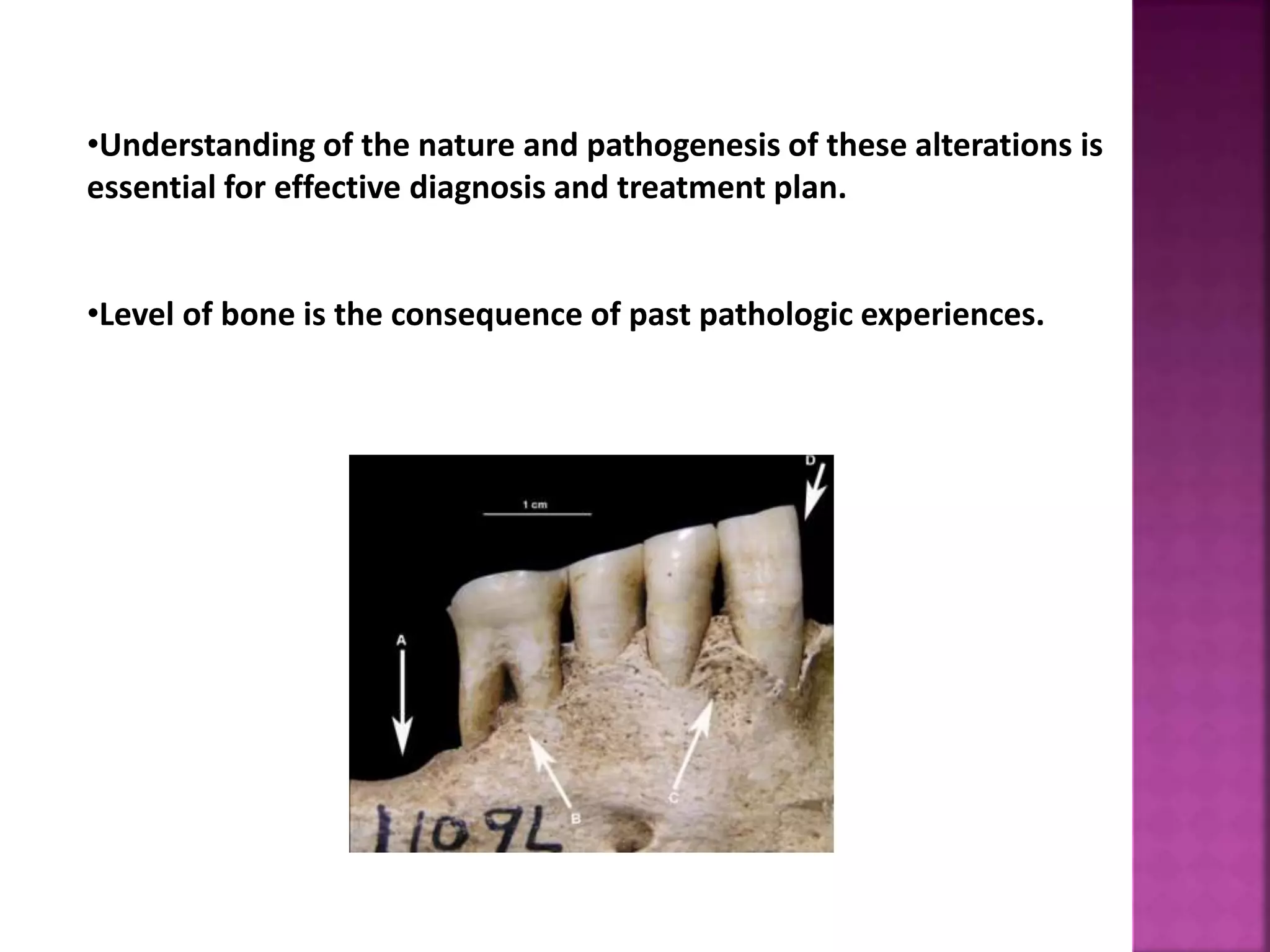
•Understanding of the nature and pathogenesis of these alterations is
essential for effective diagnosis and treatment plan.
•Level of bone is the consequence of past pathologic experiences.
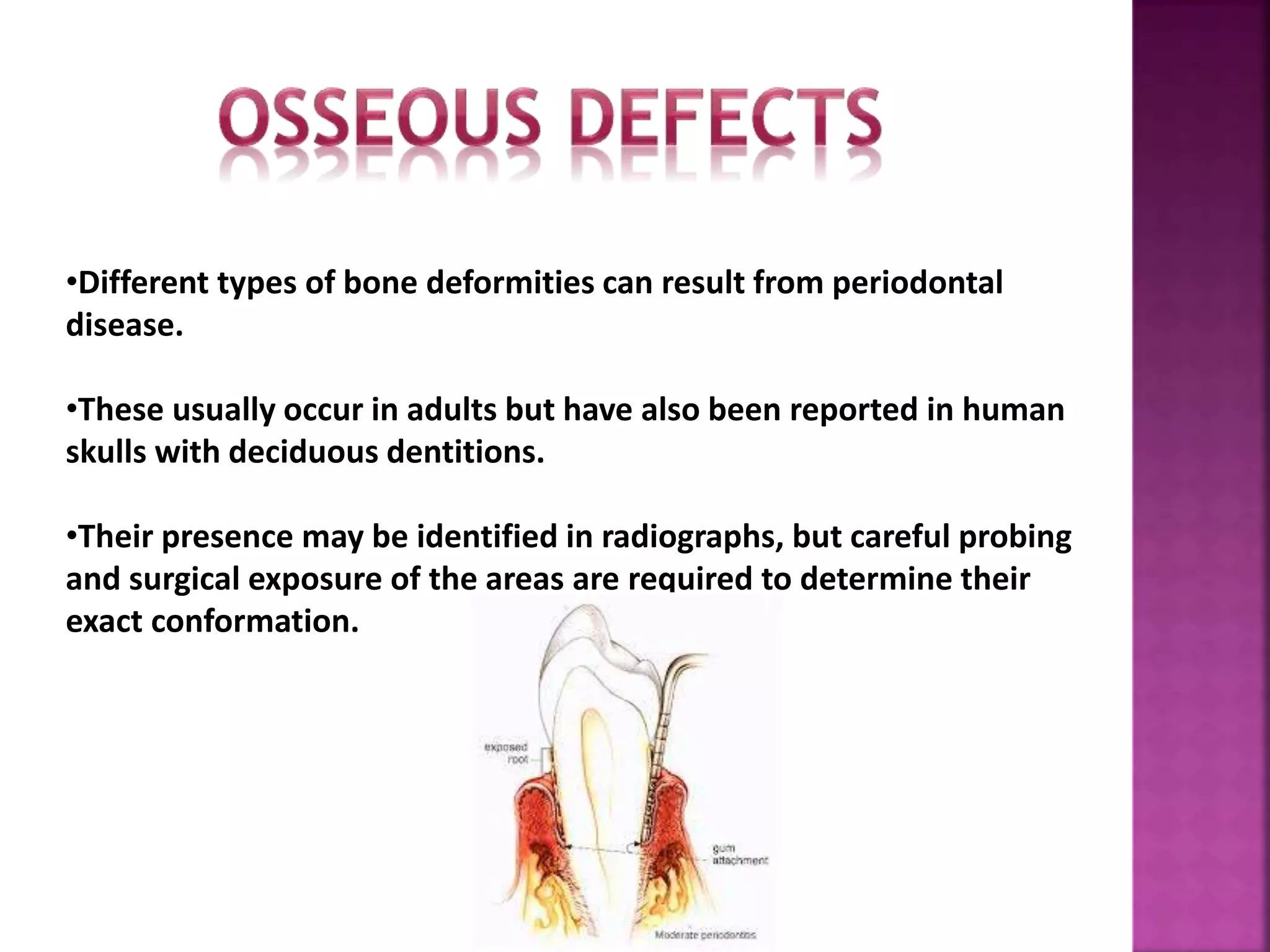
•Different types of bone deformities can result from periodontal
disease.
•These usually occur in adults but have also been reported in human
skulls with deciduous dentitions.
•Their presence may be identified in radiographs, but careful probing
and surgical exposure of the areas are required to determine their
exact conformation.
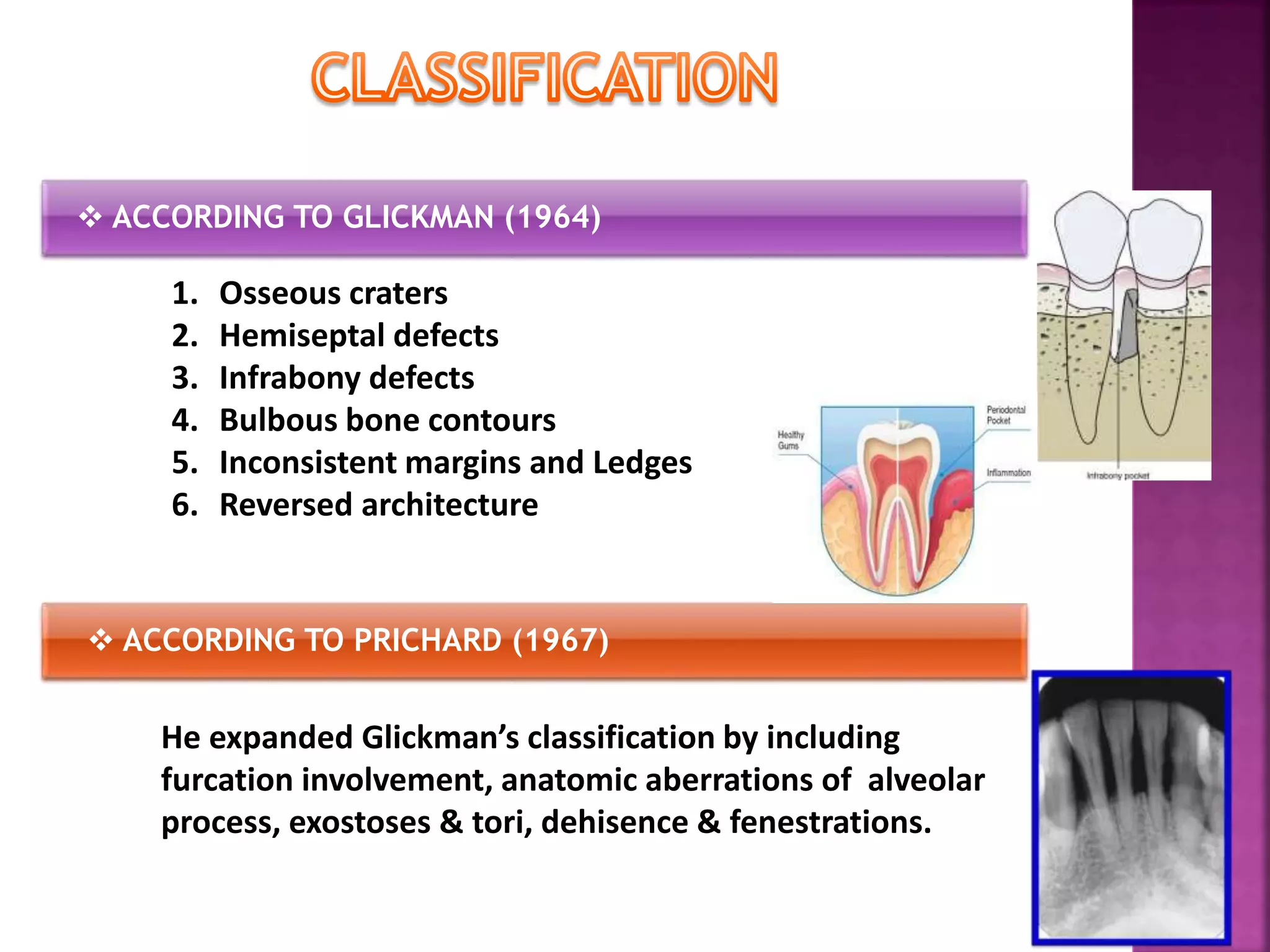
 ACCORDING TO GLICKMAN (1964)
1. Osseous craters
2. Hemiseptal defects
3. Infrabony defects
4. Bulbous bone contours
5. Inconsistent margins and Ledges
6. Reversed architecture
 ACCORDING TO PRICHARD (1967)
He expanded Glickman’s classification by including
furcation involvement, anatomic aberrations of alveolar
process, exostoses & tori, dehisence & fenestrations.
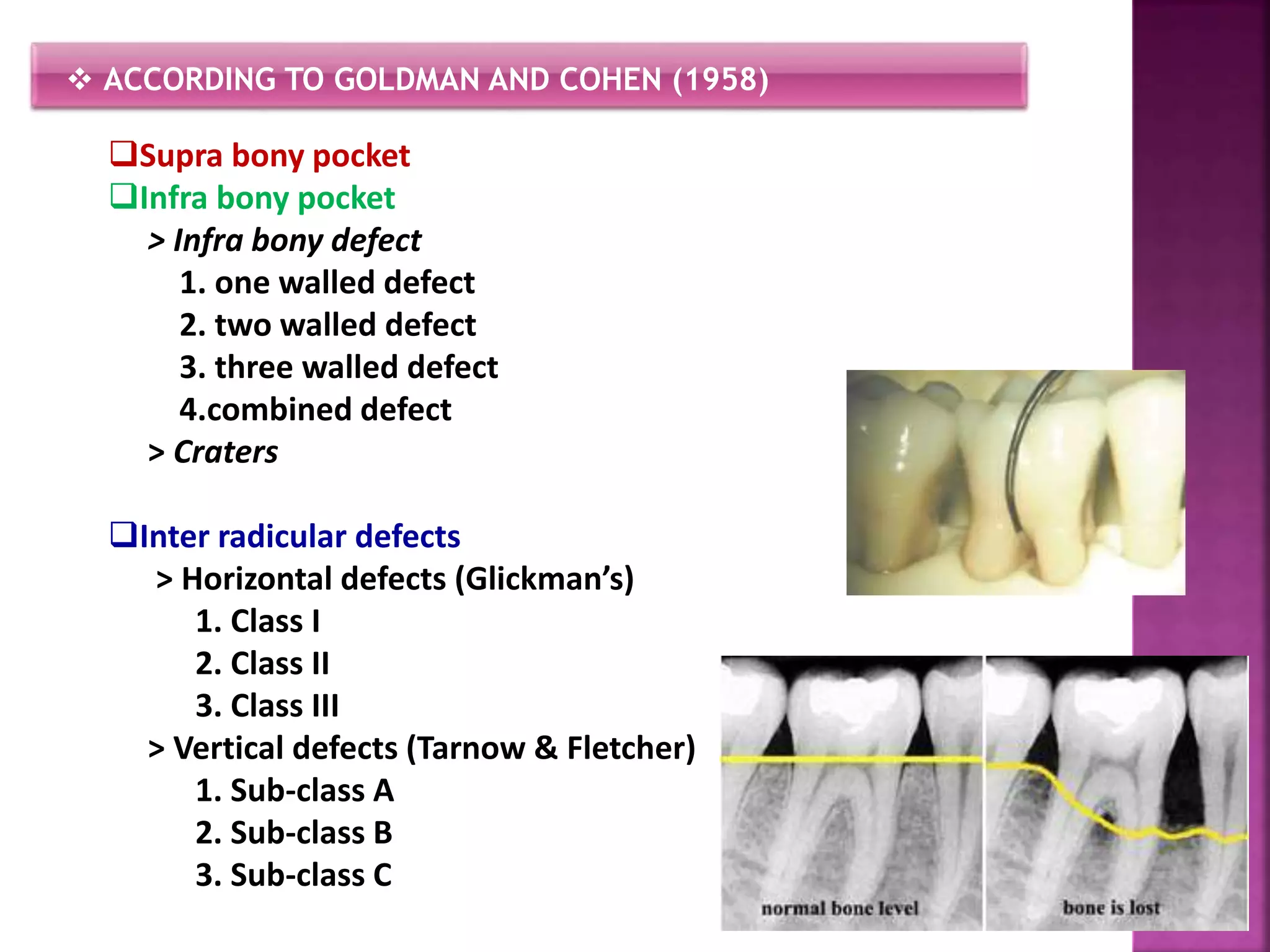
 ACCORDING TO GOLDMAN AND COHEN (1958)
Supra bony pocket
Infra bony pocket
> Infra bony defect
1. one walled defect
2. two walled defect
3. three walled defect
4.combined defect
> Craters
Inter radicular defects
> Horizontal defects (Glickman’s)
1. Class I
2. Class II
3. Class III
> Vertical defects (Tarnow & Fletcher)
1. Sub-class A
2. Sub-class B
3. Sub-class C
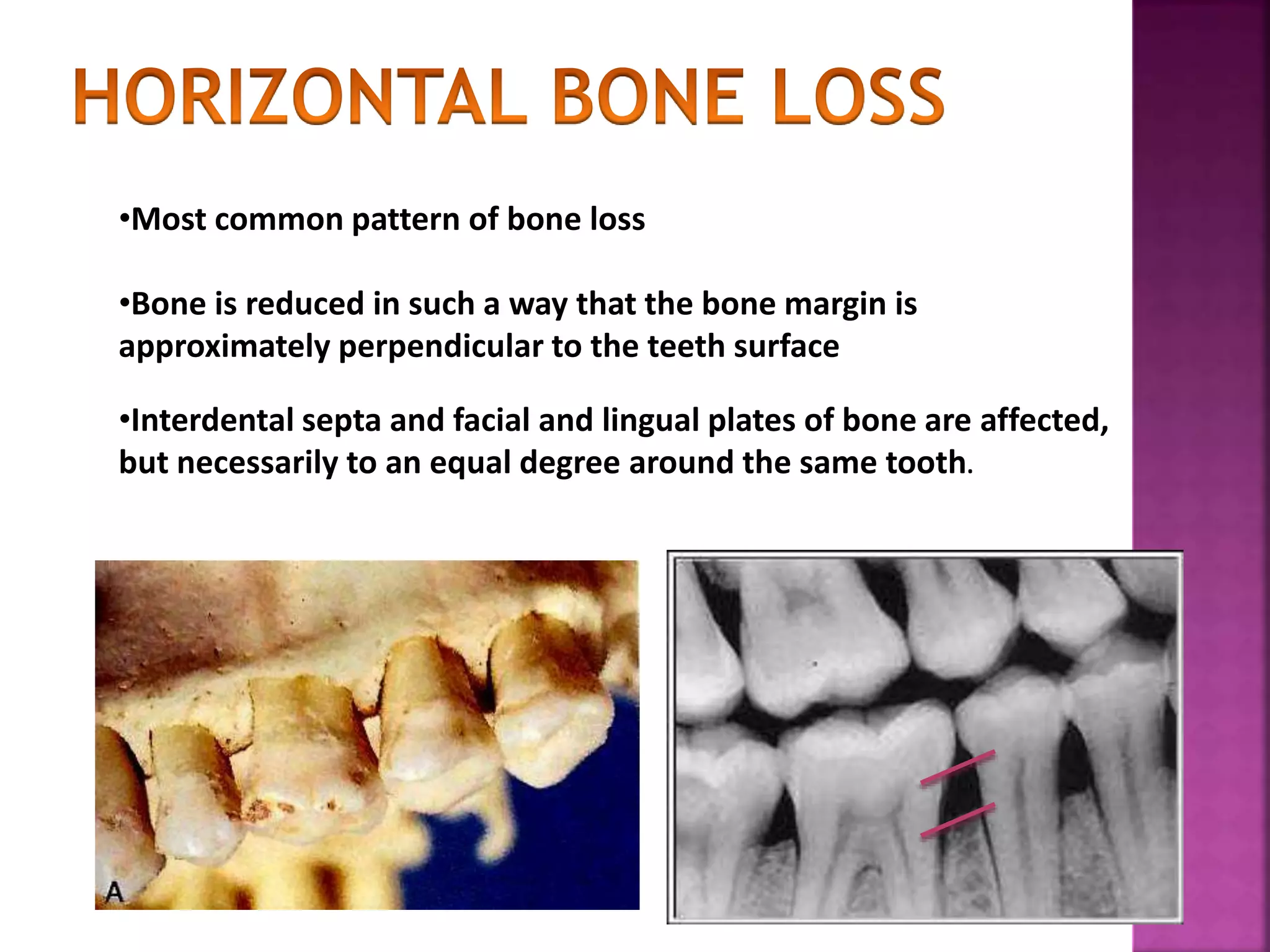
•Most common pattern of bone loss
•Bone is reduced in such a way that the bone margin is
approximately perpendicular to the teeth surface
•Interdental septa and facial and lingual plates of bone are affected,
but necessarily to an equal degree around the same tooth.
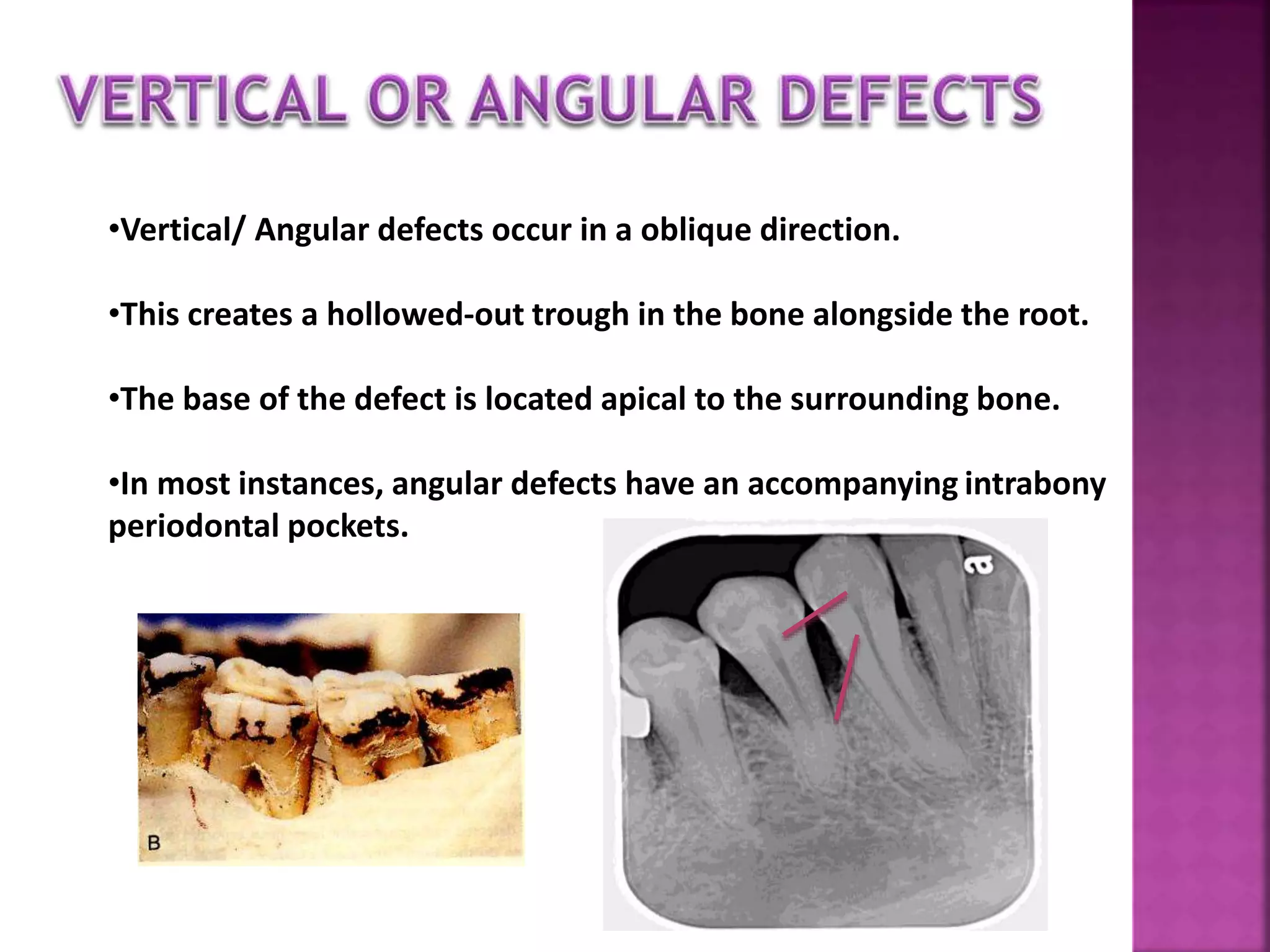
•Vertical/ Angular defects occur in a oblique direction.
•This creates a hollowed-out trough in the bone alongside the root.
•The base of the defect is located apical to the surrounding bone.
•In most instances, angular defects have an accompanying intrabony
periodontal pockets.
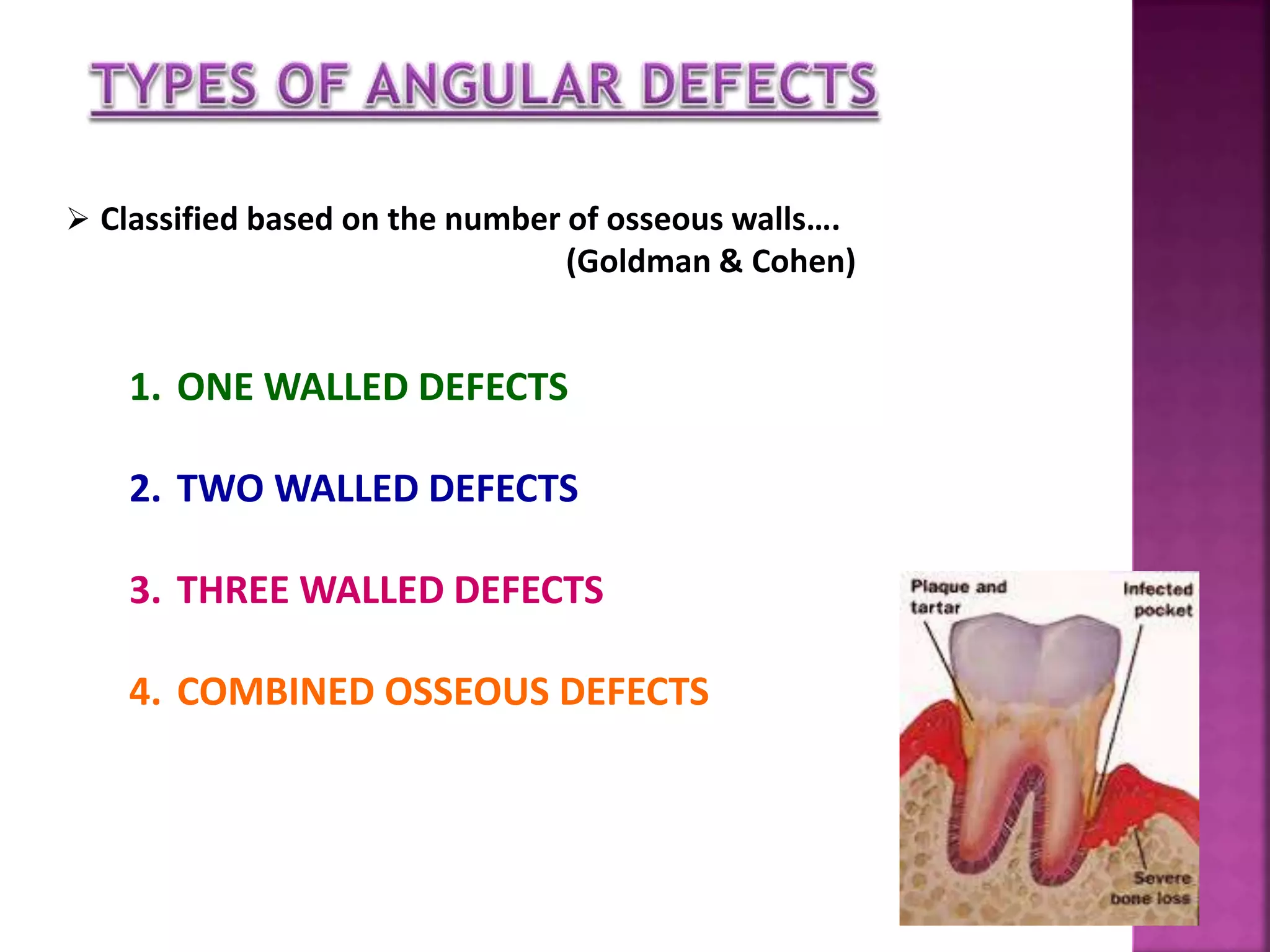
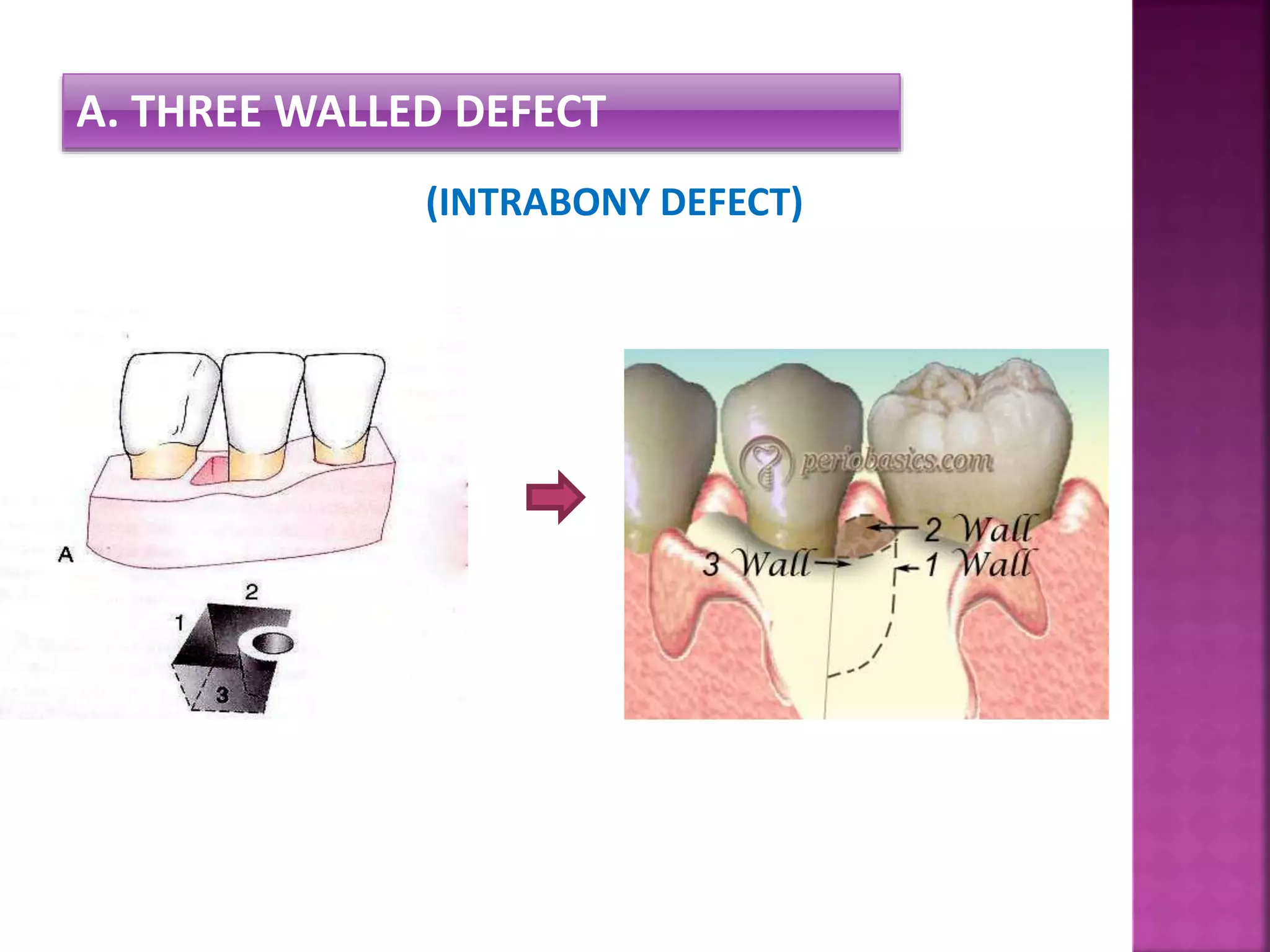
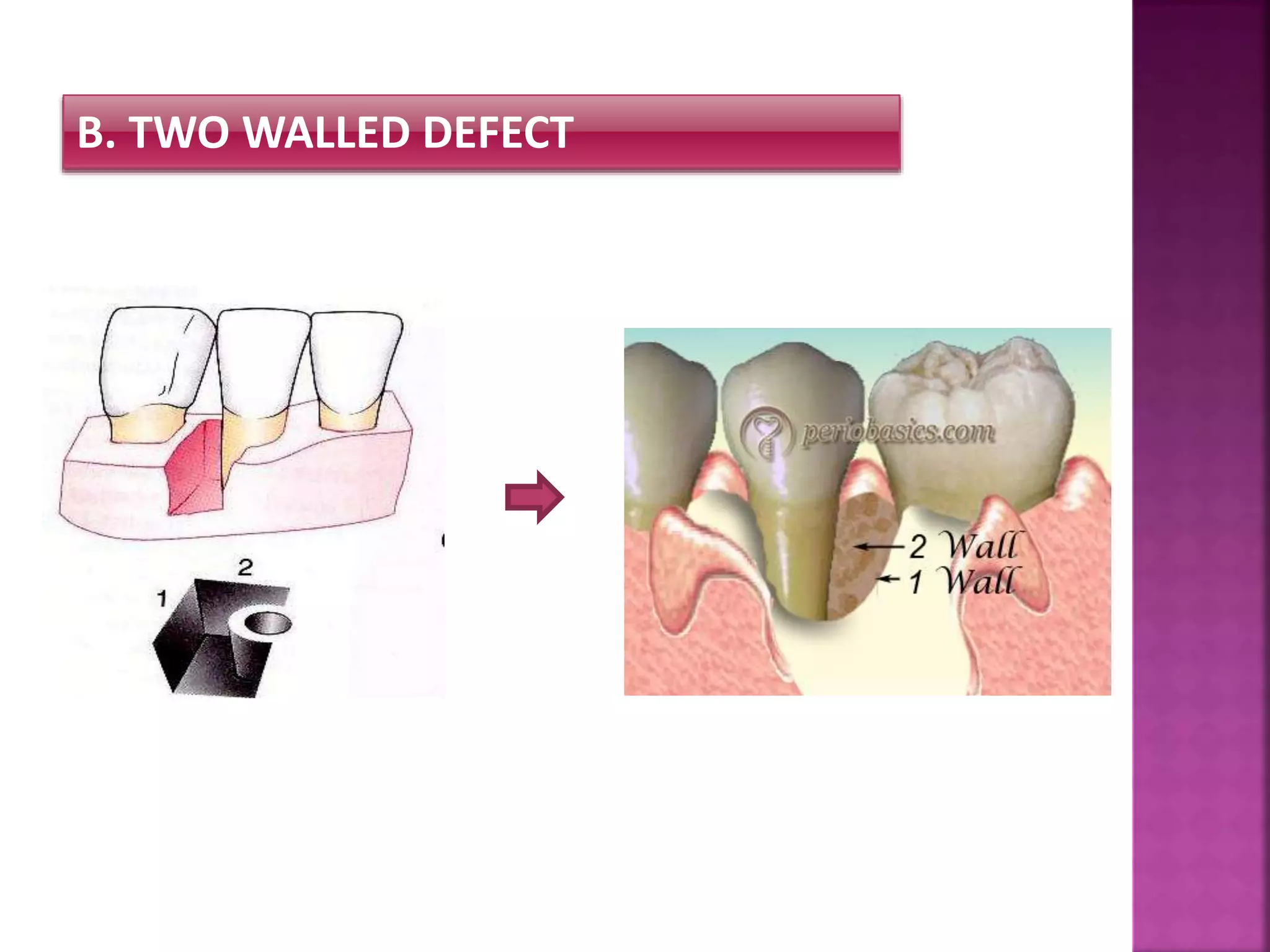
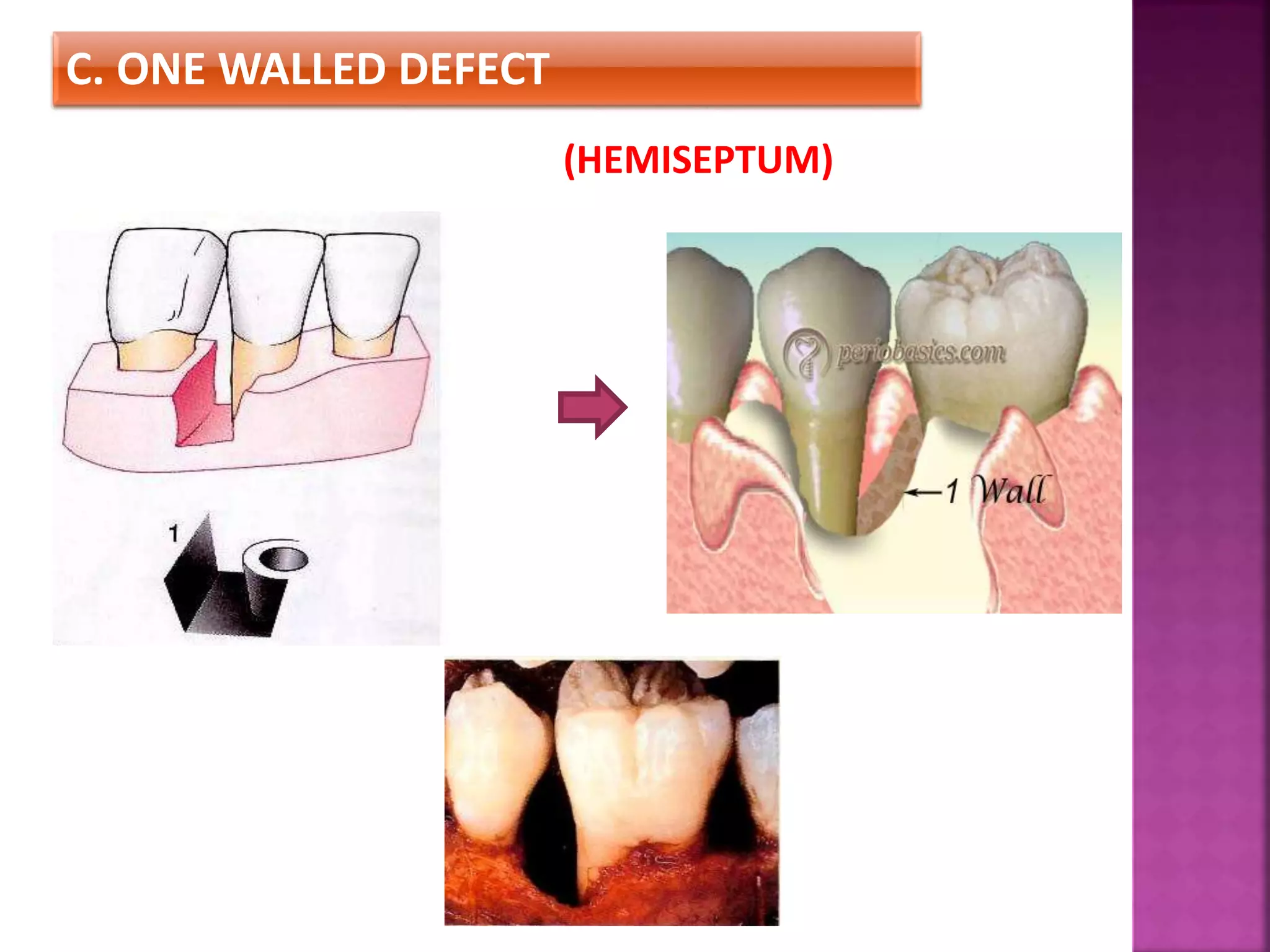
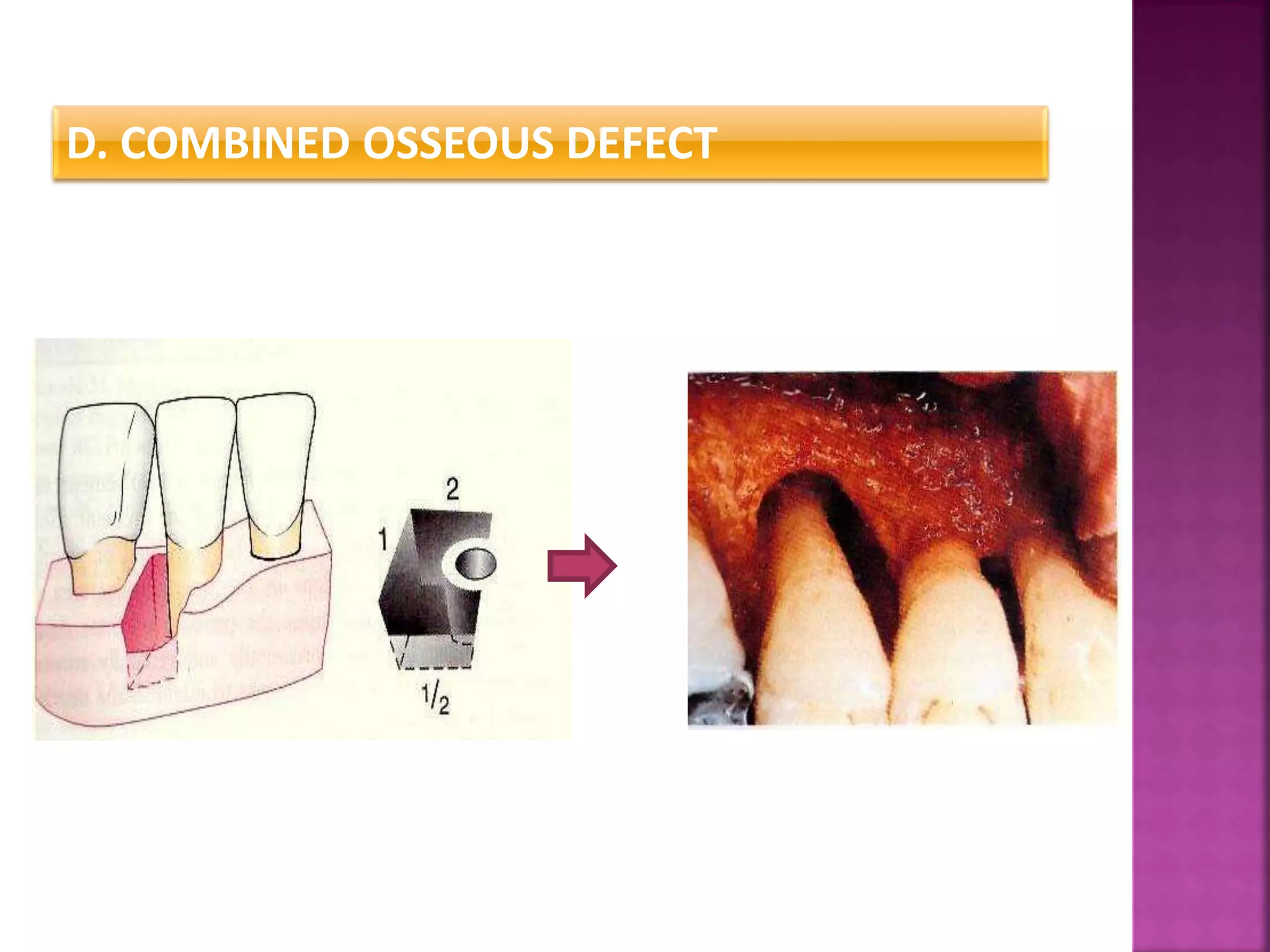
 Classified based on the number of osseous walls….
(Goldman & Cohen)
1. ONE WALLED DEFECTS
2. TWO WALLED DEFECTS
3. THREE WALLED DEFECTS
4. COMBINED OSSEOUS DEFECTS
A. THREE WALLED DEFECT
(INTRABONY DEFECT)
B. TWO WALLED DEFECT
C. ONE WALLED DEFECT
(HEMISEPTUM)
D. COMBINED OSSEOUS DEFECT
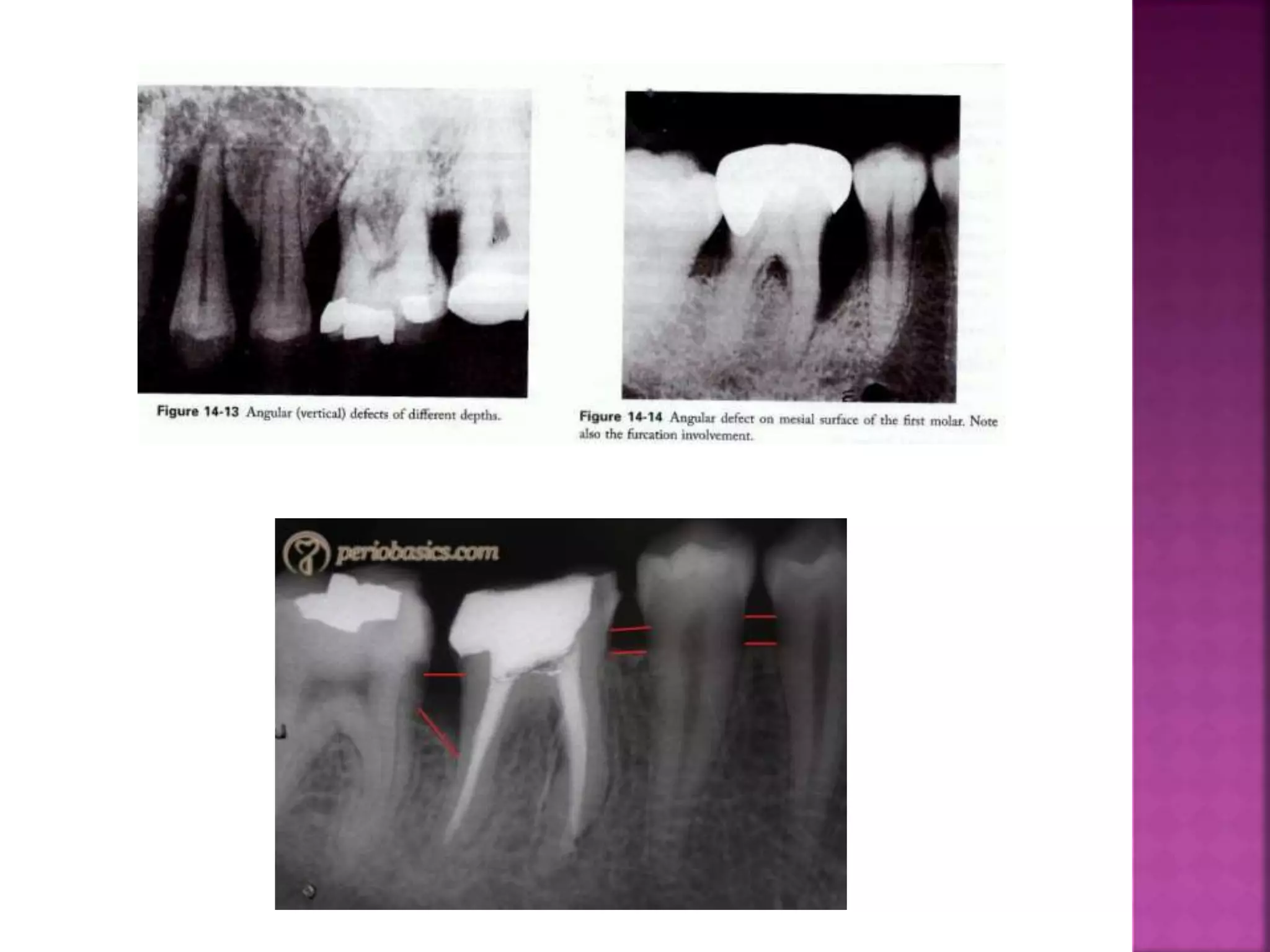
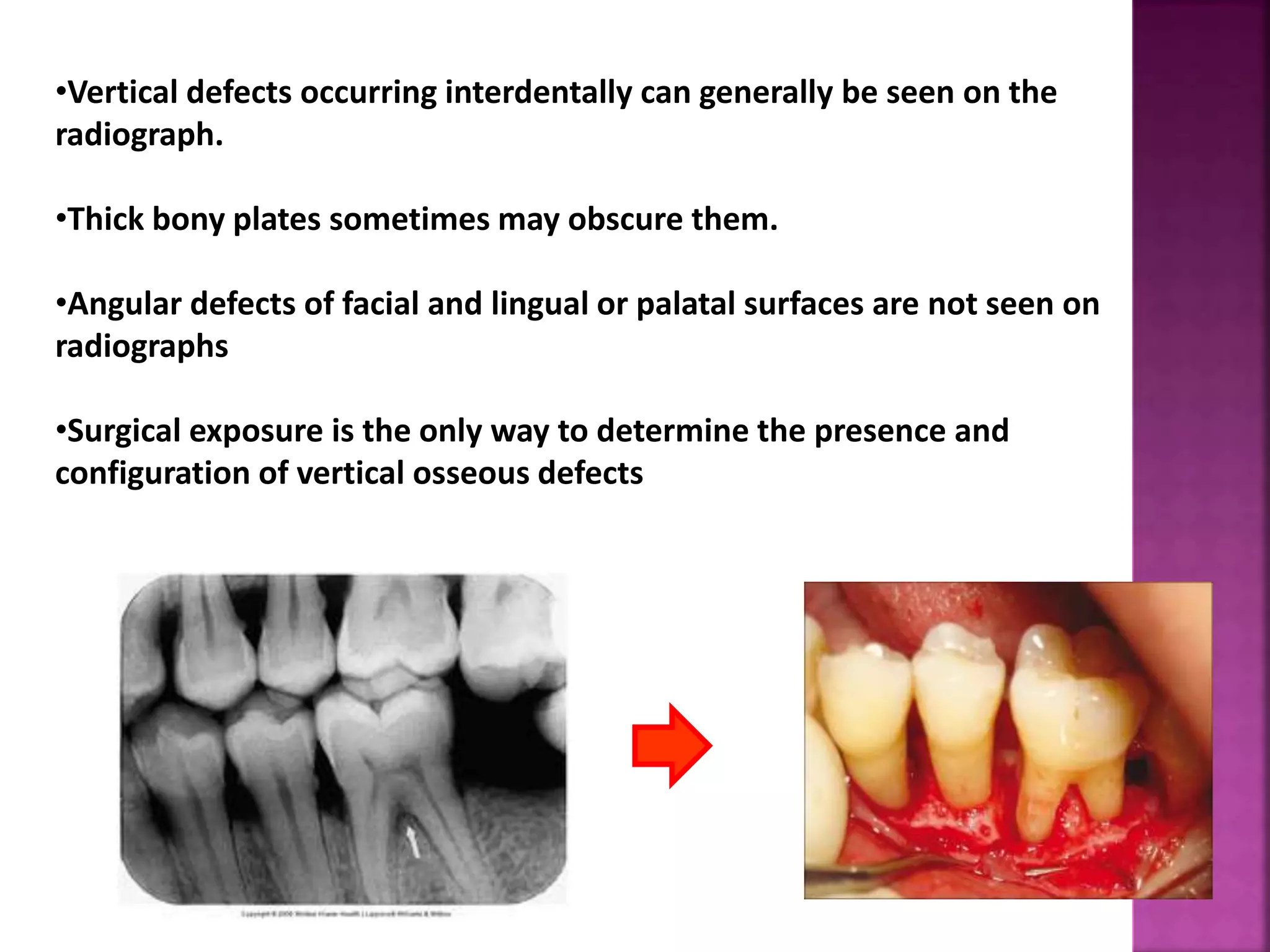
•Vertical defects occurring interdentally can generally be seen on the
radiograph.
•Thick bony plates sometimes may obscure them.
•Angular defects of facial and lingual or palatal surfaces are not seen on
radiographs
•Surgical exposure is the only way to determine the presence and
configuration of vertical osseous defects
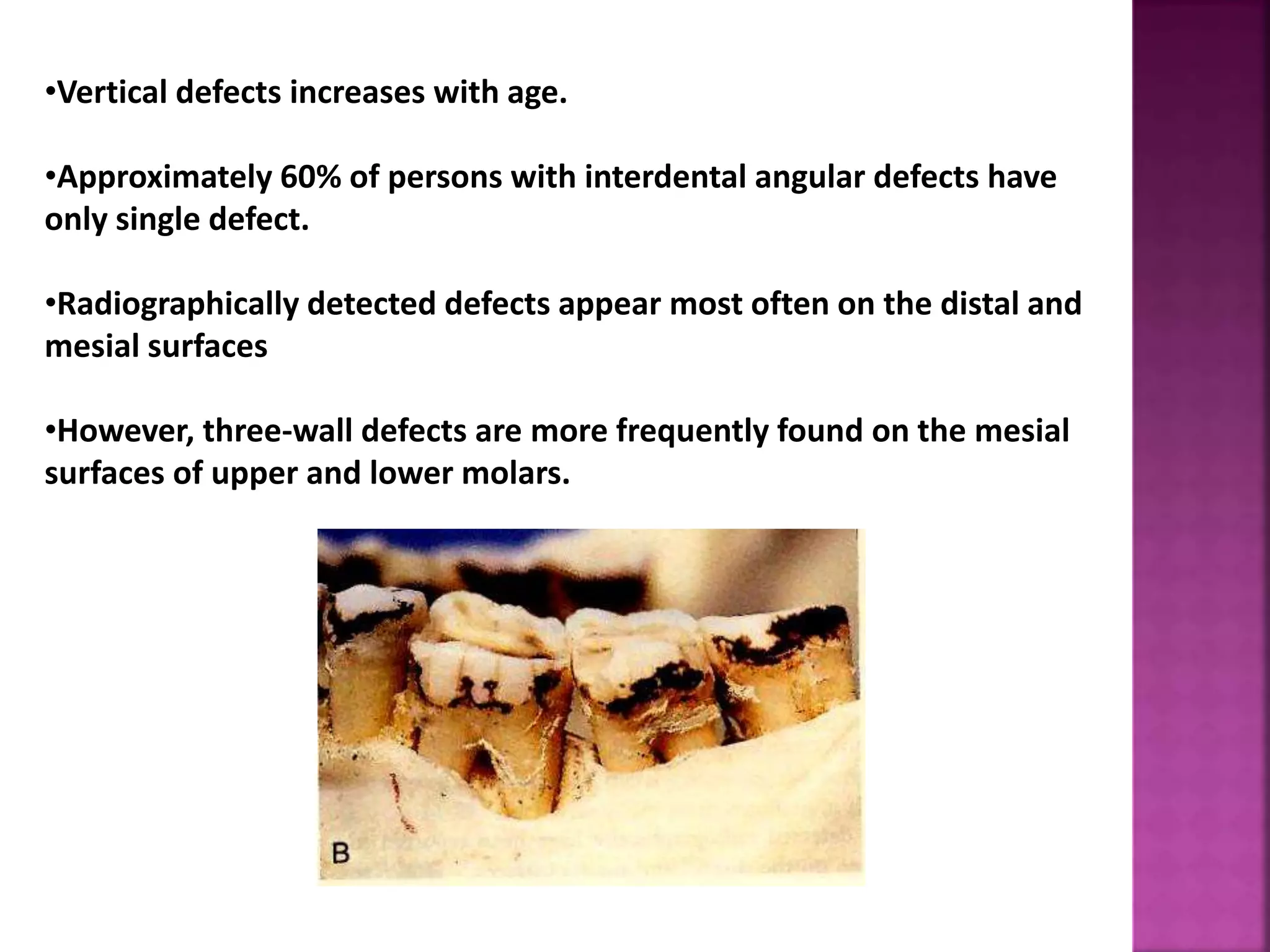
•Vertical defects increases with age.
•Approximately 60% of persons with interdental angular defects have
only single defect.
•Radiographically detected defects appear most often on the distal and
mesial surfaces
•However, three-wall defects are more frequently found on the mesial
surfaces of upper and lower molars.
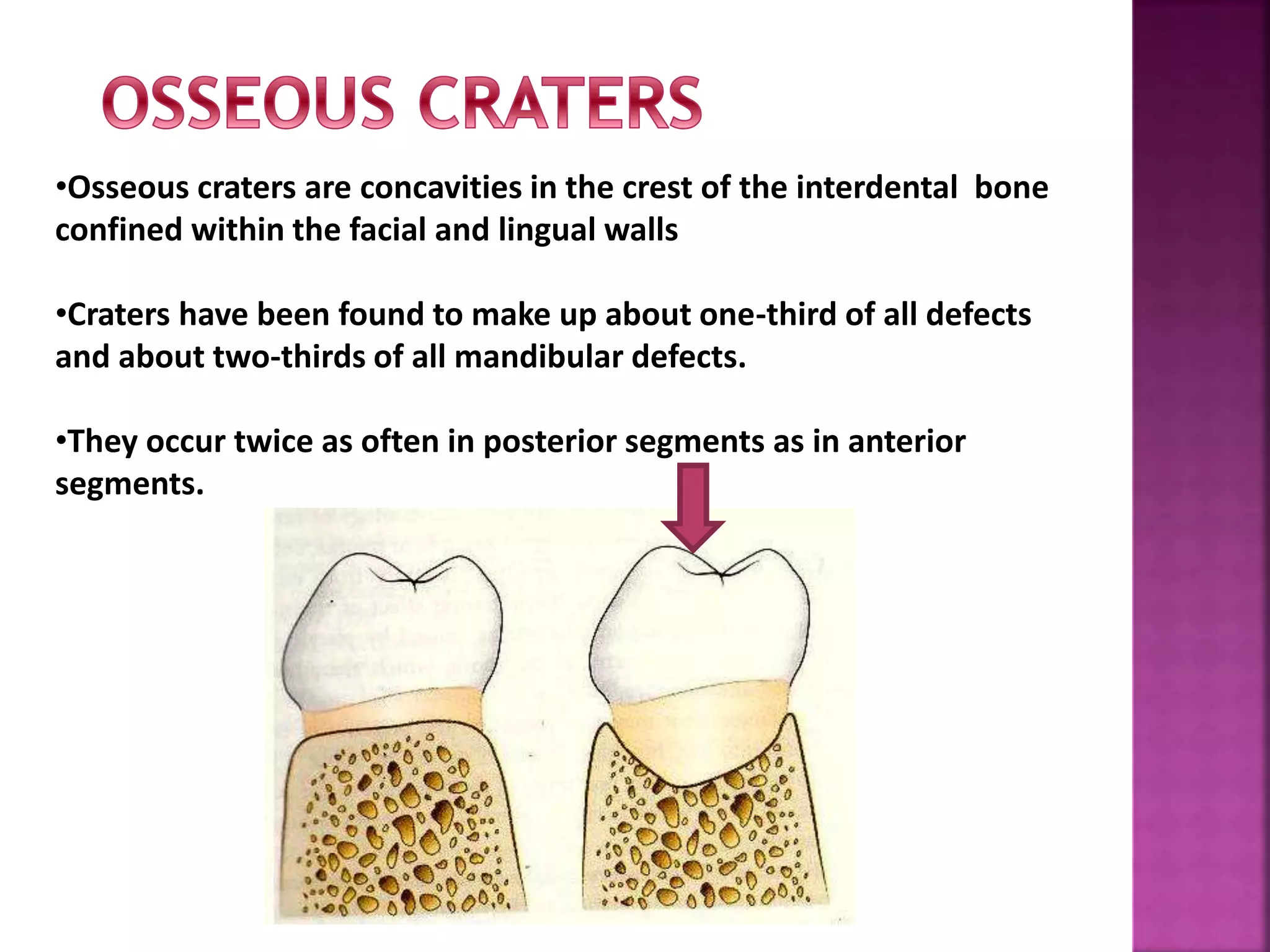
•Osseous craters are concavities in the crest of the interdental bone
confined within the facial and lingual walls
•Craters have been found to make up about one-third of all defects
and about two-thirds of all mandibular defects.
•They occur twice as often in posterior segments as in anterior
segments.
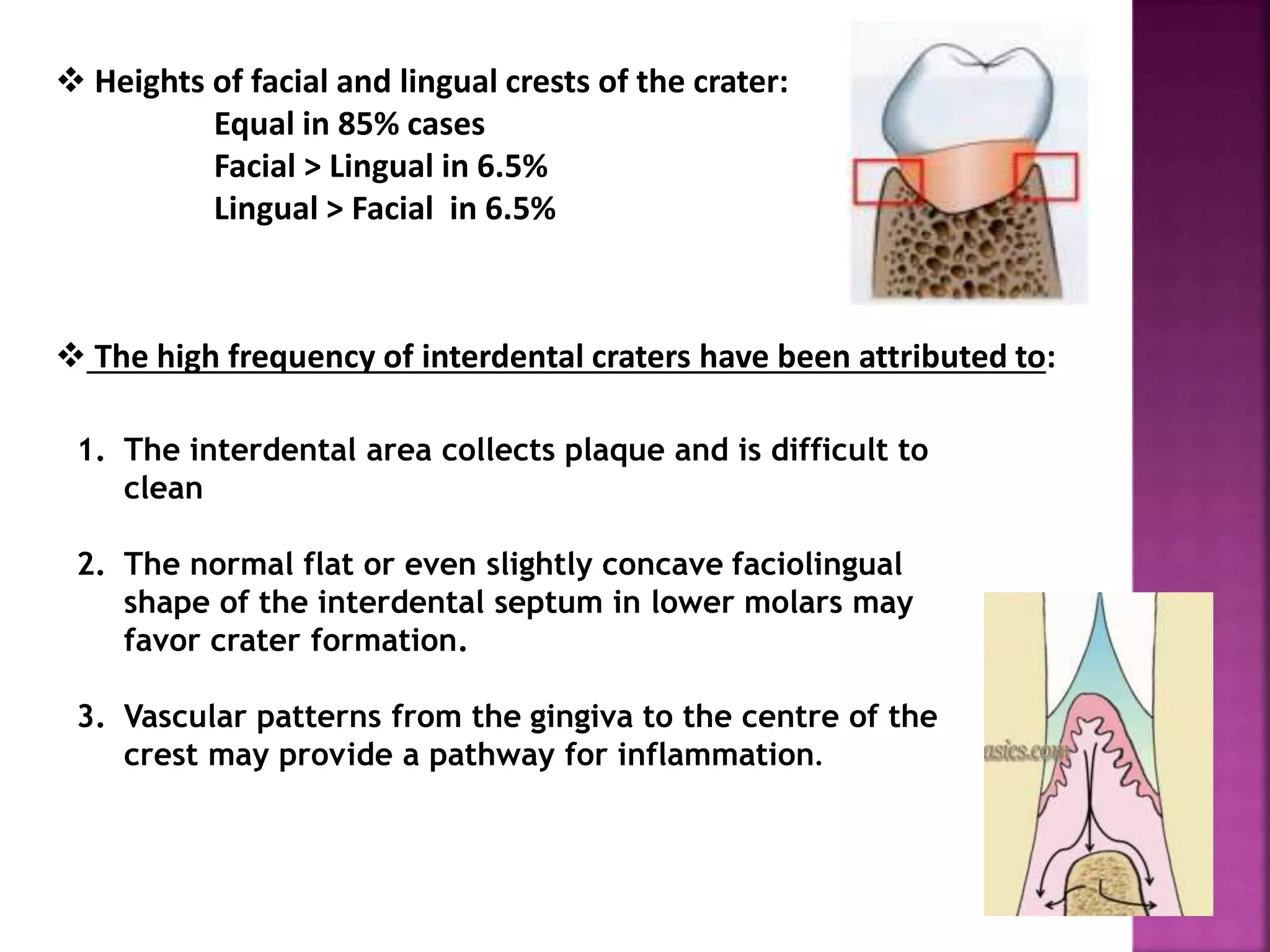
 Heights of facial and lingual crests of the crater:
Equal in 85% cases
Facial > Lingual in 6.5%
Lingual > Facial in 6.5%
 The high frequency of interdental craters have been attributed to:
1. The interdental area collects plaque and is difficult to
clean
2. The normal flat or even slightly concave faciolingual
shape of the interdental septum in lower molars may
favor crater formation.
3. Vascular patterns from the gingiva to the centre of the
crest may provide a pathway for inflammation.
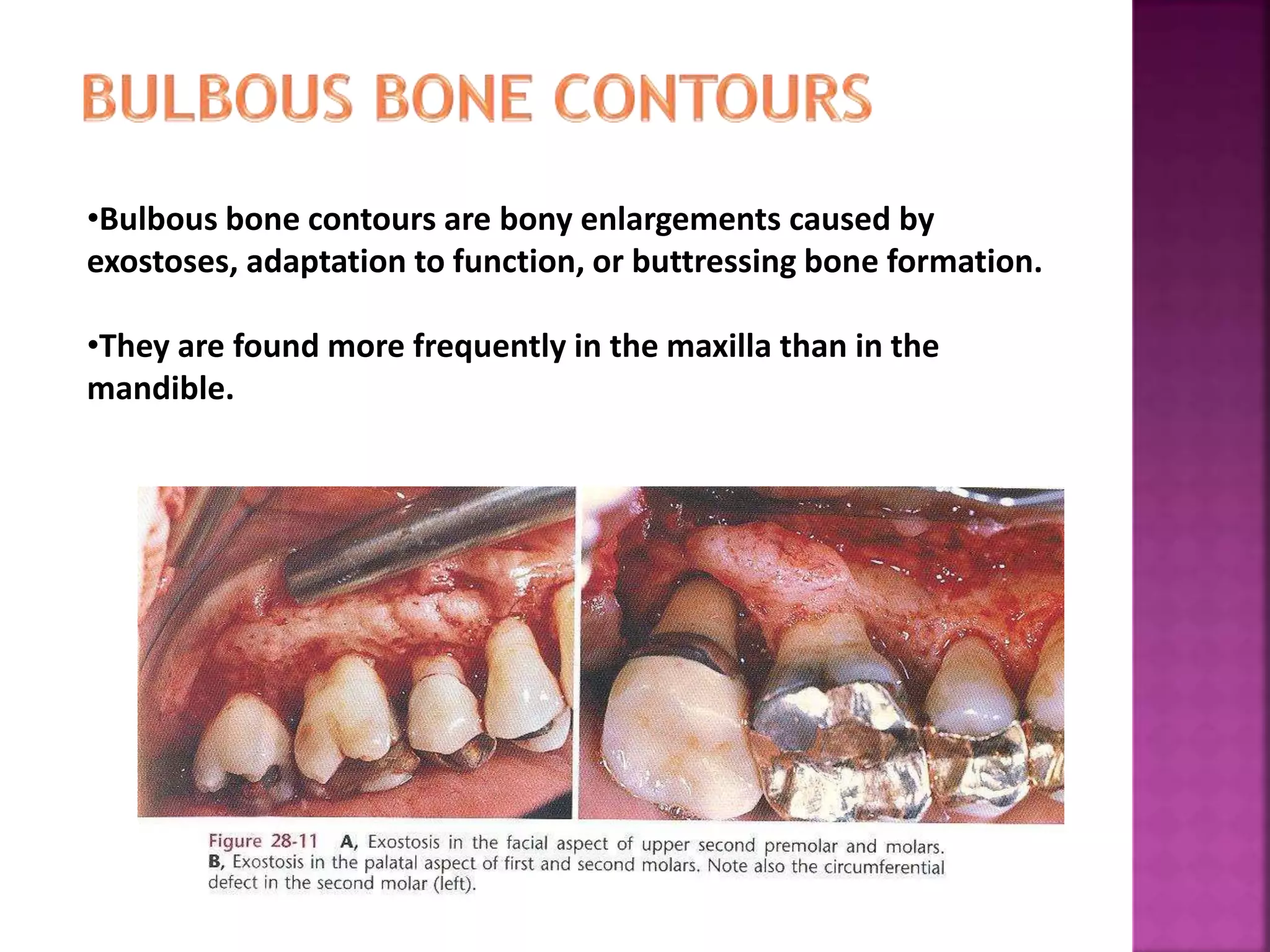
•Bulbous bone contours are bony enlargements caused by
exostoses, adaptation to function, or buttressing bone formation.
•They are found more frequently in the maxilla than in the
mandible.
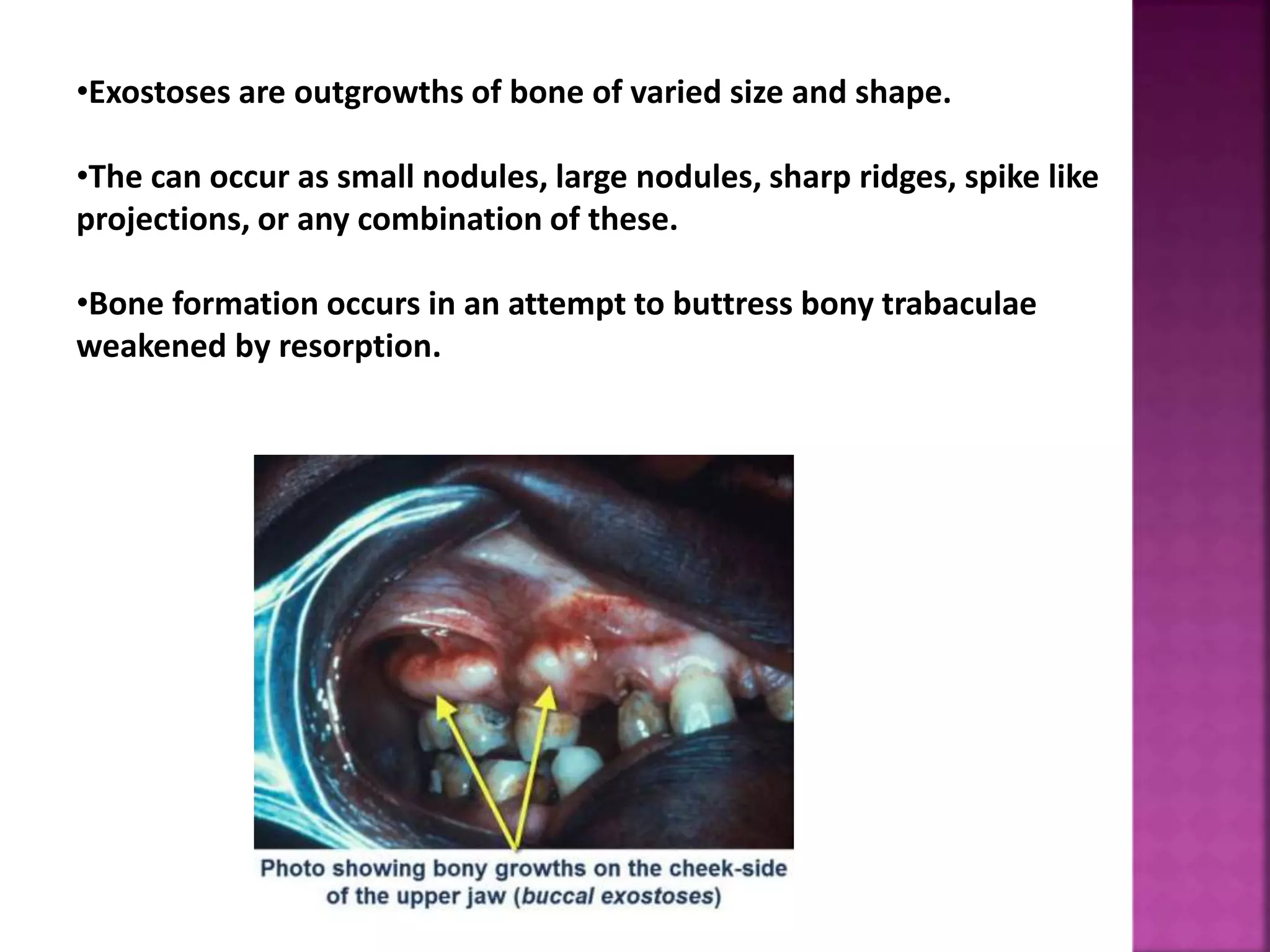
•Exostoses are outgrowths of bone of varied size and shape.
•The can occur as small nodules, large nodules, sharp ridges, spike like
projections, or any combination of these.
•Bone formation occurs in an attempt to buttress bony trabaculae
weakened by resorption.
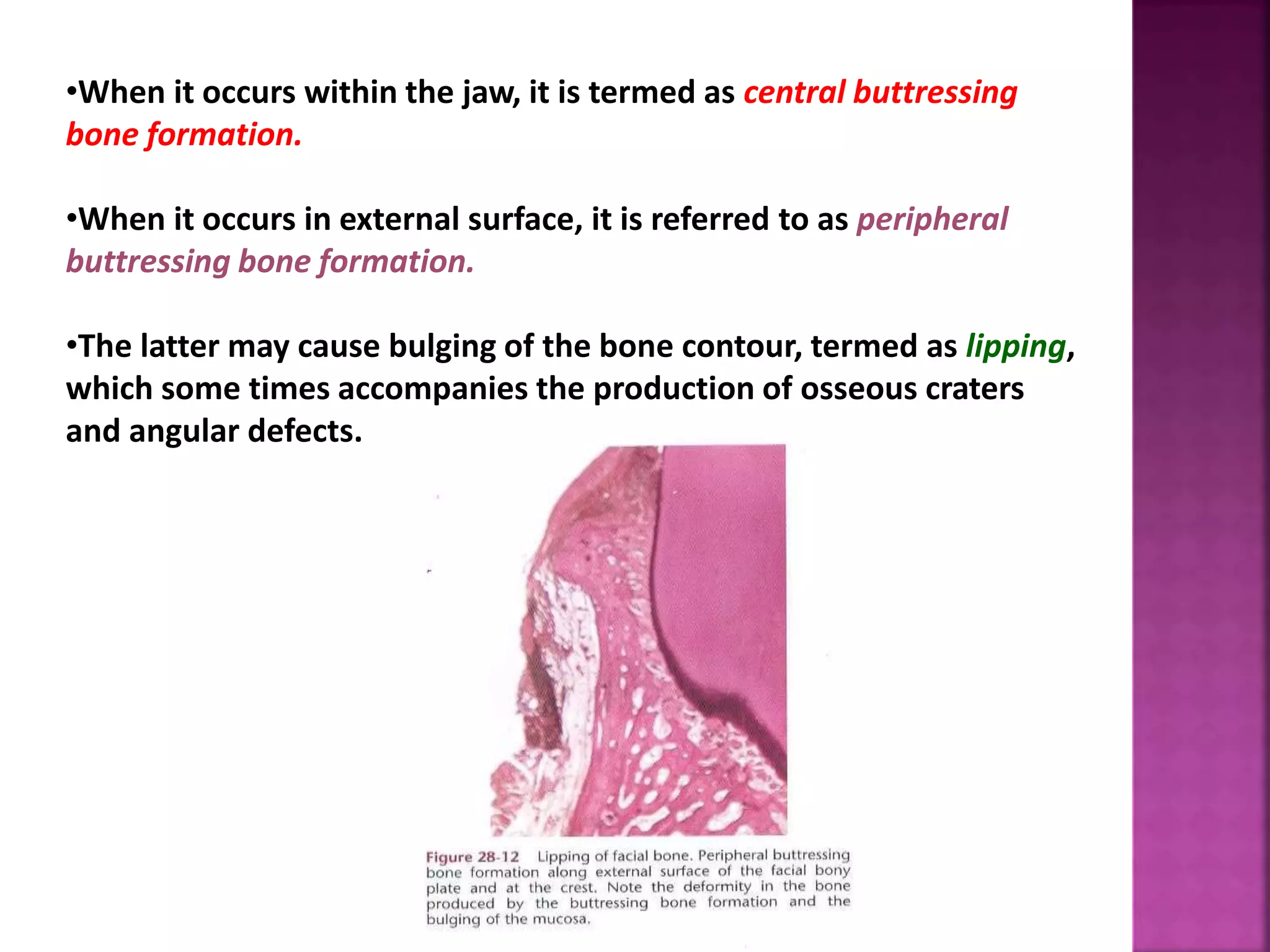
•When it occurs within the jaw, it is termed as central buttressing
bone formation.
•When it occurs in external surface, it is referred to as peripheral
buttressing bone formation.
•The latter may cause bulging of the bone contour, termed as lipping,
which some times accompanies the production of osseous craters
and angular defects.
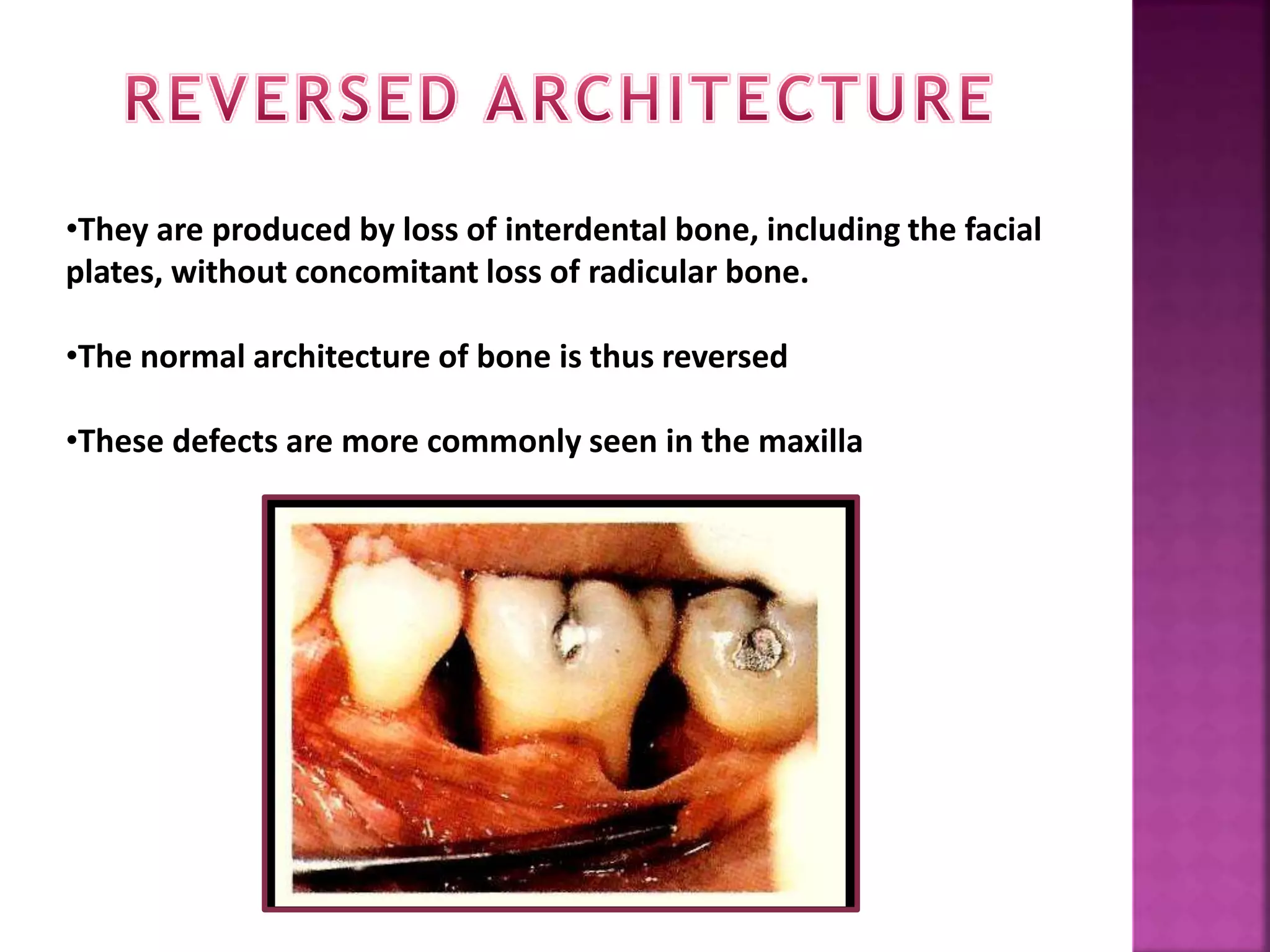
•They are produced by loss of interdental bone, including the facial
plates, without concomitant loss of radicular bone.
•The normal architecture of bone is thus reversed
•These defects are more commonly seen in the maxilla
•Ledges are plateau like bone margins caused by resorption of thickened
bony plates
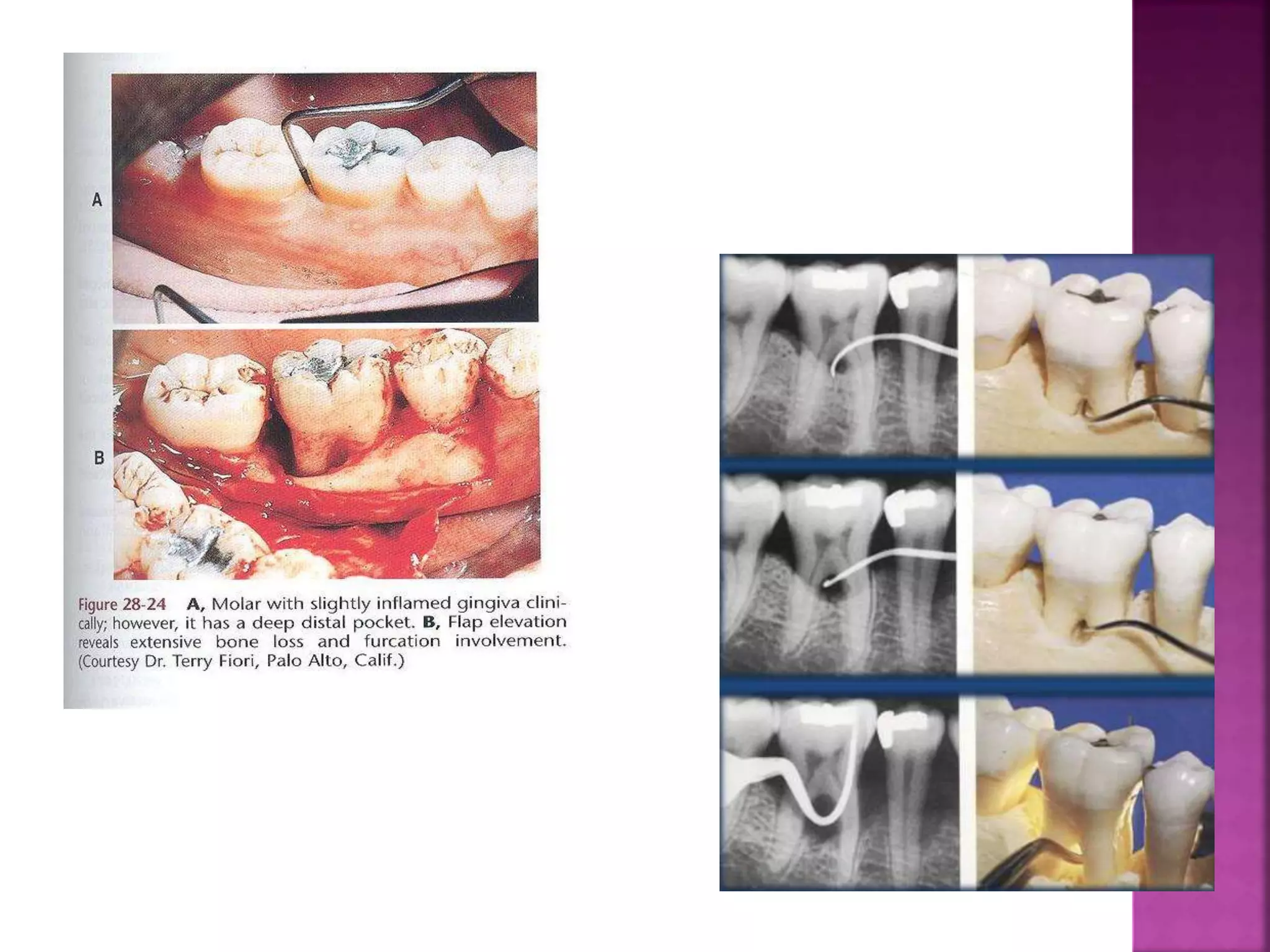
•The term Furcation involvement refers to the invasion of the
bifurcation and trifurcation of multi-rooted teeth by periodontal
disease.
•Denuded furcation may be visible clinically or covered by the wall
of pocket.
•Extend of involvement is determined by exploration with a blunt
probe, along with a simultaneous blast of warm air to facilitate
visualization.
 CLASSIFICATION BY GLICKMAN -1958 (Horizontal)
Grade I - Incipient bone loss
Grade II - Partial bone loss (cul-de-sac)
Grade III - Total bone loss - through-and through
Grade IV - Bone loss similar to grade III with gingival recession.
exposing the furcation area.
 CLASSIFICATION BY TARNOW & FLETCHER-1984 (vertical)
1. Sub-class A (0-3mm)
2. Sub-class B (4-6mm)
3. Sub-class C (>7mm)
•Microscopically, furcation exhibits no unique pathologic features.
•Furcation involvement is a stage of progressive periodontal disease
and has its same etiology.
•The difficulty and some times impossibility of controlling plaque is
responsible for the presence of lesions in this area.
•Trauma from occlusion has been suspected as a contributing etiologic
factor in cases of furcation involvement with crater like or angular
deformities in the bone especially when bone destruction is localized
in one of the roots.
•Other factors that may play a role are:
> presence of enamel projections into the furcation
> Proximity of the furcation to the cementoenamel junction
> Presence of accessory pulpal canals in the furcation area.
Periodontal disease cause alteration in the morphologic pattern of the
alveolar bone. They usually follow definite clinical or pathological
patterns. A good understanding of the nature and pathogenesis of
these alterations will help in effective diagnosis and treatment of the
disease.
• Carranza’s Clinical Periodontology 10th Edition
•Clinical Periodontology an dental Implantology - Lindhe
Patterns of bone destruction in periodontics

Patterns of bone destruction in periodontics

  • 1.
    S. MANEESH AHAMED ROLLNO : 12 FINAL YEAR PART 1
  • 2.
    • INTRODUCTION • OSSEOUSDEFECTS • CLASSIFICATION OF OSSEOUS DEFECTS • HORIZONTAL BONE LOSS • VERTICAL/ANGULAR BONE LOSS - TYPES OF ANGULAR BONE LOSS • OSSEOUS CRATERS • BULBOUS BONY CONTOURS •LEDGES •FURCATION INVOLVEMENT - CLASSIFICATION OF FURCATION INVOLVEMENT •CONCLUSION •BIBLIOGRAPHY
  • 3.
    •Extension of inflammationfrom the marginal gingiva into the supporting periodontal tissues marks the transition from gingivitis to periodontitis. •Periodontal disease alters the morphologic features of the bone in addition to reducing bone height
  • 5.
    •Understanding of thenature and pathogenesis of these alterations is essential for effective diagnosis and treatment plan. •Level of bone is the consequence of past pathologic experiences.
  • 6.
    •Different types ofbone deformities can result from periodontal disease. •These usually occur in adults but have also been reported in human skulls with deciduous dentitions. •Their presence may be identified in radiographs, but careful probing and surgical exposure of the areas are required to determine their exact conformation.
  • 7.
     ACCORDING TOGLICKMAN (1964) 1. Osseous craters 2. Hemiseptal defects 3. Infrabony defects 4. Bulbous bone contours 5. Inconsistent margins and Ledges 6. Reversed architecture  ACCORDING TO PRICHARD (1967) He expanded Glickman’s classification by including furcation involvement, anatomic aberrations of alveolar process, exostoses & tori, dehisence & fenestrations.
  • 8.
     ACCORDING TOGOLDMAN AND COHEN (1958) Supra bony pocket Infra bony pocket > Infra bony defect 1. one walled defect 2. two walled defect 3. three walled defect 4.combined defect > Craters Inter radicular defects > Horizontal defects (Glickman’s) 1. Class I 2. Class II 3. Class III > Vertical defects (Tarnow & Fletcher) 1. Sub-class A 2. Sub-class B 3. Sub-class C
  • 9.
    •Most common patternof bone loss •Bone is reduced in such a way that the bone margin is approximately perpendicular to the teeth surface •Interdental septa and facial and lingual plates of bone are affected, but necessarily to an equal degree around the same tooth.
  • 10.
    •Vertical/ Angular defectsoccur in a oblique direction. •This creates a hollowed-out trough in the bone alongside the root. •The base of the defect is located apical to the surrounding bone. •In most instances, angular defects have an accompanying intrabony periodontal pockets.
  • 12.
     Classified basedon the number of osseous walls…. (Goldman & Cohen) 1. ONE WALLED DEFECTS 2. TWO WALLED DEFECTS 3. THREE WALLED DEFECTS 4. COMBINED OSSEOUS DEFECTS
  • 13.
    A. THREE WALLEDDEFECT (INTRABONY DEFECT)
  • 14.
  • 15.
    C. ONE WALLEDDEFECT (HEMISEPTUM)
  • 16.
  • 17.
    •Vertical defects occurringinterdentally can generally be seen on the radiograph. •Thick bony plates sometimes may obscure them. •Angular defects of facial and lingual or palatal surfaces are not seen on radiographs •Surgical exposure is the only way to determine the presence and configuration of vertical osseous defects
  • 18.
    •Vertical defects increaseswith age. •Approximately 60% of persons with interdental angular defects have only single defect. •Radiographically detected defects appear most often on the distal and mesial surfaces •However, three-wall defects are more frequently found on the mesial surfaces of upper and lower molars.
  • 19.
    •Osseous craters areconcavities in the crest of the interdental bone confined within the facial and lingual walls •Craters have been found to make up about one-third of all defects and about two-thirds of all mandibular defects. •They occur twice as often in posterior segments as in anterior segments.
  • 20.
     Heights offacial and lingual crests of the crater: Equal in 85% cases Facial > Lingual in 6.5% Lingual > Facial in 6.5%  The high frequency of interdental craters have been attributed to: 1. The interdental area collects plaque and is difficult to clean 2. The normal flat or even slightly concave faciolingual shape of the interdental septum in lower molars may favor crater formation. 3. Vascular patterns from the gingiva to the centre of the crest may provide a pathway for inflammation.
  • 21.
    •Bulbous bone contoursare bony enlargements caused by exostoses, adaptation to function, or buttressing bone formation. •They are found more frequently in the maxilla than in the mandible.
  • 22.
    •Exostoses are outgrowthsof bone of varied size and shape. •The can occur as small nodules, large nodules, sharp ridges, spike like projections, or any combination of these. •Bone formation occurs in an attempt to buttress bony trabaculae weakened by resorption.
  • 23.
    •When it occurswithin the jaw, it is termed as central buttressing bone formation. •When it occurs in external surface, it is referred to as peripheral buttressing bone formation. •The latter may cause bulging of the bone contour, termed as lipping, which some times accompanies the production of osseous craters and angular defects.
  • 24.
    •They are producedby loss of interdental bone, including the facial plates, without concomitant loss of radicular bone. •The normal architecture of bone is thus reversed •These defects are more commonly seen in the maxilla
  • 25.
    •Ledges are plateaulike bone margins caused by resorption of thickened bony plates
  • 26.
    •The term Furcationinvolvement refers to the invasion of the bifurcation and trifurcation of multi-rooted teeth by periodontal disease. •Denuded furcation may be visible clinically or covered by the wall of pocket. •Extend of involvement is determined by exploration with a blunt probe, along with a simultaneous blast of warm air to facilitate visualization.
  • 27.
     CLASSIFICATION BYGLICKMAN -1958 (Horizontal) Grade I - Incipient bone loss Grade II - Partial bone loss (cul-de-sac) Grade III - Total bone loss - through-and through Grade IV - Bone loss similar to grade III with gingival recession. exposing the furcation area.  CLASSIFICATION BY TARNOW & FLETCHER-1984 (vertical) 1. Sub-class A (0-3mm) 2. Sub-class B (4-6mm) 3. Sub-class C (>7mm)
  • 28.
    •Microscopically, furcation exhibitsno unique pathologic features. •Furcation involvement is a stage of progressive periodontal disease and has its same etiology. •The difficulty and some times impossibility of controlling plaque is responsible for the presence of lesions in this area. •Trauma from occlusion has been suspected as a contributing etiologic factor in cases of furcation involvement with crater like or angular deformities in the bone especially when bone destruction is localized in one of the roots. •Other factors that may play a role are: > presence of enamel projections into the furcation > Proximity of the furcation to the cementoenamel junction > Presence of accessory pulpal canals in the furcation area.
  • 29.
    Periodontal disease causealteration in the morphologic pattern of the alveolar bone. They usually follow definite clinical or pathological patterns. A good understanding of the nature and pathogenesis of these alterations will help in effective diagnosis and treatment of the disease.
  • 31.
    • Carranza’s ClinicalPeriodontology 10th Edition •Clinical Periodontology an dental Implantology - Lindhe