CHAPTER 1: INFORMATION
AND COMMUNICATION
TECHNOLOGY
Computer Ethics and Legal Issues
Definition
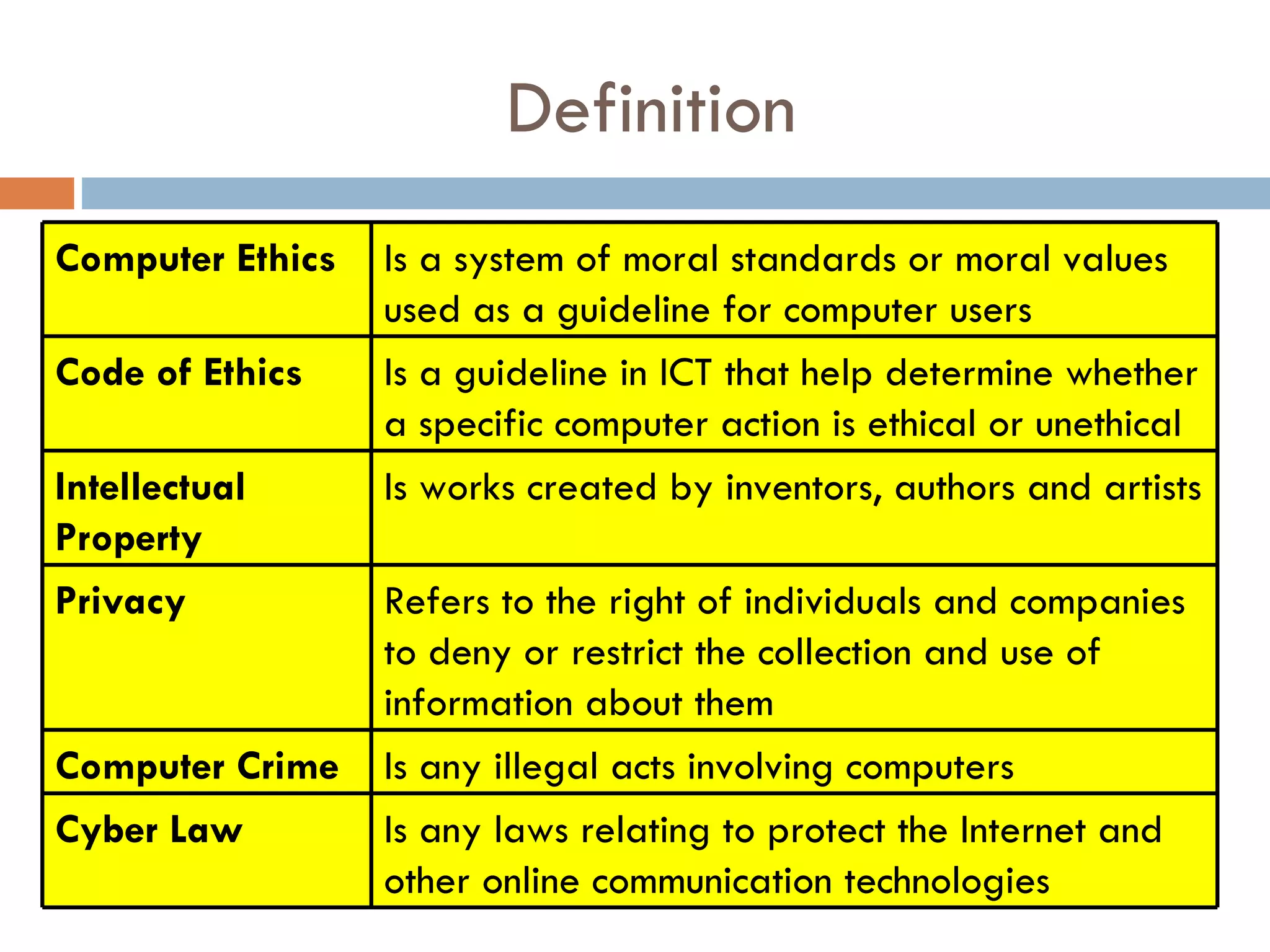
Computer Ethics   Is a system of moral standards or moral values
                  used as a guideline for computer users
Code of Ethics    Is a guideline in ICT that help determine whether
                  a specific computer action is ethical or unethical
Intellectual      Is works created by inventors, authors and artists
Property
Privacy           Refers to the right of individuals and companies
                  to deny or restrict the collection and use of
                  information about them
Computer Crime    Is any illegal acts involving computers
Cyber Law         Is any laws relating to protect the Internet and
                  other online communication technologies
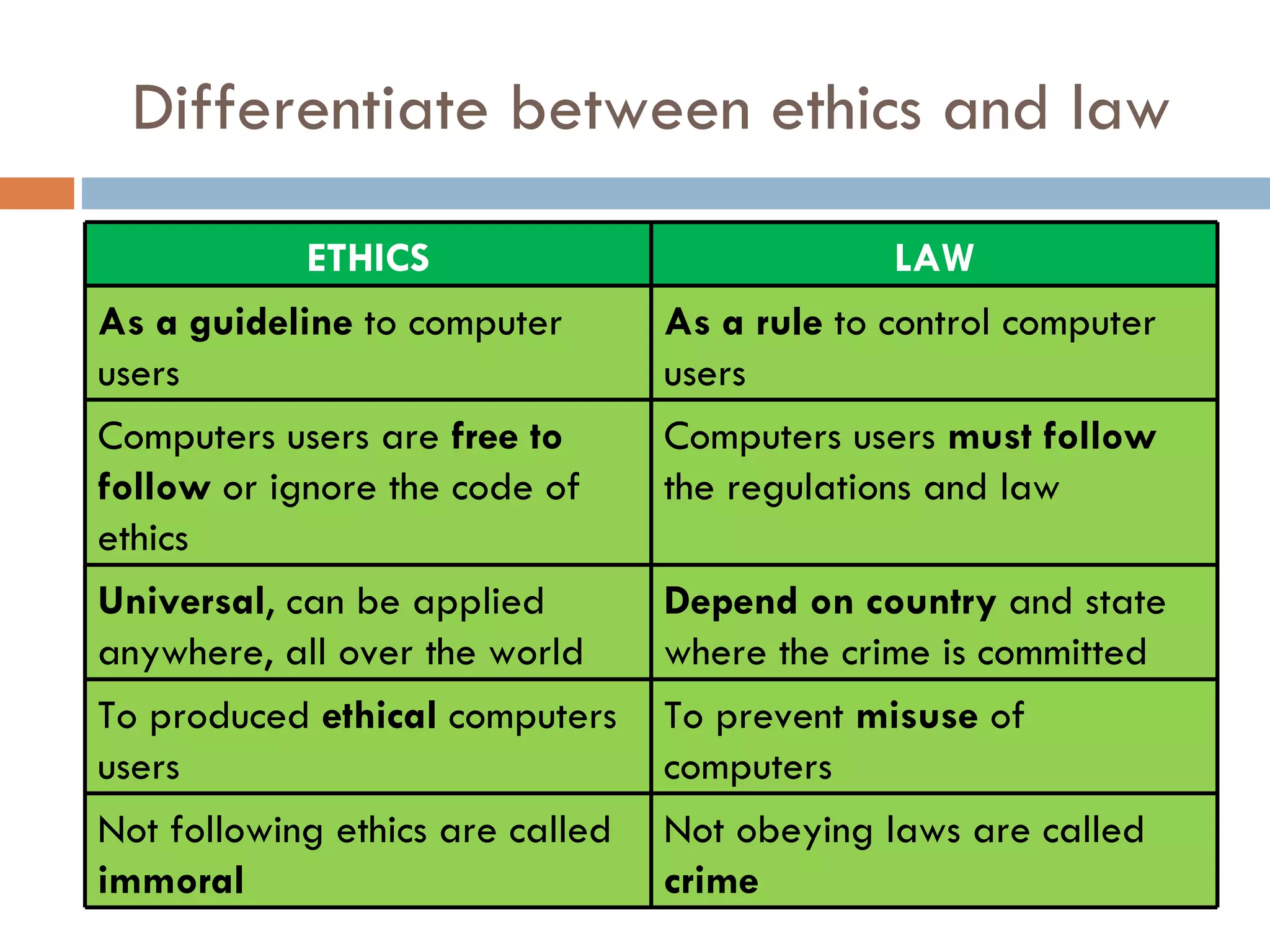
Differentiate between ethics and law

            ETHICS                              LAW
As a guideline to computer        As a rule to control computer
users                             users
Computers users are free to       Computers users must follow
follow or ignore the code of      the regulations and law
ethics
Universal, can be applied         Depend on country and state
anywhere, all over the world      where the crime is committed
To produced ethical computers     To prevent misuse of
users                             computers
Not following ethics are called   Not obeying laws are called
immoral                           crime
Intellectual Property Laws
    Four types of Intellectual Property are:


•    Patents for inventions
•    Trademarks for brand identity
•    Design for product appearance
•    Copyright for materials
Privacy
Ways of making personal data more privates:
 Install personal firewall

 Clear your history file when you are browsing

 Purchase goods with cash, rather than credit card
Authentication
   Authentication is a process where user verifies their
    identity. Authentication deals with the problem of
    determining whether a user should be allowed
    access to a particular system.
   Four commonly authentication methods:
A) User identification
   Is a unique combination of characters (letter,
    number or symbol) that identify specific user
   Examples:
              pin number
              password
B) Possessed object
   Is a any item that you must carry to gain access to
    computer of computer facility
   Examples:
               ATM card
               credit card
               smart card
C) Biometric device
   Is a device that translates personal characteristics
    into digital code that is compared with the digital
    code stored in the database
   Examples:
               fingerprint reader
               iris scanner
               hand geometric scanner
               signature verification system
Controversial Contents and Control
         PORNOGRAPHY                                     SLANDER
 is any form media or material (like       is a false spoken statement about
books, video or photos) that show erotic   someone, intended to damage his or her
behavior and intended to cause sexual      reputation
excitement
                                            the effects of slander on society are:
 the effects of pornography on society    iv)Can develop society that disregards on
are:                                       honesty and truth
iv)Can lead to criminal acts such as       v)Can lead to bad habits of spreading
exploitation of women                      rumors and untruth
v)Can lead to sexual addiction             vi)Can cause people to have nagative
vi)Can develop lower moral values          attitudes toward another person
towards other people
vii)Can erode good religious, cultural,
behaviors and beliefs
Computer Crimes
   Why we need cyber law?
    i)     Cyber laws are made to force people to be good
    ii)    To give protection against the misuse of computers
           and computer criminal activities
   Examples of cyber abuse on the users:
    i)     Sending a computer virus via e-mail
    ii)    Harassment through e-mail
    iii)   Hacking into your school's database to change your
           examination results
   Malaysian Cyber Law
    i)     Computer Crime Act 1997
    ii)    Copyright (Amendment) Bill 1997
    iii)   Digital Signature Act 1997
    iv)    Telemedicine Bill 1997
    v)     Communication and Multimedia Act 1998
    vi)    Digital Signature Regulations 1998
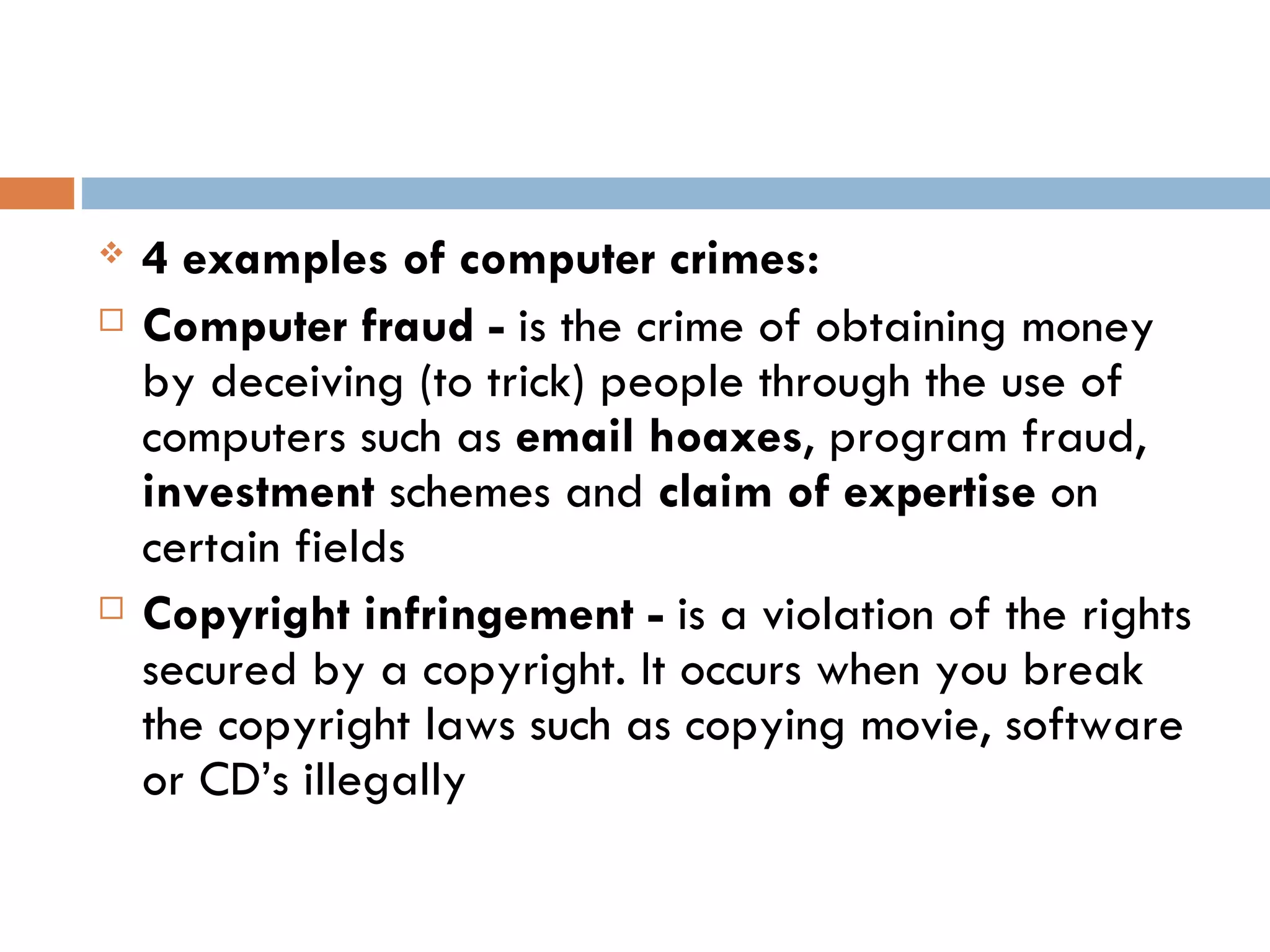
   4 examples of computer crimes:
   Computer fraud - is the crime of obtaining money
    by deceiving (to trick) people through the use of
    computers such as email hoaxes, program fraud,
    investment schemes and claim of expertise on
    certain fields
   Copyright infringement - is a violation of the rights
    secured by a copyright. It occurs when you break
    the copyright laws such as copying movie, software
    or CD’s illegally
Computer theft – is defined as the unauthorized
    used of another person’s property such as transfer
    of payment to the wrong accounts, get online
    material with no cost and tap into the data
    transmission lines
e   Computer attack – is defined as any activities
    taken to disrupt the equipments of computers
    systems, change processing controls and corrupt
    stored data

Computer Ethics and Legal Issues

  • 1.
    CHAPTER 1: INFORMATION ANDCOMMUNICATION TECHNOLOGY Computer Ethics and Legal Issues
  • 2.
    Definition Computer Ethics Is a system of moral standards or moral values used as a guideline for computer users Code of Ethics Is a guideline in ICT that help determine whether a specific computer action is ethical or unethical Intellectual Is works created by inventors, authors and artists Property Privacy Refers to the right of individuals and companies to deny or restrict the collection and use of information about them Computer Crime Is any illegal acts involving computers Cyber Law Is any laws relating to protect the Internet and other online communication technologies
  • 3.
    Differentiate between ethicsand law ETHICS LAW As a guideline to computer As a rule to control computer users users Computers users are free to Computers users must follow follow or ignore the code of the regulations and law ethics Universal, can be applied Depend on country and state anywhere, all over the world where the crime is committed To produced ethical computers To prevent misuse of users computers Not following ethics are called Not obeying laws are called immoral crime
  • 4.
    Intellectual Property Laws Four types of Intellectual Property are: • Patents for inventions • Trademarks for brand identity • Design for product appearance • Copyright for materials
  • 5.
    Privacy Ways of makingpersonal data more privates:  Install personal firewall  Clear your history file when you are browsing  Purchase goods with cash, rather than credit card
  • 6.
    Authentication  Authentication is a process where user verifies their identity. Authentication deals with the problem of determining whether a user should be allowed access to a particular system.
  • 7.
    Four commonly authentication methods:
  • 8.
    A) User identification  Is a unique combination of characters (letter, number or symbol) that identify specific user  Examples: pin number password
  • 9.
    B) Possessed object  Is a any item that you must carry to gain access to computer of computer facility  Examples: ATM card credit card smart card
  • 10.
    C) Biometric device  Is a device that translates personal characteristics into digital code that is compared with the digital code stored in the database  Examples: fingerprint reader iris scanner hand geometric scanner signature verification system
  • 11.
    Controversial Contents andControl PORNOGRAPHY SLANDER  is any form media or material (like  is a false spoken statement about books, video or photos) that show erotic someone, intended to damage his or her behavior and intended to cause sexual reputation excitement  the effects of slander on society are:  the effects of pornography on society iv)Can develop society that disregards on are: honesty and truth iv)Can lead to criminal acts such as v)Can lead to bad habits of spreading exploitation of women rumors and untruth v)Can lead to sexual addiction vi)Can cause people to have nagative vi)Can develop lower moral values attitudes toward another person towards other people vii)Can erode good religious, cultural, behaviors and beliefs
  • 13.
    Computer Crimes  Why we need cyber law? i) Cyber laws are made to force people to be good ii) To give protection against the misuse of computers and computer criminal activities  Examples of cyber abuse on the users: i) Sending a computer virus via e-mail ii) Harassment through e-mail iii) Hacking into your school's database to change your examination results
  • 14.
    Malaysian Cyber Law i) Computer Crime Act 1997 ii) Copyright (Amendment) Bill 1997 iii) Digital Signature Act 1997 iv) Telemedicine Bill 1997 v) Communication and Multimedia Act 1998 vi) Digital Signature Regulations 1998
  • 15.
    4 examples of computer crimes:  Computer fraud - is the crime of obtaining money by deceiving (to trick) people through the use of computers such as email hoaxes, program fraud, investment schemes and claim of expertise on certain fields  Copyright infringement - is a violation of the rights secured by a copyright. It occurs when you break the copyright laws such as copying movie, software or CD’s illegally
  • 16.
    Computer theft –is defined as the unauthorized used of another person’s property such as transfer of payment to the wrong accounts, get online material with no cost and tap into the data transmission lines e Computer attack – is defined as any activities taken to disrupt the equipments of computers systems, change processing controls and corrupt stored data