Presentation on “Pharmaceutical Preformulation in Bangladesh”
Course Name: Advanced Formulation Technology
Course Code: PH-5101
Presented By
Md. Mahfuzul Islam Bhuiyan
ID. No. 029-21-15
Semester- Fall-2019
Southern University Bangladesh
Contents
 Introduction of Preformulation
 Goals of Preformulation
 Usefulness of Preformulation
 Classes of Preformulation
 Factors to be consider before Preformulation
 Steps in Preformulation
 Principle area of Preformulation
 Evaluated parameters in Preformulation
 Conclusion
Preformulation
 Preformulation is the branch of Pharmaceutical science that utilizes biopharmaceutical
principles in the determination of physicochemical properties of the drug substance.
 It is defined as the phase of research and development in which preformulation studies
characterize physical and chemical properties of a drug molecule in order to develop
safe, effective and stable dosage form.
Goals of Preformulation
 To establish the physico-chemical parameters of a new drug entity
 To determine its kinetics and stability
 To establish its compatibility with common excipients
 It provides insights into how drug products should be processed and stored to ensure their quality
 To generate useful information to the formulator to design an optimum drug delivery system.
 The necessity of preformulation is not only acknowledged by most companies it is to a certain
extent prerequisite and forms back bone for R&D.
Usefulness of Preformulation
 Selection of drug candidate itself
 Selection of formulation components.
 API & drug product manufacturing processes
 Determination of the most appropriate container closure system
 Development of analytical methods
 Assignment of API retest periods
 The synthetic route of the API
 Toxicological strategy
Classes of Preformulation
 Preformulation studies can be classified into:
a. Fundamental preformulation studies
These studies are specific to candidate drug molecules and it include solubility analysis (e.g.,
ionization constant, partition coefficient, solubilization, thermal effect, common ion effect,
dissolution etc.), solid state properties (e.g., polymorphism, solvated forms and amorphous form ),
stability analysis (e.g., solution-state stability and solid-state stability) and permeability studies.
These studies are dependent on the chemical structure of the candidate drug molecule.
b. Derived preformulation studies
These studies include characterization of particle properties (e.g., particle size and particle shape),
bulk density, powder flow properties, compaction behaviour etc. They are carried out on the
intended dosage form.
Factors to be consider before Preformulation
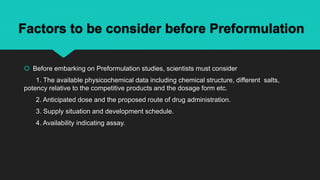
 Before embarking on Preformulation studies, scientists must consider
1. The available physicochemical data including chemical structure, different salts,
potency relative to the competitive products and the dosage form etc.
2. Anticipated dose and the proposed route of drug administration.
3. Supply situation and development schedule.
4. Availability indicating assay.
Steps in Preformulation
Principle area of Preformulation
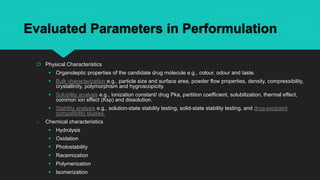
Evaluated Parameters in Performulation
 Physical Characteristics
 Organoleptic properties of the candidate drug molecule e.g., colour, odour and taste.
 Bulk characterization e.g., particle size and surface area, powder flow properties, density, compressibility,
crystallinity, polymorphism and hygroscopicity.
 Solubility analysis e.g., ionization constant/ drug Pka, partition coefficient, solubilization, thermal effect,
common ion effect (Ksp) and dissolution.
 Stability analysis e.g., solution-state stability testing, solid-state stability testing, and drug-excipient
compatibility studies.
o Chemical characteristics
 Hydrolysis
 Oxidation
 Photostability
 Racemization
 Polymerization
 Isomerization
Conclusion
 Preformulation studies on a new drug molecule provide useful information for subsequent
formulation of a physiochemically stable and biopharmaceutically suitable dosage form
 Preformulation work is the fundation of developing efficacious and economical formulations.
Reference
 Banker GS, Rhodes CT. Modern Pharmaceutics, Edition 4, Marcel Dekker, New York. 2002 p: 167-
184
 Chaurasia G. (2016). A Review on Pharmaceutical Preformulation Studies in Formulation and
Development of New Drug Molecules. International Journal of Pharmaceutical Science and
research, 7(6): 2313-2320.
 Kulkarni, S., Sharma, S. and Agrawal, A. (2015). Preformulation – A Foundation For Formulation
Development. International Journal of Pharmaceutical, Chemical And Biological Sciences, 5(2):
403-406.
 Gibson, M. (2004). Pharmaceutical Preformulation and Formulation: A Practical Guide from
Candidate Drug Selection to Commercial Dosage Form. Florida: CRC Press LLC.

Preformulation

  • 1.
    Presentation on “PharmaceuticalPreformulation in Bangladesh” Course Name: Advanced Formulation Technology Course Code: PH-5101 Presented By Md. Mahfuzul Islam Bhuiyan ID. No. 029-21-15 Semester- Fall-2019 Southern University Bangladesh
  • 2.
    Contents  Introduction ofPreformulation  Goals of Preformulation  Usefulness of Preformulation  Classes of Preformulation  Factors to be consider before Preformulation  Steps in Preformulation  Principle area of Preformulation  Evaluated parameters in Preformulation  Conclusion
  • 3.
    Preformulation  Preformulation isthe branch of Pharmaceutical science that utilizes biopharmaceutical principles in the determination of physicochemical properties of the drug substance.  It is defined as the phase of research and development in which preformulation studies characterize physical and chemical properties of a drug molecule in order to develop safe, effective and stable dosage form.
  • 4.
    Goals of Preformulation To establish the physico-chemical parameters of a new drug entity  To determine its kinetics and stability  To establish its compatibility with common excipients  It provides insights into how drug products should be processed and stored to ensure their quality  To generate useful information to the formulator to design an optimum drug delivery system.  The necessity of preformulation is not only acknowledged by most companies it is to a certain extent prerequisite and forms back bone for R&D.
  • 5.
    Usefulness of Preformulation Selection of drug candidate itself  Selection of formulation components.  API & drug product manufacturing processes  Determination of the most appropriate container closure system  Development of analytical methods  Assignment of API retest periods  The synthetic route of the API  Toxicological strategy
  • 6.
    Classes of Preformulation Preformulation studies can be classified into: a. Fundamental preformulation studies These studies are specific to candidate drug molecules and it include solubility analysis (e.g., ionization constant, partition coefficient, solubilization, thermal effect, common ion effect, dissolution etc.), solid state properties (e.g., polymorphism, solvated forms and amorphous form ), stability analysis (e.g., solution-state stability and solid-state stability) and permeability studies. These studies are dependent on the chemical structure of the candidate drug molecule. b. Derived preformulation studies These studies include characterization of particle properties (e.g., particle size and particle shape), bulk density, powder flow properties, compaction behaviour etc. They are carried out on the intended dosage form.
  • 7.
    Factors to beconsider before Preformulation  Before embarking on Preformulation studies, scientists must consider 1. The available physicochemical data including chemical structure, different salts, potency relative to the competitive products and the dosage form etc. 2. Anticipated dose and the proposed route of drug administration. 3. Supply situation and development schedule. 4. Availability indicating assay.
  • 8.
  • 9.
    Principle area ofPreformulation
  • 10.
    Evaluated Parameters inPerformulation  Physical Characteristics  Organoleptic properties of the candidate drug molecule e.g., colour, odour and taste.  Bulk characterization e.g., particle size and surface area, powder flow properties, density, compressibility, crystallinity, polymorphism and hygroscopicity.  Solubility analysis e.g., ionization constant/ drug Pka, partition coefficient, solubilization, thermal effect, common ion effect (Ksp) and dissolution.  Stability analysis e.g., solution-state stability testing, solid-state stability testing, and drug-excipient compatibility studies. o Chemical characteristics  Hydrolysis  Oxidation  Photostability  Racemization  Polymerization  Isomerization
  • 11.
    Conclusion  Preformulation studieson a new drug molecule provide useful information for subsequent formulation of a physiochemically stable and biopharmaceutically suitable dosage form  Preformulation work is the fundation of developing efficacious and economical formulations.
  • 12.
    Reference  Banker GS,Rhodes CT. Modern Pharmaceutics, Edition 4, Marcel Dekker, New York. 2002 p: 167- 184  Chaurasia G. (2016). A Review on Pharmaceutical Preformulation Studies in Formulation and Development of New Drug Molecules. International Journal of Pharmaceutical Science and research, 7(6): 2313-2320.  Kulkarni, S., Sharma, S. and Agrawal, A. (2015). Preformulation – A Foundation For Formulation Development. International Journal of Pharmaceutical, Chemical And Biological Sciences, 5(2): 403-406.  Gibson, M. (2004). Pharmaceutical Preformulation and Formulation: A Practical Guide from Candidate Drug Selection to Commercial Dosage Form. Florida: CRC Press LLC.