

Research Plan
HOW TO CHOOSE A TOPIC for
Research Plan and Write
Dissertation Project and Thesis
AND APPLY FOR FOUNDING
By: Prof. Lili Saghafi
AGENDA
HOW TO CHOOSE A TOPIC and Apply for FOUNDING
• Choosing a topic
• How to write
• Developing Your Ideas
• Applying for Funding
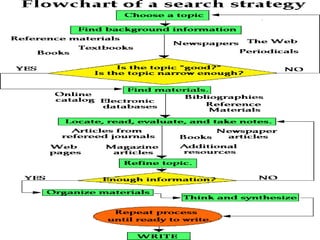
Choosing a topic
• Research / Dissertation projects
are really tough to start from a
cold stop. Try to find something
you’ve already been thinking
about, an idea that’s been
developing in the back of your
mind for a while, something that
may have arisen in a seminar
, in your studying for front
matter, or in something else
you’ve been reading or working
on.
The word seminar is derived from the Latin word seminarium, meaning "seed plot".
Choosing a topic
• You can always go back to old
reaction papers you’ve written,
articles you’ve liked, or notes
you’ve taken ( specially In my
Course) to mine them for ideas.
Choosing a topic
• One thing a lot of people do is keep an “ideas folder”
of interesting ideas, topics, notes, etc.—just write
down anything that strikes you as having some
potential for development, whenever you see it or
think of it, and stick it in the folder.
• Whenever you’re stuck, go back to the ideas folder
and see if anything pops out at you.
• Try to tease out an idea and see where it goes.
• While you are studying for your dissertation is a great
time to start filling up your ideas folder.
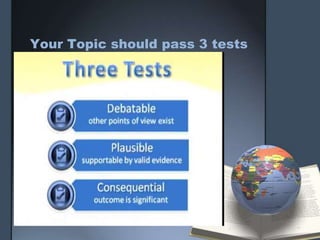
Your Topic should pass 3 tests
Example of TODAY’s
Conversation
• the importance of a currently debated public
issue.
• Centre wants stronger censor board
regulatory framework The central
government will form a committee for a "re-
look" into the Cinematographic Act to make
the censor board's regulatory framework
more robust.
• Will act upon Verma panel's proposals: PM
In the aftermath of the brutal rape and
murder of a 23-year-old girl in Delhi, the
panel was set up to recommend proposals
on how to tackle atrocities against women.
• Sniffing Out Lung Cancer We’re combing the country
to find examples of intelligent, scalable innovation –
and we’re going to pick 20 of the best to be featured
Example of TODAY’s Conversation
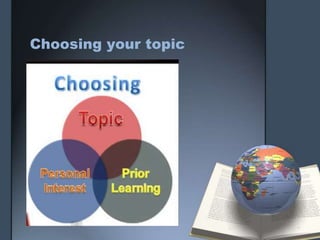
Choosing your topic
Filter
After Choosing A Topic
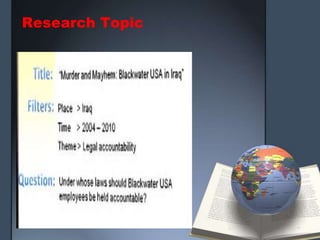
You have to consider 3 filters on it so that you
can be more focused and deeply investigate
• Theme
• Place
• Time
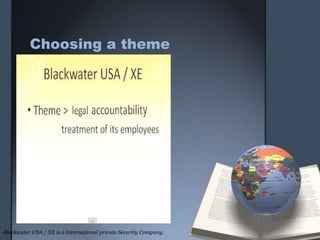
Choosing a theme
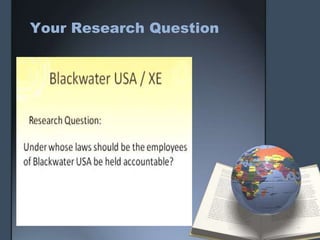
Blackwater USA / XE is a International private Security Company.
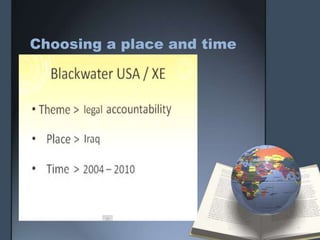
Choosing a place and time
Your Research Question
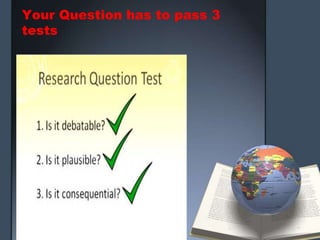
Your Question has to pass 3
tests
Research Topic
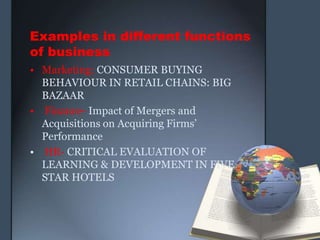
Examples in different functions
of business
• Marketing: CONSUMER BUYING
BEHAVIOUR IN RETAIL CHAINS: BIG
BAZAAR
• Finance- Impact of Mergers and
Acquisitions on Acquiring Firms’
Performance
• HR- CRITICAL EVALUATION OF
LEARNING & DEVELOPMENT IN FIVE
STAR HOTELS
Examples in different functions
of business
• HR- ONLINE RECRUITING AND ITS IMPACT ON
CORPORATIONS
• IT- ZERO TRUST ACCESS CONTROL AND ITS
EFFECT ON NETWORK SECURITY
• IT-ENRON FIASCO AND ITS CONSEQUENCES
• SCM-RFID AND SCM
• CRM-CULTURAL EFFECT ON PROJECT
MANAGEMENT IN SCHNEIDER ELECTRONIC
India
• CRM-LOCATION SPECIFIC PROJECTS IN
ERICSON INTERNATIONAL
Example of BROAD TOPIC
• nuclear waste
• violence in schools
5 Ws
• 5 Ws (a concept used by many
journalists) to help narrow the broad
topics you have listed.
• The 5 Ws are essentially “Who, What,
When, Where, Why,” but it is also
useful to include the question
• of “How” in your discussion.
Narrowing the topics
• In addition to narrowing the topics, avoid
creating questions that can be answered
with a simple “yes” or “no.”
• So, for example, you could create questions
such as “What is the best way to transport
nuclear waste?” or “Who is responsible for
reducing school violence?”
• Other questions might include “How should
nuclear waste be regulated?” or “How
should parents deal with school violence?”
Narrowing the topics
• By creating a series of questions
like these, you can see how a
broad, overly general topic can
be narrowed to something more
specific, debatable, and
accessible for research.
Narrowing the topics
• Additionally, these questions can
lead you to the strategies for
developing research questions
A couple good ways to think
about developing a topic:
1) Think about your topic as a
conversation, and ask yourself
two kinds of questions.
– First, how does the current
conversation lead us to miss
something important?
– Second, how can your project
move this conversation in a
more fruitful direction?
A couple good ways to think about
developing a topic:
2- This could be in one of many
ways—
– measuring something in a
better way than it has been
before,
– recognizing something important
that has been ignored,
– Bringing two streams of thinking
together that haven’t spoken to
each other before, etc.
A couple good ways to think
about developing a topic:
3- What is the puzzle that current theory
leaves unexplained, and how will you solve
it? ( Energy, Water, Telecommunication
, pharmaceutical Global problems,....)
4- Your dissertation should make a double
contribution: both theoretical and empirical.
Hindustan Unilever Vitality Foundation , Water For Public Good, India water Partnership
A couple good ways to think
about developing a topic:
5. Think about what your project will sound like in a job talk.
1. Banish the following words:
» seek
» hope
» try
» wish
» believe
2. Banish the following phrases:
» “is worthy of study”
» “deserves study”
» “merits study”
The fact that you are studying it proves that it is worthy of study.
Saying these words makes you sound like a junior grad
student trying to convince a skeptical advisor of the value of a
dissertation topic.
A couple good ways to think
about developing a topic:
6. You need to be able to make the case that your
project is both interesting and relevant.
7. What’s your punchline (the last part of a joke or funny
story that delivers the meaning and the bulk of the
humor) ? What will you say when someone who
could hire you asks you about your research in the
elevator at PGDM?
8. Have a 30–second version of your dissertation that
makes people want to know what you find out.
9. Also, remember that you’ll have to sell your project
to people outside of your field—why does company
need your research?
A couple good ways to think
about developing a topic:
10. You must be passionate about your choice of
projects, because you’ll have to work on it and live
with it for sometime .
11. You can’t start off lukewarm—imagine how you’ll feel
after a while down the road.
A couple good ways to think
about developing a topic:
12. On the other hand, be a little cautious. Do think
about how your project will “brand” you.
13. In many ways, your dissertation will define where
you sit in terms of the categories that organize our
profession—e.g., a public opinion scholar, a critical
constructivist, a gender studies person, a formal
theorist.
14. Think about how you want to be situated in the
profession—there may be reason to postpone
certain projects.
15. What scholarly community do you most want to be a
part of? What kind of job do you want?
Be Cautious
• Don’t try to “game the system” by choosing a topic
that’s “hot” or that you think will be by the time you
finish.
• One of the biggest risks in writing a dissertation is not
finishing it, so you have to actually care about what
you are working on, even three years down the road
if you want to continue on the same topic.
• And you don’t know what the field will look like when
you finally get to the job market.
Be Cautious
• Keep timing issues in mind.
• Some projects are more suitable for specific times in
your career than others.
• For a dissertation, you need to finish in a finite period
of time.
Founding
Applying for Funding
• Some funding proposals can be no more than two
single– spaced pages, and they are due as early as
September.
• Keep this in mind and get to it!
• General Information on Research & Development
Funding Schemes of Central Government
Departments/Agencies in India
• The Echoing Green Fellowship program has provided
more than $2 million in seed funding to a diverse
group of the world’s most promising social
entrepreneurs.
• Unicef funded pilot project
• http://timesofindia.indiatimes.com/topic/Unicef-
funded-pilot-project
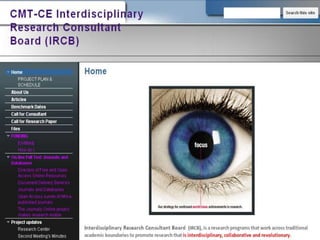
Interdisciplinary
Research Consultant
Board (IRCB), is a
research programs
that work across
traditional academic
boundaries to
promote research
that is
interdisciplinary, colla
borative and
revolutionary.
Interdisciplinary
Research Consultant
Board (IRCB)
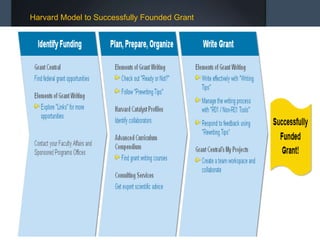
Harvard Model to Successfully Founded Grant
TIPS TO WORK WITH EXCEL
for RESEARCH
• Data Analysis
• Analysis ToolPak
Thank you for being
great audience
Any
Question?

Prof lili saghafi How to Write Research Plan / Dissertation Project and Thesis

  • 1.
    Research Plan HOW TOCHOOSE A TOPIC for Research Plan and Write Dissertation Project and Thesis AND APPLY FOR FOUNDING By: Prof. Lili Saghafi
  • 2.
    AGENDA HOW TO CHOOSEA TOPIC and Apply for FOUNDING • Choosing a topic • How to write • Developing Your Ideas • Applying for Funding
  • 3.
    Choosing a topic •Research / Dissertation projects are really tough to start from a cold stop. Try to find something you’ve already been thinking about, an idea that’s been developing in the back of your mind for a while, something that may have arisen in a seminar , in your studying for front matter, or in something else you’ve been reading or working on. The word seminar is derived from the Latin word seminarium, meaning "seed plot".
  • 4.
    Choosing a topic •You can always go back to old reaction papers you’ve written, articles you’ve liked, or notes you’ve taken ( specially In my Course) to mine them for ideas.
  • 5.
    Choosing a topic •One thing a lot of people do is keep an “ideas folder” of interesting ideas, topics, notes, etc.—just write down anything that strikes you as having some potential for development, whenever you see it or think of it, and stick it in the folder. • Whenever you’re stuck, go back to the ideas folder and see if anything pops out at you. • Try to tease out an idea and see where it goes. • While you are studying for your dissertation is a great time to start filling up your ideas folder.
  • 6.
    Your Topic shouldpass 3 tests
  • 7.
    Example of TODAY’s Conversation •the importance of a currently debated public issue. • Centre wants stronger censor board regulatory framework The central government will form a committee for a "re- look" into the Cinematographic Act to make the censor board's regulatory framework more robust. • Will act upon Verma panel's proposals: PM In the aftermath of the brutal rape and murder of a 23-year-old girl in Delhi, the panel was set up to recommend proposals on how to tackle atrocities against women.
  • 8.
    • Sniffing OutLung Cancer We’re combing the country to find examples of intelligent, scalable innovation – and we’re going to pick 20 of the best to be featured Example of TODAY’s Conversation
  • 9.
  • 10.
    Filter After Choosing ATopic You have to consider 3 filters on it so that you can be more focused and deeply investigate • Theme • Place • Time
  • 11.
    Choosing a theme BlackwaterUSA / XE is a International private Security Company.
  • 12.
  • 13.
  • 14.
    Your Question hasto pass 3 tests
  • 15.
  • 16.
    Examples in differentfunctions of business • Marketing: CONSUMER BUYING BEHAVIOUR IN RETAIL CHAINS: BIG BAZAAR • Finance- Impact of Mergers and Acquisitions on Acquiring Firms’ Performance • HR- CRITICAL EVALUATION OF LEARNING & DEVELOPMENT IN FIVE STAR HOTELS
  • 17.
    Examples in differentfunctions of business • HR- ONLINE RECRUITING AND ITS IMPACT ON CORPORATIONS • IT- ZERO TRUST ACCESS CONTROL AND ITS EFFECT ON NETWORK SECURITY • IT-ENRON FIASCO AND ITS CONSEQUENCES • SCM-RFID AND SCM • CRM-CULTURAL EFFECT ON PROJECT MANAGEMENT IN SCHNEIDER ELECTRONIC India • CRM-LOCATION SPECIFIC PROJECTS IN ERICSON INTERNATIONAL
  • 18.
    Example of BROADTOPIC • nuclear waste • violence in schools
  • 19.
    5 Ws • 5Ws (a concept used by many journalists) to help narrow the broad topics you have listed. • The 5 Ws are essentially “Who, What, When, Where, Why,” but it is also useful to include the question • of “How” in your discussion.
  • 20.
    Narrowing the topics •In addition to narrowing the topics, avoid creating questions that can be answered with a simple “yes” or “no.” • So, for example, you could create questions such as “What is the best way to transport nuclear waste?” or “Who is responsible for reducing school violence?” • Other questions might include “How should nuclear waste be regulated?” or “How should parents deal with school violence?”
  • 21.
    Narrowing the topics •By creating a series of questions like these, you can see how a broad, overly general topic can be narrowed to something more specific, debatable, and accessible for research.
  • 22.
    Narrowing the topics •Additionally, these questions can lead you to the strategies for developing research questions
  • 23.
    A couple goodways to think about developing a topic: 1) Think about your topic as a conversation, and ask yourself two kinds of questions. – First, how does the current conversation lead us to miss something important? – Second, how can your project move this conversation in a more fruitful direction?
  • 24.
    A couple goodways to think about developing a topic: 2- This could be in one of many ways— – measuring something in a better way than it has been before, – recognizing something important that has been ignored, – Bringing two streams of thinking together that haven’t spoken to each other before, etc.
  • 25.
    A couple goodways to think about developing a topic: 3- What is the puzzle that current theory leaves unexplained, and how will you solve it? ( Energy, Water, Telecommunication , pharmaceutical Global problems,....) 4- Your dissertation should make a double contribution: both theoretical and empirical. Hindustan Unilever Vitality Foundation , Water For Public Good, India water Partnership
  • 26.
    A couple goodways to think about developing a topic: 5. Think about what your project will sound like in a job talk. 1. Banish the following words: » seek » hope » try » wish » believe 2. Banish the following phrases: » “is worthy of study” » “deserves study” » “merits study” The fact that you are studying it proves that it is worthy of study. Saying these words makes you sound like a junior grad student trying to convince a skeptical advisor of the value of a dissertation topic.
  • 27.
    A couple goodways to think about developing a topic: 6. You need to be able to make the case that your project is both interesting and relevant. 7. What’s your punchline (the last part of a joke or funny story that delivers the meaning and the bulk of the humor) ? What will you say when someone who could hire you asks you about your research in the elevator at PGDM? 8. Have a 30–second version of your dissertation that makes people want to know what you find out. 9. Also, remember that you’ll have to sell your project to people outside of your field—why does company need your research?
  • 28.
    A couple goodways to think about developing a topic: 10. You must be passionate about your choice of projects, because you’ll have to work on it and live with it for sometime . 11. You can’t start off lukewarm—imagine how you’ll feel after a while down the road.
  • 29.
    A couple goodways to think about developing a topic: 12. On the other hand, be a little cautious. Do think about how your project will “brand” you. 13. In many ways, your dissertation will define where you sit in terms of the categories that organize our profession—e.g., a public opinion scholar, a critical constructivist, a gender studies person, a formal theorist. 14. Think about how you want to be situated in the profession—there may be reason to postpone certain projects. 15. What scholarly community do you most want to be a part of? What kind of job do you want?
  • 30.
    Be Cautious • Don’ttry to “game the system” by choosing a topic that’s “hot” or that you think will be by the time you finish. • One of the biggest risks in writing a dissertation is not finishing it, so you have to actually care about what you are working on, even three years down the road if you want to continue on the same topic. • And you don’t know what the field will look like when you finally get to the job market.
  • 31.
    Be Cautious • Keeptiming issues in mind. • Some projects are more suitable for specific times in your career than others. • For a dissertation, you need to finish in a finite period of time.
  • 34.
  • 35.
    Applying for Funding •Some funding proposals can be no more than two single– spaced pages, and they are due as early as September. • Keep this in mind and get to it! • General Information on Research & Development Funding Schemes of Central Government Departments/Agencies in India • The Echoing Green Fellowship program has provided more than $2 million in seed funding to a diverse group of the world’s most promising social entrepreneurs.
  • 36.
    • Unicef fundedpilot project • http://timesofindia.indiatimes.com/topic/Unicef- funded-pilot-project
  • 37.
    Interdisciplinary Research Consultant Board (IRCB),is a research programs that work across traditional academic boundaries to promote research that is interdisciplinary, colla borative and revolutionary.
  • 38.
  • 40.
    Harvard Model toSuccessfully Founded Grant
  • 41.
    TIPS TO WORKWITH EXCEL for RESEARCH • Data Analysis • Analysis ToolPak
  • 42.
    Thank you forbeing great audience Any Question?