SEFETY IN HAND TOOLS ANDSEFETY IN HAND TOOLS AND
GRINDINGGRINDING
Presented ByPresented By
K.LAVANYAK.LAVANYA
M.TECHM.TECH
1
HAND TOOLSHAND TOOLS
2
INTRODUCTIONINTRODUCTION
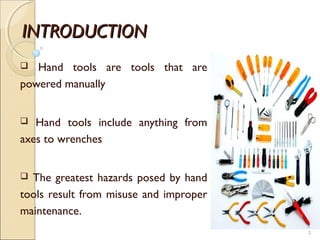
 Hand tools are tools that are
powered manually
 Hand tools include anything from
axes to wrenches
 The greatest hazards posed by hand
tools result from misuse and improper
maintenance.
3
What the RegulationsWhat the Regulations
Say About Hand ToolsSay About Hand Tools
Each employer shall be responsible for the safe
condition of tools and equipment used by employees,
including tools and equipment which may be furnished
by employees.
Compressed air used for cleaning. Compressed air shall
not be used for cleaning purposes except where
reduced to less than 30 p.s.i. and then only with
effective chip guarding and personal protective
equipment. 4
Cont’d…..Cont’d…..
Employers shall not issue or permit the use of unsafe hand
tools
Wrenches, including adjustable, pipe, end, and socket
wrenches shall not be used when jaws are sprung to the
point that slippage occurs
Impact tools, such as drift pins, wedges, and chisels, shall be
kept free of mushroomed heads
The wooden handles of tools shall be kept free of splinters or
cracks and shall be kept tight in the tool 5
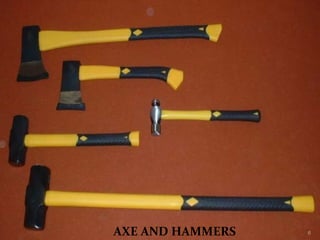
AXE AND HAMMERS 6
HAZARDS OF HANDTOOLSHAZARDS OF HANDTOOLS
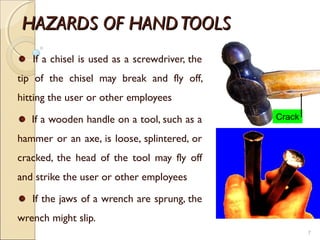
If a chisel is used as a screwdriver, the
tip of the chisel may break and fly off,
hitting the user or other employees
If a wooden handle on a tool, such as a
hammer or an axe, is loose, splintered, or
cracked, the head of the tool may fly off
and strike the user or other employees
If the jaws of a wrench are sprung, the
wrench might slip.
7
Crack
Cutting and Slicing ToolsCutting and Slicing Tools
(Knives, Box Cutters, Scissors, Razor Blades, etc…)(Knives, Box Cutters, Scissors, Razor Blades, etc…)
Safety Gloves – Protection against accidental cuts and vibration
A Sharp Blade Is Safer – When dull, a blade can slip from the
object being cut and cause a serious injury.
Cut Downward – Always away from your hand.
Put It Back – Never leave a cutting tool lying on a table, chair, sink
or desk. There are only three places that a cutting tool should
ever be
1) in use,
2) stored safely in a drawer, tool box, in a knife rack, or,
3) in the dishwasher (blade down, handle up)
8
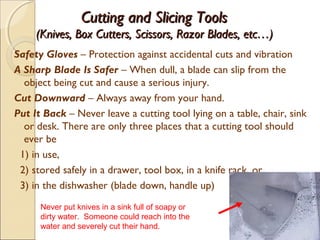
Never put knives in a sink full of soapy or
dirty water. Someone could reach into the
water and severely cut their hand.
Cutting and Slicing ToolsCutting and Slicing Tools
Let It Go! – Never attempt to catch a
dropped knife or other cutting tool – let it fall.
Wipe Away From The Sharp Edge – if you need to
wipe or clean material off the blade, always wipe away
from the sharp edge.
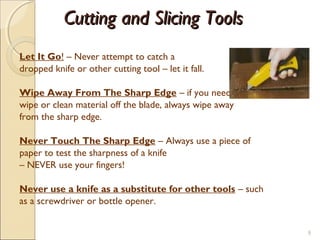
Never Touch The Sharp Edge – Always use a piece of
paper to test the sharpness of a knife
– NEVER use your fingers!
Never use a knife as a substitute for other tools – such
as a screwdriver or bottle opener.
9
EMPLOYER’S DUTYEMPLOYER’S DUTY
The employer is responsible for the safe condition
of tools and equipment used by employees
Employers shall not issue or permit the use of
unsafe hand tools.
Employees should be trained in the proper use and
handling of tools and equipment.
10
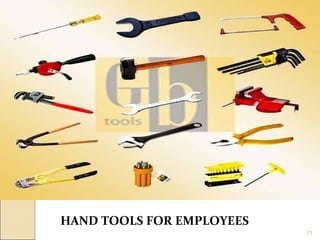
HAND TOOLS FOR EMPLOYEES
11
EMPLOYEE’S DUTYEMPLOYEE’S DUTY
Employees, when using saw blades, knives, or other
tools, should direct the tools away from aisle areas
They should be away from other employees working
in close proximity
Knives and scissors must be sharp; dull tools can
cause more hazards than sharp ones
Cracked saw blades must be removed from service.
12
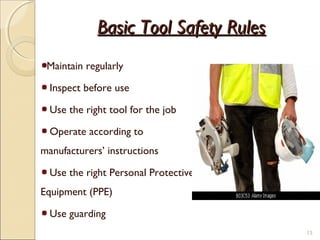
Basic Tool Safety RulesBasic Tool Safety Rules
Maintain regularly
Inspect before use
Use the right tool for the job
Operate according to
manufacturers’ instructions
Use the right Personal Protective
Equipment (PPE)
Use guarding
13
14
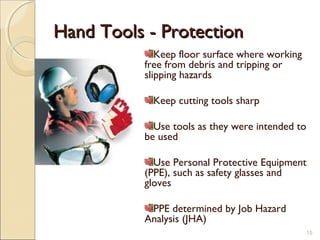
Hand Tools - ProtectionHand Tools - Protection
Keep floor surface where working
free from debris and tripping or
slipping hazards
Keep cutting tools sharp
Use tools as they were intended to
be used
Use Personal Protective Equipment
(PPE), such as safety glasses and
gloves
PPE determined by Job Hazard
Analysis (JHA)
15
16
OSHA Office of Training and Education 9
Examples of PPEExamples of PPE
earplugs, earmuffsHearing
vestsBodies
glovesHands and arms
safety shoesFeet
hard hatsHead
face shieldsFace
safety glasses, gogglesEye
Body Part Protection
SAFETY FIVE RULESSAFETY FIVE RULES
All hazards involved in the use of power tools can
be prevented by following five basic safety rules:
Keep all tools in good condition with regular
maintenance.
Use the right tool for the job.
Examine each tool for damage before use and do not
use damaged tools.
Operate tools according to the manufacturers’
instructions.
Provide and use properly the right personal protective
equipment.
17
General Safety PrecautionsGeneral Safety Precautions
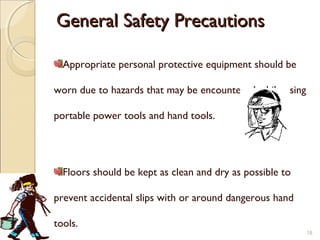
Appropriate personal protective equipment should be
worn due to hazards that may be encountered while using
portable power tools and hand tools.
Floors should be kept as clean and dry as possible to
prevent accidental slips with or around dangerous hand
tools.
18
SAFETY PRECAUTIONSSAFETY PRECAUTIONS
 Wrenches must not be used when jaws are
sprung to the point that slippage occurs.
 Impact tools such as drift pins, wedges, and chisels
must be kept free of mushroomed heads.
 The wooden handles of tools must not be
splintered.
19
Cont’d…..Cont’d…..
 Iron or steel hand tools may produce sparks that
can be an ignition source around flammable substances.
 Where this hazard exists, spark-resistant tools
made of non-ferrous materials should be used
 These tools are used where flammable gases, highly
volatile liquids, and other explosive substances are
20
OSHA GUIDELINESOSHA GUIDELINES
 Management leadership and employee
involvement
 Worksite analysis
 Hazard prevention and control
 Safety and health training
21
GRINDINGGRINDING TOOLSTOOLS
22
INTRODUCTION OF GRINDINGINTRODUCTION OF GRINDING
Whether they are portable or fixed, grinding wheels are
designed to operate at very high speeds.
If a grinding wheel shatters while in use, the fragments can
travel over 300 miles per hour.
The potential for serious injury, material damage and
other losses from these shooting fragments is great.
To ensure that grinding wheels are safely used in your
workplace, know the hazards and how to control them.
23
INTRODUCTIONINTRODUCTION
The grinding machine is used for:
 Roughing and finishing flat, cylindrical, and
conical surfaces
 Finishing internal cylinders bores
 Forming and sharpening cutting tools
24
CONTD…CONTD…
 Snagging or removing rough projections from
castings and stampings
 Leaning, polishing, and buffing surfaces
 Complete roughing and finishing of certain
classes of work.
25
TYPES OF GRINDINGTYPES OF GRINDING
There are three types of grinder
Surface grinder
Cylindrical grinder
Universal Tool and cutter grinder
26
POSSIBLE HAZARDSPOSSIBLE HAZARDS
 Body contact with the grinding tool at
operating speed
 Injuries caused by failure of the grinding tool
during use
 Grinding particles, sparks, gases and dust
generated during grinding
 Noise
 Vibration
27
SAFETY AGAINST HAZARDSSAFETY AGAINST HAZARDS
Body contact with the abrasive product
 When using grinding tools, the greatest caution and
care is necessary.
 Tie back long hair and do not wear loose clothing,
ties and jewellery
 If the machine or work piece is held in the hand,
always wear gloves and applicable clothing.
 After switching off the machine, make sure that this
has completely stopped before you leave it unattended.
28
Injury through failure of a grinding toolInjury through failure of a grinding tool
Operating requires the greatest of caution, because
these can be easily damaged.
Before use you should check all products for signs of
damage.
It should be stored to prevent damaging influences
such as moisture, frost and as well as mechanical damage
Observe the warning or safety instructions on grinding
tools or the packaging
29
Grinding particles, sparks, dust andGrinding particles, sparks, dust and
vapoursvapours
All dry grinding processes should be equipped with
suitable extraction systems
For dry grinding, it is recommended to use
respirators, also if extraction systems are available
Protection covers or guards should be adjusted so
that they guide sparks and grinding particles away
from the body.
30
CONTD…CONTD…
Additional measures are necessary for the
protection of persons who are in the vicinity
It is recommended to wear eye protection
during all grinding processes
For freehand grinding, safety goggles or a face
mask is recommended
31
GRINDER SAFETY PROCEDURESGRINDER SAFETY PROCEDURES
To avoid injuries follow the safety precautions
listed below.
Wear goggles for all grinding machine
operations.
Check grinding wheels for cracks before
mounting.
Never operate grinding wheels at speeds in
excess of the recommended speed.
32
33
CONTD…CONTD…
Never adjust the workpiece or work mounting
devices when the machine is operating
Do not exceed recommended depth of cut for the
grinding wheel or machine.
Remove workpiece from grinding wheel before
turning machine off.
Use proper wheel guards on all grinding machines.
34
SAFETY MEASURESSAFETY MEASURES
Observe the instructions on the grinding tool and
grinding machine.
Make sure that the abrasive wheel is suitable for the
respective application.
Before using each time, check the abrasive wheel for
signs of damage.
Observe the instructions for correct operating and
storing of the grinding tool.
35
PERSONAL PROTECTIVE EQUIPMENTPERSONAL PROTECTIVE EQUIPMENT
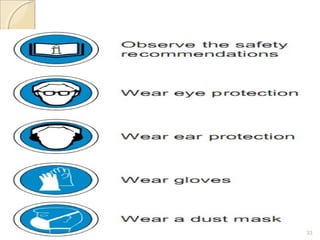
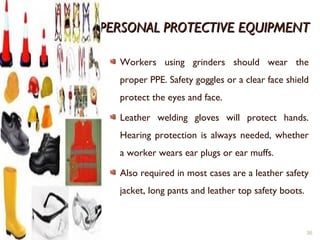
Workers using grinders should wear the
proper PPE. Safety goggles or a clear face shield
protect the eyes and face.
Leather welding gloves will protect hands.
Hearing protection is always needed, whether
a worker wears ear plugs or ear muffs.
Also required in most cases are a leather safety
jacket, long pants and leather top safety boots.
36
REFERENCESREFERENCES
www. Osha.gov
SP 70 :2001Handbook On Construction Safety Practices
www.indiamart.com
Provision and Use of Work Equipment Regulations 1998
Approved Code of Practice and guidance L22 ISBN 978 0
7176 6295 1
37
38

Safety hand tools & grinding

  • 1.
    SEFETY IN HANDTOOLS ANDSEFETY IN HAND TOOLS AND GRINDINGGRINDING Presented ByPresented By K.LAVANYAK.LAVANYA M.TECHM.TECH 1
  • 2.
  • 3.
    INTRODUCTIONINTRODUCTION  Hand toolsare tools that are powered manually  Hand tools include anything from axes to wrenches  The greatest hazards posed by hand tools result from misuse and improper maintenance. 3
  • 4.
    What the RegulationsWhatthe Regulations Say About Hand ToolsSay About Hand Tools Each employer shall be responsible for the safe condition of tools and equipment used by employees, including tools and equipment which may be furnished by employees. Compressed air used for cleaning. Compressed air shall not be used for cleaning purposes except where reduced to less than 30 p.s.i. and then only with effective chip guarding and personal protective equipment. 4
  • 5.
    Cont’d…..Cont’d….. Employers shall notissue or permit the use of unsafe hand tools Wrenches, including adjustable, pipe, end, and socket wrenches shall not be used when jaws are sprung to the point that slippage occurs Impact tools, such as drift pins, wedges, and chisels, shall be kept free of mushroomed heads The wooden handles of tools shall be kept free of splinters or cracks and shall be kept tight in the tool 5
  • 6.
  • 7.
    HAZARDS OF HANDTOOLSHAZARDSOF HANDTOOLS If a chisel is used as a screwdriver, the tip of the chisel may break and fly off, hitting the user or other employees If a wooden handle on a tool, such as a hammer or an axe, is loose, splintered, or cracked, the head of the tool may fly off and strike the user or other employees If the jaws of a wrench are sprung, the wrench might slip. 7 Crack
  • 8.
    Cutting and SlicingToolsCutting and Slicing Tools (Knives, Box Cutters, Scissors, Razor Blades, etc…)(Knives, Box Cutters, Scissors, Razor Blades, etc…) Safety Gloves – Protection against accidental cuts and vibration A Sharp Blade Is Safer – When dull, a blade can slip from the object being cut and cause a serious injury. Cut Downward – Always away from your hand. Put It Back – Never leave a cutting tool lying on a table, chair, sink or desk. There are only three places that a cutting tool should ever be 1) in use, 2) stored safely in a drawer, tool box, in a knife rack, or, 3) in the dishwasher (blade down, handle up) 8 Never put knives in a sink full of soapy or dirty water. Someone could reach into the water and severely cut their hand.
  • 9.
    Cutting and SlicingToolsCutting and Slicing Tools Let It Go! – Never attempt to catch a dropped knife or other cutting tool – let it fall. Wipe Away From The Sharp Edge – if you need to wipe or clean material off the blade, always wipe away from the sharp edge. Never Touch The Sharp Edge – Always use a piece of paper to test the sharpness of a knife – NEVER use your fingers! Never use a knife as a substitute for other tools – such as a screwdriver or bottle opener. 9
  • 10.
    EMPLOYER’S DUTYEMPLOYER’S DUTY Theemployer is responsible for the safe condition of tools and equipment used by employees Employers shall not issue or permit the use of unsafe hand tools. Employees should be trained in the proper use and handling of tools and equipment. 10
  • 11.
    HAND TOOLS FOREMPLOYEES 11
  • 12.
    EMPLOYEE’S DUTYEMPLOYEE’S DUTY Employees,when using saw blades, knives, or other tools, should direct the tools away from aisle areas They should be away from other employees working in close proximity Knives and scissors must be sharp; dull tools can cause more hazards than sharp ones Cracked saw blades must be removed from service. 12
  • 13.
    Basic Tool SafetyRulesBasic Tool Safety Rules Maintain regularly Inspect before use Use the right tool for the job Operate according to manufacturers’ instructions Use the right Personal Protective Equipment (PPE) Use guarding 13
  • 14.
  • 15.
    Hand Tools -ProtectionHand Tools - Protection Keep floor surface where working free from debris and tripping or slipping hazards Keep cutting tools sharp Use tools as they were intended to be used Use Personal Protective Equipment (PPE), such as safety glasses and gloves PPE determined by Job Hazard Analysis (JHA) 15
  • 16.
    16 OSHA Office ofTraining and Education 9 Examples of PPEExamples of PPE earplugs, earmuffsHearing vestsBodies glovesHands and arms safety shoesFeet hard hatsHead face shieldsFace safety glasses, gogglesEye Body Part Protection
  • 17.
    SAFETY FIVE RULESSAFETYFIVE RULES All hazards involved in the use of power tools can be prevented by following five basic safety rules: Keep all tools in good condition with regular maintenance. Use the right tool for the job. Examine each tool for damage before use and do not use damaged tools. Operate tools according to the manufacturers’ instructions. Provide and use properly the right personal protective equipment. 17

  • 18.
    General Safety PrecautionsGeneralSafety Precautions Appropriate personal protective equipment should be worn due to hazards that may be encountered while using portable power tools and hand tools. Floors should be kept as clean and dry as possible to prevent accidental slips with or around dangerous hand tools. 18
  • 19.
    SAFETY PRECAUTIONSSAFETY PRECAUTIONS Wrenches must not be used when jaws are sprung to the point that slippage occurs.  Impact tools such as drift pins, wedges, and chisels must be kept free of mushroomed heads.  The wooden handles of tools must not be splintered. 19
  • 20.
    Cont’d…..Cont’d…..  Iron orsteel hand tools may produce sparks that can be an ignition source around flammable substances.  Where this hazard exists, spark-resistant tools made of non-ferrous materials should be used  These tools are used where flammable gases, highly volatile liquids, and other explosive substances are 20
  • 21.
    OSHA GUIDELINESOSHA GUIDELINES Management leadership and employee involvement  Worksite analysis  Hazard prevention and control  Safety and health training 21
  • 22.
  • 23.
    INTRODUCTION OF GRINDINGINTRODUCTIONOF GRINDING Whether they are portable or fixed, grinding wheels are designed to operate at very high speeds. If a grinding wheel shatters while in use, the fragments can travel over 300 miles per hour. The potential for serious injury, material damage and other losses from these shooting fragments is great. To ensure that grinding wheels are safely used in your workplace, know the hazards and how to control them. 23
  • 24.
    INTRODUCTIONINTRODUCTION The grinding machineis used for:  Roughing and finishing flat, cylindrical, and conical surfaces  Finishing internal cylinders bores  Forming and sharpening cutting tools 24
  • 25.
    CONTD…CONTD…  Snagging orremoving rough projections from castings and stampings  Leaning, polishing, and buffing surfaces  Complete roughing and finishing of certain classes of work. 25
  • 26.
    TYPES OF GRINDINGTYPESOF GRINDING There are three types of grinder Surface grinder Cylindrical grinder Universal Tool and cutter grinder 26
  • 27.
    POSSIBLE HAZARDSPOSSIBLE HAZARDS Body contact with the grinding tool at operating speed  Injuries caused by failure of the grinding tool during use  Grinding particles, sparks, gases and dust generated during grinding  Noise  Vibration 27
  • 28.
    SAFETY AGAINST HAZARDSSAFETYAGAINST HAZARDS Body contact with the abrasive product  When using grinding tools, the greatest caution and care is necessary.  Tie back long hair and do not wear loose clothing, ties and jewellery  If the machine or work piece is held in the hand, always wear gloves and applicable clothing.  After switching off the machine, make sure that this has completely stopped before you leave it unattended. 28
  • 29.
    Injury through failureof a grinding toolInjury through failure of a grinding tool Operating requires the greatest of caution, because these can be easily damaged. Before use you should check all products for signs of damage. It should be stored to prevent damaging influences such as moisture, frost and as well as mechanical damage Observe the warning or safety instructions on grinding tools or the packaging 29
  • 30.
    Grinding particles, sparks,dust andGrinding particles, sparks, dust and vapoursvapours All dry grinding processes should be equipped with suitable extraction systems For dry grinding, it is recommended to use respirators, also if extraction systems are available Protection covers or guards should be adjusted so that they guide sparks and grinding particles away from the body. 30
  • 31.
    CONTD…CONTD… Additional measures arenecessary for the protection of persons who are in the vicinity It is recommended to wear eye protection during all grinding processes For freehand grinding, safety goggles or a face mask is recommended 31
  • 32.
    GRINDER SAFETY PROCEDURESGRINDERSAFETY PROCEDURES To avoid injuries follow the safety precautions listed below. Wear goggles for all grinding machine operations. Check grinding wheels for cracks before mounting. Never operate grinding wheels at speeds in excess of the recommended speed. 32
  • 33.
  • 34.
    CONTD…CONTD… Never adjust theworkpiece or work mounting devices when the machine is operating Do not exceed recommended depth of cut for the grinding wheel or machine. Remove workpiece from grinding wheel before turning machine off. Use proper wheel guards on all grinding machines. 34
  • 35.
    SAFETY MEASURESSAFETY MEASURES Observethe instructions on the grinding tool and grinding machine. Make sure that the abrasive wheel is suitable for the respective application. Before using each time, check the abrasive wheel for signs of damage. Observe the instructions for correct operating and storing of the grinding tool. 35
  • 36.
    PERSONAL PROTECTIVE EQUIPMENTPERSONALPROTECTIVE EQUIPMENT Workers using grinders should wear the proper PPE. Safety goggles or a clear face shield protect the eyes and face. Leather welding gloves will protect hands. Hearing protection is always needed, whether a worker wears ear plugs or ear muffs. Also required in most cases are a leather safety jacket, long pants and leather top safety boots. 36
  • 37.
    REFERENCESREFERENCES www. Osha.gov SP 70:2001Handbook On Construction Safety Practices www.indiamart.com Provision and Use of Work Equipment Regulations 1998 Approved Code of Practice and guidance L22 ISBN 978 0 7176 6295 1 37
  • 38.