ABG InterpretationLacie M. Crone, RN, MSEd, CCRN, CPNApril 10, 2009
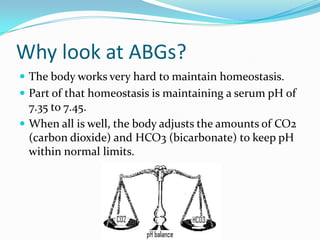
Why look at ABGs?The body works very hard to maintain homeostasis. Part of that homeostasis is maintaining a serum pH of 7.35 to 7.45.When all is well, the body adjusts the amounts of CO2 (carbon dioxide) and HCO3 (bicarbonate) to keep pH within normal limits.
What is this pH business?pH-parts of Hydogen
The pH scale looks at how many hydrogen ions are present.
The lower the pH, the more hydrogen ions are present. The more acidic the solution.
The higher the pH, the fewer the number of hydrogen ions are present. The stronger the alkalosis.And if pH is off?Extremes of pH interfere with hydrogen bonding of molecules and can denature proteins.Excess CO2 can cause pH to drop (acidosis). This can lead to depression of the central nervous system, confusion, coma, and death.Alkalosis can cause nerve cells to generate impulses without the normal stimuli. This can range from tingling to convulsions to death.
What is up with carbon dioxide?CO2 is a byproduct of cellular respiration.Remember the Kreb’s cycle? When the cell generates ATP it also generates waste products of CO2 and H2O.CO2 acts as an acid in the body. CO2 , in the presence of H2O, can become H2CO3, carbonic acid. You can read more about this in your book.Incidentally, CO2 is an acid in the environment also. CO2 emissions combine with H2O to create H2Co3, hence acid rain although sulfur and nitrogen are much more responsible than CO2 for acid rain.
I thought Hydrogen was acidic…It is true that the greater the number of hydrogen ions present, the lower the pH and therefore the greater the level of acidity.The body employs a delicate interplay with CO2 and H and HCO3 to maintain a normal pH.Basically, CO2 acts as an acid, H acts as an acid, and HCO3 acts as a base.There will be more to come on this in a bit.
What is up with bicarbonate?HCO3 acts as a base in the human body.The kidneys help regulate the level of HCO3 in the body. Basically, when the body has too many H ions present, the buffer system releases more HCO3 into circulation.There is an enzyme (carbonic anydrase) found concentrated in red blood cells that helps convert CO2 into HCO3 and thus assists in regulating the body’s pH. You can read more about this enzyme by looking it up in your book.
Acidosis vs. AlkalosisBasically, when we are talking serum, an acidosis is any pH that is less than 7.35 and an alkalosis is any pH that is greater than 7.45.Remember that there are other fluids in the human body that have a higher or lower pH. We are only talking about serum here.When the body is outside of the 7.35-7.45 range, there are a few things that we as medical personnel can do to help the body come around. The body will tolerate small fluctuations, but large ones can result in death.
My bologna has a first name…ABGs are identified by three names.First we identify the last name.Is it an acidosis, an alkalosis, or is it normal?If it is normal we are finished~yippee! Right…normal…that seldom happens. Next  we identify the middle name.Is it respiratory or metabolic?Finally we identify the first name.Is it uncompensated, partially or fully compensated?
Now what?First you need to know what is normal.Table 1 below shows the four major numbers we will look at when analyzing ABGs. Note that PO2 is not the same as a sat that you take with the “glow finger” which should be 94%-100%.Because you will see things written differently in differentbooks and you will have doctors speak differently, we willuse the following.PaO2 for PO2
PaCO2 for PCO2
SaO2 for sats obtained from a sat probe22-26
Lets play some tic-tac-toe!The object of this is to take your lab values and insert them into the correct box. Once you have placed all the values you will look to see which ones correlate to start naming your gas results.Example #1pH 7.43PaO2 85PaCO2 42HCO3 257.43Click the mouse to put each valueon the chart.  Click once more to reveal the name of the gas.4225This is a normal blood gas!
Tic tac toe #2NoExample #2pH 7.47PaO2 84PaCO2 34HCO3 217.4734Click the mouse to put each valueon the chart.  Click once more to reveal the name of the gas.21This is respiratory alkalosisMany gasses will be abnormal. In this case, the pH and the PaCO2 agree because they areboth in the alkalosis column. When the PaCO2 and the pH agree then the problem iswith the respiratory system in the body. If the pH and the HCO3 had been in alignmentthe problem would be metabolic.
Tic tac toe #3Example #3pH 7.28PaO2 92PaCO2 52HCO3 247.2852Click the mouse to put each valueon the chart.  Click once more to reveal the name of the gas.24This is a respiratory acidosis.In this case, the pH and the PaCO2 agree because they are both in the acidosis column. Because the pH and the PaCO2 agree, this is a respiratory acidosis.
Tic tac toe #4Example #4pH 7.34PaO2 94PaCO2 28HCO3 187.3428Click the mouse to put each valueon the chart.  Click once more to reveal the name of the gas.18This is a metabolic acidosis.In this case, the pH and the HCO3 agree because they are both in the acidosis column. Because the pH and the HCO3 agree, this is a metabolic acidosis.
But you said three names…I did say that ABGs were known by three names.First we identify if it is normal, an acidosis, or an alkalosis.Next we identify the source by identifying either respiratory (CO2 related) or metabolic (HCO3 related) based upon which of those values  correlates with the pH.Now we need to determine if it is compensated, uncompensated, or partially compensated.
Compensation-partial or noneTo determine compensation we look at the value that didn’t come into alignment with the pH.If the value that is not in alignment with the pH is in the normal column, there is no compensation.If the value that is not in alignment with the pH is in the far opposite column, there is partial compensation.The tricky one is full compensation. We will look at that on another set of slides.
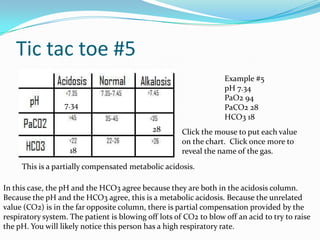
Tic tac toe #5Example #5pH 7.34PaO2 94PaCO2 28HCO3 187.3428Click the mouse to put each valueon the chart.  Click once more to reveal the name of the gas.18This is a partially compensated metabolic acidosis.In this case, the pH and the HCO3 agree because they are both in the acidosis column. Because the pH and the HCO3 agree, this is a metabolic acidosis. Because the unrelatedvalue (CO2) is in the far opposite column, there is partial compensation provided by therespiratory system. The patient is blowing off lots of CO2 to blow off an acid to try to raisethe pH. You will likely notice this person has a high respiratory rate.
Tic tac toe #6Example #6pH 7.49PaO2 89PaCO2 60HCO3 307.4960Click the mouse to put each valueon the chart.  Click once more to reveal the name of the gas.30This is a partially compensated metabolic alkalosis.In this case, the pH and the HCO3 agree because they are both in the alkalosis column. Because the pH and the HCO3 agree, this is a metabolic alkalosis. Because the unrelatedvalue (CO2) is in the far opposite column, there is partial compensation provided by therespiratory system. The patient is holding onto lots of CO2 to hold onto an acid to try tolower  the pH. You will likely notice this person has a low respiratory rate.

Abg Interpretation

  • 1.
    ABG InterpretationLacie M.Crone, RN, MSEd, CCRN, CPNApril 10, 2009
  • 2.
    Why look atABGs?The body works very hard to maintain homeostasis. Part of that homeostasis is maintaining a serum pH of 7.35 to 7.45.When all is well, the body adjusts the amounts of CO2 (carbon dioxide) and HCO3 (bicarbonate) to keep pH within normal limits.
  • 3.
    What is thispH business?pH-parts of Hydogen
  • 4.
    The pH scalelooks at how many hydrogen ions are present.
  • 5.
    The lower thepH, the more hydrogen ions are present. The more acidic the solution.
  • 6.
    The higher thepH, the fewer the number of hydrogen ions are present. The stronger the alkalosis.And if pH is off?Extremes of pH interfere with hydrogen bonding of molecules and can denature proteins.Excess CO2 can cause pH to drop (acidosis). This can lead to depression of the central nervous system, confusion, coma, and death.Alkalosis can cause nerve cells to generate impulses without the normal stimuli. This can range from tingling to convulsions to death.
  • 7.
    What is upwith carbon dioxide?CO2 is a byproduct of cellular respiration.Remember the Kreb’s cycle? When the cell generates ATP it also generates waste products of CO2 and H2O.CO2 acts as an acid in the body. CO2 , in the presence of H2O, can become H2CO3, carbonic acid. You can read more about this in your book.Incidentally, CO2 is an acid in the environment also. CO2 emissions combine with H2O to create H2Co3, hence acid rain although sulfur and nitrogen are much more responsible than CO2 for acid rain.
  • 8.
    I thought Hydrogenwas acidic…It is true that the greater the number of hydrogen ions present, the lower the pH and therefore the greater the level of acidity.The body employs a delicate interplay with CO2 and H and HCO3 to maintain a normal pH.Basically, CO2 acts as an acid, H acts as an acid, and HCO3 acts as a base.There will be more to come on this in a bit.
  • 9.
    What is upwith bicarbonate?HCO3 acts as a base in the human body.The kidneys help regulate the level of HCO3 in the body. Basically, when the body has too many H ions present, the buffer system releases more HCO3 into circulation.There is an enzyme (carbonic anydrase) found concentrated in red blood cells that helps convert CO2 into HCO3 and thus assists in regulating the body’s pH. You can read more about this enzyme by looking it up in your book.
  • 10.
    Acidosis vs. AlkalosisBasically,when we are talking serum, an acidosis is any pH that is less than 7.35 and an alkalosis is any pH that is greater than 7.45.Remember that there are other fluids in the human body that have a higher or lower pH. We are only talking about serum here.When the body is outside of the 7.35-7.45 range, there are a few things that we as medical personnel can do to help the body come around. The body will tolerate small fluctuations, but large ones can result in death.
  • 11.
    My bologna hasa first name…ABGs are identified by three names.First we identify the last name.Is it an acidosis, an alkalosis, or is it normal?If it is normal we are finished~yippee! Right…normal…that seldom happens. Next we identify the middle name.Is it respiratory or metabolic?Finally we identify the first name.Is it uncompensated, partially or fully compensated?
  • 12.
    Now what?First youneed to know what is normal.Table 1 below shows the four major numbers we will look at when analyzing ABGs. Note that PO2 is not the same as a sat that you take with the “glow finger” which should be 94%-100%.Because you will see things written differently in differentbooks and you will have doctors speak differently, we willuse the following.PaO2 for PO2
  • 13.
  • 14.
    SaO2 for satsobtained from a sat probe22-26
  • 15.
    Lets play sometic-tac-toe!The object of this is to take your lab values and insert them into the correct box. Once you have placed all the values you will look to see which ones correlate to start naming your gas results.Example #1pH 7.43PaO2 85PaCO2 42HCO3 257.43Click the mouse to put each valueon the chart. Click once more to reveal the name of the gas.4225This is a normal blood gas!
  • 16.
    Tic tac toe#2NoExample #2pH 7.47PaO2 84PaCO2 34HCO3 217.4734Click the mouse to put each valueon the chart. Click once more to reveal the name of the gas.21This is respiratory alkalosisMany gasses will be abnormal. In this case, the pH and the PaCO2 agree because they areboth in the alkalosis column. When the PaCO2 and the pH agree then the problem iswith the respiratory system in the body. If the pH and the HCO3 had been in alignmentthe problem would be metabolic.
  • 17.
    Tic tac toe#3Example #3pH 7.28PaO2 92PaCO2 52HCO3 247.2852Click the mouse to put each valueon the chart. Click once more to reveal the name of the gas.24This is a respiratory acidosis.In this case, the pH and the PaCO2 agree because they are both in the acidosis column. Because the pH and the PaCO2 agree, this is a respiratory acidosis.
  • 18.
    Tic tac toe#4Example #4pH 7.34PaO2 94PaCO2 28HCO3 187.3428Click the mouse to put each valueon the chart. Click once more to reveal the name of the gas.18This is a metabolic acidosis.In this case, the pH and the HCO3 agree because they are both in the acidosis column. Because the pH and the HCO3 agree, this is a metabolic acidosis.
  • 19.
    But you saidthree names…I did say that ABGs were known by three names.First we identify if it is normal, an acidosis, or an alkalosis.Next we identify the source by identifying either respiratory (CO2 related) or metabolic (HCO3 related) based upon which of those values correlates with the pH.Now we need to determine if it is compensated, uncompensated, or partially compensated.
  • 20.
    Compensation-partial or noneTodetermine compensation we look at the value that didn’t come into alignment with the pH.If the value that is not in alignment with the pH is in the normal column, there is no compensation.If the value that is not in alignment with the pH is in the far opposite column, there is partial compensation.The tricky one is full compensation. We will look at that on another set of slides.
  • 21.
    Tic tac toe#5Example #5pH 7.34PaO2 94PaCO2 28HCO3 187.3428Click the mouse to put each valueon the chart. Click once more to reveal the name of the gas.18This is a partially compensated metabolic acidosis.In this case, the pH and the HCO3 agree because they are both in the acidosis column. Because the pH and the HCO3 agree, this is a metabolic acidosis. Because the unrelatedvalue (CO2) is in the far opposite column, there is partial compensation provided by therespiratory system. The patient is blowing off lots of CO2 to blow off an acid to try to raisethe pH. You will likely notice this person has a high respiratory rate.
  • 22.
    Tic tac toe#6Example #6pH 7.49PaO2 89PaCO2 60HCO3 307.4960Click the mouse to put each valueon the chart. Click once more to reveal the name of the gas.30This is a partially compensated metabolic alkalosis.In this case, the pH and the HCO3 agree because they are both in the alkalosis column. Because the pH and the HCO3 agree, this is a metabolic alkalosis. Because the unrelatedvalue (CO2) is in the far opposite column, there is partial compensation provided by therespiratory system. The patient is holding onto lots of CO2 to hold onto an acid to try tolower the pH. You will likely notice this person has a low respiratory rate.