Head Injury
Kyaw San Lin (RN – 21)
Kaung Thet Han (RN – 12)
Kyaw Khan Zaw (RN – 17)
Final year - Part 2 M.B.B.S.
1
Contents
Physiology & Pathophysiology
Epidemiology
Initial evaluation and management
History
Examination
Classification
Management
Outcomes
2
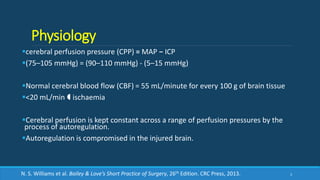
Physiology
cerebral perfusion pressure (CPP) = MAP − ICP
(75–105 mmHg) = (90–110 mmHg) - (5–15 mmHg)
Normal cerebral blood flow (CBF) = 55 mL/minute for every 100 g of brain tissue
<20 mL/min  ischaemia
Cerebral perfusion is kept constant across a range of perfusion pressures by the
process of autoregulation.
Autoregulation is compromised in the injured brain.
3N. S. Williams et al. Bailey & Love’s Short Practice of Surgery, 26th Edition. CRC Press, 2013.
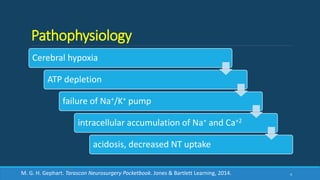
Pathophysiology
Cerebral hypoxia
ATP depletion
failure of Na+/K+ pump
intracellular accumulation of Na+ and Ca+2
acidosis, decreased NT uptake
4M. G. H. Gephart. Tarascon Neurosurgery Pocketbook. Jones & Bartlett Learning, 2014.
Pathophysiology
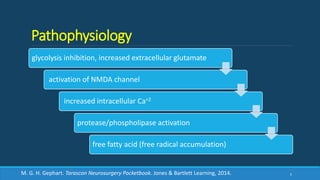
glycolysis inhibition, increased extracellular glutamate
activation of NMDA channel
increased intracellular Ca+2
protease/phospholipase activation
free fatty acid (free radical accumulation)
5M. G. H. Gephart. Tarascon Neurosurgery Pocketbook. Jones & Bartlett Learning, 2014.
Pathophysiology
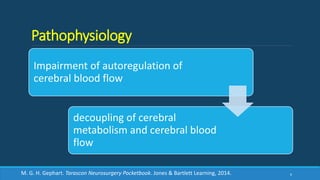
Impairment of autoregulation of
cerebral blood flow
decoupling of cerebral
metabolism and cerebral blood
flow
6M. G. H. Gephart. Tarascon Neurosurgery Pocketbook. Jones & Bartlett Learning, 2014.
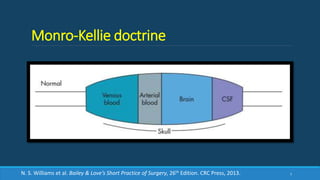
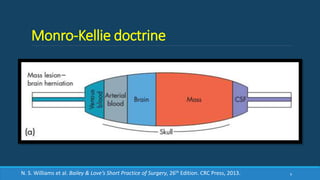
Monro-Kellie doctrine
7N. S. Williams et al. Bailey & Love’s Short Practice of Surgery, 26th Edition. CRC Press, 2013.
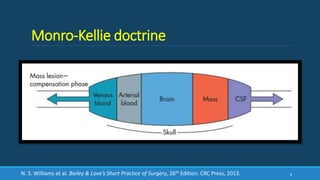
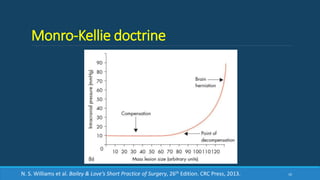
Monro-Kellie doctrine
8N. S. Williams et al. Bailey & Love’s Short Practice of Surgery, 26th Edition. CRC Press, 2013.
Monro-Kellie doctrine
9N. S. Williams et al. Bailey & Love’s Short Practice of Surgery, 26th Edition. CRC Press, 2013.
Monro-Kellie doctrine
10N. S. Williams et al. Bailey & Love’s Short Practice of Surgery, 26th Edition. CRC Press, 2013.
Contents
Physiology & Pathophysiology
Epidemiology
Initial evaluation and management
History
Examination
Classification
Management
Outcomes
11
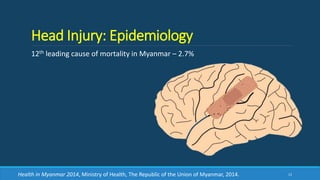
Head Injury: Epidemiology
12th leading cause of mortality in Myanmar – 2.7%
12Health in Myanmar 2014, Ministry of Health, The Republic of the Union of Myanmar, 2014.
Contents
Physiology & Pathophysiology
Epidemiology
Initial evaluation and management
History
Examination
Classification
Management
Outcomes
13
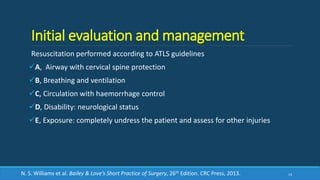
Initial evaluation and management
Resuscitation performed according to ATLS guidelines
A, Airway with cervical spine protection
B, Breathing and ventilation
C, Circulation with haemorrhage control
D, Disability: neurological status
E, Exposure: completely undress the patient and assess for other injuries
14N. S. Williams et al. Bailey & Love’s Short Practice of Surgery, 26th Edition. CRC Press, 2013.
Contents
Physiology & Pathophysiology
Epidemiology
Initial evaluation and management
History
Examination
Classification
Management
Outcomes
15
History
•Bystanders and paramedics may give vital information on the:
pre-injury state (fits, alcohol, chest pain)
energy involved in the injury (speed of vehicles, height fallen)
conscious state and haemodynamic stability of the patient after the accident
length of time taken for extrication
•the length of retro- and antegrade amnesia  useful for grading severity
•medication history, especially anticoagulants
16N. S. Williams et al. Bailey & Love’s Short Practice of Surgery, 26th Edition. CRC Press, 2013.
Contents
Physiology & Pathophysiology
Epidemiology
Initial evaluation and management
History
Examination
Classification
Management
Outcomes
17
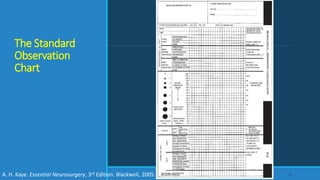
The Standard
Observation
Chart
18A. H. Kaye. Essential Neurosurgery, 3rd Edition. Blackwell, 2005.
Examination: Primary survey
•Ensure adequate oxygenation and circulation
•Check pupil size and response and GCS as soon as possible
•Check for focal neurological deficits before intubation if possible
•Check blood sugar for hypoglycaemia
19N. S. Williams et al. Bailey & Love’s Short Practice of Surgery, 26th Edition. CRC Press, 2013.
Examination: secondary survey
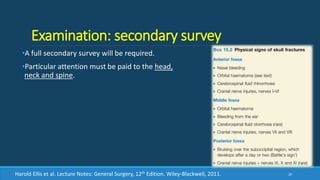
•A full secondary survey will be required.
•Particular attention must be paid to the head,
neck and spine.
20Harold Ellis et al. Lecture Notes: General Surgery, 12th Edition. Wiley-Blackwell, 2011.
Head
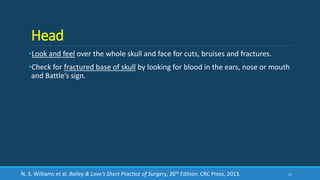
•Look and feel over the whole skull and face for cuts, bruises and fractures.
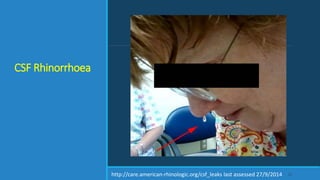
•Check for fractured base of skull by looking for blood in the ears, nose or mouth
and Battle’s sign.
21N. S. Williams et al. Bailey & Love’s Short Practice of Surgery, 26th Edition. CRC Press, 2013.
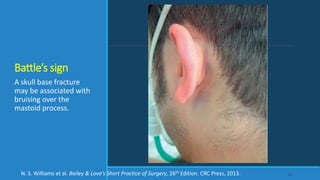
Battle’s sign
A skull base fracture
may be associated with
bruising over the
mastoid process.
22N. S. Williams et al. Bailey & Love’s Short Practice of Surgery, 26th Edition. CRC Press, 2013.
Racoon Eyes or
Panda Eye Sign
23
https://en.wikipedia.org/wiki/Raccoon_eyes#/media/File:Bilateral_periorbital_ecchymosis_(raccoon_eyes).jpg
last assessed 27/9/2014
CSF Rhinorrhoea
24http://care.american-rhinologic.org/csf_leaks last assessed 27/9/2014
Cervical spine immobilisation
Attempt full cervical spine immobilisation for patients who have sustained a
head injury and present with any of the following risk factors unless other
factors prevent this:
GCS less than 15 on initial assessment by the healthcare professional.
Neck pain or tenderness.
Focal neurological deficit.
Paraesthesia in the extremities.
Any other clinical suspicion of cervical spine injury.
25
Head injury: Triage, assessment, investigation and early management of head injury in children, young people
and adults, National Institute for Health and Clinical Excellence, January 2014.
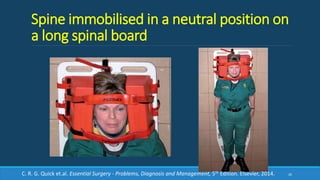
Spine immobilised in a neutral position on
a long spinal board
26C. R. G. Quick et.al. Essential Surgery - Problems, Diagnosis and Management, 5th Edition. Elsevier, 2014.
Examination of the whole patient in head
injury
•Cervical spine injury is common in patients with head injuries.
•Even obtunded patients should move all four limbs.
•Check and record power, tone and sensation in the peripheral nerves.
•Log roll to check the whole spine for steps and tenderness.
•Perform a rectal examination to check for anal tone and anal wink.
•Check for priapism.
27N. S. Williams et al. Bailey & Love’s Short Practice of Surgery, 26th Edition. CRC Press, 2013.
Neurologic Assessment
GCS score
Brainstem examination – Pupillary examination, ocular movement examination,
corneal reflex, gag reflex
Motor examination
Sensory examination
Reflex examination
28
C. R. Ainsworth, Head Trauma, Medscape, Jan 09, 2015. (http://emedicine.medscape.com/article/433855,
last accessed Sept 29, 2015)
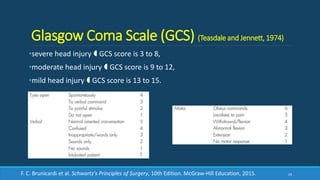
Glasgow Coma Scale (GCS) (Teasdale and Jennett, 1974)
•severe head injury  GCS score is 3 to 8,
•moderate head injury  GCS score is 9 to 12,
•mild head injury  GCS score is 13 to 15.
29F. C. Brunicardi et al. Schwartz's Principles of Surgery, 10th Edition. McGraw-Hill Education, 2015.
Brain Herniation
•1  subfalcine herniation
•2  midline shift
•3  uncal herniation
•4  central transtentorial herniation
•5  tonsillar herniation
30N. S. Williams et al. Bailey & Love’s Short Practice of Surgery, 26th Edition. CRC Press, 2013.
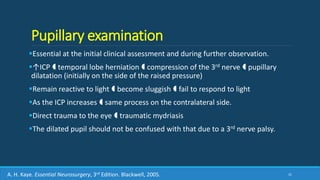
Pupillary examination
Essential at the initial clinical assessment and during further observation.
↑ICP  temporal lobe herniation  compression of the 3rd nerve  pupillary
dilatation (initially on the side of the raised pressure)
Remain reactive to light  become sluggish  fail to respond to light
As the ICP increases  same process on the contralateral side.
Direct trauma to the eye  traumatic mydriasis
The dilated pupil should not be confused with that due to a 3rd nerve palsy.
31A. H. Kaye. Essential Neurosurgery, 3rd Edition. Blackwell, 2005.
Motor examination
Difficult to perform.
Limited to an assessment of asymmetry
Difference in muscle tone between the left and right sides.
Indicative of a hemispheric injury and raises the possibility of a mass lesion.
32
C. R. Ainsworth, Head Trauma, Medscape, Jan 09, 2015. (http://emedicine.medscape.com/article/433855,
last accessed Sept 29, 2015)
Sensory examination
Asymmetric response to central pain stimulation
Often difficult.
Unable to cooperate with sensory testing.
Findings not reliable in patients who are intoxicated or comatose.
33
C. R. Ainsworth, Head Trauma, Medscape, Jan 09, 2015. (http://emedicine.medscape.com/article/433855,
last accessed Sept 29, 2015)
Peripheral reflex examination
Identify gross asymmetry in the neurologic examination.
Indicate the presence of a hemispheric mass lesion.
34
C. R. Ainsworth, Head Trauma, Medscape, Jan 09, 2015. (http://emedicine.medscape.com/article/433855,
last accessed Sept 29, 2015)
Contents
Physiology & Pathophysiology
Epidemiology
Initial evaluation and management
History
Examination
Classification
Management
Outcomes
35
Classification
According to
Scalp: open and closed
Skull site: vault and base of skull
Skull type: linear, comminuted and depressed
Intracranial bleeding: extradural, subdural, subarachnoid and intraparenchymal
Brain tissue causes: diffuse, blunt (direct, coup–contrecoup) and penetrating
36N. S. Williams et al. Bailey & Love’s Short Practice of Surgery, 26th Edition. CRC Press, 2013.
Contents
Physiology & Pathophysiology
Epidemiology
Initial evaluation and management
History
Examination
Classification
Management
Outcomes
37
Management
•Scalp wounds need closure.
•Significant depressed fractures need elevating, antibiotics and antiepileptics.
•Skull base fractures may be associated with CSF leak.
•Pneumococcus vaccination is valuable, but prophylactic antibiotics are not
usually indicated.
38N. S. Williams et al. Bailey & Love’s Short Practice of Surgery, 26th Edition. CRC Press, 2013.
Criteria for performing a CT head scan
For adults, CT head scan within 1 hr of the risk factor being identified
GCS <13 on initial assessment in the emergency department.
GCS <15 at 2 hrs after the injury on assessment in the emergency department.
Suspected open or depressed skull fracture.
Any sign of basal skull fracture (haemotympanum, 'panda' eyes, cerebrospinal
fluid leakage from the ear or nose, Battle's sign).
Post-traumatic seizure.
Focal neurological deficit.
More than 1 episode of vomiting.
39
Head injury: Triage, assessment, investigation and early management of head injury in children, young people
and adults, National Institute for Health and Clinical Excellence, January 2014.
Criteria for performing a CT head scan
For adults, CT head scan within 8 hr of the head injury:
Age 65 yrs or older.
Any history of bleeding or clotting disorders.
Dangerous mechanism of injury (a pedestrian or cyclist struck by a motor
vehicle, an occupant ejected from a motor vehicle or a fall from a height of
greater than 1 metre or 5 stairs).
> 30 min retrograde amnesia of events immediately before the head injury.
40
Head injury: Triage, assessment, investigation and early management of head injury in children, young people
and adults, National Institute for Health and Clinical Excellence, January 2014.
MRI
•Limited role in the evaluation of acute head injury.
•Extraordinary anatomic detail, but
•Long acquisition times
•Difficulty in obtaining MRIs in persons who are critically ill
•Used in the subacute setting  patients with unexplained neurologic deficits.
41
not commonly used to
evaluate acute head injuries
C. R. Ainsworth, Head Trauma, Medscape, Jan 09, 2015. (http://emedicine.medscape.com/article/433855,
last accessed Sept 29, 2015)
Investigating injuries to the cervical spine
CT cervical spine scan within 1 hour of the risk factor being identified:
GCS < 13 on initial assessment.
The patient has been intubated.
Plain X-rays are technically inadequate.
Plain X-rays are suspicious or definitely abnormal.
A definitive diagnosis of cervical spine injury is needed urgently (for example,
before surgery).
The patient is having other body areas scanned for head injury or multi-region
trauma.
42
Head injury: Triage, assessment, investigation and early management of head injury in children, young people
and adults, National Institute for Health and Clinical Excellence, January 2014.
Investigating injuries to the cervical spine
(cont.)
The patient is alert and stable, there is clinical suspicion of cervical
spine injury and any of the following apply:
◦ age 65 years or older
◦ dangerous mechanism of injury (fall from a height of greater than 1 metre or
5 stairs; axial load to the head, for example, diving; high-speed motor vehicle
collision; rollover motor accident; ejection from a motor vehicle; accident
involving motorised recreational vehicles; bicycle collision)
◦ focal peripheral neurological deficit
◦ paraesthesia in the upper or lower limbs.
43
Head injury: Triage, assessment, investigation and early management of head injury in children, young people
and adults, National Institute for Health and Clinical Excellence, January 2014.
Standard skull X-ray
‘Do not use plain X-rays of the skull to diagnose significant brain injury without
prior discussion with a neuroscience unit.*
However, they are useful as part of the skeletal survey in children presenting
with suspected non-accidental injury.*’
With the advent of NICE guidelines, CT  investigation of choice for the
diagnosis of clinically significant head injury. ^
Skull radiographs  little role in the diagnosis
May be indicated in some instances, for eg. suspected non-accidental injury in
children or lack of access to CT. ^
44
* Head injury: Triage, assessment, investigation and early management of head injury in children, young people
and adults, National Institute for Health and Clinical Excellence, January 2014.
^ C. R. G. Quick et.al. Essential Surgery - Problems, Diagnosis and Management, 5th Edition. Elsevier, 2014.
Standard skull X-ray views
•Towne’s view from a 19-year-old woman
after a blunt blow to the side of the head; she
was fully conscious.
•This shows a depressed fracture in the left
parietal bone (arrowed).
•The segment of bone is depressed by more
than the thickness of the skull and therefore
needed surgically elevating.
45C. R. G. Quick et.al. Essential Surgery - Problems, Diagnosis and Management, 5th Edition. Elsevier, 2014.
Standard skull X-ray views
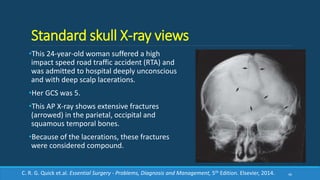
•This 24-year-old woman suffered a high
impact speed road traffic accident (RTA) and
was admitted to hospital deeply unconscious
and with deep scalp lacerations.
•Her GCS was 5.
•This AP X-ray shows extensive fractures
(arrowed) in the parietal, occipital and
squamous temporal bones.
•Because of the lacerations, these fractures
were considered compound.
46C. R. G. Quick et.al. Essential Surgery - Problems, Diagnosis and Management, 5th Edition. Elsevier, 2014.
Involving the neurosurgical department
Discuss with a neurosurgeon the care of all patients with new, surgically
significant abnormalities on imaging.
The definition of 'surgically significant‘ should be developed by local
neurosurgical centres and agreed with referring hospitals, along with referral
procedures.
47
Head injury: Triage, assessment, investigation and early management of head injury in children, young people
and adults, National Institute for Health and Clinical Excellence, January 2014.
Indications for surgery
Although no strict guidelines exist for defining surgical lesions in persons with
head injury, most neurosurgeons consider any of the following to represent
indications for surgery in patients with head injuries:
extra-axial hematoma with midline shift > 5 mm
intra-axial hematoma with volume > 30 mL
an open skull fracture
a depressed skull fracture with > 1 cm of inward displacement
any temporal or cerebellar hematoma that is > 3 cm in diameter
48
C. R. Ainsworth, Head Trauma, Medscape, Jan 09, 2015. (http://emedicine.medscape.com/article/433855,
last accessed Sept 29, 2015)
Involving the neurosurgical department
Regardless of imaging, other reasons for discussing a patient's care
plan with a neurosurgeon include:
◦ Persisting coma (GCS 8 or less) after initial resuscitation.
◦ Unexplained confusion which persists for > 4 hrs.
◦ Deterioration in GCS score after admission (greater attention should be paid
to motor response deterioration).
◦ Progressive focal neurological signs.
◦ A seizure without full recovery.
◦ Definite or suspected penetrating injury.
◦ A CSF leak.
49
Head injury: Triage, assessment, investigation and early management of head injury in children, young people
and adults, National Institute for Health and Clinical Excellence, January 2014.
Transfer from hospital to a neuroscience
unit
Intubate and ventilate
all patients with GCS 8 or less requiring transfer to a neuroscience unit
Coma
Loss of protective laryngeal reflexes.
Ventilatory insufficiency as judged by blood gases: hypoxaemia (PaO2 < 13
kPa on oxygen) or hypercarbia (PaCO2 > 6 kPa).
Spontaneous hyperventilation causing PaCO2 < 4 kPa.
50
Head injury: Triage, assessment, investigation and early management of head injury in children, young people
and adults, National Institute for Health and Clinical Excellence, January 2014.
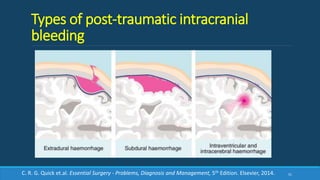
Types of post-traumatic intracranial
bleeding
51C. R. G. Quick et.al. Essential Surgery - Problems, Diagnosis and Management, 5th Edition. Elsevier, 2014.
Extradural haemorrhage
Radiology: 70% temporoparietal, 90% with fractures and underlying middle meningeal
artery injury
• Lenticular, convex shape
• May have delayed enlargement
• Rarely associated with other brain injury (in comparison to acute subdural hematoma)
Outcome: 5% mortality , 10–30% delayed enlargement
Presentation: Most have history of severe head trauma
• Classically have a “lucid interval” with resolving confusion after initial injury and then
neurological decline (actually occurs in < 30%)
Treatment: Surgical evacuation versus observation (if small and asymptomatic)
52M. G. H. Gephart. Tarascon Neurosurgery Pocketbook. Jones & Bartlett Learning, 2014.
Position of the haematoma if a CT scan
has not been performed
i. it underlies the fracture (that may have been seen on the skull X-ray)
ii. it underlies a boggy swelling on the skull
iii. it is on the same side as the pupil that dilated first
iv. in 85% of cases it is on the contralateral side to the hemiparesis
53A. H. Kaye. Essential Neurosurgery, 3rd Edition. Blackwell, 2005.
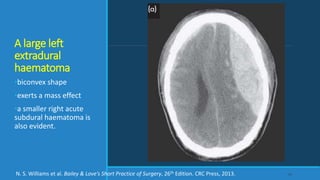
A large left
extradural
haematoma
•biconvex shape
•exerts a mass effect
•a smaller right acute
subdural haematoma is
also evident.
54N. S. Williams et al. Bailey & Love’s Short Practice of Surgery, 26th Edition. CRC Press, 2013.
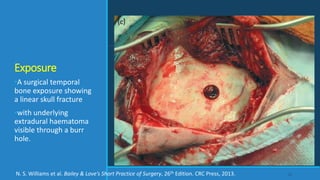
Exposure
•A surgical temporal
bone exposure showing
a linear skull fracture
•with underlying
extradural haematoma
visible through a burr
hole.
55N. S. Williams et al. Bailey & Love’s Short Practice of Surgery, 26th Edition. CRC Press, 2013.
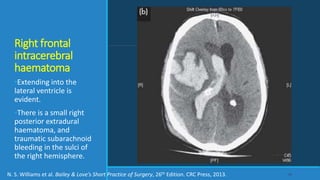
Right frontal
intracerebral
haematoma
•Extending into the
lateral ventricle is
evident.
•There is a small right
posterior extradural
haematoma, and
traumatic subarachnoid
bleeding in the sulci of
the right hemisphere.
56N. S. Williams et al. Bailey & Love’s Short Practice of Surgery, 26th Edition. CRC Press, 2013.
Subdural haemorrhage
•Epidemiology: Occurs in 15% of severe head trauma
• Chronic subdurals are often seen in elderly with minor trauma especially when on
anticoagulation
• Predisposition with conditions that cause brain atrophy and therefore, increased tension on
bridging veins (e.g. alcohol abuse, dementia)
•Etiology: Shear injury to bridging cortical veins (e.g., trauma, intracranial
hypotension, severe atrophy, birth trauma)
•Radiology (CT):
• Acute → hyperintense (can be isointense with low hematocrit or rapidly expanding lesions)
• Subacute → isodense
• Chronic (> 3 wks) → hypodense
57M. G. H. Gephart. Tarascon Neurosurgery Pocketbook. Jones & Bartlett Learning, 2014.
Subdural haemorrhage
•Treatment: Patients with symptomatic SDH with midline shift should be
surgically evacuated
• Acute SDH requires a trauma craniotomy; chronic SDH may be amenable to evacuation with
burr holes
•Outcome: 35–90% mortality, depending on chronicity, patient age, and
comorbidities
• Reaccumulation of chronic SDH occurs in up to 45%
58M. G. H. Gephart. Tarascon Neurosurgery Pocketbook. Jones & Bartlett Learning, 2014.
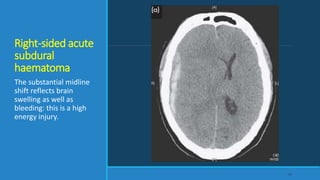
Right-sided acute
subdural
haematoma
The substantial midline
shift reflects brain
swelling as well as
bleeding: this is a high
energy injury.
59
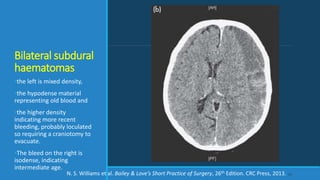
Bilateral subdural
haematomas
•the left is mixed density,
•the hypodense material
representing old blood and
•the higher density
indicating more recent
bleeding, probably loculated
so requiring a craniotomy to
evacuate.
•The bleed on the right is
isodense, indicating
intermediate age.
60N. S. Williams et al. Bailey & Love’s Short Practice of Surgery, 26th Edition. CRC Press, 2013.
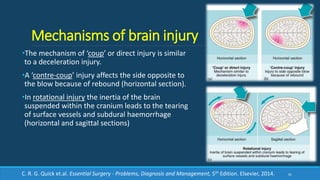
Mechanisms of brain injury
•The mechanism of ‘coup’ or direct injury is similar
to a deceleration injury.
•A ‘contre-coup’ injury affects the side opposite to
the blow because of rebound (horizontal section).
•In rotational injury the inertia of the brain
suspended within the cranium leads to the tearing
of surface vessels and subdural haemorrhage
(horizontal and sagittal sections)
61C. R. G. Quick et.al. Essential Surgery - Problems, Diagnosis and Management, 5th Edition. Elsevier, 2014.
Types of brain injury
•Apparent traumatic subarachnoid haemorrhage may actually be a spontaneous
subarachnoid haemorrhage which then led to the fall.
•Diffuse axonal injury results from high energy injury.
•Carotid dissection may be a delayed complication of skull base fracture.
•Non-accidental injury in children: beware delayed presentation.
62N. S. Williams et al. Bailey & Love’s Short Practice of Surgery, 26th Edition. CRC Press, 2013.
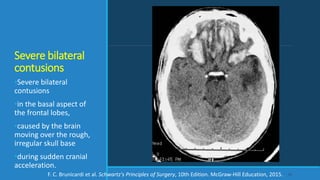
Severe bilateral
contusions
•Severe bilateral
contusions
•in the basal aspect of
the frontal lobes,
•caused by the brain
moving over the rough,
irregular skull base
•during sudden cranial
acceleration.
63F. C. Brunicardi et al. Schwartz's Principles of Surgery, 10th Edition. McGraw-Hill Education, 2015.
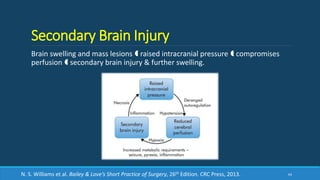
Secondary Brain Injury
Brain swelling and mass lesions  raised intracranial pressure  compromises
perfusion  secondary brain injury & further swelling.
64N. S. Williams et al. Bailey & Love’s Short Practice of Surgery, 26th Edition. CRC Press, 2013.
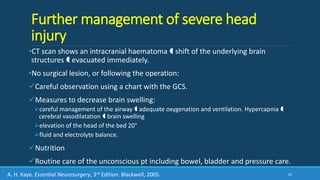
Further management of severe head
injury
•CT scan shows an intracranial haematoma  shift of the underlying brain
structures  evacuated immediately.
•No surgical lesion, or following the operation:
Careful observation using a chart with the GCS.
Measures to decrease brain swelling:
careful management of the airway  adequate oxygenation and ventilation. Hypercapnia 
cerebral vasodilatation  brain swelling
elevation of the head of the bed 20°
fluid and electrolyte balance.
Nutrition
Routine care of the unconscious pt including bowel, bladder and pressure care.
65A. H. Kaye. Essential Neurosurgery, 3rd Edition. Blackwell, 2005.
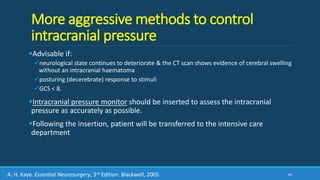
More aggressive methods to control
intracranial pressure
Advisable if:
neurological state continues to deteriorate & the CT scan shows evidence of cerebral swelling
without an intracranial haematoma
posturing (decerebrate) response to stimuli
GCS < 8.
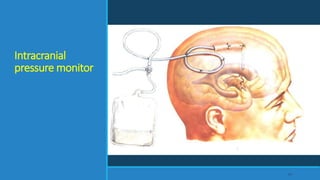
Intracranial pressure monitor should be inserted to assess the intracranial
pressure as accurately as possible.
Following the insertion, patient will be transferred to the intensive care
department
66A. H. Kaye. Essential Neurosurgery, 3rd Edition. Blackwell, 2005.
Intracranial
pressure monitor
67
More aggressive methods to control
intracranial pressure
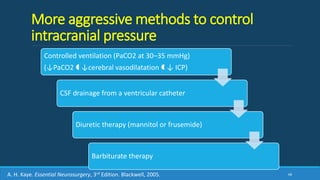
Controlled ventilation (PaCO2 at 30–35 mmHg)
(↓PaCO2  ↓cerebral vasodilatation  ↓ ICP)
CSF drainage from a ventricular catheter
Diuretic therapy (mannitol or frusemide)
Barbiturate therapy
68A. H. Kaye. Essential Neurosurgery, 3rd Edition. Blackwell, 2005.
Care of other systems
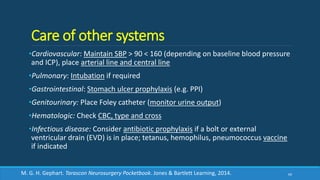
•Cardiovascular: Maintain SBP > 90 < 160 (depending on baseline blood pressure
and ICP), place arterial line and central line
•Pulmonary: Intubation if required
•Gastrointestinal: Stomach ulcer prophylaxis (e.g. PPI)
•Genitourinary: Place Foley catheter (monitor urine output)
•Hematologic: Check CBC, type and cross
•Infectious disease: Consider antibiotic prophylaxis if a bolt or external
ventricular drain (EVD) is in place; tetanus, hemophilus, pneumococcus vaccine
if indicated
69M. G. H. Gephart. Tarascon Neurosurgery Pocketbook. Jones & Bartlett Learning, 2014.
Care of other systems
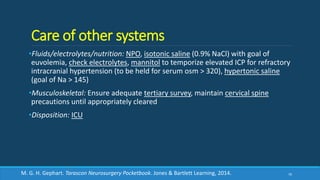
•Fluids/electrolytes/nutrition: NPO, isotonic saline (0.9% NaCl) with goal of
euvolemia, check electrolytes, mannitol to temporize elevated ICP for refractory
intracranial hypertension (to be held for serum osm > 320), hypertonic saline
(goal of Na > 145)
•Musculoskeletal: Ensure adequate tertiary survey, maintain cervical spine
precautions until appropriately cleared
•Disposition: ICU
70M. G. H. Gephart. Tarascon Neurosurgery Pocketbook. Jones & Bartlett Learning, 2014.
Discharge criteria in minor and mild head
injury
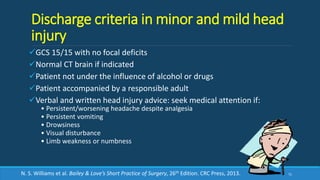
GCS 15/15 with no focal deficits
Normal CT brain if indicated
Patient not under the influence of alcohol or drugs
Patient accompanied by a responsible adult
Verbal and written head injury advice: seek medical attention if:
• Persistent/worsening headache despite analgesia
• Persistent vomiting
• Drowsiness
• Visual disturbance
• Limb weakness or numbness
71N. S. Williams et al. Bailey & Love’s Short Practice of Surgery, 26th Edition. CRC Press, 2013.
Contents
Physiology & Pathophysiology
Epidemiology
Initial evaluation and management
History
Examination
Classification
Management
Outcomes
72
Outcomes of a head injury
•Post-concussion syndrome gives persisting headaches and problems in
concentrating.
•Players concussed when playing sport should not return immediately to the
field.
•Good recovery is not necessarily a return to normal; it may be independent
living.
73N. S. Williams et al. Bailey & Love’s Short Practice of Surgery, 26th Edition. CRC Press, 2013.
Neurological Complications
•focal neurologic deficits
•global neurologic deficits
•seizures
•CSF fistulae
•hydrocephalus
•vascular injuries
•infections
•brain death
74
C. R. Ainsworth, Head Trauma, Medscape, Jan 09, 2015. (http://emedicine.medscape.com/article/433855,
last accessed Sept 29, 2015)
Glasgow Outcome Score (GOS)
(Jennett and Bond, 1975)
75K. I. Bland et al. General Surgery, Principles and International Practice, 2nd Edition. Springer, 2009.
76

Head injury

  • 1.
    Head Injury Kyaw SanLin (RN – 21) Kaung Thet Han (RN – 12) Kyaw Khan Zaw (RN – 17) Final year - Part 2 M.B.B.S. 1
  • 2.
    Contents Physiology & Pathophysiology Epidemiology Initialevaluation and management History Examination Classification Management Outcomes 2
  • 3.
    Physiology cerebral perfusion pressure(CPP) = MAP − ICP (75–105 mmHg) = (90–110 mmHg) - (5–15 mmHg) Normal cerebral blood flow (CBF) = 55 mL/minute for every 100 g of brain tissue <20 mL/min  ischaemia Cerebral perfusion is kept constant across a range of perfusion pressures by the process of autoregulation. Autoregulation is compromised in the injured brain. 3N. S. Williams et al. Bailey & Love’s Short Practice of Surgery, 26th Edition. CRC Press, 2013.
  • 4.
    Pathophysiology Cerebral hypoxia ATP depletion failureof Na+/K+ pump intracellular accumulation of Na+ and Ca+2 acidosis, decreased NT uptake 4M. G. H. Gephart. Tarascon Neurosurgery Pocketbook. Jones & Bartlett Learning, 2014.
  • 5.
    Pathophysiology glycolysis inhibition, increasedextracellular glutamate activation of NMDA channel increased intracellular Ca+2 protease/phospholipase activation free fatty acid (free radical accumulation) 5M. G. H. Gephart. Tarascon Neurosurgery Pocketbook. Jones & Bartlett Learning, 2014.
  • 6.
    Pathophysiology Impairment of autoregulationof cerebral blood flow decoupling of cerebral metabolism and cerebral blood flow 6M. G. H. Gephart. Tarascon Neurosurgery Pocketbook. Jones & Bartlett Learning, 2014.
  • 7.
    Monro-Kellie doctrine 7N. S.Williams et al. Bailey & Love’s Short Practice of Surgery, 26th Edition. CRC Press, 2013.
  • 8.
    Monro-Kellie doctrine 8N. S.Williams et al. Bailey & Love’s Short Practice of Surgery, 26th Edition. CRC Press, 2013.
  • 9.
    Monro-Kellie doctrine 9N. S.Williams et al. Bailey & Love’s Short Practice of Surgery, 26th Edition. CRC Press, 2013.
  • 10.
    Monro-Kellie doctrine 10N. S.Williams et al. Bailey & Love’s Short Practice of Surgery, 26th Edition. CRC Press, 2013.
  • 11.
    Contents Physiology & Pathophysiology Epidemiology Initialevaluation and management History Examination Classification Management Outcomes 11
  • 12.
    Head Injury: Epidemiology 12thleading cause of mortality in Myanmar – 2.7% 12Health in Myanmar 2014, Ministry of Health, The Republic of the Union of Myanmar, 2014.
  • 13.
    Contents Physiology & Pathophysiology Epidemiology Initialevaluation and management History Examination Classification Management Outcomes 13
  • 14.
    Initial evaluation andmanagement Resuscitation performed according to ATLS guidelines A, Airway with cervical spine protection B, Breathing and ventilation C, Circulation with haemorrhage control D, Disability: neurological status E, Exposure: completely undress the patient and assess for other injuries 14N. S. Williams et al. Bailey & Love’s Short Practice of Surgery, 26th Edition. CRC Press, 2013.
  • 15.
    Contents Physiology & Pathophysiology Epidemiology Initialevaluation and management History Examination Classification Management Outcomes 15
  • 16.
    History •Bystanders and paramedicsmay give vital information on the: pre-injury state (fits, alcohol, chest pain) energy involved in the injury (speed of vehicles, height fallen) conscious state and haemodynamic stability of the patient after the accident length of time taken for extrication •the length of retro- and antegrade amnesia  useful for grading severity •medication history, especially anticoagulants 16N. S. Williams et al. Bailey & Love’s Short Practice of Surgery, 26th Edition. CRC Press, 2013.
  • 17.
    Contents Physiology & Pathophysiology Epidemiology Initialevaluation and management History Examination Classification Management Outcomes 17
  • 18.
    The Standard Observation Chart 18A. H.Kaye. Essential Neurosurgery, 3rd Edition. Blackwell, 2005.
  • 19.
    Examination: Primary survey •Ensureadequate oxygenation and circulation •Check pupil size and response and GCS as soon as possible •Check for focal neurological deficits before intubation if possible •Check blood sugar for hypoglycaemia 19N. S. Williams et al. Bailey & Love’s Short Practice of Surgery, 26th Edition. CRC Press, 2013.
  • 20.
    Examination: secondary survey •Afull secondary survey will be required. •Particular attention must be paid to the head, neck and spine. 20Harold Ellis et al. Lecture Notes: General Surgery, 12th Edition. Wiley-Blackwell, 2011.
  • 21.
    Head •Look and feelover the whole skull and face for cuts, bruises and fractures. •Check for fractured base of skull by looking for blood in the ears, nose or mouth and Battle’s sign. 21N. S. Williams et al. Bailey & Love’s Short Practice of Surgery, 26th Edition. CRC Press, 2013.
  • 22.
    Battle’s sign A skullbase fracture may be associated with bruising over the mastoid process. 22N. S. Williams et al. Bailey & Love’s Short Practice of Surgery, 26th Edition. CRC Press, 2013.
  • 23.
    Racoon Eyes or PandaEye Sign 23 https://en.wikipedia.org/wiki/Raccoon_eyes#/media/File:Bilateral_periorbital_ecchymosis_(raccoon_eyes).jpg last assessed 27/9/2014
  • 24.
  • 25.
    Cervical spine immobilisation Attemptfull cervical spine immobilisation for patients who have sustained a head injury and present with any of the following risk factors unless other factors prevent this: GCS less than 15 on initial assessment by the healthcare professional. Neck pain or tenderness. Focal neurological deficit. Paraesthesia in the extremities. Any other clinical suspicion of cervical spine injury. 25 Head injury: Triage, assessment, investigation and early management of head injury in children, young people and adults, National Institute for Health and Clinical Excellence, January 2014.
  • 26.
    Spine immobilised ina neutral position on a long spinal board 26C. R. G. Quick et.al. Essential Surgery - Problems, Diagnosis and Management, 5th Edition. Elsevier, 2014.
  • 27.
    Examination of thewhole patient in head injury •Cervical spine injury is common in patients with head injuries. •Even obtunded patients should move all four limbs. •Check and record power, tone and sensation in the peripheral nerves. •Log roll to check the whole spine for steps and tenderness. •Perform a rectal examination to check for anal tone and anal wink. •Check for priapism. 27N. S. Williams et al. Bailey & Love’s Short Practice of Surgery, 26th Edition. CRC Press, 2013.
  • 28.
    Neurologic Assessment GCS score Brainstemexamination – Pupillary examination, ocular movement examination, corneal reflex, gag reflex Motor examination Sensory examination Reflex examination 28 C. R. Ainsworth, Head Trauma, Medscape, Jan 09, 2015. (http://emedicine.medscape.com/article/433855, last accessed Sept 29, 2015)
  • 29.
    Glasgow Coma Scale(GCS) (Teasdale and Jennett, 1974) •severe head injury  GCS score is 3 to 8, •moderate head injury  GCS score is 9 to 12, •mild head injury  GCS score is 13 to 15. 29F. C. Brunicardi et al. Schwartz's Principles of Surgery, 10th Edition. McGraw-Hill Education, 2015.
  • 30.
    Brain Herniation •1 subfalcine herniation •2  midline shift •3  uncal herniation •4  central transtentorial herniation •5  tonsillar herniation 30N. S. Williams et al. Bailey & Love’s Short Practice of Surgery, 26th Edition. CRC Press, 2013.
  • 31.
    Pupillary examination Essential atthe initial clinical assessment and during further observation. ↑ICP  temporal lobe herniation  compression of the 3rd nerve  pupillary dilatation (initially on the side of the raised pressure) Remain reactive to light  become sluggish  fail to respond to light As the ICP increases  same process on the contralateral side. Direct trauma to the eye  traumatic mydriasis The dilated pupil should not be confused with that due to a 3rd nerve palsy. 31A. H. Kaye. Essential Neurosurgery, 3rd Edition. Blackwell, 2005.
  • 32.
    Motor examination Difficult toperform. Limited to an assessment of asymmetry Difference in muscle tone between the left and right sides. Indicative of a hemispheric injury and raises the possibility of a mass lesion. 32 C. R. Ainsworth, Head Trauma, Medscape, Jan 09, 2015. (http://emedicine.medscape.com/article/433855, last accessed Sept 29, 2015)
  • 33.
    Sensory examination Asymmetric responseto central pain stimulation Often difficult. Unable to cooperate with sensory testing. Findings not reliable in patients who are intoxicated or comatose. 33 C. R. Ainsworth, Head Trauma, Medscape, Jan 09, 2015. (http://emedicine.medscape.com/article/433855, last accessed Sept 29, 2015)
  • 34.
    Peripheral reflex examination Identifygross asymmetry in the neurologic examination. Indicate the presence of a hemispheric mass lesion. 34 C. R. Ainsworth, Head Trauma, Medscape, Jan 09, 2015. (http://emedicine.medscape.com/article/433855, last accessed Sept 29, 2015)
  • 35.
    Contents Physiology & Pathophysiology Epidemiology Initialevaluation and management History Examination Classification Management Outcomes 35
  • 36.
    Classification According to Scalp: openand closed Skull site: vault and base of skull Skull type: linear, comminuted and depressed Intracranial bleeding: extradural, subdural, subarachnoid and intraparenchymal Brain tissue causes: diffuse, blunt (direct, coup–contrecoup) and penetrating 36N. S. Williams et al. Bailey & Love’s Short Practice of Surgery, 26th Edition. CRC Press, 2013.
  • 37.
    Contents Physiology & Pathophysiology Epidemiology Initialevaluation and management History Examination Classification Management Outcomes 37
  • 38.
    Management •Scalp wounds needclosure. •Significant depressed fractures need elevating, antibiotics and antiepileptics. •Skull base fractures may be associated with CSF leak. •Pneumococcus vaccination is valuable, but prophylactic antibiotics are not usually indicated. 38N. S. Williams et al. Bailey & Love’s Short Practice of Surgery, 26th Edition. CRC Press, 2013.
  • 39.
    Criteria for performinga CT head scan For adults, CT head scan within 1 hr of the risk factor being identified GCS <13 on initial assessment in the emergency department. GCS <15 at 2 hrs after the injury on assessment in the emergency department. Suspected open or depressed skull fracture. Any sign of basal skull fracture (haemotympanum, 'panda' eyes, cerebrospinal fluid leakage from the ear or nose, Battle's sign). Post-traumatic seizure. Focal neurological deficit. More than 1 episode of vomiting. 39 Head injury: Triage, assessment, investigation and early management of head injury in children, young people and adults, National Institute for Health and Clinical Excellence, January 2014.
  • 40.
    Criteria for performinga CT head scan For adults, CT head scan within 8 hr of the head injury: Age 65 yrs or older. Any history of bleeding or clotting disorders. Dangerous mechanism of injury (a pedestrian or cyclist struck by a motor vehicle, an occupant ejected from a motor vehicle or a fall from a height of greater than 1 metre or 5 stairs). > 30 min retrograde amnesia of events immediately before the head injury. 40 Head injury: Triage, assessment, investigation and early management of head injury in children, young people and adults, National Institute for Health and Clinical Excellence, January 2014.
  • 41.
    MRI •Limited role inthe evaluation of acute head injury. •Extraordinary anatomic detail, but •Long acquisition times •Difficulty in obtaining MRIs in persons who are critically ill •Used in the subacute setting  patients with unexplained neurologic deficits. 41 not commonly used to evaluate acute head injuries C. R. Ainsworth, Head Trauma, Medscape, Jan 09, 2015. (http://emedicine.medscape.com/article/433855, last accessed Sept 29, 2015)
  • 42.
    Investigating injuries tothe cervical spine CT cervical spine scan within 1 hour of the risk factor being identified: GCS < 13 on initial assessment. The patient has been intubated. Plain X-rays are technically inadequate. Plain X-rays are suspicious or definitely abnormal. A definitive diagnosis of cervical spine injury is needed urgently (for example, before surgery). The patient is having other body areas scanned for head injury or multi-region trauma. 42 Head injury: Triage, assessment, investigation and early management of head injury in children, young people and adults, National Institute for Health and Clinical Excellence, January 2014.
  • 43.
    Investigating injuries tothe cervical spine (cont.) The patient is alert and stable, there is clinical suspicion of cervical spine injury and any of the following apply: ◦ age 65 years or older ◦ dangerous mechanism of injury (fall from a height of greater than 1 metre or 5 stairs; axial load to the head, for example, diving; high-speed motor vehicle collision; rollover motor accident; ejection from a motor vehicle; accident involving motorised recreational vehicles; bicycle collision) ◦ focal peripheral neurological deficit ◦ paraesthesia in the upper or lower limbs. 43 Head injury: Triage, assessment, investigation and early management of head injury in children, young people and adults, National Institute for Health and Clinical Excellence, January 2014.
  • 44.
    Standard skull X-ray ‘Donot use plain X-rays of the skull to diagnose significant brain injury without prior discussion with a neuroscience unit.* However, they are useful as part of the skeletal survey in children presenting with suspected non-accidental injury.*’ With the advent of NICE guidelines, CT  investigation of choice for the diagnosis of clinically significant head injury. ^ Skull radiographs  little role in the diagnosis May be indicated in some instances, for eg. suspected non-accidental injury in children or lack of access to CT. ^ 44 * Head injury: Triage, assessment, investigation and early management of head injury in children, young people and adults, National Institute for Health and Clinical Excellence, January 2014. ^ C. R. G. Quick et.al. Essential Surgery - Problems, Diagnosis and Management, 5th Edition. Elsevier, 2014.
  • 45.
    Standard skull X-rayviews •Towne’s view from a 19-year-old woman after a blunt blow to the side of the head; she was fully conscious. •This shows a depressed fracture in the left parietal bone (arrowed). •The segment of bone is depressed by more than the thickness of the skull and therefore needed surgically elevating. 45C. R. G. Quick et.al. Essential Surgery - Problems, Diagnosis and Management, 5th Edition. Elsevier, 2014.
  • 46.
    Standard skull X-rayviews •This 24-year-old woman suffered a high impact speed road traffic accident (RTA) and was admitted to hospital deeply unconscious and with deep scalp lacerations. •Her GCS was 5. •This AP X-ray shows extensive fractures (arrowed) in the parietal, occipital and squamous temporal bones. •Because of the lacerations, these fractures were considered compound. 46C. R. G. Quick et.al. Essential Surgery - Problems, Diagnosis and Management, 5th Edition. Elsevier, 2014.
  • 47.
    Involving the neurosurgicaldepartment Discuss with a neurosurgeon the care of all patients with new, surgically significant abnormalities on imaging. The definition of 'surgically significant‘ should be developed by local neurosurgical centres and agreed with referring hospitals, along with referral procedures. 47 Head injury: Triage, assessment, investigation and early management of head injury in children, young people and adults, National Institute for Health and Clinical Excellence, January 2014.
  • 48.
    Indications for surgery Althoughno strict guidelines exist for defining surgical lesions in persons with head injury, most neurosurgeons consider any of the following to represent indications for surgery in patients with head injuries: extra-axial hematoma with midline shift > 5 mm intra-axial hematoma with volume > 30 mL an open skull fracture a depressed skull fracture with > 1 cm of inward displacement any temporal or cerebellar hematoma that is > 3 cm in diameter 48 C. R. Ainsworth, Head Trauma, Medscape, Jan 09, 2015. (http://emedicine.medscape.com/article/433855, last accessed Sept 29, 2015)
  • 49.
    Involving the neurosurgicaldepartment Regardless of imaging, other reasons for discussing a patient's care plan with a neurosurgeon include: ◦ Persisting coma (GCS 8 or less) after initial resuscitation. ◦ Unexplained confusion which persists for > 4 hrs. ◦ Deterioration in GCS score after admission (greater attention should be paid to motor response deterioration). ◦ Progressive focal neurological signs. ◦ A seizure without full recovery. ◦ Definite or suspected penetrating injury. ◦ A CSF leak. 49 Head injury: Triage, assessment, investigation and early management of head injury in children, young people and adults, National Institute for Health and Clinical Excellence, January 2014.
  • 50.
    Transfer from hospitalto a neuroscience unit Intubate and ventilate all patients with GCS 8 or less requiring transfer to a neuroscience unit Coma Loss of protective laryngeal reflexes. Ventilatory insufficiency as judged by blood gases: hypoxaemia (PaO2 < 13 kPa on oxygen) or hypercarbia (PaCO2 > 6 kPa). Spontaneous hyperventilation causing PaCO2 < 4 kPa. 50 Head injury: Triage, assessment, investigation and early management of head injury in children, young people and adults, National Institute for Health and Clinical Excellence, January 2014.
  • 51.
    Types of post-traumaticintracranial bleeding 51C. R. G. Quick et.al. Essential Surgery - Problems, Diagnosis and Management, 5th Edition. Elsevier, 2014.
  • 52.
    Extradural haemorrhage Radiology: 70%temporoparietal, 90% with fractures and underlying middle meningeal artery injury • Lenticular, convex shape • May have delayed enlargement • Rarely associated with other brain injury (in comparison to acute subdural hematoma) Outcome: 5% mortality , 10–30% delayed enlargement Presentation: Most have history of severe head trauma • Classically have a “lucid interval” with resolving confusion after initial injury and then neurological decline (actually occurs in < 30%) Treatment: Surgical evacuation versus observation (if small and asymptomatic) 52M. G. H. Gephart. Tarascon Neurosurgery Pocketbook. Jones & Bartlett Learning, 2014.
  • 53.
    Position of thehaematoma if a CT scan has not been performed i. it underlies the fracture (that may have been seen on the skull X-ray) ii. it underlies a boggy swelling on the skull iii. it is on the same side as the pupil that dilated first iv. in 85% of cases it is on the contralateral side to the hemiparesis 53A. H. Kaye. Essential Neurosurgery, 3rd Edition. Blackwell, 2005.
  • 54.
    A large left extradural haematoma •biconvexshape •exerts a mass effect •a smaller right acute subdural haematoma is also evident. 54N. S. Williams et al. Bailey & Love’s Short Practice of Surgery, 26th Edition. CRC Press, 2013.
  • 55.
    Exposure •A surgical temporal boneexposure showing a linear skull fracture •with underlying extradural haematoma visible through a burr hole. 55N. S. Williams et al. Bailey & Love’s Short Practice of Surgery, 26th Edition. CRC Press, 2013.
  • 56.
    Right frontal intracerebral haematoma •Extending intothe lateral ventricle is evident. •There is a small right posterior extradural haematoma, and traumatic subarachnoid bleeding in the sulci of the right hemisphere. 56N. S. Williams et al. Bailey & Love’s Short Practice of Surgery, 26th Edition. CRC Press, 2013.
  • 57.
    Subdural haemorrhage •Epidemiology: Occursin 15% of severe head trauma • Chronic subdurals are often seen in elderly with minor trauma especially when on anticoagulation • Predisposition with conditions that cause brain atrophy and therefore, increased tension on bridging veins (e.g. alcohol abuse, dementia) •Etiology: Shear injury to bridging cortical veins (e.g., trauma, intracranial hypotension, severe atrophy, birth trauma) •Radiology (CT): • Acute → hyperintense (can be isointense with low hematocrit or rapidly expanding lesions) • Subacute → isodense • Chronic (> 3 wks) → hypodense 57M. G. H. Gephart. Tarascon Neurosurgery Pocketbook. Jones & Bartlett Learning, 2014.
  • 58.
    Subdural haemorrhage •Treatment: Patientswith symptomatic SDH with midline shift should be surgically evacuated • Acute SDH requires a trauma craniotomy; chronic SDH may be amenable to evacuation with burr holes •Outcome: 35–90% mortality, depending on chronicity, patient age, and comorbidities • Reaccumulation of chronic SDH occurs in up to 45% 58M. G. H. Gephart. Tarascon Neurosurgery Pocketbook. Jones & Bartlett Learning, 2014.
  • 59.
    Right-sided acute subdural haematoma The substantialmidline shift reflects brain swelling as well as bleeding: this is a high energy injury. 59
  • 60.
    Bilateral subdural haematomas •the leftis mixed density, •the hypodense material representing old blood and •the higher density indicating more recent bleeding, probably loculated so requiring a craniotomy to evacuate. •The bleed on the right is isodense, indicating intermediate age. 60N. S. Williams et al. Bailey & Love’s Short Practice of Surgery, 26th Edition. CRC Press, 2013.
  • 61.
    Mechanisms of braininjury •The mechanism of ‘coup’ or direct injury is similar to a deceleration injury. •A ‘contre-coup’ injury affects the side opposite to the blow because of rebound (horizontal section). •In rotational injury the inertia of the brain suspended within the cranium leads to the tearing of surface vessels and subdural haemorrhage (horizontal and sagittal sections) 61C. R. G. Quick et.al. Essential Surgery - Problems, Diagnosis and Management, 5th Edition. Elsevier, 2014.
  • 62.
    Types of braininjury •Apparent traumatic subarachnoid haemorrhage may actually be a spontaneous subarachnoid haemorrhage which then led to the fall. •Diffuse axonal injury results from high energy injury. •Carotid dissection may be a delayed complication of skull base fracture. •Non-accidental injury in children: beware delayed presentation. 62N. S. Williams et al. Bailey & Love’s Short Practice of Surgery, 26th Edition. CRC Press, 2013.
  • 63.
    Severe bilateral contusions •Severe bilateral contusions •inthe basal aspect of the frontal lobes, •caused by the brain moving over the rough, irregular skull base •during sudden cranial acceleration. 63F. C. Brunicardi et al. Schwartz's Principles of Surgery, 10th Edition. McGraw-Hill Education, 2015.
  • 64.
    Secondary Brain Injury Brainswelling and mass lesions  raised intracranial pressure  compromises perfusion  secondary brain injury & further swelling. 64N. S. Williams et al. Bailey & Love’s Short Practice of Surgery, 26th Edition. CRC Press, 2013.
  • 65.
    Further management ofsevere head injury •CT scan shows an intracranial haematoma  shift of the underlying brain structures  evacuated immediately. •No surgical lesion, or following the operation: Careful observation using a chart with the GCS. Measures to decrease brain swelling: careful management of the airway  adequate oxygenation and ventilation. Hypercapnia  cerebral vasodilatation  brain swelling elevation of the head of the bed 20° fluid and electrolyte balance. Nutrition Routine care of the unconscious pt including bowel, bladder and pressure care. 65A. H. Kaye. Essential Neurosurgery, 3rd Edition. Blackwell, 2005.
  • 66.
    More aggressive methodsto control intracranial pressure Advisable if: neurological state continues to deteriorate & the CT scan shows evidence of cerebral swelling without an intracranial haematoma posturing (decerebrate) response to stimuli GCS < 8. Intracranial pressure monitor should be inserted to assess the intracranial pressure as accurately as possible. Following the insertion, patient will be transferred to the intensive care department 66A. H. Kaye. Essential Neurosurgery, 3rd Edition. Blackwell, 2005.
  • 67.
  • 68.
    More aggressive methodsto control intracranial pressure Controlled ventilation (PaCO2 at 30–35 mmHg) (↓PaCO2  ↓cerebral vasodilatation  ↓ ICP) CSF drainage from a ventricular catheter Diuretic therapy (mannitol or frusemide) Barbiturate therapy 68A. H. Kaye. Essential Neurosurgery, 3rd Edition. Blackwell, 2005.
  • 69.
    Care of othersystems •Cardiovascular: Maintain SBP > 90 < 160 (depending on baseline blood pressure and ICP), place arterial line and central line •Pulmonary: Intubation if required •Gastrointestinal: Stomach ulcer prophylaxis (e.g. PPI) •Genitourinary: Place Foley catheter (monitor urine output) •Hematologic: Check CBC, type and cross •Infectious disease: Consider antibiotic prophylaxis if a bolt or external ventricular drain (EVD) is in place; tetanus, hemophilus, pneumococcus vaccine if indicated 69M. G. H. Gephart. Tarascon Neurosurgery Pocketbook. Jones & Bartlett Learning, 2014.
  • 70.
    Care of othersystems •Fluids/electrolytes/nutrition: NPO, isotonic saline (0.9% NaCl) with goal of euvolemia, check electrolytes, mannitol to temporize elevated ICP for refractory intracranial hypertension (to be held for serum osm > 320), hypertonic saline (goal of Na > 145) •Musculoskeletal: Ensure adequate tertiary survey, maintain cervical spine precautions until appropriately cleared •Disposition: ICU 70M. G. H. Gephart. Tarascon Neurosurgery Pocketbook. Jones & Bartlett Learning, 2014.
  • 71.
    Discharge criteria inminor and mild head injury GCS 15/15 with no focal deficits Normal CT brain if indicated Patient not under the influence of alcohol or drugs Patient accompanied by a responsible adult Verbal and written head injury advice: seek medical attention if: • Persistent/worsening headache despite analgesia • Persistent vomiting • Drowsiness • Visual disturbance • Limb weakness or numbness 71N. S. Williams et al. Bailey & Love’s Short Practice of Surgery, 26th Edition. CRC Press, 2013.
  • 72.
    Contents Physiology & Pathophysiology Epidemiology Initialevaluation and management History Examination Classification Management Outcomes 72
  • 73.
    Outcomes of ahead injury •Post-concussion syndrome gives persisting headaches and problems in concentrating. •Players concussed when playing sport should not return immediately to the field. •Good recovery is not necessarily a return to normal; it may be independent living. 73N. S. Williams et al. Bailey & Love’s Short Practice of Surgery, 26th Edition. CRC Press, 2013.

  • 74.
    Neurological Complications •focal neurologicdeficits •global neurologic deficits •seizures •CSF fistulae •hydrocephalus •vascular injuries •infections •brain death 74 C. R. Ainsworth, Head Trauma, Medscape, Jan 09, 2015. (http://emedicine.medscape.com/article/433855, last accessed Sept 29, 2015)
  • 75.
    Glasgow Outcome Score(GOS) (Jennett and Bond, 1975) 75K. I. Bland et al. General Surgery, Principles and International Practice, 2nd Edition. Springer, 2009.
  • 76.